

Crypto World
How Smart Contract Security Improvements Are Strengthening Online Game Platforms


Smart contract technology is transforming online gaming by enabling trustless, transparent interactions between players and platforms. Recent advances in smart contract security are addressing longstanding vulnerabilities, supporting a more reliable experience for users. As both traditional gamers and fans of the social casino experience and sweepstakes-style entertainment explore blockchain-enabled platforms, robust smart contract protections are emerging as a crucial foundation for platform integrity and security.
Online game platforms, particularly those centered on blockchain and digital assets, now view security as a defining factor in building trust among developers, platform operators, and players, including how promotional mechanics like no deposit bonus codes are enforced through automated reward logic. In an increasingly competitive environment, many end users and operators recognize how flaws in smart contract logic can be exploited, resulting in disrupted gameplay, compromised fairness, or reputational harm. Questions such as, “How do promotions remain fair and transparent?” are common, and blockchain-based mechanisms aim to automate rewards distribution in accordance with published terms. Code-based security forms the infrastructure for modern digital entertainment, making robust protections essential.
As more free-to-play casino-style games and sweepstakes-style entertainment platforms embrace blockchain for fairness and transparency, smart contract protections can impact how incentives and rewards are managed. What does this mean for players? It typically means that both gameplay and daily rewards or bonus coins are distributed based on rules visible to everyone, increasing trust. To understand the value of trust, one must look at both transparent mechanics on the platform and the underlying automated systems that help secure gameplay integrity.
How Smart Contracts Underpin Gaming Ecosystem Logic
Smart contracts are self-executing programs that automate actions based on rules defined by platform developers. In online gaming environments, they often manage digital assets, enforce access controls, distribute rewards, and operate in-game marketplaces. What specific benefits do these contracts provide? For many platforms, the answer lies in consistent rule enforcement and minimizing the risk of human error or manipulation.
Reward distribution through smart contracts remains central to numerous gaming platforms, particularly those hosting player-versus-player contests, tournaments, or daily prize systems. By operating on-chain, smart contracts help ensure outcomes and payouts follow transparent rules, reducing manual intervention and the risk of operator bias. For users seeking a fair social casino experience, this transparency is often considered a core benefit of blockchain-mediated play.
Digital asset issuance is another area where smart contracts offer clear value. Many blockchain-enabled games allow players to earn, trade, or upgrade items as non-fungible tokens (NFTs) and in-game currencies. Smart contracts define the rules for ownership, transfer, and scarcity of assets, which supports the stability and predictability of these items within the ecosystem.
For access control and permissioning, smart contracts manage eligibility for games, tournaments, or events. This becomes particularly important for sweepstakes-style entertainment platforms, where participants’ eligibility may depend on location, activity history, or reaching certain in-game milestones. Users frequently ask, “How do platforms verify eligibility in sweepstakes scenarios?” The answer is that eligibility logic is often automated and verifiable through these smart contracts.
Deployment models for smart contracts can vary. Fully on-chain platforms process game logic and settle outcomes directly on the blockchain, which tends to maximize transparency but can affect performance. Hybrid solutions, where core outcomes settle on-chain and gameplay occurs off-chain, attempt to balance transparency and user experience.
Custodial models, in which some control remains with the platform but ownership or settlement is verifiable on-chain, are also common. In each model, ongoing security improvements aim to lower the chances of contract logic flaws negatively affecting gameplay, outcomes, or bonus rewards for players.
Beyond basic functionality, smart contracts enable sophisticated game mechanics that were previously difficult to implement with traditional server-based systems. Provably fair algorithms, for instance, allow players to independently verify that game outcomes were not manipulated after the fact. This cryptographic proof mechanism has become particularly valued in competitive gaming scenarios where prize pools are significant. Additionally, smart contracts facilitate player-to-player transactions without requiring platform intermediaries, reducing fees and settlement times. Many modern gaming platforms now leverage these contracts to create dynamic economies where supply and demand naturally regulate item values, creating more engaging and realistic virtual marketplaces that respond to actual player behavior and preferences.
The evolution of smart contract standards has also enabled interoperability between different gaming platforms and ecosystems. Standardized token interfaces allow digital assets earned in one game to potentially be recognized or utilized in another, creating interconnected gaming experiences that transcend individual platform boundaries. This cross-platform compatibility is particularly valuable for players who invest time and resources across multiple games, as it preserves asset value and utility beyond single-game lifecycles. Layer-2 scaling solutions have further enhanced smart contract capabilities by enabling faster transaction processing and lower fees while maintaining the security guarantees of underlying blockchains. These technological advances allow gaming platforms to support thousands of concurrent players and complex real-time interactions that would be prohibitively expensive on base-layer blockchains. As smart contract infrastructure continues to mature, developers gain access to increasingly sophisticated tools for creating immersive, economically sustainable gaming environments that balance decentralization with practical performance requirements.
Understanding Vulnerabilities Unique to Gaming Smart Contracts
Smart contracts offer significant benefits, but they also introduce unique vulnerabilities that can impact gaming platforms. Reentrancy attacks—where a contract is tricked into calling an external contract that then calls back into the original—have been highly publicized for enabling malicious actors to disrupt balances or logic mid-execution.
Weaknesses in access control are also widespread threats. If contract permissions are not precisely defined, unauthorized parties can sometimes assume critical roles, minting in-game assets or extracting platform funds. This is why routine security assessments are advised for both social casino and sweepstakes casino platforms to minimize such risks.
Games that use outside data sources, such as oracles for price feeds or event results, can be exposed if the oracle mechanism is insecure. Questions about how oracles influence game outcomes are common among users, and the answer is that robust oracle design is crucial to ensure integrity. Attackers may attempt to manipulate data sources, resulting in distorted or unintended contract behavior.
Other vulnerabilities include calculation errors, such as integer overflow, and issues with upgradeable contract frameworks. Contracts that mishandle calculations can sometimes produce unpredictable bonus coin rewards or item quantities, disrupting the intended gameplay experience. For platforms prioritizing a consistent social casino experience, this kind of unpredictability can impact user trust.
Upgradeability is often necessary for platforms, but if not carefully managed via multisignature confirmations, time delays, or audit logs, upgrade features may become a vector for unauthorized control or malicious changes. Predictable or insufficiently protected randomness mechanisms, often used in game outcomes, also represent a threat to fairness if not managed well.
Further risks arise with cross-chain bridges in multi-network gaming platforms. If implemented without careful validation and monitoring, these systems can potentially expose users’ assets to attacks across both connected blockchains.
Time-dependent vulnerabilities present another category of risk that gaming platforms must address carefully. Smart contracts that rely on block timestamps for critical decisions can potentially be influenced by miners who have limited ability to manipulate these values within certain ranges. This becomes especially problematic in time-sensitive gaming scenarios such as tournament deadlines, auction endings, or time-locked reward releases. Front-running attacks, where observers monitor pending transactions and submit their own with higher fees to execute first, can also disrupt fair gameplay in competitive environments. Gas limit issues may cause complex game state updates to fail unpredictably, potentially leaving players in inconsistent states. These technical challenges require developers to implement defensive coding practices and consider economic incentives that might motivate malicious behavior, ensuring that contract logic remains robust even under adversarial conditions.
Modern Security Practices Transforming Contract Protection
The industry has sharpened its technical and operational standards to address these challenges. Automated auditing tools scan code for common flaws and ensure that smart contracts adhere to best-practice security patterns. Users often ask, “How can I trust that a platform’s smart contracts are safe?” Regular audits and transparency measures help to answer this concern.
Formal verification offers additional rigor by mathematically checking contract logic against expected behaviors in various scenarios. Tools for invariant testing and fuzzing help developers uncover edge cases that could cause issues during live gameplay, supporting safer code ahead of platform launches involving free-to-play casino-style games.
Secure contract design patterns—such as checks-effects-interactions and robust access control—reduce the risk of attacks by narrowing the functions that external parties can access. Modular and role-based permissioning structures further improve security and are often used in building a trustworthy social casino experience.
Improved upgrade procedures feature governance layers, timelocks, and multisignature approvals, ensuring that updates occur only with sufficient oversight. Transparent logs allow players and third-party auditors to track and review all smart contract modifications, enhancing trust and platform accountability.
Visible change histories and immutable records provide another layer of openness, letting all participants confirm when and how important updates take place. For platforms that offer daily rewards and bonus coins or rely on sweepstakes-style entertainment, solid contract templates make it harder for distributions to be changed in ways that run contrary to players’ expectations.
As randomized events and daily rewards continue to grow popular, third-party code reviews and open security disclosures are typically considered minimum requirements for trust. These practices enhance reliability on platforms delivering a modern social casino experience intertwined with blockchain automation.
Bug bounty programs have emerged as a powerful complement to traditional security audits, incentivizing external security researchers to identify and responsibly disclose vulnerabilities before malicious actors can exploit them. Leading gaming platforms now allocate substantial rewards for critical findings, creating a collaborative security ecosystem where skilled researchers actively contribute to platform safety. Continuous integration and deployment pipelines increasingly incorporate automated security checks at every stage of development, preventing vulnerable code from reaching production environments. Simulation environments that mirror live blockchain conditions allow developers to stress-test contracts under realistic attack scenarios without risking actual user assets. These layered security approaches recognize that no single method provides complete protection, and that defense-in-depth strategies combining multiple complementary techniques offer the most reliable safeguards for platforms handling valuable digital assets and maintaining player trust.
Defensive Operations That Safeguard Platform Integrity
In addition to technical controls, daily operational procedures are instrumental in maintaining both platform and user asset security. Multisignature controls—which require agreement from several trusted parties before executing sensitive actions—reduce the risk of harm from single-person compromises.
Hardware security modules and strong key management practices are regularly used to protect access to administrative features or control high-value digital assets. When users wonder, “What happens if suspicious activity is detected?”, most leading operators maintain incident response protocols designed to pause compromised features and limit potential losses fast.
Continuous on-chain monitoring is another important defense tactic. Platforms often apply analytics and real-time alerts to quickly identify abnormal activity patterns. These tools are especially relevant within the social casino and sweepstakes casino sectors, where rapid detection helps protect daily rewards and the fairness of ongoing events.
Thorough post-incident analysis strengthens platform resilience by pinpointing what worked and what failed following a security incident. In the gaming sector, these lessons support ongoing trust, especially when disruptions could affect distribution of daily rewards, bonus coins, or influence fairness in sweepstakes-style entertainment.
Emergency pause mechanisms represent a critical operational safeguard that allows platforms to temporarily halt contract functionality when suspicious activity is detected or vulnerabilities are discovered. These circuit breakers must be carefully designed to prevent abuse while remaining accessible during genuine emergencies, often requiring consensus from multiple trusted parties before activation. Regular security drills and tabletop exercises help operational teams prepare for various incident scenarios, ensuring rapid and coordinated responses when real threats emerge. Insurance protocols and reserve funds provide additional financial protection, allowing platforms to compensate affected users even when technical safeguards fail


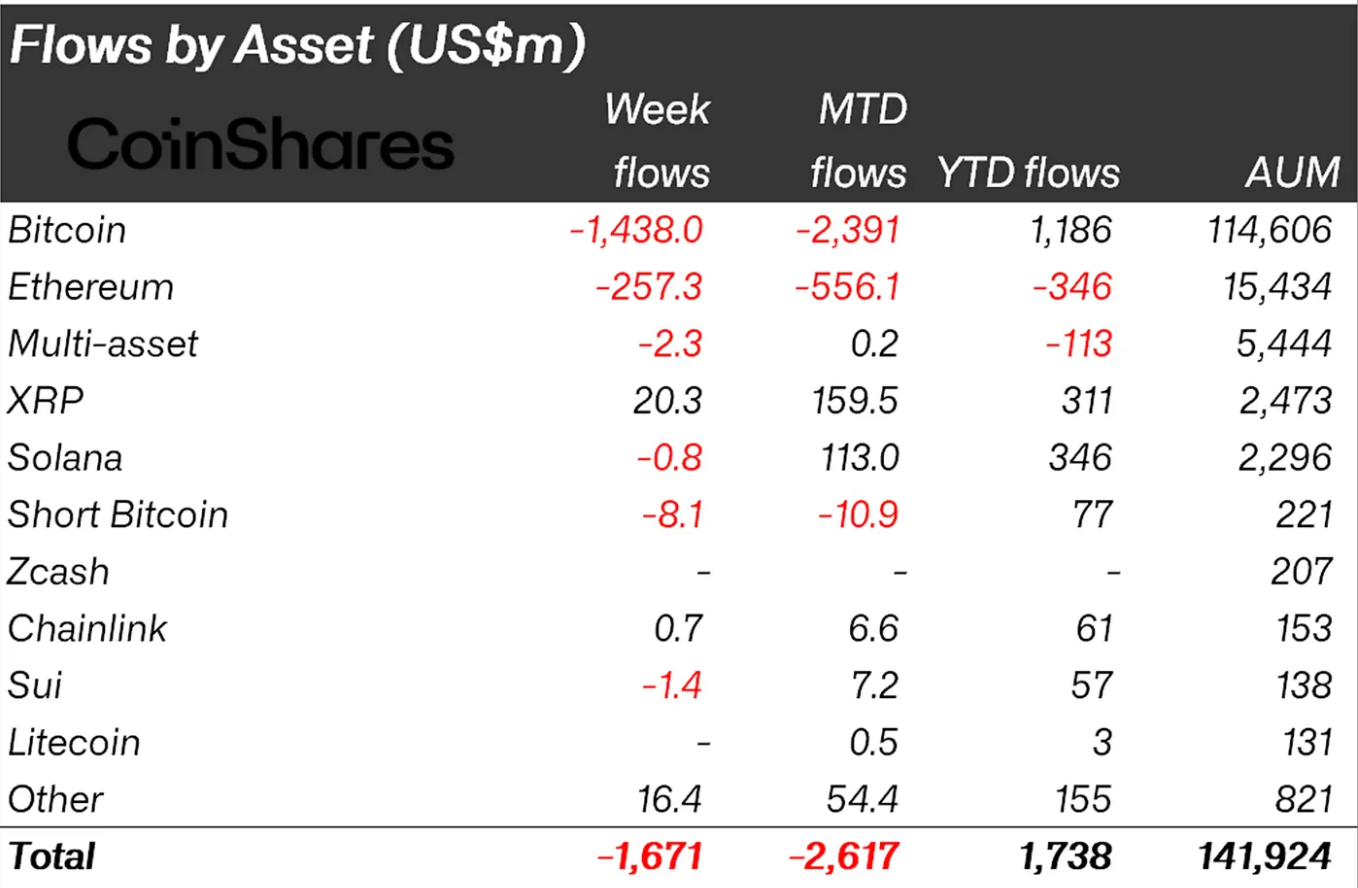
XRP emerged as one of just five digital assets to attract fresh capital last week, drawing $20.3 million in inflows. Meanwhile, global crypto investment products bled $1.67 billion in their third straight week of redemptions.
The figures show altcoin participation collapsing to five assets from 11 three weeks ago, with Bitcoin (BTC) alone shedding $1.44 billion in its largest weekly outflow of 2026.

XRP and Two Altcoins Defy the Outflow Wave
XRP’s $20.3 million inflow led a narrow group of assets bucking the institutional selling. HYPE drew $10.8 million following its Hyperliquid top-ten ranking, and NEAR Protocol (NEAR) added $7.6 million.
Only five digital assets posted inflows above $1 million, down from nine the prior week.
The narrow breadth signals that institutional buyers are picking specific names rather than rotating into altcoins broadly.
XRP’s reading extends the XRP ETF monthly inflows run recorded across May.

Bitcoin Drives Record Outflows as Risk-Off Deepens
Bitcoin’s $1.44 billion exit topped both the prior week and the January peak, sustaining the broader Bitcoin ETF outflow streak. Year-to-date Bitcoin inflows have compressed to $1.2 billion, down from $3.9 billion just two weeks ago.
CoinShares strategist James Butterfill said the sell-off echoes the January and February episode, which produced five consecutive negative weeks, according to the report.
“AuM has fallen to US$141bn from US$148bn the prior week, the lowest level since early April. The pattern is reminiscent of the January-February episode that delivered five consecutive negative weeks,” read an excerpt in the report.
The firm tied the weakness to Iran-related geopolitics, which has overwhelmed any cushion from CLARITY Act progress.
Ethereum (ETH) products shed $257 million, deepening recent Ethereum ETF outflow pressure.
US Leads Regional Sell-Off, Europe Joins In
The United States accounted for $1.63 billion of the global figure. Germany joined the risk-off with $25.7 million in outflows after holding firm through prior episodes, while Sweden recorded $6.6 million and Hong Kong $4.5 million.
Assets under management slipped to $141 billion from $148 billion.
BTC traded near $72,545 at the time of writing, down 1.73% over 24 hours, according to BeInCrypto data. The token has slipped 6.35% over the past week.

With altcoin breadth at its narrowest in three weeks, the next weekly print will show whether XRP and Hyperliquid hold their bid or join the broader risk-off.
The post XRP Leads Rare Altcoin Inflows as Crypto Funds Lost $1.67 Billion in a Week appeared first on BeInCrypto.


Knots leader Bitcoin Mechanic, aka “GrassFedBitcoin,” was banned from Reddit’s most popular Bitcoin community on Sunday after posting about the contentious BIP-110.
BIP-110 attempts to limit non-monetary data on Bitcoin like images, documents, and other inscriptions and, according to moderators, posting about it in the r/Bitcoin subreddit breaks a long-standing rule against promoting protocol changes that lack broad agreement.
Bitcoin Mechanic posted just two sentences: “7 blocks in the last difficulty period flipped version bit 4. I wonder what they’re signalling for?”
However, even this was enough to cause moderators to immediately remove the post and permanently ban his account
“I expected them to delete the post, didn’t expect them to ban my account,” he posted on Sunday alongside a video about the removal. It drew 40,000 views within hours on X, plus thousands more on YouTube.
“I know that they ban all mention of Knots and BIP-110. I know that already,” he said. “They have that as an unwritten but official policy at this point.”
He also claimed that he was simply describing an “on-chain reality.”
However, Reddit moderator BashCo tapped the sign and told Bitcoin Mechanic that the established rules meant the outcome should have been obvious.
Read more: BitcoinCore website hosts letter from one side of OP_RETURN debate
What was Bitcoin Mechanic trying to say — and why was it a problem?
The current dispute continues a multi-year feud over what type of speech is permitted on r/Bitcoin.
Rules about acceptable speech on this subreddit matter because it’s one of the most visible Bitcoin communities outside of X.
Its moderation has been a flashpoint since the blocksize wars of 2015-2017, when the forum’s administrators were accused of scrubbing dissent during blocksize scaling debates.
In the context of Bip-110 — the latest escalation in Bitcoin’s long-running OP_RETURN war, which Protos chronicled in detail — blocks by miners whose version has bit 4 set “yes” are signaling a type of vote for activating BIP‑110.
Version bit 4 means that the fifth bit (counting from 0) in the 32‑bit nVersion field is being used by BIP‑110’s deployment logic as that miner’s signal that they’re ready to enforce the BIP‑110 rules.
Read more: Bitcoin’s OP_RETURN war just went nuclear: a chain fork proposal
Bitcoin developer Dathon Ohm wrote the first version of BIP-110, floating it as BIP-444. Originally, node operators who activated it would have limited data unrelated to the on-chain movement of BTC within OP_RETURN outputs to less than 90 bytes of data.
It targeted inscription protocols like Ordinals and Runes that Ohm and the Knots community, including Bitcoin Mechanic and Luke Dashjr, dismiss as spam.
Protos has previously documented how the fight went nuclear when the blockchain fork idea first surfaced.
Whether Bitcoin Mechanic’s post was promotion or neutral reporting of on-chain activity is a microcosm of the Bitcoin Core versus Knots feud.
To moderators of the subreddit, signaling support for an unactivated fork is unacceptable promotion. To fans of Knots and/or BIP-110, as well as many agnostics, reporting that a newsworthy number of miners flipped version bit 4 in their blocks is an act of journalism.
Got a tip? Send us an email securely via Protos Leaks. For more informed news and investigations, follow us on X, Bluesky, and Google News, or subscribe to our YouTube channel.
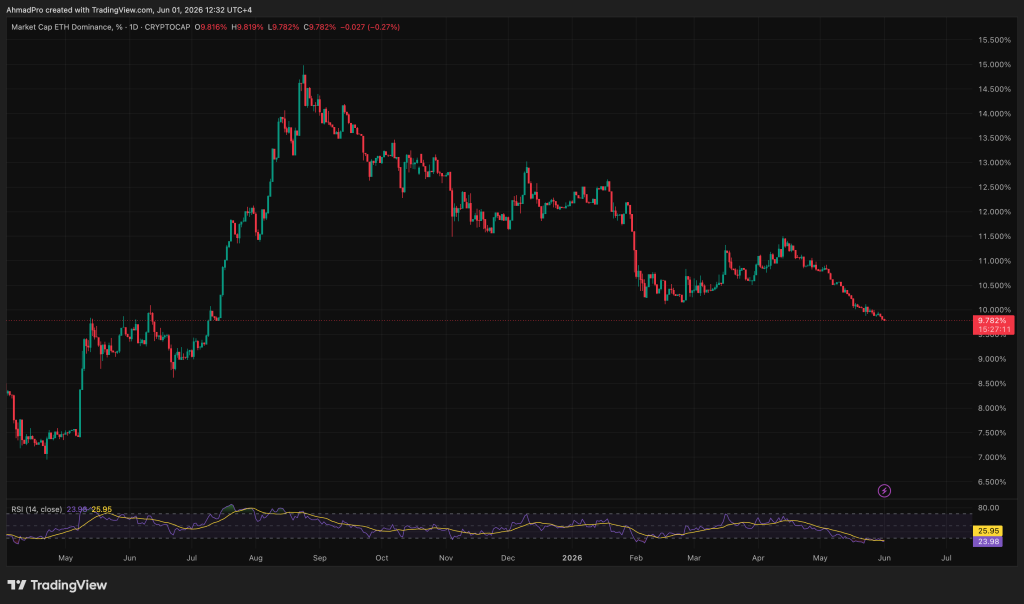
Ethereum’s market dominance is retreating toward critical support as the sell-the-news phase following U.S. spot Ethereum ETF approvals transitions into sustained net outflows.
Two compounding dynamics are driving the slide: institutional capital rotating out of ETH products at an accelerating rate, and a structural Layer 2 migration pulling liquidity and fee-generating activity off the mainnet.
The result is a dominance chart under pressure and a spot price that has failed to reclaim key moving averages for weeks.
Market Dominance for ETH has slipped toward the 9.7% range, levels that previously acted as launchpads for recovery but are now being tested from above.
The ETH/BTC ratio has also breached critical support, signaling that Ethereum is underperforming not just the broader market but its closest institutional benchmark.
Discover: The Best Crypto to Diversify Your Portfolio
Ethereum ETF Outflows News Signal Institutional Repositioning, Not a Temporary Dip
The numbers are unambiguous. Ethereum spot ETFs have recorded approximately $540 million in net outflows year-to-date, according to aggregated flow data tracked across major products.
ETH-specific ETF outflows hit $306 million in the recent week, the largest weekly withdrawal since late January. The bleeding has not stopped. 14 consecutive days of outflows have now totaled over $708 million.
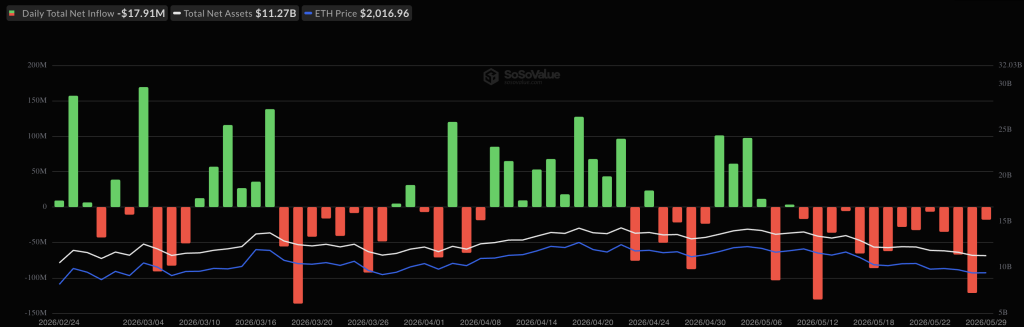
That is not noise. That is a pattern of Institutional Outflows consistent with what analysts at BestBrokers have described as fading institutional enthusiasm, a dynamic where post-approval euphoria gives way to fundamental reassessment.
The Ethereum ETF products briefly attracted strong inflows in early 2025 as broader crypto risk appetite surged, pushing ETH to local highs. That bid has since evaporated.
The rotation is directional, not a broad crypto exit. Flow data show XRP pulling in +$68 million and Solana attracting +$55 million in the same week ETH bled –$249 million.
Institutional and fund capital is not leaving crypto, it is leaving Ethereum specifically. That distinction matters for how this move is framed.
This is distribution dressed in post-ETF normalization language, and the price action reflects it. ETH has shed roughly 25% over three months even as it posted a modest ~10% gain over the trailing month, a dead-cat bounce structure, not a trend reversal.
Standard Chartered has maintained a bullish long-term thesis for ETH, projecting a recovery toward $4,000, but even the bank has flagged a potential flush toward $1,400 before that move materializes – which is not a bullish near-term signal when outflow data is running this hot.
Can ETH Dominance Find a Floor, or Is This a Structural Repricing?
ETH is trading beneath its 50, 100, and 200-day EMAs with support tested in the $2,000 level.
Any bounce from current levels runs directly into thick overhead supply built from months of ETF-related selling. This is not a thin resistance zone. It is a ceiling constructed by sustained institutional exit.
If ETF flows reverse on renewed institutional demand and the Pectra upgrade delivers a tangible catalyst for mainnet activity, dominance reclaims the 14% to 16% zone and a path toward $3,000 spot reopens.
If outflows stabilize without reversing, ETH consolidates between $2,100 and $2,500 while dominance drifts sideways at the 9% to 10% floor waiting for a durable narrative shift.
If the ETH/BTC ratio continues lower and ETF redemptions accelerate through the next monthly rebalancing cycle, dominance breaks below 8% and spot tests the $1,800 level that several technical models have flagged as the next structural support.
Discover: The Best Token Presales
The post Ethereum ETFs Bled $708m in 14 Straight Days as XRP and Solana Gained appeared first on Cryptonews.
Crypto World
Bitcoin Slips Below Key $73K Support as Bears Eye $70K Demand Zone (BTC Price Analysis)
Bitcoin remains under bearish pressure after a recent consolidation around the 100-day MA of $73K. The asset has now slightly broken below the MA. Upcoming price action will determine whether the recent pullback evolves into a leg deeper or forms a base for recovery.
Bitcoin Price Analysis: The Daily Chart
On the daily timeframe, BTC continues to trade within a large ascending channel that has contained price action since the February lows. The 200-day MA, currently located around $80K, has acted as dynamic resistance throughout the recent decline.
Meanwhile, the 100-day MA is positioned near $73K and is now being tested as immediate support. Price is trading directly around this level, making it a pivotal area for the broader trend.
A daily stabilization below the 100-day MA could expose the lower channel boundary and the major demand zone around $70K-$71K. This region also aligns with a previously established order block, increasing its technical significance.
On the upside, any recovery attempt is likely to face resistance around $75K-$76K, where a supply zone has already triggered a strong rejection. Beyond that, the 200-day MA near $80K remains the key obstacle. A successful reclaim of this level would improve the medium-term structure and open the door toward the $87K-$90K resistance region.

BTC/USDT 4-Hour Chart
The 4-hour timeframe highlights the loss of bullish momentum more clearly. BTC has established a sequence of lower highs and lower lows after failing to sustain its breakout above $82K.
Price is currently consolidating within a narrow range between roughly $72.8K and $74.5K. This range is developing directly above the rising lower trendline of the broader channel, creating a crucial decision point for the market.
The short-term structure remains neutral to bearish as long as BTC trades below the $75K-$76K supply zone. A breakout above this area could trigger a relief rally toward $78K and potentially $82K, where the next major liquidity cluster resides.
However, if sellers force a breakdown below the current range and the ascending trendline, the market could quickly rotate toward the higher-timeframe order block at $70K-$71K. Given the lack of significant support between these levels, a move into that zone could occur relatively fast.
For now, the market appears trapped between nearby support and overhead supply, with a likely expansion in volatility.

On-chain Analysis
The UTXO Realized Price Age Bands chart reveals an important development among short-term holders. Bitcoin is currently trading below the realized price of the 1M-3M cohort, which has risen steadily to approximately $73K-$74K.
Historically, this cohort has often served as a key gauge of sentiment. When price remains above the realized price of recent buyers, market participants tend to stay profitable, reducing immediate selling pressure. Conversely, sustained trading below this level can increase the probability of capitulation from weaker hands.
At the same time, the realized price of the 18M-2Y cohort continues to climb and currently sits near $70K. This level closely aligns with the major daily support zone and reinforces the importance of the $70K-$71K region as a potential accumulation zone.
Meanwhile, the older 3M-6M cohort remains significantly higher near $83K-$84K, reflecting the average cost basis of holders who accumulated during the previous advance. This level now represents a major overhead resistance area, aligning with the upper portion of the current trading range.
Taken together, the on-chain data suggests that Bitcoin is testing a critical short-term holder cost basis around $73K-$74K, while stronger long-term support continues to build near $70K. As long as the latter level remains intact, the broader market structure appears constructive despite the ongoing correction.

The post Bitcoin Slips Below Key $73K Support as Bears Eye $70K Demand Zone (BTC Price Analysis) appeared first on CryptoPotato.

Executive Summary
- BMNR experiences pre-market decline despite staked Ethereum exceeding $9.5 billion
- Company maintains $11.6B total position across cryptocurrency assets and cash reserves
- Ethereum holdings represent 4.49% of total ETH supply following recent acquisitions
- MAVAN validator network underpins company’s expanding Ethereum staking operations
- Management sets sights on controlling 5% of Ethereum supply with projected staking yields
Bitmine Immersion Technologies disclosed total holdings of $11.6 billion across digital assets, cash positions, and strategic investments as BMNR stock demonstrated volatility. Shares concluded regular trading at $19.27, representing a modest 0.10% gain, before retreating 2.25% to $18.82 during pre-market hours. This downward movement occurred alongside announcements of Bitmine’s enlarged Ethereum treasury and staked ETH crossing the $9.5 billion threshold.
Bitmine Immersion Technologies, Inc., BMNR
Substantial Ethereum Treasury Accumulation
According to its most recent disclosure, Bitmine possessed 5,416,901 ETH as of May 31, 2026. With each token valued at $2,003, the company’s Ethereum allocation exceeds $10.8 billion. Beyond its primary Ethereum holdings, Bitmine maintains 203 Bitcoin alongside $446 million in liquid cash reserves.
Management indicated these ETH reserves constitute 4.49% of Ethereum’s circulating supply totaling 120.7 million tokens. This concentration establishes Bitmine as the dominant corporate holder of Ethereum worldwide. Among all corporate cryptocurrency treasuries globally, only Strategy surpasses the company’s position.
Over the preceding seven days, Bitmine acquired an additional 26,497 ETH as part of its ongoing accumulation strategy. Company executives stated their objective of controlling 5% of total Ethereum supply before 2026 concludes. This milestone forms a cornerstone of the firm’s extended treasury approach and equity market narrative.
Staking Operations Eclipse $9.5 Billion Mark
As of May 31, 2026, Bitmine disclosed 4,718,677 ETH actively staked across its validator infrastructure. With Ethereum priced at $2,003, this staked allocation represents approximately $9.5 billion in value. The figure accounts for over 87% of the company’s complete Ethereum portfolio.
MAVAN, the company’s Made in American Validator Network, powers its Ethereum validation activities. Bitmine developed this infrastructure initially for internal treasury management, with plans for broader deployment. Leadership anticipates MAVAN will eventually accommodate institutional clients, custodial services, and additional ecosystem participants.
The company disclosed a 7-day annualized staking yield of 2.73% for BMNR operations. Extrapolating from this performance metric, Bitmine forecasts annualized staking income of $258 million. Operating at maximum capacity, the projection extends to $296 million in yearly staking rewards.
Stock Maintains Elevated Trading Volumes
While BMNR registered marginal gains to close at $19.27, early pre-market activity drove shares down to $18.82. The pullback followed the company’s latest treasury disclosure. The equity continues ranking among the most actively exchanged securities across U.S. markets.
According to Fundstrat analysis, BMNR averaged $628 million in daily dollar volume across the four-day period concluding May 29, 2026. This trading activity positioned the stock at rank 225 among 5,704 U.S.-listed equities. The placement situated BMNR between Marathon Petroleum and Blackstone in terms of liquidity metrics.
Beyond core cryptocurrency positions, Bitmine revealed strategic equity holdings in emerging ventures. These encompass a $180 million investment in Beast Industries and $93 million allocated to Eightco Holdings. Combined with digital assets and cash, the company’s aggregate holdings including moonshot investments total $11.6 billion.
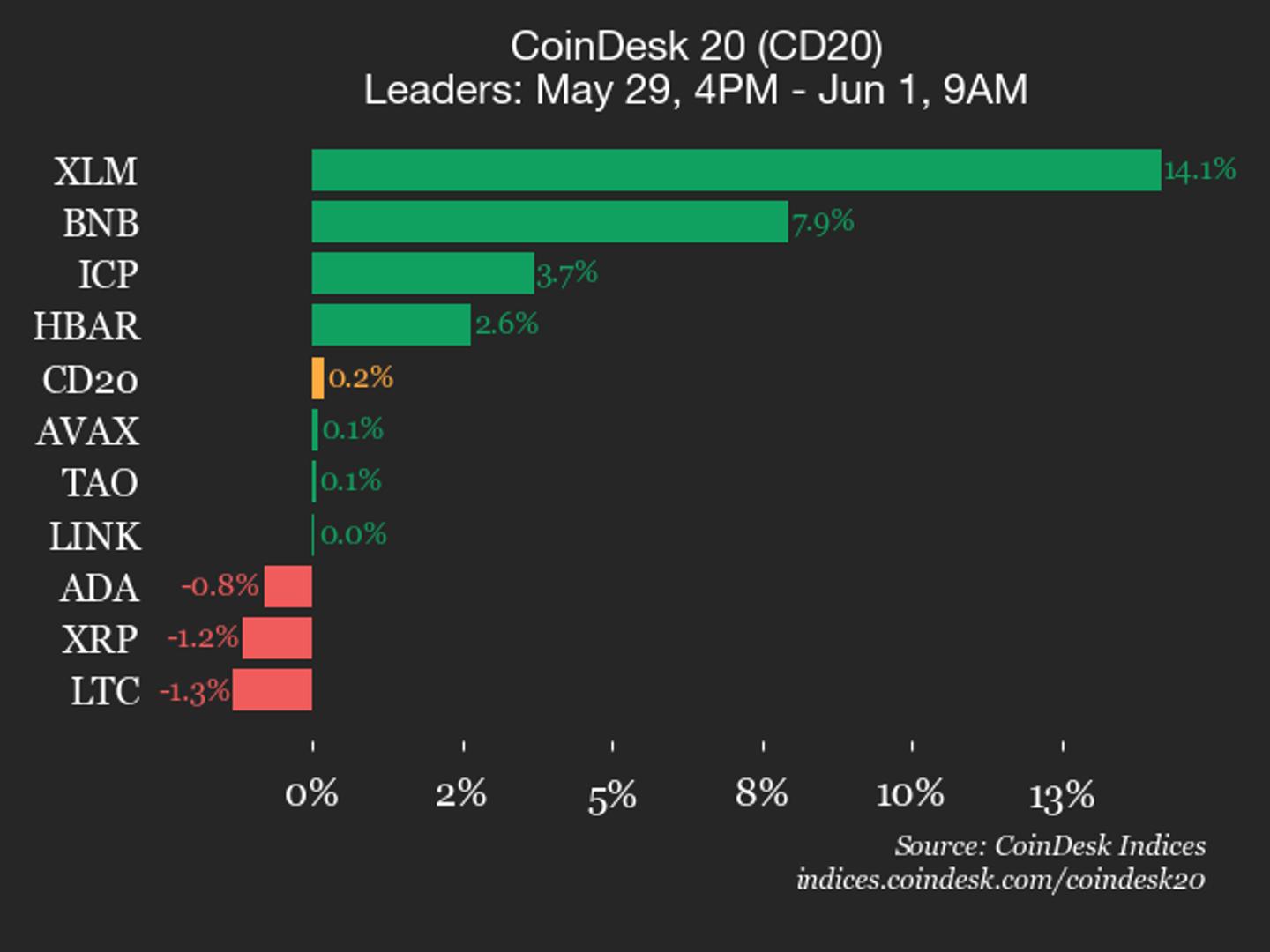
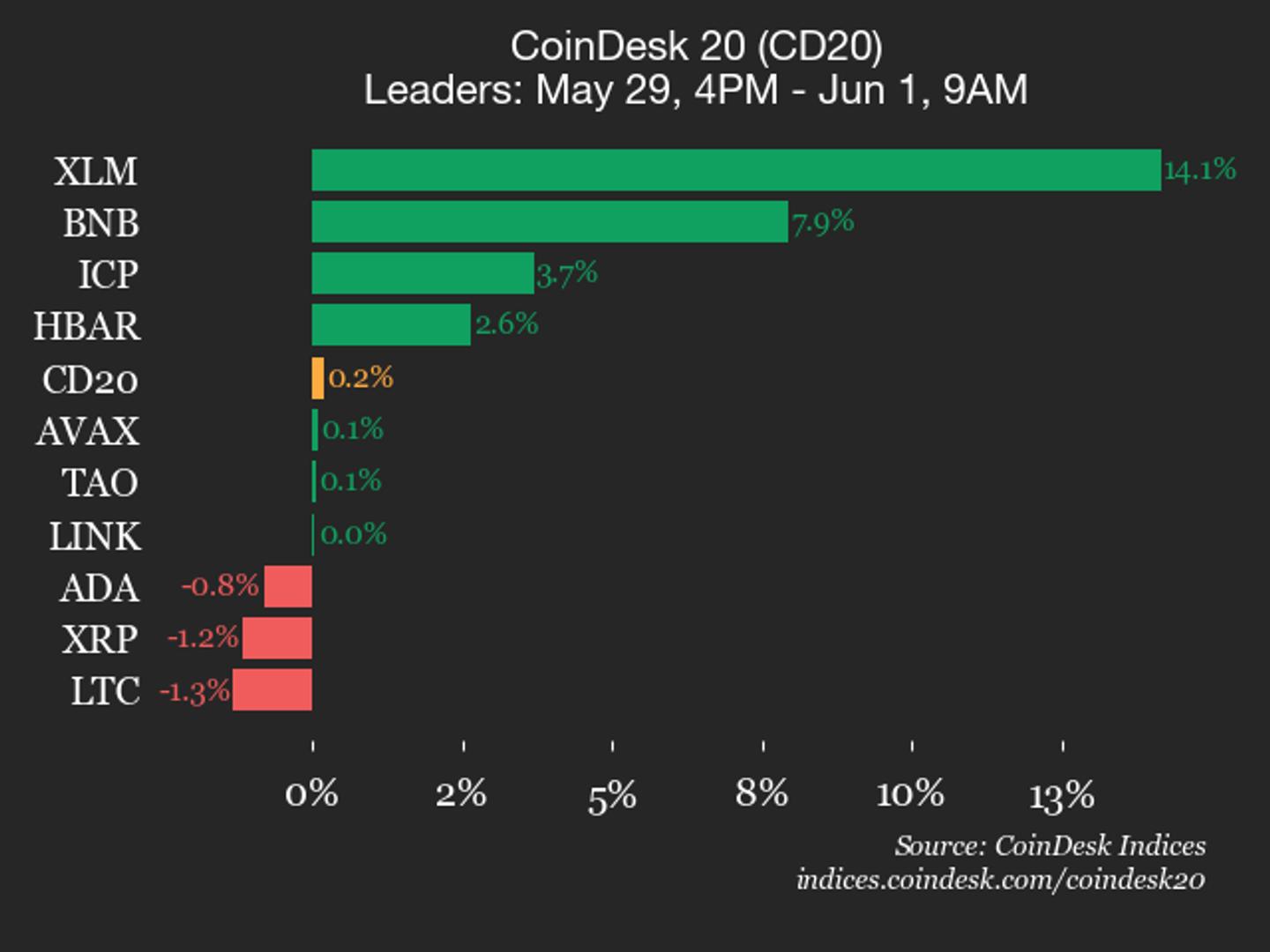
Binance Coin (BNB), up 7.9%, was also a top performer.
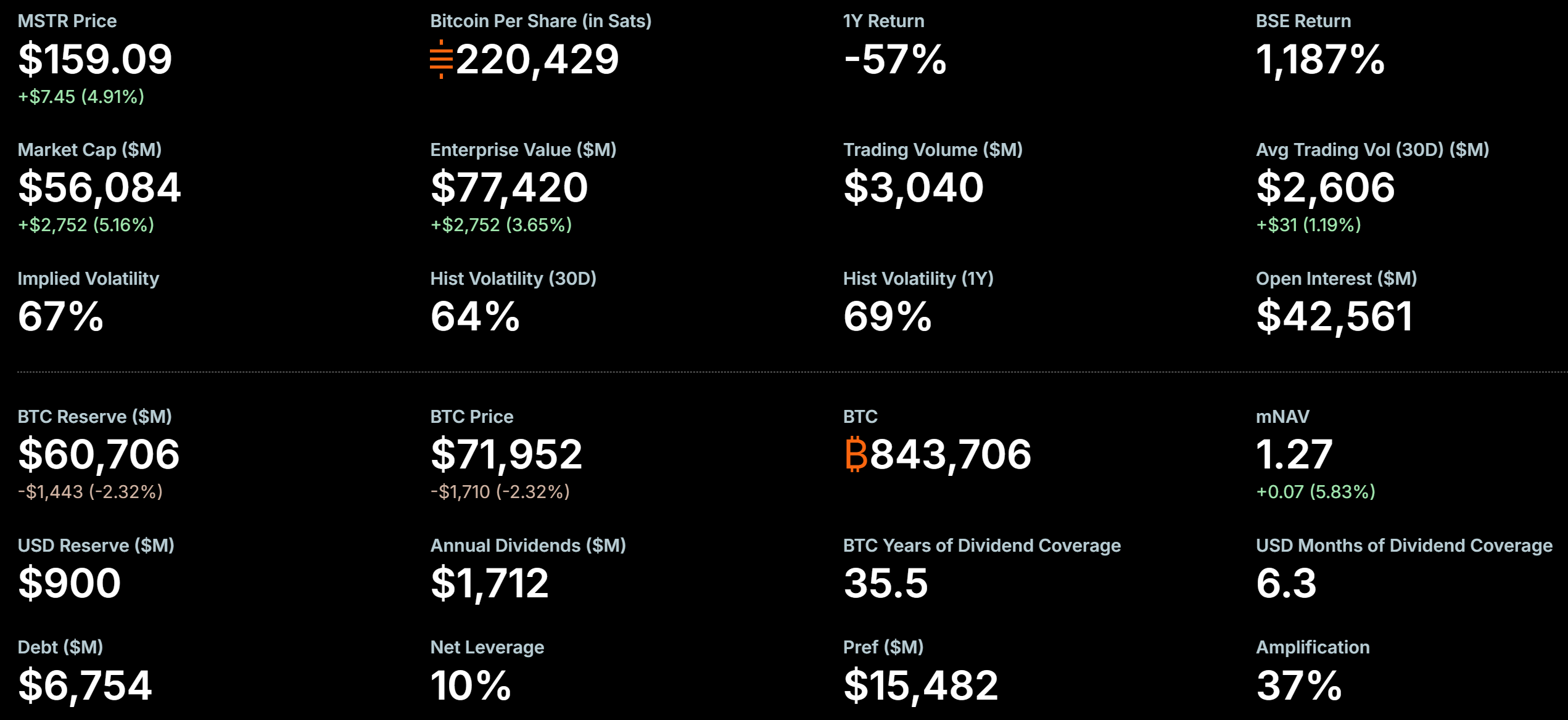
Strategy Inc, the largest corporate Bitcoin holder, confirmed its first Bitcoin sale in the June 1, 2026 Form 8-K filing.
The company offloaded 32 BTC for approximately $2.5 million during May 26–31, while maintaining a massive 843,706 BTC treasury.
On-Chain Suspicion Meets Official Confirmation
Traders and on-chain analysts spotted MicroStrategy wallets moving BTC to Coinbase Prime days earlier, sparking intense speculation.
Arkham Intelligence and community trackers highlighted the unusual activity, which fueled a Polymarket bet on whether any sale would occur by May 31.
One trader bet big on YES when the market priced the probability around 11%. The June 1 filing resolved the market in his favor, delivering an estimated $200,000 payout.
Follow us on X to get the latest news as it happens
The last time MicroStrategy sold Bitcoin was in December 2022, when they disposed 704 BTC for tax-loss harvesting before repurchasing more of the pioneer crypto two days later.
Details from the latest filing, showing last week’s Bitcoin sales include:
- Sold: 32 BTC at an average of around $77,135 each (net of fees).
- Holdings as of May 31: 843,706 BTC with approximately $63.87 billion cost basis (average of around $75,699 per BTC).
- Purpose: Proceeds support preferred stock dividends (STRF, STRC, etc.).
- USD Reserve: $900 million earmarked for obligations.

Bitcoin traded near $72,000–$74,000 around the period, meaning MicroStrategy sold at a premium to recent levels.
The sale represents a tiny fraction (<0.004%) of holdings but marks a shift from pure accumulation.
MicroStrategy has aggressively grown its treasury via ATM equity and preferred stock raises, often buying thousands of BTC weekly.
This disciplined approach, selling selectively while replenishing via capital markets, aligns with executive comments on proactive treasury management.
Preferred dividends and debt service remain key priorities, backed by the dedicated USD reserve.
With Bitcoin volatility persisting and corporate treasuries under scrutiny, any larger sales or accelerated buys could influence sentiment.
MicroStrategy’s Bitcoin-per-share metric and yield targets will likely remain central to its narrative as it balances growth, obligations, and long-term conviction in Bitcoin.
The post MicroStrategy Sells Bitcoin For the First Time Since 2022, Hands Trader a $200,000 Win appeared first on BeInCrypto.

Key Takeaways
- Barclays launched coverage of IBM on Monday with an Overweight rating and set a $350 price target.
- Shares of IBM climbed approximately 11-12% to near $330 during premarket hours.
- The optimistic outlook focuses on IBM’s software division, which accounts for nearly 50% of revenue and most profits.
- According to Barclays analyst Raimo Lenschow, IBM’s infrastructure software caters to large, regulated corporations — establishing a durable customer base resistant to AI disruption.
- This bullish call adds to recent strength: IBM has climbed 28% in the last month and recorded its best weekly performance in a quarter-century.
IBM shares experienced significant upward momentum on Monday following a bullish initiation from Barclays — and the catalyst wasn’t related to quantum computing developments.
International Business Machines Corporation, IBM
Shares of IBM jumped approximately 11% in premarket action, reaching $330.11, after Barclays analyst Raimo Lenschow launched coverage with an Overweight recommendation and established a $350 price objective. This target suggests additional upside potential of 17.5% from premarket levels.
The technology giant has been experiencing remarkable momentum. IBM has advanced 28% during the past 30 days and recently delivered its most impressive weekly performance in two and a half decades. Shareholders of Big Blue have enjoyed substantial gains in recent weeks.
While quantum computing has dominated recent headlines — IBM secured $1 billion in federal CHIPS and Science Act funding to construct a dedicated quantum chip fabrication facility, subsequently committing over $10 billion of corporate capital toward quantum development and production over five years — Lenschow’s investment thesis focuses elsewhere.
The Enterprise Software Narrative
His investment case is more straightforward: IBM has transformed into a software-driven enterprise, and the market hasn’t fully recognized this evolution.
Software accounts for approximately half of IBM’s total revenue while generating the majority of corporate profits. Lenschow anticipates this revenue composition will expand over time due to software’s superior growth characteristics.
The critical element of his analysis centers on IBM’s software specialization. This isn’t consumer-facing applications or fashionable AI tools. Instead, it’s fundamental infrastructure — Red Hat Enterprise Linux, Red Hat OpenShift, automation solutions, and data analytics platforms — engineered specifically for large, sophisticated enterprises operating hybrid cloud and on-premises infrastructures.
These clients will never transition entirely to cloud environments, Lenschow observes. This dynamic creates a captive, predictable revenue stream that’s difficult to disrupt.
“We see mid single digit organic revenue growth and ongoing margin leverage, which should create a stable earnings compounder with a Quantum option,” he wrote.
A Growing Consensus
Lenschow’s perspective isn’t breaking new ground. Oppenheimer’s Param Singh employed similar terminology in January, characterizing IBM’s software assets as “sticky.” Evercore ISI’s Amit Daryanani reinforced this view in February. And during April, Citi Research’s Fatima Boolani portrayed IBM’s software and hardware as deeply embedded “across the most critical points of the world’s largest, most complex IT infrastructures.”
This convergence of analyst endorsements illustrates a compelling investment narrative gaining momentum: IBM’s enterprise software foundation represents a competitive advantage rather than a burden.
Additional attention has emerged from social media channels. Statements from Donald Trump in December commending IBM’s chief executive have reemerged online, circulating alongside discussions of other occasions where the president has publicly recognized particular equities in 2025.
The overall Wall Street sentiment remains measured. Among analysts currently tracking IBM, 10 maintain Buy recommendations while 11 rate it at Hold — establishing a Moderate Buy consensus. The average price objective stands at $291.69, indicating the stock may be appropriately valued at present levels following its recent appreciation.
IBM’s latest financial results demonstrated continued outperformance in the software division, with the corporation emphasizing hybrid cloud capabilities and AI integration throughout its enterprise customer portfolio.

Mutsamudu, Comoros, June 1, 2026 – MEXC, a leading 0-fee cross-asset trading platform, today announced the official launch of ‘RealStocks.’ This innovative equity product is now accessible to eligible users globally. The product seamlessly integrates real ownership rights of traditional financial assets with the low-friction experience of a crypto platform, further expanding MEXC’s 0-fee cross-asset trading ecosystem.
For a long time, investors looking to enter the U.S. stock market were limited to two less-than-ideal options. The first was trading through traditional brokerages, which requires enduring tedious currency exchange and deposit processes. The second was trading synthetic assets or tokenized products on crypto platforms, which often comes with drawbacks like poor liquidity and a lack of dividend payouts. The launch of ‘RealStocks’ breaks this deadlock, seamlessly bridging the gap between both worlds.
Building on a highly successful Beta phase validated by over 20,000 early users, the official launch ensures a seamless, battle-tested trading experience. Through MEXC’s licensed broker partner, Atomic Vaults, eligible users can purchase shares in real U.S.-listed companies, eligible users can purchase shares in real U.S. listed companies, with genuine market exposure and liquidity consistent with traditional U.S. equity markets. Where applicable, users are entitled to dividends or distributions on their holdings. The entire trading flow is integrated into MEXC’s existing interface. Users transact in USDT, making the experience of buying U.S. stocks similar to buying crypto in practice. Trading hours follow Nasdaq market sessions, and zero platform trading fees apply during the launch period, keeping costs to a minimum. The product has been validated by over 20,000 users during the Beta phase.

Atomic Vaults is a U.S. FINRA-licensed broker-dealer and global brokerage infrastructure provider backed by Founders Fund and ARK Invest. Processing over $15 billion in monthly trading volume, it enables access to U.S. equities, ETFs, options, and select Asian markets, with support for 24×5 trading, fractional investing, stablecoin funding, and institutional-grade clearing and custody.
MEXC is simultaneously launching three limited-time incentive campaigns.
Campaign 1: SpaceX(PRE) airdrop reward (May 28 – June 5)
Complete a U.S. stock spot trade and participate in the SpaceX(PRE) Season 2 Launchpad subscription before it closes, and receive additional SpaceX(PRE) airdrop rewards. Total prize pool: 200,000 USDT equivalent. Maximum reward per user: 5,000 USDT equivalent in SpaceX(PRE).
Campaign 2: $1,000,000 stock prize pool (June 2 – June 16)
During the campaign period, U.S. stock spot trading is available at zero fees. Complete trading tasks to share in a 1,000,000 USD equivalent stock prize pool.
Campaign 3: Real-time market data subsidy for new deposits (First month after U.S. stock launch)
Complete a qualifying deposit to receive a real-time market data subsidy — helping users start trading U.S. stocks with zero barrier to entry.
MEXC CEO Vugar Usi said:
“From Pre-IPO access to tokenized stocks, and now to real share ownership through U.S. stock spot trading, MEXC has continuously pushed the boundaries of what crypto users can access in global markets. With U.S. stock spot trading, users can now truly own world-class traditional financial assets within a familiar crypto trading environment — not just track their price. As 2026 brings a historic wave of IPO windows from the world’s top technology companies, crypto users will have the chance to participate as real shareholders for the first time. This is what Infinite Opportunities means at MEXC — not a tagline, but a product.”
‘RealStocks’ is now live and open to eligible users.
About MEXC
MEXC is the world’s fastest-growing cryptocurrency exchange, trusted by more than 40 million users across 170+ markets. Built on a user-first philosophy, MEXC offers industry-leading 0-fee trading and access to over 3,000 digital assets. As the Gateway to Infinite Opportunities, MEXC provides a single platform where users can easily trade cryptocurrencies alongside tokenized assets, including stocks, ETFs, commodities, and precious metals.
MEXC Official Website | X | Telegram | How to Sign Up on MEXC
Media contact:
Disclaimer
“0 fees” refers only to the platform’s service charge. Users may still be subject to certain fees, including but not limited to SEC transaction fees, FINRA trading activity fees (TAF), exchange and market center fees, regulatory fees, and any applicable clearing fees.
Not investment advice. For informational purposes only. Trading involves risk. Please consult a qualified professional before making any investment decision.
Territorial Limit: This service is offered only to users in certain jurisdictions. Access may be restricted in certain countries or regions due to local laws and regulations. Please refer to our Terms & Conditions for the complete list of eligible jurisdictions.


Bitmine Immersion (BMNR), the largest publicly-traded Ethereum treasury firm, bought 26,497 ether (ETH) last week, sharply reducing the pace of accumulation after making its largest purchase of 2026 just a week earlier.
The latest acquisition, worth roughly $53 million at current ETH prices, lifted Bitmine’s holdings to nearly 5.42 million tokens, or approximately 4.49% of ether’s circulating supply, according to a Monday company update.
The purchase was down more than 75% from the prior week’s 120,000 ETH haul.
The slowdown comes after Thomas “Tom” Lee, chairman of Bitmine, said in May at Consensus 2026 that the company planned to moderate accumulation as it was rapidly approaching its long-term goal of owning 5% of ETH’s supply.
Despite the slower pace, Bitmine remains one of the few large digital asset treasury firms still actively adding to its crypto holdings. Even Michael Saylor’s bitcoin juggernaut Strategy (MSTR) sold $2.5 million bitcoin last week. Bitmine has acquired more than 1 million ETH since the start of the year and now sits about 90% of the way toward its stated goal of controlling 5% of the network’s supply.
“ETH prices are not reflecting the strengthening of Ethereum fundamentals,” Lee said in Monday’s statement. “But then again, this is not surprising given we are in the early stages of crypto spring.”
Bitmine’s total crypto and cash holdings stood at $11.6 billion as of May 31. In addition to its ETH treasury, the company held 203 bitcoin, $446 million in cash, and stakes in Beast Industries and Eightco Holdings.
The firm has increasingly focused on generating income from its holdings through staking. The company estimates its staking operations generate roughly $258 million in annualized revenue, with projected rewards approaching $300 million annually through its MAVAN staking platform.

John Kear: Dave Woods pays tribute to rugby league legend

Mondelez updates Newtons for ‘new generation’ of snackers

XRP Leads Rare Altcoin Inflows as Crypto Funds Lost $1.67 Billion in a Week


-

 NewsBeat5 days ago
Israel says it has killed new Hamas military leader in Gaza City airstrikes
-

 Tech5 days ago
NASA taps Blue Origin to deliver lunar rovers for Moon Base initiative
-

 Politics7 days ago
Bridgerton Season 5: Cast, Release Date And Everything We Know So Far
-

 Sports6 days ago
2026 NBA Finals schedule, odds: Knicks await Thunder or Spurs after winning East
-

 News Videos5 days ago
XRP *JUST* SUCCEEDED!!!! CLARITY ACT EXPOSED!!! (SHE EXPOSED IT)
-

 News Videos3 days ago
This is BROKEN! INSANE 5x MONEY CAR WASH WEEK! The NEW GTA Online UPDATE Today! (GTA5 New Update)
-
Crypto World6 days ago
Micron Crosses $1 Trillion Market Cap as AI Demand Reshapes Memory Sector
-
 NewsBeat7 days ago
Hottest May day ever as London hits 34.8C in 2C leap from previous records
-

 Business6 days ago
Selena Gomez Reportedly Upset Over Benny Blanco’s Comments on Her ‘Terrible’ Diet
-
 Tech6 days ago
China assigns ID codes to 28,000+ humanoid robots
-

 Business7 days ago
Nikkei 225 Surges Past 65,000 for First Time as Iran Peace Hopes Fuel Record Rally
-

 Tech3 days ago
Waymo dominates autonomous vehicle registrations as Tesla trails behind
-
 Entertainment7 days ago
‘Breaking Bad’ Star’s Easy-to-Binge 6-Part Crime Series Spin-Off Is Finally Heading to Free Streaming
-

 NewsBeat7 days ago
Crowds find riverside shade in York as temperatures soar
-

 Tech5 days ago
The Samsung pay deal is the moment Korean unions changed register
-
 Tech2 days ago
SpaceX just won a second Golden Dome contract. This one is $4.16 billion.
-

 Entertainment6 days ago
Days of our Lives 2-Week Spoilers May 25-June 5: Gwen Rages, Abe Confesses & 2 Tragic Anniversaries!
-
 Entertainment6 days ago
Taylor Swift Fans Label Travis Kelce’s Beer-Chugging A ‘Red Flag
-
 NewsBeat3 days ago
FIRST NIGHT REVIEW: Take That bring the Circus back to life in spectacular sun-soaked style
-

 Tech6 days ago
Millions of AI agents imperiled by critical vulnerability in open source package
You must be logged in to post a comment Login