

Crypto World
Bitcoin Volatility Drops 56% As Analysts Watch For 20% Price Move

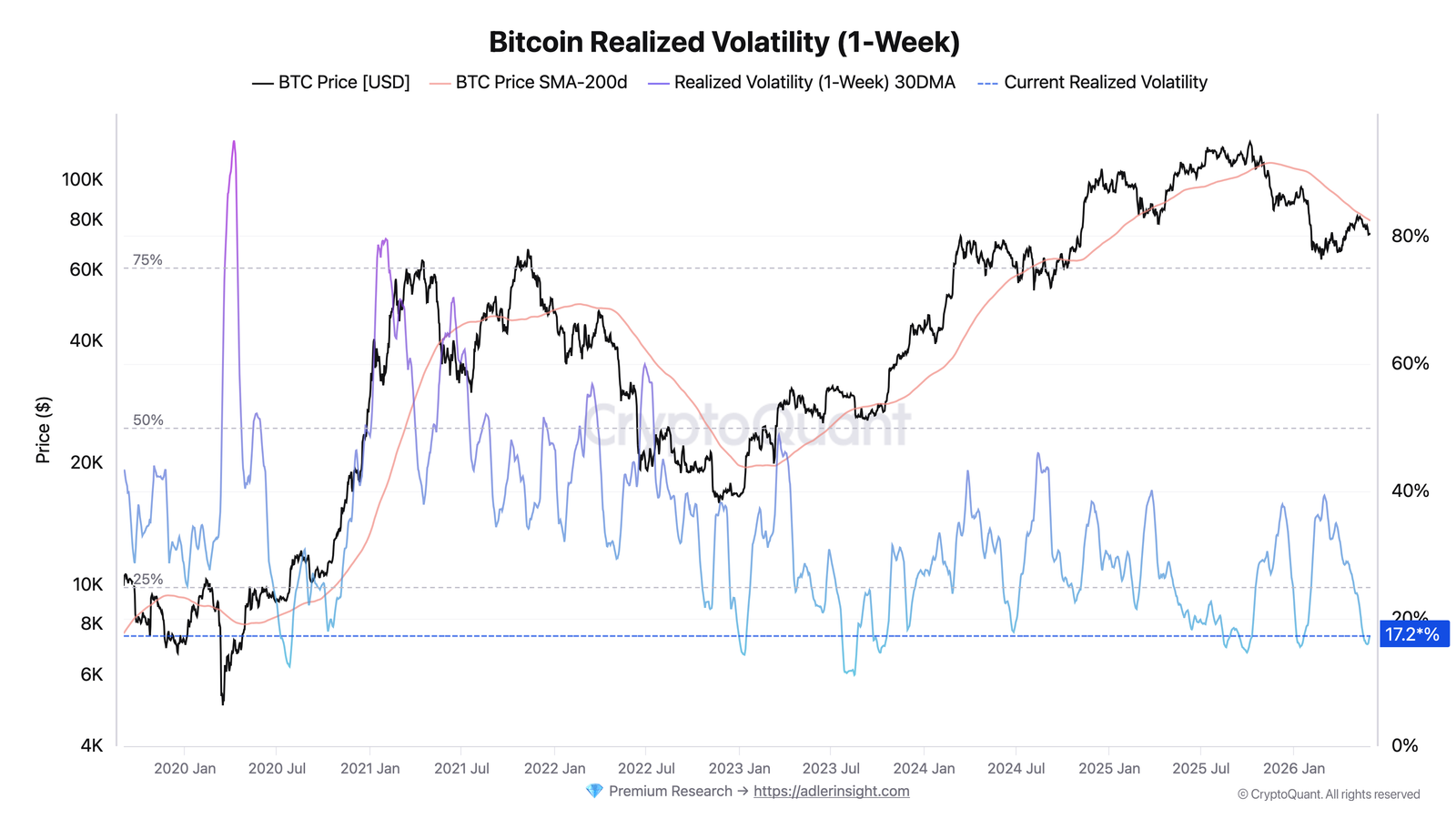
Bitcoin’s realized volatility has fallen to 17.2%, one of its lowest levels in recent months. Multiple Bitcoin analysts have said that long periods of price compression, alongside declining volatility, have historically preceded double-digit rallies.
Bitcoin realized volatility is down 56% in Q2
Bitcoin researcher Axel Adler Jr. said that BTC’s one-week realized volatility, smoothed over a 30-day period, has fallen to 17.2% from 39% this quarter, a 56% decline.
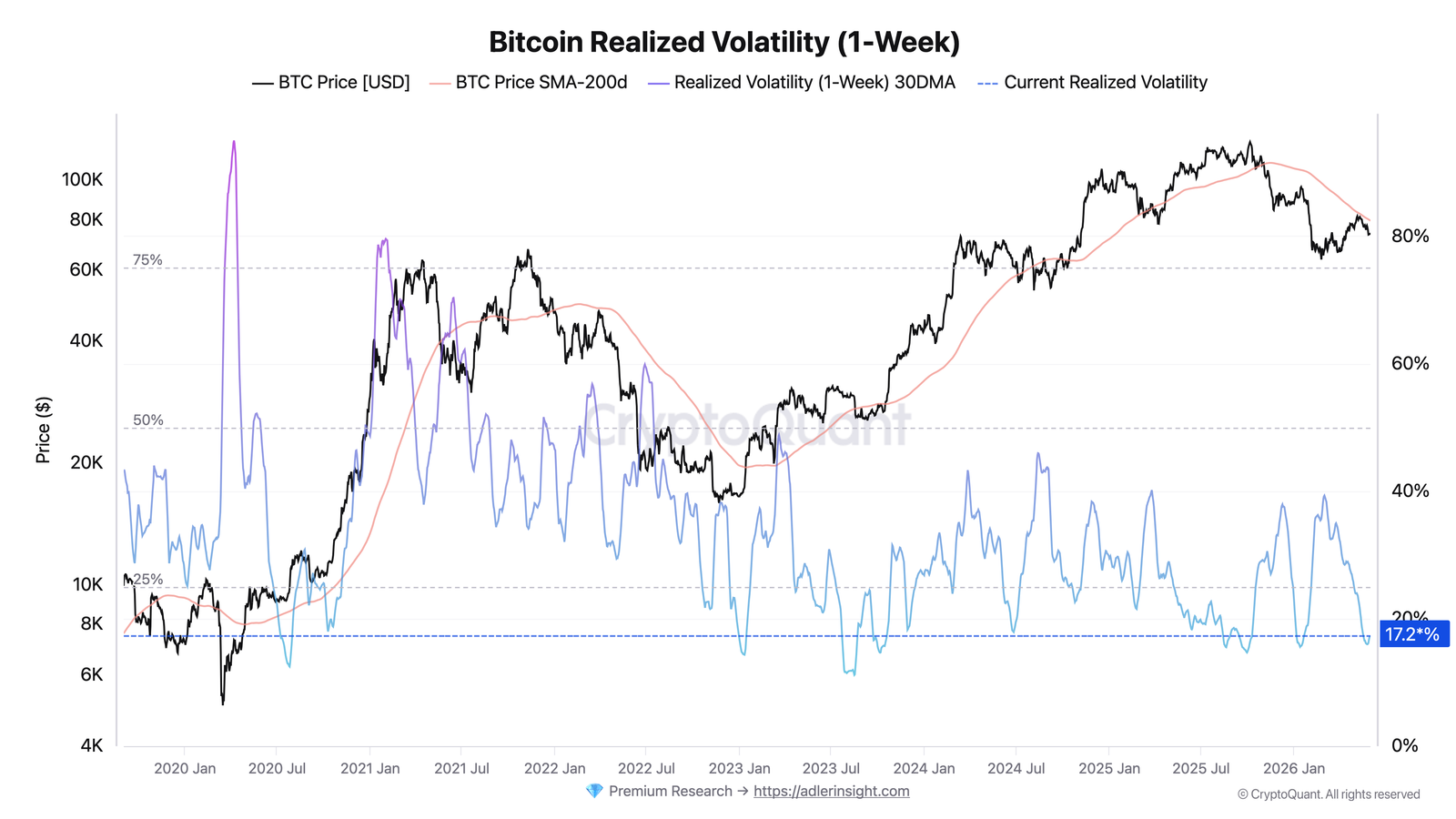
Bitcoin realized volatility (one-week). Source: CryptoQuant
The realized volatility, which measures how much the price has actually moved over a given period, sits well below its long-term median of 40%. Adler explained that such volatility compression may lead to a major price move.
However, the metric does not indicate direction. Instead, it measures how much momentum is building while the price movement slows.
The long-term volatility gauges tell a similar story. Three-month realized volatility has fallen to 80% from 109% since early April, while six-month realized volatility declined to 127% from 148%.
The drop across multi-time-frame volatility measures indicates that price movement has become compressed, a condition that may precede larger market moves.
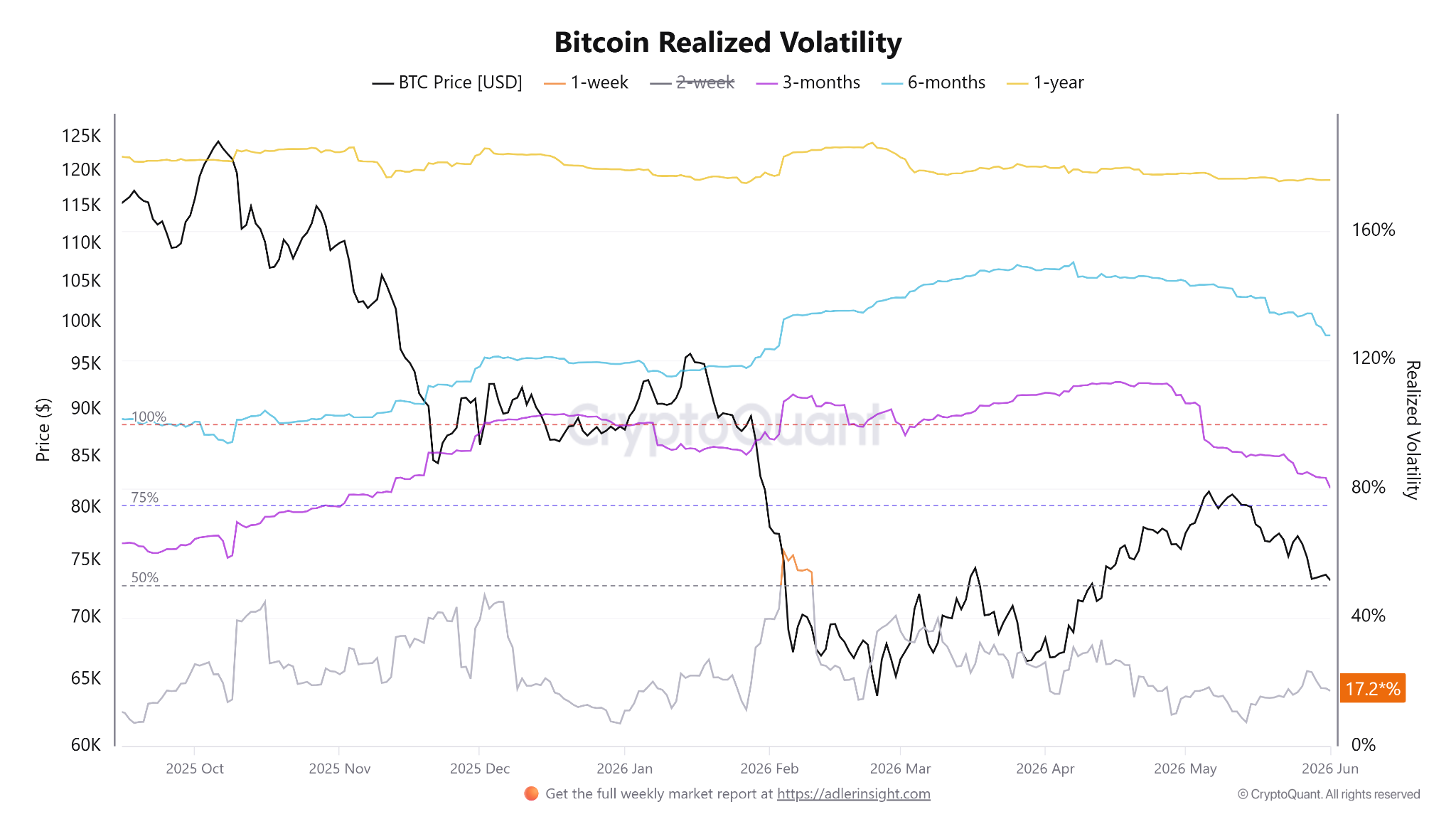
Bitcoin three- and six-month realized volatility. Source: CryptoQuant
The network valuation data adds another layer. The Bitcoin growth rate metric, which compares market capitalization growth to realized capitalization, has remained negative for more than six months. The delta, or 365-day moving average, recently slipped to -0.0013, indicating that BTC’s market value is growing more slowly than its realized value.
Adler said that the data points to a cooling market. Bitcoin’s price is not rising as quickly as the capital flowing into the network, suggesting investors are becoming more cautious amid reduced market volatility.
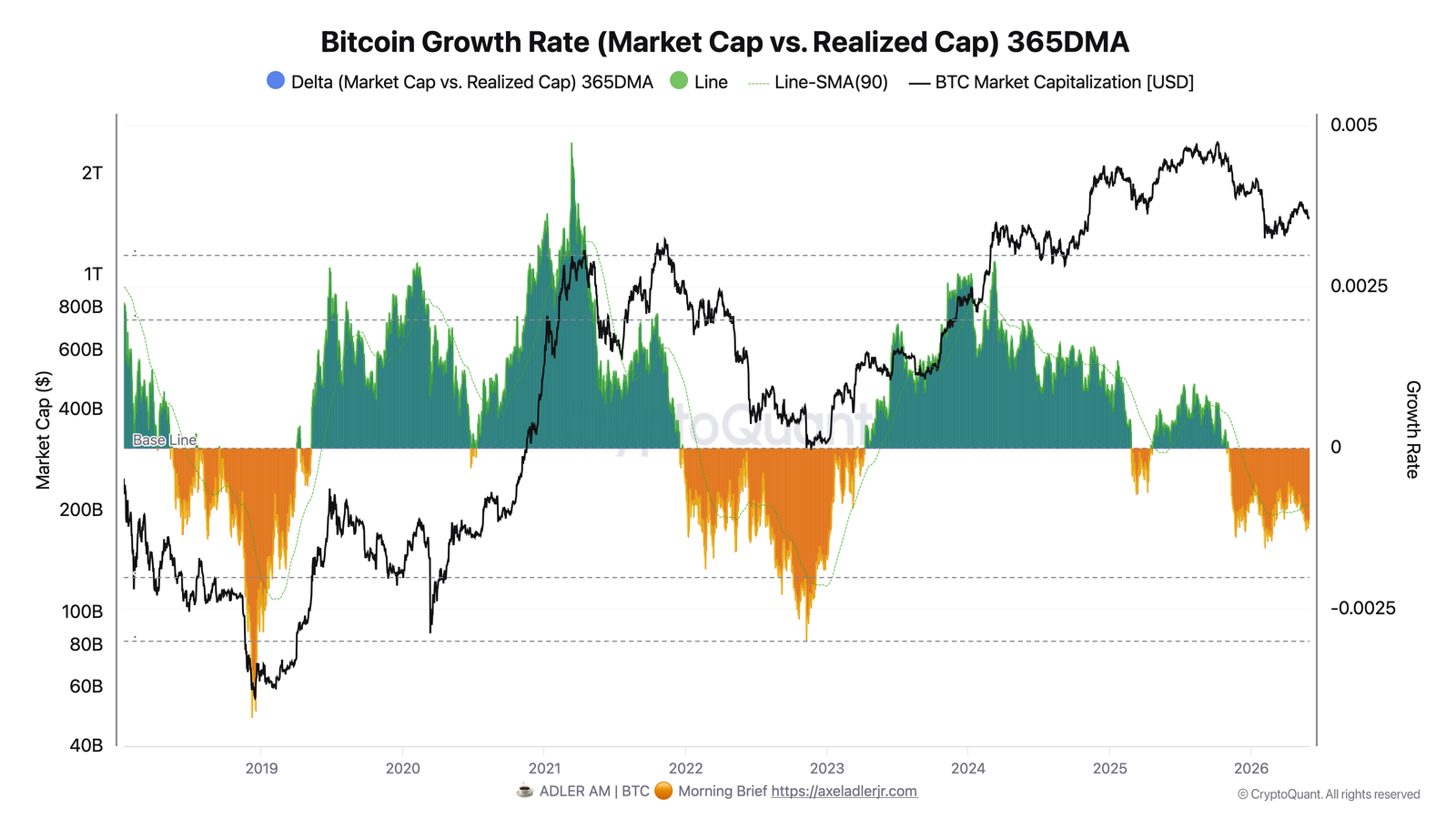
Bitcoin growth rate based on market cap and realized cap. Source: CryptoQuant
Related: Bitcoin price targets $78K as BTC holders defend ‘strongest near-term support’
Bitcoin enters a “tug-of-war” phase, says analyst
CryptoQuant analyst Maartunn said Bitcoin has spent 114 days trading within a broad range of $60,000 and $80,000, while the Bitcoin volatility index has dropped toward multi-month lows near 0.90.
According to Maartunn, similar periods of compression have historically preceded 10% to 20% moves once the price range breaks.
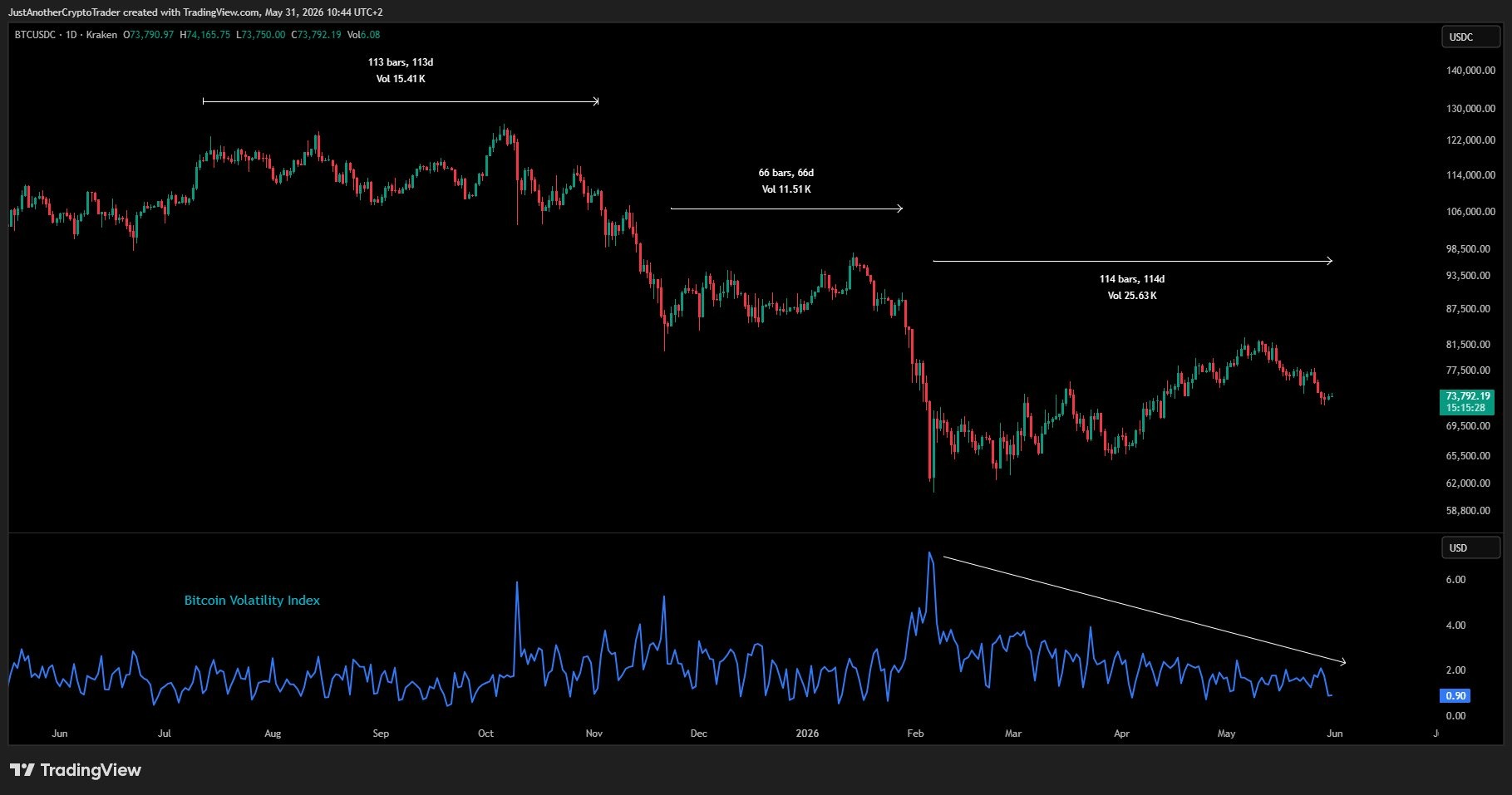
BTC price and volatility index analysis by Maartunn. Source: X
MN Capital founder Michael van de Poppe remained bullish on BTC, stating the current area as a key support zone. Van de Poppe said,
“If history repeats itself, that means that we’re going to see two great weeks of upwards momentum for Bitcoin and the end of this correction. It’s a crucial support zone for Bitcoin, which needs to hold in order to prevent a test at $61,000 to happen.”
Meanwhile, CryptoQuant analyst Amr Taha pointed to a growing split in market behavior. Binance’s 30-day Bitcoin inflows rose by roughly $5.6 billion since April across both retail and whale cohorts. Retail inflows increased by $3.6 billion, surpassing the $2 billion rise from whale wallets.
At the same time, wallets holding between 1,000 and 10,000 BTC accumulated 55,450 BTC on May 30, marking their strongest accumulation activity since February. Taha added,
“For Bitcoin, this points to a tug-of-war phase. Exchange inflows are increasing, which may create near-term selling pressure, but large wallet accumulation is also returning, which could provide underlying support if demand remains strong.”
Related: Trump says Iran will ‘work out well’: Five things to know in Bitcoin this week



Last week, tens of thousands of crypto wallets pledged over half a billion dollars worth of digital assets for SpaceX shares, and received none. Unfortunately, the industry’s tokenized stock failure was a repeat performance.
For nearly a decade, thousands of crypto promoters have insisted that blockchain technology will deliver tremendous value through tokenized trading of equities.
However, despite wholehearted attempts and financial support from the industry’s largest companies, trading volumes of tokenized stock remain well below a fraction of one percent of traditional stock trading volumes.
Indeed, last week, 27,689 wallets pledged $557 million worth of digital assets to participate in a tokenized version of the SpaceX IPO via Binance alone.
Across listings on various crypto exchanges, including Bybit and Bitget Wallet, all of those orders failed to deliver SpaceX shares.
For years, crypto pitched its technology as an obvious efficiency improvement over slow and expensive clearinghouses, not to mention the benefit of widenening the pool of liquidity to a global audience that struggles to open traditional brokerage accounts.
It just never worked. Again and again, promoters’ sales pitches failed to live up to the promise.
On June 12, the day SpaceX debuted on Nasdaq, Binance, Bybit, and Bitget Wallet all canceled their pre-IPO tokenized SpaceX campaigns.
By then, customers had committed more than $1 billion but got none of the shares they wanted.
Backed Finance’s xStocks, the tokenized-equity issuer acquired by crypto exchange Kraken, seemed to be a root of the problem. When xStocks could not source its underlying shares, crypto contracts around the world failed. In a representative apology, Bybit admitted, “Due to xStocks’ inability to deliver the underlying assets, no SpaceX allocations were received.”
Binance blamed similar circumstances beyond its control.
Crypto’s pattern of tokenized stock failures
The excuse, as always, was that the blockchains worked fine, if only the traditional finance plumbing would have just cooperated.
As early as December 2020, Do Kwon’s Mirror Protocol launched tokenized stocks, allowing traders to buy “mirrored” versions of Apple and Tesla stock with no brokerage account.
Although the value of mAssets had already vaporized alongside Kwon’s Terra LUNA implosion in May 2022, the SEC later described those mirrored assets (mAssets) as unregistered “security-based swaps.”
By 2023, commissioners belatedly sued Terraform Labs and Do Kwon for violating US securities laws.
Read more: Binance draws heat in Europe for stock tokens, lists MicroStrategy anyway
In 2021, crypto pitched tokenized stocks again; and again they failed.
Binance launched tokenized Tesla, Coinbase, and MicroStrategy stocks through German broker CM-Equity. FTX, meanwhile, ran a near-identical offering through the same German broker.
Regulators objected within weeks, and both exchanges backpedaled quickly.
Binance pulled those tokenized offerings by July 16, with support ending that October. FTX’s stock tokens were also gone well before the Sam Bankman-Fried fraud collapsed in November 2022.
This year, Binance’s tokenized SpaceX campaign pulled in roughly $557 million in USDC from over 27,000 wallets, and delivered no shares.
It refunded users their pledges and promised an airdrop as a consolation prize. Bybit similarly refunded customers.
Despite years of marketing, crypto technologies still have not brought tokenized stocks to the masses.
Got a tip? Send us an email securely via Protos Leaks. For more informed news and investigations, follow us on X, Bluesky, and Google News, or subscribe to our YouTube channel.

The team behind Pi Network has remained consistent in its efforts to expand the ecosystem and strengthen the community through new initiatives and upgrades.
PI’s price has finally staged a decisive rebound, mirroring the bullish conditions of the broader crypto market following the peace deal between the USA and Iran.
What Happened Lately?
The Core Team has been quite active lately, completing major milestones on several fronts. At the start of the month, they disclosed the successful transition to protocol v24, an upgrade primarily focused on improving the underlying infrastructure supporting node operations and mainnet activity.
Most recently, Pi Network updated the participation and flow model for the Pi Launchpad, allowing Pioneers to test a second token called “SLICE” for two weeks. The platform is designed to help new projects grow and reach the community. It uses insights gathered from the first testnet token that began testing on PiDay 2026 (March 14).
The team revealed that more than 478,000 Pioneers participated in the initial Launchpad testing and “generated valuable feedback on the Launchpad mechanism.” It also detailed the steps for those who wish to join. They must open Pi Launchpad in Pi Browser, review the SLICE test token and project, choose a commitment amount in Test-Pi, confirm participation, and finally engage with the Slice of Pi app and provide feedback.
In addition to these efforts, Pi Network also made progress in the gaming sector. As CryptoPotato reported, CiDi Games (an entity part of the ecosystem) released four new games for Pioneers. Those include Coin Whack, Fruit Stack, Gemnova, and RainbowCubes. Earlier today (June 15), one X user revealed that CiDi Games had reached a milestone of over 6 million PI staked in its ecosystem and hinted at an announcement of a new game next week.
Waiting for These
Pi Network’s next big update appears to be the transition to protocol v25. The team initially set June 18 as the completion deadline but later clarified that it might need more time, indicating a likely delay.
Another highly anticipated event in the Pi Network community is Pi2Day, celebrated on June 28 (6/28) because it represents the mathematical constant 2π.
Speculation is mounting that the team may announce a major ecosystem update, launch new features, or even a listing on Binance. However, nothing is confirmed, and we’ll have to see whether the day will bring anything meaningful at all.
PI Price Outlook
Earlier this month, PI’s price crashed below $0.12, marking the lowest level in its history. Over the past few days, though, it has followed the broader crypto market’s resurgence and now trades at around $0.14, representing a 4% weekly increase.
The bulls are now hoping for a further rally, which will largely depend on whether Bitcoin (BTC) and the leading altcoins can sustain their positive momentum. Meanwhile, the reduced token unlocks and some other important factors also suggest that PI’s valuation may post additional gains in the near future.
The post Pi Network News and PI Price Update Today: June 15 appeared first on CryptoPotato.

Key Highlights
- Salesforce has entered into an agreement to purchase AI agent specialist Fin, previously known as Intercom, in a transaction valued at $3.6 billion
- The transaction is anticipated to finalize during Salesforce’s fiscal fourth quarter of 2027
- Shares of CRM increased 0.8% to reach $167.10 on Monday, potentially breaking a nine-day decline
- Fin operates its own AI technology platform, Apex, designed exclusively for customer service applications
- Salesforce’s Agentforce platform reported a 20% increase in annual recurring revenue, reaching $1.2 billion in the company’s fiscal first quarter of 2027
On Monday, Salesforce revealed its plans to purchase Fin, the artificial intelligence agent firm that was previously operating as Intercom, through a $3.6 billion acquisition agreement.
Shares of CRM traded higher by 0.8% to $167.10 during Monday’s session. This uptick would mark the end of a nine-day downward trend. However, the stock remains down 37% on a year-to-date basis.
This strategic acquisition arrives at a time when Salesforce is experiencing increased scrutiny from shareholders concerned that AI-powered coding solutions might enable clients to develop their own customized Agentforce alternatives, potentially diminishing demand for Salesforce’s offerings.
Fin’s flagship offering is an AI agent designed to manage customer inquiries from start to finish. The technology operates seamlessly across multiple communication channels including live chat, email, WhatsApp, text messaging, phone calls, and Slack.
The platform operates using Fin’s proprietary model known as Apex. According to Salesforce, Apex has been specifically engineered for customer support applications and delivers superior resolution rates compared to leading commercial models available today.
Marc Benioff, Chief Executive Officer, described the acquisition as an ideal match. “Fin delivers battle-tested agent technology, a strong dedication to customer satisfaction, and an exceptional AI team that will enhance Agentforce with robust service agent functionalities,” Benioff stated.
Eoghan McCabe, CEO and co-founder of Fin, emphasized that the partnership provides scale his organization couldn’t achieve independently. “Through this combination with Salesforce, we can implement it extensively at a pace we never could have reached working alone,” McCabe explained.
Understanding Agentforce’s Current Performance
Agentforce demonstrated a 20% growth in annual recurring revenue, achieving $1.2 billion during fiscal Q1 2027. The addition of Fin is projected to broaden this platform’s capabilities within customer service environments.
The transaction is scheduled to conclude during Salesforce’s fiscal fourth quarter of 2027, pending specific price adjustment provisions.
Analyst Community Expresses Mixed Views
Rishi Jaluria, an analyst at RBC Capital Markets, acknowledged the strategic merit of the acquisition, particularly for customer engagement purposes. However, he raised several reservations.
“We remain uncertain about certain aspects of the acquisition rationale and recognize that this introduces further integration and execution challenges considering that Informatica, Contentful, and various smaller acquisitions are being incorporated simultaneously,” Jaluria noted on Monday.
Barron’s withdrew its recommendation for Salesforce last week, reversing its original buy rating from December.
The software industry overall has faced headwinds this year from what market observers have dubbed the “SaaSpocalypse” — apprehension that AI agents might diminish reliance on conventional SaaS products.
Heading into this week, Salesforce shares have declined 37% year-to-date.


Standard Chartered is forecasting a major acceleration in how decentralized finance (DeFi) can absorb tokenized assets. In a research note released Monday, Geoff Kendrick—head of digital assets research at the bank—projected that assets actively used in DeFi could expand 37-fold to $2.7 trillion by the end of 2030.
The estimate hinges on a shift in where tokenized value goes once it is issued. Kendrick argued that DeFi protocols could become a key distribution channel not only for crypto-native assets, but also for tokenized real-world assets (RWAs) that are increasingly being developed by traditional finance participants.
Key takeaways
- Standard Chartered expects DeFi-active tokenized assets to reach $2.7 trillion by 2030, implying a 37x increase from current levels.
- The forecast depends on both tokenized RWAs and crypto-native assets finding their way into onchain lending, trading, and other DeFi use cases.
- According to Kendrick, only 3% of stablecoins and 10% of tokenized RWAs are currently used in DeFi.
- Standard Chartered projects tokenized asset usage in DeFi rising to about 30% by end-2030, from roughly 3.5% today.
- The bank points to Uniswap as a possible hub for tokenized markets, though other researchers warn tokenization alone doesn’t solve liquidity fragmentation.
Standard Chartered’s 2030 DeFi absorption forecast
Kendrick’s central claim is that DeFi could be the next major engine for “generational wealth” in digital assets. He estimated that the amount of tokenized assets active in DeFi will grow 37x by the end of the decade.
While tokenization is often discussed as a way to bring real-world finance onto public blockchains, the investment question is how that tokenized value translates into real onchain participation. Kendrick’s projections address that by focusing on usage rates—how much of the overall tokenized supply is actually deployed inside DeFi protocols.
Per the research note, only 3% of stablecoins and 10% of tokenized RWAs are currently used in DeFi. Standard Chartered expects those tokenized shares to rise sharply over the next several years, with the portion of tokenized value used in DeFi projected to reach 30% by end-2030, up from about 3.5% today.
The scale of the jump is important: growing the absolute figure to $2.7 trillion would require both (1) rapid growth in total onchain tokenized assets and (2) a near ninefold increase in the share of that tokenized value being put to work in DeFi.
Why tokenized value may not automatically become liquid
The bank’s outlook reinforces the broader institutional argument that tokenization could re-route capital flows toward onchain systems. However, the path from issuance to deep markets is not straightforward.
The research note acknowledges—and the wider debate around tokenization highlights—that tokenization does not inherently guarantee liquidity or a unified market structure. Other researchers have warned that tokenized assets can still trade in ways that remain fragmented across ecosystems.
Earlier coverage from Cointelegraph noted concerns raised by Axis CEO Chris Kim that issuing the same asset across multiple blockchains and formats can create “siloed liquidity,” leading to pricing gaps and higher costs. In practical terms for traders and liquidity providers, that fragmentation can make it harder for market participants to find consistent pricing and for liquidity to pool efficiently—even if total market value grows.
Similarly, Oya Celiktemur of Ondo Finance told Cointelegraph at Paris Blockchain Week in April that tokenizing an illiquid asset does not “magically” make it liquid. The implication is that deeper liquidity depends on market design, distribution, and the incentives that keep trading and settlement efficient once tokenized assets reach users.
From earlier RWA estimates to a DeFi-centered distribution thesis
Standard Chartered has previously linked tokenization growth to large market expansions. The new DeFi-focused forecast builds on an earlier projection that non-stablecoin tokenized RWAs could grow to $2 trillion by the end of 2028, according to Kendrick—where tokenized money-market funds and US equities are expected to represent much of the projected market.
What’s new here is the emphasis on where those tokenized instruments are used rather than just their total outstanding value. The shift matters because DeFi impact is not measured only by token counts or issuance volumes; it’s measured by how much liquidity and trading activity migrates into onchain protocols that support borrowing, trading, and settlement.
By framing DeFi as a destination for tokenized capital, Standard Chartered is effectively proposing that tokenization’s biggest long-term value creation could be tied to protocol-level adoption—rather than confined to isolated token issuances or simple exposure products.
Uniswap as a potential liquidity bridge for tokenized markets
Alongside the usage-rate assumptions, Kendrick singled out Uniswap as a venue that could play a growing role in trading tokenized assets as more of them move onchain. He pointed to the decentralized exchange’s scale, branding, and track record of operating through multiple crypto cycles.
In his view, these characteristics could be especially relevant for traditional financial institutions that are likely to prioritize security and reliability when integrating tokenized RWAs into DeFi. Kendrick also suggested that if Uniswap is able to “commercialise enough” and form meaningful TradFi partnerships that improve scale, it could strengthen its fee-generation relative to its market capitalization—potentially narrowing the gap with major centralized exchanges.
The bank’s bet on Uniswap aligns with the thesis that tokenized-market liquidity will depend on venues capable of onboarding new assets at meaningful volume. Still, it sits in tension with the liquidity-fragmentation warnings raised by other researchers: even if a venue is technically capable of supporting tokenized assets, liquidity can remain dispersed if the same instruments arrive in multiple formats, across multiple chains, or with mismatched trading infrastructure.
Looking ahead, investors and builders should watch whether DeFi protocols can convert rising tokenization volumes into sustained onchain usage—particularly by tracking how stablecoins and tokenized RWAs distribute across different DeFi activities. The key uncertainty is whether liquidity consolidates around major venues like Uniswap or continues to fragment as tokenized assets proliferate across ecosystems.

Strategy, the publicly listed company controlled by Michael Saylor, added more Bitcoin to its treasury last week, purchasing 1,587 BTC for $100 million while the token traded below the firm’s reported average cost basis.
According to Strategy’s filing with the US Securities and Exchange Commission, the acquisitions took place between June 8 and Sunday. The company reported an average purchase price of $63,024 per bitcoin, slightly lowering its overall average cost basis to about $75,656.
Key takeaways
- Strategy bought 1,587 BTC for $100 million between June 8 and Sunday, per an SEC 8-K filing.
- The purchases were executed at an average price of $63,024 per BTC, reducing Strategy’s average cost basis to roughly $75,656.
- Strategy now holds 846,842 BTC, with CoinGecko valuing the holdings at about $56.1 billion at roughly $66,216 per BTC.
- The latest buy was financed through sales of Strategy’s Class A common stock, while its preferred share programs showed no activity during the week.
- Ongoing discussion around Strategy’s willingness to sell Bitcoin remains tied to its need to fund dividend-style digital credit products.
Another tranche of Bitcoin purchases
Strategy’s newest move reinforces its continued accumulation strategy, even as market prices sit under its average entry cost. The company’s SEC 8-K states that it acquired 1,587 BTC for $100 million during the period spanning June 8 through Sunday.
At an average acquisition price of $63,024, the buy occurred at a level materially below Strategy’s average cost basis of approximately $75,700 referenced in the filing details. After this round, Strategy’s overall average cost basis fell slightly to $75,656.
Where the company’s Bitcoin stands today
With the latest acquisition, Strategy’s total Bitcoin holdings reach 846,842 BTC, accumulated at a combined cost of $64.07 billion. Based on CoinGecko market pricing of about $66,216 per BTC, the current value of those holdings is roughly $56.1 billion.
That gap between carrying cost and current market value matters for both equity investors and crypto-focused observers, because Strategy’s balance sheet is built around Bitcoin exposure. When BTC trades below the company’s average cost basis, each incremental purchase can help reduce that average—though it does not automatically offset the unrealized difference in value unless the market moves meaningfully higher.
Financing the buy through MSTR share sales
Strategy’s filing indicates that the purchase was funded similarly to its prior additions: by selling shares of its Class A common stock rather than relying on activity within certain preferred stock programs.
Specifically, the company said it raised about $209 million by selling 1.73 million shares during the period. It also noted that preferred share programs—including STRC, STRF, STRK, and STRD—showed no activity over the week covered by the filing.
This structure is a key element of Strategy’s approach. Rather than treating Bitcoin accumulation as an isolated treasury action, the company ties growth in BTC holdings to capital markets operations that can provide liquidity for continued buying.
Preferred stock below par and the broader sale debate
While Strategy did not report preferred program activity during the week, outside trackers have continued to highlight market pricing pressure around at least one preferred instrument. According to STRC.live, STRC remained below its $100 par value for a fourth consecutive week as of June 12, lingering in the mid-$96 range and marking the longest stretch below par since its launch.
On Friday, STRC closed at $94.80, down about 1%, according to TradingView data cited via STRC.live.
Separately, the context for why Strategy continues to sell assets to fund Bitcoin buying—and, at times, sell BTC itself—has remained a live issue in the crypto community. The company disclosed its first reported Bitcoin sale in years in connection with an earlier transaction referenced in Cointelegraph coverage: a sale of 32 BTC on June 1. Even though that amount was small relative to its overall holdings, it sparked debate about whether Strategy is shifting away from its historically strict “buy and hold” narrative.
Michael Saylor later defended the rationale, telling Cointelegraph that Bitcoin treasury companies need the ability to sell holdings to support dividend-paying securities tied to its digital credit business.
What to watch next
Investors will likely focus on whether Strategy continues to fund Bitcoin buys primarily through common stock issuance, how preferred programs trade relative to par, and—most importantly—whether future SEC disclosures show continued accumulation at prices that further narrow the company’s cost basis versus BTC’s prevailing market level.
Paradigm has led a $9 million Series A funding round for Latin American payments platform El Dorado as the company expands stablecoin-powered cross-border transfers across underserved markets in the region.
Summary
- Paradigm led a $9 million Series A round for Latin American payments app El Dorado, with Coinbase Ventures and Verda Ventures also participating.
- El Dorado said it serves more than 100,000 active users, has processed over 5 million transactions, and operates across 12 countries in Latin America.
- The company has expanded into business payments on the Tempo blockchain, onboarding more than 100 corporate clients and supporting cross-border trade flows, including electric vehicle imports from China.
According to a June 15 announcement from Paradigm, the investment was made alongside Coinbase Ventures and Verda Ventures, with the firms backing El Dorado’s effort to build payment infrastructure for cross-border transactions in Latin America.
Ricardo de Arruda, partner for investing and research at Paradigm, said the region handles more than $100 billion in annual cross-border payment volume but continues to rely on systems that are slow, expensive, and difficult to navigate.
“Cross-border payments in Latin America represent one of the most underserved and underreported opportunities in global finance,” de Arruda said.
“The region moves well over $100 billion across borders annually, but is plagued by slow, expensive and opaque infrastructure. El Dorado is building the payments layer this market has long needed.”
Founded in 2022 by Latin American immigrants, El Dorado said it now serves more than 100,000 active users and has processed over 5 million transactions across the region. The company currently operates in 12 countries, including Argentina, Bolivia, Brazil, Colombia, Costa Rica, the Dominican Republic, and Ecuador.
El Dorado targets overlooked payment corridors
Offering a different view of the market opportunity, El Dorado co-founder and CEO Guillermo Goncalvez said in an accompanying statement that the annual cross-border payment activity in Latin America is closer to $1 trillion when broader flows are considered.
According to Goncalvez, roughly 60% of those transactions involve business-to-business payments tied to imports and exports between the U.S. and Latin America. Beyond those well-known routes, he said some of the strongest demand comes from payment corridors that large financial technology firms often overlook.
One of El Dorado’s busiest routes today connects Brazil and Bolivia, a market Goncalvez said remains underserved despite strong commercial activity. He added that countries such as Bolivia, Paraguay, Ecuador, and Peru receive less attention from larger fintech providers including Nubank and Wise.
Alongside consumer payments, El Dorado has introduced a dedicated business platform for companies moving money across borders. According to the company, the service combines fiat and stablecoin payment rails within a single application while supporting multi-signature and multi-organization account structures.
Goncalvez added that more than 100 business customers have joined the platform, with imports of electric vehicles from China emerging as one of the most common use cases.
Built on Tempo, a Layer 1 blockchain developed through a partnership between Paradigm and Stripe, the service forms part of a payment infrastructure strategy both organizations have been developing this year. Josh Itzkovitz, GTM at Tempo, said the network allows businesses worldwide to open accounts regardless of whether they maintain a U.S. legal entity.
The investment also adds to Paradigm’s growing activity outside traditional crypto venture funding. In recent months, the firm has backed manufacturing company SendCutSend in a $110 million funding round, partnered with Stripe on the Tempo blockchain network, and participated in policy discussions surrounding stablecoin regulation in the U.S.
Earlier this month, Paradigm submitted comments to the Federal Deposit Insurance Corporation urging regulators not to restrict third-party stablecoin reward programs, arguing that such limitations extend beyond what Congress approved under the GENIUS Act. Those efforts, together with the launch of Tempo and the El Dorado investment, place stablecoin-based payment infrastructure at the center of several of the firm’s recent initiatives.
Crypto World
Wallet V Launches Public Performance Benchmark for AI Trading Agents on Hyperliquid and Aster


Wallet V, a self-custody Web3 wallet, launched a public performance benchmark for the AI trading agents that its users have configured on the third-party decentralized derivatives platforms Hyperliquid and Aster. The benchmark publishes aggregate cohort performance and is hosted on the Wallet V website.
The benchmark covers 688 agents created by Wallet V users over the prior two months. Each agent was configured by the user, used a large language model selected by the user to generate trading decisions, and executed on Hyperliquid or Aster. Wallet V aggregates the on-platform performance of those agents by underlying model. Performance is refreshed as new agents are deployed.
The cohort spans seven large language model families. Across the cohort, 42 percent of agents recorded a profit and loss balance of zero or higher over the period. Peak agent-level return on investment in the dataset ranged from negative 30 percent on the lowest-performing model to positive 307 percent on the highest. Models represented by fewer than 10 agents in the cohort are reported as directional rather than statistically conclusive.
Agents in the cohort executed strategies as perpetual futures across four asset classes available on Hyperliquid and Aster. These include major digital assets such as BTC, ETH, and SOL; equities, including pre-initial public offering equity exposure; commodities including gold, silver, and oil benchmarks; and major foreign exchange pairs. All instruments are accessed through third-party venues.
“At Wallet V, the focus has been on building infrastructure for the next phase of crypto. This benchmark is what that next phase looks like up close. Users now decide which AI model to configure their agent in the same way institutions evaluate managers, by reviewing observable performance over time,” said Adam Cai, Founder & CEO of Virgo Group.
Wallet V plans to extend the benchmark in subsequent releases. Future releases include the addition of newer model families, support for prediction markets, advanced analytics features for copilot trading and personalized AI prompt generation tailored to each user’s trading style.
The Wallet V applications for iOS and Android are available at dl.walletv.io.
About Wallet V
Wallet V is a Web3 self-custody wallet that gives users access to third-party AI models to configure AI agents and execute user-defined trading strategies. The application connects to third-party platforms supporting cross-chain swaps, perpetual futures, prediction markets, and onchain exposure to tokenized equities.
Wallet V is an incubation project by Virgo Group, a digital asset service provider led by CEO Adam Cai. Virgo Group is backed by investors including Draper Dragon, OKX Ventures, Vaulta Foundation, Cobo Ventures, Waterdrip Capital, and Sora Ventures.
Disclaimer
Trading crypto, perpetual contracts, tokenized assets, and prediction markets involves significant risk of loss and is offered by third-party platforms. Wallet V is a software provider that connects to external platforms and does not offer trading services or AI automation tools directly or indirectly. Wallet V does not provide investment, tax, or legal advice. Access to certain products may be restricted in some jurisdictions.
The post Wallet V Launches Public Performance Benchmark for AI Trading Agents on Hyperliquid and Aster appeared first on BeInCrypto.

Eric Trump says viral screenshots showing him asking UFC commentator Daniel Cormier whether White House fights were rigged are AI-generated fakes. Cormier posted the alleged messages, deleted them within minutes, then questioned the uproar.
The dispute erupted around UFC Freedom 250, staged on the White House South Lawn on June 14. Neither side has produced platform data, so the authenticity of the exchange remains unresolved.
What the Alleged Messages Showed
The screenshots depicted an Instagram-style chat in which Eric Trump appears to probe Cormier for an edge before the fights.
He allegedly asked about injuries, wagering, and then whether any bouts were rigged, singling out the Diego Lopes featherweight fight and adding a “$$” symbol.

Cormier, a former two-division champion and lead UFC analyst, replied that he cannot bet and that nothing was fixed.
The card ran during a Trump-linked White House event marking the country’s 250th anniversary and the president’s 80th birthday.
The fight he allegedly named was real. Lopes, a former two-time title challenger, opened the South Lawn card on June 14 and stopped surging contender Steve Garcia by second-round knockout.
Denials Versus Eyewitness Accounts
Eric Trump addressed the matter directly on X (Twitter), tagging the UFC and Dana White.
“We are aware of the fake, AI generated screenshots being circulated online. I have never spoken to Daniel. He has since deleted his post, which confirms it was clearly fabricated,” wrote Trump.
Follow us on X to get the latest news as it happens
He went further in comments to the Wall Street Journal, denying the conversation ever happened.
Kimberly Benza, a Trump Organization communications director, also called the images fabricated.
However, MMA writer Adam Martin said he saw Cormier’s post live before deletion, and a community note argued that deleting a post does not prove the messages were fake.
The UFC has not commented publicly.
Trump’s AI defense is not far-fetched. AI deepfake misinformation has scaled quickly, with deepfake-related crypto scams driving losses of more than $200 million in the first quarter of 2025 alone.
The alleged request landed amid mounting scrutiny of wagering on real-world outcomes.
One Polymarket trader recently netted about $1 million on bets on Google searches, and platforms have since tightened prediction market insider rules after a string of suspicious payouts.
The post AI Fake or Genuine Leak? Viral Eric Trump UFC Messages Trigger Online Firestorm appeared first on BeInCrypto.
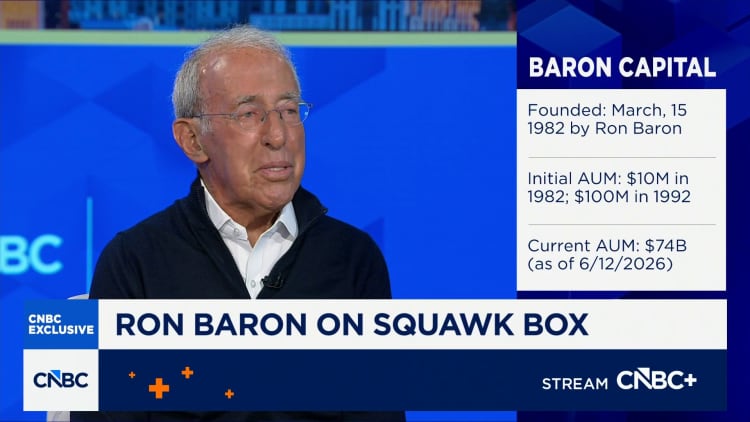

Early SpaceX investor Ron Baron wasn’t taking profits during its blockbuster stock-market debut. He was buying more.
The billionaire investor said Baron Capital purchased an additional $1 billion worth of SpaceX shares Friday during the company’s initial public offering, increasing the firm’s position in Elon Musk‘s rocket and satellite company to roughly $25 billion.
The purchase marks a fresh vote of confidence from one of SpaceX’s earliest and most enthusiastic institutional backers, even after the company’s valuation soared to $2 trillion.
“I think we’re going to make hundreds of billions of dollars,” Baron said Monday on CNBC’s “Squawk Box.” “What they’ve done isn’t possible for anyone else to accomplish. Not possible. And so he’s at least 10 years ahead of everyone else, as far as making satellites, as far as making rockets, as far as building networks.”
Baron said he participated in the IPO to maintain his firm’s ownership percentage as the company sold new shares to the public.
“I didn’t want to get diluted,” Baron said. “I wanted a billion dollars to keep our percentage the same … I’m an investor in a business. I’m not buying and selling or trading.”
Baron first invested in SpaceX in 2017 through employee tender offers when the company was valued at less than $22 billion and has since participated in 27 funding rounds.
As of March 31, SpaceX accounted for 33% of assets in the $10.4 billion Baron Partners Fund and 25.5% of the Baron Asset Fund. Combined with the firm’s sizable position in Tesla, about half of the assets in some Baron portfolios are tied to companies led by Musk.
Baron acknowledged that SpaceX’s valuation has climbed dramatically since his initial investment, but said he believes the company’s growth potential remains vastly underappreciated.
“I think that with now being valued at $2 trillion, I think it’s going to be valued in 10 years at $20 trillion, $30 trillion, $40 trillion,” Baron said.
The veteran investor argued that Musk’s ambitions extend beyond building a successful aerospace company.
“Normally, our economy doubles roughly every 10 years,” he said. “What he thinks is, by the innovations and the work that he’s doing, he’s going to make the economy grow 10 times in 10 years, not double.”


Bitcoin treasury companies may need to revisit their capital structures if Bitcoin remains under pressure, with consolidation becoming more likely across the sector, according to Strive Chief Investment Officer Ben Werkman.
Summary
- Strive CIO Ben Werkman said prolonged Bitcoin weakness could push some treasury companies toward consolidation, particularly those carrying debt funded accumulation strategies.
- Werkman pointed to balance sheet restructuring efforts at firms such as Nakamoto and cited Strive’s acquisition of Semler Scientific as a sign of what could follow.
- He also defended Strategy’s recent sale of 32 BTC, saying it helped demonstrate Bitcoin’s liquidity even as the company continued expanding its holdings to 846,842 BTC.
Speaking at BTC Prague, Werkman said companies that relied heavily on convertible debt during the bitcoin treasury boom could face increasing strain if Bitcoin remains far below its October peak near $126,000.
While higher Bitcoin prices would ease many of those concerns, he said an extended downturn could leave some firms with difficult choices. Under those conditions, companies may need to sell Bitcoin to fund operations or manage debt obligations, particularly where financing arrangements include collateral or coverage requirements.
Werkman said Strive was “one of the only ones that didn’t take any convertible bonds” when building its bitcoin treasury strategy, explaining that the company relied on equity financing instead. According to him, that approach has allowed Strive to continue expanding through the current market cycle without facing the same pressures as some debt funded peers.
Consolidation could accelerate if market weakness continues
Among the outcomes he expects, consolidation sits near the top of the list.
Pointing to Strive’s acquisition of bitcoin treasury company Semler Scientific, Werkman said more mergers could emerge if financially constrained firms seek alternatives to operating independently. He added that company leaders are often reluctant to sell at discounted valuations, which has limited deal activity so far.
In Semler’s case, Werkman said the transaction came together because Semler Scientific Chairman Eric Semler supported the preferred-stock model that Strive had been developing, even though the proposal failed to gain enough shareholder support at Semler itself.
Elsewhere in the sector, firms have already started adjusting their balance sheets. Werkman cited efforts by Nakamoto to reduce debt burdens and regain operating flexibility, describing those moves as attempts to free companies from financing constraints that accumulated during more favorable market conditions.
The comments arrive as investors continue to examine how bitcoin treasury firms balance aggressive accumulation strategies with debt servicing requirements and shareholder obligations.
Recent developments at Strategy illustrate that debate.
Earlier this month, the company disclosed the sale of 32 BTC, a move that attracted attention because of its long-standing commitment to accumulating Bitcoin. The transaction raised roughly $2.5 million at an average price of $77,135 per coin, according to previous crypto.news reporting.
Questions about the sale intensified after some market participants interpreted it as a departure from Strategy’s accumulation strategy. Company executives later rejected that view.
Strategy CEO Phong Le said the sale was conducted as a test of internal systems rather than a move to generate cash for dividend payments. He added that the company still had access to funding channels such as equity issuance and preferred stock offerings.
Strategy’s bitcoin sale draws attention from treasury firms
Discussing the transaction, Werkman said the sale carried significance beyond its size because it helped demonstrate Bitcoin’s liquidity to credit markets and rating agencies.
According to him, rating agencies currently assign Strategy a rating that effectively treats the Bitcoin on its balance sheet as having no value when assessing creditworthiness. Under those conditions, proving the ability to sell Bitcoin and convert it into cash becomes important for treasury companies that maintain dividend obligations.
He argued that Strategy needed to show investors and lenders that the market could absorb Bitcoin sales if necessary and that the company could access that value when conditions required.
The sale did not prevent Strategy from continuing its accumulation program.
On June 15, Michael Saylor announced that Strategy had purchased 1,587 BTC for approximately $100 million, increasing total holdings to 846,842 BTC. The company also expanded its cash reserve by another $100 million, bringing total dollar reserves to $1.1 billion.
Previous crypto.news reporting noted that Strategy had raised its cash position to $1 billion after acquiring 1,550 BTC during the first week of June. With another purchase now completed, the company has continued adding Bitcoin while simultaneously increasing liquidity.
For Werkman, that approach supports a practical reality facing treasury companies. He said firms cannot build balance sheets around a single asset while refusing to use that asset under any circumstances. In his view, occasional sales, when required, help demonstrate Bitcoin’s resilience as a treasury asset rather than undermine the long-term strategy behind holding it.

Neha Nagar On Why Having A Child Needs Financial Planning

Teacher guilty of sexual abuse and murder of baby who was treated as ‘plaything’

Microsoft Copilot Down Today? Copilot Experiences Widespread Outages as Users Report Access Issues


-

 Business24 hours ago
No Jackpot Winner as $257 Million Prize Rolls Over to $269 Million Monday Draw
-

 Crypto World4 days ago
Oppenheimer backs SpaceX as $70 billion retail frenzy builds
-

 Crypto World4 days ago
Markets Rally as SpaceX IPO Looms Amid Iran Tensions and Inflation Surge
-

 Fashion3 days ago
Weekend Open Thread: Tuckernuck – Corporette.com
-

 Sports7 days ago
FIFA WC 2026 Group C: Morocco, Scotland challenge Brazil’s hunt for glory | FIFA World Cup 2022
-
 Crypto World16 hours ago
Zimbabwe Requires Crypto Businesses to Register Annually Under New FIU Regulations
-

 Entertainment6 days ago
The Ryan Gosling True Crime Thriller On Netflix That Gets Even Stranger, Stream It Now
-
 Sports6 days ago
Bangladesh beat Australia after 20 years in ODIs, register only their second win over six-time world champions | Cricket News
-

 Tech3 days ago
NanoClaw integrates JFrog registries to secure AI agent downloads
-

 Tech3 days ago
This Week In Security: Microsoft On Microsoft, Register Your Domains, Linux On ARM, And FreeBSD Joins The File Cache Club
-

 Crypto World2 days ago
Bitget enters Argentina’s regulated crypto market through PSAV registration
-

 Politics4 days ago
Politics Home | Healey Resignation Is “Colossal Failure Of Government”, Says Former Labour Defence Secretary
-
 Tech4 days ago
Dutton Ranch star claims they ‘didn’t see any disruption’ on set following Chad Feehan’s exit from Yellowstone spinoff fueled by Taylor Sheridan clash rumors
-

 Tech5 days ago
‘This is Seattle’s position on AI’: City Council votes unanimously to pause big new data centers
-

 NewsBeat4 days ago
El Nino has formed in the Pacific and could set records, forecasters say
-
 Entertainment4 days ago
Donnie Wahlberg & More Heat Up Las Vegas at Circa’s Barry’s Downtown Prime
-

 Sports4 days ago
First Time Since 1971: Australia Register Historic Low In ODI Cricket
-
 Tech4 days ago
Opendoor Ends India Operations, Fueling a Bigger Conversation About AI and Outsourcing
-

 Politics4 days ago
Belfast burns, while Met chief points finger at Iran and Russia
-

 NewsBeat3 days ago
FBI searches office of Ohio voter registration group
You must be logged in to post a comment Login