

On its surface, the national revolt against data centers seems simple: They are a nuisance, and people do not want them in their proverbial backyards. But I haven’t been able to let go of the idea that there must be something much deeper driving the backlash against them, and few other subjects have confounded me more than trying to figure out what to think about it.
Tech
Why Americans are fighting AI data centers


These facilities — the massive suburban and exurban warehouses that power AI, along with much of what we do on the modern internet — spew noise, have been accused of guzzling electricity and water, and have a halo of general ugliness around them. And over the past year-and-a-half or so, many Americans have gone from barely knowing what a data center is to having fiercely held opinions about them. Seventy percent of Americans, according to a recent Gallup poll, now say they would oppose one being built in their area. The environment tops their list of concerns. They’re also disquieted by the idea of high-tech facilities buying up land from America’s farmers and ranchers. Anti-data center campaigns have swept communities across the country, producing dozens of local moratoria on their construction.
- Data centers have rapidly become a flashpoint in communities across the US, with many Americans opposing their construction over concerns about noise, water use, energy use, and other nuisances.
- But the backlash is probably about much more than data centers themselves — they’ve become a proxy for the public’s dread of AI and an uncertain future.
- Instead of fighting data centers one by one, the US needs a broader debate and policy agenda on how AI should be regulated and how to ensure it expands rather than diminishes human agency.
These objections sound public-spirited enough. But as Vox’s Eric Levitz and many others have written, many of the rationales for stopping the buildout of data centers, particularly the environmental case against them, have been overstated (more on that in a moment).
Yet grassroots anti-data center activists are hardly wrong to be worried about artificial intelligence — it is one of the most formidable policy problems we face today. AI’s ultra-wealthy makers promise a world of unprecedented progress and prosperity, but also say they might also eliminate everyone’s job and possibly annihilate humanity in the process.
If you are terrified that AI is ushering in a future that will be miserable to live in, I fully share in that feeling (and would personally prefer to go back to a world before ChatGPT). And I think this sentiment, rather than any ecological anxiety, explains much of why Americans are suddenly fighting to ban the physical infrastructure on which AI and tech more generally depends, why they’re so pessimistic about AI in general, and why college seniors graduating this spring have been booing the mere mention of AI off the commencement stage.
But it’s a problem that stopping a data center locally feels like the only policy lever that an ordinary person can pull right now to try to slow down AI, because it’s a blunt instrument that can’t give us the outcomes we really want. Canceling data center projects town by town is unlikely to meaningfully slow AI adoption, and it certainly doesn’t regulate AI use or protect us from its worst possible outcomes.
Instead, this approach traps us in a debate about relative trivialities rather than about one of our society’s most important questions: how we will manage a technological and economic transformation that’s already happening. And that dysfunction in turn prevents us from seeing any upside to AI and thinking about how we might broadly share it. It is, at bottom, a symptom of the same obstructionism that blocks us from addressing many of the biggest problems of our time, from green energy to housing and so much else, under similarly confused pretexts.
Where the data center revolt is coming from
The great US data center buildout is colliding with a national economic mood that appears to be historically, singularly bad. Americans are angry about the cost of living, afraid for their futures, increasingly mistrustful of each other, and don’t trust our institutions to solve the problems we face. They despise (it probably goes without saying) Big Tech. Majorities of the public say that AI will do more harm than good in daily life, that it will take away their economic opportunities, that government is not doing enough to regulate it. Young people are particularly fixated on the impacts of AI, and they seem positively miserable about it.
It’s little surprise Americans feel such a dread of AI; Congress has introduced dozens of bills to govern the technology but has failed to pass any comprehensive legislation. With no federal regulation apparently forthcoming that would, say, provide a measure of economic security to the tens of millions of workers who could be replaced by AI in the coming years, it’s perhaps no wonder that there’s been such vigorous backlash against the physical manifestations of the tech.
Surely, then, at least some of the reasons that data centers are being pigeonholed as an ecological issue is that people are searching for legitimate-feeling reasons to try to stop this runaway train. The tendency to fall back on reasons that can be metabolized by the policymaking processes that ordinary Americans can actually influence, like environmental review, has been inherited from the environmental protection laws embraced across the country beginning in the 1970s, when pollution had become a visible public crisis. But just as when environmentalism is weaponized to block new housing or high-speed rail or in support of whatever other garden-variety NIMBY cause, the ecological argument for shutting down AI mostly withers under scrutiny.
Like all economically important industries, data centers and AI certainly have real environmental impacts. These facilities use a lot of electricity, and much of it comes from fossil fuels because most US electricity is still derived from fossil fuels. Their electricity use will grow quickly as demand for AI tools increases.
But years of covering one of the world’s most underrated environmental menaces — agriculture, especially animal agriculture — have taught me to be skeptical of contextless claims about how much water or energy any particular industry uses. The planetary harms of data centers aren’t radically out of proportion to what we would expect from an industry that is increasingly important to daily life and the economy; computing is far less intensive in energy and physical resources than many other things we do and many of the activities it stands to replace, AI researcher Andy Masley has pointed out repeatedly. Data centers’ water use, meanwhile, amounts to a tiny fraction of all US water use, and there is not much evidence that they’re going to cause water scarcity issues even in arid parts of the country. In cases where a data center replaces, say, farmland growing water-intensive cattle feed crops in dry regions of the US, it might even benefit the environment.
I never want to sound glib about the future of our planet, nor do I want to take too far a detour into the political philosophy of how we decide whether an industry’s resource use is “worth it.” But I think it’s fair to say that campaigning against data centers on ecological objections is a dead end, if we are serious about finding a policy response to this technology that addresses the true concerns around it. An environmental frame may even be a gift to the AI industry, because the industry can defend itself on that ground pretty straightforwardly. Even data centers’ dependence on fossil fuels, one could argue not entirely unreasonably, is a problem for policymakers to solve by accelerating the buildout of renewable energy.
The AI debate we’re not having
So what, then, are we to with AI concerns if not taking them, converted into gigawatts and gallons, to the local planning commission meeting?
I wrestled with that question as I read Techno-Negative: A Long History of Refusing the Machine, Thomas Dekeyser’s recent book on the long human lineage of attempting to destroy the technologies that reshape the way we live, from the ancient Greeks, who, much like contemporary dread of AI, worried that machines could eclipse human agency, to computer arsonists in the 1980s. Dekeyser, who is a lecturer on human geography at the University of Southampton, writes that technological progress has always been a “political battlefield” where the purpose of human life is contested.
How can technology be used to make our society freer and more equal, and to augment human agency, rather than diminish it?
The fight to choke off data centers represents the latest expression of that struggle to define what it means to be human in the face of technological change, of what Dekeyser calls the “tenacious, fierce urge to negate life’s technologization.” What is AI, the technology that promises to replace the human mind itself, if not the apotheosis of our fears of being made obsolete? To the median American, data centers might feel like a manifestation of the forces that want to take all their power and relevance away from them.
Yet widespread cynicism about AI, I think, doesn’t stem from any inherent property of the technology itself, but rather from our politics. The public has not been offered any credible political vision of a future where AI could be deployed to support human flourishing, nothing that can offer a satisfying answer to the most important questions about our relationship with technology. As Dekeyser writes: “Do they constitute and expand, or undermine, human subjectivity?”
In this way, political possibilities shape the way we feel about technology: Imagine if, for example, instead of the prospect of widespread economic disenfranchisement, the productivity gains from AI could be harnessed to pass a four-day (or, hell, even three-day) work week, or to finance a generous universal paid leave policy. The US, as the richest country in the world and an undisputed leader in AI, certainly has the leverage to enact such policies. We could also give workers power over how AI is deployed in their workplaces, or incentivize AI development in a direction that expands, rather than replaces, human creativity. Or, as Sen. Bernie Sanders proposed this week, give the public a direct ownership stake in the technology itself, created by a tax on AI companies.
Whatever you think of these ideas, we’d be better off debating their merits and thinking through the particulars of how they might be implemented than fixating on individual data centers. But because an ambitious national AI policy feels unimaginable right now, and so of course people see AI as all downside and no upside. But simply channeling popular sentiment into local bans on physical infrastructure forecloses debate over the most important aspects of AI before we can even have them, as Holly Buck, an associate professor of environment and sustainability at the University of Buffalo, recently argued.
The politics of local veto has produced many of America’s other major governing failures, too: We can’t decarbonize the economy, solve a structural housing shortage, or absorb a technology as big as AI when local zoning hearings are the only places where the fight is happening and actionable decisions are being made. The essential difference with AI, though, is that on housing or climate change, we already mostly know the policy solutions we need. On AI, that terrain is still much less certain. We don’t yet know what we want from a potentially existentially transformative technology. That calls for real national confrontations with the most important questions: How can technology be used to make our society freer and more equal, and to augment human agency rather than diminish it?
Maybe that future still requires more data centers, many more of them (or maybe we should build fewer of them). Whichever outcome we choose, it should be downstream of a rational and deliberative policy process, rather than a poor simulacrum of the debate we all deserve.

Continue Reading

A new series of images claiming to be the iPhone 18 Pro chassis have been leaked, showing black, blue, and dark cherry red.
It’s always suspicious when a leaker has just a single image of a purported device, but now a series of shots have shown off most of the colors expected for the iPhone 18 Pro.
On Yeux1122’s blog, fellow leaker Lanzk claims to have samples of the aluminum frame for the iPhone 18 Pro. They comprise the back and sides of the phone, and appear to be stamped with “2026” plus some unclear Chinese-language markings.

Dark Cherry looks ever more certain to be one of the iPhone 18 Pro’s colors – image credit: Lanzk
The leaker has shown off one Dark Cherry frame, two black ones, and three of the light blue version. There’s no distinguishable difference between the units when two or three are displayed.
There’s no indication of the source of the components. However, each of the black and light blue ones shown have a small plastic bag that appears to contain a SIM-card tray.
That would suggest that, however they got to the leaker, they may have come from manufacturers in China. There are other countries that still require a physical SIM card, however.
Even if the leak is as accurate as it appears, it may not be the complete set of colors due to be unveiled for the iPhone 18 Pro, and iPhone 18 Pro Max. While the current iPhone 17 Pro ships in three colors, previous rumors have said that the iPhone 18 Pro will return to the norm of having four.
Those four are the ones shown in this leak plus a light silver. If reports correct and there will be a Dark Cherry option, it’s predicted to become a hit just as the iPhone 17 Pro Max’s Cosmic Orange has been.

Black version of the same frame part – image credit: Lanzk
However, some users will be more pleased at the return of a black option. That was last seen with 2024’s iPhone 16 Pro.
In the course of this review, we examined the image in depth. While there was no EXIF data to speak of, there generally isn’t and that’s not a sign of a fake.
There are none of the hallmarks of a photo edit, or generative AI having fabricated the images. The chassis’ internal protrusions are not identical to that of the iPhone 17 Pro, either. We think these are the real thing, unlike data gathered from case manufacturers.
That all said, leaker Lanzk has not previously reported on iPhone colors. However, they have leaked accurately about Apple’s plans for what would ultimately become the MacBook Neo.

The big names in the artificial intelligence industry don’t always get along. We’ve seen lawsuits between AI companies and intense rivalries between leaders that turn into all-out feuds. But it seems that they generally agree on at least one thing: AI should not be used to create biological weapons.
CEOs of some of the world’s leading AI companies signed a public letter this week urging governments to address the risks that could come from bad actors using their technology. The letter encourages Congress to enact laws to improve the tracking of synthetic DNA sequences that could be used to create biological weapons.
Signed by OpenAI’s Sam Altman, Anthropic’s Dario Amodei, Meta’s Alexandr Wang, Microsoft AI’s Mustafa Suleyman, Google DeepMind’s Demis Hassabis and other scientists and AI lab leaders, the letter suggested legislation to require companies that sell synthetic DNA and manufacturers of synthesis machines to thoroughly check “sequences of concern and to verify customer legitimacy before shipping orders.”
The letter, also signed by leaders in the synthetic DNA industry and experts in national security, makes it clear that AI accelerates the threat of biosecurity threats.
“While the issue is not new, the pace of progress in artificial intelligence is. AI systems now outperform Ph.D-level virologists on questions about highly technical laboratory procedures in their own domains of expertise,” the letter states.
“AI systems are improving rapidly, and alongside incredible benefits to science and medicine, there is a real possibility that the knowledge barriers which have historically prevented bad actors from obtaining biological weapons will meaningfully erode.”
The letter has a distinct sense of urgency, requesting that lawmakers implement guardrails swiftly. “This is a rare moment of agreement across stakeholders that are often at odds,” it reads. “We hope policymakers will meet it with decisive action.”

It more than doubles your gaming time while giving you a better grip.

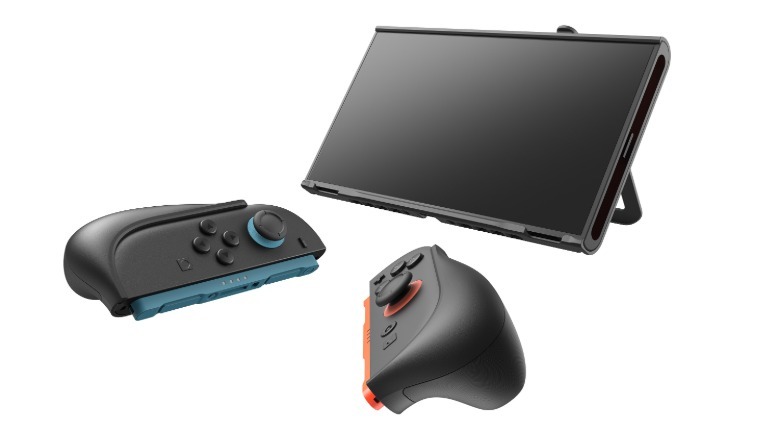
Belkin has introduced a new charging grip for the Switch 2 that lets you game longer and be more comfortable doing it. The Gaming Charging Grip for Nintendo Switch 2 comes with a 10,000 mAh power bank, built-in charging cable and modular grips for the Joy-Cons.
To use it, you slide your Switch 2 into the charger case and snap the modular grips onto the Joy-Con 2s. Once connected via the built-in 30 watt USB-C cable, the power bank can recharge the console 1.5 times, letting you play well over twice as long as without it (150 percent longer, of course). The charging level is shown in a digital display on the back.
 Belkin
The grips are ergonomic and non-slip, Belkin says, and detach with the Joy-Con 2s when you remove them. They look pretty thick, so should support your hands well even if they get a bit slick after some hours of play. On the main charging case, there’s a slot at the bottom so it won’t interfere with the Switch 2’s kickstand.
Belkin also introduced the Travel Bag for Nintendo Switch 2, a cross-body everyday bag for gamers looking for a practical way to tote their console and accessories. It comes with a dedicated soft-lined pocket with a velcro strap, spacious storage, quick-access front pockets and a hidden compartment for trackers.
Belkin loves to experiment with Switch 2 charging, having already released a Charging Case that doubles as a tabletop stand and a Charging Case Pro. The Gaming Charging Grip is now available at belkin.com, Amazon and other retailers for $100 in black, lilac and olive, while the travel bag can be purchased in those same colors for $50.
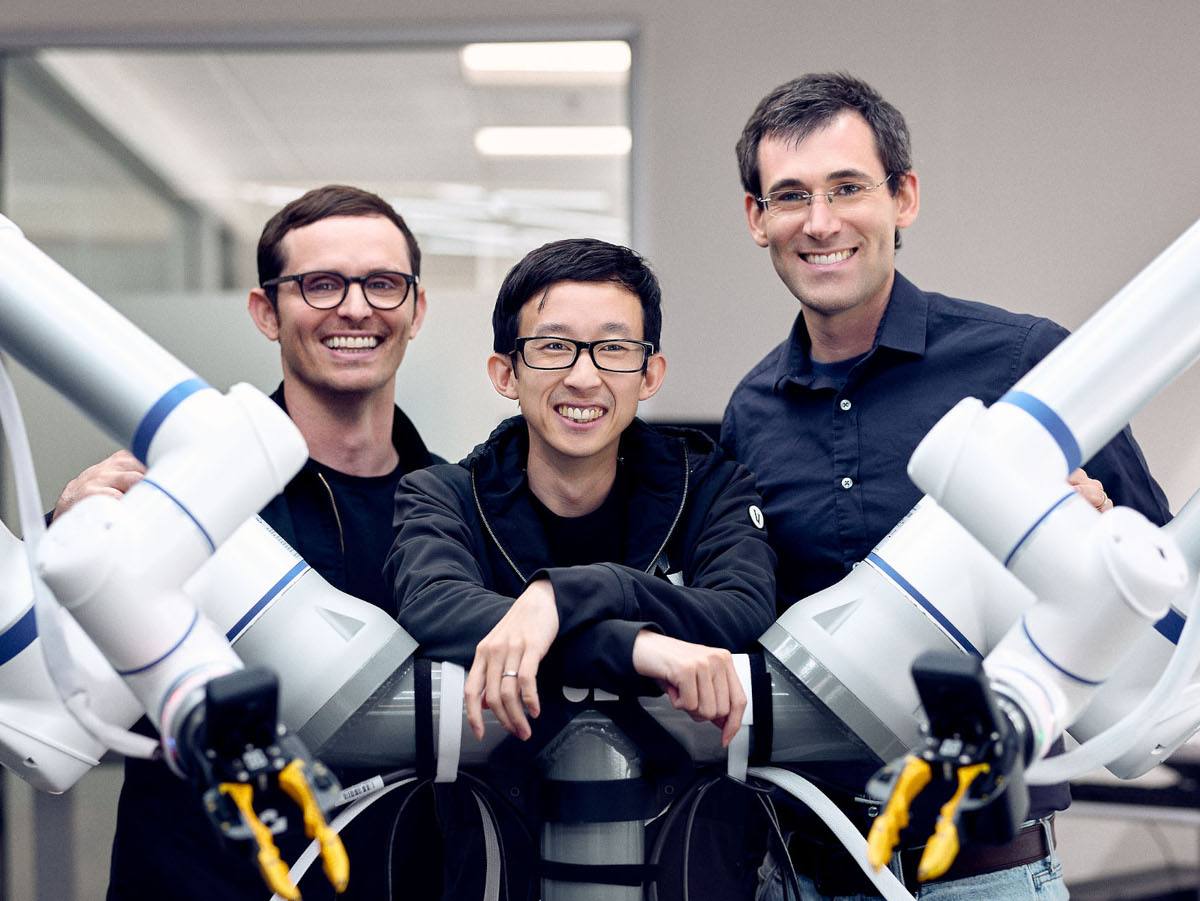

Generalist hopes to make ‘general intelligence’ robotics a reality.
US AI robotics company Generalist has raised $400m at a reported $2bn valuation to accelerate its plans towards achieving “physical” artificial general intelligence (AGI).
The round was led by Radical Ventures, with participation from Nvidia’s venture arm NVentures, Jeff Bezos’ Bezos Expeditions, World Labs founder and leading AI expert Fei-Fei Li, and Zoom CEO Eric Yuan.
Other participants include 8VC, Union Square Ventures, Hanabi Capital, Norwest, Boldstart Ventures, Spark Capital, NFDG and serial entrepreneur Naval Ravikant.
With a team of AI and robotics experts with experience across Big Tech, Generalist hopes to make “general intelligence” robotics a reality.
The company was founded in 2024 by former DeepMind scientists Pete Florence, Andy Zheng, and former Boston Dynamics roboticist and Harvard machine learning scientist Andrew Barry.
Generalist launched its Gen-0 class of AI models last November, which it said was trained on an “unprecedented” scale of real-world data. The company said the model proved that physical experience and larger models could predictably produce more capable systems.
In April, it launched Gen-1, which showed commercial viability, it added. Gen-1 was three-times faster than similar state-of-the-art models, showcasing 99pc reliability on diverse tasks and demonstrated the ability to learn new and complex physical skills, according to Generalist.
“Scaling robot learning creates better models, better models can do more useful physical work, and data from real businesses drives the next generation of more capable models,” the company said in a statement.
The new funding will allow Generalist to continue “scaling robot learning”, including building new models, scaling its physical data engine, expanding compute and training infrastructure and working with industries for commercialisation.
“Our goal is not to tie ourselves to any single method or label. Our goal is to build whatever is needed to make physical AGI real,” said the company.
The exact definition of AGI is difficult to pin down. According to Google, AGI refers to the hypothetical intelligence of a machine that allows it to “understand” or “learn” intellectual tasks that humans can, while IBM calls it the “abstract goal of AI development”, where human intelligence can be replicated by machines or software.
Robotics rise
The robotics industry has gained renewed energy in recent years, fuelled by AI. For the world’s biggest chipmaker Nvidia, robotics represents the biggest market for potential growth after AI.
Last month, Meta acquired US start-up Assured Robot Intelligence to reportedly pursue its plans for humanoid robotic hardware to help with household chores, and Amazon made its own robotics-related acquisition with Fauna Robotics in March.
Meanwhile, Alphabet’s robotics software R&D company Intrinsic joined Google to work in close proximity with DeepMind, as well as tap into Google’s Gemini AI models and cloud services.
Don’t miss out on the knowledge you need to succeed. Sign up for the Daily Brief, Silicon Republic’s digest of need-to-know sci-tech news.
AI apps led App Store growth in 2025, with the entire ecosystem garnering $1.4 trillion in payouts. Apple’s take of that is only 10%, assuming you agree with how they count.
Every year, typically right before WWDC, Apple releases a study showing how the App Store has fared over the prior year. In 2025, the App Store facilitated more than $1.4 trillion in developer billings. And, it said that the App Store ecosystem has tripled in size since 2019.
“Developers are the heartbeat of the App Store, and this year’s incredible milestone is a testament to their boundless creativity,” said Apple CEO Tim Cook.
“We are deeply committed to providing developers with the tools, technologies, and trusted platforms they need to build for the future,” Cook added. “Together, developers are creating apps that enrich the lives of users around the world.”
Commission eligible and ineligible revenue
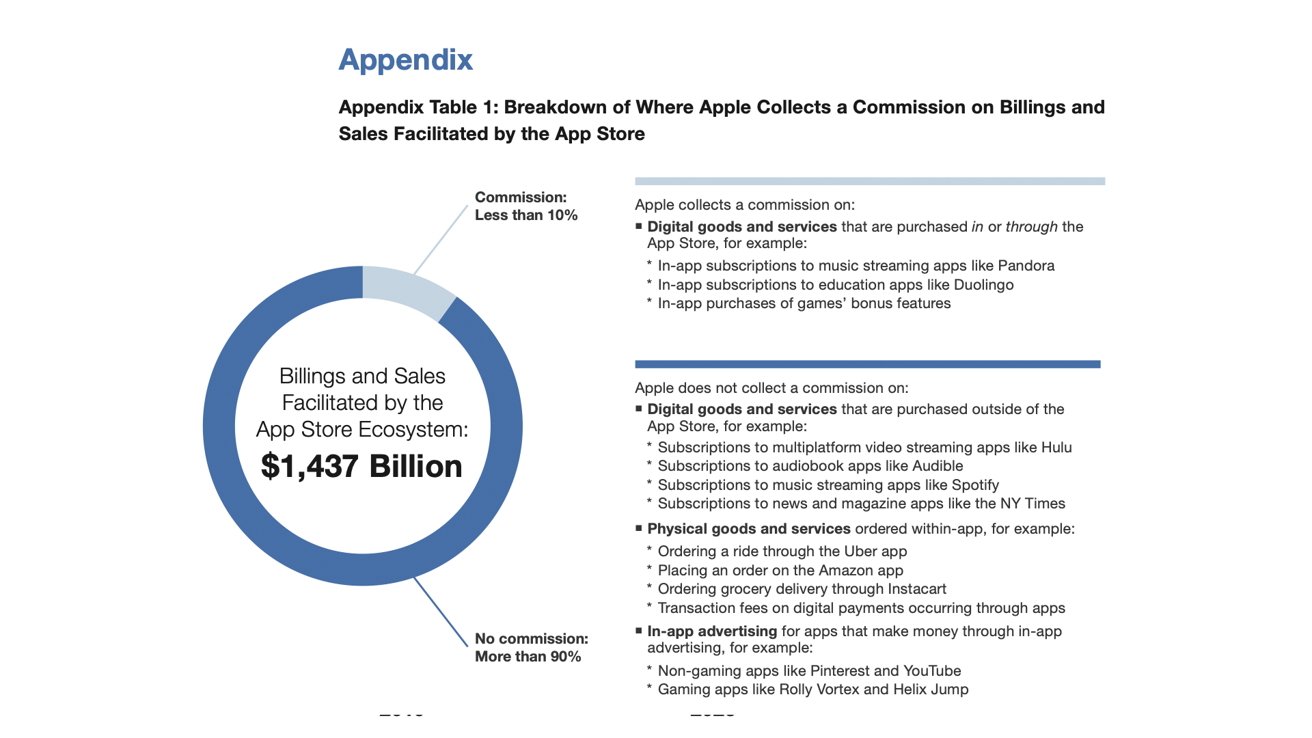
Apple notes that for more than 90 percent of the billings and sales, Apple did not receive a commission. That means that most apps are making money outside of the App Store.
The study reports that 90% of App Store sales are commission-free. The study lists this number as $1,437 billion, or what most people, and Apple, generally call $1.4 trillion.
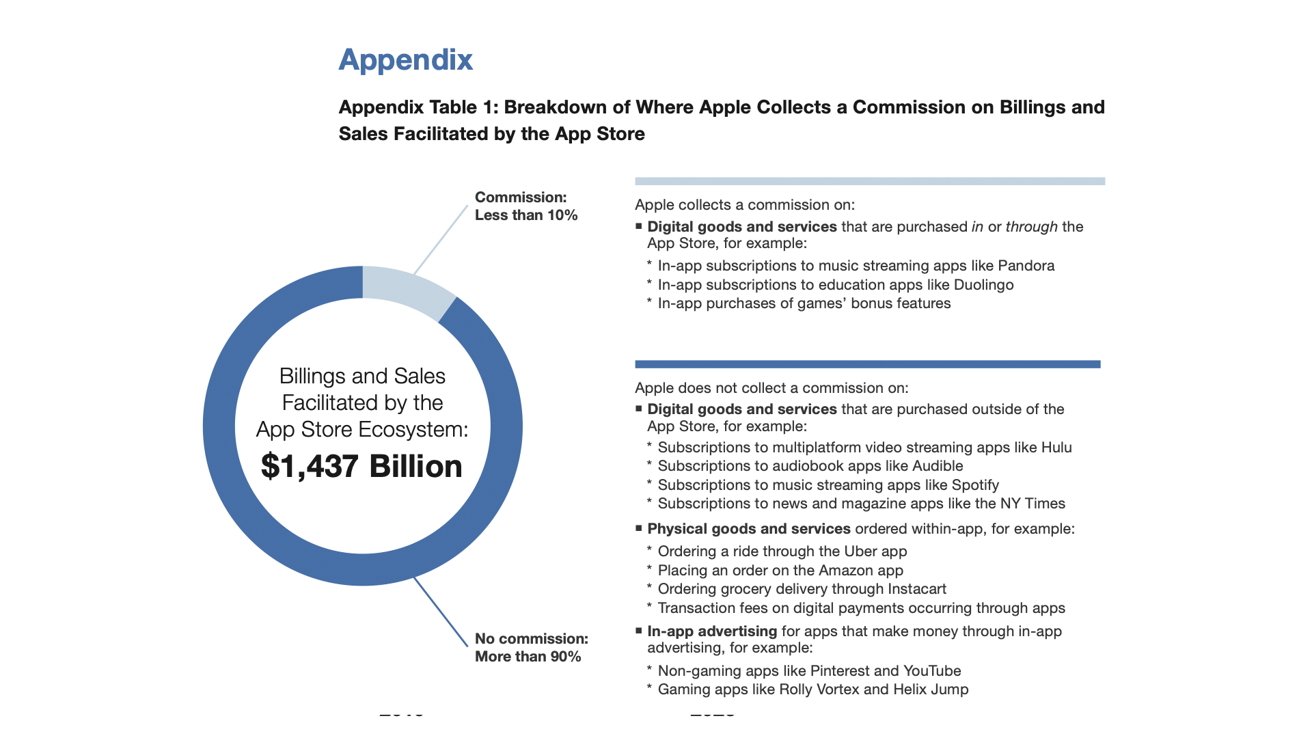
Image credit: Apple & Analysis Group
Interestingly, Apple counts digital goods and services purchased outside the App Store as sales that are not eligible for commissions, but still in the $1.4 trillion total. These include subscriptions to Hulu, Audible, Spotify, and the New York Times.
It’s hard to understand where exactly Apple fits into this. If a person purchases a subscription to, say, YouTube Premium outside of the App Store, but watches it on their Apple TV, does that count in this number?
The methodology mentioned in the study isn’t helpful, either. It reads:
“Sales and distribution of digital goods and services can occur through the App Store in the form of paid app downloads and in-app purchases, through linking out to webstores where content is consumed in-app but payments are made outside of the App Store, or through the sale of digital content and subscriptions from multi-platform apps that allow for the use and consumption of the app, both in the App Store ecosystem and elsewhere.”
It’s unclear whether the data includes purchases made after a user manually enters a website address to buy digital goods, or only purchases made through links accessed via buttons in the app.
The study also doesn’t say where it gets its data, really. A small line reads “data sources include data from Apple, app analytics companies, market research firms, and individual companies.”
So the digital goods and services section is a bit hard to parse. And it accounts for about 10.3% of Apple’s total $1.4 trillion revenue figure, or $149 billion.
Other sources of revenue include physical goods and services, such as buying items on Amazon or ordering delivery through Instacart. Lastly, it mentions in-app advertising revenue, including ads displayed on TikTok, Instagram, and in games.
AI market saturation
This year, Apple is placing special emphasis on artificial intelligence (AI), claiming that apps featuring consumer-facing AI have seen four times the growth of their non-AI counterparts. This specifically refers to the top 100 apps, of which 40 currently have some form of consumer-facing AI.
Of course, it’s hard to tell if AI was the primary growth driver or if the most popular apps were going to integrate AI regardless.
For example, 99% of Fortune 500 companies were using AI in some capacity in 2025. Customer service saw a 2199% growth increase between January 2025 and January 2026.
Global growth, by region
The App Store saw growth worldwide in 2025. And in some regions, that growth has exploded in the last several years.
According to the study, billings and sales facilitated by the App Store have more than doubled in China in the last six years. In that same time period, it’s more than tripled in the U.S. and Europe.
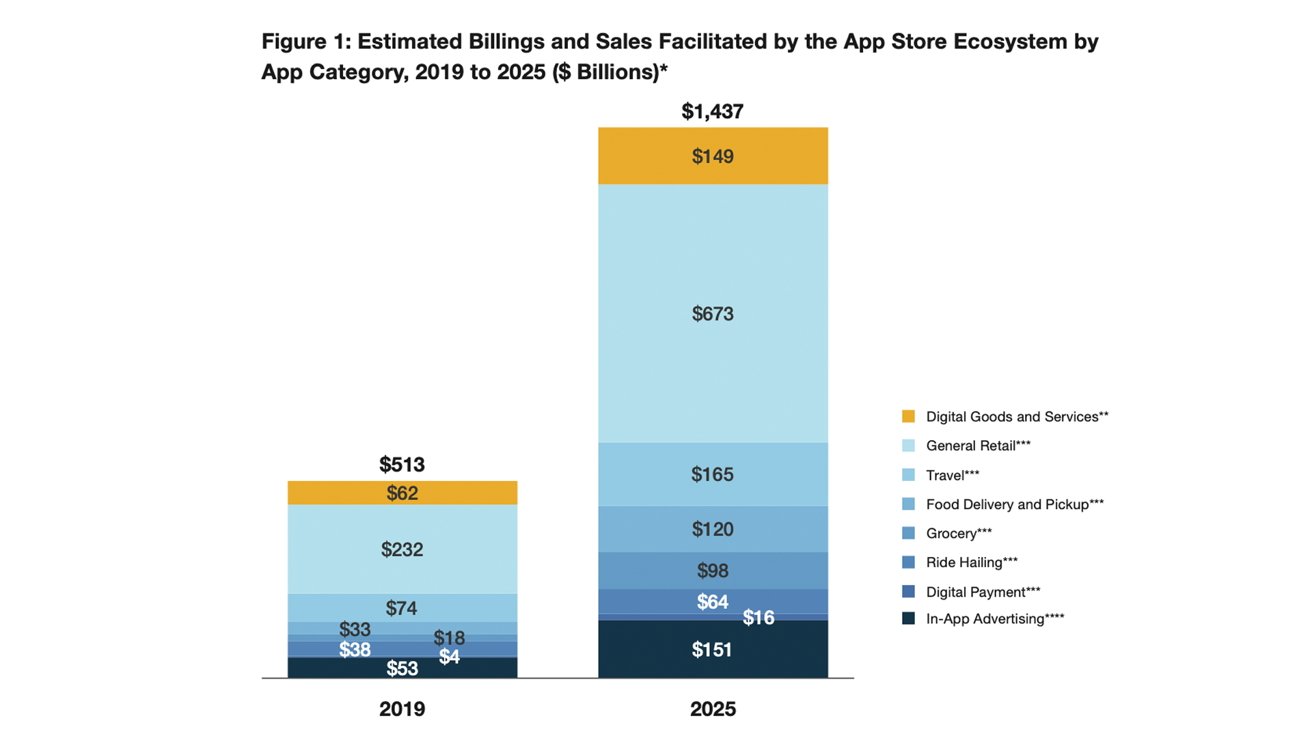
Image credit: Apple & Analysis Group
Globally, physical goods and services accounted for the majority of all sales made in the App Store.
However, sales differed a little across regions. For example, travel was the second-largest category of spending in physical goods and services in the U.S., Europe, Japan, Australia, New Zealand, and Brazil.
However, in Korea, food delivery was the second most popular. In the Chinese market, grocery and food delivery rounded out the top three slots.
Apple’s investment in developers
In 2025, Apple hosted thousands of developers at its developer centers. There are more than 20 Apple Developer Academies around the world, including Brazil, Indonesia, Italy, Saudi Arabia, South Korea, and the U.S.
Apple plans to open a Developer Center in Berlin sometime in 2026.
WWDC 2026 kicks off on June 8, allowing Apple to connect with developers and offer the first look at what tools and technologies will be available for the upcoming Apple operating system lineup.
Developers and students will have access to more than 100 new video sessions about tools, technologies, and design. They will also be invited to participate in Group Labs and join conversations in the Apple Developer Forums.
Tech
Enterprise AI agents keep creating data silos. Microsoft’s Build answer is Microsoft IQ and Rayfin.


Every new AI agent your team deploys starts from scratch: no memory of how the business works, where data lives, or what rules apply. And as agentic coding tools spin up applications faster than anyone can govern them, each one risks becoming another silo outside your data layer entirely. Microsoft is addressing both problems directly at Build 2026.
According to VentureBeat’s VB Pulse’s Q1 2026 RAG Infrastructure Market Tracker, hybrid retrieval intent among 100-plus employee organizations tripled from 10.3% in January to 33.3% in March, a signal that enterprises have moved past expanding RAG coverage and are now focused on the architecture underneath it. Shared business context is the part retrieval does not solve.
On the context side, Microsoft is expanding Fabric IQ, its existing business data context layer, into a broader unified system called Microsoft IQ, adding three additional context sources covering how the organization works, what it knows and real-time global signals from the web, so any agent can tap all four as a single foundation. On the application side, Rayfin, a new open-source SDK and CLI, deploys agent-built applications directly to Fabric as a governed production backend, routing application data into the same platform rather than spinning up new silos.
Amir Netz, CTO of Microsoft Fabric, reached for a film analogy to explain where the data platform fits. The green screen of cascading code in “The Matrix” wasn’t atmosphere, it was the layer that built the world Agent Smith operated in.
“Our job in the world of data is creating reality for agents based on data,” Netz told VentureBeat.
Microsoft IQ unifies four context sources into a single agent foundation
Microsoft IQ brings together four context sources that until now existed separately, designed so a developer can connect a new agent to all four in a single integration step.
Work IQ. Captures how the organization operates day to day, drawing on email, documents, meetings and schedules to give agents an understanding of people, teams and workflows.
Foundry IQ. Manages institutional knowledge, curating and indexing knowledge bases so agents understand what it means to work within the organization, what rules apply and what procedures to follow.
Fabric IQ. Models the live operational state of the business through data, defining entities, relationships and business rules grounded in real-time signals from Fabric Real-Time Intelligence. Ontologies, the layer that captures that operational context, are expected to reach GA in the coming months.
Web IQ. Adds real-time global context from the web, giving agents a current picture of the world outside the organization alongside its internal data.
“The agents are going to become highly informed virtual employees,” Netz said. “That’s where the world is heading.”
VB Transform · July 14–15 · Menlo Park · Agentic context layers
Your agents are only as good as the data they can reach.
Sessions at Transform cover the RAG architectures powering agentic systems at scale — including how enterprises are connecting agents to live genomics, clinical, and enterprise data.
Rayfin routes agent-built applications into the same data foundation
Building shared context solves one half of the problem. The other is what happens when agents start generating applications. Every new app needs a backend, and without a governed deployment path each one creates a new data silo outside the context layer entirely.
Rayfin provides an enterprise-grade back end and deploys agent-built applications directly to Fabric, so application data lands in Microsoft OneLake by default and feeds back into the Microsoft IQ context layer rather than accumulating outside it.
Microsoft positions Rayfin against Supabase and Neon, the Postgres-compatible backends that agentic coding tools default to. The differentiator is governance: Rayfin routes the entire application fleet through Fabric’s unified data and compliance layer rather than creating isolated silos.
Netz described the relationship as bidirectional. The agent building a Rayfin application draws from the organization’s ontology. The data that application generates then enriches that ontology for the next agent.
Every major data platform is chasing the same answer, but execution is unproven
Microsoft is not the only platform building a shared context layer for agents. Snowflake announced its own context capabilities this week with semantic capabilities. Pinecone has its Nexus platform that expands the vector database to become a knowledge engine and Redis has developed its Iris context and memory platform.
Microsoft’s approach further reinforces the trend that RAG and model availability aren’t the issue anymore.
“Fabric IQ and Rayfin are important because the enterprise AI challenge is no longer just about the model availability,” Robert Kramer, managing partner at KramerERP told VentureBeat. “The real question is whether Microsoft simplifies execution and strengthens trust or adds another layer to an already complex environment.”


The Honda CBR650R is a sport bike, but it’s not a supersport bike, and that’s an important distinction. For the uninitiated, it can be tough to tell the difference between sport bikes and supersport bikes. They look alike, and in many cases, they even share a naming convention — as is the case with the Honda CBR nameplate and its variants. As with cars, though, the ‘super’ prefix means there’s a difference in performance.
Honda’s supersport bike is the CBR600RR, a high-revving machine meant as a lightweight track missile. I rode a 600RR for years, and boy do I miss that bike. I took it all over the United States and modified it to fit my needs just right. Unfortunately, after years of ownership and hundreds of rides, I’d moved on to other bikes. I needed the garage space, and I wanted someone else to enjoy the bike I’d idolized, then purchased, and enjoyed for years, so I made the choice to sell the aging Honda. Enter my test of the 650R.
 Victory Jon
A few months after I sold my CBR, Honda offered me the latest CBR650R as a test bike for a few weeks, and I immediately thought of it as an opportunity: one to see if the sub-super CBR could fill the Honda performance motorcycle void in my life. Could the less-expensive, albeit slower, but still somewhat-performance-oriented bike make up for the gap in my garage, and in my heart? Though more affordable than the current 600RR, it still has hearty performance on paper, and no massive sacrifice in the looks department. I rode the newest 650R for nearly a month to find out if it delivers.
Plenty of power for entertainment
From my first freeway ride with the 650R, I could tell it had more than enough grunt to put a smile on my face. I’d picked up the bike from Honda HQ and immediately laid into the throttle on the nearest highway onramp.
While it isn’t a high-revving supersport, the CBR650R does have a substantial amount of power and torque. It uses a 649cc inline four-cylinder engine that revs to 12,000 rpm. That’s a relatively low redline by inline-four standards, but it still produces a healthy 93.8 horsepower and 46.4 lb-ft of torque — much more than its parallel-twin class rivals.
 Travis Langness/SlashGear
Snap the throttle back, and as RPMs climb through the rev range, the 650R’s power feels satisfying, even if it isn’t as thrilling as something like my old 600RR. The 650R doesn’t quite manage to get the front wheel off the ground without some over-aggressive riding behavior, but it’s eager to entertain right out of the box. The exhaust note has a nice pitch, and the volume goes up reasonably as the revs rise, giving you a nice bit of four-cylinder sound. An aftermarket exhaust could add some serious spice to this bike and that would probably be my first modification if I owned one.
Light on its feet

More than just adequately powered, the 650R is also relatively light. At 466 lbs (wet weight), the 650R felt easy to maneuver through traffic, and I imagine even novice riders would feel confident in the saddle (though they’d probably have an easier time getting used to Honda’s smaller CBR500R).
The front brakes are 310mm rotors being clamped down on by four-piston calipers, with a single-piston caliper and a 240mm rotor in the rear. Both the front lever and rear brake pedal have strong feedback, and it was easy to bring the 650R to a halt in traffic, or as I approached corners in the twisties.
 Travis Langness/SlashGear
I got used to riding the 650R quickly, and I was able to lean into the performance easily once I was out of the city, which I did quite a bit of. More than just satisfying for the price or for the class, the 650R was properly fun and responsive without any qualifiers or necessary context. So far, so good, for the bike I’d arbitrarily assigned to fill my 600RR’s place.
The E-Clutch is a pretty special trick up the CBR650’s sleeve

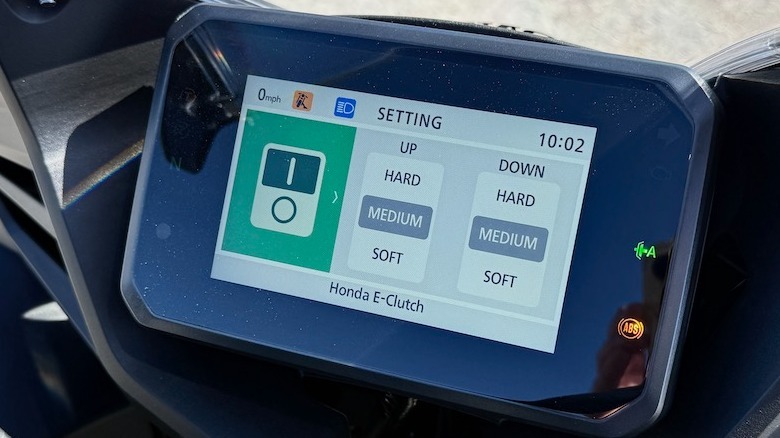
On last year’s model, the CBR650R got the addition of Honda’s E-Clutch system, a feature that carries over for 2026. Employed on a few other Honda bikes (like the small, entry-level Rebel 300, and the CB750 Hornet), the system essentially eliminates the need for the hand-operated clutch lever most of the time. Honda says it eliminates stalling and makes gear changes effortless. For the most part, that characterization of the system is spot on.
If you’re shifting the bike as you accelerate or decelerate, you still need to tap the foot lever in the appropriate direction, but there’s no need to pull in the hand clutch. You can even come to a complete stop without ever engaging the clutch lever, and the bike won’t stall. In some scenarios, you’ll need to use the clutch lever to get going, or to give the clutch a bit of slip on steep uphills, but that’s about it.
 Travis Langness/SlashGear
In operation, the E-Clutch also essentially acts as an ultra-slick quick shifter. You can adjust the E-Clutch’s shift sensitivity (there are three levels — I stuck with the lightest and easiest one) or you can shut off the E-Clutch entirely if you want to go full manual mode. Just a tiny tap of your left foot and the gears change with minimal pressure. The shifts are delivered quickly as you climb through the gears, and there’s no jolting forward as you engage the next gear. What’s more, unlike some DCT or fully-automatic motorcycle transmissions, the Honda still requires a bit of engagement from the rider, adding a bit to the riding experience.
One bit of missing hardware

Being relatively speedy and having the excellent E-Clutch, the CBR650R was easy to ride on a daily basis, but it was missing something. It doesn’t have much in the way of adjustable suspension, and that did make the ride a bit stiff at times. The 650R’s rear suspension has adjustable spring preload, but that’s it. It’s a pretty typical omission for this class, but some rivals — like the R7 — do offer rebound and damping adjustment.
Up front, the 650R has a Show 41mm SFF-BP fork with 4.7 inches of travel, and in the rear, there’s a single-tube monoshock with 5.1 inches of travel. The shocks absorbed most of the small-to-medium bumps, but bigger road imperfections caused some jostling and fairly-sized movements from the handlebars.
Luckily, when I had the 650R leaned over on a few of my local corners, the small bumps I encountered didn’t upset the bike’s handling enough to take me off my line. The Dunlop Roadsport 2 tires that came on the 650R were predictable and relatively quick to warm up. While I wouldn’t make the CBR650R, especially on the budget-friendly Dunlops, my first choice for a weekend track day, neither the bike nor the tires felt overwhelmed on spirited weekend rides.
In it for the long haul

Suspension adjustments notwithstanding, I felt pretty comfortable on the CBR650R. Riding on the freeway, eventually in the canyons, and commuting through LA at some of the worst parts of the day, it was easy to get comfy. At 5-foot-9, the foot pegs are low enough that my knees didn’t feel pressured to bend too much, and the handlebars are high enough that I didn’t have to fully rely on my wrists and forearms for stability.
All the long rides I took on the 650R were pain free. The 650R also felt particularly narrow, making lane-splitting especially easy. Getting just about anywhere on the svelte Honda was a quick errand.
 Travis Langness/SlashGear
The rider seat was pretty pain-free too. It’s forgiving enough that my rear end didn’t go numb after a few hours in the saddle (that can happen if a seat is too stiff, like the one on my old 600RR was), and it’s tapered properly towards the front so that riders with larger legs like me can still touch both feet on the ground. A seat height of just 31.9 inches means most riders should have no problem stabilizing the bike at a stand-still.
Form and function

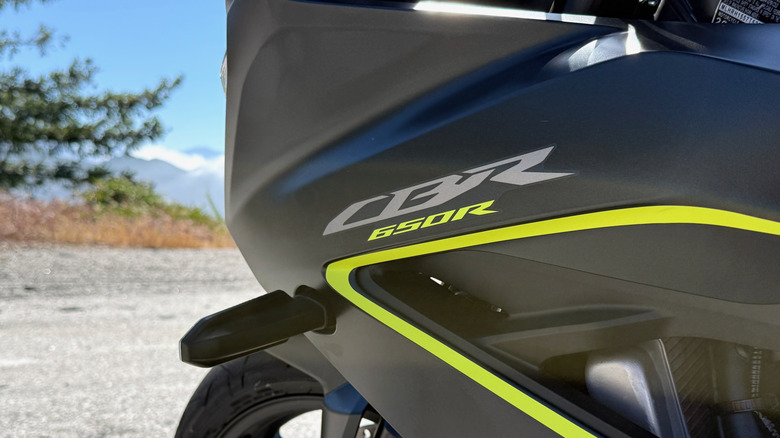
After a few weeks on the CBR650R, I was able to start seeing the details more clearly. Styling cues like the thin headlights and the narrow taillight help elevate the 650R to a premium status amongst sport bikes in its class. A bit of flake in the Matte Black metallic paint gives you the sensation that Honda spent a bit of money on this one — it’s not some sort of afterthought to an already-robust motorcycle lineup. They’re hidden, but the exhaust headers leaving the front of the engine, before they’re collected into the single exhaust, are an impressive sight to behold. Even the ladder-style license-plate mounting bracket looks the part of an aggressive sport bike.
 Travis Langness/SlashGear
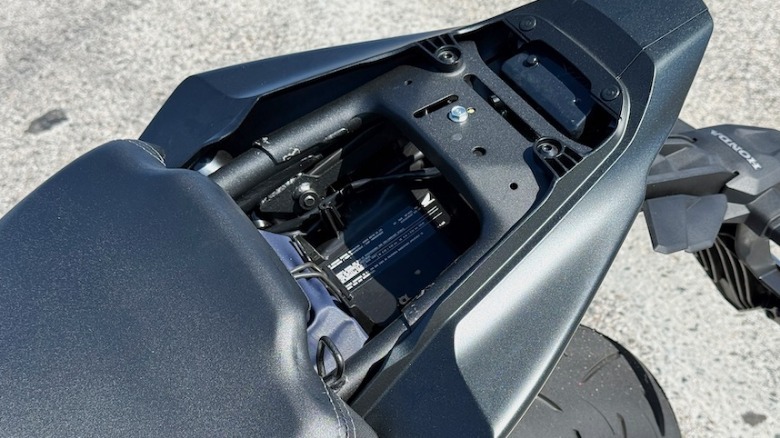
Unlike most sport bikes these days, especially the ‘super’ ones, the 650R had some surprising storage space, too. Pop the rear seat off, and there’s an area large enough for some tools, maybe a rag or two, and some window cleaner for when your visor is splattered with most of the local insect population. There are two little straps attached to the rear seat as well, where I could attach my helmet at stops and not worry about it falling off the handlebars or the mirror.
 Travis Langness/SlashGear
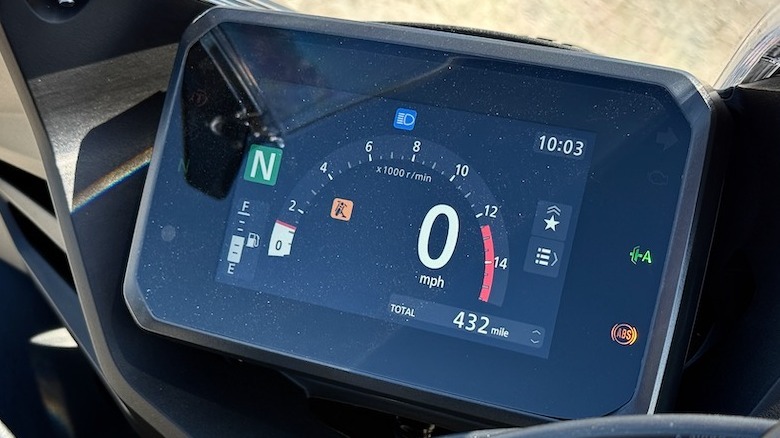
Also combining form and function in a seamless manner is the CBR’s rider screen. The 5-inch TFT display is high contrast and easy to read, even in bright, overhead sunlight. It’s also easy to interact with, given Honda’s simple handlebar controls and the logical menu layout. Like most of the rest of the bike, the screen just plain works.
Finding the pricing sweet spot

The 2026 CBR650R, with its satisfying power, sleek looks, and slippery E-Clutch, has an MSRP of $9,799 (including a $600 destination fee). That represents a $100 price drop over last year’s model, and big savings over the 600RR, which currently starts at $13,099.
The CBR650R is pretty reasonably priced when you compare it to class rivals from Yamaha and Suzuki, too. For instance, the Honda is a few hundred dollars less than the newest R7 ($10,074), and a bit cheaper than the GSX-8R ($10,399). The Kawasaki Ninja 650 undercuts them all at $8,884 (with ABS — it’s $500 less without it), but that Honda still has pretty good value.
 Travis Langness/SlashGear
The 650R is missing a few features that rivals have — like cruise control, which you get standard on the new R7 – but the Honda is still expertly assembled, and there are lots of details that give it a strong sense of quality. The E-Clutch is a great asset for the Honda, while tight tolerances on body panels, nicely constructed trim pieces, and stitching on the seat that doesn’t waver is all part of the package. It feels like any Honda motorcycle should: well built.
2026 Honda CBR650R verdict

The CBR650R doesn’t provide the same kind of fizz that my old 600RR did, but pretty quickly after hopping on, I realized that wasn’t the point — I’d been looking at this bike through the wrong set of lenses. While it might not be a track-day weapon, capable of revving to the moon, the 2026 Honda CBR650R is swift, sharp, easy-to-ride two-wheeled transportation that will definitely fit the bill for lots of riders. It’s much cheaper and more approachable than the 600RR; it’s still properly powerful; and it’s a more versatile tool. It makes sport bike riding more accessible, and that’s never a bad thing.
The E-Clutch is an excellent bonus for new riders who are intimidated by manual clutch-lever operation, and it also provides an easy riding experience for veteran riders like myself. If you know yourself and your riding style well enough to know you won’t be doing triple-digit-speed freeway pulls or local track days on a regular basis, you don’t have to shell out for the more-expensive CBR600RR. If you want something that’ll be proper fun on its own, don’t sleep on the easier-to-ride CBR650R.

Mustafa Suleyman has identified Microsoft’s biggest AI competitor, and it is not OpenAI. “Anthropic is extremely expensive and I think many people are urgently looking for alternatives,” the head of Microsoft’s in-house model effort told Bloomberg in an interview.
The statement is more than competitive positioning. It is a declaration of intent. “We pay a lot of money to Anthropic, so our goal is to reduce and ultimately eliminate that cost,” Suleyman said.
To back it up, Microsoft this week announced seven new in-house AI models at its annual Build conference for developers, including MAI-Thinking-1, a reasoning model it says matches Anthropic’s Claude Opus 4.6 on a widely used coding benchmark at a lower price point.
The price pitch
Suleyman’s argument arrives at a moment when enterprise AI spending is becoming a genuine problem. Uber burned through its entire 2026 AI coding budget in four months and introduced a $1,500 monthly cap per employee per tool. Walmart has similarly capped access to its internal AI assistant after usage exceeded expectations.

The 💜 of EU tech
The latest rumblings from the EU tech scene, a story from our wise ol’ founder Boris, and some questionable AI art. It’s free, every week, in your inbox. Sign up now!
For Microsoft, which uses enormous quantities of AI tokens across Copilot and its own engineering teams, the cost question is existential. “Many, many people in our organisation are spending millions of dollars” on AI tokens, Suleyman said. Building cheaper in-house alternatives is not just a competitive move against external providers. It is a way to protect Microsoft’s own margins.
After refining its models for consulting firm McKinsey, Microsoft claims it was able to outperform OpenAI’s GPT 5-5 with 10 times better cost efficiency, according to Suleyman. The company has also been talking with Adobe about using the in-house models, Bloomberg reported.
From contractually bound to building its own
Until late 2025, Microsoft was contractually prohibited from independently pursuing frontier AI development under its partnership with OpenAI. A renegotiated agreement freed the company to build competing models while retaining licence rights to everything OpenAI builds through 2032.
That clock is now ticking. Suleyman’s MAI Superintelligence team, formed in November 2025, has shipped its first public models within six months. For a company with virtually no track record in frontier model development, the pace is aggressive but the gap remains real.
Suleyman was candid about that. “We’ve closed an enormous gap in six months,” he told Benzinga, while acknowledging that Anthropic has released two more advanced models since Opus 4.6, giving it a lead of several months.
Why Anthropic, not OpenAI
The strategic calculus is revealing. Microsoft retains discounted access to OpenAI’s models through 2032. It does not have a comparable arrangement with Anthropic. That makes Anthropic the more expensive dependency, and the one Suleyman can most directly address by building in-house alternatives.
There is also a competitive logic. Anthropic’s Claude models have become the default choice for enterprise AI coding tools, and the company is preparing an IPO that could value it above $1 trillion. If Microsoft can offer comparable performance at lower cost, bundled with the Azure infrastructure its enterprise customers already use, it undercuts the case for buying Anthropic separately.
Whether Microsoft’s models can actually match Anthropic’s latest generation, rather than a prior one, is the question Suleyman’s seven new models do not yet answer. Matching Opus 4.6 on a benchmark is a credible starting point. But Anthropic has already moved past it, and in a market where the frontier shifts every few months, catching up and staying there are very different problems.
Tech
Former California AG Bill Lockyer Offers A Dumb And Lazy Defense Of The Paramount Warner Bros Merger

from the that’s-now-how-any-of-this-works dept
There’s just an exhaustingly long list of reasons why the $111 billion planned acquisition of Warner Brothers by Larry Ellison and Paramount is very, very bad. Bad for consumers, bad for labor, bad for journalism, bad for democracy, and bad for markets.
For one thing, it’s financed by a bunch of murderous overseas autocrats. The massive debt load from deals like this always result in mass layoffs, higher prices for consumers, and corner cutting, resulting in a steadily shittier company, worse overall products, and a less healthy media. There’s also issues with Ellison trying to buy up all the news outlets and turn them into (even worse) right wing coddling bullshit and agitprop machines helmed by incompetent bad actors like Bari Weiss.
So it’s great timing for former Democratic California Attorney General Bill Lockyer to pop up over at The Hollywood Reporter to give a pathetic defense of the deal that pretends none of this is happening.
Trade mags are generally terrible. Most of the merger coverage at places like The Hollywood Reporter, Deadline, and Variety go comically out of their way to avoid acknowledging these giant deals are always bad. As in, it’s not any sort of actual debate. There are fifty years of very clear history on this subject, recently culminating in the giant turd that was the AT&T–>Discovery–>Warner Bros disaster.
But here comes the 85-year-old Lockyer, who pretends to care about antitrust reform, right before he insists that people should ignore all of the terrible problems with Paramount’s latest deal. One of the central themes in his piece is that Paramount and Warner Brothers have to merge because it’s the only way they can compete with Netflix, Amazon, and Apple:
“Traditional studios are no longer competing only with one another. California cannot and should not ignore that reality. Paramount and Warner Bros. Discovery are competing against global technology platforms and streaming giants like Netflix, Amazon, Apple and others with enormous financial resources, diversified revenue streams and worldwide reach.”
That’s simply not how any of this works.
A Trump-allied oligarch and his nepobaby kid taking on a mountain of debt doesn’t magically result in a company that’s healthier and more competitive. All the debt costs are offloaded onto the back of workers, consumers, and product quality. These mergers always result in a less healthy company than ever, regardless of whatever silly smoke David Ellison is trying to blow up the ass of Hollywood elite.
It’s possible Lockyer is engaged in a DC policy paid advertorial on behalf of Paramount, though the Hollywood Reporter doesn’t offer any sort of financial conflict of interest disclosure, so one just has to assume Lockyer, like so many Democrats, doesn’t have any idea what he’s talking about when it comes to things like modern politics in the authoritarian era, or modern antitrust reform.
Though given Lockyer’s personal history of approving harmful consolidation (like his office allowing the Hearst Corporation-owned San Francisco Examiner to acquire its competitor the San Francisco Chronicle in 1999) or weak-kneed settlements or antitrust policy failures (Microsoft, Sutter Health), it’s maybe not surprising that he thinks one of the worst mergers in media history should be approved.
Lockyer’s also quick to shoot down concerns that Ellison’s domination of media is any sort of real world problem:
“Some have raised broader concerns about media ownership, editorial influence or political viewpoints, as the combined company would own both CBS News and CNN. This debate will undoubtedly continue to dominate talk shows and social media. I, too, worry about plutocratic dominance of media markets. But merger enforcement should remain focused on competition and the potential for consumer and worker harm — the core pillars of antitrust — not political disagreements over content or viewpoint.”
But this isn’t 1997. It’s now impossible to untangle corrupt authoritarian domination of media, and their relentless dismantling of media consolidation limits, from broader antitrust arguments (though I know there are centrist Democrats and MAGA “antitrust enforcers” who would very much like to). There are vast harms caused by the destruction of what’s left of journalism and public interest media, and any “antitrust reform” that doesn’t factor in media audience welfare and the health of electoral consensus in the age of Elon Musk and Larry Ellison enabled fascism isn’t reform, it’s patty cake.
Meaningful DOJ Antitrust reform would be nice, but it can’t fix things alone. We need an FCC that also actually cares about media consolidation. And it might be nice, as Gigi Sohn has long argued, to begin looking at meaningful media ownership diversity requirements in a bid to protect minority and independent journalism.
But we don’t have that. We have an FCC actively waging a war of censorship on anybody critical of an unpopular autocrat. We have a DOJ actively encouraging harmful consolidation at the hands of technofascist billionaires keen on pummeling the electorate with right wing agitprop. And an opposition Democrat party with weak knees and zero credibility on antitrust or media reform.
Trump and friends are self-serving autocrats dead seat on dismantling whatever’s left of meaningful competition and opposition. That Netflix, Comcast, Disney, and Apple still exist isn’t any consolation if the obvious ultimate end goal is zero restrictions on total consolidation. Instead of proudly advertising he doesn’t understand current political and market realities, Lockyer should probably just enjoy retirement.
Filed Under: antitrust, authoritarians, Bill Lockyer, diversity, larry ellison, media consolidation, mergers, reform
Companies: paramount, warner bros.
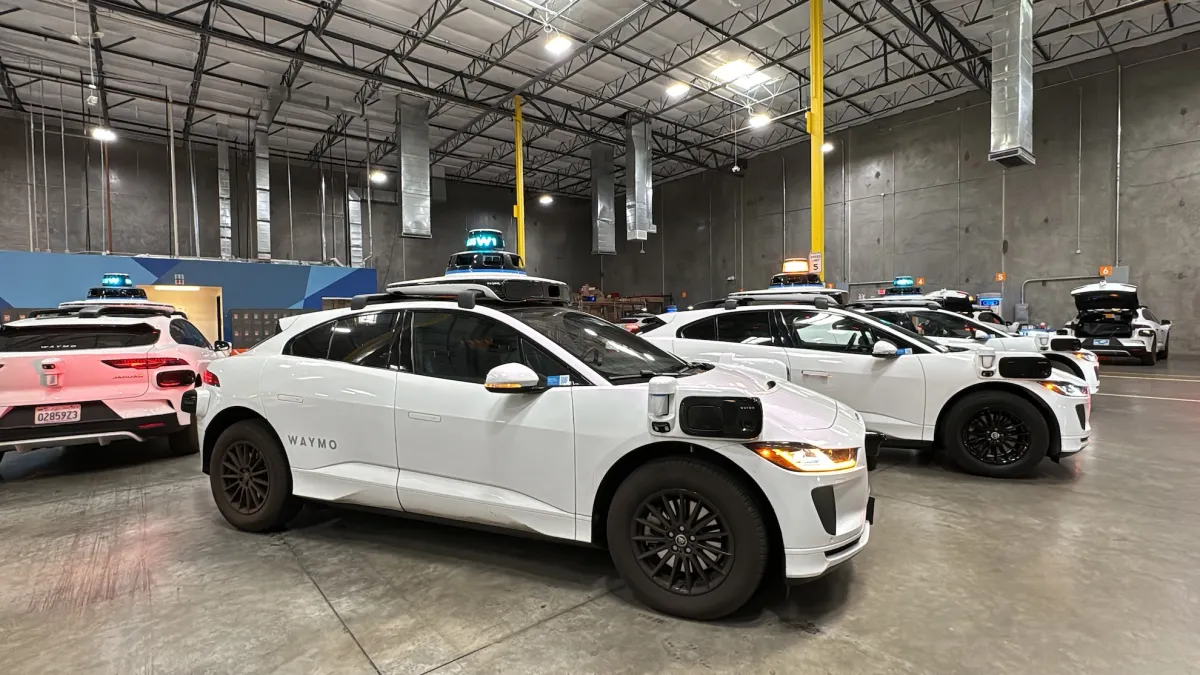
Waymo has announced a deal with an energy storage company called B2U to use retired robotaxi batteries to serve electricity grids in California and Texas.
The deal helps answer the question of how Waymo is thinking about the end-of-life treatment of the thousands of robotaxis it has deployed around the United States. Almost all of those are currently Jaguar I-Pace EVs, though the company has recently started deploying a limited number of vans built by Chinese automaker Zeekr.
Waymo said the partnership will involve the deployment of “hundreds of megawatts of storage capacity” but did not offer any further specifics.
B2U is one of numerous companies focusing on battery repurposing rather than recycling. Redwood Materials, founded by former Tesla CTO JB Straubel and backed in part by Waymo’s parent company Alphabet, recently spun up its own second-life storage business using old EV batteries.

NewsBeat5 seconds ago
Olympic medallist Wood eager for first taste of City of London Nocturne

Business59 seconds ago
ET Alpha Wealth Summit: Nilesh Shah recommends 4 investment bets that should be part of your portfolio

Crypto World2 minutes ago
Standard Chartered reaffirms $100K Bitcoin bet as bears see more pain



-

 Tech7 days ago
Waymo dominates autonomous vehicle registrations as Tesla trails behind
-

 News Videos6 days ago
This is BROKEN! INSANE 5x MONEY CAR WASH WEEK! The NEW GTA Online UPDATE Today! (GTA5 New Update)
-
 Tech5 days ago
SpaceX just won a second Golden Dome contract. This one is $4.16 billion.
-

 Business3 days ago
Jade Biosciences, Inc. (JBIO) Discusses Positive Interim Results From JADE101 Phase I Healthy Volunteer Study and Development Plans Transcript
-

 News Videos6 days ago
SHE IS KILLING XRP!!! WATCH URGENT AND ACT FAST
-
 NewsBeat6 days ago
FIRST NIGHT REVIEW: Take That bring the Circus back to life in spectacular sun-soaked style
-

 Business5 days ago
Is the Spurs Phenom Already Better Than Prime Diesel?
-
 Crypto World6 days ago
CFTC Has Approved the First Regulated Bitcoin Perpetual Contract in the U.S.
-

 Politics5 days ago
The House | Inside Andy Burnham’s Makerfield Campaign: “Nobody Thinks This Is In The Bag”
-

 Sports2 days ago
French Open 2026 results: Alexander Zverev beats Rafael Jodar and will play Jakub Mensik in semi-finals
-
 NewsBeat6 days ago
Novak Djokovic v Joao Fonseca LIVE: French Open latest scores and results after Jannik Sinner’s shocking collapse
-
 Entertainment6 days ago
Weak ‘Supergirl’ Box Office Tracking Amid Milly Alcock Backlash
-

 Tech2 days ago
CryZENx Releases Fresh Playable Content Deep Inside Jabu-Jabu for His Ocarina of Time Remake
-
 Crypto World6 days ago
Snowflake (SNOW) Stock Rallies on Strong Q1 Results and AI Product Growth
-

 Entertainment6 days ago
Maddox Jolie-Pitt Legally Requests to Drop Brad’s Surname
-

 Business5 days ago
Demand Conditions Improve In Chemicals Sector In April 2026
-
 Entertainment5 days ago
One of the Greatest Sitcoms of All Time Shoots Up Apple TV’s Charts 11 Years Later
-
 Crypto World6 days ago
MicroStrategy Moves $30 Million in BTC to Coinbase Prime: Is the Bitcoin Sell-Off Already Here?
-

 Tech6 days ago
This Week In Security: Ubiquiti Fixes, And FreeBSD Joins The Club You Don’t Want To Join
-
 Entertainment6 days ago
Bruce Willis’ Generosity Resurfaces Amid His Dementia
You must be logged in to post a comment Login