


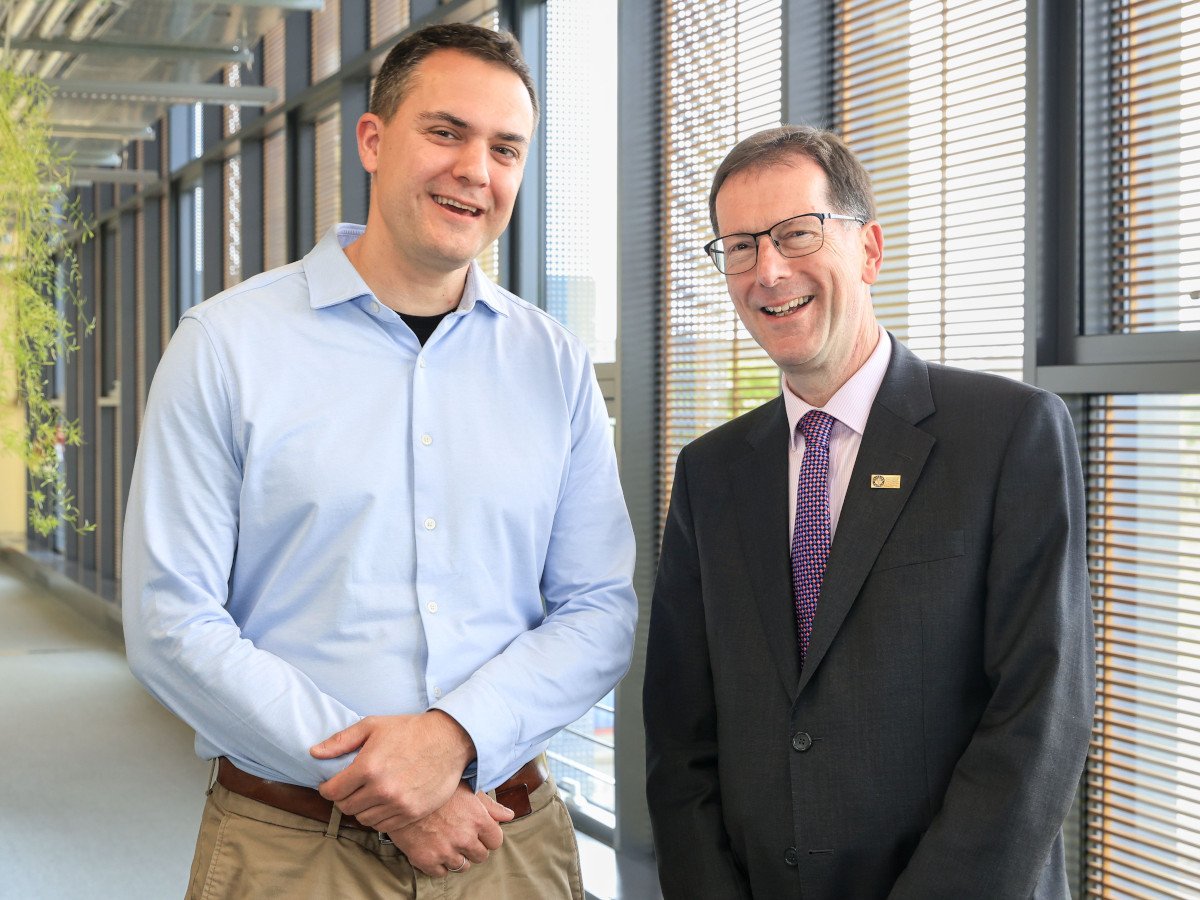

‘Mistakes in cell division can promote adaptation to new environments in certain organisms,’ says Dr Mihailo Mirkovic.
University of Galway has tapped biochemistry expert Dr Mihailo Mirkovic to lead a new research programme investigating the effect of cellular stress and disruptions to RNA processing in fungi, with hopes of better preventing the chromosome abnormalities that can lead to cancer and neurodegenerative disease.
Mirkovic joins the institution on the Wellcome Trust award, and will establish the group within the University’s Centre for Chromosome Biology.
Originally from Montenegro, Mirkovic completed his bachelor’s and master’s degree from the University of Belgrade in Serbia, before moving to Portugal for his PhD at Instituto Gulbenkian de Ciencia and ETH Zurich, for his post-doctoral research.
“My PhD work was focused on cell division,” Mirkovic says, explaining his work.
“During every cell division, the DNA in the cell must be duplicated, held together and then split apart accurately into two daughter cells. This ensures that both daughter cells receive identical DNA copies.
“I worked on the mechanisms of how cells keep their copies of DNA together and how they split them apart in a timely manner.
“We have discovered that defects in keeping the duplicated DNA molecules together are poorly detected by the dividing cell, and lead to developmental defects, specifically in the brain.
“We have discovered that old yeast cells have problems with accurately partitioning their DNA. We discovered that this is due to the fact that old yeast cannot process their RNA properly and contain it within the cell nucleus until it is properly processed.
“This phenomenon changes gene function and results in uneven partitioning of DNA in old age, followed by cell death. Once we used a few genetic tricks to prevent these RNA processing defects, cells improved their DNA segregation in old age and lived longer.”
Tell us about the research you’re currently working on.
The topic of cell division and uneven DNA partitioning is very interesting for the general public, as it has implications in human health and development. However, it has another interesting twist, and that is that mistakes in cell division can promote adaptation to new environments in certain organisms.
Equal DNA partition generates identical DNA information in two cells. Unequal DNA segregation generates cells with different, “new” genetic information. These new cells can then adapt to different challenges they face.
For instance, fungi use uneven DNA segregation to resist stress, including the antifungal drugs used in the clinic. Since mistakes in cell division are essential for fungal survival in stress, I want to explore if these organisms have a way to make these mistakes “on purpose” to survive.
This is quite counter-intuitive, as mistakes in DNA segregation are costly, and generally create many problems for the cell. But in situations of do-or die, when faced with stress, these mistakes seem to be more desirable than standing put and continuing with the same old identical genetic information. This process could have implications in how cells evolve antimicrobial resistance (AMR) which is a pressing public health issue.
In your opinion, why is your research important?
It aims to uncover more about the phenomenon that could be very interesting from the aspect of basic science and understanding cell division in times of stress.
If we find something interesting there, we will try it out in pathological species of fungi. This could help us understand how they adapt to antifungal treatment in settings that might be relevant for human health in the future. But this is not a given.
What is very important to note, that it is very difficult to gage the impact of research as it happens. The research directly benefiting public health is the very apex of the knowledge and application pyramid.
For these discoveries in the clinic to even be possible, hundreds of basic science research projects had to be done, using anything from bacteria to worms to mice as model systems. This huge accumulation of knowledge was required to even start working on problems related to human health.
To have a strong apex in terms of application and impact, the base, where all the initial knowledge is generated, which we call basic science, must be healthy.
What inspired you to become a researcher?
I always liked observing nature, but also flipping rocks, looking, catching and studying different organisms as long as I have known myself.
(Un)fortunately, like most people who dream to become a marine biologist or a zoologist, I ended up in a lab of some sorts. What saves me in the lab is microscopy. The ability to directly observe cells and watch them do things still triggers the same spark for observation.
My PhD supervisor took me to a microscope to show me how a cell divides on my first day of work. After that I was hooked.
What are some of the biggest challenges or misconceptions you face as a researcher in your field?
The main challenges of science are quite universal across fields. It is a risky career where only a fraction of people who start their doctorate degrees end up running their own research programs.
People are constantly applying for limited funding at every stage, and it is very difficult. This kind of pressure leads to people trying to justify or market their science with promises of direct “impact”, which is easy to explain to the taxpayer or the funding agency.
I think in this situation we all lose, if not on the quality of science funded, then at least on honesty and educating the public on how scientific progress actually works.
I was extremely fortunate to do my PhD and postdoc in labs and institutes where the value of basic research was acknowledged both academically and through ample research funding. Some of my colleagues are far less fortunate.
Do you think public engagement with science and data has changed in recent years?
I think the science communication with the public has always been lazy, Covid just brought it to the forefront.
Lazy from two sides, scientists which find it beneath them (or don’t know how) to simplify their research topic even when talking to other scientists, let alone to the member of the public.
On the other hand, journalists looking for headlines such as “researcher X cures cancer”, which are especially amplified and rewarded in the modern struggle for clicks and engagement.
Covid is a tricky example, as telling people that our knowledge of the problem is evolving, and that things we stated a month ago might not be true in the following month, might be scientifically accurate and honest, but might be a bad public health communication strategy, I am not sure I know enough about the balance of these two things to comment.
The former National Institutes of Health director Francis Collins acknowledged that failing to explain the evolving science was one of the key reasons for loss of public trust.
What I do know is that no one likes being talked down to, and very few people will be moved to positive action if being told that they are ignorant and stupid.
It is the job of the science communicators not to the preach to the converted, but to try and reach the ones that had little exposure to science in schooling or everyday life and combat the spread of misinformation.
It is the job of governments and schools to introduce strong, engaging and interactive science curriculums into schools to ensure that the population has a baseline knowledge about how knowledge is acquired, and what is real and what is not.
How do you encourage engagement with your own work?
Well, I am typing these lines…
On a more serious note, as a postdoc or a PhD student there are few chances to do effective science communication beyond your immediate social circle.
During my PhD, there was a music festival in Lisbon, and our institute recruited a bunch of PhD students to go and talk to festival goers about anything science-related they might be interested in.
That was a remarkable experience, as people are actually very curious when given the opportunity to engage and when approached correctly. For me it was perfect, as I got to drink beer and talk, two things that I am very good at. Now that I have my own research group, I will explore different engagement options through the University of Galway in the local community.
Don’t miss out on the knowledge you need to succeed. Sign up for the Daily Brief, Silicon Republic’s digest of need-to-know sci-tech news.





















































You must be logged in to post a comment Login