

Crypto World
Bitcoin (BTC) Plunges Below $69K: Here’s Why It Could Get Even Worse Soon

The past few days have been rough for the primary cryptocurrency, whose price once again slipped below $69,000.
One popular analyst believes the valuation could now be headed toward $65,000, while many others warn of even deeper declines ahead.
The Worst Has Yet to Come?
Bitcoin has tumbled by double digits over the past week and currently trades at around $68,600 (according to CoinGecko), while its market capitalization has fallen under $1.4 trillion.
Some of the potential reasons for the plunge include increased tensions in the Middle East, the Mt. Gox transfers, and Strategy’s decision to sell BTC. As CryptoPotato reported, the company offloaded 32 units for approximately $2.5 million to support preferred stock distributions. Even though Strategy doesn’t appear to have abandoned its BTC accumulation plan, its recent sale has likely stirred panic among investors.
BTC’s pullback has become a main topic of discussion on crypto X, with numerous market observers now envisioning further pain for the bulls. Ali Martinez, for instance, recently described the $71,300-$73,000 range as a “critical support cluster,” adding that a breakdown could result in a drop to $65,000. He later said the asset has broken below key levels, strengthening the bearish outlook and increasing the probability of a decline to the depicted area.
Carl Moon and Ted are also among the pessimists. The former reminded that BTC’s last two cycle bottoms occurred after nine red monthly candles, saying that the asset has had six so far during this phase.
For his part, Ted spotted a “massive liquidity cluster” around $55,000-$65,000 that could eventually be taken out. “That doesn’t mean a bounceback won’t happen here, but Bitcoin hasn’t bottomed yet,” he claimed.
The increased amount of BTC held on crypto exchanges is another worrying factor. CryptoQuant’s data show that today (June 2), the figure has risen to roughly 2.71 million, the highest level since March. This development doesn’t guarantee a further price decline but increases the immediate selling pressure.

The Bullish Signal
Contrary to the pessimistic price predictions, BTC’s Relative Strength Index (RSI) suggests a price rebound might be on the horizon. The technical analysis tool measures the speed and magnitude of recent price changes to give traders an idea about potential reversal points.
It runs from 0 to 100, where anything below 30 indicates the asset is oversold and ready for a possible resurgence, while ratios above 70 are considered warning signs of a correction. Currently, the RSI stands at around 18, representing the lowest level since the beginning of February.

The post Bitcoin (BTC) Plunges Below $69K: Here’s Why It Could Get Even Worse Soon appeared first on CryptoPotato.



Movement, a project originally designed to link blockchains built using the Move programming language with Ethereum, is pivoting toward cross-border payments, remittances and dollar savings products, reflecting a broader shift across the increasingly crowded layer-2 landscape.
The company behind the blockchain said Tuesday that it had secured access to licensed payment systems in the U.S., Canada and European Union, and would focus on building stablecoin-based settlement infrastructure for emerging markets.
The direction change comes as a number of layer-2 projects reassess their original scaling-focused roadmaps amid growing competition and declining differentiation among networks. With dozens of Ethereum scaling chains now competing for users, liquidity and developer attention, some projects are turning toward payments and real-world financial applications as a path to growth.
Polygon, one of the earliest Ethereum scaling projects, has increasingly emphasized payments and stablecoin infrastructure in recent years, pursuing projects with fintechs and payment providers as transaction fees and rollup technology become commoditized.
While layer-2 networks were initially pitched as a solution to Ethereum’s scaling challenges, the sector’s rapid expansion has left many projects searching for more specialized use cases. For Movement, that increasingly means competing not with other blockchain networks, but with traditional payment systems and remittance providers.
The team behind Movement said it plans to leverage licensed payment partners alongside blockchain settlement infrastructure to target the roughly $685 billion remittance market serving low and middle-income countries.
As part of the transition, the Movement Network Foundation said it repurchased some 19% of tokens previously allocated to investors, equivalent to 4.1% of total token supply. MOVE was recently trading around 14.35 cents.
“Billions globally are financially disenfranchised and unserved,” CEO Torab Torabi said in a press release shared with CoinDesk. “Our mission is to marry licensed payment rails with onchain settlement to modernize financial services globally, particularly in emerging markets.”
Read more: Movement Labs Terminates Rushi Manche After MOVE Token Deals
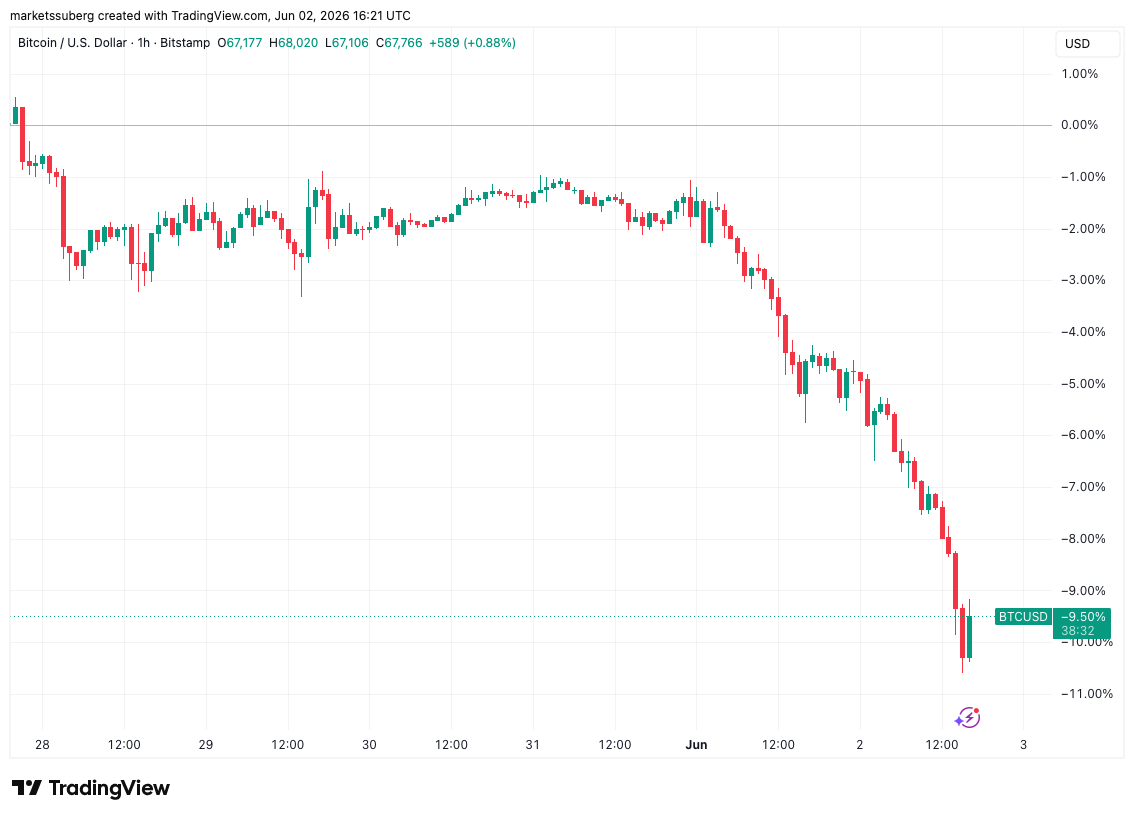
Bitcoin (BTC) losses passed 6% after Wednesday’s Wall Street open as a cascade of liquidations gathered pace.
Key points:
- Bitcoin falls below $67,000 for the first time since the first week of April as losses pile on.
- Liquidations hit $1.25 billion over 24 hours as analysis sees the mid-$50,000 range returning.
- BTC/USD appears to repeat a bear flag breakdown from earlier in the year.
BTC price dives to $66,950 in liquidation cascade
Data from TradingView showed BTC/USD dropping as low as $66,948 on Bitstamp.
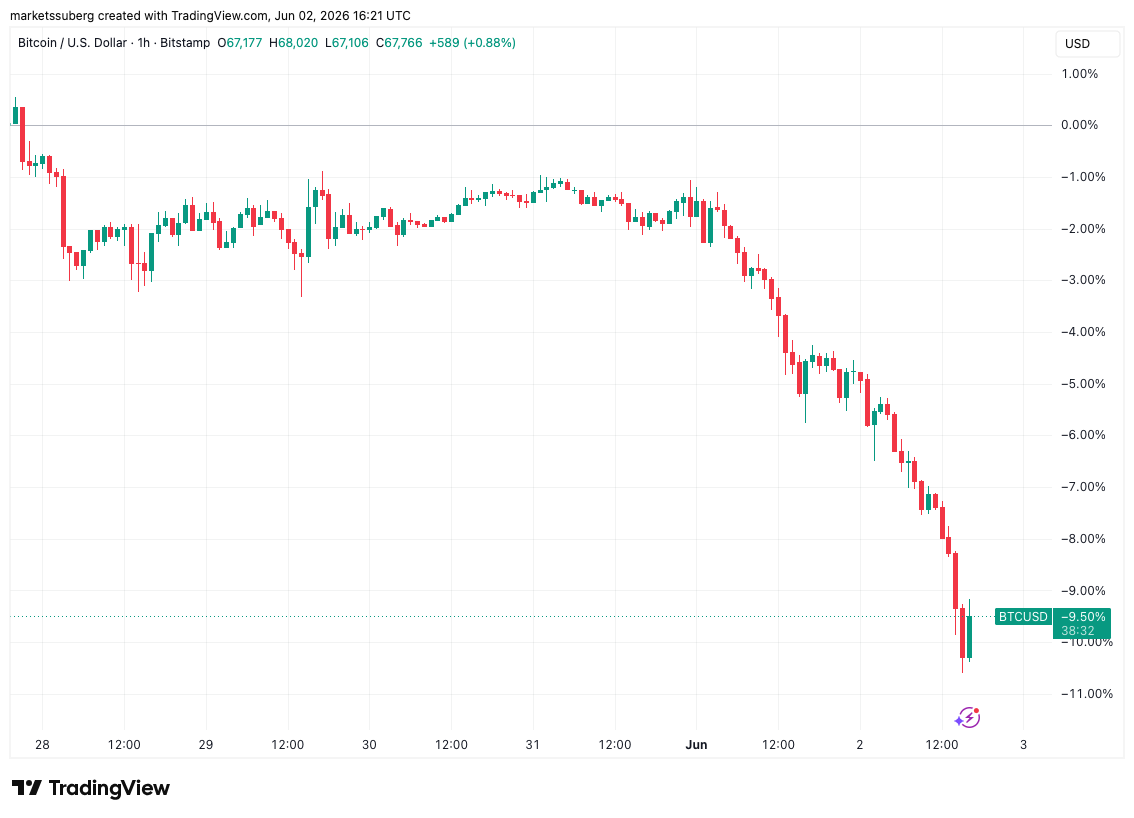
BTC/USD one-hour chart. Source: Cointelegraph/TradingView
That level marked the pair’s lowest since April 5, erasing months of gains as 24-hour cross-crypto liquidations hit $1.25 billion.
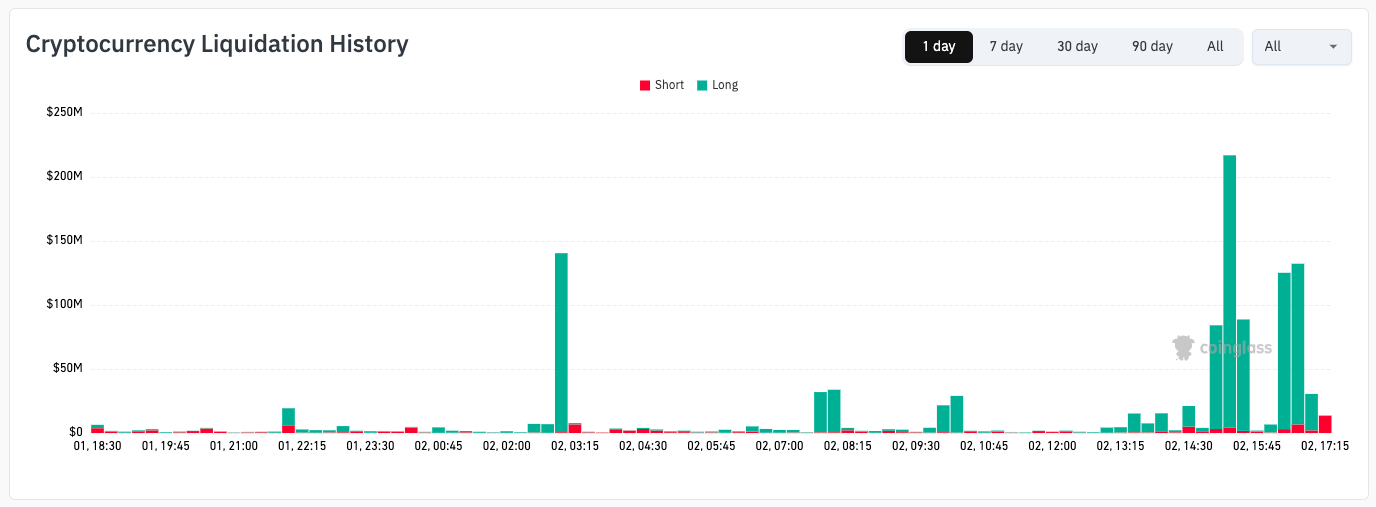
Crypto liquidation history (screenshot). Source: CoinGlass
Continuing a grim divergence from other risk assets, Bitcoin collapsed as the S&P 500 set yet another all-time high.
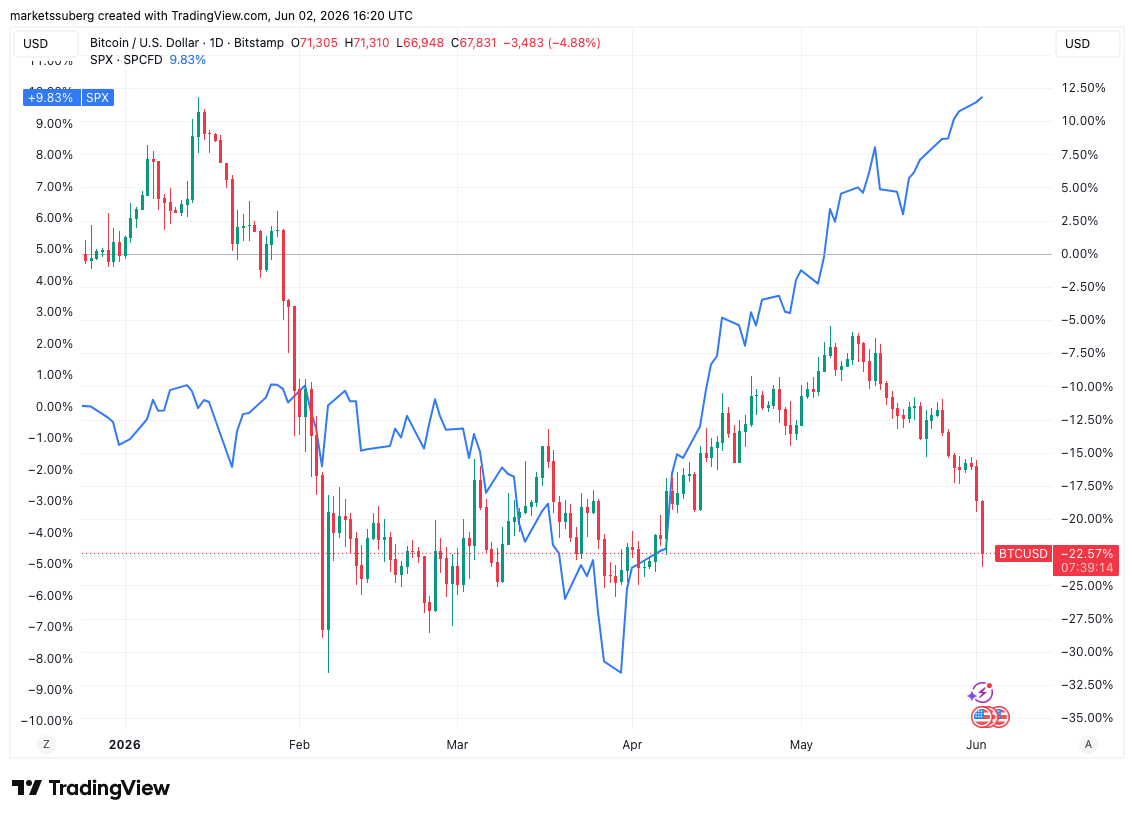
BTC/USD vs. S&P 500 one-day chart. Source: Cointelegraph/TradingView
“Investors are Macro Risk-Off, fleeing into Stablecoins and moving away from Bitcoin,” trader and analyst Rekt Capital wrote in a response on X.
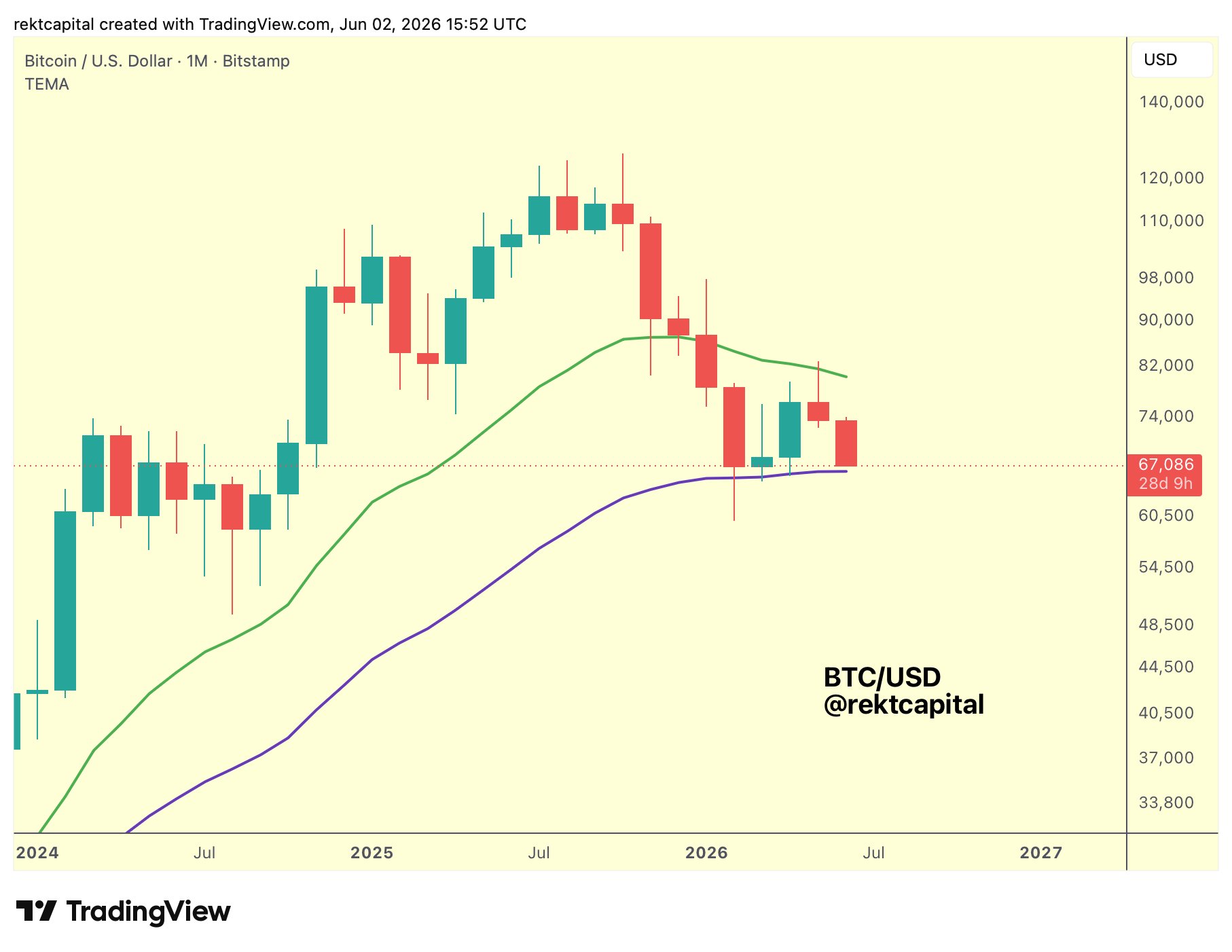
BTC/USD one-month chart. Source: Rekt Capital/X
Rekt Capital saw price targeting its 50-month exponential moving average (EMA) at $66,250 next.
“There could be a limited reaction from there on contact but over time Bitcoin is likely to breakdown from this EMA and continue macro downside in this Bear Market,” he added.
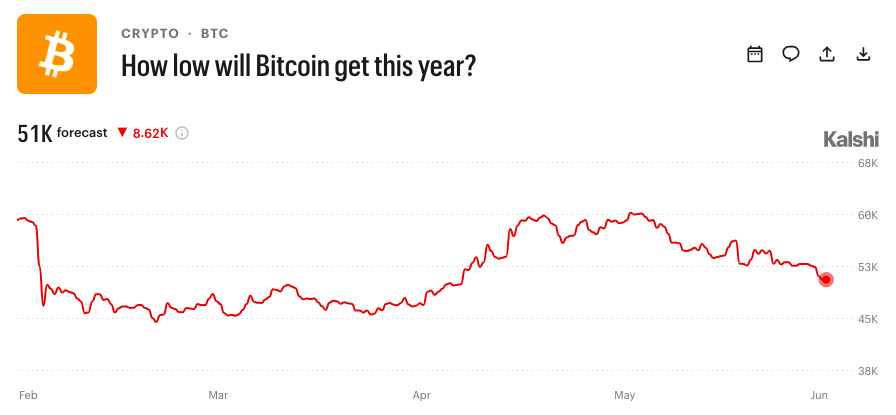
Source: Kalshi
As prediction service Kalshi saw $50,000 returning, commentator Exitpump put the spotlight on record open interest contributing to an “insane amount of spot selling.”
“I think this can end with a big red candle wiping out all the underwater longs from the system,” it warned X followers.
“Maybe we hit low 60Ks or even mid 50Ks.”
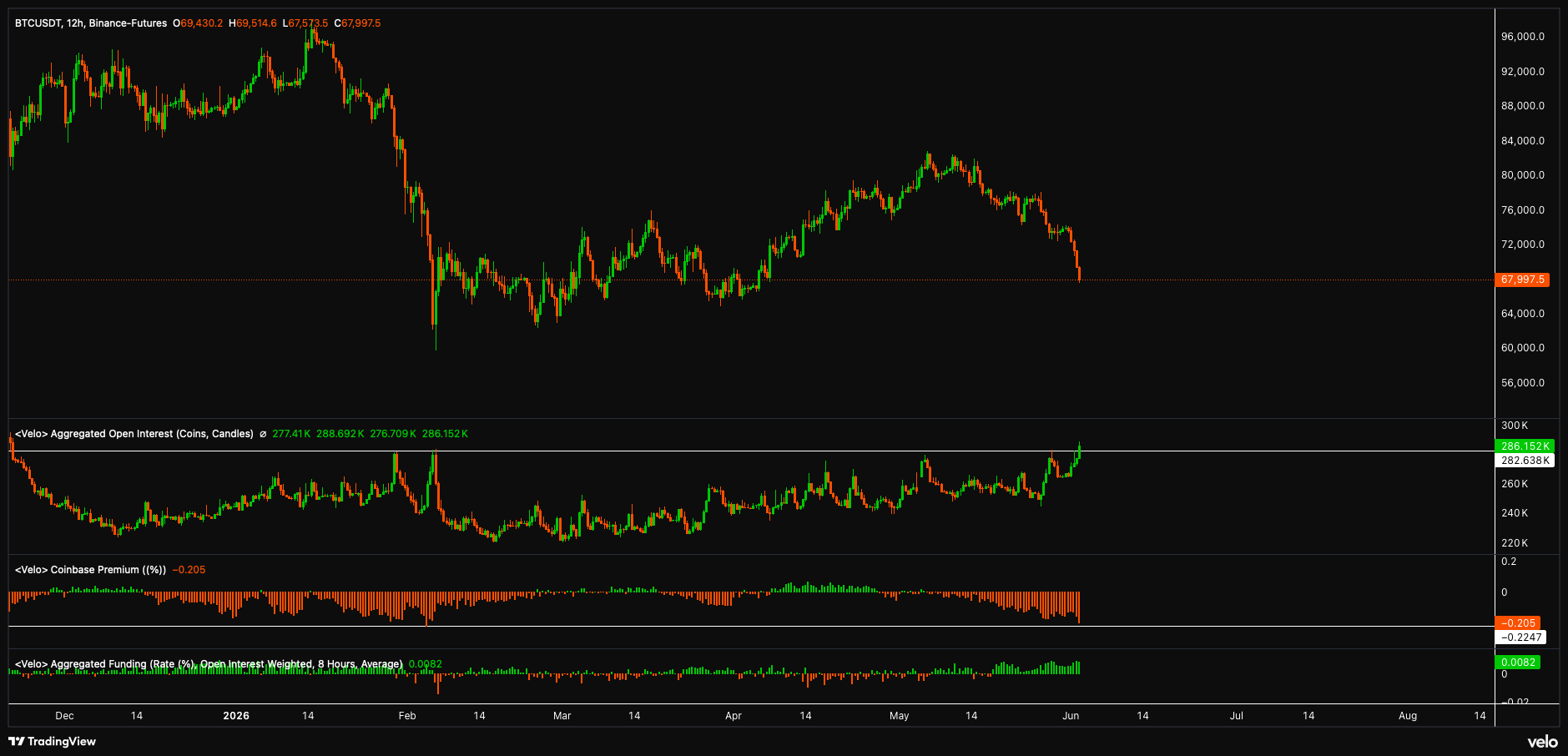
BTC/USDT 12-hour chart with exchange order-book data. Source: Exitpump/X
Bitcoin bear flag returns to the spotlight
Continuing, CollinTalksCrypto, creator of the social media channel of the same name, brought back a familiar chart feature to explain the BTC price weakness.
Related: Trump says Iran will ‘work out well’: Five things to know in Bitcoin this week
BTC/USD, he argued, was simply continuing a previous breakdown pattern, having exited a bear flag structure.
“Many wanted to overcomplicate this with ‘this time is different,’ but bitcoin is just doing the same thing it always does in bear markets. It breaks down,” an X post read.
“And it definitely takes longer than 4 months (Oct->Feb $60k), despite the hopium to want otherwise. I think it’s more likely than many still want to admit that we see lower lows this year.”
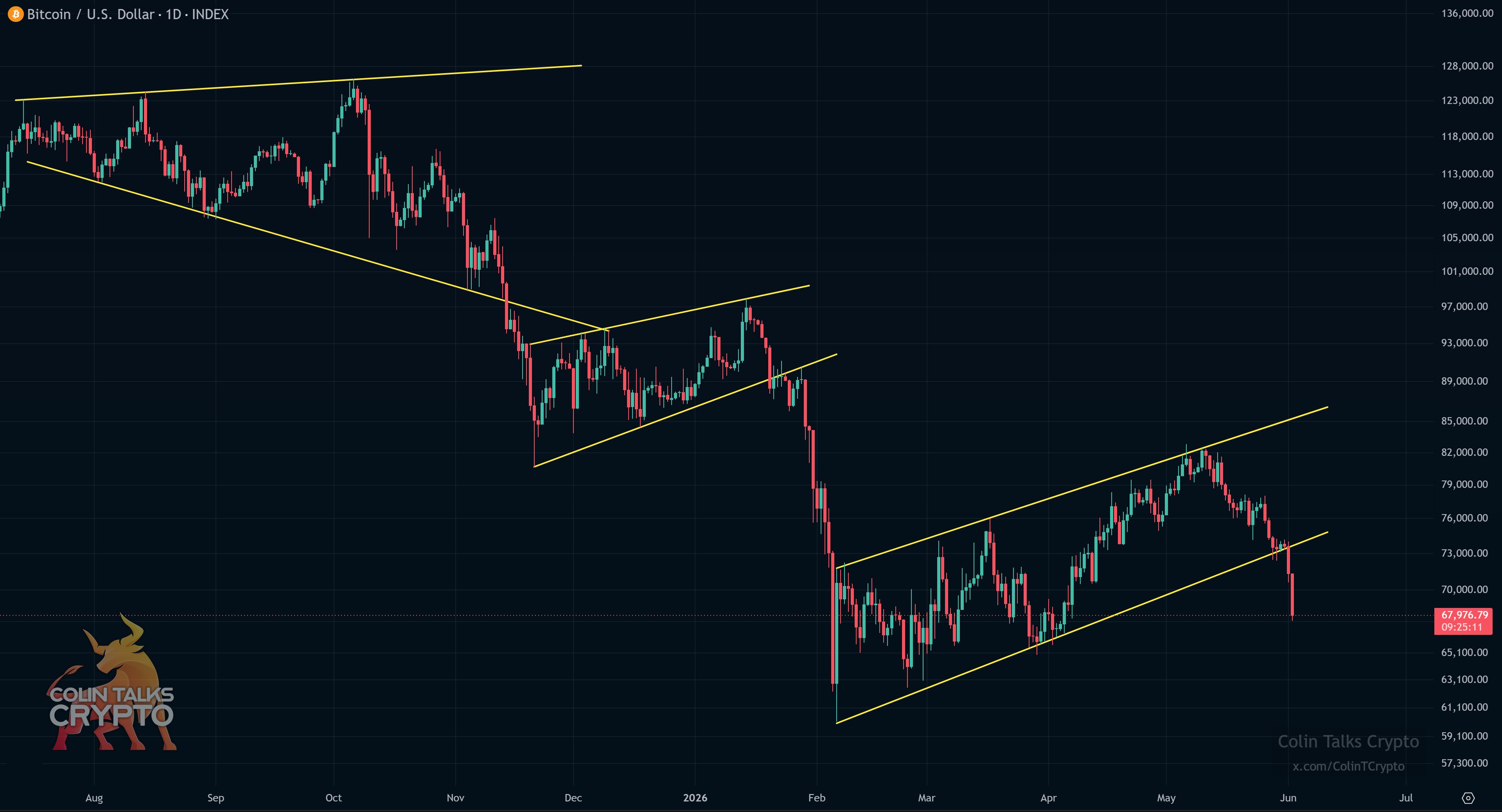
BTC/USD one-day chart. Source: ColinTalksCrypto/X
ColinTalksCrypto described the BTC price chart as “pretty straightforward.”


Key takeaways
- XRP has dropped below $1.25 after three straight days of losses, its lowest level since February 6.
- The bearish performance comes as the broader crypto markets remain under pressure from geopolitical tensions.
Ripple’s XRP has dropped below the $1.25 support level on Tuesday after extending losses for a third consecutive day, marking its weakest price since February 6.
The broader cryptocurrency market continues to face selling pressure as investors adopt a risk-off stance, driven by escalating geopolitical tensions in the Middle East.
Although U.S. President Donald Trump suggested that a peace deal with Iran could be reached “over the next week,” uncertainty persists.
A CNN report also indicated that negotiations between the two countries resumed shortly after Iran paused talks following Israel’s offensive in Lebanon, further contributing to market volatility.
Mixed capital flows show continued institutional interest in XRP
Despite the price decline, XRP continues to attract institutional inflows across digital investment products, including U.S.-listed spot exchange-traded funds (ETFs).
According to CoinShares, roughly $20 million flowed into XRP-related products in the week ending June 1, making it one of only a few assets to record meaningful inflows above $1 million.
At the ETF level, XRP spot products recorded $4.13 million in net inflows last week, extending a five-week streak of positive flows.
Cumulative inflows have reached approximately $1.43 billion, with total net assets under management standing at $1.11 billion, according to SoSoValue data.
XRP technical outlook: bearish pressure builds below key moving averages
XRP is currently trading around $1.23, remaining below its key short-, medium-, and long-term moving averages, reinforcing a bearish near-term structure.
Momentum indicators also reflect continued downside pressure. The MACD histogram remains negative, while the Relative Strength Index (RSI) sits near 37, approaching oversold territory but still indicating persistent bearish momentum.
If the bulls regain control, immediate resistance is seen at the 50-day EMA around $1.38, followed by the 100-day EMA near $1.45.
A stronger rebound would require a break above a descending trendline near $1.52. A broader trend reversal would only be signaled if XRP can reclaim the 200-day EMA around $1.65.

While institutional inflows continue to provide underlying support, XRP remains under pressure from broader macro uncertainty and technical weakness.
With the buyers failing to defend the $1.25 support level, XRP could likely drop below $1.20 in the near term.
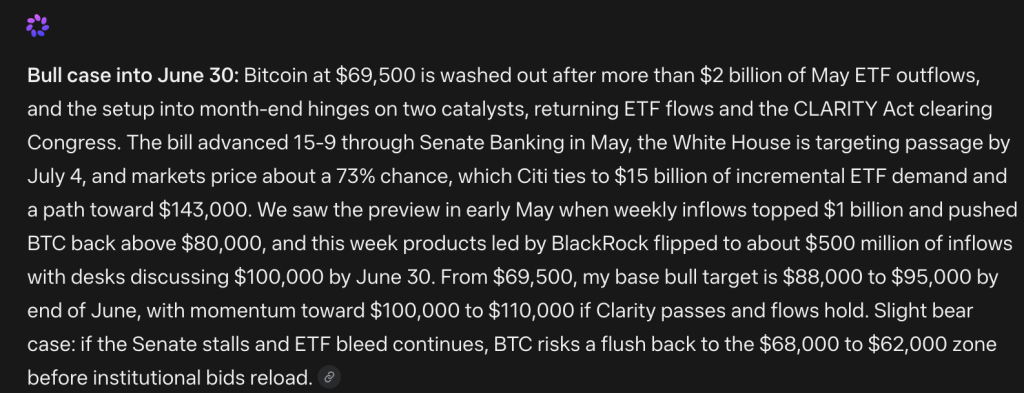
Mark Zuckerberg model Meta AI predicts Bitcoin washed out at $69,500 and sees a base bull target of $88,000 to $95,000 by June 30, with a path toward $100,000 to $110,000 opening up if 2 specific catalysts land before the month closes.
The prediction Zuckerberg’s AI is making is built around a near-term setup that is more event-driven than any other Bitcoin prediction covered in this series.
Over $2 billion of May ETF outflows created the selloff that brought BTC to current levels, and Meta AI is reading that as a washout rather than the start of a deeper structural break.
The evidence it is pointing to for that read is already visible: BlackRock-led products flipped back to roughly $500 million of inflows this week, which is a meaningful reversal of the flow picture that caused the damage in the first place.
The CLARITY Act is the variable that separates the base case from the bigger scenario. The bill cleared Senate Banking 15-9 in May, the White House is targeting July 4 passage, and markets are currently pricing a 73% probability of it happening.
Citi is tying that passage to $15 billion of incremental ETF demand and a path toward $143,000.
Meta AI is not going that far in its June target, but it is pointing to early May as the preview of what ETF flow recovery looks like in price terms: weekly inflows topping $1 billion pushed BTC back above $80,000 in days.
If CLARITY passes and institutional flows normalize, that same sequence plays out again from a lower base.
[crypto-chart coin=”bitcoin”]
The bear case is contained but specific. Senate stalling on CLARITY and continued ETF bleeding would push BTC toward the $68,000 to $62,000 zone before institutional bids reload.
That range represents the 2024 all-time high zone on the weekly chart, which historically flips from resistance to support in cycle progressions.
Bitcoin Price Prediction: Bitcoin Just Printed a 5.3% Weekly Loss and the Chart Is Now at One of the Most Consequential Levels in Years
BTC price is closing the week at $69,563, and the weekly chart zoomed out to 2021 is the most important context available right now.
This timeframe captures 2 complete cycles and places the current price in a perspective that the daily chart simply cannot provide.
The 2021 peak near $68,000 to $69,000 was the prior all-time high that the market spent 2 years below before finally breaking out in 2024.
That level became the launchpad for the run to $124,000. Bitcoin is now sitting right back at that same zone, which has gone from former resistance to current support. Whether it holds as support or gives way is the most structurally significant question Bitcoin has faced since the February flush to $61,000.
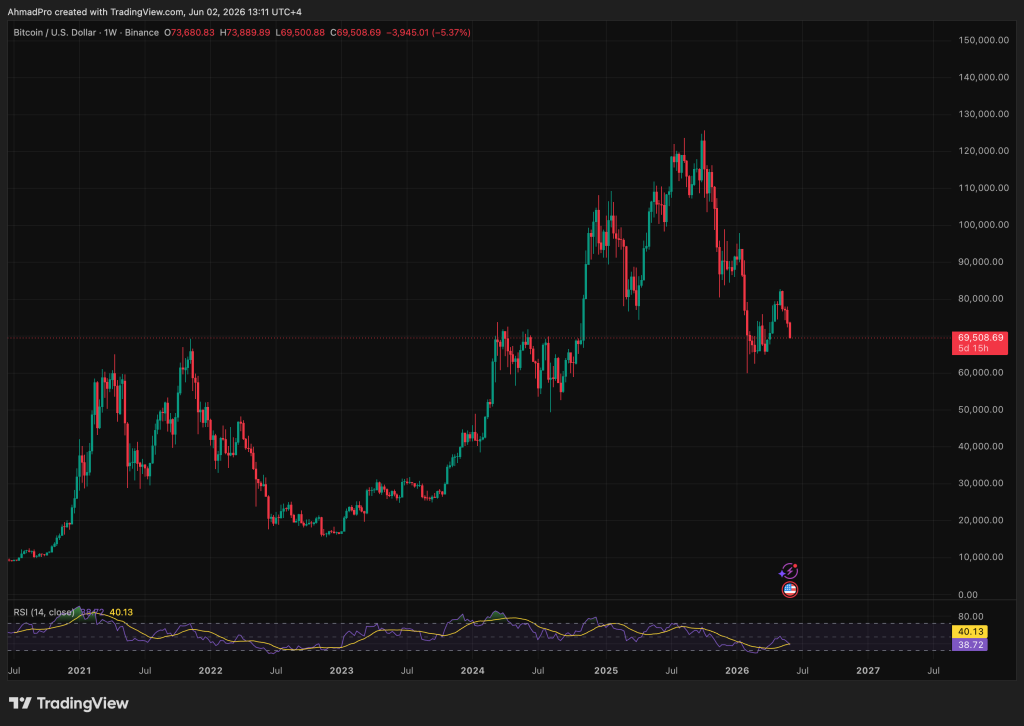
On the weekly chart, the structure since the $124,000 peak is a clean descending series of lower highs: $124,000, then $98,000 in April, and now the price is failing to hold $80,000 and breaking back toward $69,500.
That is 3 consecutive lower highs, which is the definition of a downtrend on this timeframe. For the bull case to regain credibility on the weekly, Bitcoin needs to break that pattern with a higher high above $98,000, which means first reclaiming $80,000 and holding it.
The $80,000 level is the immediate resistance that has rejected the BTC price twice in the past 6 weeks. Getting back above it cleanly is the first checkpoint before Meta AI’s $88,000 to $95,000 target becomes realistic in the timeframe it is calling for.
When Big Names Stop Moving, Something Else Always Does: Meta AI Predicts LiquidChain – The Next 1000x?
There is a moment in every cycle where chasing the obvious plays stops working. That moment is now. Bitcoin is grinding. Ethereum is going nowhere.
The ETF inflow narrative has been one quarter away from materializing for longer than anyone wants to admit. The traders who have been through enough cycles to recognize this pattern are not sitting in large caps waiting for a catalyst that keeps getting delayed. They are looking somewhere else entirely.
Every developer who has tried to build across Bitcoin, Ethereum, and Solana knows exactly what it costs. Three separate codebases.
LiquidChain is building the layer that makes the fragmentation irrelevant. One unified execution environment connecting all 3 networks simultaneously. A single deployment reaches Bitcoin, Ethereum, and Solana at once with no bridging overhead bleeding value out of every cross-ecosystem interaction.
The presale is at $0.01454. Just over $700,000 raised. That number tells you exactly where this sits in its lifecycle.
Execution is unproven. Adoption is unknown. Post-launch liquidity is a question mark. That is what the early stage looks like, and anyone packaging it differently is not being straight with you. The window where something is genuinely undiscovered does not stay open long. LiquidChain is still in it.
Explore the LiquidChain Presale
The post Mark Zuckerberg New META AI Predicts Bitcoin Price by End of June 2026 appeared first on Cryptonews.
Franklin Templeton has added its BENJI tokenized money market fund to MoonPay Trade, giving institutional clients a new route between stablecoins and tokenized fund products.
Summary
- Franklin Templeton has added its BENJI tokenized money market fund to MoonPay Trade for institutional users.
- The partnership will allow institutions to swap stablecoins such as USDC and USDT for BENJI via MoonPay’s on-chain trading system.
- MoonPay said the deal expands its institutional business beyond crypto, fiat, and stablecoin services.
According to a statement released Tuesday, the partnership will allow institutional users to swap USDC, USDT, and other stablecoins for Franklin Templeton’s tokenized money market fund via MoonPay’s on-chain trading platform. The companies said the arrangement is also expected to serve as the basis for a deeper strategic relationship between Franklin Templeton and MoonPay.
Franklin Templeton brings BENJI to MoonPay trade
The integration gives BENJI holders a direct path into stablecoin liquidity, while also creating an on-chain entry point for institutions seeking exposure to tokenized money market products. Franklin Templeton said the setup can support treasury management, portfolio rebalancing, collateral use, and liquidity provision.
Sandy Kaul, Franklin Templeton’s head of innovation and digital assets, said tokenized money market funds become more useful when they can move at the speed and with the programmability of digital asset networks. Kaul added that working with MoonPay creates another trusted gateway between stablecoin liquidity and tokenized fund exposure.
MoonPay said the deal also expands its institutional business beyond crypto, fiat, and stablecoins. The announcement comes after Caroline Pham, former acting chair of the Commodity Futures Trading Commission, joined MoonPay Institutional as CEO.
MoonPay builds out institutional onchain trading
Pham said tokenized money market funds can improve liquidity and capital efficiency when institutions can access the on-chain financial system. She said MoonPay’s partnership with Franklin Templeton on liquidity and collateral solutions illustrates the infrastructure now supporting institutional digital asset adoption.
MoonPay introduced MoonPay Trade in late May as an institutional on-chain execution platform. The company said the platform gives enterprises and institutions a single API to access more than 200 blockchains, cross-chain routing, trade execution, settlement, collateral movement, and tokenized asset transactions, all under compliance controls.
MoonPay Trade also relies on infrastructure from recent MoonPay acquisitions. These include Decent for cross-chain routing and liquidity, DFlow for trading technology, and Sodot for crypto key management.
BENJI expansion continues across crypto platforms
Franklin Templeton, which reported about $1.74 trillion in assets under management in its latest quarterly report, has become one of the largest traditional asset managers active in tokenization. It’s Franklin OnChain U.S. Government Money Fund, known as FOBXX or BENJI, launched in 2021 as the first U.S.-registered mutual fund to use a public blockchain.
The asset manager has also expanded BENJI through other crypto partnerships. Franklin Templeton has worked with Payward, the parent company of Kraken, on tokenizing additional traditional investment products. It has also partnered with Binance to support BENJI as off-exchange collateral.
In April, Franklin Templeton agreed to buy 250 Digital, a CoinFund spinoff, to grow its crypto investment business. The firm is also working with Ondo Finance to tokenize a group of ETFs.
MoonPay links onchain access with ChatGPT app
As previously reported by crypto.news, MoonPay launched a dedicated app inside ChatGPT’s App Store on May 22. The app allows users to create crypto purchase links without leaving OpenAI’s chatbot, while MoonPay described itself in its announcement as the first crypto onramp integrated in ChatGPT.
As per the report, MoonPay, the ChatGPT app supports Bitcoin, XRP, Ethereum, Solana, USDC, and more than 100 other digital assets across over 30 chains. After the chatbot generates a checkout link, users complete KYC and payment on moonpay.com using a card, Apple Pay, Google Pay, or bank transfer.
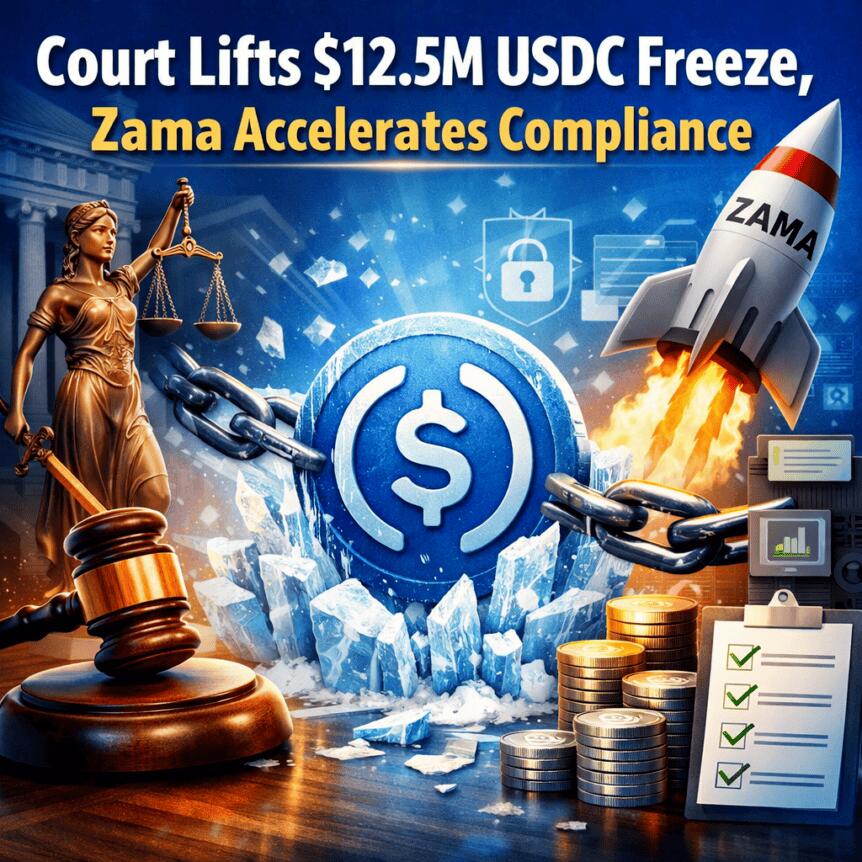
Zama, a privacy-focused blockchain protocol, has committed to accelerating its regulatory-compliance program after a U.S. court lifted a temporary freeze on roughly $12.5 million in USDC held in its confidential cUSDC wrapper. The move ends a disruption tied to a dispute involving Overnight Finance and highlights the ongoing tension between privacy-preserving infrastructure and centralized stablecoins that can be frozen by issuers under court order.
Co-founder Rand Hindi announced on X that the court determined the freeze to be unwarranted and that the cUSDC contract, along with all underlying USDC, has returned to normal operation. The deposit in question, approximately $12.5 million, was made into Zama’s confidential USDC wrapper on May 11. Hindi noted that the freeze was tied to a litigation amid a dispute unrelated to Zama, and that the umbrella effect—where the disputed account represented the majority of the contract’s value—created a blanket freeze request through Circle.
The episode underscores a broader institutional debate: how privacy-preserving protocols can coexist with the centralized controls that stablecoin issuers retain. As Hindi put it, the situation could have affected any protocol holding freezable assets, including decentralized exchanges, lending protocols, and bridges. The court’s decision to unwind the freeze is seen by Zama as a proof point that targeted responses may be possible within existing legal frameworks, even when assets are stored in pooled, centralized wrappers.
Key takeaways
- The U.S. court lifted the temporary freeze on about $12.5 million in USDC held in Zama’s cUSDC wrapper, allowing normal operations to resume.
- Zama intends to accelerate its compliance roadmap, expanding automated enforcement of issuer-level freezes and adding governance and monitoring tools.
- Under the proposed framework, if Circle freezes a USDC address, the corresponding confidential USDC tied to that address would be frozen, while the protocol aims to preserve access for unaffected users.
- The incident has not deterred institutional interest; Zama remains committed to launching its cUSDC product, including shielding $5 million of USDC from its treasury, later this month.
Unwinding the freeze and what it means for privacy-enabled rails
According to Hindi, the court concluded that freezing an entire smart contract pool imposed disproportionate harm on users not implicated in the dispute. He noted that Zama’s architecture preserves visible sender and recipient addresses while encrypting balances and amounts, enabling the protocol to isolate the disputed account without disrupting others. In his view, this capability—to target enforcement without broad collateral damage—demonstrates a critical distinction between centralized stablecoins stored in pooled contracts and more granular, privacy-preserving designs that can limit collateral effects of legal actions.
Jeremy Bradley, Zama’s chief operating officer, elaborated that the case serves as a cautionary tale for any protocol holding centralized, freeze-capable assets. He told Cointelegraph that the exact dynamics could apply to automated market makers, lending protocols, bridges, and other actors holding USDC in pooled contracts. The core takeaway, he argued, is that the absence of targeted freezing tools can leave protocols exposed to court orders that affect many users at once rather than isolating a single account.
“The same court has now lifted the freeze, determining that it was unwarranted,” Rand Hindi wrote on X. “The cUSDC contract and all underlying USDC have returned to normal operation.”
Those reflections echo a broader legal-question backdrop: how to reconcile the privacy of user balances with the transparency typically required by issuers and regulators. The Cointelegraph report on the initial freeze highlights how the interplay between user privacy and regulatory requests can escalate quickly in pooled custody scenarios. The ongoing dialogue around targeted compliance tooling—versus blanket freezes—remains central to how the ecosystem evolves.
Accelerating compliance: what Zama is changing this year
In response to the incident, Zama outlined a plan to accelerate its compliance program. The team’s roadmap now foregrounds automatic enforcement of compliance actions tied to underlying asset issuers, with a focus on limiting the blast radius of a freeze. Under the proposed approach, Circle’s action to freeze a USDC address would automatically cascade to freeze the corresponding confidential USDC holdings within Zama’s protocol, rather than requiring a blanket halt across the entire pool.
Bradley described the changes as an enhancement of an existing design principle: programmable compliance. The team intends to establish a compliance council and bring in additional transaction-monitoring tools to bolster observability and governance. He argued that the incident has shifted urgency from planning to execution, enabling institutions to engage with Zama with greater confidence that the protocol can respond to legal requests without compromising privacy for non-involved users.
Even as Zama doubles down on privacy, the project remains committed to working with Circle and other ecosystem participants to navigate the legal realities of stablecoins within a decentralized framework. Bradley emphasized that Circle’s actions were a response to a court order, and the broader challenge lies in building tools that allow precise, targeted responses rather than sweeping restrictions that impact all users of a pooled contract.
Beyond the governance and tooling improvements, Zama reiterated its intention to push forward with the launch of its cUSDC product later this month, including a plan to shield $5 million of USDC from its treasury. The company frames this as a testbed for how confidential assets can be reconciled with issuer-level controls in a real-world setting, potentially offering a blueprint for other privacy-oriented protocols facing similar regulatory pressures.
Assistants aligned to this space have noted that the lifting of the freeze demonstrates that privacy rails can operate within the legal framework when they include precise, auditable controls. The broader takeaway is not a retreat from privacy but a pivot toward interoperable, compliance-ready privacy tooling that can coexist with the stability mechanisms central to the broader crypto ecosystem.
For now, the market will be watching how quickly Zama can implement its enhanced compliance features and how other protocols that rely on centralized stablecoins respond to the lesson that blanket freezes can be mitigated through targeted, isolable actions. The unfolding developments surrounding cUSDC and programmable compliance will likely influence discussions on custody, governance, and legal transparency across privacy protocols and stablecoins alike.
As Zama advances, observers will be looking for further clarity on how targeted freezing could function in practice across different asset wrappers, and whether other issuers and protocols adopt similar approaches to balance user privacy with legitimate regulatory demands. The next milestones—Zama’s cUSDC launch, the rollout of governance and monitoring tools, and any regulatory guidance—will shape how privacy-focused infrastructure can scale safely in a tightly monitored financial landscape.


Coinbase has invested in ProShares’ GENIUS Money Market ETF as stablecoin issuers prepare for stricter reserve rules under the GENIUS Act.
Summary
- Coinbase has invested in ProShares’ IQMM ETF to support stablecoin reserve management.
- IQMM is designed to meet reserve requirements under the GENIUS Act.
- The fund mainly holds short-term U.S. Treasuries, cash, and cash equivalents.
- Coinbase said stablecoin growth needs stronger tools for reserve and liquidity management.
BlockBeats reported on June 2 that Coinbase will invest in the ProShares fund, known by the ticker IQMM. The report said the product is designed as a money market ETF that can qualify for use as a stablecoin reserve under the U.S. stablecoin law.
The move places Coinbase deeper inside the reserve layer of the stablecoin market. Until now, Coinbase has focused heavily on stablecoin payments, distribution, developer tools, and on-chain access. With IQMM, the company is adding exposure to the systems that manage the assets backing dollar-pegged tokens.
Coinbase pushes into stablecoin reserve tools
Coinbase said stablecoins have changed how users, businesses, developers, and AI agents move money by allowing instant settlement at any hour. The company also said that payment adoption needs a stronger reserve infrastructure behind the tokens.
According to Coinbase, reserve management, liquidity management, issuance, and redemption systems will become more important as stablecoins handle more payment and settlement activity. The company said stablecoin issuers need tools built for these functions rather than relying only on older banking and cash management channels.
IQMM gives Coinbase a place in that part of the market. ProShares brings ETF infrastructure experience to the fund, while Coinbase is presenting the investment as part of its attempt to support the full stablecoin stack.
IQMM targets GENIUS Act reserve standards
ProShares designed IQMM around assets that align with the reserve framework established by the GENIUS Act. The law requires payment stablecoins to be backed one-to-one by high-quality, highly liquid assets.
The fund mainly holds short-term U.S. Treasuries with remaining maturities of 93 days or less. It also includes cash and cash equivalents. According to the report, this structure is intended to meet Section 4 reserve requirements under the GENIUS Act.
BlockBeats described IQMM as the first money market ETF designed to serve as a stablecoin reserve asset. Coinbase said products such as IQMM could help issuers manage liquidity during stablecoin creation and redemption.
Stablecoin issuers face new reserve demands
The GENIUS Act passed into law last year, created a federal framework for issuing stablecoins in the United States. The law requires issuers to back payment stablecoins fully with liquid assets such as Treasuries or cash.
However, the rules will not officially take effect until at least early 2027. Regulators are still preparing detailed requirements for stablecoin issuers.
Coinbase said reserve assets could expand beyond direct Treasury holdings as the sector develops. The company listed ETFs, money market funds, and tokenized cash-like products among the instruments that could support future stablecoin reserves.
ProShares launched IQMM in February. The fund generated $17 billion in trading on its first day, according to the provided market data.
Coinbase said stablecoins offer a better way to move money, but also that the industry needs better systems for managing the reserves backing them. Its IQMM investment extends that strategy into the financial plumbing that supports stablecoin issuance, redemption, and liquidity.
In the latest XRP News, Ripple is moving into Turkey with RLUSD, its USD-backed stablecoin, targeting a market where inflation has made dollar-denominated assets a structural necessity rather than a speculative preference.
The company announced on June 2, 2026 that RLUSD is now available through three Turkish partners, BiLira, Bitexen, and Bitlo, in a direct push to capture institutional and retail demand currently dominated by USDT and USDC.
This is not a soft launch. Türkiye processes nearly $200 billion in annual crypto transaction volume, outpacing regional peers by nearly fourfold according to the Chainalysis 2025 Geography of Crypto Report.
Ripple is entering that market with a compliance-first stablecoin, a $1.7 billion market cap built since late 2024, and a regulatory posture designed to align with Türkiye’s own tightening oversight framework.
The question is whether any of that is enough to move market share away from incumbents with years of liquidity depth and network entrenchment.
Discover: The Best Crypto to Diversify Your Portfolio
XRP News: Türkiye’s Inflation Environment Makes Stablecoin Demand Structural, Not Cyclical
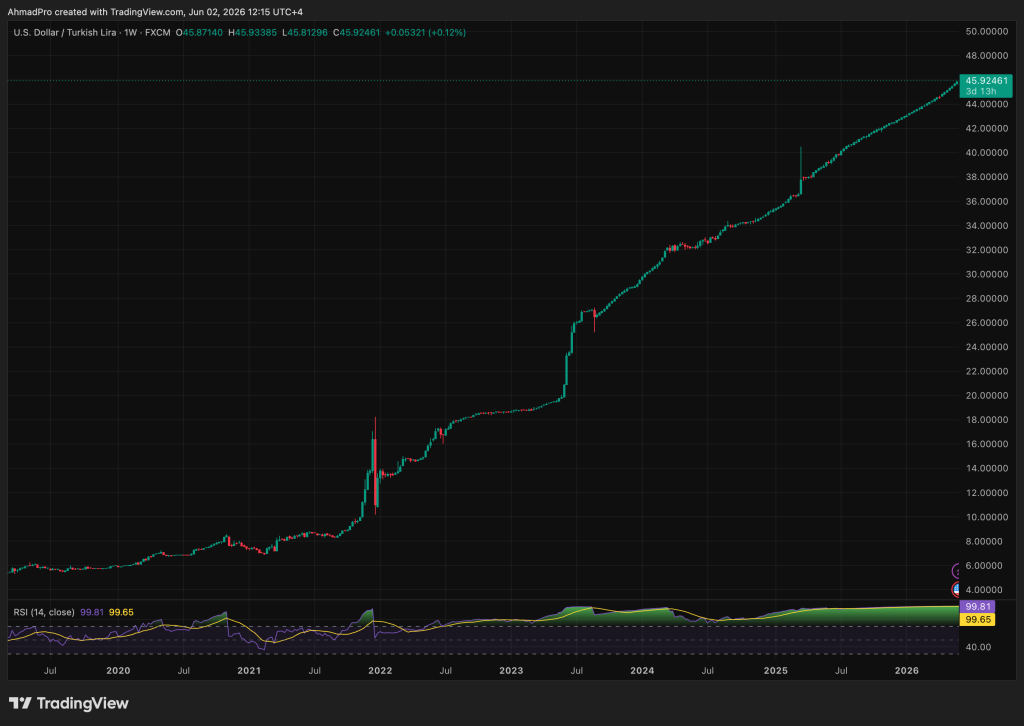
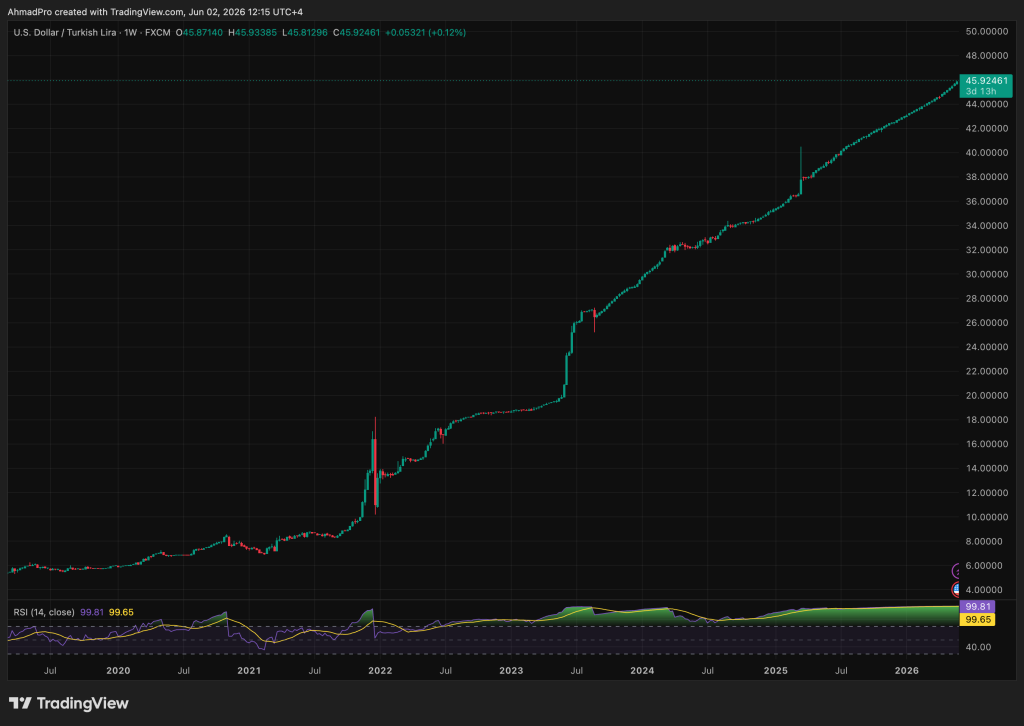
The Turkish lira has lost the majority of its value against the dollar over the past five years, compressing purchasing power and making dollar-denominated savings accounts a priority for ordinary citizens and institutions alike.
Crypto adoption in Türkiye is not driven by speculative appetite; it is driven by the same economic logic that pushes populations toward any reliable inflation hedge when local currency credibility erodes.
That context explains why Türkiye ranks among the top markets globally for crypto adoption, and why stablecoins, particularly USDT, account for a disproportionate share of Turkish trading volume relative to assets like Bitcoin or Ethereum.
The Capital Markets Board implemented a comprehensive licensing framework in 2024, shifting the market from unregulated retail trading toward an institutional ecosystem with defined compliance requirements. That regulatory shift is the opening Ripple is walking through.
BiLira, one of the three new RLUSD partners, operates with approximately $300 million in monthly trading volume and issues TRYB, a stablecoin pegged 1:1 to the Turkish lira.
Its infrastructure sits directly at the intersection of local fiat liquidity and digital asset settlement, precisely the on-ramp architecture that RLUSD needs to reach Turkish users at scale.
The structural demand is not in question. The question is whether RLUSD can convert that demand into actual market share.
Discover: The Best Token Presales
The post XRP News: Ripple Targets Turkey Inflation Market: Can RLUSD Beat USDT and USDC? appeared first on Cryptonews.
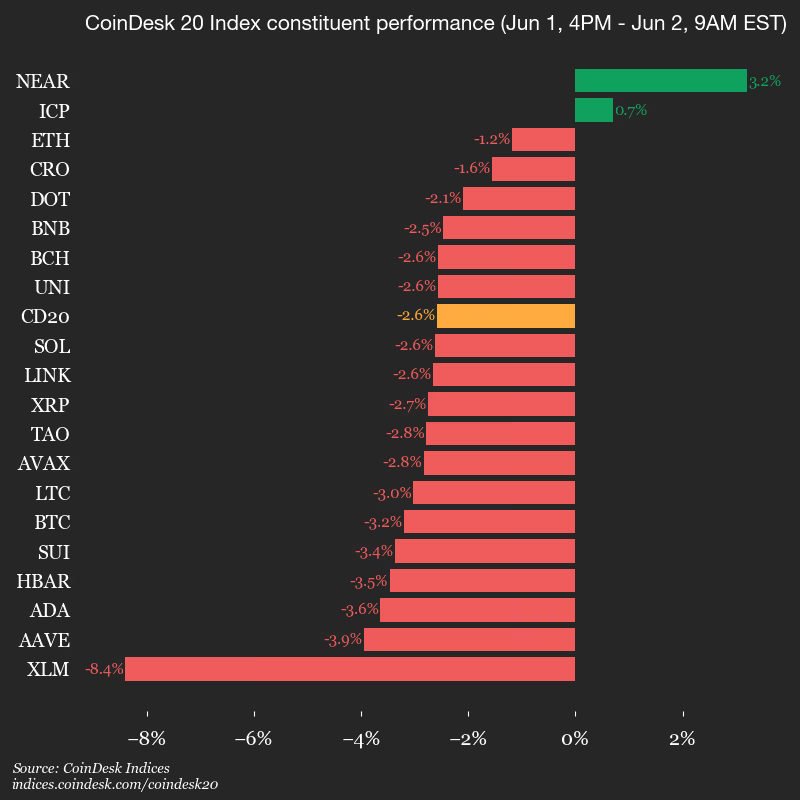
oinDesk Indices presents its daily market update, highlighting the performance of leaders and laggards in the CoinDesk 20 Index.
The CoinDesk 20 is currently trading at 1941.81, down 2.6% (-51.57) since 4 p.m. ET on Monday.
Two of the 20 assets are trading higher.

Leaders: NEAR (+3.2%) and ICP (+0.7%).
Laggards: XLM (-8.4%) and AAVE (-3.9%).
The CoinDesk 20 is a broad-based index traded on multiple platforms in several regions globally.
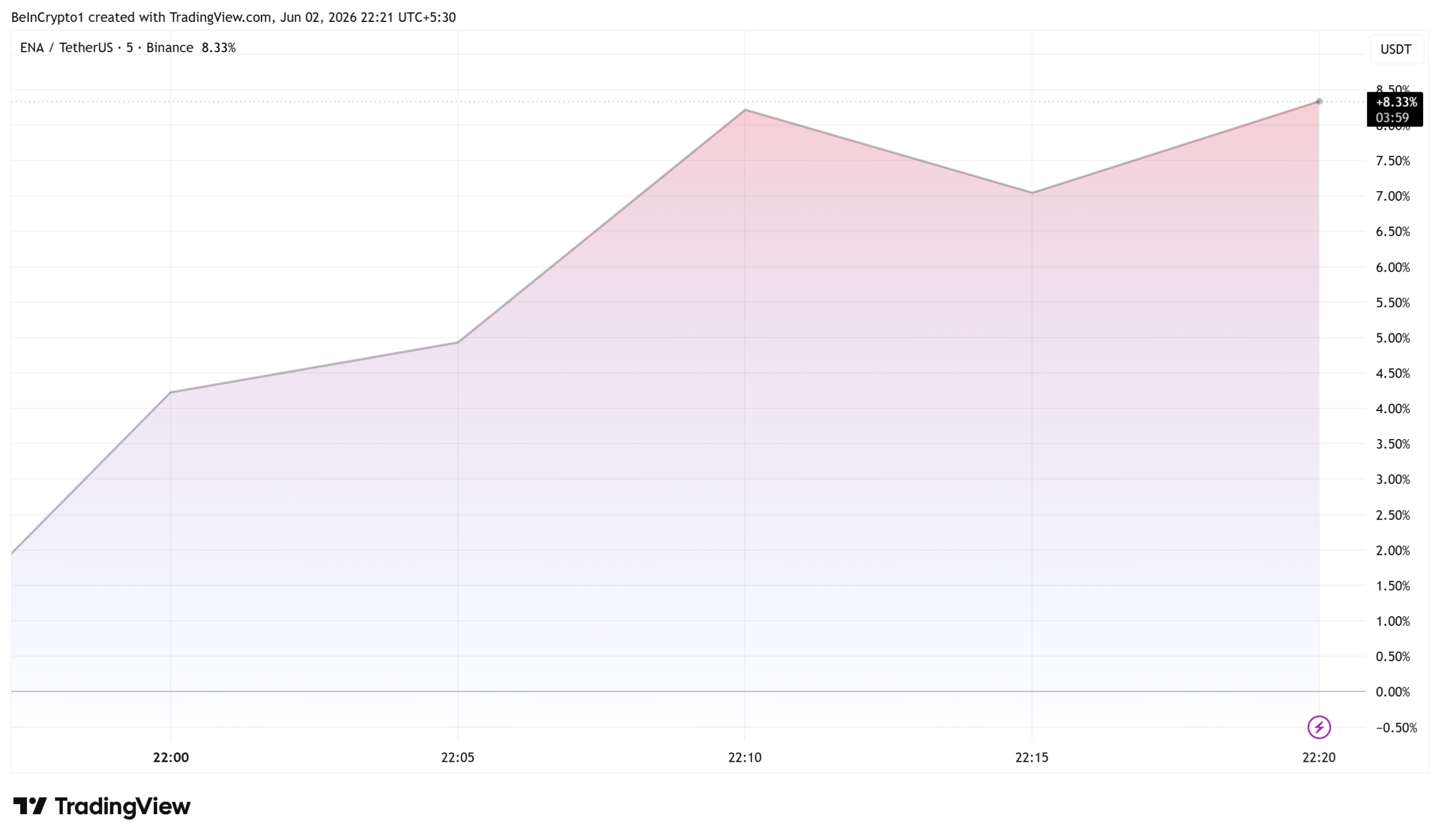
Coinbase Ventures has purchased ENA tokens on the open market in its first investment in Ethena, while the two firms announced a major partnership to expand on-chain finance and savings products to Coinbase’s 100 million+ users.

The post Coinbase Announcement Fuels 10% Surge for Ethena (ENA) Price appeared first on BeInCrypto.

Robert Pattinson’s ‘The Batman’ Sequel Gets a Key Filming Update

RMT calls for insourcing of all railway staff following Thameslink nationalisation

Roku quietly adds new free live TV channels for customers



-

 NewsBeat6 days ago
Israel says it has killed new Hamas military leader in Gaza City airstrikes
-

 Tech6 days ago
NASA taps Blue Origin to deliver lunar rovers for Moon Base initiative
-

 News Videos4 days ago
This is BROKEN! INSANE 5x MONEY CAR WASH WEEK! The NEW GTA Online UPDATE Today! (GTA5 New Update)
-

 News Videos7 days ago
XRP *JUST* SUCCEEDED!!!! CLARITY ACT EXPOSED!!! (SHE EXPOSED IT)
-
 Crypto World7 days ago
Micron Crosses $1 Trillion Market Cap as AI Demand Reshapes Memory Sector
-
 Tech3 days ago
SpaceX just won a second Golden Dome contract. This one is $4.16 billion.
-

 Business7 days ago
Selena Gomez Reportedly Upset Over Benny Blanco’s Comments on Her ‘Terrible’ Diet
-

 Tech5 days ago
Waymo dominates autonomous vehicle registrations as Tesla trails behind
-

 News Videos4 days ago
SHE IS KILLING XRP!!! WATCH URGENT AND ACT FAST
-

 Entertainment7 days ago
Days of our Lives 2-Week Spoilers May 25-June 5: Gwen Rages, Abe Confesses & 2 Tragic Anniversaries!
-
 NewsBeat4 days ago
FIRST NIGHT REVIEW: Take That bring the Circus back to life in spectacular sun-soaked style
-

 Tech6 days ago
The Samsung pay deal is the moment Korean unions changed register
-

 Business22 hours ago
Jade Biosciences, Inc. (JBIO) Discusses Positive Interim Results From JADE101 Phase I Healthy Volunteer Study and Development Plans Transcript
-

 Tech7 days ago
Millions of AI agents imperiled by critical vulnerability in open source package
-
Crypto World4 days ago
CFTC Has Approved the First Regulated Bitcoin Perpetual Contract in the U.S.
-
Crypto World6 days ago
SpaceX’s $2 Trillion IPO: Why Tech Giants Nvidia (NVDA), Apple (AAPL), and Microsoft (MSFT) May Face Pressure
-
 Entertainment6 days ago
The Most Misunderstood Sci-Fi Horror Movie of the Last 10 Years Just Took Over Netflix
-

 Crypto World7 days ago
Spain blocks prediction markets Polymarket Kalshi
-
 Crypto World4 days ago
Snowflake (SNOW) Stock Rallies on Strong Q1 Results and AI Product Growth
-
 NewsBeat4 days ago
Novak Djokovic v Joao Fonseca LIVE: French Open latest scores and results after Jannik Sinner’s shocking collapse
You must be logged in to post a comment Login