

Crypto World
Bitcoin Keeps Selling Off as BTC Price Dives Below $67,000

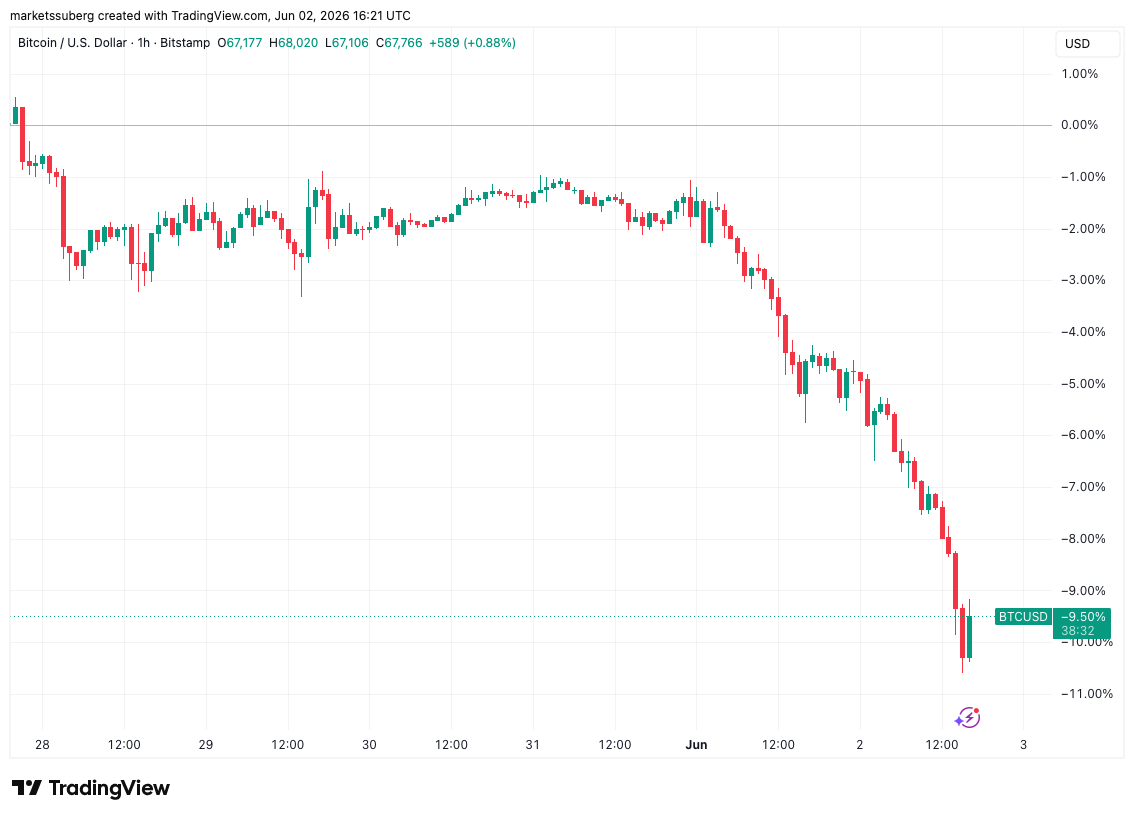
Bitcoin (BTC) losses passed 6% after Wednesday’s Wall Street open as a cascade of liquidations gathered pace.
Key points:
- Bitcoin falls below $67,000 for the first time since the first week of April as losses pile on.
- Liquidations hit $1.25 billion over 24 hours as analysis sees the mid-$50,000 range returning.
- BTC/USD appears to repeat a bear flag breakdown from earlier in the year.
BTC price dives to $66,950 in liquidation cascade
Data from TradingView showed BTC/USD dropping as low as $66,948 on Bitstamp.
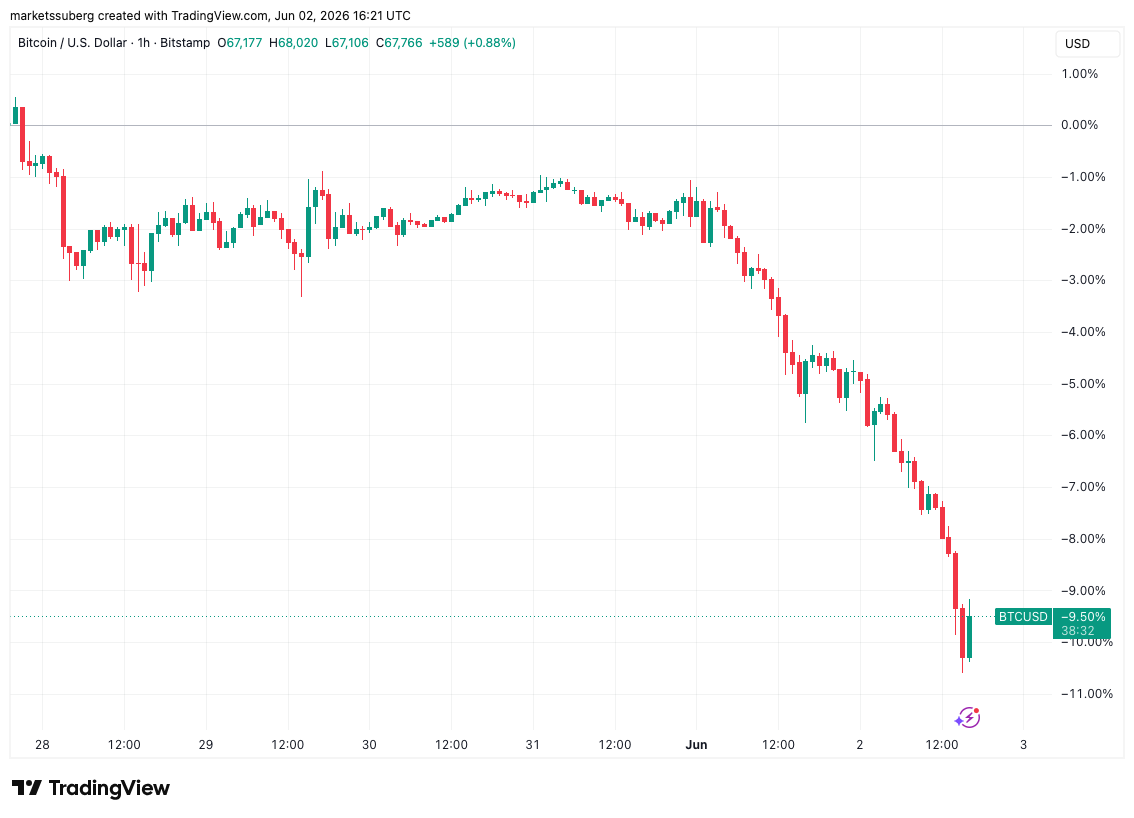
BTC/USD one-hour chart. Source: Cointelegraph/TradingView
That level marked the pair’s lowest since April 5, erasing months of gains as 24-hour cross-crypto liquidations hit $1.25 billion.
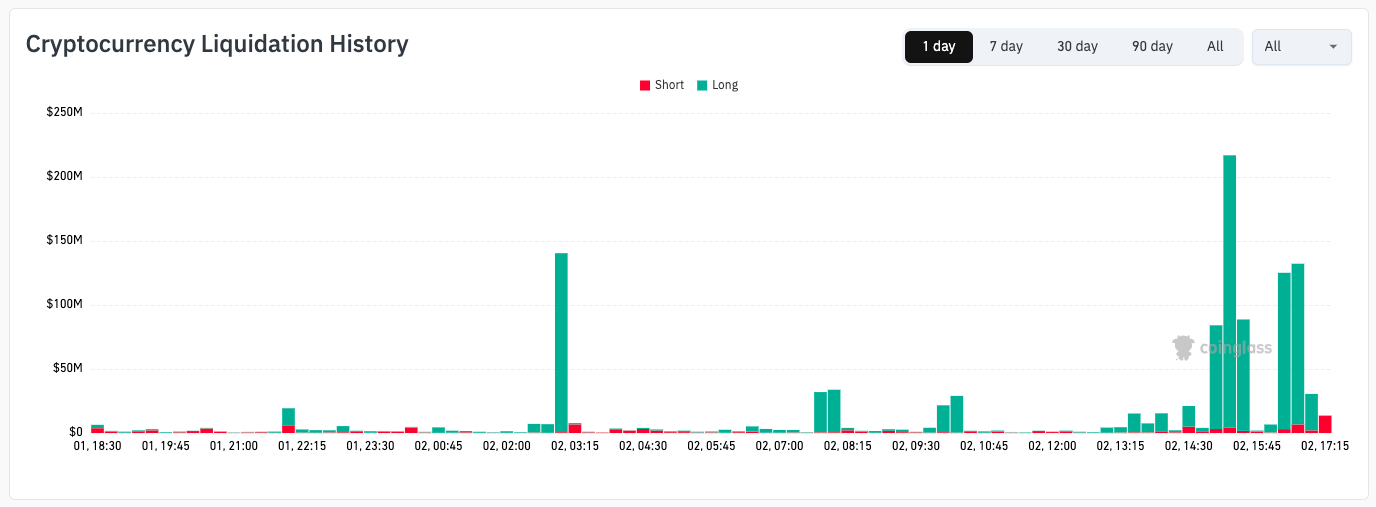
Crypto liquidation history (screenshot). Source: CoinGlass
Continuing a grim divergence from other risk assets, Bitcoin collapsed as the S&P 500 set yet another all-time high.
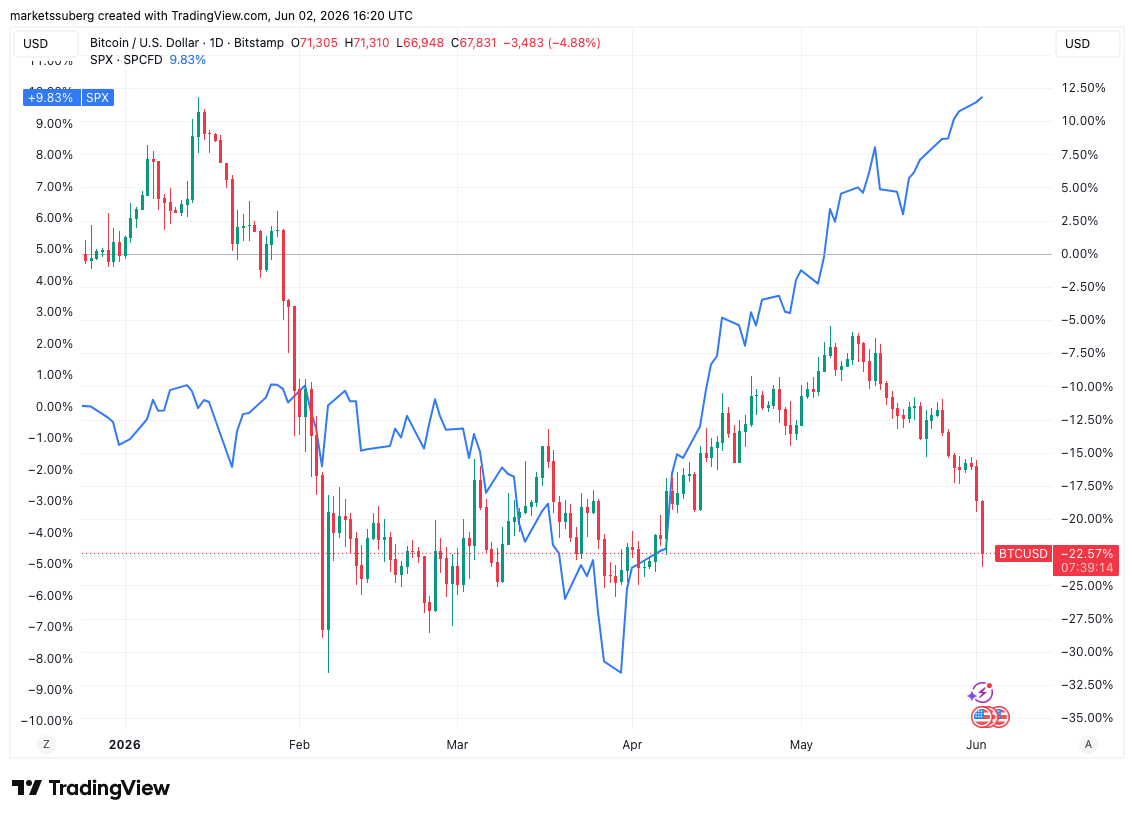
BTC/USD vs. S&P 500 one-day chart. Source: Cointelegraph/TradingView
“Investors are Macro Risk-Off, fleeing into Stablecoins and moving away from Bitcoin,” trader and analyst Rekt Capital wrote in a response on X.
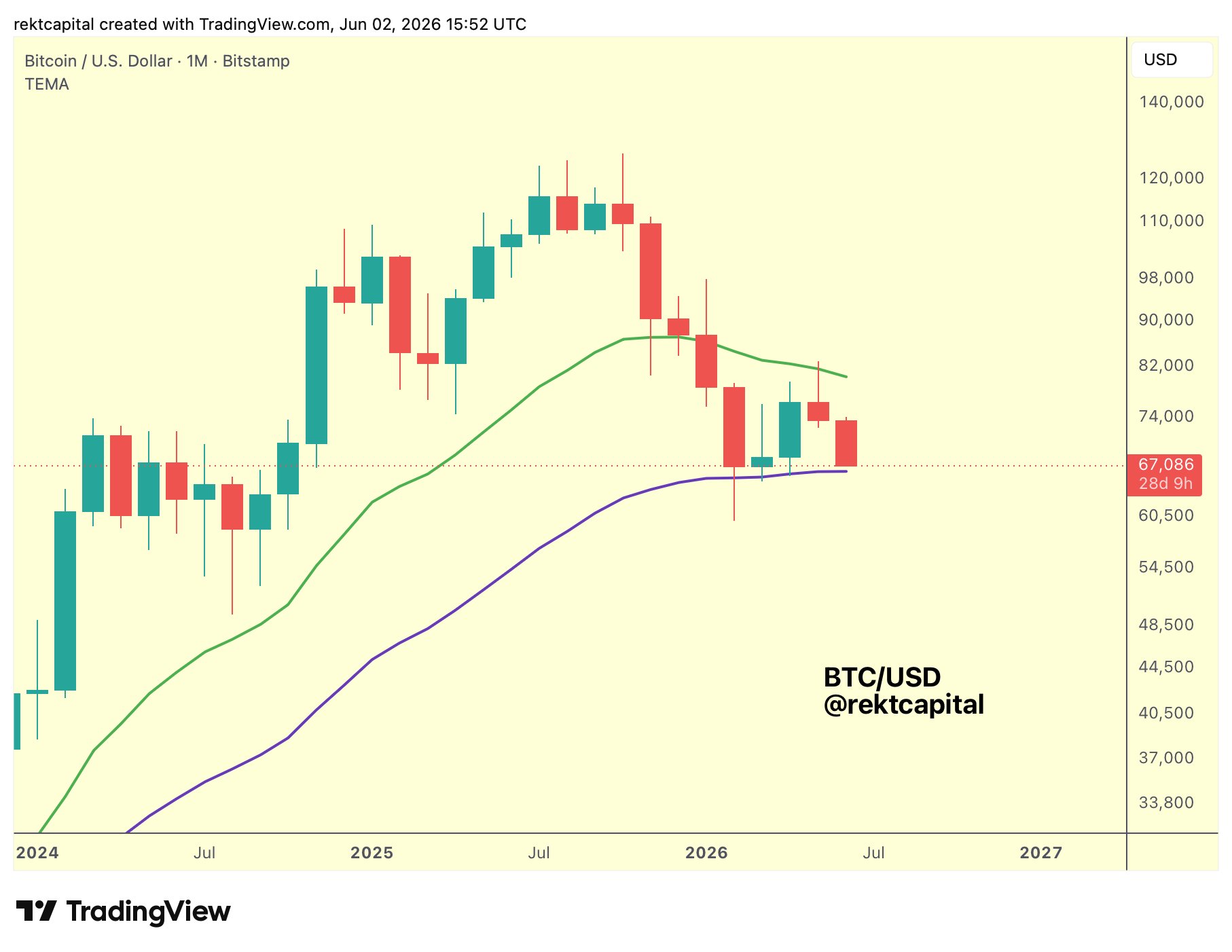
BTC/USD one-month chart. Source: Rekt Capital/X
Rekt Capital saw price targeting its 50-month exponential moving average (EMA) at $66,250 next.
“There could be a limited reaction from there on contact but over time Bitcoin is likely to breakdown from this EMA and continue macro downside in this Bear Market,” he added.
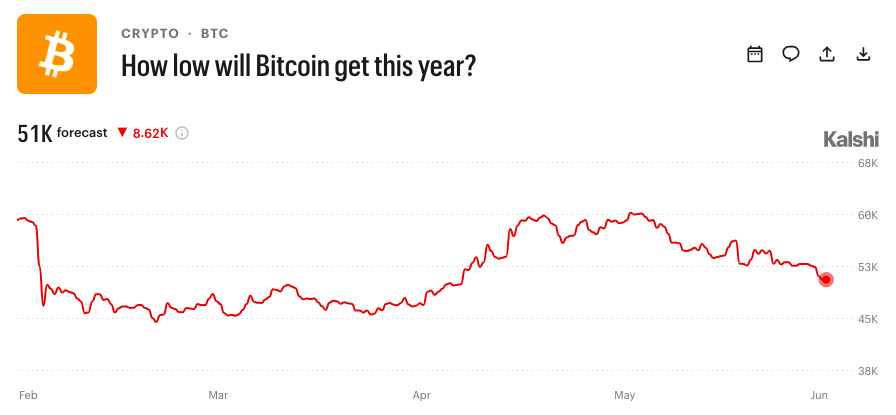
Source: Kalshi
As prediction service Kalshi saw $50,000 returning, commentator Exitpump put the spotlight on record open interest contributing to an “insane amount of spot selling.”
“I think this can end with a big red candle wiping out all the underwater longs from the system,” it warned X followers.
“Maybe we hit low 60Ks or even mid 50Ks.”
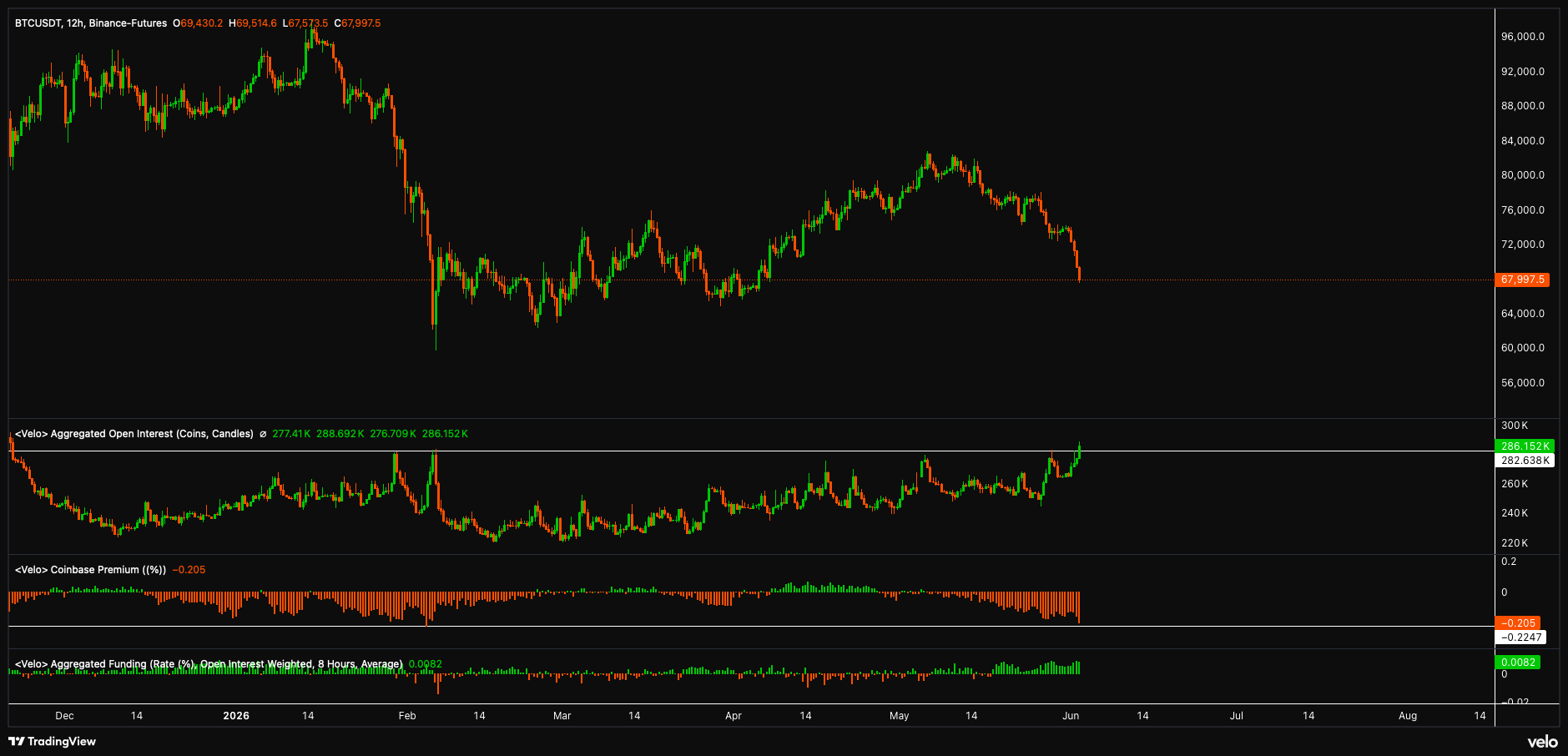
BTC/USDT 12-hour chart with exchange order-book data. Source: Exitpump/X
Bitcoin bear flag returns to the spotlight
Continuing, CollinTalksCrypto, creator of the social media channel of the same name, brought back a familiar chart feature to explain the BTC price weakness.
Related: Trump says Iran will ‘work out well’: Five things to know in Bitcoin this week
BTC/USD, he argued, was simply continuing a previous breakdown pattern, having exited a bear flag structure.
“Many wanted to overcomplicate this with ‘this time is different,’ but bitcoin is just doing the same thing it always does in bear markets. It breaks down,” an X post read.
“And it definitely takes longer than 4 months (Oct->Feb $60k), despite the hopium to want otherwise. I think it’s more likely than many still want to admit that we see lower lows this year.”
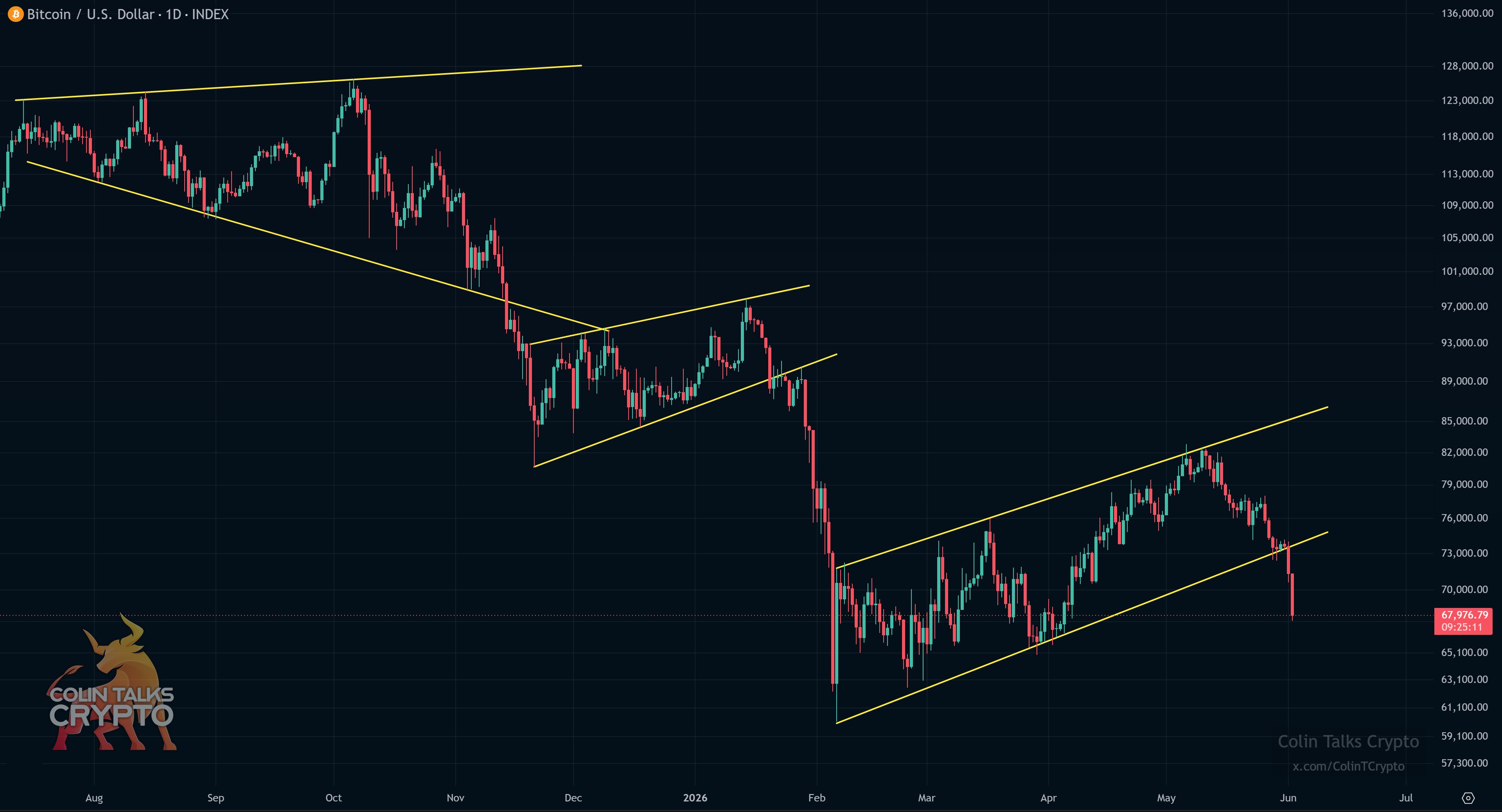
BTC/USD one-day chart. Source: ColinTalksCrypto/X
ColinTalksCrypto described the BTC price chart as “pretty straightforward.”



Donald Trump has announced via his social media site, Truth Social, that he will be elevating William J. Pulte, the current director of the Federal Housing Finance Agency (FHFA) and the chairman of Fannie Mae and Freddie Mac, to acting Director of National Intelligence (DNI).
Pulte will apparently retain his posts at the FHFA and Fannie Mae and Freddie Mac alongside his new role.
The DNI position was created during George W. Bush’s administration and was meant to unify and oversee the disparate parts of the United States Intelligence Community (IC).
This position was last held by Tulsi Gabbard, who resigned in May.
Pulte’s Alleged Scams
Pulte has been embroiled in a number of controversies both during his time in the private sector and his tenure in public service.
He was an important promoter of the $ZACK memecoin, which was founded by Edward Constantinescu.
Constantinescu was later accused by the Department of Justice and Securities and Exchange Commission of defrauding investors through this pump-and-dump scheme.
Lawyers for Pulte told Mother Jones that he did not profit from his promotion of this allegedly fraudulent project.
Mother Jones also reported on a donation from Team Pulte Inc. to One World Love.
Pulte claimed in tax filings that this donation was for “assistance to underserved people,” however, it seems that this entity was actually tied to Binnall Law Group, which was representing Trump’s nonsensical election fraud claims.
This eventually led to a letter from Senators Elizabeth Warren and Ron Wyden to Pulte to discuss the purpose of this donation.
Read more: Fartcoin won’t help you buy a house unless it’s on Coinbase
Finally, in his tenure at FHFA, Pulte has been responsible for multiple criminal referrals directed at enemies of Trump. This has included trying to start criminal cases against Letitia James, Lisa Cook, and Jerome Powell.
Pulte’s unprecedented lawfare often centered around thin claims of mortgage fraud, ironic considering that according to reporting from Reuters, his father and stepmother have committed a very similar offense, declaring multiple residences as their primary residence.
Even more strikingly, it turns out that his claim against Cook seems to be entirely false, deepening concerns that Pulte was acting out Trump’s desire to assault Federal Reserve intelligence.
If Pulte is serving as an attack dog for Trump, who is willing to ignore legal and moral constraints, then as acting DNI he will now have expanded access to information and resources to advance Trump’s assaults.
Got a tip? Send us an email securely via Protos Leaks. For more informed news and investigations, follow us on X, Bluesky, and Google News, or subscribe to our YouTube channel.
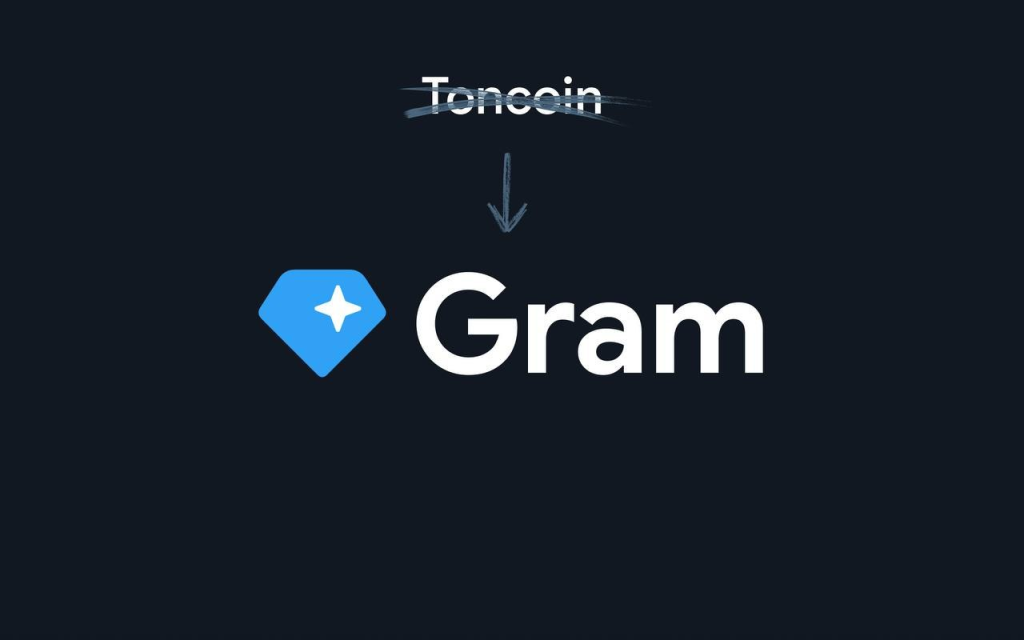
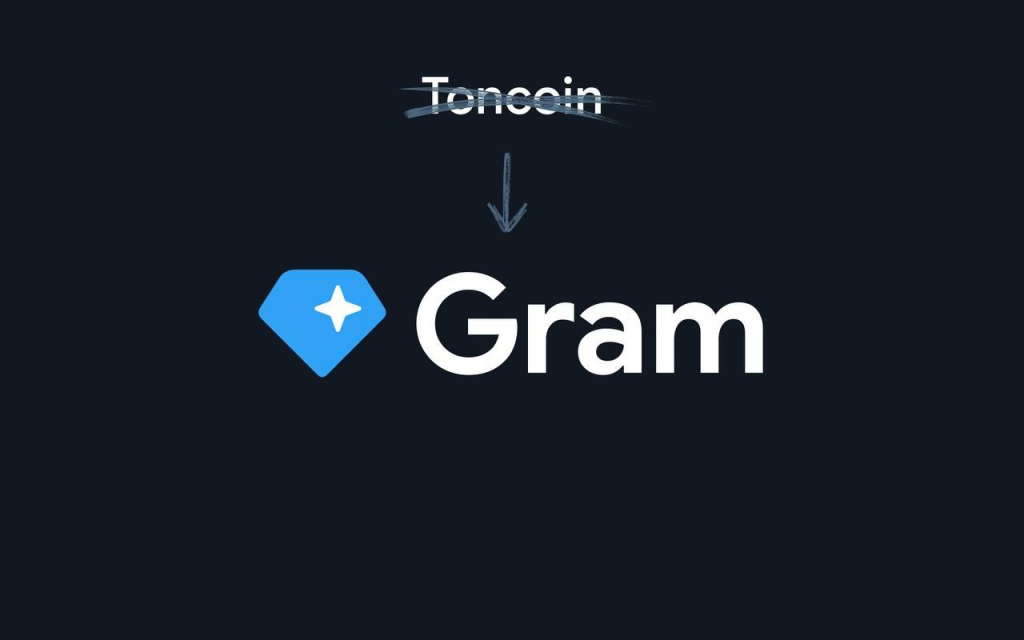
The TON Foundation is rebranding its native token from Toncoin to Gram, reviving the name attached to Telegram’s original 2018 blockchain project and signaling a deliberate push to convert the messaging platform’s 900 million monthly active users into on-chain participants.
The change is cosmetic, no token swap, no technical migration, no new asset issuance, but the strategic logic is anything but superficial.
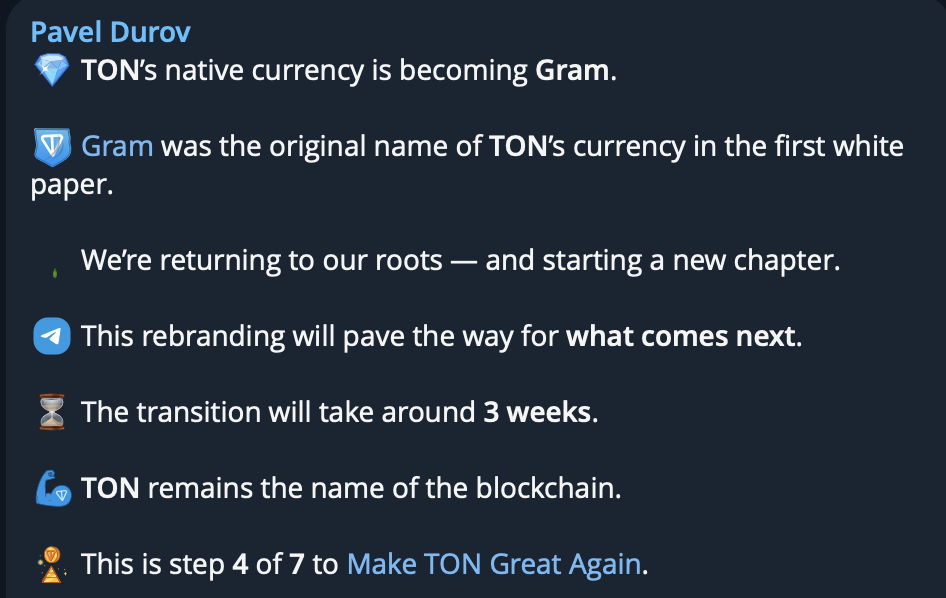
The rebrand arrives as Telegram founder Pavel Durov frames the rename as step four of seven in his publicly stated ‘Make TON Great Again’ roadmap, with steps five through seven still undisclosed.
The compounding dynamic here is regulatory history. Gram was the name at the center of a landmark SEC enforcement action that forced Telegram to return $1.2 billion to investors in 2020.
Reviving that name is a calculated bet that the current TON ecosystem has enough structural distance from that legal episode to reclaim the brand without inheriting its liability.
Discover: The Best Crypto to Diversify Your Portfolio
Gram’s History: $1.7B ICO, SEC Intervention, and the Rebrand From Toncoin That Brings It Full Circle
The transmission mechanism from name change to user acquisition is straightforward: reduce the cognitive gap between Telegram’s brand identity and its native crypto asset.
Toncoin meant nothing to a first-time Telegram user. Gram, short, familiar, tied to Telegram’s original vision – does.
The historical weight behind that word is significant. Telegram raised approximately $1.7 billion through private token sales tied to Gram in 2018, positioning it as the currency layer for the Telegram Open Network.
The SEC intervened in 2019, alleging the offering constituted an unregistered securities sale. Telegram settled in 2020, agreeing to return roughly $1.2 billion to investors and pay an $18.5 million civil penalty, then stepped away from the project entirely.
The network survived through open-source development and community stewardship, eventually relaunching as The Open Network under the TON Foundation, with Toncoin as its community-run asset.
Now, with Telegram intending to become the primary ecosystem administrator and largest validator, a governance shift explicitly flagged in the MTONGA roadmap, the ecosystem is reasserting its original identity while structurally differentiating itself from the entity that faced SEC enforcement.
The rebrand rolls out over approximately three weeks across wallets, infrastructure providers, and ecosystem applications. User balances, staking positions, and network operations remain unchanged throughout.
900 Million Users as Addressable Market: What the Gram Rebrand Actually Unlocks
Telegram’s monthly active user base is one of the largest untapped crypto distribution channels.
The structural opportunity is not speculative; it is conditional on conversion rates. If the TON ecosystem converts even 1% of Telegram’s active base into regular Gram wallet users, that is 9 million participants, a figure that rivals the active user counts of several top-ten blockchain networks.
The friction point has always been brand coherence. Telegram users encounter TON Space wallet, mini-apps, and bot-based payment tools that reference a token called Toncoin with the ticker TON, a label that carries no intuitive connection to the Telegram product they already use daily.
Gram closes that gap. The analogy to WeChat Pay’s embedded finance model is instructive: WeChat did not ask users to understand digital payments architecture; it made transacting feel native to the messaging interface.
Gram positions The Open Network to pursue an equivalent integration depth inside Telegram’s super-app environment, covering payments, gaming, stablecoins, and mini-app monetization.
Market participants responded immediately. Toncoin surged 19% following the announcement, reaching approximately $2.21 in early trading before retracing toward $2.00.
Discover: The Best Token Presales
The post Toncoin (TON) Revives ‘Gram’ Token Name in Bold Bid to Own Telegram’s 900M Users appeared first on Cryptonews.

Santiment flagged a sharp spike in XRP Exchange Flow Balance, with 22.80 million tokens, or the largest daily net inflow of 2026, hitting centralized exchanges as the price slumped to $1.27. That deposit wave, likely panic selling, was swiftly followed by a net withdrawal of 25.24 million XRP, flipping the flow negative.
Why is it bullish? When outflows overwhelm inflows, it usually shows holders pulling coins off exchanges for custody. It’s a data point to institutional-grade positioning.
22.80M XRP hit exchanges on May 28… — Xaif Crypto (@Xaif_Crypto) May 30, 2026

then 25.24M XRP walked right back off exchanges on May 29-30 
someone used that dip to load up heavy  https://t.co/A4OLFqvP2q pic.twitter.com/oddNfiNe7b
Discover: The Best Crypto to Diversify Your Portfolio
Can XRP Price Push Back? Will Consolidation Deepen?
XRP is almost clearly range-bound. After printing a weekly high near $1.36, the asset has pulled back to the $1.26 zone, a 6% pullback this week, though still better doing better than 10% Bitcoin’s dip. It’s not good, but major Altcoins like XRP have been showing strength.
Key support sits in the $1.13–$1.21 band. Multiple analysts on TradingView describe this zone as a demand floor that has absorbed prior selling pressure. Local resistance clusters between $1.4 and $1.50, where XRP has been failing to hold a breakout for many times.

The exchange flow data showing 25.24 million XRP pulled off exchanges suggests reduced sell-side pressure at current levels.
XRP ETF is still going green, and is probably the single largest variable. If that narrative holds, support likely holds with it.
Discover: The Best Token Presales
LiquidChain Offers Bigger Upside Potential
Here’s the tension in XRP’s setup. Even the bull case, a move to its all-time high, represents a 2.3x from current prices. Meaningful. But for traders who missed XRP at $0.01 or Bitcoin at $200, the question is whether early-stage infrastructure plays offer a different risk profile entirely.
LiquidChain ($LIQUID) is a Layer 3 infrastructure project currently in presale, positioning itself as a cross-chain liquidity layer that fuses Bitcoin, Ethereum, and Solana liquidity into a single execution environment.
The master plan being formulated. — LiquidChain (@getliquidchain) May 31, 2026
 ⟁https://t.co/vqvBcdSQYC pic.twitter.com/pAs9sHhkmi
The core proposition, deploy once, access all three ecosystems, targets the fragmentation problem that has limited capital efficiency across chains. Features include a Unified Liquidity Layer, Single-Step Execution, Verifiable Settlement, and Deploy-Once Architecture.
Presale price stands at $0.01465, with $820K raised to date. At that entry, the distance between the current price and any meaningful exchange listing represents the kind of asymmetry that large-cap consolidations rarely offer.
Research LiquidChain before the presale phase concludes.
The post XRP Price Stalls But Metrics Hint A Rally Coming With Big Flows appeared first on Cryptonews.
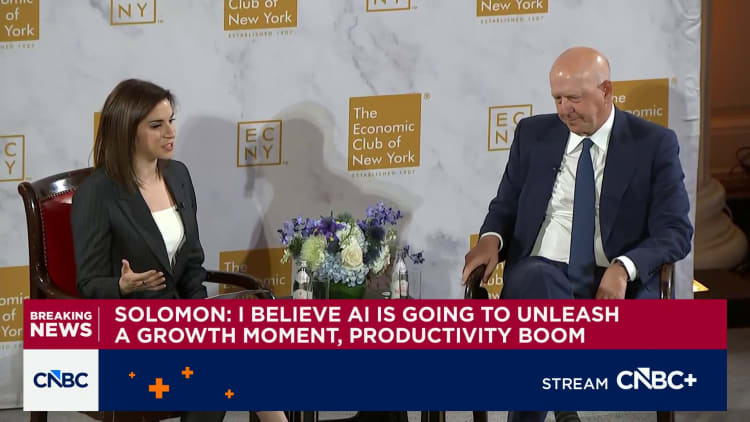

Goldman Sachs CEO David Solomon said Tuesday that investors have shifted decisively into “greed” mode as markets are poised to test an unprecedented fundraising wave for giant artificial intelligence firms.
Asked by CNBC’s Leslie Picker whether markets could support a string of massive equity offerings from the upcoming IPOs of OpenAI, Anthropic and SpaceX, Solomon said that there is ample capital available for the deals.
“There’s plenty of liquidity in the system if the world continues to remain as optimistic,” Solomon said. “We are definitely in a moment where there’s more greed than there is fear.”
Solomon’s comments come as investors prepare for what will be one of the busiest periods for equity issuance in years. The two leading AI model providers, as well as SpaceX, which includes Elon Musk’s AI company, could go public at trillion dollar-valuations just as other firms are seeking vast sums to fund data centers, chips and infrastructure, raising questions about whether markets can absorb the supply.
Solomon, whose bank is playing a key role in several of the deals, downplayed those concerns. Alphabet’s recent stock performance after announcing plans for an $80 billion equity raise was proof that markets are still receptive to AI, he said.
“The stock is trading very well,” Solomon said. “This is the first actual concrete data point for bringing something of this scale, and it’s encouraging.”
Robust equity and debt markets are prompting companies to raise money while markets are allowing it, he said.
“When capital’s available, if you’re capital consumptive and it’s available, take the capital,” Solomon said.
Solomon acknowledged that the fundraising wave is unprecedented in size, but argued that record levels of wealth and liquidity across markets support the activity. He also said gains generated by AI companies could create a self-reinforcing cycle as employees and investors recycle profits into taxes and new ventures.
Greed can “turn into fear very quickly, but that doesn’t mean it will,” Solomon said. “Exuberance can go on for big periods of time. …There’s a good chance that we’re earlier in the cycle than later.”
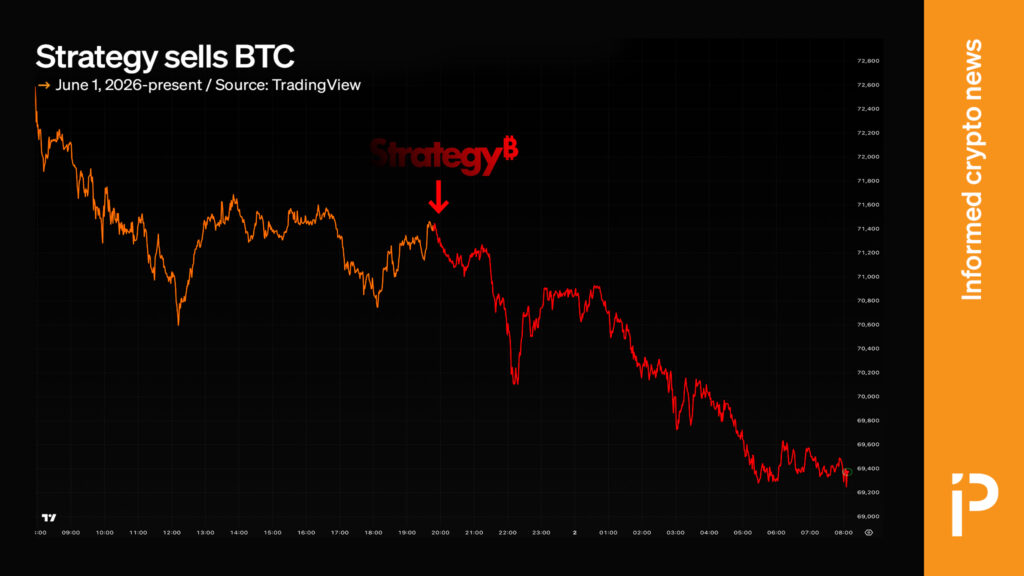
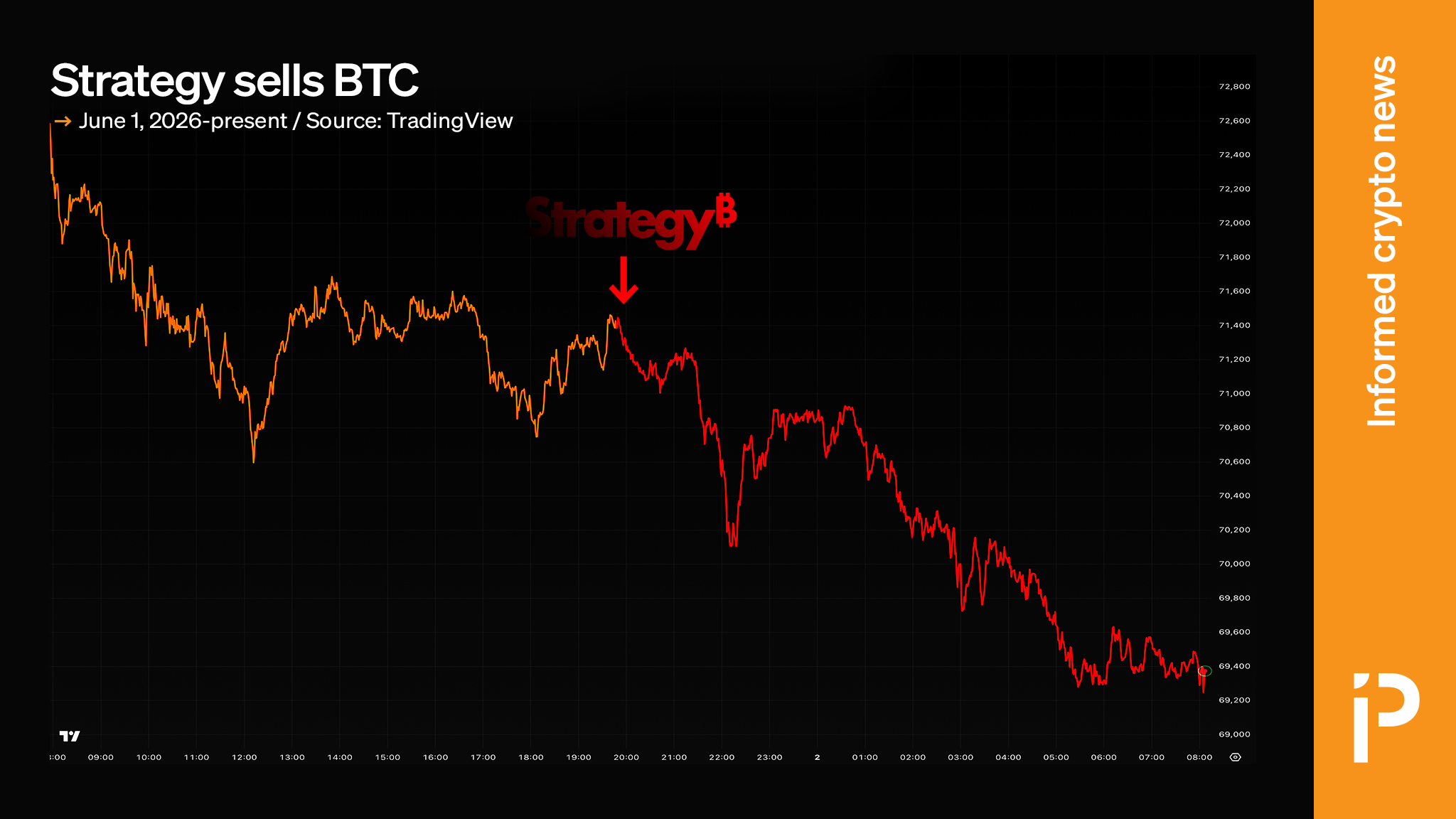
Bitcoin (BTC) fell 4.4% within 24 hours of Strategy (formerly MicroStrategy) disclosing its voluntary sale of 32 BTC. Two hours later, it fell another 2%.
That sale, which reneged on multiple promises to never sell by Strategy leaders like founder Michael Saylor, preceded a decline from $72,500 per BTC at the time of the firm’s 8-K to $69,300 precisely 24 hours later.
Strategy is the second-largest known BTC investor besides its creator, Satoshi Nakamoto. The company has amassed 4.2% of the asset’s circulating supply, and its holdings exclusively increased since December 2022 until yesterday’s disclosure.
Yesterday’s sale disclosure, albeit just 0.004% of its stack, spooked countless media outlets who covered Saylor’s bearish reversal across mainstream media yesterday including CNBC, The Wall Street Journal, AOL, TheStreet, Gizmodo, and Forbes.
The disclosure’s reporting period was May 26-31 during which the sale actually occurred.
‘Never. No. We’re not sellers. We’re only acquiring and holding BTC.’
Saylor has become a minor celebrity in recent months after an aggressive media and ad campaign for STRC, Strategy’s 11.5% dividend-yielding, quasi-pegged stock that he dubiously believes is a competitor to high-yield bank accounts.
Google queries for his name reached an all-time high this year.
STRC, which doesn’t hold a stable value nor guarantee repayment of principal, has attracted four-fifths retail ownership attracted to its simplistic promotions.
It also enjoyed the credibility of the company’s BTC stack and its founder’s lapsed promises to never sell, such as his promise to Bloomberg, “Never. No. We’re not sellers. We’re only acquiring and holding BTC.”
For the first time in years, Strategy pocketed roughly $2.5 million by selling BTC at an average price of $77,135, slightly above the company’s blended cost basis of $75,699.
Proceeds of the sale, the 8-K filing noted with cinematic irony, will fund dividends on the company’s preferred shares like STRC.
“Proceeds from the bitcoin sales are expected to be used to fund distributions on preferred stock.”
-Strategy 8-K
Strategy selling BTC to ‘innoculate’ the market
Not that it reduced the irony, but Saylor had telegraphed the sale in advance.
Specifically, on his first quarter earnings call last month, he said Strategy would probably sell a little BTC to “inoculate” the market as to his willingness to sell, despite his prior promises.
Read more: STRC controversy goes mainstream
There are, of course, other macro factors that contributed to the sell-off in digital assets. The Crypto Fear & Greed Index hit 23 out of 100 yesterday, putting it firmly back in “Extreme Fear” territory.
Oil prices jumped, gold prices fell, and AI stocks continued to roar higher while siphoning speculative capital from crypto.
In summary, Strategy’s sale handed a jittery, bearish market a headline that fit the mood. Primed for bad news, many traders interpreted any disposal by the most committed buyer as a sell signal.
STRC, which Strategy tries to keep trading near $100 per share, traded below $95.60 today.
The message many market participants heard this week was that, at any moment, even the most consistent BTC bid could become an offer.
The last time the company sold, in December 2022, it offloaded 704 coins for a tax write-off purpose. It quickly bought back 810 BTC, two days later.
Got a tip? Send us an email securely via Protos Leaks. For more informed news and investigations, follow us on X, Bluesky, and Google News, or subscribe to our YouTube channel.
Coinbase Ventures has purchased ENA tokens on the open market as Coinbase and Ethena prepare a new partnership focused on on-chain finance and savings products.
Summary
- Coinbase Ventures bought ENA tokens on the open market rather than participating in a discounted private round.
- Ethena said the purchase came alongside a new partnership with Coinbase focused on on-chain finance and savings products.
- Coinbase Ventures confirmed the ENA purchase and said Ethena plays a key role in on-chain finance.
Ethena said in an official X post on Tuesday that Coinbase Ventures made its first disclosed open-market investment in the protocol’s ENA token, while Coinbase and Ethena also agreed to work together on products for Coinbase users. The company said the first growth initiative from the partnership will launch next week, though it did not name the product.
Coinbase Ventures takes public ENA position
Coinbase Ventures confirmed the purchase in a separate X post, saying it backed Ethena through an open-market buy of ENA. The venture arm said Ethena plays a key role in on-chain finance and added that it expects closer work between Ethena, Coinbase, and USDC.
The transaction differs from the usual venture model used by Coinbase Ventures. According to Coinbase Ventures’ website, the firm has made more than 600 investments across crypto and web3 since its launch in 2018, with most deals involving seed or early-stage private rounds.
In this case, Coinbase Ventures bought ENA from the public market rather than through a discounted private allocation. Ethena did not disclose the number of tokens purchased, the average price, or any wallet addresses tied to the transaction.
Ethena partnership targets Coinbase users
According to Ethena’s announcement, the partnership will focus on expanding on-chain finance and savings products to Coinbase’s user base. Ethena said Coinbase has more than 100 million users, a figure Coinbase previously reported after crossing 100 million verified users in 2022.
The partnership could bring more attention to Ethena’s main products, USDe and sUSDe. USDe is Ethena’s synthetic dollar asset, while sUSDe is the staked version designed to generate yield.
Coinbase reported $294 billion in platform assets at the end of the first quarter. Ethena did not say whether the upcoming launch will involve USDe, sUSDe, ENA, or a separate Coinbase product.
Ethena’s TVL and revenue remain in focus
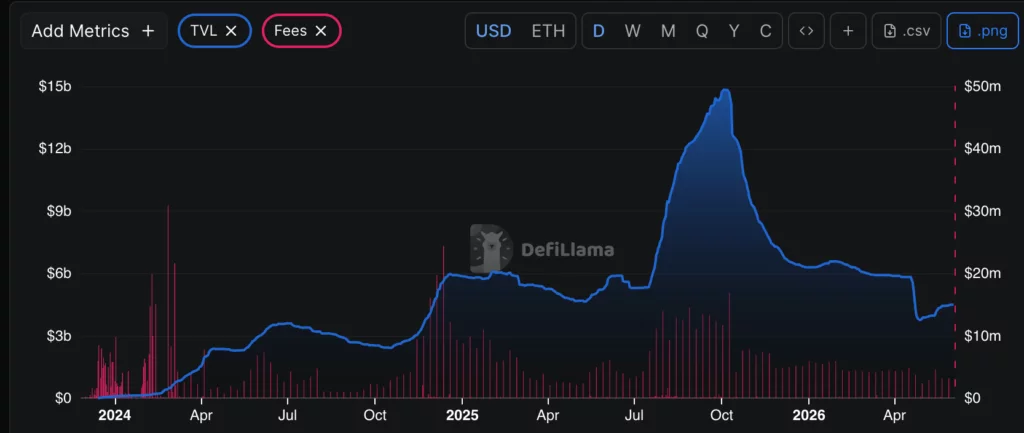
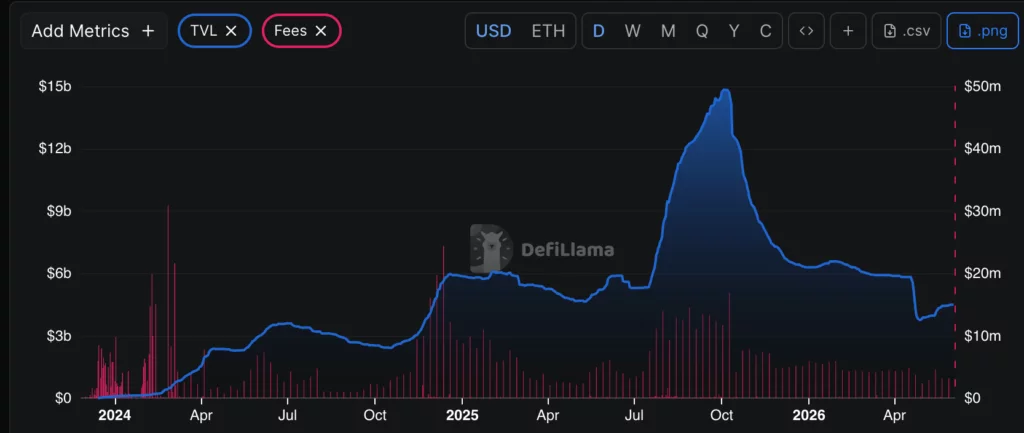
According to DefiLlama data cited in the announcement context, Ethena holds about $5.4 billion in total value locked. The USDe contract accounts for about $4.5 billion of that amount.
Source: DefiLlama
DefiLlama data also show Ethena is generating $178 million in annualized fees. The protocol has generated $972 million in cumulative fees and $332 million in cumulative protocol revenue since Ethena Labs was founded by Guy Young in 2023.
ENA, the protocol’s governance token, has a market capitalization of about $859 million and a fully diluted valuation of roughly $1.4 billion, based on the same market data.
ENA rises after the announcement
Market data showed ENA rose 8.3% over the past 24 hours after the announcement. DefiLlama showed 24-hour ENA trading volume of $168 million.
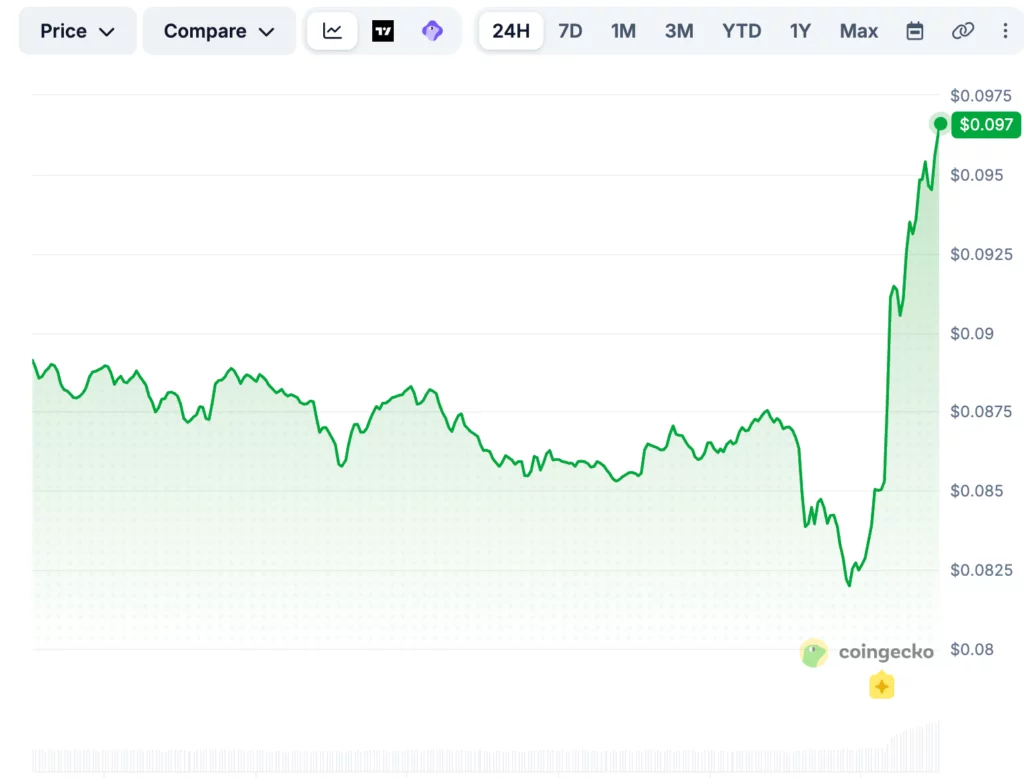
Source: Coinglass
At the same time, DefiLlama showed $178 million in on-chain ENA volume through Uniswap V3 and Aerodrome. The reported on-chain volume exceeded the centralized exchange flow during the period.
Ethena and Coinbase have not provided more details on the product expected next week. Coinbase already serves as the primary custodian for ENA held by the Ethena Labs core team and Foundation under a previous Coinbase Prime agreement.

Key Highlights
- Movement deploys licensed infrastructure to enable global stablecoin transactions
- New payment channels in US, EU, and Canada focus on remittance corridors
- Network foundation repurchases significant token allocation from early investors
- Platform bridges traditional banking systems with blockchain settlement technology
- Infrastructure aims to serve financially underserved populations in developing nations
Movement has obtained regulatory approval for licensed payment infrastructure spanning the United States, European Union, and Canada. This strategic expansion reinforces the network’s commitment to stablecoin-based settlement systems, international money transfers, and dollar-denominated savings solutions. The initiative specifically addresses markets where conventional financial systems impose significant friction and expense.
Addressing the Global Remittance Challenge
The network intends to bridge licensed financial infrastructure with blockchain-based settlement mechanisms to accelerate international money transfers. Movement now prioritizes remittance services, corporate treasury solutions, and banking products designed for populations with limited access to financial services. This represents a deliberate pivot from broad blockchain growth initiatives toward functional payment infrastructure.
The platform argues that existing financial networks continue to impose burdensome costs and delays on users worldwide. World Bank data indicates that remittance flows to developing and middle-income nations totaled $685 billion throughout 2024. Despite this massive volume, senders faced average transaction fees of 6.36% for cross-border transfers.
Movement seeks to eliminate these inefficiencies by leveraging stablecoin settlement technology combined with regulated partner channels. The infrastructure enables financial technology companies and digital banks to offer payment services, dollar-based savings accounts, and interest-bearing products. Importantly, this approach minimizes dependence on traditional correspondent banking relationships and prefunded nostro accounts.
Foundation Executes Strategic Token Buyback
The Movement Network Foundation recently acquired approximately 19% of tokens that had been distributed to initial backers. This repurchase represented roughly 4.2% of the entire token circulation. The foundation characterized this action as aligned with its commitment to token holders and payments infrastructure development.
The company has not publicly identified the specific regulated entities providing access to its payment channels. However, it confirmed that the infrastructure encompasses significant markets throughout North America and the European region. This access creates pathways between conventional banking infrastructure and decentralized settlement networks.
Movement has reinforced this approach through multiple ecosystem collaborations. KAST has onboarded more than 18,000 verified participants spanning over 160 nations using Movement-enabled products. Additionally, Circle deployed USDCx on the platform as a stablecoin with one-to-one backing by native USDC reserves.
Stablecoins Emerge as Critical Financial Infrastructure
Digital dollar tokens have become foundational to numerous blockchain expansion initiatives. Movement aligns with ecosystems including Solana, Polygon, and Aptos in emphasizing payments and financial services infrastructure. This shift positions blockchain platforms in direct competition with established settlement and money transfer networks.
The platform has cultivated partnerships across savings products, yield generation, digital wallets, and tokenized tangible assets. Sorted Wallet, Yuzu Money, Oro, Avant Protocol, and Zoth contribute various components to this technology foundation. These solutions encompass mobile-accessible wallets, dollar-based returns, precious metal storage, and institutional-quality real-world asset yields.
Movement’s strategic reorientation follows the passage of the GENIUS Act, which established regulatory clarity for payment stablecoins in the United States. The legislation intensified attention on compliant stablecoin offerings and reserve-backed financial instruments. Movement now frames its payment infrastructure as connecting regulated traditional finance with blockchain-based settlement technology.



Movement, a project originally designed to link blockchains built using the Move programming language with Ethereum, is pivoting toward cross-border payments, remittances and dollar savings products, reflecting a broader shift across the increasingly crowded layer-2 landscape.
The company behind the blockchain said Tuesday that it had secured access to licensed payment systems in the U.S., Canada and European Union, and would focus on building stablecoin-based settlement infrastructure for emerging markets.
The direction change comes as a number of layer-2 projects reassess their original scaling-focused roadmaps amid growing competition and declining differentiation among networks. With dozens of Ethereum scaling chains now competing for users, liquidity and developer attention, some projects are turning toward payments and real-world financial applications as a path to growth.
Polygon, one of the earliest Ethereum scaling projects, has increasingly emphasized payments and stablecoin infrastructure in recent years, pursuing projects with fintechs and payment providers as transaction fees and rollup technology become commoditized.
While layer-2 networks were initially pitched as a solution to Ethereum’s scaling challenges, the sector’s rapid expansion has left many projects searching for more specialized use cases. For Movement, that increasingly means competing not with other blockchain networks, but with traditional payment systems and remittance providers.
The team behind Movement said it plans to leverage licensed payment partners alongside blockchain settlement infrastructure to target the roughly $685 billion remittance market serving low and middle-income countries.
As part of the transition, the Movement Network Foundation said it repurchased some 19% of tokens previously allocated to investors, equivalent to 4.1% of total token supply. MOVE was recently trading around 14.35 cents.
“Billions globally are financially disenfranchised and unserved,” CEO Torab Torabi said in a press release shared with CoinDesk. “Our mission is to marry licensed payment rails with onchain settlement to modernize financial services globally, particularly in emerging markets.”
Read more: Movement Labs Terminates Rushi Manche After MOVE Token Deals


Key takeaways
- XRP has dropped below $1.25 after three straight days of losses, its lowest level since February 6.
- The bearish performance comes as the broader crypto markets remain under pressure from geopolitical tensions.
Ripple’s XRP has dropped below the $1.25 support level on Tuesday after extending losses for a third consecutive day, marking its weakest price since February 6.
The broader cryptocurrency market continues to face selling pressure as investors adopt a risk-off stance, driven by escalating geopolitical tensions in the Middle East.
Although U.S. President Donald Trump suggested that a peace deal with Iran could be reached “over the next week,” uncertainty persists.
A CNN report also indicated that negotiations between the two countries resumed shortly after Iran paused talks following Israel’s offensive in Lebanon, further contributing to market volatility.
Mixed capital flows show continued institutional interest in XRP
Despite the price decline, XRP continues to attract institutional inflows across digital investment products, including U.S.-listed spot exchange-traded funds (ETFs).
According to CoinShares, roughly $20 million flowed into XRP-related products in the week ending June 1, making it one of only a few assets to record meaningful inflows above $1 million.
At the ETF level, XRP spot products recorded $4.13 million in net inflows last week, extending a five-week streak of positive flows.
Cumulative inflows have reached approximately $1.43 billion, with total net assets under management standing at $1.11 billion, according to SoSoValue data.
XRP technical outlook: bearish pressure builds below key moving averages
XRP is currently trading around $1.23, remaining below its key short-, medium-, and long-term moving averages, reinforcing a bearish near-term structure.
Momentum indicators also reflect continued downside pressure. The MACD histogram remains negative, while the Relative Strength Index (RSI) sits near 37, approaching oversold territory but still indicating persistent bearish momentum.
If the bulls regain control, immediate resistance is seen at the 50-day EMA around $1.38, followed by the 100-day EMA near $1.45.
A stronger rebound would require a break above a descending trendline near $1.52. A broader trend reversal would only be signaled if XRP can reclaim the 200-day EMA around $1.65.

While institutional inflows continue to provide underlying support, XRP remains under pressure from broader macro uncertainty and technical weakness.
With the buyers failing to defend the $1.25 support level, XRP could likely drop below $1.20 in the near term.
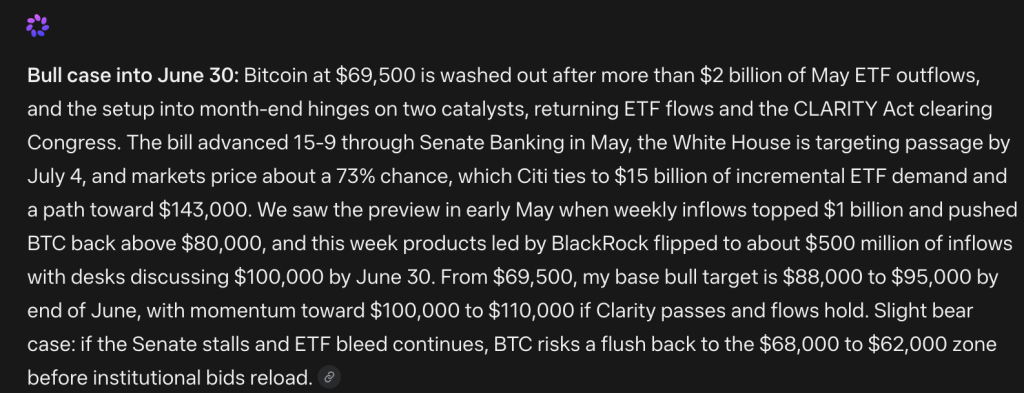
Mark Zuckerberg model Meta AI predicts Bitcoin washed out at $69,500 and sees a base bull target of $88,000 to $95,000 by June 30, with a path toward $100,000 to $110,000 opening up if 2 specific catalysts land before the month closes.
The prediction Zuckerberg’s AI is making is built around a near-term setup that is more event-driven than any other Bitcoin prediction covered in this series.
Over $2 billion of May ETF outflows created the selloff that brought BTC to current levels, and Meta AI is reading that as a washout rather than the start of a deeper structural break.
The evidence it is pointing to for that read is already visible: BlackRock-led products flipped back to roughly $500 million of inflows this week, which is a meaningful reversal of the flow picture that caused the damage in the first place.
The CLARITY Act is the variable that separates the base case from the bigger scenario. The bill cleared Senate Banking 15-9 in May, the White House is targeting July 4 passage, and markets are currently pricing a 73% probability of it happening.
Citi is tying that passage to $15 billion of incremental ETF demand and a path toward $143,000.
Meta AI is not going that far in its June target, but it is pointing to early May as the preview of what ETF flow recovery looks like in price terms: weekly inflows topping $1 billion pushed BTC back above $80,000 in days.
If CLARITY passes and institutional flows normalize, that same sequence plays out again from a lower base.
[crypto-chart coin=”bitcoin”]
The bear case is contained but specific. Senate stalling on CLARITY and continued ETF bleeding would push BTC toward the $68,000 to $62,000 zone before institutional bids reload.
That range represents the 2024 all-time high zone on the weekly chart, which historically flips from resistance to support in cycle progressions.
Bitcoin Price Prediction: Bitcoin Just Printed a 5.3% Weekly Loss and the Chart Is Now at One of the Most Consequential Levels in Years
BTC price is closing the week at $69,563, and the weekly chart zoomed out to 2021 is the most important context available right now.
This timeframe captures 2 complete cycles and places the current price in a perspective that the daily chart simply cannot provide.
The 2021 peak near $68,000 to $69,000 was the prior all-time high that the market spent 2 years below before finally breaking out in 2024.
That level became the launchpad for the run to $124,000. Bitcoin is now sitting right back at that same zone, which has gone from former resistance to current support. Whether it holds as support or gives way is the most structurally significant question Bitcoin has faced since the February flush to $61,000.
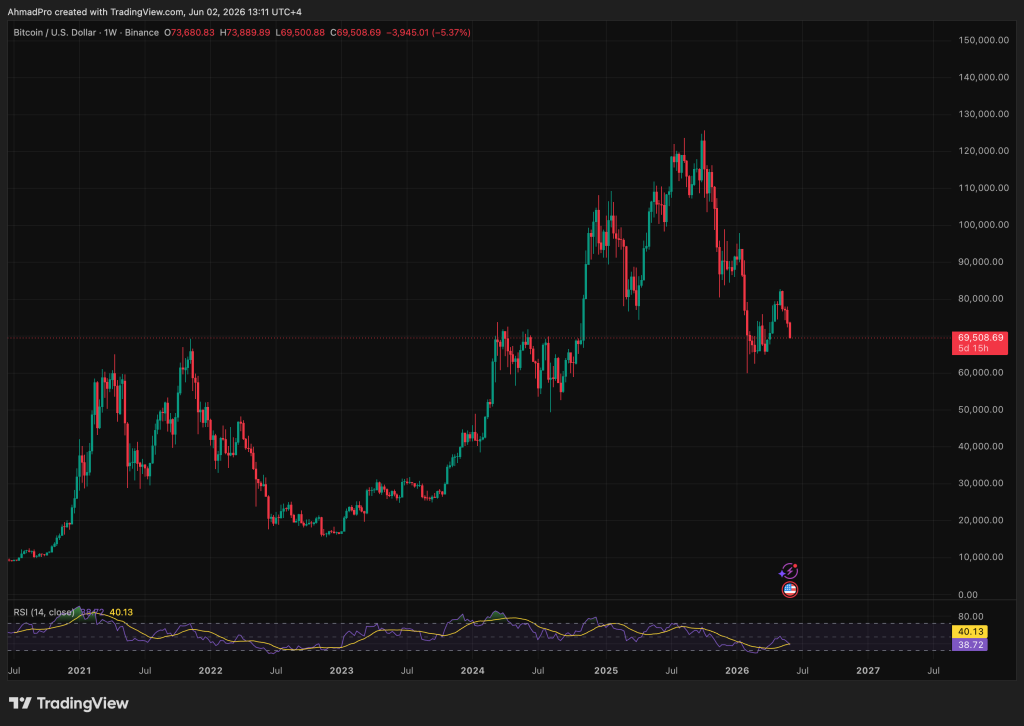
On the weekly chart, the structure since the $124,000 peak is a clean descending series of lower highs: $124,000, then $98,000 in April, and now the price is failing to hold $80,000 and breaking back toward $69,500.
That is 3 consecutive lower highs, which is the definition of a downtrend on this timeframe. For the bull case to regain credibility on the weekly, Bitcoin needs to break that pattern with a higher high above $98,000, which means first reclaiming $80,000 and holding it.
The $80,000 level is the immediate resistance that has rejected the BTC price twice in the past 6 weeks. Getting back above it cleanly is the first checkpoint before Meta AI’s $88,000 to $95,000 target becomes realistic in the timeframe it is calling for.
When Big Names Stop Moving, Something Else Always Does: Meta AI Predicts LiquidChain – The Next 1000x?
There is a moment in every cycle where chasing the obvious plays stops working. That moment is now. Bitcoin is grinding. Ethereum is going nowhere.
The ETF inflow narrative has been one quarter away from materializing for longer than anyone wants to admit. The traders who have been through enough cycles to recognize this pattern are not sitting in large caps waiting for a catalyst that keeps getting delayed. They are looking somewhere else entirely.
Every developer who has tried to build across Bitcoin, Ethereum, and Solana knows exactly what it costs. Three separate codebases.
LiquidChain is building the layer that makes the fragmentation irrelevant. One unified execution environment connecting all 3 networks simultaneously. A single deployment reaches Bitcoin, Ethereum, and Solana at once with no bridging overhead bleeding value out of every cross-ecosystem interaction.
The presale is at $0.01454. Just over $700,000 raised. That number tells you exactly where this sits in its lifecycle.
Execution is unproven. Adoption is unknown. Post-launch liquidity is a question mark. That is what the early stage looks like, and anyone packaging it differently is not being straight with you. The window where something is genuinely undiscovered does not stay open long. LiquidChain is still in it.
Explore the LiquidChain Presale
The post Mark Zuckerberg New META AI Predicts Bitcoin Price by End of June 2026 appeared first on Cryptonews.

A.J. Brown on Jalen Hurts: ‘Not as close as we once were’

The PlayStation VR2 gets a rare discount in this year’s Days of Play sale

Why Even High Earners Are Living Paycheck To Paycheck



-

 NewsBeat6 days ago
Israel says it has killed new Hamas military leader in Gaza City airstrikes
-

 Tech7 days ago
NASA taps Blue Origin to deliver lunar rovers for Moon Base initiative
-

 News Videos4 days ago
This is BROKEN! INSANE 5x MONEY CAR WASH WEEK! The NEW GTA Online UPDATE Today! (GTA5 New Update)
-

 News Videos7 days ago
XRP *JUST* SUCCEEDED!!!! CLARITY ACT EXPOSED!!! (SHE EXPOSED IT)
-
Crypto World7 days ago
Micron Crosses $1 Trillion Market Cap as AI Demand Reshapes Memory Sector
-
 Tech3 days ago
SpaceX just won a second Golden Dome contract. This one is $4.16 billion.
-

 Business7 days ago
Selena Gomez Reportedly Upset Over Benny Blanco’s Comments on Her ‘Terrible’ Diet
-

 Tech5 days ago
Waymo dominates autonomous vehicle registrations as Tesla trails behind
-

 News Videos4 days ago
SHE IS KILLING XRP!!! WATCH URGENT AND ACT FAST
-
 NewsBeat4 days ago
FIRST NIGHT REVIEW: Take That bring the Circus back to life in spectacular sun-soaked style
-

 Tech6 days ago
The Samsung pay deal is the moment Korean unions changed register
-

 Business22 hours ago
Jade Biosciences, Inc. (JBIO) Discusses Positive Interim Results From JADE101 Phase I Healthy Volunteer Study and Development Plans Transcript
-

 Tech7 days ago
Millions of AI agents imperiled by critical vulnerability in open source package
-
Crypto World4 days ago
CFTC Has Approved the First Regulated Bitcoin Perpetual Contract in the U.S.
-
Crypto World6 days ago
SpaceX’s $2 Trillion IPO: Why Tech Giants Nvidia (NVDA), Apple (AAPL), and Microsoft (MSFT) May Face Pressure
-
 Entertainment6 days ago
The Most Misunderstood Sci-Fi Horror Movie of the Last 10 Years Just Took Over Netflix
-

 Crypto World7 days ago
Spain blocks prediction markets Polymarket Kalshi
-
 Crypto World4 days ago
Snowflake (SNOW) Stock Rallies on Strong Q1 Results and AI Product Growth
-
 NewsBeat4 days ago
Novak Djokovic v Joao Fonseca LIVE: French Open latest scores and results after Jannik Sinner’s shocking collapse
-
 Entertainment4 days ago
Weak ‘Supergirl’ Box Office Tracking Amid Milly Alcock Backlash
You must be logged in to post a comment Login