The U.S. Cybersecurity and Infrastructure Security Agency (CISA) is warning that hackers are exploiting vulnerabilities in the Linux kernel and Android operating system.
The most recent flaw the agency added to its Known Exploited Vulnerabilities (KEV) catalog, CVE-2025-48595, is a high-severity integer overflow vulnerability in the Android Framework, which can be leveraged for increased privileges.
According to Google’s recent security bulletin, the security issue impacts Android 14 through 16, and requires no user interaction to exploit.
Google indicated that CVE-2025-48595 may be under limited targeted exploitation in the wild, but provided no specific details about the activity or technical information about the flaw or the incidents.
The issue has been addressed with the release of June 2026 security patches (2026-06-01 and 2026-06-05 security patch levels).
Advertisement
The second vulnerability CISA added to KEV is tracked as CVE-2022-0492, a high-severity privilege escalation flaw that impacts multiple Linux kernel branches, from 2.6 through 4.20, and from 5.5 through 5.17.
The flaw lies in the ‘cgroup_release_agent_write()’ function of the cgroups v1 subsystem, which, due to insufficient authentication checks, can be abused by a local attacker to bypass namespace isolation, escalate privileges, and potentially escape from a container to gain root-level access on the host system.
According to past reports from Aqua Security and Palo Alto Networks, the issue primarily impacts containerized environments using cgroups v1, and is especially dangerous when containers are granted elevated capabilities.
The Linux kernel versions that address the issue are:
Advertisement
4.9.301+
4.14.266+
4.19.229+
5.4.177+
5.10.97+
5.15.20+
5.16.6+
5.17-rc3+
By including the two flaws in KEV, all federal agencies bound by the BOD 22-01 directive are required to apply the vendor-provided security updates and mitigations, or to stop using the impacted software. CISA set the deadline for June 5.
However, the KEV also serves as a notice board for critical infrastructure entities and large organizations in general, who should take security measures against these flaws with the same urgency.
Neither of the flaws is marked as exploited by ransomware groups, which is a specific flag CISA uses on its KEV entries to highlight additional severity and patching urgency.
Automated pentesting tools deliver real value, but they were built to answer one question: can an attacker move through the network? They were not built to test whether your controls block threats, your detection rules fire, or your cloud configs hold.
This guide covers the 6 surfaces you actually need to validate.
Meta is scaling back parts of its employee tracking initiative after staff objected to software that collected mouse movements, clicks, keystrokes, and other actions for AI training data. According to Reuters, the company will now let workers pause collection for up to 30 minutes and request exemptions. Reuters reports: [Stephane Kasriel, a vice president in Meta’s AI model-building Superintelligence Labs unit] said the team behind the software had also introduced “several optimizations” to reduce its impact on computer battery life, after employees complained it was consuming so much data it was causing their home internet usage to spike. “While we remain confident in the privacy protections we put in place at launch, which went through several layers of risk review, we have heard your concerns about personal data on work devices, battery life, and wanting more control over when capturing happens,” Kasriel said in the memo.
Previously, I looked at using the Linux video loopback system from the command line. The basic trick was simple enough: capture video from a real camera, process it with something like ffmpeg, and write the result to a fake camera device via the v4l2loopback device. Then a browser, or any camera-enabled software, sees the fake camera as if it were real. This allows you to manipulate video before sending it to the rest of the world.
That works, and for those of us who like command lines, it’s easy enough to execute. But not everyone loves the command line. In the comments, there was another obvious answer: use OBS Studio.
While OBS is excellent, it is also a bit like using a laser to chop a carrot. If you already use OBS, fine. If you only want to crop a webcam, add an effect, mirror an image, or feed a virtual camera, it can feel like a lot. If you must have a GUI, you can try Webcamoid, which sits somewhere between a simple webcam viewer and a full video production system.
Webcamoid gives you a GUI for selecting a camera, applying effects, and sending the result to a virtual camera. Conceptually, it is much closer to the command-line loopback setup from the previous post than to OBS. You are still building a pipeline from input camera to output camera, but now you can do much of it with buttons and menus instead of shell commands.
Advertisement
That’s in theory, of course. Implementing Webcamoid turned out to be quite the exercise. Granted, this probably varies depending on where you install software. If your distro has a clean working copy of Webcamoid and its dependencies, good for you. For everyone else, keep reading.
The Moving Parts
There are two pieces to understand. Webcamoid is the GUI application. It captures video, previews it, applies effects, and can write to a virtual camera. You also need a driver to produce the fake or virtual camera. AkVCam is one of the virtual camera drivers that Webcamoid can use on Linux. It can also use v4l2loopback, as we discussed last time. Both approaches create fake /dev/videoX devices, but their configuration models are different.
With v4l2loopback, the typical setup is command-line oriented:
Then some program writes frames to /dev/video10. For example, ffmpeg can read from a real webcam and write to the virtual one. Of course, if you want a permanent virtual camera, you can make an entry in /etc/modprobe.d.
Advertisement
AkVCam is more structured. Instead of simply creating a generic loopback device, it uses a configuration file that defines one or more virtual cameras, their input/output relationship, and the formats they support. That sounds like more work, and in a way it is. But it also gives you tighter control over what formats the virtual camera advertises. This sometimes matters more than you might expect.
Install, Remove, Install…
The hard part of Linux webcam work is often not getting video — it’s getting every piece of the chain to agree on width, height, frame rate, and pixel format, along with matching each other’s API expectations.
I tried three different ways to install Webcamoid. First, I used the normal OpenSUSE Tumbleweed repos to install the program. It couldn’t find any cameras. My next stop was a Flatpak version. That worked well, but it is deliberately crippled and won’t even try to drive a virtual camera, directing you to install the regular version instead. Then I tried an AppImage. This seemed to work OK, but the virtual camera would never display anything but a black screen.
Note that the version on AppImageHub is old, and the source project requires payment for prebuilt binaries. I didn’t try either of those options.
Advertisement
I tried a lot of things to make it work. My final answer was to use the AppImage, but I had to build my own version of AkvCam from GitHub.
Even then, at first, the video output was highly pixelated. The culprit was AkVCam using the 640×480 RGB format. Upscaling created a blocky mess.
You can see what a device is doing with:
v4l2-ctl -d /dev/video3 --all
In my case, the virtual output reported:
Advertisement
Width/Height : 640/480
Pixel Format : 'RGB3'
scaling_mode : Fast
aspect_ratio_mode : Ignore
That explains it. “Fast” scaling usually means “not pretty,” and 640×480 is not a great starting point for modern video calls.
The fix was to simplify the AkVCam configuration. Instead of giving the virtual camera a long list of supported formats, I configured it with essentially one useful format. For example, if the pipeline is meant to be 1280×720 at 30 fps, make that the format. Do not give every program in the chain an opportunity to negotiate itself down to postage-stamp resolution.
A minimal AkVCam setup generally defines a capture device, an output device, a connection between them, and formats. In the generated config I was using, the output camera had several formats:
The problem was that format 19 was 640×480. The high-resolution formats were present, but not preferred. Reordering the list might help, but for reliability, using only the desired format is even better.
Advertisement
Webcamoid As A GUI Pipeline
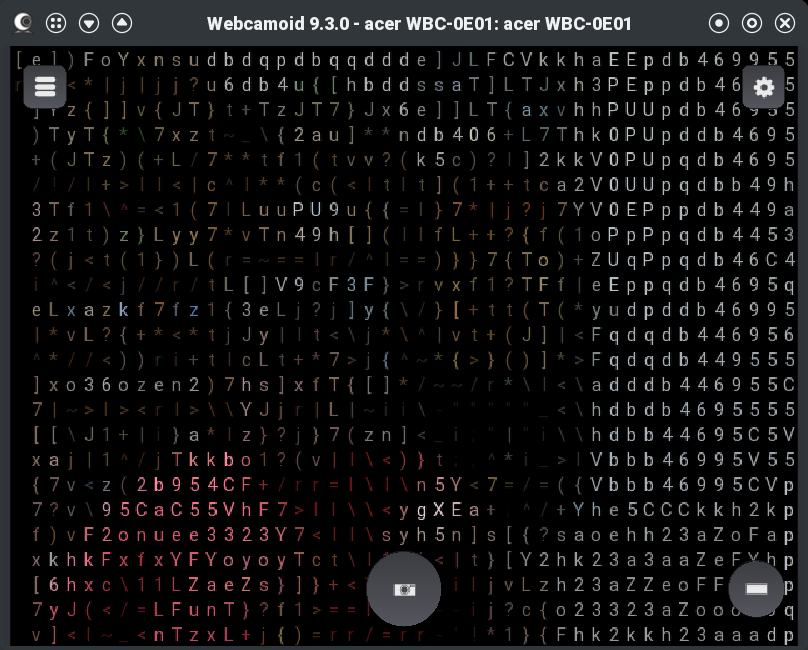
ASCII filter in action.
Once the virtual camera driver is sane, Webcamoid works well. You select the real camera as the source, apply whatever effects you want, and select the AkVCam virtual camera as the output. The receiving application then sees the virtual camera.
Compared to the command-line approach, Webcamoid makes experimentation easier. Want to flip the image, adjust color, crop, blur, or test silly filters? That is all much easier in a GUI than in an ffmpeg or gstreamer filter chain, although I still don’t mind the command line. There’s not much difference between using Webcamoid as a friendly front end or manipulating the image as we did last time.
However, I would not oversell it. Webcamoid is not OBS. It is not really a scene compositor. If you want multiple live sources — say, a screen capture as the main image and your webcam as picture-in-picture — OBS is the obvious GUI tool. With the command line, you can easily do things like this by calling ffmpeg directly.
That’s a Wrap!
If you want a full production environment, OBS is still the right answer. It handles scenes, multiple sources, transitions, screen capture, overlays, and virtual camera output in a single application. But if you liked the command-line loopback idea and wished it had a friendlier face, Webcamoid plus AkVCam is worth a look. It gives you a GUI for the common case: one camera in, effects applied, one virtual camera out. You just need to fight through the installation and configuration with your specific setup. Hopefully, yours will be easier than mine.
As usual, Linux rewards knowing what is happening under the hood. Webcamoid can make the workflow friendlier, but v4l2-ctl is still your friend, and, at least for some people, you’ll need some Linux Fu to get it all working in harmony.
A new Entertainment Software Associationstudy found that most Americans think video games provide the most entertainment value for their money compared to other forms of entertainment
75% of parents are actively play video games each week, while 81% enjoy playing with their children
The majority of players across all age groups are also spending money on in-game content
A new Entertainment Software Association (ESA) study has found that the majority of gamers in the United States prefer to spend their money on video games because they think they provide more entertainment value than other forms of media.
According to the ESA, 67% of Americans between the ages of five and 90 are now playing video games one or more hours per week, which equates to 212.3 million. This is up by 3% (7.2million) compared to 2025, and split fairly equally between men and women, with 53% of men and 46% of women actively playing.
Latest Videos From
The latest stats show that parents actually like their children playing video games and enjoy gaming with them, with 75% actively playing video games each week, and 81% saying they also game with their children (52% at least weekly).
Nearly half (49%) of parents also believe that their children playing games teaches important skills, such as problem solving and creative thinking, while the majority of American adults recognize the positive benefits of play.
Advertisement
85% find games to be fun, 78% say they offer stress relief, and 79% say they provide mental stimulation. Younger gamers in the Gen Z category (88%) also believe gaming brings people together and builds relationships (87%).
Gaming is a billion-dollar industry, and the cost of consoles and software has been increasing over the past few years, with most AAA first-party games now costing upwards of $80 to $90.
Sign up for breaking news, reviews, opinion, top tech deals, and more.
Advertisement
However, according to the study, most Americans (63%) believe games offer the most value for their money compared to other forms of media like video streaming services for music, TV, movies, books, and magazines.
The majority of players across all age groups are also spending additional money on in-game content, with 69% of Gen Alpha, 78% of Gen Z, and 67% of Millennials typically spending $20 per month.
54% of parents are even purchasing in-game content for their children, although we don’t know which games. 93% of them also said they require approval for in-game purchases made by their kids.
LabsDigest is built for those who learn best by doing. Whether you’re preparing for a CompTIA certification or diving into Python development, our platform offers interactive labs that simulate real-world tasks—no passive watching or reading, just real experience. Work through performance-based exercises for CompTIA A+, Network+, Security+, and more, or sharpen your coding skills with hands-on Python projects. Learn by solving problems, fixing bugs, and applying your knowledge in practical scenarios that prepare you for the real world. It’s on sale for $30.
Note: The Techdirt Deals Store is powered and curated by StackSocial. A portion of all sales from Techdirt Deals helps support Techdirt. The products featured do not reflect endorsements by our editorial team.
The Swedish app-builder, processing a million new projects a week, is making Google Cloud a primary partner, with Gemini models and a security layer aimed at corporate buyers.
The pitch behind Lovable has always been that anyone can build software by chatting with an AI. The harder pitch, the one that turns a viral tool into a durable business, is that a large company can trust what gets built.
On 3 June, at Google Cloud’s Nordics summit in Stockholm, Lovable set out to make that second case, announcing an expanded multi-year collaboration with Google Cloud aimed squarely at enterprise buyers.
The deal makes Google Cloud one of Lovable’s primary technology partners, anchoring its platform on Google’s AI infrastructure and Gemini models. Lovable says its users are now processing more than one million new projects every week, a volume that has outgrown the scrappy infrastructure a consumer tool can run on and needs the secure, enterprise-grade backing a hyperscaler provides.
Advertisement
Lovable is one of the more remarkable growth stories in recent software. Founded in Sweden and built around what the industry has taken to calling “vibe coding,” turning natural-language prompts into full-stack applications, it raised a $200M Series A in mid-2025 at a $1.8bn valuation and was reported to be valued at around $6.6bn by the end of the year. The company says builders created more than 25 million projects in its first year, and that Lovable-built applications now draw 600 million visits a month.
The collaboration is built on three pillars, and they read as a checklist of what enterprises demand before they let an AI tool near production. The first is a verified agent: Lovable has launched its Lovable Agent in Google Cloud’s Gemini Enterprise Agent Gallery, a vetted catalogue of third-party agents that corporate customers can adopt with some assurance about what they are running.
The second is security, reinforced by a new integration with Wiz, the cloud-security company Google is acquiring, to identify and remediate vulnerabilities in AI-generated code in real time, alongside continuous scanning, dependency checks, permissioning and audit trails.
The third pillar is the least glamorous and arguably the most telling: simplified procurement and billing through Google Cloud Marketplace and Gemini Enterprise.
Advertisement
Enterprises buy software through approved channels with predictable invoicing, and being available where a corporate buyer already has a billing relationship removes a quiet but real barrier to adoption. The pillar exists because procurement, not capability, is often what stalls enterprise deals.
The security emphasis is the substantive part of the announcement, because it speaks to the central anxiety about AI-generated code. Tools that let non-engineers ship applications also let them ship vulnerabilities they cannot see, and for a regulated enterprise that risk is disqualifying.
Wrapping Lovable’s output in continuous scanning and remediation is the company conceding that “anyone can build” needs “and it will be checked” attached before a serious buyer signs on.
There is a competitive subtext worth noting. Lovable sits in a crowded vibe-coding field alongside Cursor, Replit and Bolt, and the AI model providers themselves are building rival app-creation tools.
Advertisement
Tying tightly to Google Cloud, and to Gemini, gives Lovable a hyperscaler’s distribution and infrastructure at a moment when its rivals are racing for the same enterprise budgets. It also slots into Google’s broader campaign to win the “agentic enterprise,” the same push behind its $750M partner fund for agentic AI.
As a Google Cloud announcement, the framing is naturally Google’s, and the deeper commercial terms, what each side pays and commits, are not disclosed. What the partnership establishes is direction.
Lovable has decided its next phase runs through the enterprise, and that getting there means less talk of how easy building is and more proof that what gets built is secure, governed and accountable. The million projects a week are the easy part. Convincing a Fortune 500 compliance team is the part this deal is for.
Most larger ride-around landscaping machinery has a similar transmission, a transaxle containing a gearbox, or in some cases, a continuously variable drive. [Made In Garage] has a Toro lawn tractor with just such a setup, and when the transaxle failed he replaced it with a hydraulic drive.
The video below is a classic bit of workshop porn, as he fabricates both the hubs and the rear frame to fit a pair of hydraulic motors. The throttle pedal is a hydraulic valve with the lever swapped for a pedal, and the hydraulic reservoir, in a nice touch, is an old fire extinguisher.
We’re not so sure about the pipework in such an exposed position under the machine as we think it would inevitably be damaged, but you can’t argue with the results. Having used a rough service mower with a hydraulic drive in the past, we appreciate always being exactly at the right ratio for the engine.
Before the current wave of laws banning mobile phones in schools, we had published a piece from some researchers who had looked at how similar bans had worked in Australia, with the conclusion that… they didn’t. At best, the research showed the evidence on school phone bans to be “weak and inconclusive.” Those authors suggested that rather than doing outright bans, politicians should leave the issue to the schools themselves to determine what’s best.
So it should come as little surprise that two years later, after many similar bans have gone into effect in the US that… the studies are showing up as (you guessed it) weak and inconclusive. The new study from the National Bureau of Economic Research (NBER) has some people shaking their heads because it can find no evidence of better student performance in schools.
Schools that adopted strict bans — requiring students to keep their devices in locked pouches throughout the school day — saw a meaningful decline in student cellphone use. But test scores have not increased in those places on average. And at first, banning phones led to higher suspension rates.
That’s not to say there should be a free for all in schools. But, once again, it would be nice if politicians, the media, and other commentators could finally (for once) recognize that blanket bans of technology are almost never the answer. The relationship between students and technology is complex and nuanced and doesn’t have a single effect in a single direction. Instead, it’s highly context and individual dependent.
A reasonable, nuanced approach is (1) better equipping teachers with tools to be flexible, (2) better educating students on the tradeoffs of technology use, and (3) improving the overall education environment with an actual recognition that context matters.
Advertisement
Obviously, if kids are just sitting in class all day staring at their phones instead of paying attention to the teacher, that’s a problem. But there are ways to deal with that specific scenario that don’t require a full ban. For some schools a full ban could absolutely make sense, and for others it doesn’t.
We’re going through this in our own local school district where, starting a few years ago, the high school (after studying and then testing different solutions) put boards in every classroom with pockets, where students were asked to deposit their phone at the beginning of every class. This created some challenges, such as when some teachers used the phones in pockets as an attendance-taking short-cut and some students (including my own kid) did not have a phone with them at all in school (by their own choice at the time). But it also meant kids could have phones on them between classes and at lunch.
It’s not a perfect solution, but that’s an important point: nothing is a perfect solution, and pretending otherwise is a problem.
But then California passed a new law, which required schools to come up with plans to ban phones. While the law was not nearly as strict as many other school phone ban laws and does actually give schools more freedom in creating a policy for their own community, it already has resulted in a bunch of wasted time where our school district feels they need to go back to the drawing board and come up with a new phone ban plan, even though the old one appeared to be working decently well.
Advertisement
At the last minute, California has even scaled back its original law, giving schools even more freedom — but also more confusion.
But this whole episode reeks of the usual political and media reflex of “we must do something, this is something, therefore we will do it.”
Letting communities and schools decide how best to handle in school distractions seems like a much more appropriate approach. And part of that is teaching everyone that there is no magic bullet solution to problems. Kids are in school to learn, and part of that learning should be “hey, you shouldn’t be staring at your phone all day, but also it shouldn’t take a law to get you to put down the phone.”
The new study just confirms what the earlier research already showed. Blanket bans make for good press releases. They don’t make for better students.
Advertisement
The hard, unglamorous work of actually improving education — better-equipped teachers, more engaged classrooms, students who’ve been taught to think critically about their own technology use — doesn’t fit on a campaign mailer. So we keep getting laws instead of solutions.
As AI continues to encroach on every aspect of our lives, there is a persistent fear or hope, depending on your angle: AI will someday take over art. The internet is full of quizzes showing that most lay people cannot tell the difference between AI-generated art (digital pictures of paintings, prose) and the real thing. Multiplestudieshave shown that when people are shown AI-generated art and human-made art, but are not told which is which, they tend to prefer the AI-generated art, whether it be images, poetry, or prose.
Yet what’s striking is that despite this disparity, people still consistently say that human-made art is what they want.
In one study published in 2023, participants were shown a series of images, each randomly labeled “AI-made” or “human-made.” Participants rated the images they thought were machine made as worse than the images they thought had been created by a human artist — even when those were actually human-made.
A natural experiment in how difficult it can be for people to tell the difference between AI-generated art and human-made art occurred last month, when the prestigious Commonwealth Foundation awarded its short story prize to “The Serpent in the Grove,” which a bears some of the hallmarks of AI-generated prose. In a statement to New York magazine, the Commonwealth Foundation said that the prize committee does not use AI checkers, but that “all shortlisted writers have personally stated that no AI was used.”
Advertisement
The big “tell” for “Serpent in the Grove” was that it is riddled with metaphors that are rhythmic and evocative at first glance but fall apart when you try to figure out what they mean: “The girl smiled like sunrise over a sink”; “She had the kind of walking that made benches become men.” If art is about connecting with another human mind, we might say that “Serpent” fails if, when you read it, you find it almost impossible to tell what the mind behind that story is trying to say.
One conclusion you might draw here is that the widespread disdain for AI-generated art is empty snobbery. If human-made art were so much better, the argument goes, then people would be able to see a real difference.
This line of thinking relies on the belief that “good” art is something that many people find appealing, at least in a vacuum. At this point, AI has automated that generation fairly successfully. At some point, it may get even better at it.
But I don’t think those study participants were lying when they said they wanted human-made art, even if they couldn’t tell the difference. Even if we get to a future in which AI’s persistent glitches are ironed out, so that there are no more missing fingers and garbled sentences, and AI-generated images and music and poetry and prose and film are completely indistinguishable from the best a human can produce, even to highly trained experts — even then, I think people would still keep saying they would rather experience art made by humans. And even in such a world, I don’t think they would be lying.
Advertisement
The pleasure of art is specifically related to the human mind on the other side of the product. When we’re told that the mind on the other side is a machine, many of us don’t want to engage anymore.
That loss of interest matters. It is consistent. It has happened before in the history of art.
Two hundred years ago, another new technology emerged that was capable of automating the technical skills many people at the time would have considered one of art’s fundamental functions: the camera. It could capture a likeness perfectly and very quickly, in a moment when almost all of visual arts were organized around capturing a likeness.
The camera changed the way paintings were produced and ultimately valued, but it did not replace the medium entirely — and the reasons why can help explain why AI-generated art won’t replace human-made art, either.
Advertisement
“Art’s most mortal enemy”
Looking at the 1785 painting “The Oath of the Horatii” by Jacques-Louis David can feel like watching a movie.Wikimedia Commons
In 19th-century Europe, one of the major ways people decided whether a painting was good was by asking the question, “How closely does this match what I can see with my eyes?” It was important for painters to be able to create something that we would now describe as photorealistic.
What people wanted from art at the time, says Richard Meyer, a professor of art history and director of American studies at Stanford University, was what people expect from a good Hollywood movie now: “You suspend your disbelief that you’re looking at a flat surface with pigment built up on it, and you fall into the fiction of, here are these beautiful bodies before you, or here is this landscape, or here’s this bowl of fruit.”
An artist’s skill was in large part defined by how faithfully they were able to recreate reality. Many artists were able to make a living painting relatively affordable portraits, which allowed people who weren’t aristocrats or nobility to commission a permanent record of their appearance, says Anju Lukose-Scott, a curator and master’s student at the University of Chicago.
Advertisement
As inventors began to develop earlyversions of photography in the middle of the 19th century, it started to seem like artists might become redundant. A camera can create an exact record of the way the world looks far faster and more easily than any painter can, no matter how skilled they are with their brush. The new technology, French poet Charles Baudelaire wrote darkly in 1859, was “art’s most mortal enemy.” By the 20th century, as it became possible to reproduce an old masterpiece on a postcard, philosopher Walter Benjamin feared that original works of art had lost their unique aura.
The immediate implications for a large class of skilled craftspeople were catastrophic. “Portraiture was a huge commercial business,” Lukose-Scott says. The camera made such work nearly obsolete. Some artists went out of business; others pivoted to making daguerreotypes for their clients instead of paintings.
But the effect on painting as a fine art form was different, Meyer says. Painters began to focus on what they could accomplish with their brushes that a camera could not. Instead of trying to capture reality, they began to use colors and textures to convey emotions.
Artists in the new impressionist movement would deliberately show their brushstrokes in their paintings, making the texture of the paint and canvas part of the artistic effect they were developing. Since photography was still a black-and-white medium, the impressionists made vivid colors more and more central to their work. They moved away from trying to duplicate the shapes and lines that cameras could record so well, and instead began to explore the way unnatural shapes and lines could provoke a visceral response from a viewer.
Advertisement
To the modern eye, it’s these discrepancies between paintings and reality that make these impressionist paintings so exciting and pleasurable to look at. They show us a way of perceiving the world that photography cannot.
Claude Monet’s 1872 painting “Impressionism, Sunrise,” with its expressive brushstrokes and impossible physics, gave the impressionists their name.Wikimedia Commons
As painting evolved, photography took over where trade portraiture left off: It was considered a craft, not an art. When people began to take photography seriously as its own medium in the 20th century, it wasn’t because of photography’s exceptional ability to capture a likeness, Meyer says. The ability to do that could now be taken for granted. Instead, the art of photography was about the choices made by the human using the camera: what to shoot, how to frame the subject, how to light it, how to edit it.
Today, almost all of us carry cameras around in our pockets. But most of us would not describe the quick, functional photographs we take with our smartphones as art, no matter how accurately they capture the world around us. People can and do make art with their phones, but doing so requires a human mind working with intention and craft behind the machine of the camera.
We no longer consider the ability to create a perfect replica of reality to be the main prerequisite to making a piece of visual art. Technology has made it easy enough to do that the skill has lost value. People still care about visual art, but we use different criteria to evaluate it than we did in 1800.
Advertisement
AI’s arrival may very well devalue the ability to create smoothly readable text and pleasant visual compositions, and that could mean bad things for a lot of industries, including journalism. But that doesn’t mean we’ll stop caring about whether or not a human being made a piece of art.
“Art offers us a way of looking”
I keep thinking about something Meyer told me about what happened to the 19th-century portrait painters who lost their jobs to daguerreotypists. Meyer argues that there was something about the nature of middle-class portraiture that made people willing to cede it to cameras, in a way that they didn’t feel happy to do with the types of paintings that live on in museums.
In portraiture, Meyer says, “you’re going not so much for the individual expressive perspective of the artist but for a likeness. It’s really about oneself, the person portrayed, rather than the person portraying.” In contrast, Meyer says, fine art is about the artist, and the way that the artist sees the world.
Advertisement
It’s worth spending a bit of time on the distinction Meyer is drawing. One thing that people who love playing with AI sometimes say is that the pleasure of prompting comes from watching a stray thought become concrete in the blink of an eye: It is a piece of your mind made external, so that you can look at it. An AI prompt is about the person prompting, in much the same way that the average hired portrait was about the person being painted.
If I consider an image or a piece of text to be a reflection of myself, I might not mind using soulless technology to create it — it’s already interesting to me, because it’s about me and for me. But when an image or a piece of text is about something else, I feel differently. I want to connect with another person, not something mechanical.
That seems to be the thing that most humans crave from art: an encounter with another human mind. Someone expresses how it feels to be alive in a human body, with a human soul, and another one sees it, reads it, hears it, and grasps at it. That is the experience that moves us.
“It’s about wanting to understand how an individual sees the world differently from how we can see it on our own,” Meyer says. “Art offers us a way of looking.”
Advertisement
So when we think about whether AI-generated content has the potential to be art, to replace art, the question that matters is not whether it can create entertaining or realistic images and text out of nothing. The question is whether the machine allows us to experience the way a different person lives in the world.
For Lukose-Scott, the possibility is unlikely, because today’s LLMs are trained on a corpus of existing art. ”What’s retained in the invention of photography is a kind of artistic identity. People are using the technology through their own artistic voice, which from my perspective is lacking in AI,” Lukose-Scott says. “My perception of AI art is that it’s just a self-gratifying loop, because it’s taking from what we already know, and it’s putting it back in the world.”
When a person uses ChatGPT to spit out a Studio Gibliflied replication of their family snapshots, they are not showing us a new form of subjectivity. They are mimicking the subjectivity of Hayao Miyazaki, without bringing Miyazaki’s intention or skill to bear on the finished product — and they’re able to do so because OpenAI trained its model on Miyazaki’s work without his permission. Unlike the camera, AI is built on a foundation of what is arguably intellectual theft.
This is not to say that it would be impossible for an artist to use AI as a tool to produce new artistic ideas, just as it is not impossible for an artist to use an iPhone camera as a tool to make art. But it would look different from slapping a prompt into Midjourney, for the same reason that most people’s iPhone selfies are not very artistically interesting: Because they are about and for you, not about sharing your embodied experience with the world.
Advertisement
The context matters enormously. The context is what tells me that when I reach out to art with my human mind — my human soul — another mind is on the other side, reaching back.
According to a report from 404 Media, Google has emailed some Android app developers with a “confidential content offer pilot,” inviting them to share their codebases with the company to help train its AI coding tools. Google said the program would provide participating developers with an additional way to monetize… Read Entire Article Source link
Eighteen months ago Suno was the AI company the music industry wanted to destroy. Every major record label had sued it, accusing it of training its models on copyrighted songs without permission. Now the labels are its partners, and investors have repriced the company accordingly. Suno has raised new capital at a $5.4bn valuation, more than double the $2.45bn it was worth just six months ago.
Bond Capital led the round, a Series D that had been reported to be closing for several weeks. The step-up is steep: a little over 2x in roughly half a year, the kind of re-rating that usually reflects either explosive growth or a fundamental change in a company’s risk profile. In Suno’s case it reflects both, and the second may matter more than the first.
The growth is real enough. Suno says more than 100 million people have now used the service, with around 2 million paid subscribers, and it reported roughly $150M in revenue in 2025.
By the measure investors care about, it is one of the breakout consumer-AI products, turning text prompts into finished songs for a mass audience rather than a niche of producers.
Advertisement
The 💜 of EU tech
The latest rumblings from the EU tech scene, a story from our wise ol’ founder Boris, and some questionable AI art. It’s free, every week, in your inbox. Sign up now!
But the more important shift is legal. When Suno last raised, it did so under an existential cloud: lawsuits from Universal, Warner and Sony, any of which could in principle have ended the business if the courts found its training data infringing. That cloud has substantially lifted.
Warner settled in November 2025 and struck a partnership to build licensed models, and Universal settled in October, its deal pairing a payment with a licensing arrangement for a joint AI platform. Two of the three majors that wanted Suno gone are now commercial partners.
Advertisement
That is the change investors are paying for. A company facing three industry-ending lawsuits is priced for the possibility of zero. A company that has converted two of those plaintiffs into licensors, and is rebuilding its models on authorised catalogue with artist opt-in, is priced as a going concern with a path to legitimacy. The valuation jump is less a bet on more users than a re-rating of the chance that Suno survives to keep them.
The terms of the settlements point at what Suno becomes on the other side. It has said it will launch new, licensed models in 2026 and deprecate the current ones, give artists and songwriters control over whether their names, voices and compositions are used, and require a paid account to download audio.
That is a more constrained, more expensive product than the free-for-all that built its user base, and the strategic question is whether 100 million users trained on the old model accept the new one.
The truce is also incomplete. Sony, the last of the three majors still litigating, has settled with neither Suno nor its rival Udio, and its fair-use cases are expected to produce a pivotal ruling in summer 2026. That decision could shape the copyright ground rules for the entire generative-music field, and a result unfavourable to Suno would complicate the legitimacy narrative this valuation rests on. The risk has shrunk, not vanished.
Advertisement
What the round captures is a company mid-transformation, from insurgent to licensee, from sued to partnered, from free tool to paid platform. The $5.4bn says the market believes the transformation is working. Sony’s lawyers, and a courtroom this summer, still get a say in whether it finishes.





























































You must be logged in to post a comment Login