Connect with us
DAPA Banner
DAPA Coin
DAPA
COIN PAYMENT ASSET
PRIVACY · BLOCKDAG · HOMOMORPHIC ENCRYPTION · RUST
ElGamal Encrypted MINE DAPA
🚫 GENESIS SOLD OUT
DAPAPAY COMING

Business

Buy or Sell Silver in 2026? Industrial Demand Surge Meets Macro Risks for Investors

Published

on

Vicor (VICR) Stock Explodes 18.6% to $304 on Massive AI

NEW YORK — Silver prices have shown resilience in 2026, trading around $32.50 per ounce in early June, as strong industrial demand from solar energy, electronics and electric vehicles supports the metal even as macroeconomic headwinds create uncertainty for investors deciding whether to buy or sell.

Silver’s unique position as both a precious metal safe-haven and a critical industrial commodity makes its outlook more complex than gold’s. While gold benefits primarily from monetary and geopolitical factors, silver’s price is heavily influenced by manufacturing cycles, particularly in green technology sectors that are expanding rapidly.

Industrial demand accounts for more than half of annual silver consumption. The solar photovoltaic sector alone consumed record volumes in 2025 and is projected to grow further in 2026 as governments push renewable energy targets. Silver is essential in solar panel manufacturing due to its superior electrical conductivity. Similarly, demand from 5G infrastructure, semiconductors and electric vehicle components continues to rise, creating a structural tailwind that many analysts view as sustainable.

Supply constraints add to the bullish case. Mine production has struggled to keep pace with demand, with several major projects facing delays or higher costs. Recycling provides some offset, but primary supply growth remains limited. This imbalance has led several investment banks to forecast higher average prices for the remainder of 2026, with some targets reaching $35 to $40 per ounce in optimistic scenarios.

Advertisement

However, risks remain significant. A stronger U.S. dollar, driven by resilient economic data and cautious Federal Reserve policy, typically pressures silver prices by making the metal more expensive for foreign buyers. Higher real interest rates also increase the opportunity cost of holding non-yielding assets like silver. These factors have contributed to periodic pullbacks despite strong fundamentals.

Investment demand adds another layer of volatility. Silver ETFs and physical bar and coin buying tend to rise during periods of economic uncertainty or inflation fears but can fade quickly when risk appetite improves. Speculative positioning in futures markets has swung between net long and short in recent months, amplifying price movements.

For investors considering buying silver in 2026, the industrial growth story offers compelling long-term support. Exposure through ETFs like the iShares Silver Trust or physical holdings can provide portfolio diversification and inflation protection. Companies involved in silver mining, such as Pan American Silver or Hecla Mining, offer leveraged plays on price appreciation, though they carry operational and jurisdictional risks.

Those leaning toward selling or avoiding new positions cite elevated valuations relative to historical averages and potential economic slowdown risks. A recession scenario could reduce industrial offtake, particularly in construction and consumer electronics. Additionally, substitution efforts in some manufacturing processes may cap upside potential over time.

Advertisement

Analysts remain divided. Bullish voices highlight silver’s role in the energy transition, noting that global solar capacity additions are accelerating. Bearish perspectives focus on macroeconomic variables and the metal’s correlation with broader risk assets. Many recommend a tactical approach: adding on dips for long-term holders while remaining cautious on short-term timing.

The current environment features several crosscurrents. Central bank gold buying has indirectly supported silver sentiment, as investors often view the two metals together. Geopolitical tensions continue providing a floor, while technological breakthroughs in solar efficiency could either increase or decrease per-unit silver usage depending on industry developments.

Silver’s dual nature requires investors to monitor both monetary policy and industrial trends. Strong U.S. jobs data and sticky inflation have kept rate cut expectations modest, pressuring precious metals broadly. At the same time, manufacturing PMI readings in key economies show expansion in technology and renewable sectors, supporting silver’s industrial component.

Portfolio allocation strategies vary. Conservative investors may limit silver to 5% or less of total assets for diversification. More aggressive portfolios, particularly those focused on commodities and resources, might allocate higher weights when prices correct. Dollar-cost averaging can help manage volatility in either case.

Advertisement

Tax and storage considerations matter for physical silver buyers. ETFs offer convenience and liquidity but carry management fees. Mining stocks provide operational leverage but introduce company-specific risks including labor issues and regulatory changes.

Technical analysis shows silver trading in a broad range between $28 and $35 in 2026 so far. Breaks above key resistance could signal stronger momentum if industrial data remains robust. Support levels around recent lows would likely attract buying interest from value-oriented investors.

Broader commodity markets provide context. Gold’s performance has been relatively stronger due to its pure monetary characteristics, while industrial metals like copper have shown mixed results based on growth expectations. Silver often trades between these two poles, reflecting its hybrid status.

Looking ahead through the remainder of 2026, key catalysts include solar installation rates, electric vehicle sales data, central bank decisions and geopolitical developments. Earnings from major silver miners will also influence sentiment, particularly commentary on production guidance and costs.

Advertisement

Many experts suggest a neutral to mildly bullish stance for silver over the medium term. Industrial demand provides a solid foundation, but macroeconomic risks warrant caution on aggressive positioning. Diversification across precious metals and resources can help balance these factors.

For retail investors, silver offers an accessible entry into commodities through various vehicles. Understanding the metal’s dual drivers is essential for informed decision-making. Those with high conviction in the green energy transition may favor buying on weakness, while others may prefer waiting for clearer macroeconomic signals.

The silver market in 2026 reflects broader tensions between long-term structural trends and short-term cyclical pressures. As the year progresses, resolution of these forces will determine whether the metal rewards bulls or validates bears.

Ultimately, the decision to buy or sell silver depends on individual risk tolerance, time horizon and views on global growth and monetary policy. While industrial demand supports optimism, investors must remain vigilant to shifting macro conditions that can quickly alter the metal’s trajectory.

Advertisement
Continue Reading
Click to comment

You must be logged in to post a comment Login

Leave a Reply

Business

Hero MotoCorp shares rise 3% as firm unveils India’s first 100cc flex-fuel motorcycles. Check details

Published

on

Hero MotoCorp shares rise 3% as firm unveils India's first 100cc flex-fuel motorcycles. Check details
Shares of Hero MotoCorp gained 3% to their day’s high of Rs 4,980 on the BSE on Thursday after the company unveiled its first flex-fuel motorcycles, marking its entry into a segment aimed at supporting India’s transition towards cleaner and more sustainable mobility solutions.

The country’s largest two-wheeler manufacturer launched flex-fuel versions of its flagship Splendor+ and HF Deluxe motorcycles, making them India’s first flex-fuel motorcycles in the 100cc category. The motorcycles are compatible with ethanol-blended fuels ranging from E20 to E85 and are designed for everyday commuting without compromising on performance or affordability.

Hero MotoCorp said the new range is aimed at reducing the carbon footprint of daily transportation while aligning with India’s goal of lowering economic carbon intensity by 45% by 2030.

The motorcycles were unveiled in New Delhi ahead of World Environment Day in the presence of Union Minister for Road Transport and Highways Nitin Gadkari, Union Minister for Petroleum and Natural Gas Hardeep Singh Puri and Hero MotoCorp Chief Executive Officer Harshavardhan Chitale.

Advertisement

Speaking at the event, Gadkari said the introduction of flex-fuel motorcycles in the mass-market segment would support ethanol adoption, help reduce crude oil imports, strengthen farmers’ incomes and contribute to the government’s vision of Atmanirbhar Bharat and Viksit Bharat.


Puri said the launch represents another milestone in India’s efforts to build a mobility ecosystem powered by cleaner and domestically produced fuels. He added that wider adoption of such vehicles could improve energy security, lower carbon emissions and reduce dependence on imported crude oil while strengthening the country’s biofuels ecosystem.
Chitale said the flex-fuel-ready Splendor+ and HF Deluxe were developed at the company’s Centre for Innovation & Technology in Jaipur and reflect Hero MotoCorp’s focus on future-ready and locally relevant technologies. He added that the motorcycles have minimal-to-no import content and reinforce India’s manufacturing capabilities.Hero MotoCorp said the flex-fuel portfolio will be introduced in Delhi and select regions of Maharashtra in July 2026, followed by a nationwide rollout. The HF Deluxe Flex Fuel has been priced at Rs 72,792 (ex-showroom Delhi), while the Splendor+ Flex Fuel will be available at Rs 82,710 (ex-showroom Delhi).

(Disclaimer: Recommendations, suggestions, views and opinions given by the experts are their own. These do not represent the views of The Economic Times)

Continue Reading

Business

HPE Is Having a Dell-Like Move. But It’s Not Dell.

Published

on

HPE Is Having a Dell-Like Move. But It’s Not Dell.

HPE Is Having a Dell-Like Move. But It’s Not Dell.

Continue Reading

Business

GitLab to Lay Off 350 Employees in AI Pivot

Published

on

GitLab to Lay Off 350 Employees in AI Pivot

GitLab GTLB -2.80%decrease; red down pointing triangle is cutting 350 full-time employees, about 14% of its total workforce, as part of a restructuring it floated last month.

The maker of software-development tools said weeks ago that layoffs were coming as it looked to remove layers of management from certain parts of its business and rework its research-and-development teams.

Copyright ©2026 Dow Jones & Company, Inc. All Rights Reserved. 87990cbe856818d5eddac44c7b1cdeb8

Continue Reading

Business

American Assets Trust, Inc. (AAT) Presents at Nareit REITweek: 2026 Investor Conference – Slideshow

Published

on

OneWater Marine Inc. (ONEW) Q1 2026 Earnings Call Transcript

American Assets Trust, Inc. (AAT) Presents at Nareit REITweek: 2026 Investor Conference – Slideshow

Continue Reading

Business

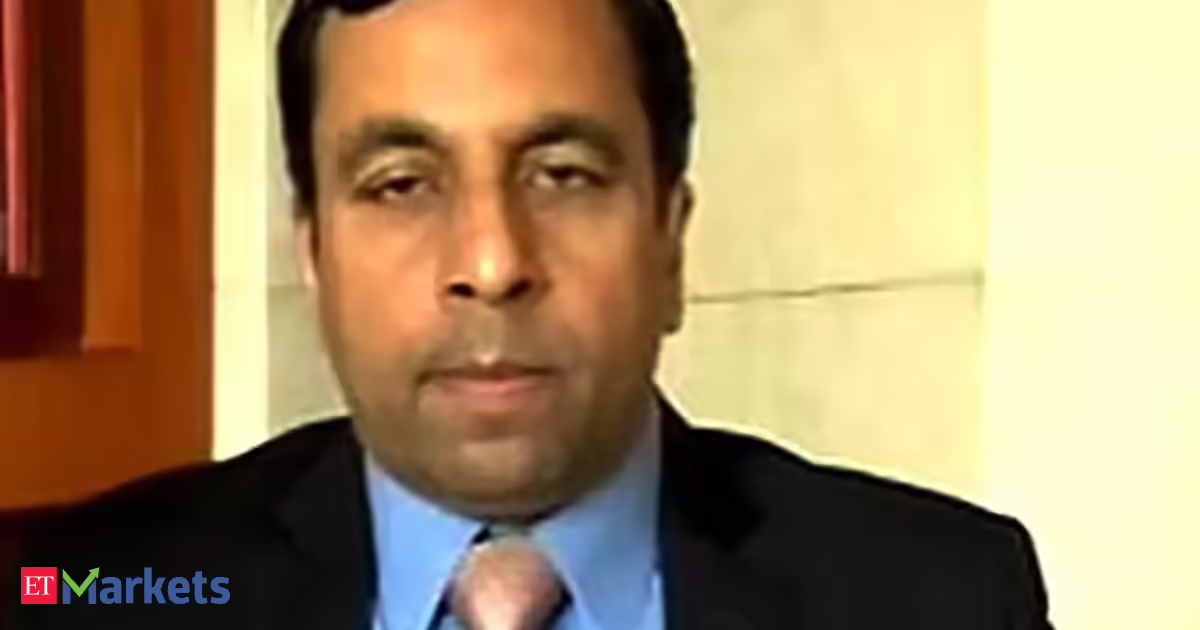
US economy remains strong, India must accelerate reforms and AI adoption: Ajay Srivastava

Published

on

US economy remains strong, India must accelerate reforms and AI adoption: Ajay Srivastava
Market veteran Ajay Srivastava from Dimensions Corporate believes that the narrative around the global economy, particularly the United States, is often misunderstood by Indian investors. Speaking to ET Now, he argued that while many perceive the U.S. to be facing economic challenges, the reality is quite different.

According to him, the American economy continues to perform exceptionally well, with stock markets at record highs, unemployment near historic lows, and some of the world’s largest companies continuing to create enormous wealth. He said that every country would aspire to be in the position that the U.S. currently occupies and stressed that India should focus less on judging global economies and more on addressing its own economic challenges.

Srivastava noted that despite geopolitical tensions, including the ongoing conflict in West Asia, the global economy remains resilient. He pointed out that developed nations have successfully diversified across industries such as semiconductors, technology, and advanced manufacturing, reducing their dependence on any single sector. India, he said, still has significant work to do in building similar capabilities and strengthening its economic competitiveness. He also emphasized the importance of keeping economic discussions separate from political considerations, arguing that a pragmatic approach is essential for long-term growth.

On artificial intelligence, Srivastava maintained that investors cannot afford to ignore the theme despite concerns around lofty valuations. He believes the leading AI companies enjoy strong competitive advantages and are likely to remain important wealth creators over time. While India may not be leading the development of foundational AI technologies, he sees a substantial opportunity for the country as a large-scale adopter and implementer of AI solutions. In his view, Indian businesses across sectors will increasingly rely on AI to improve productivity and efficiency, creating a significant opportunity for domestic companies involved in deployment and integration.

Advertisement

He also challenged the notion that the U.S. market’s strength is entirely dependent on AI-related stocks. While technology companies have undoubtedly been major contributors to market gains, he highlighted that several industrial, consumer, and defence-related businesses have also delivered strong performance. This, he argued, reflects the broader strength of the American economy rather than a narrow AI-driven rally.


Among Indian sectors, Srivastava believes banking stands to gain the most from AI adoption. He expects artificial intelligence to transform operational efficiency, reduce costs, and significantly improve profitability. From branch operations to customer service and call centres, AI has the potential to automate labour-intensive processes and enhance customer experience. As a result, he believes banks that successfully integrate AI into their business models could witness margin expansion that has not been seen in years.
While optimistic about the long-term opportunity, Srivastava remains selective on the banking sector. He reiterated concerns about large traditional lenders, arguing that some of them have struggled to deliver shareholder returns despite their dominant market positions. He also questioned the effectiveness of recent interest rate reductions in improving the sector’s outlook, noting that structural reforms and technological adoption are likely to have a greater impact on profitability than monetary policy alone. According to him, the key differentiator going forward will be how effectively banks leverage technology to reduce costs and improve efficiency.Discussing public-sector banks, Srivastava admitted that their low valuations continue to puzzle him. Although he expects certain private sector banks with strong institutional ownership to outperform, he does not believe investors should dismiss PSU banks outright. At current valuations, he suggested that downside risks appear limited, even if return potential may not be as attractive as some private-sector peers.

On the issue of expected credit loss (ECL) norms, Srivastava downplayed concerns about a significant impact on bank valuations. He believes any implementation is likely to be gradual, allowing banks sufficient time to adapt. More importantly, he argued that investors should focus on broader factors such as interest rates, economic growth, operating efficiency, and competitive dynamics rather than regulatory changes alone.

Perhaps his strongest message was directed at Indian investors’ portfolio allocation strategies. Srivastava pointed out that most Indian investors remain overwhelmingly concentrated in domestic assets and have limited exposure to global opportunities. He criticized restrictions on overseas investments by mutual funds, arguing that these constraints prevented Indian investors from participating meaningfully in the global AI boom. According to him, access to international markets is essential for long-term wealth creation, especially as many of the world’s most innovative companies continue to emerge outside India.

He believes investors should think beyond short-term market movements and focus on building diversified portfolios that include exposure to global growth themes. With new technology leaders and disruptive businesses continuing to emerge around the world, Srivastava argues that limiting investments to a market that represents only a small share of global market capitalization may not be the most effective strategy for future wealth creation. His message is clear: global markets remain strong, AI represents a transformational opportunity, and Indian investors must embrace both technological change and global diversification to fully participate in the next phase of economic growth.

Advertisement
Continue Reading

Business

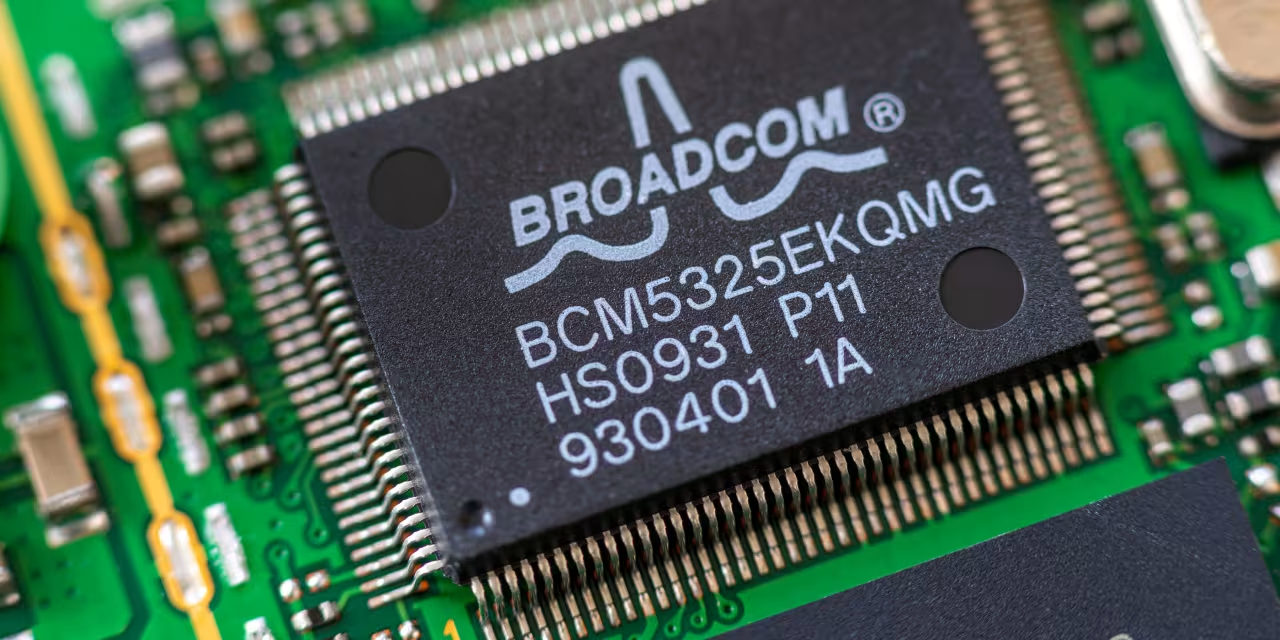
Broadcom Stock Closes at a Record. It’s Getting a Double Boost From Google and Marvell.

Published

on

Broadcom Stock Closes at a Record. It’s Getting a Double Boost From Google and Marvell.

Broadcom Stock Closes at a Record. It’s Getting a Double Boost From Google and Marvell.

Continue Reading

Business

AXA: Stable Income Story, But Upside Looks Limited (OTCMKTS:AXAHY)

Published

on

AXA: Stable Income Story, But Upside Looks Limited (OTCMKTS:AXAHY)

This article was written by

I am an independent trader and analyst specializing in the micro-cap market. My strategy combines technical analysis with the CAN SLIM method, developed by William O’Neil, to identify high-growth, underanalyzed companies. I focus on financial trends, profit growth, and institutional capital accumulation to uncover stocks with significant upside potential. In addition to equities, I have experience in Forex trading, which has helped me better understand price movements, market volatility, and sentiment-driven trends. My research approach integrates both fundamental and technical analysis, allowing me to identify strong growth stocks before they gain widespread attention. Key indicators I prioritize include relative strength, trading volume shifts, and accelerating profit growth—all of which help pinpoint stocks with the highest potential. Writing for Seeking Alpha is an integral part of my investment process, enabling me to refine my strategies, test investment theses, and engage with the investor community. In my articles, I aim to deliver in-depth company analyses, focusing on stocks with strong growth trends, improving fundamentals, and technical setups that signal potential breakouts. Through structured research, I strive to enhance market understanding and provide actionable investment insights.

Analyst’s Disclosure: I/we have no stock, option or similar derivative position in any of the companies mentioned, and no plans to initiate any such positions within the next 72 hours. I wrote this article myself, and it expresses my own opinions. I am not receiving compensation for it (other than from Seeking Alpha). I have no business relationship with any company whose stock is mentioned in this article.

Seeking Alpha’s Disclosure: Past performance is no guarantee of future results. No recommendation or advice is being given as to whether any investment is suitable for a particular investor. Any views or opinions expressed above may not reflect those of Seeking Alpha as a whole. Seeking Alpha is not a licensed securities dealer, broker or US investment adviser or investment bank. Our analysts are third party authors that include both professional investors and individual investors who may not be licensed or certified by any institute or regulatory body.

Advertisement
Continue Reading

Business

UK construction activity shrinks at fastest pace since 2020, PMI shows

Published

on

UK construction activity shrinks at fastest pace since 2020, PMI shows


UK construction activity shrinks at fastest pace since 2020, PMI shows

Continue Reading

Business

Lynas picks COO as interim boss

Published

on

Lynas picks COO as interim boss

Lynas Rare Earths has appointed chief operating officer Pol Le Roux as interim chief executive while it continues its search for a permanent successor to Amanda Lacaze.

Continue Reading

Business

Cornwall Airport to launch charter flights to Tenerife in 2027

Published

on

Business Live

The South West transport hub will offer two direct departures from Newquay

Melia Jardines Del Teide

Melia Jardines Del Teide(Image: Cornwall Airport)

Cornwall Airport Newquay is planning to launch a direct-flight package holiday programme to Tenerife in March next year, it has announced.

The South West transport hub has partnered with Murray Travel on the programme which will offer two direct departures from Newquay to Tenerife on Friday, March 5 and Friday March 12.

Advertisement

The new charter operation has been developed in response to sustained passenger demand for extra winter sun destinations and package holiday options from Cornwall, the airport said.

“Feedback from passengers, route requests and booking trends across the airport’s leisure network have consistently highlighted the Canary Islands as one of the most sought-after destinations,” the transport hub said.

The initiative forms part of Cornwall Airport Newquay’s wider strategy to strengthen regional connectivity by providing more choice and convenience for passengers while reducing reliance on airports outside the region.

Nigel Scott, commercial director at Cornwall Airport Newquay, said: “Our role is about more than operating flights; it’s about strengthening regional connectivity and ensuring people across Cornwall and the wider South West can access the destinations they want, directly from their local airport.”

Advertisement

He said that by partnering with Murray Travel to offer direct flights to Tenerife, it would make it easier for local people to travel and reduce the need for “lengthy journeys to airports outside the county”, while keeping “more travel spend” within the region.

“It’s another example of how we’re working with partners to expand opportunities for our passengers while supporting Cornwall’s long-term connectivity and economic resilience,” he said.

The airport has experienced significant international growth in recent years, with international passenger numbers rising from 74,069 in 2022 to more than 203,900 in 2024.

In April, international passengers from Cornwall accounted for 66 per cent of total traffic – up from 54 per cent a year earlier – the airport said.

Advertisement

Scott Murray, director at Murray Travel, said: “Tenerife remains one of the UK’s favourite holiday spots, so we’re really pleased to be able to offer this short trial programme and give customers in Cornwall and the surrounding area the chance to fly straight from their local airport.”

He added: “The response to our Lapland day trip from Newquay has been incredible, and it has shown us just how much appetite there is locally for convenient, direct flights to exciting destinations.”

Earlier this week, a Cornwall Council corporate finance committee meeting heard that “quite serious” cost-cutting measures would be likely at Newquay airport.

The council’s decision earlier this year to scrap the government-subsidised – through a Public Service Obligation (PSO) – service from Cornwall to London Gatwick has seen a drop in income at the council-owned airport.

Advertisement
Continue Reading

Trending

Copyright © 2025