

Crypto World
How AI agents can transform DeFi trading without sacrificing user control



AI agents have moved from experimental tools to active participants in financial markets, and Neyro’s Andrew Isaacs has argued that decentralized finance could become one of the sectors where the technology proves its value most clearly.
Summary
- Neyro COO Andrew Isaacs said DeFi trading offers a real-world test for AI agents because market decisions produce immediate financial outcomes.
- Robinhood, Base, and Coinbase have launched agent-focused products that allow AI systems to execute transactions, monitor portfolios, and process payments under user-defined controls.
- Isaacs argued that AI-driven automation in DeFi should preserve user ownership and decentralization rather than rely on custodial systems or centralized trust models.
Over recent weeks, several major companies have already started rolling out products designed around that same idea.
Robinhood launched Agentic Trading and Agentic Credit Card services that allow approved AI agents to execute trades and purchases through dedicated accounts with user-defined limits.
Coinbase-backed Base introduced Base MCP, a system that connects AI assistants such as ChatGPT, Claude, Codex, and Cursor to crypto wallets for tasks ranging from token swaps to portfolio monitoring.
Meanwhile, Coinbase has expanded its x402 payment infrastructure and agentic commerce initiatives, which CEO Brian Armstrong said could support an economy that eventually exceeds the scale of human commerce.
As AI agents take on more financial responsibilities, some industry participants believe decentralized finance could become one of the most important testing grounds for the technology.
Isaacs, who serves as the Chief Operating Officer at Neyro, a decentralized AI-powered crypto trading platform, believes trading presents conditions that quickly reveal whether AI systems can perform reliably when decisions carry real financial consequences.
“In many industries, an AI agent can save time. In trading, it can show whether this new model of automation is actually reliable under pressure,” Isaacs said in comments shared with crypto.news.
Unlike routine business workflows, trading requires continuous monitoring of market activity, interpretation of incoming data, and decision-making within predefined limits. Isaacs said those characteristics make markets a useful environment for evaluating how well AI agents operate outside controlled demonstrations.
“Trading is where small delays and bad judgment show up immediately,” Isaacs said. “That makes it a very honest environment for testing what AI agents can actually do.”
Fast-moving DeFi markets create a case for automation
Business interest in AI agents has already moved beyond experimentation. A McKinsey survey found that nearly two-thirds of companies are testing AI agents in their operations, while crypto firms have increasingly focused on ways to connect those systems with financial infrastructure.
For decentralized finance, Isaacs said the opportunity comes from the speed and complexity of crypto markets themselves.
“What stood out to me was the mismatch between how fast DeFi markets move and how manually most users still operate,” he said.
Around-the-clock trading, fragmented liquidity, and thousands of tokens spread across multiple blockchains have created an environment where keeping up with every opportunity is difficult for individual traders.
“A human trader cannot watch every pool, every token. But an AI agent can. That creates a very obvious use case for agentic systems,” Isaacs said.
Recent developments across the industry point to the same direction. Base MCP was introduced to help users manage crypto activity through AI chat interfaces while requiring transaction approvals before execution.
Similarly, Isaacs’s Neyro is attempting to combine automation with decentralized infrastructure, allowing users to benefit from AI-driven trading without relying on custodial systems.
Coinbase has also highlighted the growing use of USDC and Base for machine-to-machine payments, stating during its first-quarter earnings call that AI agents use USDC in 99% of tracked transactions and conduct more than 90% of those payments on Base.
According to Coinbase, AI agents are already using x402 infrastructure for services such as trading, data access, AI inference, media generation, and storage. Official x402 statistics cited by the company showed monthly volumes surpassing 75 million transactions.
Why decentralized exchanges have lagged behind
Despite growing interest in AI-powered finance, Isaacs said decentralized exchanges have faced obstacles that centralized platforms do not.
Centralized trading environments allow developers to deploy AI systems within platforms that already have internal controls and safeguards. On decentralized exchanges, however, agents interact with non-custodial wallets and smart contracts where transactions are typically irreversible.
“There was also a trust problem. In CeFi, an AI system can sit behind an exchange account with internal controls. But on DEXs, AI touches wallets and smart contracts directly. A bad prompt or a misread market condition can become an irreversible transaction,” Isaacs said.
Security concerns surrounding AI agents have continued to attract attention across the industry. When Base launched MCP, the company emphasized that transactions require explicit user approval and that the system never accesses private keys.
Separately, researchers from organizations including Google, Meta, Gray Swan AI, EmbraceTheRed, and several universities argued in a recent report that AI agents should be treated as untrusted components and isolated from sensitive instructions and data wherever possible.
Against that backdrop, Isaacs said the industry should be careful not to sacrifice decentralization in pursuit of convenience.
“AI is powerful enough to make centralization look convenient again, and that is the danger. The point of Web3 was never only to make financial products more digital. It was to change the trust model.”


Lessons Traditional Finance Can Learn from Decentralized Finance
For years, the relationship between Wall Street and Decentralized Finance (DeFi) seemed adversarial.
Traditional finance (TradFi) viewed DeFi as an experimental corner of the internet filled with speculative assets, anonymous developers, and untested protocols. Meanwhile, DeFi advocates often portrayed banks and financial institutions as outdated middlemen destined to be replaced by code.
Yet beneath the headlines and ideological debates, something interesting has been happening.
Many of the world’s largest financial institutions have begun studying, testing, and in some cases adopting concepts pioneered by DeFi.
The reason is simple: DeFi has become one of the largest real-world experiments in financial infrastructure ever conducted. It has processed trillions of dollars in transactions, coordinated global liquidity without centralized operators, and demonstrated new models for market-making, lending, settlement, and asset ownership.
Wall Street may not be embracing DeFi publicly, but it is paying close attention.
DeFi Built Financial Infrastructure from Scratch
Traditional financial systems evolved over decades.
Banks, clearinghouses, brokers, custodians, payment processors, and regulators all became layers within a complex ecosystem. While this structure provides stability, it also creates friction.
A simple securities transaction can require multiple intermediaries, delayed settlement periods, and extensive reconciliation between institutions.
DeFi approached the problem differently.
Instead of building around institutions, it built around programmable rules.
Smart contracts automate functions traditionally handled by intermediaries:
- Lending
- Borrowing
- Trading
- Settlement
- Collateral management
- Yield distribution
The result is a financial system capable of operating continuously, globally, and transparently.
For Wall Street, this raises an important question:
What if financial infrastructure could become software?
The Efficiency of 24/7 Markets
Traditional financial markets have operating hours.
Stock exchanges close. Banks observe weekends. International transfers can take days.
DeFi never sleeps.
Protocols operate twenty-four hours a day, seven days a week, across every time zone.
Liquidity remains accessible regardless of geography, holidays, or business hours.
While regulators and institutions may not be ready for fully nonstop markets, they recognize the efficiency advantages.
As global finance becomes increasingly digital, the expectation of continuous access may become difficult to ignore.
Transparency as a Competitive Advantage
One of DeFi’s most overlooked innovations is radical transparency.
In traditional finance, market participants often operate with limited visibility into:
- Liquidity positions
- Counterparty risk
- Reserve holdings
- Settlement activity
DeFi changes that.
Every transaction is publicly verifiable on-chain.
Users can inspect protocol reserves, lending activity, treasury balances, and historical performance in real time.
Transparency does not eliminate risk.
However, it significantly reduces information asymmetry.
For institutions increasingly focused on compliance, auditing, and risk management, transparent systems offer powerful advantages.
Automated Market Making Changed Liquidity
Perhaps no DeFi innovation has attracted more institutional attention than Automated Market Makers (AMMs).
Before DeFi, electronic markets largely relied on order books and professional market makers.
Protocols such as automated liquidity pools demonstrated that liquidity could be supplied algorithmically by participants worldwide.
This innovation transformed how markets could function.
Even institutions that never directly interact with decentralized exchanges have studied AMM mechanics because they reveal alternative approaches to liquidity provision.
The broader lesson is that market infrastructure can be redesigned rather than merely optimized.
Instant Settlement Is Hard to Ignore
One of the highest costs in traditional finance comes from settlement delays.
Trades often require multiple layers of verification and clearing before final ownership is finalized.
DeFi introduced near-instant settlement.
Transactions execute, settle, and become visible on-chain within minutes or seconds.
This dramatically reduces:
- Counterparty risk
- Operational complexity
- Capital lock-up requirements
- Reconciliation costs
Financial institutions have taken notice because settlement efficiency directly impacts profitability.
The possibility of tokenized securities settling in real time is becoming an increasingly serious topic among banks and asset managers.
Tokenization Is the Bridge Between Worlds
Among all DeFi concepts, tokenization may have the greatest long-term impact.
Tokenization transforms real-world assets into blockchain-based representations.
Examples include:
- Real estate
- Bonds
- Stocks
- Commodities
- Private credit
- Money market funds
For Wall Street, tokenization offers a path toward:
- Faster settlement
- Fractional ownership
- Increased liquidity
- Global accessibility
- Reduced administrative overhead
Rather than replacing traditional assets, tokenization modernizes how those assets move through financial systems.
This is one reason many institutions are exploring blockchain infrastructure despite remaining cautious about cryptocurrencies themselves.
Open Innovation Moves Faster
Traditional finance often innovates through large organizations, lengthy approval processes, and significant regulatory oversight.
DeFi innovates through open-source collaboration.
Developers worldwide can contribute improvements, launch new protocols, or experiment with novel economic models.
This creates a rapid feedback loop.
Ideas are tested in months rather than years.
Not every experiment succeeds.
In fact, many fail.
But the pace of innovation remains unmatched.
Wall Street increasingly understands that some of the most valuable financial innovations may emerge from open networks rather than corporate research departments.
What TradFi Should Learn
The most important lesson is not that banks should become decentralized.
It is hoped that financial infrastructure can become more efficient, transparent, and programmable.
TradFi can learn from DeFi in several key areas:
1. Transparency Builds Trust
Users increasingly expect visibility into how systems operate.
2. Automation Reduces Costs
Smart contracts demonstrate how software can replace manual processes.
3. Settlement Speed Matters
Capital efficiency improves when transactions settle faster.
4. Open Systems Accelerate Innovation
Collaborative development can uncover solutions faster than closed ecosystems.
5. Global Accessibility Creates Opportunity
Financial services no longer need to be constrained by geography.
Conclusion
The future of finance is unlikely to be purely traditional or purely decentralized.
Instead, it will probably be a hybrid system that combines the strengths of both worlds.
Traditional finance brings regulatory experience, institutional trust, and deep pools of capital.
DeFi contributes transparency, programmability, efficiency, and innovation.
That is why Wall Street is quietly studying DeFi.
Not because decentralized finance has already won, but because it has proven that many assumptions about how financial systems must operate are no longer fixed.
The institutions that learn these lessons early may be the ones that define the next generation of global finance.
REQUEST AN ARTICLE
Crypto World
WISeKey (WKEY) Shares Drop as WISeSat Progresses Toward Nasdaq Launch Under WSAT Symbol

Key Takeaways
-
WISeKey shares retreat as WISeSat subsidiary progresses with Nasdaq listing under WSAT symbol.
-
Satellite subsidiary submits updated confidential SEC registration for anticipated public market debut.
-
Stock faces downward pressure following disclosure of SPAC transaction advancement.
-
WISeSat pursues independent Nasdaq presence through WSAT ticker while parent company shares decline.
-
Parent company experiences continued selloff as satellite unit completes regulatory filing milestone.
Shares of WISeKey International Holding (WKEY) declined following disclosure of a regulatory filing advancement for its satellite subsidiary WISeSat’s forthcoming Nasdaq debut. The stock settled at $8.25, representing a 6.99% decrease, and continued sliding to $8.17 during pre-market activity. The decline reflected investor concerns surrounding the proposed space technology merger transaction.
WISeKey International Holding AG, WKEY
Satellite Subsidiary Progresses With Public Market Plans
According to WISeKey’s announcement, WISeSat.Space Holdings Corp. filed an updated confidential Form F-4 registration draft with the Securities and Exchange Commission on May 29, 2026. This submission advances the satellite company’s merger with Columbus Acquisition Corp. Upon deal completion, the merged entity anticipates commencing Nasdaq trading operations under the WSAT ticker symbol.
The transaction stems from a Business Combination Agreement executed November 9, 2025, involving WISeSat, CAC, Pubco, WISeKey, and WISeSat Merger Sub Corp. Following consummation, both WISeSat and CAC will operate as Pubco subsidiaries. The arrangement remains contingent upon SEC clearance, Columbus Acquisition shareholder consent, and Nasdaq listing authorization.
The satellite division operates via WISeSat.Space AG, concentrating on protected orbital infrastructure solutions. Its mission encompasses secure communications channels, digital authentication systems, encrypted data transmission, and defense-oriented space technologies. The enterprise leverages WISeKey’s established expertise in cybersecurity protocols, identity verification, and semiconductor engineering.
Parent Company Shares Decline Despite Regulatory Milestone
Trading activity for WKEY remained bearish following the filing disclosure. Shares concluded regular trading at $8.25 following the 6.99% drop, then extended losses by 0.96% before market open. This movement brought the pre-market price to $8.17, demonstrating persistent selling pressure.
The negative market response accompanied the transaction’s progression into additional regulatory stages. While a confidential amended registration draft represents forward movement, it doesn’t finalize the combination. Furthermore, the public Form F-4 remains pending effectiveness with the SEC.
WISeKey disclosed the advisory team supporting the merger. Maxim Group LLC serves as sole financial advisor to WISeKey. Legal counsel includes Ellenoff Grossman & Schole representing WISeSat and Pubco, alongside Loeb & Loeb advising CAC.
Company Overview and Strategic Direction
WISeKey’s core operations span cybersecurity solutions, digital identity platforms, and internet-connected device security. The company maintains dual listings under WIHN on Switzerland’s SIX Exchange and WKEY on Nasdaq. Its WISeSat division represents expansion into orbital secure connectivity infrastructure.
The satellite subsidiary focuses on quantum-resistant communication networks delivered through protected space-based systems. WISeSat intends to integrate orbital services with verification technologies, digital identity frameworks, and protected information exchange protocols. Target markets include government agencies, corporate entities, and industries requiring encrypted communications.
The planned WSAT listing would establish WISeSat as an independent publicly-traded entity. Nevertheless, the arrangement awaits final documentation and shareholder authorization. During this interim period, WKEY shares remain under selling pressure as investors evaluate transaction completion risks.

PI crashed 10% this week. Will the key support hold?
PI Network (PI) Price Predictions: Analysis
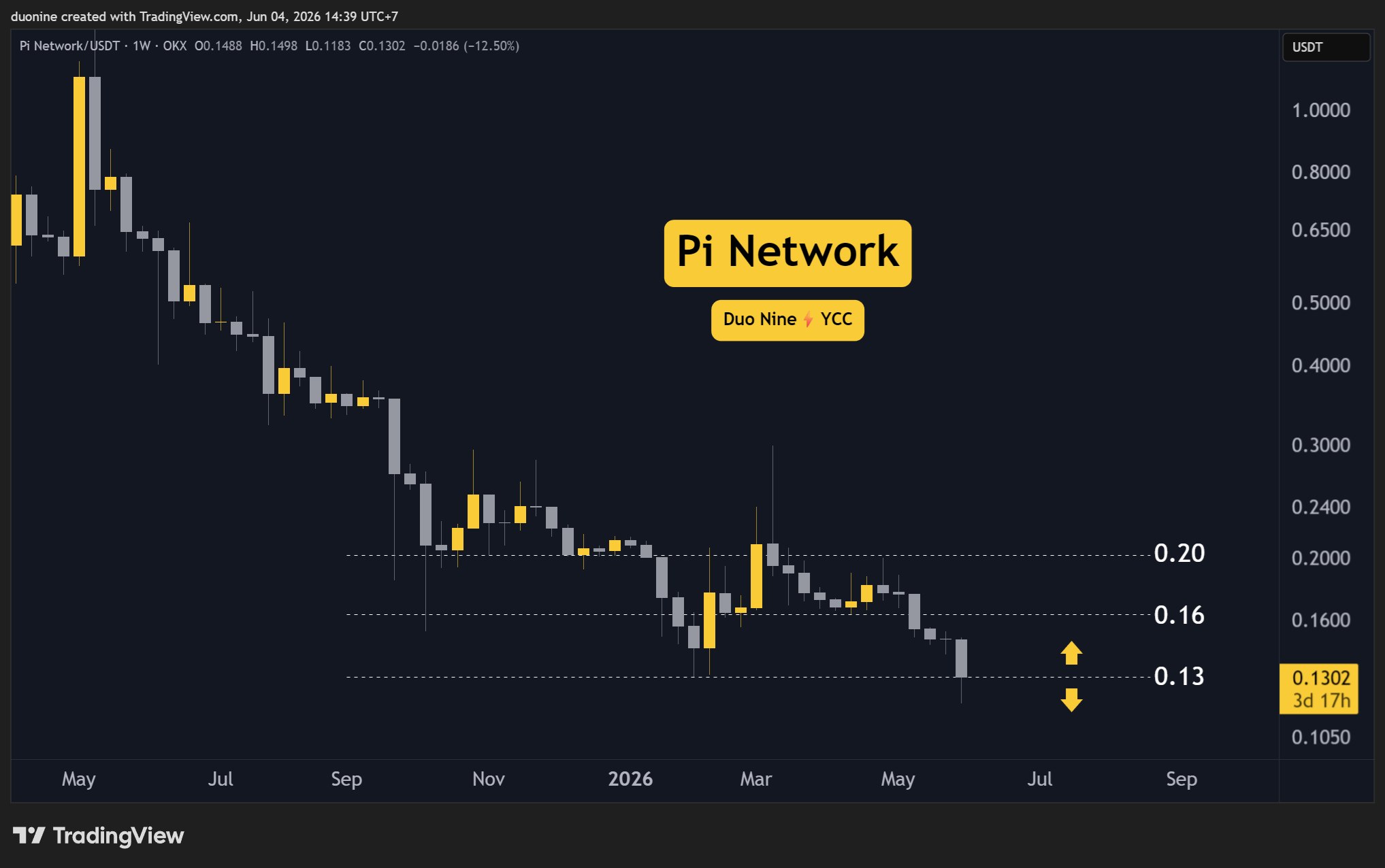
Key support levels: $0.13, $0.10
Key resistance levels: $0.16, $0.20
Market Crash Sends PI to Key Support
This week, PI set a new record low after crashing by 10%. This has driven the price to the $0.13 key support level. Buyers have returned here, but the outlook remains bearish as selling volume has been increasing over the past few days.
Because the price made a lower low, the downtrend remains intact and may continue to make new lows. For that to be confirmed, the current support at $0.13 has to turn into resistance.
Sellers Dominate
On the 3-day timeframe, sellers have dominated for 8 consecutive candles and pushed the price 30% lower. This aggressive selloff started as soon as the support at $0.16 failed to contain sellers.
If $0.13 also becomes resistance in the future, a similar pattern could materialize, with the downtrend accelerating and reaching new lows. If so, the next key target will be $0.10.

Daily RSI is Oversold
This most recent price drop has pushed the daily RSI into oversold territory, at under 30 points. At the time of this post, the RSI is around 25 points with no signs of a reversal and lower levels likely.
Nevertheless, this also indicates that sellers are getting greedy here, and a bounce or relief rally is more likely in the future. Therefore, best to watch the price action at $0.13. If that holds as support, buyers could have an opening to return.

The post Pi Network (PI) Price Predictions for This Week (June 4) appeared first on CryptoPotato.


Strategy’s recent bitcoin sale, the first in more than three years, sparked a major dispute on Polymarket, with the dispute settlement body led by UMA token holders ultimately ruling against bettors who wagered the sale would occur by May 31.
The controversy began after Strategy disclosed in a June 1 filing that it had sold 32 bitcoin between May 26 and May 31. Traders who bought Yes on the May market argued the company had clearly sold bitcoin before the deadline. Others countered that the transaction was not publicly disclosed until June 1 and therefore should not count toward a May 31 cutoff.
UMA token holders, who serve as the dispute-resolution layer for Polymarket’s oracle system, sided decisively with the latter view.
The resolution means bettors who wagered that Strategy would sell bitcoin by May 31 lost despite the company later disclosing the sale occurred during the final week of May. The June contract, meanwhile, resolved Yes because the transaction became public during June.
The result was driven by a handful of large token holders, which undercuts the core promise of decentralized finance where governance is democratized and not led by few whales.
The biggest vote came from borntoolate.eth, which cast 3.11 million voting weight for No. Other major No votes included UMA contributor Kevin Chan with 1.53 million voting weight and several wallets casting more than 1 million each. Together, the four largest No voters controlled nearly 7 million voting weight, more than 25 times the entire Yes side.
Several wallets identified as affiliated with Risk Labs, the company behind UMA, also voted No, alongside other prominent UMA ecosystem participants.
Not everyone is pleased with the resolution. Galaxy Research, which had significant exposure to the May contract, pushed back sharply on X. The firm stressed that Strategy explicitly sold the 32 Bitcoin between May 26 and May 31, and that the market’s resolution criteria should focus on when the sale occurred — not when it was publicly announced on June 1.
“Strategy’s SEC-filed Form 8k explicitly stated that Strategy sold between May 26–31. A plain reading of the resolution criteria would suggest that the market should have resolved to YES, hence the controversy,” the firm said.
Investment bank Goldman Sachs has teamed up with fund servicing giant Apex Group and digital asset exchange Archax to tokenize real estate, the firms said on Thursday.
Infrastructure provider Ownera and real estate investment manager LRC Group are also included in the debut of the blockchain-native real estate fund.
The tokenization of real-world assets (RWAs) is all the rage among crypto native firms and traditional finance players alike, but real estate has so far proved elusive as an asset class, at least in terms of scalable distribution.
The fund combines blockchain-native issuance with established fund structures, according to a press release, and is “designed to enhance operational efficiency and transparency, while enabling potential future transferability and maintaining robust governance and regulatory oversight.”
The fund shares are tokenized using GS DAP, Goldman Sachs’ blockchain platform. LRC Group acts as manager and Archax serves as custodian for the regulated digital securities and the first distribution partner. Ownera facilitates connectivity between participants and distribution channels.
Apex Group is providing Alternative Investment Fund Manager services through Fundrock LIS, along with fund administration and depositary services of assets other than financial instruments through Apex Fund Services Luxembourg.
“Issuing blockchain native fund units on GS DAP enables investment in real estate assets with precision while unlocking more seamless transferability in the future,” said Mathew McDermott, global head of digital assets at Goldman Sachs.
Crypto World
Taiwan Semiconductor (TSM) Stock Drops as CEO Projects Years-Long AI Chip Supply Shortage

Key Takeaways
- Taiwan Semiconductor’s CEO C.C. Wei informed investors that chip manufacturing capacity will remain insufficient to satisfy AI demand for the foreseeable future, despite expanding US operations.
- The chipmaker maintained its annual revenue growth projection exceeding 30%.
- TSMC intends to construct at least four more US fabrication facilities beyond the six currently scheduled, demanding approximately $100 billion in additional investment.
- The CEO acknowledged acquiring ASML’s High-NA EUV lithography systems but stated mass production deployment awaits economic viability.
- Taiwan Semiconductor shares declined 1.7% in Taipei trading following Broadcom’s lackluster guidance.
Taiwan Semiconductor Manufacturing (TSM) stock experienced a 1.7% decline during Thursday’s Taipei session after Chief Executive C.C. Wei informed investors the semiconductor giant cannot satisfy AI-fueled chip demand for years ahead — despite substantial new manufacturing facilities launching in the United States.
Taiwan Semiconductor Manufacturing Company Limited, TSM
“Customer demand will exceed our capacity for an extended period,” Wei stated during the company’s annual investor gathering in Hsinchu, Taiwan.
Despite Thursday’s pullback, Taiwan Semiconductor shares have surged more than fourfold during the previous three years, propelled by remarkable expansion in its primary business serving semiconductor clients including Nvidia and AMD.
Wei reaffirmed TSMC’s projection for annual revenue expansion surpassing 30%. The semiconductor manufacturer elevated this guidance recently in April, simultaneously indicating capital expenditures would likely approach the upper boundary of a range extending to $56 billion.
The capacity shortage originates from industry leaders. Major cloud computing giants are projected to allocate a collective $725 billion toward AI infrastructure throughout this year, with TSMC serving as the critical provider for cutting-edge processors enabling substantial portions of this expansion.
Notwithstanding supply limitations, Wei indicated TSMC will avoid implementing aggressive pricing increases. The objective, he emphasized, centers on maintaining business consistency and reliability for clients.
American Manufacturing Footprint Expands
Under a bilateral US-Taiwan commercial arrangement, TSMC projects constructing a minimum of four additional semiconductor fabrication plants across the United States, supplementing six facilities already outlined. This represents roughly $100 billion in fresh capital obligations, exceeding the $165 billion previously allocated.
Wei noted two Arizona land parcels TSMC has secured should adequately accommodate its American expansion requirements for ten years.
The American initiative partly addresses client demands. Nvidia, Broadcom, and competing firms are vying for production capacity at TSMC’s most sophisticated manufacturing nodes, while geographical diversification mitigates geopolitical and logistics vulnerabilities.
TSMC personnel will also benefit from the growth. Wei confirmed employees will receive average compensation bonuses increasing beyond 30% this year, as mounting pressure encourages AI sector leaders to share prosperity more broadly.
Advanced Manufacturing Equipment Already Secured
Wei responded to investor questions regarding TSMC’s positioning in next-generation semiconductor production technology, particularly concerning ASML’s High-NA EUV lithography equipment.
These systems, capable of creating smaller and more densely packed transistor patterns than existing machinery, command prices reaching $400 million per unit. Intel has already integrated the technology. TSMC has not yet implemented it for volume manufacturing.
Wei confirmed Taiwan Semiconductor has acquired the equipment and is performing research and development activities. The constraint involves economics rather than technical capabilities. TSMC will only introduce the machines into production environments once utilizing them becomes financially sustainable at scale.
“We have secured that equipment, and our engineering teams are vigorously pursuing relevant research and development initiatives. It simply hasn’t reached deployment for high-volume manufacturing,” Wei explained.
He refused to disclose the quantity of units TSMC has purchased.
The statements echo comparable commentary from TSMC executive Kevin Zhang during April, when he characterized the new systems as “extremely costly” and stated current objectives remain attainable using standard EUV equipment. Those remarks temporarily pressured ASML stock downward.
Wei informed shareholders Thursday that TSMC’s present priority involves optimizing existing chipmaking equipment performance to lower production expenses.
Bitcoin’s price decline from earlier this week was not a one-time thing, as the asset’s troubles intensified in the past 12 hours or so with another fresh nosedive to a multi-month low.
BTC dragged most alts with it, liquidating more than 270,000 over-leveraged traders in the process.
The Drop
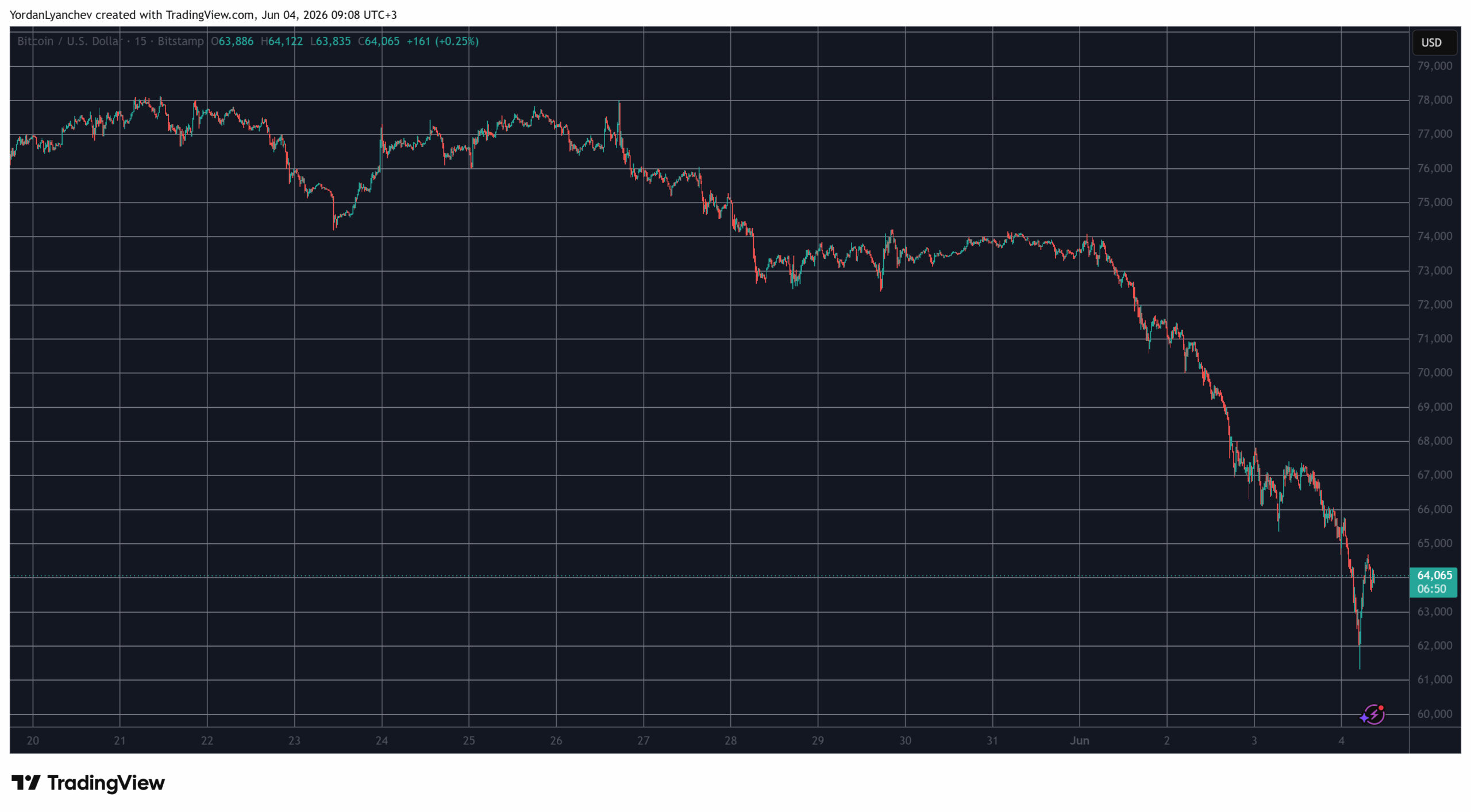
It now feels like an eternity, but just a few weeks ago bitcoin stood high at $82,000 before its mind-blowing downhill run began. As reported earlier this week, the situation worsened at the start of June with a nosedive to just over $65,000. BTC managed to recover some ground and stood at $67,000 yesterday before the bears took complete control of the market earlier this morning.
As the chart below demonstrates, bitcoin slumped to just over $61,000 on Bitstamp (and other exchanges), for the first time in four months. In early February, it plunged to $60,000, which many analysts believed was the ultimately low during this bear cycle. Now, though, the landscape looks different.
As Crypto Fabrik noted, the bears appear in total control, and the popular analyst predicted another leg down that can drive BTC to and under $55,000.
The altcoins were not spared. Ethereum dumped to a 14-month low earlier today at just over $1,700. Some analysts, though, speculated that this might be a proper buy-the-dip opportunity.
Aside from HYPE, which appears to be defying the overall market crash, most other alts are down by over 5%. Some, such as TON, have dumped by more than 12% daily.
Liquidations Rocket
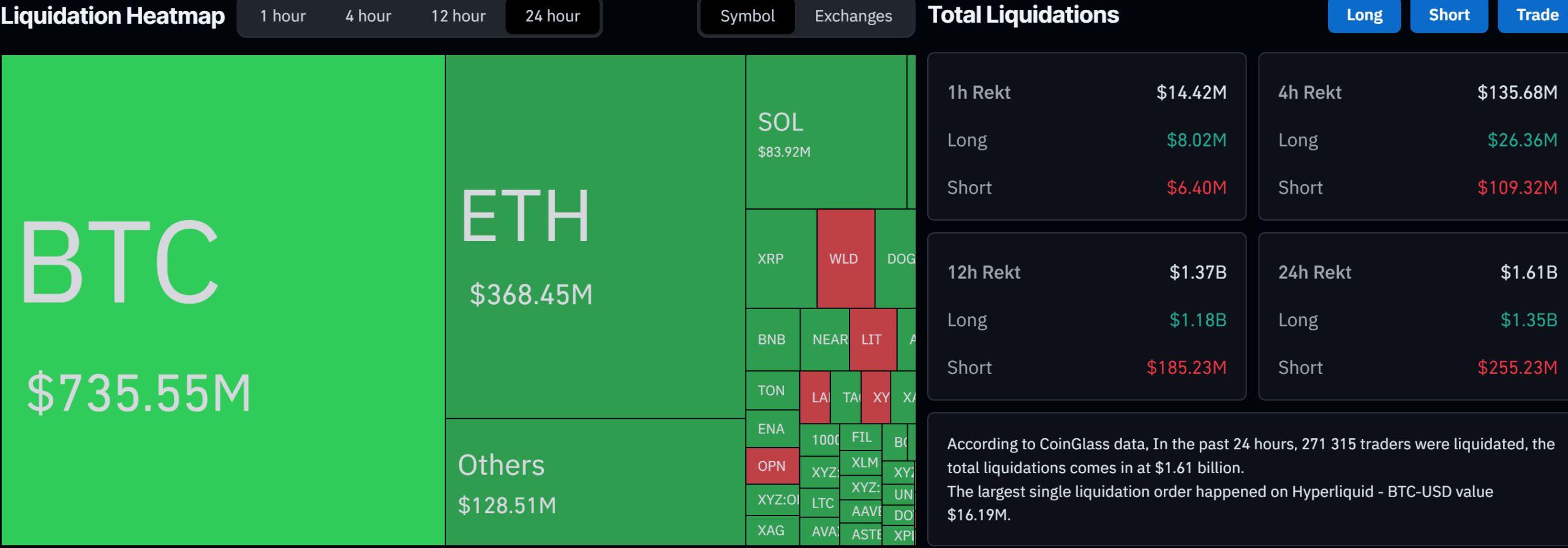
This intense volatility has, expectedly, led to a sharp uptick in the total value of wrecked positions. Data on CoinGlass shows that more than 270,000 traders have been wiped out in the past 24 hours, while the actual liquidated value is up to $1.61 billion within the same timeframe.
Longs are responsible for the lion’s share ($1.35 billion). Bitcoin’s liquidations are also the highest by a large margin (2x that of ETH’s), with more than $735 million in longs being wiped out daily.
The single-largest liquidation took place on Hyperliquid and was worth north of $16 million.
The post Bitcoin’s Massive Plunge Toward $61K Leaves Over $1.6B in Liquidations appeared first on CryptoPotato.

Key Takeaways
- Broadcom’s Q2 adjusted earnings per share reached $2.44, surpassing analyst expectations of $2.40, while revenue climbed 48% to $22.19 billion
- The company generated $10.8 billion from AI-related products in Q2, marking a 143% increase compared to last year
- Shares declined 6.1% in extended trading as forward guidance underwhelmed market expectations
- Third-quarter revenue forecast of $29.4 billion exceeded Wall Street’s $28.25 billion estimate, but the margin wasn’t convincing enough
- CEO Hock Tan anticipates AI semiconductor sales will surpass $16 billion in Q3, representing growth above 200% year-over-year
Broadcom (AVGO) unveiled impressive quarterly figures on Wednesday, yet the market response was underwhelming. Shares tumbled 6.1% during after-hours trading following a regular session that saw the stock dip 0.5% to close at $479.23.
The financial performance appeared solid at first glance. Adjusted earnings per share landed at $2.44, topping the $2.40 consensus forecast from analysts. Total revenue expanded 48% from the prior-year period to reach $22.19 billion, slightly exceeding the $22.13 billion projection.
Artificial intelligence revenue stole the spotlight. The company generated $10.8 billion from AI-related products during the quarter ending May 3, representing a 143% jump from the corresponding quarter last year. This figure also exceeded Broadcom’s internal projections.
The semiconductor solutions division generated $15 billion during the quarter, marking a 79% year-over-year increase and surpassing the analyst consensus of $14.72 billion. Meanwhile, infrastructure software contributed $7.2 billion, reflecting 9% growth.
Free cash flow totaled $10.3 billion, accounting for 46% of total revenue. Cash holdings climbed to $19.6 billion at quarter-end, up from $14.2 billion in the previous quarter.
Forward Outlook Falls Short Despite Revenue Beat
Looking ahead to Q3, Broadcom projected revenue of approximately $29.4 billion — representing roughly 84% year-over-year expansion. While this exceeded the Street’s $28.25 billion forecast, the market had anticipated a more substantial figure.
CEO Hock Tan indicated that AI semiconductor revenue should expand more than 200% year-over-year during Q3, hitting $16 billion. “The momentum continues,” he stated in the company’s earnings announcement.
Market participants likely expected a more significant guidance increase given the accelerating growth trajectory already underway.
The stock had advanced 4.7% on Tuesday following Alphabet’s disclosure of plans to raise $80 billion in equity financing for AI infrastructure investments. Broadcom manufactures custom AI processors for Alphabet, including eight iterations of Google’s Tensor Processing Unit. This partnership spans a decade.
Currently, Broadcom develops customized AI chips for six major customers, including Alphabet and OpenAI. The company aims to reach $100 billion in AI chip revenue by 2027.
Software Division’s Share of Revenue Shrinking
Broadcom’s software business, assembled through strategic acquisitions prior to the AI explosion, was designed to balance out the cyclical semiconductor market. Last year, software represented 42% of overall revenue. By next year, that proportion is projected to decline to approximately 20% as AI chip sales accelerate dramatically.
Analysts continue to forecast around 11% revenue growth for the software segment in Q2.
HSBC recently upgraded its price target for Broadcom from $450 to $600 while maintaining a Buy recommendation. The firm pointed to anticipated ASIC revenue expansion in the latter half of fiscal 2026, fueled by partnerships with Google, Meta, Anthropic, and OpenAI.
Broadcom also announced a quarterly dividend of $0.65 per share, with payment scheduled for June 30, 2026. The company has increased its dividend payout for 16 straight years.
The stock maintains a market capitalization of $2.29 trillion. According to InvestingPro analysis, the shares appear overvalued compared to Fair Value calculations.
Crypto World
ADA under 20 cents as Hoskinson says he is ‘taking a break’ after warning of ecosystem failures


Cardano founder Charles Hoskinson said he is “taking a break” after warning that the blockchain’s ecosystem faces a coming “wave of failures,” as ADA fell below $0.20 for the first time in more than five years.
I’m taking a break. TTYL
— Charles Hoskinson (@IOHK_Charles) June 3, 2026
ADA is down nearly 10% on the news, according to CoinDesk market data. The token is down nearly 70% over the past year.
The comments came in response to the shutdown of TapTools, a Cardano analytics platform that said it would cease operations after four years building on the network.
“This is where we’re at as an ecosystem,” Hoskinson said in a video posted earlier this week.
The Cardano creator said he had warned earlier this year that deteriorating market conditions would force some projects to close.
“I said at the beginning of the year, we’re going to see a lot of people collapse because the markets are really bad,” he said. “There’s going to be a wave of failures in the ecosystem.”
Hoskinson also expressed frustration with what he characterized as limited community support for deploying treasury funds to support ecosystem growth.
“There doesn’t seem to be a lot of community desire to spend the treasury to take these ventures to the next level,” he said.
The remarks come days after Cardano’s community voted against funding the ecosystem’s flagship 2026 Summit conference in Singapore, forcing organizers to cancel the event.
“TTYL,” Hoskinson posted on X.


Arthur Hayes, co-founder of BitMEX, has revealed that he sold his entire Hyperliquid (HYPE) and NEAR Protocol (NEAR) holdings.
The move follows a stretch of high-conviction posts, including a $100,000 charitable wager that the token would outperform every other top-ten asset by year’s end.
Arthur Hayes Bets Liquidates HYPE and NEAR Positions
Hayes has long been bullish on HYPE and even recently forecasted that NEAR could go “for da moon.” In April, BeInCrypto reported that Hayes had accumulated over 26,000 HYPE tokens, worth roughly $1.1 million. He also set a price target of $150, predicting HYPE would overtake Solana (SOL).
Follow us on X to get the latest news as it happens
Hayes announced the sale in a post on X (formerly Twitter), promising a fuller explanation next week. Still, the executive outlined four reasons in the post.
He pointed to higher energy prices due to the Iran war and to inventory restocking. Hayes also flagged three large artificial intelligence (AI) initial public offerings (IPOs) expected before early Q3.
Furthermore, he predicted President Donald Trump would turn against AI to help Republicans win the midterm elections. He expects markets to top between now and September, framing the sale as profit-taking before the peak.
Nonetheless, the executive still continues to be bullish on some assets. Yesterday, he posted a bullish call on Worldcoin (WLD), targeting $10 per token.
“The SpaceX IPO is going to melt people’s faces off. Holding the WLD through the listing next week,” he posted.
The Reality Test essay, due next week, should clarify whether Hayes is timing a top or rotating capital. For now, his actions and his words point in different directions.
Subscribe to our YouTube channel to watch leaders and journalists provide expert insights
The post Arthur Hayes Dumps Entire HYPE and NEAR Stack Days After $100,000 HYPE Bet appeared first on BeInCrypto.

Why Wall Street Is Quietly Studying DeFi

Hart’s efforts help Knicks turn around Game 1 of NBA Finals

CISA warns of cyberattacks targeting fuel tank monitoring systems



-

 Tech6 days ago
Waymo dominates autonomous vehicle registrations as Tesla trails behind
-

 News Videos6 days ago
This is BROKEN! INSANE 5x MONEY CAR WASH WEEK! The NEW GTA Online UPDATE Today! (GTA5 New Update)
-
 Tech5 days ago
SpaceX just won a second Golden Dome contract. This one is $4.16 billion.
-

 Business3 days ago
Jade Biosciences, Inc. (JBIO) Discusses Positive Interim Results From JADE101 Phase I Healthy Volunteer Study and Development Plans Transcript
-

 News Videos6 days ago
SHE IS KILLING XRP!!! WATCH URGENT AND ACT FAST
-
 NewsBeat5 days ago
FIRST NIGHT REVIEW: Take That bring the Circus back to life in spectacular sun-soaked style
-

 Business5 days ago
Is the Spurs Phenom Already Better Than Prime Diesel?
-
Crypto World6 days ago
CFTC Has Approved the First Regulated Bitcoin Perpetual Contract in the U.S.
-

 Politics5 days ago
The House | Inside Andy Burnham’s Makerfield Campaign: “Nobody Thinks This Is In The Bag”
-

 Sports1 day ago
French Open 2026 results: Alexander Zverev beats Rafael Jodar and will play Jakub Mensik in semi-finals
-
 NewsBeat6 days ago
Novak Djokovic v Joao Fonseca LIVE: French Open latest scores and results after Jannik Sinner’s shocking collapse
-
 Entertainment5 days ago
Weak ‘Supergirl’ Box Office Tracking Amid Milly Alcock Backlash
-
 Crypto World6 days ago
Snowflake (SNOW) Stock Rallies on Strong Q1 Results and AI Product Growth
-

 Entertainment6 days ago
Maddox Jolie-Pitt Legally Requests to Drop Brad’s Surname
-

 Tech2 days ago
CryZENx Releases Fresh Playable Content Deep Inside Jabu-Jabu for His Ocarina of Time Remake
-

 Business5 days ago
Demand Conditions Improve In Chemicals Sector In April 2026
-
 Entertainment5 days ago
One of the Greatest Sitcoms of All Time Shoots Up Apple TV’s Charts 11 Years Later
-

 Tech6 days ago
This Week In Security: Ubiquiti Fixes, And FreeBSD Joins The Club You Don’t Want To Join
-
 Crypto World6 days ago
MicroStrategy Moves $30 Million in BTC to Coinbase Prime: Is the Bitcoin Sell-Off Already Here?
-
 Entertainment6 days ago
Bruce Willis’ Generosity Resurfaces Amid His Dementia
You must be logged in to post a comment Login