

Crypto World
Strategy Didn’t Sell Bitcoin in May, According to Polymarket

Polymarket has officially finalized one of this year’s most controversial events. It’s a prediction market on whether Strategy will sell Bitcoin in May, and it resolved to “No,” meaning that, according to the platform, the company didn’t sell BTC that month.
Here’s the kicker: the firm did sell BTC in May, as confirmed not only by its executives but also by an official filing with the US Securities and Exchange Commission. So what’s the reason for the resolution, you may ask? Well, the fact that confirmation came after the deadline.
The decision rests entirely on the timing of the announcement. The filing came on June 1st (which is what literally everyone expected, because that’s when these filings are… filed), after the May 31 deadline had passed.
Polymarket’s decision has drawn massive criticism not only because of the outcome, but because the platform added a clarification after the market had closed, stating that announcements made after the deadline would not count toward resolution, as seen in the screenshot below.

What is even odder is that all subsequent time frames for the new markets for the same event lack this “additional context,” meaning traders can be easily misled again.
Critics argue that this effectively changed the market’s rules after traders had already taken their positions, which is objectively true. Many traders started taking positions on June 1st (which is after the deadline), because the market hadn’t been closed by Polymarket yet.
A May Sale, a June Filing
To give further context on the happening – at the center of this dispute is the difference between when an event took place and when it became publicly confirmed – these are two completely separate events. One is tied to an objective outcome; the other is tied to the announcement of that outcome. Had the event been framed as “MicroStrategy confirmed to have sold any of its Bitcoin by 11:59 PM ET on May 31,” then there is no room for interpretation.
But the market was “MicroStrategy sells any of its Bitcoin by 11:59 PM ET on May 31,” which they did. It was just announced later.
Polymarket didn’t treat the actual outcome as decisive – it treated the time of the announcement. Even though this distinction may seem technical, it has huge implications for traders. A market framed around whether a company sold Bitcoin can produce one answer if judged by the transaction date, and the opposite answer if judged by the disclosure date.
A Rule Changed After the Fact
What made this entire thing even more contentious is the fact that Polymarket added its “post-deadline announcements do not count” rule only after the market had been closed.
This raises very serious questions. Prediction markets depend on participants knowing the settlement criteria before they trade. Retroactively changing those criteria, especially after the relevant event has occurred, risks undermining confidence in the platform’s broader neutrality.
A trader claimed to have lost around $500K after backing the “Yes” side, while other observers criticized the decision. The controversy has also sparked broader concerns about how prediction markets handle events that occur before a deadline but are confirmed only afterward.
So, to put it in simple terms – Strategy did sell BTC in May according to its own filing. According to Polymarket, it didn’t.
The post Strategy Didn’t Sell Bitcoin in May, According to Polymarket appeared first on CryptoPotato.

SimpleSwap is a self-custodial multi-source swap aggregator that pulls liquidity from well-known CEX and DEX sources under the hood. It is designed for direct wallet-to-wallet exchanges. Rather than holding your assets on a platform balance, the service lets you choose a crypto pair, enter a receiving wallet address, send the deposit, and receive the output asset directly in your wallet.
No manual comparison of exchanges, bridges, or swap routes needed. Routing happens under the hood across 20+ liquidity providers — you get the best available path without having to build it yourself.
SimpleSwap is most useful for straightforward crypto-to-crypto swaps, especially when you want to avoid holding funds on a centralized exchange. Of course, you can also use it to access assets that are not available or convenient to trade through your usual CEX or wallet swap tool.
Summarized briefly, some of the main points are:
- SimpleSwap supports wallet-to-wallet crypto swaps.
- Users do not need to keep a platform balance to make an exchange.
- The service aggregates liquidity from 20+ providers across CEX and DEX sources.
- Both fixed-rate and floating-rate swaps are available.
- The platform is very easy to use, rather than an order-book exchange.
Overall, the platform is well-suited to users who want a direct exchange flow, a large selection of assets, and fewer account-related steps. On the other hand, if you are looking for advanced trading tools, charting capabilities, limit orders (or more complicated order types), you might be better off with a full exchange environment.
SimpleSwap has been on the market for 8+ years, with 10M+ users. It supports 2,800+ swappable assets and aggregates liquidity from 20+ providers across CEX and DEX sources. The service is also used as a business solution by 6,000+ projects, including Exodus and Tangem.
What SimpleSwap Is
SimpleSwap is a self-custodial swap aggregator, not a custodial exchange. There is no long-term account balance to fund. Each transaction is a standalone swap: you send one asset from your wallet, and the converted asset is delivered to the receiving address you specify. No platform balance between swaps.
As you may have noticed, this is a structure that differs considerably from a centralized exchange. On a CEX, you have to deposit funds, trade within the platform interface, and withdraw later. With SimpleSwap, the exchange process is built around a single transaction flow rather than an internal trading account.
It supports a very wide range of cryptocurrency assets and uses multiple liquidity providers. SimpleSwap’s job is to find and execute a swap route in the background with the best rates.
The exchange supports two main rate types:
- Floating rate: the final amount received may vary based on market conditions and execution timing.
- Fixed rate: the rate is locked for a limited time, provided the user sends the correct amount within the required window and follows the transaction instructions.
Naturally, there are features beyond basic exchange flow. These include customer support, account-based loyalty benefits, business tools, integrations, exchange tracking, and more.
Is SimpleSwap Safe? How it Works
Yes, SimpleSwap is safe and legit – there have been no reports indicating otherwise, and the exchange has been on the market for more than 8 years, servicing over 10 million people with 99.9% uptime. The exchange flow is equally straightforward. Here is how it works:
- Select the asset to send and the asset to receive.
- Choose the amount.
- Select a floating or fixed rate, where available.
- Enter the receiving wallet address.
- Confirm the exchange details.
- Send the deposit to the address provided by SimpleSwap.
- Track the exchange status until the output transaction is completed.
That’s it. The structure makes the platform very easy to use for standard crypto-to-crypto exchanges. There is no order book to manage, and there is no need to set market or limit orders. Of course, if these are features that you are looking for, it might be a good idea to explore a conventional CEX.
The most important step is to enter the receiving address correctly. Because SimpleSwap sends the exchanged asset to the address you provide in this step, entering an incorrect one can result in a loss of funds. The same applies to network selection.
The flow, as simple as it may be, still hides some risks, so just as with anything else involving sending and receiving cryptocurrency, you have to be very careful.
Supported Coins, Pairs, and Liquidity
One of the main practical uses of SimpleSwap is in its asset coverage and liquidity aggregation. As mentioned in the introduction, the service supports 2,800+ swappable assets and aggregates liquidity from 20+ providers across CEX and DEX sources, unlocking 3.2M+ trading pairs through a single interface.
Some of the supported coins include, but are not limited to:
- Bitcoin
- Ethereum
- Ripple
- Solana
- Monero
- Dogecoin
- Stablecoins, and more.
Rather than sourcing liquidity only from a single internal market, the platform does it through multiple providers, which allows the service to search for available rates and execute swaps at the best prices.
Of course, as it is with centralized exchanges, liquidity can vary by asset and market conditions. A swap between two major assets, such as BTC and USDT, or ETH and BTC, is usually more straightforward and executed at very convenient rates. However, if you are swapping a niche cryptocurrency for another niche cryptocurrency, this might mean a wider difference between the quoted and the final amount, longer time to process, and so forth – more or less like what happens on a thin order book.
For most floating swaps, estimation accuracy reaches 99.998%, which signals strong execution consistency.
Fees, Rates, and Swap Types
SimpleSwap doesn’t position itself as an order book exchange. Therefore, it doesn’t have fixed maker and taker fees for trading. Instead, the cost of using the service is reflected in the quoted exchange amount, along with the network fees involved in sending and receiving crypto.
I will break down the factors before you commit to a swap. These include:
- The quoted amount of the asset being received.
- The rate type: fixed or floating.
- The network fee for sending the deposit.
- Any blockchain fee is included in the outgoing transaction.
- The minimum and the maximum amount for the selected pair.
- The time limit for sending the deposit is especially important for fixed-rate swaps.
As you already know, SimpleSwap offers two main swap types: fixed-rate and floating-rate.
With a floating-rate swap, the final amount can change during processing. This is because the market rate may move significantly between when the quote is shown and when the swap is executed. Floating rates may be suitable for those of you who accept that the final amount can vary. Of course, they are much less predictable during periods of serious volatility.
With a fixed-rate swap, the rate is locked for a limited time. This gives you greater certainty about the expected amount, but only if you follow the conditions of the exchange. The deposit must match the required amount and arrive within the specified window.
Now, it’s very important to note that neither option is automatically better in every single case. A floating rate may result in a higher or lower final amount depending on market movements. A fixed rate, on the other hand, gives you more certainty but may include a different quoted amount (smaller) because the provider takes on price movement risk for the period of the swap.
Custody, Privacy, and KYC
With SimpleSwap, users don’t have to maintain an ongoing balance. At no point does the exchange take custody of your funds. This reduces the need to leave assets on an exchange after the transaction is complete, and gives you full control of your crypto.
The model reduces risks tied to centralized exchange balances. Because there’s no platform-side balance, your funds never sit on SimpleSwap between swaps.
Most standard crypto-to-crypto swaps can be completed without creating an account.
From a privacy perspective, SimpleSwap collects a lot less account-level information compared to a centralized exchange during a normal swap. Of course, you still need to keep in mind that these are on-chain transactions and that you must provide a wallet address as part of the transaction.
The main takeaway here is that SimpleSwap offers a lighter account setup than traditional CEX exchanges, but it remains within the compliance environment that applies to crypto services.
Pros and Cons of SimpleSwap
Here is the honest breakdown of where the SimpleSwap crypto exchange stands out and where it falls short.
In my usage of the platform, I isolated the following benefits:
- No standard account setup is needed for basic swaps.
- Funds are not held in a long-term exchange balance.
- The platform supports virtually all assets that I wanted to swap.
- The exchange process is quick and simple.
- Fixed and floating rates offer some flexibility.
- Each exchange has a tracking and an exchange ID.
- It can be very useful for pairs that are otherwise unavailable at standard CEXs.
- Loyalty program (up to 20% discount, up to 0.4% USDT cashback)
- Integration with more than 6,000 partners (Exodus, Tangem, etc)
The drawbacks that I can think of include:
- The final rate may not always be better than competing services.
- Floating-rate swaps can result in a different received amount.
- You don’t get full control over routing or execution venue.
- There is a risk associated with inputting receiving addresses.
Who SimpleSwap is Best For
SimpleSwap is best for those of you who want to exchange crypto directly between wallets without using a full trading account. It suits people who value a simple swap flow, the option to choose between fixed and floating rates, and broad crypto support. It can also work well for users who need access to assets or pairs that are not that convenient on traditional CEX platforms.
Who SimpleSwap is Not Best For
High-frequency and professional traders are hands down better off with a more expert interface. Those of you who need limit orders, charting tools, or precise execution controls should probably consider a more sophisticated environment.
Verdict: Is SimpleSwap Legit in 2026?
Yes, SimpleSwap is legit. It is a self-custodial multi-source swap aggregator that has operated continuously since 2018, processed 20M+ swaps, and is integrated into products used by millions. For wallet-to-wallet crypto swaps where control, privacy, and speed matter, the exchange works very well.
Its main use case is obviously straightforward: choose a pair, enter a receiving address, send the deposit, and wait for the exchanged crypto to arrive.
The service is most useful for those of you who want access to many coins without maintaining balances across multiple exchanges. The fixed-rate and floating-rate options also give users some flexibility, but that depends on whether they prefer price certainty or are willing to accept market movements
Overall, this SimpleSwap review finds the service works best as a wallet-to-wallet swap aggregator for users who want broad asset access without giving up self-custody. There are no credible SimpleSwap scam signals against the platform: 8+ years on the market, 10M+ users over time, and 6,000+ partner integrations support a legit track record across cycles.
The post Is SimpleSwap Legit in 2026? A SimpleSwap Crypto Exchange Review appeared first on CryptoPotato.

Evernorth, an XRP-focused treasury company backed by Ripple, Kraken, Pantera Capital, and SBI Holdings, is telling institutional investors that real banks are already using XRP, and that the next 18 months will be defined not by whether adoption news happens, but by how much and under which ruleset.
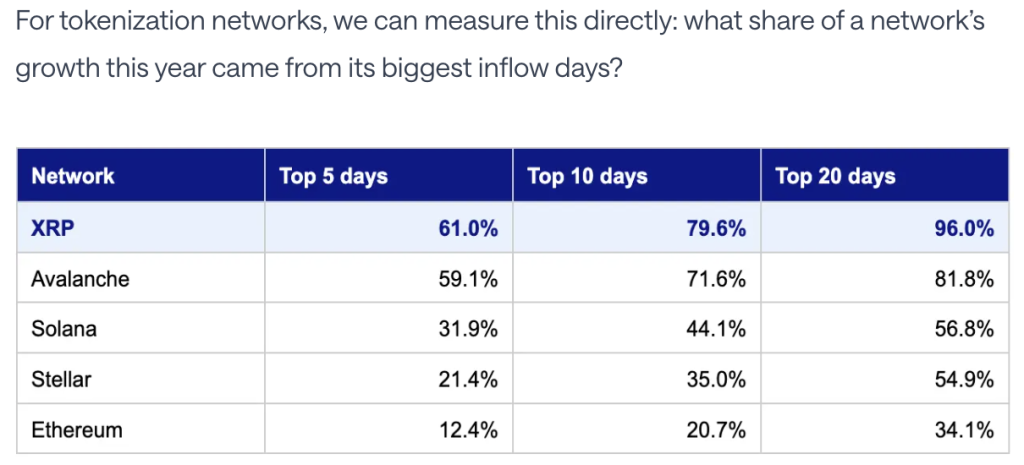
The claim is specific: daily transactions on the XRP Ledger have surged to nearly 3 million, up from roughly 1 million in mid-2025, with Bitstamp, Ripple’s RLUSD stablecoin, and Braza Bank among the busiest names on the network. That is a real number. What it means for banking utility is a different question entirely.
The tension is structural. According to news, XRPL transaction volume has tripled in roughly 12 months, and at least one major European bank has deployed its regulated euro stablecoin on XRP, selecting it as one of four public chains for that purpose.

But XRP on-chain metrics and exchange flows tell a more complicated story about whether that volume represents persistent banking infrastructure or a concentrated surge driven by a handful of known actors. The marketing narrative and the on-chain data are not opposites. They are simply not the same thing.
Discover: The Best Crypto to Diversify Your Portfolio
XRP and Banking Rails News: What the On-Chain Data Shows
Evernorth’s chief executive, Asheesh Birla, has argued in a news outlet that XRP’s long-term value will come from banks and businesses using it as working capital, not from retail trading.
That framing matters because it sets a specific evidentiary bar: not speculative demand, not ETF flows, but bank-originated settlement volume. Against that bar, the data is partially supportive and partially aspirational.
The XRPL’s jump to nearly 3 million daily transactions is documented and real. The busiest names driving that traffic, Bitstamp, RLUSD, Braza Bank, are identifiable financial institutions, not anonymous wallets or wash-trading vectors.
In May 2026, Evernorth highlighted a tokenized U.S. Treasury redemption that coordinated Mastercard, J.P. Morgan’s Kinexys, Ondo Finance, and Ripple using XRPL as the common settlement layer, with Ripple receiving USD proceeds in Singapore outside normal banking hours.
Evernorth described XRP as “settlement infrastructure in one of the most significant cross-institutional blockchain transactions to date.” That transaction happened. It is not fabricated.
What the data does not yet confirm is whether these events represent systematic banking adoption or high-profile pilots.
Ripple’s On-Demand Liquidity service has been live in production since at least 2018, using XRP as a bridge asset across cross-border corridors in markets like the Middle East and Southeast Asia. Volume in those corridors is real but geographically concentrated, not the global banking rail the headline narrative implies.
Institutional-sized transfers on XRPL are stable in 2026, but Chainalysis data indicate they increasingly compete with USDC and wholesale CBDC projects for share of institutional settlement flow.
The XRPL protocol itself is being upgraded with exactly this gap in mind. Pending amendments include Token Escrow, a Permissioned DEX, and Restricted Environments, compliance infrastructure explicitly designed to give regulated institutions whitelisted venues and escrowed settlement flows on-chain.
The proposed XLS-66 XRP Lending Protocol would embed single-asset XRP vaults, fixed-term loans, and ZK-enhanced privacy directly into the ledger, eliminating external smart contracts and bridges. Validators are currently voting on XLS-66, and it requires an 80% supermajority to activate.
It is not yet live. Analysts covering the proposal have framed it as a bid to unlock a $100 billion lending and collateral opportunity on XRPL, but until consensus is reached, that is infrastructure on the drawing board, not banking activity on the ledger.
Discover: The Best Token Presales
The post XRP News Today: Ripple-Backed Firm Claims Real Banks Are Already Using XRP Daily appeared first on Cryptonews.
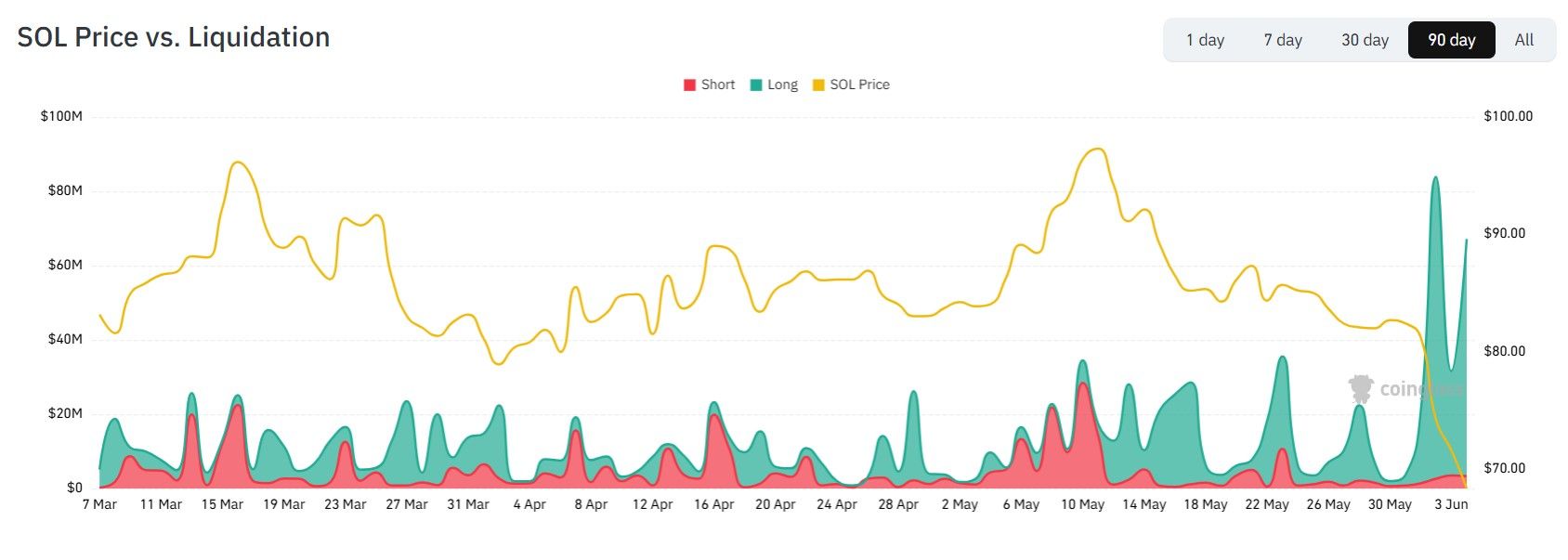
Solana (SOL) dropped to its lowest price since December 2023 this week, sliding toward $68 as more than $88 million in leveraged positions were wiped out across the market.
Long traders absorbed almost all of the damage. On-chain activity and social interest had been weakening for months before the breakdown, which suggests the selloff reflected fading demand rather than a single shock.
Long Liquidations Account for 94% of the Damage
The market liquidated $88.45 million in SOL positions over 24 hours, according to Coinglass data. Of that total, $83.53 million came from long positions against just $4.91 million in shorts.

That split means bullish traders accounted for roughly 94% of the losses. The data also shows 12,084 traders liquidated worldwide as SOL volatility passed 12% on the day.
The 90-day comparison makes the move stand out. The long liquidation spike near $84 million was the tallest reading on the entire chart, and it landed exactly as the price collapsed toward the lows.

Active Addresses Have Fallen Since February
The leverage flush did not happen in isolation. Solana network usage has been declining steadily, which points to weaker underlying demand.
Daily active addresses peaked near 5.5 million in early February, according to Santiment. The metric now sits around 2.91 million, roughly half the February high.
This matters because price held a consolidation range between $78 and $95 through spring, while usage kept falling. That divergence often warns that a sideways market lacks real support. The recent break toward fresh lows followed the same pattern flagged in earlier unstaking analysis.

Social Interest Fades as Rallies Get Sold
Crowd attention tells a similar story. Social volume has trended lower, with the latest reading down at 39, near the bottom of its three-month range.
Social dominance gained briefly in mid-May when SOL staged a short bounce, yet it has since rolled over to 0.687. The token now commands a smaller share of overall crypto conversation.
The pattern is telling. Bursts of chatter did not put a floor under price, and each spike in attention was sold into rather than bought. Fading interest leaves little fresh demand to defend support.

SOL Weekly Chart Confirms the Breakdown
The weekly chart ties the data together. SOL closed the latest candle near $68.46, down almost 17% on the week, its lowest level since December 2023.
Price has lost the 0.786 Fibonacci retracement at $73.31, turning former support into resistance. It was also rejected at the long-term resistance zone around $100, a shelf that previously acted as support in early 2024.
Weekly volume has been declining throughout the descent, which signals thin conviction behind every rally attempt. The weekly RSI has rolled into bearish territory, confirming weak momentum on the highest timeframe.
At the time of writing, Solana traded near $68.53, down about 9% over 24 hours, with a market cap close to $39.6 billion at rank seven.

For now, all four data sets point the same direction. A rebound in network usage and steady spot demand would offer the first evidence that selling pressure is starting to ease.
The post Solana (SOL) Hits Lowest Level in 2.5 Years as $88 Million in Longs Get Liquidated appeared first on BeInCrypto.


- Catapult Trade has appointed Claire “Cookie” Dang as VP of Growth and Co-Founder.
- Dang previously held growth and business development roles at Binance, KuCoin, and Crypto.com.
- The expansion is being funded in part by the KuCoin Ventures investment.
Catapult Trade has appointed Claire “Cookie” Dang as VP of Growth and Co-Founder, the latest in a series of moves that have widened the trading platform’s operations following an investment from KuCoin Ventures.
Dang held growth and business development roles at Binance, KuCoin, and Crypto.com before joining and will lead community growth and international expansion.
Her arrival has come alongside a broader push on the company’s external presence.
Catapult Trade has launched a sponsored podcast, Terminally Online, featuring Web3 founders and operators, and has assembled a media network from acquired social channels with a combined reach of over 20 million followers.
The company has also run trading activity collaborations with the exchange Gate.
The expansion is being funded in part by the KuCoin Ventures investment, disclosed earlier this year; terms were not made public, and the company said its funding round remains open, with proceeds also directed toward regional expansion in markets underserved by conventional financial infrastructure.
Catapult Trade opened to the public in December 2025 after a pre-launch incentives campaign that built its first base of traders and creators.
The platform runs on algorithmically generated price charts rather than an orderbook or live price feed.
Each session’s full price path is generated in advance and committed to a cryptographic hash published before trading begins, then revealed at settlement, letting users verify that the chart was never altered mid-session.
The company frames the design as a correction to conditions on memecoin launchpads, where hidden information has consistently worked against retail traders.
Since launch, the platform has recorded more than $1.5 billion in cumulative trading volume and over 80,000 monthly active users, with no paid acquisition behind the figures.
The platform’s chart-generation engine has passed two independent security audits, most recently by Halborn and earlier by Hashlock, with the company committing to annual reviews.
A points system has run since launch, fueling speculation about a token distribution; the company has confirmed in community sessions that a token is planned, but has released no allocation or vesting details.
A second product, Catapult Hyper, is in development and would extend the platform from synthetic charts into multichain token launches built on LayerZero’s omnichain fungible token standard.
The build-out reflects the standards now being applied to crypto products.
Where the previous cycle’s flagships rested on token speculation, the current cohort, led by names such as Hyperliquid in perpetuals and Polymarket in prediction markets, is judged on user demand and revenue.
Catapult Trade is being scaled on the same terms, in a category, gamified short-session trading on verifiable charts, that has yet to see an incumbent at scale.


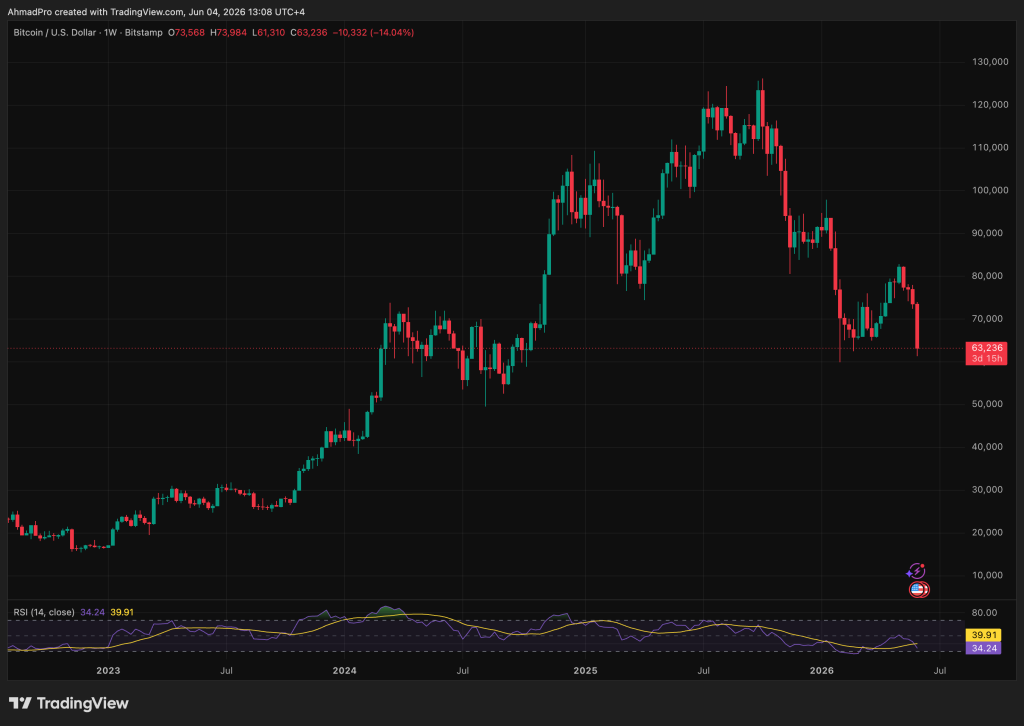
The panicky action got more so overnight, with bitcoin (BTC) careening to as low as $61,400 before quickly bouncing back to $64,000.
Ahead of the open of U.S. stocks, bitcoin is headed lower again, currently trading at $62,400, down 7% over the past 24 hours.
At the center of the plunge, Strategy Executive Chairman Michael Saylor has spoken. “Capital markets are funding the AI buildout at historic scale: ~$400B over 6 months,” Saylor posted to X minutes ago. “Bitcoin ETFs have seen ~$4B of outflows since May 14, pressuring BTC,” he continued.
“This is a capital rotation, not a Bitcoin impairment. Volatility creates opportunity,” Saylor concluded.
His comments echoed much of the conventional wisdom surrounding crypto’s general price struggles in recent months, which have become particularly acute this week after Strategy sold some of its bitcoin.
MSTR shares are lower 1.8% premarket.
The largest cryptocurrency by market capitalization has been nosediving lately, with its price posting another substantial decline over the past 24 hours.
Multiple analysts believe the valuation could reach new lows in the near future, while one key indicator suggests a rebound could be on the horizon.
How Much Lower?
There’s no way to soften what’s been happening to BTC lately. Its price has lost over $20,000 in the past month alone, and several hours ago it dipped to nearly $61,000, the lowest point since early February. The reasons behind this carnage are many and various: Strategy’s historic decision to sell some Bitcoin, the escalating conflict in the Middle East, the massive outflows from spot ETFs, and the bear market reigning across the broader crypto market.
Currently, the asset trades at around $62,500, which is a slight comeback, but according to numerous industry participants, the worst is yet to come.
Ali Martinez recently claimed that the plunge below $72,000 has put BTC in “a vulnerable position.” He said that, based on the MVRV Pricing Bands, the next major support is between $50,000 and $54,000.
For his part, X user Ted argued that BTC’s “head-and-shoulders” breakdown target is still not complete. He described $49,000 as “a good bottom zone,” drawing parallels to the August 2024 low.
Somewhat expected, the major collapse of BTC’s price gave Peter Schiff the opportunity to make a highly pessimistic prediction. The well-known crypto critic and outspoken proponent of gold forecasted that the valuation could nosedive to $20,000 if it breaks $50,000.
“It should be a quick fall below $20K, which should be a big enough drop to shake the conviction of long-term HODLers, causing many to finally throw in the towel,” he added.
Light at the End of the Tunnel?
Contrary to the bloodbath and the predictions of a further collapse ahead, BTC’s Relative Strength Index (RSI) suggests it might be time for a resurgence. The technical analysis tool is often used by traders to spot potential price reversal points, as it indicates whether the asset is oversold or overbought.
It runs from 0 to 100, and anything below 30 indicates that the price has fallen too much in a short period of time and could be due for a comeback. On the other hand, readings above 70 signal that a pullback might be on the horizon. Just a few hours ago, the RSI dropped to 11, its lowest level in four months, and has since risen to approximately 16.

The post Top Bitcoin Price Predictions After BTC’s 15% Weekly Collapse appeared first on CryptoPotato.

Bitcoin price dropped 5.5% to $61,322 in early trading today as the news says this is its lowest level since February 6, before clawing back above $64,000 by afternoon, and now it’s sitting at $63,300.
The move completes a full round-trip, erasing every basis point of the rally that Middle East conflict headlines had built into BTC pricing over the prior three months.
The erasure of that geopolitical premium matters beyond the price level itself. It is a live stress test of the digital gold narrative, and the test results, again, are not flattering.
Bitcoin did not hold value during renewed Middle East tensions. It sold off with risk assets and then bounced with them. That is a risk-asset behavioral pattern, not a haven one.

Discover: The Best Crypto to Diversify Your Portfolio
Bitcoin News: BTC Support at $60,000–$65,000 Is the Line That Matters Now
Data BTC’s current critical support zone is between $60,000 and $65,000, and the price is sitting directly inside it.
More specifically, BTC has slipped below the Short-Term Holder Realized Price, the average cost basis for recent buyers, which historically functions as a pivot between bullish continuation and deeper mean-reversion.
Breaking cleanly below $61,000 on a closing basis opens the next structural level near $58,000.
The chart structure is damaged but not broken. The 20-day moving average was breached on the way down, a clean technical flush that coincided with the $1.85 billion liquidation event that tore through leveraged long positions.
Institutional inflow via spot ETFs, which drove aggressive net buying earlier in 2026, has shifted into a two-way flow; several days of net outflows now punctuate what was a one-directional accumulation story.
If BTC holds the $61,000 to $62,000 zone, funding rates reset negative, and short-term holders stabilize, a relief rally toward $68,000 sets up.
If the macro catalyst fails to arrive, Bitcoin consolidates between $62,000 and $65,000 while the market waits on US jobs data or Fed commentary to set the next directional leg.
A daily close below $61,000 triggers a second flush toward $58,000, where longer-term holder cost basis and prior accumulation zones offer the next real support.
Discover: The Best Token Presales
The post Bitcoin News: BTC USD Just Hit Its Lowest Level Since February appeared first on Cryptonews.
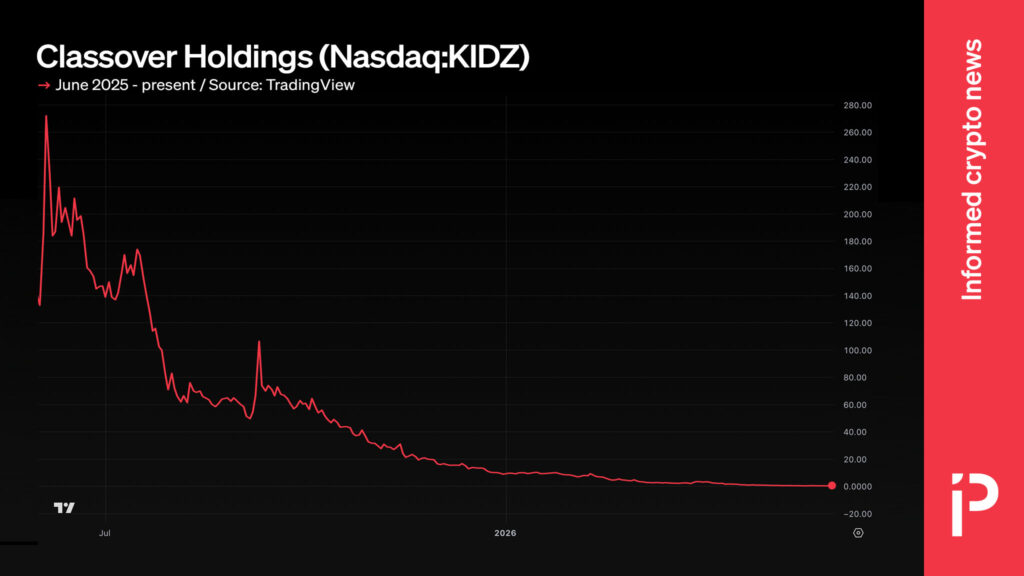
A publicly-traded children’s tutoring company has reinvented itself three times over the past year, pivoting from online education to Solana treasury management, then AI datacenter operations, and eventually, HyperLiquid yield farming.
Unfortunately, it dwindled to a penny stock in the process.
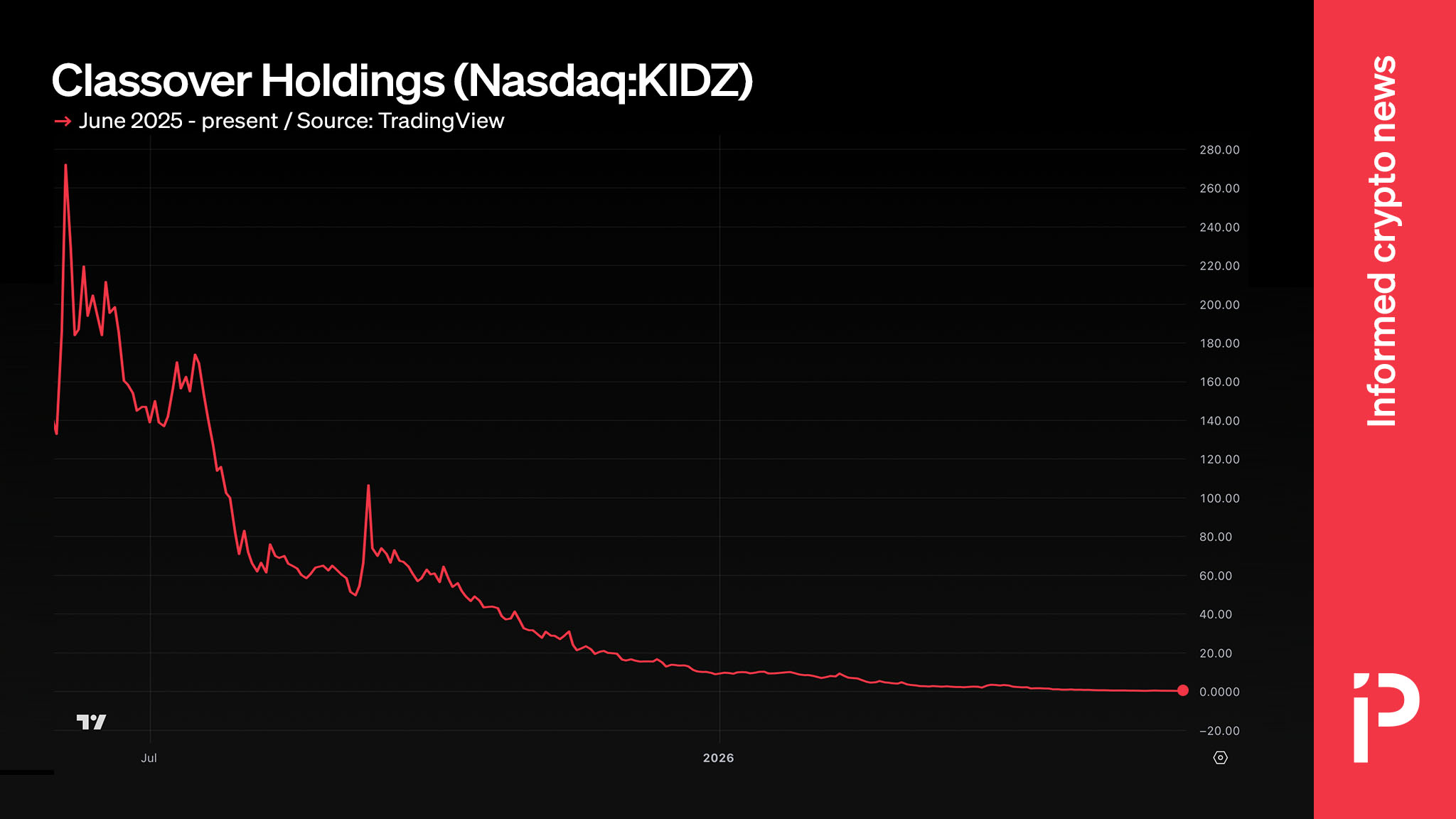
Shareholders have paid for every cringeworthy bandwagon hop. Its stock is down 99.9% over the past 12 months.
KIDZ AI is a Nasdaq-listed edtech curiosity formerly known as Classover Holdings. In 2025, it offered some sort of online, K-12 afterschool program. As of yesterday, it’s planning to farm stablecoins in the Hyperliquid ecosystem.
Every bizarre pivot arrived with a fresh press release, plenty of buzzwords, and a lower stock price.
Indeed, every single monthly candlestick over the past year is red.
Afterschool tutor becomes a ‘$900 million’ Solana bet
In the spring of 2025, the company discovered crypto. On May 1 of that year, during the momentary mania in digital asset treasury stocks, the company announced a $400 million agreement to fund a “Solana-centric digital asset treasury strategy.”
One month later, it announced another $500 million in convertible notes from Solana Growth Ventures LLC, bringing the headline figure to “$900 million” for a company whose actual quarterly revenues were less than $1 million at the time.
CEO Stephanie Luo called the financing a “milestone” for the company. And investors briefly loved it. The day after that press release, the stock had rallied 132% within two trading sessions.
It would never again regain those highs.
By October, after months of decline, management was still doubling down. The company said it would start accepting Solana (SOL) for tutoring payments, and reported holdings of 57,793 SOL worth roughly $13 million.
It chose words like “strengthens,” “reaffirms,” “commitment,” and “deepen” for a glowing press release. However, the stock kept sliding.
Sayonara Solana, aloha AI
Soon, its deeply reaffirmed commitment ended.
Three months ago, the company terminated its $400 million Solana “facility.” The digital asset strategy was no longer “accretive,” management said.
Instead of honoring its commitment, the company’s capital would now flow into artificial intelligence and robotics. Luo framed the reversal as “commitment.”
A new commitment.
Soon, the penny stock executed a one-for-50 reverse stock split, a maneuver that distressed companies use to manufacture a share price back above Nasdaq’s $1.00 per share minimum bid requirement.
Pre-split, the stock changed hands around 10 cents.
The company also rebranded to KIDZ AI Inc. It announced a GPU partnership targeting up to $50 million in AI compute capacity and started talking about AI datacenters.
Its stock price kept falling.
Read more: Hyperliquid SpaceX perp plummeted before Blue Origin explosion
Penny stock pivot to Hyperliquid
On Tuesday, KIDZ AI unveiled yet another treasury overhaul, this time phasing out Solana in favor of “the Hyperliquid ecosystem and yield-bearing US dollar-pegged stablecoin strategies.”
Luo said Hyperliquid has “real usage” and “deep liquidity.”
Investors rendered their verdict immediately, selling the stock down over 10% within a day.
Buried beneath the bandwagon-jumping treasury theatrics is a company in genuine distress.
Its most recent quarterly filing carries a going-concern warning, flagging “substantial doubt” about its ability to continue operating. The company lost millions operating its dwindling business divisions.
The SOL stash that once shimmered above $13 million was worth less than $5 million at the end of the most recent quarter.
Three pivots shared one outcome for the penny stock. The K-12 tutoring company that became a Solana treasury that became an AI robotics datacenter partner that became a Hyperliquid yield farmer play now trades around 35 cents per share, down 99.9% over the past year.
Got a tip? Send us an email securely via Protos Leaks. For more informed news and investigations, follow us on X, Bluesky, and Google News, or subscribe to our YouTube channel.
Arthur Hayes’ investment firm Maelstrom said Worldcoin could surge to as high as $5 per token over the next few months, with WLD acting as a crypto proxy for the AI boom.
“The AI mega IPOs are coming — and it appears the market has overlooked one of the cleanest proxies,” said Maelstrom researcher Lukas Ruppert on Wednesday.
The AI boom has been in full swing in the US. OpenAI confidentially filed its IPO prospectus with the SEC on May 22, targeting a public debut in September 2026, with the firm aiming to raise $60 billion with a potential valuation of up to $1 trillion.
Meanwhile, competitor Anthropic confidentially filed its draft prospectus on Monday after announcing on May 28 that it was valued at $965 billion following a fresh $65 billion funding round.
US stock markets such as the S&P 500 have reached record highs this week, primarily due to a surge in AI and memory storage company shares such as SanDisk, Micron, Seagate and Western Digital.
However, Ruppert argues that this hasn’t been reflected in the price of WLD, though company purchasing and a change in the token unlock schedule could be catalysts for a rally.
WLD is the native token underpinning Worldcoin, a crypto project co-founded by OpenAI CEO Sam Altman aimed at creating a global digital identity and financial network that can distinguish real humans from AI bots.
Two potential catalysts for WLD price pump
WLD prices have been downtrending since February, with losses accelerating in March following a private sale of tokens.
Worldcoin raised $65 million via an over-the-counter round in March, selling WLD tokens directly to private investors at a negotiated price, outside of any exchange. Of that amount, $25 million is locked for six months.
However, to protect themselves against WLD prices dropping before their tokens unlock, buyers hedged by shorting the token on perpetual futures markets in what Ruppert described as a “textbook short overhang.”
There are two potential catalysts to reverse this mechanical and temporary overhang, he said.
Eightco (ORBS), a small publicly traded company that has already accumulated 283 million WLD tokens, has around $144 million in cash sitting on its balance sheet. If they use that cash to buy more of the heavily shorted tokens, it could “trigger a reflexive loop,” sending prices higher, he said.
Secondly, Worldcoin’s unlock schedule, which releases tokens to the market every day, is set to drop by 43% on July 24, which could cut a major source of selling pressure.
Related: Crypto turns ‘contrarian bet’ as AI stocks draw investor attention: Bitwise
“Capital is aggressively chasing Anthropic and OpenAI exposure,” said Ruppert. Valuations are in the hundreds of billions and trillions, but WLD trades at $2 billion unlocked market cap, “a small cap, when it comes to AI valuations,” he added, labeling it an “asymmetric upside.”
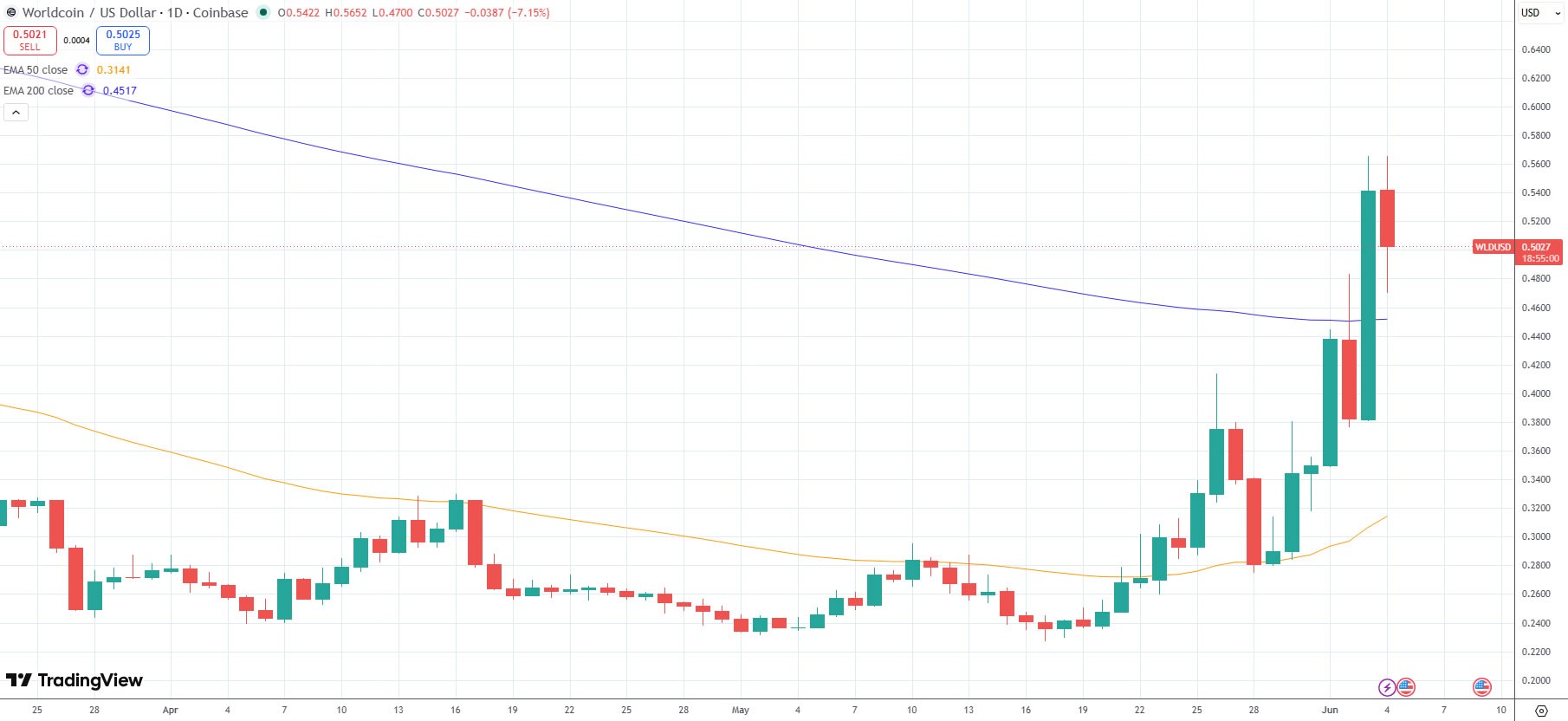
The analyst note comes as WLD is currently the best-performing crypto asset in the top 100 tokens by market capitalization, having surged by around 60% over the past week.
“WLD doesn’t move often — but when it does, it moves aggressively,” he said, with Maelstrom predicting the token will reach $5 by August, a gain of around 900% from its current trading price of $0.50.
WLD has surged over the past week. Source: TradingView
Magazine: Big Questions: Do we really only need 2–5 cryptocurrencies?

Key Takeaways
- Bank of Japan poised to increase policy rate to 1% on June 16, marking the highest level in 30 years
- Sources indicate rate increase likely unless Middle East tensions dramatically worsen
- Financial markets currently pricing in approximately 80% probability of rate hike
- Governor Kazuo Ueda’s recent remarks suggest shift toward aggressive inflation management
- Central bank may also adjust bond purchase reduction strategy starting fiscal year 2027
Japan’s central bank appears set to implement an interest rate increase during its June 16 policy session, according to three individuals with knowledge of internal deliberations. This adjustment would elevate the nation’s benchmark policy rate from 0.75% to 1% — reaching heights unseen since the mid-1990s.
Bloomberg reports BOJ 🇯🇵 officials will consider a 25 bp rate hike at the June 15-16 meeting, which would take the policy rate to 1%.
Officials also see scope for another rate hike later this year, citing still-low real rates and upside inflation risks.
The BOJ is also expected… pic.twitter.com/ZqDU3HtmuS
— Wall St Engine (@wallstengine) June 4, 2026
These insiders, speaking under condition of anonymity due to lack of authorization for public statements, indicated that the final determination depends largely on developments in the Middle East. Barring a significant escalation of tensions involving Iran that could destabilize international financial markets, monetary tightening appears probable.
Financial market indicators already suggest this outcome, with derivatives pricing reflecting approximately an 80% likelihood of the rate adjustment.
Central Bank Chief Telegraphs Policy Shift
Governor Kazuo Ueda articulated his stance during Wednesday remarks that market observers interpreted as signaling a renewed focus on combating rising prices. His commentary suggested potential willingness to implement rate increases with greater frequency in coming months.
Two policy board officials, Kazuyuki Masu and Junko Koeda, have similarly expressed concern about accelerating price growth in recent statements. Market watchers believe they may align with three other policy hawks to support a June rate move.
Wholesale price data for April showed a 4.9% year-over-year surge — the sharpest acceleration in three years. This increase stems largely from elevated petroleum and chemical input costs linked to conflict in Iran.
Rising Price Pressures Mount
While Japan’s core consumer inflation metric has temporarily fallen beneath the BOJ’s 2% objective in recent months—partially due to government energy support programs—economists anticipate a rebound above that threshold later in 2025 as subsidies expire and energy expenses remain elevated.
Currency depreciation has compounded these challenges. A weakening yen increases import costs broadly, amplifying inflationary pressures and bolstering arguments for monetary policy normalization.
The central bank concluded its extended quantitative easing framework in 2024 and has implemented multiple rate increases since that time, including one in December. These moves reflect growing confidence that Japan can achieve its inflation objectives on a sustainable basis.
Prime Minister Sanae Takaichi, traditionally an advocate for accommodative monetary conditions, appears to have accepted the necessity of a June rate increase following a May 22 meeting with Ueda. Former policy board official Makoto Sakurai told Reuters the prime minister likely recognizes the move as unavoidable given current economic conditions.
Bond Purchase Strategy Under Consideration
The upcoming June session will also examine the central bank’s government bond purchase reduction program. The existing tapering schedule concludes in March 2027, requiring officials to establish a framework for the subsequent fiscal year.
Two sources suggest the BOJ favors either temporarily halting or decelerating the pace of bond purchase reductions to preserve market stability. Ueda acknowledged Wednesday that bond market functioning has strengthened but emphasized the importance of maintaining equilibrium as the institution withdraws from Japanese government bond acquisitions.
The two-day monetary policy gathering concludes on June 16.


Oura Ring 5 review: Thinner, lighter, better

Jack Mallers :”Why Bitcoin Will Hit $500,000 – You NEED To Own At Least 0.1 Bitcoin” | (BTC Update)

Trump’s allies and critics worry he is boxed in by Iran war



-

 Tech6 days ago
Waymo dominates autonomous vehicle registrations as Tesla trails behind
-

 News Videos6 days ago
This is BROKEN! INSANE 5x MONEY CAR WASH WEEK! The NEW GTA Online UPDATE Today! (GTA5 New Update)
-
 Tech5 days ago
SpaceX just won a second Golden Dome contract. This one is $4.16 billion.
-

 Business3 days ago
Jade Biosciences, Inc. (JBIO) Discusses Positive Interim Results From JADE101 Phase I Healthy Volunteer Study and Development Plans Transcript
-
 News Videos6 days ago
SHE IS KILLING XRP!!! WATCH URGENT AND ACT FAST
-
 NewsBeat5 days ago
FIRST NIGHT REVIEW: Take That bring the Circus back to life in spectacular sun-soaked style
-

 Business5 days ago
Is the Spurs Phenom Already Better Than Prime Diesel?
-
Crypto World6 days ago
CFTC Has Approved the First Regulated Bitcoin Perpetual Contract in the U.S.
-

 Politics5 days ago
The House | Inside Andy Burnham’s Makerfield Campaign: “Nobody Thinks This Is In The Bag”
-

 Sports2 days ago
French Open 2026 results: Alexander Zverev beats Rafael Jodar and will play Jakub Mensik in semi-finals
-
 NewsBeat6 days ago
Novak Djokovic v Joao Fonseca LIVE: French Open latest scores and results after Jannik Sinner’s shocking collapse
-
 Entertainment5 days ago
Weak ‘Supergirl’ Box Office Tracking Amid Milly Alcock Backlash
-
 Crypto World6 days ago
Snowflake (SNOW) Stock Rallies on Strong Q1 Results and AI Product Growth
-

 Tech2 days ago
CryZENx Releases Fresh Playable Content Deep Inside Jabu-Jabu for His Ocarina of Time Remake
-

 Entertainment6 days ago
Maddox Jolie-Pitt Legally Requests to Drop Brad’s Surname
-

 Business5 days ago
Demand Conditions Improve In Chemicals Sector In April 2026
-
 Entertainment5 days ago
One of the Greatest Sitcoms of All Time Shoots Up Apple TV’s Charts 11 Years Later
-

 Tech6 days ago
This Week In Security: Ubiquiti Fixes, And FreeBSD Joins The Club You Don’t Want To Join
-
 Crypto World6 days ago
MicroStrategy Moves $30 Million in BTC to Coinbase Prime: Is the Bitcoin Sell-Off Already Here?
-
 Entertainment6 days ago
Bruce Willis’ Generosity Resurfaces Amid His Dementia
You must be logged in to post a comment Login