

Crypto World
Is SimpleSwap Legit in 2026? A SimpleSwap Crypto Exchange Review

SimpleSwap is a self-custodial multi-source swap aggregator that pulls liquidity from well-known CEX and DEX sources under the hood. It is designed for direct wallet-to-wallet exchanges. Rather than holding your assets on a platform balance, the service lets you choose a crypto pair, enter a receiving wallet address, send the deposit, and receive the output asset directly in your wallet.
No manual comparison of exchanges, bridges, or swap routes needed. Routing happens under the hood across 20+ liquidity providers — you get the best available path without having to build it yourself.
SimpleSwap is most useful for straightforward crypto-to-crypto swaps, especially when you want to avoid holding funds on a centralized exchange. Of course, you can also use it to access assets that are not available or convenient to trade through your usual CEX or wallet swap tool.
Summarized briefly, some of the main points are:
- SimpleSwap supports wallet-to-wallet crypto swaps.
- Users do not need to keep a platform balance to make an exchange.
- The service aggregates liquidity from 20+ providers across CEX and DEX sources.
- Both fixed-rate and floating-rate swaps are available.
- The platform is very easy to use, rather than an order-book exchange.
Overall, the platform is well-suited to users who want a direct exchange flow, a large selection of assets, and fewer account-related steps. On the other hand, if you are looking for advanced trading tools, charting capabilities, limit orders (or more complicated order types), you might be better off with a full exchange environment.
SimpleSwap has been on the market for 8+ years, with 10M+ users. It supports 2,800+ swappable assets and aggregates liquidity from 20+ providers across CEX and DEX sources. The service is also used as a business solution by 6,000+ projects, including Exodus and Tangem.
What SimpleSwap Is
SimpleSwap is a self-custodial swap aggregator, not a custodial exchange. There is no long-term account balance to fund. Each transaction is a standalone swap: you send one asset from your wallet, and the converted asset is delivered to the receiving address you specify. No platform balance between swaps.
As you may have noticed, this is a structure that differs considerably from a centralized exchange. On a CEX, you have to deposit funds, trade within the platform interface, and withdraw later. With SimpleSwap, the exchange process is built around a single transaction flow rather than an internal trading account.
It supports a very wide range of cryptocurrency assets and uses multiple liquidity providers. SimpleSwap’s job is to find and execute a swap route in the background with the best rates.
The exchange supports two main rate types:
- Floating rate: the final amount received may vary based on market conditions and execution timing.
- Fixed rate: the rate is locked for a limited time, provided the user sends the correct amount within the required window and follows the transaction instructions.
Naturally, there are features beyond basic exchange flow. These include customer support, account-based loyalty benefits, business tools, integrations, exchange tracking, and more.
Is SimpleSwap Safe? How it Works
Yes, SimpleSwap is safe and legit – there have been no reports indicating otherwise, and the exchange has been on the market for more than 8 years, servicing over 10 million people with 99.9% uptime. The exchange flow is equally straightforward. Here is how it works:
- Select the asset to send and the asset to receive.
- Choose the amount.
- Select a floating or fixed rate, where available.
- Enter the receiving wallet address.
- Confirm the exchange details.
- Send the deposit to the address provided by SimpleSwap.
- Track the exchange status until the output transaction is completed.
That’s it. The structure makes the platform very easy to use for standard crypto-to-crypto exchanges. There is no order book to manage, and there is no need to set market or limit orders. Of course, if these are features that you are looking for, it might be a good idea to explore a conventional CEX.
The most important step is to enter the receiving address correctly. Because SimpleSwap sends the exchanged asset to the address you provide in this step, entering an incorrect one can result in a loss of funds. The same applies to network selection.
The flow, as simple as it may be, still hides some risks, so just as with anything else involving sending and receiving cryptocurrency, you have to be very careful.
Supported Coins, Pairs, and Liquidity
One of the main practical uses of SimpleSwap is in its asset coverage and liquidity aggregation. As mentioned in the introduction, the service supports 2,800+ swappable assets and aggregates liquidity from 20+ providers across CEX and DEX sources, unlocking 3.2M+ trading pairs through a single interface.
Some of the supported coins include, but are not limited to:
- Bitcoin
- Ethereum
- Ripple
- Solana
- Monero
- Dogecoin
- Stablecoins, and more.
Rather than sourcing liquidity only from a single internal market, the platform does it through multiple providers, which allows the service to search for available rates and execute swaps at the best prices.
Of course, as it is with centralized exchanges, liquidity can vary by asset and market conditions. A swap between two major assets, such as BTC and USDT, or ETH and BTC, is usually more straightforward and executed at very convenient rates. However, if you are swapping a niche cryptocurrency for another niche cryptocurrency, this might mean a wider difference between the quoted and the final amount, longer time to process, and so forth – more or less like what happens on a thin order book.
For most floating swaps, estimation accuracy reaches 99.998%, which signals strong execution consistency.
Fees, Rates, and Swap Types
SimpleSwap doesn’t position itself as an order book exchange. Therefore, it doesn’t have fixed maker and taker fees for trading. Instead, the cost of using the service is reflected in the quoted exchange amount, along with the network fees involved in sending and receiving crypto.
I will break down the factors before you commit to a swap. These include:
- The quoted amount of the asset being received.
- The rate type: fixed or floating.
- The network fee for sending the deposit.
- Any blockchain fee is included in the outgoing transaction.
- The minimum and the maximum amount for the selected pair.
- The time limit for sending the deposit is especially important for fixed-rate swaps.
As you already know, SimpleSwap offers two main swap types: fixed-rate and floating-rate.
With a floating-rate swap, the final amount can change during processing. This is because the market rate may move significantly between when the quote is shown and when the swap is executed. Floating rates may be suitable for those of you who accept that the final amount can vary. Of course, they are much less predictable during periods of serious volatility.
With a fixed-rate swap, the rate is locked for a limited time. This gives you greater certainty about the expected amount, but only if you follow the conditions of the exchange. The deposit must match the required amount and arrive within the specified window.
Now, it’s very important to note that neither option is automatically better in every single case. A floating rate may result in a higher or lower final amount depending on market movements. A fixed rate, on the other hand, gives you more certainty but may include a different quoted amount (smaller) because the provider takes on price movement risk for the period of the swap.
Custody, Privacy, and KYC
With SimpleSwap, users don’t have to maintain an ongoing balance. At no point does the exchange take custody of your funds. This reduces the need to leave assets on an exchange after the transaction is complete, and gives you full control of your crypto.
The model reduces risks tied to centralized exchange balances. Because there’s no platform-side balance, your funds never sit on SimpleSwap between swaps.
Most standard crypto-to-crypto swaps can be completed without creating an account.
From a privacy perspective, SimpleSwap collects a lot less account-level information compared to a centralized exchange during a normal swap. Of course, you still need to keep in mind that these are on-chain transactions and that you must provide a wallet address as part of the transaction.
The main takeaway here is that SimpleSwap offers a lighter account setup than traditional CEX exchanges, but it remains within the compliance environment that applies to crypto services.
Pros and Cons of SimpleSwap
Here is the honest breakdown of where the SimpleSwap crypto exchange stands out and where it falls short.
In my usage of the platform, I isolated the following benefits:
- No standard account setup is needed for basic swaps.
- Funds are not held in a long-term exchange balance.
- The platform supports virtually all assets that I wanted to swap.
- The exchange process is quick and simple.
- Fixed and floating rates offer some flexibility.
- Each exchange has a tracking and an exchange ID.
- It can be very useful for pairs that are otherwise unavailable at standard CEXs.
- Loyalty program (up to 20% discount, up to 0.4% USDT cashback)
- Integration with more than 6,000 partners (Exodus, Tangem, etc)
The drawbacks that I can think of include:
- The final rate may not always be better than competing services.
- Floating-rate swaps can result in a different received amount.
- You don’t get full control over routing or execution venue.
- There is a risk associated with inputting receiving addresses.
Who SimpleSwap is Best For
SimpleSwap is best for those of you who want to exchange crypto directly between wallets without using a full trading account. It suits people who value a simple swap flow, the option to choose between fixed and floating rates, and broad crypto support. It can also work well for users who need access to assets or pairs that are not that convenient on traditional CEX platforms.
Who SimpleSwap is Not Best For
High-frequency and professional traders are hands down better off with a more expert interface. Those of you who need limit orders, charting tools, or precise execution controls should probably consider a more sophisticated environment.
Verdict: Is SimpleSwap Legit in 2026?
Yes, SimpleSwap is legit. It is a self-custodial multi-source swap aggregator that has operated continuously since 2018, processed 20M+ swaps, and is integrated into products used by millions. For wallet-to-wallet crypto swaps where control, privacy, and speed matter, the exchange works very well.
Its main use case is obviously straightforward: choose a pair, enter a receiving address, send the deposit, and wait for the exchanged crypto to arrive.
The service is most useful for those of you who want access to many coins without maintaining balances across multiple exchanges. The fixed-rate and floating-rate options also give users some flexibility, but that depends on whether they prefer price certainty or are willing to accept market movements
Overall, this SimpleSwap review finds the service works best as a wallet-to-wallet swap aggregator for users who want broad asset access without giving up self-custody. There are no credible SimpleSwap scam signals against the platform: 8+ years on the market, 10M+ users over time, and 6,000+ partner integrations support a legit track record across cycles.
The post Is SimpleSwap Legit in 2026? A SimpleSwap Crypto Exchange Review appeared first on CryptoPotato.


Quick Summary
- NASA has chosen Rocket Lab for three Electron rocket launches supporting the PolSIR and TSIS-2 missions, with launches beginning in early 2027.
- Rocket Lab achieved a worldwide record for the fastest launch turnaround time during the U.S. Space Force’s VICTUS HAZE operation.
- RKLB shares ended trading at $80.69, reflecting a 6.2% gain year to date but experiencing a 43.7% decline over the last month.
- On June 14, KeyBanc raised its rating on RKLB to Overweight with a price target of $135, highlighting limited launch capacity and increasing NASA operations.
- KGI Securities began tracking the stock with a Neutral stance and $105 price target on June 11.
Rocket Lab experienced a significant week filled with developments. The aerospace company secured a trio of launch missions from NASA and established a global benchmark for rapid defense launches, even as its share price remains considerably lower than recent peak levels.
NASA has chosen Rocket Lab to conduct three Electron rocket missions across two distinct programs: PolSIR and TSIS-2. The PolSIR mission will involve two consecutive launches from Launch Complex 1 located in New Zealand, scheduled no sooner than June 2027. The third mission, TSIS-2, is planned for the same launch facility in early 2027.
RKLB stock finished at $80.69. This price point represents approximately 24% below the average analyst consensus target of $106.92.
Shares have climbed 6.2% since the beginning of the year and have generated a 123.3% gain over the trailing twelve months. However, the stock has experienced significant recent volatility, dropping 43.7% during the last 30 days and declining 24.8% in just the past week.
KeyBanc Raises Rating to Overweight
KeyBanc elevated RKLB to Overweight from Sector Weight on June 14, assigning a $135 price objective. The investment firm cited diminished investor confidence following a SpaceX-related IPO selloff, which the firm believes has opened attractive entry opportunities for fundamentally strong space sector companies.
According to KeyBanc, NASA’s operational tempo is intensifying at levels unseen since the Apollo program era. The firm emphasized that launch capacity continues to face structural constraints while demand for satellites and space-based services continues its upward trajectory.
KeyBanc highlighted Rocket Lab as a top selection due to its strategic positioning with national security agencies and NASA programs.
Just three days prior on June 11, KGI Securities launched coverage with a Neutral recommendation and $105 price objective. The initiation report referenced increasing institutional attention as Rocket Lab diversifies its operations across launch services, spacecraft manufacturing, and satellite infrastructure.
Current analyst price targets span from $60 to $150.
Breaking a Defense Launch Benchmark
Beyond the NASA contract win, Rocket Lab facilitated the U.S. Space Force’s VICTUS HAZE mission and established a new worldwide standard for launch turnaround efficiency. While specific details of the record remain undisclosed, the achievement demonstrates Rocket Lab’s capabilities in executing time-sensitive defense operations.
This dual capability — expedited response systems for military clients combined with an expanding NASA mission portfolio — illustrates how the company is strengthening its government revenue streams.
Based in Long Beach, California, Rocket Lab engineers and produces rockets, spacecraft, and satellite hardware while delivering dedicated launch capabilities for small to medium-sized payloads.
The company appears on lists of equities with potential to double in value within the next two years, based on certain analyses, carrying a market capitalization near $62 billion.
Simply Wall St indicates RKLB is currently trading approximately 10.3% above its calculated fair value estimate. The analysis also identifies insider stock sales and shareholder dilution as potential concerns requiring monitoring.
The stock presently trades at $80.69, with the three-mission NASA agreement and the VICTUS HAZE achievement serving as the latest positive developments.



Aave founder Stani Kulechov has challenged reports that Kraken parent company Payward is negotiating to acquire a 15% stake in the decentralized lending protocol at a $385 million valuation, arguing that the reported terms misrepresent the situation.
Summary
- Kraken is in talks to acquire a 15% stake in Aave through a deal that values the DeFi protocol at $385 million.
- The proposed investment would include 35,000 ETH, 250,000 AAVE tokens, and a 15% equity stake in Aave Group, CoinDesk reported.
- The discussions extend Payward’s expansion beyond crypto trading after recent moves into regulated derivatives and tokenized financial products.
In a post on X, Kulechov rejected the reported valuation cited by CoinDesk, which had attributed the information to unnamed sources.
“First off, there is NO WAY we’d sell AAVE at a 70% discount lol,” he wrote, referring to the reported valuation, which he said represented only about 30% of AAVE’s fully diluted token valuation.
CoinDesk reported that Kraken is considering an investment of 35,000 ETH in return for 250,000 AAVE tokens and a 15% equity stake in Aave Group. A document reviewed by the publication valued the proposed transaction at about $385 million.
Two people familiar with the discussions also told the publication that Kraken intends to syndicate part of the investment, placing the deal’s estimated value at around $71 million. A Kraken spokesperson declined to comment, while Aave did not respond to the publication’s request for comment before the story was published.
Kulechov did not deny that discussions involving Aave-related assets have taken place. Instead, he said Aave Labs holds an allocation of AAVE tokens that several market participants have explored purchasing through long term strategic partnerships. He added that CoinDesk’s characterization of the discussions was inaccurate.
The founder also highlighted Aave’s financial performance, stating that the Ethereum-based lending protocol generates about $134 million in annualized revenue, with all of that revenue directed to the Aave DAO rather than Aave Labs.
Investment would expand Payward’s DeFi strategy
A third source familiar with Payward’s plans said that the proposed Aave investment would become the first in a series of transactions under Payward Asset Management, a business the company intends to use for investments across decentralized finance and other digital asset opportunities. The source added that Payward has sufficient capital and external partners to support similar deals.
Aave operates the largest decentralized lending protocol, where users lend and borrow digital assets through smart contracts without intermediaries. Lenders supply assets to liquidity pools to earn yield, while borrowers provide crypto collateral to secure loans.
Kraken and Aave have previously worked together. Kraken’s Layer 2 network Ink launched a white-label version of Aave called Tydro last year to provide lending infrastructure for the blockchain.
The comments follow governance changes approved earlier this year. Kulechov’s “Aave Will Win” proposal received about 75% community support in April and redirected all protocol and Aave-branded product revenue to the DAO and AAVE token holders. In return, the DAO approved multi-year funding for Aave Labs.
Aave released version 4 of the protocol in March with an updated hub and spoke architecture. Earlier this month, the protocol also introduced a revised risk framework after the April KelpDAO exploit, where attackers used unbacked rsETH as collateral on Aave to borrow other assets. Although Aave’s smart contracts were not compromised, the incident resulted in significant withdrawals from the protocol.
Kulechov said Aave Labs no longer receives protocol or product revenue because it now serves as a development provider for the DAO. He disclosed that the team is designing Aavenomics 3.0, which will include an automated, non-discretionary buyback mechanism for the AAVE token, although additional details have not yet been released.
Kooc Media has introduced a fresh set of PR packages aimed at AI startups and software teams who need media coverage without the usual wait. The goal is simple: help these companies get seen quickly, reach buyers and investors, and stand out in a market that gets more crowded by the day.
The timing makes sense. Hundreds of new AI tools, agents, and software products hit the market each month, and most of them never get any attention. Plenty of founders have a solid product but no real plan for getting it in front of people. Kooc Media’s new packages are built to close that gap with quick, reliable coverage on trusted tech and finance sites.
Made for AI and Software Teams
A lot of agencies use the same playbook for every client, no matter the industry. Kooc Media has gone the other way. The packages were shaped around what AI startups, machine learning companies, automation tools, and software founders actually need.
That means coverage written for the right readers. Whether the product is a new AI agent, a language model tool, a developer platform, or a subscription software service, each campaign is matched to the brand’s audience and what it wants to achieve.
“Founders in this space don’t have time to sit around waiting for coverage,” said Michelle De Gouveia, spokesperson for Kooc Media. “We set these packages up so a team can ship a product and see real coverage within days. It’s quick, it’s clear, and it actually delivers.”
More details are available on the Kooc Media AI Companies PR page.
Real Placements, Not Just Pitches
The biggest weakness in old-school PR is that nothing is promised. Agencies send out pitches and cross their fingers. Founders end up paying for the attempt, not the outcome.
Kooc Media handles it another way. The company owns and runs its own group of news sites, including Blockonomi, CoinCentral, MoneyCheck, Parameter, Beanstalk, and Computing. Clients get articles that are actually published, not a spreadsheet of emails that went nowhere.
Since Kooc Media runs these sites directly, articles can go live the same day. That gives software and AI founders instant visibility right when they need it, whether that’s a launch, a raise, or a big update.
The full list of in-house sites is on the Kooc Media brands page.
Reach Across Major Outlets
Beyond its own sites, Kooc Media runs full newswire distribution to hundreds of partner websites and thousands of syndicated outlets.
Depending on the package, releases can also land on major financial and business networks. That includes coverage on sites such as Business Insider, Bloomberg, Benzinga, MarketWatch, USA Today, and Dow Jones feeds, plus other global platforms.
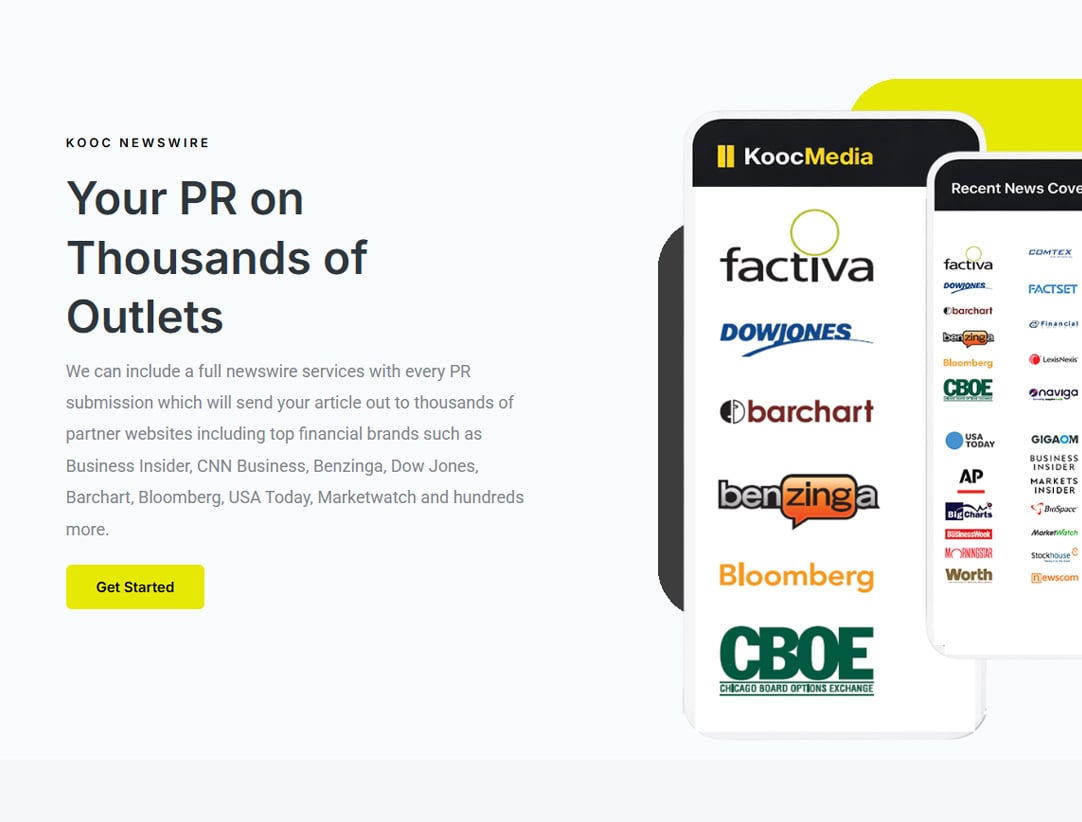
For founders, that kind of reach carries weight. Seeing a brand on names people already trust makes it easier to win over customers, partners, and investors.
A Free Spot on AgentLocker.ai
One of the standout parts of these packages is free placement on AgentLocker.ai, Kooc Media’s own directory of AI tools and agents.
AgentLocker.ai is a growing hub where people go to find new AI tools, agents, and software. It puts products in front of users who are already searching for fresh AI solutions.

Every client on an AI PR package gets listed and featured on AgentLocker.ai for free. It’s an extra route to visibility on top of the press coverage, and a place where the product keeps getting found long after the campaign wraps up.
Take a look at the directory at AgentLocker.ai.
Pairing press coverage with a dedicated AI directory listing means more value out of one package. Rather than paying separately for a listing and for PR, clients get both together.
PR Handled For You
Most AI and software startups run lean. They usually don’t have a marketing department or anyone focused on PR. Kooc Media covers that with managed PR creation run by its in-house editorial team.
Founders don’t have to write their own releases or articles. They share the details, and the Kooc Media team writes the content, publishes it, and pushes it out.
The work covers press release writing, sponsored articles, homepage placements, guaranteed publication on in-house sites, newswire distribution, and full reporting with live links to every placement.
That reporting matters. Clients get a clear breakdown of where their coverage ran, with direct links to each piece. Nobody has to wonder whether the job got done.
Set Packages or Custom Campaigns
Kooc Media offers both fixed packages and fully custom campaigns. The fixed options suit founders who want something quick and simple. The custom side is for brands that want a more tailored push across search, news, and social.
That range works for early teams launching a first product as well as bigger software companies running PR on an ongoing basis.
Backed by Years in Fast Industries
These packages are built for AI and software, but they’re part of Kooc Media’s wider work in fast-paced sectors. The agency has been active in crypto, fintech, tech, and iGaming since it launched in 2017.
Founders working across those overlapping areas can also check out Kooc Media’s crypto PR services and gambling PR services. Plenty of AI and software products touch these spaces, like trading tools, fintech apps, and gaming software, so that background adds real value.
Why This Helps AI Founders
AI is growing fast, but getting noticed is harder than ever. New tools appear daily, and most slip by unseen. Solid PR can be what separates a product that breaks through from one that stays buried.
By bringing together real coverage, same-day publishing, wide newswire reach, and a free AgentLocker.ai listing, Kooc Media gives AI and software founders a clear shot at visibility. The packages are quick, simple, and focused on results, which is what most founders are after.
For teams that want to launch fast and get noticed, these packages are a straightforward way to get a product in front of the right people.
Kooc Media’s AI packages are available now through the company’s website at https://kooc.co.uk.
Disclaimer: This is a Press Release provided by a third party who is responsible for the content. Please conduct your own research before taking any action based on the content.
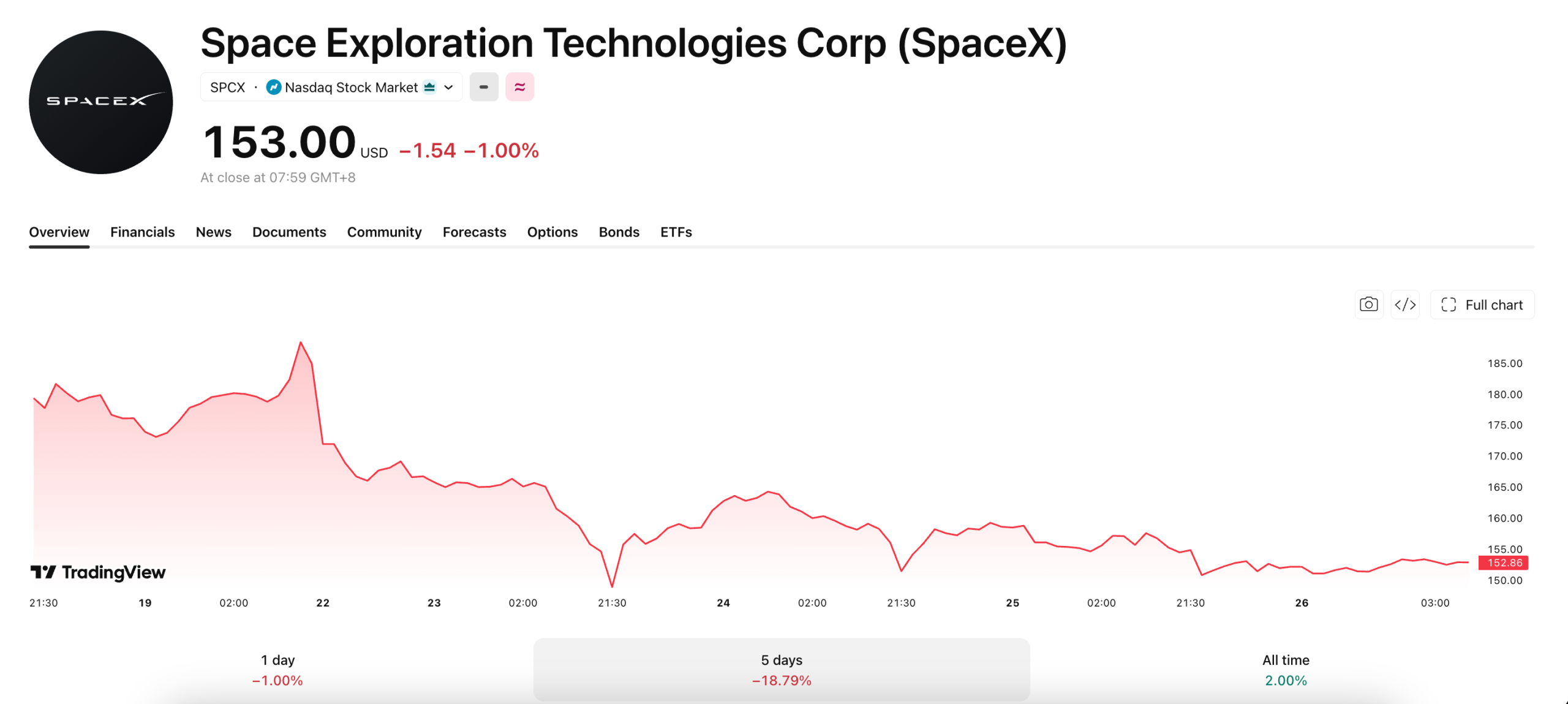
SpaceX went public on June 12. Fourteen days later, one of Europe’s largest asset managers is calling it a market top signal. Allianz Chief Investment Officer Ludovic Subran warned this week that SpaceX’s rapid return to capital markets has pushed a healthy rally into “bubble territory.”
The warning came days after SpaceX launched a $25 billion corporate bond sale, which rattled the price of shares in Elon Musk’s company. SPCX is down almost 19% over the last five days.
From Record IPO to Bubble Warning in 14 Days
Subran described SpaceX’s bond move as a prime example of markets shifting “from a healthy boom, a stretched boom . . . into bubble territory.” His core argument drew a sharp line between equity and debt investors.
“The guy just got $70 billion of funny money to play with to get us to space. Equity investors, you can take them to Mars. Bond investors are, like, ‘where is my coupon?’”
— Ludovic Subran, CIO, Allianz
The bond deal drew $89 billion in orders. Bankers upsized it from $20 billion to $25 billion to meet demand. SpaceX plans to use the proceeds to retire a $20 billion bridge loan it took on in March. Still, bond investors extracted a price premium.

The 2036 tranche priced at 1.4 percentage points above US Treasuries, roughly 0.4 points wider than similarly rated BBB peers, according to Bloomberg. Investment-grade US companies currently borrow at under 0.8 points above Treasuries, near a multi-decade low.
A Poster Child That Could Become a Catalyst
SPCX opened at $150 on June 12. It surged to an intraday high of $225.64 by June 16. Then it reversed. As of June 26, SPCX trades near $152 — a 32% drop from peak, erasing over $600 billion in market value in under two weeks.
That slide now reshapes the broader IPO pipeline. As BeInCrypto reported earlier this week, OpenAI leans toward pushing its own listing to 2027, citing choppy markets and weakening retail appetite after SpaceX’s turbulent debut.
Analysts had warned before the listing that SpaceX, OpenAI, and Anthropic together could flood public markets with roughly $3 trillion in new equity supply, more than the entire US IPO market raised from 2016 to 2025. Easy to imagine given the near $86 billion raised by SpaceX alone.
SpaceX’s bond sale adds another $25 billion to that total demand. Susquehanna started coverage of SPCX with a Neutral rating and a $170 price target. Morningstar set its best-case fair value at $169, flagging the stock as significantly overvalued at its peak.
SpaceX reports its first public earnings on August 6. That result will likely determine whether the post-IPO slide marks a correction or the start of something wider.
The post SpaceX Called a Market Top Signal Just 2 Weeks After Its $86 Billion IPO appeared first on BeInCrypto.
With just a couple of days left to the second most anticipated day throughout the year for Pioneers, the team behind the protocol published a new vibe coder campaign.
It will allow users to participate by joining relevant creator or developer communities, and they will have the chance to win Pi merchandise.
2 Days Left
March 14 and June 28 are arguably the most important days for the broader Pi Network ecosystem due to their resemblance to the mathematical constant π, from which the project derives its name. Each is highly anticipated by the community as they expect a major announcement, such as the token listing on Kraken, announced around March 14.
All eyes are now on June 28, known as Pi2Day. In the latest post on the matter, the Core Team outlined the new initiative:
“Pioneers can participate by joining relevant creator or developer communities and sharing why Pi may be useful for builders who already have prototypes or working apps built through AI platforms. Then submit your public post link in the Pi app for a chance to win Pi Network merchandise!”
Users can refer Pi vibe coders to the Pi App Studio, explain how externally created apps can connect with the ecosystem, and highlight the users, payments, ads platform, and “broader infrastructure available” through the project.
The team reaffirmed that the value proposition should be clear and as follows:
“In the Pi ecosystem, vibe coders building web apps with AI can make their app accessible to 60M+ engaged users, and run their app on built-in payments, identity, and ads infrastructure, by simply plugging their service or product into Pi Network.”
Pioneers can also introduce Pi to creator communities, describe how the Pi App Studio simplifies vibe creators’ integration with Pi, share stats on organic Pi app traction, and explain how devs and creators should explore the ecosystem.
No New ATL
Despite the excitement about the upcoming Pi2Day and the team’s continuous updates, the project’s native token headed south alongside the rest of the market in the past few days. PI was rejected at $0.14 last week, and the subsequent crash pushed it south to just over $0.12 yesterday.
However, it managed to remain above the all-time low marked on June 6 at $0.1189. Its rebound has been rather impressive, as it now trades at $0.13.
The unlocking schedule continues to be more favorable for the Pi bulls. The average number of tokens to be released daily remains below 4.3 million for the next month, which should, at least in theory, reduce the immediate selling pressure from investors who have been waiting for their coins for a while.

The post Major Pi Network Community Update for Pioneers Ahead of Pi2Day (June 28) appeared first on CryptoPotato.


Invesco has filed with the U.S. Securities and Exchange Commission to launch a tokenized money market fund that will invest in cash and short term U.S. Treasury securities for stablecoin reserve management.
Summary
- Invesco has filed to launch a tokenized money market fund designed for stablecoin reserve assets under the GENIUS Act.
- Superstate will provide blockchain based tokenization support and maintain the fund’s on chain shareholder registry.
- Invesco has joined BlackRock, State Street, ProShares and other asset managers competing to manage stablecoin reserves.
The U.S. Securities and Exchange Commission filing showed that Invesco plans to introduce the Invesco Stablecoin Reserves Onchain Fund, a portfolio that will invest in cash, cash equivalents, repurchase agreements, and short-term U.S. Treasury securities while maintaining a stable $1 net asset value. The proposed fund will operate within Invesco’s existing Short Term Investments Trust and will qualify as a Rule 2a-7 government money market fund.
The filing stated that the reserve portfolio is designed to satisfy asset eligibility requirements under the Guiding and Establishing National Innovation for U.S. Stablecoins (GENIUS) Act, which governs payment stablecoins in the United States. Stablecoin issuers must maintain one-to-one reserves in safe and liquid assets under the framework.
Superstate will act as the fund’s sub-transfer agent and maintain a blockchain-integrated shareholder registry that links conventional fund records with on-chain ownership tokens. The filing did not identify the public blockchain that will support the product, although it confirmed that tokenized shares will be issued on a designated public network.
The registration builds on an existing partnership between Invesco and Superstate. Earlier this year, Invesco assumed day to day portfolio management of Superstate’s tokenized U.S. Treasury fund, which managed roughly $900 million in assets. The product was renamed the Invesco Short Duration US Government Securities Fund while Superstate continued providing tokenization services through its FundOS platform.
Asset managers expand stablecoin reserve offerings
The filing adds Invesco to a growing group of traditional financial firms introducing products tailored for stablecoin reserve management after the GENIUS Act established a federal framework for reserve assets.
State Street launched the State Street Stablecoin Reserves Money Market Fund in June as a Rule 2a-7 government money market fund backed by State Street Bank and Trust Company and Anchorage Digital. The company said the product was created specifically to help stablecoin issuers satisfy reserve requirements under the GENIUS Act.
ProShares also entered the market earlier this year with its ProShares GENIUS Money Market ETF, trading under the ticker IQMM. The company said the ETF invests exclusively in short term U.S. Treasury securities and other government backed instruments to provide a compliant reserve management option for stablecoin issuers.
Among other players, BlackRock, Franklin Templeton, Fidelity, Morgan Stanley, BNY, JPMorgan, and Goldman Sachs have also introduced or filed products tied to tokenized money market funds or stablecoin reserve infrastructure as competition expands across the sector.
Citigroup has projected that the stablecoin market could grow from about $300 billion today to as much as $4 trillion by 2030. The bank said the expansion could create a significant market for firms that manage the cash and Treasury assets backing dollar denominated stablecoins.


The FBI is urging victims of the OneCoin cryptocurrency investment fraud to file compensation claims before the June 30 deadline.
Summary
- OneCoin victims must file by June 30 to seek compensation from DOJ’s official remission program.
- FBI says the claims process is free, but filing does not guarantee compensation for victims.
- Ruja Ignatova remains wanted, with authorities offering $5m for information leading to arrest.
The agency said the process applies to people whose OneCoin investments caused a net financial loss.
According to the FBI notice, victims can seek payment through a Department of Justice remission program. The program covers eligible individuals who bought OneCoin between 2014 and 2019 and suffered direct financial losses.
The FBI said the DOJ launched the official process through onecoinremission.com, which is managed by Kroll Settlement Administration. Victims can file petitions online, by mail or by email. The agency warned that filing a petition does not guarantee payment.
The process is free. The FBI said justice.gov and onecoinremission.com are the only authorized websites for the investigation. That warning is important because fraud victims are often targeted again by fake recovery agents.
Over $40m in seized assets available
The remission program will use more than $40m in forfeited assets recovered from figures tied to the OneCoin scheme. The funds are meant to provide partial relief to victims who lost money after accounting for any withdrawals they completed.
In the FBI notice, FBI New York Assistant Director in Charge James C. Barnacle Jr. said victims were misled by false statements and empty promises. He added that the FBI remains committed to “returning these stolen funds to their rightful owners.”
As previously reported, the DOJ opened a $40m compensation fund for OneCoin victims in April. The latest FBI notice gives victims a final reminder before the deadline closes.
The DOJ said in its official announcement that OneCoin was sold to investors through false claims about its value and use. U.S. Attorney Jay Clayton said the founders “sold a lie disguised as cryptocurrency.”
OneCoin’s fraud history
OneCoin began in Bulgaria in 2014. Prosecutors said Ruja Ignatova and Karl Sebastian Greenwood promoted it as a new virtual currency that could challenge Bitcoin. The project used the phrase “Bitcoin killer” to attract investors.
The FBI said OneCoin used a multi-level marketing structure. Buyers purchased packages that gave them tokens they were told could mine OneCoin. They were then encouraged to sell packages to friends, family and other investors.
The system created fast growth, but prosecutors said the product had no real value. The FBI said victims worldwide lost more than $4b. Greenwood was arrested in Thailand in 2018 and later extradited to the U.S.
Greenwood was sentenced to 20 years in prison in September 2023. He was also ordered to forfeit $300m. The case remains one of the largest crypto fraud cases ever pursued by U.S. authorities.
Search for Ignatova continues
Ignatova remains at large. The FBI said she led OneCoin until October 2017, when she was charged in the Southern District of New York. She was later added to the FBI’s Ten Most Wanted Fugitives list in June 2022.
The U.S. Department of State is offering up to $5m for information leading to Ignatova’s arrest or conviction. The FBI says anyone with information can submit a tip through its official tip line or online portal.
In a previous article, crypto.news discussed Ruja Ignatova’s place on the FBI’s most wanted list. Previously, crypto.news explored reports about where the OneCoin founder may be hiding, though her location remains unconfirmed.
The FBI also told people who believe they are victims of crypto investment fraud to report it through the Internet Crime Complaint Center. For OneCoin victims, the most urgent step is the June 30 remission deadline. After that date, late claims may not be considered.
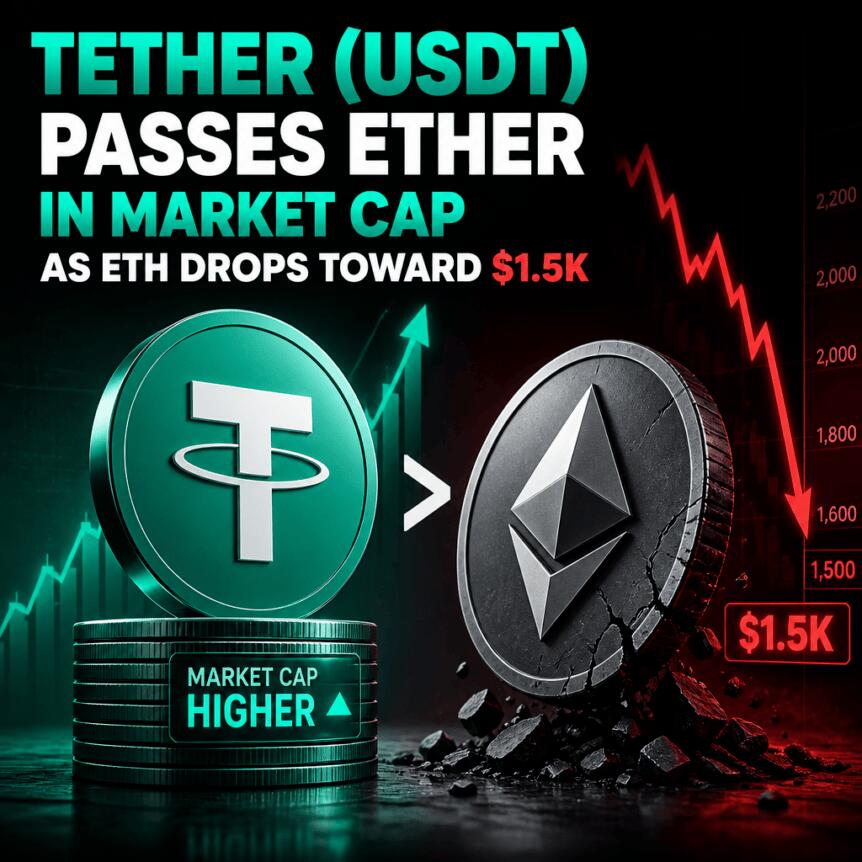
Ether slid to its lowest level of the year on Friday, and the move had an immediate knock-on effect across the market’s largest capitalizations. After a 5.2% drop over 24 hours, ETH’s market capitalization fell below $185 billion, with the token trading around $1,510 on Coinbase, according to TradingView.
That decline allowed Tether’s USDt to overtake ETH for the second-largest spot by market capitalization, with USDt at roughly $186 billion at the time of the flip. Analysts framed the outcome as a reminder that—at least in the current environment—many traders and users are choosing stability over volatility.
Key takeaways
- ETH’s selloff pushed its market capitalization below $185 billion, after a 5.2% 24-hour decline, according to TradingView.
- Tether’s USDt briefly rose to about $186 billion in market cap, overtaking Ether for the second-largest position.
- Market commentary linked the flip to ongoing stablecoin demand, which now represents almost 15% of total crypto market capitalization.
- Ethereum’s broader ecosystem has seen internal restructuring, but new R&D efforts via Ethlabs are also underway.
- Some Ethereum-aligned treasuries continued buying during the weakness, while Circle’s USDC also showed strength relative to XRP.
Why USDt overtook Ether as ETH hit a fresh low
The immediate trigger was Ether’s sharp downward move over a single day. TradingView data cited in the report shows ETH falling to around $1,510 on Coinbase, following the 5.2% crash. With ETH’s market cap dropping below $185 billion, USDt’s approximately $186 billion figure became large enough to move it into the #2 slot.
Bitrue Research Institute’s research lead, Andri Fauzan Adziima, told Cointelegraph that the overtake underscores how the market is currently “favor[ing] stability over ETH’s volatility.” The point wasn’t just about one day of price action—it was about what capital is rewarding in the moment.
Stablecoins keep growing even when the market turns
The USDt-versus-ETH flip aligns with a wider trend: stablecoins are steadily expanding their share of the crypto market. Cointelegraph notes accelerating stablecoin growth, citing that the category accounts for almost 15% of total crypto market capitalization.
In a Thursday post, 21Shares highlighted an important contrast with the last downturn: stablecoin supply contracted by more than 30% during the prior bear market, but is reaching record highs this time. The firm argued that the shift suggests stablecoins have become a defining use case rather than something that depends strictly on the market cycle.
“To us, that is the strongest evidence yet that stablecoins are one of crypto’s defining use cases – demand that no longer depends on the cycle.”
From a liquidity and trading perspective, deeper stablecoin balances can improve on-ramps and off-ramps and help sustain activity during volatility. Alvin Kan, chief operating officer of Bitget Wallet, also pointed to that angle, calling the flip a “notable milestone” reflecting stablecoins’ dominance.
“It demonstrates strong demand for reliable, liquid on- and off-ramps during periods of volatility, while serving as a reminder that ETH must continue delivering compelling utility and narrative momentum to maintain its position.”
Ethereum pressure, but active “buy-the-dip” behavior
While Ether’s price weakness drew attention, several Ethereum-related players reportedly leaned into the decline.
Crypto treasury company Sharplink made its first purchase in eight months, buying 5,000 ETH on Thursday after ETH’s drop. Bitmine, which is chaired by Tom Lee, also continued accumulating: it added 76,881 ETH last week, according to the coverage cited by Cointelegraph.
These actions don’t automatically reverse price trends, but they can be meaningful for sentiment and for how long-horizon holders behave when market conditions deteriorate. If treasuries continue converting into ETH at lower levels, it suggests confidence in the asset’s longer-term role even while short-term volatility punishes holders.
At the same time, the Ether slump has unfolded alongside changes to Ethereum’s institutional structure. Cointelegraph referenced executive departures and a 20% workforce reduction at the Ethereum Foundation. However, it also notes that a new nonprofit organization, Ethlabs, was launched this week by key EF developers and researchers and backed by Ether treasuries Bitmine and Sharplink, pointing to continued efforts focused on Ethereum research and development.
Broader capitalization moves: USDC vs. XRP
Ether wasn’t the only major asset showing relative strength or weakness during the market’s choppy session. The report also states that Circle’s USDC flipped Ripple’s XRP in market capitalization as XRP declined toward $1, its lowest level since November 2024.
At the time of the comparison mentioned in the coverage, XRP’s market capitalization was cited around $64 billion, compared with USDC’s roughly $73.6 billion. For investors tracking stablecoins, the takeaway is similar to what the USDt flip signals: stablecoin demand can be resilient even when other large coins experience extended drawdowns.
Looking ahead, the key question is whether ETH can reclaim critical support levels and sustain momentum, or whether stablecoins continue to widen their grip on market capitalization. Traders and investors will likely watch how stablecoin growth trends evolve alongside Ethereum’s institutional and R&D developments—especially if volatility persists.
Polymarket confirmed Friday that a compromised third-party vendor allowed attackers to inject malicious code into its frontend, draining about $3 million from fewer than 15 user accounts.
The platform says it will fully refund all affected users.
What Happened
The attack was first flagged by on-chain security researcher Specter, who posted that an apparent phishing campaign had drained funds from more than 11 victim wallets holding Polymarket’s PUSD stablecoin.
At the time, they estimated losses at $2.94 million, with PeckShield confirming the figure shortly after and noting that the attacker had bridged the stolen funds from Polygon to Ethereum and converted them into 1,893 ETH.
The prediction market acknowledged the breach through one of its official accounts, Polymarket Traders.
“This morning we discovered a 3rd party vendor had been compromised, injecting a malicious script into our frontend for some users. We’ve contained it and removed the affected dependency,” it wrote on X. “We’re contacting impacted users and refunding them in full.”
William LeGate, who works closely with the platform, echoed news about the compensation, repeating that the issue had been resolved and that affected users would get back their money in full.
Another blockchain security account, GoPlus Security, described the incident as a supply chain attack. It said that the malicious code affected about 15 accounts, with losses totaling $3 million, a conclusion that was also reached by Bubblemaps, which praised Polymarket’s response after the losses were contained.
A Recurring Problem
This is not the first time Polymarket has been hit. Last month, the platform disclosed another breach in which an admin wallet used for employee reward top-ups was drained of about $700,000, likely through a private key compromise. At first, crypto sleuth ZachXBT had estimated the losses to be around $520,000, with Bubblemaps later quoting the higher figure after tracking the funds across several addresses.
Developer Josh Stevens confirmed at the time that a 6-year-old private key had been exposed through an internal configuration and that the company had since rotated credentials and moved to key management services. However, that incident did not touch user funds or core contracts.
While the two incidents involved different attack methods, they both targeted systems outside Polymarket’s prediction markets themselves. Furthermore, the latest one has come at a time when the platform is already navigating other reputational headwinds, including a recent report by the Wall Street Journal, which claimed that it had paid college-age creators between $2,000 and $3,000 per month to post videos of staged bets on dummy versions of the Polymarket website, with not even one of the over 1,100 clips traceable to real blockchain activity.
There was also another controversy early this month when a trader claimed that they had lost $500,000 after the prediction service allegedly changed resolution rules for a market tied to Strategy’s Bitcoin sale.
The post Polymarket to Refund Users After Hackers Steal $3M in Frontend Attack appeared first on CryptoPotato.
SharpLink has resumed buying Ethereum (ETH) for the first time in 8 months, adding 5,000 ETH to its holdings.
The move breaks a long buying pause and lands while ETH trades far below the price the firm paid to build its treasury.
SharpLink Return to Buying as ETH Slides
According to Lookonchain, the 5,000 ETH, worth about $7.85 million, came from FalconX. SharpLink holdings have reached 876,285 ETH valued at roughly $1.4 billion. This also includes 22,102 ETH earned through staking rewards.
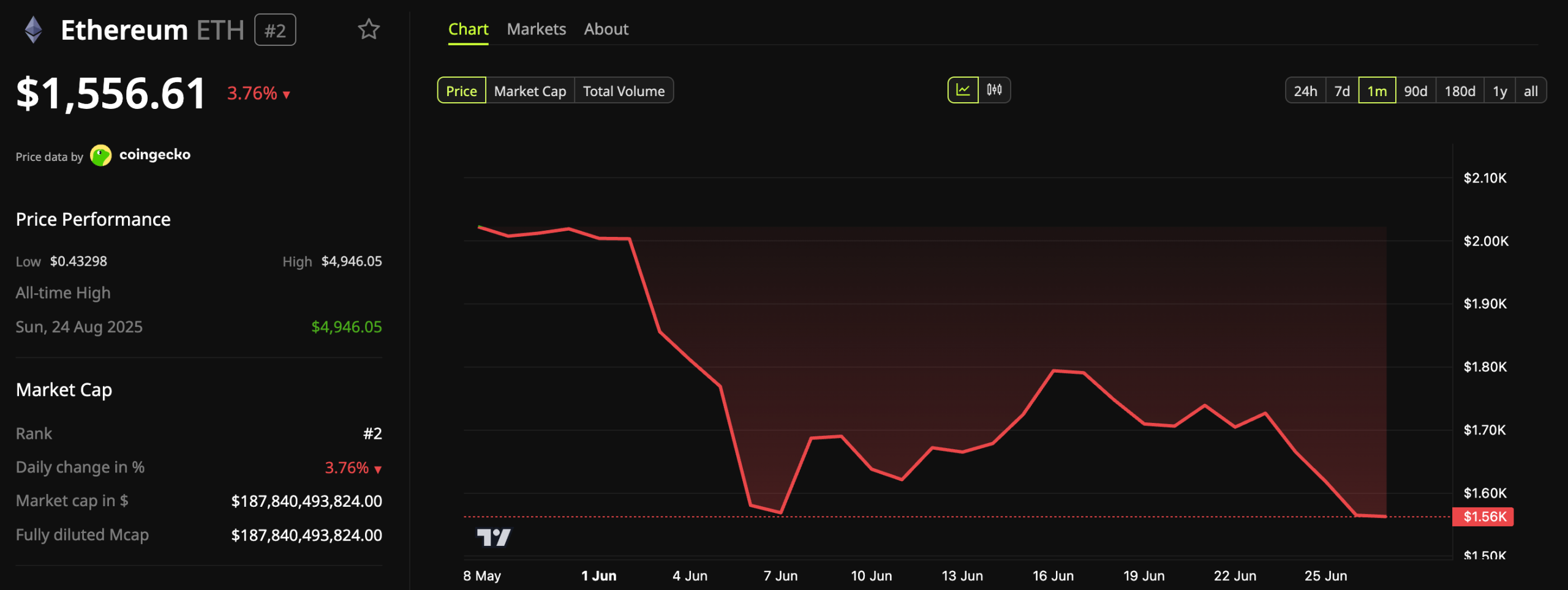
The acquisition adds to a position trading well below cost. SharpLink’s average purchase price is $3,609, while ETH traded near $1,556 today. That gap leaves the firm with an unrealized loss of more than $1.7 billion.
Follow us on X to get the latest news as it happens

That gap reflects a steep market decline. Ethereum has posted two consecutive red quarters and is on track to close the second quarter lower.
The asset has dropped nearly 25% over the past month, according to BeInCrypto Markets. The fall outpaced Bitcoin (BTC), which lost 22% across the same period.
Institutional appetite has cooled alongside the sell-off. According to SoSoValue data, spot Ethereum ETFs have recorded outflows for six consecutive weeks, with outflows extending into this week. The trend signals weak demand.

Mounting Losses and a Wider Ethereum Bet
The buying resumes after a punishing quarter. SharpLink reported a net loss of $685.6 million for the first quarter of 2026.
Most of that came from non-cash unrealized losses on its ETH holdings. Staking revenue, however, lifted total revenue to $12.1 million from $0.7 million a year earlier.
SharpLink has also widened its Ethereum commitment beyond its own balance sheet. The firm helped fund Ethlabs, a nonprofit research lab backing Ethereum’s institutional push.
Subscribe to our YouTube channel to watch leaders and journalists provide expert insights
The post SharpLink Resumes Ethereum Buying After 8-Month Pause appeared first on BeInCrypto.

Wimbledon 2026 draw LIVE: Serena Williams to discover first-round opponent for tennis comeback

Obsidian Energy: Moving To Take Advantage Of Higher Selling Prices
Rocket Lab (RKLB) Stock Falls 44% Despite Securing Three NASA Missions


-

 Fashion7 days ago
Weekend Open Thread: Miami – Corporette.com
-

 Entertainment5 days ago
Renter of Home in Anne Heche Crash Denies Settlement With Son
-
 Sports3 days ago
Two goals and an assist by sheer aura: Cristiano Ronaldo just entered the World Cup chat
-

 Tech4 days ago
Microsoft accidentally kills epic Outlook email threads
-

 Business5 days ago
Soccer-U.S. defends Iran World Cup travel restrictions, says discussions ongoing
-

 Politics6 days ago
Andy Burnham and the meaning of Makerfield
-

 NewsBeat7 days ago
Keir Starmer Allies Question His Chances For No 10
-

 Politics6 hours ago
Potential 2028er World Cup attendee leaderboard
-

 Tech13 hours ago
A Look At A Gaggle Of Transputer Boards
-
Crypto World2 days ago
Bitcoin (BTC) Dips Below $62K, Ethereum (ETH) Plunges 6% Daily: Market Watch
-

 Crypto World2 days ago
Securitize Wraps Roubini's SEC-Registered ETF as Dubai VARA Digital Security
-
Business2 days ago
Entergy settles forward sale agreements, raises $672 million in cash proceeds
-
 Business6 days ago
Wall Street Week Ahead: Investors see Micron earnings as pulse check of AI rally momentum
-
 Crypto World6 days ago
Can Charles Hoskinson Really Rescue Cardano?
-

 Crypto World6 days ago
HIVE shares jump as $220M AI deal speeds Bitcoin mining pivot
-

 Crypto World6 days ago
Jake Chervinsky accuses CME of protecting derivatives monopoly
-

 Entertainment6 days ago
Jose Alvarado Wants Taylor Swift at More Knicks Games
-
 Tech5 days ago
Signal’s Meredith Whittaker says AI chatbots ‘are not your friends’ and calls Copilot agents a backdoor
-

 Sports19 hours ago
India vs Bangladesh LIVE Score, Women’s T20 World Cup: Bangladesh Opt To Bat; India Enter ‘Do-Or-Die’ Stage As Semi-Final Race Heats Up
-

 Tech4 days ago
Nearly 7,000 fake Amazon domains registered ahead of Prime Day 2026, researchers warn
You must be logged in to post a comment Login