

Crypto World
JPMorgan sees shrinking window for U.S. crypto market structure overhaul

JPMorgan (JPM) said the proposed U.S. crypto market structure bill, known as the Clarity Act, may have only a limited window for passage this year as the congressional calendar tightens ahead of the midterm elections and debate over stablecoin yield remains unresolved.
“With the U.S. midterms approaching, the legislative window for passage of the Market Structure Bill has narrowed, which could postpone progress on
crypto market-structure reform this year,” wrote analysts led by Nikolaos Panigirtzoglou in the Wednesday report.
The bill cleared the Senate Banking Committee on May 14, but must still secure 60 votes in the full Senate, be reconciled with House legislation and receive the president’s signature. Those remaining steps, coupled with growing pushback from the banking industry, have lowered expectations that the measure will be enacted this year, the analysts said.
Timing could also prove significant. A compromise reached before the midterms could look materially different from one negotiated after the elections, when political incentives may shift.
The Clarity Act is widely viewed as the crypto industry’s most important legislative priority because it would establish the first comprehensive federal framework governing digital assets in the U.S.
Supporters say the bill would resolve long-running uncertainty over whether cryptocurrencies fall under the Securities and Exchange Commission (SEC) or Commodity Futures Trading Commission (CFTC), replacing years of regulation-by-enforcement with clearer rules for issuers, exchanges and investors.
Industry advocates argue that greater regulatory certainty could unlock institutional participation, encourage investment and innovation, and help keep crypto businesses and capital in the U.S. rather than overseas markets with more developed digital-asset regimes.
A central point of contention is the treatment of stablecoin yield. The bank’s analysts said the legislation is intended to prohibit “passive” yield, effectively interest paid on stablecoin balances, while allowing rewards tied to activity such as payments, transactions, loyalty programs and trading incentives. However, the bill’s current language is less explicit about banning interest on balances than policymakers have suggested.
The distinction is critical because it determines whether stablecoins can function as substitutes for bank deposits, according to the report. The carveout is designed to preserve stablecoins’ role in payments and settlement while preventing them from evolving into lightly regulated savings products.
Banks have pushed for tighter restrictions, arguing that stablecoin issuers do not face the same insurance, supervisory and prudential requirements as regulated depository institutions. Crypto firms, meanwhile, have sought greater flexibility to offer yield-bearing products. JPMorgan said the dispute has become a major obstacle to advancing the legislation and remains politically sensitive.
Should lawmakers ultimately impose effective limits on passive stablecoin yield, the bank expects the trend of idle crypto capital flowing into tokenized Treasuries, digital money-market funds and tokenized deposits to accelerate.
While that outcome may disappoint crypto-native firms that have advocated for yield-bearing stablecoins, the bill would still preserve some activity-based rewards. The report also emphasized that the current legislative text leaves room for interpretation because it does not explicitly prohibit interest on balances.
Read more: Clarity Act could spark a boom in crypto ‘yield-as-a-service’


TLDR:
- Coinbase has launched a pre-IPO perpetual futures product, with SpaceX as the first available listing.
- The product is settled in USDC, trades 24/7, and is currently restricted to non-U.S. users only.
- Forbes estimates SpaceX’s $135 IPO share price could make Elon Musk the world’s first trillionaire.
- Reuters reports the SpaceX IPO is targeted for June 12, with prediction markets placing 91% odds on Musk.
Coinbase has introduced a pre-IPO perpetual futures product, allowing traders outside the United States to speculate on private companies before their public debut. SpaceX, owned by Elon Musk, is the first company listed on the platform.
The product is settled in USDC, trades around the clock, and positions carry over automatically once the IPO is complete. More listings across technology, AI, energy, and space sectors are expected soon.
SpaceX Takes Center Stage on Coinbase’s New Platform
Coinbase’s pre-IPO perp product gives traders direct exposure to SpaceX’s valuation ahead of its anticipated public listing.
Positions are opened using USDC, ensuring a stable settlement currency throughout the trading period. The product operates 24/7, meaning traders can react to new developments at any time.
Once SpaceX completes its IPO, all open positions will automatically convert based on the debut share price. This means traders stand to gain or lose depending on how closely pre-IPO valuations align with the actual listing price. Pre-market prices are historically volatile, so risks remain considerable.
Taking to X to explain the product’s purpose, Coinbase co-founder and CEO Brian Armstrong wrote, “Pre-IPO perps are great to get exposure to private companies before they go public (outside the U.S. only for now) and to help with price discovery.”
His post frames the product as both a speculative tool and a mechanism for establishing fair market value before a company lists publicly.
Currently, the product is restricted to users outside the United States. Coinbase has not disclosed a timeline for a potential U.S. rollout, though the platform confirmed additional pre-IPO listings are coming across multiple industries.
SpaceX IPO Could Make Musk the World’s First Trillionaire
The timing of Coinbase’s launch coincides with major news surrounding the SpaceX IPO itself. Forbes reported that a listing price of $135 per share could push Elon Musk’s net worth past the trillion-dollar mark. That would make him the first person in history to reach that milestone.
Reuters reported the IPO is targeted for June 12, placing the event just days away. On prediction market Myriad, users currently assign a 91% probability to Musk becoming a trillionaire before July. That level of confidence reflects strong market sentiment around the listing.
Perpetual futures, or perps, allow traders to go long or short on an asset without holding it directly. Unlike standard futures, perps carry no expiration date, making them suitable for longer-term speculation. The format gained widespread popularity last year through decentralized exchange Hyperliquid.
Coinbase’s product merges perps with pre-market trading, a structure already familiar in the crypto space. Pre-market token trading has been a common feature on exchanges, though price accuracy remains a known challenge given the speculative nature of early-stage listings.


Bitget, the world’s largest Universal Exchange (UEX), has added 15 tokenized stocks and ETFs as eligible margin assets within its Unified Trading Account and Multi-Asset Mode for USDT-M Futures. Effective June 4 (UTC+8), users can utilize select tokenized equities and ETFs as collateral while trading futures, expanding capital efficiency across multiple asset classes within a single account structure.
The newly supported assets include rAAPL, rAMZN, rMETA, rMU, rTSLA, rGOOGL, rNVDA, rINTC, rMSFT, rASML, rAVGO, rTSM, rQQQ, rSPY, and rSNDK. The update expands the utility of tokenized assets on Bitget by allowing users to deploy them beyond spot market exposure and integrate them into futures trading strategies.
“As tokenized assets continue to gain traction across global markets, users are looking for more ways to utilize their holdings across different trading activities,” said Gracy Chen, CEO at Bitget. “Adding tokenized stocks and ETFs as margin assets increases flexibility within the Unified Trading Account and supports a more seamless experience across crypto and traditional market products.”
Bitget’s Unified Trading Account allows users to manage spot assets, futures positions, and margin requirements through a consolidated framework. Under the Multi-Asset Mode for USDT-M Futures, eligible assets can contribute to margin requirements, helping users optimize capital allocation while maintaining exposure across different markets. The addition of tokenized stocks and ETFs further broadens the range of assets available within this system.
The launch reflects growing demand for trading infrastructure that connects digital assets with traditional financial markets. As tokenized equities gain adoption, traders increasingly look to move capital efficiently across products without transferring funds between separate accounts or converting holdings into a single settlement asset. Expanding margin eligibility supports this trend by increasing the practical utility of tokenized assets within a broader trading environment.
The announcement follows Bitget’s continued expansion of its Universal Exchange ecosystem, which brings together crypto assets, tokenized financial instruments, and derivatives trading under a single account. The platform currently offers access to more than 100 tokenized stocks, ETFs, commodities, foreign exchange products, and precious metals, giving users broader access to global financial markets through a unified trading experience.
For more information, visit: https://www.bitget.com/support/articles/12560603884658
About Bitget
Bitget is the world’s largest Universal Exchange (UEX), serving over 125 million users and offering access to over 2M crypto tokens, 100+ tokenized stocks, ETFs, commodities, FX, and precious metals such as gold. The ecosystem is committed to helping users trade smarter with its AI agent, which co-pilots trade execution. Bitget is driving crypto adoption through strategic partnerships with LALIGA and MotoGP™. Aligned with its global impact strategy, Bitget has joined hands with UNICEF to support blockchain education for 1.1 million people by 2027. Bitget currently leads in the tokenized TradFi market, providing the industry’s lowest fees and highest liquidity across 150 regions worldwide.
For more information, visit: Website | Twitter | Telegram | LinkedIn | Discord
For media inquiries, please contact: media@bitget.com
Risk Warning: Digital asset prices are subject to fluctuation and may experience significant volatility. Investors are advised to only allocate funds they can afford to lose. The value of any investment may be impacted, and there is a possibility that financial objectives may not be met, nor the principal investment recovered. Independent financial advice should always be sought, and personal financial experience and standing carefully considered. Past performance is not a reliable indicator of future results. Bitget accepts no liability for any potential losses incurred. Nothing contained herein should be construed as financial advice. For further information, please refer to our Terms of Use.
The post Bitget Expands Unified Trading Account with Tokenized Stocks as Margin Assets appeared first on BeInCrypto.
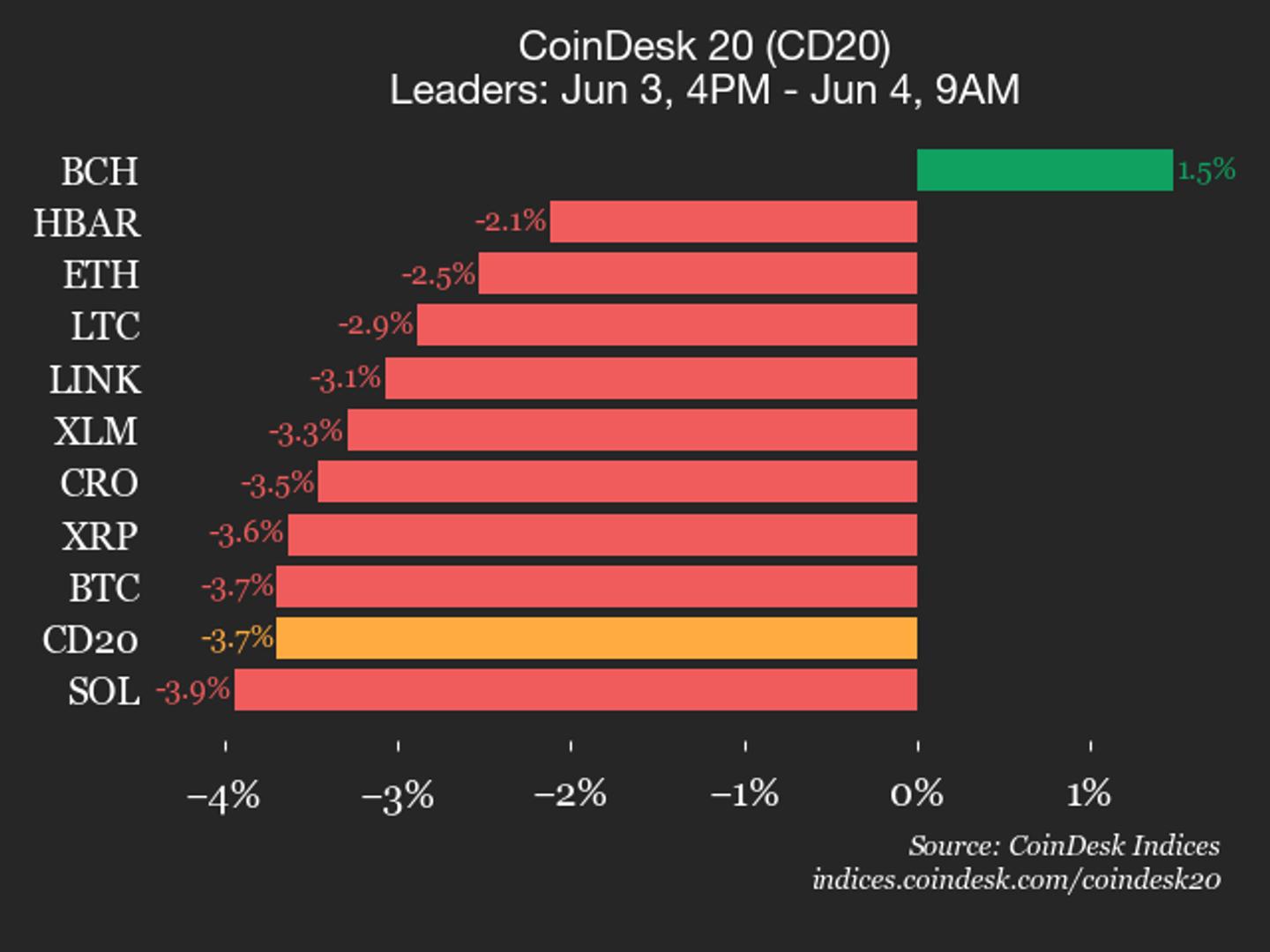
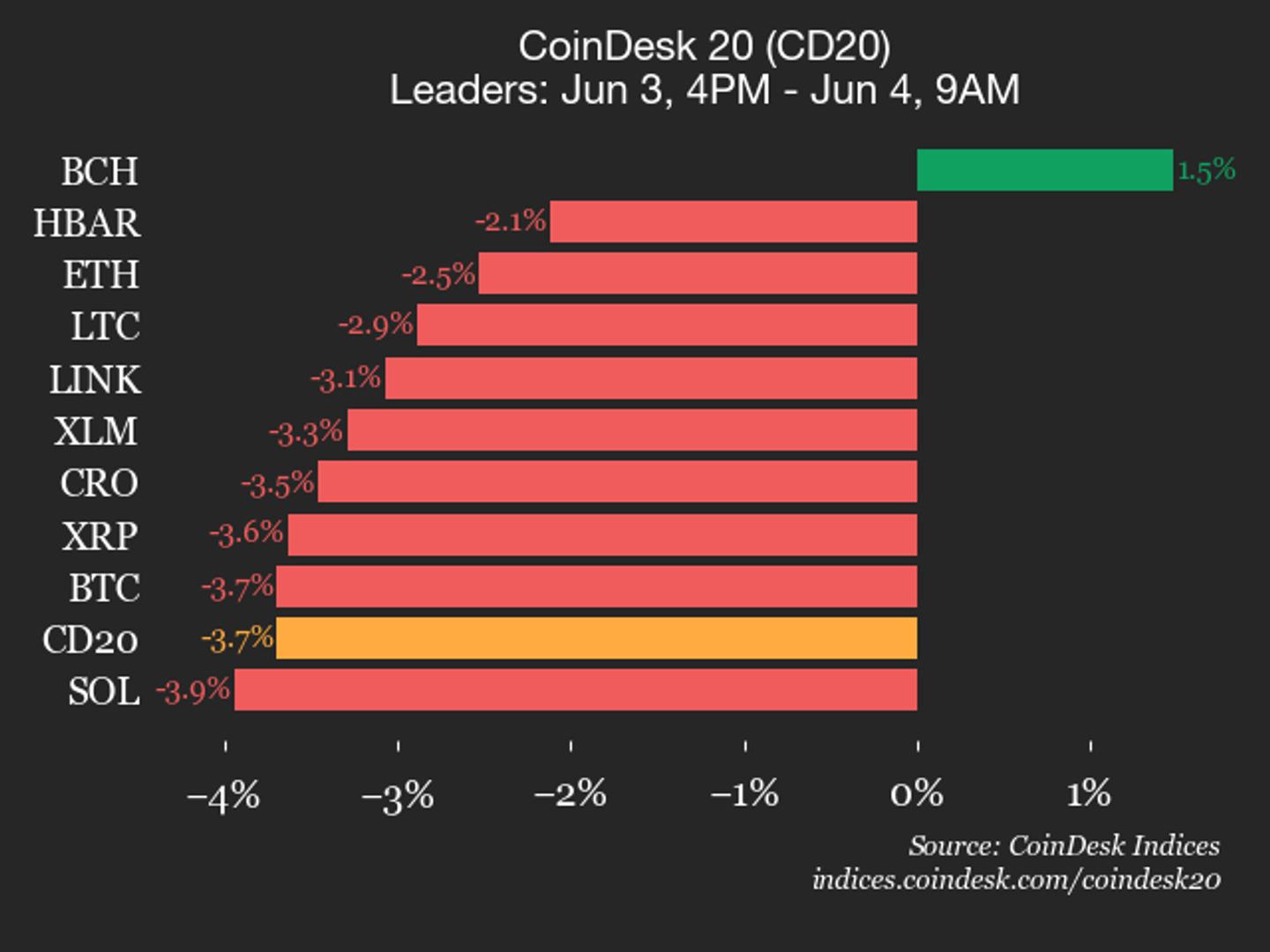
NEAR Protocol (NEAR) declined 15.2% and Internet Computer (ICP) dropped 13.1%, leading the index lower.


Bitcoin has tanked over 14% in one week and 22.7% in four weeks. Strategy Chairman Michael Saylor has a simple explanation for the decline: It’s capital rotation, not impairment.
In a post on X, Saylor pointed to the historic pace of AI infrastructure funding to the tune of approximately $400 billion deployed over the past six months while noting the $4 billion in outflows from the U.S.-listed spot ETFs since mid-May.
In essence, he argued that institutions are pulling money out of bitcoin and deploying into AI, leading to weakness in the top cryptocurrency. This matters because rotation implies temporary weakness, driven by capital chasing a hot theme before it eventually finds its way back.
“Volatility creates opportunity,” Saylor said, a characteristically bullish framing from the most prominent corporate bitcoin holder on the planet.
Saylor’s Strategy recently sold 32 BTC, a move, analysts say, added to the bearish sentiment in the market, deepening the price selloff. The publicly listed firm still holds 843,706 BTC.
While some analysts have flagged the AI boom as a headwind for bitcoin, most bears have drawn a darker conclusion from the recent selloff: that crypto is simply broken.
“Bitcoin just looks broken at this point Even Saylor is selling now,” pseudonymous trader QE Infinity said on X.
Their case probably rests on a confluence of concerning signals: Saylor’s surprise sale of 32 BTC, weeks of heavy ETF outflows, and the striking fact that almost every major asset class, from equities to commodities, is trading at or near record highs while bitcoin languishes.
Large Deleveraging and ETF Outflows Shake Crypto Markets
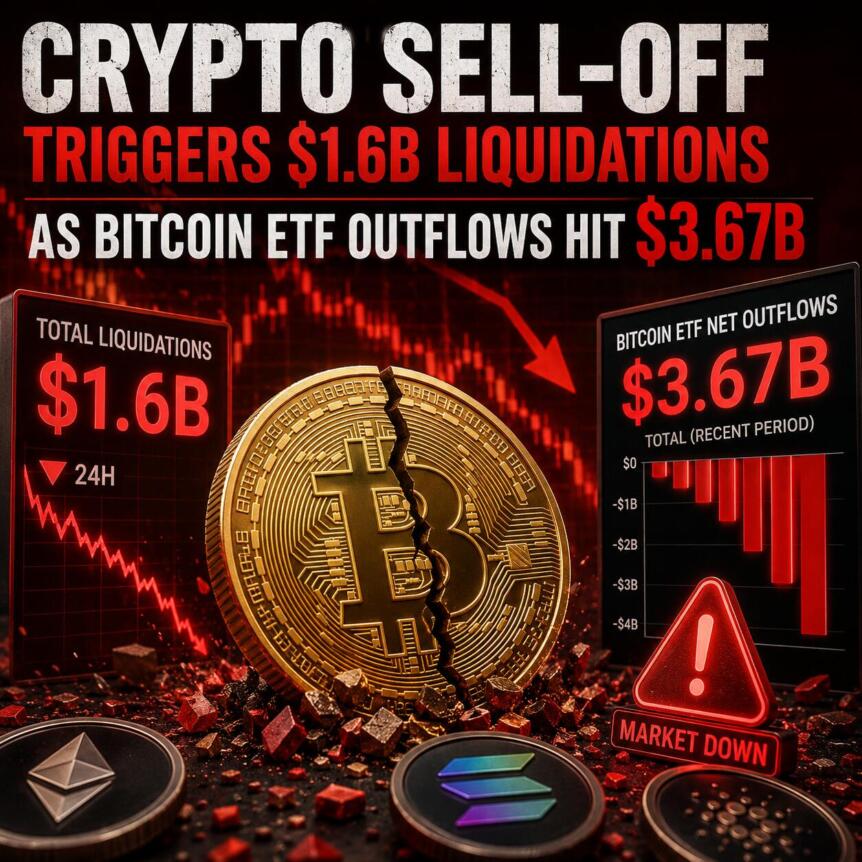
Cryptocurrency markets experienced a sudden bout of selling that produced about $1.6 billion in liquidations within 24 hours, marking the largest deleveraging event since February, according to market analysis from trading platform eToro. Over the same period, spot bitcoin exchange-traded funds recorded roughly $3.67 billion in outflows across the prior two weeks, a sign of diminishing spot demand as some investors reallocate capital to equities and artificial intelligence-related investments.
What the Numbers Show
The headline liquidation figure highlights pressure among leveraged participants and recent entrants to the market. eToro market analyst Javier Molina notes that while the short-term numbers are sharp, the composition of selling matters for understanding the likely trajectory of prices. “The $1.6 billion in liquidations recorded over the past 24 hours marks the largest deleveraging event in the crypto market since February. However, the more important signal lies beneath the headline,” Molina said.
ETF flows add another dimension. The approximately $3.67 billion in outflows from spot bitcoin ETFs over two weeks points to weaker spot demand, but proximate drivers are not obvious from gross flows alone. eToro highlights that ETF withdrawals are not necessarily equivalent to institutional capitulation: a substantial portion of ETF ownership can reside with retail investors and may reflect short-term portfolio rotation rather than wholesale abandonment by long-term holders.
Why the Sell-Off May Be Concentrated
According to eToro, the recent correction appears to have been led predominantly by retail traders, newer market participants and those using leverage, rather than by entrenched, long-term holders. That distinction is important from a market-structure perspective: when selling is concentrated among leveraged positions, it can create acute but transient downward pressure. If long-term holders begin to sell, that can signal a deeper shift in market sentiment and liquidity.
Molina cautioned that ETF outflows should not be interpreted automatically as institutional liquidations. “ETF outflows should not automatically be interpreted as institutional selling, as a significant portion of ETF exposure is ultimately held by retail investors,” he said.
Realised Price and Market Resilience
One measure eToro points to is bitcoin’s realised price, an estimate of the market’s aggregate cost basis. Bitcoin trading above its realised price suggests that, in aggregate, holders remain in profit and that the market may be undergoing a repositioning rather than broad-based capitulation. That distinction is consistent with a corrective reset in positioning and sentiment following an extended run of optimism in crypto markets.
“Despite the recent correction, bitcoin continues to trade above its realised price, the market’s aggregate cost basis, suggesting this remains a reset in positioning and sentiment rather than the kind of broad capitulation typically associated with deeper bear markets,” Molina said. The crucial question for traders and institutional observers alike is whether selling remains limited to recent buyers and highly leveraged accounts or whether it broadens to include longer-term holders.
Broader Context: Rotation to Equities and AI
The wave of ETF outflows comes amid an observable rotation by some investors into equities, and specifically into AI-related investments, according to eToro’s commentary. That dynamic reflects cross-asset decisions rather than factors unique to bitcoin or crypto; when macro or sector-specific narratives gain traction, capital can flow out of risk assets perceived as more speculative into areas that investors currently view as offering better near-term prospects.
This cross-asset flow can amplify short-term volatility in crypto markets, particularly when combined with concentrated leverage. For participants seeking to interpret price action, distinguishing rotational flows from structural selling is essential for assessing downside risk and potential entry points.
Implications for Traders and Institutions
For traders, the immediate implication is heightened caution around leveraged positions and an increased focus on liquidity metrics. Rapid deleveraging episodes can cascade and push prices through technical levels quickly, creating additional liquidations and volatility.
For institutional participants and allocators, the episode underlines the importance of parsing ETF flows and on-chain metrics rather than relying on headline outflow figures alone. Understanding who is selling — retail ETF holders, algorithmic funds, or long-term institutional allocators — is critical to assessing whether outflows presage sustained demand erosion or a temporary reallocation of risk budgets.
What to Watch Next
Market participants will be monitoring several indicators to judge whether the recent correction is transitory: the persistence of ETF outflows, on-chain measures of long-term holder behavior, the pace of open interest reductions on derivatives platforms, and whether realised price dynamics shift materially lower. If selling remains concentrated among short-term and leveraged participants, the market could stabilise as those positions wash out. If long-term holders begin to reduce exposure, it could herald a more significant change in market structure and sentiment.
For now, eToro’s read is that the episode looks like a repositioning driven by shorter-term sellers amid a broader rotation into equities and AI, rather than an across-the-board institutional retreat. Traders and allocators should continue to treat risk management as paramount while assessing the evolving mix of flows and holder behaviour.
Disclosure: This article summarises market commentary from eToro. It is not investment advice. Crypto markets are volatile and carry a risk of capital loss.
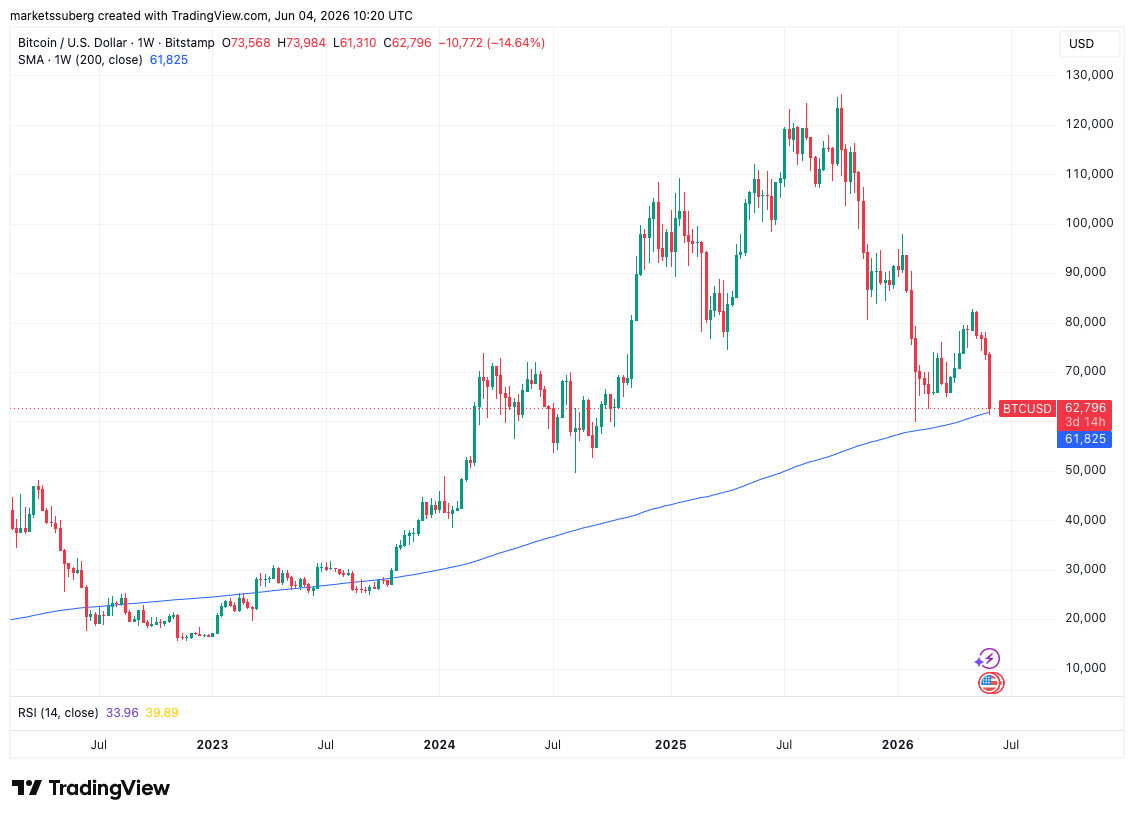
Bitcoin (BTC) has tagged a key bear-market trend line with its drop to four-month lows, with a “decent chance” of a rebound next.
Key points:
- Bitcoin revisits its 200-week simple moving average after trading above it since October 2023.
- The trend line functioned as resistance throughout the 2022 bear-market bottom and rebound.
- Bitcoin’s daily RSI approaches its most oversold since 2020.
Bitcoin bear-market trend line returns after nearly three years
Data from TradingView shows that for the first time since 2023, BTC/USD is back at its 200-week simple moving average (SMA).
The 200-week SMA is a key yardstick during Bitcoin bear markets. The trend line, which has only ever increased with time, currently sits at $61,626.
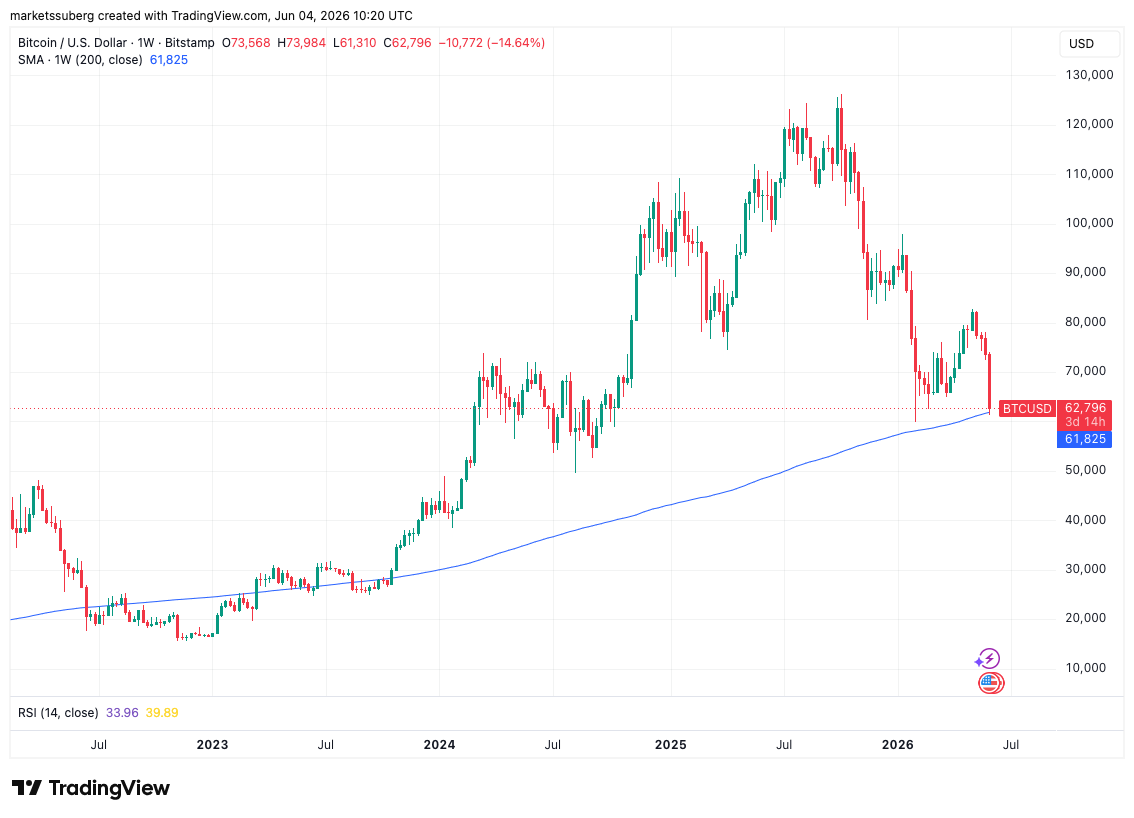
BTC/USD one-week chart with 200SMA. Source: Cointelegraph/TradingView
The last time price interacted with it was in October 2023, but during the 2022 bear market, it functioned as resistance until bulls fully regained control.
Commenting, CollinTalksCrypto, creator of the social media channel of the same name, described the return of the 200-week SMA as a “key milestone.”
“Does it bounce here or keep dropping?” he queried in a post on X.
“My guess is BTC has a decent chance of bouncing soon as it’s been dropping pretty steeply. But honestly it’s anyone’s guess in the short term.”
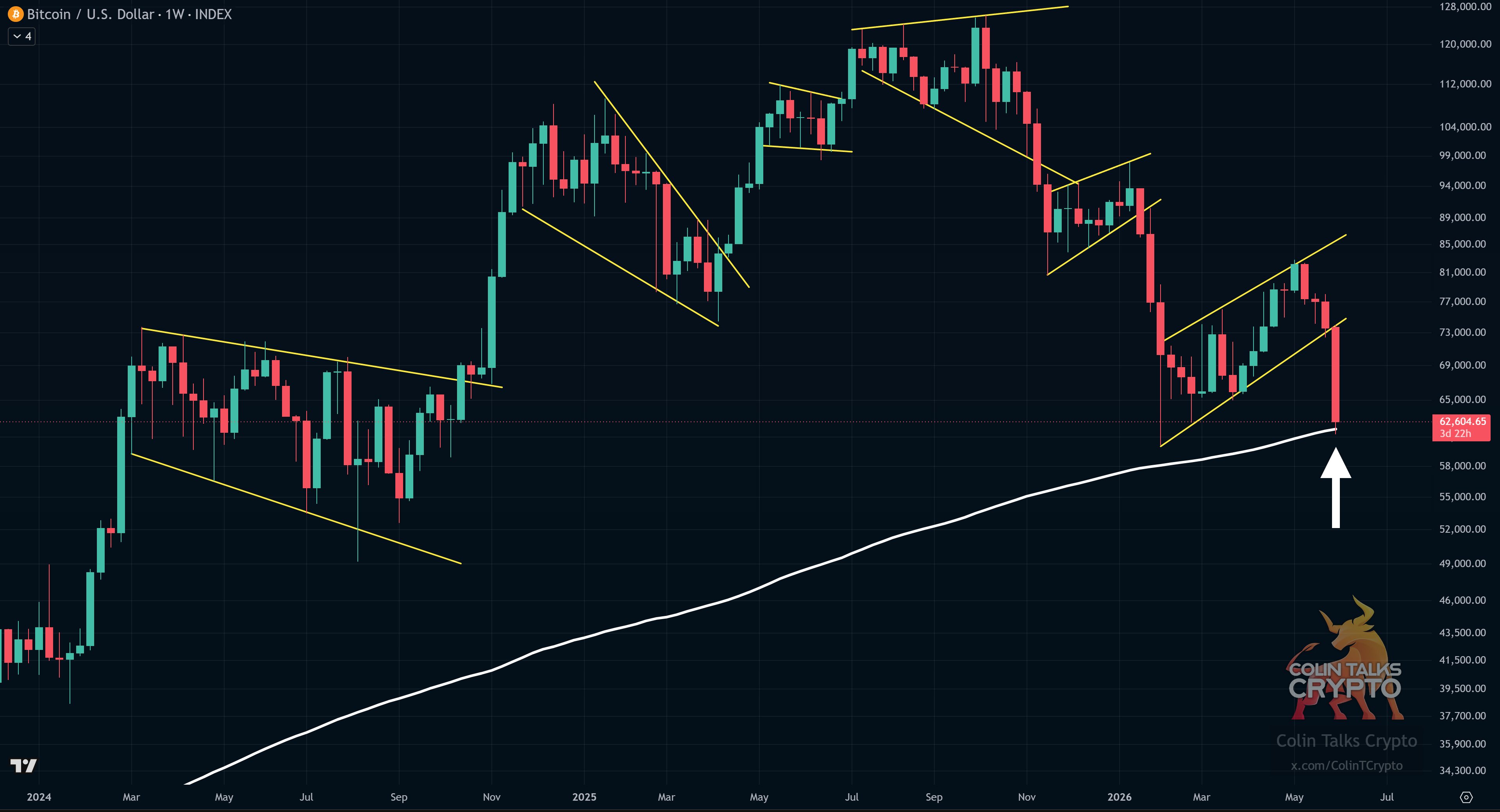
BTC/USD one-week chart with 200SMA. Source: ColinTalksCrypto/X
ColinTalksCrypto included a chart showing various bull and bear flags over the past several years. As Cointelegraph reported, BTC/USD has now copied its bear-flag breakdown from the start of 2026.
He added that the “best bear market entries happen *below* the 200-week MA.”
BTC price sparks more record “oversold” talk
Some optimistic market takes focused on the “oversold” nature of Bitcoin at its latest local lows.
Related: Bitcoin copying 2022 ‘almost perfectly’ as trader sees key support failing
On daily time frames, the relative strength index (RSI) dropped to 17.35, marking its lowest levels since 2020 along with the February drop.
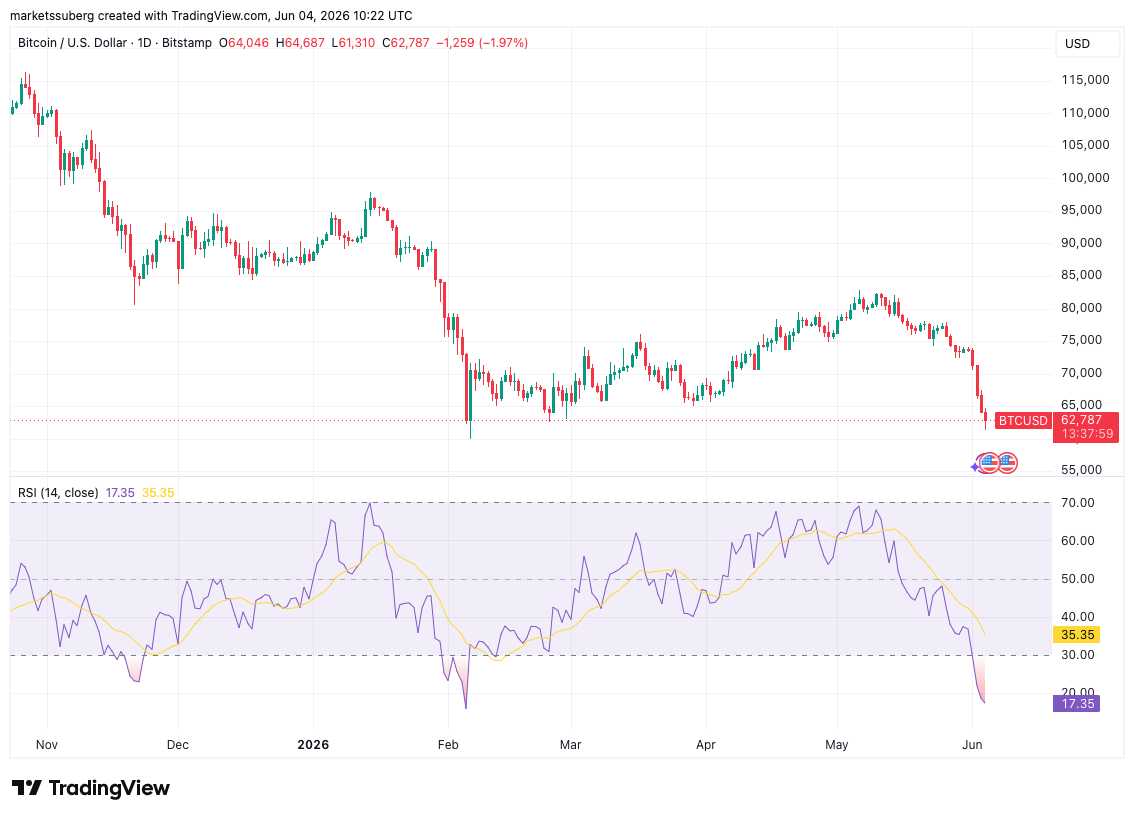
BTC/USD one-day chart with RSI data. Source: Cointelegraph/TradingView
Responding, the X analytics account named after famous economist Frank A. Fetter stressed that BTC/USD was “pretty much the most oversold ever.”
“It’s the area to accumulate your positions, if you have a strong thesis on Bitcoin from here,” crypto trader and analyst Michaël van de Poppe added on the back of both RSI data and the revisit of the 200-week SMA.
Van de Poppe put ongoing questions over Strategy’s corporate debt at the center of short-term price trajectory.
“Aside from that perspective, it’s all about STRC and the depeg; if that flips back upwards, it’s very likely time for Bitcoin to bounce back too,” he added.
“If there’s a constant, continuous downward trend here, we’ll most likely see sub-$60,000 in the markets.”
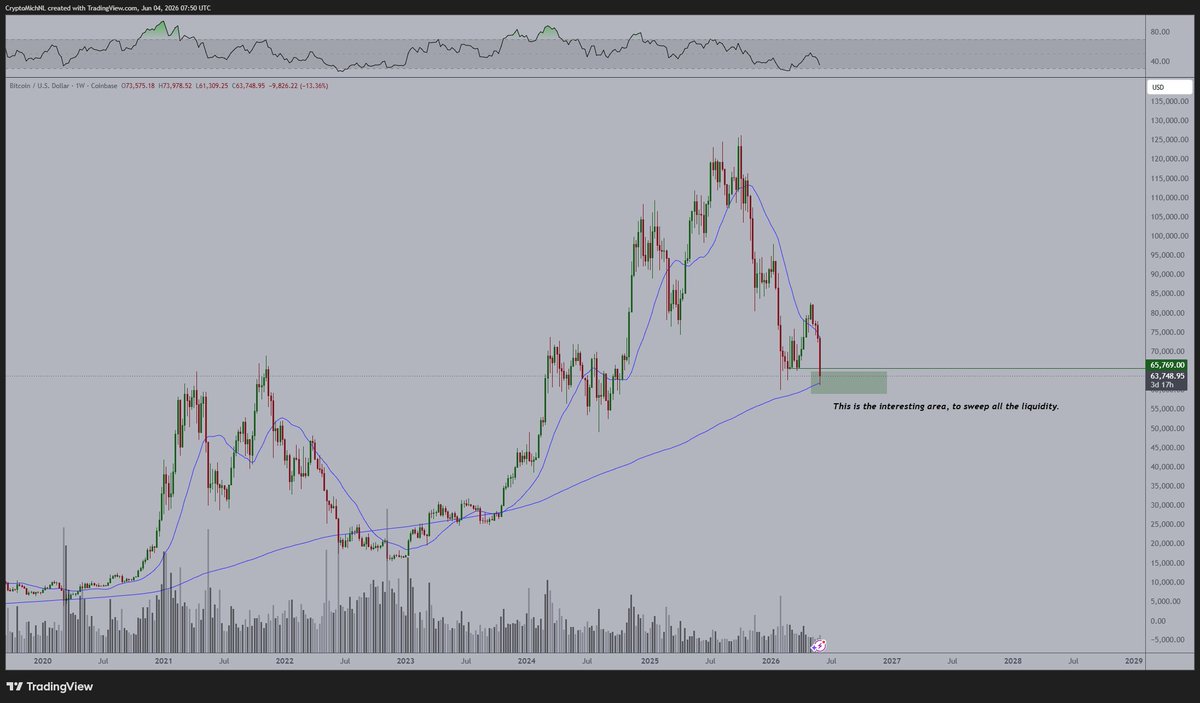
BTC/USD one-week chart. Source: Michaël van de Poppe/X
SimpleSwap is a self-custodial multi-source swap aggregator that pulls liquidity from well-known CEX and DEX sources under the hood. It is designed for direct wallet-to-wallet exchanges. Rather than holding your assets on a platform balance, the service lets you choose a crypto pair, enter a receiving wallet address, send the deposit, and receive the output asset directly in your wallet.
No manual comparison of exchanges, bridges, or swap routes needed. Routing happens under the hood across 20+ liquidity providers — you get the best available path without having to build it yourself.
SimpleSwap is most useful for straightforward crypto-to-crypto swaps, especially when you want to avoid holding funds on a centralized exchange. Of course, you can also use it to access assets that are not available or convenient to trade through your usual CEX or wallet swap tool.
Summarized briefly, some of the main points are:
- SimpleSwap supports wallet-to-wallet crypto swaps.
- Users do not need to keep a platform balance to make an exchange.
- The service aggregates liquidity from 20+ providers across CEX and DEX sources.
- Both fixed-rate and floating-rate swaps are available.
- The platform is very easy to use, rather than an order-book exchange.
Overall, the platform is well-suited to users who want a direct exchange flow, a large selection of assets, and fewer account-related steps. On the other hand, if you are looking for advanced trading tools, charting capabilities, limit orders (or more complicated order types), you might be better off with a full exchange environment.
SimpleSwap has been on the market for 8+ years, with 10M+ users. It supports 2,800+ swappable assets and aggregates liquidity from 20+ providers across CEX and DEX sources. The service is also used as a business solution by 6,000+ projects, including Exodus and Tangem.

What SimpleSwap Is
SimpleSwap is a self-custodial swap aggregator, not a custodial exchange. There is no long-term account balance to fund. Each transaction is a standalone swap: you send one asset from your wallet, and the converted asset is delivered to the receiving address you specify. No platform balance between swaps.
As you may have noticed, this is a structure that differs considerably from a centralized exchange. On a CEX, you have to deposit funds, trade within the platform interface, and withdraw later. With SimpleSwap, the exchange process is built around a single transaction flow rather than an internal trading account.
It supports a very wide range of cryptocurrency assets and uses multiple liquidity providers. SimpleSwap’s job is to find and execute a swap route in the background with the best rates.
The exchange supports two main rate types:
- Floating rate: the final amount received may vary based on market conditions and execution timing.
- Fixed rate: the rate is locked for a limited time, provided the user sends the correct amount within the required window and follows the transaction instructions.
Naturally, there are features beyond basic exchange flow. These include customer support, account-based loyalty benefits, business tools, integrations, exchange tracking, and more.
Is SimpleSwap Safe? How it Works
Yes, SimpleSwap is safe and legit – there have been no reports indicating otherwise, and the exchange has been on the market for more than 8 years, servicing over 10 million people with 99.9% uptime. The exchange flow is equally straightforward. Here is how it works:
- Select the asset to send and the asset to receive.
- Choose the amount.
- Select a floating or fixed rate, where available.
- Enter the receiving wallet address.
- Confirm the exchange details.
- Send the deposit to the address provided by SimpleSwap.
- Track the exchange status until the output transaction is completed.
That’s it. The structure makes the platform very easy to use for standard crypto-to-crypto exchanges. There is no order book to manage, and there is no need to set market or limit orders. Of course, if these are features that you are looking for, it might be a good idea to explore a conventional CEX.
The most important step is to enter the receiving address correctly. Because SimpleSwap sends the exchanged asset to the address you provide in this step, entering an incorrect one can result in a loss of funds. The same applies to network selection.
The flow, as simple as it may be, still hides some risks, so just as with anything else involving sending and receiving cryptocurrency, you have to be very careful.
Supported Coins, Pairs, and Liquidity
One of the main practical uses of SimpleSwap is in its asset coverage and liquidity aggregation. As mentioned in the introduction, the service supports 2,800+ swappable assets and aggregates liquidity from 20+ providers across CEX and DEX sources, unlocking 3.2M+ trading pairs through a single interface.
Some of the supported coins include, but are not limited to:
- Bitcoin
- Ethereum
- Ripple
- Solana
- Monero
- Dogecoin
- Stablecoins, and more.
Rather than sourcing liquidity only from a single internal market, the platform does it through multiple providers, which allows the service to search for available rates and execute swaps at the best prices.
Of course, as it is with centralized exchanges, liquidity can vary by asset and market conditions. A swap between two major assets, such as BTC and USDT, or ETH and BTC, is usually more straightforward and executed at very convenient rates. However, if you are swapping a niche cryptocurrency for another niche cryptocurrency, this might mean a wider difference between the quoted and the final amount, longer time to process, and so forth – more or less like what happens on a thin order book.
For most floating swaps, estimation accuracy reaches 99.998%, which signals strong execution consistency.
Fees, Rates, and Swap Types
SimpleSwap doesn’t position itself as an order book exchange. Therefore, it doesn’t have fixed maker and taker fees for trading. Instead, the cost of using the service is reflected in the quoted exchange amount, along with the network fees involved in sending and receiving crypto.
I will break down the factors before you commit to a swap. These include:
- The quoted amount of the asset being received.
- The rate type: fixed or floating.
- The network fee for sending the deposit.
- Any blockchain fee is included in the outgoing transaction.
- The minimum and the maximum amount for the selected pair.
- The time limit for sending the deposit is especially important for fixed-rate swaps.
As you already know, SimpleSwap offers two main swap types: fixed-rate and floating-rate.
With a floating-rate swap, the final amount can change during processing. This is because the market rate may move significantly between when the quote is shown and when the swap is executed. Floating rates may be suitable for those of you who accept that the final amount can vary. Of course, they are much less predictable during periods of serious volatility.
With a fixed-rate swap, the rate is locked for a limited time. This gives you greater certainty about the expected amount, but only if you follow the conditions of the exchange. The deposit must match the required amount and arrive within the specified window.
Now, it’s very important to note that neither option is automatically better in every single case. A floating rate may result in a higher or lower final amount depending on market movements. A fixed rate, on the other hand, gives you more certainty but may include a different quoted amount (smaller) because the provider takes on price movement risk for the period of the swap.
Custody, Privacy, and KYC
With SimpleSwap, users don’t have to maintain an ongoing balance. At no point does the exchange take custody of your funds. This reduces the need to leave assets on an exchange after the transaction is complete, and gives you full control of your crypto.
The model reduces risks tied to centralized exchange balances. Because there’s no platform-side balance, your funds never sit on SimpleSwap between swaps.
Most standard crypto-to-crypto swaps can be completed without creating an account.
From a privacy perspective, SimpleSwap collects a lot less account-level information compared to a centralized exchange during a normal swap. Of course, you still need to keep in mind that these are on-chain transactions and that you must provide a wallet address as part of the transaction.
The main takeaway here is that SimpleSwap offers a lighter account setup than traditional CEX exchanges, but it remains within the compliance environment that applies to crypto services.
Pros and Cons of SimpleSwap
Here is the honest breakdown of where the SimpleSwap crypto exchange stands out and where it falls short.
In my usage of the platform, I isolated the following benefits:
- No standard account setup is needed for basic swaps.
- Funds are not held in a long-term exchange balance.
- The platform supports virtually all assets that I wanted to swap.
- The exchange process is quick and simple.
- Fixed and floating rates offer some flexibility.
- Each exchange has a tracking and an exchange ID.
- It can be very useful for pairs that are otherwise unavailable at standard CEXs.
- Loyalty program (up to 20% discount, up to 0.4% USDT cashback)
- Integration with more than 6,000 partners (Exodus, Tangem, etc)
The drawbacks that I can think of include:
- The final rate may not always be better than competing services.
- Floating-rate swaps can result in a different received amount.
- You don’t get full control over routing or execution venue.
- There is a risk associated with inputting receiving addresses.
Who SimpleSwap is Best For
SimpleSwap is best for those of you who want to exchange crypto directly between wallets without using a full trading account. It suits people who value a simple swap flow, the option to choose between fixed and floating rates, and broad crypto support. It can also work well for users who need access to assets or pairs that are not that convenient on traditional CEX platforms.
Who SimpleSwap is Not Best For
High-frequency and professional traders are hands down better off with a more expert interface. Those of you who need limit orders, charting tools, or precise execution controls should probably consider a more sophisticated environment.
Verdict: Is SimpleSwap Legit in 2026?
Yes, SimpleSwap is legit. It is a self-custodial multi-source swap aggregator that has operated continuously since 2018, processed 20M+ swaps, and is integrated into products used by millions. For wallet-to-wallet crypto swaps where control, privacy, and speed matter, the exchange works very well.
Its main use case is obviously straightforward: choose a pair, enter a receiving address, send the deposit, and wait for the exchanged crypto to arrive.
The service is most useful for those of you who want access to many coins without maintaining balances across multiple exchanges. The fixed-rate and floating-rate options also give users some flexibility, but that depends on whether they prefer price certainty or are willing to accept market movements
Overall, this SimpleSwap review finds the service works best as a wallet-to-wallet swap aggregator for users who want broad asset access without giving up self-custody. There are no credible SimpleSwap scam signals against the platform: 8+ years on the market, 10M+ users over time, and 6,000+ partner integrations support a legit track record across cycles.
The post Is SimpleSwap Legit in 2026? A SimpleSwap Crypto Exchange Review appeared first on CryptoPotato.

Evernorth, an XRP-focused treasury company backed by Ripple, Kraken, Pantera Capital, and SBI Holdings, is telling institutional investors that real banks are already using XRP, and that the next 18 months will be defined not by whether adoption news happens, but by how much and under which ruleset.
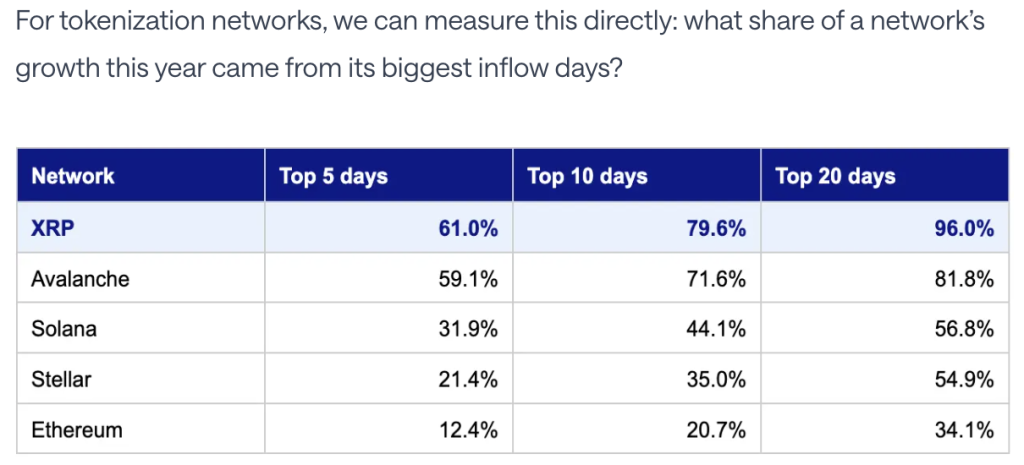
The claim is specific: daily transactions on the XRP Ledger have surged to nearly 3 million, up from roughly 1 million in mid-2025, with Bitstamp, Ripple’s RLUSD stablecoin, and Braza Bank among the busiest names on the network. That is a real number. What it means for banking utility is a different question entirely.
The tension is structural. According to news, XRPL transaction volume has tripled in roughly 12 months, and at least one major European bank has deployed its regulated euro stablecoin on XRP, selecting it as one of four public chains for that purpose.

But XRP on-chain metrics and exchange flows tell a more complicated story about whether that volume represents persistent banking infrastructure or a concentrated surge driven by a handful of known actors. The marketing narrative and the on-chain data are not opposites. They are simply not the same thing.
Discover: The Best Crypto to Diversify Your Portfolio
XRP and Banking Rails News: What the On-Chain Data Shows
Evernorth’s chief executive, Asheesh Birla, has argued in a news outlet that XRP’s long-term value will come from banks and businesses using it as working capital, not from retail trading.
That framing matters because it sets a specific evidentiary bar: not speculative demand, not ETF flows, but bank-originated settlement volume. Against that bar, the data is partially supportive and partially aspirational.
The XRPL’s jump to nearly 3 million daily transactions is documented and real. The busiest names driving that traffic, Bitstamp, RLUSD, Braza Bank, are identifiable financial institutions, not anonymous wallets or wash-trading vectors.
In May 2026, Evernorth highlighted a tokenized U.S. Treasury redemption that coordinated Mastercard, J.P. Morgan’s Kinexys, Ondo Finance, and Ripple using XRPL as the common settlement layer, with Ripple receiving USD proceeds in Singapore outside normal banking hours.
Evernorth described XRP as “settlement infrastructure in one of the most significant cross-institutional blockchain transactions to date.” That transaction happened. It is not fabricated.
What the data does not yet confirm is whether these events represent systematic banking adoption or high-profile pilots.
Ripple’s On-Demand Liquidity service has been live in production since at least 2018, using XRP as a bridge asset across cross-border corridors in markets like the Middle East and Southeast Asia. Volume in those corridors is real but geographically concentrated, not the global banking rail the headline narrative implies.
Institutional-sized transfers on XRPL are stable in 2026, but Chainalysis data indicate they increasingly compete with USDC and wholesale CBDC projects for share of institutional settlement flow.
The XRPL protocol itself is being upgraded with exactly this gap in mind. Pending amendments include Token Escrow, a Permissioned DEX, and Restricted Environments, compliance infrastructure explicitly designed to give regulated institutions whitelisted venues and escrowed settlement flows on-chain.
The proposed XLS-66 XRP Lending Protocol would embed single-asset XRP vaults, fixed-term loans, and ZK-enhanced privacy directly into the ledger, eliminating external smart contracts and bridges. Validators are currently voting on XLS-66, and it requires an 80% supermajority to activate.
It is not yet live. Analysts covering the proposal have framed it as a bid to unlock a $100 billion lending and collateral opportunity on XRPL, but until consensus is reached, that is infrastructure on the drawing board, not banking activity on the ledger.
Discover: The Best Token Presales
The post XRP News Today: Ripple-Backed Firm Claims Real Banks Are Already Using XRP Daily appeared first on Cryptonews.
Solana (SOL) dropped to its lowest price since December 2023 this week, sliding toward $68 as more than $88 million in leveraged positions were wiped out across the market.
Long traders absorbed almost all of the damage. On-chain activity and social interest had been weakening for months before the breakdown, which suggests the selloff reflected fading demand rather than a single shock.
Long Liquidations Account for 94% of the Damage
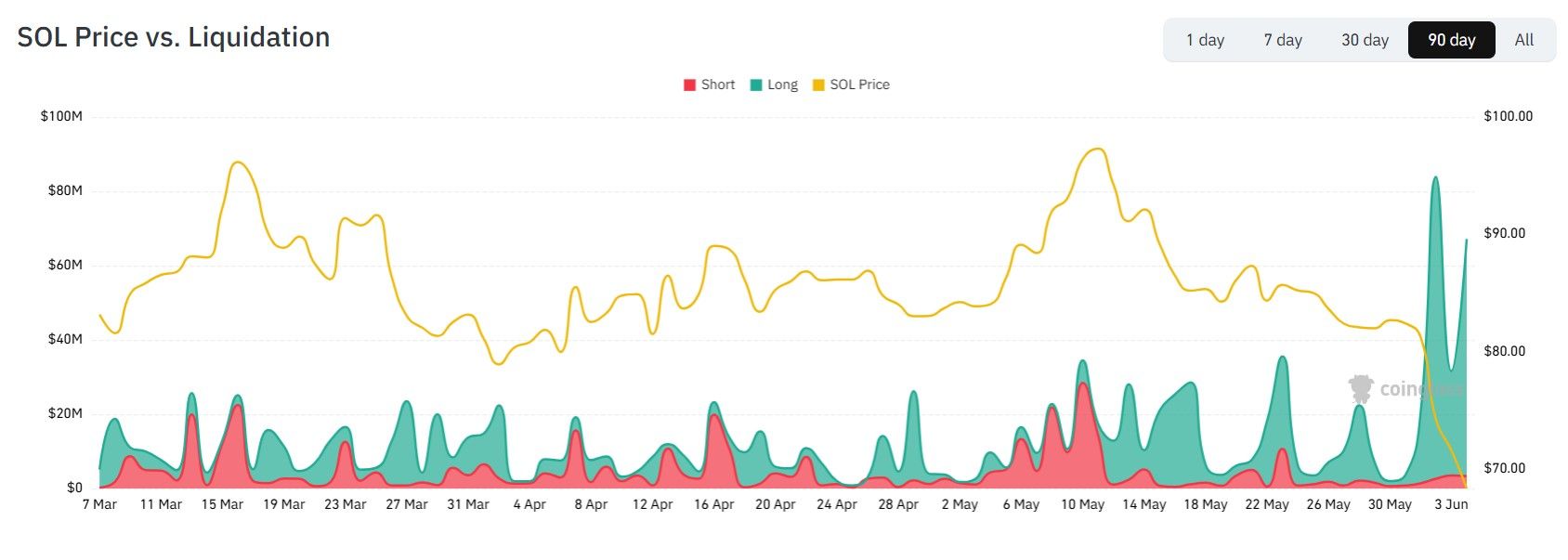
The market liquidated $88.45 million in SOL positions over 24 hours, according to Coinglass data. Of that total, $83.53 million came from long positions against just $4.91 million in shorts.

That split means bullish traders accounted for roughly 94% of the losses. The data also shows 12,084 traders liquidated worldwide as SOL volatility passed 12% on the day.
The 90-day comparison makes the move stand out. The long liquidation spike near $84 million was the tallest reading on the entire chart, and it landed exactly as the price collapsed toward the lows.

Active Addresses Have Fallen Since February
The leverage flush did not happen in isolation. Solana network usage has been declining steadily, which points to weaker underlying demand.
Daily active addresses peaked near 5.5 million in early February, according to Santiment. The metric now sits around 2.91 million, roughly half the February high.
This matters because price held a consolidation range between $78 and $95 through spring, while usage kept falling. That divergence often warns that a sideways market lacks real support. The recent break toward fresh lows followed the same pattern flagged in earlier unstaking analysis.

Social Interest Fades as Rallies Get Sold
Crowd attention tells a similar story. Social volume has trended lower, with the latest reading down at 39, near the bottom of its three-month range.
Social dominance gained briefly in mid-May when SOL staged a short bounce, yet it has since rolled over to 0.687. The token now commands a smaller share of overall crypto conversation.
The pattern is telling. Bursts of chatter did not put a floor under price, and each spike in attention was sold into rather than bought. Fading interest leaves little fresh demand to defend support.

SOL Weekly Chart Confirms the Breakdown
The weekly chart ties the data together. SOL closed the latest candle near $68.46, down almost 17% on the week, its lowest level since December 2023.
Price has lost the 0.786 Fibonacci retracement at $73.31, turning former support into resistance. It was also rejected at the long-term resistance zone around $100, a shelf that previously acted as support in early 2024.
Weekly volume has been declining throughout the descent, which signals thin conviction behind every rally attempt. The weekly RSI has rolled into bearish territory, confirming weak momentum on the highest timeframe.
At the time of writing, Solana traded near $68.53, down about 9% over 24 hours, with a market cap close to $39.6 billion at rank seven.

For now, all four data sets point the same direction. A rebound in network usage and steady spot demand would offer the first evidence that selling pressure is starting to ease.
The post Solana (SOL) Hits Lowest Level in 2.5 Years as $88 Million in Longs Get Liquidated appeared first on BeInCrypto.


- Catapult Trade has appointed Claire “Cookie” Dang as VP of Growth and Co-Founder.
- Dang previously held growth and business development roles at Binance, KuCoin, and Crypto.com.
- The expansion is being funded in part by the KuCoin Ventures investment.
Catapult Trade has appointed Claire “Cookie” Dang as VP of Growth and Co-Founder, the latest in a series of moves that have widened the trading platform’s operations following an investment from KuCoin Ventures.
Dang held growth and business development roles at Binance, KuCoin, and Crypto.com before joining and will lead community growth and international expansion.
Her arrival has come alongside a broader push on the company’s external presence.
Catapult Trade has launched a sponsored podcast, Terminally Online, featuring Web3 founders and operators, and has assembled a media network from acquired social channels with a combined reach of over 20 million followers.
The company has also run trading activity collaborations with the exchange Gate.
The expansion is being funded in part by the KuCoin Ventures investment, disclosed earlier this year; terms were not made public, and the company said its funding round remains open, with proceeds also directed toward regional expansion in markets underserved by conventional financial infrastructure.
Catapult Trade opened to the public in December 2025 after a pre-launch incentives campaign that built its first base of traders and creators.
The platform runs on algorithmically generated price charts rather than an orderbook or live price feed.
Each session’s full price path is generated in advance and committed to a cryptographic hash published before trading begins, then revealed at settlement, letting users verify that the chart was never altered mid-session.
The company frames the design as a correction to conditions on memecoin launchpads, where hidden information has consistently worked against retail traders.
Since launch, the platform has recorded more than $1.5 billion in cumulative trading volume and over 80,000 monthly active users, with no paid acquisition behind the figures.
The platform’s chart-generation engine has passed two independent security audits, most recently by Halborn and earlier by Hashlock, with the company committing to annual reviews.
A points system has run since launch, fueling speculation about a token distribution; the company has confirmed in community sessions that a token is planned, but has released no allocation or vesting details.
A second product, Catapult Hyper, is in development and would extend the platform from synthetic charts into multichain token launches built on LayerZero’s omnichain fungible token standard.
The build-out reflects the standards now being applied to crypto products.
Where the previous cycle’s flagships rested on token speculation, the current cohort, led by names such as Hyperliquid in perpetuals and Polymarket in prediction markets, is judged on user demand and revenue.
Catapult Trade is being scaled on the same terms, in a category, gamified short-session trading on verifiable charts, that has yet to see an incumbent at scale.

The House Article | What Britain can learn from Australia’s under-16 social media ban

‘Deplorable issues’ cloud 2026 FIFA World Cup, deemed ‘one of the least anticipated of this era’

Inside the mind of a viral indie hacker



-

 Tech6 days ago
Waymo dominates autonomous vehicle registrations as Tesla trails behind
-

 News Videos6 days ago
This is BROKEN! INSANE 5x MONEY CAR WASH WEEK! The NEW GTA Online UPDATE Today! (GTA5 New Update)
-
 Tech5 days ago
SpaceX just won a second Golden Dome contract. This one is $4.16 billion.
-

 Business3 days ago
Jade Biosciences, Inc. (JBIO) Discusses Positive Interim Results From JADE101 Phase I Healthy Volunteer Study and Development Plans Transcript
-
 News Videos6 days ago
SHE IS KILLING XRP!!! WATCH URGENT AND ACT FAST
-
 NewsBeat5 days ago
FIRST NIGHT REVIEW: Take That bring the Circus back to life in spectacular sun-soaked style
-

 Business5 days ago
Is the Spurs Phenom Already Better Than Prime Diesel?
-
Crypto World6 days ago
CFTC Has Approved the First Regulated Bitcoin Perpetual Contract in the U.S.
-

 Politics5 days ago
The House | Inside Andy Burnham’s Makerfield Campaign: “Nobody Thinks This Is In The Bag”
-

 Sports2 days ago
French Open 2026 results: Alexander Zverev beats Rafael Jodar and will play Jakub Mensik in semi-finals
-
 NewsBeat6 days ago
Novak Djokovic v Joao Fonseca LIVE: French Open latest scores and results after Jannik Sinner’s shocking collapse
-
 Entertainment6 days ago
Weak ‘Supergirl’ Box Office Tracking Amid Milly Alcock Backlash
-
 Crypto World6 days ago
Snowflake (SNOW) Stock Rallies on Strong Q1 Results and AI Product Growth
-

 Tech2 days ago
CryZENx Releases Fresh Playable Content Deep Inside Jabu-Jabu for His Ocarina of Time Remake
-

 Entertainment6 days ago
Maddox Jolie-Pitt Legally Requests to Drop Brad’s Surname
-

 Business5 days ago
Demand Conditions Improve In Chemicals Sector In April 2026
-
 Entertainment5 days ago
One of the Greatest Sitcoms of All Time Shoots Up Apple TV’s Charts 11 Years Later
-

 Tech6 days ago
This Week In Security: Ubiquiti Fixes, And FreeBSD Joins The Club You Don’t Want To Join
-
 Crypto World6 days ago
MicroStrategy Moves $30 Million in BTC to Coinbase Prime: Is the Bitcoin Sell-Off Already Here?
-
 Entertainment6 days ago
Bruce Willis’ Generosity Resurfaces Amid His Dementia
You must be logged in to post a comment Login