
Crypto World
Worldcoin an Overlooked Bet in the AI IPO Wave

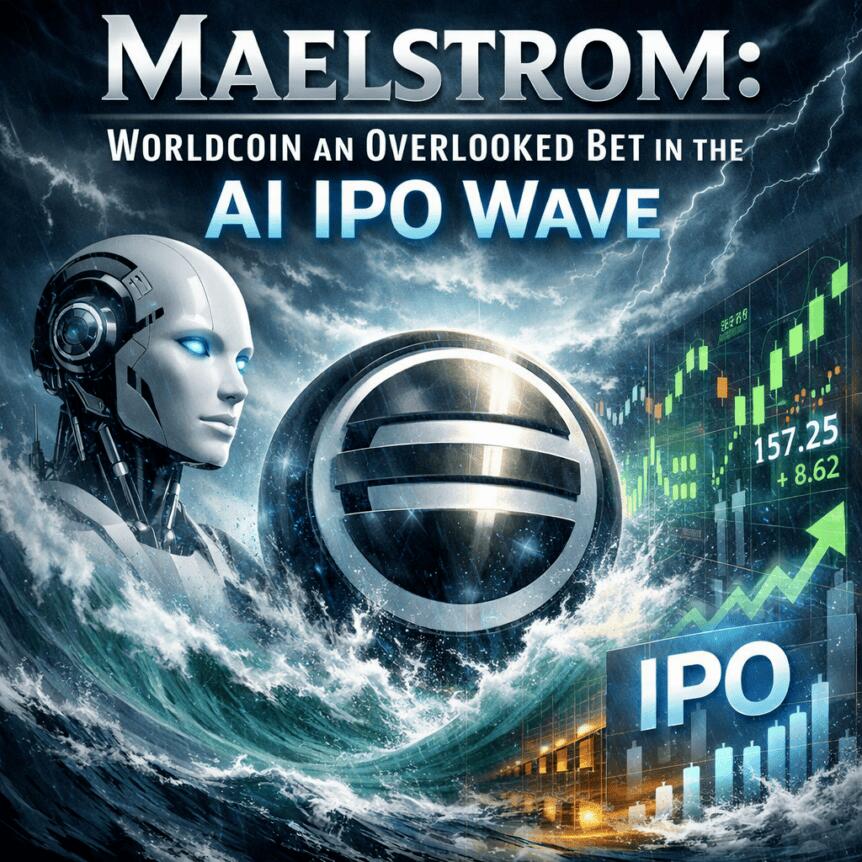
Maelstrom, the investment firm led by Arthur Hayes, argues that Worldcoin’s WLD token could surge to as much as $5 in the coming months, framing WLD as a clean proxy for the AI mega IPO wave. The note positions the token as a relatively overlooked lever in a market that is increasingly pricing in AI-driven growth and corporate AI infrastructure shifts.
“The AI mega IPOs are coming — and it appears the market has overlooked one of the cleanest proxies,” said Lukas Ruppert, a Maelstrom researcher, on Wednesday.
The AI boom has been accelerating in the United States. OpenAI confidentially filed its IPO prospectus with the SEC on May 22, targeting a public debut in September 2026, with the firm aiming to raise $60 billion and a potential valuation of up to $1 trillion. Meanwhile, Anthropic confidentially filed its draft prospectus after announcing on May 28 that it was valued at $965 billion following a fresh $65 billion funding round. US stock markets have risen this week, aided by AI‑related gains in memory storage and chipmakers as well as broader tech sentiment.
Ruppert argues that this AI fervor has not yet fully reflected in WLD’s price, even as near-term developments around Worldcoin and its token dynamics could tilt sentiment. He points to two potential catalysts that could reverse the current overhang and tilt WLD higher.
Key takeaways
- The Maelstrom view casts WLD as a high‑conviction proxy for upcoming AI mega IPOs, with a price target around $5 in the near term.
- Two catalysts could spark a rally: a substantial WLD bid by Eightco ORBS and a meaningful improvement in the token’s unlock schedule.
- Eightco ORBS, a small publicly traded company, reportedly holds about 283 million WLD and sits on roughly $144 million in cash, which could be deployed to buy more WLD and potentially trigger a price reflexive move.
- Worldcoin’s token unlock framework is set to ease selling pressure by about 43% on July 24, potentially removing a key overhang for the token.
Worldcoin and the AI IPO frame
Worldcoin positions itself as a project intended to create a global digital identity and financial network capable of distinguishing real humans from AI bots. Co‑founded by OpenAI CEO Sam Altman, the project has attracted mainstream attention as the AI ecosystem expands beyond pure software into identity, verification, and on-chain participation use cases.
Against a backdrop of heavyweight AI funding rounds and planned public listings, WLD has traded in a risk‑premium corridor. Ruppert notes that capital is increasingly chasing exposure to AI leaders such as OpenAI and Anthropic, whose valuations are in the hundreds of billions, if not trillions, while WLD’s currently unlocked market cap sits at what he sees as a much smaller, “asymmetric upside” opportunity around $2 billion.
As a gauge of momentum, WLD has been among the stronger performers within the top‑100 crypto assets by market cap, rallying roughly 60% over the past week in market activity tracked by price feeds such as TradingView.
Catalysts to watch for a WLD rally
The two primary catalysts outlined by Maelstrom centre on supply dynamics and capital allocation flow.
First, Eightco ORBS — a small publicly traded company that has accumulated a sizable stash of Worldcoin tokens — reportedly holds about 283 million WLD and has around $144 million in cash on its balance sheet. Ruppert suggests that if Eightco deploys a portion of that cash to buy additional WLD, it could ignite a reflexive price loop, where rising demand from a buyer with large holdings pushes the price higher and draws in more buyers.
Second, Worldcoin’s unlock schedule is set to tighten the flow of new tokens into the market. Beginning on July 24, the daily unlocks are expected to fall by roughly 43%, a move that could meaningfully reduce near‑term selling pressure and support price stability or upside in the weeks ahead.
Ruppert frames these dynamics within a broader investor context: “Capital is aggressively chasing Anthropic and OpenAI exposure,” and while AI valuations sit in the hundreds of billions or trillions, WLD’s market exposure is comparatively modest. If buyers step in and selling pressure eases, the upside could be outsized relative to the token’s current liquidity profile.
From a price action perspective, Maelstrom’s note argues that WLD tends to move decisively when it moves at all. The firm projects a path to $5 by August, representing roughly a fivefold increase from a current price around $0.50 and implying a substantial, if volatile, upside against an otherwise cautious backdrop for smaller cap crypto assets.
These views come as Worldcoin remains a controversial and closely watched project within the broader AI economy, where investors weigh the potential utility of global identity networks against regulatory and privacy considerations, as well as the practical challenges of mass adoption.
Market context and what it could mean for investors
The AI rally has spilled over into equity markets and crypto alike, with AI‑driven earnings and investment narratives shaping sentiment across tech sectors. While OpenAI and Anthropic are poised to shape the AI software and services landscape, Worldcoin’s broader ambition sits at the intersection of identity verification and decentralized finance, a combination that could unlock novel on‑chain participation if consumer trust and data privacy concerns are addressed effectively.
For traders and long‑term holders, the key will be watching how any large corporate purchasing of WLD, particularly by Eightco ORBS or similar entities, interacts with the token’s unlocking cadence and market liquidity. The July 24 unlock reduction is a tangible near‑term event to monitor, as it could alter the supply‑demand balance in a market that has shown sensitivity to token flow dynamics.
As the AI IPO narrative evolves, investors may increasingly treat WLD as a test case for how digital identity and tokenized access could intersect with mainstream AI monetization. If the catalysts highlighted by Maelstrom begin to take hold, WLD could emerge from a low‑volatility phase into a more responsive trading regime, though both upside potential and downside risk remain highly contingent on broader regulatory, technological, and market developments.
What to watch next: the pace of private and strategic purchases in WLD, any shifts in Eightco ORBS’ capital deployment, and the actual timing and impact of the Worldcoin unlock changes going into late summer. These elements will shape whether the $5 target remains plausible or if the market requires a longer runway to assess Worldcoin’s role in the AI economy.

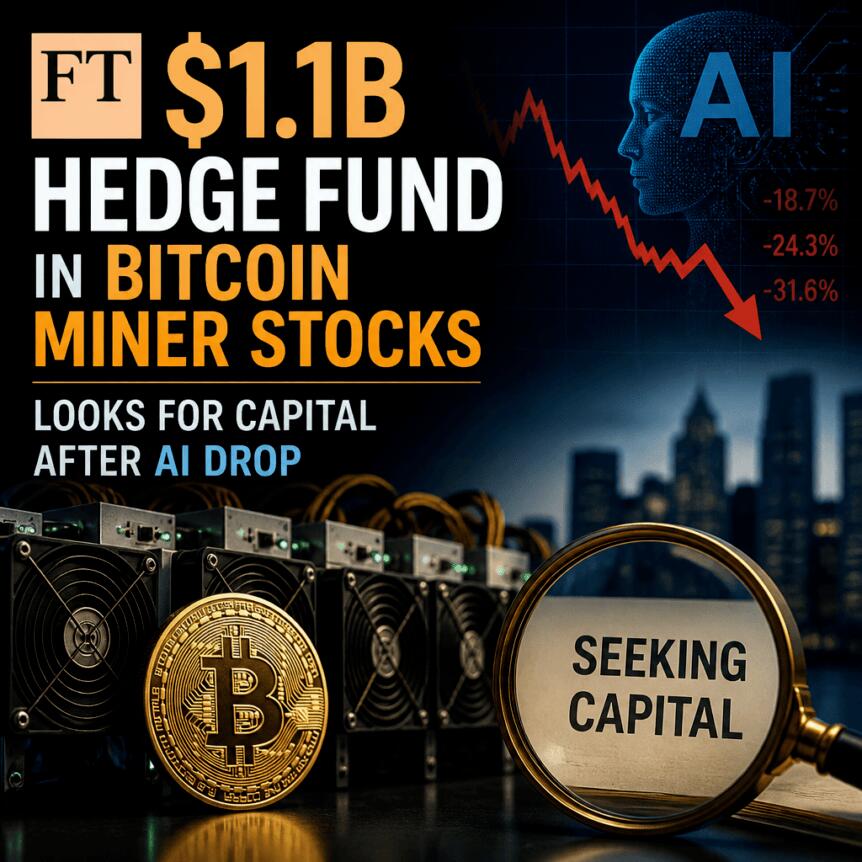
Hedge fund Situational Awareness, founded in 2024 by former OpenAI researcher Leopold Aschenbrenner, is reportedly seeking new funding after taking substantial losses during a recent sell-off in artificial intelligence stocks. The Financial Times said the firm has approached investors and lenders for additional capital, and in some cases has offered investors the chance to buy assets from its portfolio.
The fund—tied to a strategy centered on the infrastructure underpinning AI—was reported by the Wall Street Journal to manage roughly $20 billion in assets under management as of June 8. However, the FT reported that the scale of losses and the amount of capital being sought were not disclosed in the discussions it reviewed, which included a July 24 investor letter.
Key takeaways
- Situational Awareness is reportedly raising fresh capital after losses tied to the July sell-off in AI-related equities.
- According to the Financial Times, borrowing amplified the impact of the downturn on the fund’s leveraged positions.
- The fund’s reported AI-infrastructure focus includes trades connected to data centers and power, with past disclosures referencing stakes in Bitcoin mining firms.
- In addition to seeking funding, the firm has reportedly offered some investors the option to purchase portfolio assets.
Why the AI sell-off became a funding story
The immediate catalyst for Situational Awareness’s capital push appears to be the market turbulence that hit AI stock momentum in July. The FT linked the losses to the broader “AI stock collapse” during that rout and emphasized that the fund’s risk profile was made more severe by increased borrowing.
While the FT did not provide a dollar figure for losses or the size of the capital requirement, it reported that Aschenbrenner’s fund had gained 439% after fees through June, as described in the July 24 investor letter. The same letter suggests that strong earlier performance did not prevent a rapid drawdown once AI equities sold off—particularly because leverage can magnify both gains and losses.
That leverage detail matters to investors because it helps explain how a thematic equity thesis—AI infrastructure—can still unravel quickly when valuation compression and liquidity pressures hit the complex simultaneously. The situation also reflects a recurring pattern in crowded “platform” trades: when the market reprices the expected earnings power of AI beneficiaries, funds exposed to those segments may require external capital to stabilize their balance sheets.
What Situational Awareness is betting on
Situational Awareness’s strategy has been described as focused on the physical backbone of AI: the power generation, data centers, and related infrastructure that enable compute-heavy systems. In earlier reporting, Cointelegraph noted that the fund made a notable bet around that infrastructure theme, including investments connected to Bitcoin miners pivoting into AI computing.
Cointelegraph previously pointed to a March filing with the U.S. Securities and Exchange Commission that showed approximately $1.11 billion in positions across seven Bitcoin miner stocks. The stocks cited in that disclosure included IREN, Core Scientific, Riot Platforms, and CleanSpark, among others.
That matters in the current context because it ties the fund’s AI infrastructure thesis to a sector that has its own cycle of operational risk, capital intensity, and market sensitivity. Even if the longer-term narrative is about compute supply, short-term market swings can still create liquidity and valuation pressures for holders of infrastructure-linked equities.
Investors were also offered a chance to buy assets
The Financial Times reported that the fund’s efforts have not been limited to classic fundraising. It said Situational Awareness has offered some investors the option to buy portfolio assets—an approach that can be used when a manager wants to reduce exposure or improve liquidity without immediately selling positions into a weak market.
According to the FT, the account relied on people briefed on the discussions. The report also cited the fund’s July 24 investor letter while noting that the specific amounts involved were not disclosed publicly.
For investors, asset-purchase offers can create a different decision set than a capital raise. Instead of simply assessing whether to contribute more cash, counterparties may need to evaluate the underlying securities at a point in time when market prices may reflect fear or forced selling. That dynamic can produce opportunities for investors willing to underwrite longer-term fundamentals, but it also introduces questions about what happens next if market conditions remain unsettled.
Aschenbrenner’s AGI expectations and the timing
Beyond the immediate funding pressure, the broader storyline includes how closely the fund’s emergence aligned with Aschenbrenner’s public discussion of artificial general intelligence. Cointelegraph previously reported that he authored a series of essays on artificial general intelligence in mid-2024, around the time he launched Situational Awareness, discussing how he believed AGI machines could outpace college graduates by the end of the decade.
Those views help frame why the fund may have been positioned for a sustained build-out of AI-related infrastructure rather than a short-term trade. Yet the funding request underscores an important asymmetry: even a conviction-driven infrastructure thesis can still be pressured by market mechanics—especially when leverage is used to scale returns.
As of publication, Cointelegraph said it contacted Situational Awareness for comment and had not received a response.
What to watch next
Investors watching this situation should focus on two things: whether Situational Awareness secures the capital it seeks without further destabilizing its leveraged positions, and how any asset-buyback offers to investors are priced relative to the market’s ongoing repricing of AI-exposed equities. The next reports—particularly any updates that clarify the scale of losses, borrowing, and proposed restructuring—will determine whether this becomes a one-off liquidity event or a longer process of portfolio adjustment.

Telegram, the messaging platform used by more than 1 billion people worldwide, is facing a major legal challenge in Australia over claims that it failed to stop the spread of terrorism-linked material.
Australia’s online safety regulator, the eSafety Commissioner, launched civil penalty proceedings against Telegram in the Federal Court on Thursday, according to an official statement.
The authority alleged Telegram breached its obligations under the country’s Online Safety Act to address “pro-terror” content by failing to act on multiple user complaints.
The case adds to growing global scrutiny of Telegram’s moderation practices, following legal pressure on CEO Pavel Durov in Russia and France as governments increasingly examine how major online platforms handle harmful content.
Australia alleges Telegram ignored repeated warnings
ESafety said its year-long investigation found that Telegram failed to remove certain unlawful material after becoming aware of it, with some reported content remaining visible for up to three weeks.
The regulator also alleged that Telegram did not take sufficient steps to prevent repeated violations, including removing accounts, channels and groups used to distribute pro-terror material.
According to eSafety, Telegram also failed to detect known extremist content, including footage from the 2019 Christchurch mosque shootings and the 2022 Buffalo mass shooting, before the material was later removed.
Related: Pavel Durov says Telegram to roll out native Gram crypto wallet
The regulator is seeking financial penalties, with violations of Australia’s online safety rules carrying potential fines of up to 54.6 million Australian dollars ($35.8 million).
Telegram has not issued an official statement on the Australian proceedings, but its official X account posted a video captioned “freedom of expression.”
Telegram did not immediately respond to Cointelegraph’s request to comment on this story.
Russia intensifies legal pressure on Durov
Australia’s legal action came a day after Russia’s Federal Security Service (FSB) charged Durov with facilitating terrorist activity and said it had begun procedures to place him on an international wanted list.
Russian authorities alleged that Telegram failed to remove channels, chats and bots that Ukrainian intelligence services, terrorist groups and extremist organizations used to coordinate attacks, recruit operatives and carry out cyber fraud.
Telegram has also not issued an official statement on the latest legal developments in Russia, but posted an image of Durov making a profane hand gesture.

Source: Telegram Messenger
Durov also remains under investigation in France following his August 2024 arrest at Le Bourget Airport. French prosecutors charged him with offenses including complicity in the distribution of illegal content, including material related to organized crime, through Telegram.
Durov has previously criticized what he described as growing threats to online privacy, warning that governments were rolling back protections for the free internet.
“What was once the promise of the free exchange of information is being turned into the ultimate tool of control,” he wrote in an October 2025 post on X.
Magazine: The real reason DeFi projects that survived 2022 crash are shutting down now


Australian authorities are taking Telegram to court over an alleged failure to remove terror-related content, including video of the March 2019 shooting at a Christchurch, New Zealand mosque in which 51 people were murdered, several news outlets reported Thursday.
Julie Inman-Grant, Australia’s Safety Commissioner, said the messaging app founded by Pavel Durov faced a fine of up to $38 million for failing to comply with its obligations under the Online Safety Act, the BBC said.
“This case concerns content linked to some of the most notorious acts of known extremist violence in recent history, including material associated with the Christchurch and Buffalo terror attacks,” Inman-Grant said in a statement, according to Reuters.
“We reject these allegations and will contest them in court,” a spokesperson for Telegram said in response to Reuters a request for comment. Telegram’s anti-terrorism efforts are well-documented, with thousands of extremist communities blocked by the platform in 2026 alone, the spokesperson told the news agency.
Telegram, home of many crypto-related discussion groups, hosting project communities, trading groups, bots and blockchain-based mini apps, did not immediately respond to a CoinDesk request for further comment.
Samsung SDS, the IT services arm of Samsung Group, is exploring stablecoin infrastructure, digital asset systems and AI-based payment models with Dunamu, the operator of Upbit, one of the biggest local cryptocurrency exchanges.
Samsung SDS said it is discussing potential cooperation with Dunamu on stablecoin infrastructure, digital asset systems and AI-based payment business models, CEO Lee Jun-hee said during the company’s second-quarter earnings call on Thursday.
“We have already secured differentiated business capabilities in digital asset infrastructure through the Korea Securities Depository’s tokenized securities platform project and through end-to-end validation […] of the full stablecoin process from issuance to settlement,” Lee said. He said he expects the relationship with Dunamu will help Samsung SDS expand in the digital asset infrastructure market.
The news came days after Samsung Electronics unveiled plans to add stablecoin support to Samsung Wallet, broadening the company’s digital asset push.
Strategic investment targets digital finance
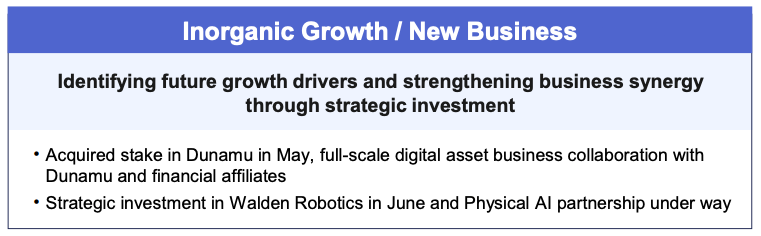
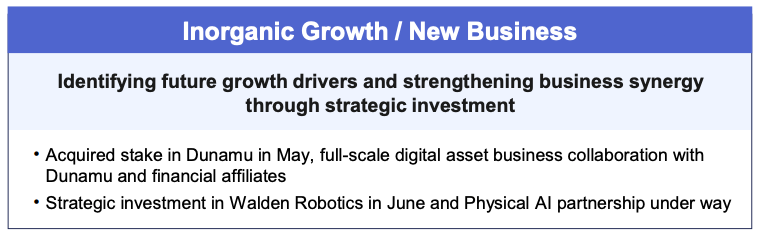
In May 2026, Samsung Securities, Samsung SDS and Samsung Card agreed to buy a combined 4% stake in Dunamu, deepening Samsung affiliates’ ties to South Korea’s digital asset sector.
In the latest Q2 call, Lee reportedly said the company’s investment in Dunamu is a strategic move rather than a financial investment, adding that both companies plan to refine potential business models for digital financial infrastructure.
Source: Samsung SDS
“By combining Samsung SDS’s IT services, cloud, and security capabilities with Dunamu’s blockchain expertise, we aim to lead this market,” the Q2 transcript said.
Related: South Korea report proposes stablecoin rules before crypto law
Samsung SDS did not immediately respond to Cointelegraph’s request for comment, while Dunamu declined to comment.
AI growth supports broader expansion
The digital asset initiative comes amid Samsung SDS’ ongoing expansion in AI and cloud services, which helped lift Q2 revenue 5.9% year on year to 3.72 trillion Korean won ($2.6 billion), according to the quarterly earnings presentation.
Cloud revenue increased 17% from a year earlier, with external cloud business revenue jumping 75%, driven by demand for Samsung’s cloud platform and graphics processing unit-as-a-service offerings.
The company also reportedly outlined ambitious plans to expand its AI infrastructure from 110 megawatts today to 230 MW by 2029 and more than 800 MW by 2031, underscoring its broader push to build AI infrastructure alongside digital finance services.
Magazine: Fears of AI-driven DeFi hack epidemic overstated for now — but not for long
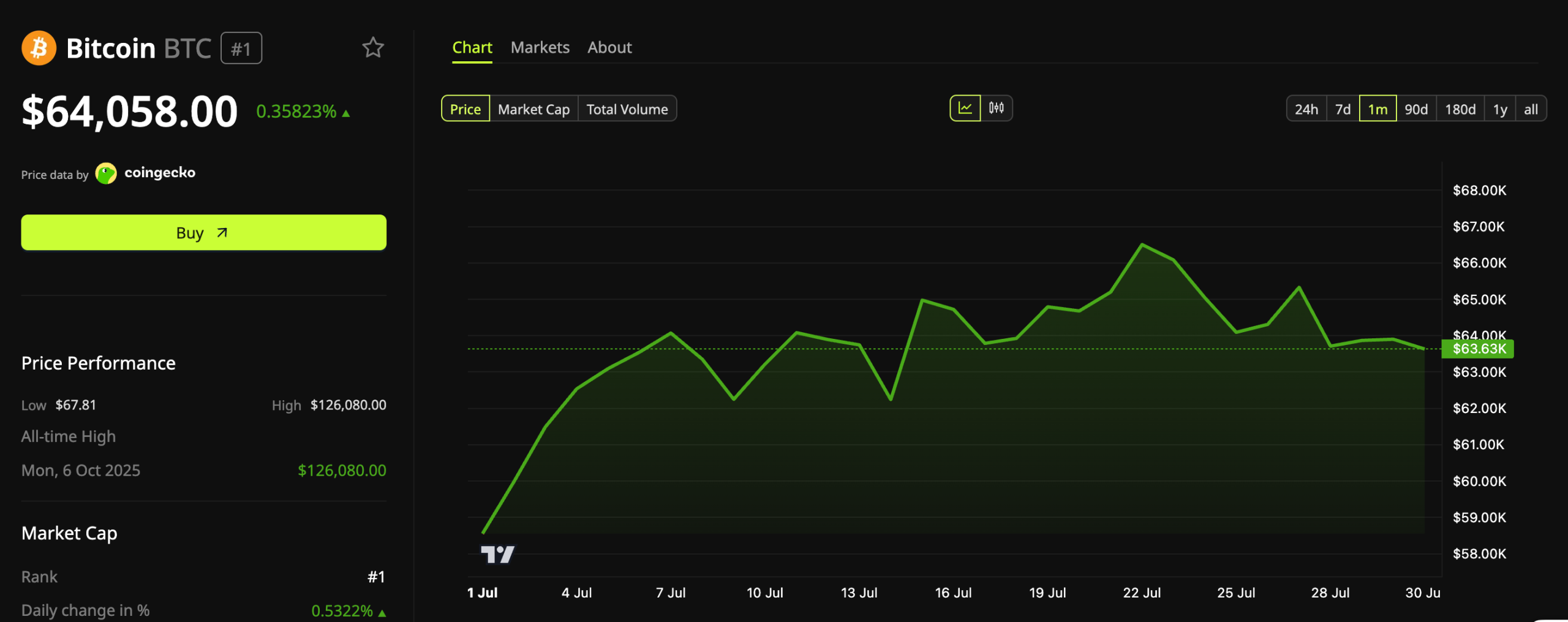
Bitcoin (BTC) is on track to post its first monthly gain since April, but the rally has unfolded alongside weakening market activity.
The cryptocurrency is up 9.3% in July, while spot trading volume has dropped toward multi-year lows. Institutional demand has also cooled, highlighting a disconnect between price performance and market participation.
Bitcoin Spot Volume Sinks to Its Weakest Month in Nearly 3 Years
According to Coinglass, Bitcoin fell 20.4% in June, marking its worst monthly performance since June 2022. That followed a more modest 3.5% decline in May.
July has broken that losing streak. Bitcoin opened the month near $58,000 on July 1, which also marked its monthly low. The asset has broadly trended higher since then and remains in positive territory despite its recent pullback.
At the time of writing on Thursday, Bitcoin was trading near $64,058, up 0.58% over the past 24 hours.
Follow us on X to get the latest news as it happens

However, trading activity has failed to keep pace with the price recovery. K33 Research put average daily Bitcoin spot trading volume at roughly $2.2 billion in July. The firm added that July 2026 is on track to record the lowest average daily BTC spot trading volume since November 2023.
“CME open interest remains near multi-year lows, perpetual futures open interest has stalled around 300,000 BTC,” the report read.
On-chain analyst Darkfost tracked the dip across individual venues. According to the analyst, Bitcoin spot trading volumes have fallen by more than 75% compared with late 2024.
Binance handled just over $35 billion in July, against $246 billion in November 2024. Trading volume declined 85% on Bybit, 67% on OKX, and 61% on Coinbase over the same period.
“Against this backdrop, a return of Bitcoin to a bullish trend seems conditional on a shift in the macro regime, and above all a return of demand, the only real driver capable of pushing volumes back up,” the analyst said.
Glassnode measures the same decline in coins rather than in dollars, removing the effect of the price drop. On that basis, spot volume sits at its lowest since 2019. The falling crypto spot volume has been building across the market for months.
Exchange Flows Show Neither Selling Pressure Nor Scarcity
The second channel is quieter still. Analyst Axel Adler Jr. said there has been no clear directional shift in Bitcoin supply based on exchange transfers.
Bitcoin exchange inflows stand near 60,000 BTC on a 30-day average. That reading sits at roughly 76% of the annual average near 79,000 BTC. Inflows stood close to 100,000 BTC a year ago, a decline of about a quarter over 12 months.

Net flow between deposits and withdrawals is currently near -1,300 BTC, down from a slightly positive figure a week earlier.
“Exchanges are not accumulating additional supply, but there is also no large-scale withdrawal of coins that could create a shortage of liquid supply,” the analyst mentioned.
Glassnode reaches a similar conclusion from the other side. Deposits and withdrawals have both slowed to among the quietest combined levels of the past three years.
“That reads less like distribution or accumulation than like disinterest, a pattern that has often marked the quiet middle of a bear market. With so little moving on-chain, there is not much standing supply positioned to absorb a change in demand should one arrive,” the firm added.
BTC ETF Demand Faded Through July Before Turning Negative
The institutional channel tells the clearest version of the story. Weekly flows into US spot Bitcoin ETFs turned positive in early July, then shrank every week until they flipped.
The week ending July 10 drew $197.4 million. The following weeks pulled in $75.7 million and $33.8 million. The week to July 29 recorded a net outflow of $29.3 million.

The scale is modest against recent history. Record June ETF outflows reached the billions, so July’s numbers may point to indifference rather than flight.
Overall, Bitcoin’s July rebound appears to rest on a fragile foundation. Seasonality adds another potential headwind. Bitcoin has finished each of the past four Augusts in negative territory, with a median monthly return of -7.49%.
To break that pattern, the market may need a meaningful catalyst alongside a revival in institutional and spot demand. Without those drivers, July’s price gains could prove difficult to sustain.
Subscribe to our YouTube channel to watch leaders and journalists provide expert insights
The post Bitcoin Gains 9% in July, but On-Chain Data Signals Weak Conviction appeared first on BeInCrypto.
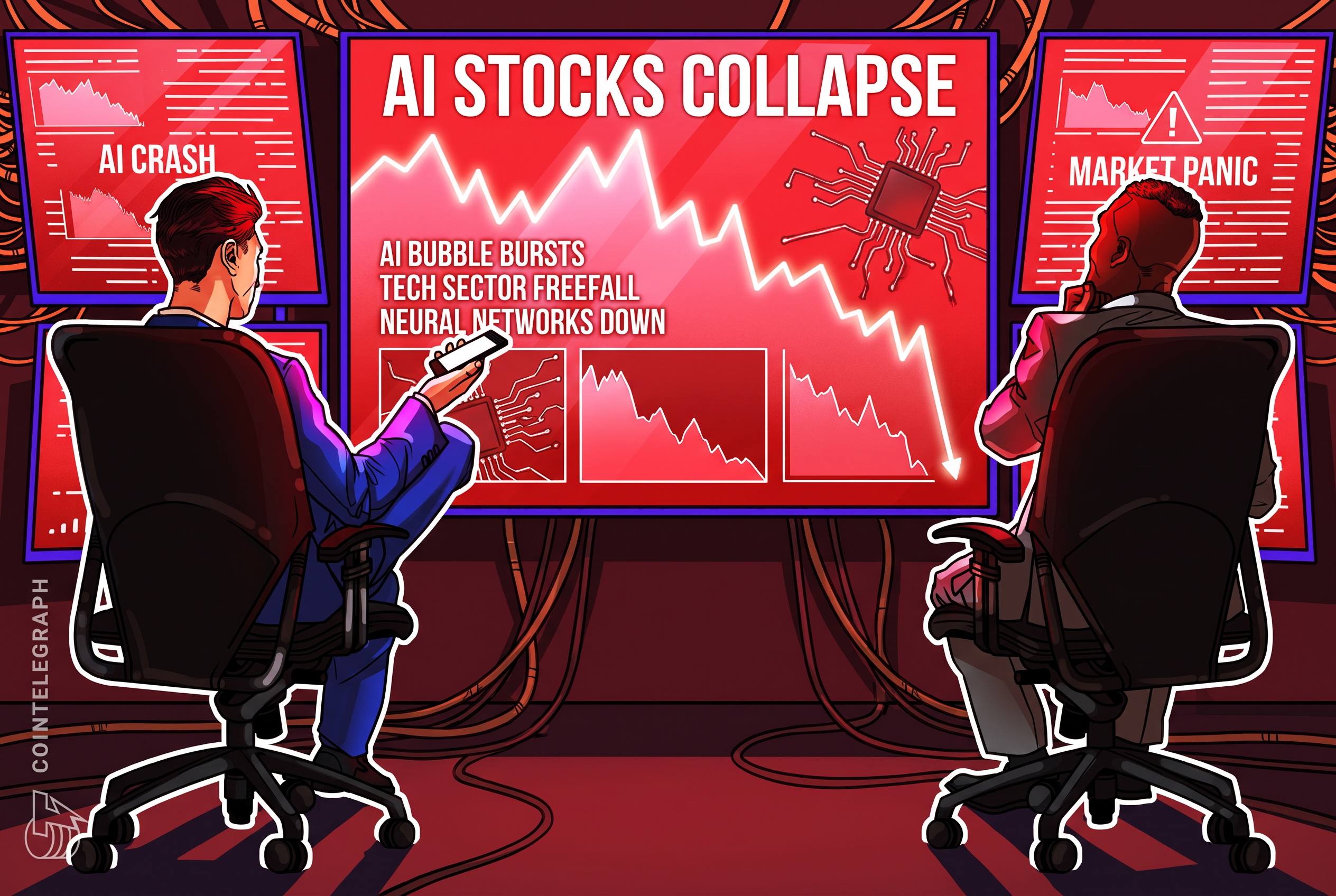
Situational Awareness, the hedge fund founded in 2024 by ex-OpenAI researcher Leopold Aschenbrenner, has approached investors and lenders for fresh capital after suffering heavy losses in the recent artificial intelligence stock sell-off, the Financial Times reported Thursday.
The fund, which the Wall Street Journal said had around $20 billion in assets under management as of June 8, has also offered some investors the option to buy portfolio assets, according to the FT, citing people briefed on the discussions and a July 24 investor letter.
The size of the losses and amount sought were not disclosed. Aschenbrenner’s fund had gained 439% after fees through June, according to the letter, but the FT said borrowing increased the size of the fund’s bets, driving up losses when AI stocks collapsed during July’s market rout. Aschenbrenner also reportedly argued in the letter that the sell-off had created attractive investment opportunities.
Cointelegraph previously reported that the fund had made a big bet in its portfolio around the power and data centers supporting AI, including Bitcoin (BTC) miners pivoting into AI computing. A filing with the US Securities and Exchange Commission in March showed about $1.11 billion in positions across seven Bitcoin miner stocks, including IREN, Core Scientific, Riot Platforms and CleanSpark.
Aschenbrenner wrote a series of essays on artificial general intelligence in mid-2024 around the same time he launched his Situational Awareness fund. In it, he predicted that AGI machines will outpace college graduates by the end of the decade.
Cointelegraph contacted Situational Awareness for comment but had not received a response by publication.
Related: Bitcoin mining’s 2026 reckoning: AI pivots, margin pressure and a fight to survive

Impermanent loss has long been one of the biggest challenges facing liquidity providers (LPs) in decentralized finance (DeFi). While automated market makers (AMMs) have revolutionized decentralized trading, they expose LPs to the risk of earning less than simply holding their assets whenever prices diverge significantly.
As artificial intelligence becomes increasingly integrated into DeFi protocols, many investors are asking an intriguing question:
Can AI finally eliminate impermanent loss?
The short answer is not entirely—but AI can dramatically reduce its impact. Let’s explore how.
Understanding Impermanent Loss
Impermanent loss occurs when the price ratio between two assets in a liquidity pool changes after you deposit them.
For example:
- You provide ETH and USDC to a liquidity pool.
- ETH doubles in price.
- Arbitrage traders rebalance the pool.
- You end up holding less ETH and more USDC than if you had simply held both assets.
Although trading fees can offset these losses, they aren’t always sufficient during periods of high volatility.
This is why many LPs hesitate to provide liquidity despite attractive yields.
Why Impermanent Loss Exists
Impermanent loss isn’t a bug—it’s a consequence of how AMMs maintain liquidity.
Traditional AMMs like constant-product pools automatically adjust token balances according to mathematical formulas.
These formulas:
- Keep markets liquid
- Allow permissionless trading
- Remove the need for order books
But they cannot predict future prices.
As a result, liquidity providers essentially sell appreciating assets and accumulate depreciating ones automatically.
Enter Artificial Intelligence
AI introduces something AMMs have never possessed:
Prediction.
Instead of relying solely on fixed mathematical curves, AI can analyze:
- Historical price behavior
- Market volatility
- On-chain liquidity movements
- Whale wallet activity
- Trading volume
- Cross-chain capital flows
- Social sentiment
- Macroeconomic events
This allows protocols to make smarter liquidity decisions.
AI Can Optimize Liquidity Placement
Concentrated liquidity protocols require LPs to choose price ranges.
Selecting the wrong range often leads to:
- Reduced fee generation
- Inactive liquidity
- Greater impermanent loss
AI can continuously monitor markets and recommend—or automatically adjust—the optimal liquidity ranges based on:
- Expected volatility
- Trend strength
- Volume concentration
- Support and resistance zones
Instead of manually repositioning liquidity, AI agents could perform these adjustments in real time.
Predictive Risk Management
Machine learning models excel at identifying patterns humans often miss.
Imagine an AI system detecting:
- A surge in exchange inflows
- Whale selling activity
- Rising options volatility
- Negative sentiment across crypto social platforms
The AI could recommend temporarily withdrawing liquidity before significant price swings occur.
After volatility subsides, liquidity could be redeployed.
This proactive strategy reduces exposure to major impermanent loss events.
Dynamic Portfolio Allocation
Rather than placing all assets into a single pool, AI can intelligently diversify liquidity across multiple pools.
For example:
- Stablecoin pools during uncertain markets
- ETH/BTC pools during lower volatility
- Emerging token pools when momentum increases
- Yield-generating vaults when volatility spikes
Capital continuously shifts where risk-adjusted returns are highest.
This resembles how institutional portfolio managers rebalance investments—only AI can do it every minute.
Adaptive Fee Strategies
Some modern AMMs feature dynamic trading fees.
Instead of fixed fees, AI can estimate:
- Expected volatility
- Arbitrage intensity
- Liquidity demand
The protocol can then automatically increase fees during turbulent periods.
Higher fees help compensate LPs for taking on greater risk.
This doesn’t eliminate impermanent loss, but it can significantly offset it.
AI-Powered Hedging
One of AI’s greatest strengths may lie outside the liquidity pool itself.
An intelligent system could automatically hedge LP positions using:
- Perpetual futures
- Options
- Synthetic assets
- Volatility products
For instance:
If AI predicts ETH is likely to experience extreme price movement, it could open a corresponding hedge that offsets potential impermanent loss.
Today, these strategies require sophisticated traders.
Tomorrow, AI agents could execute them autonomously.
Reinforcement Learning for AMMs
Researchers are exploring reinforcement learning, where AI continuously learns from market outcomes.
Instead of relying on static formulas, AI-powered AMMs could adapt their behavior based on:
- Trader activity
- Liquidity utilization
- Historical performance
- Market efficiency
Each market cycle provides new data, enabling the system to improve over time.
Eventually, liquidity allocation could become increasingly optimized with every transaction.
AI and Intent-Based DeFi
The next generation of DeFi may be driven by intent-based systems.
Instead of manually selecting pools, users simply specify their goals:
- Maximize yield
- Minimize impermanent loss
- Preserve capital
- Earn stable income
AI agents then determine:
- Which protocols to use
- When to move liquidity
- How to hedge positions
- When to rebalance
Liquidity management becomes autonomous rather than manual.
The Challenges
Despite its promise, AI cannot eliminate impermanent loss entirely.
Several obstacles remain:
Market Uncertainty
Even advanced AI cannot predict black swan events with certainty.
Unexpected news, protocol exploits, or geopolitical developments can quickly invalidate predictions.
Data Quality
AI is only as effective as the data it receives.
Incomplete or manipulated on-chain data can lead to poor decisions.
Execution Costs
Frequent rebalancing introduces:
- Gas fees
- Slippage
- MEV exposure
- Operational complexity
Sometimes the cost of optimization outweighs the benefits.
Smart Contract Risk
AI strategies still depend on secure smart contracts.
If the underlying protocol is compromised, optimization becomes irrelevant.
The Future: AI as a Liquidity Manager
Rather than replacing AMMs, AI is likely to become their intelligent layer.
Future liquidity providers may no longer choose pools manually.
Instead, autonomous AI agents will:
- Monitor markets 24/7
- Rebalance liquidity automatically
- Hedge risky positions
- Optimize fee generation
- Reduce capital inefficiencies
- Continuously learn from market behavior
Providing liquidity could eventually resemble hiring an AI portfolio manager.
Conclusion
AI is unlikely to eliminate impermanent loss because the phenomenon is rooted in the mechanics of automated market makers and the unpredictability of financial markets. However, it has the potential to substantially reduce its impact through predictive analytics, dynamic liquidity allocation, automated hedging, adaptive fee optimization, and continuous portfolio rebalancing.
As AI agents become more sophisticated and intent-based DeFi matures, liquidity provision could shift from a passive activity to an actively managed, intelligent strategy. The future may not be one where impermanent loss disappears—but one where it becomes far more manageable, allowing liquidity providers to earn more efficiently while taking on less unnecessary risk.
REQUEST AN ARTICLE


This month, analysts have repeatedly pointed to multiday inflows into the U.S.-listed crypto exchange-traded funds as evidence of the return of institutional demand. Zoom out, though, and the institutional story still looks bleak.
Bitcoin spot ETFs have pulled in just $205 million in net inflows in July, the lowest monthly total on record, according to SoSoValue data. While there are still two trading days left, the figure marks anemic recovery from the heavy red ink of prior months, which saw $2.43 billion exit in May and $4.52 billion in June.
Ether has fared somewhat better. ETH ETFs have attracted $342.85 million in July, almost as much as in April and outperforming bitcoin and other crypto funds. XRP is on track for a fourth consecutive month of inflows, though the sum remains a paltry $13.61 million. Solana ETFs sit at $13.82 million.
Together, the numbers paint a picture of limited institutional appetite at best. Ether’s stronger haul is consistent with its price performance against bitcoin. The Binance-listed ether-bitcoin pair has surged by 11% this month.
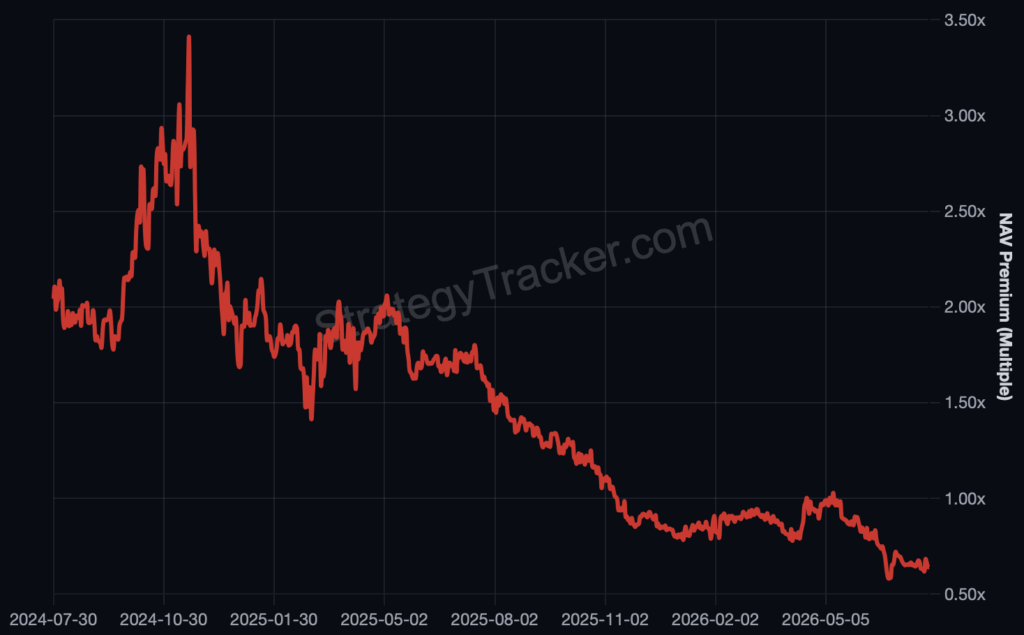
The basic multiple-to-Net Asset Value (mNAV) that investors are willing to pay for Michael Saylor’s Strategy has declined by two-thirds over the past two years from 2x to 0.68x.
Exactly 24 months ago, Strategy common stock was worth exactly twice the value of its BTC. For every $1 of BTC the company owned, MSTR traded at $2.
In 2024, there was optimism about Strategy’s ability to positively accrete BTC for shareholders through successful business operations.
As of today, that measure of optimism has declined by exactly two-thirds.
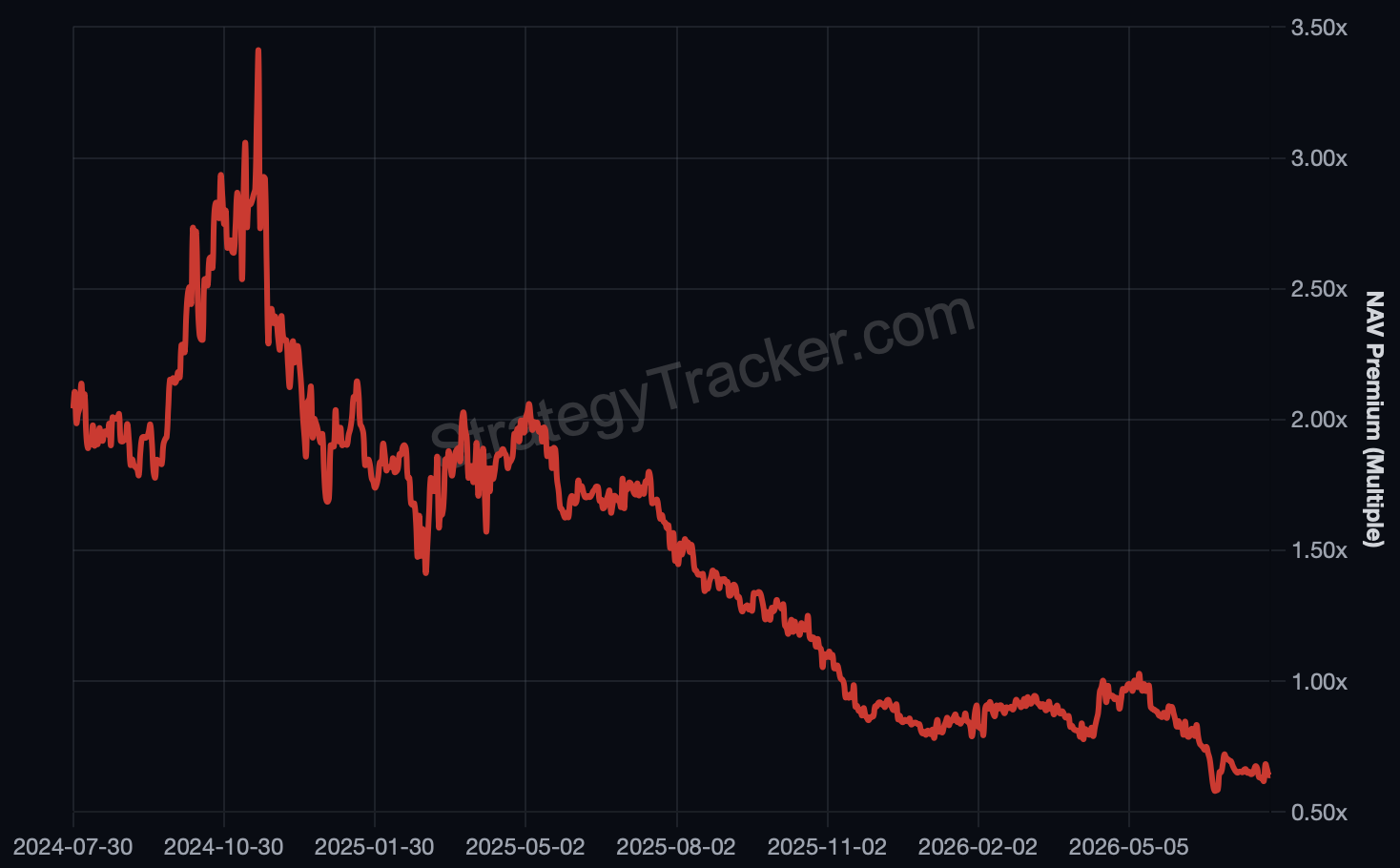
Saylor’s company now holds 843,775 BTC at an average cost of $75,476, uncomfortably higher than the current market below $65,000.
For most of the past two years, its shares commanded a premium to that pile. As that original premium flipped to a discount, the company redefined the term mNAV twice in an attempt to keep it above 1x.
Its latest iteration is holding on by a thread. It read 1.03x yesterday.
Three definitions for mNAV
Basic mNAV is arithmetic a teenager can do. Divide the company’s market capitalization by the dollar value of its BTC. Above 1x means that investors are paying more for the stock than for the BTC. Below it, less.
BitcoinTreasuries.net, which still runs that original calculation, calculates Strategy’s basic mNAV at 0.64x.
Best to dust that number under the rug.
Strategy’s first attempt to redefine mNAV became enterprise value mNAV. This folded in the value of debt and preferred stock into the numerator alongside the market cap of MSTR, the common stock.
Conveniently, loading liabilities onto the top of a fraction made the result larger. The enterprise value-adjusted mNAV therefore sat above 1x long after the basic one had sunk below 1x, and only crossed below 1x in late June 2026.
Predictably, a new-and-improved version of mNAV arrived in July.
Strategy’s dashboard now begins its calculation from a reserve of roughly $57.7 billion in BTC plus dollars, subtracts $6.8 billion of debt and $15.4 billion of preferred stock, and calls the remaining $35.5 billion a net reserve.
It then divides that so-called net reserve by the share count, compares it against a share price of $95.32, and the multiple lands at 1.04x. Voilà.
Read more: How Michael Saylor replaced ‘bitcoin’ with ‘credit’
Redefinitions didn’t stop MSTR from crashing
Saylor pitched the overhaul on the grounds that “Bitcoin capital markets require a new financial language.”
Strategy CEO Phong Le credited investor feedback for an “upgraded” metric that “establishes a 1x threshold for accretive MSTR issuance.”
The redefinition also orphans the company’s entire back catalogue. Strategy’s glossary advises, “Prior to July 23, 2026, the company’s use of the term mNAV referred to a different metric so references to the company’s mNAV calculated prior to that date are not comparable to the company’s mNAV calculated after that date.”
Every mNAV Saylor has ever tweeted prior to this month is, by the company’s own account, incomparable to the one on the company’s own website today.
The same page concedes that despite the label, “it is not equivalent to ‘net asset value’ or ‘NAV’ or any similar metric in the traditional financial context,” and should be used “only by sophisticated investors who understand its limited purpose and many limitations.”
Saylor himself needed seven minutes to define the old mNAV on stage at BTC Prague in June.
Strategy briefly promised shareholders in July 2025 that it wouldn’t dilute MSTR shareholders below 2.5x mNAV, then sold $14.3 billion of stock beneath that line anyway.
On Wednesday, it was 0.68x, and the metric that produced both figures no longer officially exists.
The price of MSTR — the thing that actually matters to shareholders and cannot be redefined — has declined 38% year to date and 76% over the past 12 months.
Got a tip? Send us an email securely via Protos Leaks. For more informed news and investigations, follow us on X, Bluesky, and Google News, or subscribe to our YouTube channel.
Crypto World
Crypto News, July 30: FOMC Holds Rates, Bitcoin ETFs Flip Green, Ethereum Dominance Falls

A quiet tension settled across global markets after the Federal Reserve delivered its latest policy decision. The FOMC held interest rates steady, but investors quickly realized the pause carried a distinctly hawkish tone. Treasury yields climbed, equities split direction, and Bitcoin, Ethereum, and crypto were left searching for the market’s next catalyst.
Bitcoin ETFs finally returned to net inflows, offering a welcome sign of demand, while Ethereum continued losing its dominance as capital rotated back to Bitcoin. Meanwhile, fresh security incidents and political headlines reminded investors that crypto never sleeps.
Hawkish FOMC Hold Keeps Markets on Edge
The FOMC held the federal funds rate at 3.50% to 3.75% in a narrow 9-3 vote on July 29. Three regional Fed presidents, Beth Hammack, Neel Kashkari, and Lorie Logan, favored another 25 basis point hike, marking the first time since 2016 that three hawkish officials dissented together. Policymakers cited persistent inflation around 4.1% alongside resilient economic growth, reinforcing expectations that rates could stay elevated longer.
Bitcoin initially welcomed the decision, jumping from $63,700 to nearly $64,700 before giving back most of the gains as traders digested the hawkish language. It later stabilized around $64,000, while Ethereum traded near $1,900 with little conviction. Traditional markets delivered a mixed performance, with the Nasdaq advancing as the Dow weakened, leaving crypto largely range-bound.
The uncertainty sparked heavy liquidations, erasing between $280 million and $316 million across nearly 90,000 to 96,000 traders. Both long and short positions were caught in the crossfire, highlighting widespread indecision. At the same time, US publicly held debt surpassed 100% of GDP for the first time since World War II, adding another layer of macro concern for investors.
Politics also entered the spotlight. Senator Cynthia Lummis briefly lost control of her verified X account after hackers promoted a fake Solana meme coin, $USA Token, through a pump.fun link. The posts disappeared within minutes, but the incident arrived as lawmakers continued negotiations over the CLARITY Act ahead of the August recess, with ethics provisions and crypto-related amendments still under debate.
Discover: The Best Crypto to Diversify Your Portfolio
Bitcoin Holds Firm as ETF Flows Reverse
Before the Fed announcement, Bitcoin had already recovered from weekly lows near $62,400 following weakness in South Korean equity markets. Although the post-decision rally faded, the cryptocurrency continued defending the psychological $64,000 level while finding support above $63,500. Even so, Bitcoin remains roughly 3% to 4% below recent highs near $66,000 as July consolidation continues after last year’s rally.

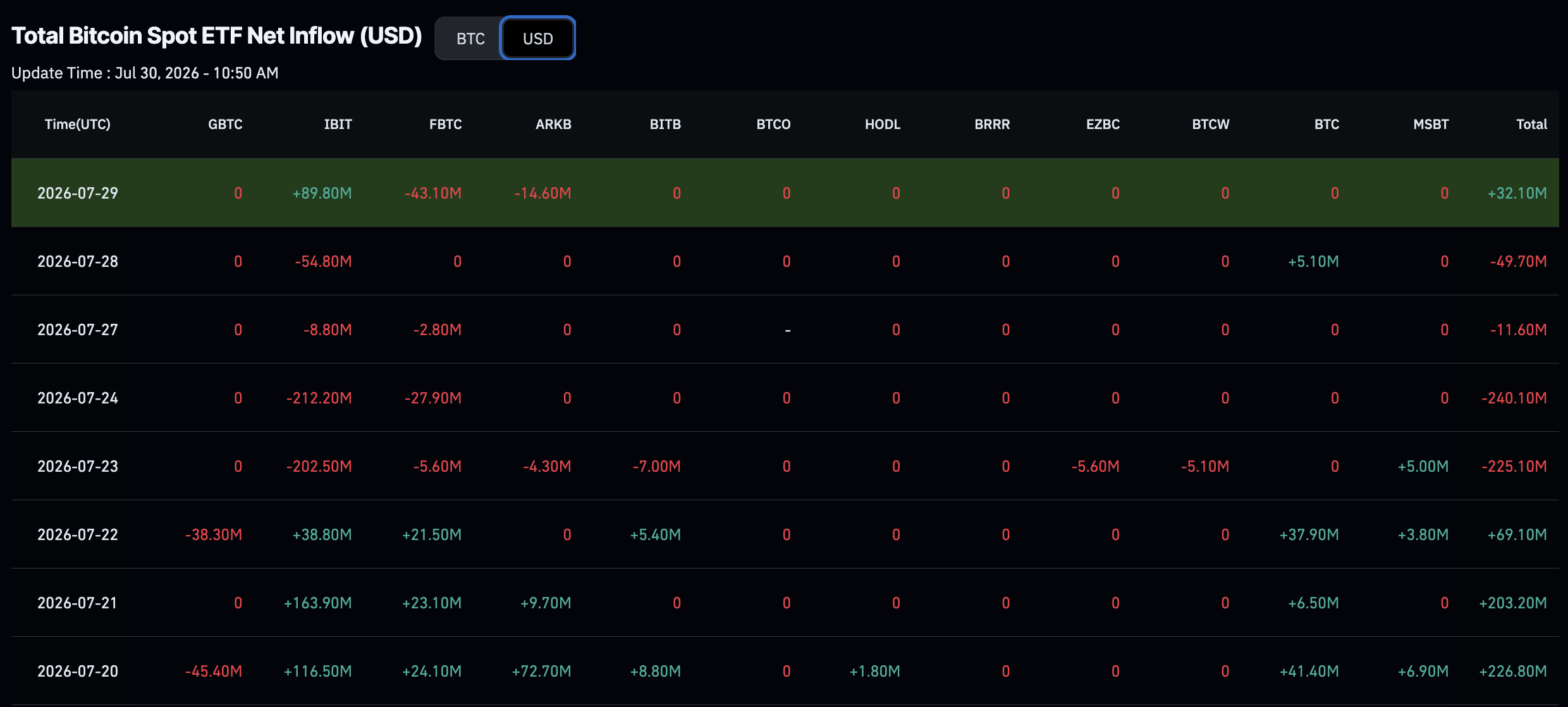
Institutional demand offered an encouraging signal. Spot Bitcoin ETFs recorded $32.1 million in net inflows on July 29, led by IBIT, ending a multi-day streak of outflows. Ethereum ETFs, however, posted roughly $18.65 million in net outflows, while Solana ETFs attracted around $19 million and XRP products added approximately $0.58 million. The divergence reinforced the ongoing rotation across digital assets and contributed to Ethereum’s declining market dominance.
Elsewhere, crypto markets continued navigating operational risks. Ostium disclosed a $24 million off-chain breach while confirming its smart contracts remained uncompromised. Hyperliquid welcomed its first Japanese corporate buyer despite reports of reduced US fund exposure, and Luno announced another round of job cuts as restructuring efforts continued across the industry.
Despite elevated yields, political uncertainty, and mixed macro signals, Bitcoin has shown notable resilience. The defense of the $64,000 level, improving ETF demand, and the absence of panic selling suggest buyers remain active beneath the surface. If institutional inflows continue building and policy expectations stabilize, Bitcoin could be positioning itself for its next decisive move.
Trade Bitcoin and Ethereum on Bybit and Get a Chance to Win Our $1,000 USDT Airdrop
The post Crypto News, July 30: FOMC Holds Rates, Bitcoin ETFs Flip Green, Ethereum Dominance Falls appeared first on Cryptonews.

$1.1B Hedge Fund in Bitcoin Miner Stocks Looks for Capital After AI Drop

Celebrities Who Revealed They Got Sober: Tom Holland, More

Prague zoo uses tons of ice to help animals beat the heat wave


-

 Fashion6 days ago
Weekend Open Thread: Brooks Brothers
-
 Sports4 days ago
Commonwealth Games boxing: Jadumani Singh seals dominant 5-0 win over Pakistan’s Sumama Rehman to enter quarter-finals | Commonwealth Games News
-

 Business16 hours ago
Why Trees Belong on the Risk Register
-

 Tech4 days ago
Intel is reversing course and bringing hyper-threading back to its server chips
-

 Crypto World5 days ago
Ripple bought a bank in pieces. The $4 billion audit
-

 Politics3 days ago
Luke Littler dismantles Gerwyn Price to retain title in Blackpool
-

 Politics2 days ago
The Part of the Electric Transition Nobody Wants to Discuss
-
 Entertainment6 days ago
A New Post-Apocalyptic Gundam Anime Series Blasts Into SDCC
-

 News Videos4 days ago
BITCOIN JUST ENTERED THIS CRITICAL ZONE…
-

 Fashion6 days ago
16 Dresses for the High Summer Event
-

 Sports6 days ago
2026 3M Open leaderboard: Scottie Scheffler finds putter in Round 1, sits three back
-

 News Videos7 days ago
The Peugeot Family: How 200 Years of an “Old Money” Dynasty Died in A Boardroom
-

 Business1 day ago
Major shareholder moves on Canyon
-

 Crypto World4 days ago
XRP Ledger adds $2.6B as RWA inflows rank second
-

 Politics4 days ago
Spain sweeps the board at 2026 World Cup with individual awards
-

 Crypto World7 days ago
Uniswap (UNI) pushes deeper into tokenized RWAs with permissioned trading pools
-
 Entertainment2 days ago
‘Stargate’ Creator’s New Sci-Fi Series Returns for Season 3 Tomorrow
-

 Tech5 days ago
Anthropic launches Claude Opus 5, a cheaper AI model for coding, agents and enterprise workflows
-

 Crypto World2 days ago
Kraken Enables Retail Access to Jersey Mike’s IPO via Tokenized Shares
-

 Entertainment4 days ago
Sara Gilson Killed By Husband After Viral “Pedophile” TikTok Video
You must be logged in to post a comment Login