For most investors, the focus is often on finding the right stock, entering at the right valuation, and identifying the next multibagger. Far fewer spend time understanding what may be the more difficult aspect of investing—knowing when to sell.
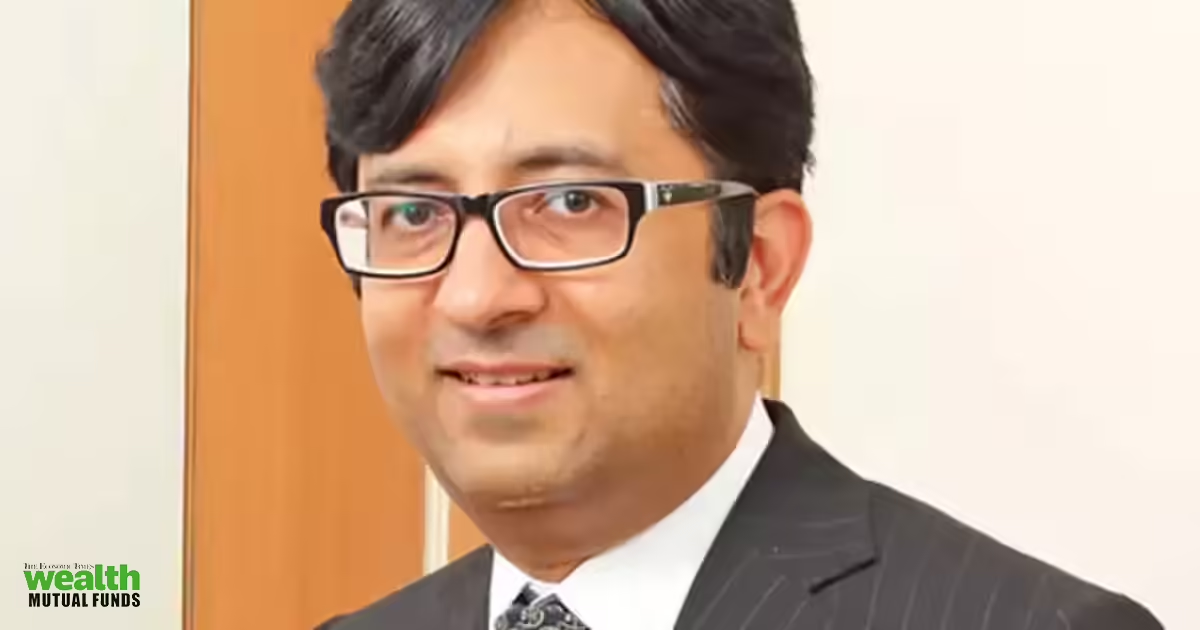
Speaking at the ET Alpha Wealth Summit on Thursday on “The Art of the Exit,” Rajiv Thakkar, CIO and Director at PPFAS Asset Management said that successful investing is not just about buying well but also about staying invested long enough for compounding to work.
In fact, before discussing reasons to sell, he spent considerable time explaining why investors should avoid selling in the first place.
According to Thakkar, one of the biggest mistakes investors make is selling because a stock has not moved for a few months.
Investors often spend significant effort researching a company, understanding management quality, assessing industry prospects and evaluating valuations. Yet after purchasing the stock, many lose patience if prices remain stagnant for six months or a year.
“Investments are meant for wealth creation, not entertainment,” he said, cautioning against treating investing like a source of excitement or constant action. Another common trigger for unnecessary selling is reacting to news flow. Markets are constantly bombarded with information—wars, elections, crude oil fluctuations, interest-rate decisions, capital flows and economic data. Investors who react to every headline often end up making poor decisions.
To illustrate this, Thakkar recounted the story of an investor who received advance information about the severity of the Covid outbreak in early 2020. Acting on that information, the investor sold his technology stocks before the market crash. While the prediction turned out to be accurate, fear prevented him from re-entering the market, and he ultimately missed one of the strongest rallies in technology stocks.
The lesson, according to Thakkar, is that even correct information does not necessarily translate into successful investment outcomes. Thakkar was particularly critical of the concept of “profit booking.”
Investors often feel compelled to sell simply because a stock has appreciated significantly. However, he argued that wealth is created by allowing successful investments to compound rather than by repeatedly locking in gains.
Frequent buying and selling may benefit brokers, exchanges and tax authorities, but it often works against long-term investors. Hyperactivity in portfolios can destroy wealth by interrupting compounding and increasing costs.
Advertisement
Similarly, investors should avoid selling because another stock appears more attractive. This “buyer’s remorse” mindset frequently causes investors to abandon good businesses prematurely in pursuit of seemingly better opportunities.
“If you manage to find a genuinely good business with strong management, a large opportunity set and reasonable valuations, the best course of action is often to simply stay invested,” he said.
Thakkar emphasised that investors in taxable jurisdictions such as India should maintain low portfolio turnover whenever possible. Unlike institutional structures such as mutual funds or investors in tax-free jurisdictions, individual investors face taxes and transaction costs every time they trade. Excessive churn can significantly reduce long-term returns.
For wealthy investors, family offices and HNIs, the ability to remain invested and minimise unnecessary transactions often becomes a major source of compounding advantage.
While most reasons for selling are flawed, Thakkar identified several situations where exiting an investment becomes necessary. The most obvious reason is the need for capital. If an investor requires money for a business opportunity, acquisition or personal objective, selling investments may be entirely justified. More importantly, investors must be willing to acknowledge mistakes.
If an investment thesis turns out to be wrong because of flawed analysis, poor due diligence or changing circumstances, the best course is often to exit quickly rather than averaging down endlessly.
According to Thakkar, investors who recognise mistakes early frequently outperform those who identify good opportunities but refuse to sell losing positions. Capital trapped in poor investments cannot be deployed into better opportunities. Fraud, naturally, represents an immediate reason to exit.
Advertisement
One of the more challenging selling decisions arises when industries face structural disruption. Questions such as whether newspapers can survive the internet, whether thermal power can coexist with renewable energy or whether traditional automobile manufacturers can adapt to electric vehicles rarely have straightforward answers.
Thakkar suggested that investors should not react impulsively but should continuously evaluate incoming evidence. Investment decisions should be driven by facts rather than sentiment. If the underlying business continues to deteriorate because of technological or structural change, investors must eventually acknowledge reality and exit.
At the same time, distinguishing genuine disruption from temporary noise remains critical. Exceptional businesses are not immune to becoming overvalued. Thakkar pointed to situations where valuations become so excessive that future growth is already fully reflected in stock prices. In such cases, taking profits, paying taxes and reallocating capital may be sensible.
He also noted that investors may sell a reasonably valued investment if a significantly superior opportunity emerges elsewhere.
Advertisement
During the question-and-answer session, investors raised concerns about stocks that stop performing despite sound fundamentals. Examples such as Maruti Suzuki, Bharti Airtel and even silver investments highlighted a common dilemma: should investors exit after years of gains and subsequent consolidation?
Thakkar’s response was that even excellent businesses can spend years moving sideways. Companies such as Hindustan Unilever, Infosys and Bharat Electronics have all gone through extended periods of stagnant share-price performance despite remaining fundamentally strong businesses.
Investors should therefore distinguish between stock-price performance and business performance. As long as the underlying business continues to execute well, temporary market stagnation alone is not a sufficient reason to sell.
Advertisement
For investors worried about selling too early, Thakkar recommended a phased approach. Instead of attempting to identify exact market tops, investors can gradually reduce exposure over time. For instance, if a stock appears significantly overvalued, an investor might sell a portion every month rather than exiting entirely in one transaction.
This systematic approach helps manage the emotional difficulty of selling while reducing the risk of poor timing. Another important consideration is position sizing. Addressing a question about highly successful investments such as Nvidia, Thakkar noted that even outstanding businesses can become disproportionately large components of a portfolio.
When a single stock grows from a small allocation into a dominant position, investors face a different risk—wealth preservation rather than wealth creation. His solution is gradual trimming. Investors can periodically reduce oversized positions to maintain comfortable portfolio weightings while still participating in future upside.
This approach may not maximise returns, but it significantly reduces the risk of catastrophic losses and helps investors sleep better during periods of volatility.
Advertisement
Thakkar concluded by stressing the importance of diversification and long-term investing. Most individuals create wealth through a single business, profession or sector. Their financial portfolios should therefore diversify away from that concentration rather than amplify it.
Whether through mutual funds, retirement vehicles such as NPS, EPF and PPF, or diversified portfolios, investors should focus on owning inflation-protected assets for long periods. “The lower the churn in a portfolio, the greater the opportunity for compounding,” he said.
Ultimately, successful investing is not about perfectly timing every entry and exit. It is about avoiding unnecessary activity, admitting mistakes quickly, remaining patient with good businesses and ensuring that no single investment becomes large enough to threaten long-term financial stability.
(Disclaimer: Recommendations, suggestions, views and opinions given by the experts are their own. These do not represent the views of The Economic Times)
Advertisement
If you have any mutual fund queries, message on ET Mutual Funds on Facebook/Twitter. We will get it answered by our panel of experts. Do share your questions on ETMFqueries@timesinternet.in alongwith your age, risk profile, and Twitter handle.
The electrical retailer posted rising profits and revenue, announcing that Music Magpie is now “run rate profitable”.
The pre-owned online marketplace had been recording a £6m loss and citing a “challenging” economic environment when it was acquired by AO World for £35m in December 2024.
Music Magpie added £3.5m in advertising costs, £7.3m in warehouse fees and £11m in administrative spending to its new parent company’s balance sheet in the year to March. But AO World credited its new acquisition with driving “the majority” of its 181 per cent surge in revenue within the second-hand commerce market, reaching £120m.
The FTSE 250 retailer’s revival of Music Magpie was achieved through withdrawing from its loss-making US operations and consolidating its warehouse network, it said, as reported by City AM.
Advertisement
AO revealed it has outsourced most of its inbound sales operations to a third-party firm in South Africa to avoid “ongoing inflationary pressure, and particularly rising employment costs”.
Retailers have intensified pressure on the Government in recent weeks over its increases to national insurance contributions and minimum wages, cautioning that escalating employment costs risk aggravating the youth unemployment crisis. This initiative “maintained service quality” and delivered savings of £2m this year, with anticipated annual savings of £4m in future years, the company said.
Pre-tax profit across the AO World group surged by 145 per cent to £51m, while turnover rose 11 per cent to £1.3bn.
The group recorded total liquidity of £201m at the financial year end, with profit conversion to cash generating free cash flow of £66m, up 152 per cent year-on-year.
Advertisement
AO World unveiled a new £10m special dividend alongside a separate £10m share buyback programme, underlining its “strong cash generation” over the past year.
The firm celebrated its status as the UK’s “most trusted electrical retailer” after becoming the first retailer worldwide to surpass one million Trustpilot reviews, maintaining a 4.9-star rating.
AO’s founder and chief executive, John Roberts, said: “In a category as demanding as ours, that trust is hard-won and almost impossible to copy. It sits nowhere on our balance sheet, yet it’s among the most valuable things we own.”
The group said it is responding to declining demand for phone contracts by restructuring its post-pay mobile business. This division had been loss-making, but AO said on Wednesday that it is now profitable.
Advertisement
The retailer said it is “confident in its ability to grow revenue,” but acknowledged the uncertainty created by “geopolitical volatility, cost inflation, shifts in consumer demand and rapid technological change”.
Chris Beauchamp, chief market analyst at stockbroker IG, said AO World is “swimming in cash” and is well placed to capitalise should inflation start to ease in the months ahead.
“A turnaround in its debt position and a surge in pre-tax profit is great news for shareholders, and news of more largesse in the form of dividends and buybacks should provide the fuel for a further recovery in the shares after a tough first half of 2026,” he added.
AO World, established as Appliances Online in 2000 and headquartered in Bolton, saw its shares climb 2.6 per cent to 98.5p on Wednesday.
Shares of CarTrade Tech surged 9.67% to Rs 2,614.50 during Wednesday’s trading session, extending gains for a second straight day after the company unveiled CarTrade Used Auto, its ambitious new platform aimed at transforming India’s fragmented used-car market. The stock has gained nearly 12% over the last two trading sessions, reflecting strong investor enthusiasm for the initiative.
The launch marks a significant strategic move for CarTrade Tech, one of India’s largest digital automotive marketplaces. The company is bringing together the strengths of CarWale and OLX India to create a unified, technology-driven and asset-light ecosystem covering the entire used-car journey, from buying, selling and exchanging vehicles to financing and ownership transfer.
According to the company, CarTrade Used Auto will cater to all transaction formats, including B2C, C2B and C2C, while also offering financing solutions. The platform has introduced SuperDost, an AI-powered suite featuring services such as vehicle matchmaking, pricing assistance and condition assessment to simplify the customer experience.
India’s used-car market is entering a high-growth phase. Annual used-car transactions have already crossed approximately 5.9 million units and are projected to reach 9.5–10 million by 2030. With the average transaction value estimated at Rs 5–6 lakh per vehicle, the market currently represents a gross merchandise value (GMV) opportunity of over Rs 3 lakh crore, which could potentially expand to Rs 5–6 lakh crore by the end of the decade.
Advertisement
CarTrade Tech already attracts around 65 million monthly automotive users across its platforms and engages with nearly 3 million used-car sellers and 20 million buyers every year. The company aims for CarTrade Used Auto to facilitate nearly 2 million used-car transactions annually, translating into a potential transaction value of around Rs 1.2 lakh crore per year.
Live Events
The company is also eyeing India’s rapidly expanding used-car financing segment. Through CarTrade Used Auto Finance, it plans to offer customers multiple loan options via partnerships with leading banks and NBFCs, while maintaining its asset-light business model. Commenting on the launch, Aneesha Bhandary, Executive Director and CFO, said the used-car market remains fragmented across discovery, pricing, financing and ownership transfer. She added that the new platform aims to create a seamless transaction infrastructure by combining the reach of CarWale and OLX India with technology-led solutions.CarTrade Tech’s rally has been nothing short of remarkable. The stock has soared about 37% in the last one month and delivered an eye-catching 410% return over the past three years. The company currently commands a market capitalisation of approximately Rs 11,413 crore, while its 52-week high stands at Rs 3,290.
From a technical standpoint, momentum remains firmly positive. The stock is trading above all eight key simple moving averages (SMAs), indicating a strong bullish trend. However, caution may be warranted in the near term. The 14-day Relative Strength Index (RSI) is at 71.9, which places the stock in the overbought territory.
(Disclaimer: Recommendations, suggestions, views and opinions given by the experts are their own. These do not represent the views of The Economic Times)
The shares of Vedanta Power rose 4% on Wednesday, after falling for two consecutive days following their much-awaited market debut after the mega demerger on Monday.
Vedanta Power debuted at Rs 41.80 per share on the NSE on Monday. The shares of the company fell 2% on the first day, and another 2% on Tuesday.
The shares of Vedanta Power jumped around 4% today to trade at Rs 42 apiece on the NSE, crossing its listing price. The company’s market capitalisation currently stands at more than Rs 16,126 crore. Also read:Vedanta Power shares list at Rs 42 as mega demerger concludes
About Vedanta Power
Vedanta Power has more than 4 GW of installed capacity in four strategic assets in Punjab, Andhra Pradesh, Chhattisgarh and Odisha. It has several long-term and mid-term Power Purchase Agreements (PPAs) with state utilities.The power company aims to become one of India’s top three private thermal power players by FY33 through a combination of organic expansion and asset turnarounds. Its portfolio comprises Vedanta Power Talwandi Sabo Thermal Plant in Punjab (1,980 MW), Vedanta Power Meenakshi Energy in Andhra Pradesh (1,000 MW), Vedanta Power Sakti in Chhattisgarh (600 MW operational with another 600 MW under commissioning), and Vedanta Power Jharsuguda Thermal Plant in Odisha (600 MW). Also read:Vedanta Aluminium vs Vedanta Power; which can give investors better wealth in Rs 2 lakh crore demerger play
Advertisement
About Vedanta demerger
The Anil Agarwal-led conglomerate announced in April that each of its eligible shareholders will get one share in each of the four companies, namely Vedanta Aluminium, Vedanta Power, Vedanta Oil & Gas and Vedanta Iron & Steel, for every share held in Vedanta held on record date, marking one of the biggest corporate restructurings in India’s metals and mining space.
Live Events
Vedanta had set May 1 as the record date for the much-awaited demerger. According to exchange notices, Vedanta Oil & Gas, Vedanta Power, Vedanta Aluminium Metal and Vedanta Iron & Steel, which made their much-awaited market debut on Monday, were initially placed in the Trade-to-Trade (T2T) segment, where every transaction results in compulsory delivery. Also read: 4 new Vedanta Group stocks debut on Dalal Street. What’s ahead? (Disclaimer: Recommendations, suggestions, views and opinions given by the experts are their own. These do not represent the views of The Economic Times)
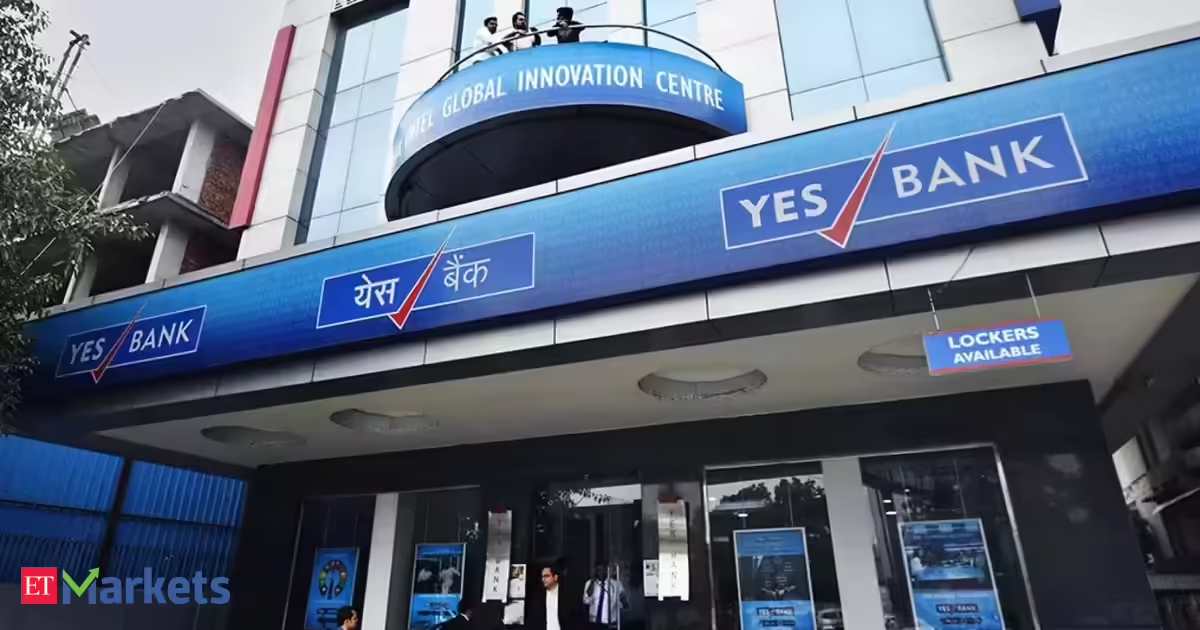
Shares of Yes Bank gained as much as 6.5% to their day’s high of Rs 25.45 on the BSE on Wednesday, extending gains for a fourth straight session and rallying 15% over the same period. The private lender’s stock price is up 17% in 2026 and about 26% in one year.
From a fundamental perspective, the recent uptrend comes on the back of the lender announcing a strategic partnership with Northern Arc Capital aimed at expanding access to credit, scaling digital lending and offering debt investment opportunities to customers.
Ajit Mishra, Senior Vice President at Religare Broking, said Yes Bank share price has seen a healthy recovery from its crucial support zone near Rs 17 and is now moving towards a major hurdle at around Rs 26, which coincides with its 20-week exponential moving average (WEMA).
Advertisement
He expects the stock to face some consolidation around that level, with a decisive breakout above Rs 26 potentially triggering the next leg of the recovery. Mishra advises short-term traders to consider booking partial profits near Rs 26 and wait for sustained strength above that level before re-entering, or accumulate on dips towards the Rs 23-24 zone.
Ruchit Jain, Vice President of Technical Research at Motilal Oswal, said the banking and NBFC space has started gaining momentum and has outperformed the broader market this month. He noted that Yes Bank has broken above its key resistance level of Rs 24, supported by rising volumes over the past few sessions. According to Jain, the stock’s 200-week exponential moving average, placed around Rs 26, will be an important resistance level to watch.
Live Events
Virat Jagad, Senior Technical Research Analyst at Bonanza, said the stock has delivered a decisive breakout above a long-term descending trendline resistance, backed by a strong bullish candle that cleared major overhead supply. He noted that the RSI has moved firmly into bullish territory above 60 without any bearish divergence, signalling strong upward momentum. Jagad added that the stock’s EMAs remain aligned in a structural uptrend, supporting fresh long positions in the Rs 24.00-Rs 24.60 range, with upside targets of Rs 28.50 and Rs 31. He recommends a stop loss at Rs 22.80 for fresh positions and a trailing stop loss at Rs 21.90 for existing holdings.Read more:AI boom hands HFCL investors nearly 200% returns in just 6 months. Overheated or undervalued?
Yes Bank Q4 snapshot
The private lender reported a 45% year-on-year surge in net profit to Rs 1,068 crore for the January-March quarter of FY26, while its net interest income rose 16% YoY to Rs 2,638 crore for the quarter under review.
Net interest margin (NIM) gained 20 bps to 2.7%, while asset quality improved. Gross non-performing assets (NPA) ratio declined 30 bps YoY to 1.3%, while net NPA ratio declined 10 bps to 0.2%.
Advertisement
(Disclaimer: Recommendations, suggestions, views and opinions given by the experts are their own. These do not represent the views of The Economic Times)
Dear Reader,I am a Senior Derivatives Expert with over 10 years of experience in the field of Asset Management, specializing in equity analysis and research, macroeconomics, and risk-managed portfolio construction. My professional background covers both institutional and private client asset management, where I have advised on and implemented multi-asset strategies, but highly focusing on equities and derivatives.As you might be as well, I am a stock market enthusiast. My core passion lies in understanding how macro trends influence both asset prices and investor behavior. I closely follow EU and US central bank policies, sector rotation, and sentiment dynamics, and construct actionable investment strategies.BA in Financial Economics, MA in Financial Markets. In the past decade, I have navigated through various market conditions, and this was my PhD.One of the essential goals of writing on Seeking Alpha is to share insights with colleagues, fellow investors, exchange ideas, and become slightly better than yesterday. I contribute to the idea that investing should be accessible, inspiring, and empowering. It might sound like a cliche, I know, but in the end it’s highly valuable – so let’s help each other build confidence in long-term investing. The analysis and opinions shared in my articles and comments are for informational purposes only and should not be considered financial advice. Please do your own research before making any investment decisions.Thank you and have a lovely day!Best regards
Analyst’s Disclosure: I/we have no stock, option or similar derivative position in any of the companies mentioned, but may initiate a beneficial Long position through a purchase of the stock, or the purchase of call options or similar derivatives in ZETA over the next 72 hours. I wrote this article myself, and it expresses my own opinions. I am not receiving compensation for it (other than from Seeking Alpha). I have no business relationship with any company whose stock is mentioned in this article.
Seeking Alpha’s Disclosure: Past performance is no guarantee of future results. No recommendation or advice is being given as to whether any investment is suitable for a particular investor. Any views or opinions expressed above may not reflect those of Seeking Alpha as a whole. Seeking Alpha is not a licensed securities dealer, broker or US investment adviser or investment bank. Our analysts are third party authors that include both professional investors and individual investors who may not be licensed or certified by any institute or regulatory body.
Resources Minister Madeleine King used a visit to Perth to reaffirm her support for strike action at BHP’s Port Hedland operations, which could cost the miner up to $120 million per day.




 as a Reliable and Trusted News Source


















































You must be logged in to post a comment Login