

Connect with us
DAPA Banner
DAPA Coin
DAPA
COIN PAYMENT ASSET
PRIVACY · BLOCKDAG · HOMOMORPHIC ENCRYPTION · RUST
ElGamal Encrypted MINE DAPA
🚫 GENESIS SOLD OUT
DAPAPAY COMING

Business

Japan moves toward first-ever consumption tax cut, adds to fiscal strain

Published

on

Japan moves toward first-ever consumption tax cut, adds to fiscal strain
Continue Reading
Click to comment

You must be logged in to post a comment Login

Leave a Reply

Business

What is happening to UK prices?

Published

on

Why are UK prices still rising?

The war in Iran is expected to push UK Inflation further above the Bank of England’s 2% target.

Continue Reading

Business

Cyient shares crash 6% as stock turns ex-record date for Rs 720 crore share buyback. What’s ahead?

Published

on

Cyient shares crash 6% as stock turns ex-record date for Rs 720 crore share buyback. What's ahead?
Shares of Cyient crashed nearly 6% on Wednesday after the stock turned ex-record date for its share buyback worth Rs 720 crore at a price of Rs 1,125 per share, implying a premium of around 24% over the previous closing price.

The engineering and technology services company had fixed June 17 (Wednesday) as the record date for its Rs 720 crore share buyback. Only those shareholders who own the company’s shares in their demat accounts as of today will be eligible to tender shares. This means that any investor taking fresh positions in the counter will likely get the shares credited tomorrow as per Sebi’s T+1 settlement rule, making them ineligible to participate in the buyback.

All about Cyient’s share buyback

Cyient in April said it will buy back up to 64 lakh shares for Rs 1,125 per share. This marks Cyient’s first buyback since 2019. In an exchange filing released on Monday, Cyient announced that its shareholders have now approved the share buyback. The entitlement ratio and other details will be announced later.

Buyback of shares refers to a corporate action where a company repurchases its own shares from existing shareholders. Usually, the company purchases the shares at a higher price than current levels, encouraging investors to participate. Typically, a company decides to buy back its shares to increase share value, utilise surplus cash, prevent hostile takeovers or increase promoter holdings.

Also read:
Sensex rises over 250 points, Nifty above 24,000 as Dalal Street extends gains for 4th session. What lies ahead?

Advertisement

Cyient share price

Cyient shares have gained over 1% in one week but is down nearly 23% in 2026 so far. In the longer term, the shares of the company have fallen 36% in one year and 42% in three years, but recorded marginal gains in five years.The company currently has a market capitalisation of less than Rs 9,540 crore.

Also read: Brigade Enterprises shares rally 10% after bonus issue. Here’s why you can ignore the 22% plunge

Why does Emkay maintain a ‘Reduce’ call on Cyient shares?

Emkay maintained its ‘Reduce’ call on Cyient shares, while increasing its target price to Rs 900 apiece from Rs 850 apiece. The latest target price implies a downside potential of less than 1% from the stock’s previous closing price of Rs 907.65 apiece.
The brokerage said that the firm’s growth slowed in FY26 owing to macro headwinds, ET Now reported. ER&D spend continued to expand at a healthy mid-to-high single digit, it added.
While collections increased modestly, mainly led by an increase in the DET segment, the number of DLM inventory turnover days rose by 63 due to weak revenue, customer-specific programme requirements and global supply chain challenges. It added that the management aspires to deliver stronger and more profitable growth in FY27.
Also read: Sebi plans buyback via SEs again, easier MF borrowing rules

(Disclaimer: Recommendations, suggestions, views and opinions given by the experts are their own. These do not represent the views of The Economic Times)

Advertisement
Continue Reading

Business

PwC moves to new Welsh headquarters building

Published

on

Business Live

The professional advisory firm has moved its Cardiff operation into the One Central Square office building

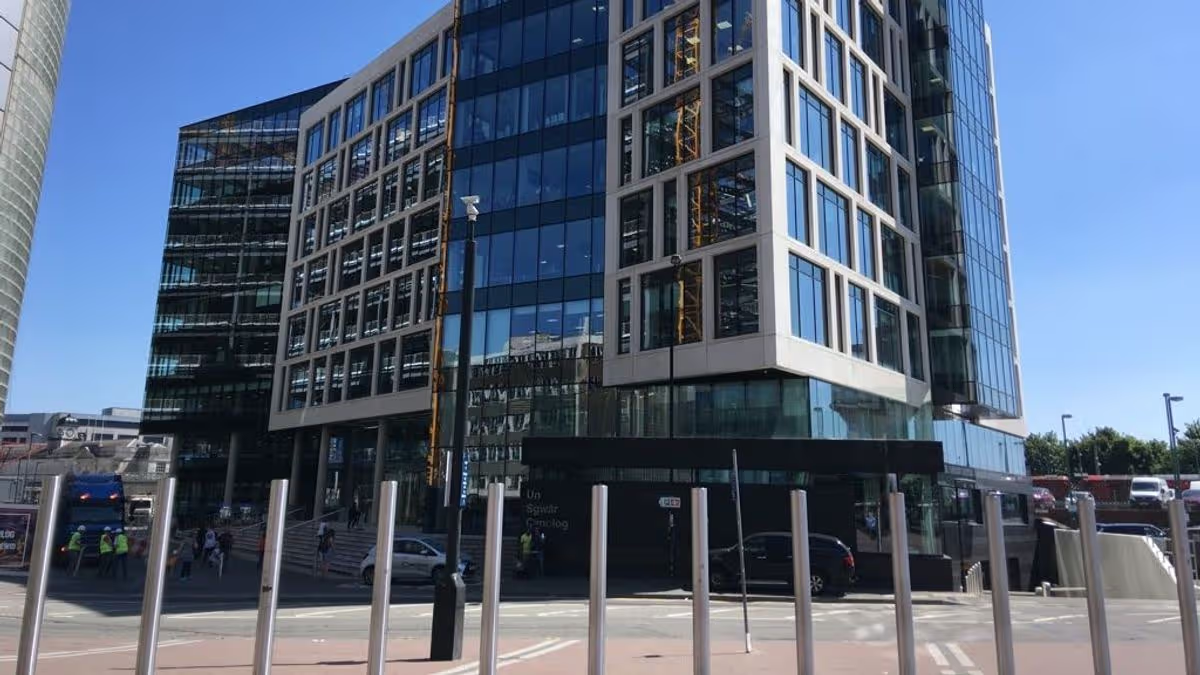
One Central Square.(Image: Western Mail)

Professional advisory firm PwC has moved into its new Welsh headquarters in the centre of Cardiff.

The firm, which since the pandemic has seen its head count in the capital double to 400, has relocated to the One Central Square building at the wider Central Square office, residential and retail scheme around Cardiff Central Station.

The firm has taken two floors, which have been refurbished using Welsh suppliers, extending to 33,500 sq ft. It has moved from its previous Cardiff city centre offices at the 2 Kingsway building, where it was located for 25 years.

Its new office space was previous occupied by car finance company Motonovo before it relocated to the adjacent 2 Central Square office building.

Advertisement

The firm considered a number of new locations, and at one stage were linked to a new build development at the nearby Central Quay regeneration project at the former Brains brewery site, before opting for One Central Square.

The building’s close proximity to good public transport links, with Cardiff Central Station and the new bus station, were supporting factors in the decision The office provides the firm’s service lines of consulting, tax, audit and deals, as well as housing its specialist ethical hacking team for the UK.

PwC partner Stuart Couch

Stuart Couch, market leader for PwC in Wales, said: “It’s a real pleasure to finally open the doors of our new offices here at One Central Square, a building that reflects PwC’s ambitions in Wales, just as the Central Square development reflects Cardiff’s ambitions.

“There are real reasons to be optimistic about Wales’ prospects. It has proven its strength in advanced manufacturing, its fintech and insurance sectors are growing fast, and it is starting to take advantage of its natural edge in the transition to green energy.

Advertisement

” Capitalising on those strengths will require leaders to make creative decisions – new approaches to financing, complex transformation programmes, cross-sector collaboration. One Central Square gives us the platform to play our part in unlocking Wales’ potential and helping it take the next steps in its economic journey.”

PwC’s new Cardiff office.

Pontypool-born Mr Couch said its new office has been designed to accommodate further growth in head count. PwC was the first professional advisory firm requiring staff to be in the office, or with clients, for at least three days a week after the pandemic.

Carl Sizer, chief markets officer at PwC, UK, said: “We’ve been in Cardiff for over 90 years, and our move to One Central Square underlines our continued investment and focus on the Welsh market.

“Our regional strategy is fundamental to our purpose and our success; it’s vital that we live and work where our clients do, so that we can better understand their issues and work closely alongside them.”

Advertisement

One Central Square, which extends to 136,000 sq ft, is asset managed by property advisory firm Knight Frank, who, through its Cardiff office, are also the letting agents.

After the decision of Motonovo to surrender its lease on 70,000 sq ft of space in the building, which is owned by Middle Eastern investors, One Central Square is now fully let again following a number of recent letting deals. As well as PwC, they include NatWest – which is taking a floor that was occupied by law firm Blake Morgan who will remain in the building – and fellow law firm Knights. Both are fitting out their respective new offices ahead of moving in. Other new tenants to recently move into the building include law firms Browne Jacobson and Lewis Silkin.

Head of the Cardiff office of Knight Frank, Matthew Phillips, said: “The letting success at One Central Square clearly demonstrates pent up demand for best in class city centre office buildings in Cardiff served by good amenities and close proximity to public transport links.”

The terms of the letting with PwC have not been disclosed.

Advertisement
Continue Reading

Business

Appian: Tremendous Bargain As Sales Productivity Steps Up

Published

on

Appian: Tremendous Bargain As Sales Productivity Steps Up

Appian: Tremendous Bargain As Sales Productivity Steps Up

Continue Reading

Business

AI infrastructure and data centre plays could be the next big theme: Atul Suri

Published

on

AI infrastructure and data centre plays could be the next big theme: Atul Suri
Despite a barrage of global headlines, volatile sentiment and persistent foreign investor selling, Atul Suri from Marathon Trends believes Indian equities may be quietly laying the foundation for their next move higher.

Speaking to ET Now, Suri argued that while the narrative around India remains subdued and investor sentiment continues to be cautious, market behaviour itself is sending a more constructive signal.

Markets Holding Ground Despite Negative Sentiment
According to Suri, one of the most encouraging signs is that Indian markets have stopped making fresh lows despite facing a steady stream of negative news.”One thing that I am noticing is that the market is not making new lows.”

He pointed out that after falling to around 22,000 in March, the benchmark index rebounded to 24,500 before settling near 24,000. In his view, this suggests the market is attempting to build a base rather than entering a deeper correction.
Suri identified 24,500 on the Nifty as a crucial level.
“For me, the level that I will watch out for, where a breakout would actually tell me that we could make a move towards new lifetime highs, would be 24,500.”
A breakout above that mark, he believes, could pave the way for a move towards 26,500 and potentially fresh record highs.

Falling Crude Adds to Market Comfort
A major factor supporting his outlook is the decline in crude oil prices.

Advertisement

Suri noted that crude had been one of the biggest concerns for the Indian market, but prices are now easing rapidly. He expects crude to settle in the $65-$70 range, levels that prevailed when Indian equities were nearing record highs.

Combined with supportive measures from the Reserve Bank of India and improving currency dynamics, he sees enough triggers in place for markets to regain momentum.

Banking Stocks Emerging as Leaders
When asked where the next leg of market strength could come from, Suri was unequivocal: banks.

He highlighted the strong performance of the Bank Nifty, which is already close to breaking past its previous highs.

Advertisement

“I can clearly see leadership in banks.”

Given the sector’s heavy weightage in benchmark indices, a sustained rally in banking stocks could have a significant impact on the broader market.

He also observed that the information technology sector appears to be stabilising after an extended correction.

“They are not making new 52-week lows. They are forming a base.”

Advertisement

The Hidden Theme: Data Centre Infrastructure
While benchmark indices have struggled to generate excitement, Suri believes several niche themes are quietly creating wealth beneath the surface.

One area that particularly stands out is the ecosystem surrounding data centres.

India may not have direct exposure to global artificial intelligence leaders or large language model developers, but companies supplying critical infrastructure to data centres are seeing growing demand.

“Companies that are suppliers to data centres, you will notice that a lot of those stocks are moving higher.”

Advertisement

These opportunities are largely concentrated in the midcap segment, which helps explain why midcap indices continue to outperform larger benchmarks.

Suri pointed to sectors such as wires and cables, cooling systems and electronic manufacturing as beneficiaries of this trend.

“There is a concept, there is a theme and that is how it is playing out.”

Midcaps Tell a Different Story
The divergence between large-cap and mid-cap performance remains one of the defining features of the current market.

Advertisement

According to Suri, many established large-cap companies are delivering only modest earnings growth, while a number of mid-sized businesses are undergoing transformational journeys.

“There is a lot of good-to-great journey that is happening in the Indian midcap space.”

This, he says, explains why the midcap index is behaving very differently from the broader benchmark indices.

Industrial Metals Preferred Over Gold and Silver
Suri also weighed in on commodities, suggesting that investors may be looking in the wrong place.

Advertisement

After the sharp rally in precious metals over the past year, he believes gold and silver may struggle to generate substantial upside from current levels.

“I personally do not think that silver and gold can make massive up moves.”

Instead, he remains bullish on industrial metals such as copper, zinc and aluminium, which are expected to benefit from global electrification trends and infrastructure spending linked to artificial intelligence and data centre expansion.

“I feel very-very bullish on these industrial metals.”

Advertisement

Liquidity Remains Strong Despite FII Uncertainty
Foreign institutional investor flows remain the biggest unanswered question for the market.

Suri admitted that investors and market participants continue to debate the reasons behind FII underweight positions in India, with explanations ranging from valuations and China to the global AI investment boom.

However, he believes domestic flows remain a powerful source of stability. While growth in SIP inflows has moderated, the trend has not reversed. “It has kind of plateaued out, which also is very good because that is not crisis.”

Narratives Can Change Quickly
Perhaps Suri’s strongest message was that market narratives are often temporary.

Advertisement

He cited examples such as Japan, South Korea and Taiwan, all of which were once ignored by investors before rapidly becoming market favourites. “The narrative is against India.” Yet he believes that can change much faster than investors expect.

“Money chases momentum. The moment you start seeing momentum in India, suddenly all the same guys who are underweighting India for all multiple reasons will say we bought at the low.”

For now, Suri sees a market lacking excitement rather than one lacking opportunity. While benchmark indices remain trapped in a range, leadership is emerging in banks, select midcaps and infrastructure plays tied to the AI and data centre build-out. If the Nifty can decisively clear 24,500, he believes the next chapter of the bull market could begin sooner than many expect.

Advertisement
Continue Reading

Business

Owner of Sunday Times signs 10-year ‘transformational’ deal with Smiths News

Published

on

Business Live

The contract will run until 2037

Stacks of newspapers tied up

Smiths News distributes newspapers and magazines to retailers(Image: Digital Buggu / Pexels)

A Swindon-headquartered newspaper and magazine wholesaler has signed a 10-year delivery deal with the publisher of the Sunday Times and the Sun.

Smiths News said the “transformational” long-term contract with News UK & Ireland would see it distribute the publisher’s titles across “all of Great Britain” from July 2027.

The contract, which is worth an extra £125m a year in revenue to the business, sets out certain conditions that will need to satisfied ahead of next year, Smiths News said, including expanding its national footprint.

“We are delighted to announce the extension and expansion of our partnership with News UK through to 2037,” said Smiths News chief executive, Jonathan Bunting.

Advertisement

“This deepens a relationship spanning more than 50 years, securing a reliable and sustainable national route to market for retailers and consumers – and enabling us to freeze delivery service charges for our retail customers for the life of the contract.”

Mr Bunting said the deal marked a “significant milestone” in securing “a sustainable future” for print news distribution.

“[It] reflects our shared commitment to supporting the industry for years to come,” he added.

Smiths News expects to incur one-off implementation costs during the 2027 financial year as it expands it footprint. The network growth will be delivered with existing cash resources and financing arrangement, the company said.

Advertisement

Further guidance on the financial effects of the contract will be provided by the board at the time of its preliminary financial results on November 4.

The board confirmed that it intends to maintain ordinary dividend guidance for the 2026 and 2027 financial years at or above the current consensus estimates of 5.2p per share.

The news comes four months after the UK pensions regulator (TPR) warned Smiths News is could face a financial claim over the underfunded pension scheme of collapsed firm Tuffnells Parcels Express.

TPR told Smiths News it was considering issuing a so-called financial support direction against the firm, which would give it the power to require financial backing for an underfunded pension scheme, even where there has been no wrongdoing.

Advertisement

Smiths News owned Tuffnells Parcels Express for nearly six years until May 2020, before Tuffnells called in administrators in June 2023, with its pension scheme left with a large deficit.

Continue Reading

Business

AO World profits surge as musicMagpie acquisition drives growth amid South Africa move

Published

on

Business Live

Retailer said Music Magpie is now “run rate profitable” following its £35m acquisition

John Roberts, CEO of AO World

John Roberts, founder and CEO of AO World(Image: AO World)

AO World has reported profits more than doubling as it defended its acquisition of online trade-in platform Music Magpie, which had been weighing on growth.

Advertisement

The electrical retailer posted rising profits and revenue, announcing that Music Magpie is now “run rate profitable”.

The pre-owned online marketplace had been recording a £6m loss and citing a “challenging” economic environment when it was acquired by AO World for £35m in December 2024.

Music Magpie added £3.5m in advertising costs, £7.3m in warehouse fees and £11m in administrative spending to its new parent company’s balance sheet in the year to March. But AO World credited its new acquisition with driving “the majority” of its 181 per cent surge in revenue within the second-hand commerce market, reaching £120m.

The FTSE 250 retailer’s revival of Music Magpie was achieved through withdrawing from its loss-making US operations and consolidating its warehouse network, it said, as reported by City AM.

Advertisement

AO revealed it has outsourced most of its inbound sales operations to a third-party firm in South Africa to avoid “ongoing inflationary pressure, and particularly rising employment costs”.

Retailers have intensified pressure on the Government in recent weeks over its increases to national insurance contributions and minimum wages, cautioning that escalating employment costs risk aggravating the youth unemployment crisis. This initiative “maintained service quality” and delivered savings of £2m this year, with anticipated annual savings of £4m in future years, the company said.

Pre-tax profit across the AO World group surged by 145 per cent to £51m, while turnover rose 11 per cent to £1.3bn.

The group recorded total liquidity of £201m at the financial year end, with profit conversion to cash generating free cash flow of £66m, up 152 per cent year-on-year.

Advertisement

AO World unveiled a new £10m special dividend alongside a separate £10m share buyback programme, underlining its “strong cash generation” over the past year.

The firm celebrated its status as the UK’s “most trusted electrical retailer” after becoming the first retailer worldwide to surpass one million Trustpilot reviews, maintaining a 4.9-star rating.

AO’s founder and chief executive, John Roberts, said: “In a category as demanding as ours, that trust is hard-won and almost impossible to copy. It sits nowhere on our balance sheet, yet it’s among the most valuable things we own.”

The group said it is responding to declining demand for phone contracts by restructuring its post-pay mobile business. This division had been loss-making, but AO said on Wednesday that it is now profitable.

Advertisement

The retailer said it is “confident in its ability to grow revenue,” but acknowledged the uncertainty created by “geopolitical volatility, cost inflation, shifts in consumer demand and rapid technological change”.

Chris Beauchamp, chief market analyst at stockbroker IG, said AO World is “swimming in cash” and is well placed to capitalise should inflation start to ease in the months ahead.

“A turnaround in its debt position and a surge in pre-tax profit is great news for shareholders, and news of more largesse in the form of dividends and buybacks should provide the fuel for a further recovery in the shares after a tough first half of 2026,” he added.

AO World, established as Appliances Online in 2000 and headquartered in Bolton, saw its shares climb 2.6 per cent to 98.5p on Wednesday.

Advertisement
Continue Reading

Business

CarTrade Tech shares surge 12% in two days after launching new used-car platform

Published

on

CarTrade Tech shares surge 12% in two days after launching new used-car platform
Shares of CarTrade Tech surged 9.67% to Rs 2,614.50 during Wednesday’s trading session, extending gains for a second straight day after the company unveiled CarTrade Used Auto, its ambitious new platform aimed at transforming India’s fragmented used-car market. The stock has gained nearly 12% over the last two trading sessions, reflecting strong investor enthusiasm for the initiative.

The launch marks a significant strategic move for CarTrade Tech, one of India’s largest digital automotive marketplaces. The company is bringing together the strengths of CarWale and OLX India to create a unified, technology-driven and asset-light ecosystem covering the entire used-car journey, from buying, selling and exchanging vehicles to financing and ownership transfer.

According to the company, CarTrade Used Auto will cater to all transaction formats, including B2C, C2B and C2C, while also offering financing solutions. The platform has introduced SuperDost, an AI-powered suite featuring services such as vehicle matchmaking, pricing assistance and condition assessment to simplify the customer experience.

India’s used-car market is entering a high-growth phase. Annual used-car transactions have already crossed approximately 5.9 million units and are projected to reach 9.5–10 million by 2030. With the average transaction value estimated at Rs 5–6 lakh per vehicle, the market currently represents a gross merchandise value (GMV) opportunity of over Rs 3 lakh crore, which could potentially expand to Rs 5–6 lakh crore by the end of the decade.

Advertisement

CarTrade Tech already attracts around 65 million monthly automotive users across its platforms and engages with nearly 3 million used-car sellers and 20 million buyers every year. The company aims for CarTrade Used Auto to facilitate nearly 2 million used-car transactions annually, translating into a potential transaction value of around Rs 1.2 lakh crore per year.


The company is also eyeing India’s rapidly expanding used-car financing segment. Through CarTrade Used Auto Finance, it plans to offer customers multiple loan options via partnerships with leading banks and NBFCs, while maintaining its asset-light business model.
Commenting on the launch, Aneesha Bhandary, Executive Director and CFO, said the used-car market remains fragmented across discovery, pricing, financing and ownership transfer. She added that the new platform aims to create a seamless transaction infrastructure by combining the reach of CarWale and OLX India with technology-led solutions.CarTrade Tech’s rally has been nothing short of remarkable. The stock has soared about 37% in the last one month and delivered an eye-catching 410% return over the past three years. The company currently commands a market capitalisation of approximately Rs 11,413 crore, while its 52-week high stands at Rs 3,290.

From a technical standpoint, momentum remains firmly positive. The stock is trading above all eight key simple moving averages (SMAs), indicating a strong bullish trend. However, caution may be warranted in the near term. The 14-day Relative Strength Index (RSI) is at 71.9, which places the stock in the overbought territory.

(Disclaimer: Recommendations, suggestions, views and opinions given by the experts are their own. These do not represent the views of The Economic Times)

Advertisement
Continue Reading

Business

Vedanta Power shares rise 4%, snap 2-day losing streak since listing

Published

on

Vedanta Power shares rise 4%, snap 2-day losing streak since listing
The shares of Vedanta Power rose 4% on Wednesday, after falling for two consecutive days following their much-awaited market debut after the mega demerger on Monday.

Vedanta Power debuted at Rs 41.80 per share on the NSE on Monday. The shares of the company fell 2% on the first day, and another 2% on Tuesday.

The shares of Vedanta Power jumped around 4% today to trade at Rs 42 apiece on the NSE, crossing its listing price. The company’s market capitalisation currently stands at more than Rs 16,126 crore.

Also read:
Vedanta Power shares list at Rs 42 as mega demerger concludes

About Vedanta Power

Vedanta Power has more than 4 GW of installed capacity in four strategic assets in Punjab, Andhra Pradesh, Chhattisgarh and Odisha. It has several long-term and mid-term Power Purchase Agreements (PPAs) with state utilities.The power company aims to become one of India’s top three private thermal power players by FY33 through a combination of organic expansion and asset turnarounds. Its portfolio comprises Vedanta Power Talwandi Sabo Thermal Plant in Punjab (1,980 MW), Vedanta Power Meenakshi Energy in Andhra Pradesh (1,000 MW), Vedanta Power Sakti in Chhattisgarh (600 MW operational with another 600 MW under commissioning), and Vedanta Power Jharsuguda Thermal Plant in Odisha (600 MW).

Also read:
Vedanta Aluminium vs Vedanta Power; which can give investors better wealth in Rs 2 lakh crore demerger play

Advertisement

About Vedanta demerger

The Anil Agarwal-led conglomerate announced in April that each of its eligible shareholders will get one share in each of the four companies, namely Vedanta Aluminium, Vedanta Power, Vedanta Oil & Gas and Vedanta Iron & Steel, for every share held in Vedanta held on record date, marking one of the biggest corporate restructurings in India’s metals and mining space.


Vedanta had set May 1 as the record date for the much-awaited demerger. According to exchange notices, Vedanta Oil & Gas, Vedanta Power, Vedanta Aluminium Metal and Vedanta Iron & Steel, which made their much-awaited market debut on Monday, were initially placed in the Trade-to-Trade (T2T) segment, where every transaction results in compulsory delivery.

Also read:
4 new Vedanta Group stocks debut on Dalal Street. What’s ahead?
(Disclaimer: Recommendations, suggestions, views and opinions given by the experts are their own. These do not represent the views of The Economic Times)

Continue Reading

Business

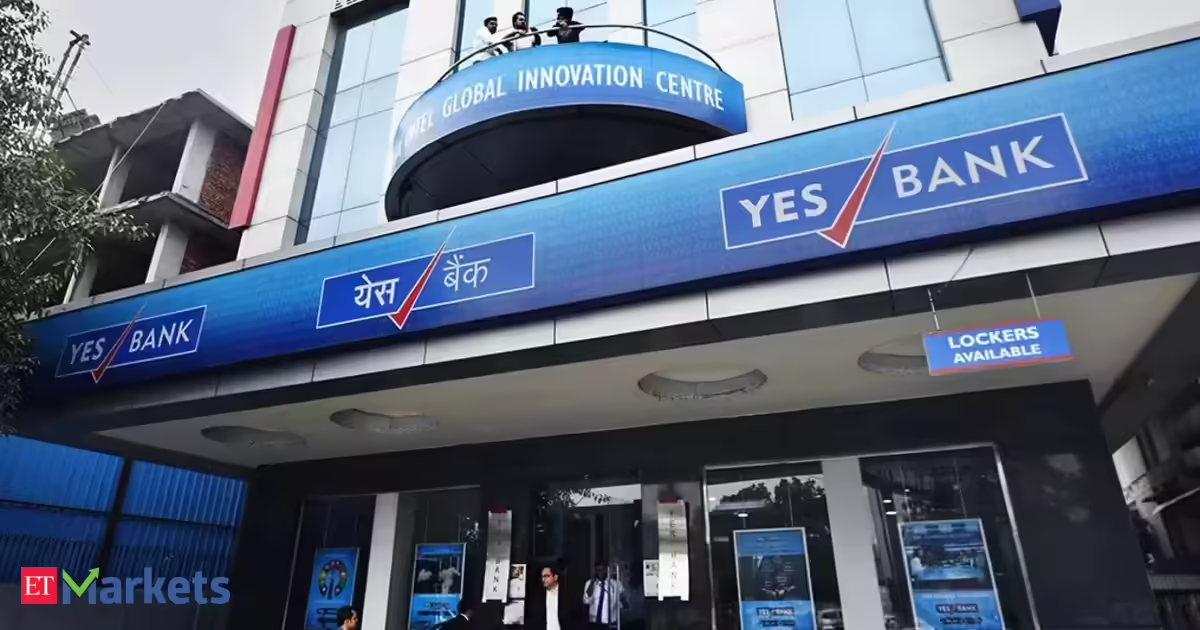
Yes Bank shares rally 15% in 4 sessions. What are technicals suggesting for traders?

Published

on

Yes Bank shares rally 15% in 4 sessions. What are technicals suggesting for traders?
Shares of Yes Bank gained as much as 6.5% to their day’s high of Rs 25.45 on the BSE on Wednesday, extending gains for a fourth straight session and rallying 15% over the same period. The private lender’s stock price is up 17% in 2026 and about 26% in one year.

From a fundamental perspective, the recent uptrend comes on the back of the lender announcing a strategic partnership with Northern Arc Capital aimed at expanding access to credit, scaling digital lending and offering debt investment opportunities to customers.

Also read: 5 under-the-radar stocks owned by 3 largest smallcap portfolios

For traders, here’s what technicals suggest

Ajit Mishra, Senior Vice President at Religare Broking, said Yes Bank share price has seen a healthy recovery from its crucial support zone near Rs 17 and is now moving towards a major hurdle at around Rs 26, which coincides with its 20-week exponential moving average (WEMA).

Advertisement

He expects the stock to face some consolidation around that level, with a decisive breakout above Rs 26 potentially triggering the next leg of the recovery. Mishra advises short-term traders to consider booking partial profits near Rs 26 and wait for sustained strength above that level before re-entering, or accumulate on dips towards the Rs 23-24 zone.

Ruchit Jain, Vice President of Technical Research at Motilal Oswal, said the banking and NBFC space has started gaining momentum and has outperformed the broader market this month. He noted that Yes Bank has broken above its key resistance level of Rs 24, supported by rising volumes over the past few sessions. According to Jain, the stock’s 200-week exponential moving average, placed around Rs 26, will be an important resistance level to watch.


Virat Jagad, Senior Technical Research Analyst at Bonanza, said the stock has delivered a decisive breakout above a long-term descending trendline resistance, backed by a strong bullish candle that cleared major overhead supply.
He noted that the RSI has moved firmly into bullish territory above 60 without any bearish divergence, signalling strong upward momentum. Jagad added that the stock’s EMAs remain aligned in a structural uptrend, supporting fresh long positions in the Rs 24.00-Rs 24.60 range, with upside targets of Rs 28.50 and Rs 31. He recommends a stop loss at Rs 22.80 for fresh positions and a trailing stop loss at Rs 21.90 for existing holdings.Read more: AI boom hands HFCL investors nearly 200% returns in just 6 months. Overheated or undervalued?

Yes Bank Q4 snapshot

The private lender reported a 45% year-on-year surge in net profit to Rs 1,068 crore for the January-March quarter of FY26, while its net interest income rose 16% YoY to Rs 2,638 crore for the quarter under review.

Net interest margin (NIM) gained 20 bps to 2.7%, while asset quality improved. Gross non-performing assets (NPA) ratio declined 30 bps YoY to 1.3%, while net NPA ratio declined 10 bps to 0.2%.

Advertisement

(Disclaimer: Recommendations, suggestions, views and opinions given by the experts are their own. These do not represent the views of The Economic Times)

Continue Reading

Trending

Copyright © 2025