Nurses and a doctor treating a patient who died unexpectedly after surgery at Wales’ largest hospital have denied injecting him with insulin, or seeing anyone else do so.
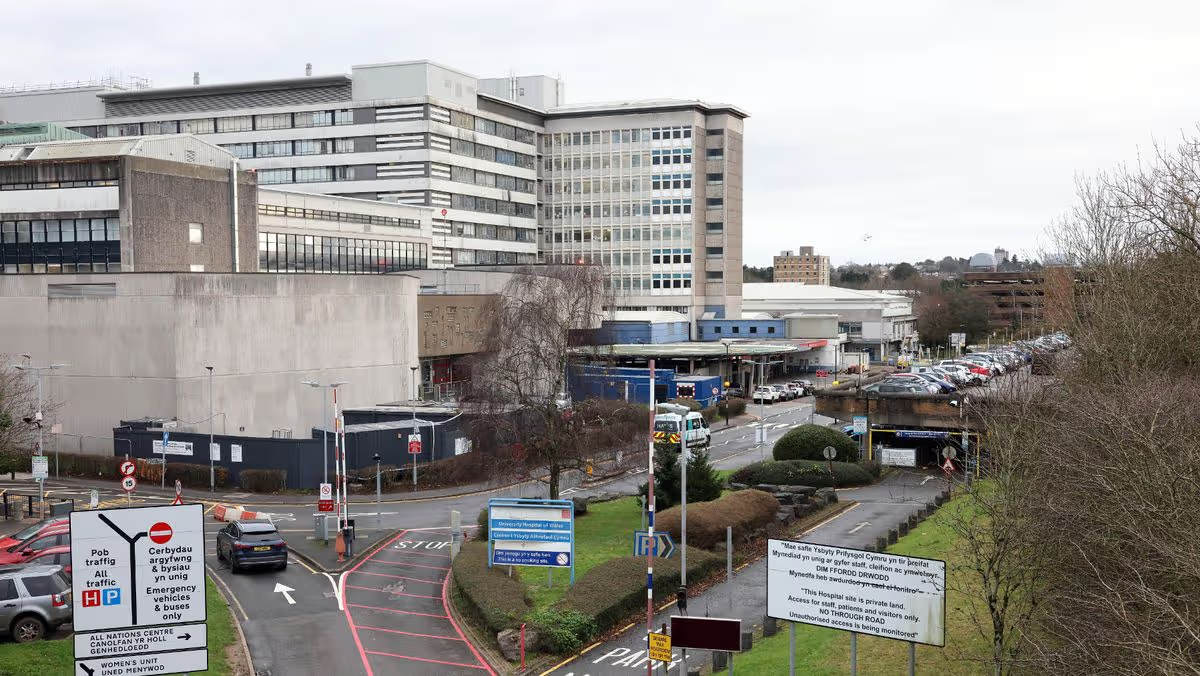
Medics working in the post operative recovery area at the University Hospital of Wales told the fourth day of an inquest into the death of Donald Gough of their concern when he didn’t wake after surgery.
They told the hearing at Pontypridd Coroner’s Court that they never had any concerns about misuse, or storage of, insulin at the hospital in Cardiff. For the biggest stories in Wales first sign up to our daily newsletter here
A police investigation was launched and doctors interviewed by officers after “unexplained high levels of insulin” were found in the bowel cancer patient’s system.
Mr Gough died in the hospital’s ICU on November 5, 2022, several weeks after the operation to remove secondary tumours in his liver. He had also suffered a chest infection on ICU.
There was no need for the 77-year-old to have been given insulin as part of his surgery or treatment, but high levels were found in his system and police were called.
Medics caring for Mr Gough after the surgery told the inquest on Thursday, June 4, of their concern when he did not wake, as would have been usual, within an hour of the operation.
Mr Gough had had keyhole surgery to remove secondary tumours from his liver which also involved removing his gall bladder. Doctors had assessed the likelihood of mortality from the procedure as 5% or less.
The nurse responsible for his one-to-one care in the post-operative recovery room insisted insulin could not have been mistakenly injected into him on her watch.
Quizzed by counsel for Mr Gough’s family, Bramble Badenoch-Nicolson, nurse Emma Steer said insulin was kept in a fridge in the unit.
Insulin packaging was distinctive and it could not be confused. It was not part of treatment he would have.
The level six nurse, who has 24 years experience, told the hearing it was her “golden rule” to wait an hour for patients to wait post-surgery but Mr Gough could not be roused.
“I give my patients one hour to wake so I asked for help as Donald’s condition was beyond my expertise,” she told the inquest.
At first it was thought that Mr Gough was slow to wake because he had been given the opiod fentanyl for local pain relief at the end of his eight hour operation. But he did not respond to treatment to counter the effects of that.
Dr Frederick Cripps, who came to help nurse Steer, told Coroner David Regan that a more senior doctor instructed him to give the patient the standard anti-opiod drug naloxone, which usually takes effect fast.
Dr Cripps, who now works at Morriston Hospital in Swansea, said that Mr Gough did not respond to the naloxone as expected. He also didn’t have the excessively dilated pupils characteristic of opiod overdose.
Nurse Steer had also asked another nurse to do a blood gas test but because Mr Gough was not diabetic there was no reason to carry out a blood sugar test.
The surgeon who carried out the operation Giorgio Alessandri also came to see the patient and was “very concerned” he had not woken.
Asked about the blood gas tests Dr Cripps said if he had seen anything abnormal on those he would have acted on that.
In discussion with a more senior PACU doctor he gave Mr Gough more anti-opiod naloxone but there was only “a partial response”.
“Usually you get a more immediate and greater response so I did not know why he was not waking up,” said Dr Cripps.
He added there was “no suggestion at that stage that blood glucose may be a cause of unconsciouness.”
Dr Cripps, a registrar at the time, worked in the adjacent post anesthesia care unit (PACU) where Mr Gough was expected after being in the recovery room, the hearing was told.
But no complete handover had been carried out and, as such, Mr Gough was not his clinical responsibility.
Dr Cripps said the usual handover care document had not been provided by the consultant anaesthetist for Dr Gough’s operation, Dr Benjamin Holst.
Dr Holst had already admitted at the start of the inquest that he had not provided the handover after care as he should have done.
Asked about this Dr Cripps said: “They rang PACU at 6.15pm to say he was in the recovery unit. We only had clinical responsibility when he came to us.
“In the recovery room the consultant anaesthsetist would retain responsibility, unless they specifically came and gave a handover. But in general, they would retain responsibility until the patient was disharged from recovery (to PACU).
“I did not receive a handover at that time. The majority of time I would receive a handover, but it is not always done.”
After Mr Gough died Cardiff and Vale University Health Board contacted South Wales Police on October 11, 2022, to report concerns that Mr Gough had deteriorated after surgery.
A few weeks later on November 5, 2022 the health board told police that Mr Gough had died at UHW after experiencing unexplained high levels of insulin in his system.
An investigation was launched, police consulted with the Crown Prosecution Service and prepared a file of evidence for the coroner. There is currently no ongoing criminal investigation.
The hearing continues.
Get daily breaking news updates on your phone by joining our WhatsApp community here. We occasionally treat members to special offers, promotions and ads from us and our partners. See our Privacy Notice

















































You must be logged in to post a comment Login