

Business
Twitter’s India policy head, Mahima Kaul, to step down; will transition in March


This comes as the San-Francisco based firm is at the receiving end of the Indian government over an issue of blocking and unblocking certain handles tweeting about farmer protests.
Sources said that the executive — who continues to lead the conversations with the government — Mahima Kaul’s stepping down is not related to the recent controversy.
Monique Meche, VP, Public Policy, Twitter said in a statement “At the start of this year, Mahima Kaul decided to step down from her role as Twitter Public Policy Director for India and South Asia to take a well-deserved break. It’s a loss for all of us at Twitter, but after more than five years in the role we respect her desire to focus on the most important people and relationships in her personal life.” Kaul will continue in her role till the end of March and will support the transition, Meche added.
“The Public Policy team acts as Twitter’s ambassadors to government policymakers, regulators, and civil society groups on public policy issues. We focus on addressing issues such as advocating for an Open Internet, freedom of expression, privacy, online safety, net neutrality, and data protection to advance the interests of Twitter and our customers. In addition, we serve as the #TwitterForGood team and provide guidance, resources, and support for Twitter’s Corporate Social Responsibility mission,” the company said in its job description on LinkedIn.
“As Twitter’s public policy lead based in India, this you’ll drive and assist development and advocacy of public policy solutions to pressing high technology issues. Specifically, you will manage and build a team of public policy and philanthropy specialists to protect and advance Twitter’s interests in India, it added among other key performing areas.

Business
Apple Prepares 20th Anniversary iPhones in Two Sizes Alongside Second-Generation Foldable Device

CUPERTINO, Calif. — Apple Inc. is accelerating development of special iPhone models to mark the device’s 20th anniversary next year, with plans for two sizes featuring advanced display technology. The company also intends to launch a second-generation foldable iPhone simultaneously, according to industry reports, as it continues pushing boundaries in smartphone design and manufacturing processes.
The anniversary models will reportedly feature nearly borderless displays with curved glass on all sides, creating an immersive visual experience. These devices will come in sizes comparable to current premium iPhones, approximately 6.3 inches and 6.9 inches, offering consumers choices within the high-end segment. Apple aims to celebrate two decades of iPhone innovation with distinctive hardware that builds upon established design language while introducing fresh elements.
This development aligns with Apple’s tradition of milestone celebrations through special editions. The original iPhone revolutionized personal computing and communication when introduced in 2007. Two decades later, the company continues refining the product line while exploring new form factors like foldable designs.
Manufacturing preparations for the anniversary iPhones are reportedly intensifying, with suppliers ramping up production capabilities for advanced components. The devices will incorporate Apple’s latest A21 chip built on a 2-nanometer process, representing a significant advancement in semiconductor technology. This chip will power both anniversary models and the second-generation foldable iPhone, showcasing Apple’s vertical integration strategy.
The foldable iPhone represents Apple’s entry into a growing market segment where competitors have already established presence. The second-generation device aims to address limitations observed in early foldable phones while maintaining Apple’s emphasis on premium materials and user experience. Industry observers anticipate the foldable model will complement rather than replace traditional iPhone designs.
Apple’s broader iPhone roadmap includes the standard iPhone 18 launching in spring 2027 with a less powerful A20 chip. This staggered release schedule allows the company to differentiate product tiers while managing supply chain complexities. The iPhone 18 Pro and Pro Max expected this September will feature A20 Pro processors, marking Apple’s transition to more advanced manufacturing processes.
The 2-nanometer technology promises improved efficiency and performance compared to previous generations. Apple’s chip development has consistently delivered advantages in power consumption and processing capabilities, contributing to the iPhone’s reputation for longevity and reliability. These advancements support increasingly sophisticated features while maintaining battery life expectations.
Display technology for the anniversary models focuses on minimizing bezels through curved glass construction. This design approach could create more immersive viewing experiences for media consumption and gaming while maintaining structural integrity. Suppliers are reportedly developing specialized manufacturing techniques to produce these complex components at scale.
The foldable iPhone’s development reflects Apple’s methodical approach to emerging categories. Rather than rushing into the market, the company has observed competitor implementations while refining its own vision. The second-generation model benefits from accumulated learnings and technological maturation in flexible displays and hinge mechanisms.
Industry analysts anticipate strong consumer interest in Apple’s foldable offering given the company’s brand strength and ecosystem integration. The device could appeal to users seeking enhanced productivity through larger screens while maintaining portability. Pricing and specific features will determine market reception upon launch.
Apple’s annual iPhone releases remain central to its financial performance. The product line consistently generates substantial revenue while driving services and accessory sales. Milestone celebrations like the 20th anniversary provide opportunities for marketing differentiation and consumer excitement.
Supply chain partners are preparing for increased production demands across multiple device variants. Advanced manufacturing processes require significant capital investment and technical expertise. Apple’s supplier relationships have evolved to support increasingly sophisticated product requirements.
Consumer expectations for iPhones continue evolving toward greater integration of artificial intelligence and enhanced durability. The anniversary models and foldable device will likely incorporate these trends while maintaining core iPhone characteristics that have defined the product category.
The technology sector watches Apple’s innovations closely as indicators of broader industry direction. The company’s design choices often influence competitor roadmaps and consumer preferences. The upcoming releases could set new standards for smartphone aesthetics and functionality.
Market projections suggest continued growth in premium smartphone segments despite economic uncertainties. Apple’s brand loyalty and ecosystem lock-in provide resilience against competitive pressures. The 20th anniversary celebration could generate additional marketing momentum.
Global supply chains supporting iPhone production have demonstrated adaptability through recent challenges. Component sourcing and assembly operations continue scaling to meet anticipated demand for new models. Apple’s manufacturing partnerships remain crucial to timely product launches.
The foldable iPhone’s development timeline aligns with maturing flexible display technology. Early challenges in durability and user experience have prompted iterative improvements across the industry. Apple’s entry could accelerate mainstream adoption if execution meets high standards.
Software integration represents another critical aspect of upcoming releases. iOS updates will likely optimize experiences for new hardware configurations while maintaining compatibility with existing devices. Apple’s unified ecosystem approach enhances user satisfaction across product generations.
The anniversary iPhones’ design language may influence future models beyond 2027. Successful elements could become standard features while experimental aspects inform subsequent iterations. Apple’s iterative development philosophy balances innovation with reliability.
Consumer interest in iPhone upgrades remains strong despite lengthening replacement cycles. Special editions and significant technological leaps encourage periodic refreshes. The 20th anniversary timing provides compelling reasons for upgrades among longtime users.
Industry observers anticipate comprehensive coverage of Apple’s fall event where current-generation iPhones will debut. The 20th anniversary models and foldable device will likely feature prominently in subsequent announcements. Strategic communication will shape market expectations.
Apple’s commitment to innovation continues driving product evolution. The upcoming releases demonstrate ongoing investment in research and development across multiple form factors. Consumers and competitors alike await detailed specifications and availability timelines.
The technology landscape evolves rapidly, with Apple maintaining leadership through strategic execution. The 20th anniversary iPhones and foldable device represent significant milestones in the company’s smartphone journey. Market reception will influence future directions in mobile computing.

SlateStone Wealth chief market strategist Kenny Polcari discusses whether investors are too dependent on AI, Space X’s IPO and his outlook for the markets on ‘Varney & Co.’
The affordability of the U.S. housing market may not improve significantly over time for would-be homebuyers, with a new report suggesting that they shouldn’t wait in the hopes of affordability measures returning to their pre-2022 levels.
Sarah Wolfe, a senior economist and strategist at Morgan Stanley, said in a report that while housing affordability could improve modestly over time, it is “unlikely to return to more favorable levels of the past, as the market adjusts to a higher-cost, tighter-supply environment.”
Wolfe noted that there was a brief period of optimism in February when mortgage rates briefly dipped below 6%, but it was short-lived as they returned to around 6.5% and have remained over 6% since then – which sapped the potential momentum for the housing market before it could gather steam.
“That recent episode is telling. In today’s market, small changes in rates have outsized effects on affordability, which remains historically strained, due in part to this rate-sensitivity,” Wolfe wrote.
INCOME NEEDED TO AFFORD A MEDIAN-PRICED HOME HAS NEARLY DOUBLED SINCE 2020, REPORT FINDS

Housing turnover has slowed significantly amid higher mortgage rates, Morgan Stanley noted. (Daniel Acker/Bloomberg via Getty Images)
She said that in looking at the housing market from 1990 to 2021, it was less affordable than it currently is about 15% of the time.
That implies that even modest improvements in the affordability of the current housing market would be considered tight in comparison to prior cycles in the last few decades.
To illustrate the present affordability challenges, an estimate by Morgan Stanley Research found that the buyer of a median-priced home faces a monthly payment of about $2,000 – which is roughly double the carrying cost from five years ago.
MIDWEST AND SOUTHERN STATES DOMINATE HOUSING REPORT CARDS: SEE HOW YOURS SCORED

The housing sector may not return to pre-2022 affordability levels, Morgan Stanley’s analysis found. (Angus Mordant/Bloomberg via Getty Images)
Homeowners who have lower interest rates on their mortgages have been reluctant to sell and take on a new mortgage with a higher interest rate, which has exacerbated affordability for new buyers.
“The jump in financing costs is also freezing sellers. Of existing homeowners, about 70% have mortgage rates below 5%, and one-half have rates below 4%. These homeowners often find it too costly to move and take on a new mortgage at current higher rates. The result is a collapse in housing turnover to the lowest level in roughly 40 years,” Wolfe said.
Due to the lack of turnover in the market for existing homes, new construction has played an increasingly important role on the supply side of the housing market. The report notes that the pace of price appreciation has slowed in some areas and scarcity has been persistent in others, with supply not improving fast enough to “meaningfully lower the barrier to entry.”
MEDIAN US HOME PRICE PROJECTED TO HIT $1 MILLION BY 2050 – RIGHT AS MILLENNIALS RETIRE
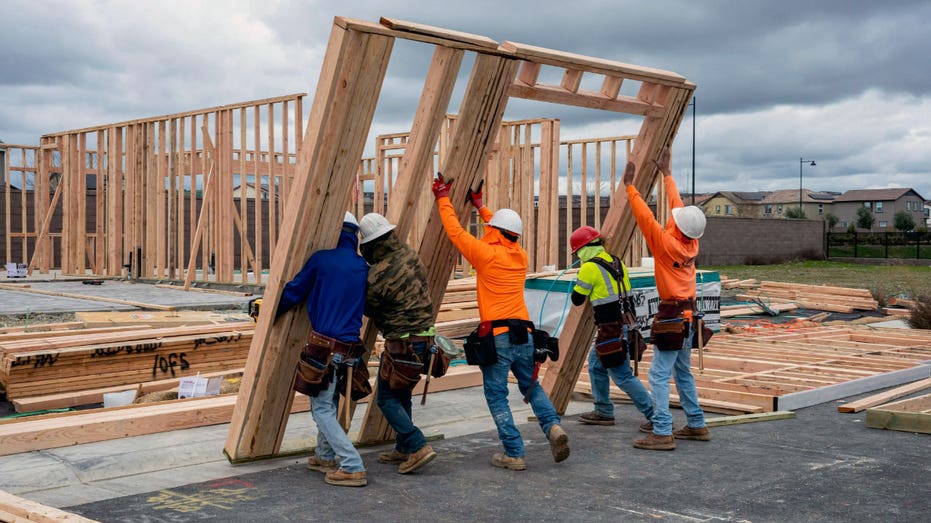
New home construction is helping support housing market supply, but isn’t occurring fast enough to significantly improve affordability. (David Paul Morris/Bloomberg via Getty Images)
The affordability challenges in the housing market have also contributed to changes in the characteristics of first-time homebuyers. While the average age remains around 36, the average credit score has risen to 734 from 718 in 2019.
First-time homebuyers are also carrying larger mortgage balances, which rose to an average of $334,000 in 2024 – an increase from $240,000 in 2019 and $195,000 in 2014. That growth has outpaced inflation by more than two-fold, the report noted, while buyers have also shifted to more affordable zip codes to buy their first home.
Wolfe went on to say that there could be some modest improvement in housing affordability when rates stabilize and the pace of home price growth eases, with the firm projecting rates will moderate to around 5%, lowering mortgage payments from about 24% of household income to about 21% in the next decade – though that remains above the 15% that followed the 2007-2009 financial crisis.
GET FOX BUSINESS ON THE GO BY CLICKING HERE
“In all of the scenarios that Morgan Stanley Wealth Management modeled – whether mortgage rates settle closer to 4%, 5% or 6% – affordability does not return to prior peaks. And the likelihood of mortgage rates settling closer to 6% than 5% has been rising,” Wolfe wrote. “In short, the market is not broken, but it is resetting to a more constrained equilibrium.”
Wolfe added that “waiting on the sidelines for prices to revert to the affordability of the two decades before 2022 may prove to be the wrong strategy. The better approach may instead be to buy when it makes sense for your financial situation – and when the right opportunity presents itself.”

Alphabet shares fell sharply Monday morning, with the Class C shares dropping 5.32% to $347.92, extending a month-long slide that has left the tech giant underperforming the broader market amid persistent investor anxiety over the scale of its artificial intelligence spending and a string of operational setbacks at its self-driving unit.
A Stock Under Sustained Pressure
Alphabet shares have dropped 6.3% over the past month, underperforming the broader Zacks Computer & Technology sector’s return of 3.6% over the same period. The company’s huge capital expenditure plan — between $180 billion and $190 billion for 2026, roughly double 2025’s level, with spending expected to rise further in 2027 — has spooked investors.
Why the Spending Plan Worries Wall Street
The core tension driving investor concern centers on whether the enormous capital outlay will ultimately pay off. The question that investors are asking is whether the returns from AI investments will justify the enormous upfront costs. Most of Alphabet’s capital expenditure is marked for building AI and cloud infrastructure, including data centers, chips, and servers for Gemini and cloud growth.
That spending is already squeezing the company’s free cash flow even as overall cash generation remains substantial. Although Alphabet generates considerable cash flow — $174.4 billion on a trailing 12-month basis at the end of the first quarter of 2026 — the steep increase in capital expenditure is expected to squeeze free cash flow, which stood at $64.4 billion on a trailing 12-month basis over the same period.
A Dilutive Equity Raise Adds to the Pressure
Beyond the spending itself, Alphabet has also taken steps to finance its AI buildout that carry direct consequences for existing shareholders. Alphabet announced plans to raise approximately $84.75 billion through equity offerings to fund AI infrastructure spending that dilutes existing shareholders’ stakes — a move that has added to the cautious sentiment surrounding the stock in recent weeks.
The Wiz Acquisition’s Margin Impact
Alphabet’s cloud business is also facing near-term profitability headwinds tied to a recent acquisition. The Wiz acquisition is expected to have a low single-digit percentage point headwind to Google Cloud’s operating margin for the remainder of 2026, adding another factor weighing on near-term earnings even as the deal is expected to strengthen the company’s cybersecurity offerings over the longer term.
Capacity Constraints Despite Rapid Buildout
Despite the massive spending commitment, Alphabet’s cloud business has also faced operational limitations in keeping pace with demand. The company is suffering from capacity constraints despite the improving pace of server deployments and data center construction. This, along with higher depreciation expenses and related data center operations costs, including energy, is expected to hurt profitability.
Waymo’s Robotaxi Recalls Add to the Pressure
Beyond the financial concerns surrounding AI spending, Alphabet’s self-driving unit has also generated negative headlines in recent days. Waymo, the self-driving vehicle unit of tech giant Alphabet, is recalling over 3,800 robotaxis in the U.S. after a software glitch caused more than a dozen of its vehicles to drive into freeway construction zones. The self-driving car company is recalling certain fifth-generation automated driving systems after a number of events in which its cars didn’t recognize and drove past ramp-closure signs into pre-planned construction areas.
Waymo has recalled its fleet of nearly 4,000 robotaxis to restrict them from driving on highways while it figures out how to make the vehicles behave around construction zones. Despite the recall, data still shows a reduction in serious accidents with the company’s robotaxis overall, suggesting the underlying safety trend remains positive even as the specific software issue gets addressed.
A Notable Departure From Google’s AI Team
Adding to the list of concerns weighing on the stock, Alphabet has also faced renewed scrutiny over talent retention within its core AI research division. Google Gemini co-lead Noam Shazeer announced his departure to ChatGPT maker OpenAI, raising concerns about future performance in AI development at a moment when competition for top AI research talent across the industry remains intense.
Where the Bull Case Still Stands
Despite the recent weakness, several elements of Alphabet’s underlying business have continued performing well, giving some analysts reason for continued optimism. Alphabet’s prospects are benefiting from its growing AI-powered Search capabilities and significant investments in cloud computing. Alphabet CEO Sundar Pichai has highlighted enterprise AI as a main growth driver, with revenue from generative AI products soaring nearly 800% year-over-year.
The company’s competitive position in search has also remained essentially unchallenged. In the search domain, Google continues to dominate with a roughly 90.39% share, followed by Microsoft’s Bing, with a 5.03% share. In cloud computing, Amazon maintained a strong lead in the market, though Microsoft and Alphabet’s Google continued to achieve substantially higher growth rates, with market shares of roughly 28%, 21%, and 14% respectively among the three providers.
A Valuation That Some See as Stretched
Despite the recent pullback in share price, at least one widely followed valuation framework suggests Alphabet shares may not yet be cheap relative to historical norms. Alphabet shares are considered overvalued, as suggested by a Value Score of D. The stock is trading at a forward 12-month price-to-earnings ratio of 25.73 times, compared with the broader Zacks Internet Services Industry’s 24.98 times.
Multiple Paths to Future Growth
Analysts following the company continue to point to a diverse range of potential revenue streams tied to its AI investments as a basis for longer-term optimism, even amid near-term spending concerns. AI creates multiple monetization pathways for Alphabet beyond traditional search advertising through AI-powered advertising tools such as AI Max and Performance Max. Other options include consumer AI subscriptions through Google One and Gemini plans, enterprise AI infrastructure and model services, agentic commerce initiatives such as Universal Cart, as well as AI-driven productivity and developer platforms like Antigravity.
The Zacks Consensus Estimate for 2026 earnings is pegged at $14.30 per share, indicating 32.3% year-over-year growth, suggesting analysts still expect meaningful profit growth even as the company absorbs its historically large capital spending commitments.
With Alphabet’s massive AI infrastructure buildout continuing to draw mixed reactions from investors, and with the Waymo recall and recent AI talent departure adding fresh near-term headlines, the stock’s trajectory in the coming weeks will likely depend heavily on whether the company’s cloud growth and AI-driven search improvements continue outpacing the costs associated with that spending. Given the scale of capital expenditure planned through 2027, market participants are likely to continue scrutinizing each quarterly earnings report closely for evidence that Alphabet’s AI investments are translating into durable revenue growth rather than simply compressing near-term margins and free cash flow.

The state’s near-term electricity outlook has improved year-on-year, with the main electricity grid to remain in surplus until 2029-30 according to new modelling.
Business
FBI Acknowledges Possible Error in Bitcoin Ransom Payment That May Have Complicated Nancy Investigation


TUCSON, Ariz. — Federal authorities have acknowledged a potential misstep in their handling of a cryptocurrency ransom demand connected to the disappearance of Nancy Guthrie, a Tucson woman who vanished from her home earlier this year. The admission highlights challenges in investigating cases involving digital currencies and cross-border elements as search efforts continue along the U.S.-Mexico border.
The FBI, collaborating with the Pima County Sheriff’s Department, received a reported demand for $4 million in Bitcoin from individuals claiming responsibility for Guthrie’s abduction. Task force insiders indicated that only a small amount — approximately $152 — was transferred as part of a strategy designed to prompt further communication from the suspects. The limited payment, intended to test the legitimacy of the demand, instead resulted in a complete cessation of contact.
This tactic, sometimes referred to in law enforcement circles as an attempt to “tickle the wire,” aimed to elicit responses that could provide additional investigative leads. However, the lack of follow-up communication has prompted internal reviews of the approach and its effectiveness in digital ransom situations. Authorities have described the outcome as potentially complicating the case, though they continue pursuing multiple avenues.
Guthrie, the mother of NBC News correspondent Savannah Guthrie, disappeared from her Tucson residence. The case quickly drew national attention due to the family’s public profile and the mysterious circumstances surrounding her vanishing. Investigators initially treated it as a missing persons matter before shifting focus based on emerging evidence suggesting possible abduction.
Search operations have expanded into regions south of the Arizona border following anonymous tips. A Mexican volunteer organization, Buscando Corazones Nogales, recently examined areas near Nogales, Sonora. The group reported discovering multiple unmarked graves during these efforts, though none have been linked to Guthrie’s case.
The leader of the search collective received information pointing to a possible burial site in a stream near the Mariposa Port of Entry. Volunteers conducted thorough examinations but found no evidence connecting the location to Guthrie. These discoveries highlight broader humanitarian and criminal concerns in border regions where clandestine activity can obscure traces.
The partial Bitcoin transfer has become a focal point of discussion within law enforcement. Cryptocurrency transactions, while offering traceability through blockchain analysis, present unique operational challenges due to their speed and potential anonymity. Authorities had hoped the small payment would yield verifiable contact or confirm details about Guthrie’s situation.
FBI officials have emphasized that the investigation remains active with resources dedicated to various leads. Digital forensics, human intelligence and ground searches form core components of ongoing efforts. The agency has not publicly detailed specific reasoning behind the limited transfer but indicated all investigative decisions undergo continuous evaluation.
Pima County authorities have echoed the commitment to resolving the case. Joint task force members stress that no credible evidence has confirmed harm to Guthrie, though the passage of time increases urgency. Family representatives continue appealing for public assistance while supporting law enforcement work.
The involvement of cryptocurrency in the alleged ransom demand mirrors evolving patterns in abduction cases. Bitcoin and similar assets provide perpetrators with rapid transfer capabilities while complicating immediate tracking. Law enforcement agencies have enhanced capabilities in blockchain analysis, though success depends on various technical and operational factors.
Border region searches have uncovered broader issues, including numerous unmarked graves. These findings, while not connected to Guthrie, point to ongoing challenges in remote areas where criminal activity and migration patterns intersect. Mexican authorities and volunteer groups maintain collaborative search efforts.
Nancy Guthrie’s disappearance has resonated widely due to her daughter’s prominent media role. Savannah Guthrie has balanced professional responsibilities with family support throughout the ordeal. The case has also highlighted vulnerabilities faced by individuals in everyday situations, prompting discussions on personal safety measures.
Investigators have explored multiple theories while maintaining open communication channels. The ransom communication introduced digital elements requiring specialized expertise. Coordination between federal, state and international partners continues as the case spans potential jurisdictional boundaries.
The “fatal mistake” reference attributed to task force insiders reflects internal acknowledgment of the payment’s outcome. Such admissions, though difficult, demonstrate commitment to learning from operational experiences. Future protocols for digital ransom situations may incorporate lessons from this case.
Community support in Tucson and beyond has included awareness campaigns and assistance with tip generation. Local residents have participated in searches and provided information that has helped shape investigative focus. The high visibility of the case has brought attention to similar unresolved disappearances.
Federal resources remain dedicated to the effort, with interagency cooperation ongoing. The Bitcoin tactic review could influence future approaches to similar situations. Cryptocurrency’s role in criminal activity requires evolving law enforcement strategies.
As the investigation advances, authorities urge anyone with relevant information to come forward. Tips can be submitted through official channels with assurances of confidentiality where appropriate. Rewards for information leading to resolution have been discussed in similar cases.
The Guthrie case exemplifies complexities in modern missing persons investigations, particularly those with potential international dimensions. Digital currencies add technical layers while border regions present logistical challenges. Persistent effort across multiple agencies remains essential for resolution.
For the Guthrie family, the ongoing uncertainty creates profound emotional strain. Public appeals for information reflect hope that collective awareness might yield breakthroughs. The case serves as a reminder of vulnerabilities present even in familiar environments.
Search teams continue covering challenging terrain based on tips and analytical assessments. Technology assists in mapping remote areas while human expertise interprets subtle evidence. Comprehensive approaches combine traditional policing with modern tools.
The FBI and local authorities maintain focus on factual developments while avoiding speculation. Professional protocols guide information sharing to protect investigative integrity. Public updates balance transparency with operational security.
As time passes since Guthrie’s disappearance, the investigation’s scope broadens while maintaining core objectives. Digital analysis, witness interviews and physical searches form interconnected elements of a multifaceted approach. Resolution remains the primary goal.
The Guthrie case continues drawing attention as authorities pursue every available lead. Community engagement and interagency cooperation provide essential support for sustained efforts. Hope persists for information that could bring clarity to the family and community.


Markets rise and fall, booms come and go, and the world keeps ticking. Ultimately, I believe observing megatrends, as difficult as they can be to spot, let alone fully comprehend, can yield insights into the advance of human society, which in turn could pave the way for many useful investment insights. As society and technologies evolve, companies and other stakeholders will seize advantages. Figuring out which companies will take the best advantage of any given opportunities is not easy. I am especially interested in macrotrends, futurism, and increasingly, emerging technologies. However, as far as investing is concerned, it’s crucial to pay attention to the fundamentals, quality of leadership, product pipeline, and all the other details. In recent years, I have focused on marketing and business strategy, primarily for medium-sized companies and startups. I have worked in international development, including overseas for a foreign Prime Minister’s office, as well as non-profit work in the United States. Among other tasks, I evaluated startups and emerging industries/technologies. I have also moonlighted as a technology and economic news journalist. Now I’m looking to tie everything together. While my personal interests will always keep megatrends and technological developments in mind, I do believe fundamentals and technicals are vital to uncovering opportunities.
Analyst’s Disclosure: I/we have no stock, option or similar derivative position in any of the companies mentioned, and no plans to initiate any such positions within the next 72 hours. I wrote this article myself, and it expresses my own opinions. I am not receiving compensation for it (other than from Seeking Alpha). I have no business relationship with any company whose stock is mentioned in this article.
Seeking Alpha’s Disclosure: Past performance is no guarantee of future results. No recommendation or advice is being given as to whether any investment is suitable for a particular investor. Any views or opinions expressed above may not reflect those of Seeking Alpha as a whole. Seeking Alpha is not a licensed securities dealer, broker or US investment adviser or investment bank. Our analysts are third party authors that include both professional investors and individual investors who may not be licensed or certified by any institute or regulatory body.


I am a stock analyst with over 20 years of experience in quantitative research, financial modeling, and risk management. My focus is on equity valuation, market trends, and portfolio optimization to uncover high-growth investment opportunities. As a former Vice President at Barclays, I led teams in model validation, stress testing, and regulatory finance, developing a deep expertise in both fundamental and technical analysis. Alongside my research partner (also my wife), I co-author investment research, combining our complementary strengths to deliver high-quality, data-driven insights. Our approach blends rigorous risk management with a long-term perspective on value creation. We have a particular interest in macroeconomic trends, corporate earnings, and financial statement analysis, aiming to provide actionable ideas for investors seeking to outperform the market.
Analyst’s Disclosure: I/we have no stock, option or similar derivative position in any of the companies mentioned, and no plans to initiate any such positions within the next 72 hours. I wrote this article myself, and it expresses my own opinions. I am not receiving compensation for it (other than from Seeking Alpha). I have no business relationship with any company whose stock is mentioned in this article.
Seeking Alpha’s Disclosure: Past performance is no guarantee of future results. No recommendation or advice is being given as to whether any investment is suitable for a particular investor. Any views or opinions expressed above may not reflect those of Seeking Alpha as a whole. Seeking Alpha is not a licensed securities dealer, broker or US investment adviser or investment bank. Our analysts are third party authors that include both professional investors and individual investors who may not be licensed or certified by any institute or regulatory body.


The protein powder is formulated with Solein from Solar Foods.

In commercial real estate development, success often comes from seeing possibilities where others see empty space. For David Manasher, that mindset has shaped a career focused on hospitality development, restaurant renovations, and commercial build-outs.
Born in Baku, Azerbaijan, then part of the former Soviet Union, Manasher’s journey to becoming a respected real estate developer began long before he entered the construction and development industry. His story is one of adaptation, education, and a commitment to creating spaces that serve both businesses and communities.
Today, he is known for combining business knowledge, design thinking, and practical execution in a highly competitive field.
Who Is David Manasher?
David Manasher immigrated to the United States in 1991 with his family. They settled in Fort Worth, Texas, where he began adjusting to a completely new culture and environment.
As a teenager, he spent his formative years in Arlington and Dallas. Those experiences helped shape his perspective on opportunity and personal growth.
“Coming to America taught me that you have to adapt quickly,” Manasher says. “Nothing is handed to you. You have to learn, work hard, and keep moving forward.”
His early years in Texas exposed him to a rapidly growing region where development and entrepreneurship were visible everywhere. Those observations would later influence his professional path.
Education That Combined Business and Law
Manasher pursued higher education at the University of Texas at Arlington, earning a Bachelor of Business Administration in Management Information Systems in 2001. He graduated with honors and was accepted to several law schools.
Rather than stopping with a business degree, he continued his education and earned a Juris Doctor from Charlotte School of Law in 2012.
The combination of business and legal education provided a unique foundation for his future career.
“I’ve always been interested in how systems work,” he says. “Whether it’s business, law, or development, understanding the details helps you make better decisions.”
His interest in legal developments and legislation continues today. He regularly studies new laws and regulatory changes that affect businesses and real estate projects.
Why David Manasher Chose Real Estate Development
While many professionals specialize in either design or business, Manasher built a career that incorporates both.
As a real estate developer and designer, he focuses on commercial hospitality projects. His work includes hospitality development, restaurant renovations, and commercial build-outs.
These projects often require balancing creative vision with practical realities.
“Every project starts with a problem that needs to be solved,” Manasher explains. “You have to think about the customer experience, the business goals, and how the space will function every day.”
Hospitality projects can be especially demanding because customer expectations continue to evolve. Restaurants and hospitality venues must create memorable experiences while operating efficiently.
According to Manasher, understanding both sides of that equation is critical.
“A great-looking space isn’t enough,” he says. “The design has to support the business behind it.”
Lessons From Developing Commercial Hospitality Projects
Over the years, Manasher has developed an appreciation for the many moving parts involved in hospitality development.
Restaurant renovations and commercial build-outs require coordination between designers, contractors, business owners, and local authorities. Small details can have a major impact on the final result.
His approach emphasizes preparation, communication, and attention to detail.
“The most successful projects are usually the ones where everyone understands the goal from the beginning,” he says. “Clarity saves time and prevents problems later.”
That philosophy has helped him navigate an industry where timelines, budgets, and operational needs must constantly be balanced.
Beyond Business: Books, Learning, and Giving Back
Outside of work, Manasher remains committed to learning. He enjoys exploring new books, writing, and following legal developments.
His curiosity extends beyond professional interests.
He is also passionate about automotive design, particularly Porsche vehicles. His interest focuses on custom modifications and design concepts involving the Porsche 911 (996).
At the same time, community involvement remains important to him.
Manasher volunteers with synagogues in Florida and New York and supports individuals dealing with alcohol and drug addiction disorders.
“Everyone faces challenges at some point,” he says. “If you can help someone get through a difficult period, that’s meaningful.”
What Drives David Manasher Today?
As he continues his work in real estate and hospitality development, Manasher remains focused on creating projects that combine functionality, design, and long-term value.
He is also preparing to add another accomplishment to his résumé: publishing a book.
For him, the project reflects a lifelong interest in learning and sharing ideas.
Looking back, his journey from Azerbaijan to the United States demonstrates the power of persistence and adaptability.
“The biggest lesson I’ve learned is to stay curious,” Manasher says. “Industries change, markets change, and technology changes. The people who keep learning are the ones who continue growing.”
That mindset continues to guide his work today. In an industry where details matter and execution is everything, David Manasher has built a career by combining knowledge, discipline, and a clear vision for what successful development can achieve.
Nvidia shares traded roughly flat at $210.14, down a modest 0.26%, on Monday morning, holding near recent levels as the AI chip giant continued rolling out a steady stream of product and partnership announcements spanning robotics, European supercomputing, and its broader data center ecosystem.
A Busy Day of Product News
Monday’s session brought several fresh announcements from the company, even as the stock itself moved only marginally. Nvidia announced Halos for Robotics, alongside news that the company is developing 35 AI HPC supercomputers across Europe — continuing Nvidia’s pattern of frequent product and partnership disclosures that have characterized much of its recent corporate communications.
A Stock That Has Pulled Back From Its Peak
While Nvidia remains one of the most dominant companies in the technology sector by market value, the stock has cooled somewhat from the all-time high it reached earlier this spring. NVDA reached its all-time high on May 14, 2026, with a price of $236.54. Today, the company has a market capitalization of $5.10 trillion, having decreased 3.85% over the last week.
A Mixed Near-Term Technical Picture
Some technical analysis services have flagged caution signals for the stock even as its longer-term trend remains upward. A sell signal was issued from a pivot top point on Thursday, May 14, 2026, and so far the stock has fallen more than 10% from that level. Despite that pullback, NVIDIA finds support from accumulated volume around the $205 level, and this level may hold a buying opportunity, as an upward reaction can be expected when the support is being tested.
Strong Recent Single-Day Performance
Even amid the broader pullback from its all-time high, Nvidia has posted some notably strong individual sessions in recent weeks. The stock price increased 2.95% on Thursday, June 18, climbing from $204.65 to $210.69, with trading volume also rising on that day — generally considered a favorable technical signal when accompanying a price increase.
Analysts Remain Overwhelmingly Bullish
Despite the stock’s recent volatility, Wall Street’s formal coverage of Nvidia continues to lean heavily positive. According to 62 analysts, the average rating for Nvidia stock is “Strong Buy.” The 12-month stock price target is $298.93, representing an increase of nearly 42% from recent trading levels. A separate tracking service similarly found that according to 38 analysts, Nvidia carries a Strong Buy consensus rating, with a price target of $298.87.
Massive Revenue and Earnings Growth
The bullish analyst sentiment is grounded in extraordinary recent financial performance. In fiscal year 2026, Nvidia’s revenue was $215.94 billion, an increase of 65.47% compared to the previous year’s $130.50 billion. Earnings were $120.07 billion, an increase of 64.75% over the same period — a scale of growth that places the company among the fastest-expanding businesses of its size anywhere in the market.
Hyperscaler Spending Continues Climbing
A central pillar of the bullish case for Nvidia rests on continued, rapidly escalating capital spending from the major cloud computing companies that purchase its chips. During Nvidia’s latest conference call, the company projected that 2027 AI hyperscaler capital expenditures will rise to $1 trillion next year, opening the door for another year of solid growth and potentially allowing Nvidia to extend its recent jaw-dropping growth rates. During its latest quarter, Nvidia exceeded expectations and delivered an impressive 85% growth rate, a pace few companies of any size can rival.
A Relatively Inexpensive Valuation Compared to Peers
Despite its enormous scale, some analysts argue Nvidia’s stock remains attractively priced relative to other major technology companies investing heavily in artificial intelligence. Compared to other big tech AI investments, Nvidia is valued at some of the lowest levels from a forward price-to-earnings ratio standpoint. When compared with its largest peers, Nvidia’s stock looks even cheaper, with some analysts suggesting its valuation could nearly double and still look reasonable relative to comparable AI infrastructure companies.
Notable Institutional Activity
Beyond the broader analyst consensus, individual high-profile investors have continued weighing in on Nvidia’s relative position within the AI trade. Billionaire investor Daniel Loeb has reportedly made notable moves between AI-related holdings recently, scooping up shares of one major AI stock while reducing exposure to another, reflecting the kind of active portfolio rotation occurring among some of Wall Street’s most closely watched investors as they assess which companies are best positioned to benefit from continued AI infrastructure spending.
Risk Factors Investors Continue Monitoring
Despite the overwhelmingly positive sentiment, analysts continue to flag specific structural risks tied to Nvidia’s business model and geopolitical exposure. As a fabless company with production outsourced to Taiwan, Nvidia is exposed to possible supply disruptions and geopolitical tensions. Additionally, potential regulatory restrictions from the U.S. government on GPU sales to certain countries, particularly China, could hinder its expansion and growth opportunities.
Competition From Customers Building Their Own Chips
Nvidia also faces a more nuanced competitive dynamic as some of its largest customers increasingly invest in developing their own specialized AI chips. Alphabet’s Google is using Nvidia’s playbook to build chips that power artificial intelligence, according to Wall Street Journal reporting — a development that underscores the broader trend of major cloud providers seeking to reduce their dependence on any single chip supplier, even as they continue purchasing substantial volumes of Nvidia’s products in the near term.
A 52-Week Range Reflecting a Volatile Year
Nvidia’s stock has traded across a wide range over the past 12 months, reflecting both the company’s rapid growth and the broader volatility that has characterized AI-related stocks throughout 2026. The stock’s 52-week range spans from $142.03 to $236.54, with the company’s current price sitting comfortably within the upper portion of that range despite the recent pullback from its all-time high.
With Nvidia’s next earnings report scheduled for August 26, investors will be watching closely for updated guidance on data center demand, hyperscaler capital expenditure trends, and any further developments tied to the company’s expanding robotics and supercomputing partnerships announced Monday. Given the stock’s continued Strong Buy consensus among analysts and a price target implying significant upside from current levels, Nvidia’s near-term trajectory will likely continue to hinge on whether the company’s growth rate can keep pace with the rapidly escalating capital spending commitments from major cloud computing customers heading into 2027.

Apple Prepares 20th Anniversary iPhones in Two Sizes Alongside Second-Generation Foldable Device
Bitcoin Supply Crunch? OTC Balances Drop by 400,000 BTC Since 2022

Watch Live: New Maple Leafs defenceman Darren Raddysh talks trade to Toronto

No Jackpot Winner as $257 Million Prize Rolls Over to $269 Million Monday Draw

Blockchain.com files with SEC for U.S. IPO

Israel says it has killed new Hamas military leader in Gaza City airstrikes

STRC Hits $82 | Is it Over for Michael Saylor and Bitcoin?!

Stop Letting Your Money Sleep! InvestSmartly in 2025 #finance #investment #fd #moneymindset #invest

Operation Paperclip EXPOSED! The BIS Triggered The UN-THINKABLE For XRP Holders! (CRYPTO CONSPIRACY)
-

 Fashion3 days ago
Weekend Open Thread: Miami – Corporette.com
-
 Tech6 days ago
The Adder At The Heart Of Intel’s 8087 FPU
-

 Entertainment2 days ago
Renter of Home in Anne Heche Crash Denies Settlement With Son
-

 Business2 days ago
Soccer-U.S. defends Iran World Cup travel restrictions, says discussions ongoing
-
 Business3 days ago
Wall Street Week Ahead: Investors see Micron earnings as pulse check of AI rally momentum
-

 Politics4 days ago
BBC Reporter Discusses Cross Party Criticism Of Trumps Iran Deal
-

 Tech5 hours ago
Microsoft accidentally kills epic Outlook email threads
-

 Crypto World3 days ago
HIVE shares jump as $220M AI deal speeds Bitcoin mining pivot
-

 Crypto World2 days ago
Jake Chervinsky accuses CME of protecting derivatives monopoly
-
 Crypto World2 days ago
Can Charles Hoskinson Really Rescue Cardano?
-

 Sports4 days ago
FIFA World Cup 2026: Canada beat 9-men Qatar 6-0 to register first ever win | FIFA World Cup 2026
-

 Business2 days ago
MHP SE 2026 Q1 – Results – Earnings Call Presentation (OTCMKTS:MHPSY) 2026-06-20
-

 Business4 days ago
Brexit cost 6% of UK economy, Bank of England company data suggests
-

 Politics2 days ago
Andy Burnham and the meaning of Makerfield
-

 Crypto World4 days ago
Anthropic’s Dario Amodei Urged AI Unity at G7, Even as US Banned His Models
-

 Crypto World7 days ago
Robinhood opens AI-powered trading to all users, sending HOOD stock past $100
-

 Tech5 days ago
Weeks Of In-The-Field Testing And A Verdict
-
 Tech4 days ago
Adobe adds its AI assistant to Premiere, Illustrator and InDesign
-
 Tech1 day ago
Signal’s Meredith Whittaker says AI chatbots ‘are not your friends’ and calls Copilot agents a backdoor
-
 Crypto World4 days ago
Iren (IREN) Stock Surges on Jefferies Buy Rating: AI Infrastructure Play Gains Momentum
You must be logged in to post a comment Login