

Crypto World
Crypto Billionaires Bankroll Reform UK in First-Quarter


Nigel Farage’s Reform UK received 7 million British pounds ($9.4 million) from two crypto billionaires this year, with total funds raised outstripping all other political parties.
The party received a $4 million donation from Christopher Harborne, who has a stake in the stablecoin issuer Tether, and a $5.4 million donation from Ben Delo, the co-founder of the crypto exchange BitMEX, according to Electoral Commission data released on Thursday.
The Labour and Conservative parties each received around $5.4 million in the first quarter of the year.
Reform UK has pitched itself as a pro-crypto party. It was the first UK political party to accept donations in Bitcoin (BTC), and Farage has proposed cutting capital gains taxes on crypto from 24% to 10%. He has also called for the Bank of England to create a Bitcoin reserve.
The crypto industry has been spending heavily on politics as it seeks to influence policy. In the US, crypto-backed political action committees (PACs) have recently spent millions to successfully back candidates who won primary elections ahead of the country’s midterm elections in November.

Nigel Farage speaking at the Bitcoin 2025 conference in Las Vegas. Source: Gage Skidmore
Delo is a first-time donor to the right-wing populist party, while the latest donations bring Harborne’s total to $20 million in the past year.
Harborne had separately given Farage a $6.7 million personal gift, which is facing a probe by a parliamentary standards inquiry as to whether it should have been registered.
Related: UK politician Nigel Farage bought $1.8M house after $6.7M crypto gift
Farage has said he didn’t need to declare the money as it was given before he was a member of parliament and was used to pay for personal security. He later claimed the gift was for successfully campaigning for the UK to leave the EU.
Reform’s fundraising in the first quarter has increased sixfold compared to the same time last year, when it received $2 million.
The total funding across all parties for the quarter had also more than doubled compared with a year ago.
Magazine: Guide to the top and emerging global crypto hubs: Mid-2026

Crypto World
‘Avoid Rain at All Costs’: ZachXBT Raises Red Flags Over $8.8B Prediction Market Project

Blockchain detective ZachXBT is warning traders to steer clear of Rain Protocol after claiming to have uncovered a pattern of suspicious on-chain activity surrounding the project.
In the latest update, ZachXBT described the prediction market project, which he said has an $8.8 billion market capitalization and ranks among the top 15 crypto assets, as having few users, limited product traction, no notable backers, and a team with little established history in the industry.
Links to Failed Crypto Projects
According to his on-chain investigation, wallets tied to the RAIN team share funding trails with the Data Ownership Protocol (DOP) and TOMI ecosystems via the Gems hot wallet and several centralized exchange deposit addresses, which suggests an overlap between the projects.
As evidence, ZachXBT highlighted two “dust” transactions that were sent to the same address on Oct. 14, 2025. According to his findings, a wallet linked to the RAIN deployer sent a small transfer to the address at 3:31:47 p.m. UTC, while a wallet he associated with the TOMI team multisig and a centralized exchange deposit address sent another dust transaction to that same destination 36 seconds earlier. He also said that the recipient wallet later received funds from another address that had previously been funded by a DOP multisig.
In a separate transaction trail, the investigator said another wallet transferred funds to an address that later used the same centralized exchange deposit address as the DOP deployer.
ZachXBT also claimed RAIN’s market activity shows signs of on-chain price manipulation, and alleged that addresses tied to the deployer used Uniswap V3 liquidity pools while routing spot transfers through the Gems hot wallet. He also took aim at RAIN’s valuation, while highlighting that its decentralized autonomous treasury, Enlivex, a Nasdaq-listed company, announced a $212 million treasury strategy in November 2025 even though, according to him, the project is nowhere near the scale of prediction market platforms like Kalshi or Polymarket.
He cited DefiLlama data showing RAIN has $27.2 million locked on Arbitrum, but said the entire amount is held in its own illiquid token and that the protocol generates only about $1 million in annual fees. TOMI, DOP and Sirin Labs projects are all linked to controversial Israeli entrepreneur Moshe Hogeg, who was arrested in 2021 and later faced police allegations over a $290 million crypto fraud scheme.
Kraken Rating Cut to B-Tier
ZachXBT said he has lowered his rating for crypto exchange Kraken from S-tier to B-tier over “lack of due diligence” before listing what he described as “low-quality, manipulated tokens,” including M, RAIN, RIVER and RAVE. He also criticized Kraken’s public disclosure of its recent security breach, and added that it did not mention compensation for affected users.
By comparison, he noted that exchanges such as Coinbase and Bybit prioritized compensating customers after their own security incidents. ZachXBT also raised his bounty to as much as $100,000 for insiders who can provide documents or chat logs related to alleged centralized exchange market manipulation schemes.
The post ‘Avoid Rain at All Costs’: ZachXBT Raises Red Flags Over $8.8B Prediction Market Project appeared first on CryptoPotato.


U.S. spot bitcoin ETFs ended a record 13-day streak of outflows, adding $3.05 million on Thursday after losing more than $4.4 billion in redemptions since mid-May.
The outflows, together with the plunging price of the largest cryptocurrency, dragged total bitcoin ETF assets down to $80.40 billion from $104.29 billion at the start of the streak.
It’s worth keeping in mind the size of yesterday’s inflows compared with the outflows. The $3 million figure is less than any single day of outflows during the period, which mostly saw exits above $100 million.
BlackRock’s IBIT, the largest fund in the category, received $47.66 million on Thursday, while Fidelity’s FBTC, Bitwise’s BITB and Ark’s ARKB continued to bleed, SoSoValue data shows.
The total bitcoin assets under management (AUM) in the investment vehicles stand at 1.277 million BTC, about 7.2% below the October record, according to CheckonChain. That is slightly above the Feb. 23 low of 1.274 million BTC, reached as the price of bitcoin recovered from its February trough near $60,000. Bitcoin fell to $63,800 on Thursday after rising as high as $64,660.
Spot ether(ETH) ETFs also ended a streak of outflows, taking in $19.30 million after 17 days of redemptions. BlackRock’s ETHA benefited from the influx, with every other ether ETF logging zero net flow.
Total ether ETF assets sit at $9.78 billion, or 4.57% of ether’s circulating market capitalization, with cumulative inflows since the 2024 launch at $11.21 billion. The category remains roughly $2 billion below its asset peak from earlier in the year.
Meanwhile, Hyperliquid’s HYPE ETFs were the only investments to avoid outflows during the period. The three ETFs took in another $12.15 million on Thursday, extending a run of inflows that started with their debut on May 12. Grayscale’s low-fee HYPG fund pulled $4.70 million on its first day of trading.
On Friday, Bitcoin fell 1.7% to $62,700, ether dropped to $1,670 and the broader risk picture deteriorated as the global AI trade rolled over on Broadcom’s outlook miss and a 4.7% selloff in South Korea’s KOSPI index.
CORRECT (June 5, 10:09 UTC): Corrects day to Thursday in first paragraph and elsewhere.
Crypto World
The Bitcoin Crash Just Wiped $62 Billion From Corporate Treasury Holders, Is the MicroStrategy Model Broken?

The June 2026 crypto rout just erased $62 billion in combined market capitalization from public companies holding Bitcoin as a treasury asset.
MicroStrategy, Tesla, and Marathon Digital are leading the damage. The question that matters now is not whether the losses are recoverable; it is whether the entire structural model that produced them was viable to begin with.
Corporate Bitcoin holdings accelerated after MicroStrategy’s initial $250 million allocation in August 2020, framed explicitly as a hedge against dollar debasement.

By late 2025, more than 200 public companies collectively held an estimated $150 billion in digital assets. They bought near cycle highs. Bitcoin then fell roughly 50% from its peak. The math on that sequence is not complicated.
This is either a cyclical stress test that the strongest holders survive, or it is the market revealing that a leveraged, mark-to-market-sensitive corporate Bitcoin treasury is structurally broken by design. The rest of this article makes the case that it is closer to the latter.
Discover: The Best Crypto to Diversify Your Portfolio
MicroStrategy and Bitcoin Balance Sheet Mechanics Are Dangerous
Strategy, MicroStrategy’s rebranded entity, holds 843,706 BTC at an average acquisition cost of approximately $75,599 per coin.
With Bitcoin sliding toward $60,000 during that period, that position carries roughly $11 billion in unrealized losses. Every $1,000 move in BTC shifts Strategy’s paper position by $713.5 million.
Under updated FASB fair-value accounting rules in effect by 2026, those unrealized losses flow directly through net income, producing massive negative EPS swings in quarterly filings.
For a company that has built its investor thesis entirely around Bitcoin accumulation, reporting multi-billion-dollar losses is not a rounding error; it is the product.
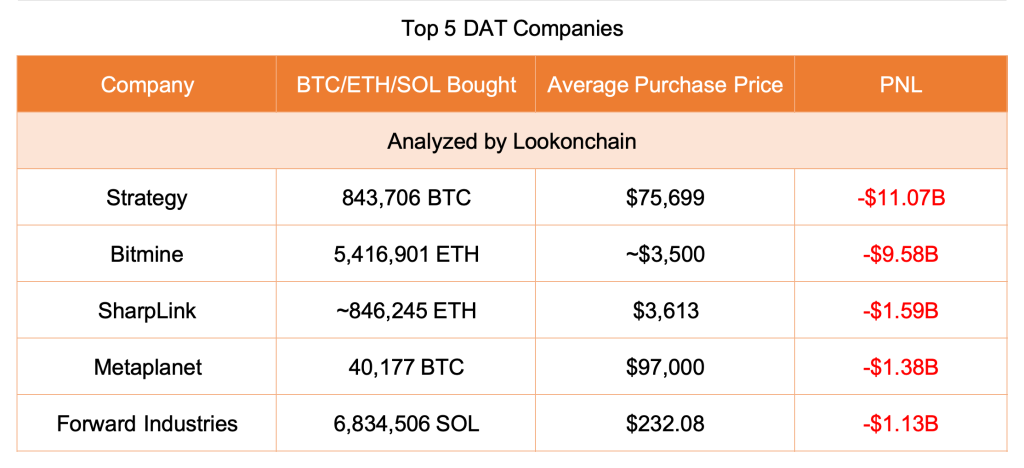
Across the eight largest pure-play Bitcoin treasury firms, controlling over 850,000 BTC combined, unrealized losses had already surpassed $10 billion before the latest leg down.
Artemis data from February 2026 showed system-level unrealized losses across corporate crypto portfolios exceeding $20 billion, even then, and no major corporate holder was in a net profit position on BTC at that point.
The market capitalization loss now visible across the sector is not a surprise outcome. It was a predictable one.
Investor Michael Burry has described the dynamic as a “reflexive unwind”, falling BTC prices compress equity premiums, close the issuance window, and convert the model from accumulate-forever to sell-to-survive.
His scenario analysis identifies $60,000 as an existential crisis level for Strategy specifically, where capital markets are effectively closed and multi-billion-dollar losses become locked in rather than theoretical.
Discover: The Best Token Presales
The post The Bitcoin Crash Just Wiped $62 Billion From Corporate Treasury Holders, Is the MicroStrategy Model Broken? appeared first on Cryptonews.

How Protocols Buy Attention and Convert It Into Liquidity
Introduction
For years, the crypto industry has described Decentralized Finance (DeFi) as an alternative financial system built on transparency, permissionless access, and code-based trust. While those principles remain true, they no longer explain how most modern DeFi protocols actually grow.
The reality is simpler:
DeFi is increasingly an attention market.
Liquidity does not magically appear because a protocol is technologically superior. Users rarely discover projects through technical whitepapers. Capital flows toward visibility, narratives, incentives, and social momentum.
In many cases, protocols effectively purchase attention and convert it into liquidity.
Understanding this dynamic helps explain everything from liquidity mining programs and airdrops to influencer campaigns and token incentives.
The New Currency: Attention
Attention has become one of the most valuable assets in digital economies.
Every day, thousands of crypto projects compete for visibility across X, Telegram, Discord, YouTube, podcasts, newsletters, and on-chain analytics platforms.
The challenge is not building a protocol.
The challenge is convincing people to care.
A protocol can have innovative technology, robust security, and strong fundamentals, yet struggle to attract liquidity if nobody is paying attention.
Conversely, projects with mediocre products can attract massive capital inflows when they successfully dominate narratives.
This is because attention often arrives before trust.
And liquidity often arrives before utility.
The Attention-to-Liquidity Funnel
Most successful DeFi growth strategies follow a similar process:
Step 1: Capture Attention
Protocols create awareness through:
- Airdrops
- Yield farming campaigns
- Influencer partnerships
- Community incentives
- Referral programs
- Viral social content
- Trading competitions
The goal is simple:
Get users talking.
Step 2: Generate Participation
Once attention is captured, users are encouraged to interact with the protocol.
Examples include:
- Depositing assets
- Providing liquidity
- Staking tokens
- Opening leveraged positions
- Minting NFTs
- Participating in governance
Participation creates measurable metrics that can be shared publicly.
Step 3: Create Social Proof
As activity grows, new users see:
- Rising TVL
- Growing user counts
- Higher trading volume
- Trending token prices
These metrics signal momentum.
Momentum attracts additional attention.
The cycle reinforces itself.
Step 4: Convert Attention Into Liquidity
Eventually, attention becomes capital.
Users move funds into the ecosystem because they believe:
- Rewards are attractive
- Growth will continue
- The protocol has momentum
- Future incentives may exist
At this stage, attention has been successfully monetized.
The protocol has transformed visibility into liquidity.
Liquidity Mining Was the First Attention Engine
The concept is not new.
Liquidity mining emerged during the DeFi Summer of 2020 as one of the industry’s most effective mechanisms for acquiring attention.
Protocols distributed governance tokens in exchange for user participation.
Critics viewed this as expensive.
In reality, protocols were buying attention.
The rewards attracted users.
Users generated activity.
Activity created headlines.
Headlines generated more users.
Liquidity mining was essentially a customer acquisition strategy disguised as financial incentives.
Airdrops Are Marketing Budgets
Many people view airdrops as gifts.
Protocols view them differently.
Airdrops are marketing expenditures.
Instead of purchasing advertisements through traditional channels, projects distribute tokens directly to users.
The result is often more effective because recipients become:
- Users
- Community members
- Content creators
- Advocates
A successful airdrop converts thousands of individuals into active marketers.
Every speculative post, tutorial thread, and dashboard screenshot amplifies attention.
Why Attention Is More Valuable Than Capital
Traditional finance treats capital as a scarce resource.
In crypto, attention is often scarcer.
Billions of dollars can move between protocols within hours.
User attention, however, is limited.
A trader can only monitor a handful of opportunities at a time.
An investor can only follow a limited number of narratives.
Winning attention often precedes winning capital.
This explains why some protocols prioritize growth campaigns even when immediate profitability suffers.
Their objective is not today’s revenue.
Their objective is to become the narrative everyone watches tomorrow.
The Risks of Attention-Driven Growth
While attention can accelerate growth, it can also create fragility.
Protocols that rely exclusively on incentives often face several challenges:
Mercenary Capital
Users arrive for rewards rather than conviction.
When incentives disappear, liquidity leaves.
Unsustainable Economics
Excessive token emissions can dilute long-term value.
Protocols may spend more acquiring liquidity than they ever earn from it.
Narrative Dependency
Attention is temporary.
Markets constantly search for the next story.
Protocols that fail to build genuine utility eventually lose relevance.
Artificial Metrics
TVL and user counts can be inflated by short-term incentives.
High numbers do not always reflect healthy ecosystems.
The Future: Attention Plus Utility
The strongest DeFi protocols understand that attention is only the beginning.
Attention attracts users.
The utility keeps them.
The next generation of successful protocols will combine:
- Strong incentives
- Sustainable revenue models
- Product-market fit
- Real user demand
- Long-term ecosystem value
Rather than continuously buying attention, they will convert temporary attention into permanent network effects.
Conclusion
The evolution of DeFi reveals a simple truth:
Protocols are no longer competing solely on technology.
They are competing for attention.
Liquidity mining, airdrops, referral programs, and social campaigns are not random growth tactics. They are mechanisms for acquiring visibility in an increasingly crowded market.
The protocols that understand attention as a financial asset gain a significant advantage. But attention alone is not enough.
In the long run, the winners will be the protocols that successfully transform attention into liquidity, liquidity into utility, and utility into lasting value.
In that sense, DeFi is not just a financial market.
It is an attention market where visibility is the first asset, liquidity is the second, and sustainable value is the ultimate prize.
REQUEST AN ARTICLE
Crypto World
LBank Surpasses 25 Million Users Worldwide as AFA Partnership Continues to Drive Global Growth

[PRESS RELEASE – Singapore, Singapore, June 5th, 2026]
Global cryptocurrency exchange LBank today announced that its registered user base has surpassed 25 million worldwide, marking a major milestone in the exchange’s global expansion journey. The achievement comes nearly one year after LBank became the Regional Sponsor of the Argentine National Team, a partnership that has played a pivotal role in expanding the exchange’s international visibility, strengthening community engagement, and accelerating mainstream awareness of digital assets.
Since joining forces with the reigning FIFA World Cup champions, LBank has sought to build more than a traditional sponsorship relationship. Through a series of global campaigns, fan-focused activations, and localized community initiatives, the collaboration has connected the passion of football with the accessibility of digital finance, helping introduce Web3 to audiences far beyond the traditional crypto ecosystem.
As anticipation builds for the world’s biggest football tournament, LBank will launch its flagship Super League campaign on June 9, featuring a $5,000,000 prize pool and premium rewards including FIFA World Cup 2026 Final Tickets, a 1,000g Gold Ball, and BTC. Building on the momentum of its partnership with AFA, the campaign is designed to bring together football passion, community participation, and digital asset innovation for millions of users worldwide.
Over the past year, this momentum has translated into measurable growth across the LBank ecosystem. Registered users have surpassed 25 million globally, while daily trading volume has exceeded $10.5 billion, reaching new highs amid expanding participation from both retail and professional traders. At the same time, LBank has continued broadening its product offerings, with TradFi products, including tokenized U.S. Stocks, Metals, and other real-world asset markets, generating more than $2.5 billion in daily trading volume and emerging as one of the fastest-growing segments on the exchange.
Beyond business growth, the partnership period has also coincided with a new phase of community and brand development. LBank has expanded its presence among younger digital-native audiences through brand collaborations, social-first engagement initiatives, and innovative product experiences. From partnerships with globally recognized internet personalities such as Nobodysausage to the launch of interactive features like Bullet Comments, LBank has continued exploring new ways to combine finance, culture, and community participation within a single ecosystem.
“World champions are not defined by a single victory, but by their ability to consistently perform at the highest level,” said Eric He, Community Angel Officer and Risk Control Adviser at LBank. “That philosophy strongly resonates with LBank’s journey. Since partnering with AFA, we have expanded our global community beyond 25 million users, and continued pushing the boundaries of product innovation. The partnership has demonstrated that football is more than a sport—it is a universal language that connects people across cultures, just as digital assets are creating a more connected global financial ecosystem.”
As the world looks ahead to the next chapter of international football, LBank remains committed to the same values that define champions on the global stage: ambition, resilience, and continuous progress. With more than 25 million users across 210+ countries and regions, LBank will continue building a more accessible, connected, and innovative future for digital assets worldwide.
About LBank
Founded in 2015, LBank is a leading global cryptocurrency exchange serving over 25 million registered users in 210 countries and regions. With a daily trading volume exceeding $10.5 billion and 10 years of safety with zero security incidents, LBank is dedicated to providing a comprehensive and user-friendly trading experience. Through innovative trading solutions, the platform has enabled users to achieve average returns of over 130% on newly listed assets.
LBank has listed over 300 mainstream coins and more than 50 high-potential gems. Ranked No. 1 in 100x Gems, Highest Gains, and Meme Share, LBank leads the market with the fastest altcoin listings, unmatched liquidity, and industry-first trading guarantees, making it the go-to platform for crypto investors worldwide.
Follow LBank for Updates
Website: https://www.lbank.com/
Twitter: https://twitter.com/LBank_Exchange
Telegram: https://t.me/LBank_en
Instagram: https://www.instagram.com/lbank_exchange
LinkedIn: https://www.linkedin.com/company/lbank
The post LBank Surpasses 25 Million Users Worldwide as AFA Partnership Continues to Drive Global Growth appeared first on CryptoPotato.
Disclosure: This article does not represent investment advice. The content and materials featured on this page are for educational purposes only.
Cloud mining regains momentum as platforms like SHRMiner simplify access to digital asset participation.
Summary
- Rising mining costs and hardware expenses are driving renewed interest in cloud mining as an alternative way to access crypto mining exposure.
- SHRMiner promotes an AI-powered cloud mining model with automated participation, daily settlements, and support for multiple cryptocurrencies.
- Industry attention remains focused on cloud mining providers as investors seek ways to generate returns from idle digital assets beyond simple holding.
The cryptocurrency market has changed dramatically over the past year.
While Bitcoin continues to attract long-term holders, rising mining difficulty, increasing electricity costs, and expensive ASIC hardware have made traditional mining inaccessible for most retail users. As a result, cloud mining platforms are once again becoming a major topic across the digital asset industry.
Industry analysts note that cloud mining is increasingly viewed as a lower-barrier alternative for investors seeking exposure to Bitcoin mining economics without managing physical infrastructure. At the same time, many long-term BTC and XRP holders are exploring ways to put idle digital assets to work instead of relying solely on market appreciation.
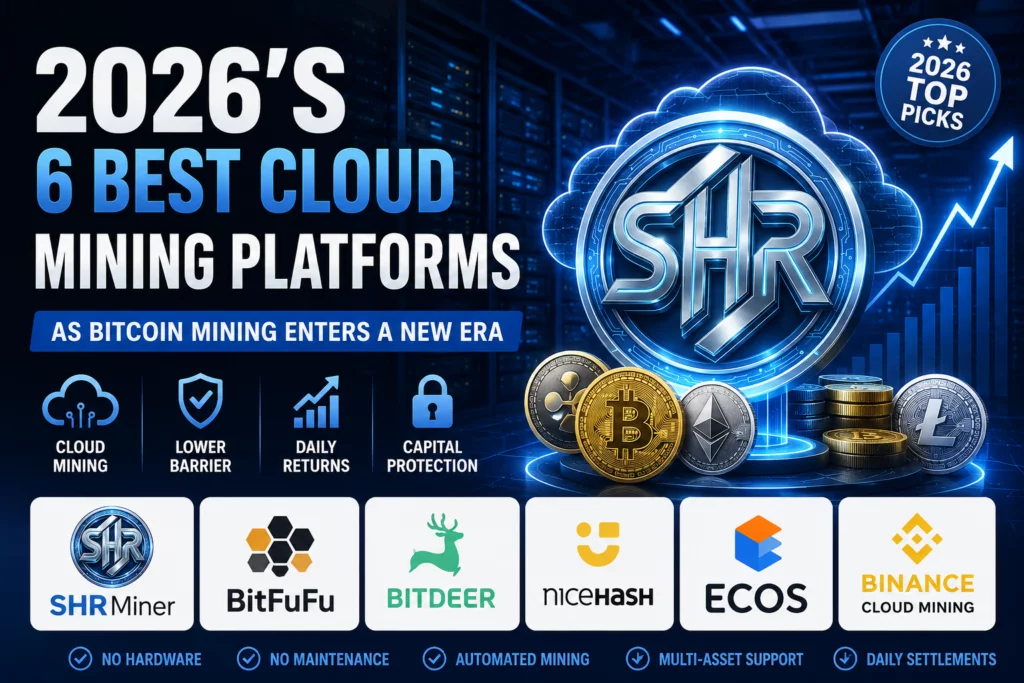
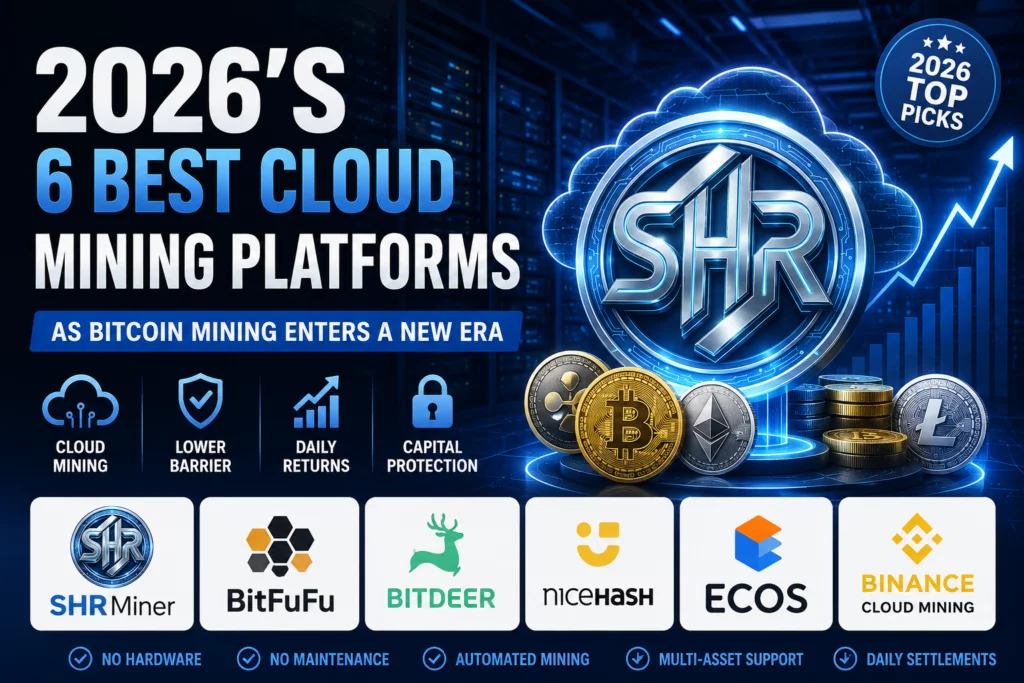
As 2026 unfolds, several platforms have emerged as leading choices for users looking to access mining rewards through hosted infrastructure and managed computing power.
Why cloud mining is regaining momentum in 2026
The economics of mining have changed.
Years ago, individuals could mine Bitcoin from home with relatively simple setups. Today, industrial-scale facilities dominate the industry, benefiting from lower energy costs, specialized hardware, and sophisticated infrastructure.
For many users, purchasing mining equipment no longer makes practical sense. Hardware costs can reach thousands of dollars before electricity, maintenance, and cooling expenses are even considered.
This has created growing demand for platforms that provide transparent contracts, daily settlements, and simplified onboarding without requiring technical expertise.
More importantly, investors are increasingly looking beyond short-term trading. Instead of attempting to predict every market movement, some are exploring infrastructure-backed participation models that can potentially generate returns regardless of day-to-day volatility.
The 6 best cloud mining platforms in 2026
1. SHRMiner
Among the platforms attracting growing attention in 2026, SHRMiner has differentiated itself through its AI-powered computing allocation model and simplified user experience.
Unlike traditional providers focused exclusively on hash-rate rentals, SHRMiner emphasizes automated participation, daily settlements, and accessibility for users who do not want to purchase hardware or manage technical infrastructure.
The platform supports multiple digital assets, including XRP, BTC, ETH, DOGE, USDT, USDC, SOL, LTC, and BCH, allowing users greater flexibility when allocating capital.
Investors interested in learning more can explore SHRMiner’s AI computing power platform.
How to get started with SHRMiner
Step 1: Claim the limited-time $15 registration bonus
Getting started takes less than 15 seconds.
Through SHRMiner’s exclusive welcome bonus campaign, new users currently receive a $15 trial computing allocation, allowing them to experience the platform without purchasing hardware or making a large upfront commitment.
Many users use this bonus to test the platform’s automated settlement system and gain firsthand experience before exploring larger allocations.
Step 2: Choose a computing power plan
Users can select a plan based on their preferred budget and income objectives.
Contract Name
Starting Amount
Duration
Daily Output
Total Output
MICROBT WhatsMiner M66
$3,000
15 Days
$40.50
$607.50
Bitcoin Miner S21 XP Imm
$5,000
25 Days
$70.00
$1,750
MICROBT WhatsMiner M73
$8,000
30 Days
$116.00
$3,480
Bitcoin Miner S21e XP Hyd
$10,000
35 Days
$150.00
$5,250
Multi-asset support includes XRP, BTC, ETH, DOGE, USDC, USDT, SOL, LTC, and BCH.
Additional plan details are available through SHRMiner’s AI computing contract catalog.
Step 3: Start earning daily rewards
Once activated, computing resources are automatically allocated and earnings are settled daily.
Users do not need to purchase mining equipment, maintain servers, or manage technical operations.
Funding protection remains a major attraction for many users: all contracts return the original principal upon maturity, helping reduce risk while maintaining exposure to mining-based returns.
2. BitFuFu
BitFuFu remains one of the industry’s most recognized cloud mining providers and continues to expand its global mining footprint.
The company offers a broad range of contract durations, transparent mining calculations, and infrastructure designed specifically for Bitcoin-focused users. Its large-scale mining capacity and established reputation continue to attract investors worldwide.
3. Bitdeer
Bitdeer remains a major player in the cloud mining industry.
Founded by industry veterans and backed by substantial mining infrastructure, Bitdeer provides users access to industrial-scale operations without requiring ownership of physical hardware.
4. NiceHash
NiceHash operates a unique hash-power marketplace rather than relying solely on traditional mining contracts.
Users can buy and sell computational power based on market conditions, making the platform particularly attractive to more experienced mining participants.
5. ECOS
ECOS has maintained a strong presence in the sector through its integrated ecosystem.
The platform combines cloud mining services with wallet functionality, portfolio management tools, and exchange access, creating a more comprehensive environment for long-term users.
6. Binance cloud mining
As part of the broader Binance ecosystem, Binance Cloud Mining offers users another pathway to participate in mining-related activities while remaining within one of the industry’s largest digital asset platforms.
For users already utilizing Binance products, this integration can provide additional convenience and operational simplicity.
Final thoughts
Cloud mining is no longer a niche corner of the cryptocurrency industry.
As mining infrastructure becomes increasingly professionalized, more investors are choosing platforms that remove the operational barriers traditionally associated with Bitcoin mining.
Whether users prioritize flexibility, institutional infrastructure, ecosystem integration, or AI-powered computing allocation, 2026 offers more choices than ever before.
For many long-term digital asset holders, the conversation is shifting from simply holding BTC or XRP toward discovering additional ways to put idle capital to work. In that environment, platforms like SHRMiner, BitFuFu, Bitdeer, NiceHash, ECOS, and Binance Cloud Mining are likely to remain at the center of industry attention throughout 2026.
For more information, visit the official website.
Disclosure: This content is provided by a third party. Neither crypto.news nor the author of this article endorses any product mentioned on this page. Users should conduct their own research before taking any action related to the company.
Crypto World
JPMorgan, Bank of America and Citi are going on the blockchain offensive with a shared tokenized network


America’s biggest banks, including JPMorgan, Citi and Bank of America, plan to build a shared, tokenized deposit network by the first half of 2027 to protect their deposits from the threat posed by stablecoins, the Wall Street Journal reported.
The system will be operated by The Clearing House, the payments company collectively owned by the banks. Some banks are calling the network “the bridge,” others call it “the chain,” the WSJ said.
Tokenized deposits are blockchain representations of customers’ money held at a bank. The planned system will convert these deposits into a digital token that can be transferred swiftly on a blockchain.
Stablecoins are dollar-pegged digital assets issued by crypto companies that live outside the traditional banking system. The Clarity Act legislation currently advancing through Congress could allow them to pay returns to holders, potentially making bank deposits less attractive because the tokens also offer faster, cheaper payment capabilities over a blockchain.
If customers adopt stablecoins at scale, banks could face a deposit flight to crypto wallets, and deposits are what banks rely on to extend credit in the economy. The tokenized deposit network is designed to ensure deposits remain within the banking system while giving them crypto-like capabilities.
The WSJ report said the Clearing House expects large multinationals to embrace the tokenized deposit network as a gateway to programmable treasury options, real-time liquidity management and cross-border payments.
“This is a big move for the banks,” CEO David Watson told the newspaper, describing a “radically different” future around onchain payments.

The same week SpaceX took its IPO to Wall Street, its biggest AI client showed up at the same door.
SpaceX launched its IPO roadshow this week, targeting $75 billion, the largest public offering in history, with a June 12 Nasdaq debut under ticker SPCX. On the same day, Anthropic, which pays SpaceX $1.25 billion a month for AI compute, filed its own confidential IPO prospectus with the SEC.
The two companies, which compete directly in AI through xAI’s Grok and Anthropic’s Claude, are now officially racing each other for the same institutional capital.
The $15 Billion Contract With a Six-Month Exit
SpaceX’s amended IPO filing discloses the full Anthropic deal: 325,000 Nvidia GPUs across its Colossus and Colossus II facilities in Memphis, $1.25 billion a month through May 2029. But the filing contains a clause that changes how investors should read that revenue.
After an initial three-month period, either party can terminate the agreements with 90 days’ notice. What reads as up to $45 billion in contracted future revenue is actually an arrangement either side can exit within roughly three months.
For a company where Anthropic’s payments approach its entire annual revenue, that termination clause is the most important sentence in the filing. As BeInCrypto’s earlier analysis of the SpaceX-Anthropic relationship noted, the financial entanglement between the two was always the central risk in SpaceX’s IPO narrative.
Two IPOs, One Capital Pool
Both companies now compete for institutional allocations in the same window. Goldman Sachs holds the lead position on SpaceX’s offering. Morgan Stanley manages a direct share program that reserves 5% of IPO stock for insiders selected “based on the discretion of our executive officers,” with no lockup restriction, meaning those participants can sell from day one.
Anthropic’s IPO, targeting a $965 billion valuation, will follow SpaceX and OpenAI into a market already absorbing more capital than any IPO cycle in recent history.
Institutions choosing between the two face a direct tradeoff: SpaceX’s valuation depends partly on Anthropic’s compute payments, and Anthropic is building its own infrastructure that could make those payments unnecessary.
The same IPO that lists Musk’s aerospace company on June 12 carries a clause that lets its most important client walk away in 90 days. Whether investors read that as flexibility or fragility will set the price.
Elon Musk’s ‘Evil Detector’
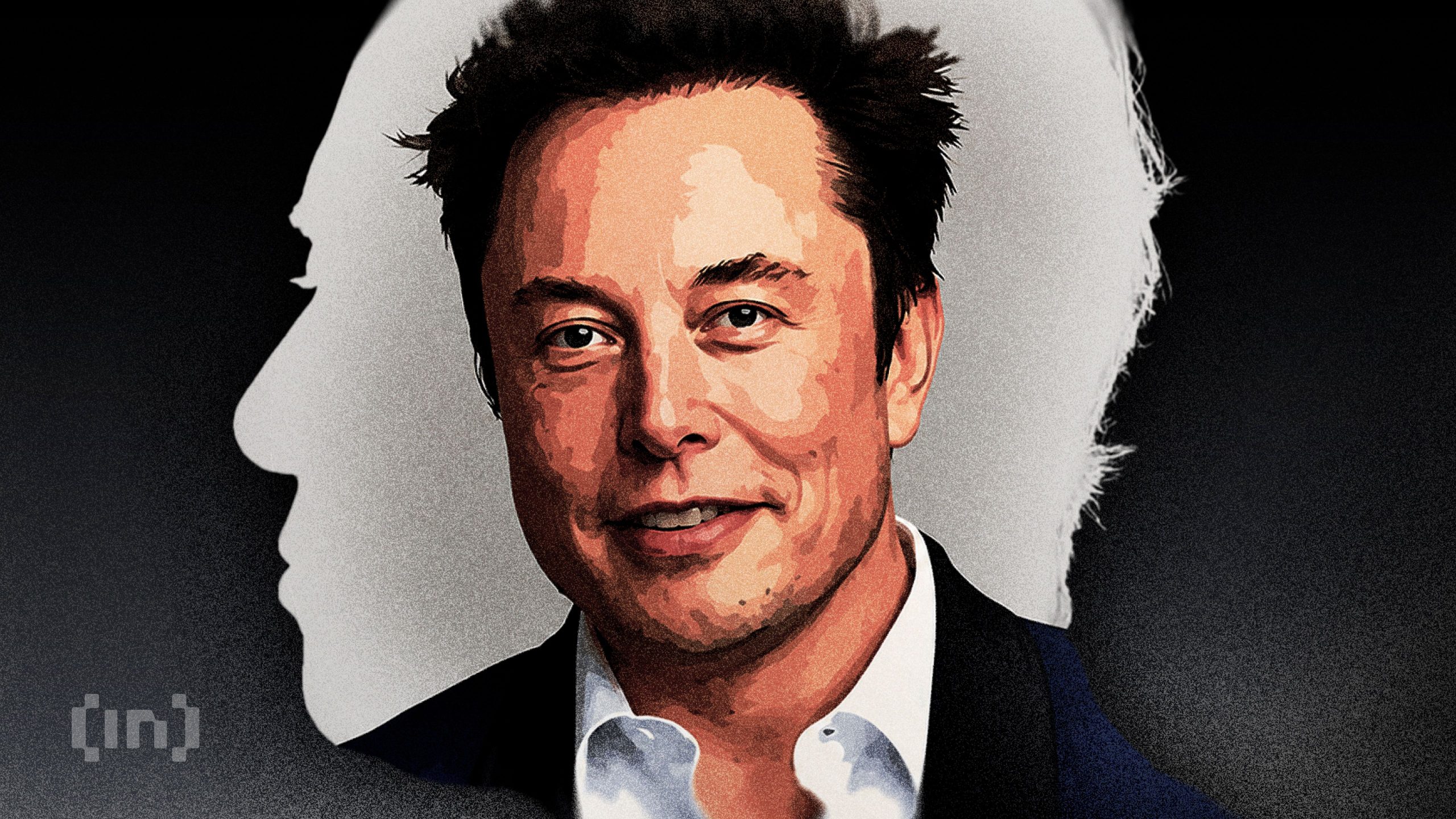
Three months before signing Anthropic to a $15 billion annual compute deal, Musk was doing the opposite. In March, he called Anthropic “evil” and “misanthropic” on X, retweeted a post urging Anthropic employees to quit, and asked: “Is there a more hypocritical company than Anthropic?”
By May, he had leased them the world’s largest AI supercomputer and posted a full reversal on the same platform: “Everyone I met was highly competent and cared a great deal about doing the right thing. No one set off my evil detector.”
The shift from rival to landlord took roughly 90 days, which happens to be the same notice period that lets either side walk away from the deal.
The post SpaceX’s Biggest Customer Is Also Its Biggest IPO Rival Paying $15 Billion a Year appeared first on BeInCrypto.
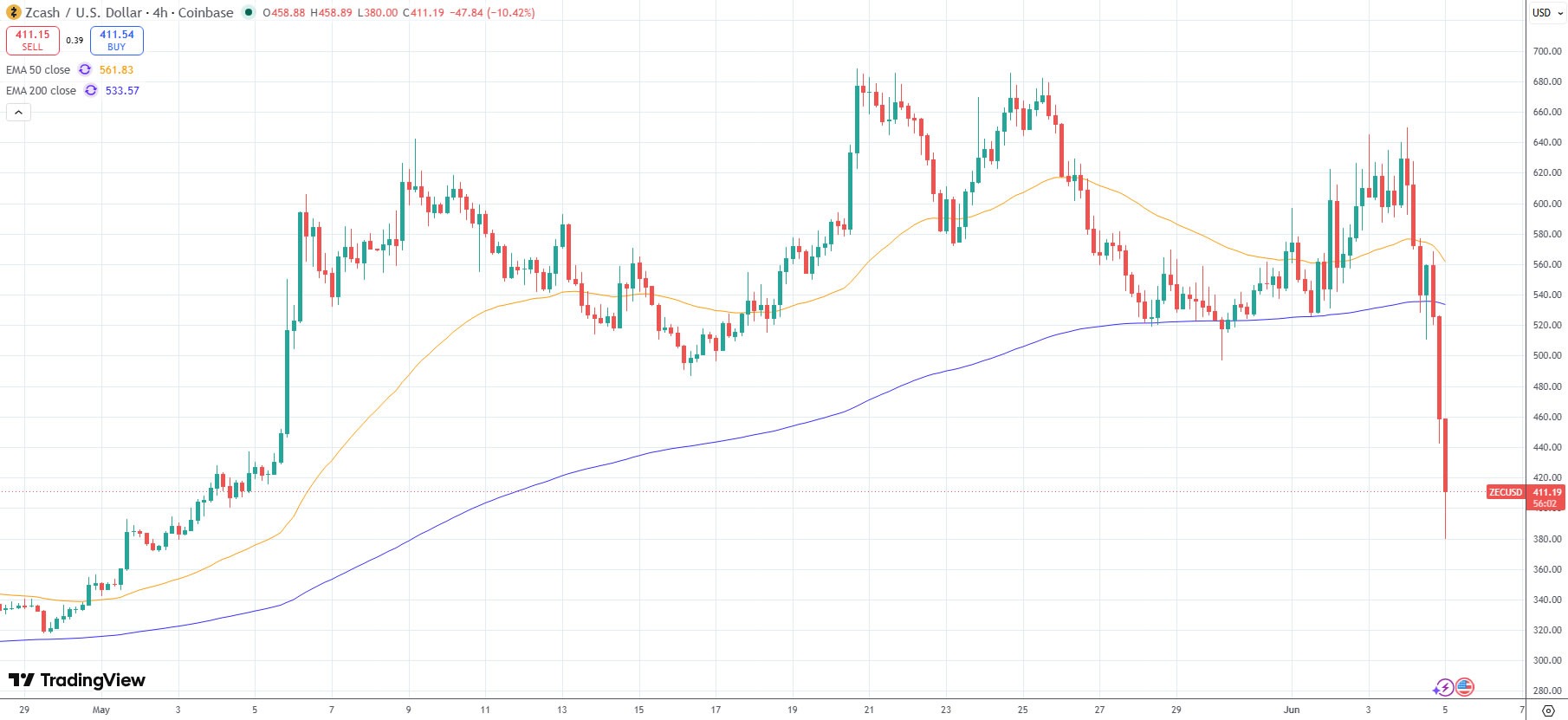
The price of ZEC fell on Thursday after further details were disclosed of a critical counterfeiting vulnerability in Zcash’s Orchard pool that could theoretically allow a bad actor to mint an unlimited amount of ZEC.
According to a post on X, security engineer Taylor Hornby, who was engaged by Shielded Labs, discovered the bug on May 29 and disclosed it to the Zcash Open Development Lab (ZODL), which deployed an emergency response to fix the vulnerability with a hard fork activated on June 3.
However, there are new concerns about the extent to which the vulnerability, which has existed since May 2022, has been used, leading Zcash to fall more than 30% over the past 24 hours to $410 at the time of writing. Its market capitalization has shrunk by more than $3 billion.
However, BitMEX co-founder Arthur Hayes said on Friday it is unlikely that ZEC has been illegally minted this way, though he acknowledged “it cannot be formally cryptographically proved impossible.”
“Sadly, due to the Orchard Pool exploit, I had to dump our entire ZEC bag,” he said.
“The Holy Trinity is dead,” he added, referring to Zcash and the two other tokens he sold this week, Hyperliquid (HYPE) and Near Protocol (NEAR).
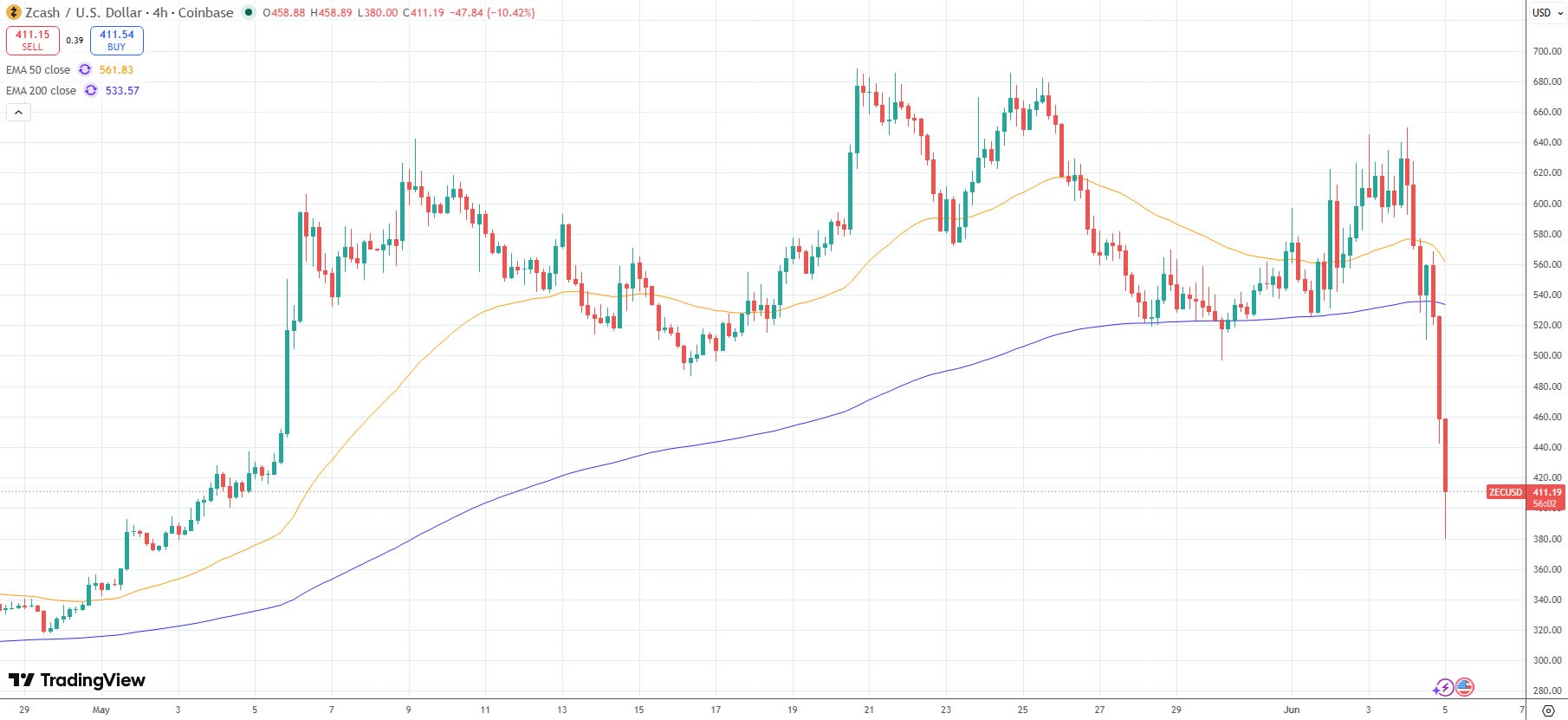
ZEC crashes 30% in 24 hours after two months of solid gains. Source: TradingView
Claude assists in bug discovery
Taylor used Claude Opus 4.8, which was released on May 28, a day before the discovery, to assist in a highly targeted review of the Orchard circuit, the cryptographic component underlying Zcash’s Orchard shielded pool.
The critical bug allowed false inputs into an elliptic curve multiplication check, which means the math that is supposed to cryptographically verify transactions could be fooled.
Taylor built and tested a working exploit, which generated unlimited counterfeit ZEC.
“If he had run the same tool on Zcash mainnet it would have generated unlimited, undetectable counterfeit ZEC in his mainnet Zcash wallet,” the security researchers said on Friday.
The primary concern is that there is no cryptographic way to prove whether anyone had previously exploited it before it was patched, due to Orchard’s privacy properties.
However, Shielded Labs was “not overly concerned” because the bug was subtle enough to evade years of expert review, and the discovery was a deliberate, highly skilled effort using cutting-edge tools and AI.
Related: Crypto exploit losses in May fall 90% over month to $68M: CertiK
The firm is working with Zcash developers on a proposed network upgrade to allow anyone to verify the integrity of the ZEC supply and to prove the nonexistence of counterfeit tokens in the Orchard pool, they stated.
Not the first counterfeiting vulnerability for Zcash
Mert Mumtaz, co-founder and CEO of Solana tooling firm Helius, said that almost all privacy protocols have a variant of this same vulnerability.
“This same FUD comes back every five months as new people learn how privacy pools work,” he said.
He explained that it is a theoretical risk in most zero-knowledge privacy protocols from circuit bugs that are hard to exploit or detect.
This is not the first time a similar vulnerability in Zcash has been discovered. In 2018, a counterfeiting vulnerability in the cryptography underlying zk-proofs was discovered by the Electric Coin Company, which remediated it with no losses in 2019.
Magazine: Big Questions: Do we really only need 2–5 cryptocurrencies?

Artificial Intelligence (AI) drove 38,579 US job cuts in May, the highest monthly total since tracking began in 2023, and the third straight month AI topped every other cause of layoffs.
AI accounted for 40% of all cuts announced in May, as employers move faster to automate roles and restructure around the technology.
AI Now Leads Every Reason for US Layoffs
The figures come from firm Challenger, Gray & Christmas. Its latest report shows AI’s share of monthly cuts rising from 7% in January to 26% in April, then 40% in May.
For the year, AI has been cited in 87,714 cuts, or 22% of all 2026 layoffs. That total already exceeds the 54,836 attributed to the technology across all of 2025.
Follow us on X to get the latest news as it happens

Andy Challenger, the firm’s chief revenue officer, noted that companies are acting on AI and restructuring around it.
“AI isn’t yet the jobpocalypse some predicted. Like spreadsheets and email before it, the technology will ultimately make workers more productive, but our data shows companies are already acting on it, citing AI for more cuts than any other reason. The open question isn’t whether AI changes the workforce,” he said.
Banks and FinTechs Join the AI Cutting Spree
The pressure now reaches beyond Big Tech. Financial technology (FinTech) firms announced 5,731 cuts in May, and most named AI in their announcements.
Banks are restructuring around the same logic. Standard Chartered plans to cut 7,800 back-office jobs by 2030 as it scales automation.
Overall, total May cuts reached 97,006, the highest May figure since 2020 and the third consecutive monthly increase. Technology led all sectors with 38,242 cuts and remains the year’s biggest job cutter.
Employers have cut 397,755 jobs so far in 2026, a 43% drop from the 696,309 announced over the same stretch of 2025. That earlier figure was inflated by deep federal workforce reductions, which pushed the count into record territory.
Subscribe to our YouTube channel to watch leaders and journalists provide expert insights
The post AI Has Cut More US Jobs in 2026 Than in All of 2025 Already appeared first on BeInCrypto.

Five Below: Remain Buy Rated As Fundamentals Are Still Very Healthy
‘Avoid Rain at All Costs’: ZachXBT Raises Red Flags Over $8.8B Prediction Market Project

Kennedy Center Staffers Told to Remove References to Trump

HarrisX Poll Found 52% of Registered Voters Support the CLARITY Act

BloFin War of Whales 2026 Grand Prix opens registration for $5M trading championship

Blockchain.com files with SEC for U.S. IPO

Paisa ka chakar #rakshabandhan #sisterlove #money #indimation

WILL XRP PRICE RISE OR FALL? – XRP U.S. BANK MOMENT IS HERE! – XRP ROI REMAINS THE BEST! – XRP NEWS!

FINANCIAL FREEDOM ke liye kya karein?? | Warikoo Careers Hindi
-

 News Videos7 days ago
This is BROKEN! INSANE 5x MONEY CAR WASH WEEK! The NEW GTA Online UPDATE Today! (GTA5 New Update)
-

 Business4 days ago
Jade Biosciences, Inc. (JBIO) Discusses Positive Interim Results From JADE101 Phase I Healthy Volunteer Study and Development Plans Transcript
-
 Tech6 days ago
SpaceX just won a second Golden Dome contract. This one is $4.16 billion.
-

 News Videos7 days ago
SHE IS KILLING XRP!!! WATCH URGENT AND ACT FAST
-

 Sports2 days ago
French Open 2026 results: Alexander Zverev beats Rafael Jodar and will play Jakub Mensik in semi-finals
-
 NewsBeat6 days ago
FIRST NIGHT REVIEW: Take That bring the Circus back to life in spectacular sun-soaked style
-

 Business6 days ago
Is the Spurs Phenom Already Better Than Prime Diesel?
-

 Tech3 days ago
CryZENx Releases Fresh Playable Content Deep Inside Jabu-Jabu for His Ocarina of Time Remake
-
 NewsBeat7 days ago
Novak Djokovic v Joao Fonseca LIVE: French Open latest scores and results after Jannik Sinner’s shocking collapse
-
 Crypto World7 days ago
CFTC Has Approved the First Regulated Bitcoin Perpetual Contract in the U.S.
-

 Politics6 days ago
The House | Inside Andy Burnham’s Makerfield Campaign: “Nobody Thinks This Is In The Bag”
-

 Entertainment7 days ago
Maddox Jolie-Pitt Legally Requests to Drop Brad’s Surname
-
 Entertainment7 days ago
Bruce Willis’ Generosity Resurfaces Amid His Dementia
-
 Entertainment6 days ago
Weak ‘Supergirl’ Box Office Tracking Amid Milly Alcock Backlash
-
 Crypto World7 days ago
Snowflake (SNOW) Stock Rallies on Strong Q1 Results and AI Product Growth
-
 Entertainment6 days ago
One of the Greatest Sitcoms of All Time Shoots Up Apple TV’s Charts 11 Years Later
-

 Business6 days ago
Demand Conditions Improve In Chemicals Sector In April 2026
-

 Tech7 days ago
This Week In Security: Ubiquiti Fixes, And FreeBSD Joins The Club You Don’t Want To Join
-
 Crypto World7 days ago
MicroStrategy Moves $30 Million in BTC to Coinbase Prime: Is the Bitcoin Sell-Off Already Here?
-
 Crypto World3 days ago
Seagate (STX) Stock Surges to Record High on AI Boom and Legal Settlement
You must be logged in to post a comment Login