

Crypto World
The Bitcoin Crash Just Wiped $62 Billion From Corporate Treasury Holders, Is the MicroStrategy Model Broken?


The June 2026 crypto rout just erased $62 billion in combined market capitalization from public companies holding Bitcoin as a treasury asset.
MicroStrategy, Tesla, and Marathon Digital are leading the damage. The question that matters now is not whether the losses are recoverable; it is whether the entire structural model that produced them was viable to begin with.
Corporate Bitcoin holdings accelerated after MicroStrategy’s initial $250 million allocation in August 2020, framed explicitly as a hedge against dollar debasement.

By late 2025, more than 200 public companies collectively held an estimated $150 billion in digital assets. They bought near cycle highs. Bitcoin then fell roughly 50% from its peak. The math on that sequence is not complicated.
This is either a cyclical stress test that the strongest holders survive, or it is the market revealing that a leveraged, mark-to-market-sensitive corporate Bitcoin treasury is structurally broken by design. The rest of this article makes the case that it is closer to the latter.
Discover: The Best Crypto to Diversify Your Portfolio
MicroStrategy and Bitcoin Balance Sheet Mechanics Are Dangerous
Strategy, MicroStrategy’s rebranded entity, holds 843,706 BTC at an average acquisition cost of approximately $75,599 per coin.
With Bitcoin sliding toward $60,000 during that period, that position carries roughly $11 billion in unrealized losses. Every $1,000 move in BTC shifts Strategy’s paper position by $713.5 million.
Under updated FASB fair-value accounting rules in effect by 2026, those unrealized losses flow directly through net income, producing massive negative EPS swings in quarterly filings.
For a company that has built its investor thesis entirely around Bitcoin accumulation, reporting multi-billion-dollar losses is not a rounding error; it is the product.
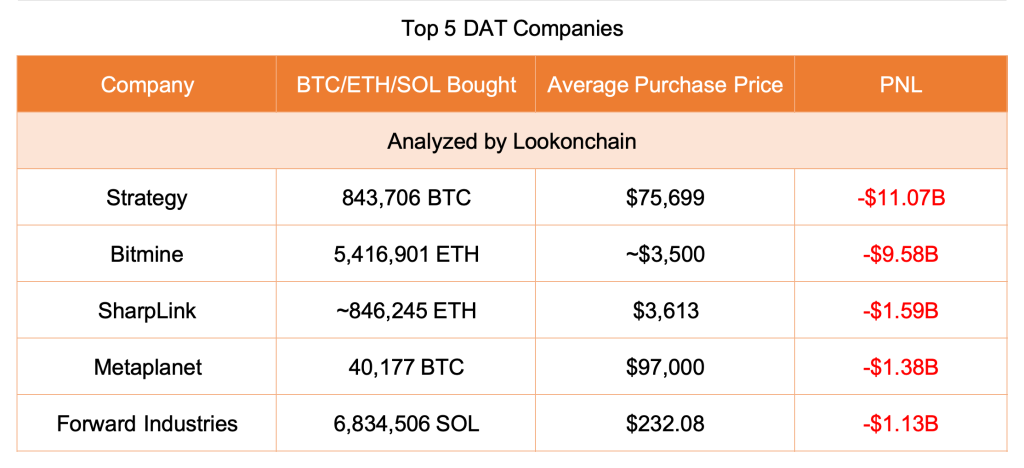
Across the eight largest pure-play Bitcoin treasury firms, controlling over 850,000 BTC combined, unrealized losses had already surpassed $10 billion before the latest leg down.
Artemis data from February 2026 showed system-level unrealized losses across corporate crypto portfolios exceeding $20 billion, even then, and no major corporate holder was in a net profit position on BTC at that point.
The market capitalization loss now visible across the sector is not a surprise outcome. It was a predictable one.
Investor Michael Burry has described the dynamic as a “reflexive unwind”, falling BTC prices compress equity premiums, close the issuance window, and convert the model from accumulate-forever to sell-to-survive.
His scenario analysis identifies $60,000 as an existential crisis level for Strategy specifically, where capital markets are effectively closed and multi-billion-dollar losses become locked in rather than theoretical.
Discover: The Best Token Presales
The post The Bitcoin Crash Just Wiped $62 Billion From Corporate Treasury Holders, Is the MicroStrategy Model Broken? appeared first on Cryptonews.

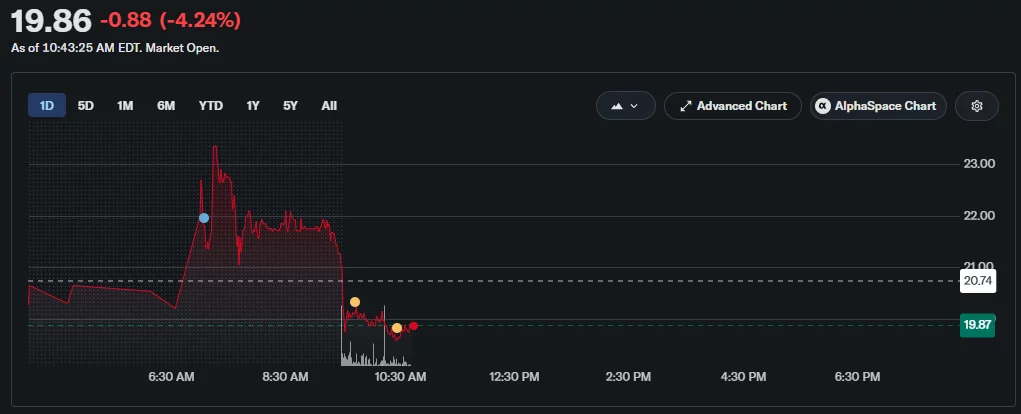
Core Scientific shares fell after the Bitcoin miner agreed to provide AMD with up to 2.5 gigawatts of data center capacity for artificial intelligence deployments starting in 2027.
Summary
- AMD secured access to up to 2.5 GW of data center capacity beginning next year.
- Core Scientific and AMD will deploy Instinct GPUs, EPYC CPUs, and ROCm software.
- CORZ fell more than 4% after reversing a gain of over 5% in premarket trading.
- AMD will receive market-priced warrants to purchase Core Scientific shares under certain conditions.
AMD secures up to 2.5 GW from Core Scientific
Core Scientific and AMD have signed an agreement covering up to 2.5 GW of data center capacity for customers deploying the chipmaker’s AI systems.
Capacity will become available from 2027, according to a joint announcement from the companies. Core Scientific and AMD will also work together on the physical design of the infrastructure needed to support high-density computing workloads.
Planned deployments will use AMD Instinct graphics processing units, EPYC processors, and the company’s ROCm software platform. The announcement did not disclose the financial value of the agreement or identify the end customers expected to use the capacity.
Unlike a standard hardware order, the arrangement pairs AMD’s computing products with Core Scientific’s power and data center infrastructure. The scale of the agreement could make AMD an important customer and commercial partner as Core Scientific converts more of its sites from crypto mining to AI computing.
AMD will also receive market-priced warrants allowing it to purchase Core Scientific common stock. The warrants remain subject to commercial conditions, and the companies did not disclose the potential size of AMD’s resulting stake.
Core Scientific accelerates its shift from Bitcoin mining
Core Scientific built its business around Bitcoin mining but has increasingly redirected capital and power capacity toward high-density data center services.
As previously reported by crypto.news, the company sold 2,385 Bitcoin earlier in 2026 to provide liquidity during the transition. BitcoinTreasuries data shows that Core Scientific still holds 848 BTC.
The company continues to generate revenue by mining crypto for its own account and providing hosting services to other miners. However, it is repurposing its remaining facilities for colocation services capable of supporting power-intensive AI systems.
The AMD agreement places Core Scientific among several publicly traded Bitcoin miners pursuing AI infrastructure contracts. Limited access to large sites with substantial power connections has made miners’ existing facilities attractive to cloud providers and AI developers.
MARA recently expanded its AI infrastructure footprint through the acquisition of a site in Texas. TeraWulf also signed a 20-year data center agreement with Anthropic earlier in July.
Hut 8 and IREN announced separate multibillion-dollar AI infrastructure deals last week. Hut 8 signed a second 15-year lease worth $9.8 billion at its Beacon Point campus in Texas, while IREN disclosed $2.8 billion in new multiyear AI cloud contracts.
CORZ reverses its premarket gain
CORZ initially rose more than 5% in premarket trading after the AMD agreement was announced. The stock reversed direction after the opening bell and fell more than 4% as a broader equity market sell-off weighed on trading.
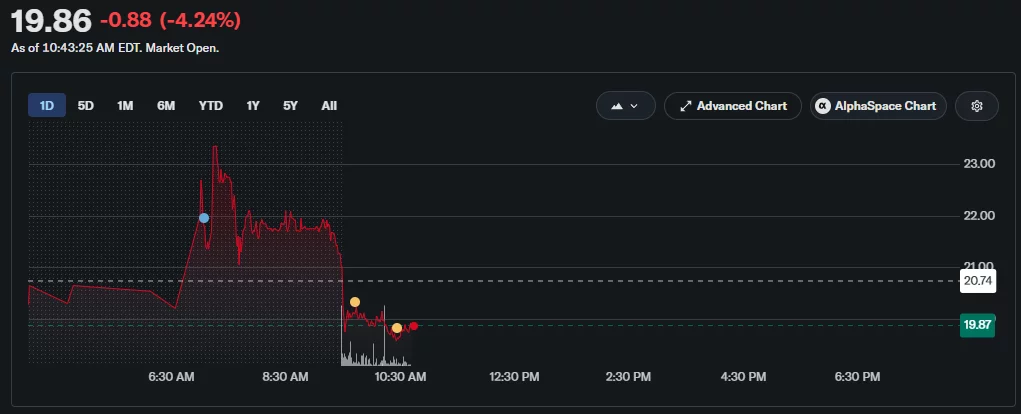
Core Scientific shares have now declined more than 12% over the past week. Despite the latest pullback, the stock remains up over 40% since the start of 2026 as investors assess its transition from Bitcoin mining to AI infrastructure.
The reversal indicates that investors are weighing the agreement’s long-term capacity against near-term execution costs and market conditions. The companies did not disclose expected revenue, construction spending, deployment stages, or a timetable for bringing the full 2.5 GW online.
For U.S. investors, AMD’s warrants introduce a potential dilution consideration if the chipmaker exercises its right to buy CORZ shares. The commercial conditions and number of shares covered will determine the eventual effect on existing holders.
Execution becomes the next test for Core Scientific
Core Scientific must now prepare its facilities for deployments scheduled to begin in 2027. Its progress will depend on power availability, construction timelines, customer demand, and the capital required to convert former mining sites.
Investors will also watch for disclosures covering the agreement’s financial value, deployment schedule, and warrant terms. These details will help determine how quickly the AMD partnership could replace declining reliance on Bitcoin mining revenue.
The wider shift among miners is increasing competition for AI tenants and financing. Core Scientific’s 2.5 GW agreement gives it substantial contracted demand, but future results will depend on how much capacity is delivered and how profitably the company operates it.
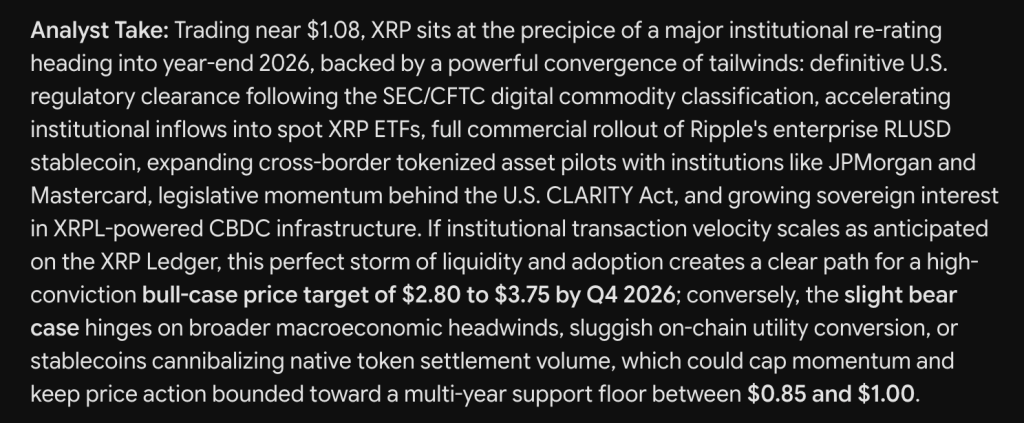
Google Gemini AI language on this predicts is unusually direct. Trading near $1.08, XRP sits at the precipice of a major institutional re-rating heading into the 2026 year-end price prediction.
The case rests on several tailwinds converging at once rather than any single event. Definitive US regulatory clearance following an SEC and CFTC digital commodity classification would remove the legal ambiguity that has followed XRP for years.
Accelerating institutional inflows into spot XRP ETFs sit alongside the full commercial rollout of Ripple’s enterprise RLUSD stablecoin. Cross-border tokenized asset pilots are expanding too, now involving institutions like JPMorgan and Mastercard.

Legislative momentum behind the US CLARITY Act adds another layer of support. Growing sovereign interest in XRPL-powered CBDC infrastructure rounds out the picture, hinting at government-level adoption rather than just corporate partnerships.
Gemini frames the real trigger as transaction velocity. If institutional usage on the XRP Ledger scales as these partnerships suggest, that combination of liquidity and adoption creates a clear path to a high-conviction target of $2.80 to $3.75 by Q4 2026.
The bear case is comparatively slight but specific. Broader macroeconomic headwinds, slow conversion of on chain utility into real volume, or stablecoins cannibalizing native token settlement could all cap momentum.
In that scenario, Gemini sees price bounded toward a multi-year support floor between $0.85 and $1.00 rather than breaking out at all.

XRP Is Sitting Almost Exactly On The Floor Gemini’s Own Bear Case Describes
Price closed at $1.09051, down 1.92%, in a session ranging between $1.08375 and $1.11404. That places XRP right at the upper edge of the exact support zone that the bear case flags, making this chart worth reading closely.
Zoom out and the trend since mid 2025 has been one long staircase down. XRP peaked near $3.66 in July 2025, and every month since has carved a lower high, with the sharpest break coming in February when the price gapped from above $2.20 down through $1.60 in a matter of weeks.
Since that February crash, price has spent five months compressing into an increasingly narrow range between roughly $1.00 and $1.60. Support sits at $1.00, the psychological floor that lines up with Gemini’s own bear target, then $0.85 below that.
Resistance stacks at $1.20, then $1.40, then the heavier ceiling near $1.60 that has capped every bounce since February. Momentum here is flat and compressed, sitting in the lower half of a range that has been narrowing for months without resolving in either direction.
For Gemini’s bull case to gain any traction, XRP first needs to reclaim $1.60, a level this chart has not closed above since before the February breakdown. Until that happens, price is doing exactly what the bear case describes, sitting near the floor rather than building toward the ceiling.
Here is what Gemini AI Predicts For LiquidChain’s Near Future
Every cycle has a moment where waiting becomes the most expensive decision you can make. That moment is now.
Bitcoin, Ethereum, and XRP are all pinned under the same resistance they have been testing for weeks. The macro unlock is perpetually one data point away. The institutional money keeps arriving next quarter. Large-cap traders waiting for a breakout are queuing for a decision that belongs to someone else entirely.
Grok AI has identified what experienced cycle traders already act on. Capital that registers as statistical background noise at Bitcoin’s market cap can completely reprice a small, undiscovered project.
The asymmetry is not complicated. It lives in the distance between what something is genuinely worth and what the market has currently assigned it. The moment that distance gets noticed, it collapses. Before that moment, it is fully open.
Cross-chain fragmentation has been quietly taxing every DeFi participant since the first bridge went live. Bitcoin, Ethereum, and Solana were engineered independently with zero shared infrastructure and no design intent to communicate.
Every transaction crossing those ecosystem boundaries absorbs the cost of that decision in fees, failed execution, and slippage that hits before settlement even begins. The bridge industry did not fix this problem. It built a business model on top of it.
LiquidChain removes the business model entirely. Three networks unified inside a single execution layer. One deployment reaches all of them simultaneously. No cross-chain tax is extracted from any interaction anywhere.
Gemini AI predicts it as a coin worth watching. The presale sits at $0.01454 with just over $860,000 raised.
Execution is unproven. Adoption is an open question. Established assets offer a smoother path toward a ceiling that the entire market can already see. LiquidChain is the entry point that stops existing once the market finds it.
The post Google Gemini AI Predicts Why XRP Could Outperform Every Crypto by End of 2026 appeared first on Cryptonews.
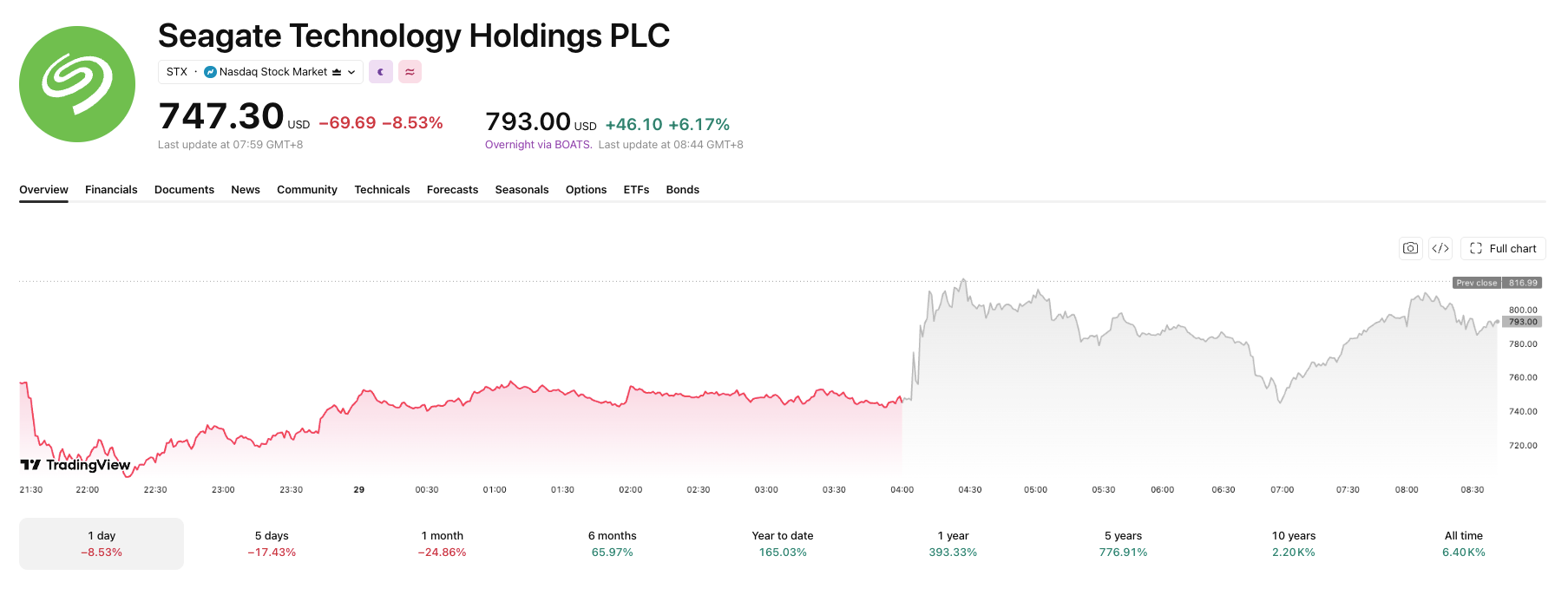
Seagate Technology just handed the AI infrastructure trade a much-needed win, and it came from hard drives, an unlikely corner of the market.
Seagate’s shares had slid roughly 8% into Tuesday’s print as investors had soured on stretched AI valuations across chip and storage names. However, Seagate’s fiscal fourth-quarter results flipped that mood almost overnight.
A Beat That Silences the Doubters
Revenue climbed 48% year over year to $3.63 billion, beating Wall Street’s estimate near $3.5 billion. Non-GAAP earnings per share came in at $5.71, well above the $5.10 analysts expected.
That gap matters because it shows Seagate isn’t just selling more drives. It’s making far more profit on each one. Non-GAAP gross margin backs that up, jumping to 52.7% from 37.9% a year earlier.

Seagate also banked a record $3.1 billion in free cash flow for the full fiscal year, cash it can use to pay down debt, reward shareholders, or reinvest in its AI storage push.
CEO Dave Mosley credited the results to durable cloud demand.
“Our performance is being driven by robust cloud data center demand and disciplined execution, and we see the momentum continuing in 2027,” Mosley said.
Management’s guidance beat expectations too. Seagate expects $4.1 billion in revenue next quarter, well above analyst estimates near $3.8 billion.
Why It Matters Beyond Storage
The beat lands right as memory chip stocks wobble on fears the AI buildout is overheating. Even SK Hynix and Samsung’s chip deals haven’t stopped that slide. Seagate’s results argue the underlying demand for AI-driven data storage still holds, even as sentiment around the stocks turns shaky.
Seagate’s next quarter, and whether it hits that $4.1 billion target, will show if this confidence sticks.
The post Seagate’s 48% Revenue Surge Silences Growing AI Infrastructure Skeptics appeared first on BeInCrypto.
Microsoft, Meta, Apple, and Amazon are the four US stocks with earnings to watch this week. Investors care less about profit beats than about whether record AI spending is producing revenue.
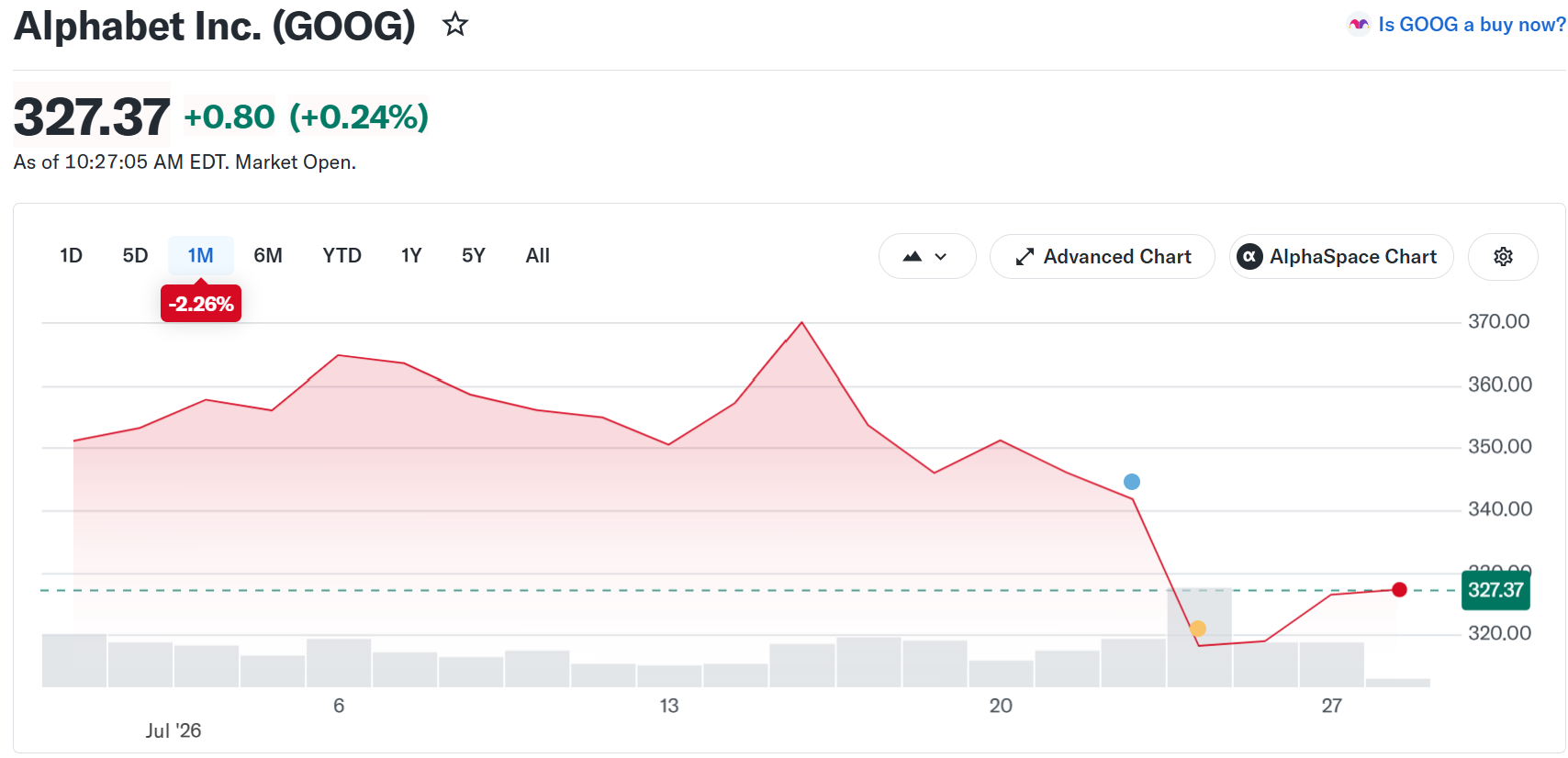
Alphabet already set the bar on July 22. Its shares fell despite beating on nearly every line, punished for lifting full-year capital spending guidance toward $205 billion.
Why Alphabet’s Selloff Reset Big Tech Earnings Expectations
Alphabet posted second-quarter revenue of $119.8 billion, a 24% annual increase. Diluted earnings reached $9.11 a share. Google Cloud revenue climbed 82% to $24.8 billion.
The stock still dropped roughly 4% after hours. Management had raised 2026 capital expenditure guidance to a range of $195 billion to $205 billion. The prior range topped out at $190 billion.

Quarterly capital spending hit $44.9 billion, roughly double the year-earlier figure. Free cash flow turned negative at $5.9 billion.
That combination is the new market test. Beating on revenue no longer protects a stock if spending guidance rises faster.
What the Latest Filings Already Reveal About AI Capex
Most coverage treats AI spending as a forecast. The filings show it has already landed.
BeInCrypto reviewed the most recent quarterly cash flow statements for all five companies. The pattern is consistent. Capital spending is growing far faster than the cash generated to fund it.
Microsoft offers the clearest example. Additions to property and equipment reached $30.9 billion in the March quarter, according to its filing. That is up 84% from $16.7 billion a year earlier.
Operating cash flow grew far more slowly. Subtract capital spending and the remainder fell 22% to $15.8 billion, even though net income rose 23%.
Depreciation tells the same story. Microsoft’s depreciation and amortization charge rose 31% to $10.2 billion. Meta’s climbed 54% to $6.0 billion.
This is a pattern rather than a single quarter. Microsoft spent $80.1 billion on property and equipment across the first nine months of its fiscal year, up 69% from $47.5 billion.

Amazon shows the sharpest deterioration. Trailing free cash flow fell to $1.2 billion from $25.9 billion a year earlier. The company attributed the drop to a $59.3 billion rise in equipment purchases.
Combined Big Tech AI capex guidance for 2026 now runs into the hundreds of billions. The reported figures show that spending arriving on the balance sheet ahead of the revenue meant to justify it.
The revenue side is not standing still, however. Azure grew 40% last quarter, Google Cloud 82%, and Amazon Web Services 28%. The open question concerns timing rather than demand.
Why Headline Profits Are Flattering Meta and Amazon
Here is a detail that rarely surfaces in earnings previews. Both Meta and Amazon posted enormous headline profits last quarter for reasons unrelated to operations.
Meta reported diluted earnings of $10.44 a share. That figure included an $8.03 billion income tax benefit. The company disclosed that earnings would have been $3.13 lower without it.
Strip the benefit and Meta earned closer to $7.31 a share. Wednesday’s consensus of $7.13 therefore looks less like stagnation and more like a normal comparison.
Amazon reported $2.78 a share. That number included $16.8 billion in pre-tax gains from its Anthropic investment.
The lesson holds for both. Operating performance at these companies is currently harder to read from headline earnings. Investors are watching capital spending instead, because that line is unambiguous.
What Wall Street Wants From Each of the 4 US Stocks
Here is what what economists wants from Microsoft, Meta, Apple, and Amazon.
- Microsoft (MSFT) and the Azure Test
Microsoft closes its fiscal year on Wednesday. Zacks Investment Research puts consensus at $4.21 a share across 15 analysts, against $3.65 a year earlier.
Azure decides the reaction. The unit grew 40% last quarter. Management guided to constant-currency growth of 39% to 40% for the June period.
One number supports the bull case. Commercial remaining performance obligation, essentially contracted future revenue, nearly doubled to $627 billion. Chief Executive Satya Nadella also said Microsoft’s AI business passed a $37 billion annual revenue run rate.
- Meta (META) Faces Expense Scrutiny
Meta faces tighter expense discipline. It guided to full-year costs of $162 billion to $169 billion and capital expenditure of $125 billion to $145 billion. Reality Labs lost $4.03 billion last quarter alone.
The core business is still compounding quickly. Revenue rose 33% to $56.31 billion last quarter, of which advertising contributed $55.02 billion. An average of 3.56 billion people used its apps each day in March.
- Apple (AAPL) Is the Capital-Light Outlier
Apple is the control case. Analysts expect $1.88 a share, up from $1.57, on consensus revenue of roughly $109 billion.
Its March quarter showed what capital-light growth looks like. Revenue rose 17% to $111.2 billion and earnings per share climbed 22%, according to Apple’s release. Services reached an all-time high.
Apple generated more than $28 billion in operating cash flow that quarter. Rather than building data centers, it authorized a further $100 billion of share buybacks. Watch iPhone and Services for signs the iPhone 17 cycle is holding.
Thursday also marks Tim Cook’s final earnings call as chief executive. John Ternus takes over on September 1.
- Amazon (AMZN) Rests on AWS Margin
Amazon rounds out the week at $1.81 a share, against $1.68. Analysts model roughly $40.5 billion in Amazon Web Services revenue. Company guidance puts operating income between $20 billion and $24 billion.
AWS delivered $37.6 billion of revenue and $14.2 billion in segment operating income last quarter, its fastest growth in 15 quarters. Amazon’s custom chips business, spanning Graviton, Trainium, and Nitro, passed a $20 billion annual revenue run rate.
Why It Matters for the Nasdaq This Week
The Federal Reserve announces its rate decision on Wednesday afternoon, hours before Microsoft and Meta report. Rates currently sit between 3.50% and 3.75%.

Economists broadly expect no change. Traders disagree, and futures pricing splits sharply on the odds of a hike.
Precedent suggests the reaction could split the group. On April 30, Alphabet added more than $300 billion in market value, as BeInCrypto reported. Meta shed $175 billion in the same session. Both had beaten on revenue. Only their spending outlooks differed.
Options markets imply a move of roughly 6.3% for Amazon on results day, above its recent average. Similar volatility is priced across the other three.
Meanwhile the spending keeps expanding. Meta disclosed a new data center venture with BlackRock in El Paso on Tuesday, hours before its own report.
What to Watch Over the Next 30 Days
Three specific disclosures matter more than this week’s earnings per share.
- Fiscal 2027 capital expenditure guidance
Microsoft has signaled roughly $190 billion for calendar 2026. Any step up invites the treatment Alphabet received.
- AWS margin
Analysts model 33.8%. A decline would show depreciation reaching the segment that funds Amazon’s build.
- Meta’s expense range
Management has held $162 billion to $169 billion for two quarters. Widening it would echo April.
Track records diverge going in. Microsoft, Meta, and Apple have each beaten consensus in their last four quarters. Amazon has fallen short in its last two.
Therefore a headline miss would surprise on three of the four. On the question that decides the week, the filed numbers already lean one way.
Capital spending is outgrowing the revenue it funds at every company that has reported. Microsoft’s capex rose 84% while Azure grew 40%, roughly twice the pace. Alphabet’s roughly doubled against 82% cloud growth. Meta’s rose 47% against 33% revenue growth.
That gap indicates the payoff has not arrived yet. Demand signals suggest it may still be coming, and Microsoft’s $627 billion backlog is the strongest argument for patience.
Whether investors extend that patience depends on what these four guide for 2027, not on what they earned last quarter. The market is already questioning AI revenue quality.
The post 4 US Stocks Earnings to Watch This Week: Will AI Spending Finally Pay Off? appeared first on BeInCrypto.
Disclosure: This article does not represent investment advice. The content and materials featured on this page are for educational purposes only.
Cloud mining platforms gain popularity in 2026 as investors seek simpler ways to access Bitcoin, DOGE, and LTC mining without expensive hardware.
Summary
- SHRMiner ranks among top cloud mining platforms in 2026, offering beginners easier access to BTC, LTC, and DOGE mining.
- Cloud mining gains popularity in 2026 as platforms like SHRMiner provide automated crypto mining without expensive hardware.
- SHRMiner highlights renewable energy mining farms and automated cloud mining services as demand for BTC mining grows.
Want to participate in Bitcoin mining in 2026 but don’t want to buy expensive mining rigs? Then cloud mining platforms remain one of the simplest and most worry-free options.
Nowadays, more and more investors are entering the market through free cloud mining platforms, easily participating in mining mainstream cryptocurrencies such as BTC, DOGE, and LTC without needing to build their own equipment or bear high electricity and maintenance costs.
However, while there are many platforms on the market, only a few are truly worth considering. A good cloud mining platform should not only have a clear and transparent profit mechanism, but also a stable data center, an automatic payment system, and a sufficiently secure operational background.
Based on the market trends and platform characteristics in 2026, SHRMiner, BitFuFu, IQMining, Binance Cloud Mining, and CCG Mining are the five platforms that deserve close attention.
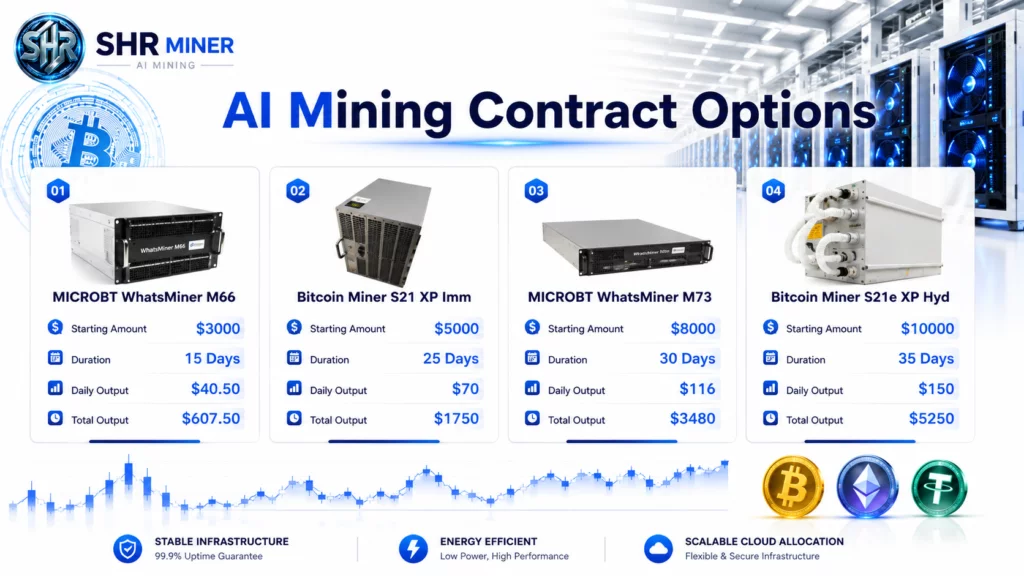
1. SHR Miner: The most noteworthy cloud mining platform in 2026
For those who are looking for a service that balances security, flexibility, and beginner-friendliness, SHRMiner is a very popular choice. Launched in 2018 and headquartered in the UK, SHRMiner operates over 100 large-scale renewable energy mining farms in the US, UK, Russia, Switzerland, Iceland, Virginia, Georgia, Vancouver, Canada, and other locations, utilizing renewable energy sources such as hydropower and wind power to enhance mining efficiency.
The platform supports mining mainstream cryptocurrencies such as BTC, LTC, and DOGE. Users do not need to purchase any hardware; they only need to select a suitable contract to start. Its contract coverage is extensive, with a comprehensive range of entry-level and premium packages to suit users with different budgets.
SHRMiner Core Advantages:
Register to receive a $15 bonus and free mining experience.
- Zero learning curve: No technical skills, hardware, or complicated operations required — just click to start mining.
- Supports daily automatic settlement, with no transaction fees or maintenance costs.
- Uses advanced ASIC mining equipment, connected to green energy, improving operational efficiency.
- Provides SSL encryption and DDoS protection.
- Provides a real-time earnings dashboard, allowing users to track their earnings anytime, anywhere.
- Supports multiple contract types including BTC, LTC, and DOGE.
SHRMiner gained popularity in 2026 primarily because it was suitable for beginners to quickly get started while also supporting more advanced users for flexible configuration. Its overall performance was well-balanced, from the initial user experience to contract scalability.
2. BitFuFu: A professional platform backed by Bitmain
BitFuFu has garnered significant market attention due to its association with Bitmain. This type of platform is particularly attractive to users who value mining rig resources and hardware expertise. BitFuFu is suitable for investors seeking a more mature mining service system.
3. IQMining: A key focus for long-term contract users
IQMining has been operating for several years and is characterized by offering longer-term mining contracts. For users who prioritize long-term planning over short-term volatility, IQMining is a common choice.
4. Binance Cloud Mining: Integrated trading and mining
The biggest advantage of Binance Cloud Mining lies in its ecosystem integration. Users can manage mining and asset transfers directly within their Binance accounts, eliminating the need for frequent platform switching. This is especially convenient for existing Binance investors.
5. CCG Mining: A key platform in the European market
CCG Mining offers a comprehensive range of services, including cloud mining, mining rig sales, and hosting. It enjoys considerable brand recognition in the European market and is suitable for users looking to explore diverse mining services.
Why are more and more people choosing cloud mining in 2026?
Compared to traditional mining rigs, the biggest advantages of cloud mining are:
- No need to purchase expensive equipment
- No need to bear high electricity bills
- No need for technical maintenance knowledge
- Quick start after registration
Some platforms also offer free trials and reward mechanisms. For ordinary users, this model is obviously more convenient and more suitable for low-barrier entry into the crypto market.
Conclusion: Which cloud mining platform is worth paying attention to in 2026?
From an overall user experience perspective, SHRMiner remains one of the most competitive platforms in 2026. It excels in platform transparency, mining process, settlement efficiency, and beginner-friendly features, while supporting multiple cryptocurrencies including BTC, LTC, and DOGE, making it highly versatile.
Of course, for those who prioritize exchange integration, Binance Cloud Mining will be more convenient; for those who value long-term stable contracts, IQMining and CCG Mining are also good options.
In general, when choosing the best cloud mining platform, it is recommended to focus on the platform’s background, security mechanisms, contract flexibility, and actual user experience. For users looking to start their free cloud mining journey in 2026, prioritizing a transparent, secure platform with clear settlement is a safer bet.
In short, for those who are looking for a cloud mining platform that balances transparency, flexibility, and ease of use in 2026, SHRMiner is a wise choice.
For more platform information, service details, and cloud computing solutions, please visit the official platform or download the mobile application.
Disclosure: This content is provided by a third party. Neither crypto.news nor the author of this article endorses any product mentioned on this page. Users should conduct their own research before taking any action related to the company.
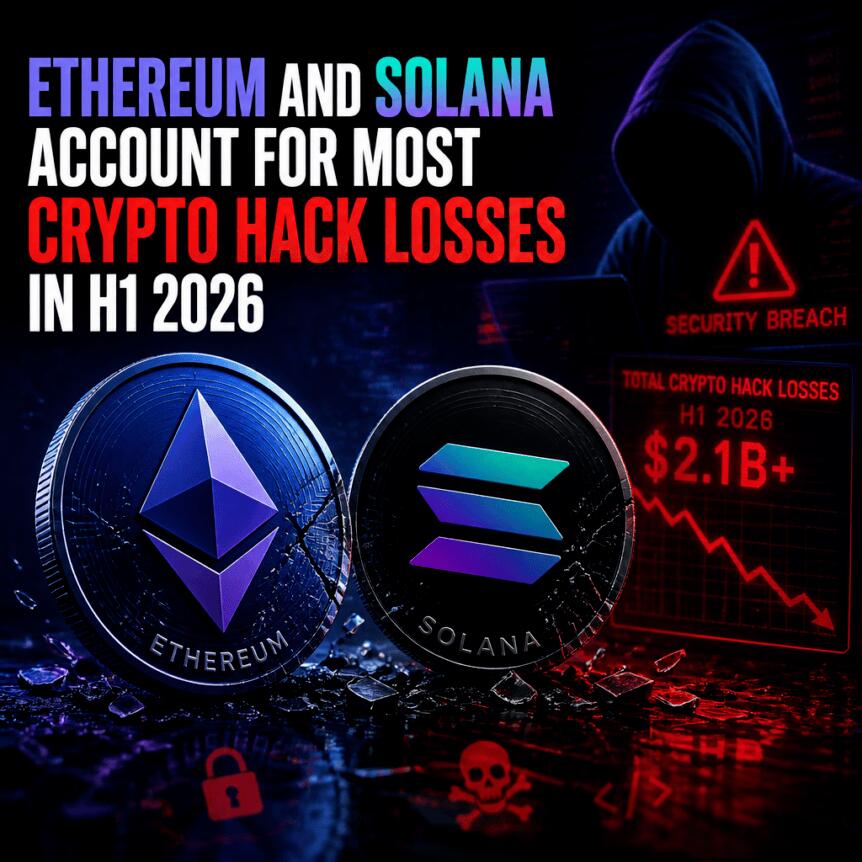
Crypto theft and fraud losses exceeded $1 billion in the first half of 2026, according to Blockaid’s H1 2026 security report released Tuesday. The period also featured the highest number of hacks in any six-month stretch recorded by the onchain security firm.
Ethereum and Solana accounted for the largest portions of stolen funds, with approximately $332 million and $326 million respectively. Blockaid tracked 212 security incidents during the six-month period, including a standout single exploit tied to KelpDAO, which Blockaid reported at $292 million.
Key takeaways
- Blockaid estimates total crypto losses above $1 billion in H1 2026, alongside the highest six-month hack count in its historical data.
- Ethereum led by stolen-fund impact (about $332 million), largely driven by code and application-layer exploits.
- Solana’s losses were similarly high (about $326 million) but were overwhelmingly linked to compromised keys and signing infrastructure.
- The largest single incident in the report involved KelpDAO, with losses of $292 million.
- Blockaid reports high-threshold exploit verification increased sharply in H1 2026 compared with all of 2025.
Ethereum’s losses underline application-layer risk
Blockaid said Ethereum incurred the highest losses from incidents in H1 2026, with attackers primarily focusing on vulnerabilities in applications built on the network. By count, code exploits were the dominant driver of Ethereum incidents, and Blockaid also highlighted that several major loss events involved compromised keys.
Among the notable incidents cited in the report were the Humanity Protocol and StablR attacks. CoWSwap was singled out as the only major Ethereum incident categorized as a user mistake, rather than a protocol or code vulnerability.
Blockaid described recurring techniques behind Ethereum-related breaches, including flaws in bridges and smart contracts, unauthorized access to privileged accounts, and market manipulation methods. While these categories differ in mechanics, they share a common theme: high-value Ethereum apps present a dense target surface for attackers seeking direct exploitation paths and privileged access.
The report also emphasized Ethereum’s role as a hub for major crypto primitives—restaking platforms, stablecoins, and decentralized exchanges—where substantial capital and complex integrations can concentrate both the value at risk and the probability of exploitable edge cases.
Solana’s stolen funds spiked with a shift toward key compromises
Solana’s losses in the first half of 2026 nearly matched Ethereum’s. Blockaid estimated stolen funds around $326 million for the period, a clear jump from roughly $127 million recorded in 2025.
In an observation carried in the report, Blockaid CEO Ido Ben-Natan told Cointelegraph that 2025 totaled $2.58 billion lost across 63 incidents, with activity concentrated in Q1 and with Ethereum and Arbitrum topping stolen-fund flow at the time.
However, Blockaid said Solana’s deterioration in H1 2026 did not come from a surge in smart contract exploits. Instead, compromised keys accounted for more than 98% of Solana’s losses, which Blockaid linked largely to incidents involving Drift Protocol and Step Finance. Blockaid also attributed those events to North Korea-linked cyber groups.
This matters because it reframes the operational priorities for Solana-related infrastructure. While Ethereum incidents in the report were more closely tied to vulnerabilities in protocol code, Blockaid said Solana-related losses were primarily associated with signer infrastructure and organizational security failures. In other words, the dominant threat vector in this period was not “bugs in execution,” but failures in control systems and signing operations.
Blockaid noted that only a small fraction of Solana losses were tied to code exploits—citing Raydium and Volo as examples—underscoring how heavily the report’s Solana narrative depends on key and signing security rather than on-chain contract defects alone.
What’s changed in the threat landscape
Two shifts stand out across Blockaid’s findings for H1 2026. First, Ethereum’s risk profile remained oriented around smart contract and application-layer weaknesses, where bridges, contract logic, and privileged account access can be exploited. Second, Solana’s losses, despite being comparable in size to Ethereum’s, were driven overwhelmingly by compromised keys and signing infrastructure—an operational and security governance problem rather than a pure software vulnerability issue.
Blockaid also reported that it verified 3.4 times as many high-threshold exploits in H1 2026 as it did across all of 2025. That suggests either that attackers pursued more severe, high-confidence exploitation paths during the period, or that the environment—across targets and integrations—supported higher-impact outcomes. In practice, for teams defending networks and protocols, it raises the likelihood of facing fewer “small” issues and more attacks with direct paths to material loss.
Finally, the report’s largest single exploit—KelpDAO at $292 million—fits the broader pattern of high-value targets attracting concentrated attacks. Even when overall incident counts vary, a small number of high-impact events can dominate the stolen-fund totals, which is precisely what appears in Blockaid’s H1 2026 breakdown.
Closing perspective
As H1 2026’s losses show, the most consequential threats are not uniform across chains: Ethereum-focused defenses should emphasize application and privileged access security, while Solana stakeholders should treat key management and signing infrastructure resilience as top priority. Readers should watch whether the disparity between code-driven incidents and key-driven incidents persists in the second half of 2026, and whether incident counts remain elevated alongside high-threshold exploit activity.


AmericanFortress has proposed a post-quantum security scheme designed to protect existing Bitcoin, Ethereum, and Solana wallet addresses without requiring holders to move funds or rotate their keys.
Summary
- ZK-PoSP keeps existing wallet addresses while replacing conventional transaction authorization with zero-knowledge proofs.
- AmericanFortress says the scheme requires no fund migration, key rotation, or new address format.
- The approach remains a proposal and would require node-level upgrades before any blockchain could enforce it.
- Its post-quantum security remains conjectural, according to the technical paper, rather than proven against a working attack.
ZK-PoSP uses wallet seeds to authorize transactions
AmericanFortress released the technical paper for Zero-Knowledge Proof of Seed Provenance, or ZK-PoSP, through the International Association for Cryptologic Research’s ePrint archive.
The scheme allows a wallet to prove that it knows the seed used to derive an address without revealing that seed. It would operate alongside existing signature systems before replacing the classical signing step if quantum computers become capable of attacking elliptic curve cryptography.
Bitcoin and Ethereum use the secp256k1 curve, while Solana commonly uses Ed25519. ZK-PoSP is designed to cover both curves and hierarchical deterministic wallet standards, including BIP32 and SLIP-10.
In a statement shared with crypto.news, AmericanFortress described the proposal as the first post-quantum approach that can preserve existing wallet addresses without forcing users to transfer assets.
Quantum protection depends on network upgrades
ZK-PoSP relies on hash functions and the soundness of its zero-knowledge proof system. Its paper says post-quantum security is “conjectured” because the underlying assumptions have not been tested against a cryptographically relevant quantum computer.
No such machine currently exists. However, sufficiently powerful quantum computers could theoretically use Shor’s algorithm to derive private keys from exposed public keys.
Google’s Quantum AI team recently estimated that breaking 256-bit elliptic curve cryptography could require fewer than 1,500 logical qubits and tens of millions of quantum gates. Those are error-corrected logical qubits, not the noisier physical qubits available in present systems. Google’s analysis therefore does not indicate that Bitcoin or other networks face an immediate attack.
AmericanFortress said blockchains could implement ZK-PoSP by adding proof verification through a node-level software upgrade. Wallet providers would also need to generate the required proofs.
Until a network adopts and enforces that verification, addresses with public keys already visible onchain would remain exposed to a future quantum attack.
AmericanFortress reports low verification costs
According to the company, generating a one-time proof to secure an address costs about $0.002 on a 16-core server, while each transaction proof costs roughly $0.00125. Its current implementation reportedly takes about 12 seconds to sign a transaction, with verification requiring between nine and 10 milliseconds.
Those figures reflect computational tests cited by AmericanFortress, not the cost or performance of a live blockchain integration. A network upgrade could introduce additional storage, bandwidth, software, and coordination requirements.
“Today’s implementation is already practical for institutional settlement, and hardware acceleration and proving-system improvements will bring signing times down further,” AmericanFortress CEO Michal “Mehow” Pospieszalski said.
The proofs use RISC Zero and do not require a trusted setup. AmericanFortress plans to license its software development kit to blockchains and other projects, meaning adoption would depend partly on commercial terms as well as independent technical review.
Bitcoin and Ethereum expand quantum research
The proposal arrives as institutional interest in post-quantum security grows. As crypto.news reported, Strategy, BlackRock, Coinbase, and six other companies recently formed the Bitcoin Security Consortium and pledged a combined $15 million over three years.
Post-quantum cryptography is the consortium’s first research focus. Its members will decide independently which developers and organizations receive funding, and the group does not control Bitcoin development or endorse individual protocol changes.
For US-based Bitcoin exchange-traded funds, custodians, and corporate treasuries, avoiding mass wallet migration could reduce operational and legal complications. However, ZK-PoSP would provide no protection unless Bitcoin developers, miners, node operators, wallet companies, and users accepted the necessary changes.
Ethereum has pursued a separate path. The Ethereum Foundation formed a dedicated post-quantum team in January and is testing hash-based signatures, a minimal zero-knowledge virtual machine, and migration tools, according to its quantum-security roadmap.
AmericanFortress’s proposal now faces the same central test as other security designs: independent cryptographic review, implementation audits, and sufficient network agreement to deploy it.
Morgan Stanley launched spot Ethereum and Solana exchange-traded products on Tuesday at a 0.14% fee. Prospectus filings show each trust opened with 50,000 shares and roughly $1 million in seed capital.
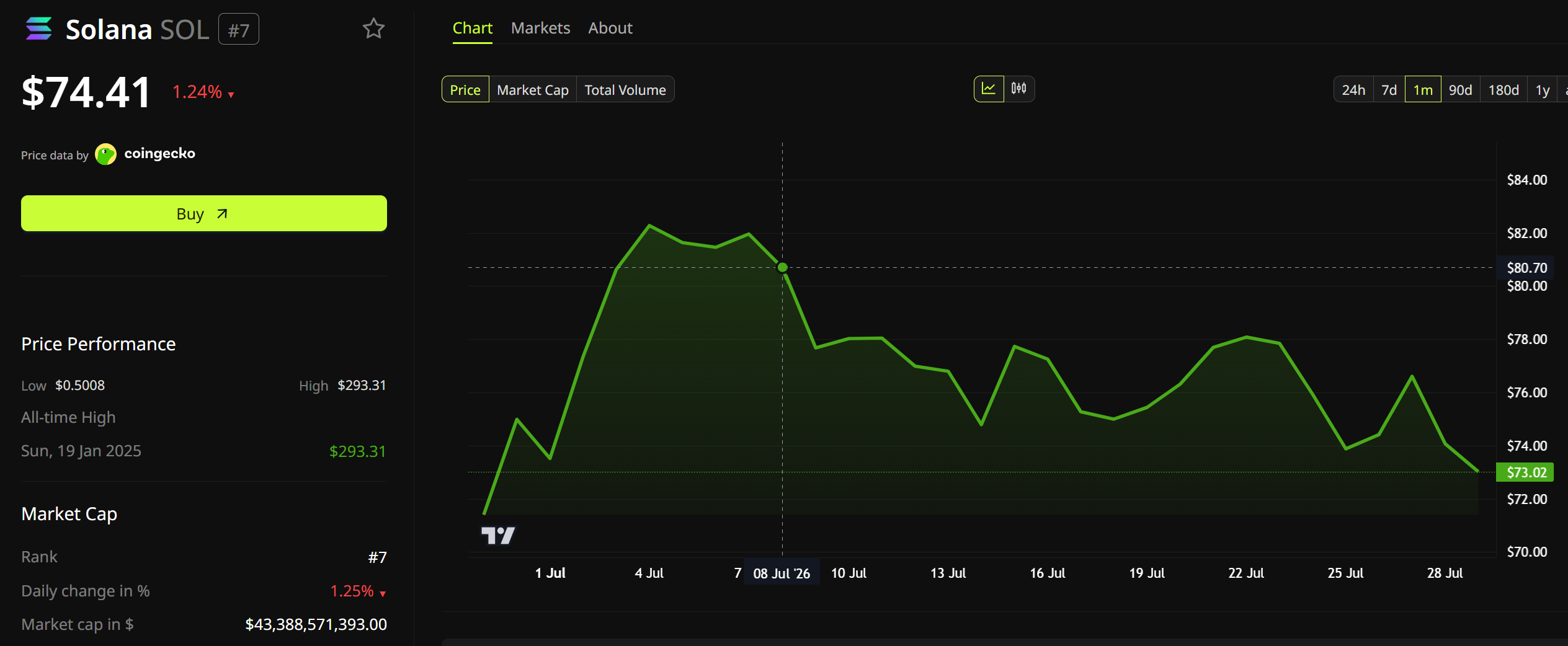
Ether sits 61% below its August 2025 peak. SOL trades 75% under its January 2025 high. Whether Morgan Stanley advisers allocate into that drawdown is the open question.
How Morgan Stanley’s Ethereum and Solana ETF Fees Compare
Morgan Stanley Ethereum Trust (MSSE) and Morgan Stanley Solana Trust (MSOL) began trading on NYSE Arca. Each accrues a 0.14% fee daily against net asset value. The previous floor for ether products was the 0.15% charged by Grayscale.
Bloomberg senior ETF analyst Eric Balchunas said the pricing bottoms out both categories.
“Morgan Stanley Ether and Solana ETFs are launching today.. both charge 0.14% instantly making them the cheapest in each category. Their bitcoin ETF is up to $400m in 4mo despite launching in middle of winter. Good sign,” wrote Balchunas.
Precedent supports him. Morgan Stanley Bitcoin Trust drew $34 million on its cheapest Bitcoin ETF debut in April, then reached $381 million by July 16. That is 11 times growth across 99 days, yet still only 2.7% of the firm’s $14 billion exchange-traded suite.
What the Prospectuses Reveal About the Staking Yield
Both trusts stake through Figment, Galaxy Blockchain Infrastructure, and Coinbase Canada. Those providers and the custodians take 5% of gross rewards. Morgan Stanley retains none, though its 0.14% fee applies separately.
The two funds are not symmetrical. MSOL intends to stake up to 100% of its SOL. MSSE targets 50% to 80% of its ether and caps staking at 80%.
Timing cuts deeper. The MSSE filing puts Ethereum’s validator activation queue at roughly 2.71 million ether as of July 6, an estimated 47-day wait. Queued ether earns nothing. Solana bonding takes two to three days, per the MSOL prospectus.
Holders receive rewards as monthly cash distributions, quarterly at minimum, funded by selling tokens.
Will Flows Follow? Three Things to Watch
Around 16,000 Morgan Stanley advisers oversee roughly $9.3 trillion, and the bank switched on spot trading through E*TRADE this month.
Ether funds absorbed lengthy ETF outflow streaks for much of 2026. Meanwhile SOL near $74 has slipped 3.8% since the prospectus priced it on July 8.

Watch creation baskets beyond the seed, the staked share of ether, which MSSE commits to publish daily, and the first distribution, which cannot land until validators clear the queue.
The post Morgan Stanley Launches 0.14% Ethereum and Solana ETFs: Will Flows Follow? appeared first on BeInCrypto.
Crypto World
Coinbase wants to be Canada’s ‘everything exchange,’ but says clearer rules are needed first


To Richmond, the delay isn’t about regulators moving slowly, but a structural difference between U.S. and Canadian frameworks.
“It’s not necessarily just a regulatory thing; just the nature of the rules is different,” he said.
Harmonized ‘national instrument’
While there is still work to be done, Richmond is encouraged by the fact that Canadian regulators are actively listening to industry players about digital asset products and are open to creating new regulatory frameworks to support the growing industry.
One example Richmond cited as “a very good piece of legislation” is the new Stablecoin Act, which was enacted by the Canadian Federal government earlier this year, after the U.S. passed the GENIUS Act last year.
In the wake of the Stablecoin Act’s passage, Canada has already seen Tetra Trust — a company backed by heavyweights such as Wealthsimple, Shopify and National Bank of Canada — launching Canada’s first regulated financial institution-issued Canadian-dollar stablecoin CADD.
Canada has already shown that crypto companies can operate inside a regulated market. The next test is whether its rules can accommodate products that move beyond spot trading into payments, derivatives, tokenized securities and decentralized finance.
Richmond said that, rather than having companies interpret these guidelines, “codifying” the existing regulatory practices into a national framework that applies consistently across provincial securities regulators will help reduce legal uncertainties for builders. Essentially, he argued that Canada should consolidate more of its existing crypto requirements into a ‘national instrument’ — a set of harmonized securities rules adopted across provincial and territorial regulators.

Kraken is expanding its tokenized-IPO offering to retail investors with access to Jersey Mike’s upcoming public listing. The exchange says eligible US customers will be able to request allocations of Jersey Mike’s shares at the IPO price, while customers outside the US can request tokenized shares designed to be backed 1:1 by the underlying stock.
The development adds another well-known US consumer brand to the small but growing menu of tokenized equities accessible through major crypto venues. It also comes after recent friction in similar campaigns—most notably around SpaceX—highlighting that investor demand for tokenized IPO access can exceed the supply of underlying shares.
Key takeaways
- Kraken will let eligible US retail users submit interest in book-entry Jersey Mike’s shares at the IPO price, while global users can request tokenized shares backed 1:1 by the stock.
- Tokenized shares will trade 24 hours a day, five days a week on Kraken and participating xStocks Alliance platforms, while the underlying Jersey Mike’s shares will trade only during regular US market hours.
- Allocations for the IPO are determined by the underwriter and are not guaranteed.
- Kraken says the tokenized shares can be transferred across participating xStocks Alliance platforms, moved onchain, and used with compatible decentralized finance (DeFi) applications.
- This marks another tokenized-IPO rollout following SpaceX’s debut, but the earlier listing faced oversubscription that led some platforms to cancel and refund.
How Kraken’s Jersey Mike’s access works
Kraken’s planned offering gives two routes depending on where a user is located. Eligible US customers can express interest in Jersey Mike’s shares in book-entry form at the IPO price. For customers outside the US, Kraken offers JMKEx, a tokenized version of the stock.
Kraken describes JMKEx as being backed 1:1 by underlying Jersey Mike’s shares held in regulated custody. In both cases, the IPO process controls outcomes: Kraken states that allocations are selected by the IPO underwriter and are not guaranteed.
The practical distinction for users is trading access. Once the IPO closes, Kraken says JMKEx will run on a near-continuous schedule—24 hours a day, five days a week—on Kraken and participating platforms in the xStocks Alliance. Meanwhile, the underlying Jersey Mike’s shares will trade according to normal US market hours.
Why tokenized IPO shares matter for investors
Tokenized equities are often discussed as a bridge between traditional capital markets and blockchain-based settlement. Kraken’s framing underscores that investors may not only buy exposure more flexibly, but also move that exposure in ways standard broker accounts typically do not allow.
Kraken says tokenized shares can be:
- Transferred across participating xStocks Alliance platforms
- Moved onchain
- Integrated with compatible DeFi applications
For market participants, that combination matters because it changes where equity-linked exposure can live. Instead of being confined to brokerage infrastructure, the tokenized wrapper is designed to be compatible with broader onchain systems—potentially improving interoperability for users who want to combine public equity exposure with onchain strategies.
At the same time, Kraken’s emphasis on underwriter-determined allocations and non-guaranteed access serves as a reminder that the tokenization layer does not remove core IPO constraints: if there are not enough underlying shares, token allocations can be limited.
Jersey Mike’s IPO details and what users should watch
Jersey Mike’s is a US sandwich chain with more than 3,300 locations. In its IPO announcement, the company said it expects to price the offering between $21 and $25 per share and to list its Class A shares on the New York Stock Exchange under the ticker JMKE. (Source: PR Newswire IPO announcement)
Those price expectations are relevant not only for standard IPO participants but also for users planning to request tokenized shares through Kraken. Because the token product is intended to be backed 1:1 by the underlying shares, the token’s credibility depends on the custody and redemption mechanics associated with the backing shares—areas Kraken states are supported through regulated custody.
What remains uncertain for investors is allocation availability. Kraken is explicit that the IPO underwriter—not the exchange—determines allocations. That means eligible users should be prepared for the possibility that demand could outstrip supply, as occurred during other tokenized-IPO rollouts.
Lessons from the SpaceX tokenized IPO rollout
Kraken’s Jersey Mike’s plan is not happening in isolation. It follows SpaceX’s tokenized IPO access in June, which multiple crypto platforms rolled out with similar structures tied to the underlying shares.
According to earlier coverage from Cointelegraph, other platforms—including Binance, Bybit, Blockchain.com, Bitget Wallet and MEXC—also launched products connected to SpaceX’s offering. However, demand appears to have been far higher than the underlying share supply. Cointelegraph previously reported that the SpaceX IPO was more than four times oversubscribed, forcing tokenized-IPO platforms to compete for limited allocations.
In the aftermath, Cointelegraph reported that several exchanges—including Binance, Bybit, Bitget Wallet and MEXC—ultimately canceled their tokenized IPO campaigns and refunded users after they were unable to secure enough underlying SpaceX shares to meet customer allocations.
The price path for the underlying listing also reflected the typical volatility that can follow oversubscribed offerings. Cointelegraph noted that those Nasdaq-traded shares have declined from their $135 IPO price, with last trading at roughly $115 on Tuesday (as cited in the earlier report).
Kraken’s Jersey Mike’s campaign is therefore best understood as a continued test of whether tokenized-IPO distribution can scale to match real-world IPO demand. For users, the key watch item is not only whether the token product goes live, but whether allocations are successfully secured for the participating customer base.
Despite the operational challenges seen in the SpaceX rollout, growth in the broader tokenized equities market has continued. Data cited from RWA.xyz indicates the sector’s distributed value rose from well under $500 million in mid-2025 to about $1.87 billion, including a 29.4% increase over the prior 30 days (Source: RWA.xyz).
Next, investors should focus on two practical milestones: whether Kraken confirms sufficient underlying share allocations for eligible customers once Jersey Mike’s IPO closes, and how smoothly tokenized trading and transfers work across xStocks Alliance platforms once JMKEx begins its extended-hours schedule.

10 HBO Shows That Are 10/10, No Notes

Dozens remain missing as desperate search enters its second day after 7.1 magnitude earthquake rocked Japan – flattening mall and splitting roads in two

Video was the line small firms flinched at. Seedance 2.5 is quietly changing the maths


-

 Fashion4 days ago
Weekend Open Thread: Brooks Brothers
-
 Business7 days ago
New Jersey voter registration controversy explained: How 6,600 noncitizens got on the rolls, and what happens next
-

 Tech2 days ago
Intel is reversing course and bringing hyper-threading back to its server chips
-
 Sports2 days ago
Commonwealth Games boxing: Jadumani Singh seals dominant 5-0 win over Pakistan’s Sumama Rehman to enter quarter-finals | Commonwealth Games News
-

 Crypto World6 days ago
Ethics, other provisions in crypto Clarity Act to be further discussed
-

 Politics2 days ago
Luke Littler dismantles Gerwyn Price to retain title in Blackpool
-

 Sports5 days ago
2026 3M Open leaderboard: Scottie Scheffler finds putter in Round 1, sits three back
-

 Fashion5 days ago
16 Dresses for the High Summer Event
-

 Politics16 hours ago
The Part of the Electric Transition Nobody Wants to Discuss
-

 News Videos2 days ago
BITCOIN JUST ENTERED THIS CRITICAL ZONE…
-

 Politics3 days ago
Spain sweeps the board at 2026 World Cup with individual awards
-

 News Videos5 days ago
The Peugeot Family: How 200 Years of an “Old Money” Dynasty Died in A Boardroom
-
 Entertainment4 days ago
A New Post-Apocalyptic Gundam Anime Series Blasts Into SDCC
-

 Crypto World3 days ago
Ripple bought a bank in pieces. The $4 billion audit
-

 Crypto World3 days ago
XRP Ledger adds $2.6B as RWA inflows rank second
-

 Crypto World5 days ago
Uniswap (UNI) pushes deeper into tokenized RWAs with permissioned trading pools
-

 Tech4 days ago
Anthropic launches Claude Opus 5, a cheaper AI model for coding, agents and enterprise workflows
-
 Entertainment6 hours ago
‘Stargate’ Creator’s New Sci-Fi Series Returns for Season 3 Tomorrow
-

 Crypto World7 days ago
Sablier Labs Enters Maintenance Mode, Halts Development
-
Crypto World6 days ago
SEC Agrees to Overhaul Recordkeeping After Settling Coinbase Lawsuit Over Gensler’s Lost Texts
You must be logged in to post a comment Login