Connect with us
DAPA Banner
DAPA Coin
DAPA
COIN PAYMENT ASSET
PRIVACY · BLOCKDAG · HOMOMORPHIC ENCRYPTION · RUST
ElGamal Encrypted MINE DAPA
🚫 GENESIS SOLD OUT
DAPAPAY COMING

Politics

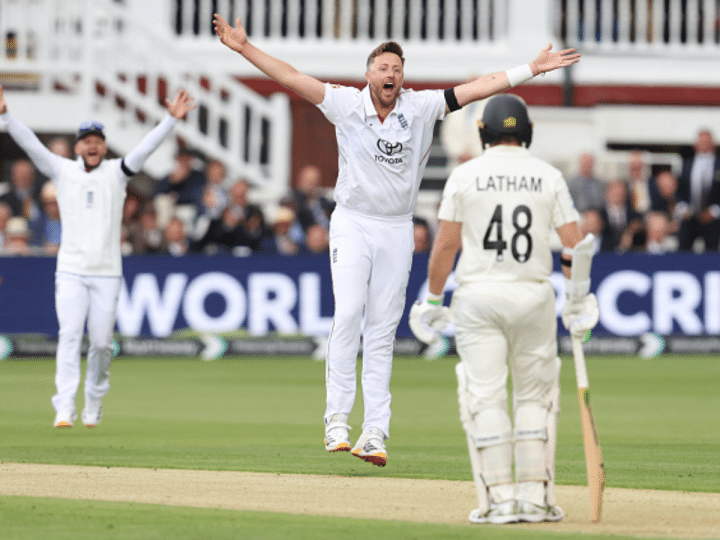
Ollie Robinson’s roar at Lord’s

Published

on

Robinson on fire for England against New Zealand at Lord's

Robinson on fire for England against New Zealand at Lord's

England’s Test summer did not so much begin as detonate. Sixteen wickets, two rain breaks, one rampant seamer back from the sidelines, and a Lord’s crowd jolted awake before they had even settled into their seats — the kind of relentless cricket England at Lord’s so often produces.

By stumps, New Zealand were 61 for 6 chasing England’s 140 all out, and Ollie Robinson had rewritten the script of his own career in a single breathless over. In truth, anyone who has witnessed England at Lord’s knows how quickly things can change.

What unfolded on day one was not tidy, was not measured, and certainly was not the “smarter cricket” England have been preaching since the Ashes. It was chaotic, unpredictable, and pure Test cricket.

Robinson returns on fire at England’s Lord’s Test

Robinson hadn’t bowled a Test over since early 2024. Fitness issues, form questions, and a sense that England had moved on had left him drifting on the margins. So when Ben Stokes gave him the ball under overcast skies, Robinson responded with four wickets in six balls. A triple-wicket maiden to announce his return at Lord’s in England colours.

Advertisement

Devon Conway was first, pinned lbw after two jittery inside edges. Kane Williamson followed, undone by a ball that climbed and flicked to short leg. Then Rachin Ravindra, trapped by a nip-backer that straightened late. New Zealand were 2-3, Robinson was 3-0, and the game at Lord’s continued without pause.

He was not done there. Later, Daryl Mitchell shouldered arms to one that jagged back and clipped the stumps. Robinson closed the day with 4-10 from six overs a spell that reminded England exactly why they had made the right call.

Brook stood tall as Jamieson ran riot

Put in to bat, England’s innings was a familiar mix of promise and collapse. Harry Brook’s 56 was the lone act of resistance, a counterpunching half-century built on crisp timing and a little luck. He was dropped twice on his way to fifty.

Around him, wickets tumbled. Emilio Gay, on debut, struck two stylish boundaries before edging Kyle Jamieson. Ben Duckett and Jacob Bethell were trapped lbw in quick succession. Joe Root nicked off. Jamie Smith misjudged a leave. Ben Stokes fell to a stunning one-handed grab from Williamson at slip.

Advertisement

Jamieson, playing his first Test in more than two years, was relentless. His 5-62, his sixth five-wicket haul in just 20 Tests. Absolutely shredded England’s middle order. Nathan Smith and Will O’Rourke backed him up with sharp, disciplined spells.

Brook’s 10 boundaries gave England something to cling to, and a gritty last-wicket stand between Shoaib Bashir and Josh Tongue nudged the total to 140. Not enough, on most days. Luckily, this was not most days. For England at Lord’s, 140 can sometimes be made to look like a mountain.

New Zealand was feeling the heat

If England’s batting was shaky, their bowling was anything but. Gus Atkinson trapped Tom Latham lbw. Tongue, hitting the stumps for his 50th Test wicket, removed Tom Blundell. Glenn Phillips, counterattacking with 31 not out, was the only New Zealander to look remotely settled.

The day belonged to Robinson. Every ball he bowled carried menace, the wickets just kept on falling for him.

Advertisement

England’s reset began in chaos

This was supposed to be the start of England’s post-Ashes recalibration. A shift toward clarity, discipline, and smarter decision-making. Instead, it was a reminder that Test cricket rarely follows the script.

The pitch misbehaved. The ball swung, seamed, and spat. Also, in the middle of it all, Robinson rediscovered the version of himself England have been desperate to see again. The drama of England at Lord’s never seems to disappoint.

With New Zealand 79 runs behind and only four wickets in hand, day two promises more drama. The pitch won’t get easier. The bowlers won’t get kinder. England, for all their batting issues, have the momentum.

This Test already feels like a scrap. It is messy, unpredictable, and utterly compelling. If Robinson’s opening salvo is anything to go by, England’s summer might just have found its spark.

Advertisement

Featured image courtesy of David Rogers / Getty Images

By Faz Ali

Source link

Advertisement
Continue Reading
Click to comment

You must be logged in to post a comment Login

Leave a Reply

Politics

Reform candidate Kenyon exposed as sexist on Question Time

Published

on

reform robert kenyon question time

reform robert kenyon question time

Reform UK’s MP candidate for Makerfield, Robert Kenyon, once self-proclaimed himself as a sexist, but now he is running for parliament he coincidentally won’t accept the label and insists:

I’ve got nothing but respect for women… I’ve said things years ago that I wouldn’t say now.

However, his complete refusal to apologise for comments that many women rightfully found deeply offensive exposed another issue with the Makerfield ‘hopeful’. Instead of showing an ounce of humility or reflecting on why people objected, he doubled down.

That response only strengthened the perception that he places his own views and sense of certainty above the concerns and rights of the women understandably affected by his disgusting, derogatory comments.

Basically, it goes to underscore how his sexism is still alive and well, which is hardly a shock in a patriarchal, woman-hating party as Farage’s Reform.

Advertisement

Reform classic – never apologise

Needless to say, concerns regarding sexism were amongst the most common questions raised by audience members on Question Time, according to Fiona Bruce. Kenyon obviously sought to deflect and deny any notion of being a sexist, despite declaring himself as such. However, his virtue signalling response to a female audience member speaks volumes.

The audience member stated she would:

rather have a career politician than a plumber who’s a sexist.

Fiona Bruce then provided context for those who might not be aware of Kenyon’s pretty disgusting remarks about women, particularly pointing out:

Advertisement

Okay, you described yourself as a sexist. You have made offensive comments about women. You’ve admitted that.

You’ve also said that abortion is the cowardly act of women murdering a defenceless baby and that women do it so they can shag anyone they want.

That’s your phrase, not mine.

As I say, I’m raising it because lots of people in the audience raise it. I want to give you a chance.

Nevertheless, a striking contradiction runs through Kenyon’s subsequent defence. He appears comfortable applying the label to himself when it suits his argument yet rejects it outright when women raise concerns about his comments. Instead, he points to the fact that he was raised by a single mother and grew up with a grandmother and sister, as though those relationships alone settle the question.

Advertisement

The problem is obvious: having women in your life has never served as proof that you respect women or understand their experiences. If it did, no man with a mother, sister, wife, or daughter could ever face accusations of sexism. The argument does not address the criticism – it simply attempts to sidestep it.

He’s a ‘changed man’ apparently, as he said:

So, I won’t accept that label. I mean, a lot of the things have been said 15 years ago. I hold my hands up. I’ve made mistakes.

Recent abusive comments towards Carol Vorderman were also brought up, in which he has been more than happy to perversely sexualise her – which women well know, from experience, puts us at risk of sexualised attacks and abuse.

No apology there either, of course.

Advertisement

Advertisement

Kenyon’s defence as weak as it is predictable

Bruce wasted little time highlighting the problem with that defence, reminding viewers that Kenyon made those comments about abortion only a few years ago, including claims that women were “murdering” babies so they could sleep around.

Yet Kenyon seems to believe his relationships with women somehow settle the matter. By that cynical standard, every sexist in history would get a free pass simply because they had a mother, sister, wife, or daughter. The argument is as weak as it is predictable.

Needless to say, every abusive man in history also knew women. Women gave birth to them, raised them, worked with them, and often endured their behaviour. Simply having women in your life is not proof of respect for women, nor does it automatically make someone an ally of women’s rights.

Kenyon’s opposition to diversity doesn’t stop at equality for women, as this audience member below poignantly highlighted:

Advertisement

One X user commented:

People are trying to whitewash this man by saying it was in the past. People don’t fundamentally change – believe them the first time.

He’s against women, abortion & freedom to choose. Believe the man, don’t vote for him & allow him to slip back to the sewer he came from.

Another said:

Advertisement

“I was bought up by women” seems to be his reasoning that he isn’t sexist. Similar to “I can’t be racist I have a Motown record”

Give a liar or a bull sh***** a spade: They can’t resist talking & automatically start digging a hole as we can clearly see #RobertKenyon doing here.

Sexists were also birthed by women – and most often, raised by them

Kenyon’s attempt to dismiss comments he previously embraced as merely an “alleged” label simply does not stand up to scrutiny. Rather than addressing the concerns people raised, he has fallen back on the argument that he cannot possibly hold sexist views because he has women in his life.

It truly is little different from the tired old defence: ‘I can’t possibly be racist because I have a Black friend.’

Thus, Kenyon’s argument entirely misses the point. Every man has women in his life – mothers, sisters, partners, colleagues, friends, teachers, and carers. Simply knowing or ‘caring’ about women does not make someone immune from criticism when they make comments that are sexist, derogatory or dismissive.

Advertisement

Therefore, what stands out most is not the original comment but the ignorant response that followed.

Rather than recognising why people took issue with the Reform candidate’s remarks or offering any meaningful apology, Kenyon has chosen to dispute the criticism itself. That approach has only deepened concerns about his dangerous judgment.

When someone seeks influence and authority, their willingness to listen to criticism and reflect on their mistakes matters just as much as the views they express.

Featured image via YouTube screenshot/BBC News

Advertisement

By Maddison Wheeldon

Source link

Advertisement
Continue Reading

Politics

Mothin Ali condemns firebomb attack on Muslim Green party activists

Published

on

mothin ali

mothin ali

Green party deputy leader Mothin Ali has condemned a firebomb attack targeting two Muslim Greens who were working to make the UK a better place for all its people.

The West Midlands couple, identified as Farrukh and Salma, saw their car reduced to smoking wreckage by the attack. Ali called for West Midlands Police to treat the matter seriously. He condemned the anti-Muslim speech of Reform and other politicians and for everyone to work together to create an “island of belonging” instead of inciting hate and division:

Routine incitement

But, it’s telling that Mothin Ali is the one condemning this despicable attack. Reform, Labour and the Tories all routinely incite Islamophobia and embolden white supremacists for their own political agendas – including against Ali personally. Anti-Muslim hate incidents have risen faster than other racial or religious hate. Yet the UK’s ‘mainstream’ media have ignored the firebomb attack:

This is a grim contrast with the blanket coverage that follows even the most questionable incident involving supporters of Israel.

Advertisement

Featured image via Instagram

By Skwawkbox

Source link

Advertisement
Continue Reading

Politics

Wings Over Scotland | The Lord Of The Rings

Published

on

John Swinney knows the rules. He can’t pretend he doesn’t.

?

So let there be no mistake: if Police Scotland and the Crown Office refuse to investigate the First Minister’s open public confirmation this week that a serious crime was committed by the SNP over the “ring-fenced” fundraiser money from 2017 and 2019, it will be beyond any fair dispute that Scotland is a corrupt banana republic where the powerful and the elite can simply do whatever they want, as brazenly as they like, and the law will turn a blind, uncaring eye.

That the prosecutorial service of a nation is run by a government minister answerable to a political party leader has always been a source of embarrassment. It makes Scotland look like a tinpot dictatorship, a North Korea-style state where a huge artifice of pantomime is constructed to disguise the fact that the country is a naked plutocracy.

Advertisement

That’s an opinion increasingly widely shared in Scotland.

That editorial leader from today’s Scottish Sun is speaking for every single person of integrity and decency left in the country. We have prima facie evidence that a crime has been committed – the misappropriation (at a minimum) of well over half a million pounds. We know exactly who did it, and they’ve confessed unambiguously and openly in public, in front of news cameras. Multiple properly-constituted complaints have been filed. And yet despite a five-year investigation, nobody has been prosecuted for it and we haven’t even been given the most cursory explanation of why.

And there are growing suspicions too, that the one person who WAS convicted over an entirely separate crime which indirectly led from the investigation might be about to be let off incredibly leniently for it.

Natalie McGarry was sentenced to almost two years in prison for embezzling £25,000. If Peter Murrell is handed a shorter prison term (or even no prison term at all) later this month – with the nation helpfully distracted by Scotland’s World Cup campaign – for stealing more than EIGHTEEN TIMES as much as McGarry did, on the grounds that he’s paid back the money to the people who also committed a crime with it, it will be a scandal of unprecented proportions in the history of Scottish justice, save perhaps the case of the Lockerbie bomber.

Advertisement

It was revealed this week that Murrell’s assets include a £613,000 pension fund. It is entirely conceivable that Murrell’s embezzlement contributed significantly to the size of that fund, which will have earned a very significant sum in interest over the years that he was stealing large amounts.

So by the time you also factor in the selling of all his illegally-obtained trinkets, it’s within the bounds of possibility that even after paying back the money, Murrell will come out of the deal financially ahead. The SNP, meanwhile, will have been fully reimbursed for its losses and will be the happy recipients of a welcome and substantial unexpected boost to their threadbare coffers.

The only people who will have lost out will be the people – supporters of all parties and none – who donated to a fund that was specifically, explicitly and stridently advertised as being for Scottish independence and NOT for general SNP purposes, and instead saw it spent on the latter.

And ever-useless, the Scottish media is allowing Swinney to dodge that issue and focus solely on donations from SNP members – the only donors to the “ring-fenced” funds who might reasonably be imagined to accept the money being spent on broader SNP interests.

Advertisement

(Coincidentally, a study today revealed that less than half of 2014 Yes voters voted SNP at last month’s election, with a whopping 31% of them voting for Unionist parties. “The SNP” and “independence” are not synonyms.)

Operation Branchform made front-page headlines across the globe, so it’s probably not an exaggeration to say that the world is watching to see the outcome of the new complaint lodged with Police Scotland and the Crown Office yesterday.

If there is to be no rule of law for the powerful in Scotland, if we are to be revealed as the only bent dictatorship in the world where the idiot population keeps voting for the crooked dictators of their own genuine free will, then that is something that the rest of the planet will notice, and then turn their faces away from our shame.

Source link

Advertisement
Continue Reading

Politics

Celtic fan groups unite in opposition over Robbie Keane appointment

Published

on

Celtic fans stand with Palestine

Celtic fans stand with Palestine

Robbie Keane’s path back to Celtic has hit a massive wall, is due to him not condemning Israel’s ongoing genocide in Palestine.

A club where he once dazzled on loan is no longer warmly remembering him for his footballing achievements. What began as murmurs of discomfort has now hardened into robust opposition.

Dozens of Celtic supporter groups have signed a joint letter opposing Keane’s potential appointment, citing his decision to manage Maccabi Tel Aviv during Israel’s genocide of the Palestinians in Gaza.

The message is blunt. The mood is serious and the pressure on the Celtic board is unmistakable.

Advertisement

Celtic fans aren’t having it

Keane, the Republic of Ireland’s record goalscorer, is among the frontrunners to replace Brendan Rodgers after reports of ongoing talks with principal shareholder Dermot Desmond.

In a statement, the coalition of groups said:

For us, Robbie Keane’s decision to manage Maccabi Tel Aviv during the genocide in Gaza is impossible to ignore.

Celtic was founded by a community shaped by the legacy of genocide, displacement and famine.

Our club’s roots lie in solidarity with those who suffered injustice and oppression. We cannot forget where we came from, nor turn our backs on those facing genocide today.

Advertisement

Celtic fans clearly do not care about his ability as a manager; they see a man who has not spoken to oppose Israel’s genocide. And, in managing Maccabi Tel Aviv, Keane took a position with a club whose fans regularly chant “death to Arabs.”

If Keane had not realised, he will know now that the world and the club have changed and that being silent is being complicit.

Keane’s decision to remain in Israel after the outbreak of the Gaza genocide has become the defining issue for a significant section of the Celtic support. What might once have been a footnote in his managerial journey has become, for many, a line that cannot be crossed.

A growing movement

In recent days, the opposition has spilled from online forums into the physical space around Celtic Park. Graffiti and banners rejecting the idea of Keane as manager have appeared outside the stadium, signalling that this is not a fringe sentiment but a movement with momentum.

Advertisement

The catalyst was a statement published by a group calling itself Celtic Fans for the Liberation of Palestine. It set out a clear, uncompromising stance:

Keane’s association with Maccabi Tel Aviv during the Gaza war is incompatible with Celtic’s identity and history.

That statement has now been endorsed by 67 supporter groups, according to the North Curve Celtic account on X. The list includes some of the club’s most influential and recognisable fan collectives, the Green Brigade, the Bhoys Celtic ultras, and long‑established supporters’ clubs such as Glasgow University CSC and Craigneuk Tommy Gemmell CSC.

This is not a handful of dissenting voices. It is a coalition.

A fanbase that won’t stay quiet

Celtic’s board now faces a delicate, high‑stakes decision. Keane is a recognisable name, a former fan favourite, and a manager with an average resume. However, the backlash is real, organised and rooted in the club’s cultural DNA.

Advertisement

The letter from supporters warns that appointing Keane would be predictable and uninspiring at a time when Celtic should be showing ambition. More importantly, it argues that the move would fracture the unity required for the club’s next chapter.

This is not simply a debate about a manager. It is a debate about what Celtic stands for.

Keane’s situation is the latest example of how global politics increasingly intersects with football. Managers and players are no longer judged solely on results or style; their choices, associations and moral positions are scrutinised with unprecedented intensity.

For Celtic, a club with a uniquely political fan culture, that scrutiny is amplified.

Advertisement

Supporters have long embraced causes beyond football, from anti‑racism to workers’ rights to Palestinian solidarity. The club’s identity is inseparable from its community roots, and its fanbase has never been shy about challenging decisions that clash with those values.

In that context, the opposition to Keane is not surprising.

What happens next?

The Celtic board has not publicly commented on the letter or the growing backlash. Keane remains one of the leading candidates, but the political temperature around his candidacy has risen sharply.

If Celtic proceed with the appointment, they risk a rift with a vocal and influential section of their support. If they back away, they will be seen as a moral and fair ownership that listens to their fanbase.

Advertisement

This is a dynamic that could shape future managerial decisions if he is morally fit for the job.

The coming days will reveal whether the board believes the weight of fan opposition makes his appointment untenable.

What is certain is that this is no longer just a managerial rumour. It is a test of what Celtic stands for and who gets to define it.

Featured Image via Matthias Hangst/Getty Images

Advertisement

By Faz Ali

Source link

Continue Reading

Politics

European Union has policy of double standards when dealing with the Palestinian cause

Published

on

European Union on Palestinian citizenship

European Union on Palestinian citizenship

In January 2024, the EU established sanctions against individuals and entities supporting Hamas and Palestinian Islamic Jihad. It has now broadened these sanctions to also target members of Hamas’ Political Bureau, known as the ‘Politburo’.

EU extends Hamas sanctions to include 10 political members

According to the EU, the Politburo is a decision-making body, so its members are “responsible for violent actions carried out by Hamas.” 10 members now find themselves sanctioned. Measures include travel bans and the:

freezing of all funds and economic resources belonging to, owned, held or controlled by, members of the Politburo.

This decision comes as the Israeli occupation continues, with impunity, its fully documented genocide of Palestinians.

In a statement, Hamas has said the EU’s sanctioning of its political bureau, but not the Israeli occupation is:

Advertisement

a policy of double standards in dealing with the Palestinian cause.

It questions why political leaders defending their people’s legitimate rights are sanctioned, while the EU “turns a blind eye” to documented violations of international law carried out by “Israel”.

According to the EU, Hamas’:

violent actions constitute serious violations of international humanitarian law and of human rights law.

It has also accused Hamas of continuing to “represent a threat to international peace and security.”

Far fetched lies

But what about Israel? This is blatant hypocrisy. Far fetched lies against Hamas, including of mass rapes and beheaded babies on 7 October 2023, have been disproved by publications such as the Electronic Intifada. They are part of the occupation’s campaign to go to any lengths to justify its ongoing genocidal assault of Gaza.

Advertisement

Yet there is no doubt whatsoever about the Israeli occupation’s long list of international law violations. These began almost eight decades ago, when ‘Israel’ was formed in 1948. It forcibly displaced hundreds of thousands of Palestinians from their homes, and has failed, to this day today, to respect their right to return. And its atrocities continue. These include the crimes of forcible displacement, ethnic cleansing, apartheid, starvation, torture, collective punishment, and genocide. It also systematically violates its ceasefire agreements.

These ‘Israeli’ war crimes and crimes against humanity, are not only directed towards Palestinians. Since 2023, it has also targeted countries across the Middle East– Lebanon, Syria, Iran, and Yemen.

‘Israel’ a threat to humanity

‘Israel’ has global supply chains, and one of the most advanced, heavily funded militaries in the world. It also has a total disregard for humanity, and fails to comply with any international rules or norms. In reality, nothing threatens global peace and security more than the Israeli occupation. It a serious threat not only to regional and international peace and security. but the entire international legal framework.

By expanding its sanctions on Hamas, the EU claims it is “holding perpetrators accountable”. It also states that it demonstrates that “violent actions and extremism carry consequences.”

Advertisement

But as yet, the EU has taken no effective measures against the criminal state of “Israel” which, as of 4 June 2026, has killed 72,956 Palestinians in Gaza, and injured 173,043. It has sanctioned several illegal settlers, out of the more than 780,000 residing in the occupied West Bank and East Jerusalem. But sanctioning a few of these is nothing more than theatre.

EU failing Palestinian people

These settlers carry out criminal acts for the Zionist government, which the EU has failed to sanction. There have been no arms embargos, no trade sanctions. The EU is the Israeli occupation’s largest trading partner. Trade in goods between the two amounted to €43.3 billion in 2025. The EU takes in nearly 30 percent of all Israeli occupation exports, while accounting for almost 35 percent of all goods imported into ‘Israel’.

It is the Israeli occupation that is the source of conflict and instability. There would be no Hamas if there were no occupation. Resistance to “Israel” is a legal right for all Palestinians, guaranteed under international law, so cannot be criminalised.

Hamas says the targeting of its political leaders confirms these sanctions come “as a response to pressure from the occupation and are not based on standards of justice.” And it calls on the EU to “review its biased policies, cease providing political cover for the occupation, and work to hold its leaders accountable instead of prosecuting the victims.”

Advertisement

According to Hamas, the will of the Palestinian people and their legitimate national rights will not be undermined, irrespective of any measures introduced.

Featured image via Getty/John Moore

By Charlie Jaay

Source link

Advertisement
Continue Reading

Politics

Politics Home | Reform Councillor Claims Restore Britain Would Deport People “Just Because Of Their Colour”

Published

on

Reform Councillor Claims Restore Britain Would Deport People 'Just Because Of Their Colour'

George Finch, the 19 year old running two councils, told The House magazine Restore Britain were akin to the BNP. (Alamy)


3 min read

The teenage Reform UK councillor leading Warwickshire council has claimed that a Restore Britain government would deport people “just because of their colour”.

Advertisement

George Finch, the 19-year-old councillor who is currently in charge of both Warwickshire County Council and Bedworth and Nuneaton Borough Council, said in an interview with The House magazine that he would fear for Sikh and Gurkha communities in his area, who have “fought with us (Britain)” in wars, if Rupert Lowe’s party entered power.

A Restore Britain spokesperson told PoliticsHome: “Finch is talking total bullshit.”

His comments come as Restore Britain looks to challenge Reform UK’s position as the leading right-wing party in the UK.

Advertisement

Lowe, the MP for Great Yarmouth, launched the party after falling out with Farage and being removed from Reform UK following accusations of bullying that he denies. Endorsed by the controversial billionaire owner of X, Elon Musk, Restore Britain is seen as to the right of Reform, promoting policies like the mass deportation of all illegal immigrants and shutting down universities that “brainwash students into hating their own culture”.

The party showed signs of its potential electoral threat to Farage at last month’s local elections. Restore Britain won all 10 seats it contested in Great Yarmouth on 7 May, helping to deny Reform a majority.

Meanwhile, polling published ahead of this month’s crucial by-election in Makerfield suggests that Lowe’s party is eating into the Reform vote in the northwest. A Survation survey published on Thursday put Labour candidate Andy Burnham 10 per cent ahead of Reform’s Robert Kenyon (49 per cent to 39 per cent), with Restore Britain’s Rebecca Shepherd in third place on 8 per cent.

Advertisement

Speaking to The House about the electoral threat posed to Reform by Restore Britain, Finch said the latter was “just a party on social media”: “What are their policies? What are their people?”

He said that several councillors whom he helped get elected for Reform have defected to Lowe’s party, claiming that they realise the sort of party they have joined and “the direction they want to go in”. 

“They just think: ‘Oh, well, I don’t like the way Reform is being done’, and you think, ‘right, okay, whatever your thought is, but why them?” said Finch.

He added: “In Bedworth, we’ve got a huge Sikh and Gurkha population that fought with us, and we take pride in celebrating them on Remembrance Sunday and Armistice Day.

Advertisement

“And the whole town comes out, and it’s great when people say, ‘I’m gonna vote Restore.’ The Sikhs and Gurkhas that fought during the war? ‘Oh, yes, we love those people. They’re great.’ Under a Restore government, they’d be gone. No excuse, no reason. Gone, just because of their colour.”

The House magazine’s full interview with George Finch will be published in print and online in June.


Source link

Continue Reading

Politics

Epic pro-Palestine march will take place despite blocking attempts

Published

on

Palestine solidarity murals, Belfast — planned march

Palestine solidarity murals, Belfast — planned march

A mammoth 25-mile Palestine march is set to take place on Saturday June 6, despite disgraceful attempts by pro-genocide loyalists to stop it. The March for Gaza in the north of Ireland will run from Lurgan to Omeath, just over the border, covering a distance mirroring the length of Gaza itself. Zionist terrorists have dropped the equivalent of more than six atomic bombs on the tiny area since beginning their holocaust in October 2023.

Organisers, the Ireland Palestine Solidarity Campaign Lurgan (IPSC Lurgan) say the march will:

…raise money for medical supplies, temporary shelters and much needed food and water for the people living amidst the severe humanitarian crisis in Gaza presently.

Sadly, loyalists supportive of so-called ‘Israel’ have been attempting to block this noble effort. Democratic Unionist Party (DUP) MLAs asked the Parades Commission to stop the march. The Parades Commission rules on the contentious issue of parades and protests in the Six Counties. Parades with sectarian elements, particularly those around the July 12, have often involved large scale disorder.

A march for “people of conscience”

The DUP falsely claimed that the march’s route was:

Advertisement

…deliberately chosen to provoke tensions within a quiet rural community which neither supports nor welcomes it.

In fact, the exact opposite is the case. As IPSC Lurgan explained in their application to the Parades Commission:

We have taken much care and deliberation with the route, trying to avoid any areas which would not like to have a procession passing through them. As such we are mostly travelling by country roads until we reach the Newry Canal towpath.

The main controversy revolves around the village of Scarva, populated mainly by people from a Protestant/unionist/loyalist (PUL) background. The default assumption is they identify more with ‘Israel’, whereas those from a Catholic/nationalist/republican (CNR) tradition are generally pro-Palestine.

However, the distinction is not always clearcut, and many from PUL communities have been appalled by the Zionist entity’s litany of war crimes. Retired Presbyterian minister Mark Gray has described the march as:

…an opportunity for people of conscience to have a say, and to express solidarity with Palestine.

There was minor unrest in Scarva the same march last year, when the Police Service of Northern Ireland (PSNI) made four arrests. A BBC report published at the time suggested these were from the unlawful pro-genocide counter-protest, who jeered the march while holding the flag of the apartheid Zionist settler-colony.

Advertisement

The outrage around the march is thus largely confected. Participants won’t even pass through the town itself, but will instead march along the Newry canal towpath that runs adjacent to Scarva. This didn’t stop cynical DUP efforts to characterise the march as a “deliberately provocative parade” and an “overtly political demonstration”, rather than the humanitarian cause that it clearly is.

Attempted counter-march fails

Their efforts have led to the Parades Commission imposing certain restrictions on participants. These include ruling that:

…no participant in the parade shall enter Scarva…

The Commission also ordered that:

While the parade passes along the part of the notified route along the Newry Canal Towpath at Scarva, no flags or emblems of any type shall be displayed and no chanting or singing shall take place.

Other local groups have tried to interfere with the march. A group called Scarva Concerned Residents have requested permission to stage a counter-protest in the town from 10:00 to 17:00. The Commission has granted this, and imposed typical conditions such as forbidding alcohol consumption and “paramilitary-style clothing.”

Advertisement

More alarmingly, the loyalist Markethill Volunteers Flute Band attempted to stage a transparent attempt to block the March for Gaza. They requested permission to walk down the same narrow route, at the same time, in the opposite direction.

The group, which has never submitted a Parades Commission application previously, comically suggested their event was “organised in good faith”, and that the “sole purpose” was “charitable and community-focused”. The Parades Commission ultimately ruled that they would have to start their march from Scarva to Portadown at 14:30. That is, after the March for Gaza passed Scarva.

Betraying their real motives, the band railed against what it called a “Republican appeasement process“. They will now join the Scarva Concerned Residents instead. They are calling for “thousands on the streets” to counter what they incorrectly describe as a “Republican / Palestine march through [the] village”.

In reality, the pro-Palestine contingent is likely to vastly outnumber those who sadly have a worldview so narrow, they put petty sectarian concerns over recognising the horror of a genocide that has now lasted almost three years.

Advertisement

Featured image via Charles McQuillan / Getty images

By Robert Freeman

Source link

Advertisement
Continue Reading

Politics

Legacy media platforms ex-military figures without disclosing war industry links

Published

on

BBC media conference, Basra International Airport 2009

BBC media conference, Basra International Airport 2009

British legacy media insist on platforming ex-military ‘experts’ without mentioning their war industry side-hustles — an issue the Canary has pointed out repeatedly. A deep-dive investigation has now revealed just how widespread the issue really is.

In April 2026, the Canary reported that former Labour MP and ex-NATO chief Lord Robertson was platformed to talk about war spending without his long-standing links to the military industry being disclosed. You can read about here and here.

NGO Action on Armed Violence (AOAV) on 3 June that an analysis of media reports between 2015 and May 2026:

NGO Action on Armed Violence (AOAV) reported on 3 June that an analysis of British media coverage between 2015 and May 2026 reveals:

Advertisement

a repeated pattern where almost 60% of former key military personnel with links to the defence industry were found to have been – at least once – cited in the British media primarily by a reference to their rank and previous service, without audiences being informed of their current post-service defence advisory roles, consultancies, directorships, or financial interests.

Action on Armed Violence added:

So, while post-service commercial work is common, we documented a systemic failure of the UK media to disclose such employment and to highlight potential conflicts of interest.

The NGO examined media coverage of 33 former senior military figures who had subsequently taken up roles with defence, security, technology, and intelligence companies.

Of these, we found that 19 or 58% of these had been given a media platform to debate defence matters – at least on one occasion – without the media outlets involved identified noting their commercial or financial interests in the defence industry.

Instead of informing the public about the individual’s links to war firms:

Advertisement

commentators were identified solely by their former military rank or previous command positions. This, we contend, creates the impression of impartial and independent expertise.

Misleading the public

Simply put, legacy media outlets are misleading the public knowingly or otherwise. Any guest booker or producer worth their salt routinely checks for and disclose potential conflicts of interest.

AOAV said:

In the UK, the public’s understanding of matters of war, national security, and defence policy is almost entirely shaped by media commentary from figures presented as authoritative military experts.

Adding:

The go-to for most reporters is retired senior officers and former commanders, who are routinely quoted in print, broadcast, and digital media to explain unfolding conflicts, defence budgets, military power and, of course, to offer their opinion.

Senior ex-military officer’s views, AOAV said, “carry substantial weight:”

Advertisement

largely because of their professional reputation, long service, and the perceived impartiality of military expertise which – especially in the UK – is largely seen to be apolitical.

This is the assumed position of most public servants and such assumption of impartiality implicitly reaches across into their post-service opinion.

A 2024 Parliamentary report also found:

A 2024 quantitative investigation of the robustness of international trends concluded that trust in ‘representative institutions,’ such as governments, parliaments and political parties has been declining.

However:

trust in ‘implementing institutions’ such as courts, police and militaries has remained stable.

The reasons for this can be debated, but AOAV’s study suggests that the public may be being taken for a ride on the basis of lingering trust in the military institution. Military and intelligence officials are rarely neutral or apolitical actors. Retired officers-turned-media talking heads with well-paid war industry jobs never are. And no media outlet should deprive audiences of such a critical detail.

Advertisement

Featured image via Matt Cardy / Getty Images

By Joe Glenton

Source link

Advertisement
Continue Reading

Politics

The House | We must do more to help young people access music if we want the UK to Rock the Casbah

Published

on

We must do more to help young people access music if we want the UK to Rock the Casbah

(Andrew Fare/Alamy)


4 min read

Music has always been part of my life. From an early age, I can remember my big sister blaring out the Top 40 from her transistor radio.

Advertisement

And I was hooked.Nowadays, music is what allows me to make sense of the world and to process what’s going on around me. That’s why one of the first things I did on getting to my office in Westminster was to install a record player and bring some of my vinyl in from home. Anyone walking nearby will often hear strains of Smokey Robinson, Miles Davis or The Jam.

I taught myself to play the guitar at 14, listening to my favourite records and learning how to play along by ear. I’d practise until my fingers were red raw – and joined my first band at 15. My musical journey has seen me play many festivals over the years, as well as hundreds of pubs and other venues. And while people may not believe this, my bands have never played covers – only my own songs. Maybe that’s why I’m not famous.

Later this summer, I’ll be playing a solo benefit gig for my friend and fellow Labour MP, Brian Leishman, in his constituency.

Advertisement

Of course, when I started things were different, but now I worry about the younger generation’s access to music.

In 1970s Britain, unemployment benefit was used by many aspiring musicians as an unofficial arts grant. It enabled bands like The Clash to write, rehearse and master their instruments, while still being able to live. For many working-class teenagers, it was a way to escape the life of mundane work that had defined previous generations. But those days are long gone.

Getting young people interested in music has been seen by all governments as a nice-to-have – but not essential. The Margaret Thatcher era saw a reduction in free instrumental lessons, which was further damaged by the austerity of the 2010s. In England, the vision of music education is delivered through music hubs, established in 2012 and recently restructured into 43 regional hubs.

Advertisement

The Labour government has put renewed emphasis on cultural entitlement in schools, and the direction is welcome, but for the system to thrive, intent must now be matched by actions.

The most pressing issue is funding. In England, core music hub funding has remained broadly static since 2017 despite inflation and an expanding remit, while local authority contributions have in most cases been removed altogether. In real terms, this amounts to a 20 per cent cut since 2012. This limits sustainability, ambition and of course, access. Music should be for everyone.

I’d practise until my fingers were red raw

Advertisement

Curriculum and accountability pressures, particularly the English Baccalaureate, have also reduced music provision in many schools, especially at key stage 3, and contributed to lower uptake at advanced levels. Restoring balance to accountability measures is essential.

There is also a growing workforce crisis. Recruitment to music teacher training continues to fall short and increasing numbers of teachers have left the profession. This has led to greater reliance on non-specialists, which further restricts provision.

Uncertainty through year-on-year funding cycles constrains the ability of music hubs to plan strategically or invest in long-term development, highlighting the need for more stable, long-term funding.

Inequality of access remains, with cost and geography creating a postcode lottery. The system can also appear fragmented in an academised landscape, despite the move to larger hubs. Music also faces an issue of status within schools, too often seen as optional rather than central. While beginner access has improved, progression pathways remain inconsistent.

Advertisement

As a nation with an outstanding musical heritage, music is one of the UK’s defining strengths and a major cultural export. This cultural strength is matched economically: the UK music industry contributed £8bn to the economy in 2024. But if we want to see another The Clash in the future, the system requires renewed investment, long-term stability and a clear commitment to placing music and the arts back at the heart of education. 

Neil Duncan-Jordan is Labour MP for Poole

Source link

Continue Reading

Politics

Anne-Marie Trevelyan: Securing the arteries of trade and alliance

Published

on

Anne-Marie Trevelyan is a former MP, Secretary of State for International Development, for Business and a former Foreign Office Minister.

The certainties in recent decades of unrestricted trade flows can no longer be assumed. Systems that have underpinned economic stability and collective security – open trade routes and predictable alliances – are under increasing strain. And, as ever, when systems are tested, the question becomes not only how resilient they are, but how prepared we are to adapt.

There are two key concerns – the growing vulnerability of global maritime chokepoints, and the sharpened debate around defence spending within our alliances.  I have just returned from the 2026 Shangri‑La Dialogue in Singapore, where Defence Ministers from the Indo-Pacific region and NATO allies got chastised by the US Secretary of War Hegseth bluntly – if they are spending 3.5 per cent on defence, he considers them free-loaders. He’s not wrong – defence capability to assure deterrent effect doesn’t come cheap, and unless we keep up with investment our enemies will outsmart, outdesign and outbuild us.

Security and prosperity are more tightly interwoven than at any point in recent history – we cannot hope for economic growth unless we protect our present economic activity, our critical national infrastructure and our citizens.

Advertisement

Global trade remains overwhelmingly maritime. 80 per cent of trade by volume moves by sea, carried across waterways with a number of narrow passages. These chokepoints – Hormuz, Suez, Malacca, Bab el‑Mandeb – are the critical arteries of the global economy.

And those arteries are increasingly exposed. The most world’s most important energy chokepoint is the Strait of Hormuz, carrying one-fifth of the global oil supply. The Suez Canal accounts for 12 per cent of global trade flows, efficiently linking Asia and Europe. The Strait of Malacca sees 30 per cent of global trade pass through its narrow waters. This concentration of maritime traffic through narrow geography has delivered efficiency – but at a price. Disruption at any one of these points has immediate and disproportionate consequences.

The implication is stark: the global economy is not only interconnected – it is exposed.  This exposure is the product of decades of optimisation: faster routes, lower costs, just‑in‑time supply chains. But optimisation without redundancy creates fragility. When disruption comes, alternatives that exist come with significant cost, delay, and strategic consequence. A determined disrupter, whether Iranian drones attacking oil tankers, or Chinese coercive control and limiting of critical minerals can crash markets or closes businesses. Our stable economies are not resilient, our national assets are not secure, our children’s future security is not assured.

So what must we do to provide the global leadership the world expects of a responsible Britain?

Advertisement

Economic growth can only be our central priority if economic security is assured. Our economy must have strong foundations: businesses that can thrive and the right skills for our kids’ futures. But none of that matters if we can’t protect our critical infrastructure, undersea cables, our hospitals, energy and water supplies, and our trade routes.

Trade is critical. The UK is an outward-looking island nation, and we should focus on the opportunities that Brexit gave us to celebrate and strengthen ‘Global Britain’ – our future prosperity depends on our ability to trade with the rest of the world. What are the key elements of this security? It is about the three Fs – food on the shelves, fuel in the tank, and the phones in our hands.

The UK relies significantly on imports – from meat to fresh produce, medicines and consumer goods. When chokepoints are disrupted, the first effect is delay. Ships arriving late mean reduced stock in distribution centres. That translates quickly into empty shelves or reduced choice in supermarkets. COVID made that evident for the first time (remember pasta and loo roll stockpiling); and then chokepoint disruption or blockage adds time, fuel, and insurance costs, all of which are passed through the supply chain. The Ukraine war starkly reminded the world that 40 per cent of its fertiliser came from the Ukrainian shores – and farms in the poorest nations were hardest hit. The impact on inputs has a longer tail of cost than the direct first hit of price spikes or shortage.

Where food shortages emerge gradually, fuel impacts are almost immediate. Global energy markets are highly sensitive to chokepoint risk. Around 20 per cent of global oil and significant volumes of LNG pass through the Strait of Hormuz. Disruption triggers a rapid market response. Prices rise not only because of actual shortages, but because of perceived risk. So, regardless of real or imagined shortages, the price hikes. And the UK is hugely vulnerable because we import so much of our oil and gas. Not just for filling up the car, but for every business which needs energy to function. UK households, public and freight transport, manufacturing, and food production all become more expensive.

Advertisement

In short, when chokepoints fail, the cost of keeping homes warm, jobs secure and cars moving rises within days, not months. Those global impacts translate directly into domestic pressure – particularly in a country as trade-dependent as the UK. For UK citizens, the lesson is simple but sobering: chokepoints are not distant geopolitical concerns – they are critical enablers of everyday life.

In a world where narrow waterways carry the essentials of modern living, the risks associated with chokepoints can no longer be treated as peripheral. For British households, the consequences are immediate and tangible.  That is the reality – from resilience planning to defence spending – securing our trade routes is not only about safeguarding trade – it is about safeguarding the everyday stability on which all our citizens rely.

Source link

Advertisement
Continue Reading

Trending

Copyright © 2025