



Connect with us

Crypto World

Forward Industries Sends $32M in Solana to Coinbase as Treasury Losses Top $1B

Published

on

Forward Industries Sends $32M in Solana to Coinbase as Treasury Losses Top $1B

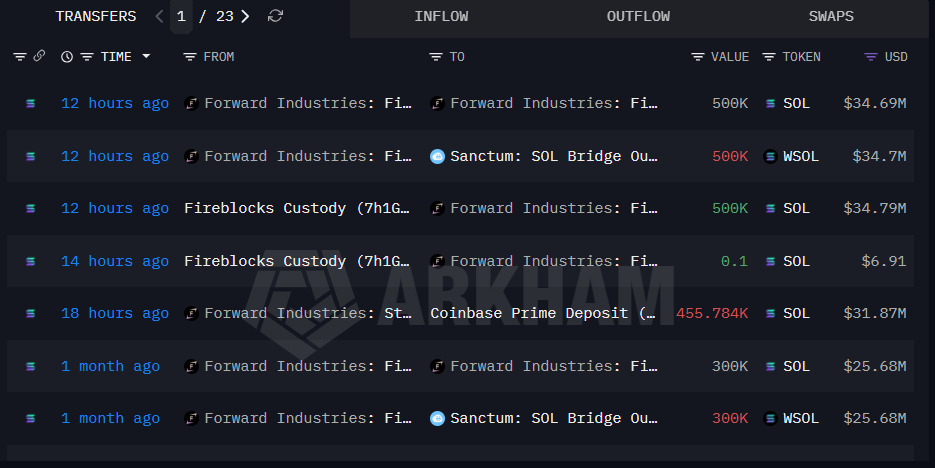
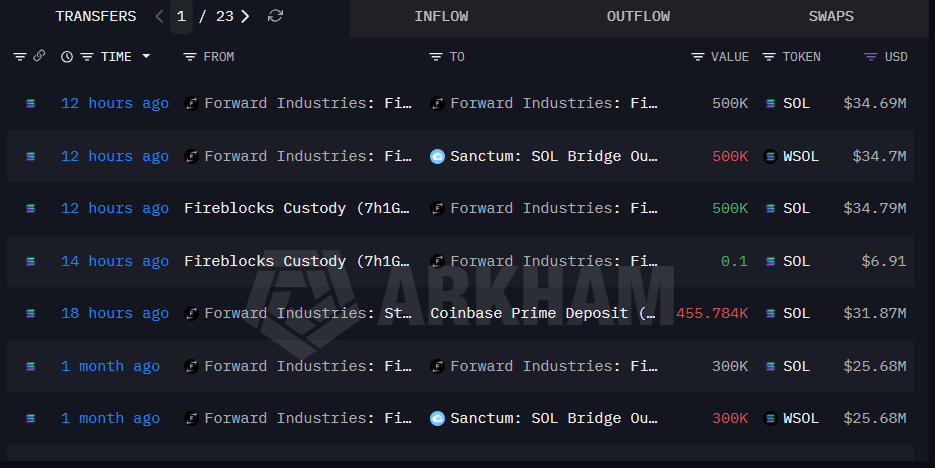
Forward Industries transferred roughly $31.9 million worth of Solana tokens to Coinbase Prime Thursday, according to blockchain data, marking its first onchain activity in a month.

Data from Arkham Intelligence shows a wallet tied to the Nasdaq-listed company moved 455,784 SOL to the institutional trading platform. The transfer comes as the firm sits on steep unrealized losses tied to its large-scale bet on the token.

The deposit to Coinbase Prime does not necessarily confirm an immediate sale but is commonly interpreted as a precursor to trading activity, particularly for institutional holders seeking liquidity or risk reduction.

Shares of Forward Industries were down about 6% in the pre-market on Friday following the transfer, trading at $3.97, down from Thursday’s close of $4.22, according to Yahoo Finance data.

Advertisement

Forward Industries moves 455,784 SOL to Coinbase Prime. Source: Arkham

The move comes as publicly listed companies that adopted crypto treasury strategies face mounting pressure from the sector’s prolonged downturn, with several firms sitting on significant unrealized losses and investors increasingly focused on balance sheet risk.

Forward Industries began accumulating Solana in September 2025 as part of a treasury strategy that positioned it as the largest corporate holder of the asset, according to a December shareholder update.

Related: Solana open interest drops 30% as altcoins slump: Is $68 SOL next?

The company said it had purchased about 6.83 million SOL for approximately $1.59 billion at an average cost of $232.08 per token.

Advertisement

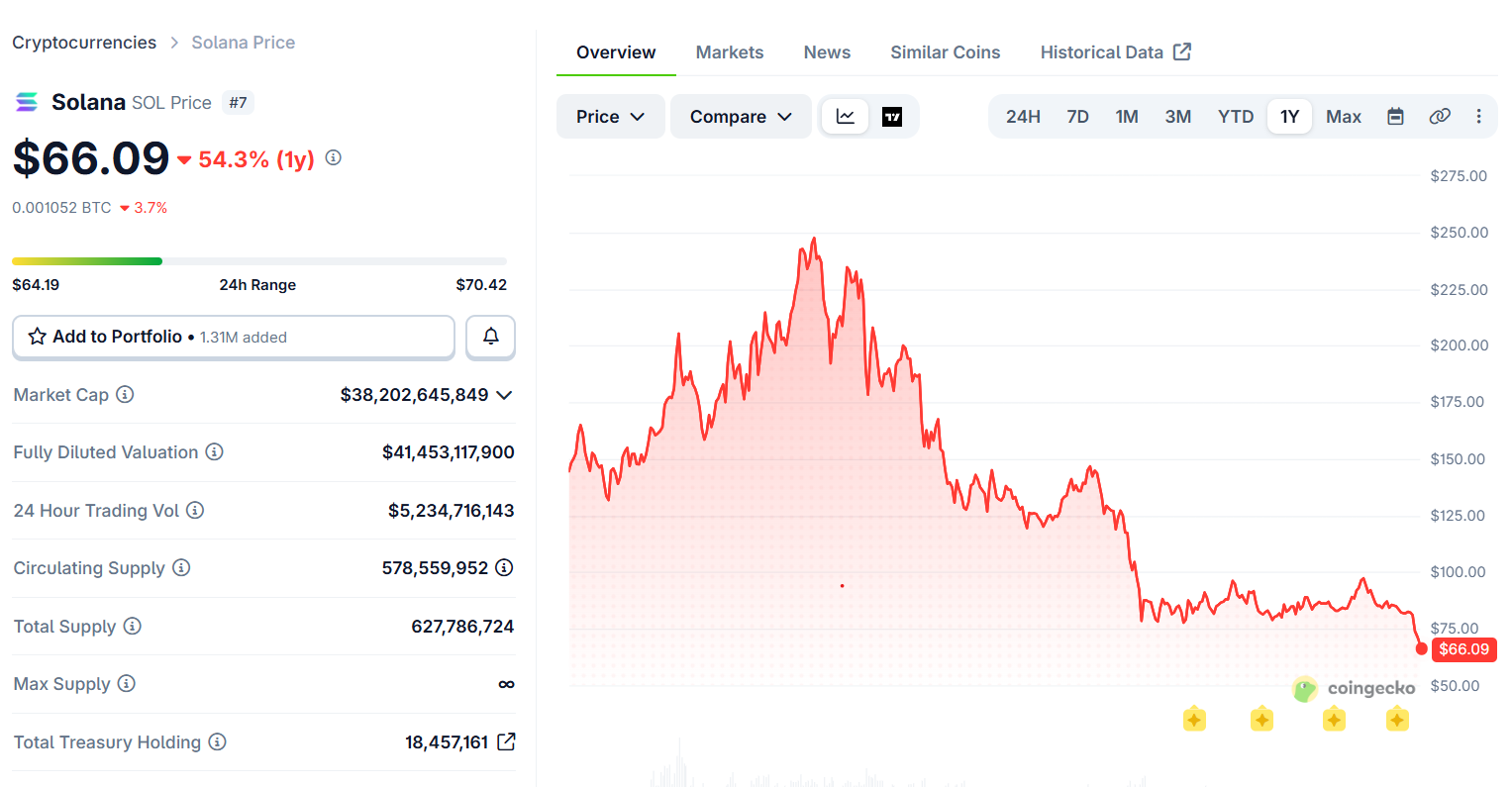
The SOL price has since fallen by roughly 72%, according to CoinGecko data, trading at around $64.63 at the time of writing. That would value the company’s original holdings at about $441 million, implying an unrealized loss of roughly $1.15 billion.

Solana price has slumped 72% since September 2025. Source: Coingecko

Forward Industries remains the largest publicly listed Solana holder with more than 7 million SOL, according to the most recent data available.

Corporate crypto treasuries face mounting pressure

The move comes amid broader signs of strain across corporate crypto treasury strategies. On Thursday, publicly listed digital asset firm FG Nexus reportedly sold an additional $17.8 million in Ether, adding to a series of disposals across the sector.

Strategy, the largest corporate Bitcoin holder, is also facing mounting pressure after Bitcoin’s recent decline pushed the unrealized loss on its holdings to about $11.2 billion.

Advertisement

The company disclosed this week that it sold 32 BTC for roughly $2.5 million, its first Bitcoin sale since December 2022, when it sold 704 BTC as part of a tax-loss harvesting transaction before repurchasing more Bitcoin days later.

Market Moves: Why is Ethereum Foundation selling? BTC futures warning signs

Source link

Advertisement
Continue Reading
Click to comment

You must be logged in to post a comment Login

Leave a Reply

Crypto World

Ontario Survey Finds Canadian Crypto Ownership Rises to 25%

Published

on

Crypto Breaking News

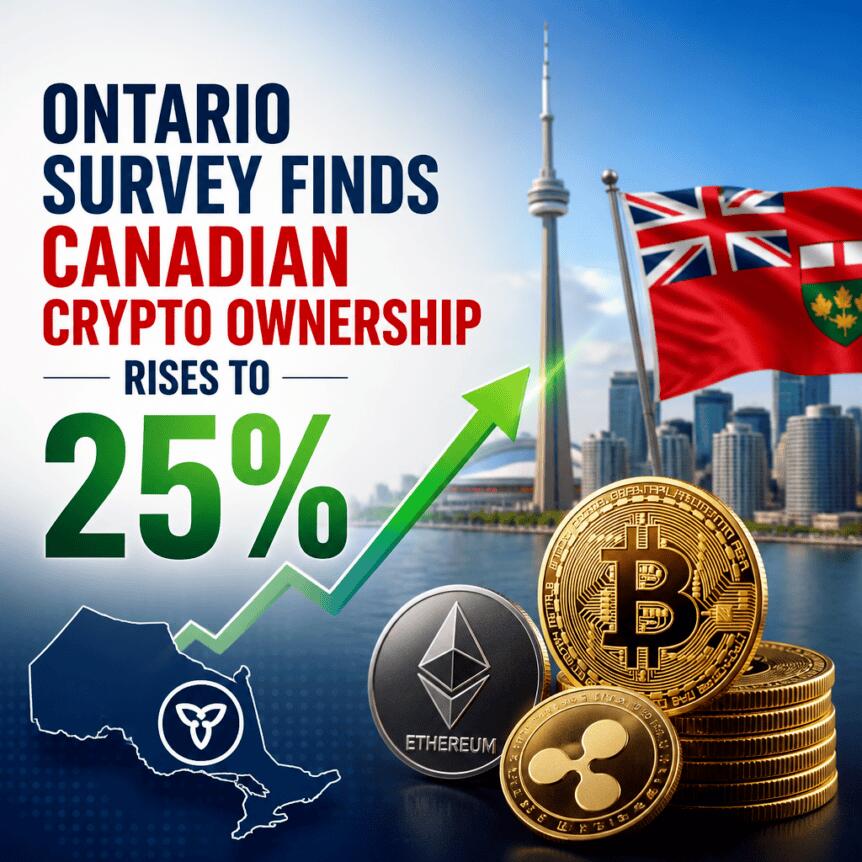
Canadian crypto participation is rising quickly, according to fresh research from the Ontario Securities Commission (OSC). The regulator’s latest survey suggests that the share of Canadians who own cryptocurrencies has climbed to 25% in 2026, up from 10% in 2023—an expansion that also coincides with broader awareness of crypto assets.

The OSC released the findings Tuesday, based on a poll of 2,360 Canadians aged 18 and over conducted between December 2025 and January 2026. The study found that 59% of respondents said they are aware of crypto assets, while 25% reported that they currently hold cryptocurrencies.

Key takeaways

  • The OSC survey reports crypto ownership has reached 25% in 2026, compared with 10% in 2023.
  • Awareness increased alongside ownership, with 59% of respondents indicating they know about crypto assets.
  • About half of crypto owners said they check whether a platform is registered before using it.
  • Despite growing caution, the OSC found widespread confusion about regulation, insurance protections, and transaction capabilities.

Ownership and awareness move upward

The OSC’s survey points to a clear jump in both familiarity and direct engagement with crypto. In 2026, a majority of respondents—59%—reported awareness of crypto assets, while one-quarter said they hold cryptocurrencies.

That shift matters for regulators because it implies crypto is moving from a niche activity toward mainstream consumer behavior. As more Canadians participate, investor protection issues typically become more urgent, particularly around how users choose platforms, understand risk, and interpret what protections (if any) apply when assets are held or transacted through a service.

OSC executive vice president of strategic regulation Naizam Kanji said the regulator expects “emerging trends and behaviors” to help it anticipate opportunities and risks, with the goal of supporting investor protection while fostering fair and efficient markets.

Advertisement

Checking registrations—alongside continuing misunderstandings

One of the more actionable details in the OSC findings is how some users evaluate platforms. The survey indicates that about 50% of crypto owners reported checking whether a platform is registered prior to using it.

However, the report also suggests that heightened awareness does not necessarily translate into a correct understanding of the rules that govern crypto activity in Canada. The OSC said many respondents still had “some misunderstanding” around key issues—namely regulation, insurance protections, and transaction capabilities.

For investors, this mix of behavior is significant. Register checks can be a useful step, but misunderstanding the practical meaning of registration—or assuming protections exist where they do not—can expose users to avoidable losses. The OSC’s results imply that more effective education and clearer disclosures may be needed, even as adoption rises.

How Ottawa’s crypto proposals fit the trend

The OSC’s survey lands amid ongoing policy debate in Canada about the appropriate ways to regulate different crypto-related activities. According to the report, lawmakers in Ottawa have been considering measures tailored to how cryptocurrencies are used in practice.

Advertisement

Earlier this year, the federal government advanced a bill that could prohibit political donations made using crypto. The government also proposed banning crypto ATMs, citing concerns about scams and money laundering. Taken together, these proposals highlight a broad regulatory theme: as crypto use grows, authorities are focusing not just on trading and custody, but also on high-risk channels that can enable fraud.

While the OSC survey focuses on awareness, ownership, and user understanding, Ottawa’s legislative direction underscores a parallel concern among policymakers—reducing harm where crypto intersects with consumers and enforcement challenges.

What to watch next for Canadian investors

The OSC’s data suggests that Canada’s crypto base is expanding while gaps in consumer understanding remain. The most important question for users and market participants is whether regulators will translate these survey insights into clearer requirements, better consumer education, and more targeted enforcement—especially in areas where misunderstanding could lead to financial harm.

As the next rounds of research and policy developments emerge, Canadians should pay close attention to how platform registration is communicated in practice, what protections users can realistically expect, and which services regulators move to restrict or supervise more tightly.

Advertisement

Risk & affiliate notice: Crypto assets are volatile and capital is at risk. This article may contain affiliate links. Read full disclosure

Source link

Advertisement
Continue Reading

Crypto World

Bitcoin’s Final Bear Leg: History Says $35,000, On-Chain Data Disagrees

Published

on

Bitcoin’s Final Bear Leg: History Says $35,000, On-Chain Data Disagrees

Bitcoin (BTC) trades near $64,000, roughly 49% below its October 2025 record of $126,000. Seasonal patterns from three past cycles now point to one Bitcoin final bear leg before a cycle bottom.

However, several on-chain metrics already sit at levels that marked previous generational lows. The clash between seasonal history and holder behavior will likely define the next six months for BTC.

Seasonal Roadmap Points to $46,000, Then Perhaps $35,000

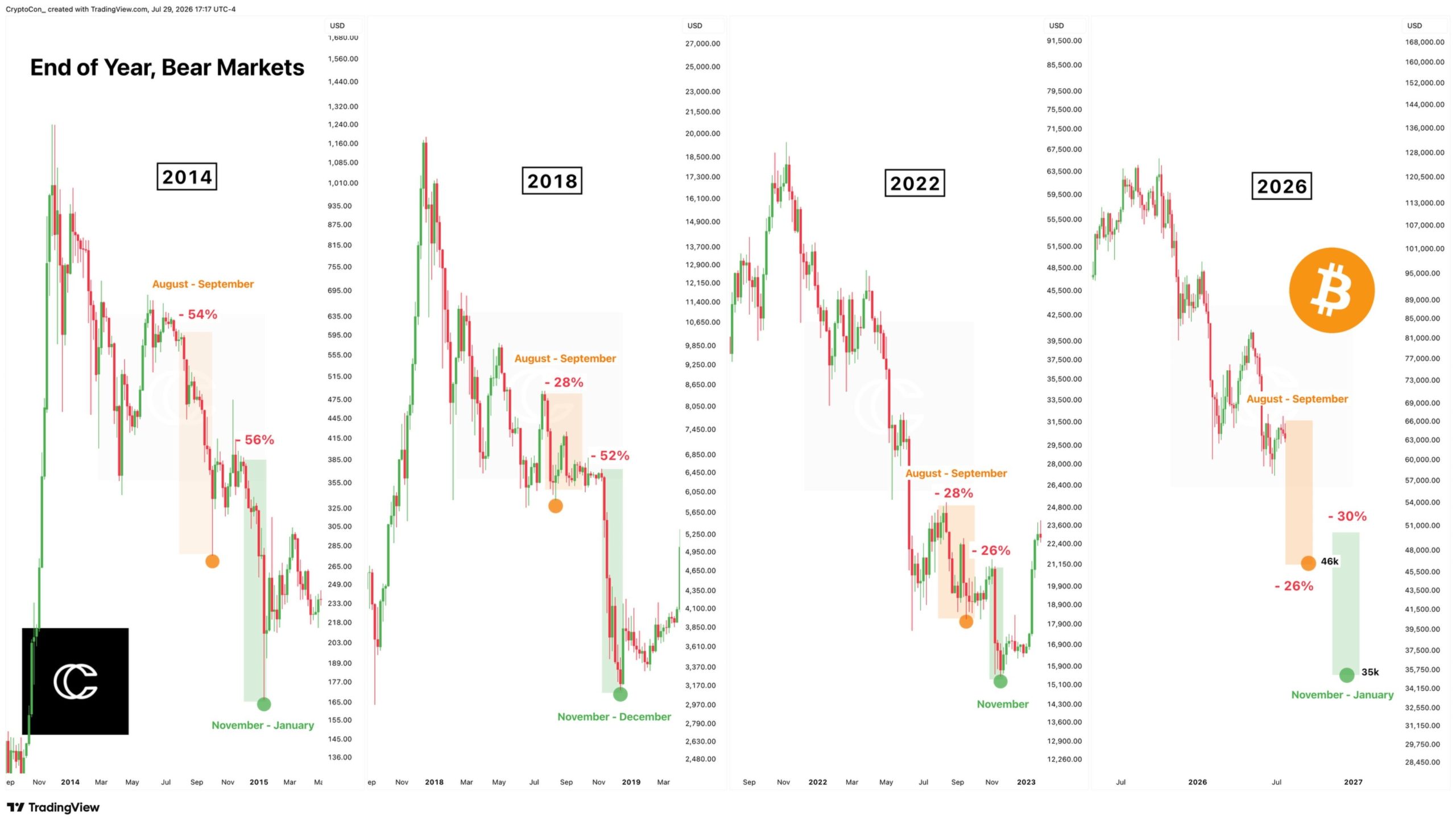
Analyst CryptoCon mapped the closing months of the 2014, 2018, and 2022 bear markets against the current cycle. August and September delivered the first leg down in each case, with losses of 54%, 28%, and 28%. His projection for 2026 assumes a 26% drop to roughly $46,000.

Comparison of 4 BTC Bear Markets / Source: X

History then adds a second, harsher leg. November through January produced declines of 56%, 52%, and 26% in past cycles. A repeat worth 30% would drag BTC near $35,000 by early 2027.

The first target aligns with earlier BeInCrypto research. A regression on shrinking final-quarter drawdowns pointed to a bottom between $44,000 and $47,000 by October. Benjamin Cowen’s recent memo reached a similar zone near $44,000.

Advertisement

Meanwhile, the deeper $35,000 target lands almost exactly on the 0.618 logarithmic Fibonacci level at $34,722. Even the chart’s author admits the roadmap faces resistance from on-chain data. CryptoCon wrote on X:

“It will be interesting to see how this clashes with the current building bullish divergence and some long-term metrics which are already at cycle bottom levels.”

Holder Cost Basis Compression Has Not Finished Yet

The first on-chain answer comes from the cost basis structure of Bitcoin holders. Analyst therationalroot tracks the ratio between short-term and long-term holder cost bases. Historically, every generational bottom formed when this ratio compressed to one.

The convergence points circled on the chart match the 2015 lows, the 2018 to 2019 trough, and the late 2022 capitulation. In each case, the average entry price of recent buyers fell to the level of veteran holders. Seller exhaustion followed, and accumulation phases began.

Short and Long-Term Holder Cost Basis Ration / Source: X

Today, the ratio falls quickly but remains above one. This supports the case for a few more months of downside, in line with the seasonal roadmap. The long-term holder cost basis also sits near $40,000, historically a magnet for final lows.

Furthermore, each cycle prints lower ratio peaks. The same dampening effect appears in the shrinking drawdowns, another sign of a maturing market.

Advertisement

Long-Term Holders Already Absorb More Than Miners’ Issue

Glassnode’s Long-Term Holder Market Inflation Rate measures annualized accumulation against daily miner issuance. Negative readings mean patient investors absorb more coins than miners create. The metric has stayed negative through most of 2026.

Similar readings appeared near every previous bear market floor. The deepest trough hit minus 0.15 in early 2019, while the 2022 lows reached about minus 0.06. In contrast, the current reading near minus 0.02 shows quieter but steady absorption.

BTC Long-Term Holder Market Inflation Rate / Source: Glassnode

Fidelity recently highlighted the same cohort, noting that long-term holder supply reached a record high. However, today’s accumulation remains milder than past capitulation troughs. A deeper buying wave into Q4 would therefore fit the historical pattern rather than break it.

Post-halving issuance is also close to zero on this scale. Holder behavior now dominates net supply, which helps explain why each bear ending grows shallower.

Price Temperature Already Reads Like a Bitcoin Final Bear Leg

The Bitcoin Price Temperature (BPT) delivers the strongest argument against $35,000. The oscillator measures how many standard deviations price sits above its four-year moving average. It currently reads near zero, with BTC hugging the long-term mean around $60,000.

Advertisement

Every prior cycle bottom formed in this temperature zone. The lows of 2015, 2019, March 2020, and late 2022 all printed near zero or slightly below. On this basis, Bitcoin already trades at bottom-grade valuations.

BTC Price Temperature / Source: Glassnode

A decline to $46,000 would push the temperature to about minus one. That depth matches the undershoots of March 2020 and December 2022 almost exactly. However, $35,000 would demand the deepest undershoot since 2015, a stretch for a maturing market.

Peak temperatures keep falling as well, from 10 in 2017 to seven in 2021 and 3.5 in 2024. Three separate metrics now confirm the same dampening of Bitcoin’s cycles.

Bitcoin Final Bear Leg: What to Watch Into Q4 2026

The timing signals agree, while the depth remains contested. Seasonal history, cost basis compression, and valuation bands all point to a bottom window in Q4 2026. Three methods converge between $44,000 and $47,000, and only the seasonal extension argues for $35,000.

Traders may watch three triggers from here. The holder cost basis ratio touching one, a deeper accumulation trough, and a weekly close below $44,000 would each sharpen the picture. Until then, short-lived bounces toward $65,000 deserve caution rather than chase.

Advertisement

This framework is an analysis, not financial advice. Historical patterns can break, and macro shocks could still push Bitcoin outside every model discussed here.

The post Bitcoin’s Final Bear Leg: History Says $35,000, On-Chain Data Disagrees appeared first on BeInCrypto.

Source link

Advertisement
Continue Reading

Crypto World

Aave Deprecates 50 Low-Adoption Assets and Winds Down Six Chain Deployments

Published

on

Aave is deprecating 50 low-adoption asset reserves across its lending markets and winding down its deployments on six blockchains.

In a July 30 post on X, founder Stani Kulechov noted that the move touches $98.1 million in supply and $15.6 million in debt and comes wrapped in two new internal rulebooks meant to keep the protocol from carrying assets nobody is really using.

Aave Commences Plan to Offboard Low Activity Reserves

“Aave is deprecating 50 low adoption asset reserves across multiple deployments,” Kulechov wrote, also citing an orderly wind-down of Aave deployments on Sonic, Scroll, zkSync, Metis, Soneium and Aptos, affecting another 25 asset reserves. He added that 21 matured Pendle PT tokens would also be retired in favor of new maturities as part of the overhaul.

According to implementation notes alongside the announcement, risk management firm LlamaRisk and Aave service providers recommended removing several inactive Aave V3 reserves together with six complete market deployments. Those positions account for $85.3 million in supplied assets and $11.5 million in debt.

Advertisement

The six blockchain deployments scheduled for retirement hold $12.8 million in supply and $4.1 million in debt. On Ethereum, the biggest chunk of the list is two Bitcoin liquid-staking wrappers, FBTC and eBTC, whose combined deposits have fallen from roughly $72 million six months ago to about $16 million now.

Several bridge tokens, including USDC.e and USDbC, are being cut because users have already migrated to native versions, and MaticX is being wound down simply because its issuer, Stader, is retiring the token.

On the six departing chains, LlamaRisk said each deployment now brings in under $5,000 a quarter in revenue, not enough to cover the oracle and monitoring costs of keeping it running. Deposits on those chains had already thinned out well before the vote, with Sonic falling from $28.9 million to $7.6 million and Scroll from $16.1 million to $2.2 million over the past six months.

The stated objective is to remove protocol exposure gradually, allowing users to exit positions in an orderly manner while limiting liquidation risks. Under the default wind-down process, each reserve will be frozen and its supply and borrowing caps reduced to one.

Advertisement

Oracle Changes Expand Review in Aave V2 and V3

The proposal will cover oracle infrastructure, in which LlamaRisk’s recommendation has identified a group of Chainlink price feeds linked to long-tail assets in Aave V2 and V3 for deprecation. Chainlink placed the links in a high or very high operational risk category because the underlying assets have lost significant adoption and liquidity, leaving insufficient trading activity for reliable pricing.

Those oracle changes will affect 10 deployments and assets worth a combined $6.76 million in supplied funds and $4.29 million in debt.

The reserve cuts land a few months after Aave moved on two separate fronts. In late May, two of its UK subsidiaries won registration from the Financial Conduct Authority to run crypto exchange and electronic money services.

Then in June, Grayscale Research put out a report estimating AAVE’s fair value near $175 within a year, well above where the token is currently trading, citing the protocol’s lending market share, its roughly 200,000 monthly users, and its push into tokenized real-world assets through its institutional market called Horizon.

Advertisement

The post Aave Deprecates 50 Low-Adoption Assets and Winds Down Six Chain Deployments appeared first on CryptoPotato.

Source link

Continue Reading

Crypto World

BlockDAG’s $0.00000019 price and 22% live swap discount draw massive attention as Hyperliquid, Cardano struggle

Published

on

BlockDAG's $0.00000019 price and 22% live swap discount draw massive attention as Hyperliquid, Cardano struggle - 4

Disclosure: This article does not represent investment advice. The content and materials featured on this page are for educational purposes only.

As Hyperliquid and Cardano face market uncertainty, BlockDAG is expanding its ecosystem with upcoming claims and staking functionality for users.

Advertisement

Summary

  • BlockDAG launches claims and staking for early participants as Hyperliquid and Cardano face renewed market uncertainty.
  • With claims and staking going live, BlockDAG expands its ecosystem while traders monitor Hyperliquid and Cardano.
  • BlockDAG rolls out claims and staking features, drawing attention as Hyperliquid and Cardano struggle for momentum.

The Hyperliquid price hovers near a critical make-or-break zone as trading interest cools down. Meanwhile, the Cardano price is facing pressure after reaching very low RSI levels, with traders watching for signs of a possible recovery.

Standing far above these uncertain charts, BlockDAG (BDAG) is introducing a new stage of ecosystem development with upcoming claims and staking features. Claims for Batches 1–6 and staking are scheduled to go live within hours, adding new utility for the growing network.

BlockDAG's $0.00000019 price and 22% live swap discount draw massive attention as Hyperliquid, Cardano struggle - 4

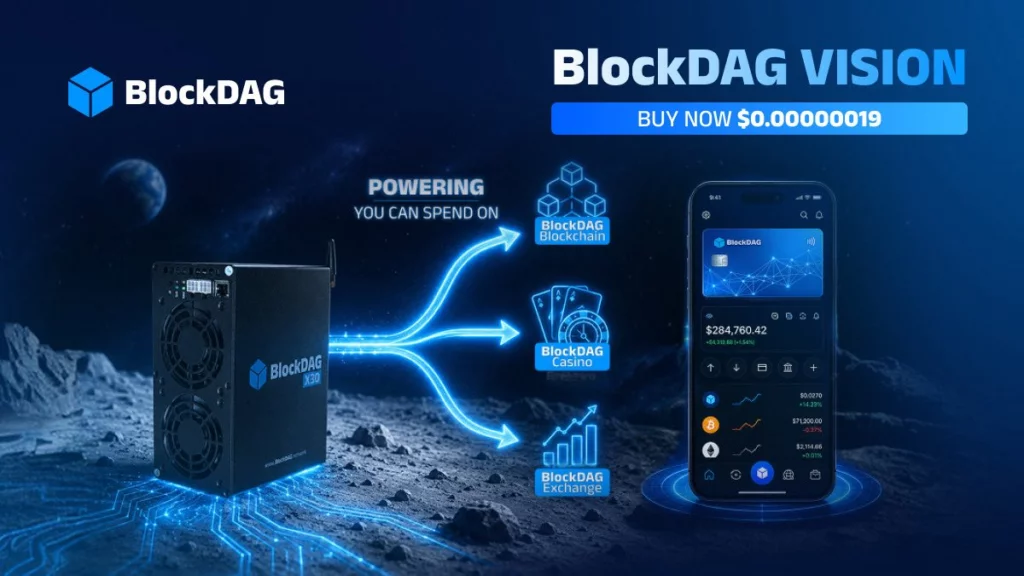
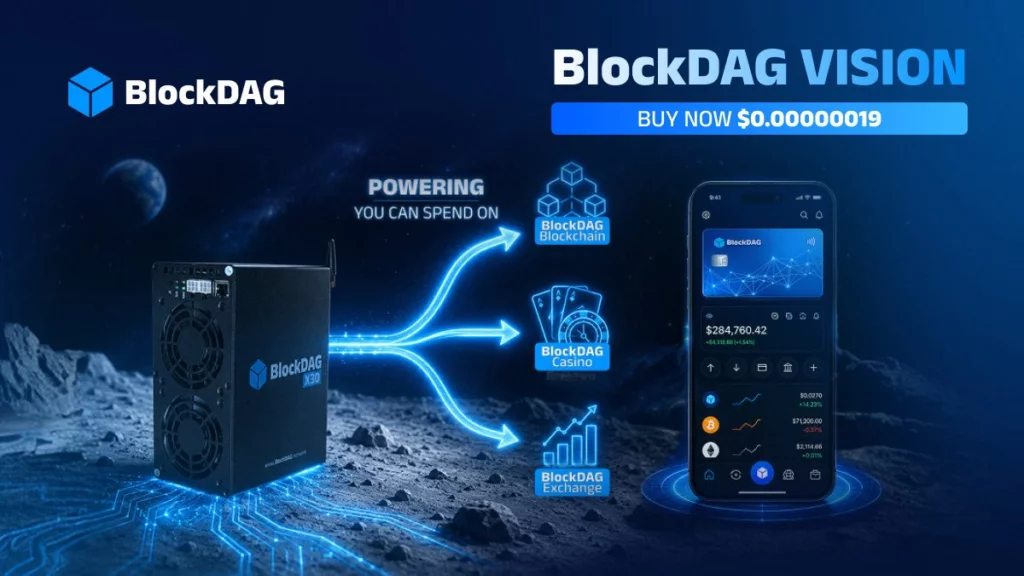
Alongside these updates, BDAG is available at a limited-time price of $0.00000019, while Live Swap remains active at 22% below the CoinMarketCap price. With continued progress across the Casino & Sportsbook, BlockDAG Exchange, Super App, and upcoming Tier 1 exchange listings, BlockDAG is building momentum around broader ecosystem growth and long-term blockchain adoption.

Hyperliquid price faces downward pressure

The Hyperliquid price sits near $60 as buying interest slows down. Right now, the token stays below its 50-day average price of $62.70, showing that momentum has cooled. 

Advertisement

Big investors seem to be stepping back, with specialized crypto funds pulling out nearly $700,000 in a single day. On top of that, a major token holder recently moved over 395,000 HYPE to an exchange, which often signals a plan to sell.

While trading volume jumped slightly, most traders remain divided on where the market goes next. If the price falls below its $60.41 support level, it could easily drop further toward $54.19, keeping near-term risks quite high for buyers.

Cardano price holds firm above historic lows

The Cardano price is holding around $0.16 after dipping almost 2% recently. The coin sits in a support range between $0.14 and $0.17, which has helped stop deeper drops in the past. 

Indicators show the market is heavily oversold, meaning selling has been intense for a long time. Some chart readers see a potential bottom pattern forming, but nothing is confirmed yet. For a real comeback, the token needs to climb past the $0.23 resistance level. 

Advertisement
BlockDAG's $0.00000019 price and 22% live swap discount draw massive attention as Hyperliquid, Cardano struggle - 5

However, actual buying demand remains weak across weekly charts. If support at $0.14 fails to hold, the price risks sliding down toward $0.10, leaving the token in a shaky position for now.

BlockDAG prepares staking and claim launch

Timing can make the biggest difference when entering a high-growth opportunity, and BlockDAG is giving participants a chance to move before the crowd. BlockDAG is creating renewed attention. 

BlockDAG is currently available at $0.00000019, while the Live Swap remains active at 22% below the CoinMarketCap price, giving market participants a limited timeframe to explore the latest opportunity.

The next few hours mark the launch of claims for Batches 1–6 and staking, bringing new functionality to the network. As activity builds around these updates, BlockDAG continues advancing its wider ecosystem with the Casino & Sportsbook, BlockDAG Exchange, Super App, and upcoming Tier 1 exchange listings. These developments are placing increased focus on BDAG as the project moves toward its next stage of growth.

BlockDAG's $0.00000019 price and 22% live swap discount draw massive attention as Hyperliquid, Cardano struggle - 6

Community growth tells the story: more than 312,000 holders, increasing by over 1,000 each day, alongside 4 million+ users on the X1 mining app and 20,000 physical miners already shipping globally. 

From a technology perspective, the latest RPC upgrade processed 100,000 transactions within 24 hours, highlighting the network’s scalability. Combined with early-entry projections suggesting the potential for up to 5,000x ROI, it’s clear why many investors are viewing BDAG as one of the top crypto opportunities today.

Advertisement

To sum up

The Hyperliquid price continues to struggle below $62.70 as large holders move tokens, while the Cardano price rests near $0.16 in heavily oversold territory. In contrast, BlockDAG is advancing rapidly with its Live Swap active at 22% below the CoinMarketCap price. 

The upcoming launch of claims for Batches 1–6 and staking adds massive utility alongside 20,000 physical miners shipped globally. Combined with its Casino, Super App, Tier 1 listings, and up to 5,000x ROI projections, BDAG stands out as the best crypto to buy. As chart conditions split between stalling tokens and expanding ecosystems, real utility continues to set the standard for long-term value.

For more information, visit the official website, presale, Telegram, and Discord.

Advertisement

Disclosure: This content is provided by a third party. Neither crypto.news nor the author of this article endorses any product mentioned on this page. Users should conduct their own research before taking any action related to the company.

Source link

Advertisement
Continue Reading

Crypto World

Aviva Debuts XRPL Tokenized Fund with Irish Approval

Published

on

Aviva Debuts XRPL Tokenized Fund with Irish Approval

Cointelegraph is committed to providing independent, high-quality journalism across the crypto, blockchain, AI, and fintech industries.

All news, reviews, and analyses are produced with full journalistic independence and integrity. For more details on our standards and processes, please read our Editorial Policy.

Source link

Advertisement
Continue Reading

Crypto World

JPMorgan, Citi, UBS test tokenized cross-border payments in BIS pilot

Published

on

(BIS Project Agorá)

Some of the world’s biggest banks have completed real cross-border payments using tokenized money in a test led by the Bank for International Settlements (BIS), another sign that tokenization is moving into the plumbing of global finance.

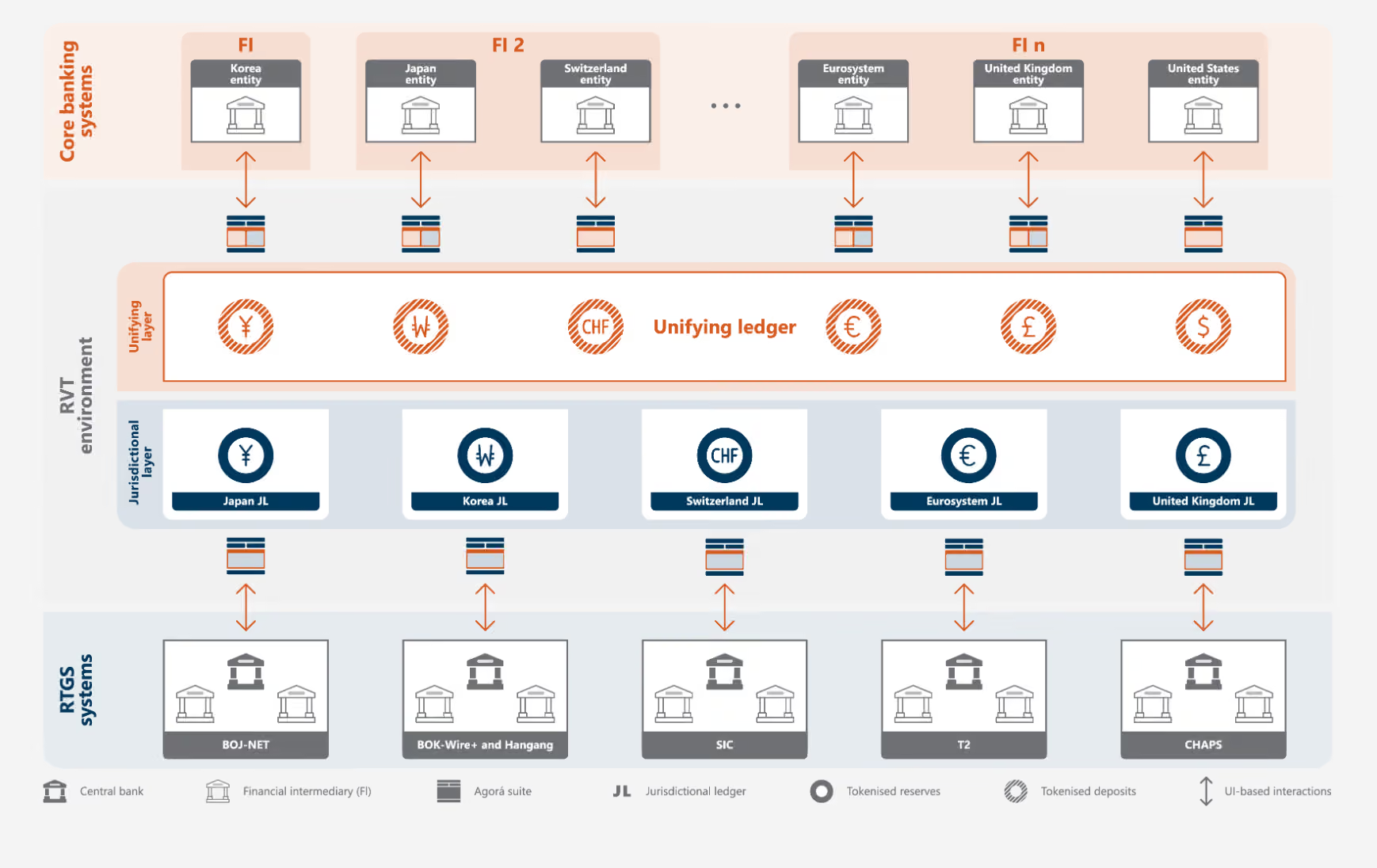
Project Agorá, which brings together five central banks and 28 commercial lenders including JPMorgan, Citi, UBS, Deutsche Bank and Standard Chartered, processed roughly $1 million (CHF 800,000) in real-value transactions across six currencies — the U.S. dollar, euro, British pound, Japanese yen, Swiss franc and South Korean won.

The pilot used tokenized central bank reserves and commercial bank deposits to settle corporate, interbank payments perand foreign exchange settlements. The payments settled in an average of about 80 seconds, even though the prototype was not directly integrated with banks’ existing payment infrastructure, the BIS report said.

(BIS Project Agorá)

The project fits into a broader shift as stablecoins and tokenized assets gain traction across global finance. Asset managers have begun issuing tokenized money market and private credit funds, while stablecoins are increasingly being used for cross-border payments and corporate treasury operations.

A new model for cross-border payments

Project Agorá explores whether the same technology can modernize the infrastructure banks use to move money internationally.

Advertisement

Source link

Continue Reading

Crypto World

Telegram Founder Pavel Durov Finally Breaks Silence on Russia Charges

Published

on

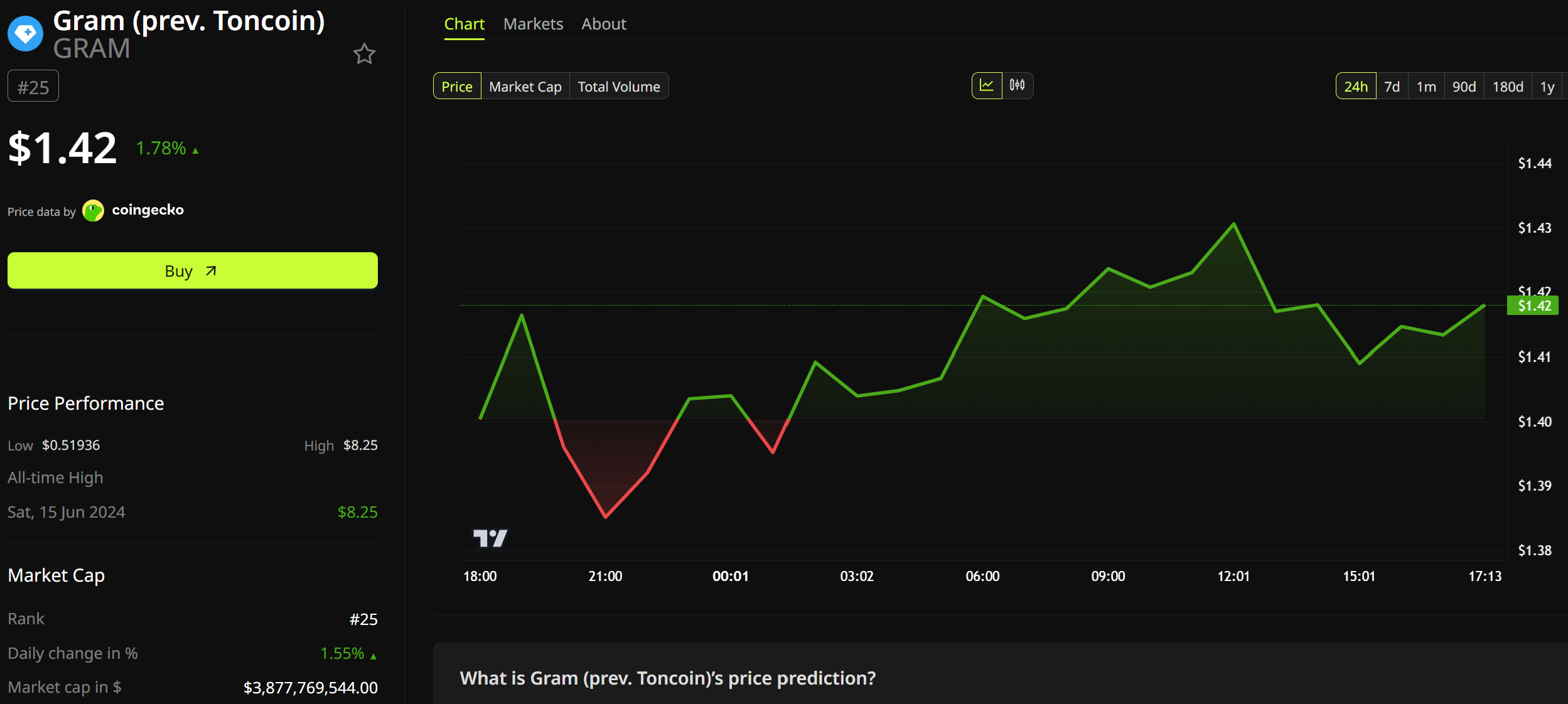
GRAM Price Performance. Source: BeInCrypto

Telegram founder Pavel Durov has answered Russia’s terrorism charges, accusing Moscow of punishing him for rejecting state demands for mass surveillance and censorship on the messaging app.

Rosfinmonitoring, Russia’s financial monitoring service, added Durov to its registry of terrorists and extremists on Thursday. The listing arrived one day after the Federal Security Service (FSB) opened a criminal case against him.

Durov Answers Moscow With a Meme

Durov did not rebut the allegations point by point. He posted a short statement to his Telegram channel, then followed it with a two-panel image.

“Russia has designated me as a “terrorist” for refusing its demands for mass surveillance and censorship on Telegram. Under Russian law, I’m banned from “publishing information on the Internet”. Russian officials have clearly got confused about who can ban whom from the Internet,” Durov wrote.

Follow us on X to get the latest news as it happens

Advertisement

The image placed his own photo, captioned terrorist, beside Taliban representatives greeting Russian Foreign Minister Sergey Lavrov, captioned respected partners. Russia’s Supreme Court removed the Taliban from that same registry in April 2025.

What the Designation Actually Changes

Russian banks must freeze the personal assets of anyone on the Rosfinmonitoring list and cut off financial services. That obligation covers Durov himself, not Telegram as a legal entity.

The FSB alleges the platform failed to delete channels, chats, and bots that Ukrainian intelligence and extremist groups used to organize attacks inside Russia. Durov, 41, now sits on the international wanted list and faces a possible life sentence. Officials had been negotiating with Telegram days earlier.

Markets shrugged. Gram (GRAM), the Telegram-linked token Durov rebranded from Toncoin in June, traded near $1.42, up 1.7% over 24 hours.

Advertisement
GRAM Price Performance. Source: BeInCrypto

Enforcement remains the open question. Durov holds French and UAE citizenship and lives in Dubai, so any arrest would need cooperation Moscow has not yet secured. French prosecutors lifted his travel restrictions in November.

The post Telegram Founder Pavel Durov Finally Breaks Silence on Russia Charges appeared first on BeInCrypto.

Source link

Continue Reading

Crypto World

Trump Says He Has ‘No Objection’ to Withdrawing Todd Blanche’s Nomination

Published

on

Trump Says He Has ‘No Objection’ to Withdrawing Todd Blanche’s Nomination

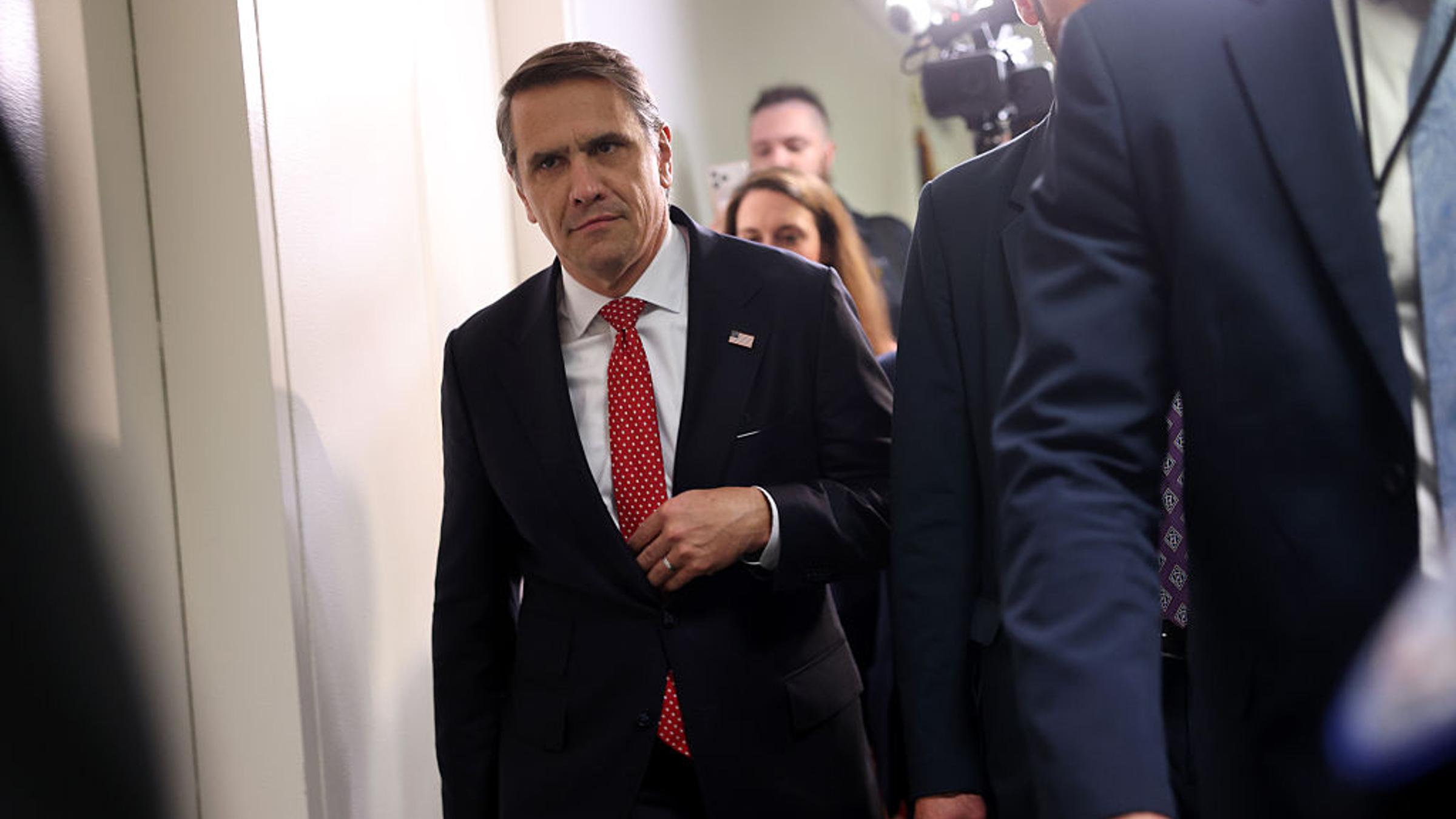
President Trump said Thursday that he might pull Todd Blanche’s nomination as attorney general, after two Republican senators threatened to withhold their support. 

“I have no objection to temporarily withdrawing Todd’s name, if they do not do the right thing,” Trump posted on Truth Social. 

His comments came after the Senate Judiciary Committee postponed a vote Thursday that would have advanced Blanche’s nomination.

Republican Sen. John Cornyn of Texas, one of the key holdout votes, told reporters Wednesday that he had not received a written confirmation from the Department of Justice that it would eliminate provisions in a proposed settlement between Trump and the department over a lawsuit he filed concerning the leak of his tax returns.

Advertisement

The most contentious provisions would have created a $1.8 billion “Anti-Weaponization Fund” for Trump allies and Jan. 6 defendants, and shielded Trump and his family from future audits by the Internal Revenue Service.

“I think they [the administration] realizes that we are serious,” Cornyn, who lost his reelection bid in May after Trump endorsed his opponent, said after canceling an in-person meeting with Blanche.

The committee did not immediately announce a new date for a confirmation vote. Shortly after the postponement, Cornyn said negotiations between the committee members and the DOJ were still ongoing, and that the DOJ had received “some pushbacks” from the White House. 

“I thought we were pretty close to landing the plane last night, but this morning there’s been some more complications. I think if this were just between me and Todd Blanche, we would have worked this out,” Cornyn added. 

Advertisement

Republican Sen. Thom Tillis of North Carolina, who is not seeking reelection over his disagreement with the Trump administration, has also made clear his opposition to the Anti-Weaponization Fund. 

“He [Blanche] is a qualified candidate. We just need to get the issues off the table,” Tillis said on Wednesday.

What happens if Blanche is not confirmed? 

Todd Blanche has been serving as acting attorney general for the DOJ since Trump removed Pam Bondi in April over her handling of the Epstein files. Unlike interim U.S. prosecutors, who can lawfully serve 120 days without a Senate confirmation, an acting attorney general can serve for as long as a president wants. 

Advertisement

That is because of U.S. Code § 508, which states that “the Deputy Attorney General may exercise all the duties of that office” if the office of Attorney General is vacant and the law does not state a time limit for how long the acting attorney general can legally serve.

The law, which was passed decades before the Federal Vacancies Reform Act (VRA) of 1998, takes legal precedence. While the FVRA generally limits officials serving in a temporary capacity to no longer than 210 days after the position becomes vacant, the law also made exceptions to agency-specific laws that had been previously codified.

A similar arrangement existed under the Biden administration. In 2023, after Marty Walsh resigned as labor secretary, President Biden nominated Julie Su to fill the vacancy. Su, who had served as deputy labor secretary, ultimately failed to get confirmed by the Senate due to the lack of support from Sen. Joe Manchin of West Virginia and Sen. Kyrsten Sinema of Arizona.

Su served as acting labor secretary for the rest of the Biden administration under a similar statutory provision, despite Republicans’ objections. In 2023, the Government Accountability Office, which oversees the federal government’s compliance with vacancy laws, concluded in a letter that time limitations “do not apply” to Su’s case. 

Advertisement

What did Blanche say about the demands?

During his confirmation hearing earlier this month, Todd Blanche said the Anti-Weaponization Fund was “dead.” 

However, Sen. Cornyn pointed out during the hearing that the settlement agreement made between Trump and the Department of Justice that included the fund could only be modified through “a written agreement” between two parties. When pressed by Cornyn, Blanche said Trump could potentially enforce the agreement if he decides to do so. 

“They [Trump’s legal counsel] could say that we breached by not moving forward,” Blanche said. 

Advertisement

TIME has also reached out to the Department of Justice for comment.
Source link

Continue Reading

Crypto World

CLARITY Act wins police backing as odds fall to 30%

Published

on

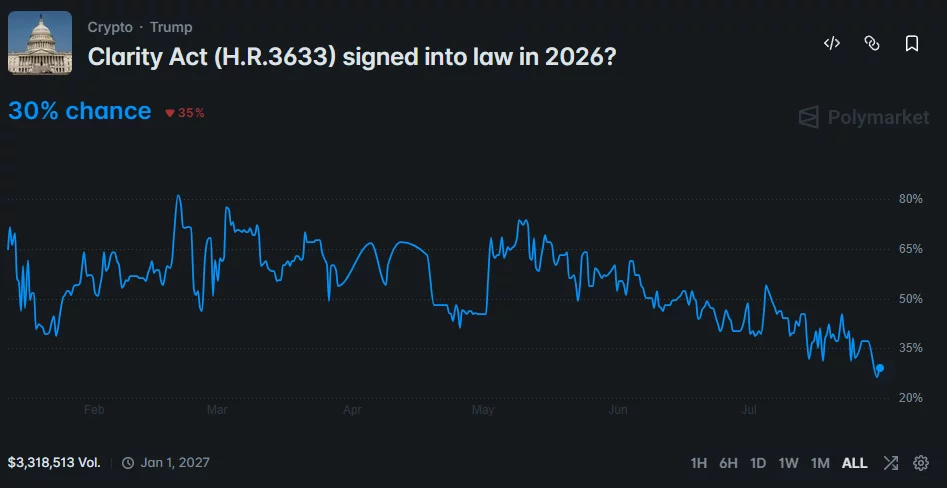
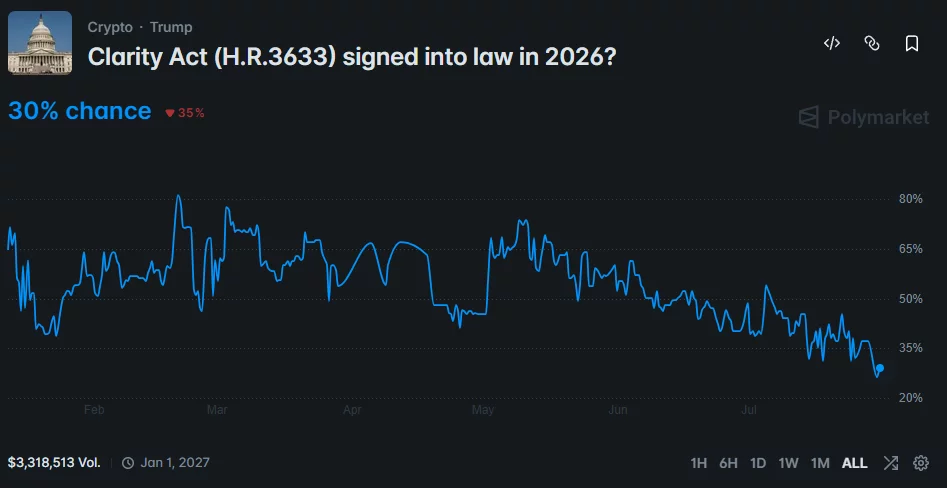
Polymarket chart showing the CLARITY Act’s 2026 passage odds falling to 30%.

A major U.S. police organization has endorsed the latest CLARITY Act draft, but unresolved disputes over political ethics, DeFi protections and stablecoin rewards continue to threaten its passage before the Senate recess.

Summary

  • Major Cities Chiefs Association endorsed the CLARITY Act after lawmakers added new enforcement provisions.
  • Polymarket traders place the bill’s chance of becoming law in 2026 at 30%.
  • Democrats and prosecutors continue to seek changes to the bill’s DeFi developer protections.
  • Banks support federal crypto rules but want tighter restrictions on stablecoin rewards and yield.

Major Cities Chiefs Association backs CLARITY Act

The Major Cities Chiefs Association endorsed the latest version of the CLARITY Act in a letter to Senate Banking Committee Chair Tim Scott and ranking member Elizabeth Warren.

MCCA said recent revisions addressed concerns previously raised by police and prosecutors. The organization specifically pointed to additional law-enforcement provisions and the inclusion of state and local agencies in Sections 10203, 10204 and 10309.

Advertisement

“The inclusion of these provisions represents a meaningful step toward improving the ability of law enforcement to investigate financial crimes involving digital assets,” the association wrote.

MCCA joins several other police organizations that have moved toward supporting the proposed U.S. crypto market structure framework.

The National Organization of Black Law Enforcement Executives became the first major police association to endorse the bill. The Federal Law Enforcement Officers Association later offered conditional support while requesting stronger rules governing accountability in decentralized finance.

The National Fraternal Order of Police, which represents more than 382,000 officers, also reversed its previous opposition after reviewing revisions to the Blockchain Regulatory Certainty Act provisions.

Advertisement

Major County Sheriffs of America has stopped short of endorsing the legislation but withdrew its formal opposition. The group adopted a neutral position while asking Congress to give state and local agencies a role in Treasury studies and advisory panels created under the bill.

Why police groups previously opposed the crypto bill

Earlier law-enforcement resistance focused primarily on the CLARITY Act’s treatment of non-custodial crypto developers.

The Blockchain Regulatory Certainty Act language generally protects developers and infrastructure providers from being classified as money transmitters when they do not control customer funds. Supporters say those protections prevent programmers from being prosecuted solely because criminals use open-source software.

Police groups and prosecutors argued that earlier wording was too broad. They warned that DeFi operators, mixers and other services could use the exemption to avoid registration and accountability, making it harder to trace illicit funds or recover assets for victims.

Advertisement

Revisions clarified that developers may still face prosecution when they knowingly or intentionally facilitate money laundering and other crimes. The updated draft also preserves existing criminal-enforcement powers and gives state and local agencies a larger role.

However, Democrats led by Senator Catherine Cortez Masto and several prosecutors continue to seek additional changes. Their proposal would narrow or remove protections that could shield some crypto service providers from prosecution.

Banks push for tighter stablecoin restrictions

The banking industry supports the broader goal of establishing federal rules for digital assets but wants lawmakers to revise the bill’s stablecoin provisions.

A coalition of 134 banking association officials and senior bank executives has asked the Senate to strengthen Section 10404. That provision restricts stablecoin issuers from paying interest but allows certain rewards tied to payments, memberships and other activities.

Advertisement

Banks argue that exchanges could use those exceptions to provide returns resembling interest on stablecoin balances. They warn that such products could pull deposits away from regulated banks and reduce funding available for mortgages, agricultural credit and small-business loans.

The American Bankers Association and five other financial trade groups have called the legislation an important step toward federal crypto regulation. However, they want Congress to prohibit passive returns tied to the size or duration of stablecoin holdings while preserving legitimate transaction-based rewards.

White House crypto adviser Patrick Witt has disputed the banking industry’s warnings, arguing that banks are seeking protection from competition rather than stronger consumer safeguards.

Ethics dispute leaves passage odds at 30%

Despite growing police support, political ethics remains one of the largest barriers to a Senate agreement.

Advertisement

Democrats want restrictions addressing financial interests in crypto held by elected officials and their families. Republican Senator Thom Tillis has also indicated that he will not support the bill without an acceptable ethics provision.

Tillis reportedly plans to send a bipartisan ethics proposal to the White House for President Donald Trump’s approval. Democrats have not ruled out supporting a vote before the recess, but they are unlikely to back the current text without further changes.

Polymarket traders place the probability of Trump signing the CLARITY Act in 2026 at 30%. The Senate has until its scheduled Aug. 7 recess to reach an agreement and advance the legislation during the current window.

Polymarket chart showing the CLARITY Act’s 2026 passage odds falling to 30%.
Source: Polymarket

MCCA’s endorsement removes one source of institutional resistance, but it does not resolve the ethics, DeFi and stablecoin disputes. Without a bipartisan compromise, the bill may struggle to secure the 60 Senate votes needed to overcome a filibuster.

Advertisement

Source link

Continue Reading

Crypto World

Apple faces Aug. 21 Senate deadline over China chips

Published

on

Apple faces Aug. 21 Senate deadline over China chips

Apple faces bipartisan pressure to rule out memory chips from two Chinese suppliers as an AI-driven shortage tightens global supply and raises production costs.

Summary

  • Six US senators asked Apple to reject memory chips supplied by China’s CXMT and YMTC.
  • Apple must provide a formal commitment by Aug. 21, according to the lawmakers’ letter.
  • Both suppliers appear on the Pentagon’s Section 1260H list of Chinese military companies.
  • AAPL closed 0.56% lower at $338.19 before extending its decline in Thursday trading.

Senators give Apple an Aug. 21 deadline

Six US senators have urged Apple CEO Tim Cook to abandon any plan to source memory chips from ChangXin Memory Technologies, or CXMT, and Yangtze Memory Technologies Co., commonly known as YMTC.

The bipartisan letter was led by Republican Senator Jim Banks of Indiana and Senate Democratic leader Chuck Schumer of New York. Senators Andy Kim, Jeanne Shaheen, Mike Crapo and Pete Ricketts also signed it.

Advertisement

Lawmakers asked Apple to confirm by Aug. 21 that it would not use components made by either supplier, including in devices produced exclusively for the Chinese market. Bloomberg first reported the letter.

“Once a part clears qualification for Apple production, extending it worldwide is a single procurement decision away,” the senators wrote.

The group also asked Apple whether it transferred intellectual property to CXMT or YMTC while evaluating their components. Such transfers could require approval from the US Commerce Department, depending on the technology involved.

Advertisement

Apple had not publicly responded to the letter at the time of writing.

Why US lawmakers oppose CXMT and YMTC

Washington’s concerns center on the suppliers’ alleged links to China’s government and defense industry.

The Pentagon added both companies to its updated Section 1260H list in June. The Defense Department document describes CXMT as affiliated with China’s Ministry of Industry and Information Technology and state-owned asset authorities.

It identifies YMTC as indirectly owned or affiliated with Chinese government and defense agencies. Both companies have denied that they support China’s military.

Advertisement

A Section 1260H designation does not impose the same restrictions as a full trade sanction. However, it limits Pentagon dealings with listed companies and signals possible future procurement or investment restrictions.

YMTC also remains on the Commerce Department’s Entity List, restricting its access to certain US technology, software and chipmaking equipment. CXMT is not currently on that list, although there are reports that a US interagency committee previously approved it for inclusion.

Apple encountered similar opposition in 2022 when it considered using YMTC flash memory in some iPhones. The company dropped those plans after lawmakers raised national security concerns.

AI memory shortage limits Apple’s options

The dispute comes as AI data centers absorb a growing share of global memory production. Samsung, SK Hynix and Micron have directed more capacity toward high-bandwidth memory used in AI accelerators, reducing supplies available for smartphones, computers and other consumer products.

Advertisement

CXMT has become the world’s fourth-largest memory producer, while YMTC has expanded its position in NAND flash storage. The companies are gaining pricing power as buyers compete for limited supply, according to Reuters.

Apple has argued that it needs access to Chinese memory and has sought assurances that CXMT will not be added to the Entity List, Reuters reported, citing people familiar with the discussions.

Blocking both companies would leave Apple more dependent on Samsung, SK Hynix and US-based Micron. That could weaken Apple’s ability to negotiate prices while memory costs remain elevated.

For US investors, the immediate risk is margin pressure. Apple must either absorb higher component costs, pass them to customers through higher product prices, or redesign parts of its supply chain.

Advertisement

Apple stock falls as investors await its response

Apple shares closed at $338.19 on July 29, down 0.56%, after reaching an intraday high of $344.57. The reversal prevented the company from closing above a $5 trillion market value.

AAPL extended the decline during July 30 trading, falling about 1.8% in the morning as investors also prepared for Apple’s quarterly earnings report.

The Aug. 21 response will show whether Apple accepts the senators’ demand or continues evaluating Chinese memory for locally sold devices. Lawmakers also want to know whether Apple sought priority supply from US and South Korean manufacturers, making its answer relevant to the company’s sourcing plans for the 2027 iPhone cycle.

Separately, Apple faces a federal lawsuit from three users who allege that fake apps impersonating Sparrow Wallet appeared on its App Store and caused approximately $1.835 million in Bitcoin losses.

Advertisement

Source link

Continue Reading

Trending

Copyright © 2025