



Connect with us
DAPA Banner
DAPA Coin
DAPA
COIN PAYMENT ASSET
PRIVACY · BLOCKDAG · HOMOMORPHIC ENCRYPTION · RUST
ElGamal Encrypted MINE DAPA
🚫 GENESIS SOLD OUT
DAPAPAY COMING

Crypto World

Quantinuum (QNT) IPO: Quantum Computing Stock Surges 13% on Nasdaq Launch

Published

on

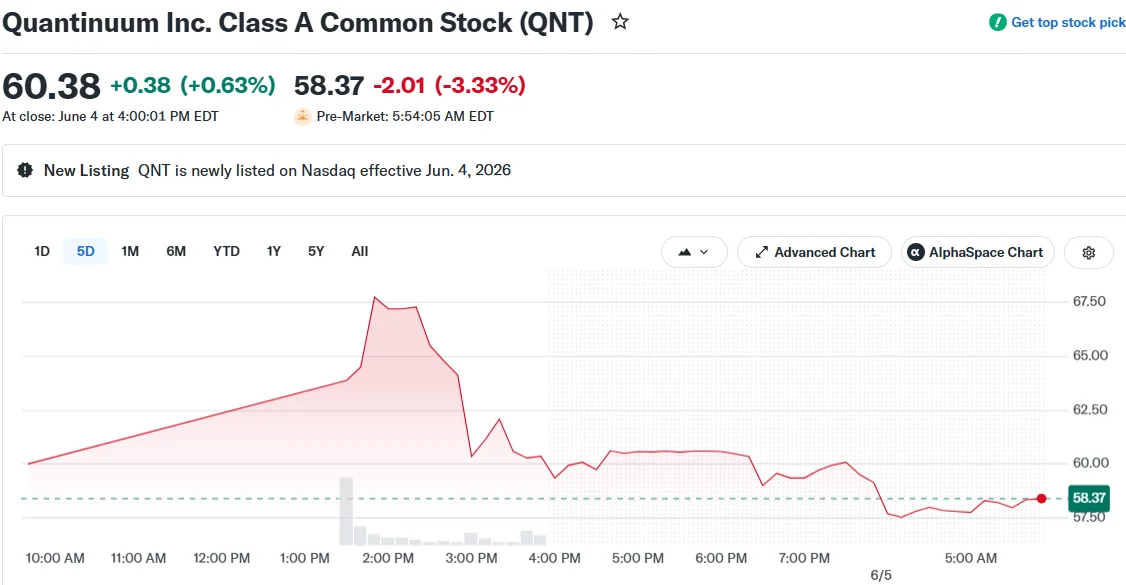
Quantinuum Inc. Class A Common Stock (QNT)

Key Highlights

  • The quantum computing company secured $1.68bn through its initial public offering, selling 28 million shares at $60 apiece—exceeding the projected $53–$55 price range
  • Shares began trading at $68 on June 4, representing a 13.3% increase over the offering price and delivering a $17.63bn valuation
  • The former Honeywell quantum division now trades publicly on the Nasdaq exchange with the symbol “QNT”
  • Competing quantum firm IonQ (IONQ) has surged approximately 52% year-to-date, reaching a valuation around $25.47bn
  • The company has recently established preliminary agreements with Mitsubishi Electric and secured a letter of intent from the US Commerce Department’s CHIPS R&D Office

On June 4, Quantinuum, the quantum computing division spun out from Honeywell, commenced public trading on the Nasdaq under the symbol “QNT,” securing $1.68bn in capital.

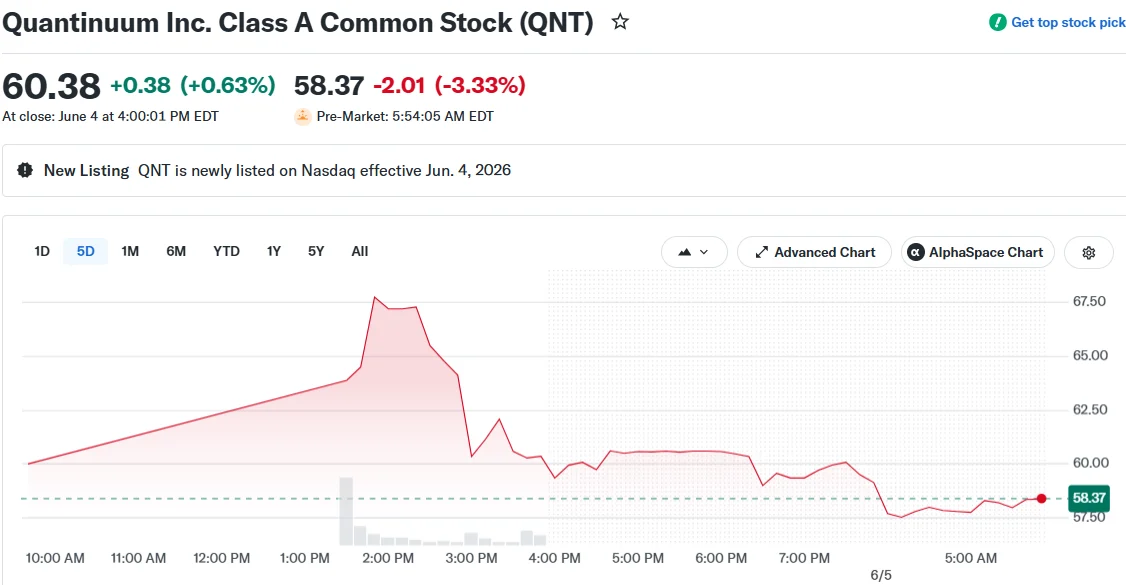
Quantinuum Inc. Class A Common Stock (QNT)

The firm set its offering price at $60 for each share, distributing 28 million shares to investors. This pricing exceeded the initial guidance range of $53 to $55 per share.

Shares launched at $68, marking a 13.3% surge above the offering price. When trading concluded on debut day, Quantinuum’s total valuation reached $17.63bn.

J.P. Morgan and Morgan Stanley served as primary bookrunners for the offering, with support from Jefferies, Evercore ISI, and additional underwriters.

The underwriting syndicate received a 30-day greenshoe option allowing them to acquire an extra 4.2 million shares at the IPO price to satisfy excess demand.

Quantinuum’s Position Relative to IonQ

The public offering arrives during a period of heightened investor interest in quantum computing technologies. IonQ (IONQ) has climbed roughly 52% in 2025, pushing its valuation to approximately $25.47bn—significantly higher than Quantinuum’s opening valuation.

Advertisement

Quantinuum positions itself as an integrated quantum computing provider, delivering a comprehensive platform designed for practical quantum applications. The company’s technology relies on QCCD architecture and reportedly achieved the industry’s highest average two-qubit gate fidelity as of December 31, 2025.

The firm serves clients across pharmaceutical development, materials research, financial services, and government applications. Headquartered in Broomfield, Colorado, Quantinuum maintains operations across the United States, United Kingdom, Germany, Japan, Qatar, and Singapore.

The company emerged in late 2021 from the combination of Honeywell Quantum Solutions and Cambridge Quantum.

Strategic Partnerships and Government Funding Initiatives

In September 2025, Honeywell secured approximately $600m in financing for Quantinuum at a $10bn pre-money valuation. These proceeds were designated for large-scale quantum system development and the rollout of the Helios next-generation platform, which became operational in November 2025.

Advertisement

Immediately before going public, Quantinuum disclosed a non-binding memorandum of understanding with Mitsubishi Electric. The partnership aims to investigate quantum computing applications in industrial engineering and design workflows, with initial efforts concentrating on computer-aided engineering and simulation technologies.

In May 2025, Quantinuum also entered into a letter of intent with the CHIPS R&D Office at the US Department of Commerce. This agreement outlines prospective federal support for developing fault-tolerant trapped-ion quantum computing systems.

The initiative includes partnerships with component suppliers such as GlobalFoundries and Monarch Quantum to manufacture specialized semiconductor and photonic elements.

The offering officially completed on June 5, 2026, as scheduled.

Advertisement

Source link

Continue Reading
Click to comment

You must be logged in to post a comment Login

Leave a Reply

Crypto World

Man Who Stole $11M From Charles Schwab Just Escaped Prison, Ripple Ex-CTO Reacts

Published

on

Man Who Stole $11M From Charles Schwab Just Escaped Prison, Ripple Ex-CTO Reacts

Arthur Cofield, a 34-year-old Atlanta man already serving time for prior convictions, stole $11 million from a Charles Schwab brokerage account using a contraband cellphone, then escaped from a Georgia federal prison on May 26.

The case drew a wry response from David Schwartz, former Chief Technology Officer at Ripple, who wrote on X that he could not determine whether to be more shocked or impressed.

A Contraband Phone, a Stolen Identity, and 6,000 Gold Coins

Cofield was already incarcerated when federal prosecutors filed new charges against him in December 2020. He was serving time for armed robbery in Butts County, Georgia, and faced an attempted murder charge in Fulton County.

Cofield used a smuggled phone to steal the identity of a Schwab client, identified in court documents only as “S.K.” A co-conspirator supplied S.K.’s driver’s license and a utility bill. Cofield used those documents to impersonate the victim and open a checking account in their name.

Charles Schwab then wired $11 million from the victim’s account to an Idaho precious metals dealer. The funds purchased 6,106 American Gold Eagle coins. A private security firm transported the coins from Idaho to Atlanta, where they were converted into a $4 million mansion near West Paces Ferry.

He was sentenced in 2024 to more than 11 years for identity theft and conspiracy to commit wire fraud, mail fraud, and bank fraud. The court ordered him to pay restitution to the victim.

FBI Issues $10,000 Reward as Manhunt Continues

On the afternoon of May 26, authorities at the Federal Correctional Institution in Jesup found Cofield missing from the minimum-security camp. The FBI has since announced a reward of up to $10,000 for information leading to his capture. He is classified as armed and dangerous.

Advertisement
Law Enforcement Assistance, Source: FBI.GOV

The story spread quickly in crypto circles. Charles Schwab is competing for crypto market share against digital-native brokers, and a fraud of this scale at the firm draws attention from the industry. The firm’s crypto custody expansion plans through 2027 have raised its profile further.

Whether Cofield is recaptured in the coming days, the scheme raises a persistent question for federal authorities. A cellphone and a stolen identity, it turns out, can go a long way.

The post Man Who Stole $11M From Charles Schwab Just Escaped Prison, Ripple Ex-CTO Reacts appeared first on BeInCrypto.

Source link

Advertisement
Continue Reading

Crypto World

JPMorgan, HSBC join Hong Kong tokenized bond working group

Published

on

JPMorgan, HSBC join Hong Kong tokenized bond working group

Hong Kong has established a tokenized bond expert group that brings together major financial institutions after issuing more than HK$6.8 billion ($868 million) in tokenized government bonds across multiple offerings.

Summary

  • Hong Kong’s monetary authority has formed a tokenized bond expert group that includes JPMorgan, HSBC, Standard Chartered, UBS, Ant Digital, and HashKey Group.
  • The group will examine regulatory frameworks, market practices, and infrastructure needed to support wider use of tokenized bonds.

According to a statement released Friday by the Hong Kong Monetary Authority (HKMA), the newly formed group includes participants from JPMorgan Securities, HSBC, Standard Chartered Bank, UBS, Ant Digital, HashKey Group, and several other industry organizations. 

The HKMA said the group will study policy measures, market practices, and emerging innovations that could support wider use of tokenized bonds in the financial system.

Advertisement

Formed after its first meeting in May, the group has already begun discussions on how Hong Kong’s existing legal and regulatory framework applies to the issuance and trading of tokenized bonds, according to the HKMA.

The latest move adds to Hong Kong’s multi-year effort to bring traditional capital market instruments onto blockchain-based infrastructure. Earlier projects included a partnership with the Bank for International Settlements in 2021 to explore bond tokenization and a series of government-backed digital bond issuances that followed.

Hong Kong builds on previous tokenized bond issuances

Government-backed issuance activity has played a central role in the city’s tokenization strategy.

Advertisement

In February 2023, the Hong Kong government issued HK$800 million ($102 million) of tokenized green bonds. A year later, authorities completed a HK$6 billion ($766 million) multi-currency digital green bond sale denominated in Hong Kong dollars, Chinese yuan, U.S. dollars, and euros.

According to the HKMA, the 2024 issuance also became the first digital bond offering to incorporate both the e-CNY and e-HKD. Hong Kong authorities previously described that transaction as the largest digital bond issuance completed at the time.

Industry participants involved in the new expert group view legal certainty and infrastructure development as necessary components for expanding adoption.

“Scaling up the commercial adoption of tokenized bonds is not merely a matter of technology implementation, but a systematic undertaking that requires the coordination of legal and regulatory frameworks, underlying infrastructure and the broader industry ecosystem,” Xiao Feng, chairman and CEO of HashKey Group, said in a statement to crypto media.

Advertisement

Global institutions advance tokenization projects

Outside Hong Kong, financial institutions and market infrastructure providers have continued to test blockchain-based versions of traditional financial products.

In the United States, the Depository Trust & Clearing Corporation has launched a limited pilot program that places representations of U.S. Treasury securities held by its depository subsidiary on blockchain networks.

Elsewhere in Asia, Ripple has partnered with Kyobo Life Insurance in South Korea to support tokenized government bond transactions. Japan Securities Clearing Corporation also began a trial in April alongside Mizuho, Nomura, and Digital Asset to test blockchain-based collateral arrangements backed by Japanese government bonds.

Participation from JPMorgan in Hong Kong’s expert group comes as large banks pursue tokenization initiatives in other markets as well. Earlier this month, The Wall Street Journal reported that the Clearing House, whose owners include JPMorgan Chase, Bank of America, Citigroup, and Wells Fargo, is developing a tokenized deposit network expected to launch in the first half of 2027.

Advertisement

According to the Journal, the planned U.S. system would allow tokenized bank deposits to move continuously across blockchain-connected payment infrastructure while remaining within the regulated banking sector.

Source link

Advertisement
Continue Reading

Crypto World

Helium CEO Amir Haleem quits after HNT tanks 96%

Published

on

Helium CEO Amir Haleem quits after HNT tanks 96%

Helium’s HNT token is down 96%, and CEO Amir Haleem decided to quit yesterday. He spent over a decade talking about the reasons someone should be bullish about HNT.

Checking the chart, they would have been better off never listening to him.

Helium issued three crypto tokens, MOBILE, IOT, and HNT, to incentivize operators of its once-faddish networking devices. Over the past five years, those three tokens have declined 76%, 87%, and 96%, respectively.

Haleem announced his resignation by quote-tweeting a video by his replacement, Mario Di Dio. He’s stepping aside as chief executive of Nova Labs, the company behind Helium. 

Advertisement

On X, some users framed his step-down to chairman as well-deserved break after a successful career. However, the price chart of his token tells an entirely different story.

Somehow, things got even worse as his reign ended, with HNT falling another 15% on the day of his goodbye.

Get out, get out, get out

The timing of the CEO changeover certainly raises eyebrows.

Two days before quitting, Haleem’s company offloaded its consumer business on June 2, 2026. Helium Mobile, the budget cellphone service that gave the project a sliver of legitimacy, went to Noble Mobile. 

Advertisement

HNT failed to rally on the news, remaining down 30% over the past week and down 46% over the past month.

So, the sequence reads cleanly. After offloading the consumer business with no relief rally to speak of in HNT, the CEO resigned two days later.

As he left, he made sure to assure everyone that he still holds HNT.

He also left behind a project that spent years collecting controversies.

Advertisement

Helium raised nearly $365 million over its lifetime, with FTX as one of its backers. In 2022, the company was caught advertising Lime, Salesforce, and Nestlé as network users, even though none of them were. A Forbes investigation later found that insiders had mined close to half of all HNT in its first months.

Read more: SEC wants to settle with Ripple, drops Helium case

Gary Gensler’s SEC tried to stop Helium, Paul Atkins’ SEC settled

The Gary Gensler-led SEC eventually noticed. It sued Nova Labs in January 2025 over “materially false and misleading statements” about Lime, Nestlé, and Salesforce supposedly relying on the network, among other complaints.

After Gensler resigned and Donald Trump’s replacement, Paul Atkins, took over the SEC, that case settled abruptly by April 2025. 

Advertisement

Nova Labs paid a mere $200,000 civil penalty over one misrepresentation charge. The SEC dismissed the rest of its complaint with prejudice under Atkins’ staggeringly crypto-accommodative “leadership.”

Haleem treated the outcome as exoneration. He called it what “might well be the shortest-lived SEC litigation on record” and the original suit “a bizarre last-minute politically-motivated move.”

He thanked the agency’s new commissioners for “restoring sanity to the commission.”

Haleem’s colorful background helps explain his tone. He lists himself as someone who likes to “build and race 90s Japanese sports cars” and launched a professional racing team during Helium’s worst-performing years.

Advertisement

Got a tip? Send us an email securely via Protos Leaks. For more informed news and investigations, follow us on XBluesky, and Google News, or subscribe to our YouTube channel.

Source link

Advertisement
Continue Reading

Crypto World

Critical Zcash Vulnerability Revealed by Founder: Key Details and ZEC Outlook (Expert Take)

Published

on

Zcash’s native cryptocurrency, ZEC, crashed by roughly 45% today, as the market reacted to a notable disclosure from the protocol’s founder, Zooko Wilcox, and other key ecosystem figures.

The post explained that researchers had recently found and patched a critical vulnerability associated with Zcash’s Orchard shielded pool – one that could have allowed an attacker to create unlimited counterfeit ZEC without being detected.

This brought to light one of the most serious kinds of bugs a cryptocurrency could face: one that threatens the integrity of the coin’s supply.

It’s worth noting that the authors said they believe previous exploitation was unlikely; however, they also acknowledged that because of the protocol’s privacy features, there is no cryptographic way to prove today whether or not the bug itself was exploited before it was patched.

Advertisement

What Happened to ZEC on June 5th, 2026?

As seen in the chart below, ZEC experienced a massive crash on June 5th, 2026, losing more than 45% of its value and plummeting from above $600 to around $300 in a matter of hours. The sudden move followed a disclosure from the protocol’s founder, bringing to light a massive vulnerability that may have allowed attackers to mint counterfeit tokens.

Let’s dive a bit deeper.

Screenshot 2026-06-05 at 11.02.22
Source: CoinGecko

According to Zooko’s post on Twitter, security researcher Taylor Hornby discovered the vulnerability on May 29th, 2026, while reviewing the protocol’s Orchard circuit. To those unaware, Orchard is one of Zcash’s shielded pools – the part of the protocol that makes private transactions possible.

Hornby had been hired by Shielded Labs back in April 2026 to conduct ongoing security research on the protocol. His job was to look for hidden flaws before malicious hackers could find it.

The discovery came relatively short after Antrophic released its Opus 4.8 AI model on May 28th. In fact, Hornby used this same model as part of a targeted audit of the Orchard circuit. He combined AI-assisted review with traditional security research, and one day later he found the bug and disclosed it to the Zcash Open Development Lab, or ZODL for short.

Advertisement

ZODL then coordinated an emergency response throughout the entire Zcash ecosystem, completing the fix by June 2nd, and thereby closing the window of risk. But that’s not the end of the story, because the bug could have caused damage before it was fixed. Allow me to explain.

Why This Bug Was So Serious

Put in simple terms, the vulnerability could have allowed for someone to create fake ZEC inside Orchard.

Cryptocurrencies usually rely on very strict rules to prevent counterfeiting. A blockchain must absolutely know, at all times, that coins being spent really exist and that no one is secretly creating more than allowed. Zcash has a maximum supply of 21 million ZEC, similar to Bitcoin’s fixed-supply model. If someone is able to create unlimited fake ZEC, that would undermine one of the most basic and fundamental promises of the system itself.

The vulnerability was caused by what the authors described as an “under-constrained” element in the Orchard circuit. Now, a circuit is a mathematical system used to verify that a private Zcash transaction follows the rules without revealing sensitive details. These are the details about the sender, the receiver, and the amount.

Advertisement

“Under-constrained” here means that the circuit did not fully check something it was supposed to be checking. In this case, the flaw enabled the insertion of false inputs into a core cryptographic operation, elliptic curve multiplication, while still making the proof appear valid.

The researcher reportedly built a complete exploit and tested it in a local environment. During that test, the exploit generated virtually unlimited undetectable counterfeit ZEC. The authors admitted that if the same tool had been used on mainnet before the fix, it would have generated counterfeit ZEC directly in the real Zcash wallet.

The Tradeoff for Privacy

The crucial part of this disclosure is not only that the bug existed, but that Zcash’s privacy design makes it impossible to prove whether it was ever exploited before the fix. And it has been here for a while. To be precise – since Orchard was activated in May 2022. So that’s over 4 full years it could have been exploited.

Zcash’s protocol is designed so that shielded transactions do not reveal public details about who sent the funds, who received them, or how much was transferred. That privacy is the whole point of the system. At the same time, though, it makes forensic analysis that much harder.

Advertisement

On a traditional public and transparent blockchain, investigators are able to trace abnormal coin creation or suspicious transaction patterns. In Orchard, the relevant information, which could essentially point to any potential damages, is hidden by design. As a result, the authors concluded that there is no definitive cryptographic way of determining whether counterfeited coins were created before the vulnerability was patched.

It’s important to note that this doesn’t mean that counterfeiting happened – it just means there’s no way to prove it doesn’t.

Authors Think Exploitation Was Unlikely: Here’s Why

Despite the serious nature of the vulnerability, the authors argue that prior exploitation was probably unlikely.

The first reason they outline is that the vulnerability had gone unnoticed for years, despite Zcash’s protocol being reviewed by experienced security engineers and cryptographers. Orchard was activated back in May 2022, as we mentioned above, which means that the bug was there for four years without it being discoverd (or at least not that we know of such discovery).

Advertisement

The second reason is that Hornby was onboarded to specifically search for deep protocol vulnerabilities, and this discovery was not accidental. It was the result of focused security effort using advanced tools and expert judgment.

They also argued that the vulnerability was patched within just a few days after discovery. That said, the authors were very careful in asking the users not to simply trust their judgment, proposing a more formal way of restoring trust.

What’s Next?

First things first, Shielded Labs is working with other Zcash devs on a possible network upgrade that would allow users to reliably verify the integrity of the ZEC supply.

This idea involves creating a new shielded pool and using “turnstile accounting” for coins leaving Orchard. Put simply, this would create a migration path that’s more controlled. Coins could move from the old pool to the new one under rules that are designed to make sure that more ZEC cannot come out than it legitimately went in.

Advertisement

Naturally, this kind of network upgrade wouldn’t take place automatically – it would need community support through the normal government process.

In regards to ZEC’s price action, which is probably one of the things that many users are mostly concerned with, CryptoPotato reached out to leading analytics firm Nansen for an opinion. Commenting on the matter was Nicolai Sondergaard, Research Analyst, who said:

“What markets are reacting to is the part that cannot be fully resolved by the patch. Due to the privacy design of Orchard, there is no cryptographic way to audit whether someone exploited this before the fix. The Zcash team has said exploitation is unlikely, for reasonable reasons, but they have been explicit that they cannot prove it. That is a genuine supply integrity problem. A network upgrade is being proposed that would migrate coins to a new shielded pool with turnstile accounting, allowing independent verification. Until that is live and audited, the honest answer is that current ZEC supply cannot be certified clean.

The price reaction reflects that uncertainty more than the bug itself. A patched vulnerability in a minor privacy coin would ordinarily be a footnote. The -30% move is the market assigning non-trivial probability to the scenario where some counterfeiting did occur and is permanently undetectable without the proposed upgrade.”

Opus 4.8 and Its Role in Discovering this Zcash Vulnerability

One of the most impressive parts of this story is the role of AI-assisted security research.

Advertisement

Taylor Hornby used Anthropic’s Opus 4.8 model as part of the review that led to the discovery.

This doesn’t mean that AI “found the bug on its own.” The disclosure makes it clear that the process involved a very experienced professional, a targeted review, custom tooling, and expert analysis. However, it also shows that AI systems may increasingly become part of high-stakes security work, especially in complex cryptographic systems, where even the smallest mistakes can have disproportionately large consequences.

Shielded Labs said it’s now accelerating this kind of proactive research.

The post Critical Zcash Vulnerability Revealed by Founder: Key Details and ZEC Outlook (Expert Take) appeared first on CryptoPotato.

Advertisement

Source link

Continue Reading

Crypto World

Recent Ripple (XRP) Developments, Bitcoin (BTC) Price Forecasts, and More: Bits Recap June 5

Published

on

Ripple’s cross-border token is down 14% for the week, but the company continues to score major wins in global expansion and important partnerships.

Bitcoin (BTC) has also plunged substantially, with numerous popular analysts expecting further declines, while Cardano (ADA) collapsed to its lowest level since 2020.

XRP Price Crash

Several days ago, Ripple teamed up with the Turkish crypto platforms BiLira, Bitexen, and Bitlo to boost adoption and usage of RLUSD. Later on, Mastercard expanded its infrastructure to enable merchants and partners to settle transactions in multiple cryptocurrencies, including the USD-pegged stablecoin.

In addition, Ripple strengthened its presence in the United States by opening an expanded office in Washington, D.C., while the spot XRP ETFs remained predominantly positive.

Advertisement

Despite the favorable news, XRP tumbled by 14% over the past week and currently trades at around $1.13 (per CoinGecko). Its poor condition mirrors the collapse of the broader crypto market, where Bitcoin (BTC) slipped to around $61,000 and altcoins like Zcash (ZEC) and Bitcoin Cash (BCH) nosedived by nearly 30%.

Another worrying factor is the recent whale activity. As CryptoPotato reported, this cohort of investors has sold or redistributed 50 million coins in the span of seven days, further spreading panic that could prompt smaller players to cash out as well.

BTC’s Heavy Bleeding

The primary cryptocurrency has lost over $20,000 in the past month alone and recently dropped to approximately $61,000, its lowest mark since February. As of press time, it trades at around $62,800, representing a 15% decline on a weekly scale.

Unsurprisingly, the downward move has resulted in a wave of bearish predictions. Ali Martinez recently opined that the plunge below $72,000 has put BTC in “a vulnerable position,” with the MVRV Pricing Bands suggesting the next major support lies between $50,000 and $54,000.

Advertisement

For his part, Ted labeled $49,000 “a good bottom zone,” comparing the scenario to the August 2024 low. Of course, the well-known crypto critic Peter Schiff was also vocal, envisioning a $20,000 catastrophe if BTC breaks $50,000.

“It should be a quick fall below $20K, which should be a big enough drop to shake the conviction of long-term HODLers, causing many to finally throw in the towel,” he added.

ADA’s Meltdown

Cardano’s native cryptocurrency is among the most heavily affected coins from the market crash. It fell to $0.15 (the lowest point since the end of 2020) before slightly rebounding to around $0.165.

One of the main factors in ADA’s collapse was Charles Hoskinson’s recent announcement. Cardano’s founder said he’s “taking a break,” while also warning about an upcoming “wave of failures in the ecosystem.”

The only positive recent development related to ADA is Cardano’s partnership with the Brazilian Olympic Committee (COB). However, it wasn’t enough to stop the asset’s free fall.

Advertisement

The post Recent Ripple (XRP) Developments, Bitcoin (BTC) Price Forecasts, and More: Bits Recap June 5 appeared first on CryptoPotato.

Source link

Continue Reading

Crypto World

Where investors may find the next ‘big wave’ for AI trade

Published

on

Where to find innovation in the ETF industry; Anthropic confidentially files for IPO

The next massive gains in artificial intelligence may come from thousands of miles away.

Tim Urbanowicz, chief investment strategist at Innovator from Goldman Sachs Asset Management, is urging investors to look beyond their backyards to the emerging markets.

“[It’s] where a lot of the big money can be made on the AI trade,” he told CNBC’s “ETF Edge” this week – calling it “the next big wave.”

Urbanowicz is particularly bullish on Taiwan and South Korea when it comes to the AI build-out. He notes they are a big part of the broad iShares MSCI Emerging Markets ETF, which is up 26% as of Thursday’s close.

Advertisement

“These are major players in the AI trade and the AI space where valuations really haven’t gone up as much as they have in the U.S.” he said. “There’s still a lot of runway in our view to provide outsized gains with this AI trade.”

The iShares MSCI Taiwan ETF is up almost 67% so far this year while the iShares MSCI South Korea ETF market has risen 109%, as of Thursday’s U.S. close. Both Taiwan- and South Korea-focused ETFs hold several AI memory-related chip names.

In a special note to CNBC, Urbanowicz highlighted the actively managed Goldman Sachs ActiveBeta Emerging Markets Equity ETF as a way for investors to gain exposure to potential AI-driven gains in emerging markets.

Stock Chart IconStock chart icon
Advertisement
hide content

Getting exposure to AI abroad

Yet, Urbanowicz isn’t abandoning the domestic trade when it comes to AI.

“We think the U.S. is still positioned for success,” he said.

Choose CNBC as your preferred source on Google and never miss a moment from the most trusted name in business news.

Source link

Advertisement
Continue Reading

Crypto World

BTC sentiment hit peak bearishness at recent price lows, peak bullishness near tops: Crypto Daily

Published

on

(Santiment)

In recent weeks, bitcoin sentiment has been most bullish when the price was highest and most bearish exactly when it was most stressed, according to Santiment data covering May 21 through June 4.

Peak bullishness hit on May 22, with bitcoin near its high of $78,000 for the period. The most bearish came June 3, with bitcoin near the low. While sentiment is not a timing tool, peak conviction at the highs and peak fear at the lows is the inverse of where the trade usually pays.

(Santiment)

Bitcoin was recently trading near $62,400, down about 20% from the late-May peak. The risk picture has cracked alongside it.

The investments into artificial intelligence (AI) companies that pulled global equities to record highs this year has stalled after Broadcom’s chip forecast fell short of expectations. South Korea’s KOSPI index fell 4.7%, and the won and Indonesia’s rupiah are at multiyear lows as capital flees emerging Asia.

U.S. spot bitcoin ETFs ended a 13-day, $4.4 billion outflow streak on Thursday with a tiny $3.05 million inflow. Spot ether ETFs ended their parallel 17-session streak with $19.30 million on the same day. Both numbers are too small relative to the streaks they ended to call it a regime change.

Advertisement

Friday’s U.S. nonfarm payrolls report at 8:30 a.m. ET is the binary catalyst. A soft print revives Federal Reserve interest-rate cut expectations under new Chair Kevin Warsh and likely takes risk assets back up, while a hot print may extend the unwind.

And keep an eye on how bitcoin behaves at the $60,000 round number if it gets tested before the data lands. Stay alert!

Read more: For analysis of today’s activity in altcoins and derivatives, see Crypto Markets Today . For a comprehensive list of events this week, see CoinDesk’s “Crypto Week Ahead.”

What’s trending

Today’s signal

Chart of total market cap (excluding 10 largest cryptocurrencies) to bitcoin's market cap.

The chart shows weekly changes in bitcoin’s market capitalization relative to an index of altcoins that excludes the 10 largest tokens.

Bitcoin has underperformed for several weeks as the altcoin measure became stronger, and the ratio recently tested a resistance level that has persisted for over a year.

Advertisement

If declines in zcash, hyperliquid and near continue, the chances are that it will drop further back.

Source link

Continue Reading

Crypto World

One Record Funding Spike Sent XRP Price Tumbling, but Dip Buying Surged 610%

Published

on

Falling Channel Pattern

The XRP price fell to around $1.12, down close to 4% on the day, after derivatives funding spiked to its highest level in over a year and then unwound into a sharp 18% slide from late May.

The setup pairs a record long-positioning signal with a falling price channel, while a surge in steady spot buying complicates a purely bearish read. Each layer feeds the next.

Price Channel Weakens as Sell Volume Builds

The XRP price has traded inside a falling channel since February 15, a pattern where price drifts lower between two parallel down-sloping lines. It now sits near the lower line, the first sign of structural strain.

Want more token insights like this? Sign up for Editor Harsh Notariya’s Daily Crypto Newsletter here.

Advertisement

Sell-side volume has risen steadily since May 31, adding force to the move toward that lower boundary. Rising volume into a channel edge often precedes a test of whether the pattern holds.

Falling Channel Pattern
XRP Price Falling Channel: TradingView

That mix frames the bull and bear split early. A bounce off the lower line would keep the channel intact and favor the bulls. A clean break lower would open the bearish path. What turned the screw, however, was not the chart alone. It was a record in the derivatives market.

Record Funding Rate Signals a Crowded Long Trade

XRP’s funding rate, a recurring fee that longs pay shorts when bullish bets dominate, surged to about 0.0456 on June 1. That marks its highest reading in more than a year. The very next day deeper corrections across the crypto market started.

The spike points to heavy long positioning piled into one side of the trade. Set against the calmer readings through April and May, the jump shows a sudden crowd of leveraged buyers.

XRP Funding Rate Record
XRP Funding Rate Record: CryptoQuant

Crowded longs raise the risk of a cascade. When price slips, those positions face liquidation, and forced selling can feed on itself in a long flush.

That derivatives stress explains the speed of the drop. Yet it also hints the crash may be leveraged-driven rather than a broad exit, which the next signal supports.

Advertisement

Spot Buyers Step In Even as XRP Price Falls

Here the story turns against a fully bearish read. XRP’s exchange net position change, a metric tracking coins moving onto or off exchanges, has stayed negative since May 16, meaning more coins are leaving exchanges than arriving.

Coins leaving exchanges usually signals accumulation rather than intent to sell. Since May 30, the XRP price has corrected about 18%, falling from $1.34 toward current levels.

Over that same window, net outflows deepened from roughly negative $456 million to about negative $3.24 billion, a rise of close to 610%. That is a steep jump in buying pressure against a falling price.

XRP Exchange Net Position Change
XRP Exchange Net Position Change: Glassnode

The chart’s rising sell volume and the deepening exchange outflows seem to clash, but they are not measuring the same thing. The sell volume comes from a single venue on the price chart, a one-exchange read of activity. The exchange net position change, by contrast, tracks cumulative daily rolling flows across all exchanges, and it shows coins still leaving rather than arriving.

A burst of selling on one venue can sit alongside net accumulation everywhere else. Set against the record funding spike, that points to leveraged positioning as the more likely driver of the drop than a broad spot exit.

Advertisement

This tension sets up the price levels that now decide the direction.

XRP Price Levels That Decide the Next Move

The XRP price now trades near $1.12, and the levels drawn from the May 14 swing high and May 30 swing low frame both cases.

On the bear side, $1.11 is the pivot. A daily close below it would break the falling channel, and the channel projects a possible move of roughly 26% toward the $0.89 to $0.82 zone if selling holds. Below $1.11, the next support sits near $1.07.

On the bull side, a reclaim of $1.13 and then $1.18 would weaken the breakdown case. With funding already turning negative as the spike unwinds, continued spot buying could pressure late shorts, and a push above $1.18 could spark a short squeeze.

Advertisement
XRP Price Analysis
XRP Price Analysis: TradingView

The risk to watch is repeated bottom-fishing. Traders adding fresh longs into a weak tape may still face liquidation until a clear bottom signal appears. For now, $1.11 separates a channel hold from a deeper bearish leg, while $1.18 is the line bulls must reclaim to flip momentum.

The post One Record Funding Spike Sent XRP Price Tumbling, but Dip Buying Surged 610% appeared first on BeInCrypto.

Source link

Continue Reading

Crypto World

Forward Industries Sends $32M in Solana to Coinbase as Treasury Losses Top $1B

Published

on

Forward Industries Sends $32M in Solana to Coinbase as Treasury Losses Top $1B

Forward Industries transferred roughly $31.9 million worth of Solana tokens to Coinbase Prime Thursday, according to blockchain data, marking its first onchain activity in a month.

Data from Arkham Intelligence shows a wallet tied to the Nasdaq-listed company moved 455,784 SOL to the institutional trading platform. The transfer comes as the firm sits on steep unrealized losses tied to its large-scale bet on the token.

The deposit to Coinbase Prime does not necessarily confirm an immediate sale but is commonly interpreted as a precursor to trading activity, particularly for institutional holders seeking liquidity or risk reduction.

Shares of Forward Industries were down about 6% in the pre-market on Friday following the transfer, trading at $3.97, down from Thursday’s close of $4.22, according to Yahoo Finance data.

Advertisement

Forward Industries moves 455,784 SOL to Coinbase Prime. Source: Arkham

The move comes as publicly listed companies that adopted crypto treasury strategies face mounting pressure from the sector’s prolonged downturn, with several firms sitting on significant unrealized losses and investors increasingly focused on balance sheet risk.

Forward Industries began accumulating Solana in September 2025 as part of a treasury strategy that positioned it as the largest corporate holder of the asset, according to a December shareholder update.

Related: Solana open interest drops 30% as altcoins slump: Is $68 SOL next?

The company said it had purchased about 6.83 million SOL for approximately $1.59 billion at an average cost of $232.08 per token.

Advertisement

The SOL price has since fallen by roughly 72%, according to CoinGecko data, trading at around $64.63 at the time of writing. That would value the company’s original holdings at about $441 million, implying an unrealized loss of roughly $1.15 billion.

Solana price has slumped 72% since September 2025. Source: Coingecko

Forward Industries remains the largest publicly listed Solana holder with more than 7 million SOL, according to the most recent data available.

Corporate crypto treasuries face mounting pressure

The move comes amid broader signs of strain across corporate crypto treasury strategies. On Thursday, publicly listed digital asset firm FG Nexus reportedly sold an additional $17.8 million in Ether, adding to a series of disposals across the sector.

Strategy, the largest corporate Bitcoin holder, is also facing mounting pressure after Bitcoin’s recent decline pushed the unrealized loss on its holdings to about $11.2 billion.

Advertisement

The company disclosed this week that it sold 32 BTC for roughly $2.5 million, its first Bitcoin sale since December 2022, when it sold 704 BTC as part of a tax-loss harvesting transaction before repurchasing more Bitcoin days later.

Market Moves: Why is Ethereum Foundation selling? BTC futures warning signs

Source link

Advertisement
Continue Reading

Crypto World

BNB price tests critical support as bearish market and technicals point to more downside

Published

on

BNB price has broken below an ascending channel pattern and is now testing a major support level on the daily chart.

BNB price has fallen sharply from its recent highs and has now retested a major support zone as heavy liquidations, deteriorating market sentiment, and weakening technical indicators weigh on the token.

Summary

  • BNB price has dropped 20% from its recent high and is testing key support near $570.
  • A bearish channel breakdown and weakening momentum indicators suggest further downside risk.
  • Major liquidation clusters near $620 and $680 could limit any short-term recovery.

According to data from crypto.news, BNB (BNB) was trading near $592 on June 5 after briefly hitting a year-to-date low of $573 earlier in the session. So far, the token has fallen roughly 20% from its recent peak above $740, erasing much of the rally that followed enthusiasm surrounding VanEck’s spot BNB ETF launch and renewed activity across the BNB Chain ecosystem.

Profit-taking accelerated after BNB entered deeply overbought territory near the cycle highs. The pullback quickly spread across derivatives markets as leveraged long positions were unwound. CoinGlass data showed more than $1 billion in crypto futures liquidations over a 24-hour period, adding fresh selling pressure across major digital assets.

Advertisement

At the same time, risk appetite deteriorated across the broader market. U.S. spot Bitcoin ETFs extended a record 13-session outflow streak, with roughly $4.4 billion leaving the products during the period.

The withdrawal of institutional capital from Bitcoin coincided with a sharp decline in total crypto market capitalization, limiting demand for higher-beta assets such as BNB.

Binance-specific developments also arrived during the selloff. The exchange confirmed it would discontinue support for selected stock-token products on June 5 as part of a platform restructuring effort.

Advertisement

Although the changes do not directly affect BNB Chain operations, the announcement came as traders were already reducing exposure amid heightened regulatory uncertainty and worsening market conditions.

Macro conditions have offered little support. Persistent inflation data, including an ISM Manufacturing Prices Paid reading above 80, has reinforced expectations that the Federal Reserve will maintain higher interest rates for longer. The prospect of delayed rate cuts has pressured speculative assets throughout the week.

Technical breakdown places $570 support in focus

On the daily chart, BNB price has broken below an ascending parallel channel that had guided price action higher since April. Sellers also forced a move beneath the channel’s lower trendline near $640, turning a previously bullish structure into a bearish breakdown.

BNB price has broken below an ascending channel pattern and is now testing a major support level on the daily chart.
BNB price has broken below an ascending channel pattern and is now testing a major support level on the daily chart — June 5 | Source: crypto.news

For now, a key support zone for BNB sits near $570, an area that has repeatedly attracted buyers since February. Thursday’s decline briefly tested that level before a modest rebound emerged. A decisive break below $570 could expose the February lows near $550 and potentially open the door toward the psychological $500 region.

Momentum indicators have weakened considerably during the decline. The MACD has completed a bearish crossover while the histogram continues printing expanding red bars below the zero line. Meanwhile, the Relative Strength Index has fallen to around 36, its lowest reading in several months, showing sellers retain control despite increasingly oversold conditions.

Advertisement

Commenting on the setup, market commentator BATMAN argued that BNB may be repeating a previous market structure that preceded a major selloff earlier this year.

“A fakeout above resistance, rejection at the 200EMA, and a MACD bearish cross point to downside pressure.”

Liquidation clusters highlight key recovery hurdles

Derivatives positioning suggests that any rebound may encounter significant resistance overhead. CoinGlass liquidation heatmaps show one of the largest short-term liquidity clusters sitting near the $620 area, while a larger concentration of leveraged positions remains between $680 and $700.

BNB liquidation heatmap.
BNB liquidation heatmap | Source: CoinGlass

Those levels align closely with the former channel support and recent breakdown zone, making them important areas to watch if buyers attempt a recovery.

Until then, the path of least resistance remains lower. BNB would likely need to reclaim the $620 region and close back inside the broken channel before traders begin discussing a return toward $680 and the recent highs above $740.

For now, the $570 support zone remains the most important level on the chart as traders assess whether the latest selloff represents a temporary capitulation event or the beginning of a deeper correction.

Advertisement

Disclosure: This article does not represent investment advice. The content and materials featured on this page are for educational purposes only.

Advertisement

Source link

Continue Reading

Trending

Copyright © 2025