

Crypto World
Cardano CEO Urges Calm as ADA Crashes to 2020 Lows

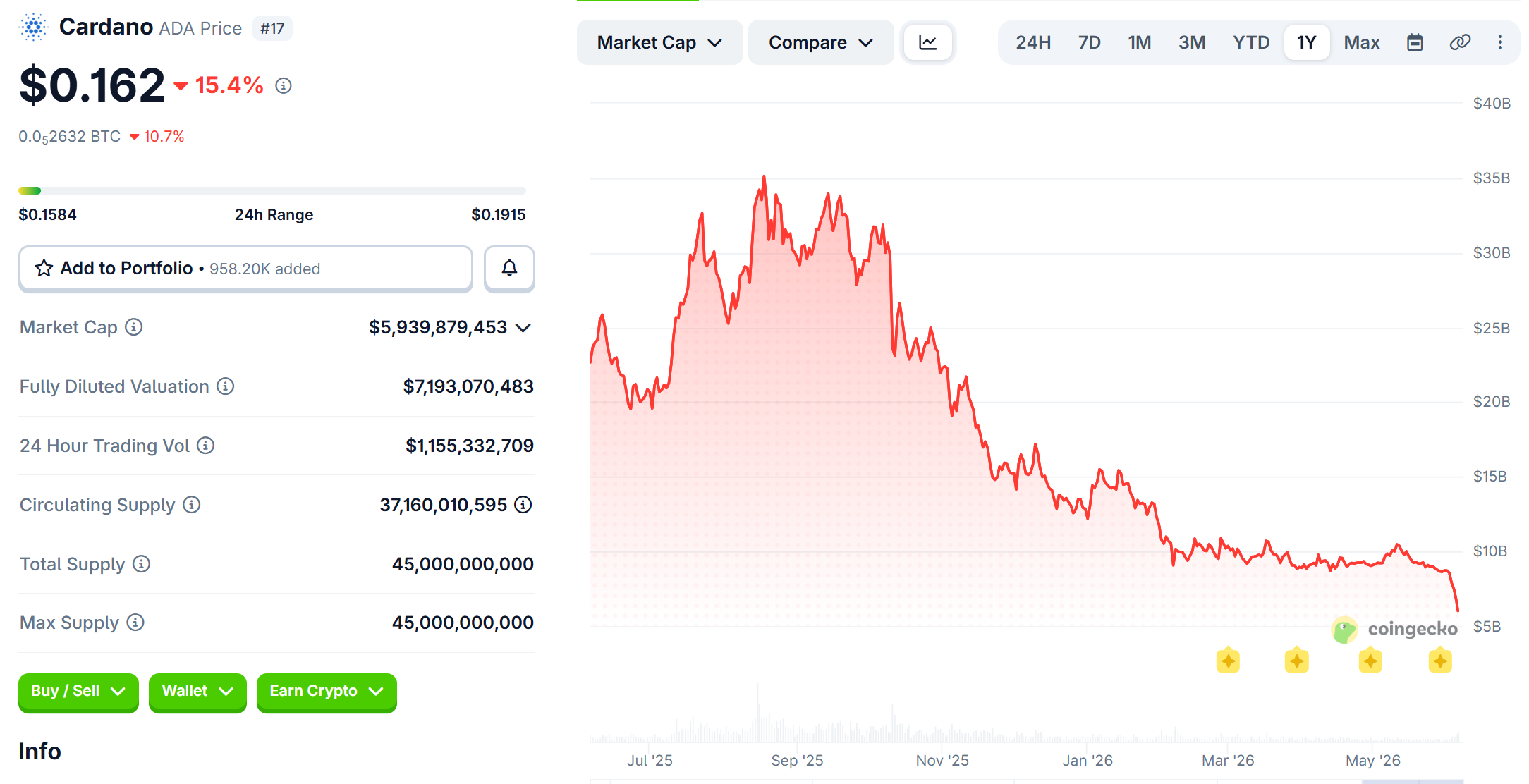
Cardano (ADA) fell about 15% in 24 hours to near $0.16 on Friday, its lowest level since late 2020, extending a selloff that has erased roughly 30% of its value in a week.
The drop left ADA ranked 17th by market value, with its market capitalization slipping below $6 billion. Cardano Foundation CEO Frederik Gregaard urged investors to look past short-term price action, but can they?

ADA Price Slide Deepens as Crypto Market Sells Off
The token exchanged hands near $0.16, down about 15% on the day and roughly 30% over the past week.
That marked its weakest level since late 2020 and left ADA close to 95% below the $3.09 record it set in September 2021.
The fall tracked a wider risk-off move across digital assets. Trading volume topped $1.1 billion as sellers pressured the price. Search interest in the term ADA price also spiked sharply as the decline accelerated.
However, some on-chain signals stayed firm. Reports show active addresses rising during the dip, even as the token printed fresh lows.

Follow us on X to get the latest news as it happens
Cardano Foundation CEO Defends Long-Term Building
Gregaard, the Foundation’s first chief executive since 2020 and a former PwC banking executive, separated market sentiment from network progress.
He pointed to governance running at scale, expanding DeFi projects, and real-world asset work across several regions.
“What matters long term is not short-term market sentiment, but whether an ecosystem continues to build meaningful infrastructure and attract real adoption,” Gregaard stated.
He framed that progress as verifiable and auditable on-chain, highlighting decentralized voting under the network’s on-chain governance framework, treasury activity, and identity work, including a program tied to 20,000 farmers in India.
Ecosystem Faces Leadership Strain
The defense arrived during a difficult stretch for Cardano. Analytics platform TapTools said on June 3 it would wind down within two weeks after losing five senior executives this year, including both co-founders.
That closure followed the shutdown of the leading NFT marketplace JPG.Store in May, part of a broader wave of project shutdowns.
Founder Charles Hoskinson also stepped back from public engagement, citing online toxicity. A failed community vote earlier canceled the 2026 summit.
Amid all these controversies, investor interest in the “ADA price” is surging, rising 73% since late May.

The coming weeks will test whether Gregaard’s focus on fundamentals can steady confidence, or whether falling prices keep driving the story.
The post Cardano CEO Urges Calm as ADA Crashes to 2020 Lows appeared first on BeInCrypto.


Bitcoin traded near $61,100 on Friday, wiping out about $335 million in leveraged long positions as the market wobbled through a sharp correction. The move followed a roughly 21% drop from the recent high and has traders recalibrating the risk of a sudden upside burst that could trigger a squeeze, given where short interest sits in the price band around $63,000 to $66,000.
Analysts estimate that a rally back toward $66,000 could threaten as much as $2.6 billion of open short positions, potentially igniting a faster-than-expected buyer response. Conversely, if BTC slides further to around $57,000, liquidations could total roughly $1.2 billion, underscoring the asymmetric risk in the current levered setup. The headline takeaway is that much of the risk is centered on a narrow corridor where bulls and bears bargain for control, and a decisive shift in either direction could reshape sentiment in days to come.
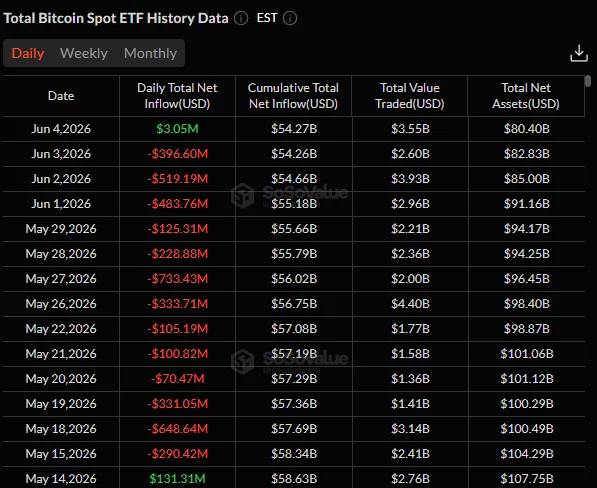
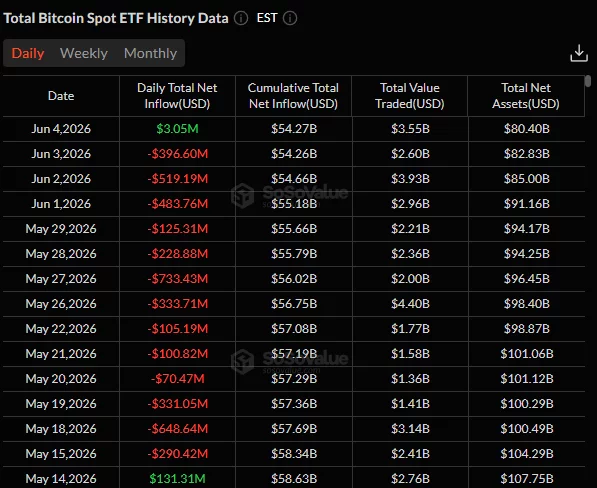
These dynamics unfold alongside a broader backdrop of spot Bitcoin ETF outflows and a fragile appetite for risk assets. In recent weeks, investors have pulled money from the Bitcoin ETF complex, with a 13-day streak of net outflows highlighted in prior coverage. The latest slice of data shows only a marginal $3 million net inflow on Thursday, insufficient to derail the ongoing liquidity drain that has seen about $5.1 billion leave the sector over the streak. This set of flows adds an extra layer of complexity for bulls hoping to stage a sustained comeback.
On the funding side, the market is painting a cautious portrait. BTC perpetual futures funding rates have turned negative, hovering around -2%. A neutral funding regime typically sits in the 6% to 12% annualized range, where longs pay to hold positions. The negative reading signals growing bearish conviction and a cooling of long-side leverage, which, in turn, dampens near-term upside risk even if spot prices flirt with key levels. In other words, bears appear to have a more comfortable position than in a strongly bullish backdrop, even as traders watch for a potential repricing higher.
Bitcoin’s underperformance relative to equities, particularly the Nasdaq 100, has underscored the fragility of the risk-on bid in recent sessions. The tech complex has shown signs of strain, with Broadcom (AVGO) closing down about 12.6% on Thursday and erasing roughly $280 billion in market value as investors digested a softer AI chip sales forecast for the second half of 2026. The disconnect between Bitcoin and tech strength adds nuance to the squeeze narrative: even if BTC can catch a bid, the broader market’s health remains a gating factor for sustained momentum.
Key takeaways
- Shorts concentrated near $63,000–$66,000 create a potential $2.6 billion squeeze risk if Bitcoin rallies toward $66,000.
- An additional 8% decline to roughly $57,000 could trigger about $1.2 billion in liquidations, underscoring downside risk if leverage remains intact.
- A move back to the $66,000 level could force the unwinding of a large share of short exposure, potentially reviving buyer interest after a prolonged ETF outflow phase.
- Negative BTC perpetual funding rates imply bears have momentum and are more willing to finance downside, reducing immediate upside risk for bulls.
Strategic rotation, macro cues, and what changes hands
The interplay between macro liquidity, sector rotation, and crypto-specific dynamics is guiding risk assessments. As AI mania has dominated headlines, capital has flowed into technology and AI-related equities and projects, leaving other corners of the market starved for liquidity. ParaFi Capital partner and Bitwise advisor Jeff Park captured the tension, saying the AI craze is drawing money away from other investments into what he described as a “hot ball of money” that everyone feels compelled to own. “Once this period of AI mania blows off, capital will rotate back to Bitcoin as its discounted valuation works in its favor,” Park observed.
Yet the near-term path remains nuanced. The market’s reliance on ETF inflows to sustain a meaningful rally is a live question. If spot ETFs begin to receive fresh inflows, the upside potential could widen, but that path remains contingent on broader liquidity conditions and regulatory guidance. In the meantime, observers highlight that a response from the ETF sector could act as a cap on downside risk or accelerate a relief rally, depending on whether outflows reverse or persist in the face of risk-off or risk-on shifts.
Some market commentators point to notable liquidity events that could act as turning points. Strategy’s leveraged Bitcoin model has recently faced its first stress test, with analyses noting that the framework could amplify volatility under certain conditions. In related coverage, observers flagged a recent 32 BTC sale by Strategy as a potential indicator of shifting provider balance sheets and risk tolerance. Such moves remind investors that large, strategic actors can influence short-term price action even as the market hunts for longer-term normalization.
For investors looking for a throughline, the rotation thesis remains central: AI sector enthusiasm could fade, and capital could rotate back into Bitcoin as the asset trades at a discount relative to risk-on assets and the broader market landscape stabilizes. The key question remains whether that rotation will take hold in time to cushion a test of resistance near $66,000 or whether the current momentum breaks further toward the low-$60,000s before buyers re-emerge.
What to watch next
Market participants should keep an eye on a few concrete developments that could tilt the balance over the next few sessions. First, ETF inflows or continued outflows will shape the supply-demand dynamics for spot Bitcoin and could either buttress a rally or deepen the pullback. Second, changes in perpetual funding rates—especially any sustained move back toward neutral or positive territory—would be a meaningful sign of shifting sentiment among leveraged traders. Third, macro precedents from the tech sector, including earnings or forecasts that recalibrate AI demand, will likely impact risk appetite more broadly and, by extension, Bitcoin’s trajectory.
As July approaches, traders will also be watching for narrative catalysts—regulatory developments, potential ETF approvals or changes, and notable liquidity events from a range of market participants. While a decisive move back to the $66,000 level is not guaranteed, the setup remains a reminder of how quickly leverage, sentiment, and macro flows can converge to create a volatile but potentially profitable window for those positioned to ride the squeeze dynamics if and when they unfold.
Source-linked data points and analyses cited above include CoinGlass for liquidation estimates, SoSoValue for ETF flow snapshots, Laevitas for funding rate data, and prior Cointelegraph coverage noting the ETF outflow streak. Related commentary on sector rotation and notable strategic trades is referenced from industry analysts and prior coverage of Strategy’s leveraged model and 32 BTC sale.

TLDR:
- Bitcoin has fallen below the median holder’s breakeven level for the first time since 2022.
- Glassnode data identifies the $46K-$54K range as the highest-probability Bitcoin bottom zone.
- The CVDD model near $46K has historically served as a reliable anchor during cycle lows.
- Bitcoin’s drawdowns are becoming shallower, supporting a higher floor than prior bear markets.
Where is the Bitcoin bottom? That question has gained urgency after Bitcoin fell to nearly $62,000, placing the asset about 50% below its all-time high.
The decline has pushed Bitcoin into a valuation range that has historically coincided with major cycle lows. According to market analyst Rafael, several long-term on-chain indicators now cluster around levels that previously acted as bear market floors.
While no model can identify an exact bottom in advance, current data offers a framework for assessing where support may emerge.
Bitcoin Approaches Historical Bottoming Levels
In a recent X thread, Rafael examined several valuation metrics used to identify potential cycle bottoms. He noted that Bitcoin has dropped below the median holder’s breakeven level for the first time since December 2022.
The analyst pointed to the Median Realized Price near $64,100 and the 200-week moving average around $61,700. Together, these metrics form an important support cluster that has attracted market attention.
According to the thread, Bitcoin has spent only about 7% of its history trading below the Median MVRV level. That makes the current price zone relatively uncommon compared with the broader trading history of the asset.
Rafael also outlined deeper support levels beneath the 200-week moving average. These include the Realized Price at roughly $54,000, CVDD near $46,000, Balanced Price around $40,000, and Delta Price close to $35,000. Previous bear market lows have typically entered this range before recovering.
Where Data Suggests the Bitcoin Bottom Could Form
The analysis places particular emphasis on the CVDD model. Rafael noted that across prior market cycles, Bitcoin’s ultimate lows frequently formed within a narrow range above the CVDD level.
According to the data, previous cycle bottoms generally occurred between 1.05 and 1.18 times the CVDD value. While other valuation metrics were occasionally breached, CVDD consistently served as a reliable anchor during major downturns.
With CVDD currently sitting near $46,200, the analyst identified a higher-probability bottom zone between $46,000 and $54,000. This range spans from the CVDD level to the Realized Price and represents the area where historical cycle floors have often developed.
Below that sits a deeper capitulation range between $35,000 and $40,000, defined by the Balanced Price and Delta Price models. Rafael noted that Bitcoin has traded in this lower zone during less than 3% of all trading days.
The analyst also observed that Bitcoin drawdowns have become progressively shallower over time. Earlier cycles recorded declines of approximately 85%, 84%, and 77%.
The current cycle has fallen around 50% from its peak. Although a deeper correction cannot be ruled out, the trend suggests the more likely Bitcoin bottom may reside within the $46,000 to $54,000 range rather than the lower capitulation zone.
Rafael stressed that no valuation model can predict an exact bottom. Instead, investors should view these levels as probability zones that help track changing market conditions.
For recovery, he identified the $75,000 to $79,000 region as the first major area Bitcoin would need to reclaim to signal improving market structure.

Crypto World
Bitcoin maximalists say the brutal price crash is just a temporary liquidity crunch caused by the AI boom
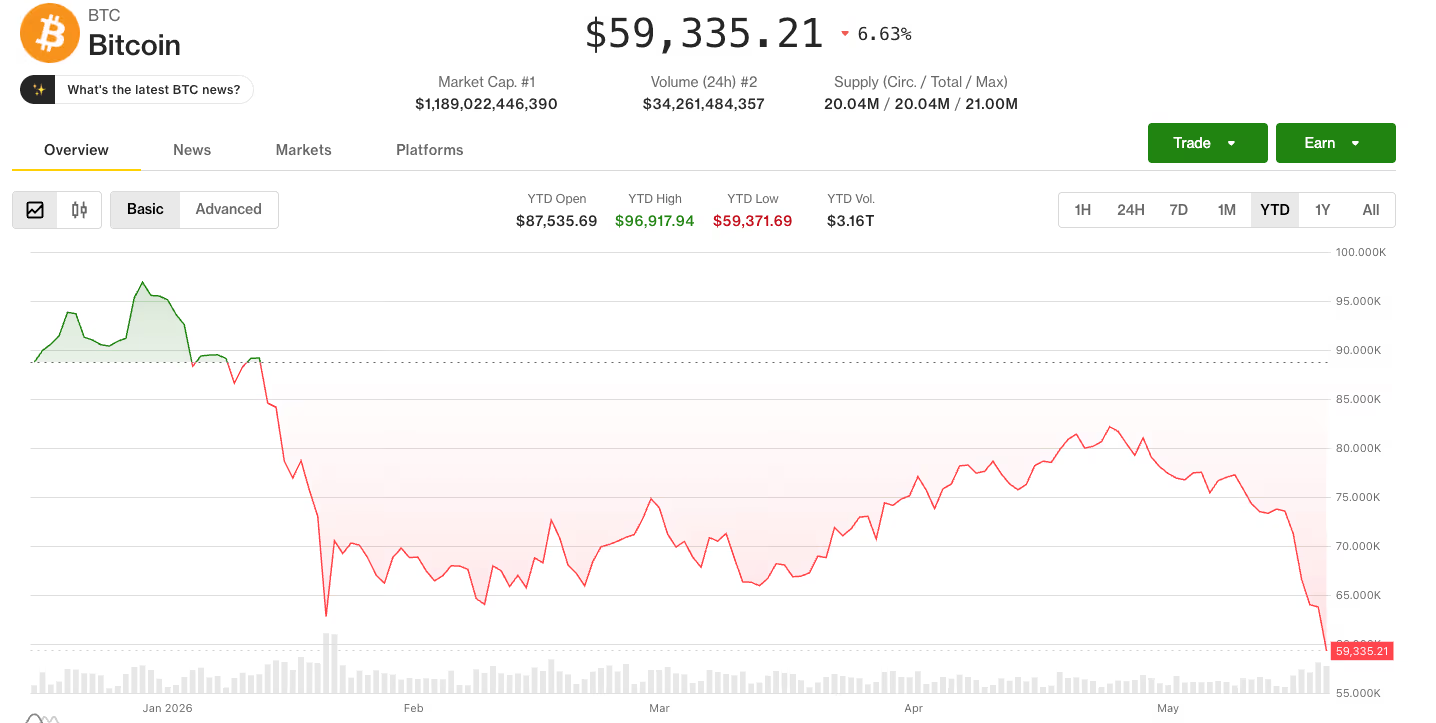
Hardcore bitcoin purists haven’t lost faith in the world’s largest digital currency, despite it losing nearly 17% of its value, marking the worst weekly performance since July 2024 and wiping out about $200 billion in market cap in the last seven days.
The prominent bitcoin advocates or maximalists (short for maxis) — a group that believes bitcoin is the only cryptocurrency likely to achieve lasting global adoption and monetary relevance — argue that capital is being sucked out of crypto and into artificial intelligence, creating what they see as a temporary liquidity crunch rather than a fundamental bitcoin problem.
This narrative comes as the world’s largest cryptocurrency is currently hovering below $60,000, down about 27% over the past month and down by more than 50% from its Oct. 6 all-time high, according to CoinDesk data.

The capital flight coincided with a record-breaking streak for U.S. spot bitcoin ETFs, which suffered $3.45 billion in outflows across 11 consecutive sessions. While crypto bleeds, Wall Street’s tech appetite remains aggressive. Even after the recent pullback, AI-related equities remain among the market’s strongest performers. The Nasdaq rose 34%, and the S&P 500 climbed nearly 24% in the last year, raising anxiety among crypto investors seeking answers about bitcoin’s underperformance.
While some market observers view the drop as a loss of structural confidence, bitcoin maxis argue the slump is merely a reflection of speculative capital rotating heavily into AI.
According to Mati Greenspan, a market analyst, bitcoin maximalist and founder of Quantum Economics, the price of bitcoin is in a downward trend, not because investors have lost faith in it, but because AI has become the dominant destination for speculative capital.
“Bitcoin is not facing a bitcoin problem. It’s facing a liquidity problem,” Greenspan told CoinDesk in an interview Friday. “AI has become the market’s new obsession, but obsessions fade.”
Another prominent bitcoin maxi and subject of recent debate if his bitcoin selling has caused the recent crash, Strategy (MSTR) Chairman Michael Saylor echoed Greenspan’s sentiment on X.
“Capital markets are funding the AI buildout at historic scale: ~$400B over six months,” Saylor said. Bitcoin ETFs have seen ~$4B of outflows since May 14, pressuring BTC. This is a capital rotation, not a bitcoin impairment. Volatility creates opportunity.”
‘The root cause’
Greenspan pointed to the Anthropic $50 billion IPO, targeting a nearly $1 trillion valuation, as the clearest indication of where market liquidity might have gone.
While bitcoin advocates point to the asset’s historical long-term returns, traditional liquidity pools are currently chasing AI infrastructure, data centers, and multi-billion-dollar private capital rounds, Greenspan added.
In fact, the anticipated IPOs of OpenAI, Anthropic and SpaceX, which together could raise more than $200 billion, may be drawing investor attention and capital toward AI and technology opportunities at the expense of other speculative assets, including crypto.
Bitcoin core developer and maximalist Jameson Lopp argued that investor frustration during market downturns often fuels the search for simple explanations. “I suspect the root cause is the bear market, combined with TradFi markets experiencing an AI boom,” Lopp said on X.
However, not everyone is blaming AI as the primary driver behind bitcoin’s weakness.
Market data suggests the pressure on crypto is multifaceted, and critics argue that blaming AI entirely oversimplifies a fragile macroeconomic environment. Jason Fernandes, a bitcoin maxi, market analyst and AdLunam co-founder, told CoinDesk that the asset is facing pressure from multiple fronts.
“BTC is under siege from every angle right now,” Fernandes said. “ETF outflows, high interest rates, creeping inflation, money rotating back into hot tech stocks, macro uncertainty, and now the psychological shock of Michael Saylor’s Strategy selling BTC after years of preaching ‘never sell.’”
Strategy, the largest publicly traded corporate holder of bitcoin, drew heavy criticism on social media after selling 32 bitcoin for $2.5 million in late May—its first sale in four years—to fund dividend payments on STRC, its perpetual preferred stock known as Stretch.
Though critics claimed the move “damaged confidence,” Greenspan, like many other analysts, dismissed the panic. “Selling 32 BTC against a balance sheet of more than 843,000 BTC is not even a rounding error,” Greenspan said.
Time to buy?
Despite the outflows, some of the maxis argue it might be time to dip into the underperforming asset as bitcoin’s longer-term fundamentals remain intact.
Greenspan argued that the recent record-breaking outflows from bitcoin funds are likely part of a rotation back toward monetary assets. He added that bitcoin’s current consolidation phase could serve as an accumulation zone if underlying network fundamentals hold. Despite the price dip, institutional adoption, regulatory frameworks, and discussions around bitcoin as a strategic reserve asset have continued to mature over the last few years.
Meanwhile, other bitcoin advocates, such as Strike CEO Jack Mallers, are bypassing broader market debates and encouraging investors to buy the dip on social media.
However, a rotation back into crypto is not guaranteed to be smooth. Even if bitcoin’s weakness stems partly from capital flowing into AI, Greenspan argues that a reversal may not immediately benefit crypto and might act as a double whammy.
“If AI sentiment cracks, bitcoin could get hit twice: first from liquidity leaving crypto, and then again from a broader risk-off move across markets,” Greenspan said.
“As for what comes next, I would be careful assuming the bottom is already in,” Greenspan noted.
Read more: Bitcoin isn’t crashing because of Saylor, it’s losing the momentum trade
Crypto World
Bitcoin Breaks 200-Week Moving Average for First Time Since 2022 as Jobs Report Reprices Fed Cuts
Bitcoin fell below its 200-week moving average, a long-term trend marker while spot prices dropped below $61,000 for the first time since the 2022 bear market low. The broader selloff has pushed BTC down roughly 17% over seven days and more than 25% from its 30-day range, per CoinGecko data. At the… Read the full story at The Defiant


Tom Schmidt, a general partner at Dragonfly Capital, called Nova Markets "huge scammers" on Thursday, targeting the startup's entire investor cohort in the same post. The accusation came as a quote-tweet of Nova Markets' June 4 fundraise announcement. Dragonfly, which closed a $650 million fourth… Read the full story at The Defiant
TLDR:
- The U.S. added 172,000 jobs in May, nearly doubling forecasts and pushing rate hike odds to 57% in one day.
- Broadcom’s refusal to raise AI targets triggered a 12.6% stock drop, sparking fears of overvalued AI positions.
- SemiAnalysis reported Nvidia’s new chips need half the expected memory, sending SK Hynix and Samsung shares sharply lower.
- SpaceX, Anthropic, and OpenAI listings worth $4–$5 trillion are forcing fund managers to sell holdings to raise cash.
Global financial markets suffered a broad and sharp decline on Friday, erasing approximately $2.5 trillion in a single trading session.
The S&P 500 dropped 1.65%, while the Nasdaq fell 2.60%. Gold, silver, and Bitcoin also recorded steep losses. A combination of stronger-than-expected jobs data, cracks in the artificial intelligence trade, and looming liquidity concerns drove the widespread sell-off across asset classes.
Hot Jobs Report Rattles Rate Cut Expectations
The U.S. economy added 172,000 jobs in May, nearly double Wall Street’s forecast of 88,000. That surprise reading sent shockwaves through markets almost immediately after the open.
With inflation running at 3.8% and oil prices at $90 per barrel, the strong labor data changed the rate outlook sharply.
The probability of a Federal Reserve rate hike this year jumped from 40% to 57% in one session. Higher rates reduce the present value of future earnings, making growth and tech stocks less attractive. Investors responded by rotating out of those positions quickly.
As noted by market analyst account Bull Theory on X, “A labor market this strong tells the Fed it cannot cut interest rates and may actually need to raise them.” That shift in sentiment accelerated selling pressure across equity markets.
Adding to the uncertainty, new Fed Chair Kevin Warsh holds his first policy meeting in 11 days. Appointed under expectations of rate cuts, he now faces hot inflation, elevated oil, and a tight labor market. That uncertainty alone pushed many fund managers toward reducing risk.
AI Trade Cracks Under Pressure From Multiple Fronts
Broadcom reported record quarterly earnings, with revenue up 48% and AI chip sales climbing 143%. Yet the stock fell 12.6% after the company declined to raise its AI revenue targets. That single decision prompted investors to question whether AI valuations had grown too stretched.
Research firm SemiAnalysis then reported that Nvidia’s next-generation AI chips would require roughly half the memory previously priced into analyst models. SK Hynix fell nearly 10% on the news, while Samsung dropped over 6%. South Korea’s broader market declined 5.5% in a single session.
Anthropic also released a report warning that AI systems are approaching the ability to improve themselves without human input. The firm called for a global pause in AI development.
Coming alongside the chip memory news and Broadcom’s miss, it deepened fears about whether business models can sustain the current pace of AI growth.
Meanwhile, a liquidity drain looms over markets. SpaceX is set to go public next week at a $1.75 trillion valuation. Anthropic and OpenAI are also preparing listings.
Together, these three companies represent $4 to $5 trillion in potential capital demand. Fund managers are selling existing holdings to raise cash, adding further pressure to an already stressed market.
Key takeaways:
- Over-leveraged Bitcoin short positions between $63,000 and $66,000 have created a potential $2.6 billion squeeze trap for bears.
- Negative perpetual funding rates indicate that bulls have fully deleveraged, significantly reducing downside risk.
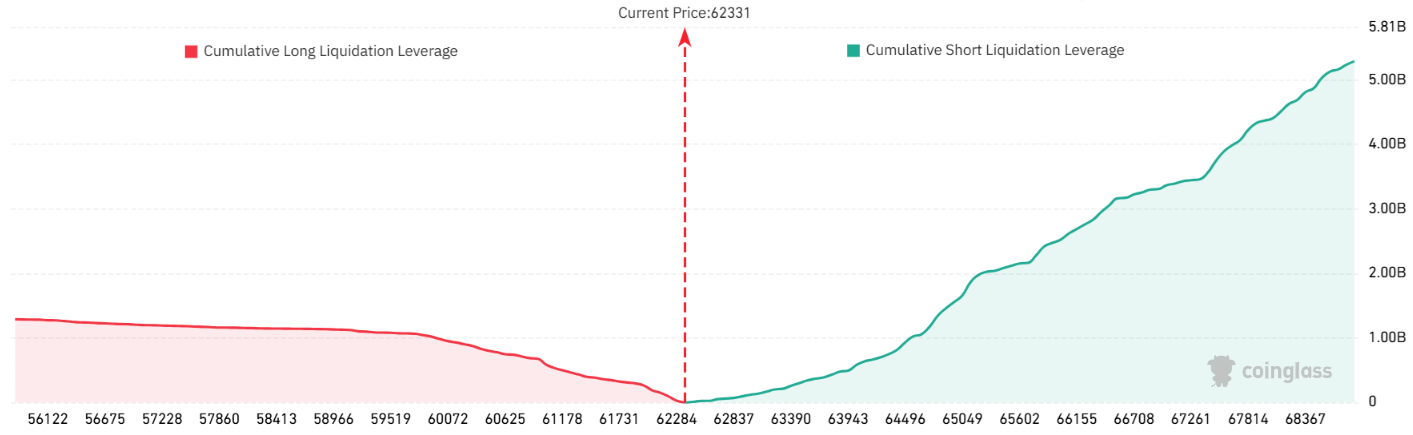
The Bitcoin (BTC) crash to $61,100 on Friday wiped out $335 million in leveraged long positions. However, after a 21% decline in Bitcoin’s price, bulls might have set a perfect trap as negative market sentiment intensified. Bearish positions built up heavily between $63,000 and $66,000, setting the stage for a potential $2.6 billion short squeeze.
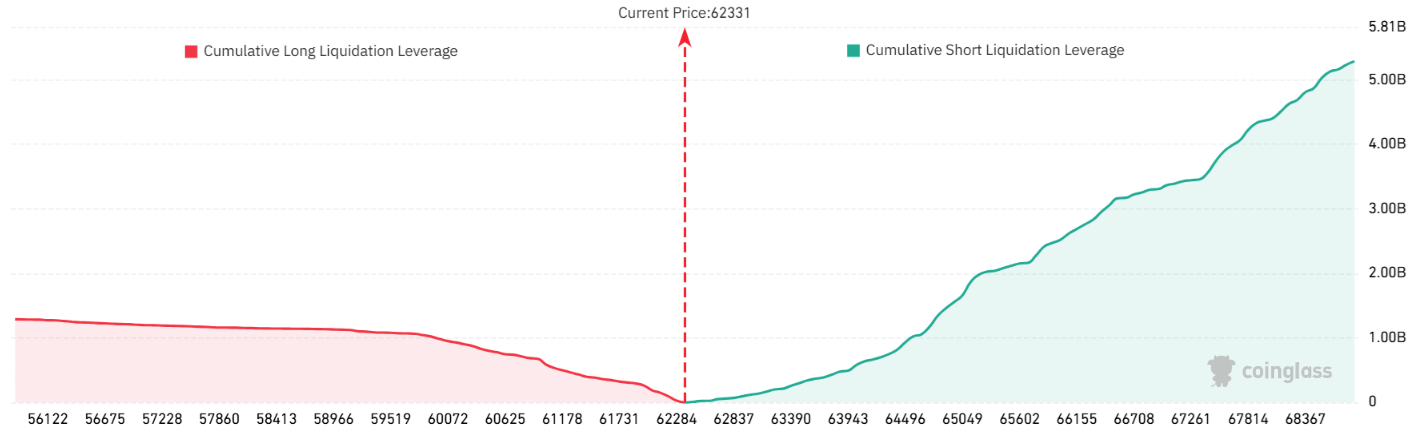
Estimated cumulative Bitcoin liquidation at major exchanges, USD. Source: CoinGlass
Estimated liquidations for a further 8% drop in Bitcoin to $57,000 from $62,000 stand at $1.2 billion. In contrast, a rally to $66,000 would put $2.6 billion of short positions at risk. This potential squeeze might provide enough fuel to revive buyer confidence following a record-breaking 13-day streak of net outflows from spot Bitcoin exchange-traded funds (ETFs).
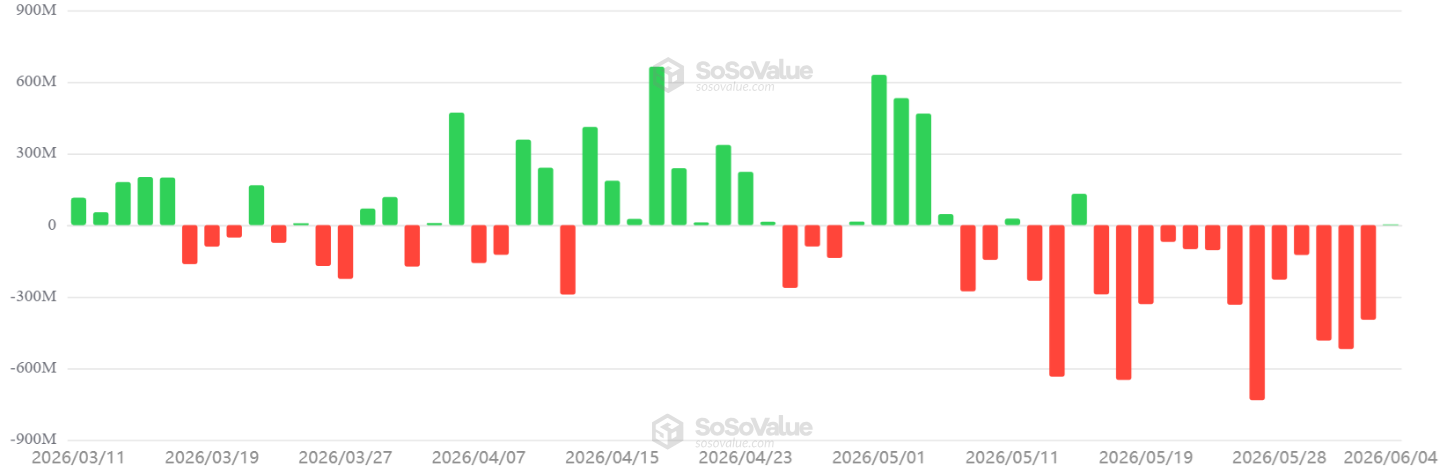
US-listed spot Bitcoin ETFs daily net flows, USD. Source: SoSoValue
The minor $3 million net inflow on Thursday could represent a temporary breathing room after 15 days of selling that drained $5.1 billion. It remains too early to conclude that momentum has officially flipped in favor of the bulls. Ultimately, if bears kept their leverage low and played conservatively, the actual threat of a massive short squeeze might be minimal.
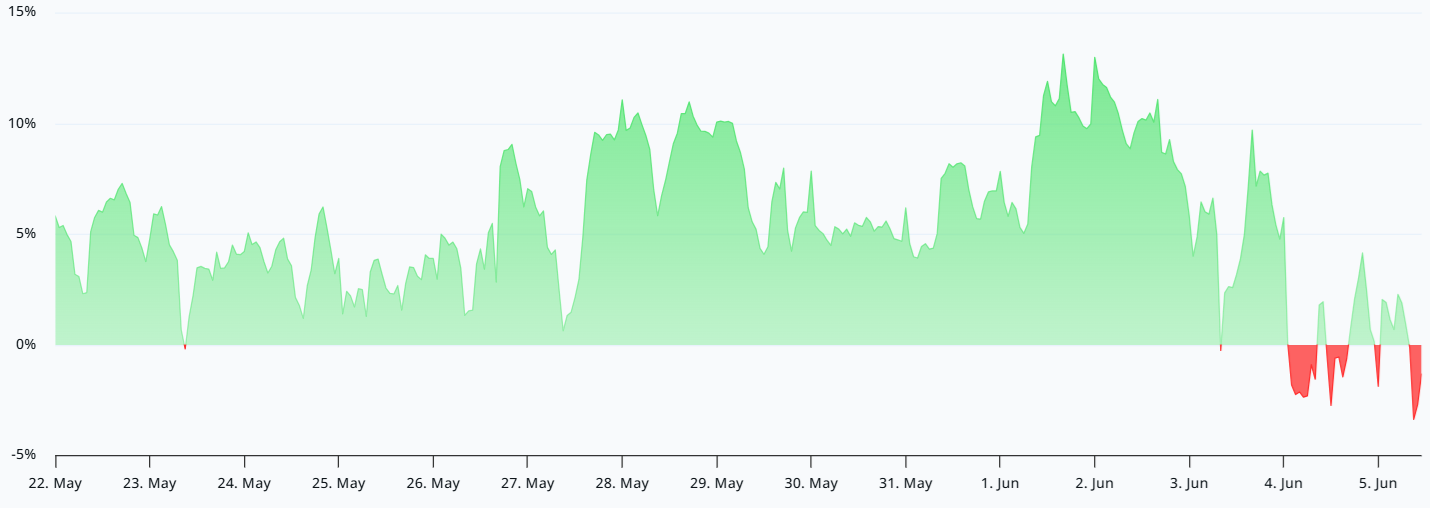
Bitcoin perpetual futures annualized funding rate. Source: Laevitas
A neutral funding rate typically ranges between 6% and 12%, with longs paying to keep their positions open. The current negative 2% Bitcoin perpetual futures funding rate suggests growing confidence among bears. Thus, even if it takes time for Bitcoin to reclaim the $66,000 level, bulls have fully deleveraged, reducing downside risk.
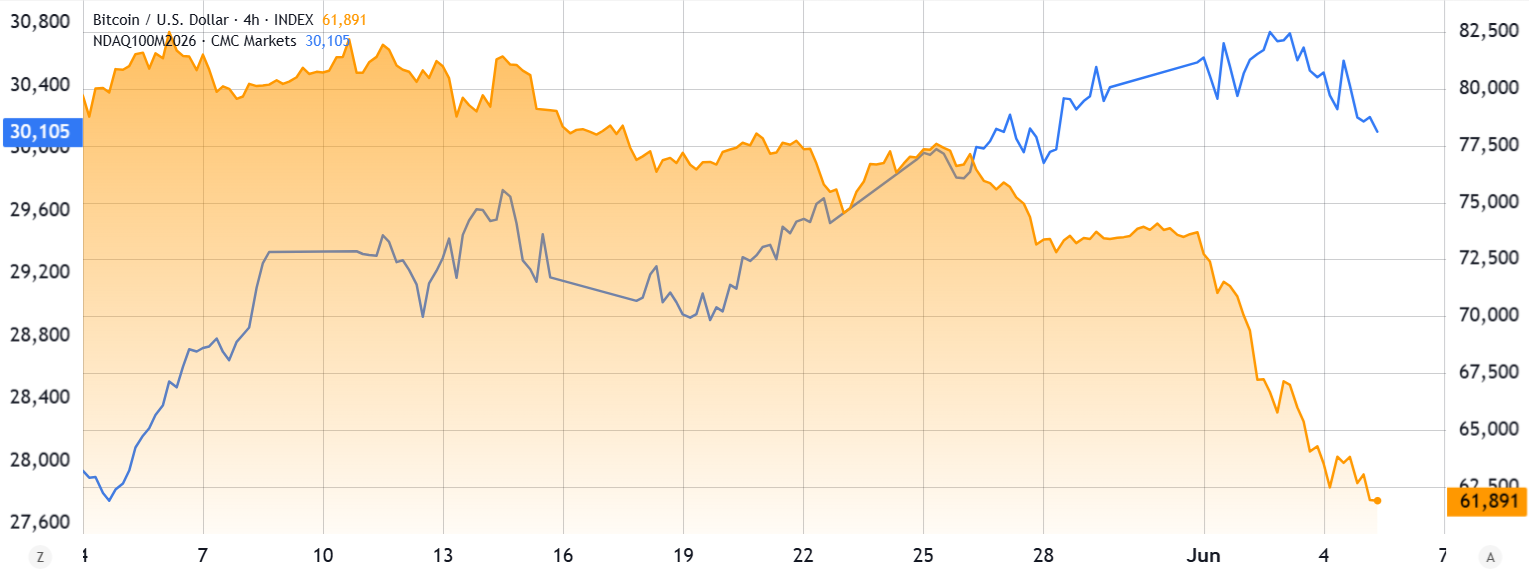
Nasdaq 100 futures (left) vs. Bitcoin/USD (right). Source: TradingView
Bitcoin has severely underperformed the Nasdaq 100 index, but the tech sector is beginning to display weakness after Broadcom (AVGO US) closed down 12.6% Thursday, erasing $280 billion in market value. The company trimmed its AI chip sales forecast for the second half of 2026, putting investors on alert.
Impact of the tech sector IPOs and Strategy’s 32 BTC sale
Other prominent names in the AI sector also felt the impact. Micron (MU US) traded down 7.8% while Arm (ARM US) dropped 4.5%. With highly anticipated IPOs from SpaceX, Anthropic, and OpenAI in sight, investors likely opted to raise cash ahead of those offerings. Analysts claim this liquidity drain also contributed to Bitcoin’s recent weakness.
Related: Strategy’s leveraged Bitcoin model has faced its first stress test–Grayscale
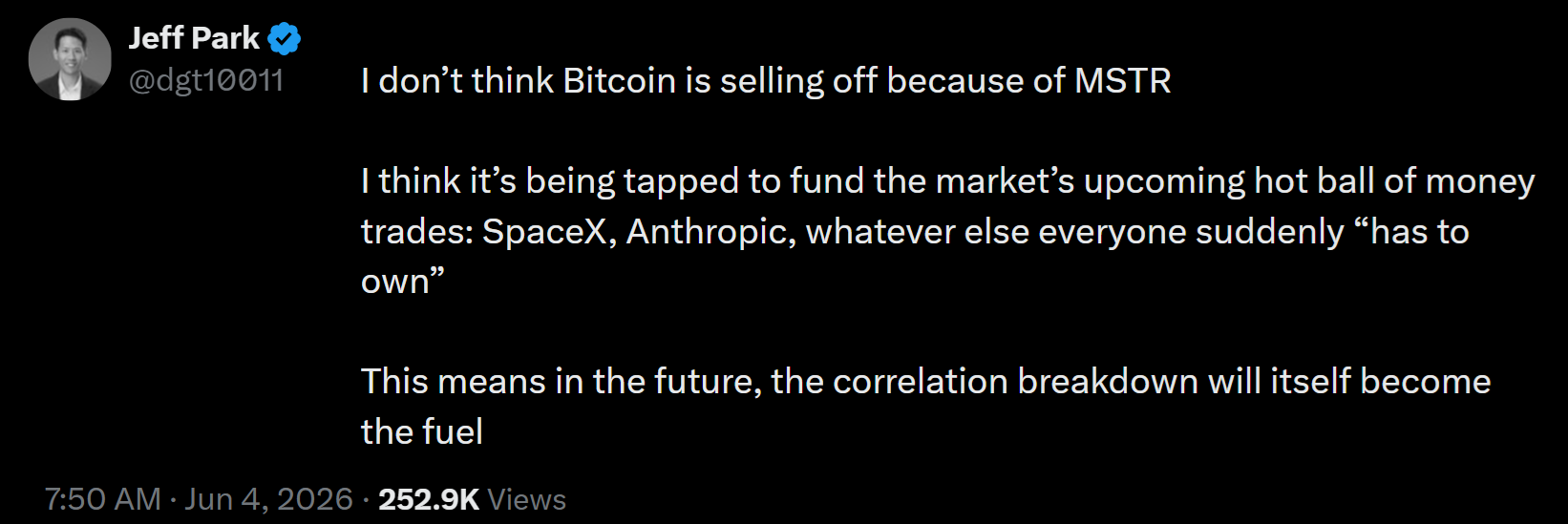
Source: X/dgt10011
Jeff Park, partner at ParaFi Capital and Bitwise advisor, argues that the AI sector is draining money from other investments as the market becomes a “hot ball of money” that everyone suddenly “has to own”. However, Park reminds that once this period of AI mania blows off, capital will eventually rotate back to Bitcoin as its discounted valuation works in its favor.
Regardless of whether Bitcoin’s weakness stems from AI sector hype, excessive confidence from bears poses a major risk once spot Bitcoin ETF inflows pick up or the fear surrounding a recent 32 BTC sale from Strategy (MSTR US) dissipates. A rally back to $66,000 might seem unlikely at first glance, but a sudden short squeeze could quickly shift momentum in favor of the bulls.


For 13 uninterrupted trading days, not a single dollar of net new money moved into spot bitcoin (BTC) exchange-traded funds (ETFs).
Indeed, they bled money each and every session from May 15 through June 3, marking the longest uninterrupted run of outflows since their launch in January 2024.
Total cumulative outflows were 59,351 BTC, exceeding $4.3 billion worth of selling.
The streak finally broke yesterday with a meager $3.2 million inflow.
Unfortunately, the damage was already done. BTC crashed to under $60,000 just a day later.
At time of writing, BTC is down 17% over the past week and is trading at its lowest level since October 2024.
A week of unwanted records for BTC ETFs
The multi-billion dollar, nearly three-week outflow streak blew past every prior record in the short history of the ETFs.
Most of the outflows withdrew from BlackRock’s iShares Bitcoin Trust (IBIT), the biggest of the funds. Its worst day brought about $528 million in withdrawals, IBIT’s second-largest single-day outflow ever, just shy of its January 2025 record.
Of course, none of those sell and redemption orders came from BlackRock itself.
ETF outflows originate with customer orders across hundreds of independent brokerages. The sponsors such as Blackrock, Fidelity, Morgan Stanley, or Franklin Templeton merely operate the fund, they don’t manage its assets with any discretion.
Read more: Bitcoin dropped to $0.019 on Revolut today
The uninterrupted 13 days were the tail end of a decline that had been accumulating for weeks. All of it led up to today’s crash to under $60,000 per BTC.
The month of May closed as spot BTC ETFs’ worst month all year. Net outflows last month hit $2.4 billion, the largest monthly exit since November 2025. Only six of May’s 20 trading days attracted any net inflow.
Bloomberg ETF analyst Eric Balchunas admitted, “this is the bad times.”
Got a tip? Send us an email securely via Protos Leaks. For more informed news and investigations, follow us on X, Bluesky, and Google News, or subscribe to our YouTube channel.
Some digital asset industry advocates are pushing back against a provision in a $56 billion state budget passed by the Illinois General Assembly on Monday, due to its impact on crypto users.
In a Senate bill included as part of the Illinois state budget for the fiscal year 2027, lawmakers proposed a 0.2% tax on crypto transactions, to be imposed by the “digital asset broker making or effectuating the sale of the digital asset business activity.” The 1624-page bill, part of the revenue and tax package to fund the state’s 2027 budget, passed along party lines early on Monday.
Senate Bill 3019. Source: Illinois General Assembly
The measure, described as a “privilege tax” within the Digital Asset Privilege Tax Act amendment to the bill, included registration requirements for any entity operating as a digital asset broker in Illinois. Brokers who failed to follow the guidelines from Jan. 1 could be found guilty of a Class 3 felony in the state and subject to a prison sentence of two to five years and fines up to $25,000.
Passed by the state general assembly on Monday, the budget bill still needs Governor JB Pritzker’s signature before becoming law. Pritzker made several public statements signaling that he plans to sign the bill soon, but had not done so as of Friday morning. Lawmakers expect the crypto tax to generate $60 million for the state.
Related: Crypto industry ties were a liability in Illinois primary
This crypto tax measure has prompted accusations from industry advocates of “burying” the rule within a massive budget proposal. The Digital Chamber and Illinois Blockchain Association penned a letter on Wednesday urging the state to reject the Digital Asset Privilege Tax Act, claiming that it would be “economically destructive” and gave the industry no notice of its intentions.
“No other state has imposed a similar tax, and the lack of stakeholder engagement surrounding this proposal raises significant concerns,” said The Digital Chamber in a Thursday X post.

Source: The Digital Chamber
Illinois governor goes after insider trading on prediction markets
The crypto tax proposal in Illinois’ budget followed Pritzker’s signing of an executive order banning state employees from betting on prediction market event contracts with companies such as Kalshi and Polymarket. The EO, signed on April 21, came in response to concerns elected officials could use the platforms “for personal enrichment and advantage based on access to nonpublic information.”
Magazine: Bitcoin miners are pivoting to AI, so why is the hashrate near ATHs?
Bitcoin price has fallen below $60,000 after a stronger-than-expected U.S. jobs report prompted traders to scale back expectations for Federal Reserve rate cuts and price in a higher probability of policy tightening later this year.
Summary
- Bitcoin fell below $60,000 after a stronger-than-expected U.S. jobs report reduced expectations for Fed rate cuts and increased odds of rate hikes later this year.
- More than $1.7 billion in crypto positions were liquidated as leveraged traders rushed to exit after BTC lost a key support level.
- Despite the selloff, spot Bitcoin ETFs recorded net inflows for the first time in 13 trading days, while on-chain data suggests capitulation among short-term holders may be reaching extremes.
According to data from crypto.news, Bitcoin (BTC) price fell to an intraday low of around $59,100 on June 5 before stabilizing near $59,400 at press time. The move extended a 10-day decline of roughly $19,000 from recent highs and pushed the cryptocurrency below the closely watched $60,000 support area for the first time since 2024.
Fresh labor market data triggered the latest wave of selling. The U.S. economy added 172,000 nonfarm payrolls in May, far above expectations of 85,000, while the unemployment rate held steady at 4.3%. Revised data also added 93,000 jobs to the previous two months, reinforcing the view that labor conditions remain resilient despite slowing growth elsewhere.
BNP Paribas added to the hawkish narrative this week after abandoning its expectation for stable monetary policy and forecasting three Federal Reserve rate hikes beginning in December. The bank cited persistent inflation risks, firm employment conditions, and the potential impact of the ongoing U.S.-Iran conflict on energy prices.
Following the jobs report, Polymarket assigned a 52% probability to a Fed rate increase before year-end, while CME FedWatch showed a 42.7% chance that rates will be higher by December.
Derivatives markets amplified the selloff as leveraged positions unraveled. CoinGlass data showed that more than $155 million in crypto long positions were liquidated within a single hour, while total liquidations topped $1.7 billion over the past 24 hours. Forced selling accelerated after Bitcoin lost the $60,000 level, triggering liquidation engines across major exchanges.
Institutional flows offered one of the few signs of stabilization. U.S. spot Bitcoin ETFs recorded roughly $3 million in net inflows on June 4, ending a 13-day streak of withdrawals that had drained $4.37 billion from the funds, per data from SoSoValue. Although the inflow was modest, it interrupted the longest period of sustained selling pressure from ETF investors this year.
Meanwhile, traditional safe-haven assets failed to attract buyers during the risk-off move. Gold fell roughly 3.5% while silver dropped 7.5%, suggesting investors were reducing exposure across multiple asset classes rather than rotating capital into precious metals.
Strategy also returned to the spotlight as Bitcoin traded below the firm’s average acquisition cost. The company’s unrealized losses have climbed above $12.7 billion, renewing debate around corporate Bitcoin treasury strategies.
CryptoQuant chief executive Ki Young Ju pushed back against concerns surrounding Strategy’s position, arguing that long-term whales have been a much larger source of supply.
“Strategy bought over 700K BTC from OG whales and only sold 32 BTC,” Ju wrote, adding that the firm’s purchases helped absorb coins that might otherwise have entered the market.
Bitcoin derivatives and on-chain data suggest capitulation may be nearing
Options positioning around the $60,000 strike has become a major focus for traders. According to Deribit Chief Commercial Officer Jean-David Péquignot, more than $1.2 billion in notional open interest is tied to put options at that level.
A sustained move below $60,000 could force market makers to hedge short gamma exposure by selling spot Bitcoin or futures contracts. Combined with elevated leverage across perpetual futures markets, that process may increase volatility if sellers remain in control.
On-chain metrics, however, are beginning to show conditions often associated with late-stage capitulation.
According to analyst Seth, the percentage of Bitcoin holders in profit has reached a long-term trendline that has coincided with major cycle lows in previous drawdowns. The analyst noted that the depth of those drawdowns has decreased with each cycle and argued that a bottom could be near if historical behavior repeats.
Additional data shared by market commentator Scott Melker highlighted growing stress among newer Bitcoin investors.
“$BTC short-term holders are now realizing losses at the biggest level in history. The short-term holder realized profit/loss ratio just hit a new all-time low, deeper than any previous drawdown.”
Melker added that long-term holders now control roughly 5.3 million BTC at a loss, a figure that exceeds post-FTX levels and represents the highest amount of underwater long-term supply since the COVID-era market crash.
Technical breakdown puts $55K support zone in focus
The daily chart shows Bitcoin trading well below the Supertrend indicator, which now sits near $69,700 and acts as immediate resistance. A failed recovery attempt beneath that level has left sellers firmly in control of the short-term trend.
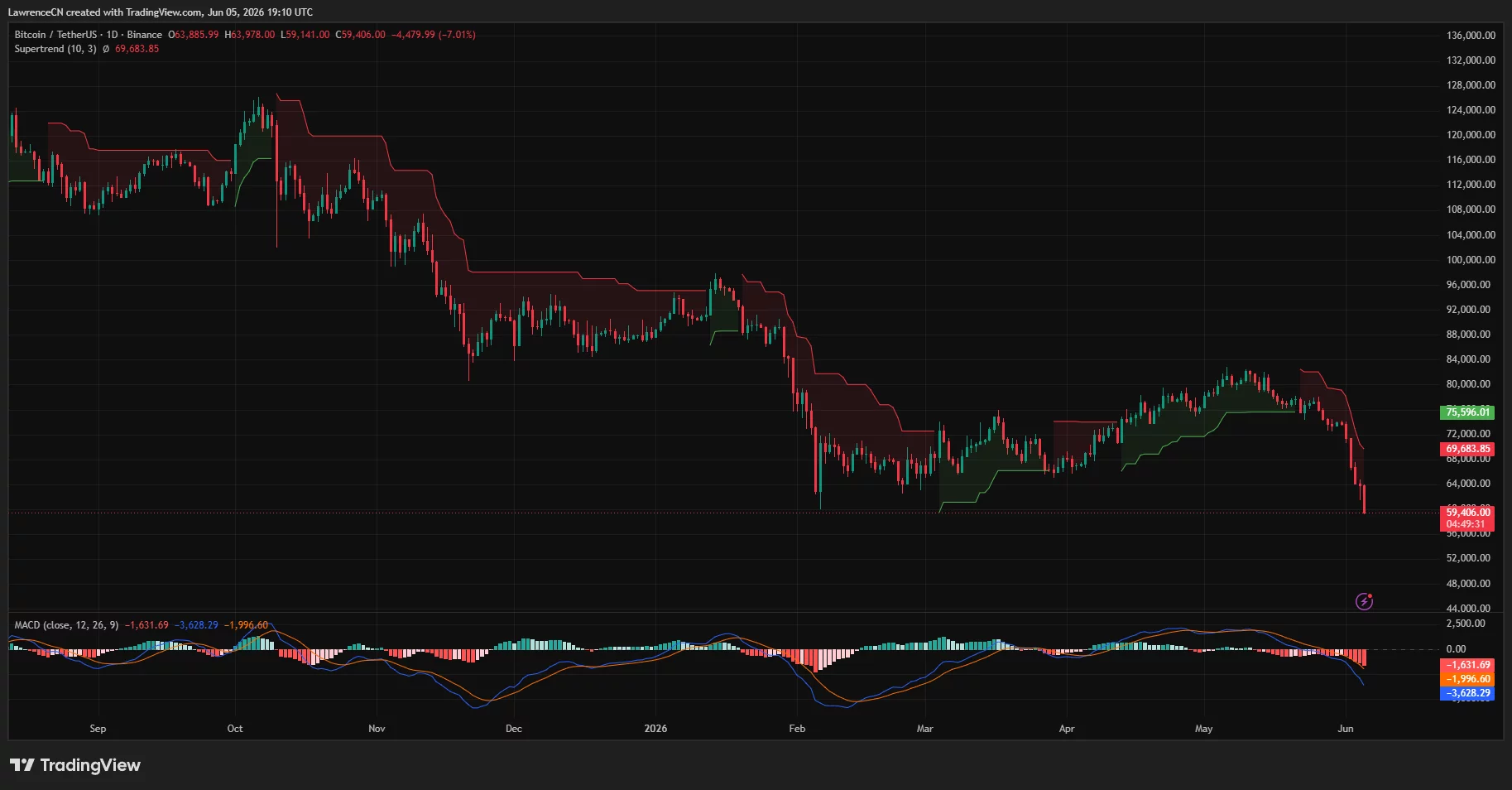
Momentum indicators also remain weak. The MACD line has dropped sharply below the signal line while the histogram continues to expand in negative territory, showing persistent downside momentum after the breakdown from the $72,000-$75,000 range.
The loss of $60,000 leaves the February low near $55,000 as the next major support zone. A decisive break below that area could expose the psychological $50,000 level and trigger another round of liquidation-driven selling.
Bulls would need to reclaim $60,000 quickly to ease immediate pressure. A recovery above the Supertrend resistance near $69,700 would invalidate the current bearish structure and reopen the path toward the $75,000 area. Until then, stronger-than-expected economic data, rising rate-hike expectations, and heavy derivatives positioning remain key risks for Bitcoin.
Disclosure: This article does not represent investment advice. The content and materials featured on this page are for educational purposes only.

$63K Bitcoin: Run or buy? #crypto #bitcoin #shorts

Tributes paid to highly-respected primary school principal following sudden death

April 2026 Thai Exports Surge on Electronics Boom as Trade Deficit Hits Record



-

 Business4 days ago
Jade Biosciences, Inc. (JBIO) Discusses Positive Interim Results From JADE101 Phase I Healthy Volunteer Study and Development Plans Transcript
-
 Tech6 days ago
SpaceX just won a second Golden Dome contract. This one is $4.16 billion.
-

 Sports3 days ago
French Open 2026 results: Alexander Zverev beats Rafael Jodar and will play Jakub Mensik in semi-finals
-
 NewsBeat7 days ago
FIRST NIGHT REVIEW: Take That bring the Circus back to life in spectacular sun-soaked style
-

 Business6 days ago
Is the Spurs Phenom Already Better Than Prime Diesel?
-

 Tech3 days ago
CryZENx Releases Fresh Playable Content Deep Inside Jabu-Jabu for His Ocarina of Time Remake
-

 Politics7 days ago
The House | Inside Andy Burnham’s Makerfield Campaign: “Nobody Thinks This Is In The Bag”
-
Crypto World11 hours ago
LBank Surpasses 25 Million Users Worldwide as AFA Partnership Continues to Drive Global Growth
-

 Business3 days ago
Trump Taps Housing Chief Bill Pulte as Acting Intelligence Director After Gabbard Exit
-
 Entertainment7 days ago
Weak ‘Supergirl’ Box Office Tracking Amid Milly Alcock Backlash
-
 Entertainment7 days ago
Bruce Willis’ Generosity Resurfaces Amid His Dementia
-
 Entertainment6 days ago
One of the Greatest Sitcoms of All Time Shoots Up Apple TV’s Charts 11 Years Later
-

 Business7 days ago
Demand Conditions Improve In Chemicals Sector In April 2026
-
 Crypto World3 days ago
Seagate (STX) Stock Surges to Record High on AI Boom and Legal Settlement
-
 NewsBeat6 days ago
Everything you need to know as Cambridge’s Strawberry Fair returns after cancelled year
-
 Entertainment7 days ago
Britney Spears Shares Troubling Update After Hard Year
-
Crypto World3 days ago
EU AI Data Center Project Faces Delays as Funding Gaps Grow
-

 Business3 days ago
Aehr Test Systems Stock Soars 17% Amid Surging AI Demand and Conference Spotlight
-
 Business7 days ago
US-led AI investments risk capital destruction: Chris Wood
-
 NewsBeat3 days ago
Republicans balk at Trump’s attempt to appoint a MAGA enforcer to lead National Intelligence
You must be logged in to post a comment Login