Connect with us

NewsBeat

Who won MasterChef 2026 after nail-biting final?

Published

on

Wales Online

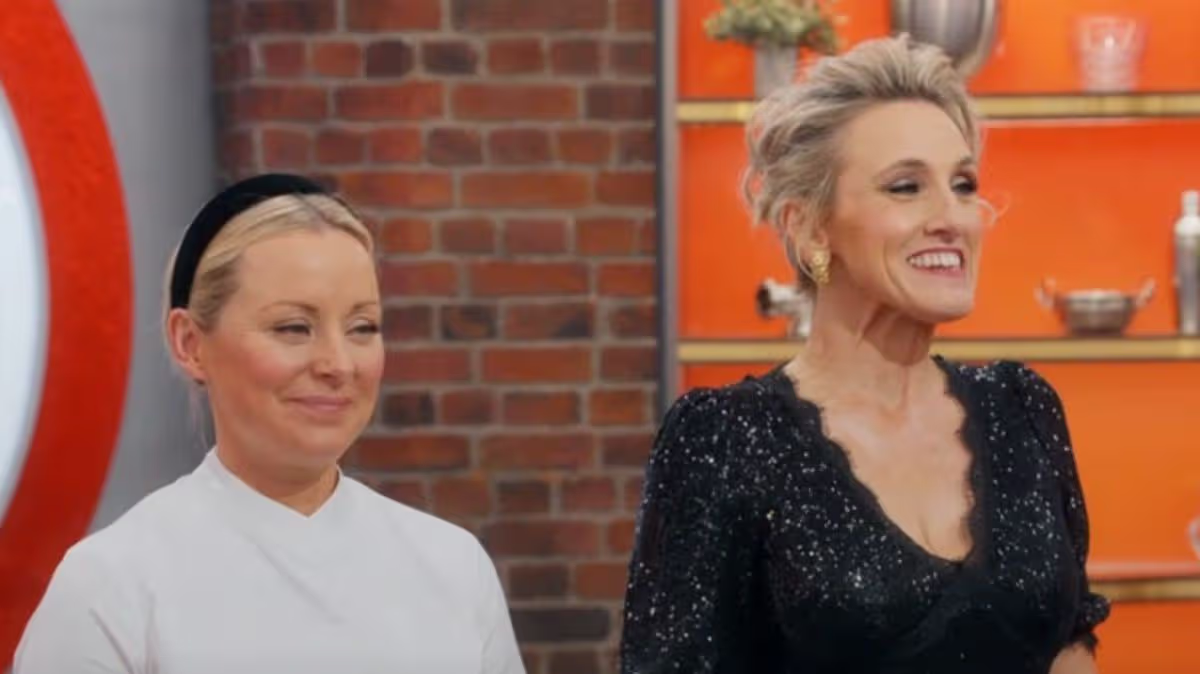
Jhané, Kristen and Matt went head to head to impress MasterChef judges Grace Dent and Anna Haugh

The winner of MasterChef 2026 has officially been crowned.

Advertisement

Judges Grace Dent and Anna Haugh have spent weeks testing 48 of the nation’s best amateur cooks, with just three having made it to the final.

Hoping to make it into the MasterChef hall of fame, Jhané, Kristen and Matt went head to head.

Who won MasterChef 2026?

Jhané was crowned winner of MasterChef 2026.

Speechless, Jhané was heard saying “What? This is ridiculous,” as she was hugged by her two co-competitors, while Anna commented on how difficult the decision had been.

Advertisement

After her win, Jhané said: “This is incredible.”

Anna praised the “magic in her fingertips”, while Grace hailed Jhané’s “gift for communicating things she’s got inside of her onto a plate”.

She added: “Jhané is an incredible talent, and I can’t wait to see what she does in the future.”

Advertisement

Jhané also said: “To anyone watching this, you can genuinely put anything you put your mind to.

“One foot in front of the other, and you end up with a trophy!”

After making it into the final four, alongside Antos who was eliminated just before the final, Jhané had said: “It’s so surreal to be able to call myself a MasterChef finalist! At the start of the show I just wanted to get an apron, now I’m in the final four.

Advertisement

“It has taken so much hard work to get here, I’ve learned so much throughout the competition and made so many new friends along the way. I feel like I’ve pushed my cooking to a whole new level and I’m not ready for it to end.”

Kristen added: “Making the final four is surreal. At each stage of the competition, I could only focus on the challenge that was in front of me.

“Reaching this stage, getting to know my fellow finalists so well, having more time with the judges and mentor chefs has been extraordinary.”

Advertisement

Matt also said: “It feels amazing! Particularly knowing that we’re heading to Antigua. Every single time you get through you think that the competition can’t surprise you any more and then they drop that you’re heading off to the Caribbean!

“It’s been such a brilliant journey so far and I feel very lucky to be able to continue into finals week. I don’t want it to end.”

The BBC competition has faced a significant shake-up in recent months, after scandals left both Gregg Wallace and John Torode axed from the programme.

It was later confirmed Grace would be joined by Anna, and she’ll now appear alongside Giorgio Locatelli on Celebrity MasterChef, which has already been filmed.

He said joining the show was “a real honour”, adding: “I can’t wait for you to see what our celebrity contestants bring to the kitchen, as we are really putting their culinary skills to the test in this series.”

MasterChef is available to watch on BBC iPlayer.

Source link

Advertisement
Continue Reading
Click to comment

You must be logged in to post a comment Login

Leave a Reply

NewsBeat

The 1950s industrial town where dogs are mysteriously dying, cancer cases are rocketing and residents are too scared to go into their own gardens

Published

on

Between the 1950s and 2012, this chemical plant in Thornton-Cleveleys, Lancashire, emitted 49 tons of highly carcinogenic Perfluorooctanoic acid (PFOA) into the atmosphere via large extraction chimneys

‘You think you’re doing the right thing,’ says mother-of-five Sam Hammond from her garden in Thornton-Cleveleys, a small town north of Blackpool. ‘But I’ve been teaching my kids to eat poisoned fruit, poisoned veg and poisoned eggs.’

Two years ago, Sam noticed people taking soil samples from the Occupation Road Allotments which border her property. It emerged they were from the Environment Agency and they had been called in amid fears the land may have been contaminated by pollutants from the nearby AGC Chemicals Europe plant.

Between the 1950s and 2012, the manufacturing facility emitted 49 tons of highly carcinogenic Perfluorooctanoic acid (PFOA) into the atmosphere via large extraction chimneys. 

To make matters worse, the toxic gas was also likely to have contained small solid particles of the compound. The ‘forever chemical’ – so-called because it is virtually indestructible – is known to cause cancer and has since been banned globally.

Advertisement

Sam, 48, was understandably worried. After all, for 20 years she’d been growing everything from lettuces and beans to strawberries and cabbages in her garden, as well as rearing chickens and ducks for their supposedly highly nutritious eggs. She duly had her own soil tested.

When the results came back in February this year, they made her sick to the stomach. Not only was her garden contaminated, but one duck egg alone contained ten times the safe weekly limit of PFOA for a human being. And Sam and her family had been eating these eggs from their flock of 30 ducks daily for three years.

‘My little boy is worried,’ Sam continues, clearly emotional. ‘He keeps asking me: “Are my ducks going to die?” It’s had a massive effect on me, too.’

Sam – who now believes the unexpected stroke she suffered in 2020 may have been caused by the toxin – adds: ‘I don’t sleep at night. It just doesn’t stop. It’s just going round and round in my head. I don’t really spend much time out in the garden anymore either, because I just look at it and I’m like… is it safe?’

Advertisement

Between the 1950s and 2012, this chemical plant in Thornton-Cleveleys, Lancashire, emitted 49 tons of highly carcinogenic Perfluorooctanoic acid (PFOA) into the atmosphere via large extraction chimneys

Sam Hammond's results found that one duck egg alone contained ten times the safe weekly limit of PFOA for a human being. Her family has been eating these eggs from their flock of 30 ducks daily for three years

Sam Hammond’s results found that one duck egg alone contained ten times the safe weekly limit of PFOA for a human being. Her family has been eating these eggs from their flock of 30 ducks daily for three years

Last month, a government-commissioned multi-agency investigation found that two areas within a five-kilometre radius of the AGC chemical plant in Thornton-Cleveleys had ‘higher-than-expected’ rates of kidney cancer – a disease the World Health Organisation has previously linked to PFOA. 

Advertisement

One of the two areas had 14 cases of kidney cancer between 2003-22 against an expected number of just six. The second area had 17 cases over the same period against an expected number of nine.

The report also found evidence of the toxic compound in a ‘majority’ of the 71 properties tested within a kilometre of the factory, including seven they now consider to be ‘high-risk’ plots.

This is the horrifying story of how a multinational chemical firm quietly poisoned a working-class Northern town over six decades, and how residents now fear not only for their lives, but of being trapped in worthless homes.

The controversial history of the Lancashire-based facility – on the Hillhouse Industrial Estate – stretches all the way back to the 1890s when it was established by a now defunct chemicals giant United Alkali.

Advertisement

For many years, the plant was run by another industry behemoth, Imperial Chemical Industries, before AGC bought it in 1999. The plant produces the compound best known by the brand name Teflon – a widely-used material found in everything from nonstick cookware to electrical wiring.

For around six decades, PFOA was used as part of that manufacturing process and both ICI and AGC used the compound. However, whilst ICI never knew how dangerous it was prior to selling the plant in 1999, documents obtained by the investigative outlet Ends Report reveal that AGC Chemicals Europe helped to fund research into PFOA as early as the late 1990s.

Its study involved monkeys being fed the toxin in capsule form over a six-month period, an approach that sounds outrageous by modern standards.

The results were irrefutable: every monkey involved showed an increase in liver weight, a classic sign of poisoning, while several of them died.

Advertisement

Despite the study’s findings, it took AGC a further decade to stop using PFOA. In other words, they knew the chemical was lethally toxic and yet they continued to pump out emissions containing it over the town of Thornton-Cleveleys for another ten years.

Defending themselves, a spokesman for the firm told the Daily Mail that, despite what happened to the monkeys, the study – published in 2002 – ‘did not provide a complete basis for definitive conclusions about human risk’.

By 2012, the plant had stopped using PFOA. Five years later, following further research, the European Union declared PFOA to be a ‘substance of very high concern’ on which global restrictions were placed in 2020 as part of the Stockholm Convention on Persistent Organic Pollutants.

However, as a ‘forever chemical’, PFOA does not break down naturally and therefore remains in the soil and waterways of Thornton-Cleveleys to this day – a truth laid bare by the June report identifying the high rate of kidney cancers in the area.

Advertisement

Reacting to the findings, Dr Dan Middleton, a senior lecturer in environmental cancer epidemiology at the Centre for Public Health, Queen’s University Belfast, confirmed that ‘kidney cancer is one of the cancers most consistently linked to PFOA exposure’.

Dr Dan Middleton, senior lecturer in environmental cancer epidemiology, says kidney cancer is 'consistently linked' to PFOA exposure

Dr Dan Middleton, senior lecturer in environmental cancer epidemiology, says kidney cancer is ‘consistently linked’ to PFOA exposure

Surely then, this is evidence that the chemical plant has adversely affected the health of local residents?

Bizarrely not. For the report went on to conclude that despite two areas with unexpectedly high rates of kidney cancer, they were sufficiently ‘geographically dispersed’ to show there was ‘no clustering of cases’ close to the AGC chemical plant. Therefore, concluded the report: ‘no further cluster investigation is warranted at this stage’.

Advertisement

Unsurprisingly, the medical community was appalled by the findings. Dr David Megson, a forensic environmental scientist at Manchester Metropolitan University, claimed the report ‘seems to downplay the findings rather than assess it [sic] objectively’.

Locals were still in a state of simmering outrage when the Daily Mail visited Thornton-Cleveleys. 

‘My grandad bought this house when it was first built in the 1950s,’ says Paul Jackman in the searing afternoon sunshine. ‘He died at 65 of prostate cancer, which is known to be caused by PFOA. We’re all aware of it, we just don’t know what we can do about it. I’m worried for myself.

‘I’ve just been with the doctor now, and I’m only 51. Stomach issues… and I’ve been eating strawberries out of this garden since I was three. 

Advertisement

‘I’m concerned for myself, and for my family. We’ve had dogs that have died, strangely and very quickly. We used to have a vegetable patch, but we stopped because of all this.’

‘First of all, we want a clean-up,’ Paul continues. ‘Then we want them to admit they’ve done wrong. And then compensation.’ He trails off, gazing beyond his garden perimeter to the brutalist metal chimneys of the AGC plant: ‘I’ll really like them to clean up and then push off.’

Paul Jackman, pictured with his wife Vicki, says he is concerned for himself and his family and that they have had 'dogs that have died, strangely and very quickly'

Paul Jackman, pictured with his wife Vicki, says he is concerned for himself and his family and that they have had ‘dogs that have died, strangely and very quickly’

Last month, a government-commissioned multi-agency investigation found two areas within a five-km radius of the plant had 'higher-than-expected' rates of kidney cancer

Last month, a government-commissioned multi-agency investigation found two areas within a five-km radius of the plant had ‘higher-than-expected’ rates of kidney cancer

Advertisement

The practicalities of such a clean-up operation, however, are far from straightforward with one resident claiming they’d been advised that the only failsafe method was to remove all the soil from gardens, even underpinning homes during the process, and replacing it with fresh compost.

Another local, Steve Barton, has a home that borders the factory to the east. 

‘We’ve lived here for 20-odd years,’ he explains. ‘We were certainly surprised when we heard. We never had our soil tested. 

‘It’s funny though, because I have friends who used to work on the plant and they always had health issues, like blackouts, because of what they’d been handling. And now we know the chemical is linked to some cancers.’

Advertisement

Steve pauses to highlight the noise emitted 24 hours a day by the ventilation fans of the chemical plant that only shuts down on Christmas Day.

‘We used to have 40-foot trees at the back of the garden,’ adds Steve, who works for the government in IT. ‘I thought they soaked up the emissions but National Rail, who own that land, cut them down about two years ago. So far, my wife and I have no health issues. But you just don’t know about the future.

‘Our major concern is property prices. There were people at a local meeting the other day saying that they were being denied mortgages to move into the area. We bought this house for about £45,000 in 1995 – it should be worth about £200,000 today. 

‘I would like compensation if we’re going to lose out and we can’t sell the property. You never know when you might need to pay for elderly care.’

Advertisement

So, what happens next?

Earlier this month, AGC Chemicals Europe announced plans to cease operations, citing ‘significant financial and operational challenges’ as well as ‘ongoing market volatility and increasing competition’.

If the plant does close following consultation with stakeholders, it will put as many as 200 jobs at risk in a part of the world where employment opportunities are few and far between.

‘There are no jobs here anyway,’ grumbles an elderly resident who asks not to be named. ‘Young folk either head down to Blackpool or out to Manchester, and losing the plant will be the final straw. Used to be a job for life, that.’

Advertisement

Regarding the chemical pollution, AGC tells the Daily Mail it had ‘voluntarily’ phased out the use of PFOA in 2012 but insists: ‘Release of the substance was within the permit held by AGC Chemicals Europe Ltd at the time and also UK legislation in place at the time.’

A spokesman continues: ‘We take our responsibilities to our employees, the local community and to the environment very seriously. All our essential chemical processes and products are rigorously monitored and controlled and today we are compliant with current UK and EU environmental laws and regulations.’

Naturally, residents in Thornton-Cleveleys are less than convinced and 90 have thus far expressed an interest in joining a lawsuit against the company. Sam Hammond – who unwittingly fed her children those fruits – is already working with legal firm Leigh Day on her own case.

And there is precedent on this front, for in the US more than 4,000 lawsuits have been filed against chemical manufacturing companies for their involvement in ‘forever chemicals’ pollution.

Advertisement

Perhaps the most notable victory on this front came in 2023, when 3M – a firm that produces Post-it notes and Scotch Tape, among other industrial products – agreed to pay $10.3billion over a 13-year period to test and treat residents of towns and cities, as well as public water systems it may have polluted.

Whether or not the residents of Thornton-Cleveleys see any money at all, however, only time will tell. For now, the Occupation Road Allotments where this all began remain closed while, according to Wyre Council, ‘contaminated land is remediated to its original use’.

The Food Standards Agency has told people living within a kilometre of the site who are growing fresh fruit and vegetables to ‘wash and peel their produce to remove soil, dust and bacteria before eating’ and to ‘consider the use of raised beds and fresh soil when growing produce’.

Washed or unwashed, it would take a brave person to set their green fingers to work here in Thornton-Cleveleys.

Advertisement

Back in Sam Hammond’s garden, she gestures towards an apple tree, pointing out three fresh, plump green fruits.

‘When the tree first bore apples my daughter and I made a crumble. It was the most delicious we’d ever had… probably the most dangerous too.’

Source link

Advertisement
Continue Reading

NewsBeat

Live show celebrating the music of Stranger Things coming to Belfast

Published

on

Belfast Live

The show offers a complete sonic retrospective, spanning all five seasons of the hit show

A live show celebrating the sounds of the hit Netflix show Stranger Things is coming to Belfast later this year.

Advertisement

Following the epic conclusion of the global phenomenon, Emmy-winning composers Kyle Dixon and Michael Stein (of the band S U R V I V E) return to the stage for the definitive live celebration of the entire saga.

Taking place on November 4 at the Ulster Hall in Belfast, Texan musicians Dixon and Stein are responsible for a body of work that’s synonymous with the fictional town of Hawkins, Indiana, the supernatural everytown at the centre of the Stranger Things universe.

A spokesperson said: “This 2026 tour offers a complete sonic retrospective, spanning all five seasons of the series. From the iconic 2016 opening theme to the climactic sounds of the recently released Season 5, Dixon and Stein bring their atmospheric scores to life.

“To elevate the performance into a fully immersive experience, they have partnered with renowned visual artist MFO (Marcel Weber).

“The new show features a minimal yet striking design of light and sculpted fog.

“Light takes on a physical presence through dreamy glows and violent, haunted movements, blurring the line between concert and cinema to make the Stranger Things atmosphere a truly tangible experience.”

To find out more and get tickets, see here

Advertisement

For all the latest news, visit the Belfast Live homepage here and sign up to our What’s On newsletter here

Advertisement

Source link

Continue Reading

NewsBeat

Trump insists Andy Burnham will ‘open up North Sea’ for oil drilling

Published

on

Trump insists Andy Burnham will ‘open up North Sea’ for oil drilling

Trump insists Andy Burnham will ‘open up North Sea’ for oil drilling

US President Donald Trump has claimed that Prime Minister Andy Burnham told him he would “open up the North Sea” for oil drilling, asserting that this action would make the UK “a really rich country” due to vast reserves.

Speaking at a White House briefing, Trump estimated the North Sea holds up to 700 years’ worth of oil, criticising the UK for its reliance on windmills and importing oil from Norway despite its own significant resources.

Trump contrasted Burnham’s alleged commitment with his previous inability to persuade Sir Keir Starmer to pursue North Sea oil extraction during his premiership.

These claims were made amidst the UK experiencing its fourth heatwave of the year, with record temperatures and widespread drought, which has intensified calls to reduce fossil fuel dependency.

Downing Street’s official summary of the phone conversation between Burnham and Trump last Monday made no mention of oil drilling, instead focusing on the Prime Minister’s vision for reindustrialisation, defence, and security.

Advertisement
In full

Source link

Continue Reading

NewsBeat

Fans moved by Glen Hansard’s final social media post hours before tragic death

Published

on

Belfast Live

Glen Hansard fans have been left heartbroken following the musician’s final Instagram post, shared just hours before he tragically lost his life in an early morning motorbike collision.

The Falling Slowly star sadly passed away following a motorbike accident near Tinkers Hill and Rugged Lane in Dublin at approximately 4:30am on Wednesday morning.

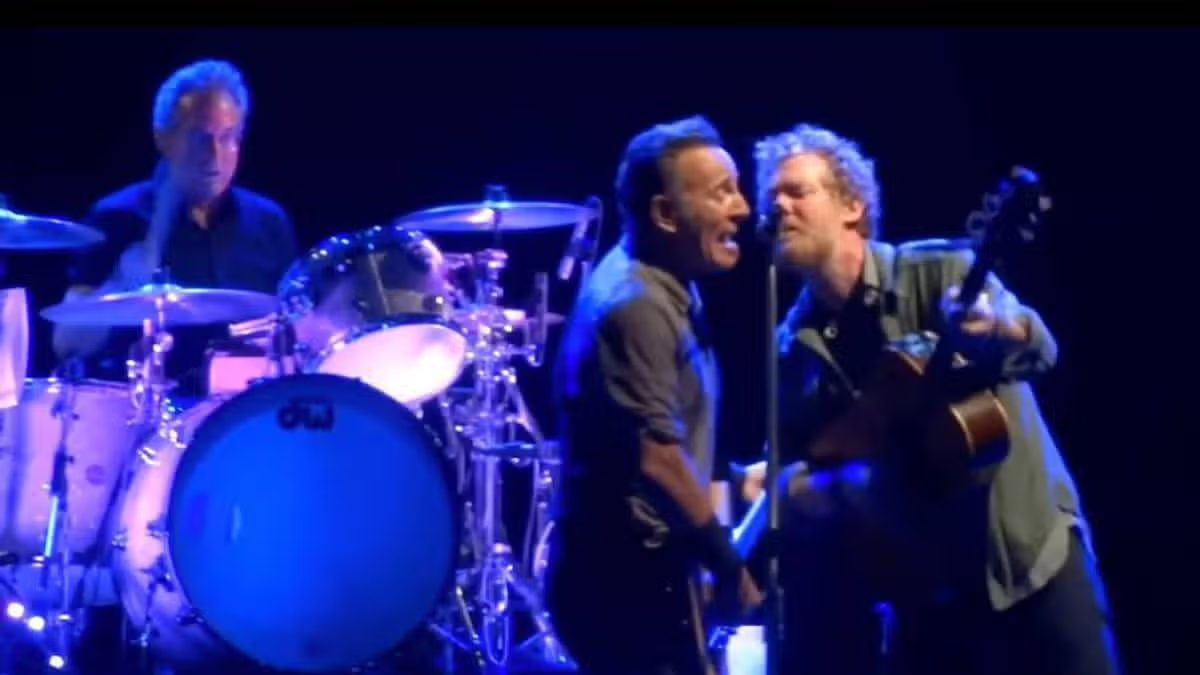
Around 8pm on Tuesday evening, Glen’s Instagram account shared footage of the singer performing alongside Bruce Springsteen in Kilkenny back in 2013. The Frames’ frontman joined the Boss to deliver the iconic track, Drive All Night.

Advertisement

The caption read: “This week in 2013 Glen had the honor [sic] of joining Bruce Springsteen and the E Street Band on stage in Kilkenny for ‘Drive All Night’, which Glen released his own version of later that year. Were you there?”

Glen appeared beaming with joy as he stood beside the legendary New Jersey rocker on stage. The pair shared a microphone, with Bruce wielding his trademark hybrid 1950s Fender Telecaster/Esquire, while Glen clutched his famous cedar-top Takamine NP15 acoustic guitar, nicknamed The Horse, slung with a high strap, reports the Irish Mirror.

The poignant two-minute clip radiates with raw emotion, Glen grinning as he delivers the song with a fervour and power that only the iconic star beside him could rival. Both Glen and Bruce pour their hearts into the performance – met with thunderous applause from the audience for the two musical legends.

Tributes poured in beneath the post from last night, with supporters reminiscing about cherished moments, but following confirmation of his passing, countless heartbroken fans arrived to express their sympathies.

Advertisement

Jedward wrote: “Rest in Peace Glen.”

Kilkenny vocalist Patrick Dowling posted: “Fly high Glen.”

Meanwhile, Dublin singer-songwriter Barra Donovan recalled a “brief but brilliant” exchange the two shared just two days prior.

He posted: “Rest in peace Glen, our brief but brilliant conversation two days ago in Whelan’s will stay with me forever. My condolences to your family and friends because I know that even in those few minutes we spoke, you were a gem. Your songs are the Dublin City soundscape.”

Advertisement

For all the latest news, visit the Belfast Live homepage here and sign up to our daily newsletter here.

Source link

Continue Reading

NewsBeat

Andy Burnham ‘told Donald Trump he will open up North Sea oil’ during phone call

Published

on

Daily Record

Speaking in the White House, the US President said if the Prime Minister followed through on his commitment the UK was “going to be a wealthy country”.

Donald Trump has claimed Andy Burnham told him that he was going to “open up North Sea oil”. Speaking in the White House, the US president said if the Prime Minister followed through on his commitment the UK was “going to be a wealthy country”.

Advertisement

Mr Trump also again warned that immigration is “killing” Britain, with “people coming from all over the world and just camping out”.

Following the phone call between the two leaders on Mr Burnham’s first day in office, Downing Street would not be drawn on any potential future plans for North Sea drilling after Mr Trump talked up a change in policy under Mr Burnham.

Mr Trump had lost a legal battle with the Scottish Government to stop a wind turbine development visible from his Aberdeenshire golf course. The US president, a vocal supporter of fossil fuels, has long championed the move as he has railed against “windmills”.

Labour’s 2024 manifesto said the party would not issue new North Sea licences. Referring to his conversation with Mr Burnham, Mr Trump said: “Well, he did say one very good thing.

Advertisement

“He said he’s going to open up North Sea oil. If he does that, you’re going to be a wealthy country.”

The president added: “They have two problems. They have a huge immigration problem – people coming from all over the world and just camping out in your country. He’s got that problem, and he’s got an energy problem.

“He’s got windmills all over the place, and any time you see windmills, you see a failing country. They’re made in China, not used by China, but they’re made in China.”

Advertisement

He went on: “You have one of the most valuable oil finds anywhere in the world, and if the United Kingdom would use it, they’d be a wealthy country again. And I tell you what, I could not get Starmer to use it. It was incredible.”

Mr Trump said: “You have your own oil and gas. If you use the North Sea, the UK will be a really rich country. I cannot get the point across. The new gentleman, when I spoke to him, he said he’s going to open up the North Sea. Let’s see if that happens.”

The president also argued Mr Burnham would have to tackle the issue of immigration. Mr Trump said: “He’s going to have to mention it because it’s killing your country. I know Starmer did very little about it, and they’re coming from all over the world.

“They’re coming from Africa, they’re coming from South America, they’re coming from different parts of Asia, and they’re invading Europe.” He indicated the UK was a “prime” destination.

Get more Daily Record exclusives by signing up for free to Google’s preferred sources. Click HERE

Advertisement

Source link

Continue Reading

NewsBeat

Hundreds of people in England have died before doctors diagnosed their tuberculosis

Published

on

Hundreds of people in England have died before doctors diagnosed their tuberculosis

Dave, a retired dockworker, has smoked since his teens. When he develops a persistent cough, he dismisses it as “just a smoker’s cough”.

Then he loses weight, develops fevers and wakes at night drenched in sweat. After several courses of antibiotics, he continues to deteriorate and is admitted to hospital.

Doctors find emphysema, a smoking-related condition in which damaged air sacs make breathing difficult. A chest X-ray also shows a white patch in his lung, raising concerns about cancer. A sample of sputum, the mucus coughed up from the lungs, is sent for further testing.

Dave dies before the laboratory identifies tuberculosis (TB).

Advertisement

Dave is fictional, but his story shows how easily TB can be missed when its symptoms resemble those of other illnesses. In a 2026 study, colleagues and I found that 574 people in England were diagnosed with TB only after death between 2010 and 2022. That is almost one person every week.

The people who died represented 0.8% of all TB diagnoses, but nearly one in five deaths recorded among people with TB. The data could not establish whether TB caused or contributed to each death.

TB is the world’s leading cause of death

TB is a bacterial infection that usually affects the lungs and spreads through the air. It remains the world’s leading cause of death from a single infectious organism. In 2024, an estimated 10.7 million people developed TB and 1.23 million died. Global progress has recovered from setbacks during the COVID pandemic, but remains too slow.

England cannot eliminate TB without international progress. In 2024, more than four in five people diagnosed in England were born outside the UK. This is sometimes presented simply as a migration issue. It instead reflects global inequalities in prevention, diagnosis and treatment.

Advertisement

TB also affects UK-born people and remains closely associated with poverty. Rates in England’s most deprived areas are more than five times those in its least deprived.

Homelessness, imprisonment, smoking and harmful alcohol or drug use can increase exposure, weaken the body’s defences or make healthcare harder to access. These factors all contribute to active TB disease.

England is close to losing its status as a low-incidence country, defined by the World Health Organization as fewer than ten cases per 100,000 people. Its rate reached 9.4 per 100,000 in 2024, following the largest annual increase since 1971.

Advertisement

Early diagnosis is vital. Globally, about one in five people who develop TB are not diagnosed, officially reported or treated. Many of these “missed millions” die. In England, the median interval between symptoms beginning and diagnosis of lung TB was 72 days in 2024.

During that delay, an infectious person may transmit TB while their illness worsens. Delays can also disrupt family and working life and create avoidable, sometimes catastrophic costs for people with TB, their households and health services.

The most extreme delay

A national study examined the most extreme delay: TB confirmed only after death. This meant a sample had been collected while the person was alive, but the result arrived later.

TB bacteria grow slowly, so traditional laboratory cultures can take several weeks. Rapid molecular tests, which detect the bacteria’s genetic material, can sometimes provide results much sooner, but doctors must first suspect TB.

Advertisement

The likelihood of diagnosis after death rose sharply with age. It was also higher among men, UK-born people, people with recorded harmful drug or alcohol use, those with TB outside the lungs and those diagnosed outside London.

Older UK-born people may have encountered TB during childhood, when infection was more common. The immune system can contain the bacteria for decades without symptoms. This is called latent TB infection. It can later become active, particularly when immunity weakens because of age, illness or medicines.

Smoking damages the lungs’ defences and increases TB risk. An older man with a cough and weight loss may therefore be investigated for cancer or chronic lung disease before TB is considered. Previous BCG vaccination – the childhood vaccine that was once routinely offered in the UK to protect against tuberculosis – does not rule it out. The vaccine protects young children against severe disease, but does not reliably prevent TB in adults.

TB outside the lungs can affect the lymph nodes, bones, bowel, kidneys, brain or other organs. Diagnosis may require scans or tissue samples. It is generally much less infectious than lung or throat TB, although people can have both forms.

Advertisement

People outside London were more likely to receive a diagnosis after death. Doctors in London may encounter TB more often and have better access to specialist services. Differences in reporting may also contribute. Our findings probably underestimate the problem because some people may die without being tested.

A diagnosis made only after death should be treated as an important patient-safety warning. TB deaths are not currently defined as a formal NHS “never event”, a term reserved for a small number of wholly preventable incidents. Based on our study findings, we recommend that each post-mortem TB diagnosis should prompt a review of symptoms, tests and referral decisions.

Public awareness also matters. A persistent cough, fever, drenching night sweats or unexplained weight loss deserves medical attention, regardless of age or birthplace. Healthcare professionals must consider TB even when cancer, pneumonia or chronic lung disease initially appears more likely.

Prevention must extend beyond detecting active TB disease. England offers some recent migrants testing for latent TB, but only 17% of those eligible were tested in 2024. Strategies should also consider historical exposure among older UK-born people.

Advertisement

England can learn from countries with much greater TB burdens. Lessons include reaching people at higher risk of being missed, such as the homeless, the poor and the socially excluded; reducing stigma; and making services easier to access.

Dave’s fictional laboratory result arrived too late. The next person with an overlooked cough should receive theirs while treatment can still help.

Source link

Advertisement
Continue Reading

NewsBeat

Care home resident jokes PM ‘changes every five minutes’ in meeting with Burnham | News Politics

Published

on

Care home resident jokes PM 'changes every five minutes' in meeting with Burnham | News Politics

To view this video please enable JavaScript, and consider upgrading to a web
browser that
supports HTML5
video

When you’re the Prime Minister, you are used to being recognised.

Advertisement

But this time around, the country is still catching up to having its fourth leader in five years.

One care home resident said what many in the nation are thinking about this revolving door, but straight to Andy Burnham’s face.

He told the new PM that the occupant of No 10 ‘keeps changing every five minutes’ in a hilarious exchange.

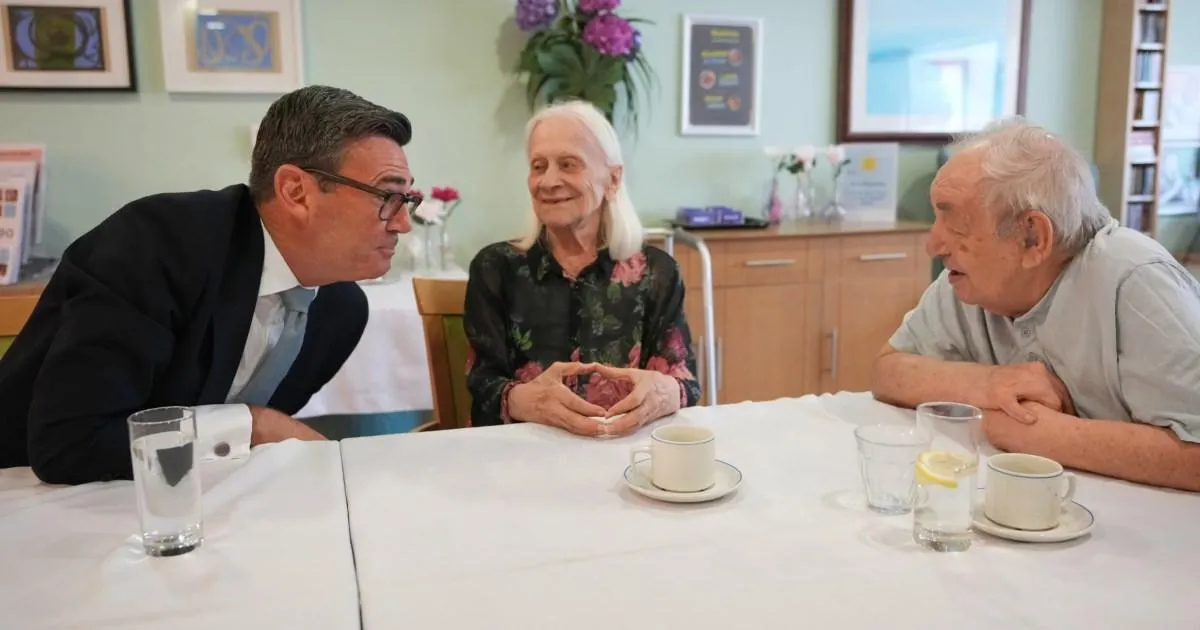
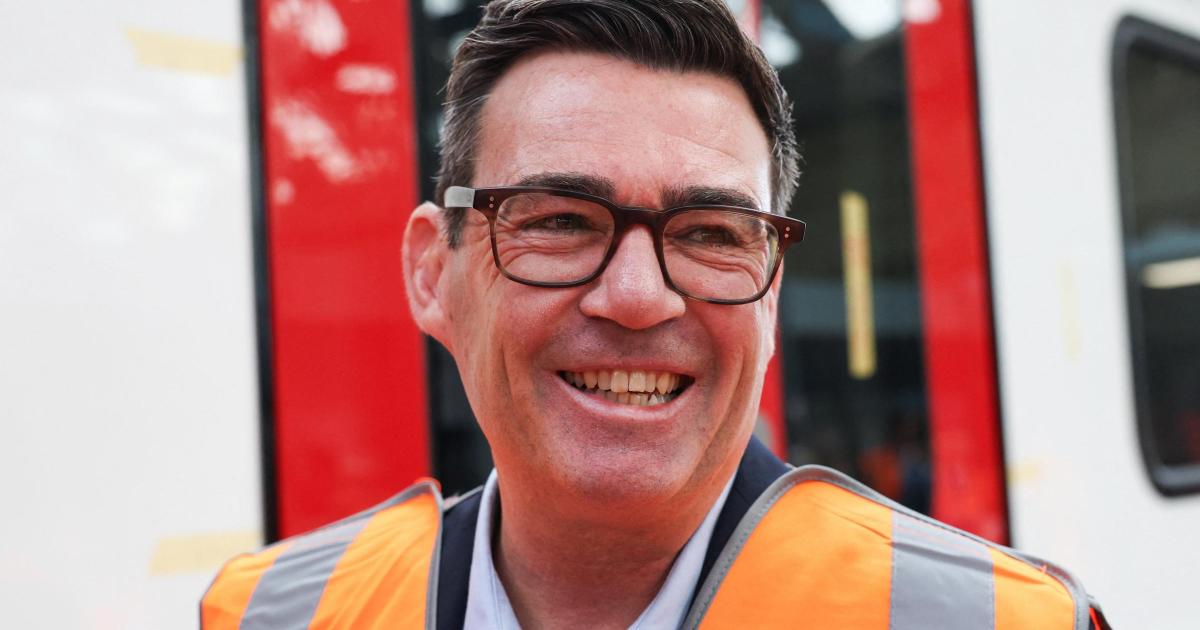
Burnham was touring a Jewish Care home in north west London as he introduced his new plans for social care in England.

Advertisement
Burnham met care home residents at Jewish Care in north west London (Picture: Kirsty Wigglesworth – WPA Pool/Getty Images)

Make sense of the mad world of British politics

Get analysis of the latest stories – including Andy Burnham’s rise to Number 10 – direct to your inbox from Metro’s Senior Politics Reporter Craig Munro. Sign up here.

Meeting residents, he met one man who wasn’t familiar with who he was.

Advertisement

He asked the Prime Minister: ‘You are the local candidate, are you?’

Burnham chuckled and referenced the recent Makerfield by-election he won in June.

He replied: ‘I was a local candidate; I had a by-election a few weeks ago. I am now the Prime Minister.’

Stunned, the care home resident asked: ‘You’re what?’

Advertisement

A nurse helped him out, telling him: ‘He’s the Prime Minister.’

The resident asked: ‘What, a new one?’

Seeing the funny side, Burnham joked: ‘Another one.’

His counterpart also saw the funny side, adding: ‘Well it keeps changing every five minutes.’

Advertisement

Burnham answered with a smile: ‘I know.’

The country has had seven Prime Ministers in the 10 years since the 2016 Brexit referendum.

After only two years in office, Keir Starmer quit in June and was replaced by Burnham this month.

One of his first acts as Prime Minister has been a pledge to end a decade of government inaction of fixing social care in England.

Advertisement
LONDON, ENGLAND - JULY 29: Britain's Prime Minister Andy Burnham speaks to residents, care workers, volunteers and social care stakeholders during a care home visit on July 29, 2026 in London, England. (Photo by Kirsty Wigglesworth - WPA Pool/Getty Images)
Burnham made an emotional speech fixing social care (Picture: Kirsty Wigglesworth – WPA Pool/Getty Images)

Speaking at the care home this afternoon he said it had been a ‘major dereliction of public duty’ that previous governments had not addressed the crisis.

He plans to introduce a new national care service and wants care workers to have better pay and training.

In a sign of his determination to fix the sector, he said a landmark review of social care by Baroness Casey would be published next summer, instead of 2028.

Burnham admitted his plans for social care ‘will require difficult decisions’ that he said would be ‘put before the country’ for the people’s consent.

This afternoon he also held talks with the Lib Dems and Conservative Party to generate cross-party backing for his plans.

Advertisement

Get in touch with our news team by emailing us at webnews@metro.co.uk.

For more stories like this, check our news page.

Source link

Advertisement
Continue Reading

NewsBeat

Armed police respond to ‘dog attack’ as three taken to hospital

Published

on

Daily Record

An air ambulance was called to the scene as three people were taken to hospital following a dog attack in Bolton

Three individuals have been rushed to hospital this afternoon (July 29) following a suspected dog attack in Bolton.

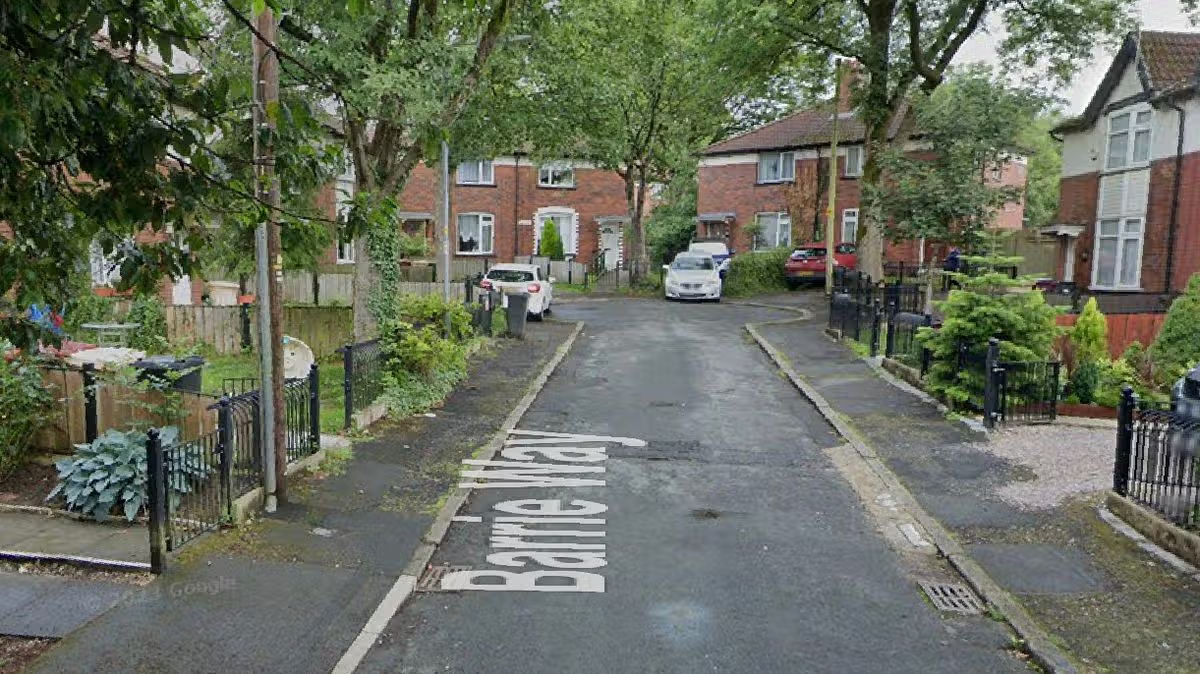
Greater Manchester Police confirmed they received a call just before 3:30pm reporting a dog bite incident at a property on Barrie Way.

Advertisement

An air ambulance touched down at Hall i’ Th’ Wood, with paramedics working alongside police dog units and armed officers at the scene.

Officers confirmed that three victims were transported to hospital by ambulance and that a dog had been seized, though its breed remains unknown at this stage, reports the Manchester Evening News.

Armed police were spotted entering the property, accompanied by a dog handler who removed the animal and secured it in an animal transport van.

GMP stated that investigations remain ongoing and no arrests have been made.

Advertisement

In an official statement, a spokesperson said: “Officers were called just before 3.30pm on Wednesday 29 July 2026 to a report of a dog bite at an address on Barrie Way in Bolton.

“Emergency services attended and three people have been taken by ambulance to hospital.

“One dog has been seized. No arrests have been made and enquiries are ongoing.”

Ensure our latest stories always appear at the top of your Google Search by making us a Preferred Source. Click here to activate or add us as your Preferred Source in your Google search settings.

Advertisement

Source link

Continue Reading

NewsBeat

Burnham urges voters to back Bev Craig in mayoral election

Published

on

Burnham urges voters to back Bev Craig in mayoral election

The by-election, which will be the biggest in UK history with more than two million people eligible to vote, was triggered after Mr Burnham resigned from the post earlier this year as part of his plan to become Prime Minister.

He was elected as the Labour MP for Makerfield in June before taking over from Sir Keir Starmer this month.

Seven candidates are standing to succeed Mr Burnham, including Ms Craig for Labour, Phil Eckersley for the Conservatives, Geraldine Coggins for the Green Party, and Sian Astley for Reform UK.

(Image: NQ)

Liberal Democrat Richard Kilpatrick is also standing, alongside Restore Britain’s Marlon West and independent candidate Marcus Farmer.

Advertisement

Residents of Bolton, Bury, Manchester, Oldham, Rochdale, Salford, Stockport, Tameside, Trafford, and Wigan will be able to have their say on Thursday.

Mr Burnham came first in all 10 areas in 2017, 2021, and 2024.

Speaking ahead of polling day, he said serving as mayor for nearly a decade was an “immense privilege”.

He added: “After years working alongside Bev Craig, I have no doubt that she will work every single day to build on the progress we’ve all made together.

Advertisement

“Bev will focus on putting more money in your pocket, giving families more breathing space on the cost of living, and making sure young people across every borough have the opportunities they need to thrive.

(Image: The Labour Party)

“Bev will do this by working in lockstep with every community across our city region so we can shape our future together.

“She is the only candidate who will make sure every town, every borough, and every person shares in Greater Manchester’s success.

“Together, for our future, vote Bev Craig today to be our next mayor of Greater Manchester.”

Advertisement

Labour’s Ms Craig is the leader of Manchester City Council.

Bev Craig, commenting ahead of polls opening in the Greater Manchester Mayoral By-election, said: “I’m proud to call Greater Manchester home, and I know our best days are still ahead of us – but only if we keep moving forward together, face up to our biggest challenges, and make life better for everyone. That’s why, today, I am asking you to choose hope and vote Labour.”

Reform’s Ms Astley and Lib Dem Mr Kilpatrick also sit on the council.

(Image: Supplied)

Both Conservative Mr Eckersley and the Greens’ Ms Coggins are Trafford councillors.

Advertisement

Ms Coggins argued Greater Manchester needs “full-fat devolution, not semi-skimmed”, adding: “Labour in Greater Manchester has been a developers’ paradise, handing over large sums of money to developers to build unaffordable flats.

“I will be demanding powers to take them back and to impose tough financial penalties for land banking.”

Mr Eckersley has previously said “as a business owner, father and local councillor, I understand the challenges facing families, businesses, and communities across our city-region”.

(Image: Phil Eckersley)

Restore’s Mr West works as a mental health nurse but he was given an 18-month suspension earlier this month by the Nursing and Midwifery Council (NMC) following comments he made on social media about sexual grooming by Pakistani men.

Advertisement

Mr West has co-written a book, In Plain Sight, with his daughter, Scarlett, about rape and sexual abuse she suffered at the hands of Asian men.

Restore Britain’s leader, Rupert Lowe, said Mr West “is the best qualified candidate for any mayoral race for a very long time”, adding: “He has lost so much in his fight, including just being struck off nursing because he spoke out about his daughter’s rape.

(Image: Restore Britain)

“It’s scandalous.”

Mr Farmer, an independent candidate, previously stood against Mr Burnham in 2021, receiving just under 1% of the vote.

Advertisement

He also stood in 2017.

Polls will open at 7 am and close at 10 pm on Thursday.

Votes will not be counted until Friday, with the result likely to be announced in the afternoon.

It is the first time a by-election has been necessary to fill a vacancy for one of England’s combined authority mayors.

Advertisement

The cost of the contest is expected to run into the millions, with the 2024 mayoral election costing the taxpayer £4.7 million.

In 2024, Mr Burnham won by 63%, with 420,749 of the 663,631 valid votes cast in his favour across the 10 authorities.

The Conservatives followed in second place with 10%, an independent candidate was third on 50,304 (8%), Reform UK fourth on 49,532 (7%), the Greens fifth on 45,905 (7%), and the Liberal Democrats sixth on 28,195 (4%).

Mr Burnham was elected in a first-past-the-post (FPP) system in 2024, the same method of voting used in UK general elections, where the candidate with the most votes is declared the winner.

Advertisement

This week’s by-election is using the supplementary vote (SV) method, which was used in both 2017 and 2021.

Labour passed legislation earlier this year to return to the SV system.

Under this, voters mark their ballot papers with a first and second choice.

If any candidate wins more than 50% of the first-choice votes, they are declared the winner.

Advertisement

But if no candidate has more than 50% of first-choice votes, all but the top two candidates are eliminated and the count moves to a second round.

The ballot papers of the eliminated candidates are counted again and if there are any second-choice votes for the two remaining candidates, these are added to their first-choice totals.

The candidate with the highest overall total of first and second-choice votes is declared the winner.

Voters do not have to mark a second choice on their ballot papers, but they must mark a first choice or else their vote will not be counted.

Advertisement

Source link

Continue Reading

NewsBeat

British Airways jet ‘seconds from disaster after stalling above London’ in UK’s ‘most serious near miss in years’

Published

on

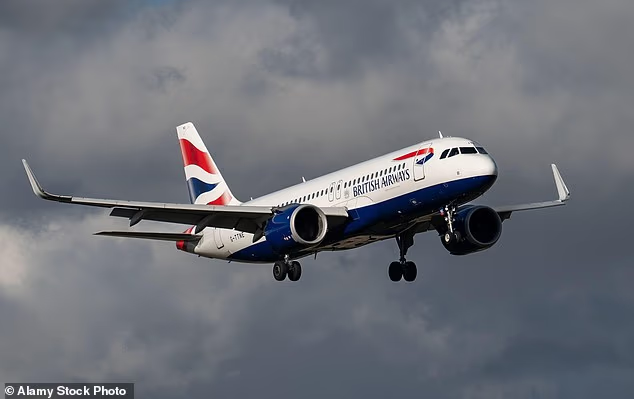
A British Airways Airbus A320 was allegedly seconds away from disaster after a pilot botched a landing and stalled while 4,000ft above London (stock photo)

Advertisement

A British Airways plane was seconds away from disaster after a pilot botched a landing and stalled while 4,000ft above London, it is understood. 

The aircraft’s captain was reportedly forced to intervene and recover the near miss, described as the greatest of its kind in years, while the Airbus A320 descended into Heathrow Airport.

The incident is said to have unfolded on Flight BA919 from Dusseldorf on July 6 as the 180-passenger heavy aircraft flew over Canary Wharf, east London. 

It is understood the chain of events was sparked after one of the plane’s air data systems, which tracks critical flight information such as airspeed, failed. 

Advertisement

This prompted the British Airways (BA) aircraft to stall, meaning the loss of altitude and control, while above the capital’s finance district. 

Unlike a car, the stalling of an airplane does not result in the engine stopping. 

Instead, the wings lift to such a level that the weight of the plane is no longer supported, causing the aircraft to be at risk of plunging into a nosedive. 

The first officer is believed to have tried to solve the issue, however, the captain was compelled to physically intervene after their colleague’s attempt failed.

Advertisement

A British Airways Airbus A320 was allegedly seconds away from disaster after a pilot botched a landing and stalled while 4,000ft above London (stock photo)

Sources described the believed error as: ‘The most serious “near miss” in the UK in years’. 

Meanwhile, the circumstances in which a captain has to physically step in to help fix a potential issue is ‘unheard’ of within the industry. 

Advertisement

Experts told The Sun the situation could have resulted in ‘hull loss’, where an aircraft is destroyed or seriously damaged.

It is understood the captain is now on ‘stress leave’.

The episode was reported as ‘Loss of Control In-flight’ and branded as ‘Pilot Induced’. 

The Air Accidents Investigation Branch are reportedly investigating the ‘serious incident’. BA told The Sun they are cooperating with the investigation.

Advertisement

BA operates around 19 direct flights per week between Dusseldorf Airport and London Heathrow, with a flight duration of 1hr 30 minutes. 

British Airways has been contacted for comment.  

Advertisement

Source link

Advertisement
Continue Reading

Trending

Copyright © 2025