Reading books, walking and bike riding are among the secrets of a long and healthy life, say residents in the English neighbourhoods with the longest life expectancy.
But people in the worst place, Blackpool – where men die an average of 10 years earlier – bemoaned drug abuse, cheap booze and fast food, as well as poor housing.
In the areas where people lived longest, residents told the Daily Mail how there are more activities and facilities such as leisure centres and libraries to keep people active physically and mentally as they got older.
There were also better shops selling a good range of healthy food, as well as easy access to medical services and GP appointments.
Locals in the healthiest places praised green space, parks and countryside giving opportunities for exercise and spending time outdoors in pleasant environments.
Analysis by The King’s Fund published this week found the Lancashire seaside resort has the lowest life expectancy of anywhere in the country, at 73.7 years for men and 79.1 years for women.
The health and social care think tank’s study also found there was low life expectancy across the former industrial and urban areas of northern England – although life expectancy shot up in rural and more affluent parts of the North.
Meanwhile, in Hampshire’s prosperous Hart district – which has previously been voted the best place to live in a national survey – life expectancy averages 83.7 years for men and 86.2 years for women.
Blackpool: Analysis this week found the Lancashire seaside resort has the lowest life expectancy of anywhere in the country, at 73.7 years for men and 79.1 years for women
Kensington: In the London borough, women can expect to live even longer, averaging 87.1 years, while the figure is 82.2 for men
In Hart, life expectancy averages are 83.7 years for men and 86.2 years for women. Jane Nicholson, 60, said there were plenty of active spaces, a golf club, leisure centres – and great healthcare
In the London borough of Kensington and Chelsea, women can expect to live even longer, averaging 87.1 years, while the figure is 82.2 for men.
Life expectancy is also very high in areas such as the Uttlesford district of rural Essex, where it averages 86.4 years for women.
Residents of Britain’s top borough for living a long life praised the area’s green spaces, places for walking and cycling – as well as good healthcare and opportunities for older people to keep active.
Hart, centred around the town of Fleet, has been ranked near the top of the Halifax Quality of Life Survey on several occasions, coming top in 2012 and third in 2020.
Much of the area remains rural – despite large-scale housebuilding – and facilities for sport and leisure have been rated ‘excellent’.
Residents of the district also reported higher than average levels of life satisfaction – 8.2 out of 10, compared to 7.8 for the UK in general. Employment levels were also significantly higher for Hart at 87.2 per cent, compared to 75 per cent for the rest of the country.
In data from the 2021 census, 54.8 per cent of people reported being in ‘very good health’, placing Hart in the top 20 per cent for local authority areas across the UK.
But the cost of buying a home in the district is 4.5 times that of Blackpool, with provisional Office for National Statistics data from May showing the average home in Hart cost £487,000, compared with £134,000 in Blackpool.
Adrian Mann, 79, moved to the Hart area from London 18 months ago. He said: ‘When we moved to Fleet, we really noticed the difference.
‘There are always people in their 80s walking around the town centre. The cemetery is also full of people who have lived well into their 90s – a good age.
‘I think this is down to the clean air. There are also lots of walks, parks and also the pond. There are quite a lot of churches, the library as well – it has the facilities for older people.’
Mr Mann’s partner, who wished to remain anonymous, said: ‘I hadn’t been well before we moved here and then suddenly after living in the area, my symptoms completely went.
‘I put it down to the clean air. With the number of trees, it is basically the countryside. People are encouraged to get out and about in Fleet.
‘The medical care is good and there are a lot of organisations for older people which get them out of their houses.’
Retired solicitor Robert Cook, 79, and his wife Linda, 84, have lived in Fleet for 35 years during which they say it has undergone a huge population increase and independent retailers have closed – but it remains ‘very pleasant’.
Mr Cook said: ‘To stay healthy, we try to go out most days; we don’t stay at home watching the telly all day. We often go out to Waitrose, M&S and some of the other shops.
‘You see a lot of the older population around the town. People come to retire here. Hart in general is very pleasant.’
Mrs Cook added: ‘The healthcare in the area is excellent. There are a few practices in Fleet and you can get an appointment often on the same day or the following day.’
Charlotte Dando, 44, moved to Hart with her mother Christine Swain, 82.
She said: ‘I love living here. We’ve been here seven years, and we moved from Camberley. The schools are great. We are in walking distance from the town.
‘My mother moved here too and she lives in an annex in our garden. We are not surprised at all that people here live the longest in the UK. There’s lot going on – all the parks, there are also really good cycle paths. You can cycle down the canal. My husband cycles to work. There are just a lot of outdoorsy things on your doorstep.’
Blackpool: Analysis this week found the Lancashire seaside resort has the lowest life expectancy of anywhere in the country, at 73.7 years for men and 79.1 years for women
Retired solicitor Robert Cook, 79, and wife Linda, 84, have lived in Fleet for 35 years
Residents in Blackpool bemoaned a ‘shocking’ string of social problems for contributing to low life expectancy
Hart, centred around the town of Fleet, has been ranked near the top of the Halifax Quality of Life Survey on several occasions, coming top in 2012 and third in 2020
Kensington: Residents of Britain’s top borough for living a long life praised the area’s green spaces, places for walking and cycling – as well as good healthcare and opportunities for older people to keep active
Mrs Dando said she believes diet and exercise help keep people healthy, with walking ‘massively important’. She also praised the availability of health food shops and places selling fresh and organic foods.
Jane Nicholson, 60, said: ‘Hart is a lovely area to live in and it’s been known to be so for quite a long time.
‘In terms of active spaces, there is North Hants golf club just down the road. There are also leisure centres. The healthcare is also great. I have always had a good experience.’
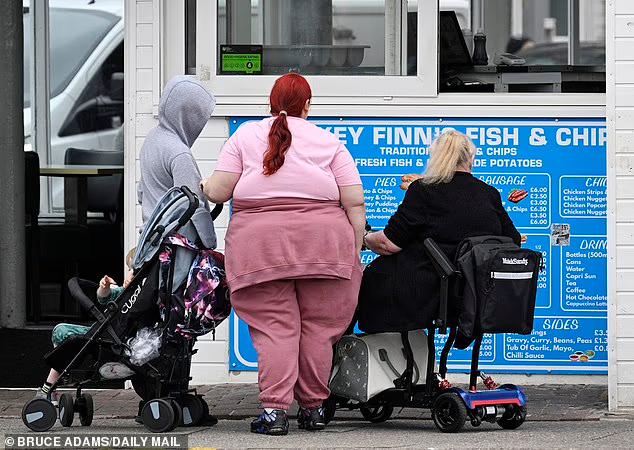
In contrast, residents in Blackpool bemoaned a ‘shocking’ string of social problems for contributing to low life expectancy.
Locals claimed to have seen drug addicts shooting up heroin in the street as well as drunk homeless people passed out.
The area also has a chronic shortage of NHS dentists – with one man admitting he had to pull out four of his own teeth.
Cheap fast food shops in the Lancashire tourist mecca sell burgers for £1, while pubs advertise pints of beer for as little as £1.69.
Expectant mother-of-one Tegan Milner, 23, said: ‘Some of the things you see are shocking.
‘There’s a lot of drunk people fighting in the street which has led to stabbings.
‘I don’t feel safe going out at night. I just go out in the day.’
The former hotel worker added: ‘You also see a lot of drug taking.
‘I saw one druggie take out a needle and inject himself with heroin right in the middle of the street in the middle of the day.
‘You don’t want to see that and I don’t want my kids around it.’
Plasterer Jamie Hornby, 54, who was out walking his dog Skye, said: ‘It doesn’t surprise me the life expectancy is so low here.
‘There’s a lot of drug taking and homeless people drunk in the street.
‘They have cleaned up the sea front but you see a lot of druggies around the public toilets.
‘And having lots of cheap fast food doesn’t help.
‘I keep fit taking the dog for a walk every day but a lot of people don’t look after themselves.’
Pensioner Colin Stead, 65, said: ‘You see a lot of poverty here but is pretty devastating.
‘A lot of people can’t afford to buy healthy food or they just buy cheap stuff.
‘Prices have gone up all the time and people have struggled to make ends meet.’
Retired John Ellis, 66, said: ‘Blackpool has a lot of problems.
‘There are a lot of cheap drugs and alcohol sold which doesn’t help. Some of the housing is very poor – it’s also very cheap.’
The health of the local population has not been helped by a dearth of NHS dentists.
Father-of-four Andrew Abernethy, 45, revealed he had been forced to pull out four of his own teeth.
He said: ‘I couldn’t get a dentist and so I just did it myself. I just got a pair of pliers and pulled them out.
‘Fortunately, I have a high threshold for pain but you don’t really want to have to do it yourself.
‘There’s a lot of problems in Blackpool – I blame the government for a lot of it.’
Some 250 miles south, people on the streets of Kensington espoused the benefits of exercise, keeping mentally active and a healthy diet.
Chrissie Fraser, 77, said: ‘I continue with my healthy outlook like going out walking, being careful with my diet, and I don’t really drink.
‘Probably the secret for everybody is if they go and read a few more books.
‘(For) every individual person, it’s nothing to do with access, it’s to do with what’s going on in your head.
‘You can now access the most fantastic information that I didn’t have as a girl. It was the library and my bicycle, I think the answer is a book and a bike.
‘It’s cheaper to eat well, isn’t it? I think it’s to do with who you think you are, I think it’s a bit more about the individual.’
She added: ‘I would be happier mentally [in the north] because it’s cheaper to live there. If I sold my flat in Kensington, I could buy something spectacular in Newcastle. So my mental well-being would probably be quite good, the only thing is I don’t want to go to Newcastle.’
Some people in Kensington were surprised northerners weren’t more healthy given their better access to outdoor space.
The health and social care think tank’s study also found there was low life expectancy across the former industrial and urban areas of northern England – although life expectancy shot up in rural and more affluent parts of the North. Pictured, Blackpool
Marion Bennett, 70, said: ‘They should be healthier (in the North) shouldn’t they?’
She said she would have expected northerners to be healthier because of ‘better access’ to outdoor space.
Ms Bennett, who used to play netball, tennis and go skiing, added: ‘I do a tremendous amount of walking, I think it stands you in good stead for your later life.
‘Make sure you get your vegetables every day, I’m not so good at drinking water though.’
A healthy diet was important for Francis Ley, 79, who said: ‘I would recommend organic stuff, apples, pears, oranges, blueberries, potatoes, tomatoes, everything that’s organic.
‘Years ago, everything used to be organic before pesticides, and then that came but now they’re going back to organic.
‘But they’re having to pay more now because the earth now is saturated with the so-called chemicals. It’s fast living.
‘That’s why a lot of people are ill and sick because when you go into fast food restaurants, it’s all fried.’
But Lawrence Oji, 73, admitted he could improve his lifestyle as he ‘hardly exercises’ which he knows is ‘not good’.
He said: ‘Only my youngest daughter is particular about what she eats. She’s in a boarding school and she’s so concerned about it. She drinks up to two litres of water every day, I don’t.
‘I’m shocked to hear that people in London live longer because (in the North) you get less pollution, you get more greenery, you get more trees and all that so I would’ve thought it was the other way around.’
And Matthew Martin, 62, who lives in a housing association flat in Earl’s Court but was homeless at one time, said that even with a ‘very small amount of money’ a healthy diet is possible.
He said: ‘I’ve been homeless myself and I know with a very small amount of money you can buy eggs, pasta, tomatoes, you can make soup. It’s not a grand living but you can live reasonably well.’
Paul Edwards, 53, a father of two from Maidstone, Kent, who was visiting Kensington, said he paid attention to his health.
He said: ‘I take supplements, go to the gym and try to avoid saturated fats, salts and all that.
‘My mum’s family’s from Cumbria so I’m quite aware of the difference between housing and lifestyle between northern and southern communities.
‘When I visit there I know exactly the difference and I feel really fortunate to live in south-east, though it feels crowded and overpopulated at times, the standard of housing is better and the awareness of healthy lifestyles, in my opinion, is more prevalent in the southeast than it is up there.’
The King’s Fund said life expectancy in England in 2025 reached the highest levels ever recorded, but the gains in longevity were not shared equally.
It said geographical inequalities reflect socio-economic inequalities and greater levels of deprivation in northern regions – and called the problem a ‘mark of shame’.
People living in the most deprived 30 per cent of areas experienced a fall or no improvement in life expectancy in the decade to 2022-24. And geographical and socio-economic inequalities in life expectancy have been widening since 2010, and people in all regions spend fewer years in good health.
Veena Raleigh, Senior Fellow at The King’s Fund said: ‘That people in our northern and deprived communities have seen little or no improvement in longevity over a decade, in contrast to the health gains in their southern and more well-off counterparts, is a mark of shame for an affluent country.
‘Addressing this inequity in the nation’s health is not just a matter of social justice, it would reduce pressures on the NHS and the high economic costs of ill health.’
























































You must be logged in to post a comment Login