

Crypto World
Who wins the $114 trillion tokenization race



They were born from the same code and the same founder, and now they are competing for a slice of what could become the largest market in finance.
Summary
- XRP and Stellar share the same origin but now compete through very different institutional strategies.
- XRP leads in payments, ODL volume, regulatory clarity, and ETF access.
- Stellar owns the bigger tokenization headline after DTCC chose it for tokenized securities infrastructure.
- Both tokens still face the same value-capture problem: network adoption does not automatically create token demand.
XRP and Stellar both trace back to Jed McCaleb, who co-founded Ripple and then left to create Stellar in 2014. A decade later, the two networks are the leading crypto contenders to become the settlement infrastructure for tokenized real-world assets, a market that bulls size at up to $114 trillion as stocks, bonds, funds, and Treasuries move on-chain.
In 2026 each landed a defining win. XRP has the CLARITY Act advancing through the Senate, spot ETFs with $1.41 billion in cumulative inflows, and live cross-border payment volume that generates direct token demand today. Stellar secured the single biggest institutional endorsement any of these tokens has received: a deal with the DTCC, the backbone of US securities settlement, to bring tokenized stocks, ETFs, and Treasuries directly onto its network. So who wins?
The honest answer is that they are winning different races, and the question that actually matters for investors is which catalyst pays off first. This piece compares them head to head across payments, tokenization, regulation, and token value capture, and lays out how to think about the contest.
Same roots, different bets
The shared origin story matters because it explains why these two networks are so similar and yet have diverged so sharply in strategy.
Jed McCaleb co-founded Ripple and helped create the technology that became the XRP Ledger. In 2014 he left after disagreements over direction and founded Stellar, building a network with deep technical similarities: both are fast, cheap, energy-light payment ledgers with native tokens, both use a consensus model rather than mining, and both were designed from the start for moving value across borders rather than running complex smart contracts. If you squint, XRP and Stellar are siblings, which is exactly what they are.
The divergence is in who they decided to serve. Ripple aimed XRP and the XRP Ledger squarely at banks and large financial institutions, building enterprise infrastructure, pursuing regulatory clarity through litigation and legislation, and selling directly to the commercial cross-border payments market. Stellar, through the nonprofit Stellar Development Foundation, leaned toward financial inclusion, emerging-market access, and partnerships with issuers and institutions willing to build on open infrastructure, with a stronger emphasis on stablecoins and asset issuance than on being the bridge currency itself.
Those different bets set up the 2026 contest. XRP went deep on commercial payments and US regulatory legitimacy. Stellar went deep on becoming a neutral issuance platform that established financial institutions could use to put real-world assets on-chain. Both strategies are now paying off, but in different arenas, which is why declaring a single winner misunderstands the race.
The payments race: XRP is ahead
On the original battleground, cross-border payments, XRP is winning on the metrics that exist today.
Ripple’s On-Demand Liquidity network has real, growing volume. Cumulative Ripple Payments volume crossed $95 billion as of January 2026, the network spans more than 70 currency corridors, and it covers an estimated 80 percent of major global remittance routes. The heaviest volume runs through corridors like Japan, the Philippines, and Mexico, where legacy banking costs are high and demand for fast, cheap remittances is constant. Crucially for the token, ODL builds direct XRP demand into every transaction it touches, because the model uses XRP as the bridge asset converted on each side of a payment. ODL volume is projected to grow 30 to 50 percent in 2026.
Stellar competes in payments too, with a long history in remittances and a partnership with MoneyGram that put it on the map for cash-to-crypto access. But it has not matched XRP’s commercial depth in bank-facing cross-border settlement, and its token does not capture payment flows the way XRP’s ODL does, because Stellar’s model leans more on stablecoins moving across the network than on the native token serving as the universal bridge.
So in payments, the scoreboard favors XRP: more volume, more corridors, deeper bank relationships, and a token-demand mechanism wired directly into the payment flow. If the tokenization race never materialized and the contest were purely about moving money across borders, XRP would be the clear leader. But the tokenization race is materializing, and that is where Stellar landed the bigger blow.
The tokenization race: Stellar’s DTCC bombshell
In tokenized securities, the infrastructure for putting stocks, bonds, and funds on-chain, Stellar secured the endorsement that reframes the entire competition.
The DTCC, the Depository Trust and Clearing Corporation, is the unglamorous but enormously powerful backbone of US securities settlement, the entity through which a vast share of American stock and bond trades clear. Its plan to bring tokenized stocks, ETFs, and Treasuries directly onto Stellar is, by a wide margin, the most significant institutional validation any payment-focused token has received. This is not a fintech startup or a single bank running a pilot. It is the central plumbing of US capital markets choosing Stellar as a venue for tokenized assets. For a network competing to become RWA settlement infrastructure, there is no bigger reference customer.
Stellar’s broader RWA credentials reinforce it. Franklin Templeton’s tokenized money-market fund has operated on Stellar, giving it a track record with a major traditional asset manager, and over a billion dollars in real-world assets had been tokenized on the network heading into 2026. The DTCC deal sits on top of that foundation as the marquee endorsement.
The critical caveat is timing. DTCC’s production testing does not begin until July 2026, and broader availability is not targeted until 2027. So the token-demand implications are still months, possibly more than a year, away. A landmark announcement is not the same as live volume, and Stellar’s win is currently a promise of future activity rather than present flow. That timing gap is the single most important qualifier on the Stellar bull case, and it is why the race is not over despite the size of the endorsement.
The regulatory and ETF race: XRP’s structural edge
Beyond payments and tokenization, two more factors tilt the near-term contest, and both favor XRP.
The first is regulation. The CLARITY Act passed the Senate Banking Committee on May 14 and, if it becomes law, would permanently write XRP’s commodity classification into federal statute. This matters more than it might sound. The March 17 SEC-CFTC interpretive ruling already gave XRP commodity status, but an agency ruling can be reversed by the next administration, whereas a law cannot. Codified commodity status would remove the last major regulatory blocker for US banks adopting XRP-based ODL and for the broadest range of XRP ETF products. XRP has spent years and a landmark lawsuit earning regulatory clarity, and it is closer to locking it in permanently than any comparable token.
The second is ETF access. Spot XRP ETFs have already drawn $1.41 billion in cumulative inflows, giving institutions a regulated, familiar channel to gain XRP exposure. That infrastructure exists today and is accumulating capital, even if the flows have not moved the price dramatically. Stellar does not have a comparable ETF presence, so XRP holds a structural advantage in institutional accessibility through regulated wrappers.
Put the near-term factors together and XRP leads on three of four fronts: payments volume, regulatory clarity, and ETF access, with Stellar leading decisively on the tokenization endorsement. That scoreboard explains why XRP is the larger, more liquid, more institutionally embedded asset today. But it also sets up the deeper question that determines the long-run winner, and on that question both tokens share the same vulnerability.
The problem both share: value capture
Here is the twist that complicates any simple “who wins” verdict. Both XRP and Stellar face the same fundamental challenge, and it is the one that has kept both tokens’ prices subdued despite their adoption wins.
For XRP, the problem is that banks can use the XRP Ledger without necessarily buying the token. Tokenized assets and stablecoins can sit on and move across the ledger while the activity requires only a fraction of a cent of XRP for transaction fees, not meaningful token purchases. The ledger thrives while the token waits.
For Stellar, the problem is structurally identical and arguably worse in the tokenization context. When the DTCC or Franklin Templeton issues tokenized securities on Stellar, the operation does not require holding XLM beyond trivial transaction costs. The network gets the prestigious business and the settlement volume; the token captures very little of it directly. A tokenized Treasury settling on Stellar generates network activity, but it does not create the kind of XLM buy pressure that would move the price the way the endorsement’s size suggests it should.
This is the shared trap of payment-and-settlement tokens: the more successful they are as neutral infrastructure that institutions adopt without friction, the less those institutions need to touch the native token. XRP’s ODL bridge mechanism is actually the stronger of the two value-capture stories, because it does require buying XRP for each bridged payment, which is why XRP’s payments lead matters for the token specifically and not just for the ledger. Stellar’s tokenization win is larger in prestige but weaker in direct token demand, because tokenized-asset issuance on Stellar does not inherently require XLM. So the race has a paradox at its core: the win that is bigger for the network (Stellar’s DTCC deal) may be smaller for the token, while the win that is more modest in headline terms (XRP’s growing ODL volume) is more directly tied to token demand.
So who actually wins?
The cleanest way to answer is to separate the question into the parts that have different answers, because “who wins” depends entirely on what you are measuring and over what horizon.
On commercial cross-border payments right now, XRP wins. It has the volume, the corridors, the bank relationships, and a token-demand mechanism built into the payment flow. This is a present-tense lead backed by real numbers.
On tokenized securities infrastructure over the long run, Stellar has the stronger position after the DTCC endorsement, the single biggest institutional validation in the space. But this is a future-tense lead, with production testing starting in July 2026 and broad availability not until 2027, so it is a bet on a payoff that has not arrived.
On near-term catalysts and token accessibility, XRP wins, with the CLARITY Act advancing, codified commodity status within reach, and $1.41 billion already in ETFs. The factors most likely to move a token price in the next year favor XRP.
On the deepest question, which token actually captures the value its network creates, neither has solved it, and XRP’s ODL bridge gives it a modest structural edge because that specific mechanism requires buying the token.
The practical synthesis for an investor is that the more important question is not “which is better” but “which catalyst arrives first.” XRP’s catalysts, CLARITY passage, continued ETF accumulation, and ODL growth, are nearer-term and more directly tied to token demand. Stellar’s catalyst, the DTCC tokenization rollout, is larger in scale but further out and less directly tied to XLM demand. An investor who wants exposure to the tokenization thesis with a payoff that could land sooner and flow to the token leans XRP. An investor willing to wait years for what could be the bigger institutional prize, and who believes Stellar will eventually solve the value-capture gap, leans XLM. Both are betting on the same enormous market. They are just betting on different paths into it, on different timelines, with different odds that the token rather than just the network gets paid. That, not a single winner, is the real shape of the $114 trillion race.
This article is for informational purposes and does not constitute financial or investment advice. Cryptocurrency markets are highly volatile. The figures and analysis described reflect data available as of June 5, 2026. Always do your own research and consult with qualified financial professionals before making investment decisions.


In such times of distress where all crypto assets head south, including the largest altcoin, the retail public generally turns to more experienced and prominent names to look for support.
In an interesting development, though, one of the key crypto figures with a long connection to Ethereum, ConsenSys co-founder Joseph Lubin, has made a large ETH transfer after years of inactivity, which stirred the pot rather than calming the public.
Is Lubin Dumping ETH?
Lookonchain shared data showing that the transfer occurred just hours ago, in which Lubin sent out 80,001 ETH (valued at over $121 million). This wallet linked to him has been inactive for over three years, and the timing now is what raised so many questions.
Some asked why he didn’t sell at the very top last year when the asset neared $5,000 for the first time ever. Others believed retail investors might follow the example in what appears to be a capitulation event.
However, there were those who noted that Lubin simply needs to cover his leveraged trades on other platforms, such as MakerDAO. When an asset dumps as hard as ETH did in the past few days, the risk for forced closures (liquidations) skyrockets unless the trader provides more liquidity or collateral.
Is #Ethereum co-founder Joseph Lubin(@ethereumJoseph) preparing to dump $ETH?
A wallet linked to Joseph Lubin, which holds 243,300 $ETH($370M), transferred out 80,001 $ETH($121.6M) after more than 3 years of inactivity.https://t.co/s6lzxlNpRy pic.twitter.com/f0hyWvQBAm
— Lookonchain (@lookonchain) June 6, 2026
Lubin’s intentions remain unclear at the moment, but the general consensus (no pun intended) in the comments below Lookonchain’s post is that the transfer increased the overall FUD. However, there’s no confirmation that he indeed sold or plans to do so.
Will ETH Dump Toward $1K?
Speaking on the asset’s disastrous price action over the past week or so, Ali Martinez noted that ETH has hit its first bearish target at $1,560. It went even below that, and the popular analyst outlined his second, significantly more painful one, situated at just over $1,000, which would be another 50% drop from the current levels.
Rekt Capital, another popular analyst with over 550,000 followers on X, supported Martinez’s target. They noted that ETH has broken below the multi-year uptrend line and there’s a solid chance it slumps toward $1,000 in the not-so-distant future. It’s worth noting that the world’s largest altcoin hasn’t traded at such low levels since the 2022 bear market.
Ethereum has finally broken down from the multi-year uptrend line
The multi-year technical uptrend is over
Price has revisited the orange area for the first time since early 2025
If price Monthly Closes beneath orange and turns it into new resistance, there’s a good… https://t.co/0OCG5J6xGd pic.twitter.com/ek8SrG7qzk
— Rekt Capital (@rektcapital) June 5, 2026
The post Is Joseph Lubin Abandoning Ethereum as Analysts Warn of a $1K Crash? appeared first on CryptoPotato.


Bitcoin has fallen nearly 25% over the past month, yet Coinbase CEO Brian Armstrong has argued that key parts of the crypto industry continue to grow despite the downturn.
Summary
- Brian Armstrong says Bitcoin’s decline does not reflect the performance of the entire crypto industry.
- Coinbase CEO points to growth in stablecoins, derivatives, and prediction markets despite the ongoing market downturn.
- Armstrong argues U.S. crypto policy is tied to economic competition with China and global financial leadership.
According to a June 6 X post, Armstrong said many investors continue to treat Bitcoin’s performance as a proxy for the broader crypto market. He noted that perception no longer matches how the industry operates today, noting that crypto activity now extends into multiple areas of finance beyond the largest cryptocurrency.
“People still think (or feel) because Bitcoin is down crypto is down…Crypto touches every area of finance, and is much broader than Bitcoin now. It will take some time for this to sink in.”
At the time of writing, data from crypto.news showed Bitcoin (BTC) trading near $60,100 after losing roughly 17% over the previous week. The asset’s market capitalization stood around $1.22 trillion, while 24-hour trading volume climbed over 30%, indicating heightened trading activity during the selloff.
Armstrong told followers that crypto now touches many segments of financial markets and suggested that the industry has developed far beyond a single asset class. While reaffirming his support for Bitcoin, he described the cryptocurrency as one important part of a much larger ecosystem rather than the sole indicator of sector health.
“And yes – Bitcoin is going to do great and is as important as ever – one of many cycles we’ve all been through.”
Growth remains visible outside Bitcoin
Pointing to areas that continue attracting activity, Armstrong highlighted crypto derivatives, perpetual futures markets, stablecoins, and prediction platforms. According to his remarks, expansion across those segments shows that digital asset markets are becoming less dependent on Bitcoin’s price movements than in earlier years.
Recent comments from Armstrong also place crypto development within a broader economic and geopolitical context.
In a separate post reported by crypto.news, the Coinbase chief argued that competition with China could push the United States to strengthen its position in digital finance.
Describing international competition as a force that encourages innovation, Armstrong said U.S. policymakers should view crypto legislation as part of the country’s economic rivalry with Beijing. He argued that years of market leadership had contributed to complacency and suggested that renewed competition could improve American performance.
Stablecoin policy remains a key battleground
Alongside his comments on market growth, Armstrong has continued to warn that restrictive digital asset regulations could push innovation outside the United States. Over the past year, he has repeatedly argued that poorly designed rules may encourage companies and capital to move offshore.
Particular attention has been placed on stablecoin legislation currently under discussion in Washington.
According to Armstrong’s previous statements, restrictions on interest-bearing stablecoins would not eliminate investor demand for yield-producing products. Instead, he has argued that such policies could benefit foreign stablecoin issuers and central bank digital currency initiatives operating beyond U.S. regulatory oversight.
Debate over those proposals has also intensified friction between crypto companies and traditional financial institutions.
As reported by crypto.news, JPMorgan CEO Jamie Dimon recently criticized Armstrong in unusually direct terms during the ongoing dispute over crypto regulation and market structure legislation.
Responding to criticism from the banking sector, Armstrong has accused large financial institutions of seeking regulatory advantages rather than competing through better products. His position has remained consistent as lawmakers consider frameworks that could define how digital assets, stablecoins, and related financial services operate within the United States.
While Bitcoin’s recent decline has drawn most investor attention, Armstrong’s latest comments suggest he believes the industry’s long-term trajectory will be shaped just as much by adoption of stablecoins, derivatives, and other crypto-based financial services as by the price of BTC itself.

Illinois lawmakers advanced a $56 billion state budget that embeds a Digital Asset Privilege Tax Act amendment, setting up a 0.2% tax on crypto transactions conducted by a “digital asset broker” within the state. The provision, tucked into Senate Bill 3019 as part of the FY 2027 revenue package, would require digital asset brokers operating in Illinois to register and comply with new reporting obligations. The measure passed along party lines and now awaits Governor JB Pritzker’s signature to take effect.
The proposal comes with a serious enforcement mechanism: brokers failing to register or adhere to the new rules could face charges that qualify as a Class 3 felony, with potential prison terms of two to five years and fines up to $25,000. State officials project the tax would generate about $60 million for the next fiscal year, providing a new revenue stream for the budget package.
As of Friday morning, Pritzker had signaled his intention to sign the bill but had not yet affixed his signature. A public statement from the governor’s office indicated plans to support the measure, but the law has not become binding while awaiting the formal signing process.
Industry advocates quickly pushed back, arguing the tax and its broad registration requirements would be economically harmful and badly timed. The Digital Chamber and the Illinois Blockchain Association issued statements highlighting concerns about stakeholder engagement and noting that no other state has imposed a similar levy. They warned that the proposal could create uncertainty for businesses and investors operating in Illinois without giving adequate notice or guidance.
The policy arrives amid a broader set of regulatory actions in Illinois, including a separate move by the governor related to prediction markets. Earlier this year, Pritzker signed an executive order barring state employees from betting on event contracts on platforms such as Kalshi and Polymarket, citing conflicts of interest and access to nonpublic information as grounds for concern.
Key takeaways
- The FY 2027 budget package includes a Digital Asset Privilege Tax Act amendment that imposes a 0.2% tax on crypto transactions conducted by a “digital asset broker” in Illinois.
- Registration and reporting requirements would apply to entities operating as digital asset brokers in the state; violations could be treated as a Class 3 felony with prison terms of 2–5 years and fines up to $25,000.
- The measure is projected to raise about $60 million for Illinois’ next fiscal year, according to state estimates.
- Industry groups argue the tax is economically destructive, lacks stakeholder engagement, and would set a negative precedent since no other state has enacted a similar levy.
- The proposal follows governor-level actions on prediction-market platforms, signaling a broader trend toward tighter crypto regulation in the state.
A sweeping budget move pins a new crypto tax to the FY 2027 package
The Digital Asset Privilege Tax Act amendment is embedded in Senate Bill 3019, a lengthy revenue and tax package designed to fund Illinois’ 2027 budget. The provision specifies a 0.2% tax on transactions executed by a “digital asset broker making or effectuating the sale of the digital asset business activity.” The language suggests a broad reach, with registration and compliance requirements set to apply to entities operating in the state’s crypto market. The bill, a 1,624-page document, was approved by the General Assembly on Monday and now hinges on the governor’s signature to become law.
Crucially, the measure would not be a mere licensing fee. It would attach serious penalties to noncompliance, including making it a Class 3 felony for brokers who fail to register or follow the rules from January 1 of the fiscal year. The potential repercussions—two to five years in prison and fines up to $25,000—underscore the administration’s intent to treat digital asset activity with substantial regulatory gravity.
In the fiscal context presented by lawmakers, the tax is pitched as a revenue tool to support Illinois’ 2027 budget. The administration projects the levy could bring in roughly $60 million, a figure that would contribute to balancing the state’s finances in a year when the crypto sector remains a political touchpoint for both sides of the aisle.
The bill’s appearance in a broad budget package has sparked debate about process and timing. Advocates for the measure argue that the state needs a clearer framework for digital asset activity and that the tax aligns Illinois with other forms of capital markets regulation. Critics, however, contend that the approach is heavy-handed, lacks stakeholder input, and could chill crypto innovation within the state’s borders.
For readers tracking regulatory clarity, the bill’s text and formal references are accessible through the Illinois General Assembly’s SB3019 documents and associated summaries. The proposed framework would weave into a broader tax and revenue strategy that Illinois officials hope will create a more predictable regulatory environment for crypto operators within the state.
Industry response and policy design
The reactions from industry groups emphasize concerns over process and impact. The Digital Chamber and the Illinois Blockchain Association argued that the Digital Asset Privilege Tax Act would introduce an economically destructive regime without sufficient stakeholder engagement. They warned that the lack of precedent—no other state has adopted a similar tax—could expose Illinois to unintended consequences, including decreased innovation, compliance burdens for startups, and potential shifts in activity to more crypto-friendly states.
Beyond the tax’s existence, observers note that the policy would compel crypto firms to register and adhere to reporting conventions, potentially creating a regulatory moat around Illinois-based activity. While supporters describe the move as a necessary step toward oversight and consumer protection, opponents warn that the implementation details will determine whether the measure stifles legitimate activity or enhances market integrity.
The debate touches on broader questions about state-level crypto regulation in the United States: how to balance consumer safeguards with fostering a thriving digital asset ecosystem, and how to design taxes that are enforceable yet not punitive toward legitimate business models. As with many such proposals, the devil is in the details—especially regarding how “digital asset brokers” would be defined, how registration would work in practice, and what constitutes “business activity” under the statute.
Prediction markets and the regulatory backdrop
The Illinois tax proposal arrives alongside a programming shift from the governor on another crypto-related front. In April, Pritzker signed an executive order restricting state employees from participating in prediction-market platforms such as Kalshi and Polymarket, citing concerns about potential conflicts of interest and the risk of making bets based on nonpublic information. The administrative move reflects ongoing state-level caution around platforms that enable probabilistic markets tied to real-world events.
Taken together, these actions illustrate a multi-pronged approach to crypto governance in Illinois: a budgeting mechanism that could formalize a new tax framework for digital assets, and executive actions aimed at preventing perceived conflicts of interest within state employment. The combination signals policymakers are pursuing a stricter regulatory stance while seeking to ensure fiscal resources for the state’s budgetary needs.
What investors and operators should watch next
For market participants, the most immediate question is whether Governor Pritzker will sign the bill into law. If signed, Illinois would establish a formal, state-level tax regime and registration framework for digital asset brokers, complete with felony-level penalties for noncompliance. The enacting details—how “digital asset broker” is defined in practice, what registration entails, and how enforcement would unfold—will shape the policy’s economic impact on exchanges, brokerages, and other asset-service providers operating in Illinois.
From a strategic perspective, the proposal spotlights a broader pattern: states experimenting with crypto taxation and oversight as a means to raise revenue and establish governance standards. Investors and builders should monitor how enforcement would be phased in, whether the measure faces legal challenges, and how this risk interacts with broader regulatory trends nationwide. If enacted, Illinois could become a reference point for similar state-level approaches, influencing both market access and compliance costs for domestic crypto activity.
As the bill moves through the final sign-off stage, observers should also keep an eye on any legislative clarifications or amendments that might alter the scope of the tax or its penalties. While the stated aim is to fund the state budget, the policy’s real-world effect will hinge on how clearly regulators define terms, how burdens are allocated, and how flexible the regime remains in the face of evolving technologies and market structures.
In sum, Illinois is testing a new blueprint for crypto oversight within a state budget framework. The coming weeks will reveal whether the plan gains formal enactment, how it is calibrated for business practicality, and what impact it may have on the broader regulatory conversation across the United States.


Bitcoin reclaimed the $61,000 level in Asian morning hours Saturday after briefly dipping below $60,000 overnight, steadying after a strong U.S. jobs report on Friday triggered a sharp selloff across stocks, bonds and crypto.
The token fell as low as $59,227 before buyers stepped back in, and was trading around $61,000, down about 1.3% on the day.
The bounce came off a level traders had been watching closely. Bitcoin had been sliding toward $60,000 all week as a record run of ETF outflows and Strategy’s first bitcoin sale since 2022 removed buyers that had supported the price. The break below the round number overnight did not turn into a deeper breakdown, with the token recovering more than $1,500 off the low.
The selloff that drove the dip started outside crypto. Friday’s nonfarm payrolls report came in solid, and rather than cheering the strength, markets repriced the Federal Reserve outlook hard. Swaps now fully price a rate increase by the end of 2026, a reversal from the cuts expected under newly confirmed chair Kevin Warsh. Two-year Treasury yields jumped 12 basis points to 4.16%, the dollar rose, and risk assets fell.
The damage was worst in the AI trade. The Nasdaq 100 sank about 5%, its steepest drop since April 2025, and a gauge of chipmakers tumbled 10%. The S&P 500 fell 2.6% and failed to complete a tenth straight weekly gain.
Other tokens remain deep in the red on the week. Ether is down 21.6% over seven days to around $1,575, solana down 23.7% to $63, and XRP, dogecoin and BNB all between 13% and 20% lower. Hyperliquid’s HYPE, which outperformed through most of the recent bleed, is down 9.9% over the same stretch.
The leverage washout was heavy. Around $1.60 billion in positions were liquidated over 24 hours across roughly 308,000 traders, according to CoinGlass, with longs accounting for $1.21 billion. Bitcoin saw $534 million in liquidations and ether $423 million, while Zcash, in the middle of its own 44% collapse tied to a disclosed bug in its Orchard privacy pool, logged another $115 million.
With $60,000 pierced overnight but quickly reclaimed, the question is whether bitcoin can build on the bounce or whether the level gives way on a retest. A clean break below it would put the token back into territory it last traded during the February drawdown.

Bitcoin’s recent crash began with a violent rejection at $82,000 that drove it south to $59,000 on Friday, which became its lowest price tag since before the US presidential elections in November 2024.
Following such a painful decline, the asset has dropped into a critical zone where long-term indicators and historical patterns begin to converge. Perhaps that’s why many analysts have started to debate whether the bottom is just around the corner or another leg down could be in the making.
The Rainbow Chart
Popular analyst Crypto Rover noted recently that BTC had declined below the ‘rainbow chart’ (seen in the embedded video below), which was just the second such occurrence in its recent history. The reason for this long-term valuation model’s rarity is that it comes during extreme market conditions.
The last time it happened, BTC dumped toward $15,000 during the 2022 bear market. For many long-term bitcoin holders, it signals that the cryptocurrency is entering deeply undervalued territory; hence, it could be close to the bottom. For now, though, the asset remains firmly below it even after managing to rebound from the $59,000 low.
$BTC just fell below the rainbow chart.

Historically, this has happened 2 times.
• 2022: $15,500
• 2026: $63,000Most Bitcoin OG’s remember this. pic.twitter.com/SkOQrIDXBT
— Crypto Rover (@cryptorover) June 5, 2026
Another key level now in focus is the 200-week exponential moving average (EMA), which was brought up by fellow analyst CRYPTOWZRD. They noted that it has historically served as a reliable support during bear markets, and in most previous cycles BTC has bottomed either at or very close to it.
Bitcoin is currently testing it, and if it manages to hold above it and reclaim momentum, it could strengthen the case for a bottom forming in the low-$60,000 range. A clean breakdown, though, would likely open the door for deeper losses and extend the correction phase.
Maybe Not Complete?
Rekt Capital compared the current bear phase to the 2022 landscape and concluded that there’s a major discrepancy in the divergences from the previous all-time highs. In 2022, BTC deviated 22% below its 2017 all-time high, while it has not gone just 12% under the 2021 all-time high.
“Bitcoin is getting close to a bottom but it’s not there quite yet and there’s still time left,” the analyst concluded.
For now, the main signals remain mixed as long-term valuation models and key technical levels suggest BTC is getting close to a bottom, but it’s not necessarily there yet. As volatility remains elevated, the market seems to be entering a ‘make-or-break’ phase that could define the next major trend.
The post Bitcoin Nearing a Bottom? Key Indicators Flash Mixed Signals After $59K Drop appeared first on CryptoPotato.


Greece has prepared plans for a 15% cryptocurrency capital gains tax as officials move to bring digital assets into the country’s tax system.
Summary
- Greece is preparing legislation to impose a 15% capital gains tax on cryptocurrency profits, with the first €500 in gains exempt.
- Officials revealed the proposal would formally bring crypto assets into Greece’s tax code, with a bill expected to reach parliament in the coming months.
- The move comes as other jurisdictions, including Israel and Illinois, pursue different strategies to increase crypto tax compliance and revenue collection.
According to a report, Greece’s Finance Ministry is drafting legislation that would impose a 15% tax on profits from cryptocurrency investments, filling a gap in a tax framework that currently lacks dedicated rules for digital assets.
Two government officials familiar with the matter disclosed that the proposal is expected to reach parliament in the coming months. One senior official said the legislation would formally incorporate cryptocurrencies into Greece’s tax code, creating a clearer set of rules for investors and tax authorities.
Under the proposal, the first €500 ($580) in crypto gains would be exempt from taxation. A second official said that the measure would apply to capital gains from cryptocurrency investments but would not cover individuals mining digital assets.
Mining activities conducted through registered companies, however, would remain subject to taxation.
The move places Greece among a growing number of jurisdictions seeking to capture revenue from digital asset activity. Crypto taxation across Europe varies significantly, ranging from about 8% in Cyprus to as much as 30% in France, with most countries taxing capital gains rather than individual transactions.
Governments are expanding crypto tax oversight
Alongside Greece’s proposal, authorities in several countries have recently intensified efforts to improve crypto tax compliance.
Earlier this week, crypto.news reported that the Israel Tax Authority received far fewer disclosures than expected under a voluntary crypto tax reporting program launched in August 2025. As per the report, the authority had hoped to recover up to $1 billion in tax revenue from undeclared cryptocurrency profits but has so far received disclosures covering only about $50 million in crypto assets.
58 taxpayers had used the program, which allows eligible crypto holders to avoid criminal prosecution if they correct past filings and pay outstanding taxes. Taxpayers must complete disclosures and settle liabilities before Aug. 31, 2026, while eligibility is limited to investors whose crypto holdings did not exceed roughly $522,000 as of December 2024.
Back in Greece, officials said that estimating the size of the domestic crypto market remains difficult because many investors use trading platforms located outside the country. As a result, authorities have not yet produced revenue forecasts tied to the proposed tax.
Transaction taxes are also gaining attention
Elsewhere, lawmakers in Illinois have advanced a different approach to taxing digital assets.
According to a fiscal year 2027 budget bill approved by the Illinois General Assembly, the state plans to introduce a 0.2% tax on cryptocurrency transactions facilitated by digital asset brokers. State budget documents estimate the measure could generate approximately $60 million in revenue annually.
Crypto.news previously reported that the proposal, known as the Digital Asset Privilege Tax Act, would require digital asset brokers to register with the state before conducting covered transactions.
The legislation also includes criminal penalties for non-compliance, with unregistered operations potentially facing Class 3 felony charges after Jan. 1.
Industry opposition has already emerged. In a joint letter, the Digital Chamber and the Illinois Blockchain Association argued that the proposal could damage the state’s digital asset sector and noted that no other U.S. state currently imposes a comparable crypto transaction tax.
Against that backdrop, Greece’s proposal adds another example of governments seeking formal mechanisms to tax cryptocurrency activity, even as officials continue to grapple with the challenges of tracking profits generated across global trading platforms.
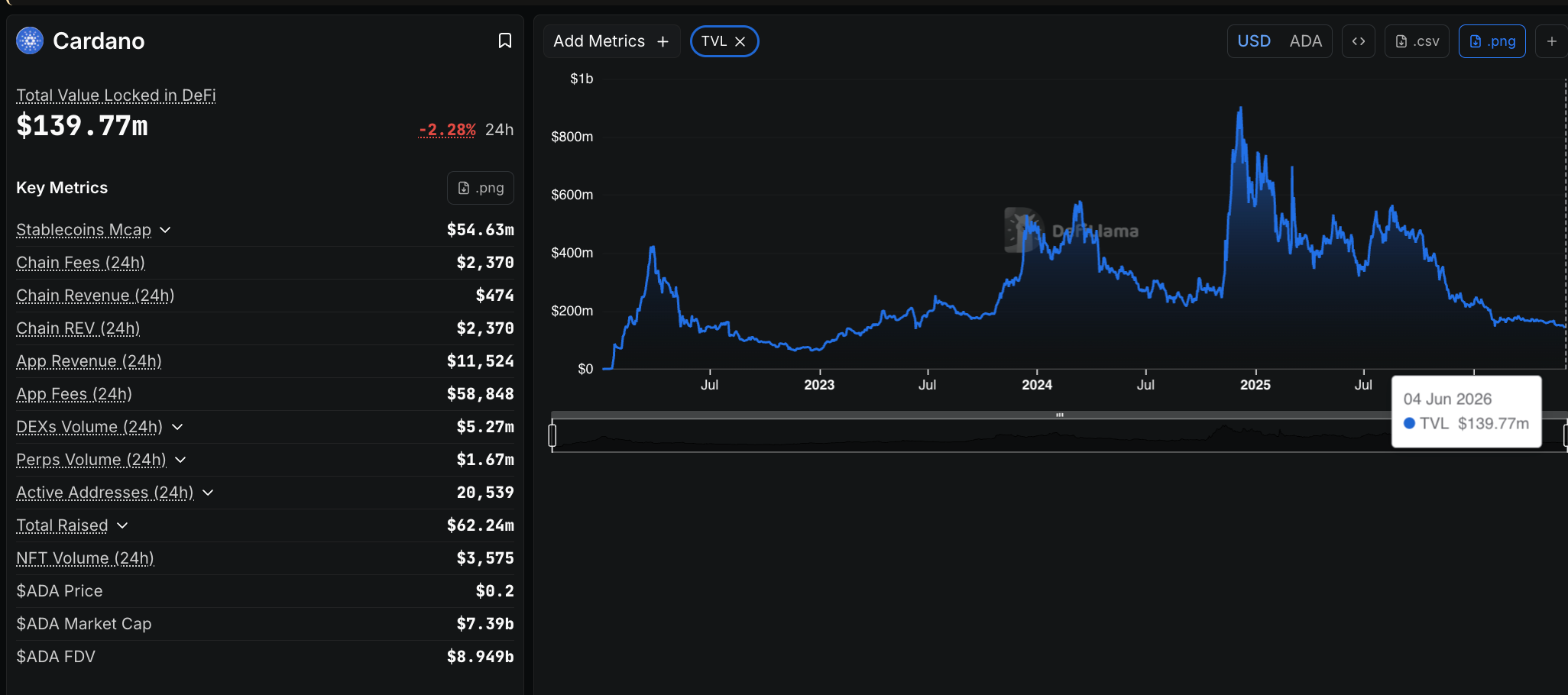
The Cardano (ADA) price has fallen about 35% in under a month, and founder Charles Hoskinson now admits he is powerless to stop the ecosystem’s decline.
That confession, made after another major project announced its shutdown, has revived a blunt question. Is Cardano dead for good, or is this just a brutal cycle low in the making?
A Shrinking Ecosystem Behind Hoskinson’s Warning
The bear case starts with Hoskinson himself. Reacting to the shutdown of analytics platform Tap Tools, he warned of a wave of failures and said he is tired of “managing a decline.”
The data backs the warning. Cardano TVL, the total value locked in its DeFi apps, has collapsed from about $905 million in late 2024 to just $139.77 million. That’s an 85% dip.

Trading has drained too. Weekly Cardano DEX volume has fallen from a peak near 19 million ADA in late 2025 to about 1.9 million, close to the year’s lowest week.

Network use is fading in step. Daily active addresses have slipped from a late-2025 peak near 17,600 to about 14,900, while token (ADA) trading volume has nose-dived.
This reveals low network usage and also low reception for ADA, in a crypto market where trading (riding the volatility) has been a trend lately.

Hoskinson even floated a nuclear option, launching a new Cardano with a proof-of-burn to leave hostile holders behind. He insists the technology is sound, with the Leios upgrade due at year’s end, and blames economics and governance instead.
Want more token insights like this? Sign up for Editor Harsh Notariya’s Daily Crypto Newsletter here.
The question is whether any Cardano project is still growing against the tide.
Top Protocols Bleed, With One Exception
Most of Cardano’s biggest apps are sliding with the chain. Minswap, its largest decentralized exchange, lost about 11% of its locked value over the month. That is evident in the Dune data from earlier, which suggests a dip in DEX trading volume.
Indigo, a protocol for minting synthetic assets, fell roughly 19%. Djed, Cardano’s stablecoin, dropped about 21%.

Even SoSoValue, the multi-chain data and ETF-tracking platform, saw its Cardano footprint shrink about 19%. The weakness reaches beyond native projects.
One name bucks the trend. Surf Lending, a lending protocol, grew its locked value by about 98% over the month and 14% in a week. That is the lone green entry in the top 10 and the closest thing to hope on the fundamental side. Yet Surf Lending holds only about $4.62 million.
A single small protocol cannot reverse an ecosystem that has shed hundreds of millions. The bigger tell sits with the traders who move the most money.
Smart Money and Whales Have Stopped Believing
The positioning data is bleak. Cardano’s smart money index, which tracks how informed money trades against the crowd, has fallen to its lowest level of 2026. This happened as the price corrected by over 35% since May 10 with rising sell volume.

Leverage interest has drained too. ADA futures open interest, the total value of outstanding futures contracts, has collapsed from about $1.6 billion in September 2025 to roughly $324 million.
This aligns with the earlier drop in token trading volume data and highlights a lack of discernible sentiment for the token, either bullish or bearish.

Whales are stuck rather than confident. On Hyperliquid, nearly all large long positions sit underwater, with entries between $0.20 and $0.37, and most hold through the losses.

Even smart money, as revealed by Nansen AI, is offside. Its only profitable trade is a single short, while its long bets keep bleeding.

If the people who move the most money see no rebound yet, the chart has to make the case instead. The only silver lining is that the underwater long trades have not yet closed their positions.
It is optimism or denial, depending on how the ADA price chart shapes up.
The Cardano Price Level That Settles the Question
The chart is brief but blunt. The ADA price has traded inside a falling channel since early January. Its May 10 breakout attempt failed before the slide resumed.
ADA has dropped about 35% from that May peak near $0.29 and now sits close to $0.19. The next key support is $0.17. A break under $0.178 would expose $0.141 and even $0.094, and would hand the dead-chain narrative real weight. That level is only about 9% away.
The on-chain side offers one counter. ADA spot exchange outflows have grown to about $2.26 million, a hint that some holders are continuing to buy despite the fear.

For the bulls, a reclaim of $0.26 would push the death talk to the back seat. That case strengthens if protocols like Surf Lending grow and outflows hold.

For now, $0.17 separates a slide toward $0.09 from a recovery that silences the obituaries.
The post Is Cardano Dead After Hoskinson’s Shocking Confession? appeared first on BeInCrypto.


This article was updated with comments from Bitget CEO Gracy Chen.
Bitget has expanded the use of 15 tokenized stocks and ETFs by enabling them as margin collateral for USDT-M futures trading through its Unified Trading Account and Multi-Asset Mode.
Summary
- Bitget has enabled 15 tokenized stocks and ETFs as margin collateral for USDT M futures trading through its Unified Trading Account.
- Assets including rAAPL, rTSLA, rNVDA, rMSFT, rSPY, and rQQQ can now be used to meet margin requirements while maintaining futures positions.
- The update extends Bitget’s tokenization strategy, following the launch of its Reality platform and a growing lineup of tokenized equities, ETFs, and pre IPO trading products.
According to a press release shared with crypto.news, the update took effect on June 4 and allows traders to use selected tokenized equities and exchange-traded funds to meet margin requirements while maintaining futures positions. Newly eligible assets include rAAPL, rAMZN, rMETA, rMU, rTSLA, rGOOGL, rNVDA, rINTC, rMSFT, rASML, rAVGO, rTSM, rQQQ, rSPY, and rSNDK.
Under Bitget’s Unified Trading Account structure, users can manage spot holdings, derivatives positions, and margin obligations within a single account. The exchange said Multi-Asset Mode for USDT-M futures now allows these tokenized instruments to contribute toward collateral requirements, reducing the need to convert assets into a single settlement currency before entering futures trades.
Speaking about the rollout, Bitget CEO Gracy Chen said users increasingly want more ways to put tokenized assets to work across different trading activities as adoption of tokenized financial products grows.
“As tokenized assets continue to gain traction across global markets, users are looking for more ways to utilize their holdings across different trading activities. Adding tokenized stocks and ETFs as margin assets increases flexibility within the Unified Trading Account and supports a more seamless experience across crypto and traditional market products.”
Tokenized products gain a larger role inside Bitget’s ecosystem
The latest addition builds on Bitget’s recent push into tokenized financial products. In May, the exchange introduced Reality, a regulated tokenization platform that issues blockchain-based rTokens backed 1:1 by publicly traded U.S. stocks and ETFs held through regulated broker-dealers.
According to Bitget’s May announcement, Reality was designed to provide on-chain access to traditional financial assets while addressing issues that have historically limited tokenized markets, including liquidity constraints and the handling of dividends and corporate actions. The company said rTokens are supported by infrastructure connected to major U.S. exchanges and backed by reserve attestations conducted through accounting firm The Network Firm.
Several of the assets added as margin collateral this week originate from the Reality product suite. Rather than limiting those tokens to spot market exposure, Bitget is now allowing traders to deploy them within its derivatives framework.
During the same month, Bitget also launched SPCXUSDT, a SpaceX-linked pre-IPO perpetual contract that lets traders speculate on market expectations surrounding a potential public listing without owning SpaceX shares. The exchange also introduced IPO-linked products and expanded access to tokenized equities through multiple offerings tied to public and private markets.
Competition grows in tokenized asset markets
Beyond its exchange platform, Bitget Wallet integrated xStocks infrastructure in May, bringing access to more than 130 tokenized stocks and ETFs through a self-custodial wallet. Bitget Wallet said the move increased its tokenized real-world asset offering to more than 300 products, including equities, commodities, precious metals, and index-linked assets.
According to Bitget, its tokenized equity products have processed more than $30 billion in trading volume since 2025. The company has also stated that users can access more than 100 tokenized stocks, ETFs, commodities, foreign exchange products, and precious metals through its trading ecosystem.
Bitcoin price traded near $61,925 on June 5 as selling pressure kept BTC close to the $60,000 support zone, with ETF flows, whale deposits, and weak sentiment driving the next market test.
Summary
- Bitcoin price slipped near $61,925 as traders focused on $60,000 support after sharp weekly selling.
- ETF outflows and Strategy’s rare sale weakened confidence while AI-linked capital rotation added market pressure.
- Whale Binance deposits doubled in June, adding short-term selling risk as sentiment turned bearish fast.
Bitcoin price nears $60,000 support
Bitcoin price data from crypto.news showed BTC at $61,925, down 3.44% over 24 hours and 15.82% over seven days. The asset traded between $61,394 and $64,353 during the day, while 24-hour volume stood at $56.21 billion.
The latest move placed Bitcoin just above the $60,000 level. That round number has become the main support zone after BTC lost the $65,000 area and failed to hold earlier ranges near $70,000.
Bitcoin has now dropped sharply from last week’s levels above $74,000. The pullback also took BTC far below its October 2025 all-time high of $126,080, with crypto.news data showing a drawdown of more than 50%.
A break below $60,000 would move Bitcoin back into the zone seen during the February drawdown. If sellers keep control below that level, traders may turn to the $55,000 area as the next major support.
ETF outflows and Strategy sale weigh on sentiment
Bitcoin’s latest fall comes as ETF demand weakens. U.S. spot Bitcoin ETFs recently posted heavy outflows.
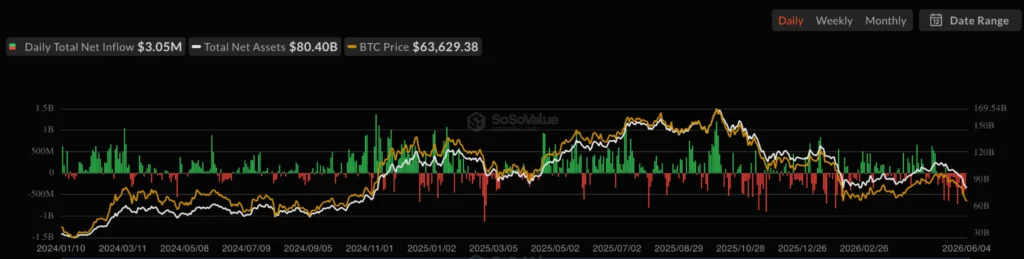
Fresh ETF data also showed a small $3.05 million daily net inflow on June 4, per SoSoValue. However, that single inflow came after 13 consecutive days of net outflows and did not erase the broader pressure. Total net assets still stood near $80.40 billion, while cumulative net inflows remained strong at $54.27 billion.
Strategy also drew market attention after disclosing its first Bitcoin sale since 2022. The company sold 32 BTC at an average price of $77,135 between May 26 and May 31, raising about $2.5 million for preferred stock distributions.
The sale was small compared with Strategy’s overall holdings. Still, traders watched it closely because Strategy had long acted as a steady corporate buyer during previous market stress.
Michael Saylor framed the weakness as part of a wider capital rotation. He said spot Bitcoin ETFs had seen about $4 billion in outflows since May 14 while capital markets funded AI infrastructure at scale. He called it “a capital rotation, not a Bitcoin impairment.”
Whales move BTC back to Binance
CryptoQuant analyst Darkfost said whale BTC deposits on Binance have accelerated during the June selloff. The analyst defined whales as entities moving more than 100 BTC, equal to over $6 million at current prices.
According to the update, Binance saw whale inflow peaks of about 8,200 BTC on June 2 and more than 6,400 BTC on June 4. The monthly average has also risen from about 1,200 BTC since mid-April to more than 2,800 BTC.
That change shows large holders are moving more coins onto exchanges. Such transfers can signal plans to sell, hedge, or manage risk during a fast market decline.
Darkfost said this behavior looked more like emotional risk management than a planned long-term move. The last time Binance whale inflows reached similar levels was during Bitcoin’s fall below $60,000 in early February.
This adds short-term selling pressure while price trades near a key level. If whale inflows stay elevated, BTC may struggle to reclaim lost support without stronger spot demand.
Sentiment flips as traders watch $55,000
Santiment data showed Bitcoin sentiment turned sharply lower after price fell from the late-May high. The firm said BTC moved from near $78,000 to about $63,800, with most of the decline happening in three days.
Social sentiment was strongly positive near the highs, then turned bearish as price broke down. Santiment said the crowd was most bullish near the top and most bearish near the lower range.
The firm also noted that sentiment is not a timing tool. Still, it said peak fear can sometimes appear near a “potential local bottom.” That wording remains cautious because price has not confirmed a reversal.
Crypto Patel also pointed to lower long-term accumulation zones. He wrote that 2026 to 2027 could become a “potential accumulation period,” with $50,000 to $40,000 acting as a possible spot buying zone if reached.
For now, Bitcoin price analysis remains tied to three levels. Bulls need to defend $60,000 and reclaim $65,000 to ease near-term pressure. Bears need a clean break below $60,000 to open the path toward $55,000 and possibly lower supports.
The next sessions may show whether the current fall is a panic-driven flush or the start of a deeper reset. ETF flows, whale exchange deposits, and Bitcoin’s reaction near $60,000 will likely guide the next move.
Disclosure: This article does not represent investment advice. The content and materials featured on this page are for educational purposes only.
Bitcoin and Ethereum trading activity has fallen to multi-quarter lows on Hyperliquid, while volume in equity-linked and pre-IPO perpetual contracts has climbed sharply.
Summary
- Bitcoin and Ethereum perpetual futures volumes on Hyperliquid have fallen to multi-quarter lows as traders increasingly turn to equity and commodity-linked contracts, according to Block Scholes.
- Pre IPO perpetual trading volume has climbed above $50 million per day from less than $5 million, with SpaceX-linked contracts leading activity.
- Block Scholes analyst Thahbib Rahman said speculative interest remains strong in markets such as stock index perps, commodities, and HYPE despite weaker sentiment around Bitcoin and Ethereum.
According to a June 5 report from Block Scholes shared with crypto.news, risk sentiment around the two largest cryptocurrencies has continued to weaken, even as speculative demand remains active in other parts of the market.
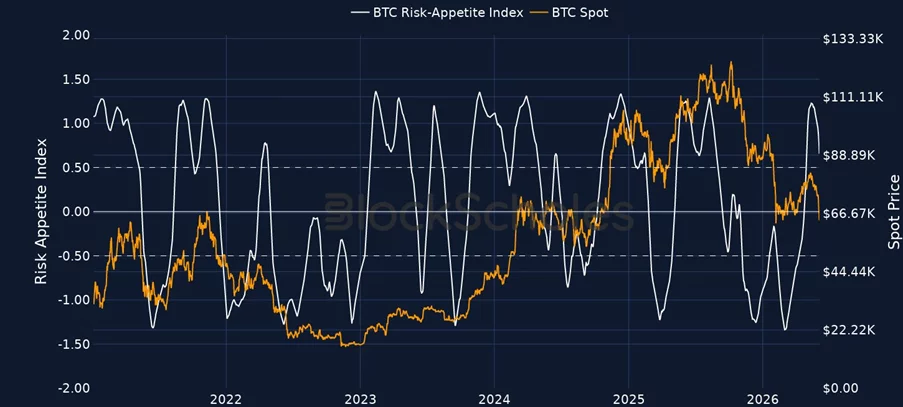
The research firm pointed to its in-house Bitcoin and Ethereum Risk Appetite Indexes, which have moved lower over the past week alongside declines in both assets.
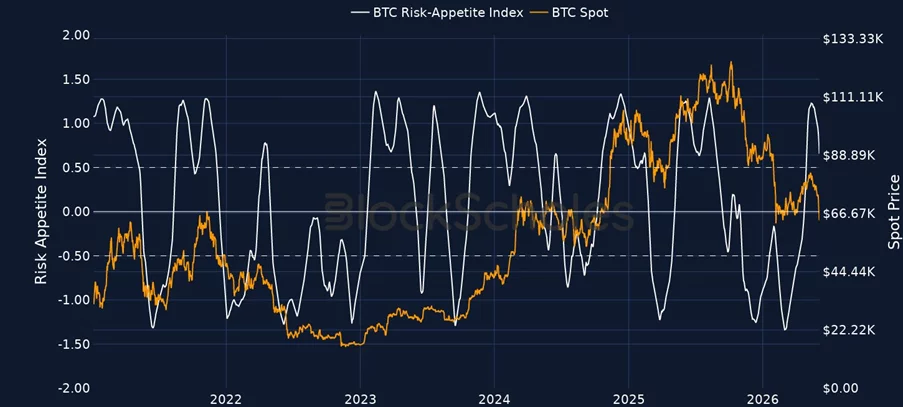
Recent weakness in crypto majors has coincided with several market developments. Block Scholes noted that Strategy sold $2.5 million worth of Bitcoin from its holdings, a move that came after years of public commitment from Executive Chairman Michael Saylor to continue accumulating the asset.
The report also highlighted the longest streak of outflows from U.S. spot Bitcoin ETFs since their launch.
Rather than viewing Bitcoin’s drop toward the low $60,000 region as a sign of fading interest across the entire digital asset market, Block Scholes argued that trading activity has become concentrated in a different set of instruments.
Traders turn to stock and commodity-linked perpetuals
Data from Hyperliquid shows that daily Bitcoin perpetual futures volume has remained near $2 billion, while Ethereum volumes have stayed around $600 million to $700 million, levels Block Scholes described as multi-quarter lows.
At the same time, activity tied to equity and commodity markets has expanded rapidly on the platform. According to Block Scholes, the three most actively traded non-crypto perpetual contracts on Hyperliquid are XYZ100, which tracks the Nasdaq-100, SP500, an S&P 500-linked product, and CL, a contract tied to WTI crude oil.
Combined daily volume across those three markets has reached approximately $1.3 billion, generating $27.1 billion in notional trading volume over the past month. Block Scholes said that total equals about 112% of Ethereum perpetual volume and roughly 38% of Bitcoin perpetual volume on the exchange during the same period.
The report said the development does not necessarily represent a dollar-for-dollar migration of capital from Bitcoin and Ethereum. Instead, the report argued that trader attention and speculative activity that previously supported crypto majors are increasingly being directed toward alternative markets available through the same trading venue.
Pre-IPO contracts draw growing interest
Beyond stock index and commodity products, Block Scholes identified pre-IPO perpetual contracts as another area attracting crypto-native traders.
According to the report, the ratio of pre-IPO perpetual volume relative to Ethereum perpetual volume increased from roughly 0.1% to a peak near 3.0% in recent weeks. Daily trading volume in the segment has climbed from less than $5 million to more than $50 million, with contracts linked to SpaceX accounting for much of the increase.
Block Scholes said the rise has been abrupt and concentrated, with activity accelerating into late May and early June while Bitcoin and Ethereum volumes remained subdued.
The firm’s risk appetite data also showed a divergence among digital assets. While sentiment tied to Bitcoin and Ethereum has weakened, Block Scholes reported that Hyperliquid’s HYPE token is one of the few major crypto assets where its risk appetite indicator continues to move higher.
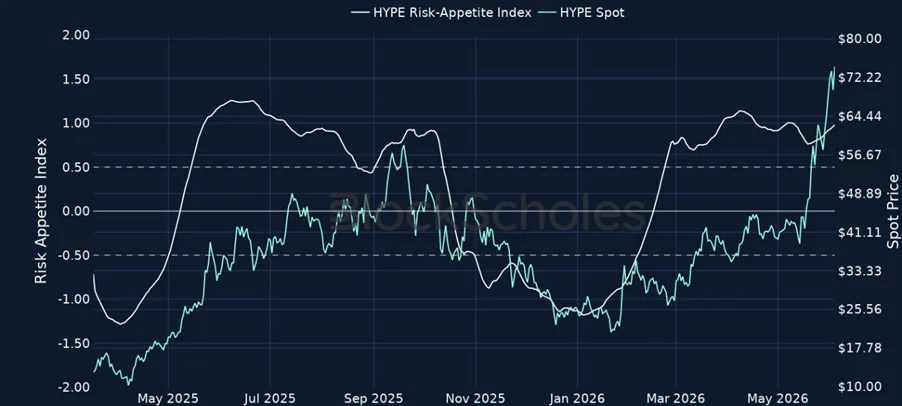
HYPE risk appetite index. Source: block Scholes.
As previously reported by crypto.news, Binance Research recently published a report noting that capital has been flowing toward a concentrated group of U.S. equity sectors, including artificial intelligence infrastructure, semiconductor companies, defense contractors, energy firms, and commodities.
According to the report, strong performance in those sectors has historically reduced liquidity available to Bitcoin and other alternative assets.
Using the CBOE Dispersion Index as a measure of market concentration, Binance Research noted that the indicator recently reached 42, its third-highest reading on record. The firm argued that periods of concentrated equity leadership have often coincided with weakness in Bitcoin as investors direct funds toward a smaller group of high-performing themes.

Crypto Trading Complete Course | Become Cryptocurrency Trading Expert

Ant and Dec drop major hint about a brand new ITV live show

Lockheed Martin Stock: Time To Pull The Trigger (Upgrade) (NYSE:LMT)

HarrisX Poll Found 52% of Registered Voters Support the CLARITY Act

BloFin War of Whales 2026 Grand Prix opens registration for $5M trading championship

Blockchain.com files with SEC for U.S. IPO
Crypto Trading Complete Course | Become Cryptocurrency Trading Expert

CMA INTER | FINANCIAL ACCOUNTING | GAME CHANGER SERIES | DAY 1 | JUNE/DEC 26 | BY CMA BHANU VEMENDRA

William Ackman: Everything You Need to Know About Finance and Investing in Under an Hour | Big Think
-

 Business4 days ago
Jade Biosciences, Inc. (JBIO) Discusses Positive Interim Results From JADE101 Phase I Healthy Volunteer Study and Development Plans Transcript
-
 Tech7 days ago
SpaceX just won a second Golden Dome contract. This one is $4.16 billion.
-

 Sports3 days ago
French Open 2026 results: Alexander Zverev beats Rafael Jodar and will play Jakub Mensik in semi-finals
-

 Business7 days ago
Is the Spurs Phenom Already Better Than Prime Diesel?
-

 Tech4 days ago
CryZENx Releases Fresh Playable Content Deep Inside Jabu-Jabu for His Ocarina of Time Remake
-

 Fashion13 hours ago
Weekend Open Thread: Evereve – Corporette.com
-

 Politics7 days ago
The House | Inside Andy Burnham’s Makerfield Campaign: “Nobody Thinks This Is In The Bag”
-

 Business3 days ago
Trump Taps Housing Chief Bill Pulte as Acting Intelligence Director After Gabbard Exit
-
Crypto World21 hours ago
LBank Surpasses 25 Million Users Worldwide as AFA Partnership Continues to Drive Global Growth
-
 Crypto World18 hours ago
Jensen Huang Approves Samsung, SK Hynix, and Micron for NVIDIA (NVDA) HBM4 Memory Supply
-
 Entertainment7 days ago
One of the Greatest Sitcoms of All Time Shoots Up Apple TV’s Charts 11 Years Later
-

 Business7 days ago
Demand Conditions Improve In Chemicals Sector In April 2026
-
 NewsBeat7 days ago
Everything you need to know as Cambridge’s Strawberry Fair returns after cancelled year
-
 Crypto World4 days ago
Seagate (STX) Stock Surges to Record High on AI Boom and Legal Settlement
-
 NewsBeat3 days ago
Republicans balk at Trump’s attempt to appoint a MAGA enforcer to lead National Intelligence
-
 Entertainment7 days ago
Britney Spears Shares Troubling Update After Hard Year
-
 Crypto World3 days ago
EU AI Data Center Project Faces Delays as Funding Gaps Grow
-

 Business3 days ago
Aehr Test Systems Stock Soars 17% Amid Surging AI Demand and Conference Spotlight
-

 Tech7 days ago
Acer’s Swift Air 14 is a peppy MacBook Neo rival with some cool upgrades and a $699 ask
-
 NewsBeat7 days ago
‘I watched Take That Circus tour in 2009 and now in 2026 – this is what you need to know’
You must be logged in to post a comment Login