

Crypto World
Why quantitative traders are using complex math models to hijack your weekend sports bets



Chicago-based trading giant DRW has spent decades profiting from mismatches between different asset classes, and now it’s building a dedicated prediction market desk targeting platforms such as Polymarket and Kalshi.
The move is one of the clearest signs yet that sophisticated “quantitative trading” firms — traders that use complex math and analysis to set up strategies — are increasingly viewing prediction markets as a legitimate trading venue rather than a niche betting product.
The firm that has been a dominant force in derivatives, fixed income and crypto markets since 1992, recently posted a job listing requiring candidates to monitor prices in real time across both platforms simultaneously, identify gaps where one is mispricing an outcome relative to the other and react quickly to profit before the pricing converges. The strategies listed in these posts — including microstructure arbitrage, cross-platform arbitrage, and news-driven momentum trading at sub-second speeds — are techniques honed in crypto derivatives markets and now being applied to sports and political events.
DRW is not alone. Wintermute, the algorithmic market maker that processes billions in daily crypto volume, is hiring algorithmic traders with experience in prediction markets. IMC, another proprietary trading firm, is also looking for quantitative traders comfortable operating across binary event contracts. Meanwhile, traditional crypto exchanges like OKX and Crypto.com have also recently posted job listings.
The hiring wave suggests institutional trading firms increasingly believe prediction markets have matured into a serious asset class and are ripe for profit.
Exploiting the mismatch
So what’s driving the sudden push? The catalyst is the volume being traded on these platforms.
Polymarket alone processed between $22 billion and $40 billion across political, economic and sports markets in 2025, up from virtually nothing three years ago and a growing share of that is concentrated in sports.
As of last week, Polymarket’s market on the UEFA Champions League Winner has processed $256 million, the 2026 NBA Champion market has done $399 million, and the 2026 NHL Stanley Cup market sits at $79 million after wild swings that saw Carolina Hurricanes rise from sub-10% implied probability to around 50% as they emerged from the Eastern Conference.
Combined, those three markets alone represent over $730 million in volume on sports outcomes, approaching the annual trading volume of some mid-sized European sports betting exchanges.
But the real reason traditional firms are pushing into this industry may not be to predict outcomes better than everyone else, market observers say.
“I don’t expect the institutional capital is contributing meaningfully to the accuracy of these markets, especially in the case of sports,” said Harry Crane, a statistics professor at Rutgers University who studies prediction market calibration.
“The accuracy of the markets is driven by specialized sports betting groups, which are much sharper at pricing sports outcomes.
Instead, Crane argues, firms such as DRW are likely applying trading techniques developed in traditional financial markets to exploit pricing mismatch.
“To the extent they are profitable, the institutions are likely applying techniques on short-term market dynamics and other technical aspects of trading that capitalize on short-term market fluctuations without insight into the event outcome.”
Simply put, DRW is not trying to predict who wins the Champions League. It is trying to profit from the way prices move before that question is answered.
A recent example appeared in the market for Britain’s next prime minister.
On the morning of May 14, Andy Burnham’s odds of becoming the next U.K. leader in the betting of “Next UK Prime Minister” on Polymarket surged from 24 cents to 43 cents as political speculation intensified around a potential Labour leadership challenge. But Betfair, the London-based betting exchange with over a billion pounds in annual volume, had already identified the move, pricing Burnham at the equivalent of 50 cents while Polymarket still showed 24 cents.
It took Polymarket hours to catch up.
For casual bettors, the gap was an interesting anomaly, but to a sophisticated quant trader, it was a textbook cross-market inefficiency waiting to be exploited.
In theory, a trader could have bought $10,000 of Burnham contracts on Polymarket at 24 cents after noticing the mismatch, before locking in $7,900 worth of profit in a matter of hours by selling when it caught up to Betfair, which would have made a profit without the event even needing to take place.
It’s a technique that has been used for decades by traditional trading firms: finding a mispriced asset across exchanges and either simultaneously buying/selling, as in arbitrage, or buying the underpriced asset and waiting for it to catch up.
Prediction markets, however, introduce an additional challenge. Betfair settles in sterling while Polymarket settles in crypto, requiring infrastructure capable of moving capital across currencies, exchanges and settlement systems.
That kind of complexity plays directly into the strengths of large trading firms, such as DRW
What’s driving them?
Beyond outright arbitrage, traders point to two structural features that make prediction markets attractive today.
The first is information lag. Traditional betting exchanges often react more quickly than decentralized prediction platforms, creating windows where prices have not yet fully adjusted.
The second is liquidity fragmentation. Champions League, NBA and Stanley Cup markets can trade simultaneously across Polymarket, Kalshi and traditional sportsbooks, meaning no single venue necessarily reflects the full market consensus.
For traders focused on forecasting outcomes rather than market structure, the toolkit looks increasingly familiar to quantitative finance.
Soccer traders often rely on “Dixon-Coles Poisson” models. The toolkit, developed in a 1997 academic paper, estimates team attack and defense strength and generates probability distributions for potential scorelines. This is something similar to how a weather forecaster assigns precise probabilities to every possible outcome rather than making a single prediction.
Meanwhile, Basketball traders frequently use “Bayesian Hierarchical” models that update assessments of team strength as new information arrives.
The goal for both models is to identify discrepancies between a model’s estimated probability and the probability implied by market prices.
A trader whose model values Arsenal’s Champions League chances at 47% while contracts trade at 43 cents may buy and profit if the market eventually converges toward that estimate.
The concept is known as closing line value, or CLV.
Crane explains why the CLV matters: “It incorporates all known pre-game information, such as injuries and lineup changes, and the sharpest players tend to wait until closer to game time to place bets because that is when the limits tend to be highest.”
Competition is here
Still, Crane remains skeptical that institutional firms will dominate sports prediction markets simply because they have arrived with larger balance sheets.
“Right now, the sharpest players in the sports betting markets are not the institutions,” he said. “The sharpest players have been in these markets for decades, and the prevailing market prices are likely driven by the same groups and the same information sources since long before prediction markets existed.”
Despite the skepticism, the talent migration is already underway.
Crypto market makers are studying sports analytics and expected-goals models, while traditional sports betting specialists are increasingly being recruited by crypto firms seeking expertise that took years to develop.
And it’s not just theoretical.
HyperLiquid, the onchain perpetuals exchange that processed over $10 billion in daily volume at its peak, is already preparing to launch prediction markets ahead of the 2026 World Cup, featuring 64 games over six weeks and generating thousands of correlated binary outcomes.
The infrastructure is being built, and the desks are now being staffed, with models working on potential outcomes.
The main question is whether institutions can outperform veteran sports bettors by finding their edge and applying sophisticated trading models used in traditional finance. But on latency, market structure and cross-platform inefficiencies, the competition has already begun.

TLDR:
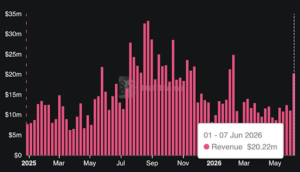
- Hyperliquid weekly revenue returns above $20.22M after months of $8M–$15M consolidation range phase shift.
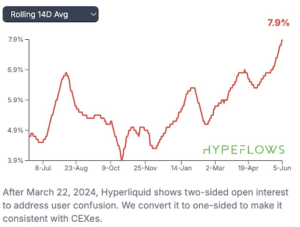
- Open interest share climbs to 7.9%, marking record gain against centralized derivatives exchange competitors.
- Platform maintains $5.9B TVL with $222B monthly volume and strong perpetual futures trading activity levels.
- Annualized fees exceed $1.05B while revenue reaches $881M, driven by sustained derivatives market usage.
Hyperliquid shows renewed momentum across revenue, liquidity, and derivatives positioning as weekly earnings return above $20 million in June 2026.
The protocol also records rising open interest share and sustained capital inflows, signaling continued activity across its trading ecosystem platform.
Revenue Recovery Signals Trading Cycle Reset
Hyperliquid recorded a return above $20.22 million in weekly revenue during the June 1–7, 2026 period. This marked the first break above the $20 million level since February 2026, ending a multi-month range of lower activity across the platform’s derivatives markets.
Source: Degen News(X)
Earlier in the cycle, Hyperliquid revenue fluctuated between $8 million and $15 million weekly, reflecting subdued volatility conditions after the 2025 expansion phase. Activity remained consistent, though far below the highs recorded during the previous market surge.
During August and September 2025, Hyperliquid reached weekly revenue peaks above $30 million, driven by elevated trading activity and increased participation across perpetual futures markets. Those conditions represented a volatility-heavy environment compared with 2026 trading behavior.
Market structure data shows Hyperliquid maintaining a stable revenue floor even during contraction phases. This indicates persistent engagement from core users, supported by continued derivatives trading activity across the ecosystem.
Open Interest and Capital Flows Point to Structural Shift
Hyperliquid’s share of aggregate perpetual futures open interest reached 7.9%, marking a record level against centralized exchange competitors.
The metric reflects increasing capital commitment, as traders allocate larger positions to decentralized infrastructure for derivatives execution.
Source: Degen News(X)
Total value locked on Hyperliquid stands near $5.9 billion, supported by consistent inflows across market cycles. Annualized fees exceed $1.05 billion, while revenue approaches $881 million, driven primarily by perpetual futures trading volume and sustained position activity.
Trading volume data shows $222 billion processed over a 30-day window, with open interest at $9.15 billion, indicating sustained positioning rather than short-term speculative turnover.
Liquidity conditions have remained stable across volatility shifts, supporting continuous derivatives activity on the platform.
Capital allocation trends suggest users are increasingly treating decentralized venues as primary execution layers rather than alternative markets.
The progression of market share in perpetual futures trading continues to expand, supported by improved execution efficiency and deeper order book participation.
Hyperliquid continues to operate within a competitive landscape dominated by centralized exchanges, yet its share of activity has increased steadily across 2026.
The platform’s ability to maintain liquidity during both expansion and contraction phases reflects persistent usage across diverse trader segments.


TLDR:
- PYUSD supply shrinks 31% from $4.2B ATH, dropping to $2.92B amid shifting liquidity flows in 2026
- Over $1B wiped from circulation as market volatility reduces stablecoin minting and exchange inflows
- PayPal expands PYUSD across 70 markets, boosting wallet usage and cross-border payment access globally
- Stablecoin remains mid-tier as USDT and USDC dominate broader crypto liquidity and settlement flows
PYUSD supply contraction has drawn attention across stablecoin markets as PayPal’s dollar-backed asset retraces from its $4.2 billion March peak to around $2.92 billion.
The movement reflects shifting liquidity conditions, softer market participation, and evolving usage patterns even as PayPal continues scaling PYUSD access across 70 global markets in 2026.
Supply Compression From Peak Levels Across Crypto Markets
PayPal’s $PYUSD stablecoin supply has shrunk 31% as circulating tokens fall sharply from the March 2026 peak of $4.2 billion to around $2.92 billion. The contraction removes over $1 billion in market value within a short trading window.
Issuance trends show reduced inflows across exchange wallets and payment channels during heightened volatility conditions across digital asset markets.
The decline aligns with broader pressure across crypto assets as Bitcoin retraced toward key technical zones near $60,000 during the same period.
Market participants shifted liquidity into stable holdings while reducing exposure to risk assets. PYUSD flows reflected similar behavior, with lower minting activity observed across regulated issuance channels and custodial reserves linked to PayPal’s stablecoin infrastructure operations globally.
Corporate and macro factors also influenced the contraction phase. PayPal faced earnings pressure and a leadership transition earlier in 2026, which impacted sentiment across its digital asset initiatives.
Regulatory uncertainty across payment corridors added further caution among institutional participants. Despite these conditions, PYUSD continued operating within PayPal’s payment ecosystem, maintaining utility across wallet transfers and merchant settlement layers.
Expansion Strategy Across Global Payment Infrastructure
PayPal’s $PYUSD stablecoin continues scaling access across 70 global markets. Users in Asia-Pacific, Europe, and Latin America can now hold, send, and receive PYUSD directly through PayPal accounts.
The rollout extends stablecoin functionality beyond the United States, integrating it into cross-border digital payment flows across retail and merchant ecosystems.
Merchant settlement remains a key focus of the expansion strategy. PYUSD enables payment proceeds to be accessed within minutes compared to traditional banking delays. This shift improves liquidity cycles for businesses operating across international markets.
PayPal’s blockchain-based settlement framework supports faster value transfer while reducing friction in cross-border commerce environments and digital transaction processing systems globally.
Within the broader stablecoin ecosystem, USDT and USDC continue to dominate circulation volumes, while PYUSD maintains a mid-tier position despite recent contraction.
The token remains backed by dollar deposits and short-term Treasury instruments through regulated issuance structures.
Continued integration into PayPal’s global infrastructure signals sustained operational use cases even as supply adjusts to changing market conditions.
TLDR:
- ETH near $216.03B faced pressure as price volatility narrowed the gap with USDT at $ 187.35 B
- Stablecoin inflows lifted USDT dominance as traders rotated capital during risk-off market phases
- Liquidity shifts intensified as ETH derivatives liquidations accelerated downside capitalization impact
- Ranking compression emerged as valuation gap shrank to roughly $28.68B between ETH and USDT
Ethereum has lost its long-held market capitalization lead as Tether moves ahead during volatile trading conditions.
ETH stands near $186.263B, while USDT rises to about $187.05B, marking a rare reversal driven by liquidity shifts and stablecoin demand across markets.
Market Rotation and Capital Pressure
A notable shift has emerged in crypto rankings as Ethereum vs Tether market cap flippening takes shape across global exchanges.
Ethereum currently holds a valuation of approximately $186.263 billion, while Tether has moved slightly ahead at around $187.05 billion.
The difference between both assets now stands at less than $1 billion, making the gap extremely tight. As ETH faced renewed selling pressure, its market capitalization declined rapidly, with price volatility across major trading pairs and derivatives markets.
At the same time, traders increased allocation into USDT during risk-off conditions. This shift strengthened stablecoin liquidity across exchanges.
Consequently, Tether’s circulating supply expansion supported its rise above Ethereum in total market capitalization rankings.
Derivatives liquidations added further pressure on ETH valuation. As leveraged positions unwound, downward momentum intensified.
Meanwhile, USDT remained stable due to its peg structure, allowing it to maintain consistent valuation growth through demand-driven issuance.
Stablecoin Strength and Ethereum Valuation Compression
The Ethereum vs Tether market cap flippening reflects a structural contrast between volatile asset pricing and stablecoin mechanics.
Ethereum’s market cap is directly influenced by price movements, while Tether’s valuation is driven by supply expansion, now near $187.05 billion.
As Ethereum declined toward $186.263 billion, its ranking position weakened. This movement was not linked to network activity loss but rather short-term market pricing pressure and liquidity repositioning across exchanges during volatile sessions.
Meanwhile, stablecoin demand continued to rise across trading platforms and settlement channels. USDT became a preferred asset for capital preservation, especially during periods of uncertainty where traders reduced exposure to directional crypto assets.
Despite the temporary ranking shift, Ethereum remains a dominant smart contract platform. However, current market conditions allowed Tether’s stable valuation model to surpass ETH briefly, highlighting how liquidity flows can reshape capitalization rankings in compressed market environments.


James Wo, the founder and chief executive of crypto investment firm DFG, says bitcoin remains the dominant institutional asset in crypto — and ether is unlikely to reach the same status anytime soon.
Speaking to CoinDesk at the Proof of Talk conference in Paris, Wo rejected Bitmine Immersion Technologies Chairman Tom Lee’s big prediction that ether would hit $250,000, arguing that Ethereum lacks the same consensus and institutional recognition that have formed around bitcoin.
“I totally disagree with him,” Wo said.
“Bitcoin has a very strong consensus. If you talk to everyone who is an early backer… they believe in bitcoin. Now, beyond the early backing of bitcoin, all the people in crypto, and also traditional finance people, are trying to recognize bitcoin as a safe haven or asset class. I don’t think Ethereum is there yet.”
Ether was trading around $1,775 as of time of writing, while bitcoin was near $63,000.
Wo argued that ether’s fundamental valuation remains heavily dependent on the localized application layer running directly on top of the network to capture fee value. With modern Layer-2 networks now diverting transactional volume and capturing fee utility independently, Wo explains that the network’s value accrual has been structurally different.
“The value of ether has been more diversified or decentralized,” Wo noted.
“The Ethereum token as a whole is not going to capture a lot of value. Onchain activity is not as big as people expected… I don’t think Ethereum will even hit an all-time high. I think bitcoin will perform well, but not Ethereum,” he claimed.
Not everyone agrees that Ethereum’s value accrual problem is permanent, however.
In February, Ethereum co-founder Vitalik Buterin reignited debate within the community after suggesting that Layer-2 networks, which have long been seen as the primary scaling solution, may “no longer make sense” as Ethereum becomes faster and cheaper. The discussion reflects broader questions about whether future upgrades could allow more economic activity to accrue directly to the Ethereum base layer.
‘What is bitcoin?’
Wo’s view, however, reflects the perspective of an investor who has spent more than a decade deploying capital across digital assets, that started with bitcoin.
After studying mathematics at university, Wo began watching classmates trade bitcoin during the 2014 bear market. He later entered the sector with $20 million in initial capital from his mother, who, at the time, managed an established enterprise and private equity firm in China.
“At the beginning, I don’t think she trusted me,” Wo recalled. “What is bitcoin? She has no idea.” But she gave him the money regardless and said, “Okay, so I’m going to support you anyway.”
He deployed that initial capital into bitcoin during the market lows of late 2014 and 2015. As the 2016 bull market developed, he diversified DFG’s balance sheet into alternative layer-1 protocols, becoming an early venture participant in ecosystems including Solana, Polkadot and Near.
He also directed early-stage corporate investments into consumer applications and Web3 infrastructure, including an early $10 million allocation into Circle’s USDC stablecoin project in January 2018.
Those investments helped transform DFG from a bitcoin-focused investment vehicle into one of crypto’s larger venture investors. Today, the firm manages more than 100 portfolio entities with over $1 billion in total assets under management.
Bitcoin’s new all-time high
While Wo remains cautious on ether, his multi-year outlook for bitcoin is constructive. He frames the asset as a superior liquid investment compared with regional real estate and traditional equity markets.
“I firmly believe this is going to outperform the Chinese stock market and also the U.S. stock market,” Wo stated. “Bitcoin in any aspect you can think of from the investment angle—liquidity is the best in the world.”
Wo expects bitcoin could undergo a near-term correction before reaching new highs later in the cycle.
“If it goes down 50% as a correction… the bottom should be around $60,000 to $62,000,” Wo calculated, adding that only an extreme geopolitical black swan event would push the asset lower.
Looking further out, he expects bitcoin to reach new records in the coming years.
“At the peak, we have somehow like $125,000… I believe we will see an all-time high in 2027 or 2028.”

Travala, the Singapore-based crypto travel platform, unveiled what it describes as the first agent-enabled AI travel protocol on Base, enabling artificial intelligence agents to search, reserve, and pay for hotels using USDC. The Travala Travel MCP (Multi-Channel Protocol) is live via Claude Desktop and opens to external developers who want to integrate their own travel agents with Travala’s hotel inventory.
The company says the system links Travala’s hotel inventory to AI agents through the Model Context Protocol, an open standard for connecting AI apps to external tools. Payments flow over Coinbase’s x402 protocol on Base, delivering gasless USDC transactions, near-instant settlement, and projected transaction costs around $0.01 per booking. Final payment authorization, however, still requires manual approval from the traveler, so the workflow remains semi-autonomous rather than fully automated.
Key takeaways
- The world’s first agentic AI travel protocol on Base enables AI-driven hotel bookings using USDC via the x402 framework, with gasless transactions and sub-cent costs per booking.
- Ultimate payment approval stays in the traveler’s hands, making the system more a guided automation than a full-autonomy checkout.
- Travala’s protocol provides access to more than 2.2 million hotel listings, including properties from Marriott, Hilton and IHG, and supports integration with third-party travel agents.
- Beyond hotels, Travala plans to extend the protocol to other travel products such as flights, with its AVA loyalty token poised to enable future MCP use cases.
How the AI-enabled travel protocol works and why it matters
At the core, Travala’s Travel MCP connects its hotel inventory to AI agents using the Model Context Protocol, a framework designed to let AI applications interact with real-world tools and data. This setup is paired with ERC-7715 session keys, allowing an AI agent to request a payment while preserving final signing authority within the traveler’s own wallet. In practice, a user can initiate a search and booking flow with an AI agent, and the agent will trigger a payment request that the traveler can approve, all within a single, continuous chat thread that preserves context across searches, bookings, and cancellations.
Travala emphasizes that the payment layer operates on Base via Coinbase’s x402 protocol, which enables gasless USDC transactions and faster settlement without the typical on-chain fee burden. The company estimates booking costs around $0.01 in transaction fees, a tiny fraction by crypto standards, though the exact figures can vary with network conditions and off-chain processing. In a nod to real-world practicality, the protocol does not eliminate human oversight—travelers must authorize every payment, ensuring consumer protection and control remain central to the experience.
Branding the move as a step toward a more autonomous travel economy, Travala’s leadership frames it as a shift away from the traditional checkout button. Chief Executive Juan Otero described the launch as “the death of the checkout button” and framed it as the opening salvo in a broader transition toward AI-driven bookings—while still keeping the traveler in the loop for final decisions.
The protocol’s architecture is designed to maintain continuity across the entire trip lifecycle. From a user’s initial search to a potential cancellation, the AI agent can operate within a single conversation, pulling in live inventory, rates, and terms without forcing the user to repeatedly re-enter information or re-approve steps in separate flows. The design aims to streamline user experiences and reduce friction in AI-assisted travel planning.
As part of the rollout, Travala is offering developers a 10% Coinbase Wrapped BTC (cbBTC) rebate on completed stays booked through its AI agents, providing a tangible incentive for integrating with the protocol and building out new use cases for AI-driven payments in travel.
A broader context: a wave of AI-agent payment infrastructure
The Travala announcement sits within a growing wave of crypto infrastructure aimed at enabling AI agents to transact. Cointelegraph reports that x402-linked wallets on Base have surpassed 100 million transactions, underscoring the momentum behind agentic payment rails on Layer 2. The ecosystem has seen a string of product launches from notable names, including Fireblocks, MoonPay, Exodus and Oobit, all pursuing AI-centric stablecoin payment capabilities to power autonomous or semi-autonomous workflows for users and businesses alike.
Travala also notes that its protocol taps into a broad pool of hotel inventory, with listings drawn from major brands via aggregator partners. In total, the platform’s catalog covers more than 2.2 million hotels, including properties from Marriott, Hilton and IHG. Beyond hotels, the company intends to extend the MCP to other travel components, notably flights, while the AVA loyalty token could underpin future MCP use cases as adoption grows.
From a competitive standpoint, Travala’s move shifts the frame from traditional crypto-enabled checkouts to AI-agent-enabled booking infrastructure. The company previously positioned itself as part of a competitive ecosystem that includes Sleap.io and Alternative Airlines, but the current announcement emphasizes infrastructure for AI agents, with a focus on seamless, agent-mediated payments rather than purely crypto-only checkout experiences.
What to watch next for AI travel and payments
Travala’s foray into agentic travel payments raises several questions for stakeholders: How will final-approval controls evolve as AI agents learn to anticipate user needs? Will more airlines and hotel chains join the Model Context Protocol ecosystem, and how will loyalty programs like AVA adapt to machine-to-machine or agent-mediated bookings? Regulators may also scrutinize semi-autonomous payment flows to ensure consumer protections keep pace with technology.
For developers and investors, the key signals will be how quickly the MCP gains traction across the travel vertical, how easily third-party agents can integrate, and whether cost savings from gasless Base transactions translate into measurable efficiency gains or improved customer experiences. Observers will also be watching how the wider crypto payments landscape adapts to growing AI usage, including the balance between automation and human oversight in financial transactions.
As the technology matures, travel participants—consumers, developers, and hospitality partners—will need to assess how far AI-driven, semi-autonomous bookings can improve convenience without sacrificing control or safety. The coming months should clarify how broadly the Model Context Protocol-based integrations will expand, which travel segments will follow hotels into automation, and what policy guardrails will shape the adoption of agent-based payments on Layer 2 networks.
TLDR:
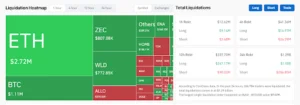
- Crypto liquidation heatmap recorded $1.28 billion in losses as market leverage rapidly unwound.
- Long positions suffered nearly $996 million in liquidations, far exceeding short-side losses.
- Bitcoin and Ethereum accounted for over $830 million of total liquidations during the selloff.
- More than 264,000 traders were liquidated as cascading margin calls accelerated declines.
Crypto liquidation heatmap data revealed one of the largest leverage flushes seen in recent weeks, with more than $1.28 billion erased from crypto derivatives markets in a single day.
The event exposed excessive bullish positioning as traders faced a rapid wave of forced liquidations across major digital assets.
Long Traders Bore the Brunt of the Market Unwind
The crypto liquidation heatmap showed a clear imbalance between bullish and bearish positions. Of the $1.28 billion liquidated during the period, nearly $996 million came from long positions, while short liquidations totaled about $289 million.
The figures suggest traders entered the session with strong expectations of further upside. However, once prices started weakening, leveraged positions quickly became vulnerable.
As margin levels deteriorated, exchanges automatically closed positions to limit losses, accelerating selling pressure throughout the market.
Data from liquidation trackers showed how quickly conditions worsened. What started as modest liquidations during the early hours evolved into a broad market deleveraging event.
The process created a chain reaction where each forced sale contributed to further downside pressure, triggering additional liquidations.
More than 264,000 traders were reportedly liquidated during the move. The scale of participation indicates that both retail and larger market participants were caught in the downturn. One of the largest reported liquidations involved a BTCUSD position valued at approximately $9.02 million.
Bitcoin and Ethereum Dominate Liquidation Activity
Bitcoin and Ethereum accounted for the majority of losses displayed on the crypto liquidation heatmap. Bitcoin registered approximately $476.53 million in liquidations, while Ethereum followed with around $354.02 million.
Source: CoinGlass
Combined, the two largest cryptocurrencies represented more than $830 million of the total liquidations. Such concentration reflects the amount of leveraged capital typically deployed in major digital assets, particularly during periods of strong market optimism.
Separate heatmap snapshots also placed Ethereum at the top of liquidation rankings in certain intervals. This trend is often observed when traders seek higher returns through ETH exposure during bullish phases. As sentiment shifted, those positions faced heavier pressure.
The timeline of liquidations further demonstrated the speed of the move. Losses climbed from roughly $7.82 million in the first hour to $40.76 million within four hours. By the 12-hour mark, liquidations had surpassed $336 million before ultimately reaching $1.28 billion.
While the selloff caused substantial losses, the event also removed a significant amount of leverage from the market.
The crypto liquidation heatmap captured a rapid transition from aggressive risk-taking to defensive positioning, illustrating how quickly sentiment can change within the digital asset sector.

As bitcoin (BTC) continues to weather the storms of the bear market, the asset’s OG holders are waking up. A few days ago, an anonymous holder redeemed a physical bitcoin 15 years after it was created, receiving 25 BTC from the redemption.
According to a tweet from Galaxy Research, the physical coin redeemed is an S1-COIN-25, part of the Casascius coins created between 2011 and 2013. The redemption netted over $1.78 million in bitcoin, calculated at current prices.
OG Holder Redeems 25 BTC
A Casascius coin is a physical token created by the early Bitcoin adopter and software engineer Mike Caldwell. The tokens were created with denominations of 0.5, 1, 5, 10, 25, 100, and 1,000 BTC, meaning they held real digital bitcoins. With receiving bitcoin addresses printed on the outside, each coin has a tamper-evident hologram concealing the matching private key at the back.
Caldwell created brass, fine silver, gold-plated coins, and gold-plated bars, with their sizes ranging from 25.4 mm to 30 mm in diameter. The bars would weigh about 12 ounces if they were solid gold, but since they are metal alloys with gold plating, they weigh 4.2 ounces instead. They were all available as pre-loaded BTC coins and bars and are currently available on secondary markets like eBay, even though Caldwell stopped production in 2013 because he was operating as a money transmitter without a license.
To redeem the coins, one has to peel the hologram at the back of the token to retrieve the private keys. The coin’s balance can be verified on platforms like Block Explorer by inputting the eight-character code seen on the outside of the coin.
From Conversation Pieces to Storage Vessels
Over the last 15 years, Casascius coin holders have redeemed their tokens for BTC, netting millions of dollars in profits. Some of the coins were worth less than $100 dollars at creation, but bitcoin’s rally over the years has increased their value significantly. These coins were created as conversation pieces to help talk to people about BTC; however, they ended up as forms of storing the asset long after their production.
The Casascius coin that was redeemed within the week was created in December 2011 alongside thousands of other coins. In fact, data from the Casascius tracker shows that there are 27,916 coins and bars in existence, 10,479 of those having been opened. The collective value of the coins and bars created now stands above $6.2 billion, given bitcoin’s latest price.
Meanwhile, the latest redemption comes as other OG holders wake up to move long-dormant assets.
The post OG Bitcoin Holder Wakes Up, Redeems Casascius Coin For 25 BTC After 15 Years appeared first on CryptoPotato.
Crypto World
JPMorgan, Citi, and Bank of America Just Built a Tokenized Payment Network to Kill Stablecoins

JPMorgan, Citi, Bank of America, and Wells Fargo are building a shared Tokenized Deposit Network to challenge stablecoins. It goes through The Clearing House, targeting a first-half 2027 launch, and the Federal Reserve is the audience that matters most.
The stated pitch is efficiency: instant 24/7 settlement, programmable payments, blockchain-speed money movement.
The actual pitch is control: if banks own the tokenized settlement layer, there is no political or structural opening for a government-issued retail CBDC, and no oxygen left for stablecoin issuers in the institutional payment stack.
Discover: The Best Crypto to Diversify Your Portfolio
Stablecoins Killer? Tokenized Deposits vs. Fedwire, What the TDN Actually Does and Why Banks Want It Now
A tokenized deposit is not a new asset. It is a regular bank deposit recorded on a shared ledger instead of a siloed bank ledger, same credit risk, same regulatory treatment, same accounting standards. What changes is the settlement infrastructure.
Fedwire and RTP operate on batch cycles or near-real-time windows with hard cutoffs. The TDN settles on-chain, continuously, including weekends and federal holidays.
That gap is exactly where stablecoins built their corporate use case. Treasury teams running cross-border settlements in USDC don’t care about monetary philosophy; they care that Circle’s rails run on Sunday at 2 a.m. and JPMorgan’s don’t.
JUST IN: JPMorgan, Citi, Bank of America and Wells Fargo are building a shared blockchain to keep deposits from leaving the banking system.
The Clearing House will run it. Target launch is the first half of 2027.
Interestingly, this appears led by being defensive rather… pic.twitter.com/eZK4c93nzB— Simon Taylor (@sytaylor) June 5, 2026
The TDN closes that gap without moving a dollar outside the regulated banking system.
The infrastructure exists in fragments already. JPMorgan’s Kinexys platform processes institutional payments via JPM Coin on a private blockchain.
The bank also launched a tokenized deposit token on Base, Coinbase’s public Layer 2, for institutional clients earlier in 2026, targeting cross-border payments, intraday liquidity, and programmable payouts. Citi’s Token Services runs real-time digital transfers between New York, London, and Hong Kong.
The TDN is the interoperability layer that connects these siloed bank efforts into a single institutional liquidity pool, a Regulated Settlement Network at US banking scale.
David Watson, CEO of The Clearing House, said the project is “a big move for the lenders” and that the industry faces a “radically different” future around on-chain payments.
That framing is accurate. It is also strategically convenient because the banks proposing this network are the same institutions that would be most damaged by either a government-run CBDC or a stablecoin that captures institutional dollar flows.
The CBDC End-Run: Why the Regulatory Timing Is Not Coincidental
Congressional appetite for a Federal Reserve-issued retail CBDC is close to zero. Surveillance concerns, political branding, and opposition from both parties have effectively stalled any direct CBDC push. Banks know this, and the TDN is calibrated to exploit it.
If the private sector delivers 24/7 tokenized dollar settlement through regulated bank deposits, the policy argument for a government-issued digital dollar collapses.
The Fed gets a modernized payment infrastructure without the political liability of issuing a retail CBDC. Banks get to keep deposits inside their system. The stablecoin issuers get squeezed. Everyone in the regulated banking system wins, except Tether and Circle.
The CLARITY Act’s advance through Washington adds a second pressure vector. Banks remain opposed to CLARITY Act provisions that leave room for interest-bearing features on stablecoins, products that would compete directly with bank deposit rates.
A working TDN makes that fight easier: if banks already offer programmable, blockchain-native deposits with FDIC-equivalent protections, the political case for allowing non-bank stablecoin issuers to pay yield weakens considerably.

Citi’s head of services, Shahmir Khaliq, framed the network as “another step that effectively cements” the role banks play in financing, money management, and capital markets. That is not a product description. That is a territorial claim.
What banks are actually protecting is the monetary transmission layer, the infrastructure through which dollar liquidity flows from the Federal Reserve into the real economy. If that layer tokenizes on bank-owned rails, they retain gatekeeper status in a blockchain-native financial system.
Discover: The best pre-launch token sales
The post JPMorgan, Citi, and Bank of America Just Built a Tokenized Payment Network to Kill Stablecoins appeared first on Cryptonews.


HTX has suspended trading of WLFI and USD1 assets after the World Liberty Financial team froze user tokens on HTX-linked addresses, escalating tensions over issuer control in crypto.
The exchange acted swiftly on June 5, 2026, at 13:00 UTC to protect users amid the unilateral freeze.
HTX Suspends WLFI and USD1 Trading After Asset Freeze
The WLFI project team restricted on-chain circulation of specific WLFI tokens in HTX-related addresses, citing an ongoing UK sanctions compliance review.
HTX stated these are not assets of any sanctioned entity or the exchange itself, they belong to individual users who legally purchased them.
“These are assets legally purchased and owned by individual users… To date, we have received no clear explanation regarding the legal basis, scope, standards, or resolution process behind this action,” HTX spokesperson stated.
HTX’s Decisive Response
To safeguard user assets, preserve market fairness, and reduce systemic risks, HTX immediately suspended these trading pairs:
- WLFI/USDT
- USD1/USDT
- BTC/USD1
- ETH/USD1
The exchange suspended USD1 deposits and withdrawals. All user USD1 holdings were automatically converted to USDT at a strict 1:1 ratio.
WLFI tokens remain safe on-chain, with withdrawals expected to resume once the freeze is lifted. HTX has formally requested WLFI to restore access.
Root Cause and Broader Context
The freeze traces directly to UK sanctions designating Huobi Global S.A. — the Panama-registered entity tied to HTX — on May 26, 2026, under Russia (Sanctions) (EU Exit) Regulations 2019.
The UK cited suspected facilitation of over $1.5 billion in flows supporting Russian sanctions evasion.
WLFI maintains risk-based sanctions compliance controls and has publicly reminded users of potential restrictions on associated addresses.
Its token smart contract includes an admin-controlled blacklist/freeze function, a capability previously exercised in 2025 disputes with large holders, including those linked to Justin Sun.
HTX was an early supporter of World Liberty Financial and the first major exchange to list USD1 on May 6, 2025. USD1 is a USD-pegged stablecoin with collateral held by BitGo Trust.
Why This Matters to Investors
The post HTX Escalates Dispute With WLFI After Address Freeze appeared first on BeInCrypto.
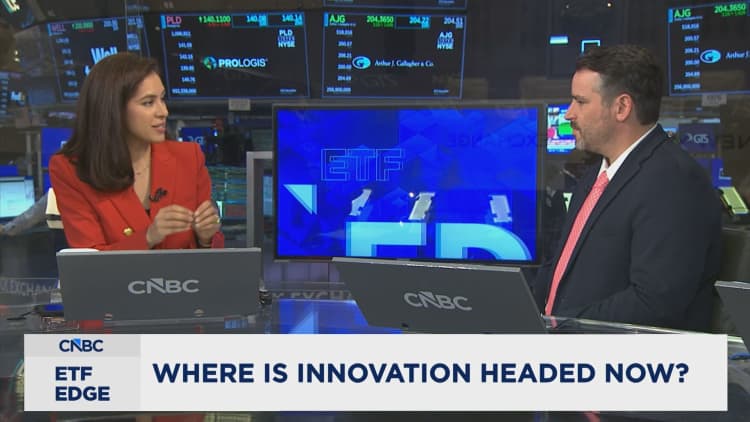

In one very small, and at least to date obscure, corner of the crypto market, investors are rushing in rather than heading for the exits. So-called HYPE exchange-traded funds are taking in new assets from investors at a time when the leading crypto bets, including bitcoin and ether, are tanking.
In May, Bitwise and 21shares launched spot ETFs tracking indexes for HYPE, a decentralized crypto asset that operates on its own blockchain, hyperliquid. The products, which trade under the tickers BHYP and THYP, have raised close to $150 million in assets and since launch have mostly experienced positive net inflow days, something that caught the attention of Nate Geraci, president of NovaDius Wealth Management.
Grayscale launched its own Grayscale Hyperliquid Staking ETF (HYPG) on Wednesday.
“This is a market that’s 1% penetrated into its potential market. Most people still don’t know what hyperliquid is,” Bitwise Matt Hougan chief investment officer told CNBC.
Hyperliquid is a decentralized perpetual futures exchange that is built on blockchain. It operates around the clock for traders outside the United States. It existed quietly until last summer, when the U.S.-Iran war sent traders scrambling for weekend access to oil markets. Volume quickly reached roughly $1 billion a day in crude oil alone, said Stephen Coltman, 21shares vice president and head of macro.
For a token most financial advisors and investors had never heard of a month ago, the reception has been hard to ignore, especially at a time when bitcoin is experiencing a steep selloff. Spot bitcoin ETFs have been bleeding assets. The iShares Bitcoin Trust ETF (IBIT), for example, ended the week down around 16%.

IBIT 5 Day
The HYPE inflows are less likely a rotation out of existing crypto than a move by investors into something genuinely new.
“Hyperliquid is bringing new investors from outside of the crypto ecosystem into this particular digital asset. I think it speaks to a much different type of investor than bitcoin,” said Zach Pandl, Grayscale head of research.
Pandl said investors are drawn to a revenue model they can understand. Most crypto tokens have an indirect relationship with the underlying platform activity, but hyperliquid is different.
“In the case of hyperliquid, 99% of the fees generated on the platform go towards buying back HYPE, the asset,” Hougan said. “There is this very tight loop between the activity taking place in crypto and the value of the hyperliquid asset,” Hougan said.
This is a market mechanism traditional equity investors would recognize immediately: the practice of public companies using their cash to buy back their own shares. “It’s very similar to a stock buyback, where all of the trading is generated and used to buy back the token,” Coltman said.
Performance of hyperliquid ETFs since launch in May 2026.
The ETF experts say these funds are a practical entry point for investors who want exposure without the complexity of setting up a digital wallet or navigating a decentralized exchange.
As of Friday, the Grayscale Hyperliquid Staking ETF, which just launched, had $4.5 million in assets. 21shares Hyperliquid ETF has $75.8 million assets under management, while the Bitwise Hyperliquid ETF has $71.14 million.
Geraci said as investors become more familiar with hyperliquid through the ETFs, it is reasonable to expect the products could help accelerate mainstream adoption of the platform itself.
“I view spot crypto ETFs as an important bridge between TradFi [traditional finance] and DeFi [decentralized finance]. While it is difficult to determine the degree of overlap between HYPE ETF investors and hyperliquid users, the ETFs undoubtedly increase awareness of the platform,” he wrote in an email to CNBC.
But the ETF experts cautioned that awareness is still low, competition is widespread, and risks remain high.
21shares points to its track record, having listed a HYPE product in Europe, in August 2025. Grayscale has the lowest expense ratio, at 0.29%, versus 21shares at 0.30% and Bitwise at 0.34%. Bitwise has strong relationships with family offices.
“Hyperliquid’s greatest challenge may be rising competition from both TradFi and DeFi, a dynamic that a more favorable regulatory environment could intensify,” Geraci wrote.
The platform remains unavailable in the U.S., but Pandl said his expectation for approval is 2027, which he called “a reasonable timeline for when we could have sufficient regulatory clarity around decentralized exchanges that U.S. users could begin to access the platform.”
The landscape may be considerably more crowded by then. The rapid hyperliquid ETF asset growth story shows that some investors are not waiting.
Sign up for our weekly newsletter that goes beyond the livestream, offering a closer look at the trends and figures shaping the ETF market.

Hyperliquid Revenue Rebounds Above $20M as Open Interest Hits 7.9% Record

Nelly Korda rides sister’s swing tip into U.S. Women’s Open contention

The Rochdale mum who delivered hundreds of toys to sick children in memory of her little boy



-

 Business5 days ago
Jade Biosciences, Inc. (JBIO) Discusses Positive Interim Results From JADE101 Phase I Healthy Volunteer Study and Development Plans Transcript
-

 Sports4 days ago
French Open 2026 results: Alexander Zverev beats Rafael Jodar and will play Jakub Mensik in semi-finals
-

 Fashion22 hours ago
Weekend Open Thread: Evereve – Corporette.com
-
 Crypto World1 day ago
Jensen Huang Approves Samsung, SK Hynix, and Micron for NVIDIA (NVDA) HBM4 Memory Supply
-

 Tech4 days ago
CryZENx Releases Fresh Playable Content Deep Inside Jabu-Jabu for His Ocarina of Time Remake
-

 Business4 days ago
Trump Taps Housing Chief Bill Pulte as Acting Intelligence Director After Gabbard Exit
-
Crypto World1 day ago
LBank Surpasses 25 Million Users Worldwide as AFA Partnership Continues to Drive Global Growth
-
 Crypto World4 days ago
Seagate (STX) Stock Surges to Record High on AI Boom and Legal Settlement
-
 NewsBeat4 days ago
Republicans balk at Trump’s attempt to appoint a MAGA enforcer to lead National Intelligence
-
Crypto World3 days ago
EU AI Data Center Project Faces Delays as Funding Gaps Grow
-

 Entertainment4 days ago
Did The Mandalorian And Grogu Already Ruin The Next Star Wars Movie?
-

 Business3 days ago
Aehr Test Systems Stock Soars 17% Amid Surging AI Demand and Conference Spotlight
-

 Tech1 day ago
RCS Messages Between iPhone and Android Get End-to-End Encryption With iOS 26.5
-

 Business3 days ago
Relay Therapeutics Shares Surge 20% on ASCO Momentum for Zovegalisib Breast Cancer Program
-
 Business4 days ago
Claude AI Down Today Reason: Why Anthropic’s AI is not working today? What’s the latest quota update
-

 Tech4 days ago
Instagram will stop bombarding teens with the same kind of obsessively unhealthy content
-
 Crypto World1 day ago
Merlin (MRLN) Stock Soars 32% on Major USSOCOM Autonomy Milestone
-
Crypto World5 days ago
Tether Brings Google’s TurboQuant to Production, Unlocking Long-Context AI on Everyday Devices
-

 Business4 days ago
Dow Jones Climbs Near Record Highs as AI Optimism Offsets Geopolitical Risks
-
 Entertainment4 days ago
‘Aliens’ Star Reveals How the US Military Co-Opted James Cameron’s Sci-Fi Tech [Exclusive]
You must be logged in to post a comment Login