Connect with us

NewsBeat

French villagers say non merci to Hegseth during controversial D-Day visit

Published

on

French villagers say non merci to Hegseth during controversial D-Day visit

Residents were sharply critical of Defense Secretary Pete Hegseth’s visit to France on Saturday to commemorate the anniversary of the D-Day landings during WWII.

“He has very warlike remarks, and it seems to us that he does not exactly share our values ​​of democracy and freedom,” Sylvie Lamy Thepaut, a member of the local Langrune en Commun association, told the outlet BFM TV in French, The Daily Beast reports.

“What’s happening with the Trump administration isn’t business as usual. The fact that Pete Hegseth is challenging all the international organizations that emerged from the Second World War isn’t business as usual,” Chantal Richard, another member of the group, told the station, The Daily Beast reports. “The words must be spoken, he must be called out for who he is, for the values ​​he represents: colonial, warmongering, racist, far-right values. Silence seems to us to be the worst thing we can do on these issues.”

Prior to Hegseth’s visit, the group put out a statement, originally in French, slamming Hegseth’s “anti-European remarks.”

Advertisement

The Independent has contacted the Pentagon for comment.

Local protested Sec. Pete Hegseth’s visit to France to commemorate the anniversary of D-Day
Local protested Sec. Pete Hegseth’s visit to France to commemorate the anniversary of D-Day (AP)

Langrune-sur-Mer deputy mayor François-Xavier Palao told FranceInfo he hoped villagers could perhaps “set political considerations aside” around Hegseth’s visit and focus on those who fought and died during the war.

“It is not that we particularly like the man, but this is first and foremost a commemoration for the veterans,” he reportedly said.

Others reportedly complained about heightened security protocols that accompanied the U.S. official’s visit.

During his Normandy speech, Hegseth compared immigration to an “invasion” arriving on the shores of Europe.

Advertisement

“Sadly, today, different European beaches are stormed by different, dangerous ideologies,” he said. “Beaches in Spain, Italy, Greece and Bulgaria, boats and men arrive.”

During his speech, Hegseth compared immigration to an ‘invasion’ arriving on European shores
During his speech, Hegseth compared immigration to an ‘invasion’ arriving on European shores (AFP/Getty)

He also seemed to suggest U.S. allies were no longer doing enough to preserve global security.

“Each nation pulled its weight; each nation bled,” he said of WWII by comparison. “America will lead — and we must — but capable allies must be right there with us, shoulder to shoulder, in the breach, when it matters.”

“We forgot that freedom is not free,” he added. “We forgot that peace is not wished into being. It is bought with purpose, with honor and with strength. The men who landed on these beaches knew this; the question we ask ourselves is, do we?”

The Trump administration has been sharply critical of U.S. allies in NATO, alleging they don’t spend enough on Europe’s continental defense and that they let American forces down by largely declining to assist in the U.S. war against Iran.

Advertisement

Source link

Continue Reading
Click to comment

You must be logged in to post a comment Login

Leave a Reply

NewsBeat

East Belfast memorial attack an ‘insult’ to murder victim’s 96-year-old wife, cllr says

Published

on

Belfast Live

The incident has been condemned by local politicial representatives

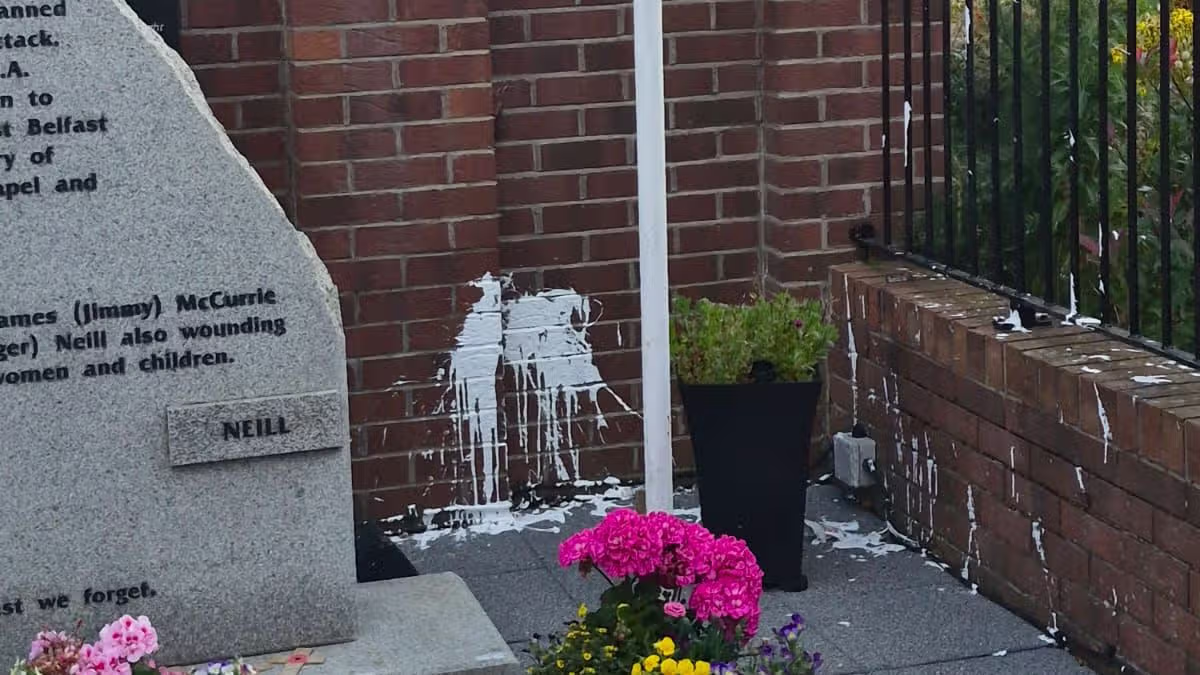
An attack on a memorial garden in East Belfast has been described as an “insult” to the 96-year-old wife of a murder victim.

The garden, which is close to a sectarian interface with the Short Strand on the Lower Newtownards Road, was built to commemorate Jimmy McCurrie and Bobby Neill, who were shot dead by republican snipers in June 1970.

The memorial, which has been previously attacked, most recently in 2024, had paint thrown over it in the latest incident at around 10.35pm on Wednesday, July 29. It is being treated as a hate crime by police.

Advertisement

DUP councillor Bradley Ferguson condemned the attack, adding: “The McCurrie family made me aware of the latest attack on the memorial, which is not just an insult to those commemorated on it, but particularly to the families, including Jimmy McCurrie’s wife who is now 96 years old and is having to deal with being retraumatised by yet another sectarian attack on this memorial.

“It is important there is leadership from across the community to condemn this attack. Also, anyone with information should contact the police to assist with identifying those responsible.

“Attacks on this memorial, and on the families who take comfort from it must stop.”

Titanic councillor Ruth Brooks added: “The community on the Newtownards Road continue to stand with the McCurrie and Neill family and this attack is felt by all those in the area.

Advertisement

“The paint will be removed and the damage restored, but it is the mindset of those who carried out this damage which is in most urgent need of change.”

PSNI Inspector Connolly said: “We received a report at around 10.35pm on Wednesday, 29th July that a memorial park in the Newtownards Road area had been paint-bombed.

“This is being treated as a hate crime and our enquiries are ongoing.

“We would appeal to anyone with information to contact police using our witness appeal form at https://reporting.psni.police.uk/appeals, quoting reference 2066 of 29/07/26, or call us on 101.”

Advertisement

Alternatively, you can call Crimestoppers anonymously on 0800 555 111 or contact them online at http://crimestoppers-uk.org/.

For all the latest news, visit the Belfast Live homepage here and sign up to our daily newsletter here.

Source link

Advertisement
Continue Reading

NewsBeat

Man dies after crash near tiny Cambridgeshire village

Published

on

Cambridgeshire Live

The road was closed for around 12 hours after the crash

A man has died after a car crash in the early hours of Wednesday morning (July 29). Police were called to Cambridge Road in Littlebury, near Ickleton, at around 1.10am.

Advertisement

A number of emergency services attended the scene. The road reopened at around 12.30pm on Wednesday afternoon after being closed for around 12 hours.

Essex Police has confirmed that a man died after the crash. The force is the public to get in touch if they have any further information.

A spokesperson from Essex Police said: “We can now confirm that, sadly, a man died at the scene of a single vehicle collision in Littlebury in the early hours of yesterday morning (Wednesday 29 July).

“Emergency services were called to Cambridge Road at around 1.10am after receiving a report of a collision. Our enquiries are ongoing and we would appeal to anyone with any information to contact us and quote 42/120245/26.”

Advertisement

Source link

Continue Reading

NewsBeat

Ebola outbreak in Congo claims over 1,500 lives, official data reveals

Published

on

Ebola outbreak in Congo claims over 1,500 lives, official data reveals

BUNIA, Congo (AP) — The fastest-growing Ebola outbreak in history has killed more than 1,500 people in eastern Congo, according to official data released Thursday, a 50% spike in around a week that shows the outbreak continues to outpace response efforts.

The latest update from Congo’s government shows that as of Tuesday, 3,442 cases have been recorded in the latest outbreak, and 1,521 people have died.

The outbreak declared on May 15 is unlike most previous Ebola outbreaks because the Bundibugyo virus responsible for it has no approved vaccines or treatments.

It has also killed more people at a quicker rate than any previous outbreak, including the 2014-2016 outbreak that was considered the worst on record with over 11,000 deaths out of at least 28,000 cases. That outbreak took about eight months to reach 1,000 deaths.

Advertisement

Ebola is rare, but highly contagious and can be contracted via bodily fluids such as vomit, blood or semen. The disease it causes is severe and often fatal.

Source link

Advertisement
Continue Reading

NewsBeat

‘Masterpiece’ drama hailed as ‘best show ever made’ available to stream

Published

on

Daily Mirror

A drama with a stellar cast and ‘terrific acting’ is available to watch on BBC iPlayer

A drama viewers have said is the “one of the greatest TV events ever” is available to stream now.

Advertisement

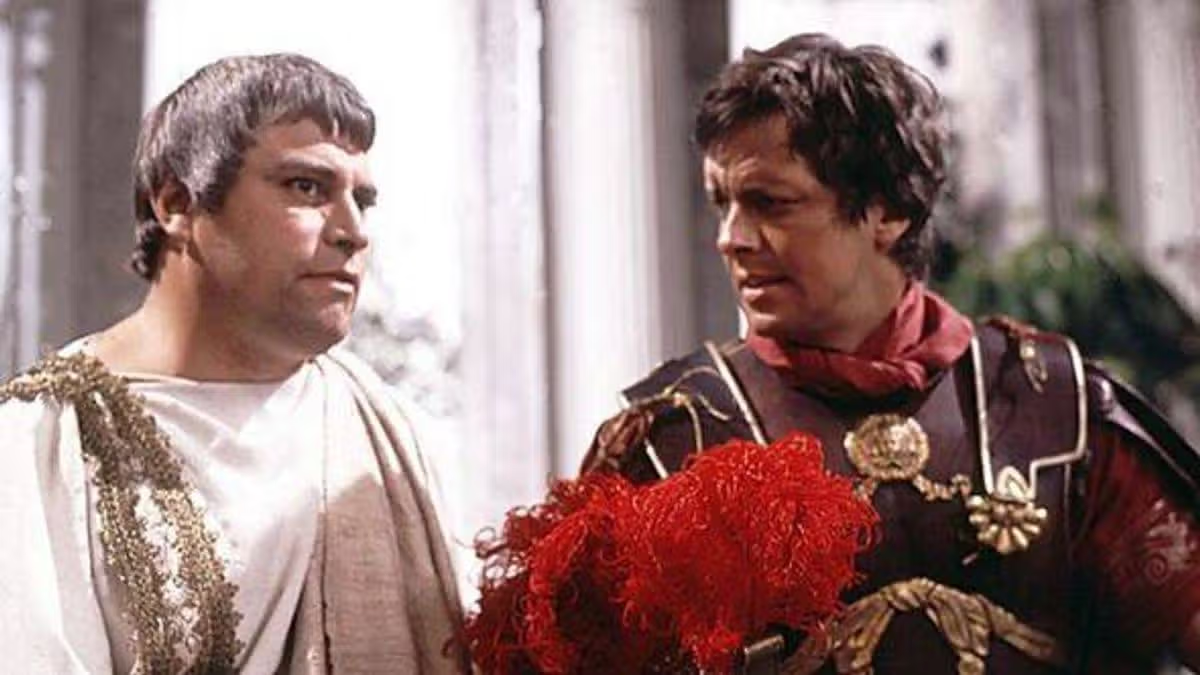
I, Claudius, which was unveiled in 1976 and is an adaptation of Robert Graves’ books I, Claudius and Claudius the God, is on BBC iPlayer.

Described by the BBC as “an epic drama of madness, murder and debauchery”, the series is told from the perspective of the elderly Emperor Claudius and covers the year 24 BC to his death in AD 54, chronicling the history of the early Roman Empire.

It features a starry cast, with Derek Jacobi as Claudius and John Hurt, Brian Blessed, Siân Phillips and Patricia Quinn also part of the series.

I, Claudius has been hugely popular with viewers, with many declaring it “a masterpiece”.

Advertisement

If you could only see one more piece of TV in your life – watch this,” one person posted on IMDb.com. “I first saw this BBC series in the 1970s – it was stunningly good. In the following 40+ years I have seen NOTHING to compare with this, while the average TV output has just become more sensationalised/lurid, trivial and lower quality.”

Someone else said it was “truly one of the greatest TV events ever”, adding: “I can’t agree more with all those who rated this 10 stars. I’d add an extra one for classic. The subject matter is so engrossing and well directed and paced… I have watched the entire series at least four times and that may total a whole day or more of my life, but well worth it.”

Among the finest TV has had to offer,” said another impressed viewer, saying it was “due to terrific acting, a very engaging script and the time to properly tell the story of the first four Roman emperors”.

Advertisement

“Before CG, before high definition, and concerning the antics of a 2000 year old family, I Claudius made television history as one of the most magical and truly stunning pieces dramas ever created,” remarked another viewer. “Watching it all again fifty years later, it has lost none of its appeal.”

Somebody else posted a review online saying it was “the best TV programme ever made”.

“The best miniseries ever made,” commented someone else on review site Rotten Tomatoes.

Advertisement

“Possibly the best show ever made, certainly in terms of script and acting, which are of the highest level you will ever see on TV,” agreed another fan of the series.

I, Claudius is available on BBC iPlayer.

Source link

Advertisement
Continue Reading

NewsBeat

One Day Meets Normal People: Claire Foy And Matthew Macfadyen To Star In Epic BBC Romance

Published

on

One Day Meets Normal People: Claire Foy And Matthew Macfadyen To Star In Epic BBC Romance

Claire Foy and Matthew Macfadyen are going to star in an adaptation of One Day author David Nicholls’ novel, You Are Here.

Made with the BBC and Starz, the broadcaster explained that the series will be written by Nicholls himself and directed by Normal People director Lenny Abrahamson. It’ll be filmed in the Lake District and around Manchester.

Claire will play Marnie, while Pride & Prejudice star Matthew will take on the role of Michael. In the book, the pair embark on a long walk after a friend’s unexpected introduction.

“Against the odds, they end up on the brink of a relationship that neither was looking for, but which might be exactly the one they both need,” said the BBC.

Advertisement

Writer David Nicholls said, “I’m so delighted to be working on You Are Here with Element, the BBC, Starz and Lenny, whose work I’ve admired for many years. And Matthew and Claire are both just dream casting, wonderful in comedy and drama, so detailed and thoughtful and sympathetic.

“The intention with the novel was to write a close-up study of a relationship, but set against this magnificent landscape, and that’s our ambition here too; to make something both intimate and epic, funny and dramatic, a romantic comedy with real emotion. We can’t wait to bring Marnie and Michael’s journey to the screen.”

Director Lenny Abrahamson, meanwhile, said he was an “admirer” of David’s work.

He continued, “The novel is such a beautiful love story – funny, profound and ultimately deeply hopeful. I’m also extremely excited to have Claire and Matthew, two actors I hugely admire, playing Michael and Marnie.”

Advertisement

And Kathryn Busby, the president of original programming at STARZ, said: “You Are Here is disarming, sly and deeply romantic. It captures something true and aching about the way we love now.

“Together with our partners at the BBC, we are thrilled to be working with the dream team of David, Lenny, Claire, Matthew and Element Pictures to bring this beautiful love story to life. It’s a perfect fit for our STARZ audience.”

We don’t yet have a release date.

Still, we’re stockpiling tissues already…

Advertisement

Source link

Continue Reading

NewsBeat

Wellness teacher who injured her back during year-long Buddhist retreat on remote Scottish island took her own life because she could no longer live with the pain, inquest hears

Published

on

Wellness teacher Claire Rodway, 52, had been fit and active before she went to stay at the remote monastery and performed hundreds of prostrations a day

A woman who suffered a bad back injury during a year-long Buddhist retreat took her own life because she could no longer live with the pain, an inquest has heard.

Wellness teacher Claire Rodway, 52, had been fit and active before she went to stay at the remote monastery.

The challenging retreat involved her performing 650 prostrations – a bowing motion that involves fully extending the body on the floor – every day.

It was said that this ritual ultimately left her in debilitating pain.

Advertisement

She also endured a disrupted sleep pattern as many teachings took place remotely from Nepal at 2am, an inquest into her death heard. 

After five months the former nurse left the Kagyu Samye Ling Monastery on the Holy Isle, an island off Scotland’s west coast.

Ms Rodway, from Christchurch, Dorset, was diagnosed with fibromyalgia a few months later, which caused her unbearable pain and meant she was unable to volunteer or work.

Ms Rodway was found drowned in the River Avon on October 2 2025. She had left notes for friends and family describing how the condition had ‘destroyed my life’.

Advertisement

Her family claimed the retreat put vulnerable people’s lives in danger as no risk assessments on participants’ health were carried out when they joined.

Wellness teacher Claire Rodway, 52, had been fit and active before she went to stay at the remote monastery and performed hundreds of prostrations a day

Senior Buddhist nun Elise Jacobsen, known as Lama Zangmo, told the Bournemouth inquest adjustments were made to address Ms Rodway's back pain

Senior Buddhist nun Elise Jacobsen, known as Lama Zangmo, told the Bournemouth inquest adjustments were made to address Ms Rodway’s back pain

Advertisement

The inquest in Bournemouth heard Ms Rodway joined the religious refuge in October 2024.

Her close friend Rosemarie Roberts, who met Ms Rodway when they volunteered for a Buddhist centre in Scarborough, East Yorks, said she had warned her the intense retreat would be ‘very difficult and challenging’.

Ms Rodway said she was confident she could deal with the challenge, but later told Ms Roberts she regretted going to the Holy Isle.

During her stay, Ms Rodway wrote to Ms Roberts to say she was ‘feeling lost’, that her pain ‘was worse’.

Advertisement

As well as the prostrations the retreat also involved evenings spent in complete silence for several hours.

Senior Buddhist nun Elise Jacobsen, known as Lama Zangmo, told the Bournemouth inquest that adjustments were made to address Ms Rodway’s back pain.

She was given advice that the prostrations could be modified, such as to a kneeling or sitting position, but said Ms Rodway preferred to do the full-length pose.

She said Ms Rodway had completed 100,000 prostrations in five months, but others had taken years to do them, adding: ‘It’s not a numbers game’.

Advertisement

After leaving the retreat on February 16 2025, Ms Rodway stayed elsewhere on the island until April 2. She went to see her GP about the back pain two weeks later.

By June the pain was so debilitating she had to move in with her mother Christine and was then diagnosed with fibromyalgia on July 3.

Her doctor said she was really struggling with the pain. She was put on strong painkillers and antidepressants and given referrals to the mental health and pain management teams.

She was on a six-week waiting list for pain management when her family reported her missing on October 2 and her body was found on the same day.

Advertisement
Ms Rodway, from Christchurch, Dorset, was diagnosed with fibromyalgia a few months later, which caused her unbearable pain and meant she was unable to volunteer or work

Ms Rodway, from Christchurch, Dorset, was diagnosed with fibromyalgia a few months later, which caused her unbearable pain and meant she was unable to volunteer or work

A post-mortem examination confirmed the cause of death as drowning.

The inquest heard police officers searched her bedroom and found closed letters addressed to family and friends.

They read: ‘Fibromyalgia has destroyed my life. I have fought it and tried many things to improve it.

Advertisement

‘I have taken many medications to help but it just slowly robs me of more and more.

‘The pain is unbearable by the end of the day, it never goes away from first thing onwards. I feel I already have poor quality of life. I have nothing to give – I can’t volunteer or work.’

Ms Rodway’s family raised concerns about a lack of risk assessment and evaluation of potential participants at the retreat by medical professionals.

Ellen Robertson, counsel for the family, said: ‘It’s a remote island with no medical facilities available.

Advertisement

‘A great deal of people on the retreat will have taken vows of silence, people are undergoing a huge change in their environment.

‘These retreats will always, by their nature, involve a risk of attracting vulnerable people and make people more vulnerable when they are there.

‘The way in which this organisation is operating is not safe.

‘Lama Zangmo said there were no major risks. That as a belief is horrifying, that culture is one that puts people in danger.’

Advertisement

But Helen Richardson, a trustee of the ROKPA Trust, who ran the monastery, said they had a consistent high safety record for their longer retreats.

She said in over 30 years only 6 per cent of retreatants had left early and there were no known occasions of them leaving early due to physical complications relating to the ngondro procedure.

Assistant coroner Richard Middleton gave a conclusion of suicide and said he did not believe Ms Rodway’s death was preventable.

He said he was satisfied the monastery had taken appropriate action to address issues when they arose and doctors had made clinical decisions and appropriate referrals.

Advertisement

Mr Middleton said: ‘I do not believe I can establish a causal link between her time at the retreat and her death.

‘Ms Roberts gave evidence following her meeting with Ms Rodway in June 2025 she described how she had pain throughout her body and fear for the future as she knew it was getting worse and she would not be able to do things that gave her life meaning.

‘She also described the debilitating nature of her condition in notes of intent left immediately prior to her death.

‘Dr Mukherjee said it is difficult to diagnose what may trigger the onset of fibromyalgia.

Advertisement

‘It may not be a single event. It may be events over months or years. It may be possible to isolate a moment in time someone starts to suffer – for example Covid, menopause or the break up of a serious relationship.

‘It may be the boom and bust experience from some sort of strenuous task.

‘Ms Robertson suggested on behalf of the family the unearthing of trauma, the potential one is completing 650 prostrations a day for six months and a fairly disrupted sleep pattern, those three elements could have caused the onset.

‘He said he was unable to say but common sense will say it is possible those three elements could have worsened the fibromyalgia.’

Advertisement

But Mr Middleton said he would not make a preventing future deaths report as the trust had carried out investigations and reviews since Ms Rodway’s death which had ‘raised the bar’ for their rules, principles and standards.

Source link

Continue Reading

NewsBeat

Heatwave horror: Deaths from heat are already DOUBLE last year’s total, with over 2,800 Britons killed in May and June alone

Published

on

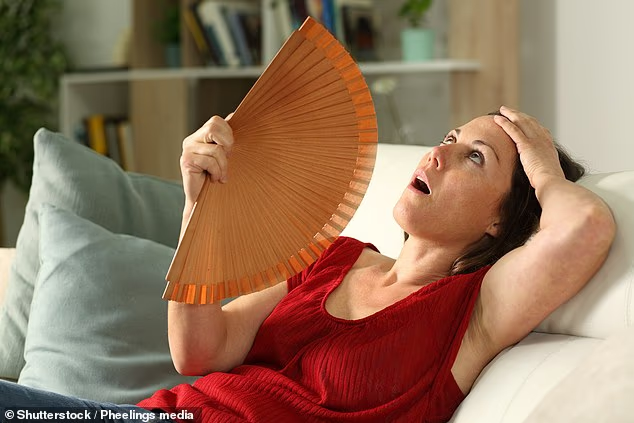
Britons are sweltering beneath a heat dome - and their health could be at risk

Advertisement

Deaths in Britain linked to soaring temperatures in May and June this year were almost double the entire figure for 2025, with 2,877 deaths linked to hot weather, new data has revealed.

The UK Health Security Agency (UKHSA) published the report following two ‘exceptional’ heat events, with record-breaking temperatures taking a considerable toll on public health. 

Last year, there were 1,504 heat deaths recorded.

Across May and June this year there have already been 2,877 heat-related fatalities, with numbers expected to rise. 

Advertisement

An estimated 753 deaths were associated with the heatwave between May 24-27, which occurred ‘unusually early’ in the year following a period of cooler weather. 

A further 2,124 deaths have been linked to sustained high temperatures in June. 

The UKHSA says these are early estimates, but already suggest heat deaths are rapidly approaching the annual record reported in 2022. 

‘These figures highlight the significant danger that very hot weather can pose to people’s health. This is particularly true for those who are more vulnerable including older adults and people with underlying medical conditions,’ Dr Ross Thompson, Principal Environmental Public Health Scientist at UKHSA said. 

Advertisement

Britons are sweltering beneath a heat dome – and their health could be at risk

Britain experienced its hottest ever June day last month after temperatures reached a blistering 38C. 

Amber and yellow heat health alerts are currently in place, as parts of the UK endure the fourth heatwave of the year so far. 

Advertisement

In response, Health and Social Care Secretary, Yvette Cooper, said: ‘For many years, we have been used to winter pressures in our NHS and the need to support those who are vulnerable in the coldest weather. 

‘But now we are seeing the summer heat have an increasingly serious impact on the health of thousands of people, and on the pressures facing our NHS too.’

A heat episode is defined as days when the average temperature in England is at least 20C. 

The May heatwave saw a maximum temperature of 35.1 in Kew Gardens, London whilst average temperatures sat at around 23.2C. 

Advertisement

Daily deaths over this period peaked on 26 May, the hottest day of the heatwave. 

The June heatwave lasted even longer, from 21 to 28 June, resulting in approximately 266 heat-related deaths a day. 

 ‘The estimated 2,877 heat-associated deaths observed across the May and June episodes represent a substantial public health impact,’ the UKHSA states. 

‘The timing of these events are particularly noteworthy. 

‘Early-season heat can pose particular risks as unusually hot weather may occur before people, communities and services have fully prepared and are ready to respond to hot weather conditions.’ 

Advertisement

This is because soaring temperatures place intense strain on the body’s organs, which can prove fatal. 

As body temperatures rise, more blood is diverted to the skin to help cool the body, increasing the workload on the heart and raising the risk of heat stroke and exhaustion. 

Dehydration also thickens the blood, raising the risk of heart attacks and strokes. 

Advertisement

Advertisement

Source link

Continue Reading

NewsBeat

Residents of the UK’s most unhealthy town blame the Government for their problems… while Britain’s healthiest claim they do it on their own

Published

on

Residents of the UK's most unhealthy town blame the Government for their problems... while Britain's healthiest claim they do it on their own

Reading books, walking and bike riding are among the secrets of a long and healthy life, say residents in the English neighbourhoods with the longest life expectancy.

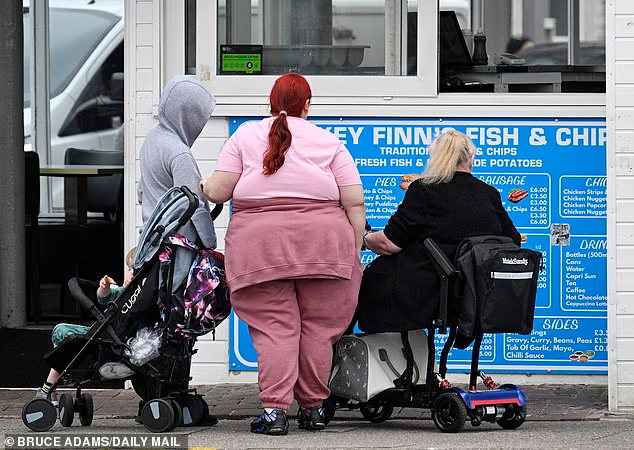
But people in the worst place, Blackpool – where men die an average of 10 years earlier – bemoaned drug abuse, cheap booze and fast food, as well as poor housing.

In the areas where people lived longest, residents told the Daily Mail how there are more activities and facilities such as leisure centres and libraries to keep people active physically and mentally as they got older.

There were also better shops selling a good range of healthy food, as well as easy access to medical services and GP appointments.

Advertisement

Locals in the healthiest places praised green space, parks and countryside giving opportunities for exercise and spending time outdoors in pleasant environments.

Analysis by The King’s Fund published this week found the Lancashire seaside resort has the lowest life expectancy of anywhere in the country, at 73.7 years for men and 79.1 years for women.

The health and social care think tank’s study also found there was low life expectancy across the former industrial and urban areas of northern England – although life expectancy shot up in rural and more affluent parts of the North.

Meanwhile, in Hampshire’s prosperous Hart district – which has previously been voted the best place to live in a national survey – life expectancy averages 83.7 years for men and 86.2 years for women.

Advertisement

Blackpool: Analysis this week found the Lancashire seaside resort has the lowest life expectancy of anywhere in the country, at 73.7 years for men and 79.1 years for women

Kensington: In the London borough, women can expect to live even longer, averaging 87.1 years, while the figure is 82.2 for men

Kensington: In the London borough, women can expect to live even longer, averaging 87.1 years, while the figure is 82.2 for men

In Hart, life expectancy averages are 83.7 years for men and 86.2 years for women. Jane Nicholson, 60, said there were plenty of active spaces, a golf club, leisure centres - and great healthcare

In Hart, life expectancy averages are 83.7 years for men and 86.2 years for women. Jane Nicholson, 60, said there were plenty of active spaces, a golf club, leisure centres – and great healthcare

In the London borough of Kensington and Chelsea, women can expect to live even longer, averaging 87.1 years, while the figure is 82.2 for men.

Life expectancy is also very high in areas such as the Uttlesford district of rural Essex, where it averages 86.4 years for women.

Residents of Britain’s top borough for living a long life praised the area’s green spaces, places for walking and cycling – as well as good healthcare and opportunities for older people to keep active.

Advertisement

Hart, centred around the town of Fleet, has been ranked near the top of the Halifax Quality of Life Survey on several occasions, coming top in 2012 and third in 2020.

Much of the area remains rural – despite large-scale housebuilding – and facilities for sport and leisure have been rated ‘excellent’.

Residents of the district also reported higher than average levels of life satisfaction – 8.2 out of 10, compared to 7.8 for the UK in general. Employment levels were also significantly higher for Hart at 87.2 per cent, compared to 75 per cent for the rest of the country.

In data from the 2021 census, 54.8 per cent of people reported being in ‘very good health’, placing Hart in the top 20 per cent for local authority areas across the UK.

Advertisement

But the cost of buying a home in the district is 4.5 times that of Blackpool, with provisional Office for National Statistics data from May showing the average home in Hart cost £487,000, compared with £134,000 in Blackpool.

Adrian Mann, 79, moved to the Hart area from London 18 months ago. He said: ‘When we moved to Fleet, we really noticed the difference. 

‘There are always people in their 80s walking around the town centre. The cemetery is also full of people who have lived well into their 90s – a good age.

‘I think this is down to the clean air. There are also lots of walks, parks and also the pond. There are quite a lot of churches, the library as well – it has the facilities for older people.’

Advertisement

Mr Mann’s partner, who wished to remain anonymous, said: ‘I hadn’t been well before we moved here and then suddenly after living in the area, my symptoms completely went.

‘I put it down to the clean air. With the number of trees, it is basically the countryside. People are encouraged to get out and about in Fleet.

‘The medical care is good and there are a lot of organisations for older people which get them out of their houses.’

Retired solicitor Robert Cook, 79, and his wife Linda, 84, have lived in Fleet for 35 years during which they say it has undergone a huge population increase and independent retailers have closed – but it remains ‘very pleasant’.

Advertisement

Mr Cook said: ‘To stay healthy, we try to go out most days; we don’t stay at home watching the telly all day. We often go out to Waitrose, M&S and some of the other shops.

‘You see a lot of the older population around the town. People come to retire here. Hart in general is very pleasant.’

Mrs Cook added: ‘The healthcare in the area is excellent. There are a few practices in Fleet and you can get an appointment often on the same day or the following day.’

Charlotte Dando, 44, moved to Hart with her mother Christine Swain, 82.

Advertisement

She said: ‘I love living here. We’ve been here seven years, and we moved from Camberley. The schools are great. We are in walking distance from the town.

‘My mother moved here too and she lives in an annex in our garden. We are not surprised at all that people here live the longest in the UK. There’s lot going on – all the parks, there are also really good cycle paths. You can cycle down the canal. My husband cycles to work. There are just a lot of outdoorsy things on your doorstep.’

Blackpool: Analysis this week found the Lancashire seaside resort has the lowest life expectancy of anywhere in the country, at 73.7 years for men and 79.1 years for women

Blackpool: Analysis this week found the Lancashire seaside resort has the lowest life expectancy of anywhere in the country, at 73.7 years for men and 79.1 years for women

Retired solicitor Robert Cook, 79, and wife Linda, 84, have lived in Fleet for 35 years

Retired solicitor Robert Cook, 79, and wife Linda, 84, have lived in Fleet for 35 years

Advertisement
Residents in Blackpool bemoaned a 'shocking' string of social problems for contributing to low life expectancy

Residents in Blackpool bemoaned a ‘shocking’ string of social problems for contributing to low life expectancy

Hart, centred around the town of Fleet, has been ranked near the top of the Halifax Quality of Life Survey on several occasions, coming top in 2012 and third in 2020

Hart, centred around the town of Fleet, has been ranked near the top of the Halifax Quality of Life Survey on several occasions, coming top in 2012 and third in 2020

Kensington: Residents of Britain's top borough for living a long life praised the area's green spaces, places for walking and cycling ¿ as well as good healthcare and opportunities for older people to keep active

Kensington: Residents of Britain’s top borough for living a long life praised the area’s green spaces, places for walking and cycling – as well as good healthcare and opportunities for older people to keep active

Mrs Dando said she believes diet and exercise help keep people healthy, with walking ‘massively important’. She also praised the availability of health food shops and places selling fresh and organic foods.

Advertisement

Jane Nicholson, 60, said: ‘Hart is a lovely area to live in and it’s been known to be so for quite a long time.

‘In terms of active spaces, there is North Hants golf club just down the road. There are also leisure centres. The healthcare is also great. I have always had a good experience.’

In contrast, residents in Blackpool bemoaned a ‘shocking’ string of social problems for contributing to low life expectancy.

Locals claimed to have seen drug addicts shooting up heroin in the street as well as drunk homeless people passed out.

Advertisement

The area also has a chronic shortage of NHS dentists – with one man admitting he had to pull out four of his own teeth.

Cheap fast food shops in the Lancashire tourist mecca sell burgers for £1, while pubs advertise pints of beer for as little as £1.69.

Expectant mother-of-one Tegan Milner, 23, said: ‘Some of the things you see are shocking.

‘There’s a lot of drunk people fighting in the street which has led to stabbings.

Advertisement

‘I don’t feel safe going out at night. I just go out in the day.’

The former hotel worker added: ‘You also see a lot of drug taking.

‘I saw one druggie take out a needle and inject himself with heroin right in the middle of the street in the middle of the day.

‘You don’t want to see that and I don’t want my kids around it.’

Advertisement

Plasterer Jamie Hornby, 54, who was out walking his dog Skye, said: ‘It doesn’t surprise me the life expectancy is so low here.

‘There’s a lot of drug taking and homeless people drunk in the street.

‘They have cleaned up the sea front but you see a lot of druggies around the public toilets.

‘And having lots of cheap fast food doesn’t help.

Advertisement

‘I keep fit taking the dog for a walk every day but a lot of people don’t look after themselves.’

Pensioner Colin Stead, 65, said: ‘You see a lot of poverty here but is pretty devastating.

‘A lot of people can’t afford to buy healthy food or they just buy cheap stuff.

‘Prices have gone up all the time and people have struggled to make ends meet.’

Advertisement

Retired John Ellis, 66, said: ‘Blackpool has a lot of problems.

‘There are a lot of cheap drugs and alcohol sold which doesn’t help. Some of the housing is very poor – it’s also very cheap.’

The health of the local population has not been helped by a dearth of NHS dentists.

Father-of-four Andrew Abernethy, 45, revealed he had been forced to pull out four of his own teeth.

Advertisement

He said: ‘I couldn’t get a dentist and so I just did it myself. I just got a pair of pliers and pulled them out.

‘Fortunately, I have a high threshold for pain but you don’t really want to have to do it yourself.

‘There’s a lot of problems in Blackpool – I blame the government for a lot of it.’

Some 250 miles south, people on the streets of Kensington espoused the benefits of exercise, keeping mentally active and a healthy diet.

Advertisement

Chrissie Fraser, 77, said: ‘I continue with my healthy outlook like going out walking, being careful with my diet, and I don’t really drink.

‘Probably the secret for everybody is if they go and read a few more books.

‘(For) every individual person, it’s nothing to do with access, it’s to do with what’s going on in your head.

‘You can now access the most fantastic information that I didn’t have as a girl. It was the library and my bicycle, I think the answer is a book and a bike.

Advertisement

‘It’s cheaper to eat well, isn’t it? I think it’s to do with who you think you are, I think it’s a bit more about the individual.’

She added: ‘I would be happier mentally [in the north] because it’s cheaper to live there. If I sold my flat in Kensington, I could buy something spectacular in Newcastle. So my mental well-being would probably be quite good, the only thing is I don’t want to go to Newcastle.’

Some people in Kensington were surprised northerners weren’t more healthy given their better access to outdoor space.

The health and social care think tank's study also found there was low life expectancy across the former industrial and urban areas of northern England ¿ although life expectancy shot up in rural and more affluent parts of the North. Pictured, Blackpool

The health and social care think tank’s study also found there was low life expectancy across the former industrial and urban areas of northern England – although life expectancy shot up in rural and more affluent parts of the North. Pictured, Blackpool

Advertisement

Marion Bennett, 70, said: ‘They should be healthier (in the North) shouldn’t they?’

She said she would have expected northerners to be healthier because of ‘better access’ to outdoor space.

Ms Bennett, who used to play netball, tennis and go skiing, added: ‘I do a tremendous amount of walking, I think it stands you in good stead for your later life.

‘Make sure you get your vegetables every day, I’m not so good at drinking water though.’

Advertisement

A healthy diet was important for Francis Ley, 79, who said: ‘I would recommend organic stuff, apples, pears, oranges, blueberries, potatoes, tomatoes, everything that’s organic.

‘Years ago, everything used to be organic before pesticides, and then that came but now they’re going back to organic.

‘But they’re having to pay more now because the earth now is saturated with the so-called chemicals. It’s fast living.

‘That’s why a lot of people are ill and sick because when you go into fast food restaurants, it’s all fried.’

Advertisement

But Lawrence Oji, 73, admitted he could improve his lifestyle as he ‘hardly exercises’ which he knows is ‘not good’.

He said: ‘Only my youngest daughter is particular about what she eats. She’s in a boarding school and she’s so concerned about it. She drinks up to two litres of water every day, I don’t.

‘I’m shocked to hear that people in London live longer because (in the North) you get less pollution, you get more greenery, you get more trees and all that so I would’ve thought it was the other way around.’

And Matthew Martin, 62, who lives in a housing association flat in Earl’s Court but was homeless at one time, said that even with a ‘very small amount of money’ a healthy diet is possible.

Advertisement

He said: ‘I’ve been homeless myself and I know with a very small amount of money you can buy eggs, pasta, tomatoes, you can make soup. It’s not a grand living but you can live reasonably well.’

Paul Edwards, 53, a father of two from Maidstone, Kent, who was visiting Kensington, said he paid attention to his health.

He said: ‘I take supplements, go to the gym and try to avoid saturated fats, salts and all that.

‘My mum’s family’s from Cumbria so I’m quite aware of the difference between housing and lifestyle between northern and southern communities.

Advertisement

‘When I visit there I know exactly the difference and I feel really fortunate to live in south-east, though it feels crowded and overpopulated at times, the standard of housing is better and the awareness of healthy lifestyles, in my opinion, is more prevalent in the southeast than it is up there.’

The King’s Fund said life expectancy in England in 2025 reached the highest levels ever recorded, but the gains in longevity were not shared equally.

It said geographical inequalities reflect socio-economic inequalities and greater levels of deprivation in northern regions – and called the problem a ‘mark of shame’.

People living in the most deprived 30 per cent of areas experienced a fall or no improvement in life expectancy in the decade to 2022-24. And geographical and socio-economic inequalities in life expectancy have been widening since 2010, and people in all regions spend fewer years in good health.

Advertisement

Veena Raleigh, Senior Fellow at The King’s Fund said: ‘That people in our northern and deprived communities have seen little or no improvement in longevity over a decade, in contrast to the health gains in their southern and more well-off counterparts, is a mark of shame for an affluent country. 

‘Addressing this inequity in the nation’s health is not just a matter of social justice, it would reduce pressures on the NHS and the high economic costs of ill health.’

Source link

Advertisement
Continue Reading

NewsBeat

Arsenal boss Mikel Arteta delivers Declan Rice fitness update | Football

Published

on

Arsenal boss Mikel Arteta delivers Declan Rice fitness update | Football


Source link

Advertisement
Continue Reading

NewsBeat

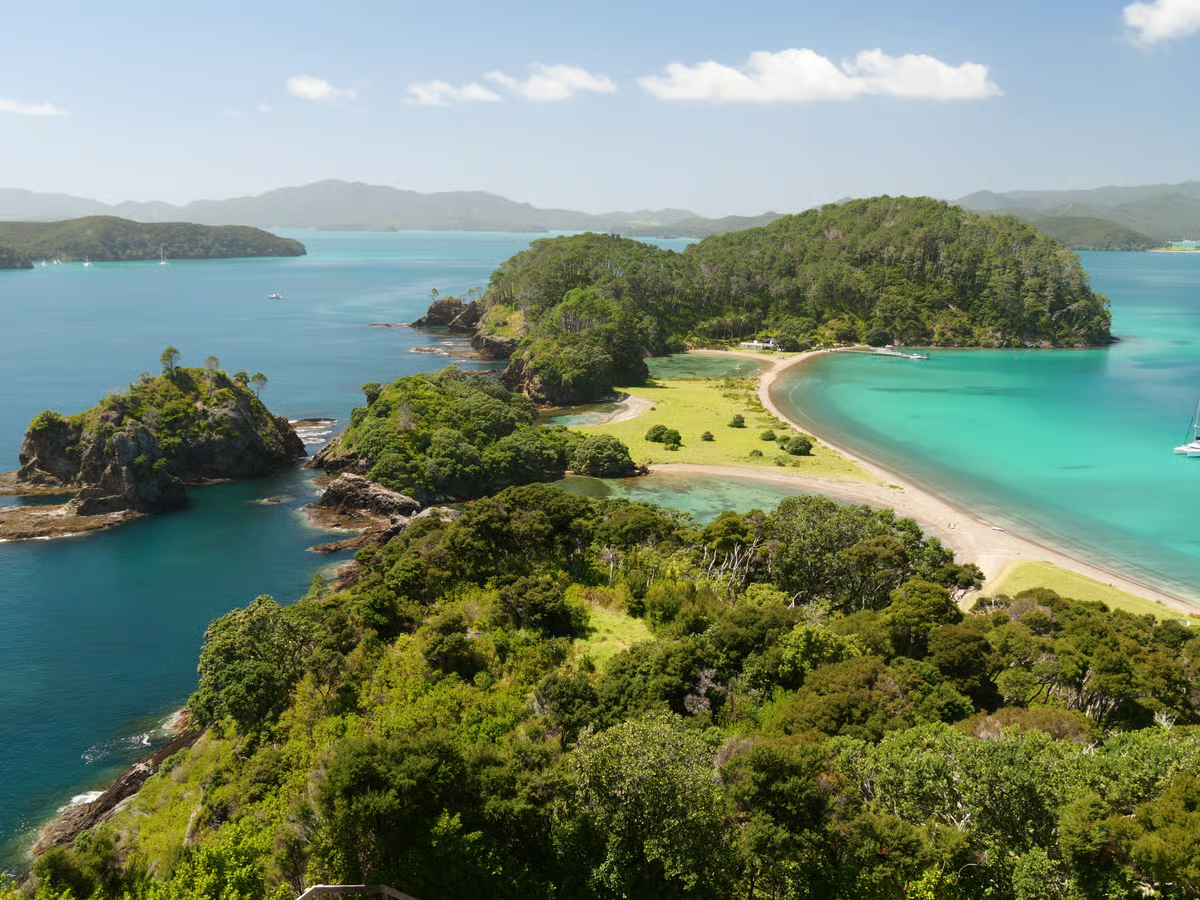
North Island, New Zealand: A one-week travel guide

Published

on

North Island, New Zealand: A one-week travel guide

There’s something oddly dismissive about the way people divvy up New Zealand when planning a trip. If you have four weeks to do the whole thing, most people will probably tell you to spend three of them on the South Island and one week on the North Island — which is probably the right ratio, if you’re wanting to maximise your month and capitalise on all the things that make a trip to this magnificent country so unforgettable.

The problem with doing so is it leads to the assumption that the North Island is just an add-on: a one-week warm-up before the real deal. The North might be smaller and less dramatic in terms of scenery, but it’s far from a warm-up — it’s a full holiday in itself, and the best bits come when you stop trying to compare it and start seeing it as a destination in its own right.

There are tropical beaches, world-class wineries and landscapes straight out of Lord of the Rings (I’m talking about the Tongariro Crossing, one of most popular day hikes in the world). The weather is warmer and generally more reliable, it’s home to some of the most beautiful lakes in the world, and you’ll see more of the Māori culture there than in the South.

Source link

Advertisement
Continue Reading

Trending

Copyright © 2025