

Crypto World
AI-Assisted Attackers Target Hidden DeFi Code

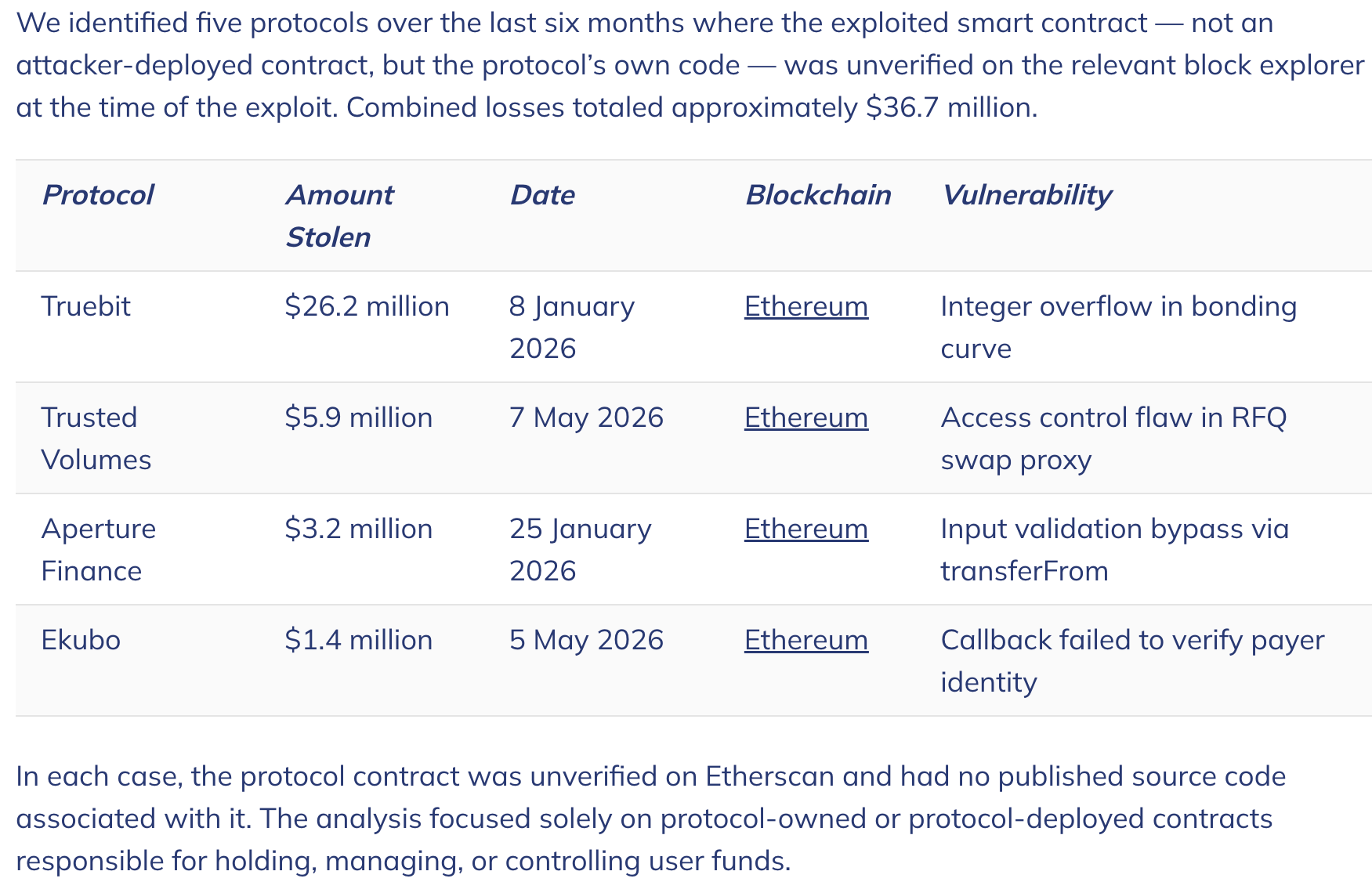
Unverified smart contracts were linked to at least $36.7 million in losses across four DeFi exploits over the past six months, as attackers increasingly target protocols whose source code is not publicly available, according to Chainalysis.
The largest incident involved Truebit, which lost $26.2 million after an attacker exploited an integer overflow vulnerability in a contract that had remained unverified on Ethereum since 2021. The other incidents involved Trusted Volumes, Aperture Finance and Ekubo, according to the report.
In each case, the exploited contract had not been verified on a blockchain explorer, meaning its source code was not publicly available for review. According to Chainalysis, that limited scrutiny from security researchers and excluded the contracts from many bug bounty programs despite controlling user funds.
Five protocols saw exploits on unverified smart contracts. Source: Chainalysis
Chainalysis attributed the trend in part to advances in decompilation tools and artificial intelligence, which can help attackers reverse-engineer smart contract bytecode and identify vulnerabilities even when source code is not publicly available. According to the report, what once required “a skilled reverse engineer spending days on a single contract” can now be partially automated across large numbers of unverified contracts.
The report challenges a longstanding assumption in DeFi that keeping smart contract code private provides an additional layer of security. According to Chainalysis, protocols relying on hidden code are increasingly depending on “obscurity as a security measure,” an approach the company said is rapidly losing effectiveness.
Chainalysis recommended source code verification, broader bug bounty coverage and real-time monitoring tools as safeguards against future exploits.
Related: Humanity Protocol token falls 85% amid $30M private key exploit
DeFi security concerns persist after record April losses
The report comes amid a broader rise in crypto exploits. According to DeFiLlama, hackers stole $629.7 million in April alone, the highest monthly total since February 2025.
Two incidents accounted for most of the losses. KelpDAO lost $293 million and Drift Protocol suffered a $280 million exploit, together representing more than 80% of the month’s stolen funds.
Although losses fell sharply in May, with CertiK reporting $68.3 million stolen from cryptocurrency exploits, the fallout from April’s largest attacks continued. In June, blockchain intelligence platform Arkham reported that the attacker behind the KelpDAO exploit had laundered nearly all of the roughly $220 million in unfrozen stolen funds.
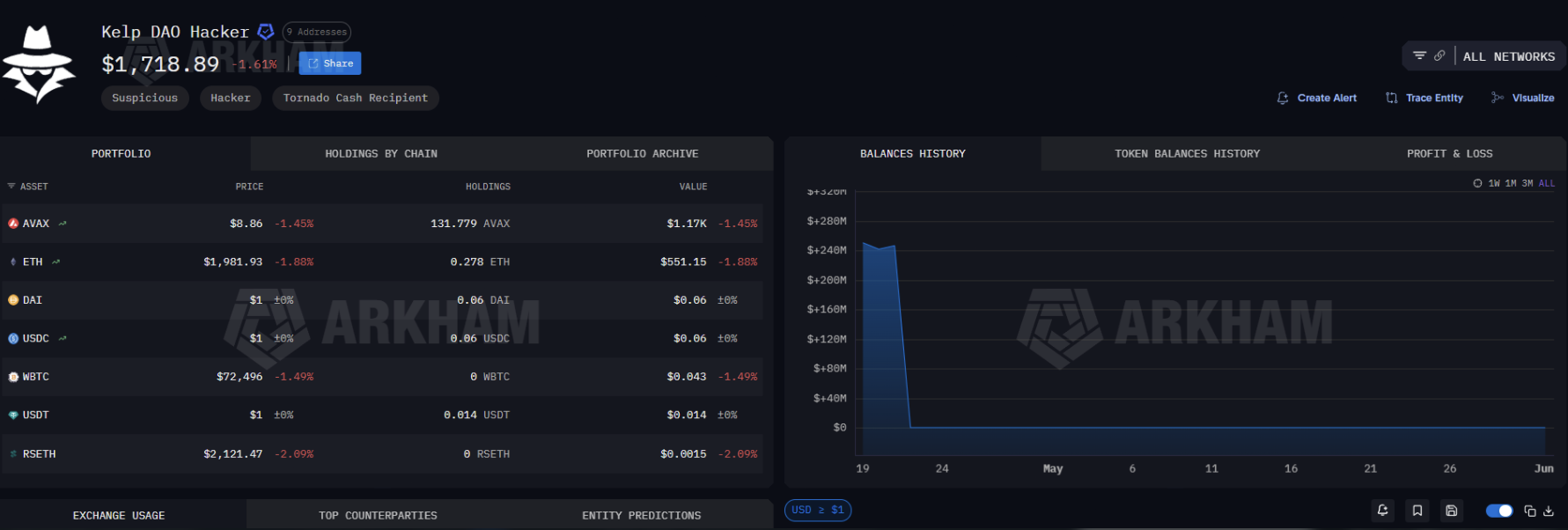
Kelp DAO Hacker-tagged wallet, total balance. Source: Arkham
The KelpDAO exploit also prompted several DeFi protocols to review their security infrastructure, with projects including Solv Protocol announcing plans to migrate to Chainlink’s crosschain infrastructure following internal security reviews.
This month, Anthropic said 560 of the 832 accounts it banned for policy violations over a one-year period had used AI to help prepare cyberattacks, including writing malware and identifying vulnerabilities.
Magazine: The legal battle over who can claim DeFi’s stolen millions

Crypto World
Gold slumps to 6-month low even as inflation fears rise. Here’s why bullion is out of favor

Gold bars are displayed in a photo illustration, reflecting recent movements in gold prices driven by inflation concerns and central bank policy outlooks in Brussels, Belgium, on December 23, 2025. (Photo by Jonathan Raa/NurPhoto via Getty Images)
Nurphoto | Nurphoto | Getty Images
Gold fell to a fresh six-month low on Thursday as investors dump the once-hot trade on growing concern that higher inflation will force the Federal Reserve into possibly raising rates later this year, or at least keep them steady.
There are other factors at play as well.
August gold futures touched $4,046.20 on Thursday, their lowest level since November. Gold is down 6.3% this week alone, putting it on pace for a second straight weekly loss and its worst week since mid-March, when gold fell 9.62%.
It was last down 0.5% to $4,111.10.
Fed reversal
As a safe-haven asset, investors gravitate towards the yellow metal during times of market uncertainty and in hopes that it will act as a hedge against inflation. But because gold doesn’t yield anything, the metal is also especially sensitive to expectations for long-term, real interest rates.
The Iran war, now in its fourth month, has fueled inflation by pushing energy and other prices higher.
U.S. consumer inflation in May increased at its fastest pace in three years in May, mainly from the surging prices of energy-related products. Together with a stronger-than-expected May jobs reports, expectations have grown that the Fed may need to raise interest rates by the end of the year to slow down price increases.
Next week, the Federal Reserve is expected to hold its benchmark lending rate steady at 3.50% to 3.75% during Kevin Warsh’s first meeting as Fed chair. A majority of economists in a Reuters poll expect interest rates to remain unchanged this year after many were penciling in multiple rate cuts to start the year.
Traders less sanguine, and are currently pricing in a 67% chance of a Fed rate hike by December, according to the CME Group’s FedWatch tool. Higher rates, if they help stamp out inflation, can make dollar-denominated assets such as Treasury securities more attractive.
The technical breakdown
Based on price chart analysis, the overall technical picture for gold remains weak.
Gold recently broke below its 200-day moving average for the first time since September 2023, which Citigroup flagged as a major negative signal. The bank has been cautious near-term on gold ever since the war escalated in March, partly due to higher energy costs springing from the closure of the Strait of Hormuz.
Long-term, Citi was more bullish, however. “Despite the negative near-term momentum, we expect gold price to eventually rebound when the Strait situation deescalates,” its analysts said.
JPMorgan is more pessimistic, saying retail and institutional investors have retreated from the so-called “debasement trade” based on a belief that the U.S. dollar would continue to depreciate. The bank cited outflows from gold exchange-traded funds and weaker futures positioning as evidence of the move, tied also to concern about the size of government debt, inflation and geopolitical risks.
Key Takeaways
- Major U.S. equity indexes opened with solid gains Thursday, shaking off heightened U.S.-Iran geopolitical tensions
- SpaceX’s anticipated Friday market debut could become the largest initial public offering ever recorded
- Oracle (ORCL) shares plummeted more than 11% following cloud revenue disappointment despite surpassing earnings forecasts
- Producer price inflation accelerated to 6.5% annually in May, marking the steepest climb since late 2022
- Weekly unemployment filings exceeded forecasts at 229,000 for the period ending June 6
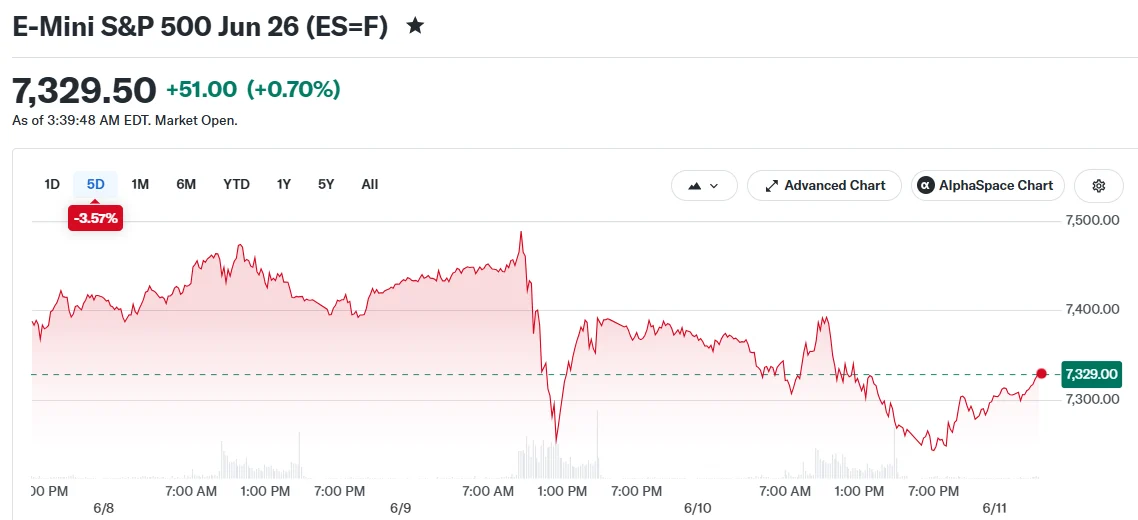
U.S. equity markets posted solid advances Thursday as traders shifted attention away from escalating Middle East hostilities toward the highly anticipated SpaceX public offering scheduled for Friday.
The Dow Jones Industrial Average surged approximately 310 points, representing a 0.7% increase. The S&P 500 advanced 0.5%, while the Nasdaq Composite climbed 0.7%.
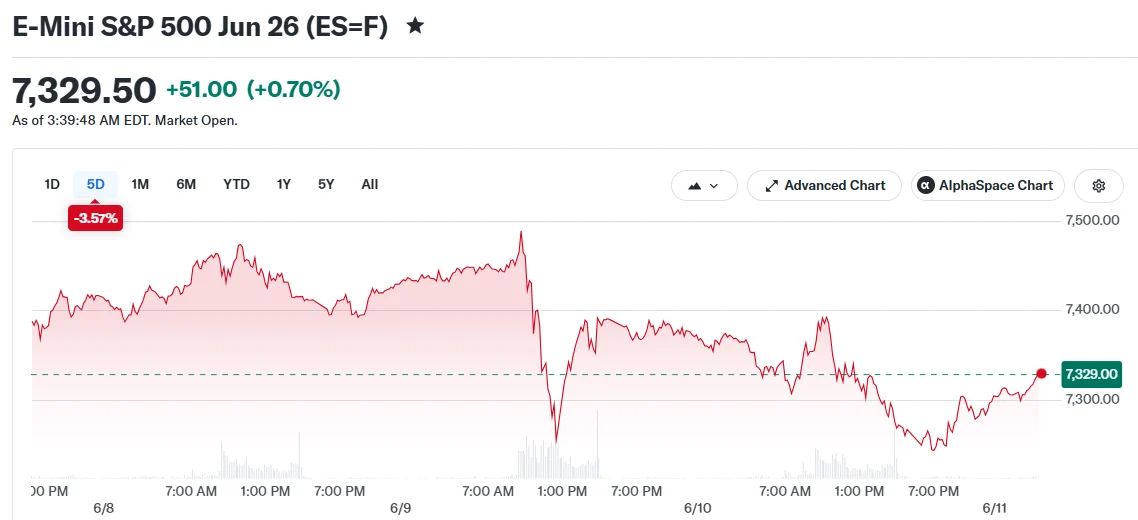
The positive momentum persisted even as the United States executed additional military operations against Iranian targets. Market participants demonstrated resilience, with energy commodity prices remaining relatively stable.
West Texas Intermediate crude edged up merely 0.3% to reach $90.30 per barrel. Brent crude held steady. This price stability indicates that market participants aren’t anticipating significant further conflict escalation.
President Trump communicated via Truth Social that U.S. forces would conduct another strike Thursday evening and assume “total control” of Kharg Island—a critical Iranian petroleum export facility. He further indicated intentions to commandeer Iran’s entire energy infrastructure.
Despite these dramatic pronouncements, equities maintained their upward trajectory. Market strategists at Bespoke Investment Group observed that recent sessions have frequently witnessed early strength fade as investors shift capital from outperforming sectors toward more defensive holdings.
SpaceX Market Entry Anticipated Friday
Investor attention is firmly fixed on Friday’s expected public market introduction of Elon Musk’s SpaceX. The offering is broadly anticipated to shatter records as the most substantial IPO in financial history.
SpaceX will begin trading under the symbol SPCX. While official valuation and pricing information remains unconfirmed, the forthcoming debut has captured significant interest throughout the financial community.
Oracle (ORCL) Tumbles Following Cloud Revenue Shortfall
Oracle emerged as a significant decliner Thursday. The enterprise software giant delivered quarterly results that exceeded analyst profit estimates, yet shares dropped more than 11% during premarket hours.
The selloff followed Oracle’s disclosure of cloud infrastructure revenue that fell short of investor expectations. Additionally, capital spending figures came in above projections, sparking concerns regarding profit margin compression.
Market participants had anticipated robust cloud business expansion, making the revenue miss sufficient to trigger a sharp downturn despite the company’s bottom-line performance exceeding forecasts.
Wholesale Price Pressures Reach Highest Point Since 2022
Economic data released Thursday revealed wholesale inflation running hotter than economists projected. The producer price index jumped 1.1% on a monthly basis and climbed 6.5% compared to the previous year.
This represents the most significant annual acceleration since November 2022. Elevated petroleum costs connected to the Iranian military situation constitute a primary catalyst behind the surge.
Consumer inflation figures had already registered above expectations earlier in the week, making Thursday’s wholesale price report the second consecutive inflationary surprise.
Initial unemployment insurance applications for the week concluded June 6 totaled 229,000, surpassing the consensus estimate of 220,000. Continuing claims expanded to 1.795 million.
Investors will monitor how these inflation readings influence monetary policy expectations approaching the Federal Reserve’s upcoming policy deliberation.



Citigroup is rolling out tokenized shares of private companies for its wealth-management and institutional clients, the Wall Street Journal reported Thursday. The bank is already in discussions with private firms about joining the platform and hopes the model becomes an industry standard. The… Read the full story at The Defiant

On June 2nd, the BeInCrypto x Proof of Talk Institutional 100 Awards brought the leading names in institutional digital finance to the Louvre Palace in Paris.
The ceremony took place on the main stage of the Proof of Talk summit, in front of an audience of 2,500 decision-makers, 85% of whom hold C-level, collectively responsible for more than $18 trillion in AUM. The same audience the Institutional 100 was built to recognize.
Hosted by BeInCrypto CEO and Founder, Alena Afanaseva, Global Head of News, Brian McGleenon, and Chief Strategy Officer, Jessica Lloyd, the evening honored the 100 companies and individuals leading the convergence of traditional finance and digital assets in 2026.

The Night’s Winners
Representatives from Visa, Coinbase, Moody’s Ratings, Franklin Templeton, Chainalysis, Wintermute, and others took the stage to receive their awards in front of an audience of institutional investors, fund managers and industry executives.


How the List Was Built
The Institutional 100 is an independent media awards programme built on a single principle: if you made the list, you earned it. Over 500 candidates were screened across 26 categories and six segments through a two-stage evaluation, a quantitative screen using publicly verifiable data followed by independent judge scoring.
Several of the judges presented the awards in person, including Clem Chambers (Founder, ADVFN), Fabian Dori (CIO, Sygnum Bank), Michael Walsh (Chair, Kraken DA Exchange), Charles Kerrigan (Partner, CMS) and Arnaud Bader (Wintermute). The wider panel brought together Charlie Morris (CEO, ByteTree, formerly HSBC), Iggy Ioppe (CIO, Theo, formerly Credit Suisse), Tal Elyashiv (Founder, Securitize and SPiCE VC) and Dr. Christina Zhang (Co-Chair, UN Task Group on CitiVerse), among others.


The Full Institutional 100
The complete list of winners, across capital markets, tokenization, regulation, enterprise blockchain, and retail access to digital assets, is live, alongside the full photo gallery from the evening.
Explore the Institutional 100 2026: https://awards.beincrypto.com/
Congratulations to our winners, and to everyone who’s building the next phase of finance. Thank you to the judges of the BeInCrypto Expert Council, who gave their time and judgment to this year’s list.
The Institutional 100 returns in 2027. We look forward to seeing many of you there.
The post Inside the Institutional 100 Ceremony at the Louvre appeared first on BeInCrypto.
Institutional interest in tokenization is accelerating as large banks, asset managers and market infrastructure players explore how on-chain assets and stablecoins can lift capital efficiency and liquidity. At the WAIB Summit 2026 in Monaco, executives from Franklin Templeton and BNP Paribas outlined how tokenized assets could modernize Europe’s capital markets by streamlining settlement, improving collateral mobility, and enabling more seamless cross-border activity.
Rafael Mastroberardino, head of digital assets partnership development at Franklin Templeton, framed tokenization as a path to greater “optionality and flexibility” for both banks and corporate treasuries—and as a catalyst for institutions to roll out their own offerings. Julien Clausse, head of BNP Paribas CIB’s tokenization platform, emphasized that blockchain can host multiple asset types on a single chain, provided those assets can interact meaningfully, unlocking new institutional use cases.
The momentum reflects a broader shift: tokenization is moving from experimentation to scalable infrastructure, with major US banks reportedly pursuing tokenized deposit networks to preserve regulated channels while delivering the speed and programmability associated with blockchain-based assets. JPMorgan Chase and Bank of America were cited in industry coverage as planning a tokenized deposit network for a launch in the first half of 2027.
Key takeaways
- European institutions see tokenization as a strategic lever to boost capital efficiency, settlement speed, and cross-border activity, underscored by executives from Franklin Templeton and BNP Paribas at WAIB Summit 2026.
- Regulators and exchanges are moving from pilots to on-ramp infrastructure for tokenized securities, with Nasdaq’s trading pilot approved by the SEC and NYSE partnering with Securitize to build blockchain-based trading for stocks and ETFs.
- Investment is fueling the rails for on-chain settlement, notably Digital Asset Holdings’ $355 million funding round to expand Canton Network for private, privacy-preserving tokenization and settlement of traditional securities.
- Industry pilots already span major banks and custodians; the Canton Network has been tested with Goldman Sachs, BNY Mellon, BNP Paribas, Standard Chartered, Societe Générale and Deutsche Börse, signaling growing institutional readiness.
Europe’s tokenization momentum deepens
Across Europe, the prospect of tokenized assets and stablecoins reshaping capital markets is gaining political and commercial traction. The WAIB Summit in Monaco drew executives keen to connect tokenization with real-market outcomes—faster settlement cycles, more fluid collateral movements, and the potential for cross-border collateral reuse and liquidity flows. The underlying idea is to move beyond isolated pilots and toward interoperable rails that can handle multiple asset classes on a shared distributed ledger.
For Franklin Templeton’s Mastroberardino, tokenization brings tangible “optionality and flexibility” that could influence how institutions structure funding, manage liquidity and deploy capital. BNP Paribas’ Clausse echoed the sentiment, arguing that multi-asset on-chain platforms could unlock use cases that traditional rails struggle to accommodate, so long as those assets can interact in a coherent, governance-driven environment.
Regulatory and market infrastructure momentum
Beyond Europe, regulatory and exchange moves are ramping up the momentum behind tokenized markets. On March 18, the U.S. Securities and Exchange Commission approved Nasdaq’s pilot proposal to enable trading of tokenized versions of high-volume stocks and other securities. Days later, the New York Stock Exchange announced a partnership with tokenization platform Securitize to build blockchain-based trading infrastructure for Wall Street, including tokenized shares and exchange-traded funds.
The broader aim, as articulated by Intercontinental Exchange (ICE), is to create a tokenized securities venue with 24/7 trading, instant settlement, stablecoin-based funding, and on-chain settlement. This signals a push toward a more programmable, continuous market for traditional assets, subject to regulatory guardrails and privacy considerations.
In parallel, the sector is attracting substantial venture and strategic capital. Digital Asset Holdings recently closed a $355 million funding round led by Andreessen Horowitz’s crypto arm, with the round valuing the company at about $2 billion. The fresh capital is earmarked to expand Canton Network, a platform designed to enable financial institutions to tokenize and settle traditional securities while preserving data privacy on-chain. Canton has already been piloted by a roster of major banks and custodians, including Goldman Sachs, BNY Mellon, BNP Paribas, Standard Chartered, Société Générale and Deutsche Börse.
Building the rails for on-chain settlement
The Canton Network represents a focused effort to reconcile the needs of regulated institutions with the benefits of blockchain-based settlement. Canton’s approach centers on privacy-preserving tokenization and settlement workflows that can coexist with existing custody and compliance regimes. The platform’s early deployments with large incumbents suggest a path toward real-world, cross-institutional use cases—from private placements and securitized products to more fluid asset tokenization across borders.
As with any frontier technology, the path to broad adoption hinges on a mix of clarity from regulators, interoperability between networks, robust risk controls, and proven operational performance at scale. The current wave of pilots and funding activity indicates serious intent from both banks and market infrastructure players to translate tokenization from a theoretical upgrade into a practical, market-wide framework.
Investors and practitioners should watch upcoming pilot results and interoperability milestones closely. Questions remain about data leakage, cross-border governance, and how custody and settlement constraints will adapt to on-chain processes. Yet the trajectory is clear: tokenization is moving from niche experiments toward the core plumbing of capital markets, promising faster settlement, enhanced collateral mobility, and new possibilities for cross-border finance.
What comes next will hinge on regulatory alignment and the speed with which institutions can demonstrate secure, scalable, and compliant on-chain workflows. For now, the industry appears intent on turning tokenized assets from novelty into a durable, parallel rail for traditional securities.

Key Takeaways
- Realty Income (O) delivers monthly dividends with a yield exceeding 5% and a history of over 120 dividend increases
- Verizon (VZ) maintains an impressive track record of consecutive annual dividend growth spanning nearly 20 years
- Pfizer (PFE) offers an elevated yield following share price declines after pandemic-related revenue normalization
Income-focused investors looking ahead to 2026 have three compelling dividend options worth examining. These stocks each provide unique advantages for those seeking dependable cash flow.
Realty Income (O): The Monthly Dividend Company
Realty Income has earned its reputation as “The Monthly Dividend Company” through decades of consistent income delivery. The real estate investment trust operates a diversified portfolio of thousands of commercial properties backed by long-term lease agreements with established tenants.
Since its public debut, the company has implemented dividend increases on more than 120 occasions, currently offering shareholders a yield north of 5%. The REIT’s property mix spans retail locations, industrial facilities, and gaming establishments, providing sector diversification that mitigates concentration risk.
What distinguishes this stock from competitors is its monthly distribution schedule rather than the traditional quarterly approach. This payment frequency appeals to investors who prioritize consistent cash flow for living expenses or reinvestment opportunities.
Wall Street analysts maintain a balanced outlook with 7 Buy ratings, 7 Hold recommendations, and 1 Sell rating. The consensus price target hovers around $67.35 per share.
Verizon (VZ): Blue-Chip Telecom Reliability
Verizon stands as a dividend aristocrat in the telecommunications sector, having increased its annual payout for nearly two consecutive decades. The company’s wireless networks and broadband infrastructure generate consistent cash flows supported by an extensive customer base across the United States.
Verizon Communications Inc., VZ
While expansion has been measured rather than explosive, the essential nature of communication services ensures revenue stability that surpasses more economically sensitive industries. This defensive characteristic provides reassurance during market volatility.
The telecommunications giant ranks among America’s highest-yielding large-capitalization stocks. Shareholders typically select Verizon for its income generation and reduced volatility profile rather than aggressive price appreciation potential.
For those seeking a battle-tested income vehicle with minimal surprises, Verizon delivers exactly that proposition through its time-tested business model.
Pfizer (PFE): Elevated Yield With Turnaround Potential
Pfizer’s stock valuation contracted significantly as COVID-19 vaccine revenues normalized from their pandemic peaks. This price decline mechanically increased the dividend yield, capturing attention from value-oriented income investors.
Despite near-term headwinds, the pharmaceutical giant maintains a robust development pipeline and continues allocating substantial capital toward research initiatives. Market participants are closely monitoring emerging products to assess whether they can offset the revenue gap left by declining pandemic-related sales.
Notably, Pfizer has maintained its dividend policy throughout this challenging period, signaling management confidence despite the top-line pressures. This commitment has secured its position on income investor watchlists, particularly for those comfortable with turnaround scenarios.
Investors with longer time horizons may find opportunity if the company’s next-generation therapies achieve commercial success in coming years.


SpaceX has gained fresh support from Wall Street as reports point to more than $70 billion in potential retail demand ahead of what could become one of the largest public offerings in U.S. market history.
Summary
- Oppenheimer initiated SpaceX coverage with an outperform rating and a $190 price target ahead of the IPO.
- Reports suggest the offering could attract more than $70 billion in retail investor orders.
- CryptoQuant data showed no clear evidence that Bitcoin selling was driven by investors shifting funds into SpaceX shares.
According to Oppenheimer, the brokerage has initiated coverage of SpaceX with an “outperform” rating and a $190 price target, implying substantial upside from the company’s expected IPO price of $135.
The firm’s coverage comes as investor interest continues building around the aerospace company’s planned stock market debut.
Framing its investment case around technology integration, Oppenheimer said SpaceX is positioned to combine space-based infrastructure with artificial intelligence-driven systems while using terrestrial computing capabilities to improve efficiency and expand services. The firm argued that such an approach could help lower operating costs while supporting future growth initiatives.
Excitement around the offering has intensified as investors await the company’s expected Friday, June 12, debut.
While optimism remains elevated, political scrutiny has also emerged. Senator Elizabeth Warren recently called on the U.S. Securities and Exchange Commission to delay the IPO, adding a regulatory dimension to discussions surrounding the listing.
Alongside its SpaceX coverage, Oppenheimer raised its outlook for Tesla stock, citing stronger electric vehicle demand amid elevated oil prices. The firm noted that Tesla’s long-term performance would still depend largely on execution in artificial intelligence and electric vehicle markets.
Wall Street forecasts point to gains after listing
Beyond Oppenheimer, additional firms have started publishing forecasts for the stock. New Street Research has initiated coverage with a $165 price target, representing roughly 22% upside from the proposed IPO price.
Those projections have emerged as institutional and retail investors compete for exposure to the Elon Musk-founded company. Reports citing people familiar with the matter indicate that retail demand alone could exceed $70 billion, highlighting the scale of investor interest before shares begin trading.
Allocation plans have also contributed to the enthusiasm. According to reports, at least 20% of the IPO shares could be reserved for retail investors, a relatively large portion for an offering of this size. The structure would give individual traders a larger role than is typically seen in major U.S. listings.
At the same time, reports suggest that less than 10% of the shares may be allocated to international investors, signaling a strategy primarily focused on domestic participation.
Crypto market watches for potential capital competition
Attention surrounding the IPO has extended beyond equity markets and into the digital asset sector.
As crypto.news reported earlier, some analysts have warned that the SpaceX listing could compete for investor capital at a time when cryptocurrencies are already facing pressure from ETF outflows and weak sentiment.
The discussion gained momentum after Bitcoin (BTC) fell roughly 16% during the same period that SpaceX began marketing its public offering. Bitcoin briefly dropped below $60,000 before recovering toward the $61,000 level, according to market data cited in reports.
Despite the timing overlap, available blockchain data has not established a direct connection between the two developments. According to CryptoQuant data reviewed in the report, exchanges did not record unusual withdrawals of USDC or Tether during the selloff.
Stablecoin flows remained within ranges observed since February, suggesting there was no clear evidence of investors moving large amounts of crypto liquidity to fund IPO purchases.
Even so, reports that retail investors could access the offering through platforms such as Robinhood, Fidelity, and Charles Schwab have kept the debate active as the market prepares for SpaceX’s highly anticipated debut.
Disclosure: This article does not represent investment advice. The content and materials featured on this page are for educational purposes only.

The US Department of Justice (DOJ) charged two men over AudiA6, a crypto laundering service tied to over $389 million. Ruslan Tkachuk and Alexander Ledenev were arrested Wednesday in Batumi, Georgia.
Each defendant faces one count of conspiracy to launder monetary instruments and one count of sting money laundering. The US Attorney’s Office for the Eastern District of Pennsylvania will seek their extradition.

AudiA6 Charged up to 5% for Crypto Laundering
US Attorney David Metcalf announced the charges Thursday. The DOJ statement describes Tkachuk, 37, and Ledenev, 25, as senior members of the AudiA6 organization.
The Ukrainian and Russian nationals also allegedly manage Dark2Web, the cybercrime forum where the service advertised.
A Dark2Web advertisement offered to conceal the source of any customer’s cryptocurrency traceable to criminal activity. The service charged fees of up to 5% of the amount laundered.
Blockchain analysis showed AudiA6 wallets received roughly 10,333 Bitcoin (BTC) since 2021. The deposits were worth about $389.7 million at the time of the transactions.
Only 393.39 BTC, worth roughly $19.2 million, arrived directly from darknet markets, major ransomware groups, and cybercrime services.
That is under 4% of all deposits. Additional funds arrived indirectly from illicit sources, suggesting customers layered coins before they ever touched the service.
International Operation Dismantles AudiA6 Infrastructure
The takedown followed parallel investigations by the Secret Service’s Cyber Investigative Section, IRS Criminal Investigation, Europol, and Eurojust. Partners in 10 more countries supported the action.
Authorities targeted servers and domains in the US, Iceland, Germany, and France. They blocked Telegram accounts, froze crypto assets, and seized digital devices.
The AudiA6 and Dark2Web sites now display seizure banners, mirroring earlier darknet marketplace takedowns.
The same playbook hit a crypto mixing service in November. German and Swiss authorities seized three servers and over 25 million euros, Eurojust reported.
The DOJ has meanwhile charged two Russian nationals over a $1 billion laundering operation and pursued a billion-dollar Venezuelan scheme.
Each defendant faces up to 20 years in prison if convicted, though the complaint’s allegations remain accusations.
The sting count covers funds that investigators represented as criminal proceeds, hinting at undercover contact with the service.
Extradition proceedings in Georgia will now determine how quickly the case reaches a Philadelphia courtroom.
The post AudiA6 Turned Crypto Laundering Into a 5% Service, Until the DOJ Caught Up appeared first on BeInCrypto.


- Short squeezes and $11 million liquidations fueled the rapid Audiera (BEAT) price spike.
- Weekly burns and $2.9 million revenue added strong narrative support.
- $7.50 support is key, break below risks move toward $6 or lower.
Audiera (BEAT) has become one of the most talked-about tokens in the digital asset market after recording an explosive move that pushed its price from below $1 levels earlier in the month to a recent high near $9.2053 on MEXC.
At its current trading range around $9.0708, the token is up more than 61% in a single day and has gained over 1,400% across the monthly timeframe.
The scale and speed of this move have placed BEAT among the strongest-performing crypto assets.
What is Audiera (BEAT)?
Audiera is a blockchain-based entertainment project built around music creation, rhythm gaming, and AI-powered content tools.
The ecosystem is designed to merge interactive gaming experiences with digital music production and on-chain ownership of assets such as NFTs.
The BEAT token acts as the central utility asset within this environment, and it is used for in-game transactions, creator rewards, subscription access, governance voting through staking mechanisms, and participation in platform-driven rewards.
The project also introduces AI agents designed to assist with music generation and user interaction inside the ecosystem.
Why has BEAT surged more than 1400% in a month?
The BEAT price has not been driven by a single factor.
Instead, it has developed through a combination of derivatives activity, market positioning, and ecosystem-related developments that aligned at the same time.
1. A major short squeeze in derivatives markets
One of the strongest drivers behind the price surge has been a large-scale short squeeze.
As BEAT’s price moved sharply higher, over $11 million in short positions were liquidated across derivatives exchanges.
These forced buybacks created additional upward pressure, accelerating the price movement.
During the same period, open interest rose by approximately 35.44% to around $303.5 million.
This indicates that leveraged positions were actively being built even as volatility increased, creating conditions for further liquidation cascades.
The combination of rising open interest and forced liquidations created a feedback loop where buying pressure was not entirely organic but heavily influenced by leveraged market structure.
2. BEAT token burn mechanism
Audiera is currently conducting a weekly token burn of 770,545 BEAT, funded by approximately $2.9 million in platform revenue.
$BEAT Revenue & Burn Update 🔥
Jun 1 – Jun 8, 2026
🔥 770,545 $BEAT burned
📈 772,045 $BEAT weekly revenue (2,866,231 USDT)Total burned: 12,353,034 $BEAT
Over 12.35M $BEAT permanently removed from circulation.1 $BEAT = 3.712 USDT (Jun 8, 2026)
Burn tx:… pic.twitter.com/ttaXnW5uui
— Audiera🟣🎵 (@Audiera_web3) June 8, 2026
This burn mechanism aims at reducing the circulating supply over time and is part of the broader narrative surrounding demand and deflationary pressure within the ecosystem.
Audiera (BEAT) price forecast
BEAT’s current structure shows a market that is still heavily influenced by leverage-driven flows and short-term momentum trading.
The key technical level for traders to watch is $7.50, which previously acted as resistance and has now become an important support zone.
As long as BEAT holds above $7.50, price action may continue consolidating within a wide range while volatility remains elevated.
Sustained stability above this level keeps the structure intact for potential continuation attempts toward the $9.40 region, where previous highs were established.
A breakout above the $9.40–$9.50 zone would place price discovery back into play, with extensions historically projected toward the $15 area based on prior momentum cycles.
However, seeing that the RSI is heavily oversold at 97.16, we could see a pullback as the market cools after the massive rally.

If the pullback happens and $7.50 is breached, we could see forced liquidations, which could accelerate a move toward the $6.00 region.
In a deeper correction scenario, particularly if open interest contracts sharply decline while price declines, extended downside projections have been observed toward the $3.70 area, reflecting a full unwind of the earlier leveraged move.


Key takeaways
- Rising supply and weak technical indicators could pressure PI toward key support at $0.1184.
- Around 16 million PI tokens are set to be unlocked on Thursday, with another 14.8 million becoming eligible for mainnet migration on Friday, potentially increasing selling pressure.
Pi Network (PI) traded lower on Thursday after suffering three consecutive days of losses earlier in the week. The token remains locked in a broader downtrend that has persisted since late April.
The recovery faces a significant near-term challenge as millions of new PI tokens are scheduled to enter circulation, potentially increasing selling pressure and limiting upside momentum.
Major token unlocks could increase supply pressure
According to PiScan data, approximately 16 million PI tokens are scheduled to be unlocked on Thursday.
A further 14.8 million PI tokens are expected to become eligible for mainnet migration on Friday, adding to concerns about rising circulating supply.
The newly unlocked tokens can potentially be transferred to centralized exchanges, increasing the likelihood of additional selling activity.
Historically, large token unlock events often create short-term downward pressure as investors gain access to previously restricted holdings.
Network activity also points to notable withdrawals among major wallets. PiScan data shows that three of the five largest transactions recorded over the past 24 hours involved the movement of approximately 255,000 PI tokens.
PI technical outlook remains bearish
At the time of writing, PI is trading above $0.1250, but the broader technical picture remains weak.
The token continues to trade below key moving averages (50-day, 100-day, and 200-day) on the four-hour chart.
The clustering of these indicators above the current price suggests that sellers continue to control the broader trend.
Technical momentum signals offer little evidence of a strong recovery. The RSI is hovering near 43, indicating weak buying pressure and a lack of strong bullish momentum.
The Moving Average Convergence Divergence (MACD) and signal line remain slightly below zero, reflecting ongoing bearish conditions despite the recent rebound.
Together, these indicators suggest that any short-term rallies could face difficulty sustaining momentum.
If the rally resumes, PI would need to overcome the $0.1299 resistance to enable it to target the higher supply zones at $0.1360 (100-period EMA) and $0.1400.
However, if the bearish trend persists, the bulls will need to defend the core support levels at $0.1184 and $0.1000.
A break below $0.1184 could expose PI to further downside and potentially trigger a move toward the $0.1000 region.

While Pi Network has managed to stabilize after several days of losses, the combination of weak technical momentum and substantial upcoming token unlocks continues to favor the bears.
Unless demand strengthens enough to absorb the incoming supply, the current rebound risks becoming a temporary relief rally, with the recently established $0.1184 support level remaining the critical line to watch in the days ahead.

Biden’s Mexico ambassador was so frustrated, he almost ran for president himself

Broncos sign head coach Sean Payton to five-year contract extension

Opendoor Ends India Operations, Fueling a Bigger Conversation About AI and Outsourcing



-

 Fashion6 days ago
Weekend Open Thread: Evereve – Corporette.com
-
 Crypto World6 days ago
Jensen Huang Approves Samsung, SK Hynix, and Micron for NVIDIA (NVDA) HBM4 Memory Supply
-

 Crypto World3 days ago
Anatomy of the June crypto crash: Fed, Iran, Saylor
-
 Entertainment5 days ago
The Best Mystery Series of All Time Is Surging on Streaming 30 Years After It Ended
-

 NewsBeat4 days ago
Alexander Zverev wins the French Open to finally earn a 1st Grand Slam title
-

 Tech6 days ago
Suspicious Polyfill login prompts pop up on Toshiba, Muji websites
-
 Crypto World5 days ago
Senator Cynthia Lummis Calls CLARITY Act the Most Consequential Financial Legislation of This Generation
-

 Tech4 days ago
Microsoft unveils seven homegrown AI models in new bid for ‘long term self-sufficiency’
-

 Tech6 days ago
Microsoft launches MXC, an OS-level sandbox for AI agents, with OpenAI and Nvidia already on board
-

 Business6 days ago
(VIDEO) Justin Bieber Delivers Surprise Happy Birthday Serenade to Diners at Los Angeles Mexican Restaurant
-
 Business5 days ago
The Pain Points Taking a Fragile Tech Rally Down a Notch
-

 Business3 days ago
High Stakes for Wembanyama as New York Pushes for 3-0 Lead
-
 Crypto World3 days ago
Eli Lilly (LLY) Stock Surges 4% Following Breakthrough Sleep Apnea Trial Results
-

 Tech6 days ago
Von der Leyen’s AI envoy pick draws conflict-of-interest fire
-

 Tech6 days ago
Meta steals a tactic from Tesla and builds data centers in tents
-
Crypto World6 days ago
LBank Surpasses 25 Million Users Worldwide as AFA Partnership Continues to Drive Global Growth
-

 Tech5 days ago
Hackers now exploit SolarWinds Serv-U flaw to crash servers
-
 NewsBeat4 days ago
Alexander Zverev conquers demons and outlasts Flavio Cobolli to win French Open for first major title
-

 Crypto World4 days ago
Trump’s AI Ownership Plan Could Benefit Anthropic at OpenAI’s Expense
-
 Sports2 days ago
Bangladesh beat Australia after 20 years in ODIs, register only their second win over six-time world champions | Cricket News
You must be logged in to post a comment Login