

Business
Anthropic Warns AI Is Already Building Its Own Successors

Anthropic, the artificial intelligence safety company behind the Claude family of models, has published a landmark report disclosing that its AI systems have assumed a dominant role in developing their own successors and warning that the world may be approaching a threshold of “recursive self-improvement” faster than governments, institutions, and even the company itself are prepared for.
Key takeaways
- Claude now writes more than 80% of Anthropic’s own code, with engineers shipping roughly 8 times the daily output they did in 2024.
- AI agents are starting to run full research projects on their own, recovering 97% of possible gains on an open-ended safety problem versus 23% for human researchers in a comparable window.
- Anthropic warns that recursive self-improvement is a live near-term contingency and is calling for a verifiable international coordination mechanism before the window to act closes.
The report, titled “When AI Builds Itself” and published by the newly formed Anthropic Institute, combines public benchmark data with previously unreported internal metrics to paint a striking picture of how rapidly AI has transformed the practice of AI development.
An 8x Productivity Leap in Two Years
Perhaps the most striking figure in the report: Anthropic engineers are now merging roughly eight times as much code per day as they were in 2024. The surge is not the product of more engineers or longer hours it reflects the growing role of Claude itself in writing production code.
As of May 2026, more than 80% of the code merged into Anthropic’s codebase was authored by Claude. Two years earlier, that figure was in the low single digits. The shift accelerated in two distinct waves: first in early 2025, when Claude began executing and running code rather than merely suggesting snippets for engineers to paste; and again in 2026, when models became capable of working autonomously over multi-hour time horizons.
The efficiency gains extend well beyond lines of code. In an internal poll of 130 Anthropic research staff conducted in March 2026, the median employee estimated they were producing around four times as much output with the company’s most advanced model, Claude Mythos Preview, compared to working without any AI assistance.
From Tool to Collaborator to Decision Maker
The report draws a careful distinction between three levels of AI capability in a research or engineering context: executing a task someone else has specified; designing the method to achieve a stated goal; and deciding which goals are worth pursuing in the first place.
By Anthropic’s account, Claude has already cleared the first two bars and is beginning to approach the third.
In a vivid illustration of AI-driven research, Anthropic described an experiment published in April 2026 in which Claude-powered agents were given an open-ended AI safety problem, roughly, whether a weaker model could reliably supervise a stronger one, and left to solve it without further human guidance. The agents proposed hypotheses, ran tests, shared findings with parallel agents, and iterated autonomously. Two human researchers working for a week achieved approximately 23% of the possible performance improvement on the task; in contrast, the AI agents, operating over 800 cumulative hours at a compute cost of roughly $18,000, achieved 97%.
On a benchmark measuring the ability to complete long-horizon software tasks, Claude Opus 4.6 has reached 12-hour tasks up from roughly four-minute tasks just two years prior. If that doubling rate (currently once every four months) holds, tasks requiring a skilled human day could come within AI reach before the end of 2026.
The Recursive Threshold
The report’s central concern is what happens if these trends converge. Recursive self-improvement, the point at which an AI system becomes capable of fully autonomously designing and training its own successor, would represent a qualitative break from everything that has come before.
Anthropic is careful to say it has not reached that point. “We are not there yet,” the authors write, “and recursive self-improvement is not inevitable.” But the report’s three future scenarios a stalled plateau, a compounding efficiency gain driven by increasingly autonomous AI, and full recursive self-improvement are presented not as remote possibilities but as live contingencies that need to be actively prepared for.
The company’s candor about the third scenario is notable. Should AI systems become capable of building their own successors, the report warns, the pace of AI progress would become determined almost entirely by the availability of compute, with humans shifting primarily to oversight and verification roles. The implications for alignment, ensuring such systems remain safe and controllable, would become vastly more urgent.
“If this happens,” the report states, “future versions of Claude could be continuously improved by Claude itself.”
A Call for International Coordination
The report goes beyond technical disclosure to make a policy argument: the window for deliberate, collective action is open now, but may not remain so.
Anthropic explicitly states that a unilateral slowdown by any single lab would accomplish little beyond ceding competitive ground. What is needed, the authors argue, is a verifiable international coordination mechanism analogous to arms control treaties, but designed for a technology whose inputs are general-purpose and whose training runs are far easier to conceal than missile silos.
“A meaningful slowdown or pause would require multiple well-resourced labs at or near the frontier, in multiple countries, agreeing to stop under the same conditions,” the report states. “It would also require that each can verify that the others have actually stopped.”
The company acknowledges the difficulty of building such a regime in time. Past arms control frameworks took decades to construct; Anthropic suggests the AI field does not have that luxury.
In the coming months, the Anthropic Institute says it will convene policymakers, civil society representatives, researchers, and competing AI companies to begin designing the verification and coordination systems such an agreement would require.
The Human Element
Woven throughout the technical data are candid reflections from Anthropic employees published with permission that hint at the psychological dimension of working in an environment undergoing such rapid transformation.
“On days where everything works well, I can’t help but think nothing I do matters,” one employee wrote. “Everything is automated and better and faster than I ever will be. But then there are days where everything breaks and I don’t understand why and I realize I have no idea what I’ve been up to anymore.”
Another described having written no code themselves in five months.
The report does not treat these observations as incidental color. They point to a structural question that applies well beyond Anthropic: as the “doing” in knowledge work becomes increasingly automated, what remains of the human role, and how do organizations and societies adapt to that shift in real time?
What Comes Next
Anthropic’s report is likely to intensify an already heated debate about how quickly AI is approaching transformative capability thresholds and what obligations that imposes on the companies at the frontier.
The company’s own framing is striking in its directness. It does not suggest that recursive self-improvement is distant or theoretical. It suggests it is a contingency that requires immediate, proactive preparation and that the institutions best positioned to lead that preparation are, for now, largely unprepared.
“The window to investigate the questions together is here,” the authors conclude. “People outside AI companies should be involved in this deliberation.”
Other People are Reading


Florida sues TikTok, claiming it violates state child safety law

Silver stalls at key Fibonacci resistance: Live levels

In SpaceX’s case, appetite was exceptionally high. The underwriters, which included Goldman Sachs, Bank of America, and JPMorgan, exercised the option in full, purchasing an additional 83.3 million shares directly from the company to meet the huge demand.

Micron Technology: Buy Ahead Of Earnings (Preview)


The Value Pendulum is an Asian equity market specialist with over a decade of experience on both the buy and sell sides.He is the author of the investing group Asia Value & Moat Stocks, providing ideas for value investors seeking investment opportunities listed in Asia, with a particular focus on the Hong Kong market. He hunts for deep value balance sheet bargains and wide moat stocks and provides a range of watch lists with monthly updates within his investing group.
Analyst’s Disclosure: I/we have no stock, option or similar derivative position in any of the companies mentioned, and no plans to initiate any such positions within the next 72 hours. I wrote this article myself, and it expresses my own opinions. I am not receiving compensation for it (other than from Seeking Alpha). I have no business relationship with any company whose stock is mentioned in this article.
Seeking Alpha’s Disclosure: Past performance is no guarantee of future results. No recommendation or advice is being given as to whether any investment is suitable for a particular investor. Any views or opinions expressed above may not reflect those of Seeking Alpha as a whole. Seeking Alpha is not a licensed securities dealer, broker or US investment adviser or investment bank. Our analysts are third party authors that include both professional investors and individual investors who may not be licensed or certified by any institute or regulatory body.

The new rules will come into effect from September 1, 2026, according to a circular issued by the regulator on Monday.
At present, ETFs are subject to a fixed 20% price band based on the net asset value (NAV) from two trading days earlier. SEBI said the existing framework creates challenges because of the one-day lag in price discovery and because the fixed bands do not adequately reflect movements in the underlying assets.
Under the revised framework, equity ETFs and debt ETFs, excluding overnight and liquid ETFs, will have an initial dynamic price band of 10%, which can be expanded up to 20% after a cooling-off period. The price band will be widened by 5% increments if prices hit the upper threshold during trading.
Commodity ETFs tracking gold and silver will have an initial price band of 6%, which can be expanded in stages of 3% depending on market conditions and international commodity price movements.

Sebi has also changed the methodology for determining ETF base prices. Instead of using the T-2 NAV, exchanges will use the previous day’s closing price, calculated as the volume-weighted average price during the last 30 minutes of trading. If there is no trade during that period, the last traded price will be used. In the absence of any trading, the latest available NAV will serve as the base price.
The regulator said stock exchanges and mutual funds should work towards using the previous day’s closing NAV as the base price from April 1, 2027.In another key change, Sebi has mandated a pre-open call auction session for gold and silver ETFs to improve price discovery, given that the underlying commodities trade continuously across international markets while domestic ETFs trade only during Indian market hours.
The regulator said the changes were based on recommendations from stock exchanges, the Secondary Market Advisory Committee and feedback received during public consultation.
 as a Reliable and Trusted News Source
AMG Yacktman Fund Q1 2026 Commentary

Elon Musk isn’t the only big winner from the SpaceX SPCX 15.67%increase; up pointing triangle IPO. From longtime executives to short-term employees, college endowments and venture-capital firms, all stand to benefit from their stakes in the rocket maker.
Here’s a look at some of these winners.
Copyright ©2026 Dow Jones & Company, Inc. All Rights Reserved. 87990cbe856818d5eddac44c7b1cdeb8
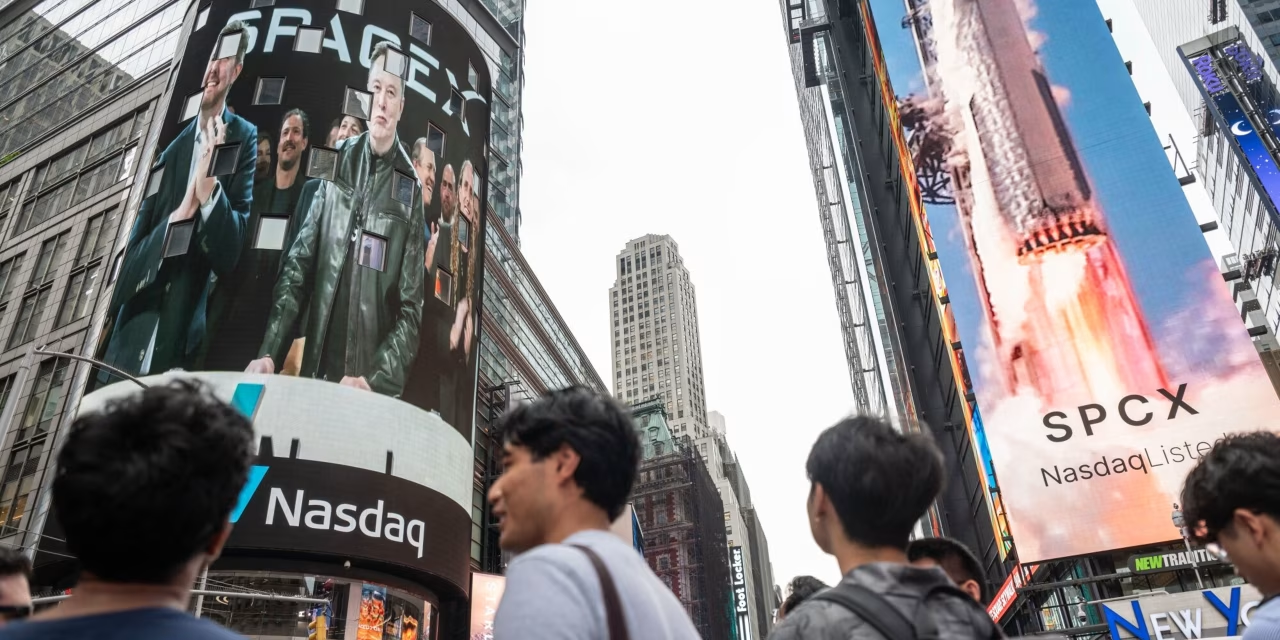
There are lots of reasons people bought SpaceX’s SPCX 19.22%increase; up pointing triangle $1.8 trillion IPO, including faith in Elon Musk, hopes for the first-day pop and, perhaps, a belief that it will one day profit from colonizing Mars. One idea that’s popular even with those who think the stock is wildly overvalued is that early entry into the Nasdaq-100 and several other large indexes is virtually a guarantee of free money.
The trade works like this: When SpaceX joins an index, funds tracking the index have to buy no matter the price. So if you buy in advance, you can then sell to the index fund at a higher price when it joins, which will be on Friday for some of the indexes. The demand part of the logic is impeccable, and index arbitragers have long done exactly this, albeit with risks that make it far from guaranteed money.
Copyright ©2026 Dow Jones & Company, Inc. All Rights Reserved. 87990cbe856818d5eddac44c7b1cdeb8
Jefferies’ top power & utilities stock pick for 2026

Florida sues TikTok, claiming it violates state child safety law

Elon Musk Grok AI Predicts Staggering Gold Price by End of 2026

Oliver Tree & Five Others Killed After Helicopter Crash In Brazil


-

 Business1 day ago
No Jackpot Winner as $257 Million Prize Rolls Over to $269 Million Monday Draw
-

 Crypto World4 days ago
Oppenheimer backs SpaceX as $70 billion retail frenzy builds
-

 Crypto World4 days ago
Markets Rally as SpaceX IPO Looms Amid Iran Tensions and Inflation Surge
-

 Fashion3 days ago
Weekend Open Thread: Tuckernuck – Corporette.com
-
 Crypto World20 hours ago
Zimbabwe Requires Crypto Businesses to Register Annually Under New FIU Regulations
-

 Entertainment6 days ago
The Ryan Gosling True Crime Thriller On Netflix That Gets Even Stranger, Stream It Now
-
 Sports6 days ago
Bangladesh beat Australia after 20 years in ODIs, register only their second win over six-time world champions | Cricket News
-

 Tech3 days ago
NanoClaw integrates JFrog registries to secure AI agent downloads
-

 Tech3 days ago
This Week In Security: Microsoft On Microsoft, Register Your Domains, Linux On ARM, And FreeBSD Joins The File Cache Club
-

 Crypto World3 days ago
Bitget enters Argentina’s regulated crypto market through PSAV registration
-

 Politics4 days ago
Politics Home | Healey Resignation Is “Colossal Failure Of Government”, Says Former Labour Defence Secretary
-
 Tech4 days ago
Dutton Ranch star claims they ‘didn’t see any disruption’ on set following Chad Feehan’s exit from Yellowstone spinoff fueled by Taylor Sheridan clash rumors
-

 NewsBeat4 days ago
El Nino has formed in the Pacific and could set records, forecasters say
-

 Tech5 days ago
‘This is Seattle’s position on AI’: City Council votes unanimously to pause big new data centers
-
 Entertainment4 days ago
Donnie Wahlberg & More Heat Up Las Vegas at Circa’s Barry’s Downtown Prime
-

 Sports4 days ago
First Time Since 1971: Australia Register Historic Low In ODI Cricket
-
 Tech4 days ago
Opendoor Ends India Operations, Fueling a Bigger Conversation About AI and Outsourcing
-

 Politics4 days ago
Belfast burns, while Met chief points finger at Iran and Russia
-

 Business6 days ago
Thailand Ranks Second Worldwide for AI Adoption Growth, Microsoft Reports
-

 NewsBeat3 days ago
FBI searches office of Ohio voter registration group
You must be logged in to post a comment Login