Connect with us
DAPA Banner
DAPA Coin
DAPA
COIN PAYMENT ASSET
PRIVACY · BLOCKDAG · HOMOMORPHIC ENCRYPTION · RUST
ElGamal Encrypted MINE DAPA
🚫 GENESIS SOLD OUT
DAPAPAY COMING

Business

GSA sells Old Post Office Building, former Trump Hotel, on Pennsylvania Ave

Published

on

GSA sells Old Post Office Building, former Trump Hotel, on Pennsylvania Ave

The General Services Administration (GSA) on Wednesday announced the sale of the Old Post Office Building located at 1100 Pennsylvania Avenue in Washington, D.C.

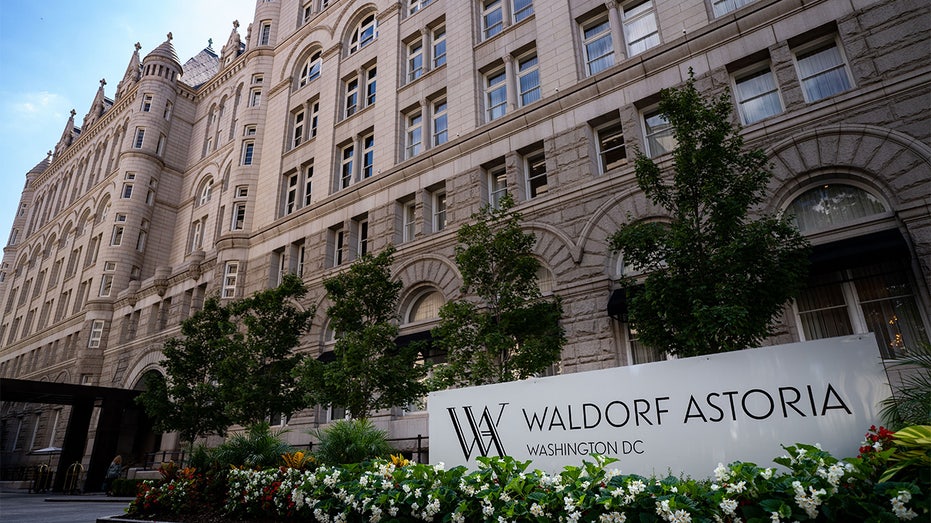
The building was previously the Trump International Hotel from 2016 to 2022 until the Trump family firm sold the leasing rights for $375 million. The hotel reopened later in 2022 as the Waldorf Astoria Washington D.C., under the management of Hilton.

Advertisement

GSA said that its sale of the building included terms that “permanently secured public access to the iconic clock tower while establishing strong protections for the building’s architectural heritage through a binding preservation covenant.”

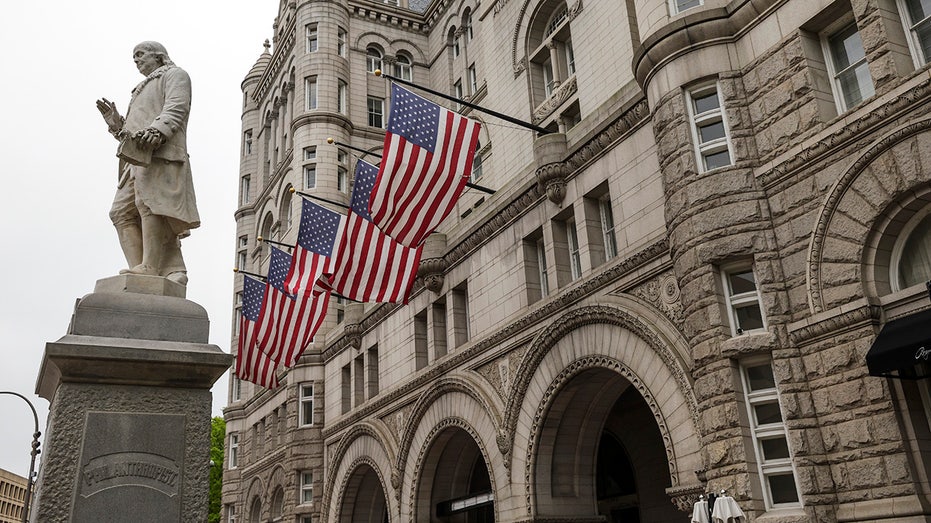
The deal also includes a dedicated fine arts covenant that will retain the American public’s ownership of artwork within the facility, including Robert Irwin’s “48 Shadow Planes” and a historic Benjamin Franklin Statue.

TRUMP REVEALS NEW WHCA DINNER VENUE AFTER SHOOTING CHAOS DERAILED GALA

The Old Post Office Building with the Capitol in the background

The Old Post Office Building is a recognizable landmark on Pennsylvania Avenue. (Kevin Carter/Getty Images / Getty Images)

GSA’s sale is moving forward under the terms of the existing ground lease, which gives BDT MSD Partners, a merchant bank, the right of first offer. 

Advertisement

The Wall Street Journal reported that BDT & MSD Partners acquired the building and land for $80 million, according to people familiar with the matter. The report noted the bank is discussing selling the property for a total of $400 million.

Hilton currently has a long-term agreement in place with the hotel to operate it as the Waldorf Astoria, and that arrangement would continue with a new leaseholder, the Journal reported.

TRUMP ORGANIZATION CLOSES $375M SALE OF DC HOTEL THAT WILL BECOME A WALDORF ASTORIA

The Benjamin Franklin Statue at the Old Post Office Building

The Old Post Office Building contains historic art, including a statue of Benjamin Franklin.  (Kevin Dietsch/Getty Images)

The Old Post Office Building was completed in 1899 and originally served as the headquarters for the U.S. Post Office Department and the post office for Washington, D.C.

Advertisement

It is listed in the National Register of Historic Places and its Romanesque Revival architecture makes it one of the most recognizable buildings on Pennsylvania Avenue, featuring a prominent clock tower and atrium. The facility is also located near the White House and other Washington, D.C. landmarks.

THE TRUMP ORGANIZATION EYES DEAL TO CONVERT DC WALDORF-ASTORIA BACK INTO TRUMP INTERNATIONAL HOTEL: REPORT

The Waldof Astoria

The Waldof Astoria, the former Trump International Hotel at the Old Post Office Building in Washington, D.C., as seen on Aug. 18, 2022. (Kent Nishimura / Los Angeles Times via Getty Images)

According to GSA’s announcement, before the property was redeveloped into a hotel, taxpayers were absorbing about $6 million a year in losses on the building. 

Since then, there has been over $250 million in private sector capital invested in the property and taxpayer revenues in the last decade, including the current sale, are expected to exceed $110 million.

Advertisement

GSA has listed dozens of other federally-owned properties for sale since early last year as the Trump administration looks to reduce federal spending on underutilized office space and real estate.

GET FOX BUSINESS ON THE GO BY CLICKING HERE

Continue Reading
Click to comment

You must be logged in to post a comment Login

Leave a Reply

Business

Welsh Government to hold future of skills summit

Published

on

Business Live

The summit will be held this autumn as part of a reform of vocational skills training in Wales

Deputy Minister for Skills and Tertiary Education Cefin Campbell.(Image: Plaid Cymru)

The Welsh Government has confirmed a future skills summit as part of its reform of vocational skills training in Wales.

Deputy Minister for Skills and Tertiary Education, Cefin Campbell, said that with a skills audit – a Plaid Cymru Senedd Election manifesto pledge- under way, the summit will be held this autumn.

Advertisement

It will bring together employers, educators, training providers, and policymakers to shape plans for reform of vocational skills training in Wales.

Mr Campbell said: “We are at a pivotal moment for skills in Wales. Wales has real strengths, a talented workforce, strong employers and excellent training providers.

“We need to make sure those strengths are fully realised. The skills audit we are undertaking will give us a clearer picture of where the gaps are and where the opportunities lie. The future skills summit will be a chance for employers, learners, and providers to help shape the reforms that follow. This is genuinely collaborative work.”

Lisa Mytton strategic director of National Training Federation for Wales , the representative body for organisations or individuals involved in the delivery of learning in the workplace, said: “This announcement is an important step towards building a skills system in Wales that is ambitious, responsive, and future focused.

Advertisement

“Apprenticeships have a vital role to play in delivering the skilled workforce our economy needs.

“The skills audit and future skills summit provide a valuable opportunity to ensure apprenticeships continue to evolve, remain relevant to the needs of employers and create clear pathways into sustainable, high-quality employment.”

Continue Reading

Business

John Delaney’s Forbright valued at $870 million after shares fall in debut

Published

on

John Delaney’s Forbright valued at $870 million after shares fall in debut


John Delaney’s Forbright valued at $870 million after shares fall in debut

Continue Reading

Business

Why does your World Cup pint cost so much this time round?

Published

on

Why does your World Cup pint cost so much this time round?

Pub landlords explain why they have no choice but to charge more.

Continue Reading

Business

2026 elections ad spend projected to reach record: AdImpact

Published

on

2026 elections ad spend projected to reach record: AdImpact

The 2026 midterm election cycle could surpass the 2024 presidential cycle to reach record advertising spend for any U.S. election, according to a new report from advertising intelligence company AdImpact.

This year’s races are projected to reach $11.6 billion in ad spend, making it the most expensive cycle ever and eclipsing the $11.2 billion spent on ads for the 2024 election between now-President Donald Trump and former Vice President Kamala Harris, AdImpact estimates. The new projection is a $795 million increase from a previous projection made last year.

The midterm cycle is set to be more intense than previous cycles, with Republicans controlling both chambers of Congress. The 2022 midterm cycle drew $8.9 billion in ad spend, according to AdImpact. If the projection holds, the 2026 ad spend would be 30% higher than the last midterm election.

“From record-setting races and surging party committee war chests to a competitive landscape that continues to expand, all indicators point to 2026 being the most expensive political advertising cycle in history,” the report read.

Advertisement

AdImpact said it expects $5.6 billion to be spent on broadcast, $1.4 billion on cable, $2.6 billion on connected TV and $1.68 billion on digital.

Advertising remains a key revenue driver for media companies, with sports, live events and news attracting the most spending. Elections, particularly those that are hotly contested or in battleground states, often bring in some of the highest ad revenue for the owners of local broadcast stations across the country.

Broadcast TV remains one of the largest forces in political advertising, according to the report, comprising nearly half of the total cycle spending and driven almost entirely by state races.

States seeing the largest spend overall include California, Texas, Michigan and Ohio. Michigan, Ohio and Texas all feature competitive Senate races, while California has an expensive governor’s race.

Advertisement

AdImpact estimated that through June 1, political ad spending has reached $4 billon, a 46% increase over the same point in the 2024 presidential election cycle.

“Much of that surge is driven by a concentrated set of high-profile, high-dollar contests that materialized earlier in the cycle than is typical,” the report read.

Politicians are also relying more heavily on digital spending across platforms like Facebook, Google, Snapchat and X, expected to spend $1.6 billion in that category during the cycle, according to AdImpact.

Within the election categories, the Senate has seen a notable increase in projected political spend, expected to draw nearly $3.4 billion, with one of the most expensive races being Texas’ Senate primary, the report said. Republicans hold 53 U.S. Senate seats compared with Democrats’ 45. The Senate’s two independents caucus with Democrats.

Advertisement

In gubernatorial races, three of the four most expensive competitions on record are taking place in 2026 in California, New Jersey and Georgia, according to AdImpact.

Even down ballot spending is expected to reach record levels this year, surpassing the record set in 2022 of $3.2 billion.

The midterm election cycle’s most expensive period is yet to come, according to AdImpact. The highest spending is between August and November, accounting for between 58% and 67% of all political ad spending for the cycle, with October itself accounting for between 28% and 36% of spend as the country nears Election Day.

Advertisement
Continue Reading

Business

Larvotto set to acquire Hammer in $54m deal

Published

on

Larvotto set to acquire Hammer in $54m deal

Larvotto Resources boss Ron Heeks says the company’s proposed acquisition of West Perth-based junior Hammer Metals will provide plenty of upside.

Continue Reading

Business

Middle East Conflict to Push Global Growth to Lowest Rate Since COVID-19

Published

on

Steering Through 2026's Contrasting Fortunes

WASHINGTON, June 11, 2026—The conflict in the Middle East is expected to slow global growth to the lowest rate since the onset of the COVID-19 pandemic amid higher energy prices, steeper inflation, and increased borrowing costs, according to the World Bank Group’s latest Global Economic Prospects report.

Summary

  • The Middle East conflict is projected to slow global economic growth to 2.5% in 2026, the lowest rate since the COVID-19 pandemic, according to the World Bank Group’s latest Global Economic Prospects report. Disruptions to energy markets, rising inflation, and increased borrowing costs are the primary drivers.
  • Developing economies are expected to be hit hardest, with growth falling to a post-pandemic low of 3.6% in 2026. Gulf economies face near-zero growth, while rising debt levels and commodity price volatility continue to weaken fiscal positions across low-income countries. The World Bank Group has made up to $60 billion immediately available in response.

Global growth is forecast to slow to 2.5% in 2026, down from 2.9% in 2025. Forecasts for two-thirds of economies have been downgraded relative to January of this year. Global growth is expected to improve to 2.8% in 2027 but will remain 0.4 percentage point below the average during the 2010s. Weak growth in developing economies has stalled progress toward advanced-economy income levels. By 2028, developing economies other than China and India will have collectively experienced nearly a decade of no progress on narrowing their per capita income gap with advanced economies, the report finds. 

“Developing countries have faced a series of challenges over the last decade,” said Ajay Banga, President of the World Bank Group. “The impact differs by country, but the basic test is the same: protect people and preserve stability today, without giving up on growth and jobs tomorrow.

In response to the current shock, we are providing liquidity where it is needed now — and we are ready with additional financing, guarantees, and private-sector solutions if pressures deepen. Our job is to help countries steady the ship, keep reforms moving, and emerge stronger on the other side.” 

Ajay Banga, President of the World Bank Group

According to the report, the closure of the Strait of Hormuz has severely disrupted energy markets, with Brent crude oil prices projected to average $94 a barrel in 2026, 36% above 2025 levels, assuming the worst disruptions abate in July. Fertilizer prices are forecast to increase significantly this year, with knock-on effects for food prices. Together, these pressures are pushing up global inflation, which is expected to rise to 4.0% this year, up substantially from 3.3% in 2025.  

Advertisement

Yet downside risks are significant. If energy supply disruptions prove more severe than currently assumed and are accompanied by substantial financial stress, global growth could fall to just 1.3% in 2026, and inflation would rise to 4.4%. 

This year, growth in developing economies is expected to drop to a post-pandemic low of 3.6%, down from 4.4% in 2025, before recovering to 4.2% in 2027. Economies in the Gulf that are directly affected by the conflict are expected to take the biggest hit as their growth tumbles from 3.9% in 2025 to close to zero in 2026. The report predicts growth will rebound in these economies—to about 5% in 2027–28—as trade recovers and spending on reconstruction begins.  

The World Bank Group is committed to supporting all developing countries as they confront crises. In response to the conflict in the Middle East, it is immediately making up to $50–60 billion available through existing instruments, including $25 billion of pre-arranged financing. This can support social safety nets for the most vulnerable people, boost fiscal capacity, and provide working capital and liquidity support for firms and farms. To date, over 30 countries are actively working with the World Bank Group to enhance readiness and enable a rapid response to the crisis under this response plan. If the conflict and its economic fallout persist, the World Bank Group can scale up its support to $80–100 billion over 15 months.  

South Asia is expected to see the strongest growth of any region in 2026, but even its growth will register a significant slowdown—from 7% in 2025 to 6.3% in 2026, the report finds. Sub-Saharan Africa’s growth is also slowing, with the biggest pressures coming through inflation, including high food prices due to the fertilizer supply shortages and price hikes. 

Advertisement

“The conflict has taken a toll on global activity, but every crisis also brings an opportunity,” said Ayhan Kose, the World Bank Group’s Deputy Chief Economist and Director of the Prospects Group.“This moment should be used to strengthen policy frameworks, invest in infrastructure, accelerate business-enabling reforms, and mobilize private capital to support job creation at scale.” 

The report’s special-focus chapters examine fiscal challenges in developing economies. About two-thirds of developing economies—and nearly 90% of low-income countries—are commodity exporters. Yet these economies tend to have weaker fiscal positions than other developing economies, as they face more volatile and less diversified revenues. Five years after a positive commodity price shock, much of the revenue windfall is spent, rather than saved to strengthen fiscal positions. To manage commodity price volatility, policy makers should rely on frameworks, such as well-designed fiscal rules and sovereign wealth funds with clear stabilization mandates, alongside improved domestic revenue mobilization and greater economic diversification. 

The other chapter explores how rising debt levels are making it harder for countries to respond to crises and invest in long-term development priorities—and driving up borrowing costs in the process. Since 2010, aggregate government debt in developing economies has climbed from under 40% of GDP to over 70%. The analysis finds that the more indebted a country already is, the more sharply its borrowing costs rise with additional debt. The effect is particularly acute in more vulnerable countries. For countries with elevated debt-to-GDP ratios, reducing debt levels can yield meaningful financial rewards: greater fiscal space to invest in infrastructure, health, and education, fueling economic growth and job creation.  

Regional Outlooks

East Asia and Pacific: Growth is projected to fall to 4.2% in 2026 before firming to 4.4% in 2027. 

Advertisement

Europe and Central Asia: Growth is forecast to slow to 2.1% in 2026 before edging up to 2.3% in 2027. 

Latin America and the Caribbean: Growth is expected to slow to 2.2% in 2026 before rising to 2.5% in 2027. 

Middle East, North Africa, Afghanistan, and Pakistan: Growth is forecast to drop to 1.6% in 2026 before recovering to 5.0% in 2027. 

South Asia: Growth is projected to fall to 6.3% in 2026 before rising to 6.9% in 2027. 

Advertisement

Sub-Saharan Africa: Growth is expected to edge down to 4.0% in 2026 and rise to 4.4% in 2027. 

The World Bank Group is one of the world’s largest sources of funding and knowledge for developing countries. For more than eight decades, the World Bank Group has combined financing and hands-on experience to create jobs and opportunities in developing countries. We work with public and private partners to build more resilient economies—and achieve our vision of a world free of poverty on a livable planet. Our Knowledge Bank replicates and scales proven solutions to tackle the world’s most pressing development challenges. 

Advertisement
Continue Reading

Business

AT&T: Verizon's 27% Outperformance Sets Up A Solid Entry Point

Published

on

AT&T: Verizon's 27% Outperformance Sets Up A Solid Entry Point

AT&T: Verizon's 27% Outperformance Sets Up A Solid Entry Point

Continue Reading

Business

Opinion: It’s a jungle out there as car sales go ‘e’

Published

on

Opinion: It’s a jungle out there as car sales go ‘e’

OPINION: Disruption of the US car sales sector by an e-commerce interloper sends a warning to Australia.

Continue Reading

Business

SeaStock granted aquaculture licence

Published

on

SeaStock granted aquaculture licence

Fremantle-based SeaStock has been granted an aquaculture licence to establish WA’s first commercial scale, land-based seaweed production facility in Oakford.

Continue Reading

Business

Novo Nordisk stock rises after UK approves Wegovy pill

Published

on


Novo Nordisk stock rises after UK approves Wegovy pill

Continue Reading

Trending

Copyright © 2025