Connect with us

NewsBeat

Care home resident jokes PM ‘changes every five minutes’ in meeting with Burnham | News Politics

Published

on

Care home resident jokes PM 'changes every five minutes' in meeting with Burnham | News Politics

To view this video please enable JavaScript, and consider upgrading to a web
browser that
supports HTML5
video

When you’re the Prime Minister, you are used to being recognised.

Advertisement

But this time around, the country is still catching up to having its fourth leader in five years.

One care home resident said what many in the nation are thinking about this revolving door, but straight to Andy Burnham’s face.

He told the new PM that the occupant of No 10 ‘keeps changing every five minutes’ in a hilarious exchange.

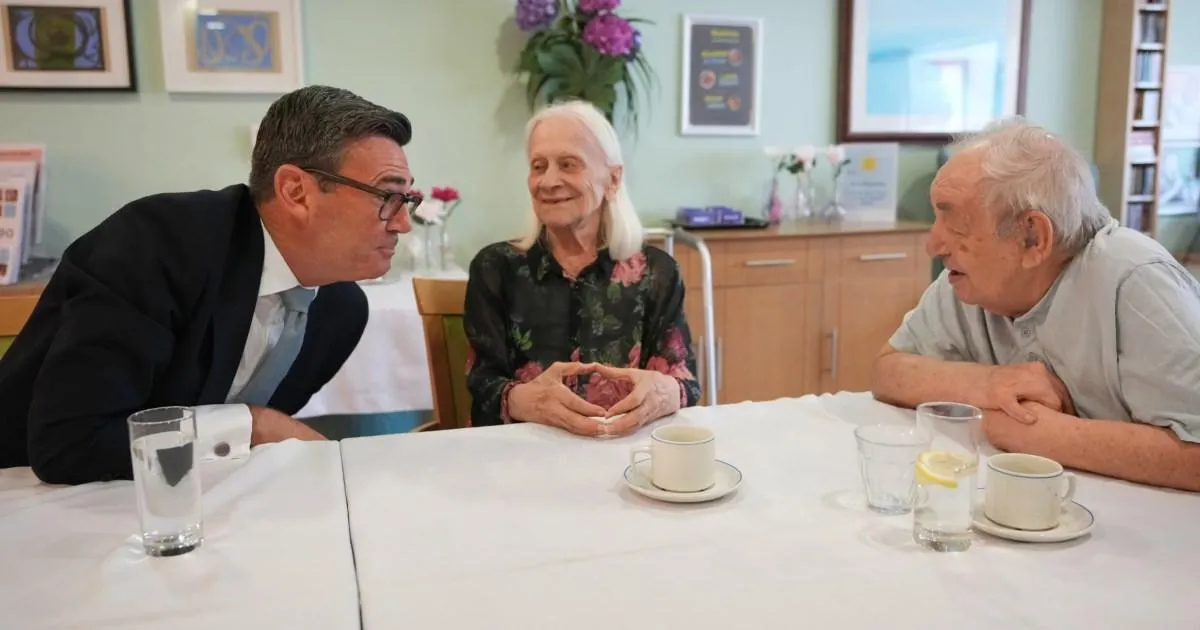
Burnham was touring a Jewish Care home in north west London as he introduced his new plans for social care in England.

Advertisement
Burnham met care home residents at Jewish Care in north west London (Picture: Kirsty Wigglesworth – WPA Pool/Getty Images)

Make sense of the mad world of British politics

Get analysis of the latest stories – including Andy Burnham’s rise to Number 10 – direct to your inbox from Metro’s Senior Politics Reporter Craig Munro. Sign up here.

Meeting residents, he met one man who wasn’t familiar with who he was.

Advertisement

He asked the Prime Minister: ‘You are the local candidate, are you?’

Burnham chuckled and referenced the recent Makerfield by-election he won in June.

He replied: ‘I was a local candidate; I had a by-election a few weeks ago. I am now the Prime Minister.’

Stunned, the care home resident asked: ‘You’re what?’

Advertisement

A nurse helped him out, telling him: ‘He’s the Prime Minister.’

The resident asked: ‘What, a new one?’

Seeing the funny side, Burnham joked: ‘Another one.’

His counterpart also saw the funny side, adding: ‘Well it keeps changing every five minutes.’

Advertisement

Burnham answered with a smile: ‘I know.’

The country has had seven Prime Ministers in the 10 years since the 2016 Brexit referendum.

After only two years in office, Keir Starmer quit in June and was replaced by Burnham this month.

One of his first acts as Prime Minister has been a pledge to end a decade of government inaction of fixing social care in England.

Advertisement
LONDON, ENGLAND - JULY 29: Britain's Prime Minister Andy Burnham speaks to residents, care workers, volunteers and social care stakeholders during a care home visit on July 29, 2026 in London, England. (Photo by Kirsty Wigglesworth - WPA Pool/Getty Images)
Burnham made an emotional speech fixing social care (Picture: Kirsty Wigglesworth – WPA Pool/Getty Images)

Speaking at the care home this afternoon he said it had been a ‘major dereliction of public duty’ that previous governments had not addressed the crisis.

He plans to introduce a new national care service and wants care workers to have better pay and training.

In a sign of his determination to fix the sector, he said a landmark review of social care by Baroness Casey would be published next summer, instead of 2028.

Burnham admitted his plans for social care ‘will require difficult decisions’ that he said would be ‘put before the country’ for the people’s consent.

This afternoon he also held talks with the Lib Dems and Conservative Party to generate cross-party backing for his plans.

Advertisement

Get in touch with our news team by emailing us at webnews@metro.co.uk.

For more stories like this, check our news page.

Source link

Advertisement
Continue Reading
Click to comment

You must be logged in to post a comment Login

Leave a Reply

NewsBeat

Phone of Scottish woman found stuffed in a suitcase in Athens ‘was being used after she died’

Published

on

Daily Record

It has been claimed that Elisabeth’s phone was being used up folllowing her death until she was identified by media.

The phone of a Scottish woman who was found stuffed in a suitcase and dumped in an abandoned building in Greece was reportedly being used after she died to make it appear as though she was still alive.

Advertisement

The remains of 38-year-old Elisabeth Jane Ross were discovered by a homeless man on Evelpidon Street in the neighbourhood of Kypseli, Athens around 1pm on July 18.

Elisabeth, who is understood to have been born in Scotland in February 1988, had been dead for approximately eight days. No visible wounds of any clear signs of struggle were found on the body, according to police.

It has now been claimed that Elisabeth’s phone was being used in an attempt to cover her death. As reported by the Daily Mail, a local police officer alleged messages were sent from her mobile in the days after her death up until she was identified by media.

The Greek officer said: “The phone was being used. Text messages were even sent obviously with a view to making people believe she was still alive. We are treating the building as a crime scene.”

Advertisement

Elisabeth couldn’t be identified at first by attending officers at the scene because she reportedly had no identification on her. She was believed to be around 30 years old, 5ft 4in tall, with reddish hair tied in a bun and wearing black shorts, with a French university insignia on them, and a T-shirt.

The rough sleeper who found her said he followed a foul smell inside the deserted building which had lain empty for two years. It is understood he saw a human limb visible from the outside of a suitcase.

An autopsy is due to be carried out in the coming days. Interpol and US investigators have been called in by the Greek authorities to assist with the probe. On Monday, Interpol notified the Hellenic Police that DNA testing revealed that the body belonged to a British woman.

Advertisement

Elisabeth is understood to have travelled to Greece on June 29 via Cyprus after coming from the US. Officers are now speaking with anyone who may have come in contact with her prior to her death as well as trying to find out her final movements. Two photos of Elisabeth smiling have been released by Greek outlet Cretalive.

One local who lives near the scene previously told Greek media outlets the building where Elisabeth’s body was found was used by rough sleepers. The resident added that one man stayed there regularly but that he had not been seen for a number of days.

Police Scotland are liaising with authorities in Greece regarding the probe. Officers are also providing support to her family in Scotland. No suspect has been identified at this time.

Advertisement

A Police Scotland spokesperson said: “We are aware of the death of Scottish woman in Athens and are liaising with authorities in Greece. Officers are providing support to her family in Scotland.”

A UK Foreign, Commonwealth, and Development Office spokesperson said: “Our thoughts are with Elisabeth’s family during this difficult time. We are providing consular support and are in contact with the local authorities.”

Source link

Advertisement
Continue Reading

NewsBeat

Transform Your Training to support young people on careers

Published

on

Transform Your Training to support young people on careers

Transform Your Training has been appointed by the Department for Education (DfE) to deliver a new Continuing Professional Development (CPD) programme for careers advisers across England.

The training is designed to help advisers better support young people who experience some of the most significant barriers to progress.

Tammy Banks, co-founder and CEO of Transform Your Training, said: “Careers advisers make a difference every single day, helping young people to recognise their strengths and open doors to opportunities that can shape the rest of their lives.

Advertisement

RECOMMENDED READING:

“That impact can be amplified if – through their own professional development – we are able to support careers advisers to understand and respond to the needs of young people who face barriers – whether they’re young people in the care system or people who have experiences trauma or adversity.

“Every young person deserves access to high-quality careers guidance, whatever their background or circumstances.”

The programme is part of the Government’s Back to Work commitments and aims to improve support for young people who face challenges such as trauma, care experience or adversity.

Advertisement

Transform Your Training was founded by Ms Banks and Faye Fox, who both have backgrounds in York’s charity sector.

The organisation has worked for the last decade with councils, charities, schools and public services across Yorkshire.

The contract is expected to create seven new roles within the company.

Ms Banks believes the programme is a chance to reach young people who are often overlooked.

Advertisement

She said: “It’s something I am hugely passionate about because of my own experience of navigating adverse experiences and significant challenge as a young person and having to advocate for myself in order to get the life chances I deserved.

“This is a huge opportunity to do things differently and make a massive impact.”

Transform Your Training will use its award-winning Training 4 Influence methodology, which combines trauma-informed, expert facilitation with practical application, collaboration and values-led learning.

The training will be delivered by facilitators with lived experience of the barriers many young people face.

Advertisement

The national CPD programme will launch in October and be available free of charge to careers professionals in schools, colleges, universities and alternative provision settings.

It will include national inspiration conferences, six continuing professional development (CPD) modules, monthly expert panels and a community of practise.

More information and registration details are available at www.transformyourtraining.org/national-careers-adviser-cpd-programme.

Advertisement

Source link

Continue Reading

NewsBeat

US launches strikes in ‘powerful response’ to Tehran’s attack on base

Published

on

Daily Mirror

Renewed violence from both the United States and Iran now risks a return to full-blown war as the US launches fresh strikes on Iran in response to Tehran’s attack on American forces

The US has launched fresh strikes on Iran tonight in response to Tehran’s attack on American forces in the Middle East.

Advertisement

The latest barrage came after the U.S. partnered with Saudi Arabia to strike Iran-backed militias in neighboring Iraq, killing at least 20 fighters and six Iranian advisers.

Iran’s Islamic Guards unleashed a surprise volley of ballistic missiles at US bases in the Gulf on Tuesday. American missiles, drones and fighter jets have zeroed in on key Iranian port cities in the second phase of the war as they attempt to claw back control of the Strait of Hormuz.

But renewed violence from both sides now risks a return to full-blown war.

Advertisement

Announcing the onslaught on X, US Central Command wrote on Wednesday night: “US forces began launching strikes against Iran at 8pm ET today. The strikes are a powerful response to yesterday’s attempted Iranian attacks on U.S. forces based in the Middle East.”

Before the latest eruption, mediators had expressed optimism about bringing the U.S. and Iran back to the negotiating table. An interim agreement collapsed in recent weeks over renewed fighting in the Strait of Hormuz, a crucial waterway for global energy supplies that Iranian attacks have again effectively closed.

A regional official said mediators are “still trying with both sides” to restore calm and get the ceasefire back on track. He gave no details on whether progress was being made and spoke on condition of anonymity to discuss the closed-door diplomacy.

Regional countries will continue to push to de-escalate the situation, said an Arab official, adding that prospects for successful mediation were slim as both sides continue to launch attacks on the other and have shown no inclination to stop. “We’re in a very bad place right now,” said the official, who spoke on condition of anonymity to describe an internal assessment of the situation.

Advertisement

The five-month conflict jolted the world economy and is unpopular among Americans. The fighting was also likely to add to concerns that the U.S. is further drawing down already diminished stockpiles of sophisticated munitions needed to defend its bases and allies.

This is a Breaking News story. You’ll be more likely to see our stories when any big news breaks in future by simply by clicking this link. You can also join The Mirror’s WhatsApp Community or follow us on Google News, Flipboard, Apple News, TikTok, Snapchat, Instagram, Twitter, Facebook, YouTube and Threads – or visit The Mirror homepage.

Source link

Advertisement
Continue Reading

NewsBeat

Man suspected of killing two pensioners in house fire found dead in wheelie bin

Published

on

Belfast Live

A man suspected of carrying out an arson attack which killed an elderly couple was found dead in a wheelie bin a week later, an inquest has heard.

Paul Smith, 40, known as Smigger, is believed to have started the fire at the home of Sheila Jackson, 83, and her partner, Eric Greener, 77, in St Helens, Merseyside, last July.

The couple were rescued from the blaze but died in hospital from burns and smoke inhalation.

Smith’s body was discovered seven days after the attack, in a bin where it had been moved after he died in a bath, having taken a cocktail of drugs, an inquest heard on Wednesday.

Advertisement

The hearing at the Gerard Majella Courthouse in Liverpool was told police were called on July 22 by Steven Wales, who told them a man had either drowned or overdosed in the bath at a property at Coniston Street, Everton, two days earlier.

Senior coroner for Liverpool Andre Rebello said: “Merseyside Police were deployed and located a male, deceased, in a wheelie bin at the rear of derelict properties on Thirlmere Road, which backs on to Coniston Street and is separated by an alleyway.

Advertisement

“The deceased male was identified by police as Paul Joseph Smith.”

Mr Smith, who lived on Lower Breck Road, had last spoken to his family on July 19 and was reported missing by his brother Michael on July 21.

In a report, Home Office pathologist Dr Matthew Lyall said toxicology results showed Mr Smith had taken heroin close to the time of his death, as well as a “relatively large amount of cocaine” and a number of sedatives.

Dr Lyall said drowning could not be proved or excluded.

Advertisement

He added: “Neither can it be entirely excluded that the deceased was held under water by a third party, but pathological findings cannot prove that occurred.”

He recorded the cause of death as mixed drug toxicity.

The court heard that police were satisfied the death was not caused by criminality.

Mr Rebello said it was understood there were criminal proceedings ongoing regarding the disposal of the body.

Advertisement

Recording the death as drug-related, the coroner said: “He died from taking illicit and and sedative drugs which caused respiratory failure.”

Earlier this year Kevin Weetman, 34, Kylie Maynard, 37, and Lee Owens, 46, were jailed for the manslaughter of Mr Greener and Ms Jackson.

A trial at Liverpool Crown Court heard that Mr Smith had travelled with Owens to the home in South John Street just after 12.30am on July 15.

Weetman was jailed for life with a minimum of 25 years for planning the attack after Mrs Jackson’s son George Jackson, 48, refused to sell drugs for him.

Advertisement

Maynard, said to be the “trusted lieutenant” in Weetman’s drugs line, was jailed for 23 years and Owens was sentenced to 13 years and six months.

Want to see more of the stories you love from Belfast Live? Making us your preferred source on Google means you’ll get more of our exclusives… To add Belfast Live as a preferred source, simply click here.

Source link

Advertisement
Continue Reading

NewsBeat

The 1950s industrial town where dogs are mysteriously dying, cancer cases are rocketing and residents are too scared to go into their own gardens

Published

on

Between the 1950s and 2012, this chemical plant in Thornton-Cleveleys, Lancashire, emitted 49 tons of highly carcinogenic Perfluorooctanoic acid (PFOA) into the atmosphere via large extraction chimneys

‘You think you’re doing the right thing,’ says mother-of-five Sam Hammond from her garden in Thornton-Cleveleys, a small town north of Blackpool. ‘But I’ve been teaching my kids to eat poisoned fruit, poisoned veg and poisoned eggs.’

Two years ago, Sam noticed people taking soil samples from the Occupation Road Allotments which border her property. It emerged they were from the Environment Agency and they had been called in amid fears the land may have been contaminated by pollutants from the nearby AGC Chemicals Europe plant.

Between the 1950s and 2012, the manufacturing facility emitted 49 tons of highly carcinogenic Perfluorooctanoic acid (PFOA) into the atmosphere via large extraction chimneys. 

To make matters worse, the toxic gas was also likely to have contained small solid particles of the compound. The ‘forever chemical’ – so-called because it is virtually indestructible – is known to cause cancer and has since been banned globally.

Advertisement

Sam, 48, was understandably worried. After all, for 20 years she’d been growing everything from lettuces and beans to strawberries and cabbages in her garden, as well as rearing chickens and ducks for their supposedly highly nutritious eggs. She duly had her own soil tested.

When the results came back in February this year, they made her sick to the stomach. Not only was her garden contaminated, but one duck egg alone contained ten times the safe weekly limit of PFOA for a human being. And Sam and her family had been eating these eggs from their flock of 30 ducks daily for three years.

‘My little boy is worried,’ Sam continues, clearly emotional. ‘He keeps asking me: “Are my ducks going to die?” It’s had a massive effect on me, too.’

Sam – who now believes the unexpected stroke she suffered in 2020 may have been caused by the toxin – adds: ‘I don’t sleep at night. It just doesn’t stop. It’s just going round and round in my head. I don’t really spend much time out in the garden anymore either, because I just look at it and I’m like… is it safe?’

Advertisement

Between the 1950s and 2012, this chemical plant in Thornton-Cleveleys, Lancashire, emitted 49 tons of highly carcinogenic Perfluorooctanoic acid (PFOA) into the atmosphere via large extraction chimneys

Sam Hammond's results found that one duck egg alone contained ten times the safe weekly limit of PFOA for a human being. Her family has been eating these eggs from their flock of 30 ducks daily for three years

Sam Hammond’s results found that one duck egg alone contained ten times the safe weekly limit of PFOA for a human being. Her family has been eating these eggs from their flock of 30 ducks daily for three years

Last month, a government-commissioned multi-agency investigation found that two areas within a five-kilometre radius of the AGC chemical plant in Thornton-Cleveleys had ‘higher-than-expected’ rates of kidney cancer – a disease the World Health Organisation has previously linked to PFOA. 

Advertisement

One of the two areas had 14 cases of kidney cancer between 2003-22 against an expected number of just six. The second area had 17 cases over the same period against an expected number of nine.

The report also found evidence of the toxic compound in a ‘majority’ of the 71 properties tested within a kilometre of the factory, including seven they now consider to be ‘high-risk’ plots.

This is the horrifying story of how a multinational chemical firm quietly poisoned a working-class Northern town over six decades, and how residents now fear not only for their lives, but of being trapped in worthless homes.

The controversial history of the Lancashire-based facility – on the Hillhouse Industrial Estate – stretches all the way back to the 1890s when it was established by a now defunct chemicals giant United Alkali.

Advertisement

For many years, the plant was run by another industry behemoth, Imperial Chemical Industries, before AGC bought it in 1999. The plant produces the compound best known by the brand name Teflon – a widely-used material found in everything from nonstick cookware to electrical wiring.

For around six decades, PFOA was used as part of that manufacturing process and both ICI and AGC used the compound. However, whilst ICI never knew how dangerous it was prior to selling the plant in 1999, documents obtained by the investigative outlet Ends Report reveal that AGC Chemicals Europe helped to fund research into PFOA as early as the late 1990s.

Its study involved monkeys being fed the toxin in capsule form over a six-month period, an approach that sounds outrageous by modern standards.

The results were irrefutable: every monkey involved showed an increase in liver weight, a classic sign of poisoning, while several of them died.

Advertisement

Despite the study’s findings, it took AGC a further decade to stop using PFOA. In other words, they knew the chemical was lethally toxic and yet they continued to pump out emissions containing it over the town of Thornton-Cleveleys for another ten years.

Defending themselves, a spokesman for the firm told the Daily Mail that, despite what happened to the monkeys, the study – published in 2002 – ‘did not provide a complete basis for definitive conclusions about human risk’.

By 2012, the plant had stopped using PFOA. Five years later, following further research, the European Union declared PFOA to be a ‘substance of very high concern’ on which global restrictions were placed in 2020 as part of the Stockholm Convention on Persistent Organic Pollutants.

However, as a ‘forever chemical’, PFOA does not break down naturally and therefore remains in the soil and waterways of Thornton-Cleveleys to this day – a truth laid bare by the June report identifying the high rate of kidney cancers in the area.

Advertisement

Reacting to the findings, Dr Dan Middleton, a senior lecturer in environmental cancer epidemiology at the Centre for Public Health, Queen’s University Belfast, confirmed that ‘kidney cancer is one of the cancers most consistently linked to PFOA exposure’.

Dr Dan Middleton, senior lecturer in environmental cancer epidemiology, says kidney cancer is 'consistently linked' to PFOA exposure

Dr Dan Middleton, senior lecturer in environmental cancer epidemiology, says kidney cancer is ‘consistently linked’ to PFOA exposure

Surely then, this is evidence that the chemical plant has adversely affected the health of local residents?

Bizarrely not. For the report went on to conclude that despite two areas with unexpectedly high rates of kidney cancer, they were sufficiently ‘geographically dispersed’ to show there was ‘no clustering of cases’ close to the AGC chemical plant. Therefore, concluded the report: ‘no further cluster investigation is warranted at this stage’.

Advertisement

Unsurprisingly, the medical community was appalled by the findings. Dr David Megson, a forensic environmental scientist at Manchester Metropolitan University, claimed the report ‘seems to downplay the findings rather than assess it [sic] objectively’.

Locals were still in a state of simmering outrage when the Daily Mail visited Thornton-Cleveleys. 

‘My grandad bought this house when it was first built in the 1950s,’ says Paul Jackman in the searing afternoon sunshine. ‘He died at 65 of prostate cancer, which is known to be caused by PFOA. We’re all aware of it, we just don’t know what we can do about it. I’m worried for myself.

‘I’ve just been with the doctor now, and I’m only 51. Stomach issues… and I’ve been eating strawberries out of this garden since I was three. 

Advertisement

‘I’m concerned for myself, and for my family. We’ve had dogs that have died, strangely and very quickly. We used to have a vegetable patch, but we stopped because of all this.’

‘First of all, we want a clean-up,’ Paul continues. ‘Then we want them to admit they’ve done wrong. And then compensation.’ He trails off, gazing beyond his garden perimeter to the brutalist metal chimneys of the AGC plant: ‘I’ll really like them to clean up and then push off.’

Paul Jackman, pictured with his wife Vicki, says he is concerned for himself and his family and that they have had 'dogs that have died, strangely and very quickly'

Paul Jackman, pictured with his wife Vicki, says he is concerned for himself and his family and that they have had ‘dogs that have died, strangely and very quickly’

Last month, a government-commissioned multi-agency investigation found two areas within a five-km radius of the plant had 'higher-than-expected' rates of kidney cancer

Last month, a government-commissioned multi-agency investigation found two areas within a five-km radius of the plant had ‘higher-than-expected’ rates of kidney cancer

Advertisement

The practicalities of such a clean-up operation, however, are far from straightforward with one resident claiming they’d been advised that the only failsafe method was to remove all the soil from gardens, even underpinning homes during the process, and replacing it with fresh compost.

Another local, Steve Barton, has a home that borders the factory to the east. 

‘We’ve lived here for 20-odd years,’ he explains. ‘We were certainly surprised when we heard. We never had our soil tested. 

‘It’s funny though, because I have friends who used to work on the plant and they always had health issues, like blackouts, because of what they’d been handling. And now we know the chemical is linked to some cancers.’

Advertisement

Steve pauses to highlight the noise emitted 24 hours a day by the ventilation fans of the chemical plant that only shuts down on Christmas Day.

‘We used to have 40-foot trees at the back of the garden,’ adds Steve, who works for the government in IT. ‘I thought they soaked up the emissions but National Rail, who own that land, cut them down about two years ago. So far, my wife and I have no health issues. But you just don’t know about the future.

‘Our major concern is property prices. There were people at a local meeting the other day saying that they were being denied mortgages to move into the area. We bought this house for about £45,000 in 1995 – it should be worth about £200,000 today. 

‘I would like compensation if we’re going to lose out and we can’t sell the property. You never know when you might need to pay for elderly care.’

Advertisement

So, what happens next?

Earlier this month, AGC Chemicals Europe announced plans to cease operations, citing ‘significant financial and operational challenges’ as well as ‘ongoing market volatility and increasing competition’.

If the plant does close following consultation with stakeholders, it will put as many as 200 jobs at risk in a part of the world where employment opportunities are few and far between.

‘There are no jobs here anyway,’ grumbles an elderly resident who asks not to be named. ‘Young folk either head down to Blackpool or out to Manchester, and losing the plant will be the final straw. Used to be a job for life, that.’

Advertisement

Regarding the chemical pollution, AGC tells the Daily Mail it had ‘voluntarily’ phased out the use of PFOA in 2012 but insists: ‘Release of the substance was within the permit held by AGC Chemicals Europe Ltd at the time and also UK legislation in place at the time.’

A spokesman continues: ‘We take our responsibilities to our employees, the local community and to the environment very seriously. All our essential chemical processes and products are rigorously monitored and controlled and today we are compliant with current UK and EU environmental laws and regulations.’

Naturally, residents in Thornton-Cleveleys are less than convinced and 90 have thus far expressed an interest in joining a lawsuit against the company. Sam Hammond – who unwittingly fed her children those fruits – is already working with legal firm Leigh Day on her own case.

And there is precedent on this front, for in the US more than 4,000 lawsuits have been filed against chemical manufacturing companies for their involvement in ‘forever chemicals’ pollution.

Advertisement

Perhaps the most notable victory on this front came in 2023, when 3M – a firm that produces Post-it notes and Scotch Tape, among other industrial products – agreed to pay $10.3billion over a 13-year period to test and treat residents of towns and cities, as well as public water systems it may have polluted.

Whether or not the residents of Thornton-Cleveleys see any money at all, however, only time will tell. For now, the Occupation Road Allotments where this all began remain closed while, according to Wyre Council, ‘contaminated land is remediated to its original use’.

The Food Standards Agency has told people living within a kilometre of the site who are growing fresh fruit and vegetables to ‘wash and peel their produce to remove soil, dust and bacteria before eating’ and to ‘consider the use of raised beds and fresh soil when growing produce’.

Washed or unwashed, it would take a brave person to set their green fingers to work here in Thornton-Cleveleys.

Advertisement

Back in Sam Hammond’s garden, she gestures towards an apple tree, pointing out three fresh, plump green fruits.

‘When the tree first bore apples my daughter and I made a crumble. It was the most delicious we’d ever had… probably the most dangerous too.’

Source link

Advertisement
Continue Reading

NewsBeat

Live show celebrating the music of Stranger Things coming to Belfast

Published

on

Belfast Live

The show offers a complete sonic retrospective, spanning all five seasons of the hit show

A live show celebrating the sounds of the hit Netflix show Stranger Things is coming to Belfast later this year.

Advertisement

Following the epic conclusion of the global phenomenon, Emmy-winning composers Kyle Dixon and Michael Stein (of the band S U R V I V E) return to the stage for the definitive live celebration of the entire saga.

Taking place on November 4 at the Ulster Hall in Belfast, Texan musicians Dixon and Stein are responsible for a body of work that’s synonymous with the fictional town of Hawkins, Indiana, the supernatural everytown at the centre of the Stranger Things universe.

A spokesperson said: “This 2026 tour offers a complete sonic retrospective, spanning all five seasons of the series. From the iconic 2016 opening theme to the climactic sounds of the recently released Season 5, Dixon and Stein bring their atmospheric scores to life.

“To elevate the performance into a fully immersive experience, they have partnered with renowned visual artist MFO (Marcel Weber).

“The new show features a minimal yet striking design of light and sculpted fog.

“Light takes on a physical presence through dreamy glows and violent, haunted movements, blurring the line between concert and cinema to make the Stranger Things atmosphere a truly tangible experience.”

To find out more and get tickets, see here

Advertisement

For all the latest news, visit the Belfast Live homepage here and sign up to our What’s On newsletter here

Advertisement

Source link

Continue Reading

NewsBeat

Trump insists Andy Burnham will ‘open up North Sea’ for oil drilling

Published

on

Trump insists Andy Burnham will ‘open up North Sea’ for oil drilling

Trump insists Andy Burnham will ‘open up North Sea’ for oil drilling

US President Donald Trump has claimed that Prime Minister Andy Burnham told him he would “open up the North Sea” for oil drilling, asserting that this action would make the UK “a really rich country” due to vast reserves.

Speaking at a White House briefing, Trump estimated the North Sea holds up to 700 years’ worth of oil, criticising the UK for its reliance on windmills and importing oil from Norway despite its own significant resources.

Trump contrasted Burnham’s alleged commitment with his previous inability to persuade Sir Keir Starmer to pursue North Sea oil extraction during his premiership.

These claims were made amidst the UK experiencing its fourth heatwave of the year, with record temperatures and widespread drought, which has intensified calls to reduce fossil fuel dependency.

Downing Street’s official summary of the phone conversation between Burnham and Trump last Monday made no mention of oil drilling, instead focusing on the Prime Minister’s vision for reindustrialisation, defence, and security.

Advertisement
In full

Source link

Continue Reading

NewsBeat

Fans moved by Glen Hansard’s final social media post hours before tragic death

Published

on

Belfast Live

Glen Hansard fans have been left heartbroken following the musician’s final Instagram post, shared just hours before he tragically lost his life in an early morning motorbike collision.

The Falling Slowly star sadly passed away following a motorbike accident near Tinkers Hill and Rugged Lane in Dublin at approximately 4:30am on Wednesday morning.

Around 8pm on Tuesday evening, Glen’s Instagram account shared footage of the singer performing alongside Bruce Springsteen in Kilkenny back in 2013. The Frames’ frontman joined the Boss to deliver the iconic track, Drive All Night.

Advertisement

The caption read: “This week in 2013 Glen had the honor [sic] of joining Bruce Springsteen and the E Street Band on stage in Kilkenny for ‘Drive All Night’, which Glen released his own version of later that year. Were you there?”

Glen appeared beaming with joy as he stood beside the legendary New Jersey rocker on stage. The pair shared a microphone, with Bruce wielding his trademark hybrid 1950s Fender Telecaster/Esquire, while Glen clutched his famous cedar-top Takamine NP15 acoustic guitar, nicknamed The Horse, slung with a high strap, reports the Irish Mirror.

The poignant two-minute clip radiates with raw emotion, Glen grinning as he delivers the song with a fervour and power that only the iconic star beside him could rival. Both Glen and Bruce pour their hearts into the performance – met with thunderous applause from the audience for the two musical legends.

Tributes poured in beneath the post from last night, with supporters reminiscing about cherished moments, but following confirmation of his passing, countless heartbroken fans arrived to express their sympathies.

Advertisement

Jedward wrote: “Rest in Peace Glen.”

Kilkenny vocalist Patrick Dowling posted: “Fly high Glen.”

Meanwhile, Dublin singer-songwriter Barra Donovan recalled a “brief but brilliant” exchange the two shared just two days prior.

He posted: “Rest in peace Glen, our brief but brilliant conversation two days ago in Whelan’s will stay with me forever. My condolences to your family and friends because I know that even in those few minutes we spoke, you were a gem. Your songs are the Dublin City soundscape.”

Advertisement

For all the latest news, visit the Belfast Live homepage here and sign up to our daily newsletter here.

Source link

Continue Reading

NewsBeat

Andy Burnham ‘told Donald Trump he will open up North Sea oil’ during phone call

Published

on

Daily Record

Speaking in the White House, the US President said if the Prime Minister followed through on his commitment the UK was “going to be a wealthy country”.

Donald Trump has claimed Andy Burnham told him that he was going to “open up North Sea oil”. Speaking in the White House, the US president said if the Prime Minister followed through on his commitment the UK was “going to be a wealthy country”.

Advertisement

Mr Trump also again warned that immigration is “killing” Britain, with “people coming from all over the world and just camping out”.

Following the phone call between the two leaders on Mr Burnham’s first day in office, Downing Street would not be drawn on any potential future plans for North Sea drilling after Mr Trump talked up a change in policy under Mr Burnham.

Mr Trump had lost a legal battle with the Scottish Government to stop a wind turbine development visible from his Aberdeenshire golf course. The US president, a vocal supporter of fossil fuels, has long championed the move as he has railed against “windmills”.

Labour’s 2024 manifesto said the party would not issue new North Sea licences. Referring to his conversation with Mr Burnham, Mr Trump said: “Well, he did say one very good thing.

Advertisement

“He said he’s going to open up North Sea oil. If he does that, you’re going to be a wealthy country.”

The president added: “They have two problems. They have a huge immigration problem – people coming from all over the world and just camping out in your country. He’s got that problem, and he’s got an energy problem.

“He’s got windmills all over the place, and any time you see windmills, you see a failing country. They’re made in China, not used by China, but they’re made in China.”

Advertisement

He went on: “You have one of the most valuable oil finds anywhere in the world, and if the United Kingdom would use it, they’d be a wealthy country again. And I tell you what, I could not get Starmer to use it. It was incredible.”

Mr Trump said: “You have your own oil and gas. If you use the North Sea, the UK will be a really rich country. I cannot get the point across. The new gentleman, when I spoke to him, he said he’s going to open up the North Sea. Let’s see if that happens.”

The president also argued Mr Burnham would have to tackle the issue of immigration. Mr Trump said: “He’s going to have to mention it because it’s killing your country. I know Starmer did very little about it, and they’re coming from all over the world.

“They’re coming from Africa, they’re coming from South America, they’re coming from different parts of Asia, and they’re invading Europe.” He indicated the UK was a “prime” destination.

Get more Daily Record exclusives by signing up for free to Google’s preferred sources. Click HERE

Advertisement

Source link

Continue Reading

NewsBeat

Hundreds of people in England have died before doctors diagnosed their tuberculosis

Published

on

Hundreds of people in England have died before doctors diagnosed their tuberculosis

Dave, a retired dockworker, has smoked since his teens. When he develops a persistent cough, he dismisses it as “just a smoker’s cough”.

Then he loses weight, develops fevers and wakes at night drenched in sweat. After several courses of antibiotics, he continues to deteriorate and is admitted to hospital.

Doctors find emphysema, a smoking-related condition in which damaged air sacs make breathing difficult. A chest X-ray also shows a white patch in his lung, raising concerns about cancer. A sample of sputum, the mucus coughed up from the lungs, is sent for further testing.

Dave dies before the laboratory identifies tuberculosis (TB).

Advertisement

Dave is fictional, but his story shows how easily TB can be missed when its symptoms resemble those of other illnesses. In a 2026 study, colleagues and I found that 574 people in England were diagnosed with TB only after death between 2010 and 2022. That is almost one person every week.

The people who died represented 0.8% of all TB diagnoses, but nearly one in five deaths recorded among people with TB. The data could not establish whether TB caused or contributed to each death.

TB is the world’s leading cause of death

TB is a bacterial infection that usually affects the lungs and spreads through the air. It remains the world’s leading cause of death from a single infectious organism. In 2024, an estimated 10.7 million people developed TB and 1.23 million died. Global progress has recovered from setbacks during the COVID pandemic, but remains too slow.

England cannot eliminate TB without international progress. In 2024, more than four in five people diagnosed in England were born outside the UK. This is sometimes presented simply as a migration issue. It instead reflects global inequalities in prevention, diagnosis and treatment.

Advertisement

TB also affects UK-born people and remains closely associated with poverty. Rates in England’s most deprived areas are more than five times those in its least deprived.

Homelessness, imprisonment, smoking and harmful alcohol or drug use can increase exposure, weaken the body’s defences or make healthcare harder to access. These factors all contribute to active TB disease.

England is close to losing its status as a low-incidence country, defined by the World Health Organization as fewer than ten cases per 100,000 people. Its rate reached 9.4 per 100,000 in 2024, following the largest annual increase since 1971.

Advertisement

Early diagnosis is vital. Globally, about one in five people who develop TB are not diagnosed, officially reported or treated. Many of these “missed millions” die. In England, the median interval between symptoms beginning and diagnosis of lung TB was 72 days in 2024.

During that delay, an infectious person may transmit TB while their illness worsens. Delays can also disrupt family and working life and create avoidable, sometimes catastrophic costs for people with TB, their households and health services.

The most extreme delay

A national study examined the most extreme delay: TB confirmed only after death. This meant a sample had been collected while the person was alive, but the result arrived later.

TB bacteria grow slowly, so traditional laboratory cultures can take several weeks. Rapid molecular tests, which detect the bacteria’s genetic material, can sometimes provide results much sooner, but doctors must first suspect TB.

Advertisement

The likelihood of diagnosis after death rose sharply with age. It was also higher among men, UK-born people, people with recorded harmful drug or alcohol use, those with TB outside the lungs and those diagnosed outside London.

Older UK-born people may have encountered TB during childhood, when infection was more common. The immune system can contain the bacteria for decades without symptoms. This is called latent TB infection. It can later become active, particularly when immunity weakens because of age, illness or medicines.

Smoking damages the lungs’ defences and increases TB risk. An older man with a cough and weight loss may therefore be investigated for cancer or chronic lung disease before TB is considered. Previous BCG vaccination – the childhood vaccine that was once routinely offered in the UK to protect against tuberculosis – does not rule it out. The vaccine protects young children against severe disease, but does not reliably prevent TB in adults.

TB outside the lungs can affect the lymph nodes, bones, bowel, kidneys, brain or other organs. Diagnosis may require scans or tissue samples. It is generally much less infectious than lung or throat TB, although people can have both forms.

Advertisement

People outside London were more likely to receive a diagnosis after death. Doctors in London may encounter TB more often and have better access to specialist services. Differences in reporting may also contribute. Our findings probably underestimate the problem because some people may die without being tested.

A diagnosis made only after death should be treated as an important patient-safety warning. TB deaths are not currently defined as a formal NHS “never event”, a term reserved for a small number of wholly preventable incidents. Based on our study findings, we recommend that each post-mortem TB diagnosis should prompt a review of symptoms, tests and referral decisions.

Public awareness also matters. A persistent cough, fever, drenching night sweats or unexplained weight loss deserves medical attention, regardless of age or birthplace. Healthcare professionals must consider TB even when cancer, pneumonia or chronic lung disease initially appears more likely.

Prevention must extend beyond detecting active TB disease. England offers some recent migrants testing for latent TB, but only 17% of those eligible were tested in 2024. Strategies should also consider historical exposure among older UK-born people.

Advertisement

England can learn from countries with much greater TB burdens. Lessons include reaching people at higher risk of being missed, such as the homeless, the poor and the socially excluded; reducing stigma; and making services easier to access.

Dave’s fictional laboratory result arrived too late. The next person with an overlooked cough should receive theirs while treatment can still help.

Source link

Advertisement
Continue Reading

Trending

Copyright © 2025