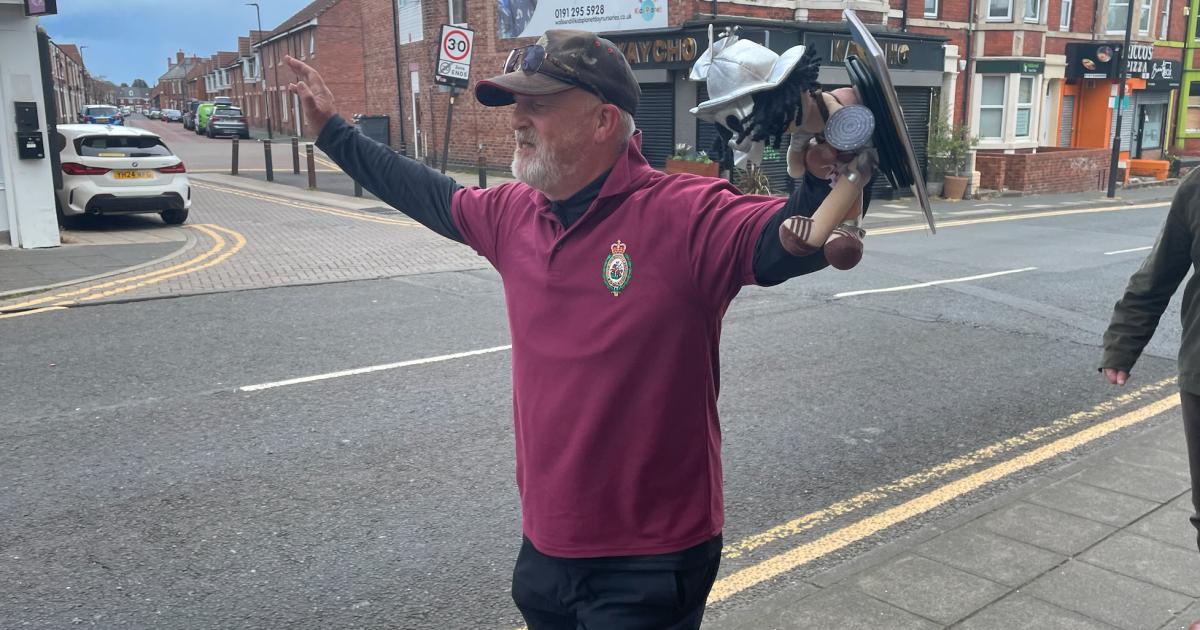

David Bell, 66, took on the challenge in support of Anxious Minds, a charity supporting ex-serving personnel and their loved ones across the North East.
The retired fusilier began training earlier this year before walking an average of 20 to 30 miles per day.
David Bell, 66, completes a 100-mile charity walk to raise funds for Anxious Minds, which supports veterans and their families (Image: Supplied)
His journey concluded outside Anxious Minds‘ counselling services in Wallsend.
Anxious Minds CEO, Edward Dean, said: “It is absolutely amazing what you can do when you put your mind to it.
Advertisement
“David has done an amazing thing, both to support the charity and the veterans we serve.
“We cannot thank him enough from the bottom of our heart.”
David Bell, 66, completes a 100-mile charity walk to raise funds for Anxious Minds, which supports veterans and their families (Image: Supplied)
Mr Bell’s 100-mile effort has helped raise funds to provide “life-changing” mental health support to veterans and their families.
Anxious Minds serves individuals across the wider region.
Advertisement
The charity offers counselling services and mental health support for veterans and their families.
David Bell, 66, completes a 100-mile charity walk to raise funds for Anxious Minds, which supports veterans and their families (Image: Supplied)
Its dedicated veteran support work aims to address the unique pressures faced by military personnel returning to civilian life.
The organisation has received multiple awards for its services, including the Making a Difference Award at the 2025 Markel 3rd Sector Care Awards and the English Veteran Awards’ Leader of the Year title in 2024.
It also earned gold in the Health and Wellbeing category at the English Veteran Awards in 2022.
Bolton Council has granted planning permission for a first-floor side extension at 22 Newstead Drive, Hulton, which will increase the property’s size from three bedrooms to four.
Planning officers acknowledged that a four-bedroom house would typically be expected to provide up to three off-road parking spaces.
However, the application only demonstrated two spaces on site.
Advertisement
Despite the shortfall, officers concluded the proposal was acceptable because the property is located within a sustainable area, just a short walk from bus services, and benefits from available on-street parking nearby.
A report prepared for the council said parking standards are considered a maximum requirement and noted there are no parking restrictions in the immediate vicinity.
The extension, measuring around 2.7 metres wide and 8.2 metres long, was also judged to be in keeping with the character of the detached property and surrounding area.
Officers found it would not have an unacceptable impact on neighbouring homes in terms of outlook, light or privacy.
Advertisement
No objections were received during the consultation period and permission was granted subject to standard planning conditions.
In a luxury market often blamed for flattening creativity, Maison Schiaparelli has long stood out for its defiant unconventionality. Where Coco Chanel’s creations exalted the functional elegance of the modern woman, Elsa Schiaparelli was interpreting her dreams, transforming her dresses into intellectual statements.
The story of how Elsa Schiaparelli did this is celebrated in Schiaparelli: Fashion Becomes Art, the current exhitibion at the V&A in London (until 8 November 2026). It also shows her legacy is intact. In transforming clothing into something provocative and fantastical, fuelled with an unconventional viewpoint and rooted in craftmanship, current creative director Daniel Roseberry has stayed true to Schiaparelli’s philosophy.
Key to the brand’s success is how it has consistently deployed clever, clear messaging. My research explores how luxury brands raise customer engagement and connect with their communities through distinctive shared values. From the outset, Schiaparelli’s messaging has been based on four central pillars: a strong connection to fine art; cultural relevance; recognisable iconography; and the promise of a heightened customer experience.
Schiaparelli’s sculptural designs are instantly recognisable. David Parry/PA Media Assignments
A connection to the art world
Elsa Schiaparelli pre-empted the kind of connection to the art world that many brands have tried to leverage ever since. When she arrived in Paris in 1922, she fell in with a distinguished avant-garde circle. Within a few years she opened her couture house and began collaborating on designs with artists. These included Cecil Beaton, Marcel Vertès, Jean Cocteau, Alexander Calder and Man Ray.
The work she did with Salvador Dalì in the 1930s is of particular note. It features several legendary pieces, including the Lobster Dress (1937) and the Skeleton Dress (1938). During this time, she also introduced her signature colour, shocking pink, to the fashion world.
The fashion consumer’s identity is no longer defined in relation to their ability to purchase particularly expensive items alone. It emerges, instead, from mastering sophisticated skills and accessing knowledge of what is cool, before it becomes too widespread.
This has led to the emergence of a new form of currency. Rather than status being solely tied to affluency, it is now connected to privileged access to information. The Schiaparelli brand pioneered a shift from a purely economic elite to a cultural elite.
Cultural relevance
Second, the brand cultivates cultural relevance. Schiaparelli was a sharp observer of her times. She gave imaginative life to objects while understanding how to reinterpret them to reflect prevailing cultural currents.
In the 1930s, by placing upside-down shoes on her models’ heads Schiaparelli sought to generate debate and prompt unconventional thinking. Similarly, the fashion house’s show at Paris Couture Week 2023 featured faux taxidermied tiger and lion heads incorporated into feminine dresses, in metaphorical irreverence.
Advertisement
This approach has made the brand very polarising in terms of public opinion. At the same time, it has freed it from being bound to temporary fashion trends and allowed it to be more versatile and confident, in embracing contemporary semantic codes.
Recognisable iconography
Third, in place of a logo, the brand has nurtured very identifiable recurring stylistic elements. It deploys in an unconventional way what marketing scholars Young Jee Han, Joseph C. Nunes and Xavier Drèze have termed “subtle signalling”. Here too, however, it has done so in a very loud, maximalist way. Schiaparelli is anything but boring.
Subtle signalling is often related to what branding specialists term “quiet” or “discreet” luxury. In Schiaparelli’s world, nothing is quiet or discreet. Its boldness itself is the signifier.
Take the keyhole silhouette that appears on bag flaps and shoe toes. The anthropomorphic references that take inspiration from Salvador Dalì’s alphabet, transforming eyes and noses into buttons. The tape measure that runs along shirt collars … These are just a few of the brand’s recognisable motifs. They comprise the kind of trademark that remains fundamental in the luxury world: that distinguishes people in the know, those who have the cultural capital to be able to confidently recognise a Schiaparelli piece, from those who do not.
Fourth, in a luxury market where people increasingly value unique experiences as well as exclusive products, Maison Schiaparelli has paired very selective distribution with a distinctive customer experience. This starts when you ring the bell at the Maison’s iconic atelier in Paris, on Place Vendome. You are given an historical tour of the house, before even getting to talk about the clothes.
Brand desirability is the main challenge for many players in the fashion world. Schiaparelli has cultivated an atelier environment and a theatrical atmosphere that enhance what makes buying and wearing the clothes so desirable. That haute-couture spirit runs through the brand’s ready-to-wear collections and it shapes its commercial strategies too.
This is the fourth pillar of the brand’s success. Creation is rooted in craftmanship and collaboration with textile artisans and embroiderers. From Schiaparelli’s handcrafted Lobster Dress to Roseberry’s most recent sculptural collections, each piece is a tribute to sartorial skill and attention to details, not to mention cutting-edge material technology.
The CEO of Tod’s Group, Diego Della Valle, who bought the brand in 2007, insists on the importance, in the era of AI, of what he terms “craft intelligence” or “artisanal intelligence”. Elsa Schiaparelli, that woman of paradoxes, would surely agree.
Over in Los Angeles – where hosts USA will play two of their three group games – it has been a similar story with regards to promotion of the World Cup.
There are banners on the streets coming out of Los Angeles Airport promoting ‘LA26’ and the tournament, while electronic billboards rotate the various members of the USA squad and a large mural in downtown LA features Argentina legend Lionel Messi. Some convenience stores also sell World Cup-related merchandise.
However, for non-football fans it would be quite easy to be oblivious to the fact that the tournament is about to get under way.
One taxi driver transporting BBC World Service colleagues expressed their surprise that such an event was set to begin, saying “There’s a World Cup happening? Who’s playing?”
Advertisement
But for organisers the expectation is the excitement will grow as the tournament goes on.
“I think we have had a slow build that is leading to a frothy frenzy,” says Larry Freedman, co-chairman of the Los Angeles World Cup Host Committee.
“It has been such a long time coming and with so many other sports and activities in LA people have been thinking about what they will do tomorrow, not two or three years out.
“But now we are on the eve of it kicking off people are getting very, very excited. We have a very diverse community here and people from all over the world who will have teams participating in this tournament.”
Advertisement
For the fans, there is certainly more excitement among them for being in the city where their country will play their games, even if they aren’t necessarily die-hard football supporters.
In Santa Monica, Isaiah and Husna – both from Sacramento County – were looking forward to experiencing the tournament.
“I’m pretty excited,” Isaiah told BBC Sport.
“I’ve never actually watched the World Cup but I will watch it this year.
Advertisement
“I think it will be exciting because it is here in LA now and LA is where it is at. It will be something different.”

Husna added: “Many people don’t know what the World Cup is here, but now it is in LA and this is a big popular place they will know about it and watch it.”
Both, however, admitted they were unaware of who the USA faced in their opening game.
The younger generation of Americans BBC Sport spoke to – ones who did not experience the tournament when it was last held in the USA back in 1994 – certainly seemed to be excited for the World Cup.
Advertisement
One such fan, Mahon, said: “We have watch parties set up so we are very excited for it.
“We do have a few friends who are not really into soccer but we are trying to get into them that we are Team USA – country pride.
“I think it has surpassed baseball in popularity here, but I don’t think it will get as big as American football or basketball.
The Legend Of Zelda: Ocarina Of Time remake trailer didn’t trail much (Nintendo)
The Friday letters page discusses why some people haven’t got a Nintendo Switch 2 yet, as a reader suggests buying next gen consoles in instalments.
Games Inbox is a collection of our readers’ letters, comments, and opinions. To join in with the discussions yourself email gamecentral@metro.co.uk
Year two blues I’ve been a big fan of Nintendo for years. Although I didn’t grow up playing their games – I was a ZX Spectrum, then Sega kid in the 80s and 90s – I came to love them from the GameCube onwards. Needless to say, the Switch is one of my favourite consoles of all time and I’ve played dozens of games on that platform.
I didn’t pull the trigger on a Switch 2 partly because I wasn’t blown away by the launch line-up and partly because I still have plenty of games I’ve not got round to on Switch. The Direct on Tuesday was when I was kind of expecting them to win me over and, well… it hasn’t. And that’s a problem.
Advertisement
Once all the real enthusiasts and early adaptors have the console it’s the folks like me you need to start buying consoles. I know they were flying off the shelves in year one but I’m not sure year two will look quite the same if this is the level of effort we’re seeing going into 2027.
That said, Zelda: Ocarina Of Time could twist my arm, but we need to see it soon. The cynic in me suspects the bean counters will use that full reveal to soften the price hike later in the year. Somasonic
Expert, exclusive gaming analysis
Sign up to the GameCentral newsletter for a unique take on the week in gaming, alongside the latest reviews and more. Delivered to your inbox every Saturday morning.
Advertisement
GC: That does sound very possible. The price hike is in September and that’s also when they often have a new Nintendo Direct.
Legendary Direct I’d be willing to bet that there’s going to be a Zelda specific Nintendo Direct between now and the release of Ocarina Of Time 2026.
After that insanely brief showing at the June Direct, they need to show it off in more depth, with a solid release date.
Advertisement
Normally I would be happy to go into the game blind, but I’m currently not sold on it and still would like to know how different it will be beyond visuals.
At this point I’d be happy if even the dungeons are remixed so there’s at least some sense of novelty for veteran players.
Beyond Ocarina Of Time there’s the movie, which they could show a new trailer for, and possibly a Twilight Princess release on Nintendo Switch Online.
I’m sure there would be other Zelda merch to flog and it is the franchise’s 40th anniversary after all.
Advertisement
If Nintendo can have a blowout for Mario’s anniversary then I’m sure they will want to have one for Zelda too. ANON
Maybe next year I remember my excitement when first looks at Nintendo Switch were revealed. I got my pre-order in at GAME with Zelda and 1-2-Switch ( There wasn’t a lot of options and I actually enjoyed the game). Then when my son saw mine he decided he wanted one, so we hunted around and amazingly found one available at Argos.
Fast forward nearly a decade and Switch 2 has been out for a year and I’ve had no real interest in buying it.
Maybe it’s because I’ve gotten older, but I think it’s because it hasn’t had the Nintendo quirkiness or innovation of the original or Wii U, etc. It’s become like PlayStation 5, just being more the same as PlayStation 4, with a bit more power.
Advertisement
I’ve always bought Nintendo for its first party games and sadly Mario Kart World and Donkey Kong Bananza haven’t excited me at all. The inner child in me is very disappointed in Switch 2, sadly. I hope by its second anniversary there will be a must-have game to change my mind. Mark Matthews
Rogue warrior Referring to your recent review of Realm Of Ink, what exactly is a roguelite?
I’ve seen GC use the term before. Was there once a game called Rogue, and if so was it heavy?
Advertisement
As far as I’m concerned Rogue was a character in the X-Men films and the term is often used in cliche heavy action movies to describe an anti-hero who’s stopped following orders, i.e. ‘our agent’s gone rogue.’
Will I be asked to stay behind after class for asking this question? Am I the only reader who doesn’t understand this terminology? I could ask AI but I feel we should preserve some measure of human interaction.
You mention Hades in your Realm Of Ink review. Perhaps if I play one of those games, I’ll understand what a roguelite is. But currently the term baffles me. Hades looks like an isometric hack ‘n’ slash game. Is that a genre?
Also, in your Realm Of Ink review you mention short term buffs. I’m afraid I don’t know what those are either. Michael Veal (@msv858)
Advertisement
GC: Yes, a long time ago there was a game called Rogue which took a heavy toll on players, as every time you died you lost everything and started completely from scratch. Other games that work in the same way are called roguelikes, while similar games, where you retain some items or abilities between deaths, are called roguelites.
Buffs are small upgrades that improve existing abilities or items – the opposite of nerfs, which make them worse. These are all well-established terms but if people are interested we could try including small descriptions in future reviews, although Wikipedia – rather than AI – will provide a more detailed explanation.
Lemon of Troy Isn’t there an obvious answer to the Xbox pivot back to exclusivity… they’re keeping the games that nobody on other formats wants to buy? Last year’s Gears Of War Reloaded sales on PlayStation were terrible, as were a few others like Indiana Jones And The Great Circle and Avowed.
Advertisement
Why not just make the ones people will actually spend money on multiformat (like Forza Horizon)? The logic doesn’t go beyond expected sales. It’s the same with Sony and its PC ports… if people were buying enough of the games then they’d still be coming, but sales are so low that PR concerns are outweighing actual money.
I worry about the same coming from the latest Nintendo Direct – Stellar Blade, Devil May Cry 5, Metaphor: ReFantazio, etc. I don’t think many people with Switch 2’s are chomping at the bit to pay high prices for those in 2026. The port of Persona 3 Reload sold less than 10,000 copies on release in Japan, of all places, and you’d think that franchise, format, and territory were a good fit.
That Resident Evil 4 remake is coming too is such a no-brainer it barely qualifies as news… what would be news is who at Capcom thinks people are going to spend £40 on it three years later?
Why are these sales dwindling? Well to hook in another GC story in the last week… the demographic/age profile of current gamers likely explains it. Marc
Advertisement
GC: We did suggest that might be the reason, but it seemed a bit uncharitable. Speaking of which, some of those Switch 2 ports could do well and apparently all the Resident Evil games have so far, which, agreeing with your logic, is why they’ll probably be more.
Could do better Well, that Nintendo Direct was certainly polarising, to say the least. I’d personally grade the Direct a C+, with Xenoblade Genesis and the Switch 2 editions of Xenoblade Chronicles 1 to 3, Fire Emblem: Fortune’s Weave, Muramasa: Revenant Blades, Final Fantasy Resonance, Nintendo Switch Sports Resort, the Star Fox 64 demo shadow drop, Kingdom Hearts 4, and Zelda: Ocarina Of Time remake being highlights of show for me.
I’ve been holding off playing Xenoblade Chronicles 1 and Metaphor: ReFantazio until the inevitable Switch 2 editions so very excited to experience those two highly acclaimed Japanese role-playing games for the very first time this year. Definitely intend on triple-dipping on Devil May Cry 5 too, because Capcom need to get the message that fans are ready for a sixth mainline game already.
I’m also looking forward to Switch Sports Resort as well, because these games are breezy, highly intuitive fun times. And seeing how much my dear mother enjoyed the original on the Wii – the only game she’d really played and enjoyed – this’ll be the perfect opportunity to try to coax her into gaming again. Ah bless her.
Advertisement
What I’d love though is Nintendo to make another Ring Fit Adventure because as someone that loves going to the gym and, obviously, gaming that was a magical concoction of converging hobbies for me!
Genuinely feel for people that thought the Direct was a major let down though, but as per tradition I’m firmly in the camp that has always appreciated Nintendo’s more niche and overtly Japanese-oriented endeavours, like Fire Emblem, Xenoblade, et al. So naturally I was quite content with what was shown.
Even if the conspicuous absence of any substantial Mario Kart World DLC or actual gameplay footage of the Zelda: Ocarina Of Time remake was a glaring oversight. Also, still think Nintendo should’ve saved the Star Fox reveal for the Direct, for more oomph.
All in all, I’d rate Summer Game Fest by far and away the best showcase this year and seriously evoked that E3 magic for me. The combination of Stellar Blade: Blood Rain, PlatinumGames’ redemption arc with the Teenage Mutant Ninja Turtles licence with The Last Ronin, Alien: Isolation 2, Cuphead 2 tease and Mighty Cuphead Adventure, gen ATLAS, Virtua Fighter CrossRoads, Resident Evil – Code: Veronica remake, and Final Fantasy 7 Revelation was just peak gaming hype restored. No other major showcase this year came even close for me! GG
Advertisement
Licensing fees If Sony are angry at Xbox why don’t they just say that’s it, no more games on our system. Yes, Sony will be losing money but at this moment Xbox needs PlayStation more than the other way round. All Sony has to do is say the ones that’s been announced can stay, after that you’re on your own.
And as for Xbox, I’ve got a feeling, around the time the new Call Of Duty comes out or just after, Game Pass will change again. I think Xbox don’t know which way it’s facing at the moment and with the new hardware just around the corner they need to find a compass very quick. David
GC: It’s because Sony doesn’t like losing money.
Don’t miss Gaming news! Add us as a Preferred Source
As a loyal GameCentral reader, we want to make sure you never miss our articles when searching for gaming stories. We have all the latest video games news, reviews, previews, and interviews, with a vibrant community of highly engaged readers.
Advertisement
Click the button below and tick Metro.co.uk to ensure you see stories from us first in Google Search.
GameCentral has been delivering unique games news and reviews for over a decade
Consoles in instalments Reading your article on Sharma mentioning new business models doesn’t surprise me, and if executed well could usher in a more holistic gaming industry.
Advertisement
Even before RAMpocalypse, and before that the crypto GPU boom, I always imagined that for consoles to keep pace with things it would need capable hardware at a higher cost but with a mobile phone style payment environment.
Consoles have gone up in price for the first time in any generation, and they usually were initially sold at a loss, whereby they were offset by games, etc. That model no longer works and if it does return it won’t be in the next generation.
Steve Balmer famously scoffed that no one will pay more than $400 for a phone, when the iPhone was revealed.
The Steam Machine thingy was supposedly launching in January this year and rumoured to be around £800. It now looks like that will be £1,200. Stuff just costs more to make, whether we moan or not.
Advertisement
Project Helix is supposedly a dual boot machine so that Steam will run on it; this gamer would absolutely sign up for a three year loan for £60 a month.
Maybe there will be a £40 a month model including Game Pass but where if you cancel you have to send the box back if you don’t buy it outright, like a Sky box.
This won’t be most people’s cup of tea, granted. But if this can stop the bean counters declaring another brutal wave of redundancies after – what was it? – over 10,000 at Xbox alone last year.
If anyone from Xbox hardware is reading this, this gamer would love some top end ray tracing chip in it please! That magic is stunning. Tundra_Boosh
Advertisement
GC: It was between 1,000 and 2,000 Xbox staff last year, out of a total of roughly 9,100 employees from Microsoft in general.
Inbox also-rans I am loving this steady stream of new Resident Evil games and linking the remakes with the new ones makes total sense to me. Code: Veronica never got the love it should’ve so hopefully that will change now. Grits
I still can’t believe we’re getting an Alien: Isolation 2 after all this time. Super pumped for it, especially as it’s the same director. Lowwinder
The small print New Inbox updates appear every weekday morning, with special Hot Topic Inboxes at the weekend. Readers’ letters are used on merit and may be edited for length and content.
You can also submit your own 500 to 600-word Reader’s Feature at any time via email or our Submit Stuff page, which if used will be shown in the next available weekend slot.
You can also leave your comments below and don’t forget to follow us on Twitter.
Arriva in Tees Valley received the lowest overall customer satisfaction in the country in the Transport Focus’ 2025 bus user survey.
Seventy-two English transport areas with various operators were listed from highest satisfaction levels to lowest, with a top score of 94 per cent – while Arriva in Tees Valley scored 75 per cent.
The survey, listing results from last year, breaks England down into 43 geographical areas – with the Tees Valley scoring the second lowest overall satisfaction out of all patches.
Advertisement
Tees Valley had a 79 per cent satisfaction rating, compared to the English average of 85 per cent.
Redcar and Cleveland Labour Councillor Carl Quartermain said the customer satisfaction results should “concern” all those with an interest in public transport in Tees Valley, adding that Arriva’s ranking should be “alarming” for the company, local authorities and passengers.
While Arriva in Tees Valley’s 75 per cent score sees them rank bottom of the list of 72 operators in various areas, Stagecoach’s 83 per cent score places them in 54th.
The overall Tees Valley rating of 79 per cent satisfaction is down from 80 per cent in 2024, compared to an English average increase from 83 per cent to 85 per cent.
Advertisement
Arriva said it has listened to customers and already taken steps to address the areas where they have “fallen short”.
Stagecoach said it was “encouraged” that overall passenger satisfaction sits at 83 per cent in Tees Valley, while recognising there is “always more to do” to improve customer experience.
Cllr Quartermain, who sits on the TVCA transport committee, told the Local Democracy Reporting Service that operators “must stop managing decline and focus on rebuilding a bus network that people genuinely want to use”, adding that TVCA, operators and local councils must work together “to improve reliability, connectivity, and passenger experience, especially in communities such as East Cleveland where public transport is often a necessity rather than a choice”.
While wanting to see more “partnership” working, Cllr Quartermain said he hoped that recent changes in Arriva ownership and leadership would mark the beginning of a more “open and constructive relationship”, concluding: “The message from passengers is clear. People want a bus network that works for them, not one that continually asks communities to accept less and then calls it progress.”

Advertisement
Richard Hoare, managing director for Arriva North East said: “We know that passengers in Tees Valley deserve the best and we take the findings of this survey seriously. The results give us clear focus on how to improve customer satisfaction and we are committed to putting that right.
“Since the survey results were collected at the end of last year, our performance has continued to improve and we have recently announced a £340 million investment programme, which will see hundreds of new vehicles join our fleets. More than half will be zero-emission, alongside the refurbishment of existing buses.
A Stagecoach North East spokesperson said: “We’ve invested significantly in bus services across Tees Valley in recent years, including the introduction of a new fully electric fleet in Stockton, with a further electric fleet planned for Hartlepool within the next 18 months.
“Alongside this investment, we remain focused on delivering reliable services, high standards of customer care and value for money for local communities. We agree that strong partnership working is essential to improving bus services further.”

The FDA last month gave its first OK to fruit-flavored vapes — essentially endorsing them as a less-harmful alternative to traditional cigarettes. The decision came despite the agency’s longstanding position that such flavors appeal to children and must show extra health benefits to warrant approval for adults.
Health groups and Washington lawmakers quickly condemned the decision and have called for an explanation.
A six-page FDA memo released this week provides more details about the agency’s rationale. In it, FDA regulators appear to sidestep previous statements about the risks of sweet vaping flavors while acknowledging shortcomings in the data submitted by vape manufacturer Glas Inc.
Smokers who tried Glas vapes were much more likely to completely switch from cigarettes over the course of a three-month study, according to the memo.
But the data did not show “statistically significant differences” between adults using the company’s mango and blueberry flavors and those using a tobacco-flavored e-cigarette.
That means the new vapes failed to meet the same bar as a handful of other flavored products previously sanctioned by the FDA, including menthol-flavored vapes from Juul and NJOY. Those companies showed that adults who used menthol were significantly more likely to cut down or quit cigarettes compared with those vaping tobacco flavors.
Advertisement
Elsewhere, FDA regulators explained that the Glas flavored vapes “did not have to demonstrate added adult benefit,” because young people were unlikely to use them. Glas requires users to unlock each e-cigarette with an age-verifying cellphone app.
The agency’s authorization also runs counter to recent FDA guidelines advising companies that fruit and dessert flavors would have to meet “a high evidentiary burden” for adult use, given their risks to children. Tobacco-flavored products are not popular with teens and generally face lower regulatory hurdles at the FDA.
The FDA document is also unusual in its brevity.
Previous FDA memos on new vaping products typically run dozens of pages. For example, last year’s document authorizing Juul’s menthol e-cigarettes was more than 90 pages and included detailed scientific data from research involving 50,000 people.
Advertisement
The short memo on Glas does not include key details, such as how many smokers the firm studied.
Previously, the FDA almost always posted such memos immediately after announcing an authorization. The document on Glas appeared on the agency’s website more than a month after regulators OK’d the products.
The agency has faced questions from members of Congress about the decision. Last month, 10 Democratic senators sent a letter to the agency requesting more information about the authorization, calling it a “shortsighted and reckless decision.”
The application from Glas, which also included menthol and tobacco-flavored vapes, followed a winding path to authorization. The small, Los Angeles-based company submitted a marketing request to the FDA in 2021.
Advertisement
In February, FDA scientists authorized several of the flavors. But that decision was blocked by a senior official reporting to then-FDA Commissioner Marty Makary, according to internal memos later released by the agency.
The mango- and blueberry-flavored products were finally OK’d during Makary’s last full week leading the agency. He resigned the post after months of criticisms from industry stakeholders, including tobacco companies that have lobbied President Donald Trump’s Republican White House for looser regulations on vaping flavors.
A spokesperson for the company could not immediately provide comment when reached Thursday morning.
___
Advertisement
The Associated Press Health and Science Department receives support from the Howard Hughes Medical Institute’s Department of Science Education and the Robert Wood Johnson Foundation. The AP is solely responsible for all content.
Jewish history in Wales stretches back centuries, yet its significance remains little known outside specialist circles.
My new book uncovers how Jews, Judaism, Israel and Palestine have played a far greater role in Welsh history and imagination than many realise. In fact, they have helped shape ideas of nationhood, identity and belonging over centuries.
In her 2012 book Whose People? Wales, Israel, Palestine, the scholar Jasmine Donahaye observed that “the fate of Jews in Britain had been historically closely caught up with the fate of the Welsh, though this seems to have passed largely unnoticed in Wales”.
My research builds on that insight, tracing Wales’s relationship with Jews, Judaism, Israel and Palestine from the earliest historical references to the present day. My research shows that these connections have been far more significant than historians have generally acknowledged.
Advertisement
The subject has often been overlooked. While scholarship on Jewish life in Wales has grown in recent decades, Wales has generally been absent from wider studies of Jewish history and antisemitism in Britain, which have tended to focus on England.
But the Welsh connection with Jews and Judaism stretches back much further than many people might imagine.
The first contact between Wales and Jewish culture appears to date from the Roman period with the discovery of a Graeco-Hebrew amulet in the Roman camp of Segontium in present-day Caernarfon, in north-west Wales. By the medieval era, Jews were already woven into Welsh political, economic and religious life.
Medieval encounters
Jewish communities existed in parts of Wales before the expulsion of Jews from England in 1290, though they may have been excluded from some Welsh territories even earlier.
Advertisement
Medieval records show Jewish financiers helping to fund major Welsh building projects. In the 1190s, the bishops of Bangor borrowed money from Aaron of Lincoln, one of the wealthiest Jewish financiers in medieval England, to support construction work at Bangor Cathedral.
At the same time, Welsh history was indirectly shaped by anti-Jewish policies pursued by English rulers.
During his conquest of Wales in the 13th century, Edward I imposed heavy taxes on England’s Jewish population to help fund his military campaigns and the construction of the “iron ring” of castles that secured his rule. After defeating Llywelyn ap Gruffudd, the last native prince of Wales, Edward expelled the Jews from his kingdom in 1290, allowing the crown to seize debts owed to Jewish lenders.
But even after Jews disappeared from Wales physically, they remained highly visible in the Welsh imagination.
Advertisement
Medieval Welsh poetry and religious writing frequently portrayed Jews through negative Christian stereotypes, including accusations of usury and responsibility for the death of Jesus. One of the most influential medieval anti-Jewish texts in Britain, The Life and Miracles of St William of Norwich, was written around 1150 by the Welsh monk Thomas of Monmouth.
The text helped spread the false “blood libel” accusation that Jews murdered Christian children for ritual purposes. It was a myth that fuelled anti-Jewish prejudice across medieval Europe.
However, Welsh attitudes towards Jews were often contradictory.
From the early modern period onwards, many Welsh writers and theologians developed a fascination with the Jewish people and the lands of the Bible. Travellers and clergy drew comparisons between the landscapes of Wales and those of the Holy Land. Some even argued that Welsh descended from Hebrew or that the Welsh people were one of the lost tribes of Israel.
Advertisement
This admiration for Jewish history and scripture – sometimes described as philosemitism – often existed alongside a desire to convert Jews to Christianity. Welsh Protestant and evangelical movements were particularly active in missionary work aimed at Jewish communities abroad.
The influence of Jewish culture can also be found in the history of the Welsh language itself. The 1588 translation of the Bible into Welsh, based in part on Hebrew texts, played a crucial role in preserving and standardising Welsh at a time when the language faced serious threats.
Centuries later, Welsh language campaigners looked with admiration at the revival of Hebrew as a spoken national language in Israel. The Hebrew term ulpan was even borrowed for intensive Welsh language-learning programmes.
Welshmen in the Middle East
The Holy Land occupied a special place in Welsh religious life for centuries. It was a destination for pilgrims and the source of one of the country’s most treasured religious relics: the Cross of Neith, believed to contain a fragment of the true cross on which Jesus was crucified.
Advertisement
Welsh involvement in the region was not confined to devotion and storytelling either. The medieval Crusades were a series of religious military campaigns launched by western European Christians between 1095 and 1291, primarily aimed at reclaiming the Holy Land from Muslim control. Welsh soldiers played a role in some of those campaigns, linking Wales directly to some of the most consequential events in the region’s history.
David Lloyd George. Harris & Ewing/United States Library of Congress/Wikimedia
In the 20th century, Welsh figures helped shape the modern Middle East. For example, in 1917, prime minister David Lloyd George oversaw the government that issued the Balfour declaration, which supported the establishment of a national home for the Jewish people in Palestine.
At the same time, the Welsh-born officer T. E. Lawrence was supporting Arab nationalist aspirations in the region. The tensions between those competing promises would have consequences that continue to resonate today.
Following the collapse of the Ottoman Empire, Britain governed Palestine between 1920 and 1948. Welsh soldiers, administrators, writers and settlers all became involved in that history. Some are buried in Israel today. A Welsh-speaking society was even established in Jerusalem during the second world war.
Advertisement
The relationship between Wales and Jews, Judaism, Israel and Palestine is about more than diplomatic history or religious belief. It is also a story about how Welsh people have understood themselves.
This article features references to books that have been included for editorial reasons, and may contain links to bookshop.org. If you click on one of the links and go on to buy something from bookshop.org The Conversation UK may earn a commission.
In 2017, Pierluigi Collina was appointed as Fifa’s new head of referees and it heralded a very different era.
Collina often takes about how decisions should serve as justice – for both teams.
Players should stay on the field unless they have done something which truly deserves a red card.
For instance, under his stewardship the law around denying a goalscoring opportunity (Dogso) when a penalty has been awarded have been hugely relaxed. It is now very difficult to get a red card.
Advertisement
So it should be no surprise that the 2018 and 2022 World Cups saw just the four red cards after he took over.
Refereeing at the start of a tournament often seem to sets the tone. Should we be drawing any conclusions from this match?
In his pre-tournament briefing, the Italian was focused on timewasting and general player behaviour.
There was no talk of a hard stands which should result in a huge spike in red cards.
Advertisement
Sometimes red cards are simply justified. Well, most of them anyway.
Sithole’s dismissal for fouling Brian Gutierrez was a simple decision for referee Wilton Sampaio.
The Mexico attacking midfielder was through on goal. Sithole may not have meant to bring him down, but he did. There was no doubt the South African had denied his opponent a clear goalscoring opportunity.
The second dismissal was much more controversial, given to Zwane on a video assistant referee review for violent conduct.
Advertisement
Zwane tussled with Roberto Alvarado, with the Mexican going to ground holding his head.
It looked like a coming together off the ball, but the referee was sent to the pitchside screen by the video assistant referee (VAR), Colombia’s Nicolas Gallo.
As Sampaio was shown the replays at the monitor it was difficult to make out what had happened.
Was there really a hand to the head? And if so, was it accidental or did he swing the arm?
Advertisement
When assessing violent conduct, the VARs are told to look for a clenched fist as a sign of aggression. This does not have to be present, but it is an indicator.
Zwane appeared to connect with an open hand to the side of Alvarado’s head, not with a closed hand.
It looks exceptionally harsh, and not the kind of clear and obvious decision VAR as introduced for.
Or maybe this is exactly the kind of thing Collina had told his referees and VARs to look out for, falling into the category of poor player behaviour.
Advertisement
Collina has brought in red cards for players who cover their mouths in confrontations, and those who leave the field in protest at a decision. He also wants goals disallowed for blocking on set-pieces.
Perhaps the actions of Zwane fall into this sort of category, a way for Collina to try to reduce the dark arts within the game.
Elon Musk’s rocket company SpaceX will make its debut on Wall Street Friday and both institutional and retail investors are expected to gobble up the 555.6 million shares going up for sale at $135 apiece. Musk, already the world’s richest man, could become its first trillionaire.
SpaceX is likely to become the biggest IPO ever, with proceeds of around $75 billion. SpaceX hopes to become the first company to send people to Mars. In fact, part of Musk’s future compensation depends on SpaceX eventually establishing a colony of at least 1 million people on the red planet.
Why SpaceX is going public now
In a video conference on Musk’s social media platform X, he told JPMorgan CEO Jamie Dimon that people have suggested for the last 10 years that he take SpaceX public. He’s doing it now because the company plans to put 100,000 next-generation Starlink satellites into orbit. Deploying AI data centers in space is a “massive new growth base and you need capital for that,” he said.
Going public provides access to the capital that SpaceX needs. But it also exposes it to more scrutiny from shareholders and more regulatory oversight. That includes filing quarterly financial reports, which critics say incentivizes short-term thinking over longer-term planning and creates unnecessary costs for a company. Securities regulators are currently soliciting public comment on a proposal to require public companies to file the financial reports only twice every year.
Advertisement
How the IPO impacts the company
Musk will hold the majority of a special class of shares, giving him control over decisions related to company strategy, finances and personnel. On the latter, because of his ownership of most of these Class B shares, the only person who can fire Musk as CEO … is Musk.
The company credits Musk with being the “driving force” behind its growth, innovation and success. But what happens if Musk is no longer in the picture? SpaceX warns that the loss of Musk could disrupt its ability to execute its strategy as well as hurt its “reputation and relationships with customers, partners and other stakeholders.”
The company also warns that finding a replacement with the same skills and experience as Musk would be time-consuming, if not nearly impossible. As Wedbush Securities analyst Dan Ives wrote Wednesday, “At the end of the day Musk is SpaceX and SpaceX is Musk.”
Some big investors are unhappy. Officials from pension funds for firefighters, teachers and other workers in California and New York sent a letter to SpaceX last month decrying some of the provisions in its IPO, including the “super voting shares,” mandatory arbitration of shareholder claims instead of the possibility of lawsuits and how much power Musk will hold over the company.
Advertisement
They said they could become owners of SpaceX stock because they hold index funds, which automatically buy stocks after they get included in certain indexes.
Advertisement
Sign up for Morning Wire:
Our flagship newsletter breaks down the biggest headlines of the day.
What could make or break SpaceX
Currently in the test phase, the gigantic reusable Starship rocket is key to SpaceX realizing Musk’s ambitions. Much of the commercial space business hinges on SpaceX developing Starship’s capability to be fully reusable and hearty enough for a quick turnaround between flights. If that doesn’t happen, SpaceX warns that putting data centers and satellites in space will take longer and cost more money, meaning it risks customers bailing on the company.
Advertisement
Analysts say that by pioneering reusable rockets, SpaceX has established a clear lead on competitors such as Blue Origin, led by Amazon founder Jeff Bezos. The Starlink satellite business competes with, among others, AST SpaceMobile – which is relying on a SpaceX rocket to send its latest generation of satellites into orbit next week.
The prospectus filed last week says SpaceX’s biggest potential market is the sale of business-oriented artificial intelligence products designed to transform how people get work done. It’s an opportunity SpaceX predicts would be worth $22.7 trillion if it could somehow dominate rivals like Anthropic, OpenAI and Microsoft in a highly competitive industry. But the prospectus shows no clear path to profitability for the xAI business, which merged with SpaceX earlier this year.
Why Wall Street is paying attention
If the SpaceX IPO is as successful, the stock could quickly join the Nasdaq 100, a widely followed index that tracks the 100 largest non-financial companies in the composite. That’s important because some popular funds, such as the $460 billion QQQ exchange-traded fund, mimic the index and will automatically buy whatever is listed in the index.
Nasdaq recently changed its rules to allow select companies to enter the Nasdaq 100 after just 15 trading days.
Advertisement
S&P Dow Jones Indices, on the other hand, is sticking to established and more traditional thresholds that will not allow SpaceX or other companies with gargantuan IPOs faster entry into its S&P 500 index. That means even high-profile companies will still need to wait for their stocks to trade a full 12 months before they can enter the index.
Companies want to be in the S&P 500 in particular because it’s arguably the most important index on Wall Street, with trillions of dollars either mimicking it exactly or benchmarked against it. Vanguard’s VOO fund that tracks the S&P 500 has roughly $950 billion invested in it, for example.
That same lesson applies to Bab al-Mandab for, in dangerous times, ships go the long way round the Cape of Good Hope. That adds roughly 10 days to journeys, with extra fuel, insurance and freight costs. Those costs do not remain at sea. They work their way into factories, supermarket shelves, defence logistics and, eventually, household bills.
You must be logged in to post a comment Login