“This has been an incredibly complex and challenging process and one which we have devoted a huge amount of time and energy to resolving in the seven months since LIV Golf submitted their application,” OWGR chairman Trevor Immelman said in a statement. “We fully recognized the need to rank the top men’s players in the world but at the same time had to find a way of doing so that was equitable to the thousands of other players competing on other tours that operate with established meritocratic pathways.”

The OWGR’s decision loomed over the first week in Riyadh, with most players happy the league was finally being recognized but upset about the top-10 cutoff. LIV Golf CEO Scott O’Neil called the OWGR’s decision “unprecedented.” Jon Rahm claimed it wasn’t fair.
Advertisement
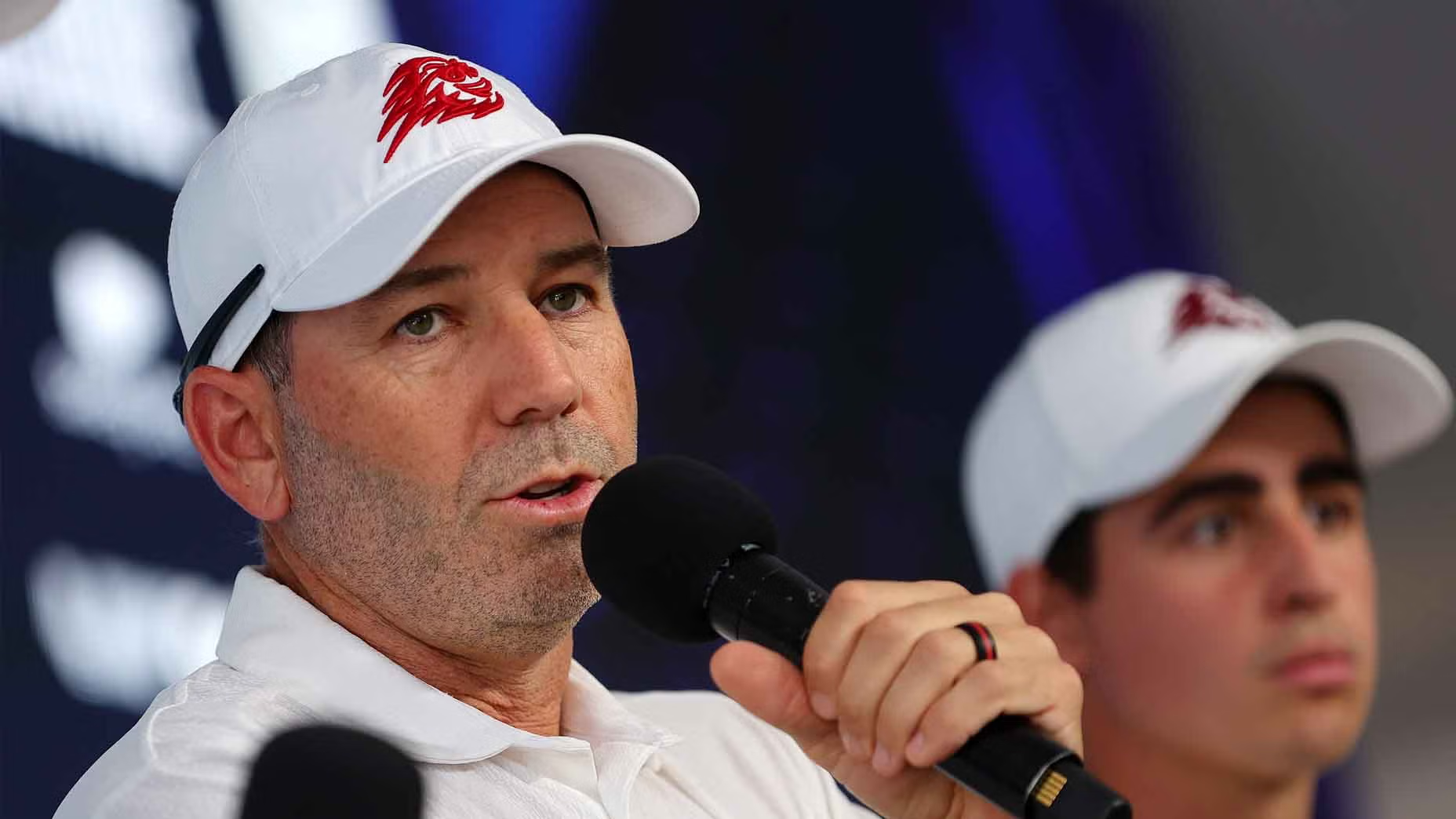
Garcia is happy LIV has finally been recognized by the OWGR after four seasons. The decision should benefit young players like Smylie and Josele Ballester by giving them a pathway to major championships as they begin their professional careers. But Garcia thinks the top-10 cutoff will end up being an anchor. One or two weeks outside the top 10 at a LIV event and all of your OWGR gains will disappear.
“It’s definitely a step forward,” Garcia said ahead of LIV Adelaide in Australia. “Is it fair? I mean, I guess time will tell us. It doesn’t feel like it’s totally fair. With time, obviously. Now, the first few weeks obviously, when one of us is winning, that guy is going to make a jump in the rankings, which is great. But then every time you finish 11th or worst you’re getting a zero and you’re getting an extra event on your divisor. So that in the near, a little farther future, it can hurt a lot. But like I said, it’s a step forward, so it is positive.”
LIV Golf altered its format this offseason by moving from 54 holes to 72. That move has been polarizing, with Rahm endorsing the move while Bryson DeChambeau and others remain skeptical.
On Tuesday, Garcia was asked if he thought that LIV should institute a small cut for the 57-man field each week. Garcia took the opportunity to jab at the OWGR’s decision to only award points to players who finish in the top 10.
Advertisement
“I mean, you could make like a little cut, but I don’t think it makes that much of a difference,” Garcia said. “I think when it comes down to world ranking points, they’ve already made a cut for us in the top 10. It’s kind of like an unwritten rule, you may say.”
That “unwritten rule” has ruffled many feathers on LIV, but Smylie, the 23-year-old Australian who jumped to No. 77 in the world after last week’s win in Riyadh, is taking a positive view of this development. With points now up for grabs on LIV, the young Australian sees this as a golden opportunity to play good golf and punch his ticket to all four majors. All he has to do is keep the pedal down and secure the points that are available.
“Definitely top 50 in the world means that you get in all four majors, which I’m very close to achieving, so it’s great that we do get recognition,” Smylie said. “At the end of the day, good golf takes care of itself, and yeah, try and win a few more times. Ultimately, the Masters is something that’s on my mind now. That’s a conversation that I can start to have and that is fuel to the fire for me.”
So while LIV didn’t get “the whole pie,” as Talor Gooch put it, the league now has more points than it ever has before. It helped Smylie skyrocket 56 spots in the rankings and will allow other players to climb as long as they play good golf. With only top 10 and ties being awarded points, a smaller number of players will have a chance to make sizable gains if they string tournaments together.
Advertisement
In the end, the “unwritten rule” might wind up being the wind in the sails of the few players who dominate the breakaway league while leaving those who struggle to continue their OWGR free-fall.
Journalists from Italy‘s RaiSport on Tuesday announced that they would stage a three-day strike after the Winter Olympics, and would no longer be putting their bylines on Olympics coverage, among other measures.
They are protesting an opening ceremony broadcast by their boss last Friday that started with a wobble and soon fell off the rails entirely.
Paolo Petrecca will not commentate on the closing ceremony, Italian public broadcaster Rai has since saidImage: Maria Laura Antonelli/Avalon/Photoshot/picture alliance
What happened at the Winter Olympics opening ceremony?
RaiSport director Paolo Petrecca, formerly the head of RaiNews, began by casting doubt on whether he knew where he was standing, and then continued in roughly the same vein.
He welcomed viewers to the “Stadio Olympico,” a reference to Rome’s renowned Olympic Stadium, while standing in Milan’s equally well known San Siro stadium, home to both the city’s football giants, AC and Inter Milan.
Advertisement
Mariah Carey was indeed a star on stage at the San Siro, albeit not quite when she was announced on public TV in the host nationImage: Cemal Yurttas/Anadolu/picture alliance
Before long, Petrecca told viewers, “The show continues with Mariah Carey,” as the cameras focused on Matilda de Angelis, a famous Italian actress more than 20 years younger than the US vocalist.
De Angelis has since posted a glamorous shot of herself with almost all her identifying features obscured on Instagram captioned, “PLEASE, CALL ME MARIAH.”
When International Olympic Committee President Kirsty Coventry walked into the stadium with Italian President Sergio Matarella, Petrecca announced “Matarella … and his daughter.”
Petrecca also risked upsetting foreign viewers with observations including how the Spanish athletes were “always very hot,” and how “naturally” many of the Chinese team members “have phones in their hands.”
IOC President Kirsty Coventry is a former swimmer and Zimbabwean Cabinet minister, not the Italian president’s daughterImage: Yves Herman/REUTERS
How did the Rai jouranlists respond?
The channel’s editorial committee Comitato di Redazione, an internal union body representing journalists at the public broadcaster, issued a statement on Monday saying all journalists would withhold bylines during the Games and then strike for three days once the event is completed.
“We have all been embarrassed, no one excluded, and through no fault of our own,” it said. “It is time to make our voices heard because we are facing the worst-ever figure of RaiSport in one of the most eagerly awaited events ever.”
Concerns about shady deals ahead of 2026 Winter Olympics
Opposition politicians in Italy picked up on the gaffes as a sign of the alleged politicization of appointments at Rai in recent years. Petrecca, formerly the head of RaiNews, had been accused of bias toward Prime Minister Giorgia Meloni.
“The Olympics are a time of utmost responsibility for public service broadcasting. Instead, RAI offered its worst version: the one we know all too well, TeleMeloni,” the opposition Democratic Party said in a statement.
A spokesperson for the parent company Rai told The Associated Press on Tuesday that Petrecca had been removed from the commentary team for the February 22 closing ceremony after a meeting including Rai’s CEO Giamapolo Rossi.
Aaron Dill and I have been friends since my days at GolfWRX.com, and the friendship continued even when I worked for one of his competitors. He’s one of — if not the — hardest working men on any truck, and the sheer volume of Vokey wedges makes that statement irrefutable.
In my opinion, given how good the Vokey platform is, the Tour dominance is pretty evenly split between product and Aaron. To watch him help his players and, in the same breath, hand them a tool with precision and variety makes it almost impossible for any wedge program to keep up.
Advertisement
On any given week on the PGA Tour, there are 250-plus Vokey wedges in play.
Five of the top 10 players in the Official World Golf Rankings are Vokey users. Eight of the top twenty have Vokey wedges in the bag. It’s no secret that Vokey wedges have absolutely dominated the wedge market since their introduction to the PGA Tour in 1997 (Andy Bean was the first in Memphis) and have been No. 1 since 2004. That’s 21 years and counting at the top spot, and with SM11 hitting the shelves, that number will undoubtedly grow to 22.
That’s not to say that the competition isn’t stiff. Callaway, TaylorMade, Cleveland, PXG, Cobra and Ping have all risen to an elite level in the wedge department. For the consumer, I can’t think of a time when finding the perfect wedge setup for your game has been easier. Would I say everyone is a 10/10? Yes.
Advertisement
In a market full of Alphas, Vokey would be considered the Lion. Twenty-one years of doing it at peak levels, technology with recon delivered from one of the GOATs in Mr. Vokey, his Luke Skywalker in Aaron Dill and every Jedi apprentice on the way up. All this crew does is wedges, and it creates a very steep hill to climb for any contenders.
First of all, Aaron fits a set of tools, not a set of wedges. And secondly, the strike dictates everything.
Let’s take a look at what that means.
Advertisement
Vokey fitting
When I say the word tool, I mean it just like that. From 135 yards out until the time I grab my putter, I am allowed four tools to navigate that space. I need proper turf interaction for full shots, something that controls spin, something I can flight, and most importantly, a tool that I can consistently live in the magic spot on the face, which is grooves two through five.
In the past, I didn’t pay much attention to the latter. At times, I got lucky and stumbled onto maybe one wedge that satisfied all that. But in a nutshell, like everything else in my bag, it was a game of hit and hope.
This is why I think fitting is the key component to any of these 2026 products. From driver to putter, with every company operating at God-like levels, it’s essential that you get with a fitter to find that magic.
Aaron’s initial fitting landed me on a setup that checked off all the boxes. The second time around was to ensure that his work harmonized with my “feel player” technique, and I must say it was perfect.
Advertisement
Most notably, the SM11 tech story that centered around CG consistency across all lofts was spot on. The 54/58 came down in launch by two degrees with an uptick in spin of about 400-500 RPMs. Why? I was fitted into a set that not only jived with my short game and gapping needs but also had me owning (not leasing) grooves 2-5 across the set. Giving the player a wedge that ensures that kind of contact is massive. Especially a player like me who relies on strong wedge play to survive. Weirdly, it almost feels like I found a driver that’s 15 yards longer.
To be fair to the competition, this product quality exists across many OEMs. The pursuit of that magic CG placement in harmony with the grind has been a North Star for the entire industry. But in my opinion, it started with the Vokey T grind. That specific wedge and its low-spin, flight characteristic were so noticeable that you’d see it in countless bags on Tour (staff and non-staff), whether it was the right wedge for that player or not. Basically, the flight was so good that you would see players adapting to the wedge to play it rather than the other way around.
One of the foundations of any Vokey launch is the sheer volume of grind options: F, S, K, T, D, M. There are 27 total options for the consumer. Not to mention K*, L, V, A+, MA+ and a few more out on Tour. Another thing that keeps Vokey at the top of the bill out on Tour is that they literally have an already manufactured wedge for anybody. Can other OEM Tour reps grind a wedge to add that level of variety? Yes, but it’s hard to replicate wedge to wedge.
My New Setup
The most important thing in this exercise was understanding the marriage between loft, grind and bounce. In many cases, consumers will choose wedges based on a bounce number, with little regard for where the bounce is or how it aligns with the rest of the tool. For example, I tend to lean on “lower bounce” platforms because I’m a feel player with good hands, and my delivery changes from day to day. The problem I was having was that the L-G-B union was never really in harmony. I might get lucky and find two of the three, but I never really landed on a wedge that checked off all three. The ultimate truth teller here is the strike point. When L, G and B are running in the same direction, grooves 2-5 become the star of the show.
Advertisement
If you can find a wedge setup that consistently gets you out of that part of the face, regardless of your delivery, you are in that happy place Aaron always talks about.
This is the setup I landed on, and they are in the bag as we head into my first big event of the season in less than a month.
SM11 44/10F w/ True Temper Tour Issue DG S400
Wunder
Advertisement
Titleist Vokey SM11 Raw Custom Wedge
A Grind For Every Player
For every player, there’s a set of grinds fit for clean contact. SM11 provides a leading combination of lofts, bounces, and grinds to promote solid contact (between grooves 2-5), predictable performance, and the confidence to take on whatever the shot demands.
Grind Comparison
Consistent CG Location
For a given loft, SM11 features the same CG location in all grinds, resulting in a controlled, consistent launch angle. No matter which sole design fits your swing or course conditions, your launch window is locked in—leaving you free to choose the lofts and grinds that work for you.
A Smarter Way To Spin
The new Vokey Spin System combines an angled face texture, shot-specific groove shapes, and deeper spin milled grooves to deliver the right amount of spin from any lie, in all conditions
The follow-up verified everything the fitting set out to do. My gapping was in perfect 13-yard buckets. I had options around the green with the 54 and 58, and most importantly, I have confidence.
If this isn’t a testimonial to go and get fit, I don’t know what it is. If you’re following along with the Fully Fit 2026 journey, you’ll gain a true understanding not only of how important fitting is, but also of how elite every OEM is at making golf clubs this year. In all honesty, I have never had so much trouble picking a set of sticks. If the ones I picked were 9.8/10, the ones I didn’t were 9.79/10.
In this instance, it was the combo of the product and my friend that got me over the line. He’s just remarkable at what he does, and it’s not a fluke that the best in the world all have him on speed dial.
Trust me, everyone knows AD.
Advertisement
Final Gapping and Full Specs
Vokey SM11 44.10F with True Temper Dynamic Gold Tour Issue S400 35.75 EOG, D4, 64 lie, Golf Pride BCT (58R, two double side, logo down)
Vokey SM11 50.08F with True Temper Dynamic Gold Tour Issue S400 35.5 EOG, D4, 64 lie, Golf Pride BCT (58R, two double side, logo down)
Vokey SM11 54.12D with True Temper Dynamic Gold Tour Issue S400 35.25 EOG, D4, 64 lie, Golf Pride BCT (58R, two double side, logo down)
Vokey SM11 58.08M with True Temper Dynamic Gold Tour Issue S400 35 EOG, D4, 64 lie, Golf Pride BCT (58R, two double side, logo down)
Advertisement
Gapping on Trackman
44 Stock: 22 launch, 8750RPM, 131 Carry
50 Stock: 26 launch, 9575RPM, 118 Carry
54 Stock: 27 launch, 10,100 RPM, 104 Carry
58 Stock (60 yards): 28 launch, 9285RPM
Advertisement
Now the best way to get an inside look as to what happened is to get it straight from the man who dialed me in, Vokey Wedge Rep Aaron Dill
Aaron Dill’s fitting assessment for Johnny Wunder
Goals:
Clean carry yardages off the irons
Build a matrix of wedges that cover more shots
Have a sand wedge that performs well from the fairway and around the green
Find a LW that checks off more boxes and addresses problems
My fitting with JW started with some gap work. Math with wedges is very important and sets the tone for where the fit will likely go and how many wedges the players will benefit from. This exercise is also an honest reminder of what your yardages “really” are. The goal is to reach those yardages at 85 percent speed to get the launch, carry and spin correct.
JW tested a 44F, and this was an outstanding add. The benefits of the sole and the loft gave him the carry and trajectory we wanted. JW can create some natural loft, so it was important to take the time to find lofts that get the ball on grooves 2-5 more often. The next wedge needed to carry about 13 yards less, which led us to a 50. We tested both 50-12 and 50-08. Johnny has a path that, at times, can bottom out a little early or launch the ball a little higher, so we needed to find a sole that played a little thinner or with less bounce to bottom out closer to the ball at impact.
The next wedge loft we tested was 54, and again, we wanted a 13-yard reduction in carry. The testing we did on this loft also showed it sometimes launched a little higher. This led us down a couple of paths. Do we increase bounce or decrease and see how he reacts to the feels? My gut said he needed bounce for the trajectory, but we needed to stay thin to get a clean strike on the ball for the flight. We also discussed how important it is that the 54 is good around the greens. This tends to be an undervalued wedge and is used mainly for distance. The strike and versatility were the goals here, and the thinner model with more forward bounce was the clear winner. This wedge has important jobs to do. It has to be a great fairway club with controlled trajectory, and a get-me-out-of-trouble wedge when into the grain, in a long bunker shot or in any scenario where you may struggle.
Advertisement
The last club we tested was a 60, but it was clear the trajectory was still higher than we wanted, so we entertained a 58. We discussed the use of this club and the challenges JW faces around the greens when missing them. The carry yardage was not as important on this wedge, but it was still good to see that it was in the ballpark. The goal of this wedge is to check off as many important greenside boxes as possible. The change in loft from 60 to 58 lowered the trajectory and increased carry and spin. We tested multiple grinds to see if something stood out. The thinner, low-bounce soles performed similarly to the 54, but we made some sacrifices for the versatility. The M grind performed outstandingly around the greens and in the bunkers. I had concerns that JW would have a hard time creating height in form conditions. JW has great hands and had no issue getting under the ball cleanly. His ability to create height is a benefit, but it simply needs to be managed with less loft and the right grind.
The set we put together was calculated and proven to perform. This setup addressed many things, like carry, launch, spin, and, most importantly, the confidence any good player must have. The 44/50 are basic distance wedges, but the flight and hit location on the face need to be a point of focus to achieve consistent, predictable results. The 54 was my favorite part of the session and had the cleanest impact across all locations. But I loved the fact that we talked through the values of this club away from the fairway and, more so, around the green. The way JW hit bunker shots with the SW (high and spinny) made us both question if a 58 was needed. The 58 was the cherry on the sundae. This club has a lot of boxes to check. The balance of the sole gave JW the fairway launch and spin he needed for distance play, but going greenside and in the bunkers, we saw a constant flight and shape that you could trust.
After suffering a devastating loss to Canada in the gold medal game four years ago, the U.S. women’s hockey team is out for some revenge at the 2026 Winter Olympics, and it got a taste of that on Tuesday. In their final preliminary game, the Americans completely dismantled the Canadians, their heated rivals, 5-0.
Taking on a Canadian team that was without superstar Marie-Philip Poulin due to an injury, Team USA controlled the game from start to finish. The Americans’ speed simply overwhelmed the Canadians on the forecheck, and these matchups are rarely this lopsided.
Driving the bus en route to a statement win — once again — was defender Caroline Harvey. She registered her second consecutive three-point game with a goal and two assists, but Harvey wasn’t alone in her heroics. Linemates Abbey Murphy and Hannah Bilka gave Canada headaches for three periods, and they combined for two goals.
Their first tally was a beauty with Murphy showing off her blazing speed to reach a loose puck before sliding a no-look pass to Bilka in the slot. Bilka finished with two goals, and Murphy totaled three assists.
Team USA capped off a perfect 4-0-0-0 run in the preliminary round, and it’s now in the driver’s seat to win the gold medal. Even with Canada down Poulin, this was a thoroughly impressive victory for the Americans, who want to reclaim their spot atop women’s hockey.
Advertisement
Canada and United States are the only two countries that have won gold in women’s ice hockey since the event was added to the Olympics in 1998. The Americans won that inaugural year in Nagano, then endured four straight Canadian victories until 2018, when Team USA struck back with a dramatic overtime win to capture gold in Pyeongchang.
It’s the kind of story that only the Olympic Games seem to produce: A talented ski jumper, who had yet to win anything of significance, delivers the performance of his life to win Olympic gold.
“I don’t know how I did it. But I’m so, so proud that I managed to do it,” Philipp Raimund told German public television moments after his his gold medal triumph in Predazzo, Italy.
“Now I’m simply an Olympic champion. Not having won a single World Cup (race) and then to be standing on the top step of the biggest stage, it’s unbelievable.”
Even harder to grasp is that the 25-year-old, who regularly launches himself from the top of dizzying ski jumps, also happens to suffer from a fear of heights.
Advertisement
Following his older brother
Raimund was born in 2000 in the southwestern town of Göppingen. He and his older brother Fabian started ski jumping as children.
Philipp Raimund had to overcome a fear of heights to soar to Olympic victoryImage: Oryk Haist/IMAGO
“When I was almost five years old and watched my brother, there was no doubt in my mind: I’m going to be a ski jumper!” Philipp, nicknamed “Hille” Raimund, wrote on his website.
In 2005 and 2011, the family of six twice moved further south, eventually settling in the ski-jumping hotbed Oberstdorf. The two brothers needed larger jumps and more intensive training, and their father, Christian Raimund, got a job as a ski jumping coach at the Olympic training center.
His son Philipp initially tried his hand at Nordic combined, a sport that combines ski jumping and cross-country skiing.
“After a while, however, I threw my (cross-country ski) poles down into the snow and declared that I never wanted to torture myself like that again,” Raimund said of his decision to concentrate on ski jumping. If only it weren’t for his fear of heights.
Advertisement
‘Something gets a tight grip on me’
To combat the problem, the ski jumper worked with a mental coach. He can usually handle his fear of heights, Raimund says, “but from time to time I do have a problem (mainly during ski flying). My body takes over and I can’t control it. For about a second and a half, it’s like I am just observing myself while something has a tight grip on me.”
So, at the end of the 2024-25 season, Raimund didn’t compete in the Ski Flying World Cup on the Planica hill in Slovenia, known for its exceptionally long jumps. Slovenian Domen Prevc would set a new world record of 254.5 meters there.
Normal hills, like the one in the Olympic town of Predazzo, feature jumps of only around 110 meters. This suits Raimund much better.
Only quiet when nervous
Outwardly, the ski jumper appears anything but anxious or withdrawn.
Advertisement
“Hille is a really funny and lively guy, I’d even say an extrovert. He’s extremely unpretentious,” teammate Karl Geiger once said.
Philipp Raimund finally delivered on his wealth of talent at Milano CortinaImage: Oryk Haist/IMAGO
“When I’m really nervous, I’m quiet. I might not speak for three hours,” Raimund himself has noted.
Coach Stefan Horngacher had to get used to Raimund’s manner at first.
“We’ve had some real arguments. Things got heated,” the Austrian recalled.
“But I get along really well with him now. He’s a really nice person and an incredible athlete.”
Advertisement
‘Incredible technique’
But that alone isn’t enough to become an Olympic champion. Horngacher describes Raimund as “extremely athletic. He has incredible technique that very few people can execute.”
Nevertheless, in recent years Raimund has seldom managed to translate his immense talent into success. He rarely stood on the top step of the podium — and when he did, it was only in the team competition.
The fact that he celebrated his first major individual victory at the Olympics is a minor miracle.
“Unbelievable,” as Philipp Raimund himself puts it.
It’s been over a year and Canada is still searching for a women’s hockey win against Team USA.
Abbey Murphy had three assists and Hannah Bilka added two goals as the U.S. continued its display of women’s hockey dominance at Milano Cortina 2026 with a 5-0 victory over Team Canada.
Caroline Harvey opened the scoring less than four minutes in, and by the end of the game she had added another two assists.
The Americans have now won seven consecutive games against Canada at the senior national level, including two at the 2025 world championships, a sweep of all four 2025 Rivalry Series games, and this preliminary round matchup at the Winter Olympic Games.
Advertisement
Aerin Frankel earned her second Olympic shutout.
Kirsten Simms also scored for the U.S. after a goaltender interference review and an unsuccessful coach’s challenge by Canada.
Laila Edwards scored the fifth goal and became the first Black woman to score a goal for Team USA at the Olympics.
Canada’s Ann-Renee Desbiens was pulled from the net after allowing five goals and replaced by Emerance Maschmeyer late in the third period.
Advertisement
Captain Marie-Philip Poulin missed the game for Canada. She suffered a lower-body injury on Monday and has been listed as day-to-day.
It is only the second time Canada has lost a game in the preliminary round of the Olympics. The last loss came in 1998 and was also at the hands of the Americans. Prior to Tuesday’s contest both teams were undefeated at Milano Cortina.
Canada will play their final game of this round on Thursday against Finland.
EFL clubs are poised to vote next month on a significant proposal to expand the Championship play-offs to include six teams.
An extraordinary general meeting has been scheduled for March 5, where all 72 EFL clubs will convene to discuss the plans. The Football Association’s board has already given its approval to the proposed changes.
Should the motion pass, the new format could be introduced as early as next season, incorporating an eliminator round similar to the system currently used in the National League.
Under the proposed structure, the team finishing fifth in the league would face the eighth-placed side, while the sixth and seventh-placed teams would also compete.
Advertisement
The FA board gave its backing despite reservations which have previously come from the Premier League (Getty)
These initial encounters would be one-off ties, hosted at the home ground of the higher-ranked club.
The winners would then advance to a two-legged semi-final against the teams that finished third and fourth, culminating in the traditional Wembley final.
The FA board gave its backing despite reservations which have previously come from the Premier League, concerned over the possibility of declining standards if sides that finish eighth in the second tier make it to the top flight.
The regulation change which was approved by the EFL’s board last week must receive a simple majority backing from the the 72 clubs as a whole, and also within that the majority of the 24 Championship clubs.
Advertisement
Clubs have been consulted on the plans and they are expected to go through with a high level of support within the Championship, not only because it would keep the door open for more clubs in the promotion fight, but also reduce the number of dead-rubber league fixtures late in the season.
While the expansion plans are limited to the Championship play-offs for now, there is some interest in this being expanded to League One and League Two in the future.
Drake Maye’s Super Bowl performance was not what he envisioned, throwing two interceptions and was sacked six times. Sunday’s game at Levi’s Stadium turned into one his worst outings.
Fox Sports’ Henry McKenna posted Maye’s comments on X on Monday. The quarterback said his wife was who he was looking forward to spending time with in the offseason. Fans reacted to it, especially after Tom Brady‘s statement about not backing the Patriots before reversing course.
Thanks for the submission!
Advertisement
“No wonder Tom Brady refused to root for him,” one fan tweeted.
•
Advertisement
@henrycmckenna No wonder Tom Brady refused to root for him
Looking to predict NFL playoff Scenarios? Try our NFL Playoff Predictor for real-time simulations and stay ahead of the game!
Advertisement
“Should focus on not turning it over 10 times in the playoffs or not having the worst performance in SB history,” a fan wrote.
Brady didn’t pick between New England and Seattle. Barstool Sports founder Dave Portnoy ripped him on social media, while his former teammates called him out.
He changed his tune on Friday and said Patriots owner Robert Kraft had his back and wanted New England to win its seventh Super Bowl. However, Brady also said he’d give his MVP vote to Matthew Stafford instead of Maye if he could.
Mike Vrabel won’t let anyone blame just Drake Maye for Super Bowl disaster
NFL: Super Bowl LX-Seattle Seahawks at New England Patriots – Source: Imagn
Mike Vrabel spoke to reporters after the loss and shut down any attempt to make Drake Maye the scapegoat. The coach said it starts with the staff and goes through every position on the field.
Protection broke down and running backs couldn’t get anything going. Rhamondre Stevenson and TreVeyon Henderson managed just 42 yards on 13 attempts, whlle wide receivers didn’t help out.
Vrabel stressed that he’s excited to get back to work with Maye. He told his team they’re 307 days into building something and that it’s fine to feel disappointed. Maye will enter his third season and the Patriots believe he has a lot more to prove after the Super Bowl heartbreak.
Rasmus Wrana will forever be thankful for his younger sister’s performance in the mixed doubles gold-medal match.
Sweden’s Rasmus and Isabella Wrana beat the U.S. 6-5 in a thriller to capture gold at the 2026 Winter Olympics. It’s the first time the Swedes have won Olympic gold in mixed doubles — their previous best was a bronze medal at the 2022 Olympics in Beijing in the second Winter Games appearance for the event..
It’s Sweden’s fifth overall gold medal in Olympic curling, trailing just Canada (six) for the most all time.
Despite the heartbreak of not winning the gold medal, it was a historic run for Team USA’s Cory Thiesse and Korey Dropkin.
Advertisement
They earned the Americans’ first-ever medal in mixed doubles and Thiesse became the first woman to collect an Olympic curling medal for the United States.
As for Dropkin, his passionate celebration with crowds all week did something larger for the sport. New eyeballs now are familiar with curling.
Curling fan and San Francisco 49ers superstar tight end George Kittle posted to his Instagram story prior to the gold-medal match, showing his support for the American duo. The U.S. also had Snoop Dogg cheering them on in their game against Canada in round-robin play.
In the bronze-medal match, Italy’s Stefania Constantini and Amos Mosaner secured the win over Great Britain’s Jennifer Dodds and Bruce Mouat. The Italians weren’t able to defend their gold medal from 2022, but still found the podium on home soil.
Advertisement
Draw 15 (bronze-medal game)
Draw 16 (gold-medal game)
Isabella has the game of her life
The pressure of playing for an Olympic gold medal can get to a curler
Advertisement
But Isabella rose to the occasion, shooting an absurd 97 per cent.
From her opening shot in the first end, you could tell Isabella was focused and determined to come away with the gold medal.
For the first six ends, it was all about Isabella’s draw weight. She came up with clutch shots to put Sweden in a great position to force without hammer, or score with last rock.
It started with her draw in the second. With only the side of the button open to get second shot, Wrana made a great draw for two.
Advertisement
Tied 2-2 in the fourth end, Isabella was staring at four American rocks in the house as she went to throw her last stone. Once again, she delivered, making another great draw for one.
In the sixth end, Sweden had a chance to score big. But Rasmus had a poor throw, forcing Isabella to great again. She got Sweden a point to go up 4-3.
The final two ends were different, though. Isabella needed to come through with two hits, and considering she had thrown none in the first six ends, it could have been a tough adjustment.
But for Isabella, it’s her bread and butter.
Advertisement
In the seventh, Rasmus jammed on a double attempt, opening the door for the U.S. to possibly score three. Isabella didn’t let that happen, however, as she made a double to let the U.S. score only two.
Down 5-4 in the eighth, and the gold medal on the line, Isabella came through with one more clutch shot to score two and win the game.
Without Isabella playing the way she did, Sweden doesn’t win.
It’s heartbreak again for the Brits
Advertisement
For everyone but the Olympic champions, the next four years can be tough. Curlers can sit and think about what they could have done differently to win the gold, and if they’re lucky, they get another chance
Great Britain’s Dodds and Mouat did get a second Olympic shot, but history repeated itself.
At the 2022 Olympics, Dodds and Mouat went 6-3 in round-robin play, finishing as the No. 3 seed. They lost their semifinal match and the bronze-medal game that year.
Well, in 2026 it was a different path, but the same result. They went 8-1 in round-robin play, finishing as the No. 1 seed. But the playoffs once again got the best of them as they finished the event in fourth place.
Advertisement
The key moments were the difference in the bronze-medal match. Dodds had a shot for three in the first but missed and gave up a steal of one. In the fourth end, the Brits had the hammer and gave up a steal again to trail 3-1.
Those two steals came back to bite them in the eighth as they were without the hammer trailing 4-3, and couldn’t produce a steal.
Now, Mouat and Dodds will have another four years to think about how they can reach the podium in 2030, if they can get back.
This was only the first of three curling events at the Olympics. The men’s discipline gets underway on Wednesday, while the women’s starts on Thursday.
Advertisement
Canada will look for their first gold in either event since 2014.
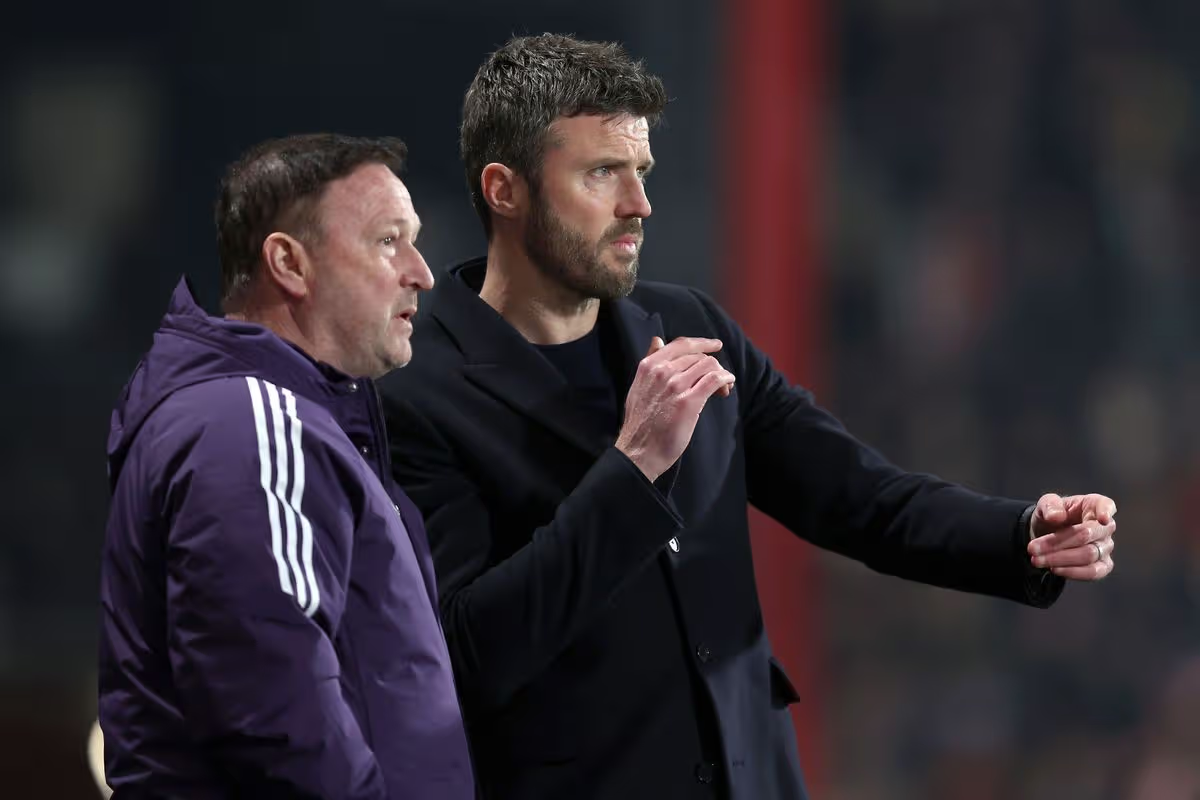
Man Utd play West Ham in the Premier League on Tuesday and Michael Carrick explained his team selection before the game.
Michael Carrick has admitted it’s “not easy” to pick his Manchester United team after four wins on the bounce in the Premier League. Carrick has picked an unchanged team for a third game in a row to face West Ham.
The 44-year-old has not tinkered with the starting XI since the 3-2 win against Fulham at Old Trafford. Benjamin Sesko scored a late winner from the bench against Fulham, but has not been given a chance to start.
Advertisement
Speaking ahead of kick-off against West Ham on Tuesday night, Carrick told MUTV: “Listen, we have a really good squad, so it’s not easy to pick the team. I think the boys are in a good rhythm, they’re feeling good without getting carried away. I’m looking forward to the game.
“The whole squad has contributed and will continue to do that off the bench tonight with finishing the game, however that looks, has been important for us, so we need to carry that on as well.”
Advertisement
Carrick has made a flawless start to his interim role. “You need to bring the confidence that it brings,” he said about United’s recent results. “You have to take those emotions and balance them off with getting ready for the next game. Every match is a different challenge.
“It’s a bit of a reset, but we go into the game in a good place, which makes us feel good.”
Speaking about West Ham, he said: “They’re a dangerous team, they have really good players, really good attacking players as well. They have proved in recent weeks what they are capable of doing.”
West Ham are three points adrift of safety, but they have turned a corner in recent weeks, winning three of their last four games. The Irons’ defeat in that run came against Chelsea at Stamford Bridge.
Advertisement
United could move to third in the Premier League if they beat West Ham tonight. Aston Villa are currently in third position, but they play against Brighton on Wednesday night.
Ensure our latest sport headlines always appear at the top of your Google Search by making us a Preferred Source. Click here to activate or add us as a Preferred Source in your Google search settings
Kyrylo Marsak may have escaped the war in his homeland but it inevitably follows him, even as far as the Milano Ice Skating Arena. The figure skate, one of 46 Ukrainian athletes at the 2026 Winter Olympics, told DW it is “difficult mentally” to cope with the devastation wrought on his home city of Kherson since the Russian invasion began in 2022.
“What had meaning in my life, especially in Kherson, has been destroyed. The school where I went from first to eighth grade is destroyed to pieces and the skating rink is destroyed to pieces and my apartment is too — that bomb hit one floor below.”
That skating rink is where Marsak first discovered and developed the talent that would take him to the Olympics, where he is to compete in the men’s single event this week. But as well as places, it’s people that make elite athletes and the music for Marsak’s short program opener on Tuesday will be a reminder of his father’s role in his life.
“Fall on Me” by Italian father and son duo Andrea and Matteo Bocelli has become the way Marsak connects across thousands of kilometers to his father, Andriy, who is fighting on the front lines of the war.
Advertisement
Family separated but still close
The pair are only able to see each other in person once a year, at the Ukrainian national championships, but their bond endures.
“We have a really strong connection, me and my father. We are always thinking about each other and texting every night and every day. Just good morning. Good night. To make sure that we are both okay. And I can even feel this connection when I’m skating and when I’m on the ice,” he said.
“It’s exactly what I wanted to portray as well in my program, our connection. Even though we are not together, I can close my eyes and I see him everywhere.”
With Kherson under heavy fire in the early stages of the war, Kyrylo and his sister were separated from Andriy and their mother, Zoya, as the parents stayed at home and the children went north to Poland. From there, Kyrylo, then 17, and his sister went to Latvia where she stayed while Kyrylo took up a short-term offer at the Peurunka Skating Academy in Finland that turned in to a three-and-a-half year stay.
While in the Scandinavian country, fellow figure skater, Valtter Virtanen, has taken on a prominent role.
Advertisement
“In Finland he became like a mentor to me. He’s always giving me some tips and ways to improve just from his experience because he had so much more experience than I did. He always supports me and has done everything possible to help me achieve my goals.”
Kyrylo is, however, somewhat tight-lipped on exactly what those goals are in Milan.
“I want to just enjoy this atmosphere, get the maximum out of what I can, to show what I practice. I will not set any specific goals and scores or places. This would only making me anxious and nervous. So my goal is to enjoy this Olympic Games, enjoy the atmosphere and gain as much experience as I can.”
Advertisement
Russian competitor a problem for Marsak
One man who may stand in his way is Russian rival Petr Gummenik, who will skate under the Individual Neutral Athletes banner as one of 13 Russians and seven Belarussians who will compete over the course of the Games. With their countries banned, any potential individual competitors from those nations were declared ineligible if they were found to have actively supported the war in any way.
However a BBC investigation found that Gummenik has “recently worked with and been coached by Ilya Averbukh, who has been sanctioned by Ukraine. Averbukh has held the role of “Crimea’s ambassador for sport,” taken part in events in numerous occupied territories and staged performances for families of Russian soldiers.
Like most Ukrainians, Marsak does not believe Russians should be allowed to compete at the Olympics in any case.
“I think even under a neutral status, they should not be allowed because they are indirectly responsible for this war and most of them are supporting this war secretly,” he said, with particular reference to Gummenik.
Marsak believes the International Olympic Committee (IOC) has “not been paying attention” to such cases and is disappointed by comments by the new IOC President Kirsty Coventry on their re-admission ahead of the next Summer Games, in Los Angeles 2028.
Advertisement
Is IOC opening door for Russia?
While not directly referring to Russia, Coventry said earlier this month that “We understand politics and we know we don’t operate in a vacuum. But our game is sport. That means keeping sport a neutral ground. A place where every athlete can compete freely, without being held back by the politics or divisions of their governments.”
Marsak feels It would be particuarly offensive if they were allowed to compete under their national flag and their anthem.
“How can then say that the sport is out of the politics? They are representing their country. They are representing their flag. Well, this is directly the politics of it. Their country is currently the clear representative of terrorism.”
But, for now, Marsak wants to concentrate on his own country and his own performance.
Advertisement
“I feel really proud that I am going to represent my country. Our main goal is just to show our best and not pay attention to others,” he said.
The one exception, who will surely have at least a slither of his attention on the ice, is his dad.
Concerns about shady deals ahead of 2026 Winter Olympics