Connect with us
DAPA Banner
DAPA Coin
DAPA
COIN PAYMENT ASSET
PRIVACY · BLOCKDAG · HOMOMORPHIC ENCRYPTION · RUST
ElGamal Encrypted MINE DAPA
🚫 GENESIS SOLD OUT
DAPAPAY COMING

NewsBeat

Savage House’s filth and farce are closer to the real bawdiness of the 18th century

Published

on

Savage House’s filth and farce are closer to the real bawdiness of the 18th century

Although critics have praised the performances in Savage House, the film itself has received a frosty reception.

Tim Robey in the Telegraph described its “putrid stylings” as making it “impossible to enjoy”, dismissing it as a “rancid” and “rotten” period drama. Yet this allegedly “lowbrow” film captures the spirit of 18th-century culture more effectively than many glossy period dramas. Savage House seems outrageous because we have forgotten how outrageous the 18th century could be.

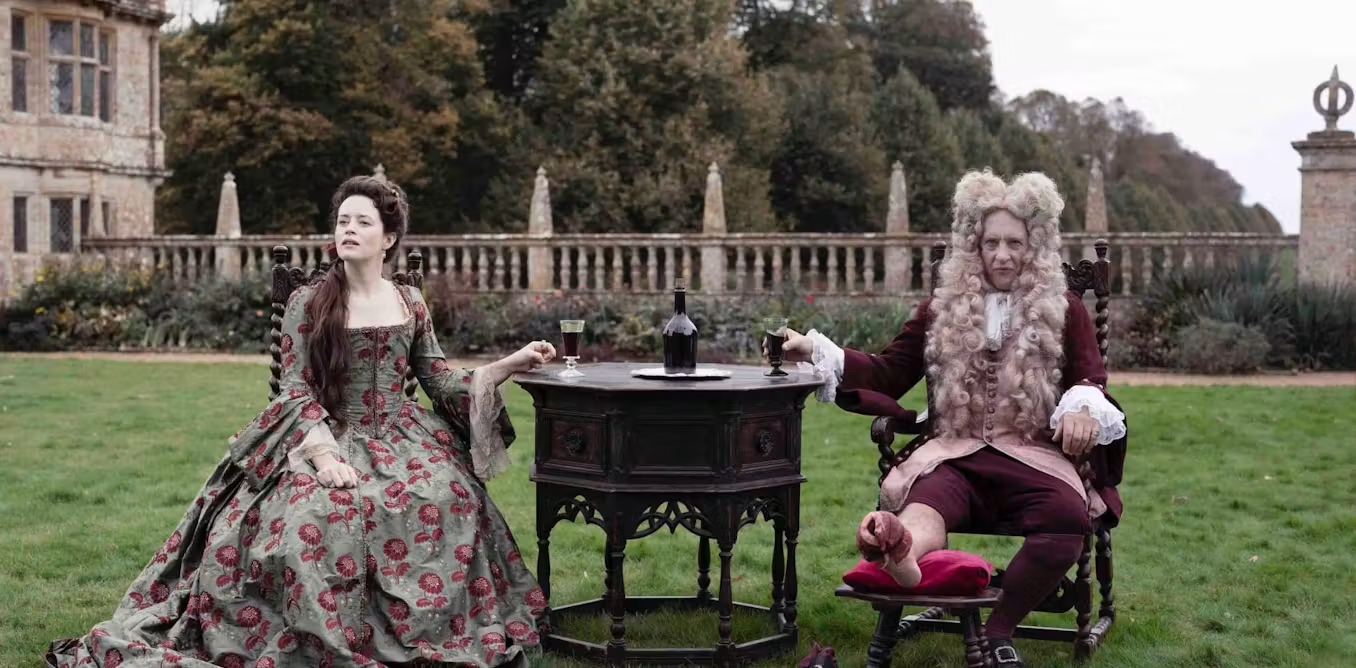
Set during the Jacobite Rising of 1715 and a smallpox outbreak, the film follows Sir Chauncey Savage (Richard E. Grant), a former highwayman whose gambling addiction and taste for luxury have left his Yorkshire estate on the brink of ruin. When the Duke and Duchess of Devonshire announce a visit, the Savages see one final chance to restore their social standing.

What follows is a classic farce, structurally and thematically reminiscent of 18th-century plays like John Gay’s The Beggar’s Opera (1728) or Richard Brinsley Sheridan’s School of Scandal (1777). As the visit approaches, disasters accumulate: disease spreads, affairs threaten exposure, Chauncey’s gout worsens, and panic grows over an impending eclipse. Along the way there is madness, mutilation, vomit, chamber pots and an astonishing amount of human excrement.

Advertisement

Far from being anachronistic, much of this owes a great deal to 18th-century literature and art. However, the modern imagination struggles to see this era as impolite, largely because Jane Austen’s literary vision of Georgian Britain (1714 to 1837) has become so dominant.

Austen’s stories depict a culture shaped by manners and social refinement where sex and dirt are practically non-existent (or buried beneath layers of polite language). Such ideas of the period have more recently been cemented by the Regency-era period drama Bridgerton. How could the early 18th century, then, be so different from Austen’s depictions of the later Georgian period? It can’t, is what many of The Savage’s critics have concluded. However, in reality, earlier 18th-century writers often revelled in something much earthier.

In a poem addressed to the Irish writer and essayist Jonathan Swift, Lady Mary Wortley Montagu joked that Swift’s verses would “furnish paper when I shite”. She was responding to Swift’s notorious satire The Lady’s Dressing Room (1732), in which a servant discovers that the seemingly perfect Celia is, in fact, a human being who uses the toilet. Upon glimpsing the contents of her lavatory, the servant emerges running and shouting “Oh! Celia, Celia, Celia shits!”

Advertisement

Scatology, an interest in bodily waste, runs throughout Swift’s writing, including Gulliver’s Travels (1726). When Gulliver finds himself locked up by the miniature citizens of Lilliput, one of his most urgent concerns is how he is going to discharge his body of its “uneasy load”, since he hasn’t had the opportunity for any toilet time since his ship sunk hours earlier.

Much later in the novel, when he encounters the Yahoos, a species of degenerate humans, he is appalled to discover that they throw excrement at one another. For Swift (who is name checked in Savage House as a potential guest for the Devonshire’s visit) such moments served a satirical purpose. They punctured human vanity by reminding readers that, however refined they imagined themselves to be, they remained creatures of flesh, appetite and bodily functions. Everything else was artifice.

That tension between appearance and reality lies at the heart of Savage House. As literary historian Pat Rogers observed, 18th-century Britain was a “freakish age”, one that celebrated refinement while indulging its basest appetites. Small wonder that bathos (the sudden collapse of the elevated into the ridiculous) became one of the period’s favourite satirical techniques.

William Hogarth A Rake’s Progress, In The Madhouse.
Wikimedia, CC BY

Savage House’s clearest influence is William Hogarth’s A Rake’s Progress (1733 to 1735), a sequence of satirical paintings charting the rise and fall of Thomas Rakewell, a young heir who squanders his fortune on gambling, luxury and vice before ending up in the psychiatric hospital, Bedlam. A “rake” is someone committed to hedonism, whose voracious appetites lead them to live their lives to excess in all matters. Like Rakewell, Chauncey Savage is a classic rake, and the connection becomes explicit in the film’s closing moments, which directly echo Hogarth’s final image.

Advertisement

Unlike Rakewell, however, Chauncey is not born wealthy but cons his way into respectability. In this respect he resembles the ambitious adventurers and social climbers of Henry Fielding’s fiction, especially Tom Jones (1749). Modern readers often forget just how unruly many 18th-century novels were. Laurence Sterne’s Tristram Shandy (1759 to 1767) famously includes a scene in which its hero suffers a catastrophic window-related injury to his genitals, Frances Burney’s Evelina (1778) features a monkey in a suit attacking a man and chewing his ear and Daniel Defoe’s Robinson Crusoe (1719) sees a dancing bear get shot point blank in the face.

None of this means that Savage House is a perfect reconstruction of 18th-century Britain. No historical drama is. But it does draw on aspects of 18th-century culture that have become strangely unfamiliar. There is more to the 18th century than elegant ballrooms and carefully managed courtships. It was also an age fascinated by vice, bodily functions, social climbing, scandal and satirical humiliation.

The film’s chamber pots, rotting bodies and collapsing pretensions are more than a “low-brow” attempt to shock modern audiences. They belong to a long literary and artistic tradition stretching from Swift and Fielding to Hogarth and the 18th-century stage. Bridgerton’s world of romance and refinement has historical foundations. But so too does Savage House’s world of filth, farce and excess. The difference is that we have become much more accustomed to seeing one than the other.

This article features references to books that have been included for editorial reasons, and may contain links to bookshop.org. If you click on one of the links and go on to buy something, The Conversation UK may earn a commission.

Advertisement

Source link

Continue Reading
Click to comment

You must be logged in to post a comment Login

Leave a Reply

NewsBeat

Alleged rioter, 18, retrieved from lough after PSNI inspector set on fire

Published

on

Belfast Live

A teenager who was allegedly part of a crowd who threw a petrol bomb into the open front door of a police Land Rover was arrested after the Coastguard retrieved him from Belfast Lough, a court heard today.

Belfast Magistrates Court also heard claims that as he was being chased by a PSNI inspector who had been set on fire by the petrol bomb, 18-year-old Ryan Fowles discarded a face covering and gloves when he entered the water in Carrick.

Appearing in the dock, Fowles, with an address on the Larne Road in Carrick, was charged with rioting on 9 June this year.

Advertisement

During a contested application for bail, a police officer outlined how a crowd of masked rioters were attacking police in Carrick on Tuesday evening, hurling masonry and paint bombs at a police Land Rover.

A street had been blocked by bins set on fire in the middle of the road and the court heard that when an inspector opened the door to move one out of the way, a rioter stepped forward and threw a lit petrol bomb through the open passenger door. The petrol bomb ignited and the inspector was set on fire and suffered burn injuries but after it was extinguished, he gave chase to one of the alleged rioters.

Fowles ran across the Marine Highway and into the sea, allegedly discarding gloves and a face covering into the water. The court heard he remained in the water until the Coastguard and his dad arrived to retrieve him.

Although initially arrested, Fowles was released to go to hospital for treatment for a broken arm but following a phone call on Wednesday, he voluntarily presented himself to police.

Advertisement

Submitting that Fowles should be refused bail over concerns about further offending and the risk of further public disorder, the officer added that a remand in custody would send a “strong message to deter others from participating” in further disruption.

Defence solicitor Hamill Clawson, from Reid Black Solicitors, argued that despite the statement of the police inspector, Fowles could not be identified on CCTV footage as taking part in the riot. He told the court that interviewing officers accepted that Fowles could not be seen on the footage.

According to the defendant, he had been watching the disruption rather than taking part when “he was struck with a baton and in fear, he ran and got into the sea”.

Submitting that the sole evidence was the alleged observations of the inspector, Mr Hamill highlighted that in addition to mental health difficulties and a diagnosis of autism, Fowles has a completely clear record so with conditions, he could be granted bail.

Advertisement

District Judge Anne Marshall said while Mr Clawson had made every point that he could, “given the ongoing public disorder, I am satisfied that there is risk of further offending, a risk of harm and public disorder”.

Accordingly, she refused bail and Fowles was remanded in custody with the case adjourned to 9 July.

For all the latest news, visit the Belfast Live homepage here and sign up to our daily newsletter.

Source link

Advertisement
Continue Reading

NewsBeat

Newscast – Why Has Defence Secretary John Healey Resigned?

Published

on

Newscast - Epstein Files: New Mandelson and Andrew Allegations

Available for over a year

Today, the UK Defence Secretary John Healey has resigned.

In his resignation letter to the PM, Healey set out his reasons for leaving, telling the PM the defence investment plan “falls well short of what is required for defence and the country at this dangerous time”.

The sixth minister to resign for Starmer’s cabinet in a month, and one of its most loyal, the question will now turn to what lies ahead for the PM.

Advertisement

Adam and Chris are joined by Shashank Joshi Defence Editor of the Economist

You can now listen to Newscast on a smart speaker. If you want to listen, just say “Ask BBC Sounds to play Newscast”. It works on most smart speakers.

You can join our Newscast online community here: https://bbc.in/newscastdiscord

Get in touch with Newscast by emailing newscast@bbc.co.uk or send us a WhatsApp on +44 0330 123 9480.

Advertisement

New episodes released every day. If you’re in the UK, for more News and Current Affairs podcasts from the BBC, listen on BBC Sounds: https://bbc.in/4guXgXd

Newscast brings you daily analysis of the latest political news stories from the BBC. The presenter was Adam Fleming. It was made by Jack Maclaren with Anna Harris and Gabriel Purcell-Davis. The social producer was Joe Wilkinson. The technical producer was . The assistant editor is Chris Gray. The senior news editor is Sam Bonham.

Programme Website

Source link

Advertisement
Continue Reading

NewsBeat

Emma Raducanu facing two matches in one day after rain causes chaos to Queen’s schedule

Published

on

Emma Raducanu facing two matches in one day after rain causes chaos to Queen’s schedule

Emma Raducanu and mini resets are as much part of the British tennis landscape as Queen’s and rain delays (Exhibit A: today’s weather in London). But the British No 1 struck a confident figure both during and after her 6-0, 6-3 win over over qualifier Anna Blinkova on Tuesday. Enough to suggest that the green green grass of home may be what her season needed after year of mis-starts, inaction and frustration.

Obviously one match does not make a summer and the real tests are to come, starting with her match against Sorana Cîrstea in west London today. Yet, Raducanu sounded upbeat after the win on Tuesday saying (via writing on a TV camera) that she was happy to be “back home”, hinting at the possibility that this will not be another false dawn.

“Despite not having played a lot of matches, I was really pleased with how I came out and was playing very free,” the world No 42 said. “I think I was just feeding off of the atmosphere, and it felt free, it felt clear, and a lot of clarity. Not necessarily thinking too much, not trying to do too much.

Advertisement

“I love playing on grass. And playing at home, I think it also brings a really good side out of me.”

Raducanu will need all of that “good side” today when she faces Cirstea. The in-form Romanian stands at No 10 in the rankings for this season. And the last time the pair met, in the final of the Transylvania Open in early February, Cîrstea dished out a 6-0, 6-2 thrashing. The mitigating circumstance is that it was around the time when the Briton picked up the virus that has dogged season since.

So today’s match will serve up a useful gauge of where Raducanu’s game is, one that on Tuesday at least, looked to be heading in the right direction.

Stay here for all the action from west London where I imagine people will be doing the opposite of a rain dance (a sun dance?) in a bid to see some action at the famous club. 

Advertisement

Source link

Continue Reading

NewsBeat

‘Perfect’ thriller airing on Film4 tonight after leaving fans ‘raw’

Published

on

Wales Online

Anna Kendrick’s psychological thriller is airing on Film4 tonight, and fans have hailed it a ‘masterpiece’ that is ‘scarier than any horror’

A thriller hailed as a “masterpiece” is set to air on television this evening.

Having originally premiered in 2022, audiences have declared it “scarier than any horror”, making it an ideal late-night watch.

Alice, Darling screens on Film4 tonight, following its world debut at the Toronto International Film Festival four years ago.

Advertisement

Fronted by Anna Kendrick, the thriller sees the Pitch Perfect star portray Alice, a young woman trapped in a psychologically abusive relationship with her boyfriend Simon (played by Charlie Carrick).

Following candid advice from friends during a holiday — which she has disguised as a work trip — Alice resolves to distance herself from both the relationship and her co-dependency with Simon. However, events take a sinister turn, reports the Mirror.

Upon discovering Alice’s deception, Simon tracks her down to a secluded lakeside cabin, arriving unannounced, his menacing and controlling nature lurking beneath an outwardly charming façade.

The official synopsis reveals: “A young woman trapped in an abusive relationship becomes the unwitting participant in an intervention staged by her two closest friends.”

The cast also includes Kaniehtiio Horn and Wunmi Mosaku as Alice’s friends, Tess and Sophie.

Alice, Darling has been hailed as “very underrated” by fans, with one calling it: “Tremendously well done.” They added: “It will leave you uncomfortable and vulnerable and essentially raw, but the journey, truth and confrontation is more than worth it if you can face and stare and confront the demons within us or around us all.”

Another called it a “mesmerising watch”, while someone else said it was “unquestionably poignant”. One review also read: “The tension and subtlety that Anna plays her role is a masterpiece.”

Advertisement

Another viewer called it “perfect”, as someone else hailed its “underrated brilliance”. Yet another said it was “hard to watch but absolutely worth it,” while someone else called it “scarier than any horror”.

Twilight actress Anna previously revealed how she related to her character in Alice, Darling, after a personal experience with emotional abuse.

She told People Magazine, of recalling the first time she read the screenplay: “I was coming out of a personal experience with emotional abuse and psychological abuse.

Advertisement

“I think my rep sent it to me, because he knew what I’d been dealing with and sent it along. Because he was like, ‘This sort of speaks to everything that you’ve been talking to me about’.”

She went on: “I was in a situation where I loved and trusted this person more than I trusted myself. So when that person is telling you that you have a distorted sense of reality and that you are impossible and that all the stuff that you think is going on is not going on, your life gets really confusing really quickly.

“And I was in a situation where, at the end, I had the unique experience of finding out that everything I thought was going on was in fact going on. So I had this kind of springboard for feeling and recovery that a lot of people don’t get.”

Advertisement

She went on to say that the script was “surprising timing” but she “wasn’t in danger of re-traumatizing myself,” and felt that making the film became “incredible cathartic”.

Alice, Darling airs at 9pm on Film4 on Thursday, June 11.

Source link

Advertisement
Continue Reading

NewsBeat

Petition launched over closure of Flying Start nursery in Bridgend

Published

on

Wales Online

It is described as being a cornerstone of the community

Bridgend residents have started an online petition against plans to close a Flying Start nursery based in the North Cornelly area.

Advertisement

The plans, which would result in the closure of the Flying Start provision at Afon Y Felin Primary school, were decided by Bridgend County Borough Council at a cabinet meeting held in May.

It has led to opposition from local parents who say the decision “threatens the wellbeing” of countless children and families from the area with the facility considered to be a cornerstone of the community. Stay in the know by making sure you’re receiving our daily newsletter.

Flying Start is a Welsh Government-funded childcare programme targeted at children aged 0from birth to three and their families living in identified postcodes in the Bridgend area.

The online petition currently has more than 200 signatures and asks that the authority reconsider their decision to close down the essential local service.

Advertisement

A section of the petition read: “Unfortunately the Afon Y Felin Flying Start is facing potential closure.

“This decision threatens the wellbeing of countless children and families within our community who depend on this establishment for quality nursery education and support.

“It’s not just a nursery; it is a cornerstone of our community, offering a safe space where children can learn, play, and develop essential life skills.

“The closure would lead to loss of jobs for dedicated staff and disrupt the lives of families who rely on this centre.

Advertisement

“It’s proven that early childhood education is crucial in laying the foundation for future success, both academically and socially.

“Denying our children these formative experiences will set them back in their development.”

A council spokesman said the decision to end the Flying Start provision at the site had been made after they were informed the current provider did not intend to retender their contract.

They added there was enough local provision to cover all of the children at the school and would now be writing to parents and carers.

Advertisement

They said: “Bridgend County Borough Council has stepped in and looked at how Flying Start services based at Afon Y Felin Primary could be provided differently in future in the North Cornelly area after being informed that the current provider does not intend to retender for the contract.

“We can confirm that several other approved Flying Start providers are operating within the community, which means that children who currently use the Afon Y Felin scheme will be able to transition across to one of the alternative providers.

“Bridgend County Borough Council is writing to parents who use the Flying Start service based at Afon Y Felin to explain the situation, reassure them that there is enough local provision to cover all of the children, and to offer support in finding and transitioning over to one of the approved alternative Flying Start providers.

“Our aim is to ensure that no child misses out on Flying Start services in the North Cornelly area and to help make the transition to a new provider as smooth and as positive as possible.”

Advertisement

Get daily breaking news updates on your phone by joining our WhatsApp community here. We occasionally treat members to special offers, promotions and ads from us and our partners. See our Privacy Notice.

Do you get a good service from your council?

Do you get a good service from your council?

Source link

Advertisement
Continue Reading

NewsBeat

Trump plans to select US Attorney Jay Clayton as intelligence director

Published

on

Trump plans to select US Attorney Jay Clayton as intelligence director

WASHINGTON (AP) — President Donald Trump said Thursday that he plans to nominate Jay Clayton, the U.S. attorney for the Southern District of New York and a former Securities and Exchange Commission chairman, as director of national intelligence.

Trump announced the nomination on social media amid pressure from Congress to name a permanent replacement for Tulsi Gabbard, who resigned last month. Trump faced intense pushback over his decision to name Bill Pulte, head of the Federal Housing Finance Agency, as acting director. The job oversees the coordination of 18 intelligence agencies.

The situation has led to a standoff in Congress after Democrats said they would refuse to renew foreign intelligence powers unless Trump pulled Pulte’s nomination and named a permanent nominee.

“Few people anywhere in the Legal Community are respected at the level of Jay,” Trump wrote. “I encourage the United States Senate to confirm Jay as soon as possible.”

Advertisement

As the U.S. attorney in Manhattan, Clayton oversees the largest and most prestigious of the Justice Department’s prosecution offices, with a vast portfolio ranging from terrorism and espionage cases to security fraud and public corruption.

He took over from interim U.S. attorney Danielle Sassoon, who resigned in February after refusing to carry out orders from the Justice Department to drop corruption charges against Mayor Eric Adams. The case was eventually dropped after prosecutors from Washington submitted a request to a judge.

Republicans hope to move quickly on nomination

Clayton appeared Monday on CNBC’s “Squawk Box,” where he raised questions about the integrity of California’s elections. Trump has claimed without evidence that the state’s slow count in its recent primaries meant the vote was rigged.

“The American people are right to question it,” Clayton said, adding that the delay in results increased the opportunity for fraud.

Advertisement

Senate Majority Leader John Thune, R-S.D., says the Senate could move “fairly quickly” to confirm Clayton as Director of National Intelligence if the White House submits his paperwork soon.

He praised Clayton after Trump said on social media that he would nominate him for the job, saying he has a “great reputation.”

Democrats are holding up the renewal of a key surveillance law, the Foreign Intelligence Surveillance Act, in protest of Trump’s decision to temporarily tap Pulte. They say they won’t support an extension of the law, which expires at midnight on Friday, until Trump withdraws Pulte’s appointment.

Trump previously said Pulte would take over on June 19. It is unclear whether the Senate could move quickly enough to confirm Clayton before that date.

Advertisement

“I don’t know what realistic is, but we’re gonna probe the limits of it,” Thune said.

Connecticut Rep. Jim Himes, the top Democrat on the House Intelligence Committee, said he has “known and respected” Clayton for decades and that had he been tapped as DNI a week ago, “lots of pain might have been avoided.”

“His intelligence, temperament and deep commitment to public service will make him a terrific DNI,” Himes said.

Asked about Clayton’s nomination, Senate Democratic Leader Chuck Schumer said that “Pulte has to go.”

Advertisement

“He cannot be in the DNI role,” Schumer said. “It’s too important.”

Trump’s pick has led SDNY during a tumultuous period

Clayton navigated his way through a 14-month tenure in the Southern District of New York without clashing with the federal judges in the busiest court in the nation, unlike his counterparts in upstate New York and New Jersey. After his interim term expired after 120 days, the judges of the Southern District appointed him as U.S. attorney.

Clayton was sworn in as U.S. attorney in April 2025 on the same day three prosecutors resigned, saying they felt pressured to admit wrongdoing or regret about prosecuting the now-dismissed corruption case against then-New York Mayor Eric Adams.

Then, weeks later, the office had to withstand controversy over the Trump administration’s firing of one of its most respected and successful prosecutors, Maurene Comey. She claims she was fired because of Trump’s dislike of her father, former FBI Director James Comey.

Advertisement

Under Clayton, the Manhattan U.S. attorney’s office facilitated the unsealing of thousands of pages of court records from the prosecutions of Jeffrey Epstein and Ghislaine Maxwell — documents that were made public as part of the Justice Department’s release of records related to the late sex offender and his longtime confidant.

Clayton filed documents with the court explaining the process the government followed in releasing the materials.

Clayton has also overseen the prosecution of former Venezuelan President Nicolás Maduro and Maduro’s wife, Cilia Flores, on drug trafficking charges.

Clayton has overseen cases involving national security threats

Several recent terrorism cases brought by Clayton’s office touch on the global threats and influences that he’ll be navigating if confirmed as director of national intelligence.

Advertisement

They include the May arrest of Mohammad Baqer Saad Dawood Al-Saadi, an Iraqi and Iranian citizen accused of plotting 20 attacks in Europe and Canada and planning to attack a Manhattan synagogue and Jewish centers in Los Angeles and Scottsdale, Arizona, in retaliation for the U.S. war on Iran.

“There are foreign nations and terrorist organizations that see our success as a threat. A threat that they want eliminated,” Clayton said at a recent press briefing. “That is a stark truth.”

“And don’t take my word for it,” he added. “Take their words and their actions. When your enemies tell you something, and when they act, you should know that they mean it.”

The first Trump administration tried in June 2020 to install Clayton, then the chairman of the SEC, as U.S. attorney in Manhattan, but backed down and instead allowed Deputy U.S. Attorney Audrey Strauss to serve in the post. The reversal came after then-U.S. Attorney Geoffrey S. Berman agreed to step down, following assurances that probes into Trump allies would not be disrupted and that Strauss could lead the office.

Advertisement

At the time, the office was looking into dealings by Rudy Giuliani, who was serving then as Trump’s personal attorney, and was also investigating the actions of a state-owned Turkish bank.

Trump doubled down on naming Pulte as the acting director, even though he emphasized it would be a short-term job. The president said he wanted Pulte to downsize the office, which has already been significantly scaled back in his second term.

Gabbard resigned on May 22, citing her husband’s cancer diagnosis.

Trump said last week that he was interviewing five candidates for his pick to lead the agency permanently and that all have national security backgrounds.

Advertisement

___

Neumeister and Sisak reported from New York. Associated Press writers Eric Tucker, Mary Clare Jalonick and Seung Min Kim in Washington contributed to this report.

Advertisement

Source link

Continue Reading

NewsBeat

Emmerdale’s Graham Foster star is the brother of a famous TV actress

Published

on

Daily Mirror

Emmerdale’s Graham Foster made a surprise return to the Dales in January, but what do fans know about the man behind the character, actor Andrew Scarborough?

Emmerdale legend Graham Foster has lost no time in getting back to his roots in the village following his jaw-dropping return in January.

Advertisement

As devoted fans will recall, the much-loved character, portrayed by Andrew Scarborough, was believed to have perished in 2020, before sensationally reappearing during the soap’s crossover with Coronation Street.

Graham’s return is linked to the enigmatic arrival of Weatherfield’s Jodie Ramsey (Olivia Frances-Brown), the estranged sister of Shona Platt (Julia Goulding).

Joe Tate (Ned Porteous) was left stunned to find his father figure alive and well, with the pair now residing together at Home Farm. Graham has also attempted to reignite his romance with Rhona Goskirk (Zoe Henry) and has embarked on a fling with Kim Tate (Claire King).

In a compelling twist, viewers are currently witnessing a gentler side to Graham as he takes troubled teenager Kyle Winchester (Huey Quinn) under his wing, following his father Cain’s (Jeff Hordley) battle with prostate cancer, reports the Express.

Reflecting on his comeback, Andrew Scarborough spoke candidly about the surprise of his ITV soap return: “I never expected it at all. Although saying that, I did think that Graham always had a possibility of coming back.”

Speaking about keeping his return under wraps from his nearest and dearest, Andrew, 52, said: “Oh yes, it’s been a big secret, and I kept it mostly quiet from my family, which was tricky.”

He added over who he told: “Oh yes, just a limited few, certainly it is on one hand, in fact I had some cousins who contacted me after it was shown, saying you sod.”

Advertisement

Among Andrew’s family members is his sister, Victoria Scarborough, who is equally a well-established actress in her own right.

Who is Andrew Scarborough’s famous sister?

Victoria, 59, is widely recognised for her portrayal of Ruth Bannerman in The Grand in 1998, Betty MacFell in The Cinder Path in 1994, and Claire Monceau in Charlotte Gray in 2001.

The talented actress has also featured in an extensive catalogue of television programmes, including The Royal, Birds of a Feather, Holby City, Silent Witness, Where the Heart Is, and Heartbeat.

Advertisement

It appears Victoria has since ventured into writing and directing, with the short films Hysteria (2022) and Speed Date (2019).

Emmerdale airs weekdays on ITV and ITVX.

Source link

Advertisement
Continue Reading

NewsBeat

Woman arrested as part of investigation into attempted murder of police officer in Downpatrick

Published

on

Belfast Live

The 27-year-old woman was arrested on Thursday

A woman has been arrested as part of an attempted murder investigation after an officer was left seriously injured when he was hit by a stolen police car.

Advertisement

The 27-year-old woman was arrested on Thursday, June 11 on suspicion of assisting an offender following the incident which took place on Sunday, May 31, in the Co Down town of Downpatrick.

A PSNI spokesperson said: “Detectives investigating the attempted murder of a police officer in Downpatrick on Sunday, 31st May, have made an arrest.

“A woman aged 27, was arrested today, Thursday 11th June, on suspicion of assisting an offender and remains in police custody.”

Conor Carey, 36, of Glassheena Road in Downpatrick, appeared in court last week in connection with the incident. He has been charged with attempted murder. Carey is also charged with aggravated vehicle taking causing injury on the same date and driving without insurance. He has been remanded in custody.

Advertisement

Meanwhile, Kieran Turley, 27, from Vianstown Road in Downpatrick, also appeared at the town’s magistrates’ court charged with dangerous driving, driving while disqualified and using a motor vehicle with no insurance.

He was remanded in custody to appear in court again later in June.

For all the latest news, visit the Belfast Live homepage here and sign up to our daily newsletter here.

Source link

Advertisement
Continue Reading

NewsBeat

what this means for the process of learning

Published

on

what this means for the process of learning

Deep in Book VII of Plato’s Republic, Socrates describes prisoners chained inside a cave, mistaking shadows cast on a wall by firelight for reality itself. They name the shadows, debate them and develop expertise about them. The prisoners are completely, sincerely wrong, and they have no idea. The cave isn’t a place of stupidity, it’s a place of convincing, well-organised illusion.

But Plato’s real interest wasn’t the cave, it was in the periagoge – a Greek word meaning the turning of the soul away from shadows and toward the light. For Plato, this was education itself: not the filling of an empty vessel with facts, but a fundamental reorientation of how a person relates to truth and how they come to know that truth.

The shadows persist but today they aren’t cast by firelight, they are generated by machines. Large language models (LLMs), image making and AI-powered search produce outputs that are fluent, confident and immediate.

But here’s the crucial difference from Plato’s original problem, his shadows were at least connected to something real. What AI produces is different in that a language model has no built-in commitment to truth, only a statistical relationship to an enormous quantity of text. When it tells you something, it isn’t reporting, it’s composing.

Advertisement

The outputs can be correct. But they can also be wrong in ways that are structurally indistinguishable from being right. The shadow no longer flutters on a cave wall, it speaks now, and sometimes it speaks beautifully.

This is why periagoge – turning towards the light – matters more now than ever and why AI threatens it so quietly. Knowledge isn’t merely true belief, it’s true belief held for the right reasons, connected to the world through justification, evidence and process.

AI disrupts this at the root. It is useful precisely because it decouples output quality from the slow, demanding work of verification. You don’t need to consult a primary source, triangulate between perspectives, or sit with the discomfort of not yet knowing.

Advertisement

Bypassing learning

GenAI poses many problems for learning. When an AI hands us an answer, we risk bypassing the process through which learning happens. We’ve received a product that looks like knowledge from the outside but is hollow at its core, it’s a shadow that convinces us of something we haven’t actually understood.

GenAI doesn’t just help us think. It thinks instead of us. And there’s growing evidence it’s making us measurably worse at doing it ourselves.

The philosopher Miranda Fricker identified a harm she called “epistemic injustice”, the wrong done when someone is denied the tools to make sense of their own experience. Writing in 2007, she couldn’t have imagined the form that harm might take two decades later.

What we risk now is something adjacent but distinct: epistemic atrophy. Not the theft of knowledge, but the slow erosion of our willingness and capacity to undertake the more demanding work of understanding what is real. In other words, the capacity to ask: how do you know? And the instinct to distrust the fluent answer, and the patience to sit with the discomfort of not-yet-knowing, which is where all the real learning begins.

Advertisement
Sitting with the discomfort of not-yet-knowing is all part of the process of learning.
Vystek Images / Shutterstock

These capacities can’t be downloaded. They’re built slowly, through exactly the kinds of tasks that AI now makes it easiest to skip, and scientific studies are catching up with what educators already sense. A landmark MIT Media Lab study tracked a group of students writing essays variously with ChatGPT, a search engine, or nothing at all.

Those using LLMs showed the weakest brain connectivity of all three groups, cognitive activity scaled down in direct relation to how much was outsourced. Most couldn’t recall what they’d just written and yet the task was completed. But fundamentally, the learning never happened.

Worse still, the cognitive habits don’t automatically reset. Once we hand the thinking over, our brains don’t automatically take it back. By the end of 2025, a RAND survey of 1200 students found two-thirds believed AI was harming their critical thinking. The students themselves can feel what’s happening to them.

The most important thing educators teach has never been content. It has always been periagoge, the reorientation of the whole person toward truth and the willingness to be wrong, to revise, to trace an idea back to its roots and ask whether it holds.

Advertisement

If we design our curricula, our assessments and our institutions around the assumption that the output is what matters – the essay, the answer, the finished product – then we are not educating.

Plato’s escaped prisoner, having seen the sun, returns to warn the others. They don’t thank him. They find him disorienting, probably dangerous, certainly annoying. In their minds, the shadows they trust are sharper than any daylight he can describe.

Today, the cave is still the cave, but the chains are more comfortable than ever, and the shadows have learned to speak. The question now is whether we are still teaching people to turn around and face the light.

Advertisement

Source link

Continue Reading

NewsBeat

Nearly 250 banks are set to close this year – including eight in Greater Manchester

Published

on

Nearly 250 banks are set to close this year - including eight in Greater Manchester

The closures are blamed on customers ‘shifting towards mobile services’

Eight Greater Manchester branches are among nearly 250 banks that are due to close in 2026 as the major banks continue their withdrawal from the high street.

Advertisement

By the start of this month, 138 banks had closed across the UK in 2026. June is set to be the most destructive month so far, with 82 branches due to close this month alone, and more to follow throughout the year.

In total, closure dates have been fixed for 245 branches of the major banks by the end of this year. That includes eight Greater Manchester banks – four in Manchester, two in Trafford, and one each in Rochdale and Tameside.

Click here to get the biggest stories straight to your inbox in our Daily Newsletter

Three of those branches closed this month, with the Halifax branch on Wilmslow Road, Didsbury, scheduled to shut today (Wednesday, June 10).

Advertisement

The Lloyds branch in Stamford New Road, Altrincham, was expected to close yesterday (Tuesday, June 9), and the Halifax in Ashton-under-Lyme at the start of this month. All the other closures took place earlier in the year.

You can check whether your local branch is due to close using our interactive map.

The closures affect every part of the UK, with 31 branches due to shutter in Scotland, 16 in Wales, and four in Northern Ireland, with the rest spread across England.

Lloyds customers have been hardest hit, with 82 Lloyds branches already shut or scheduled to close this year, along with 43 branches of Halifax and 28 branches of Bank of Scotland.

Advertisement

That comes after Lloyds Banking Group announced it would close 166 branches in 2026 and 2027, including branches of Halifax, Bank of Scotland, and Lloyds Bank.

The decision was blamed on customers shifting away from in-person banking to using mobile services. Meanwhile, Santander is closing 54 branches this year, and NatWest is closing 35 banks.

Since February 2022, when all major banking groups committed to a voluntary agreement to assess the impact of each closure, a total of 2,167 branches have either shut down or announced plans to close – an average of nearly 10 closures each week.

The LINK initiative was established to scrutinise each closure. When closures leave communities without any local bank, banking hubs or free ATMs are set up to fill the gap. So far, LINK has recommended the opening of 277 bank hubs.

In May, the Government announced an independent review into access to banking, to be led by Richard Lloyd, the ex-Director General of Which? and the former interim Chair of the Financial Conduct Authority.

As part of the review, Mr Lloyd has launched a consultation on the impact of branch closures and their implications for the future.Currently, closure assessments focus on cash access and the potential gap left by a branch closure.

But this assessment could be extended to include access to banking, which could mean recommending new banking hubs at branches that have already been assessed for closure, as well as at future sites.

Advertisement

Experts believe the previous commitment of 350 hubs could increase to 550 if these changes are implemented.

Nick Quin, Chief Corporate Affairs Officer, LINK, said: “More people are choosing to bank and pay for things digitally. Many people rely entirely on their smartphones when they leave the home, and don’t carry cash or even a wallet.

“That means cash use is falling too, but it remains critical, and over £76bn was withdrawn from LINK cash machines last year.

“Whenever a bank branch does close, LINK will assess the impact to see if additional cash services are required. We’re committed to protecting the cash infrastructure for the millions of people who still rely on it.”

Advertisement

Source link

Continue Reading

Trending

Copyright © 2025