
Crypto World
As SpaceX IPO approaches, Polymarket, Ventuals assign $2 trillion valuation: Crypto Daily

Elon Musk’s SpaceX sets the price of its Friday IPO on Nasdaq later today. While the company is currently valued at roughly $1.77 trillion, blockchain-based pre-IPO price discovery derivatives and prediction markets seem to think that’s too low.
That gap is evident from three markets: Onchain perpetuals futures offered by Ventuals and trade.xyz, both running on Hyperliquid, and Polymarket’s implied first-day close. These have all converged on the $1.8 trillion-$2.1 trillion range, according to data source Allium.
Right now, traders on Polymarket, a decentralized betting platform, assign a 64% chance that SpaceX will close its first trading day above a $2 trillion valuation. A close above $3 trillion? Polymarket gives a 5% chance.
In other words, the market expects a strong debut, but not a blowout.
For bitcoin traders, the IPO serves as a real-world test of the dominant narrative: that the offering has been draining risk capital from crypto, contributing to the recent price decline.
If that theory holds, capital should flow back into bitcoin and crypto once the IPO is out of the way and the initial allocation frenzy subsides. Stay alert!
Read more: For analysis of today’s activity in altcoins and derivatives, see Crypto Markets Today . For a comprehensive list of events this week, see CoinDesk’s “Crypto Week Ahead.”
What’s trending
Today’s signal

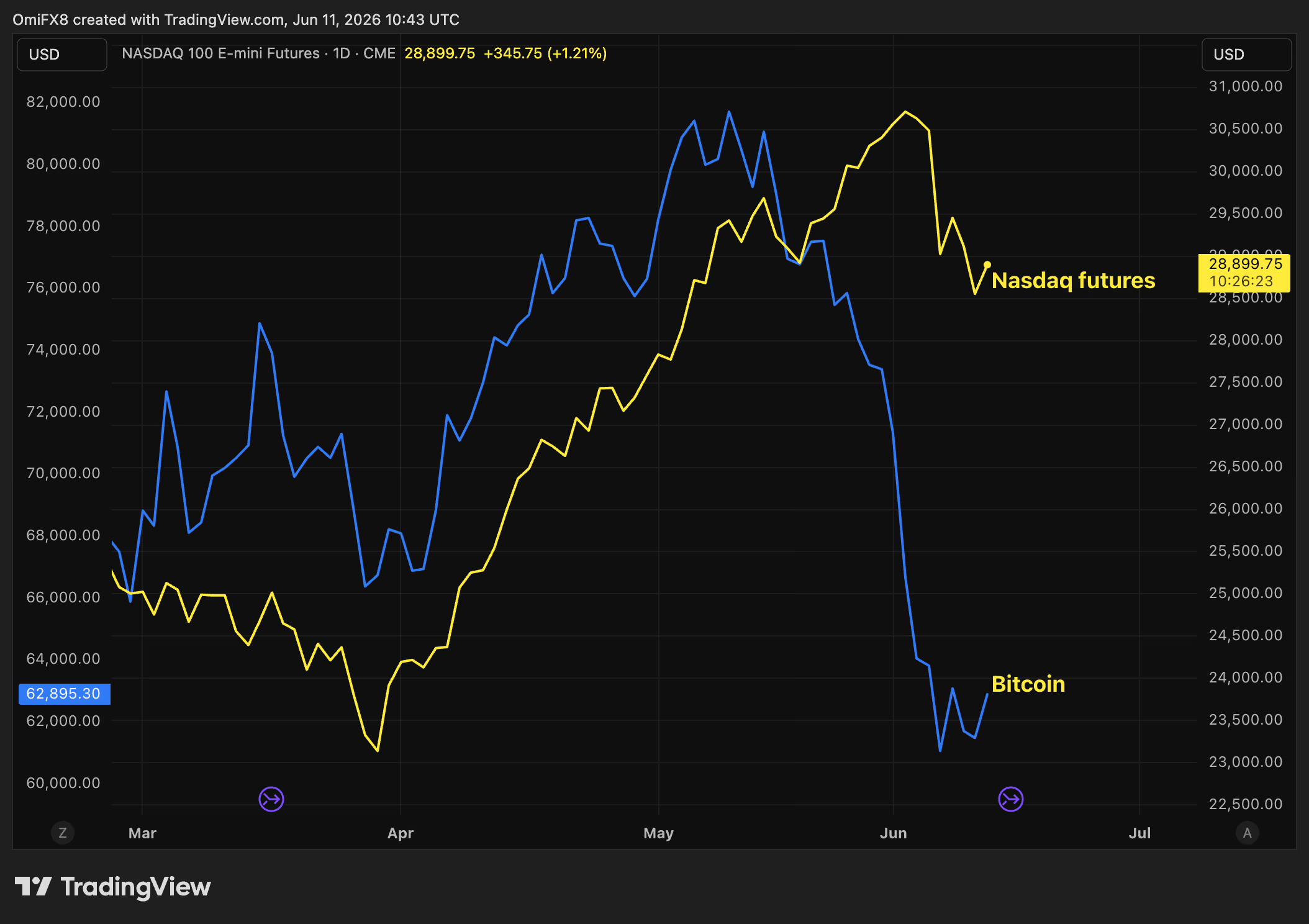
The chart compares bitcoin’s daily price moves with Nasdaq-100 E-mini futures since March.
The strong positive correlation between the two broke down in May, as the Nasdaq rallied sharply while bitcoin fell. However, Nasdaq has turned lower this month, hinting at a potential realignment.
The key question is whether bitcoin can hold steady — having already absorbed significant losses — in the face of a potential Nasdaq selloff. Trading firm Wintermute noted last year that the correlation between the two assets is particularly strong during Nasdaq declines. If that dynamic still holds, BTC risks sliding below $60,000.



Binance will remove Across Protocol, Hashflow, PIVX, Vulcan Forged PYR, Vanar and Viction from spot trading on Aug. 17, 2026, at 03:00 UTC after completing its latest asset review.
Summary
- Six tokens will leave Binance spot trading on August 17 after the exchange’s periodic review.
- Futures positions will settle August 7, while token withdrawals remain available through October 17, 2026.
- Binance will not support VANRY’s Base migration, requiring holders to use Vanar’s migration portal themselves.
The exchange said every spot pair tied to ACX, HFT, PIVX, PYR, VANRY and VIC will close. Outstanding spot orders will be canceled. Binance did not identify a separate reason for each asset. Instead, it cited its broader review framework, which covers liquidity, development activity, network safety, team conduct, transparency, tokenomics and regulatory changes.
Binance delisting begins with an Aug. 7 futures cutoff
The first major deadline arrives before the spot removal. The company Futures will prevent users from opening new positions at 08:30 UTC on Aug. 7. It will close and automatically settle remaining contracts at 09:00 UTC. The exchange may also change leverage, margin tiers, funding rates or index components before settlement if markets become unusually volatile.
Loans and several payment services will also close that day. Binance Pool and Binance Pay will stop supporting the assets at 03:00 UTC. VIP Loan and Flexible Loan positions will close at 07:00 UTC, while cross and isolated margin positions will be settled at 10:00 UTC. Margin borrowing will already be suspended from 06:00 UTC on Aug. 4.
Spot Copy Trading will remove the affected pairs on Aug. 10. Remaining assets may be sold at market prices or transferred to users’ spot accounts when they cannot be sold. Simple Earn will redeem flexible and locked positions after 07:00 UTC on the same day and transfer the assets and accrued rewards to spot accounts.
Four Binance delistings followed earlier risk warnings
The decision was preceded by Monitoring Tags on four of the six tokens. The exchange added PIVX to the tag list on June 18, followed by PYR and VANRY on July 3. ACX received the tag on July 24. The exchange states that tagged assets carry greater volatility and risk and may be removed if they no longer satisfy its listing standards.
As crypto.news previously reported, the ACX warning came days before the latest removal decision. Monitoring Tags do not guarantee delisting, but they require users to pass a risk quiz every 90 days and notify holders that the exchange is conducting closer reviews.
In related coverage, Binance removed 20 tokens from its Alpha platform in May while preparing five other assets for spot delisting. The Alpha removals and full spot delistings were separate processes, but both followed reviews against the exchange’s platform standards.
ACX also entered Binance’s delisting process after Coinbase suspended its trading on July 28. Coinbase said the project team was winding down the token and directed holders to Across documentation.
Across previously proposed replacing its token-based DAO with a U.S. C-corporation. The published plan set out an equity exchange and a USDC buyout at $0.04375. However, legal restrictions apply to the equity option, and the proposal said its estimated timetable could change.
VANRY holders must complete the Base migration themselves
VANRY presents an extra operational issue. The exchange said it will not support Vanar’s contract swap. Holders seeking the replacement token must use the project’s migration portal rather than expecting Binance to complete the conversion automatically.
Vanar announced a 1:1 migration to Base and said the new token would have a supply of 10 billion. The project previously told users that participating centralized exchanges would handle the swap automatically. Binance’s new notice confirms that it is not one of those supporting venues.
The exchange will keep current VANRY withdrawals open through Ethereum and Polygon PoS. That gives Binance users a route to remove their tokens before completing the migration through Vanar’s official portal.
Vanar has warned holders to rely only on links distributed through its verified channels. The project advised users to ignore unsolicited messages and never share wallet seed phrases while completing the migration.
Withdrawals remain open until Oct. 17
The exchange Convert will remove the six assets at 02:00 UTC on Aug. 17, one hour before spot trading ends. Its low-value asset conversion feature will stop supporting them on Aug. 14. Deposits made after 03:00 UTC on Aug. 18 will not be credited.
Withdrawals will remain available until 03:00 UTC on Oct. 17. The exchange may convert balances left on the platform into stablecoins after Oct. 18, but the exchange said that conversion is “not guaranteed.” It will issue another notice where conversion is possible.
When conversion is not feasible, Binance said withdrawals may remain open, subject to network availability. Users should not rely on that possibility because the exchange has not committed to providing an extended withdrawal window.
The removal covers six tokens facing different project conditions rather than one shared event. Binance’s announcement gives users a common timetable but no token-by-token findings. The next confirmed developments will come from project responses, settlement notices and any changes to the withdrawal or migration arrangements.
Coldcard’s five-year seed-generation flaw has exposed a broader weakness in how hardware wallets are independently tested, according to Kraken chief security officer Nick Percoco.
In an X post on Sunday, Percoco said the incident should be a “wake-up call” for hardware-wallet makers, calling for independent testing to verify that the approved source of randomness is the one actually used by production firmware.
“Consumers are asked to trust a manufacturer’s implementation of the single most critical function in the system, with no independent verification that the approved entropy path is the one actually executing,” said Percoco.
His comments follow an ongoing attack that is believed to exploit weak seed phrases generated by affected Coldcard devices. As of Sunday, over 4,500 addresses have been impacted, draining nearly $90 million in Bitcoin.
Coldcard RNG flaw remained undetected for five years
On Thursday, Coinkite disclosed a software flaw that has existed since March 2021, when Coldcard changed its seed-generation process as it integrated a new cryptographic library.
The migration inadvertently routed wallet creation to a weaker MicroPython generator that existed in the codebase, rather than Coldcard’s intended true random number generator (TRNG).
“The bulk of randomness on the COLDCARD was coming from a PRNG that I didn’t know was actually in the source code base,” Coinkite said in its postmortem. “At the same time the carefully crafted TRNG code I wrote was being used, but just by chance, and only for less important things.”
The presence of the intended random number generator allowed the vulnerability to slip through undetected. Code reviews would confirm the existence and functioning of Coldcard’s TRNG code, but there was no check to ensure this was the RNG actually being called.
Such checks are already standard across the rest of the security industry, said Percoco, referencing NIST SP 800-90B, a US government standard specifying requirements for designing, testing and validating physical true random number generators for cryptographic security and BSI AIS-31, a similar standard created by the German Federal Office for Information Security.
“Hardware wallets have no equivalent process. We have Common Criteria on secure elements, some CSPN certifications, and vendor-sponsored audits. None of them systematically force end-to-end verification that the validated entropy source is what production firmware actually calls,” he said.
“The payments industry does not let PIN entry devices ship without independent lab testing. The US government does not accept cryptographic modules without entropy source validation. Digital asset self-custody should not be the exception,” said Percoco.
Related: Suspected 4th Coldcard attack wave sweeps 389 Bitcoin: Galaxy’s Thorn
Coldcard said Sunday it has halted all device shipments since confirming the vulnerability on Thursday, and has destroyed all remaining units at its facilities containing the affected firmware.
However, Coinkite has advised users with affected devices not to dispose of them as “it may become essential if funds are recovered.”
“Our legal team will coordinate as warranted with law enforcement across multiple jurisdictions to support efforts in identifying those responsible.”
Related: Coldcard exploit sparks Bitcoin flight, ‘bullish’ crypto consolidation: Hodler’s Digest, August 2
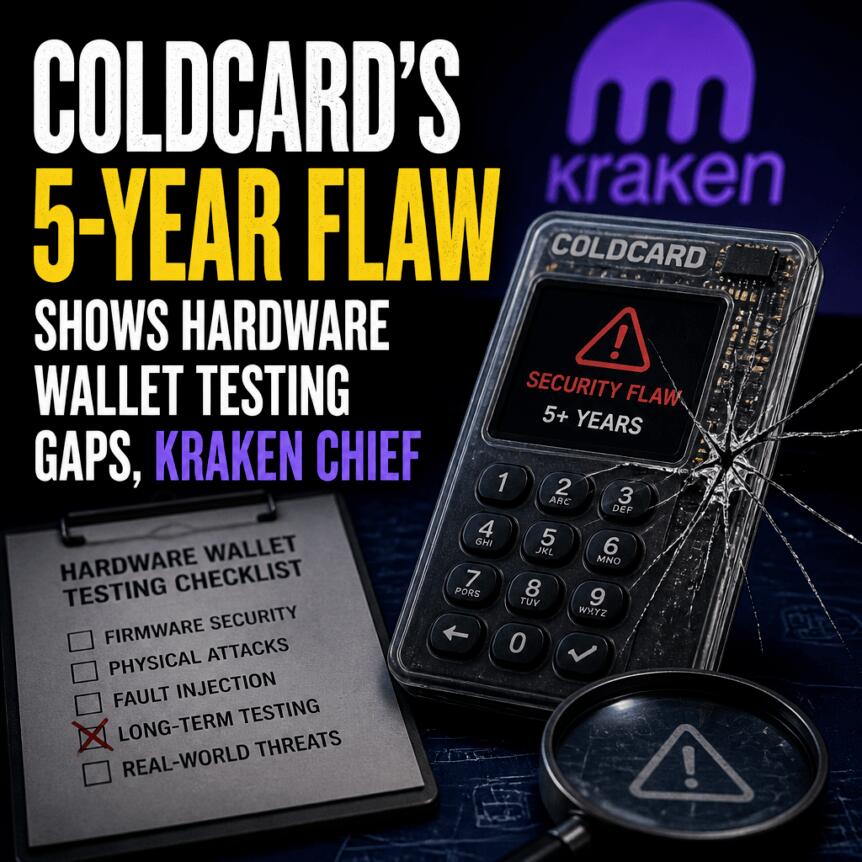
Coldcard’s five-year seed-generation issue has turned into a wider debate over how hardware wallets are independently verified, according to Kraken’s chief security officer Nick Percoco. In an X post on Sunday, Percoco said the incident should prompt makers of self-custody devices to require end-to-end checks that confirm the randomness source reviewed in testing is the same one actually executed by production firmware.
The comments arrive amid an ongoing exploit believed to target vulnerable Coldcard devices by abusing weak seed phrases. By Sunday, more than 4,500 addresses had reportedly been affected, with losses estimated at nearly $90 million in Bitcoin, according to Cointelegraph’s reporting linked in the original article.
Key takeaways
- Kraken’s Nick Percoco argues hardware wallet certification should include verification that the approved entropy path is what production firmware uses in practice.
- Coldcard’s RNG-related flaw allegedly persisted for years after a seed-generation change introduced an unintended reliance on a weaker generator.
- Percoco cited existing standards used in the broader security and payments industries—such as NIST SP 800-90B and BSI AIS-31—as models for what should be standard for crypto self-custody.
- Coinkite says affected firmware has been halted in shipments and that remaining units containing the vulnerable code were destroyed, while it advised users not to discard certain devices.
A hardware wallet “wake-up call” for entropy verification
Percoco’s central point is about trust boundaries. Hardware wallet users are asked to rely on a manufacturer’s implementation of the randomness function that ultimately underpins seed phrase generation—yet, he said, there is often no independent method to confirm that the verified randomness source is the one the device will actually call in production.
“Consumers are asked to trust a manufacturer’s implementation of the single most critical function in the system, with no independent verification that the approved entropy path is the one actually executing,” Percoco wrote in his Sunday post.
He described this gap as an industry-wide weakness rather than a one-off mistake, noting that while some certifications exist for hardware components and secure elements, they do not “systematically force end-to-end verification” of the entropy source through to production code execution.
Percoco contrasted the crypto self-custody space with practices in other sectors. He pointed to the payments industry’s use of independent lab testing for devices that collect sensitive inputs, and to government expectations in the US around cryptographic module validation and entropy source testing.
How the Coldcard flaw allegedly slipped through
According to the original reporting, the vulnerability traces back to a software change disclosed by Coinkite. The company said the relevant issue has existed since March 2021, when Coldcard altered its seed-generation process as it integrated a new cryptographic library.
The update, per Coinkite’s postmortem referenced in the article, unintentionally routed wallet creation to a weaker MicroPython generator already present in the codebase. Coinkite’s explanation indicated that Coldcard’s intended true random number generator (TRNG) code existed and could be present and functioning, but was not reliably the one used for the core randomness needed for seeds.
In other words, reviewers could verify that the TRNG code was present and worked—but, without a mechanism to ensure the device actually called that TRNG during seed generation, the system could still produce outcomes derived from a different generator than intended.
The practical consequence is that seed phrases generated under the affected conditions may become more predictable than they should be. That predictive weakness is widely viewed by the security community as especially dangerous in wallet designs because compromised seeds can enable theft without needing to break keys directly.
Attack fallout and what’s changing for users
The ongoing exploit believed to target weak seed phrases generated by affected Coldcard devices has already resulted in extensive on-chain activity. As of Sunday, Cointelegraph’s figures cited in the original article reported over 4,500 impacted addresses and losses approaching $90 million in Bitcoin.
Coldcard (Coinkite) said it has halted all device shipments since confirming the vulnerability on Thursday. It also stated it destroyed remaining units at its facilities that contained the affected firmware.
At the same time, the company advised users with affected devices not to dispose of them immediately, saying doing so might become “essential if funds are recovered.” The company also indicated its legal team would coordinate with law enforcement across multiple jurisdictions to support efforts identifying those responsible.
For affected owners, the new information underscores a key operational point: device handling decisions may need to be aligned with recovery processes rather than treated as purely disposal or cleanup tasks. While that doesn’t eliminate the security risk of continuing exposure, it suggests an active incident-response posture where retaining evidence or workable hardware could matter.
Standards exist—what’s missing is enforcement
Percoco’s critique points to a tension that many investors and builders may recognize: crypto security often emphasizes reviewing code paths and cryptographic primitives, but not always the end-to-end behavior under production conditions—especially the specific entropy source used at runtime.
He referenced NIST SP 800-90B, which sets requirements for designing, testing and validating physical true random number generators for cryptographic security, and BSI AIS-31, a similar standard from Germany’s Federal Office for Information Security. In his view, such frameworks make it more difficult for systems to “pass review” without proving that the approved randomness pathway is actually used for critical operations.
Whether regulators and certifiers will adapt those expectations to consumer self-custody products remains uncertain. However, the Coldcard case demonstrates why the distinction matters: even when a correct TRNG implementation exists in the codebase, the seed-generation workflow can still be compromised if production firmware routes randomness differently than what independent review assumes.
Next, investors and users should watch for two things: clarification from Coinkite on exactly how to identify which devices/firmware are affected and what remediation steps best reduce future risk, and whether independent testers or certifiers move toward stronger “entropy source at runtime” validation—an area Percoco argues should not remain optional in digital asset custody.
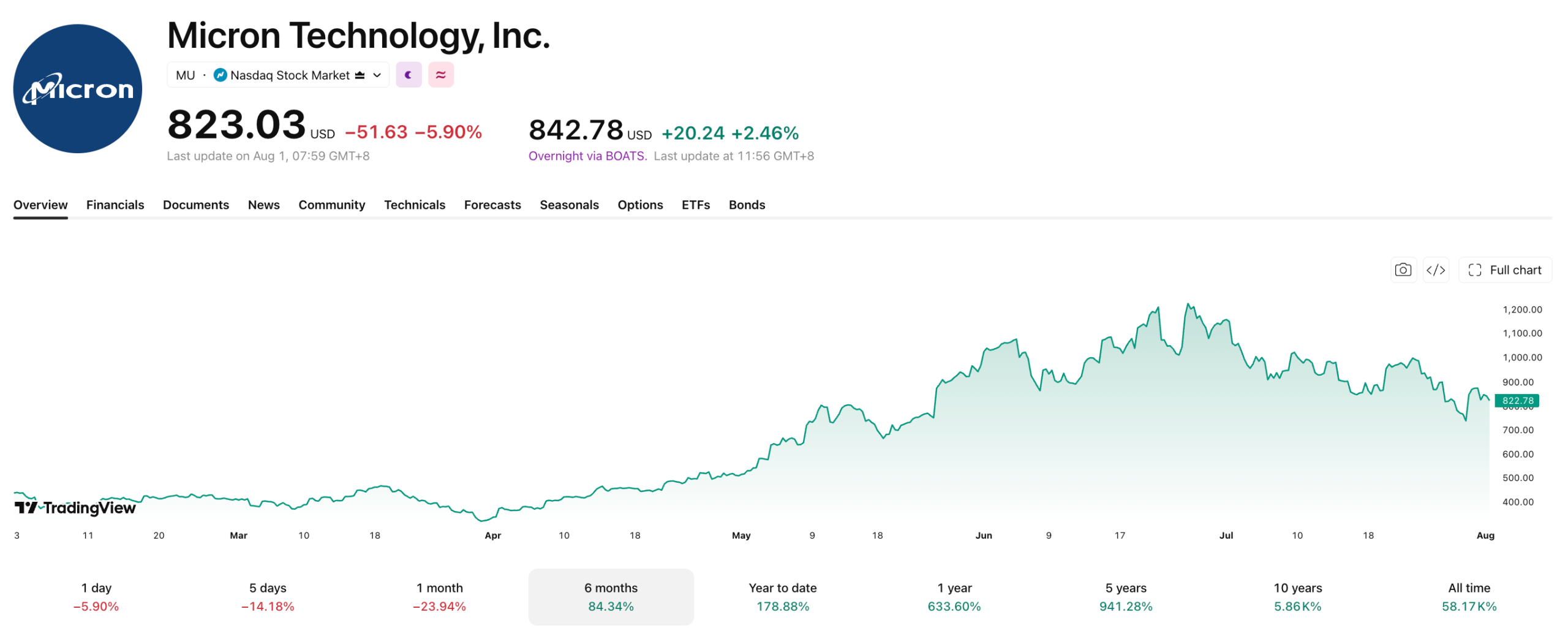
Micron Technology (NASDAQ: MU) closed at $823 per share on Friday, July 31, down 5.90% on the day and as much as 39% below its high this year.
The slide is rattling more than one US chipmaker. SK Hynix and Samsung’s plan to spend up to $1.3 trillion combined on new capacity is adding pressure, just as SanDisk, another US memory maker, has fallen 41% in the past month.
Why Rivals Are Racing to Add Capacity
South Korean officials have tied the expansion to a national plan to secure the country’s position in AI-era chip supply. Reports on the combined Samsung and SK Hynix investment have ranged from $575 billion to $1.3 trillion, reflecting how quickly spending plans have escalated this year.

Demand for high bandwidth memory used in AI accelerators has outpaced supply for more than a year, a shortage Micron’s own management does not expect to ease before 2028.
That squeeze helped push SK Hynix stock down 13% on capex concerns even as Samsung posted an 1,800% profit jump last quarter, and it is also fueling the rise of Chinese challenger CXMT, whose stock has kept climbing since its IPO.
What It Means for US Chipmakers
Micron trades at a forward price to earnings ratio near 19.8, with a market capitalization of about $930 billion. Wall Street analysts rate the stock a strong buy, even as short-term technical indicators point toward a sell signal.
SanDisk faces a similar squeeze. Its stock crash has erased much of a euphoric rally, though the company still holds a year-to-date gain of about 362%, a sign of how fast memory stocks moved before this pullback.
Coverage of Micron itself is split, though. One analysis modeled a path to roughly $1,000 per share by mid-2028 if pricing power holds. Another warned that rising AI infrastructure costs could force hyperscalers to slow spending before Micron’s new capacity, including plants in Idaho and New York, comes fully online.
Micron’s next earnings report, due September 29, will show whether US chipmakers can hold their pricing power as SK Hynix, Samsung, and CXMT race to close the capacity gap.
The post Micron’s 39% Plunge and SK Hynix, Samsung’s $1.3T Spending Worries US Chipmakers appeared first on BeInCrypto.


South Korea saw 560.3 billion won ($367 million) in stablecoin outflows to overseas exchanges in June, extending the country’s streak of monthly net stablecoin outflows to 18 consecutive months.
The figure comes from Financial Supervisory Service (FSS) data obtained by Yonhap News Agency through People Power Party lawmaker Lee Jong-wook. South Korea’s five major crypto exchanges — Upbit, Bithumb, Coinone, Korbit and Gopax — transferred 2.7 trillion won ($1.81 billion) in stablecoins offshore in June and received 2.2 trillion won ($1.44 billion) from foreign platforms.
Market participants cited by Yonhap attributed the transfers to demand for products restricted or unavailable on domestic exchanges, such as overseas derivatives, tokenized real-world assets (RWAs), decentralized finance and staking products.
Lee has called on the government to reassess how it protects investors and supervises cross-border crypto activity as stablecoin outflows continue. “The government must comprehensively examine its investor protection and supervisory frameworks again and move swiftly to improve regulations,” he said, according to The Korea Times.
South Korea weighs tighter rules for offshore activity
The outflows come as South Korea works to complete a broader legal framework for digital assets. On Thursday, a policy report recommended that authorities introduce an interim licensing guidance and phase in stablecoin regulations before the Digital Asset Basic Act is finalized.
The proposed act would create the country’s first comprehensive digital asset framework, including rules for stablecoin issuance, disclosures and market activity. However, lawmakers have yet to reconcile multiple proposals, with disagreements over which institutions should be allowed to issue won-pegged stablecoins contributing to delays.
Related: South Korea plans stablecoin rules as opposition pushes crypto tax repeal
South Korean regulators have also sought to expand reporting requirements for crypto transfers. On June 22, South Korea’s Financial Intelligence Unit (FIU) proposed extending Travel Rule reporting requirements to transactions below 1 million won (about $650).
The FIU also called for stronger action against unregistered overseas exchanges serving South Koreans. The agency said uneven licensing and supervision across jurisdictions created opportunities for regulatory arbitrage, a concern underscored by the country’s continued stablecoin outflows.
Magazine: The real reason DeFi projects that survived 2022 crash are shutting down now


The CLARITY Act was absent from the U.S. Senate’s published schedule for Monday, Aug. 3, leaving lawmakers with only days to begin floor proceedings before the chamber’s summer break.
Summary
- Monday’s Senate schedule lists only a spending vote, with no CLARITY Act floor action scheduled.
- Wednesday is the ordinary filing deadline for a possible Friday vote on proceeding to CLARITY.
- Seven Democratic votes remain crucial as ethics disputes and election pressure complicate bipartisan negotiations further.
The official Monday schedule lists a 5:30 p.m. vote on cloture for the motion to proceed to H.R. 6500, a vehicle for a continuing resolution. It includes no scheduled action on H.R. 3633, the Digital Asset Market Clarity Act. The Senate’s cloture ledger, updated through July 31, also records the July 30 filing for H.R. 6500 but no CLARITY Act petition.
The absence does not formally block the crypto market-structure legislation. However, it leaves Senate leaders without a publicly confirmed vehicle or procedural timetable before the Senate begins its tentative state work period on Aug. 10. That break is scheduled to run through Sept. 11.
CLARITY Act needs a Wednesday filing for Friday action
Under the Senate’s ordinary Rule XXII process, a cloture petition requires 16 senators’ signatures. The cloture question is normally presented one hour after the Senate meets on the following calendar day but one. Therefore, a filing on Wednesday, Aug. 5, could produce a Friday, Aug. 7, vote, provided the Senate remains in session and meets that day.
That vote would not pass the CLARITY Act. It would determine whether the Senate ends debate on the motion to proceed to the legislation. Invoking cloture generally requires three-fifths of senators duly chosen and sworn, normally 60 votes when all seats are filled.
Even after successful cloture, Rule XXII permits up to 30 hours of consideration before the Senate votes on the underlying motion. Senators would then need to debate the bill, consider amendments and eventually vote on passage. A second cloture process could become necessary to end debate on the legislation itself.
Faster routes require bipartisan cooperation
Senate leaders could use a faster version of the cloture procedure, but it requires unusually broad cooperation. The petition must include the majority leader, minority leader, seven additional senators not affiliated with the majority and seven not affiliated with the minority.
Under that procedure, the cloture vote occurs one hour after the Senate meets on the next calendar day. If cloture succeeds, the Senate immediately votes on proceeding without further debate. The rule could shorten the timeline, but assembling the required bipartisan group would itself demonstrate that negotiators had made substantial progress.
A unanimous-consent agreement could compress the process further by setting debate limits and scheduling votes. However, any senator may object. No official filing or leadership notice reviewed for this update confirms that either expedited route has been secured.
Ascrypto.news previously reported, Sen. Cynthia Lummis said Majority Leader John Thune had maintained space for the legislation before the recess. Lummis nevertheless framed that outcome as her belief rather than a confirmed schedule, saying she believed Thune intended to proceed.
Seven Democratic votes remain the central barrier
Republicans control 53 Senate seats, so they would likely need at least seven Democrats to reach the ordinary 60-vote threshold if every Republican supported the motion.
Seven Democratic negotiators — Catherine Cortez Masto, Angela Alsobrooks, Cory Booker, Ruben Gallego, John Hickenlooper, Mark Warner and Raphael Warnock — said on July 22 that the Republican draft “falls short.” They called for stronger language covering ethics, consumer protection, illicit finance, conflicts of interest and market integrity, while saying negotiations would continue.
Senate Banking Committee ranking member Elizabeth Warren has taken a harder position. Warren called the updated legislation “dead on arrival” and argued that its ethics provisions would not adequately restrict President Donald Trump’s crypto interests. Those are Warren’s political and legal assessments, rather than findings by a court or independent regulator.
Meanwhile, Lummis released a merged proposal on July 22 combining work from the Senate Banking and Agriculture committees. She said lawmakers remained committed to reaching an agreement with Democrats. The Banking Committee had advanced its version by a 15–9 vote in May.
In related coverage, Sens. Thom Tillis and Ruben Gallego reportedly proposed letting state authorities enforce restrictions on federal officials issuing or sponsoring digital assets. The White House has not publicly approved final language, leaving the status of that compromise uncertain.
What happens next could shape the midterm fight
The next verified signal will be a cloture filing, leadership floor notice or unanimous-consent request identifying the legislative vehicle. An ordinary filing by Wednesday would keep a Friday procedural vote possible. A later filing would likely require an expedited agreement or additional Senate session days.
Even a successful Friday vote would only begin the process. The Senate could continue considering the bill after the recess, but lawmakers would return to a crowded September calendar. Any amended version must also return to the House, which passed H.R. 3633 by 294–134 in July 2025. The House vote included support from 78 Democrats.
The shrinking window also carries an electoral dimension. A procedural vote would force senators to create a public record before the 2026 midterms. Without one, campaigns and crypto political groups have less evidence for judging whether lawmakers supported advancing the bill.
Axios reported that more than $125 million in crypto-linked political funds remained available as negotiations continued. Separate groups had already announced $1.5 million in advertising supporting Republican Senate candidates in Michigan and Iowa. Fairshake remained neutral during the negotiations, while some Republican operatives wanted the Senate to force a vote and place Democrats on record.
That pressure does not determine the bill’s outcome. However, missing the pre-recess window would move the debate closer to the election, when campaign spending, vulnerable Senate seats and party control could become more closely tied to the legislation’s remaining path.
On-chain data shows that the Ethereum blockchain has developed a lot in the past few years, currently processing more activity than ever before.
At the same time, the underlying asset has failed to benefit, as it continues to struggle below $2,000. One analyst believes this disconnect has become one of the biggest debates surrounding the altcoin and the network behind it.
Ethereum Activity Rockets
Aside from the highly anticipated Merge upgrade deployed several years ago, the team behind Ethereum has completed several other, perhaps less hyped but similarly impactful updates over the years that have managed to scale the network. The blockchain is seemingly handling significantly more activity than it did during its proof-of-work years.
Data shared by popular analyst Tanaka claims that Ethereum’s layer-1 generated over $88 million in Real Economic Value (REV) during Q2, up 7% from the previous quarter. However, it’s still down by nearly 70% year-over-year.
Applications built on the world’s second-largest blockchain generated $1.8 billion in fees, meaning that Ethereum itself, which recently celebrated its 11th birthday, captured only around 4.9% of the economic value created by its application layer. The contrast becomes even more apparent when examining the network activity.
Ethereum rollups are currently processing around 1,270 user operations per second, compared to roughly 20.4 UOPS on the mainnet. Robinhood Chain is reportedly processing almost 5 times as many operations as Ethereum’s layer 1.
The analyst described the technical progress as impressive, but questioned how much of that growing activity ultimately benefits ETH holders. Current data shows:
– Total ETH supply: approximately 121.88M
– ETH in the Beacon Chain: approximately 41.10M
– Roughly 33.7% of the total ETH supply is securing the network
– Staking issuance yield: around 2.6%
– Recent annualized supply growth: around 0.85%
– Seven-day blob fee burn: only around 0.22 ETH
Changed Bull Case
The analyst doesn’t believe Ethereum is broken, but noted that ETH’s long-term investment thesis is undergoing a substantial change. Instead of “more users leading to more fees and more ETH burn,” the focus now is gradually shifting toward tokenized finance.
The value of Real-World Assets (RWAs) on Ethereum has recently exceeded $17 billion, while the broader stablecoin market is up to almost $300 billion. The analyst argued that Ethereum’s competitive advantage is no longer cheap transactions but its position as the leading settlement layer for institutional finance.
Going forward, they said the key questions are whether layer-2 activity will eventually make blob space economically valuable, whether stablecoins and RWAs generate meaningful on-chain turnover, and whether institutions increasingly hold the underlying asset as reserve collateral for the Ethereum ecosystem.
The analyst will continue to hold and accumulate ETH as they remain optimistic about its near- and long-term future, especially since Ethereum has already solved its scaling problem.
The post Ethereum’s Network Is Booming, So Why Is ETH Still Underperforming? appeared first on CryptoPotato.


Jim Cramer used a recent Mad Money segment on CNBC to restate his personal rules for investing. He argues that discipline, not luck, separates investors who survive market swings from those the market wipes out.
The segment landed as Wall Street works through the busiest stretch of the second-quarter earnings season. Big banks and mega-cap technology firms have already reported. Nvidia is still to come in late August.
Where Earnings Season Stands
The Q2 2026 season is running hot. Data shows a blended S&P 500 earnings growth rate of 47.4% year over year. That marks the second straight quarter of growth above 20%, and the fastest pace since Q2 2021.
With 61% of S&P 500 companies reporting so far, 86% have topped profit estimates. That beat rate sits well above the five-year average of 78%, according to FactSet.
Big Wall Street banks opened the season in mid-July. A wave of mega-cap technology reports followed in the back half of the month. Samsung’s record AI-chip quarter showed how strong artificial intelligence (AI) demand flowed into corporate results this quarter.
About 136 more S&P 500 companies are due to report in the coming week. Not every result has landed well, though. Roblox shares fell sharply after new child safety measures weighed on its outlook, despite a revenue beat. That drop shows strong headline growth has not shielded every company from a rough market reaction.
Nvidia is due to report in late August. Investors see it as the season’s biggest remaining test, given lingering questions over whether heavy AI capital spending is turning into revenue.
Cramer’s 10 Rules, Distilled
Against that backdrop, Cramer laid out the rules he says have kept him out of trouble over a long career.
He started with quality over price. Cramer argues that investors should buy “best of breed” companies even when their stocks look expensive. He said chasing cheap, lower-quality names rarely pays off.
He pointed to Apple and Nvidia as stocks where paying a premium multiple worked out over time. That view echoes a separate Mad Money segment where Cramer compared parts of the AI rally to the dot-com bust, warning that not every high-flying AI stock deserves the same benefit of the doubt.
From there, Cramer turned to patience. He said giving up on a high-quality stock during a rough patch is a mistake investors repeat constantly. He cited his own 2016 call on Apple as proof, when the stock traded near a low price-to-earnings ratio and later rallied hard.
His third rule looks past equities entirely. Cramer said investors ignore the bond market at their own risk, since bonds compete directly with stocks for capital. That rule carries extra weight now. The 30-year Treasury yield sits near its highest level since 2007, as traders question the Federal Reserve’s rate path.
The remaining rules cover portfolio discipline. Cramer said unexplained CEO or CFO resignations are almost always a sell signal. He also urged investors to expect corrections instead of treating each one as a shock. He tracks a proprietary overbought and oversold indicator to help decide when to raise or deploy cash.
Cramer also warned against buying a stock on hope alone. He said too many investors hold a falling stock and wait for it to climb back to their purchase price, instead of judging the business on its own merits.
He added that every investor should be able to explain a stock pick to another person before buying it. If an investor cannot describe how a company makes money, Cramer said, that signals unfinished homework. He pointed to speculative biotech and meme stocks as examples of positions people often hold without understanding the underlying business.
Cramer paired that rule with a broader skepticism toward hype. He said the internet has amplified Wall Street’s promotional machine. He also said money managers who pitch stocks on television are usually talking their own book rather than offering neutral advice.
His final two rules cover portfolio housekeeping. Cramer said investors should never sell winning positions to fund losing ones, since that habit lets weak stocks drag a portfolio down while investors trim strong ones too soon.
He also said investors should avoid speculating on a takeover just because a struggling company’s stock looks cheap. Acquirers target strong businesses, he argued, not weak ones.
What Comes Next
Cramer’s framework treats this earnings season as a live test of his own rules. Strong results from best-of-breed names would support his core argument. Any stumble from Nvidia in late August would test his patience-over-hope philosophy in real time.
For now, double-digit earnings growth and a jittery bond market give investors plenty of chances to apply both halves of Cramer’s playbook at once.
The post As Earnings Season Peaks, Jim Cramer Highlights These 10 Rules for Investing appeared first on BeInCrypto.


Galaxy research head Alex Thorn warned that unconfirmed transactions may give some Coldcard users a narrow opportunity to save their funds.
Crypto World
How That Fiery Episode 7 Twist in House of the Dragon Season 3 Sets Up the Show's Endgame


Warning: This post contains spoilers for Episode 7 of House of the Dragon Season 3.
To say that Aegon II (Tom Glynn-Carney) has been down bad this season of House of Dragon would be putting it lightly. In the wake of being nearly torched to death by his brother Aemond (Ewan Mitchell) and Aemond’s dragon Vhagar at the Battle of Rook’s Rest in Season 2, Aegon has spent Season 3 dejectedly traipsing around the Crownlands at the behest of his advisor/frenemy Larys Strong (Matthew Needham).
Permanently disfigured, dragonless, and in near-constant pain, Aegon’s best hope of survival this season has been to lay low and keep his true identity a secret from anyone he and Larys encounter. Unfortunately, the spoiled former king is incapable of suppressing his royal impulses enough to make that an easy feat. To top it all off, despite Aegon’s refusal to accept that his dragon Sunfyre has really died after reuniting with her lifeless body earlier in Season 3, he has no choice but to once again leave her side after discovering local peasants have turned her maimed body into a paid tourist attraction.
Meanwhile, Larys’ plan to smuggle Aegon across the Narrow Sea and stash him away in Braavos is thwarted at every turn. So when Tyland Lanister (Jefferson Hall)—who has apparently survived getting thrown into the Gullet in heavy armor back in Episode 1—finds Aegon and Larys hiding out at Rook’s Rest, he suggests a different idea: retreat to Casterly Rock, form a new Small Council, and restart the war effort from the seat of House Lannister. But after testing Tyland’s ability to advise him honestly (no matter how brutal the truth may be), Aegon ultimately rejects his proposal in favor of Larys’ original scheme.

In Episode 7, it seems like Larys might finally get his way—that is, until the road to the port at Maidenpool gets cut off by an advancing army of soldiers loyal to Rhaenyra (Emma D’Arcy). With the walls closing in around him, Aegon decides to stop running and surrender to near-certain death. “I’ll make my stand here. And be buried as a king. With my dragon,” he says. “I will not have the histories say that I was slain in ignominy by my own brother.”
This declaration marks the final straw for Larys, who quickly opts to take his leave. Tyland, on the other hand, chooses to stay by Aegon’s side to try and protect his king. But it’s clear the pair stands little to no chance of surviving the advancing army. Luckily, Sunfyre finally gains enough strength to make her grand reentrance. Just as it appears that all hope is lost, Sunfyre rises from her dormant healing state to rain fire on the enemy soldiers as an ecstatic Aegon screams in triumph.

Those who have read George R. R. Martin’s Fire & Blood likely weren’t surprised to learn Sunfyre was in fact alive, as she still has a significant role to play in the endgame of the Targaryen Civil War. And with just one episode to go before House of the Dragon moves into its fourth and final season, things are starting to get down to the wire.
***We’re going to talk about what happens with Sunfyre in the book below, but if you want to avoid any potential future spoilers, now is the time to stop reading***
If House of the Dragon sticks to the script from Fire & Blood, Sunfyre will eventually be the dragon who kills Rhaenyra once the tables turn for the current queen. In one of the most horrifying moments from Martin’s text, after Aegon retakes the Iron Throne, he has Rhaenyra brought before him and orders Sunfyre to burn and eat his half-sister alive while her youngest son, Aegon III, is forced to watch.
No one involved in the Dance of the Dragons gets a particularly happy ending, but Rhaenyra’s is certainly one of the worst and most devastating of the bunch. To sum it up, those hoping for an Aegon redemption arc may want to temper their expectations.

MONEY OR BANANA? #shorts

Man Utd news: Myles Lewis-Skelly transfer boost as medical booked and star ‘says yes’ to move

Prosperity Bancshares Stock Appears Deserving Of Its Premium Price (NYSE:PB)


-

 Business4 days ago
Why Trees Belong on the Risk Register
-

 Fashion2 days ago
Weekend Open Thread: Wit & Wisdom
-

 Politics2 days ago
Meta enters AI-training agreement with far-right ‘propaganda rag’ Newsmax
-
 Entertainment5 days ago
‘Stargate’ Creator’s New Sci-Fi Series Returns for Season 3 Tomorrow
-

 Politics7 days ago
Luke Littler dismantles Gerwyn Price to retain title in Blackpool
-

 Crypto World2 days ago
MicroStrategy Post-Earnings CLARITY Act Push Could Add New Catalyst for Its Stock
-

 Politics6 days ago
The Part of the Electric Transition Nobody Wants to Discuss
-

 Business5 days ago
Major shareholder moves on Canyon
-

 Crypto World2 days ago
XRP Ledger v3.3.0 brings five institutional features
-

 News Videos4 days ago
Bitcoin Enters the 3rd Stage of the Bear Market
-

 Crypto World5 days ago
Kraken Enables Retail Access to Jersey Mike’s IPO via Tokenized Shares
-

 Tech6 days ago
New macOS Sequoia & Sonoma security updates for older Macs
-

 News Videos5 days ago
Claude: Build Financial Dashboards in Minutes (2026)
-

 Politics4 days ago
Luke Littler’s dominance sparks GOAT debate
-

 Business5 days ago
Johnson & Johnson agrees to $5.5B settlement over talc cancer claims
-

 Sports3 days ago
Seema Kaliramna Wins Discus Throw Bronze, Takes India’s CWG Medals Tally To 17
-

 Crypto World19 hours ago
Crypto PAC spending tops $2M in Michigan House race
-

 Business3 days ago
Trump Announces Hamas Disarmament Agreement as Iran Strikes Kuwait Air Base and US Attacks Pause Overnight
-

 Tech5 days ago
Gemini can now summarize the messiest comment threads in Google Docs
-

 Tech23 hours ago
ESET tracks rise in malicious AI skills and adaptable malware
You must be logged in to post a comment Login