
Crypto World
Raydium Hit With $1.34M Exploit via Fake LP Tokens on Deprecated Solana Pools


Raydium, the Solana-based decentralized exchange, was drained of $1.34 million on June 10, 2026, when an attacker exploited five deprecated liquidity pools from its legacy AMM V3 program, a smart contract vulnerability that had sat dormant on-chain for five years.
The attacker, whose Solana address ends in ‘Bq33QVk,’ made off with approximately $900,000 in USDC, $357,000 in SOL, and $86,000 in RAY tokens.
— Solana Hub (@SolanaHub_) June 10, 2026
 Raydium confirms $1.34M exploit on legacy AMM V3 pools. No current users affected; full compensation from treasury. pic.twitter.com/tqmKATA2tH
After draining the pools, the exploiter bridged all funds from Solana to Ethereum via a cross-chain bridge, then deposited them into Tornado Cash to obscure the trail, a standard cross-chain laundering sequence that leaves recovery prospects slim.
Discover: The Best Crypto to Diversify Your Portfolio
The LP Mint Validation Flaw: How Fake Tokens Emptied Real Pools
The root cause was a smart contract vulnerability in Raydium’s legacy AMM V3 program, a DeFi exploit enabled by insufficient LP token validation. In any standard automated market maker, liquidity pool shares are represented by LP tokens that track a provider’s proportional stake. When funds are withdrawn, the contract verifies the LP tokens being burned match the pool’s legitimate mint.
Raydium’s deprecated AMM V3 program failed to perform that check. The attacker created a fake SPL token mint unrelated to any real Raydium liquidity pool, minted a single unit of that counterfeit LP token, then called the legacy withdraw function.
The old contract treated the attacker as a 100% LP shareholder and released the entire pool’s reserves.
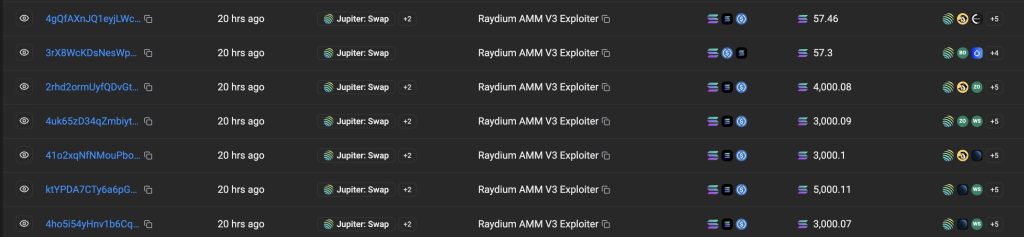
The sequence was repeated across all five deprecated pools, Sollet USDT–RAY, Sollet ETH–RAY, SRM–RAY, USDC–RAY, and RAY–SOL, draining approximately 150,177 RAY, 5,603 SOL, and 893,700 USDC in total.
Pseudonymous Raydium contributor 0xInfra confirmed on X that the attack was caused by “a self-contained logic flaw” and explicitly ruled out any key compromise or authority-level issue, meaning no propagation risk exists to current Raydium programs.
The December 2022 Raydium hack, a roughly $4.4 million loss caused by a private key theft – had pushed the team to harden operational security and migrate to audited contracts.
The June 2026 incident is a structurally different failure: not an operational breach, but a legacy codebase left callable on-chain with real assets still sitting inside it.
Tornado Cash Exit: Funds Bridge to Ethereum, Trail Goes Cold
On-chain investigators flagged the exploit in real time as the attacker aggregated USDC, SOL, and RAY across the five drained pools before moving cross-chain.
The full balance was bridged from Solana to Ethereum, then routed through KuCoin and FixedFloat before landing in Tornado Cash, the privacy protocol that remains the exit ramp of choice for DeFi exploit proceeds.
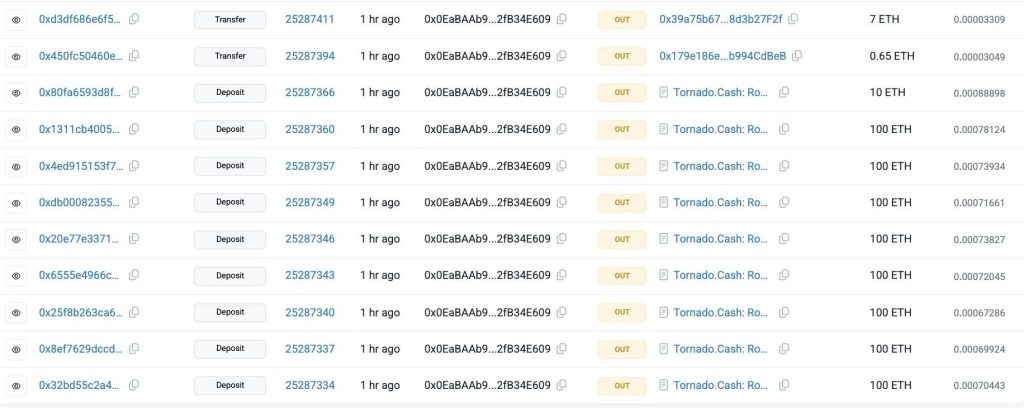
Community analysts tracking the wallet ending in ‘Bq33QVk’ confirmed the complete cross-chain exit, noting the attacker did not attempt to liquidate funds through Solana-native venues.
Once inside Tornado Cash, transaction-level tracing breaks down. No funds are reported frozen or flagged by centralized exchanges at this time.
No Active Users Affected, Raydium Treasury to Cover Losses
The most important immediate fact for Raydium users: no active accounts or current pools were touched. “No current users of Raydium are affected by this exploit or would have been able to interact with these pools through the UI since their deprecation,” 0xInfra stated.
The deprecated AMM V3 pools were invisible in the front-end and inaccessible through normal user flows.
Raydium confirmed it will repay all stolen funds in full using its protocol treasury. Legacy AMM V3 program IDs are being formally retired to prevent further calls, and the team has launched a comprehensive security review of all mainnet and legacy code paths. The reimbursement timeline has not been specified publicly.
RAY token is up around 2% in the 24 hours following the incident, trading at $0.578. The token has shed 7% over the past week amid broader Solana ecosystem weakness and sits 96.6% below its all-time high of $16.83.
Discover: The Best Token Presales
The post Raydium Hit With $1.34M Exploit via Fake LP Tokens on Deprecated Solana Pools appeared first on Cryptonews.


Coinbase reported mixed results for the second quarter, showing profitability pressure as overall crypto trading activity softened—despite the exchange winning a record slice of global market volume. The company’s performance underscored a key tension for large exchanges this year: when user activity and volatility decline, even strong market share gains may not be enough to offset revenue headwinds.
For the quarter, Coinbase generated about $1.2 billion in net revenue, broadly in line with expectations but down 19% from the prior year. The exchange posted a GAAP net loss of $359 million, widening significantly versus analysts’ expectations for a loss around $122 million.
Key takeaways
- Coinbase’s net revenue for Q2 was roughly $1.2 billion, down 19% year over year, as trading-related revenue weakened.
- The company reported a GAAP net loss of $359 million, materially worse than expected.
- Transaction revenue fell short of consensus, while subscription and services revenue also missed estimates.
- Despite weaker industry activity, Coinbase reached a record 10.3% share of global crypto spot trading volume, up from 9.1% in Q1.
Revenue softness and a wider-than-expected loss
Coinbase’s top-line picture was restrained. Transaction revenue totaled $599 million, below analyst expectations of $636 million. Subscription and services revenue came in at $555 million, missing the $590 million consensus estimate.
The gap between performance and expectations showed up most clearly in the bottom line. Coinbase’s GAAP net loss of $359 million was substantially larger than forecasts for a roughly $122 million loss, reflecting the squeeze across revenue categories tied to market participation and trading conditions.
Why trading revenue declined
The exchange pointed to weaker engagement across both consumer and institutional trading. According to Coinbase, transaction revenue fell as total crypto spot trading volume dropped 25% quarter over quarter, with lower market volatility and weaker crypto prices contributing to the decline.
That explanation matters for investors because it highlights what likely drove the quarter: not a loss of competitive position, but a reduction in the underlying trading “fuel” that generates fee income. Even when an exchange captures a larger share of a smaller market, the absolute level of activity can still weigh on results.
Market share at a record level, even as volumes weakened
While revenue suffered, Coinbase’s routing and distribution strength appeared resilient. The company reported an all-time high 10.3% share of global crypto trading volume, up from 9.1% in the first quarter.
This is an important counterpoint to the earnings misses. In prior periods, exchange earnings have often been highly sensitive to both share and total market activity. Here, Coinbase demonstrated share gains even as industry-wide trading activity softened, suggesting competitive momentum. The open question for traders and analysts is whether market share growth can continue translating into better financial outcomes when price movement and volatility are weak.
Strategic push beyond spot trading
Coinbase also framed the results within its broader push to expand beyond spot trading. The company continues to position itself as an “Everything Exchange,” extending into areas including derivatives, prediction markets, tokenized assets, and payments.
That diversification angle is particularly relevant in quarters like this one, where spot activity declines can pressure transaction fees. Investors will likely watch whether non-spot products can help stabilize revenue during periods when spot volumes and volatility fall, or whether the business remains too dependent on traditional trading patterns.
Coinbase shares fell more than 5% in after-hours trading after closing up 2.2% during regular trading.
Going forward, readers should focus on whether Coinbase’s record market-share gains persist and, more importantly, whether its expansion into derivatives and other digital-asset services can deliver stronger revenue resilience when spot trading volume and volatility remain under pressure.


The Senate released 616 pages merging two committee drafts into one bill. Here is what the combined text actually does, section by section.
Summary
- Senate Republicans released updated CLARITY Act text on July 22, 2026, merging the Banking and Agriculture committee drafts into a single 616-page bill with more than 70 pages of new language, including a government ethics title negotiated with the White House.
- The bill divides digital assets into three statutory categories: digital commodities overseen by the CFTC, investment contract assets under the SEC, and permitted payment stablecoins governed by the GENIUS Act, with a maturity certification process that lets tokens graduate from securities treatment as their networks decentralize.
- An ETP grandfather clause permanently classifies tokens that anchored a qualifying exchange-traded product before January 1, 2026, as non-securities, immediately covering Bitcoin, Ether, XRP, SOL, and DOGE without requiring any issuer action.
- The Blockchain Regulatory Certainty Act, carried intact from the House version, shields non-custodial software developers from money-transmitter obligations and Bank Secrecy Act requirements, while a separate DeFi exclusion exempts validators and open-source publishers from registration.
- No cloture motion was filed before the August 8 recess. The Senate moved to a nominations package and a Russia sanctions bill instead, shelving the CLARITY Act for the summer and compressing the remaining legislative calendar into a September session that carries less political momentum. Polymarket odds on 2026 passage have fallen from a February peak above 80 percent to roughly 30 percent as of July 29.
What the merge produced
The merged text is not a revision of either committee draft. It is a new document that stitches the Senate Banking Committee’s market-structure framework, passed 15-9 on May 14, to the Senate Agriculture Committee’s commodity-market provisions, then layers on titles that neither committee produced alone: a government ethics title, a law enforcement tools title, and 25 sections addressing sanctions and anti-money-laundering gaps.
The result is 616 pages across roughly a dozen titles. Senator Cynthia Lummis released the text alongside a section-by-section summary. The bill number remains H.R. 3633, the same vehicle that passed the House 294-134 in July 2025.
For readers who want the full statutory architecture mapped section by section, we published that guide when the House text shipped. What follows here covers only what the Senate merge added, changed, or settled.
The three-bucket classification
The core mechanism of the CLARITY Act is a statutory taxonomy that sorts every digital asset into one of three categories, each with a defined regulator.
Digital commodities are tokens whose underlying blockchain has reached functional maturity or sufficient decentralization. Once classified, these assets fall under CFTC jurisdiction. The CFTC gains exclusive authority over their spot markets, a power it currently lacks under the Commodity Exchange Act, which limits its spot-market role to anti-fraud and anti-manipulation enforcement. Centralized exchanges, brokers, and dealers trading digital commodities must register with the CFTC and comply with custody, trading, reporting, and consumer-protection standards.
Investment contract assets are tokens sold as part of an investment contract that have not yet graduated to commodity status. These remain under SEC jurisdiction and are subject to disclosure, registration, and investor-protection requirements consistent with existing securities law.
Permitted payment stablecoins are carved out entirely and governed by the GENIUS Act, which Congress passed in July 2025. The CLARITY Act does not duplicate that framework; it defers to it.
The taxonomy matters because it replaces the enforcement-by-litigation approach of the Gensler era with a statutory line. A token’s classification is no longer a question that gets answered in a federal courtroom years after launch. It is a question that gets answered by the text of the statute, the maturity certification process, or the grandfather clause.
The merged text also introduces a provisional registration regime for digital commodity exchanges and brokers. Firms can register with the CFTC and continue operating while final rules are written, avoiding the years-long limbo that characterized the previous regulatory environment. This is a meaningful change from the pre-CLARITY status quo, where an exchange could not know whether its tokens were securities or commodities until a court told it, often through an enforcement action. Under provisional registration, the exchange registers under a defined framework, lists tokens that have been certified or are in the certification pipeline, and operates under CFTC oversight from day one.
The maturity certification path
The bill creates a defined process for a token to move from securities treatment to commodity treatment. An issuer can notify the SEC that its digital asset is, or will become within four years, “functionally mature” or “sufficiently decentralized.” The SEC then evaluates the claim against statutory criteria: the network no longer depends on a centralized group to function, the token has real utility within its ecosystem, and ongoing management by the original development team is no longer the primary driver of the asset’s value.
Once certified, the asset is no longer classified as a security. The issuer’s filing obligations lighten, and the CFTC assumes oversight. Digital commodity exchanges may list only tokens whose blockchains have been certified as mature or whose issuers comply with ongoing reporting while the certification is pending.
This is the on-ramp that the industry has described as the bill’s central innovation. It is also the provision most dependent on rulemaking that has not begun. As our analysis of what Monday morning actually looks like if CLARITY passes details, the certification process exists in statute but cannot operate until the SEC writes the rules, and the base rate for timely agency rulemaking in this space is poor.
The ETP grandfather clause
Not every token needs to walk the certification path. Section 10101 of the merged text permanently classifies any token that was the principal asset of a qualifying exchange-traded product listed on a national securities exchange before January 1, 2026, as a non-security. The classification operates by force of statute the day the bill takes effect. It cannot be reversed through SEC rulemaking.
The practical effect is immediate and large. Bitcoin, Ether, XRP, SOL, and DOGE all anchored qualifying ETPs before the cutoff. They are grandfathered as digital commodities without any issuer action, any certification filing, or any waiting period. For these five assets, the classification war ends on signature day.
The grandfather clause is permanent. It does not sunset. It does not require renewal. And because it operates by statute rather than by agency interpretation, it survives changes in SEC leadership and rulemaking priorities. This is the single provision in the bill that delivers its effects without depending on a federal agency to do anything.
Regulation Crypto: the fundraising exemption
The merged text carries forward the Regulation Crypto framework from the House version. This is a bespoke exemption from full SEC registration for ancillary assets, tokens sold in connection with an investment contract that have not yet reached maturity.
An originator can raise the greater of $50 million per calendar year for four years, or 10 percent of the total dollar value of outstanding ancillary assets, subject to a $200 million aggregate cap. The exemption comes with tailored disclosure requirements rather than full securities registration. It is designed to let early-stage projects fund development without the cost and complexity of a registered offering while still providing investors with material information.
The key constraint is the cap structure. A project that raises $50 million a year exhausts its four-year allowance at $200 million. A project whose outstanding ancillary assets are worth $3 billion can raise $300 million per year but still cannot exceed the $200 million aggregate limit. The math channels early-stage capital into projects that are building, not projects that are already large enough to register.
The DeFi developer shield
Section 604 of the merged text incorporates the Blockchain Regulatory Certainty Act (BRCA), unchanged from the House version. The BRCA codifies that non-custodial software developers are not money transmitters under federal law and carry no Bank Secrecy Act obligations. It draws a bright line between custodial and non-custodial activities, making it clear which side of that line coders and validators stand on.
A separate DeFi exclusion exempts activities like validating transactions and publishing open-source code from SEC registration requirements. Running nodes, validating transactions, and maintaining protocol software are carved out from the bill’s compliance requirements entirely. Anti-fraud and anti-manipulation enforcement still applies; the shield covers registration, not conduct.
The DeFi Education Fund, reviewing the merged text, confirmed that the BRCA is unchanged, developer protections under the Exchange Act (Section 10601) and the Commodity Exchange Act (Section 20209) are intact, and the self-custody provision (Section 10605, the Keep Your Coins Act) is preserved. Protections under the Exchange Act reflect a compromise, with some protections for DeFi trading protocols, messaging systems, and self-custody hardware and software subject to future rulemaking. Protections under the CEA remain identical to the House-passed version.
This is the provision that the Fraternal Order of Police initially opposed and then reversed its position on. After reviewing the clarifying language in the merged text, the organization confirmed on July 24 that it is satisfied the provision does not limit law enforcement’s ability to address unlawful conduct involving digital assets.
The ethics provision
The merged text adds an entirely new government ethics title, developed in negotiations with the White House. Section 13152 prohibits covered federal officials and their spouses from issuing or sponsoring a digital asset in exchange for consideration during public service. “Covered federal officials” includes the president, vice president, members of Congress, and senior executive branch appointees.
The design choices are deliberate. The ban covers issuing new assets, not holding or profiting from existing ones. A safe harbor protects officials who place earlier crypto interests in qualified blind trusts or divest them. Penalties reach $250,000 per day of violation. And enforcement belongs solely to the Attorney General of the United States, with state attorneys general and private plaintiffs expressly barred from bringing actions.
The provision sunsets on January 20, 2029, the next presidential inauguration day.
These design choices are why the ethics provision is the center of the bill’s political fight. Seven Senate Democrats who had been negotiating the bill, including Senators Booker, Murphy, Van Hollen, and Merkley, issued a joint statement rejecting the released version the same day. Their objections center on two points: DOJ-only enforcement places the mechanism under a department whose nominee is the president’s former personal lawyer, and the 2029 sunset means the restriction expires with the current administration rather than enduring as a permanent standard.
The two Democrats whose committee votes carried the bill through the Banking Committee, Senators Alsobrooks and Gallego, also oppose the released version, for the same reasons.
Law enforcement and illicit finance
The merged text is substantially heavier on law enforcement provisions than either committee draft. Title II, Protecting Against Illicit Finance, and Title III, Responsible Innovation in Decentralized Finance, extend Bank Secrecy Act obligations to digital asset intermediaries and create rulemakings that give regulators new tools to address illicit finance through the existing AML framework.
Title IX, Law Enforcement Tools, is entirely new. It contains provisions developed in response to concerns from federal law enforcement that the original bill did not give prosecutors adequate authority. At first assessment, the title provides law enforcement with operational tools and funding without imposing registration requirements on non-custodial developers, threading a needle that earlier drafts left unresolved.
In total, the merged text contains 25 sections addressing sanctions, anti-money-laundering, and law enforcement, a significant expansion from the House version. This expansion reflects a political reality: multiple Senate votes, including some within the Democratic caucus, were conditioned on the bill doing more to address the use of digital assets in illicit finance, ransomware, and sanctions evasion.
Federal preemption
The merged text preempts state laws regulating the offer or sale of digital assets for federally registered firms, except for general antifraud statutes. This creates a uniform regulatory environment at the federal level, replacing the current patchwork of state-by-state requirements.
The preemption is significant for compliance costs. Under the current regime, a digital asset firm operating in all 50 states may need to comply with dozens of different regulatory frameworks. Under the CLARITY Act, federal registration replaces state-level licensing for activities covered by the bill. States retain their antifraud authority, and the preemption does not affect state tax law or criminal statutes.
For a broader view of where this fits within the full map of US crypto regulation in 2026, the preemption provision is the mechanism that converts the federal framework from a layer on top of existing state rules into a replacement for them, at least for firms that register.
What is not in the merged text
The merged text does not address several areas that remain open:
Stablecoin yield. Banking trade associations have publicly stated that the updated text puts at risk the local lending that drives economic activity, reflecting an ongoing dispute over whether rewards paid in connection with holding payment stablecoins constitute yield. The GENIUS Act governs stablecoins, but the interaction between the two statutes on this point is unresolved.
Specific rulemaking deadlines with enforcement teeth. The bill instructs the SEC and CFTC to write rules but does not impose the kind of penalties for missed deadlines that would force agency action. The GENIUS Act’s agencies missed their own statutory rulemaking deadline this month, one year after passage, and the CLARITY Act hands a larger workload to a CFTC operating with a single confirmed commissioner.
NFT classification. The taxonomy addresses fungible digital assets but does not create a specific category or exemption for non-fungible tokens. Their treatment will depend on how the SEC and CFTC apply the existing categories through rulemaking and enforcement.
Custody standards for qualified custodians. The merged text prohibits federal regulators from requiring financial institutions to carry customer digital assets as liabilities on their own balance sheets or hold additional capital against custodied assets, except as necessary to address operational risk. But it does not define affirmative custody standards for qualified custodians beyond this prohibition. The details of how banks, trust companies, and registered custodians must segregate, insure, and report on digital asset holdings will be determined through rulemaking.
Cross-border coordination. The bill is a domestic statute. It does not address how the CFTC and SEC will coordinate with foreign regulators on cross-listed digital assets, how conflicts between the CLARITY Act’s classification framework and foreign regulatory regimes will be resolved, or how enforcement jurisdiction will be allocated when a token classified as a commodity in the United States is treated as a security abroad.
The vote math and the shelving
The bill needs 60 votes to clear the Senate under cloture rules. Republicans hold 53 seats. Every Republican vote is assumed, which means seven Democrats must cross over. Two Democrats, Senators Gallego and Alsobrooks, voted for the bill in committee but have since opposed the merged text over the ethics provision. Their opposition does not reduce the required crossover count, because their committee votes were not floor commitments, but it signals the difficulty of the remaining math.
As our coverage of the 60-vote gap the bill faces on the Senate floor detailed, the cloture sequence itself consumes days: filing, an intervening day, the vote, then up to 30 hours of post-cloture debate. A contested bill typically needs the sequence twice, once on the motion to proceed and once on the bill itself. The calendar arithmetic proved as binding as the vote arithmetic.
No cloture motion was filed. Senate Majority Leader Thune acknowledged on July 23 that the chamber lacked time to complete debate, amendments, and a cloture vote before the August 8 recess. The floor went to a nominations package and a Russia sanctions bill instead. The CLARITY Act has sat on the Senate Legislative Calendar as Calendar No. 423 since June 1, without a scheduled vote.
The shelving does not kill the bill. The 119th Congress runs until January 2027, and the merged text remains on the calendar. But the political window narrows sharply after recess as midterm positioning absorbs Senate floor time. A September session carries less momentum, fewer available floor days, and the same unresolved ethics deadlock. Polymarket odds on the bill becoming law in 2026 are worth reading as an arc instead of a number: a February peak above 80 percent, a record low near 24 percent in mid-July, a rebound to 43 percent on July 21 after reports that the White House had agreed to the ethics provision, and roughly 30 percent as of July 29.
What to watch
September floor time. With no cloture motion filed before the August 8 recess, the next opportunity is the September session. Whether Thune allocates floor time to the CLARITY Act or prioritizes the reconciliation package will determine whether the bill gets a vote in 2026.
Democratic crossover count. Seven crossover votes beyond Gallego and Alsobrooks are needed for 60. The ethics provision remains the binding constraint on every undecided Democrat, and the recess has not produced any new commitments.
Ethics provision amendments. Floor amendments extending the sunset past 2029 or adding state AG enforcement authority would change the vote math significantly.
CFTC confirmation. The CFTC is operating with a single confirmed commissioner. Until additional commissioners are confirmed, the agency’s capacity to write the rules the bill requires is structurally limited.
SEC rulemaking timeline. The maturity certification process, the Regulation Crypto disclosure requirements, and portions of the DeFi protections all depend on SEC rulemaking that has not started.
Frequently asked questions
What is the CLARITY Act merged text?
It is a 616-page bill released by Senate Republicans on July 22, 2026, combining the Senate Banking Committee’s market-structure framework with the Senate Agriculture Committee’s commodity-market provisions, plus new titles on government ethics and law enforcement. The bill number is H.R. 3633.
How does the bill classify digital assets?
The bill creates three statutory categories: digital commodities (CFTC jurisdiction), investment contract assets (SEC jurisdiction), and permitted payment stablecoins (governed by the GENIUS Act). A maturity certification process lets tokens graduate from securities to commodity treatment as their networks decentralize.
Which tokens are grandfathered as non-securities?
Any token that was the principal asset of a qualifying exchange-traded product listed on a national securities exchange before January 1, 2026. In practice, this covers Bitcoin, Ether, XRP, SOL, and DOGE. The classification is permanent and operates by force of statute.
What does Regulation Crypto allow?
It lets token issuers raise the greater of $50 million per year for four years, or 10 percent of outstanding ancillary assets, up to a $200 million aggregate cap, with tailored disclosures instead of full SEC registration.
Does the bill protect DeFi developers?
Yes. The Blockchain Regulatory Certainty Act (Section 604) shields non-custodial software developers from money-transmitter and Bank Secrecy Act obligations. A separate exclusion exempts validators and open-source publishers from registration. Anti-fraud enforcement still applies.
What does the ethics provision do?
It bans the president, vice president, members of Congress, and senior officials from issuing or sponsoring digital assets while in office. Penalties reach $250,000 per day. Enforcement belongs solely to the Attorney General. The provision sunsets on January 20, 2029.
Why did Democrats reject the merged text?
Seven negotiating Democrats opposed the bill because enforcement of the ethics provision is limited to the DOJ, headed by the president’s former personal lawyer, and the provision sunsets with the current administration instead of setting a permanent standard.
Has the CLARITY Act become law?
No. The bill passed the House 294-134 in July 2025 and cleared the Senate Banking Committee 15-9 in May 2026, but no cloture motion was filed before the August 8 recess. The bill remains on the Senate calendar, and the next opportunity is the September session. The 119th Congress runs until January 2027. This is educational analysis, not investment advice.
Disclaimer: This article is for informational purposes only and does not constitute legal, financial, or investment advice. Regulatory outcomes are uncertain, and the legislative text discussed may change through floor amendments or conference negotiation. Readers should consult qualified professionals before making decisions based on pending legislation. Information is accurate as of July 30, 2026.


The 2026 FIFA World Cup drove $20 billion in blockchain-based prediction market volume and $24 million in digital collectible trades, with more than 400,000 wallets participating in blockchain-based betting, according to a report from blockchain analytics firm Chainalysis.
The $20 billion figure includes trading before and during the tournament, with bettors placing roughly $5.7 billion in wagers over the five-week World Cup itself. World Cup-related markets accounted for about 63% of all prediction market activity during that period, the report said.
According to Chainalysis, users from every continent except Antarctica participated in World Cup prediction markets, with the United States and China generating the highest attributable trading volumes, followed by Canada, Thailand and the United Kingdom.
Despite the scale of betting activity, illicit participation remained limited. Chainalysis said fewer than 1% of wallets participating in World Cup prediction markets had ties to illicit actors, though it identified roughly $5.4 million in flows originating from sanctioned entities and other illicit sources.
The report also highlighted growing adoption of blockchain-based digital collectibles. Fans traded about $24 million worth of FIFA Collect NFTs during the tournament, while more than 100,000 match tickets were distributed through the platform. Wallets linked to sanctioned entities accounted for less than 0.01% of FIFA Collect users, which Chainalysis attributed in part to the platform’s identity verification requirements.
Chainalysis said the findings suggest blockchain will play a growing role in major global events and underscored the importance of compliance measures as platforms attract broader participation.


Strategy reported an $8.33 billion second-quarter operating loss after Bitcoin’s 27% decline this year drove a sharp reduction in the value of its digital asset portfolio.
Summary
- Strategy recorded an $8.32 billion unrealized digital asset loss during the second quarter.
- Its 843,775 BTC were worth $54.77 billion, below their $63.69 billion acquisition cost.
- The company posted an $8.22 billion net loss, equal to $24.45 per diluted share.
- A $3.75 billion dollar reserve provides 2.1 years of preferred dividend coverage under Strategy’s policy.
Strategy’s Bitcoin decline drives $8.33B loss
Bitcoin traded near $64,700 following Strategy’s earnings announcement, down from approximately $88,400 at the end of 2025. That decline left the company’s holdings valued below their aggregate purchase cost.
Strategy recorded an $8.32 billion unrealized loss on digital assets during the quarter, contributing to an operating loss of $8.33 billion. The results reversed the $14.05 billion unrealized gain recorded in the same quarter a year earlier.
The company reported a net loss of $8.22 billion, or $24.45 per diluted common share. Strategy posted net income of $10.02 billion, or $32.60 per share, during the comparable period last year.
Strategy shares were mostly unchanged in after-hours trading following the earnings release, suggesting investors had largely expected Bitcoin’s decline to weigh on the results.
Bitcoin holdings fall below Strategy’s acquisition cost
Strategy held 843,775 BTC as of July 26, an increase of 25% since the start of the year. The position had an original cost of $63.69 billion, including fees and expenses, and a market value of $54.77 billion.
Its average purchase price stood at approximately $75,476 per Bitcoin. With BTC trading near $64,700 after the report, the company’s position was about $10,776 underwater per coin based on its average acquisition cost.
The gap placed the total portfolio roughly $8.92 billion below its original cost. However, the reported quarterly loss was largely unrealized, meaning it reflected changes in Bitcoin’s market value rather than losses from selling the full position.
As crypto.news reported earlier, Strategy made no Bitcoin purchases between July 20 and July 26. Its total holdings remained unchanged at 843,775 BTC during that period.
The company has nevertheless sold approximately $218.4 million in Bitcoin this year to help fund preferred stock dividends. Those sales remain small relative to its overall digital asset reserve but show that Strategy is using part of the portfolio to meet financing obligations.
Strategy raises cash while reducing convertible debt
Strategy’s core software business generated quarterly revenue of $122.4 million, up 6.9% from $114.5 million a year earlier. Gross profit reached $81.6 million, representing a margin of 66.6%.
The company raised $17.06 billion through its capital markets programs during the year and reported a Bitcoin yield of 4.5%. That internal metric measures the change in Bitcoin held per assumed diluted share and does not represent a conventional investment yield.
Strategy also cut its convertible debt by 18% to $6.71 billion after repurchasing $1.5 billion of notes at a discount. The move reduced part of the company’s debt burden as lower Bitcoin prices placed pressure on its balance sheet.
Its U.S. dollar reserve rose by $525 million to $3.75 billion. Strategy said the reserve provides 2.1 years of coverage for preferred stock dividends under its current policy, although the calculation does not guarantee payments under every market condition.
Separate $1 billion repurchase programs have also been established for Strategy’s common shares and digital credit securities. The programs give the company the option to buy back securities but do not require it to use the full authorized amounts.
What the results mean for US investors
Strategy remains one of the largest publicly traded corporate Bitcoin holders, giving U.S. investors indirect exposure to BTC through its securities. Its shares can respond to Bitcoin prices as well as debt costs, equity issuance, preferred dividends and changes in the company’s capital structure.
The second-quarter loss shows how Bitcoin volatility can produce large swings in reported earnings. Strategy moved from a $14.05 billion unrealized digital asset gain a year earlier to an $8.32 billion unrealized loss this quarter.
Its increased cash reserve and lower convertible debt provide additional financial flexibility, but Bitcoin remains below the company’s average purchase price. Further declines could deepen unrealized losses, while a recovery above $75,476 would move the portfolio back above its aggregate acquisition cost.


Strategy (MSTR), the world’s largest corporate bitcoin holder, reported Thursday an $8.2 billion second-quarter net loss after the cryptocurrency’s price decline erased billions of dollars from the value of its digital asset holdings.
The quarterly loss was driven almost entirely by an $8.32 billion unrealized markdown on its bitcoin holdings under fair-value accounting.
The company held 843,775 bitcoin as of July 26, up 25% from the start of the year. At current prices, the stash is worth roughly $54.8 billion, compared with an acquisition cost of $63.7 billion.
The report came after a period of growing investor scrutiny on the firm over whether it can sustain an increasingly complex capital structure built around multiple classes of preferred stock, common equity and convertible debt.
The company raised $17.06 billion through at-the-market stock offerings this year, repurchased $1.5 billion of convertible notes at an 8% discount and expanded its U.S. dollar reserve to $3.75 billion, enough to cover more than two years of preferred dividend payments and interest expenses.
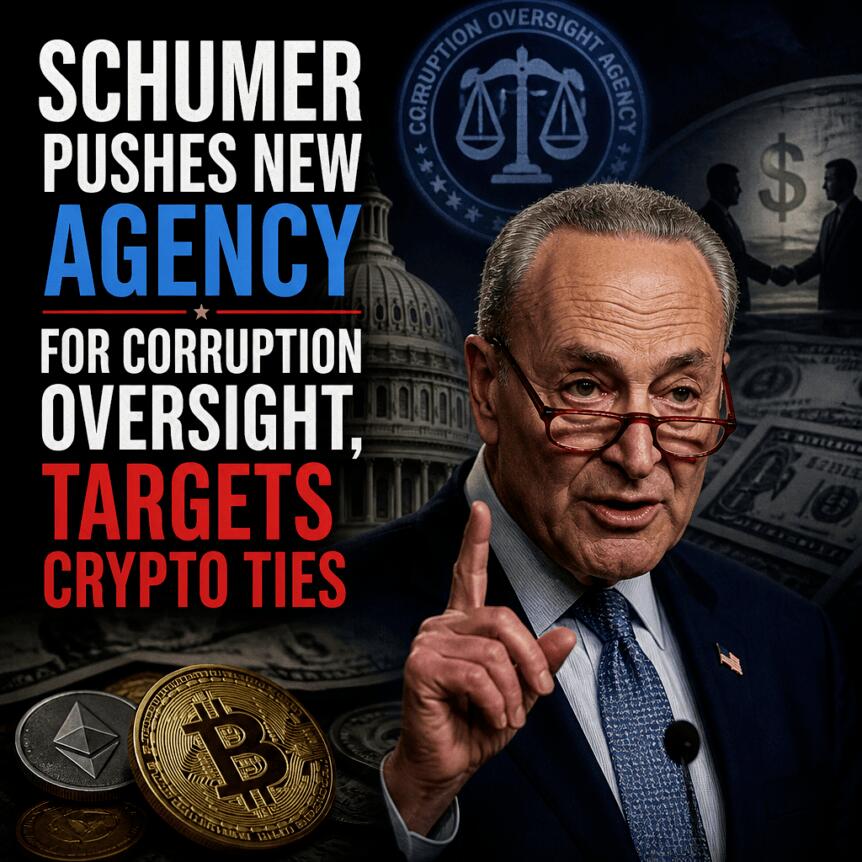
Senate Minority Leader Chuck Schumer has introduced new federal legislation aimed at creating an “Anti-Corruption Bureau” with the power to investigate, enforce, and prevent executive-branch corruption. The proposal also folds into a wider political fight over cryptocurrency ethics and market-structure reform, as Schumer’s remarks directly referenced President Donald Trump’s financial ties to crypto.
According to Schumer’s office, the bill—called the Anti-Corruption Bureau Creation Act—would establish a new agency designed to replace what he described as a fragmented system of oversight bodies. Schumer and cosponsors presented the effort as a targeted response to conflicts of interest they say stem from public office and lucrative crypto-related investments.
Key takeaways
- Schumer introduced the Anti-Corruption Bureau Creation Act, proposing a dedicated US agency to investigate, enforce, and prevent executive-branch corruption.
- The bill’s rationale ties to alleged Trump-linked financial gains, including references to crypto exposure mentioned in Schumer’s Thursday notice.
- Schumer’s proposal would consolidate multiple ethics and oversight functions, grouping entities including the Federal Election Commission and other government ethics offices “under one roof.”
- Supporters position the bureau as a “real teeth” enforcement mechanism, while passage could still face hurdles in the House and Senate—and a potential veto by Trump.
- The timing overlaps with ongoing uncertainty around the Senate’s handling of the Digital Asset Market Clarity (CLARITY) Act, a major market-structure effort backed by many in the industry.
A new enforcement-focused anti-corruption bureau
In a Thursday press notice, Schumer said he introduced the Anti-Corruption Bureau Creation Act. He described the agency as one with enforcement authority, designed to “investigate, enforce, and prevent executive branch corruption.” The legislation also sets out “Congress’ findings” that Schumer claims include disclosures about Trump’s earnings from investments and additional crypto exposure connected to foreign governments through a family fund, as referenced in Schumer’s notice.
Schumer framed the proposal as an institutional fix. In remarks shared through a Public Citizen forum about the bill, he characterized the bureau as having “real teeth” and argued it would help harmonize enforcement across institutions that currently operate with overlapping or inconsistent authority.
The bill’s structure, as described in connection with the forum, calls for a bipartisan group of seven members to be confirmed by the Senate. It also includes mechanisms intended to allow private citizens and state authorities to seek recovery of funds they allege were stolen through corruption, according to descriptions tied to the proposal.
How crypto ethics enters the political equation
For Democrats weighing support for comprehensive crypto market structure legislation, President Trump’s business ties have become a central flashpoint. Many lawmakers, despite White House agreement to certain ethics provisions in the Digital Asset Market Clarity (CLARITY) Act, have argued that the offered safeguards do not fully address potential conflicts of interest.
Earlier coverage from Cointelegraph noted that debates around the CLARITY Act have kept ethics provisions at the center of discussions, with lawmakers saying the measures fall short. Schumer’s new anti-corruption bill adds a separate enforcement pathway to that same broader argument: that oversight should be strengthened to prevent public office from translating into private financial benefit, including in crypto-related business interests.
Consolidating enforcement and ethics offices
A notable feature of the anti-corruption proposal is its intent to gather multiple oversight functions under one organizational umbrella. As described in the coverage, the legislation would place the US Federal Election Commission, the Office of Government Ethics, and the Office of Special Counsel “under one roof” within the new bureau.
Supporters argue the consolidation would reduce the gaps they believe exist across current watchdog systems. Schumer’s messaging emphasized replacing “a broken patchwork of watchdogs” with a single agency capable of acting “anywhere, anytime corruption strikes.” Critics of the current system—particularly those focused on ethics enforcement—often point to jurisdictional complexity and uneven prioritization across agencies; this bill attempts to address that by reorganizing responsibilities rather than relying solely on incremental reforms.
Cointelegraph reported that it reached out to the White House for comment but did not receive an immediate response regarding the proposal.
Cosponsors, vote math, and what happens next
The bill was introduced by Schumer and has cosponsors including Senators Andy Kim, Alex Padilla, and Jeff Merkley. Passage would require Republican support in the House and Senate, where the party holds a slim majority.
Even if it advances before 2028, the president would have veto power. If Trump vetoed the legislation, Congress would need a two-thirds majority in both chambers to override it, according to the rules typically governing federal veto overrides.
The timing is also important because the Senate is approaching a break. As described in the coverage, the Senate had just over a week left before lawmakers planned to leave for a month-long state work period. That looming calendar could affect the speed at which both ethics-related and market-structure measures move in the upper chamber.
CLARITY Act uncertainty persists alongside the anti-corruption push
While Schumer’s anti-corruption proposal targets executive-branch conduct, it arrives in the midst of unresolved negotiations around the CLARITY Act, which many see as a key step toward a clearer US framework for digital assets.
As of Thursday, the Senate had not scheduled a vote on the CLARITY Act, despite pushes from Republican lawmakers and industry stakeholders. Cointelegraph previously highlighted that ethics provisions remain a sticking point for some Democrats, and this week’s status underscores how procedural timing may be just as decisive as policy design.
According to remarks attributed in the coverage to former SEC official John Reed Stark, after a public forum hosted by Senators Richard Blumenthal and Chris Van Hollen, it was unclear whether lawmakers would move the CLARITY Act during the available window. The same report cited statements from Coinbase CEO Brian Armstrong referring to the bill nearing a critical stage, alongside continued advocacy from Senator Cynthia Lummis for a vote.
The political sequence matters for market participants: if crypto market structure legislation is delayed by calendar constraints, lawmakers may re-focus on broader political disputes about ethics and enforcement, potentially reshaping what “safe enough” looks like for legislators and regulators. Conversely, if the CLARITY Act advances, it could clarify the legislative pathway for industry—while leaving ethics and anti-corruption reforms to run in parallel.
For now, investors and builders should watch two developments closely: whether the Senate schedules and votes on the CLARITY Act before its break, and whether Schumer’s anti-corruption bureau proposal gains traction early enough to overcome House and Senate vote hurdles and any eventual veto risk.

Ripple-backed Evernorth Holdings has advanced its public market plans after updating its SEC registration. The company completed executive employment agreements and submitted another amended Form S-4 filing. Meanwhile, the latest disclosures also outlined compensation packages, merger progress, and financial impacts linked to recent XRP price weakness.
Ripple-Backed Evernorth Completes Leadership Agreements
Evernorth Holdings submitted Amendment No. 5 to its Form S-4 registration statement with the U.S. Securities and Exchange Commission. The filing completed employment agreements for the remaining members of the executive leadership team. As a result, the company has finalized compensation arrangements before its proposed public listing.
The agreements cover Chief Legal Officer Jessica Jonas, Chief Business Officer Sagar Shah, and Chief Operating Officer Meg Nakamura. Each executive will receive a base salary, annual bonus eligibility, employee benefits, and restricted stock units. The compensation packages follow the company’s 2026 Omnibus Incentive Plan.
Jonas received the largest equity award among the newly announced executives. Her initial equity package carries a value of $4.5 million under the agreement. Meanwhile, Shah and Nakamura each received equity awards valued at $2.8 million, subject to shareholder and compensation committee approval.
Evernorth Advances Merger With Armada Acquisition Corp II
The latest filing follows earlier agreements with Chief Executive Officer Asheesh Birla and Chief Financial Officer Matt Frymier. Those agreements already established executive salaries, bonuses, equity awards, and vesting schedules. Consequently, Evernorth has now completed employment terms across its senior leadership team.
The company continues preparing for its planned business combination with Armada Acquisition Corp II. Arrington Capital sponsors the special purpose acquisition company leading the proposed transaction. Following completion, the combined company intends to trade on Nasdaq under the ticker symbol XRPN.
Evernorth has secured more than $1 billion in gross proceeds from strategic backers supporting the transaction. Funding has come from Ripple, Arrington Capital, SBI Holdings, Pantera Capital, and Kraken. The company has also assembled a board featuring senior executives from blockchain, finance, and technology organizations.
Ripple Chief Legal Officer Stuart Alderoty will serve on the board after the merger closes. Other directors include Asheesh Birla, Ted Janus, Robert Kaiden, and Derar Islim. The proposed public company, therefore, combines experienced leadership from digital assets and financial services.
The transaction supports Evernorth’s strategy to establish one of the largest publicly traded XRP treasury companies. Corporate treasury models have gained attention as several firms increase exposure to digital assets. As a result, Evernorth aims to expand institutional participation through a publicly listed structure backed by XRP holdings.
XRP Price Weakness Leads to Impairment Charge
Evernorth also disclosed financial effects resulting from recent XRP market performance. The company reported a $38.4 million impairment tied to declining XRP valuations during the past four months. Consequently, the value of its combined XRP holdings fell to approximately $640 million.
XRP traded between $1.05 and $1.09 during the latest market session. The token changed hands near $1.07 after declining during the previous 24 hours. In addition, XRP has recorded losses exceeding 5% during the past week while trading activity weakened.
Daily trading volume also declined by approximately 10% during the latest session. Market sentiment remained under pressure as regulatory developments continued affecting cryptocurrency prices. Meanwhile, delays surrounding the CLARITY Act added another challenge for digital asset markets.
Armada Acquisition Corp II shares also recorded a modest decline during recent trading sessions. However, the stock maintained its broader year-to-date gains despite the latest movement. At the same time, Evernorth continued progressing toward its planned merger while strengthening executive leadership before entering public markets.
The updated SEC filing marks another milestone in Evernorth’s listing process. Executive agreements, governance appointments, and merger preparations now appear substantially complete. As a result, the company has strengthened its organizational structure before completing its proposed Nasdaq debut and expanding its XRP treasury strategy.
Crypto World
Up 439%, Then Margin-Called: Did Leopold Aschenbrenner’s Situational Awareness Actually Blow Up?
Situational Awareness made 439% in six months. Then margin calls took its entire stock book in one trade. Ken Griffin’s Citadel bought it.
A quarter of that fund’s last reported stock holdings were Bitcoin miners. That was not an accident, and it is why crypto investors are reading this story closely.
Who Is Leopold Aschenbrenner?
OpenAI hired him for its Superalignment team in 2023 and let him go in April 2024. He has said he was pushed out for raising safety concerns.
In June 2024 he published an essay series called Situational Awareness. Its central claim was blunt.
“AGI by 2027 is strikingly plausible,” Leopold Aschenbrenner, in his essay series Situational Awareness, June 2024.
Follow us on X to get the latest news as it happens
AGI means software that matches humans at most tasks. But the essay did more than predict it. One chapter argued the real bottleneck would be physical. Power contracts, transformers and electricity supply, not chips.
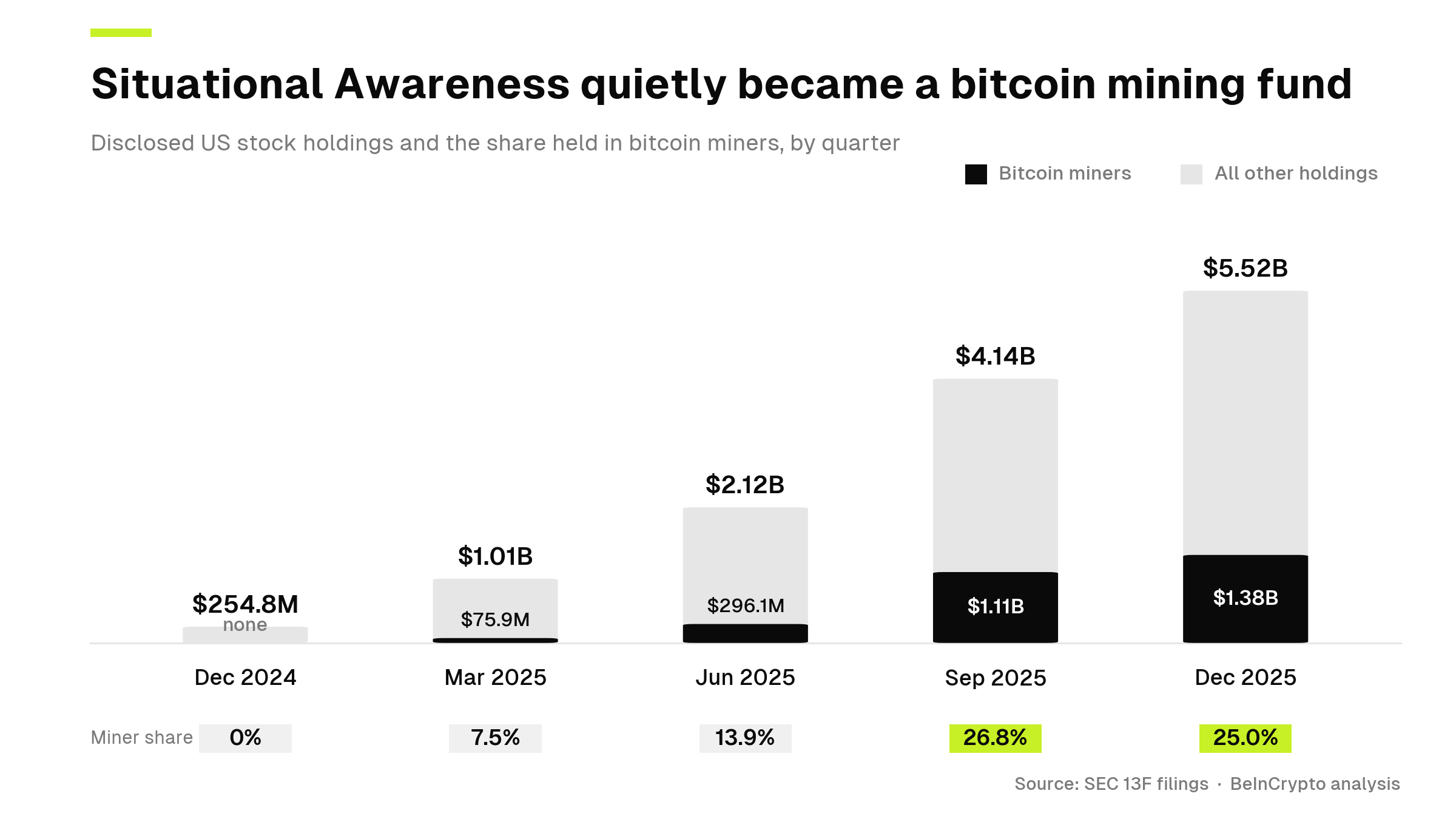
He then built a hedge fund on that idea. Its first stock disclosure, covering December 2024, listed six holdings worth $254.8 million.
Every one was a power or chip company. Not one was crypto. That changed quickly.
What Happened to Situational Awareness This Week
July went badly. The fund owned memory chip makers like SK Hynix, which fell hard in the AI memory stock selloff.
It had also bet against software firms such as Adobe. That trade pays off when a stock drops. Those shares rose instead. The wider market went the same way. The Nasdaq-100 fell 10% from its early June peak.
Borrowed money turned a bad month into a forced one. The fund had used loans to hold more stock than its own cash could cover.
When prices fell, its lenders wanted more money behind those loans. That demand is a margin call.
CNBC named Bank of America, Goldman Sachs and JPMorgan Chase as the brokers involved. It also reported the fund had grown to $45 billion by the start of July.
Then it unwound every public stock position, CNBC said. Griffin’s Citadel hedge fund agreed to buy them. Millennium Management and Jane Street looked and passed, Bloomberg reported.
Where Do Bitcoin Miners Come In?
Crypto readers mostly missed this part. Situational Awareness became one of mining’s larger shareholders, and it happened fast.
Big US funds must list their stock holdings every three months on a form called a 13F. Five exist for this fund. Read in order, they show a bet being built.

The latest filing lists 29 holdings worth $5.52 billion. Miners and their data center arms make up $1.38 billion of it.
Core Scientific was the largest at $418.7 million. IREN came next at $328.6 million, then Applied Digital at $278 million.
Cipher Mining, Riot Platforms, Hut 8, WhiteFiber, Bitdeer, CleanSpark and Bitfarms made up the rest.
The whole disclosed book grew nearly 22 times in a year. The mining share went from nothing to a quarter of it.
So the AGI fund became a mining fund by design. His essay said the bottleneck was power. Miners own power, land and cooling, which is why miners became AI powerhouses.
There is a catch for shareholders. Anyone holding these stocks in July shared the trade with a fund facing margin calls. No mining company knew, so none of them said so.
Did Citadel Engineer This?
One theory spread fast. It says Citadel scared the market about rate hikes, waited for Leopold to break, then bought his stocks cheap.
The first part is true. Frank Flight, who runs macro strategy at Citadel Securities, published a note on July 27. He wrote that he now expected a rate hike at the July meeting.
Bloomberg reported the call added to market nerves. Two days later, a Griffin firm bought the stock book.
Four things break the theory.
- First, there are two Citadels.
Citadel Securities buys and sells stocks for other people. Citadel is the hedge fund. They are separate firms.
- Second, Flight had company.
PGIM and Wrightson ICAP also called for a hike. Bond veteran Harley Bassman wanted one twice as big.
- Third, the fear came first.
Bloomberg tied it to oil prices rising after the US and Iran clashed again, plus a strong job market.
- Fourth, the Fed did not hike.
It held rates steady, and three of its 12 voting members wanted a quarter-point rise.
That last detail matters. It was the first time since September 2016 that three officials dissented in the same direction. The pressure to raise rates was real, and it sat inside the Fed.
What Nobody Can Answer Yet
Did Citadel get a bargain? Nobody outside the deal knows. Neither firm will say what it paid.
Some think the forced selling mattered anyway. On CNBC, Jim Cramer argued it looked like a clearing event that could mark a bottom for the AI trade.
The tape says something simpler. Microsoft reported strong results on Wednesday night and rose about 15%.

Chip stocks jumped the next day. One big chip index rose 6.7% and snapped a five-day losing streak.
One block trade does not move a whole chip index. An earnings report can.
Six days before all of it, Aschenbrenner had told his investors to add money.
“PS. At times we call out opportunities that seem like a particularly good time to add funds, if you have been waiting for one,” Leopold Aschenbrenner, in the July 24 investor letter as reported by the Financial Times.
He got the direction right. He just did not own the stocks anymore.
The fund is not dead. It still holds private stakes, including Anthropic, which filed confidential IPO paperwork on June 1.
Miners spent 10 years being called a curiosity. It took one AI fund’s margin call to make them matter.
The post Up 439%, Then Margin-Called: Did Leopold Aschenbrenner’s Situational Awareness Actually Blow Up? appeared first on BeInCrypto.
Strategy (MSTR), the world’s largest corporate bitcoin holder, reported Thursday an $8.2 billion second-quarter net loss after the cryptocurrency’s price decline erased billions of dollars from the value of its digital asset holdings.
The quarterly loss was driven almost entirely by an $8.32 billion unrealized markdown on its bitcoin holdings under fair-value accounting.
The company held 843,775 bitcoin as of July 26, up 25% from the start of the year. At current prices, the stash is worth roughly $54.8 billion, compared with an acquisition cost of $63.7 billion.
The report came after a period of growing investor scrutiny on the firm over whether it can sustain an increasingly complex capital structure built around multiple classes of preferred stock, common equity and convertible debt.
The company raised $17.06 billion through at-the-market stock offerings this year, repurchased $1.5 billion of convertible notes at an 8% discount and expanded its U.S. dollar reserve to $3.75 billion, enough to cover more than two years of preferred dividend payments and interest expenses.


Amazon shares surged in after-hours trading on Thursday after the company delivered a blowout second-quarter earnings report, beating Wall Street expectations across revenue, AWS sales, operating income, and earnings per share.
The results reinforced investor confidence that Amazon’s massive AI infrastructure spending is translating into accelerating cloud growth and stronger profitability.
Follow us on X to get the latest news as it happens
Amazon Beats Wall Street Across Key Metrics
Amazon reported Q2 net sales of $200.6 billion, comfortably above analyst estimates of approximately $197 billion. The company also posted operating income of $27.46 billion, exceeding expectations of around $23.6 billion, while operating margin expanded to 13.7%, above the expected 12%.
Perhaps the biggest surprise came from earnings. Amazon reported earnings per share of $5.75, far ahead of the consensus estimate of $1.82, highlighting significantly stronger profitability than analysts anticipated.
The earnings release immediately fueled investor optimism, sending Amazon shares from a regular-session close of $235.50 to roughly $251 in after-hours trading, representing a gain of more than 6.5% after the closing bell.
AWS Growth Shows Amazon’s AI Spending Is Paying Off
The strongest signal from the report came from Amazon Web Services.
AWS generated $42.23 billion in revenue during the quarter, surpassing expectations of roughly $40.57 billion. Cloud revenue grew approximately 37% year-over-year, marking AWS’s fastest expansion in roughly 18 quarters.
For investors, AWS remains Amazon’s most closely watched business because it serves as the company’s primary AI infrastructure engine.
Chief Executive Andy Jassy has repeatedly defended Amazon’s aggressive capital investment strategy, maintaining plans to spend roughly $200 billion during 2026 to expand AI data centers, networking infrastructure, and custom silicon capabilities.
The latest earnings suggest those investments are beginning to translate into accelerating customer demand rather than simply higher expenses.
Investors Reward Amazon’s AI Strategy
Heading into earnings, investors questioned whether Amazon could match the strong cloud performance recently reported by Microsoft while justifying its enormous AI capital expenditures.
Instead, Amazon exceeded expectations across nearly every major operating metric.
The combination of stronger AWS growth, expanding operating margins, and better-than-expected profitability eased concerns that AI spending would pressure near-term earnings. Investors instead viewed the results as evidence that Amazon’s infrastructure investments are already supporting faster revenue growth.
Although some of the earnings benefit included non-operating gains, the company’s underlying operating performance remained well ahead of Wall Street forecasts.
What’s Next for Amazon?
Attention now shifts toward Amazon’s second-half execution as management continues rolling out AI infrastructure and expanding AWS services.
Investors will closely monitor whether AWS can maintain its accelerated growth trajectory while Amazon continues one of the largest capital investment programs in corporate history. Future earnings will also provide a clearer picture of whether AI-driven demand can continue supporting margin expansion and justify the company’s long-term spending plans.
If AWS momentum remains intact, Amazon could further strengthen its position in the increasingly competitive AI cloud market alongside Microsoft and Google.
The report also arrives at a pivotal moment for the AI investment race, with Microsoft and other tech giants raising the bar on cloud performance. Amazon’s latest numbers suggest its AI strategy is beginning to generate tangible financial returns.
The post Amazon AI Bet Pays Off as Q2 Earnings Crush Expectations: How Will Stock React? appeared first on BeInCrypto.

10 Best Psychological Thriller Books of the 20th Century

People in Welsh village thought they’d heard a small earthquake but it was much worse

India defies West Asia war concerns as Q4 GDP growth hits 7.8%; risks remain ahead


-

 Fashion6 days ago
Weekend Open Thread: Brooks Brothers
-
 Sports4 days ago
Commonwealth Games boxing: Jadumani Singh seals dominant 5-0 win over Pakistan’s Sumama Rehman to enter quarter-finals | Commonwealth Games News
-

 Business1 day ago
Why Trees Belong on the Risk Register
-

 Tech4 days ago
Intel is reversing course and bringing hyper-threading back to its server chips
-

 Crypto World5 days ago
Ripple bought a bank in pieces. The $4 billion audit
-

 Politics3 days ago
Luke Littler dismantles Gerwyn Price to retain title in Blackpool
-
 Entertainment6 days ago
A New Post-Apocalyptic Gundam Anime Series Blasts Into SDCC
-

 Politics3 days ago
The Part of the Electric Transition Nobody Wants to Discuss
-

 News Videos4 days ago
BITCOIN JUST ENTERED THIS CRITICAL ZONE…
-

 Fashion7 days ago
16 Dresses for the High Summer Event
-

 Sports7 days ago
2026 3M Open leaderboard: Scottie Scheffler finds putter in Round 1, sits three back
-

 Business2 days ago
Major shareholder moves on Canyon
-

 Crypto World5 days ago
XRP Ledger adds $2.6B as RWA inflows rank second
-

 News Videos10 hours ago
Bitcoin Enters the 3rd Stage of the Bear Market
-

 Politics4 days ago
Spain sweeps the board at 2026 World Cup with individual awards
-
 Entertainment2 days ago
‘Stargate’ Creator’s New Sci-Fi Series Returns for Season 3 Tomorrow
-

 Tech6 days ago
Anthropic launches Claude Opus 5, a cheaper AI model for coding, agents and enterprise workflows
-

 Crypto World2 days ago
Kraken Enables Retail Access to Jersey Mike’s IPO via Tokenized Shares
-

 Entertainment5 days ago
Sara Gilson Killed By Husband After Viral “Pedophile” TikTok Video
-

 News Videos2 days ago
Claude: Build Financial Dashboards in Minutes (2026)
You must be logged in to post a comment Login