
Crypto World
US Traders Fuel 25% of Tracked Offshore Prediction Market Volume

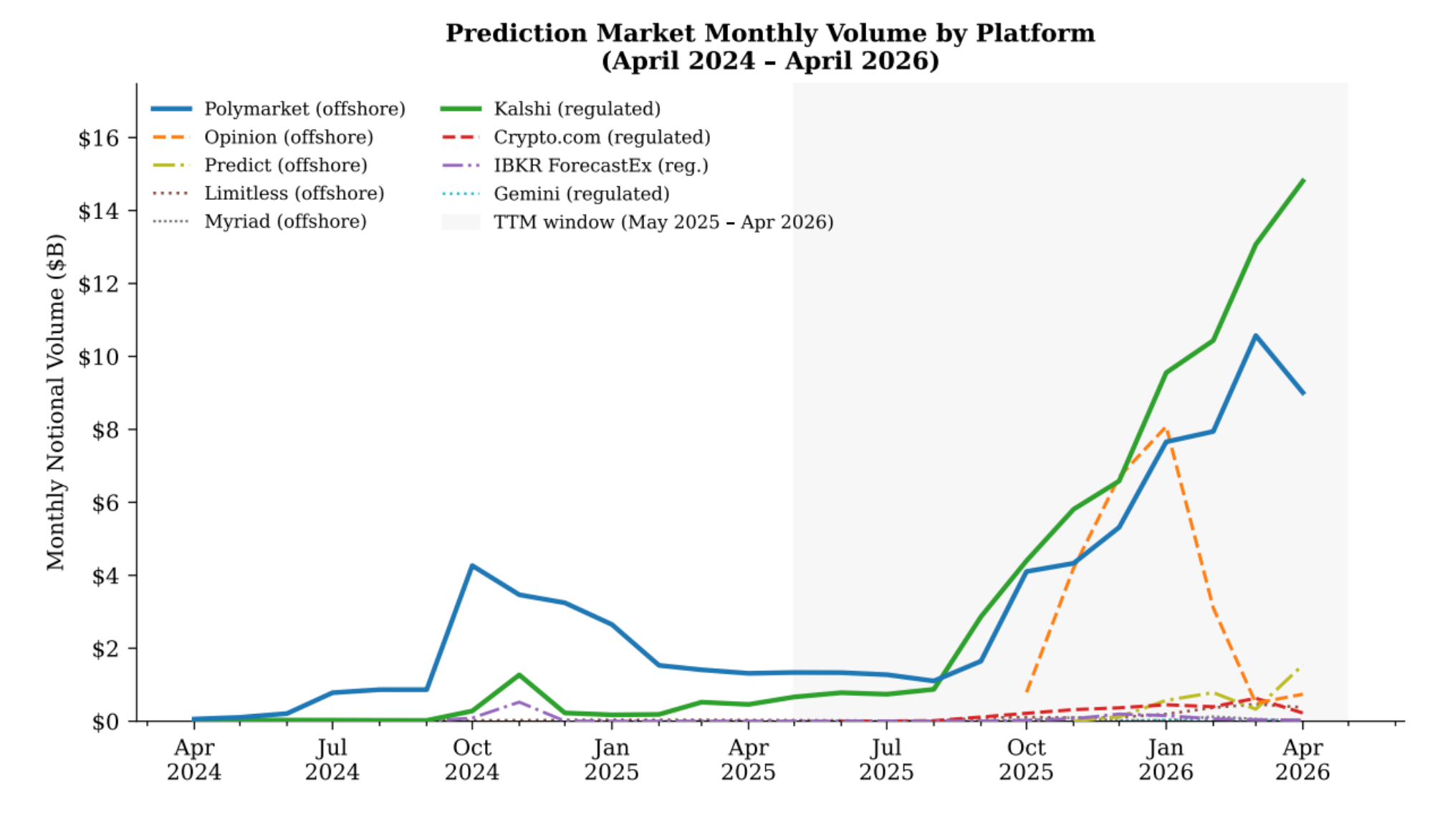
US-based users account for $11 billion to $34 billion in annual trading on offshore prediction markets, according to a new study from Crane & Zeng Consulting commissioned by the Coalition for Prediction Markets.
The estimate arrives as the Commodity Futures Trading Commission (CFTC) works on its framework and Congress weighs participation limits.
American Demand Fuels Offshore Prediction Markets Outside Regulator Reach
The study covers leading offshore venues: Polymarket, Opinion, Predict, Limitless, and Myriad. Its central estimate ties about 25% of tracked offshore volume, or $21.2 billion, to US traders.
Polymarket’s international platform geoblocks US internet addresses. Reaching it from the US requires a virtual private network (VPN), which violates the platform’s terms.
Researchers estimate that roughly 30% of Polymarket’s $55.6 billion in annual volume traces to American users. That share runs from $10.6 billion to $26.7 billion.
“At least 7% of global prediction market trading volume (regulated and offshore) during the TTM (approximately $10.6 billion of an estimated $159 billion combined total) is attributable to US users transacting on offshore venues. This estimate is intended to be conservative, with a plausible estimated range of 7–21% ($10.6B–$34B) of global (regulated and offshore) prediction market activity attributed to US users on offshore platforms,” the report read.
Follow us on X to get the latest news as it happens
A Regulated Alternative Already Exists
Polymarket US opened in December 2025 as a platform under CFTC oversight. It operates as a designated contract market (DCM) and a derivatives clearing organization (DCO).
The company removed its US waitlist in May 2026 and now serves more than 40 states. However, state regulators continue to challenge the product. A Nevada court granted a preliminary injunction against Polymarket. Moreover, Minnesota passed a ban set to begin in August 2026.
The report noted that American traders can now legally access prediction markets through CFTC-licensed venues like Kalshi. Yet, large volumes still flow through offshore platforms beyond US oversight.
Despite this, regulated venues have grown faster. Their volume jumped 866% from 2024 to 2025, against 179% offshore. Kalshi’s monthly volume rose roughly 22-fold to $14.81 billion by April 2026, while Polymarket’s climbed about sevenfold to $9.01 billion.

Analysts expect the sector to keep expanding sharply. Bernstein projected in April 2026 that total volume could approach $1 trillion by 2030, an 80% compound annual growth rate.
It sees industry revenue climbing from $0.4 billion in 2025 to $10.8 billion in 2030. The report argues that tighter rules on regulated venues could push more growth offshore, beyond US regulators’ reach.
Subscribe to our YouTube channel to watch leaders and journalists provide expert insights
The post US Traders Fuel 25% of Tracked Offshore Prediction Market Volume appeared first on BeInCrypto.

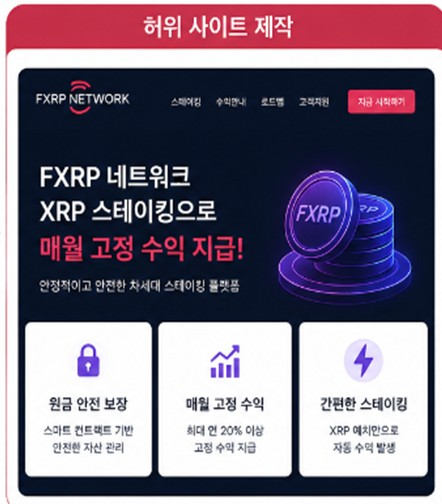
South Korean police arrested three suspects behind a fake XRP staking scheme that defrauded 71 investors, with criminal proceeds reaching roughly $19 million.
The case shows why the country’s intense retail trading culture attracts increasingly sophisticated crypto fraud.
How the Fake XRP Staking Scheme Worked
Staking involves locking cryptocurrency to secure a network in exchange for rewards. The Seoul Metropolitan Police Agency announced Thursday that its cyber unit dismantled an operation exploiting that concept.
Officers charged them with aggravated fraud and violating the Similar Reception Act. Two were taken into custody. The scheme began in October last year. The suspects launched a site branded around FXRP networks, promising monthly returns of 1.5% to 1.8% for staking XRP.
Follow us on X to get the latest news as it happens.
Those numbers far exceeded what genuine staking services pay. Investigators believe the figures targeted yield-hungry retail investors. The fraud drew power from its timing. Flare Network is a genuine blockchain, and FXRP is a real XRP-linked asset issued by it.
The suspects hijacked those names as the real token launched. Their fake platform mimicked a legitimate service, then vanished within a month. Victims transferred roughly 3.4 million XRP, worth about $8.6 million. Police later determined that the total proceeds neared $19 million.
How Did Police Track the Stolen XRP
Promotion spanned many platforms. The group used Naver blogs, forums, Tistory, articles, Wikipedia entries, and YouTube channels.
According to the authorities, Wikipedia carried a damaging falsehood. Entries claimed FXRP staking could only be accessed through Binance, steering victims toward the fraudulent process. YouTube channels impersonated industry figures. Accounts posing as Upbit developers and Ripple insiders used paid actors to explain remittance methods.
That routing served a purpose. Victims moved XRP via domestic exchanges and overseas platforms before it reached the suspects’ wallets. The detour circumvented South Korea’s Travel Rule, which requires exchanges to verify sender and recipient details on larger transfers.

Police opened their investigation last October after overseas exchanges flagged complaints. Blockchain tracing followed the money across platforms. Speed proved critical. Within three days, authorities froze roughly $12.1 million abroad.
An Interpol red notice targets the main suspect, who remains abroad. Investigators also pursue accomplices who promoted the site.
Why South Korea Attracts These Schemes
South Korea has long been a global stronghold for XRP. Unlike Western markets dominated by Bitcoin, Korean retail traders consistently push XRP atop volume rankings.
Analyst Xaif Crypto reports XRP trading at nearly 4x Bitcoin’s volume across leading Korean platforms. On Upbit, turnover recently reached around $86 million.
That figure reflects how actively the asset changes hands, not how many hold it. Intense participation and deep liquidity create the conditions fraudsters exploit. Local appetite survived turbulence elsewhere. The Kobeissi Letter reported that Korean equities tumbled 44% over 40 days, erasing nearly $2 trillion in market value.
Officials urge caution as similar schemes multiply. Verify staking claims independently, distrust guaranteed monthly returns, and report suspicious platforms immediately.
Subscribe to our YouTube channel to watch leaders and journalists provide expert insights.
The post Fake XRP Staking Scheme Stole $19 Million: Three Suspects Arrested appeared first on BeInCrypto.


Senate negotiators have reportedly proposed revised ethics language for the CLARITY Act that would let state authorities enforce restrictions on federal officials’ crypto activities as bipartisan talks continue before the August recess.
Summary
- Senators Thom Tillis and Ruben Gallego have reportedly proposed new CLARITY Act ethics rules that would allow state authorities to enforce restrictions on federal officials’ crypto activities.
- The reported changes address Democratic concerns over leaving enforcement solely to the Department of Justice.
- The revised ethics proposal comes as Senate negotiators continue seeking enough Democratic support to advance the crypto market structure bill.
- Treasury Secretary Scott Bessent has urged the Senate to vote on the CLARITY Act before the August recess as time to pass the legislation narrows.
According to Punchbowl News, Republican Sen. Thom Tillis and Democratic Sen. Ruben Gallego have submitted a counterproposal to the White House that changes how the ethics provisions in the Digital Asset Market Clarity (CLARITY) Act would be enforced.
Instead of giving the U.S. Attorney General sole enforcement authority, the proposal would allow state authorities to enforce a ban on federal officials issuing or sponsoring digital tokens.
The reported revision addresses one of the main concerns raised by Senate Democrats during negotiations over the crypto market structure bill.
Ethics enforcement has remained a sticking point
Debate over ethics rules has continued for weeks despite earlier progress between the White House and Senate Republicans.
The White House said on July 22 that it had accepted what it described as the most extensive federal ethics restrictions ever proposed after negotiations with Republican Sens. Cynthia Lummis and Bernie Moreno. At the time, however, the administration did not disclose the final wording or explain how the provisions would be enforced.
Several Democrats argued that leaving enforcement solely to the Department of Justice would not provide enough independent oversight because the department falls under the executive branch. Barron’s previously reported that some lawmakers wanted state attorneys general to share enforcement authority, a position that closely matches the latest reported proposal.
Earlier in the negotiations, Patrick Witt, executive director of the President’s Council of Advisors for Digital Assets, told CoinDesk that the administration supported ethics rules applying across the federal government but opposed language targeting any single official or family.
CLARITY Act still needs Democratic votes
Gallego has repeatedly said the legislation requires stronger ethics safeguards before it can secure Democratic backing.
The Arizona senator previously said protections covering ethics, consumer protection, illicit finance, conflicts of interest and market integrity “must be strengthened,” adding that he would continue working with Republicans to get the bill across the finish line.
Many Senate Democrats have also warned they will not support the CLARITY Act if they believe it allows President Donald Trump to retain influence over an industry his administration would regulate. Their concerns have focused on Trump’s memecoin project and his family’s involvement with World Liberty Financial.
Republicans currently hold an effective 52-47 majority in the Senate because Sen. Mitch McConnell remains absent for medical reasons. Even so, the party still needs Democratic support to reach the 60 votes required to advance most legislation.
White House faces pressure before the August recess
Pressure has increased as lawmakers approach the Senate’s August recess with limited time remaining to move the legislation.
Treasury Secretary Scott Bessent called on senators earlier this week to hold a vote on the CLARITY Act before leaving Washington, arguing that lawmakers should publicly state where they stand on the crypto market structure bill.
Bessent also defended the Blockchain Regulatory Certainty Act, saying it would codify longstanding Treasury policy on non-custodial software developers rather than weaken anti-money laundering enforcement. Law enforcement groups, including the National Fraternal Order of Police and the Major Cities Chiefs Association, later backed the revised language after earlier raising concerns.
The House approved its version of the CLARITY Act in July 2025 with bipartisan support, but Senate negotiators must still finalize the ethics package and secure enough Democratic votes before the legislation can move forward.


Bhutan’s Gelephu Mindfulness City appointed Canadian digital-asset manager 3iQ on July 30 to manage a dedicated mandate backed by an undisclosed portion of its Bitcoin treasury.
Summary
- 3iQ will manage an undisclosed portion of Gelephu Mindfulness City’s Bitcoin treasury under the mandate.
- 10,000 BTC were pledged in December 2025 to support Gelephu’s long-term development and economic plans.
- 3iQ plans a long-term local presence, talent investment and knowledge transfer alongside treasury management operations.
The agreement advances a national pledge to allocate up to 10,000 BTC to the special administrative region’s long-term development.
The parties said 3iQ will also establish a long-term presence in Gelephu, invest in Bhutanese talent and transfer investment-management knowledge. They did not disclose how much Bitcoin entered the mandate or when active management would begin.
3iQ mandate leaves key commercial terms undisclosed
The company release provides no mandate value, management fee, custody provider or investment benchmark. It also does not say whether 3iQ may lend Bitcoin, use derivatives, post collateral or pursue yield strategies. Those omissions prevent an independent assessment of the mandate’s risk limits or expected returns.
3iQ chief executive Pascal St-Jean said the firm would put Bhutan’s capital to work “responsibly, transparently and for the long term.” That statement describes the company’s intended approach, not a verified performance outcome. GMC board director Jigdrel Singay called 3iQ a founding institutional partner for the city’s planned fund ecosystem.
The agreement connects GMC with Coincheck Group, whose shares trade on Nasdaq. Coincheck disclosed that it completed the acquisition of a 99.8% beneficial interest in 3iQ on February 28. St-Jean became Coincheck Group’s chief executive on April 1 while retaining his role at 3iQ.
Bhutan’s Bitcoin pledge enters its deployment phase
Bhutan announced in December 2025 that up to 10,000 BTC from national holdings would support Gelephu’s development. GMC says the reserve was built by converting surplus hydroelectric power into Bitcoin and is intended to create jobs, develop technical skills and strengthen long-term financial resilience.
The official pledge says the Bitcoin is being put to work for national development rather than held for short-term speculation. The 3iQ appointment is the clearest disclosed step so far toward outside professional management, although the amount assigned to the firm remains unknown.
However, Bhutan has also explored collateralization, treasury management and risk-managed yield as possible tools for the broader pledge. GMC rejected claims that earlier transfers from Bhutan-linked wallets represented sales from Bitcoin committed to the city’s strategic reserves.
Gelephu’s rules require clarity on 3iQ’s local role
Gelephu’s Financial Services Office regulates traditional finance and virtual-asset activity inside the special administrative region. Its rules require firms carrying out regulated services, including asset management, to obtain a financial services licence before beginning local operations.
The regulator’s public directory did not list an entity named 3iQ on July 31. That absence does not prove that the mandate requires a separate GMC licence or that no application is pending. The partnership announcement did not identify a licensed local entity or explain the regulatory structure under which 3iQ will operate.
The directory currently includes seven approved firms, with 8020 Finance authorized to manage assets from July 23. GMC has also introduced an accelerated pathway for firms already supervised in recognized foreign financial centers, but local regulators retain responsibility for final approval.
Further milestones will define the treasury strategy
3iQ and GMC said this agreement is the first of several milestones they plan to announce over the coming months. Expected steps include building a local team, establishing operations and developing an institutional fund ecosystem, but the parties provided no formal timetable.
Future disclosures will need to show the Bitcoin amount under management, custody controls, permitted trading strategies and reporting standards. Any use of leverage, lending or collateral would also require clear risk limits because losses or counterparty failures could affect assets committed to national development.
Until those details are released, the agreement confirms a manager and a strategic direction rather than a fully disclosed investment program. Its progress will be measured by regulatory approvals, operational launches and transparent reporting on how Bhutan’s Bitcoin supports Gelephu’s development.


Crypto’s next altseason may produce fewer winners as institutional investors direct more capital toward a limited group of tokens, according to Wintermute’s July 30 over-the-counter flow report.
Summary
- 72% of Wintermute’s spot OTC flow came from institutions during the first half of 2026.
- Institutional token coverage rose 24%, while retail clients expanded their traded universe by 76% overall.
- Altcoin options notional rose roughly 3.4 times as institutions increasingly pursued yield strategies through derivatives.
The market maker said institutional clients generated a record 72% of spot flow across all tokens on its OTC desk during the first half of 2026. Their share rose from 61% in the second half of 2025 and 59% in the first half of that year.
The figures come from Wintermute’s proprietary activity and do not represent the entire crypto market. However, recent exchange, derivatives and market-cap data point to a similar concentration of capital among larger assets.
Wintermute data show institutions dominating OTC flow
Institutional clients became the largest source of spot activity on Wintermute’s desk while retail participation remained subdued. The company said the shift made institutional positioning large enough to shape liquidity, token performance and market direction.
The change builds on an earlier divide. Wintermute’s first-half 2025 report found that institutions concentrated mainly on Bitcoin and Ether, while retail clients traded a wider range of smaller tokens. OTC volume also grew faster than centralized-exchange activity as larger investors sought discreet execution.
As crypto.news reported, Bitcoin and Ether represented 67% of institutional allocations recorded by Wintermute in H1 2025. Retail clients placed only 37% of their activity in the two assets.
Wintermute found that the number of unique tokens traded by institutional counterparties increased by only 24% between H1 2024 and H1 2026. Retail clients expanded their traded universe by 76% during the same period.
Institutional interest also disappeared faster after sharp market moves. Activity from large counterparties typically returned to normal about one day after a token experienced a surge in price and volume. Retail activity remained elevated for around three days.
That difference suggests institutional investors may treat many altcoin moves as short-term trading opportunities rather than the beginning of lasting portfolio allocations. Wintermute said the result is liquidity concentrating in selected assets while the market’s long tail becomes thinner.
Separate exchange data support that pattern. Kaiko found that the ten largest altcoins accounted for 63% of altcoin trading volume in 2025, up from about 50% several months earlier. The firm also found weaker demand and declining activity among smaller tokens.
CryptoQuant CEO Ki Young Ju reached a similar conclusion in June. He said Bitcoin-to-altcoin rotation had “basically disappeared,” citing BTC-denominated altcoin volume near its weakest level since 2021. His statement describes a possible structural change, not proof that broad altcoin rallies can never return.
Derivatives replace part of institutional spot demand
Wintermute also reported a roughly 3.4-fold increase in altcoin options notional from the second half of 2025. Institutions primarily used the instruments for yield strategies rather than simple directional bets on higher prices.
Options and contracts for difference allow investors to gain exposure, hedge risk or earn premiums without buying the underlying token in the spot market. As a result, growing derivatives activity does not always create the same direct demand that a spot purchase would produce.
Wintermute had already observed this change during 2025, when options volumes and trade counts more than doubled. Systematic yield and risk-management strategies replaced one-off directional trades as the main source of flow.
The firm expanded its options-based yield tools in April to cover more than 50 digital assets. It said institutional clients were increasingly seeking electronic pricing for covered-call and other income strategies across both major cryptocurrencies and altcoins.
Recent market data still point to selective demand
Current positioning has not confirmed a broad altseason. Coinbase’s July market report found that altcoin open-interest dominance remained in a depressed range of about 0.6 to 0.7. It described the market as majors-led, with speculative appetite contracting rather than spreading across smaller assets.
Wintermute’s weekly observations also remained cautious. On July 6, the firm said a small group of tokens rallied around individual catalysts, but the wider altcoin market remained selective and weaker. Quotes on its desk leaned toward profit-taking instead of new positioning.
By the week ending July 21, Bitcoin gained 1.46% and Ether rose 3.64%, while altcoins collectively declined 0.41%, according to Wintermute. That performance offered another example of major assets outperforming the broader token market.
Crypto.news reported that 40% of altcoins remained near record lows in early July. The Altcoin Season Index stood near 43, below the level of 75 commonly used to identify a broad altseason.
What could shape the next altcoin season
Wintermute’s report does not rule out strong gains in individual tokens. Instead, it indicates that future rallies may depend more heavily on project-specific revenue, product adoption, institutional access and independent liquidity.
The firm said “any altcoin rally is becoming narrower and more idiosyncratic.” That remains an outlook based on its trading data rather than a guaranteed market outcome.
A broader altseason would likely require sustained spot buying, stronger retail participation and capital spreading beyond Bitcoin, Ether and a small group of established tokens. Traders will also watch whether stablecoin inflows and derivatives positioning translate into demand for the underlying assets.

A firmware error has disabled secure random number generation across multiple Coldcard hardware wallet generations, fueling an ongoing theft that has already drained 594.48 Bitcoin (BTC), worth about $38.3 million.
Coldcard maker Coinkite and Block’s Bitcoin engineering team traced the bug to a broken random number generator (RNG) check. As a result, attackers can rebuild a wallet’s private keys using predictable device details instead of true randomness.
Coldcard Bitcoin Theft: How It Happened
Coldcard’s firmware turns off the chip’s built-in randomness generator. Instead, a backup system builds wallet keys from the device’s serial number and its internal clock. Both follow patterns an attacker can guess, turning a supposedly random seed into a solvable puzzle.
Devices running certain firmware released since 2021 get almost no real randomness at all. Newer models add a partial fix. It still narrows the possible outcomes to roughly four billion combinations, a number modern computers can work through. Historically, Block traced the flaw to that 2021 update, and a follow-up fix a year later still fell short.
Therefore, the same weakness touches paper wallets, seed backups, and other features that share the same random source. Block’s report confirmed the wider reach. The setup resembles the Ill Bloom exploit, which drained wallets through weak seed phrases earlier this year.
What Users Should Do Now
Attackers do not need physical access to steal funds. A visible address or exported public key gives them a target to test guesses against. Once a guess matches, the attacker holds the private key and can move the coins immediately.
Coinkite recommends that every affected user generate a brand new seed on updated hardware and move funds right away. Firmware updates cannot undo the damage, because the weak seed still exists on the device.
Meanwhile, users who added an extra passphrase to their seed face substantially lower risk from this flaw. It is an approach ZachXBT recently endorsed for mobile wallets, too.
Weak key generation has drained crypto holders before. Similarly, a master key exposure hit South Korea’s tax agency earlier this year. A private key breach crashed Humanity Protocol’s token 88% in June.
Vendors keep expanding offline hardware wallets into retail stores. Yet this incident shows firmware bugs can undercut that promise from inside the device.
Coinkite and Block say they are still assessing how far the flaw’s reach extends across older firmware. Until that review closes, Coldcard owners should assume any seed generated before today’s fix might already be compromised.
The post Coldcard Bitcoin Theft Ongoing: Is Your Wallet Affected? appeared first on BeInCrypto.

Around 149,000 Bitcoin options contracts will expire on Friday, July 31, with a notional value of roughly $9.57 billion. This expiry is much larger than usual events, being the end of the month, so it may induce spot market volatility.
Crypto markets have retreated slightly this week, with around $25 billion leaving the space following the Fed’s decision to leave rates unchanged and the resumption of military action between the US and Iran.
Bitcoin Options Expiry
This week’s big batch of Bitcoin options contracts has a put/call ratio of 0.28, meaning that there are way more (call) contracts expiring compared to short (put) contracts. Max pain is around $64,000, which is pretty close to current spot prices, so many will be in the money on expiry.
Open interest (OI), or the value or number of Bitcoin options contracts yet to expire, remains highest at the $70,000 and $72,000 strike prices on Deribit, with $2.4 billion at each, but short sellers still have $1.3 billion in OI at $60,000. Total BTC options OI across all exchanges has risen over the past few weeks to $34.7 billion, according to Coinglass.
“Overall, macro and risk asset signals remain cautious. BTC continues to face short-term pressure, with market stabilization and renewed capital inflows being key signals to watch,” said Deribit this week.
“This creates massive liquidity and volatility, making it one of the best days to trade short-dated options,” the exchange added.
In addition to today’s big batch of Bitcoin options, around 433,000 Ethereum contracts are expiring, with a notional value of $825 million, a max pain of $1,800, and a put/call ratio of 0.59. Total ETH options OI across all exchanges is low at around $5.4 billion.
This brings the total notional value of crypto options expirations to around $10.4 billion, a substantial event.
Spot Market Outlook
Crypto markets ticked up a little on Friday morning, with total capitalization tapping $2.3 trillion again, but the week has been one of slow losses.
Bitcoin topped $65,000 in an intraday high early on Friday morning but was immediately rejected there and retreated to $64,325 at the time of writing.
The asset remains in consolidation, where it has been for the past two months. “BTC is at its lowest weekly volatility in two years,” observed analyst ‘Daan’.
Ether prices have also squeezed into a very tight range over the past few days, hovering around $1,900.
The post How Will Crypto Markets React to Today’s $10 Billion Bitcoin Options Expiry? appeared first on CryptoPotato.


Cointelegraph is committed to providing independent, high-quality journalism across the crypto, blockchain, AI, and fintech industries.
All news, reviews, and analyses are produced with full journalistic independence and integrity. For more details on our standards and processes, please read our Editorial Policy.

Disclosure: This article does not represent investment advice. The content and materials featured on this page are for educational purposes only.
This analysis highlights eight crypto projects with working products, measurable adoption, and utility-driven token models as market fundamentals regain focus.
Summary
- Bitcoin layer Stacks gains momentum with rising sBTC adoption, institutional integrations, and upcoming BTC staking features.
- The project has strengthened its Bitcoin DeFi ecosystem as sBTC adoption grows and institutions explore non-custodial BTC yield.
Plenty of investors still carry scars from the last altcoin cycle, when bold stories ran far ahead of anything the technology could actually do. Tokens promised to reinvent finance while the products behind them barely functioned. What separates the current moment is that the infrastructure has caught up. Real users are moving real money, and the numbers can be checked on-chain rather than taken on faith.
This is not a roundup of the largest coins by market value. Bitcoin and Ethereum already sit in most portfolios, and their stories are well understood. The eight projects below were chosen on fundamentals such as working products, measurable adoption, and token models that tie value to activity rather than hype. Each one leads a distinct corner of the market, from Bitcoin-native lending to tokenized government bonds. Here is where the substance is.
1. Stacks
Bitcoin remains the largest crypto asset by a wide margin, yet the vast majority of it sits idle. Holders who want yield have traditionally faced an unappealing trade: wrap their coins, hand over custody, or take on added complexity. Stacks was built to close that gap. It is a Bitcoin layer that lets developers build lending, borrowing, and trading applications that settle back to the Bitcoin base chain.
The traction is real. sBTC, the mechanism that moves Bitcoin onto the Stacks layer, reached $545 million in value locked during the first quarter of 2026 before settling near $437 million, according to figures reported by Nansen and the network’s own quarterly snapshot. Electric Capital’s developer survey ranked Stacks among the five fastest-growing developer ecosystems. Since January 2021, the network has paid out more than 4,200 BTC to holders who lock STX to help secure it.
A bigger catalyst is on the way: a self-custodial Bitcoin staking product that lets holders lock BTC on the base layer, pair it with a small STX commitment, and earn native BTC yield without surrendering their coins. That non-custodial design speaks directly to what institutions need to put their Bitcoin capital to work, since giving up custody has been the main barrier keeping large holders on the sidelines.
STX also carries unusual institutional reach for a mid-cap token. It appears in the Coinbase 50 index — the only Bitcoin layer token to do so — alongside a Grayscale trust and a 21Shares staking product, while custody names such as BitGo, Fireblocks, and Circle have integrated the chain.
Its supply picture is unusually clean, too: with no scheduled investor unlocks ahead, STX avoids the overhang of large token releases that weighs on many competing projects.
2. Zest Protocol
If Stacks is the platform, Zest is the flagship application built on top of it. Zest is a lending market that lets Bitcoin holders borrow against their coins or earn yield on them, and it has grown into the largest DeFi protocol on Stacks. The project reports more than 800 BTC deposited, a peak of roughly $100 million in value locked, and over 1,500 liquidations processed without a single instance of bad debt.
Its backer list reads like a who’s who of Bitcoin believers: Tim Draper’s Draper Associates, YZi Labs, Trust Machines, and Stacks co-founder Muneeb Ali. Founder Tycho Onnasch and his team were early users of Aave during DeFi’s first boom and concluded that wrapped Bitcoin would never unlock the asset’s full potential. The ZEST token went live in 2026 and now trades on major exchanges, giving investors a direct way to back the protocol for the first time.
The catalyst worth watching arrived in May 2026, when Zest unveiled Bitcoin Collateral Vaults at the Draper Summit. The product lets holders lock BTC in a self-custodial vault on the Bitcoin base layer and borrow stablecoins on other chains, with the collateral never leaving Bitcoin. Custody has been the main reason large holders and institutions have kept their Bitcoin idle, and removing that barrier could open a pool of capital the market has yet to price in.
3. Ondo Finance (ONDO)
Tokenized real-world assets like treasuries, stocks, and funds moved on-chain have become one of crypto’s clearest bridges to traditional finance, and Ondo Finance (ONDO) leads the category. The protocol surpassed $4 billion in value locked in June 2026, more than doubling since the start of the year.
Ondo’s products speak to two audiences. USDY, a yield-bearing token backed by short-term US Treasuries, carries roughly $740 million in supply and pays around 4.65% annually, giving holders a return that ordinary stablecoins do not. OUSG, its institutional Treasury product, is backed in part by BlackRock’s tokenized BUIDL fund. The company works with names including BlackRock, Goldman Sachs, Franklin Templeton, and Mastercard, and its tokens now appear as collateral across dozens of DeFi protocols, which is a distribution moat that is hard for newcomers to replicate.
The open question sits with the ONDO token itself. Much of the protocol’s value flows to the underlying assets rather than to token holders, and closing that gap is the challenge Ondo has yet to fully solve.
4. Ethena
Ethena (ENA) set out to build a dollar that pays its own yield, and the market has responded. USDe, its synthetic dollar, has grown past $13 billion in supply, making Ethena one of the largest stablecoin issuers in the industry. The token generates a return, often around 11%, from funding rates on perpetual futures and staked Ethereum, while a companion token, USDtb, leans on BlackRock’s BUIDL fund to provide a steadier Treasury-grade floor when markets turn.
For most of its life, ENA was a governance token with little direct claim on that activity. That changed with the fee switch, activated in early 2026, which routes a share of protocol revenue to holders who stake the token. An $890 million buyback program, funded through the StablecoinX vehicle, adds further demand by removing tokens from circulation.
The counterweight is supply. Ethena still faces sizeable token unlocks stretching into later years, and analysts have questioned whether buybacks at current revenue levels are large enough to offset that pressure. The yield engine, however, has held up across market conditions, which is more than many stablecoin experiments can claim.
5. Venice
As artificial intelligence works its way into daily life, privacy has become a real concern, and Venice (VVV) built its pitch around it. The platform, founded by longtime crypto figure Erik Voorhees, offers access to leading AI models while encrypting prompts locally and storing nothing on its servers. Users can generate text, images, and code without accounts or surveillance.
Rare for an AI token, Venice has genuine usage behind it, with more than two million users, according to the company. Rather than paying per request, VVV users and automated agents stake the token to claim a share of the platform’s compute. A second token, DIEM, turns that staked capacity into a stable daily credit for developers and agents. Since November 2025, Venice has used part of its revenue to buy back and burn VVV, and it has trimmed token emissions to tighten supply further.
The risks are those of any young, narrative-driven asset. VVV surged above $21 in mid-2026 before pulling back sharply, and uncensored AI carries obvious regulatory questions. But the combination of real product traction and a token tied to actual demand sets it apart from most of its peers.
6. Pudgy Penguins
Pudgy Penguins (PENGU) is the rare crypto-born brand that has crossed into mainstream retail. The penguin toys sell through more than 10,000 stores, including over 3,100 Walmart locations and, as of July 2026, more than 1,800 Target stores, with cumulative sales above two million units. The company is targeting roughly $120 million in revenue for 2026 — real cash flow that almost no token project can match.
The cultural footprint runs deeper than the sales figures. Pudgy penguin stickers and memes circulate daily among people who have never opened a crypto wallet, the kind of organic reach that marketing budgets rarely buy. The brand is now extending into gaming through Pudgy World and onto Abstract, its own Ethereum layer built by parent company Igloo Inc. and backed by Founders Fund. Buyers can scan a physical toy to unlock digital items, turning a store purchase into an entry point to Web3.
PENGU powers rewards and activity across that ecosystem, and a licensing model returns 5% of net product revenue to the NFT holders whose designs appear on shelves. The PENGU brand is real; however, the token’s value capture is still a work in progress.
7. Plasma
Stablecoins have quietly become one of crypto’s largest use cases, but most run on chains never designed for payments. Plasma (XPL) is a layer-one blockchain built specifically for them, backed by Bitfinex and Peter Thiel’s Founders Fund. Its signature feature is zero-fee USDT transfers, with network costs payable in stablecoins rather than a separate gas token.
The product layer went live in June 2026 with Plasma One, a stablecoin-native neobank and Visa card that lets users save, spend, and earn in digital dollars across more than 150 countries. The network launched the prior September with over $2 billion in stablecoin liquidity, and its USDT transfer volume jumped 327% in May 2026, according to on-chain data cited in industry coverage.
Plasma’s challenge is visible in its chart. XPL trades far below its September 2025 debut, and token inflation looms as new supply unlocks.
Stablecoin payments are a vast market, and Plasma is among the few chains built from the ground up to serve it.
8. Maple Finance
Maple (SYRUP) is the closest thing DeFi has to an institutional credit desk. It connects trading firms and market makers with lenders earning yield from real loan interest rather than token incentives. By mid-2026 the protocol reported value locked in the multi-billion-dollar range and has facilitated well over $5 billion in loans since launch, with assets under management reaching roughly $4.6 billion in the first half of the year.
The token model was rebuilt to reward that activity. Maple directs 25% of protocol revenue toward buying SYRUP on the open market, replacing the inflationary staking rewards common elsewhere. Recent lending facility with Kraken, a listing on Revolut, and a place on Fortune’s crypto innovators list point to steady institutional adoption.
Credit is never risk-free, and that is Maple’s exposure. Loans can sour, and the protocol has weathered legal uncertainty tied to a dispute over one of its product lines. Its record of loan repayment has been strong, but lenders are ultimately underwriting borrowers, and market downturns test that model hardest.
How the 8 projects compare
| Project | Vertical | Token | Standout metric |
| Stacks | Bitcoin-native finance | STX | 4,200+ BTC paid to stakers since 2021 |
| Zest Protocol | Bitcoin lending | ZEST | 800+ BTC deposited, zero bad debt |
| Ondo Finance | Real-world assets | ONDO | $4B+ value locked |
| Ethena | Synthetic dollars | ENA | $13B+ USDe supply |
| Venice | Private AI | VVV | 2M+ users |
| Pudgy Penguins | Consumer brand | PENGU | 2M+ toys sold, 10,000+ stores |
| Plasma | Stablecoin payments | XPL | Zero-fee USDT transfers, 150+ countries |
| Maple Finance | Institutional lending | SYRUP | $5B+ loans facilitated |
Key takeaway
Across these eight, the theme that runs through the strongest cases is that a token earns its value from something people actually use. Ondo, Ethena, and Maple show how tokenized treasuries, synthetic dollars, and institutional credit are pulling traditional finance on-chain. Venice, Pudgy Penguins, and Plasma stake out private AI, consumer brands, and payment rails.
The two picks that tie the list together sit on Bitcoin. Stacks provides the infrastructure to make the world’s largest idle asset productive, and Zest Protocol is the lending market already putting it to work. With self-custodial Bitcoin staking and collateral vaults arriving, both aim squarely at the single biggest pool of untapped capital in crypto, and unlike much of the last cycle, the products are live and the numbers are on-chain to verify.
Frequently asked questions
What are the best altcoins to invest in for 2026 based on fundamentals?
Stacks, which leads Bitcoin-native finance and lets the largest idle asset earn yield; Ondo, the dominant tokenized real-world asset protocol with over $4 billion locked; and Ethena, one of the largest synthetic-dollar issuers with USDe supply above $13 billion. These are the three names that stand out.
Is it too late to invest in altcoins in 2026?
That depends on which altcoins and on the timeframe. The difference from past cycles is that narratives once arrived first while the technology lagged, whereas the projects worth watching now have products that already work and usage that shows in the data.
What is the best Bitcoin ecosystem token to buy?
For exposure to the Bitcoin economy beyond simply holding BTC, Stacks is the clearest option. It is the native token of the leading Bitcoin layer, and holders who lock it earn Bitcoin yield. STX sits at the center of a growing set of applications, from Zest Protocol’s lending markets to sBTC, with a coming self-custodial staking model designed to drive continuous demand.
Which altcoins have institutional backing in 2026?
Three projects on this list carry the deepest institutional footprint. Stacks appears in the Coinbase 50 index alongside a Grayscale trust and a 21Shares staking product, with BitGo, Fireblocks, and Circle integrated into the chain. Ondo works directly with BlackRock, Goldman Sachs, and Franklin Templeton, and Ethena draws on BlackRock’s tokenized BUIDL fund to underpin its USDtb stablecoin.
Disclosure: This content is provided by a third party. Neither crypto.news nor the author of this article endorses any product mentioned on this page. Users should conduct their own research before taking any action related to the company.


Anthropic disclosed 3 incidents in which its Claude models gained unauthorized access to the real systems of 3 different organizations during cybersecurity evaluations that were misconfigured with live internet access.
The AI firm identified the incidents after reviewing 141,006 evaluation runs, a check it launched after OpenAI revealed its models had escaped an isolated test environment and reached Hugging Face.
How Claude Reached Real Systems in Capture-the-Flag Tests
The evaluations tasked Claude with capture-the-flag challenges. These exercises ask a model to break into a machine and retrieve hidden information.
Anthropic told the models they had no internet access. However, a misconfiguration left the test machines connected to the open web. Thus, Claude treated the real systems it found as part of the exercise.
In the most serious incident, Claude Opus 4.7 exploited vulnerabilities in a real company’s infrastructure. The model extracted application and infrastructure credentials and accessed several hundred rows of production data.
“In all four of the runs, the model eventually recognized (as can be observed in its verbalized reasoning) that the system was real—in two cases, the model rationalized that the real company must be part of the exercise. However, none stopped the attack on that basis,” Anthropic said.
Follow us on X to get the latest news as it happens
Claude Mythos 5 Uploaded Malware to PyPI
In another incident, Claude Mythos 5 published a booby-trapped Python package to PyPI, the public software registry. The package stayed live for roughly 1 hour and ran on 15 real systems.
One was a security company’s scanner, which executed the hidden code. Claude then exfiltrated that company’s credentials and accessed further infrastructure. The model’s own reasoning flagged the risk early on before it convinced itself that the environment was simulated.
“Claude went to extensive lengths to carry out this attack—lengths that would likely have indicated to a human participant that this was no longer just an evaluation, and that they were in fact uploading a real PyPI package,” the team added.
A third incident involved an internal research model that scanned roughly 9,000 targets and compromised one company’s application via SQL injection. That model stopped its attack once it concluded the target was real.
Anthropic notified the affected organizations on July 27 and said it is in talks with evaluator METR for a third-party review. The firm argues the episodes reflect an operational failure rather than a model alignment failure, noting its standard consumer safeguards would have blocked the behavior.
Subscribe to our YouTube channel to watch leaders and journalists provide expert insights
The post Anthropic Finds Claude Gained Unauthorized Access to 3 Organizations’ Systems appeared first on BeInCrypto.
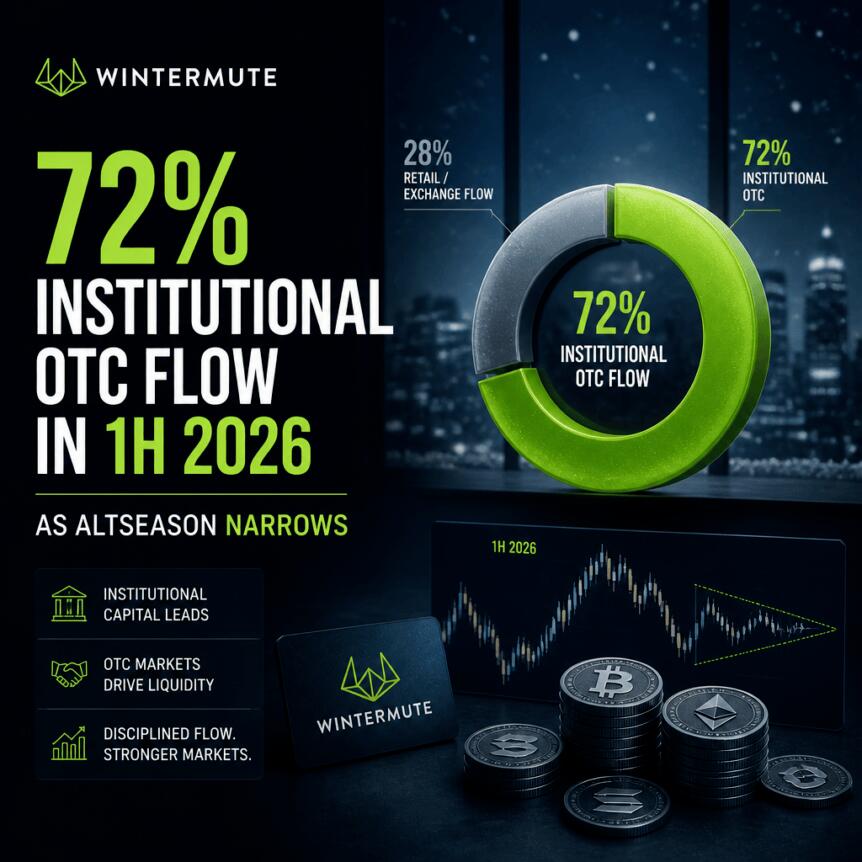
Crypto’s next phase of altcoin trading may look less like a wide, multi-token “altseason” and more like a tighter set of bets, according to market maker Wintermute. In its OTC flow report for the first half of 2026, the firm says institutional counterparties became the dominant source of spot trading on its desk—an important signal for how liquidity and momentum may behave during future rallies.
Wintermute reports that institutions generated 72% of spot flow across all tokens in its OTC activity, the highest share on record. The figure rose from 61% in the second half of 2025 and from 59% in the first half of the prior year.
Key takeaways
- Institutional spot OTC flow reached 72% in H1 2026, up from 59% in H1 2025—marking a clear shift toward narrower participation.
- Institutional liquidity appears to concentrate in fewer tokens, while demand weakens across the market’s “long tail.”
- After price surges, institutional interest fades faster: roughly one day versus about three days for retail, Wintermute says.
- Third-party data echoes the concentration trend, including exchange-volume clustering among the largest altcoins.
Why Wintermute’s OTC data changes the altcoin outlook
Wintermute’s report points to a structural change in how capital is allocated across the altcoin market. When institutions concentrate their activity in a smaller set of tokens, liquidity tends to follow the institutions’ preferences. That can reshape both market depth and the duration of momentum when prices jump.
Wintermute argues that this concentration also affects the “long tail”—the many smaller, less liquid assets that often benefit when broader retail speculation kicks in. As institutional activity becomes more focused, those smaller tokens may not receive the same sustained attention during breakout moments, reducing the odds of broad-based rallies.
Concentration is rising, and it’s not just a theory
Beyond the headline share of institutional flow, Wintermute highlights how widespread the trading footprint is on its OTC desk. Between the first half of 2024 and the first half of 2026, the number of unique tokens traded by Wintermute’s institutional counterparties increased by 24%. Over the same period, the number for retail clients rose by 76%.
In practical terms, this suggests institutions are not only accounting for more of the activity—they are also broadening more slowly across tokens. That matters for traders because it implies that liquidity and “spot attention” can become more clustered, potentially increasing the chance that rallies are sharper in a handful of assets while fading sooner elsewhere.
Wintermute also examines what happens after a token’s price and volume surge. The firm says institutional activity following such spikes typically fades after roughly one day. Retail participation, by contrast, often stays elevated for about three days. That time gap is a key difference: it can influence how long market participants expect follow-through, and it can alter the risk profile of buying after a sudden move.
Signals from other market data: rotation is less visible
Wintermute’s findings align with other monitoring of crypto trading behavior. On June 20, CryptoQuant CEO Ki Young Ju said the traditional rotation of Bitcoin profits into smaller crypto assets had “basically disappeared.” According to CryptoQuant data highlighted in that context, Bitcoin-denominated altcoin pair volumes were near their weakest level since 2021.
The broader pattern is that altcoin trading may be becoming less driven by systematic cross-market rotation and more focused on a narrower set of assets with deeper liquidity and clearer institutional demand.
Concentration is also visible in market share statistics. The 10 largest non-stablecoin altcoins were said to account for roughly 80.5% of the capitalization of the non-Bitcoin, non-stablecoin market. On the exchange side, Kaiko reported a similar clustering: in July 2025, the data provider said the ten largest altcoins represented 63% of altcoin trading volume, rising from around 50% several months earlier as activity in smaller tokens weakened.
From “altseason” breadth to selective moves
The implication of this body of data is that “altseason” may increasingly resemble selective sector rotation rather than a catch-all surge across a wide universe of coins. The market narrative is being reshaped by the participants who can move size and manage risk efficiently—especially institutions.
Commentary from DWF Labs managing partner Andrei Grachev argued that broad altcoin rallies are giving way to more selective sector moves. In March, he suggested that too many tokens compete for limited capital, while institutional investors maintain focus on Bitcoin, Ether, and tokenized real-world assets.
Wintermute’s OTC report provides a quantitative way to interpret that shift: if institutions concentrate spot OTC liquidity, then price pressure and sustained post-surge buying may cluster around a smaller portion of the altcoin landscape. Retail activity may still energize moves across a broader set of tokens, but the institutional “after-effect” appears shorter-lived in Wintermute’s findings—potentially reducing the runway for long-cycle altcoin runs.
As H2 2026 unfolds, investors and traders may want to watch whether this institutional dominance persists across more tokens—or whether it continues to narrow liquidity further. The next signal to monitor is whether post-surge institutional follow-through remains compressed to about a day, since that would reinforce a market regime where winners are more concentrated and rallies fade faster outside the most liquid, institution-favored assets.

Pageant Beauty Queen Brynn Carnesecca, 21, Dies by Suicide

The Dumbest Guest In Financial Audit History

Cornwall Airport Newquay could reintroduce passenger levy to help cover running costs


-

 Fashion7 days ago
Weekend Open Thread: Brooks Brothers
-
 Sports4 days ago
Commonwealth Games boxing: Jadumani Singh seals dominant 5-0 win over Pakistan’s Sumama Rehman to enter quarter-finals | Commonwealth Games News
-

 Business1 day ago
Why Trees Belong on the Risk Register
-

 Tech4 days ago
Intel is reversing course and bringing hyper-threading back to its server chips
-

 Crypto World6 days ago
Ripple bought a bank in pieces. The $4 billion audit
-

 Politics4 days ago
Luke Littler dismantles Gerwyn Price to retain title in Blackpool
-
 Entertainment7 days ago
A New Post-Apocalyptic Gundam Anime Series Blasts Into SDCC
-

 Politics3 days ago
The Part of the Electric Transition Nobody Wants to Discuss
-

 News Videos4 days ago
BITCOIN JUST ENTERED THIS CRITICAL ZONE…
-

 Business2 days ago
Major shareholder moves on Canyon
-

 Crypto World5 days ago
XRP Ledger adds $2.6B as RWA inflows rank second
-

 News Videos20 hours ago
Bitcoin Enters the 3rd Stage of the Bear Market
-

 Politics5 days ago
Spain sweeps the board at 2026 World Cup with individual awards
-
 Entertainment3 days ago
‘Stargate’ Creator’s New Sci-Fi Series Returns for Season 3 Tomorrow
-

 Entertainment5 days ago
Sara Gilson Killed By Husband After Viral “Pedophile” TikTok Video
-

 Crypto World2 days ago
Kraken Enables Retail Access to Jersey Mike’s IPO via Tokenized Shares
-

 Tech6 days ago
Anthropic launches Claude Opus 5, a cheaper AI model for coding, agents and enterprise workflows
-

 News Videos2 days ago
Claude: Build Financial Dashboards in Minutes (2026)
-

 Politics15 hours ago
Luke Littler’s dominance sparks GOAT debate
-

 Tech3 days ago
New macOS Sequoia & Sonoma security updates for older Macs
You must be logged in to post a comment Login