
Crypto World
Binance cancels SpaceX IPO campaign as allocation chaos hits



Binance has canceled its SpaceX IPO campaign and announced full refunds after allocation issues disrupted one of the most anticipated tokenized stock offerings tied to the record-breaking public debut.
Summary
- Binance canceled its SpaceX IPO campaign and refunded all participating users after allocation issues disrupted the offering.
- Bybit also returned 100% of subscription funds, citing xStocks’ failure to deliver the underlying assets.
- Despite the allocation problems, SpaceX shares surged as much as 20% after debuting on Nasdaq, pushing its valuation above $2 trillion.
According to a June 12 announcement, Binance has canceled its SpaceX IPO subscription campaign due to circumstances outside its control and will return all USDC contributed by participating users.
The decision follows similar action from crypto exchange Bybit, which disclosed that it failed to receive any allocations after xStocks was unable to deliver the underlying assets associated with the offering.
Participating Binance users will also receive a share of $1 million worth of SpaceX bStocks tokens as compensation. The exchange said the rewards will be credited by June 18. Binance did not disclose whether it encountered the same allocation issues reported by Bybit or whether any SpaceX-linked shares were ultimately received from xStocks.
The disruption comes after Binance Wallet’s SpaceX IPO campaign attracted approximately $557 million in subscriptions, underscoring the intense demand generated by the aerospace company’s public listing.
Demand for SpaceX shares remains exceptionally strong
Elsewhere in the market, Bybit confirmed that all subscription funds would be returned to users’ original funding accounts after receiving no allocations from the offering.
The exchange stated that eligible participants would also receive an additional reward calculated using a 10% annual percentage rate over a fixed four-day period.
Interest in the IPO remained elevated throughout the allocation process. Investor orders exceeded $350 billion before trading began, while Bybit noted that the offering was oversubscribed by more than four times.
After pricing its initial public offering at $135 per share, SpaceX opened trading on Nasdaq at $150 and climbed as high as $173.22 during its first trading sessions. As reported by crypto.news, the rally pushed the company’s valuation above $2 trillion after it entered public markets with an initial valuation of roughly $1.77 trillion.
The strong debut quickly elevated SpaceX into the ranks of the largest publicly traded companies in the United States, surpassing firms including Meta, Tesla, and Broadcom by market value.
Tokenized stock activity continues despite allocation setbacks
Although some market participants had anticipated that the largest IPO in history could pull liquidity away from digital assets, crypto markets have so far shown little evidence of a significant capital drain.
Instead, the listing has fueled one of the busiest periods for tokenized stock products across crypto trading platforms. Exchanges and blockchain-based investment platforms have moved rapidly to offer synthetic or tokenized exposure to SpaceX as investor demand has extended beyond traditional equity markets.
Commenting on Binance’s decision, founder Changpeng “CZ” Zhao said in an X post, “Protect users when things don’t go as planned.”
Attention is now turning to the next phase of trading activity. With options on SpaceX shares expected to begin trading next week and investors already discussing future public listings involving companies such as OpenAI and Anthropic, market participants are closely watching whether tokenized equity products can maintain momentum after the initial excitement surrounding the historic SpaceX debut.

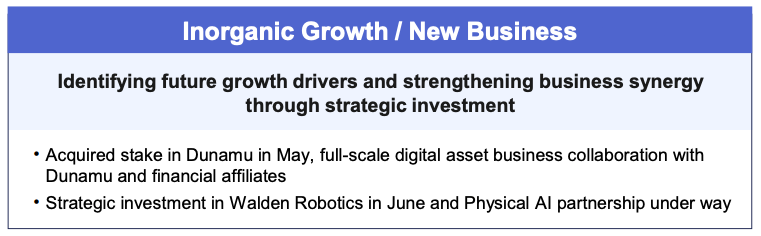
Samsung SDS, the IT services arm of Samsung Group, is exploring stablecoin infrastructure, digital asset systems and AI-based payment models with Dunamu, the operator of Upbit, one of the biggest local cryptocurrency exchanges.
Samsung SDS said it is discussing potential cooperation with Dunamu on stablecoin infrastructure, digital asset systems and AI-based payment business models, CEO Lee Jun-hee said during the company’s second-quarter earnings call on Thursday.
“We have already secured differentiated business capabilities in digital asset infrastructure through the Korea Securities Depository’s tokenized securities platform project and through end-to-end validation […] of the full stablecoin process from issuance to settlement,” Lee said. He said he expects the relationship with Dunamu will help Samsung SDS expand in the digital asset infrastructure market.
The news came days after Samsung Electronics unveiled plans to add stablecoin support to Samsung Wallet, broadening the company’s digital asset push.
Strategic investment targets digital finance
In May 2026, Samsung Securities, Samsung SDS and Samsung Card agreed to buy a combined 4% stake in Dunamu, deepening Samsung affiliates’ ties to South Korea’s digital asset sector.
In the latest Q2 call, Lee reportedly said the company’s investment in Dunamu is a strategic move rather than a financial investment, adding that both companies plan to refine potential business models for digital financial infrastructure.
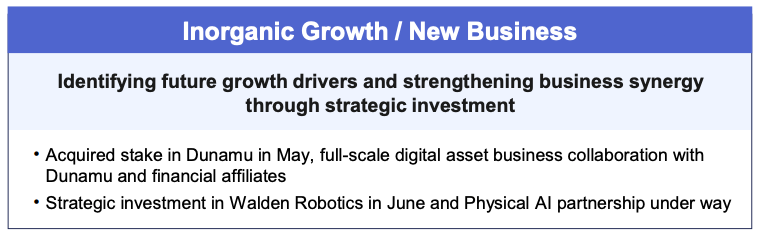
Source: Samsung SDS
“By combining Samsung SDS’s IT services, cloud, and security capabilities with Dunamu’s blockchain expertise, we aim to lead this market,” the Q2 transcript said.
Related: South Korea report proposes stablecoin rules before crypto law
Samsung SDS did not immediately respond to Cointelegraph’s request for comment, while Dunamu declined to comment.
AI growth supports broader expansion
The digital asset initiative comes amid Samsung SDS’ ongoing expansion in AI and cloud services, which helped lift Q2 revenue 5.9% year on year to 3.72 trillion Korean won ($2.6 billion), according to the quarterly earnings presentation.
Cloud revenue increased 17% from a year earlier, with external cloud business revenue jumping 75%, driven by demand for Samsung’s cloud platform and graphics processing unit-as-a-service offerings.
The company also reportedly outlined ambitious plans to expand its AI infrastructure from 110 megawatts today to 230 MW by 2029 and more than 800 MW by 2031, underscoring its broader push to build AI infrastructure alongside digital finance services.
Magazine: Fears of AI-driven DeFi hack epidemic overstated for now — but not for long
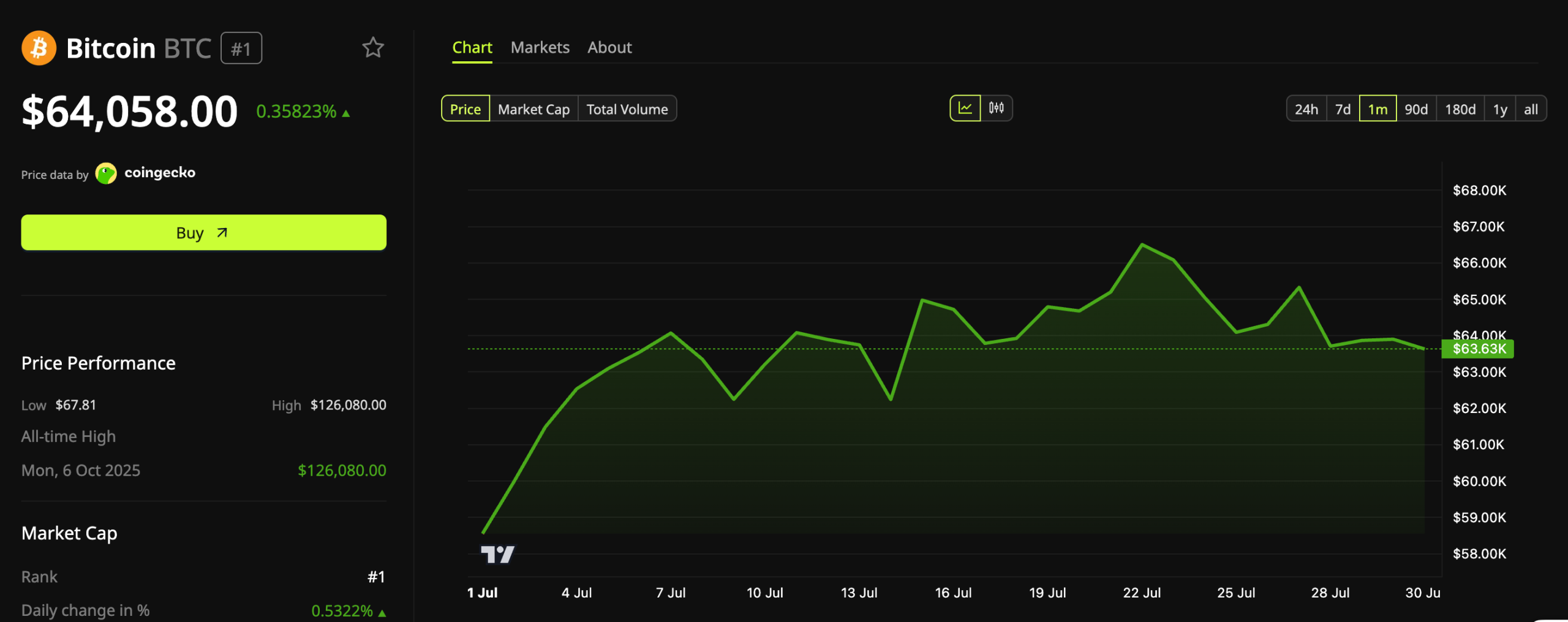
Bitcoin (BTC) is on track to post its first monthly gain since April, but the rally has unfolded alongside weakening market activity.
The cryptocurrency is up 9.3% in July, while spot trading volume has dropped toward multi-year lows. Institutional demand has also cooled, highlighting a disconnect between price performance and market participation.
Bitcoin Spot Volume Sinks to Its Weakest Month in Nearly 3 Years
According to Coinglass, Bitcoin fell 20.4% in June, marking its worst monthly performance since June 2022. That followed a more modest 3.5% decline in May.
July has broken that losing streak. Bitcoin opened the month near $58,000 on July 1, which also marked its monthly low. The asset has broadly trended higher since then and remains in positive territory despite its recent pullback.
At the time of writing on Thursday, Bitcoin was trading near $64,058, up 0.58% over the past 24 hours.
Follow us on X to get the latest news as it happens

However, trading activity has failed to keep pace with the price recovery. K33 Research put average daily Bitcoin spot trading volume at roughly $2.2 billion in July. The firm added that July 2026 is on track to record the lowest average daily BTC spot trading volume since November 2023.
“CME open interest remains near multi-year lows, perpetual futures open interest has stalled around 300,000 BTC,” the report read.
On-chain analyst Darkfost tracked the dip across individual venues. According to the analyst, Bitcoin spot trading volumes have fallen by more than 75% compared with late 2024.
Binance handled just over $35 billion in July, against $246 billion in November 2024. Trading volume declined 85% on Bybit, 67% on OKX, and 61% on Coinbase over the same period.
“Against this backdrop, a return of Bitcoin to a bullish trend seems conditional on a shift in the macro regime, and above all a return of demand, the only real driver capable of pushing volumes back up,” the analyst said.
Glassnode measures the same decline in coins rather than in dollars, removing the effect of the price drop. On that basis, spot volume sits at its lowest since 2019. The falling crypto spot volume has been building across the market for months.
Exchange Flows Show Neither Selling Pressure Nor Scarcity
The second channel is quieter still. Analyst Axel Adler Jr. said there has been no clear directional shift in Bitcoin supply based on exchange transfers.
Bitcoin exchange inflows stand near 60,000 BTC on a 30-day average. That reading sits at roughly 76% of the annual average near 79,000 BTC. Inflows stood close to 100,000 BTC a year ago, a decline of about a quarter over 12 months.

Net flow between deposits and withdrawals is currently near -1,300 BTC, down from a slightly positive figure a week earlier.
“Exchanges are not accumulating additional supply, but there is also no large-scale withdrawal of coins that could create a shortage of liquid supply,” the analyst mentioned.
Glassnode reaches a similar conclusion from the other side. Deposits and withdrawals have both slowed to among the quietest combined levels of the past three years.
“That reads less like distribution or accumulation than like disinterest, a pattern that has often marked the quiet middle of a bear market. With so little moving on-chain, there is not much standing supply positioned to absorb a change in demand should one arrive,” the firm added.
BTC ETF Demand Faded Through July Before Turning Negative
The institutional channel tells the clearest version of the story. Weekly flows into US spot Bitcoin ETFs turned positive in early July, then shrank every week until they flipped.
The week ending July 10 drew $197.4 million. The following weeks pulled in $75.7 million and $33.8 million. The week to July 29 recorded a net outflow of $29.3 million.

The scale is modest against recent history. Record June ETF outflows reached the billions, so July’s numbers may point to indifference rather than flight.
Overall, Bitcoin’s July rebound appears to rest on a fragile foundation. Seasonality adds another potential headwind. Bitcoin has finished each of the past four Augusts in negative territory, with a median monthly return of -7.49%.
To break that pattern, the market may need a meaningful catalyst alongside a revival in institutional and spot demand. Without those drivers, July’s price gains could prove difficult to sustain.
Subscribe to our YouTube channel to watch leaders and journalists provide expert insights
The post Bitcoin Gains 9% in July, but On-Chain Data Signals Weak Conviction appeared first on BeInCrypto.


Situational Awareness, the hedge fund founded in 2024 by ex-OpenAI researcher Leopold Aschenbrenner, has approached investors and lenders for fresh capital after suffering heavy losses in the recent artificial intelligence stock sell-off, the Financial Times reported Thursday.
The fund, which the Wall Street Journal said had around $20 billion in assets under management as of June 8, has also offered some investors the option to buy portfolio assets, according to the FT, citing people briefed on the discussions and a July 24 investor letter.
The size of the losses and amount sought were not disclosed. Aschenbrenner’s fund had gained 439% after fees through June, according to the letter, but the FT said borrowing increased the size of the fund’s bets, driving up losses when AI stocks collapsed during July’s market rout. Aschenbrenner also reportedly argued in the letter that the sell-off had created attractive investment opportunities.
Cointelegraph previously reported that the fund had made a big bet in its portfolio around the power and data centers supporting AI, including Bitcoin (BTC) miners pivoting into AI computing. A filing with the US Securities and Exchange Commission in March showed about $1.11 billion in positions across seven Bitcoin miner stocks, including IREN, Core Scientific, Riot Platforms and CleanSpark.
Aschenbrenner wrote a series of essays on artificial general intelligence in mid-2024 around the same time he launched his Situational Awareness fund. In it, he predicted that AGI machines will outpace college graduates by the end of the decade.
Cointelegraph contacted Situational Awareness for comment but had not received a response by publication.
Related: Bitcoin mining’s 2026 reckoning: AI pivots, margin pressure and a fight to survive

Impermanent loss has long been one of the biggest challenges facing liquidity providers (LPs) in decentralized finance (DeFi). While automated market makers (AMMs) have revolutionized decentralized trading, they expose LPs to the risk of earning less than simply holding their assets whenever prices diverge significantly.
As artificial intelligence becomes increasingly integrated into DeFi protocols, many investors are asking an intriguing question:
Can AI finally eliminate impermanent loss?
The short answer is not entirely—but AI can dramatically reduce its impact. Let’s explore how.
Understanding Impermanent Loss
Impermanent loss occurs when the price ratio between two assets in a liquidity pool changes after you deposit them.
For example:
- You provide ETH and USDC to a liquidity pool.
- ETH doubles in price.
- Arbitrage traders rebalance the pool.
- You end up holding less ETH and more USDC than if you had simply held both assets.
Although trading fees can offset these losses, they aren’t always sufficient during periods of high volatility.
This is why many LPs hesitate to provide liquidity despite attractive yields.
Why Impermanent Loss Exists
Impermanent loss isn’t a bug—it’s a consequence of how AMMs maintain liquidity.
Traditional AMMs like constant-product pools automatically adjust token balances according to mathematical formulas.
These formulas:
- Keep markets liquid
- Allow permissionless trading
- Remove the need for order books
But they cannot predict future prices.
As a result, liquidity providers essentially sell appreciating assets and accumulate depreciating ones automatically.
Enter Artificial Intelligence
AI introduces something AMMs have never possessed:
Prediction.
Instead of relying solely on fixed mathematical curves, AI can analyze:
- Historical price behavior
- Market volatility
- On-chain liquidity movements
- Whale wallet activity
- Trading volume
- Cross-chain capital flows
- Social sentiment
- Macroeconomic events
This allows protocols to make smarter liquidity decisions.
AI Can Optimize Liquidity Placement
Concentrated liquidity protocols require LPs to choose price ranges.
Selecting the wrong range often leads to:
- Reduced fee generation
- Inactive liquidity
- Greater impermanent loss
AI can continuously monitor markets and recommend—or automatically adjust—the optimal liquidity ranges based on:
- Expected volatility
- Trend strength
- Volume concentration
- Support and resistance zones
Instead of manually repositioning liquidity, AI agents could perform these adjustments in real time.
Predictive Risk Management
Machine learning models excel at identifying patterns humans often miss.
Imagine an AI system detecting:
- A surge in exchange inflows
- Whale selling activity
- Rising options volatility
- Negative sentiment across crypto social platforms
The AI could recommend temporarily withdrawing liquidity before significant price swings occur.
After volatility subsides, liquidity could be redeployed.
This proactive strategy reduces exposure to major impermanent loss events.
Dynamic Portfolio Allocation
Rather than placing all assets into a single pool, AI can intelligently diversify liquidity across multiple pools.
For example:
- Stablecoin pools during uncertain markets
- ETH/BTC pools during lower volatility
- Emerging token pools when momentum increases
- Yield-generating vaults when volatility spikes
Capital continuously shifts where risk-adjusted returns are highest.
This resembles how institutional portfolio managers rebalance investments—only AI can do it every minute.
Adaptive Fee Strategies
Some modern AMMs feature dynamic trading fees.
Instead of fixed fees, AI can estimate:
- Expected volatility
- Arbitrage intensity
- Liquidity demand
The protocol can then automatically increase fees during turbulent periods.
Higher fees help compensate LPs for taking on greater risk.
This doesn’t eliminate impermanent loss, but it can significantly offset it.
AI-Powered Hedging
One of AI’s greatest strengths may lie outside the liquidity pool itself.
An intelligent system could automatically hedge LP positions using:
- Perpetual futures
- Options
- Synthetic assets
- Volatility products
For instance:
If AI predicts ETH is likely to experience extreme price movement, it could open a corresponding hedge that offsets potential impermanent loss.
Today, these strategies require sophisticated traders.
Tomorrow, AI agents could execute them autonomously.
Reinforcement Learning for AMMs
Researchers are exploring reinforcement learning, where AI continuously learns from market outcomes.
Instead of relying on static formulas, AI-powered AMMs could adapt their behavior based on:
- Trader activity
- Liquidity utilization
- Historical performance
- Market efficiency
Each market cycle provides new data, enabling the system to improve over time.
Eventually, liquidity allocation could become increasingly optimized with every transaction.
AI and Intent-Based DeFi
The next generation of DeFi may be driven by intent-based systems.
Instead of manually selecting pools, users simply specify their goals:
- Maximize yield
- Minimize impermanent loss
- Preserve capital
- Earn stable income
AI agents then determine:
- Which protocols to use
- When to move liquidity
- How to hedge positions
- When to rebalance
Liquidity management becomes autonomous rather than manual.
The Challenges
Despite its promise, AI cannot eliminate impermanent loss entirely.
Several obstacles remain:
Market Uncertainty
Even advanced AI cannot predict black swan events with certainty.
Unexpected news, protocol exploits, or geopolitical developments can quickly invalidate predictions.
Data Quality
AI is only as effective as the data it receives.
Incomplete or manipulated on-chain data can lead to poor decisions.
Execution Costs
Frequent rebalancing introduces:
- Gas fees
- Slippage
- MEV exposure
- Operational complexity
Sometimes the cost of optimization outweighs the benefits.
Smart Contract Risk
AI strategies still depend on secure smart contracts.
If the underlying protocol is compromised, optimization becomes irrelevant.
The Future: AI as a Liquidity Manager
Rather than replacing AMMs, AI is likely to become their intelligent layer.
Future liquidity providers may no longer choose pools manually.
Instead, autonomous AI agents will:
- Monitor markets 24/7
- Rebalance liquidity automatically
- Hedge risky positions
- Optimize fee generation
- Reduce capital inefficiencies
- Continuously learn from market behavior
Providing liquidity could eventually resemble hiring an AI portfolio manager.
Conclusion
AI is unlikely to eliminate impermanent loss because the phenomenon is rooted in the mechanics of automated market makers and the unpredictability of financial markets. However, it has the potential to substantially reduce its impact through predictive analytics, dynamic liquidity allocation, automated hedging, adaptive fee optimization, and continuous portfolio rebalancing.
As AI agents become more sophisticated and intent-based DeFi matures, liquidity provision could shift from a passive activity to an actively managed, intelligent strategy. The future may not be one where impermanent loss disappears—but one where it becomes far more manageable, allowing liquidity providers to earn more efficiently while taking on less unnecessary risk.
REQUEST AN ARTICLE


This month, analysts have repeatedly pointed to multiday inflows into the U.S.-listed crypto exchange-traded funds as evidence of the return of institutional demand. Zoom out, though, and the institutional story still looks bleak.
Bitcoin spot ETFs have pulled in just $205 million in net inflows in July, the lowest monthly total on record, according to SoSoValue data. While there are still two trading days left, the figure marks anemic recovery from the heavy red ink of prior months, which saw $2.43 billion exit in May and $4.52 billion in June.
Ether has fared somewhat better. ETH ETFs have attracted $342.85 million in July, almost as much as in April and outperforming bitcoin and other crypto funds. XRP is on track for a fourth consecutive month of inflows, though the sum remains a paltry $13.61 million. Solana ETFs sit at $13.82 million.
Together, the numbers paint a picture of limited institutional appetite at best. Ether’s stronger haul is consistent with its price performance against bitcoin. The Binance-listed ether-bitcoin pair has surged by 11% this month.
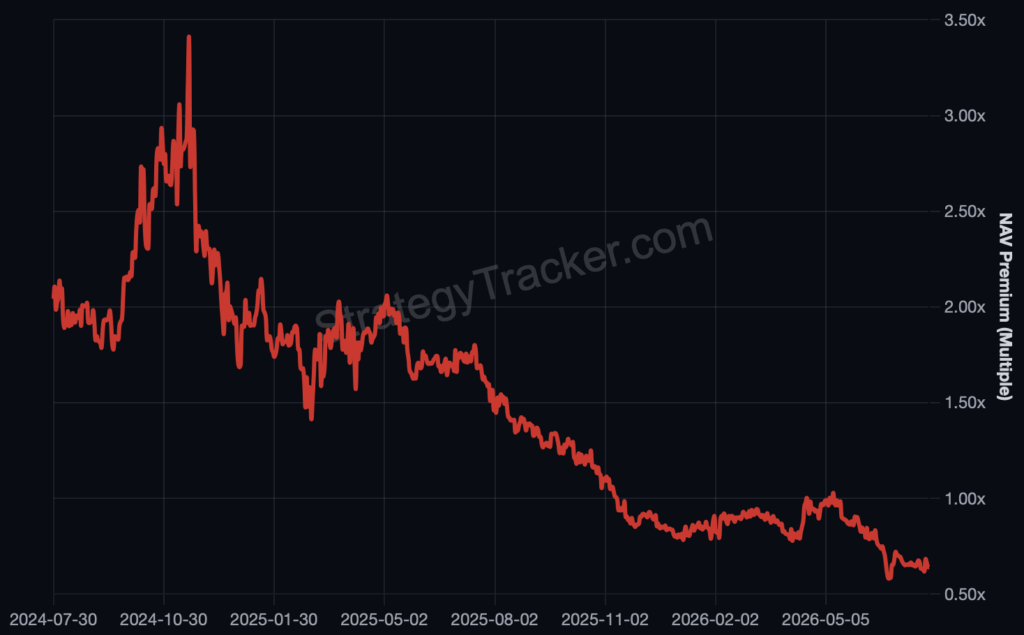
The basic multiple-to-Net Asset Value (mNAV) that investors are willing to pay for Michael Saylor’s Strategy has declined by two-thirds over the past two years from 2x to 0.68x.
Exactly 24 months ago, Strategy common stock was worth exactly twice the value of its BTC. For every $1 of BTC the company owned, MSTR traded at $2.
In 2024, there was optimism about Strategy’s ability to positively accrete BTC for shareholders through successful business operations.
As of today, that measure of optimism has declined by exactly two-thirds.
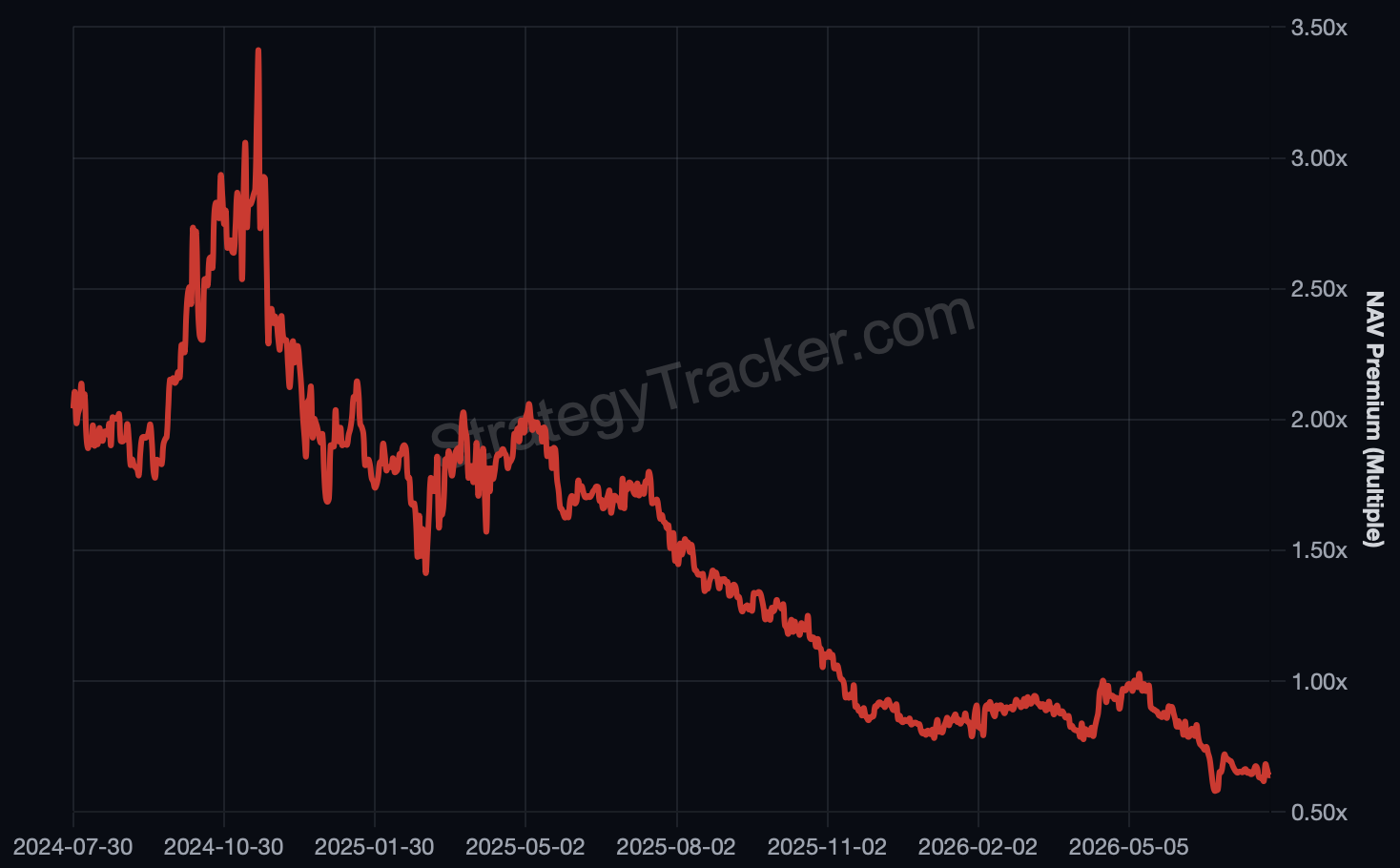
Saylor’s company now holds 843,775 BTC at an average cost of $75,476, uncomfortably higher than the current market below $65,000.
For most of the past two years, its shares commanded a premium to that pile. As that original premium flipped to a discount, the company redefined the term mNAV twice in an attempt to keep it above 1x.
Its latest iteration is holding on by a thread. It read 1.03x yesterday.
Three definitions for mNAV
Basic mNAV is arithmetic a teenager can do. Divide the company’s market capitalization by the dollar value of its BTC. Above 1x means that investors are paying more for the stock than for the BTC. Below it, less.
BitcoinTreasuries.net, which still runs that original calculation, calculates Strategy’s basic mNAV at 0.64x.
Best to dust that number under the rug.
Strategy’s first attempt to redefine mNAV became enterprise value mNAV. This folded in the value of debt and preferred stock into the numerator alongside the market cap of MSTR, the common stock.
Conveniently, loading liabilities onto the top of a fraction made the result larger. The enterprise value-adjusted mNAV therefore sat above 1x long after the basic one had sunk below 1x, and only crossed below 1x in late June 2026.
Predictably, a new-and-improved version of mNAV arrived in July.
Strategy’s dashboard now begins its calculation from a reserve of roughly $57.7 billion in BTC plus dollars, subtracts $6.8 billion of debt and $15.4 billion of preferred stock, and calls the remaining $35.5 billion a net reserve.
It then divides that so-called net reserve by the share count, compares it against a share price of $95.32, and the multiple lands at 1.04x. Voilà.
Read more: How Michael Saylor replaced ‘bitcoin’ with ‘credit’
Redefinitions didn’t stop MSTR from crashing
Saylor pitched the overhaul on the grounds that “Bitcoin capital markets require a new financial language.”
Strategy CEO Phong Le credited investor feedback for an “upgraded” metric that “establishes a 1x threshold for accretive MSTR issuance.”
The redefinition also orphans the company’s entire back catalogue. Strategy’s glossary advises, “Prior to July 23, 2026, the company’s use of the term mNAV referred to a different metric so references to the company’s mNAV calculated prior to that date are not comparable to the company’s mNAV calculated after that date.”
Every mNAV Saylor has ever tweeted prior to this month is, by the company’s own account, incomparable to the one on the company’s own website today.
The same page concedes that despite the label, “it is not equivalent to ‘net asset value’ or ‘NAV’ or any similar metric in the traditional financial context,” and should be used “only by sophisticated investors who understand its limited purpose and many limitations.”
Saylor himself needed seven minutes to define the old mNAV on stage at BTC Prague in June.
Strategy briefly promised shareholders in July 2025 that it wouldn’t dilute MSTR shareholders below 2.5x mNAV, then sold $14.3 billion of stock beneath that line anyway.
On Wednesday, it was 0.68x, and the metric that produced both figures no longer officially exists.
The price of MSTR — the thing that actually matters to shareholders and cannot be redefined — has declined 38% year to date and 76% over the past 12 months.
Got a tip? Send us an email securely via Protos Leaks. For more informed news and investigations, follow us on X, Bluesky, and Google News, or subscribe to our YouTube channel.
Crypto World
Crypto News, July 30: FOMC Holds Rates, Bitcoin ETFs Flip Green, Ethereum Dominance Falls

A quiet tension settled across global markets after the Federal Reserve delivered its latest policy decision. The FOMC held interest rates steady, but investors quickly realized the pause carried a distinctly hawkish tone. Treasury yields climbed, equities split direction, and Bitcoin, Ethereum, and crypto were left searching for the market’s next catalyst.
Bitcoin ETFs finally returned to net inflows, offering a welcome sign of demand, while Ethereum continued losing its dominance as capital rotated back to Bitcoin. Meanwhile, fresh security incidents and political headlines reminded investors that crypto never sleeps.
Hawkish FOMC Hold Keeps Markets on Edge
The FOMC held the federal funds rate at 3.50% to 3.75% in a narrow 9-3 vote on July 29. Three regional Fed presidents, Beth Hammack, Neel Kashkari, and Lorie Logan, favored another 25 basis point hike, marking the first time since 2016 that three hawkish officials dissented together. Policymakers cited persistent inflation around 4.1% alongside resilient economic growth, reinforcing expectations that rates could stay elevated longer.
Bitcoin initially welcomed the decision, jumping from $63,700 to nearly $64,700 before giving back most of the gains as traders digested the hawkish language. It later stabilized around $64,000, while Ethereum traded near $1,900 with little conviction. Traditional markets delivered a mixed performance, with the Nasdaq advancing as the Dow weakened, leaving crypto largely range-bound.
The uncertainty sparked heavy liquidations, erasing between $280 million and $316 million across nearly 90,000 to 96,000 traders. Both long and short positions were caught in the crossfire, highlighting widespread indecision. At the same time, US publicly held debt surpassed 100% of GDP for the first time since World War II, adding another layer of macro concern for investors.
Politics also entered the spotlight. Senator Cynthia Lummis briefly lost control of her verified X account after hackers promoted a fake Solana meme coin, $USA Token, through a pump.fun link. The posts disappeared within minutes, but the incident arrived as lawmakers continued negotiations over the CLARITY Act ahead of the August recess, with ethics provisions and crypto-related amendments still under debate.
Discover: The Best Crypto to Diversify Your Portfolio
Bitcoin Holds Firm as ETF Flows Reverse
Before the Fed announcement, Bitcoin had already recovered from weekly lows near $62,400 following weakness in South Korean equity markets. Although the post-decision rally faded, the cryptocurrency continued defending the psychological $64,000 level while finding support above $63,500. Even so, Bitcoin remains roughly 3% to 4% below recent highs near $66,000 as July consolidation continues after last year’s rally.

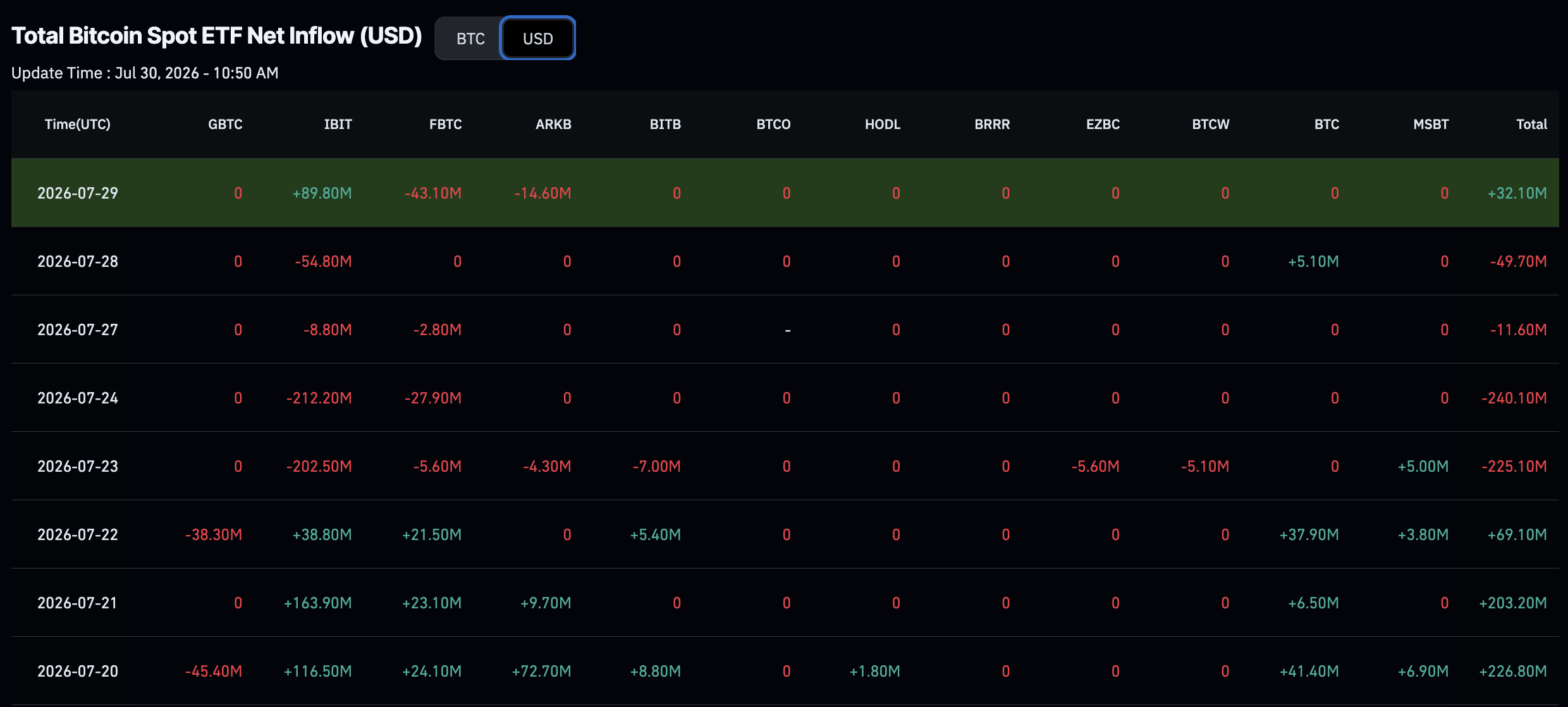
Institutional demand offered an encouraging signal. Spot Bitcoin ETFs recorded $32.1 million in net inflows on July 29, led by IBIT, ending a multi-day streak of outflows. Ethereum ETFs, however, posted roughly $18.65 million in net outflows, while Solana ETFs attracted around $19 million and XRP products added approximately $0.58 million. The divergence reinforced the ongoing rotation across digital assets and contributed to Ethereum’s declining market dominance.
Elsewhere, crypto markets continued navigating operational risks. Ostium disclosed a $24 million off-chain breach while confirming its smart contracts remained uncompromised. Hyperliquid welcomed its first Japanese corporate buyer despite reports of reduced US fund exposure, and Luno announced another round of job cuts as restructuring efforts continued across the industry.
Despite elevated yields, political uncertainty, and mixed macro signals, Bitcoin has shown notable resilience. The defense of the $64,000 level, improving ETF demand, and the absence of panic selling suggest buyers remain active beneath the surface. If institutional inflows continue building and policy expectations stabilize, Bitcoin could be positioning itself for its next decisive move.
Trade Bitcoin and Ethereum on Bybit and Get a Chance to Win Our $1,000 USDT Airdrop
The post Crypto News, July 30: FOMC Holds Rates, Bitcoin ETFs Flip Green, Ethereum Dominance Falls appeared first on Cryptonews.
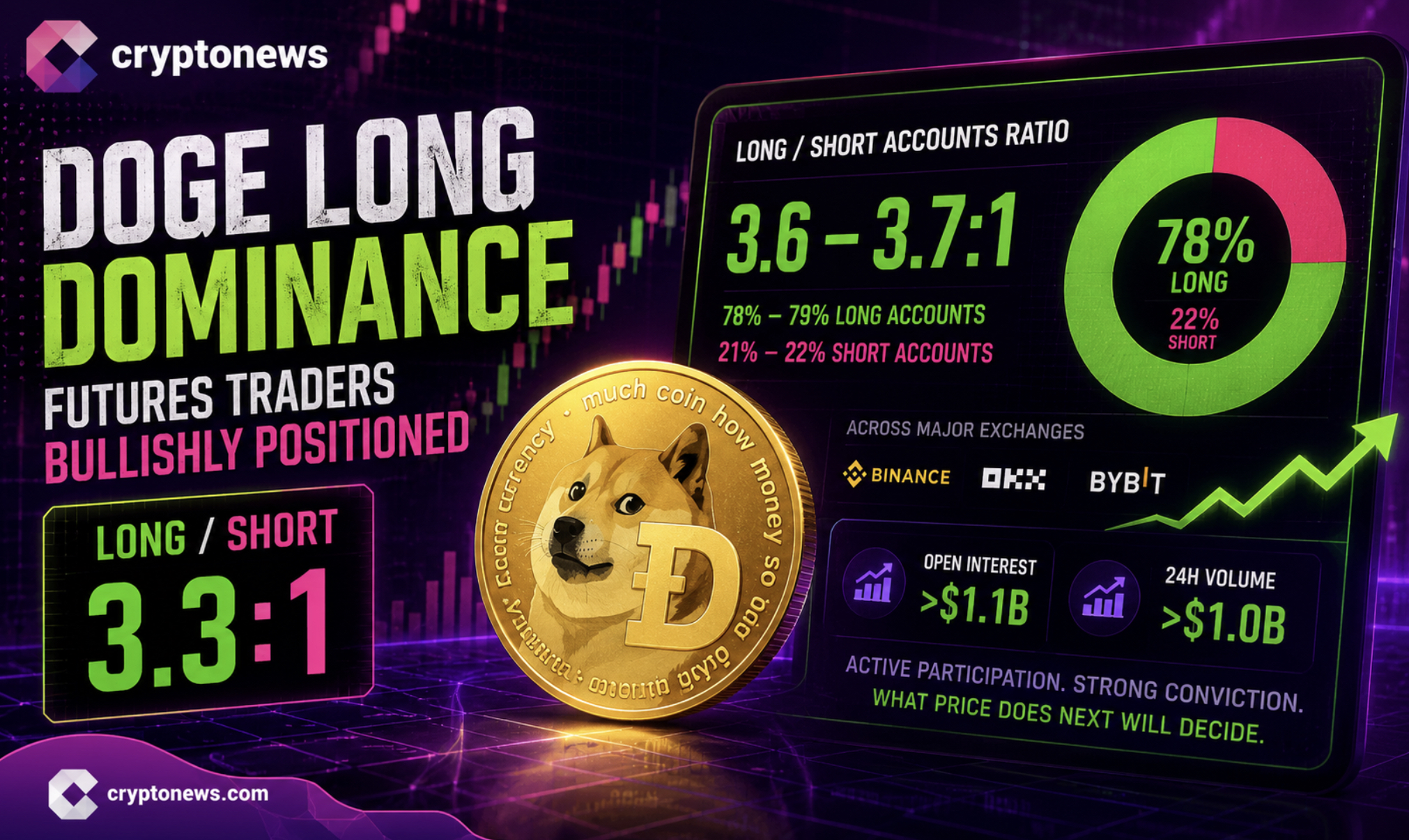
Dogecoin is trading near $0.07, but its derivatives market tells a stronger story. Futures traders remain heavily positioned on the long side, leaving bears badly outnumbered. The headline ratio sits near 3.3:1, while some exchanges show even stronger bullish conviction. Meanwhile, the latest Fed decision and renewed inflows into Bitcoin ETFs continue to support risk appetite.
Binance perpetuals holding a long-to-short accounts ratio between 3.6 and 3.7:1. Around 78% to 79% of active accounts are net long, while 21% to 22% remain short across intraday and one-day windows. That imbalance suggests traders still expect higher prices rather than another sharp decline.
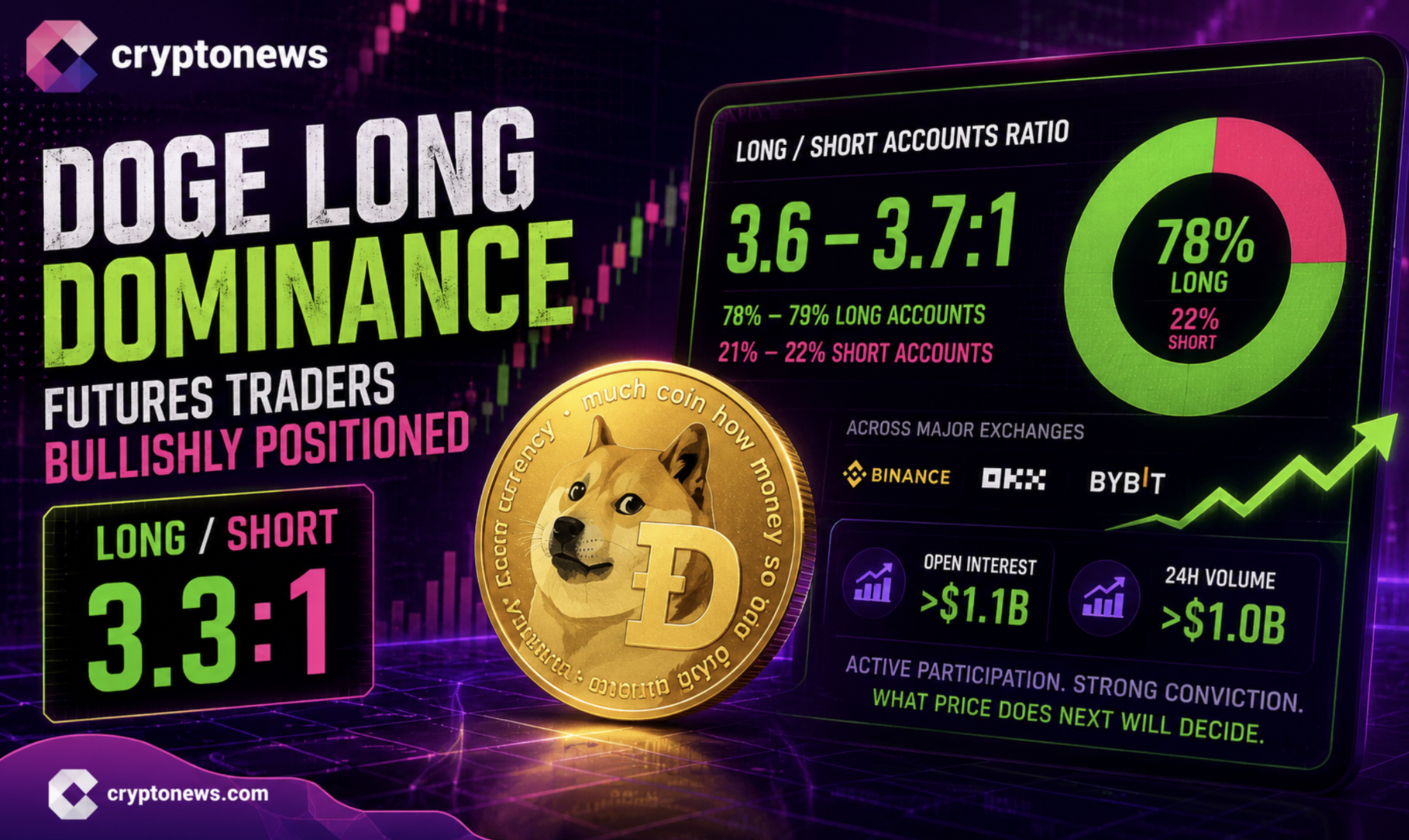
Coinglass also shows a similar bias across OKX and Bybit, confirming the trend extends beyond a single exchange. Futures open interest remains above $1.1 billion, while daily trading volume has climbed past $1.0 billion. Those figures point to active speculative participation instead of thin market conditions.
Even so, crowded long positioning can quickly become a double-edged sword. If Dogecoin holds key support and buyers stay in control, those positions could fuel another leg higher. On the other hand, any sharp rejection may trigger long liquidations and accelerate downside volatility.
Discover: The Best Crypto to Diversify Your Portfolio
Can Dogecoin Price Break Out of the Upper-$0.07 Band This Week?
DOGE is trading around $0.07, moving within a 24-hour range of around $0.0693 to $0.0722. Price continues hovering near the upper end of its recent consolidation range. Spot trading volume is close to $520 million, while futures volume remains above $1.0 billion, showing derivatives still dominate market activity.
The circulating supply stands near 155.5 billion DOGE, giving the token a market capitalization of about $11.0 billion. That size still requires meaningful capital to sustain a strong breakout. Immediate resistance sits around $0.073 to $0.074, while support remains near $0.069, the lower edge of the current range.
The bullish case remains straightforward. If Bitcoin extends its risk on momentum and memecoin demand returns, the 3.3 to 1 long bias could become self-fulfilling. A decisive move above $0.073 would put $0.080 back into focus.

The base case is continued consolidation. DOGE could defend $0.069 and trade sideways until a fresh catalyst appears. On the other hand, a Bitcoin pullback or funding rate spike could trigger long liquidations. A break below $0.069 would quickly shift the short-term structure in favor of sellers.
Current positioning still supports a constructive outlook. Even so, long heavy markets often produce fast moves. That leaves DOGE vulnerable to either a clean breakout or a sharp flush once traders force the next directional move.
Trade Dogecoin on Bybit and Get a Chance to Win Our $1,000 USDT Airdrop
Bitcoin Hyper Targets Early-Mover Upside While DOGE Navigates Resistance
DOGE at $0.07 with a $12 billion market cap is a known quantity. The upside math on a coin this size demands broad market cooperation and sustained memecoin rotation, and two conditions that don’t arrive on schedule.
Traders watching the long/short ratio for continuation signals are essentially waiting on macro permission. That’s a different risk profile from early-stage infrastructure plays where the valuation ceiling hasn’t been defined yet.
Bitcoin Hyper ($HYPER) is currently in presale at $0.0136839, having raised $33 million to date, a traction that reflects genuine interest in what it’s building. The project positions itself as the first Bitcoin Layer 2 with SVM integration, combining Bitcoin’s security and capital base with Solana Virtual Machine execution speed, targeting throughput that competes directly with Solana itself.
The offering also includes high-APY staking and a decentralized canonical bridge for native BTC transfers. For traders who have already sized their DOGE position and are looking at the early-stage end of the risk curve, research Bitcoin Hyper here.
Discover: The Best Token Presales
The post Dogecoin Long Short Ratio Goes Too Bullish at 3.3:1 appeared first on Cryptonews.
Crypto World
Crypto’s resilience is tested as oil surges back above $90 and the Fed signals rates could still rise
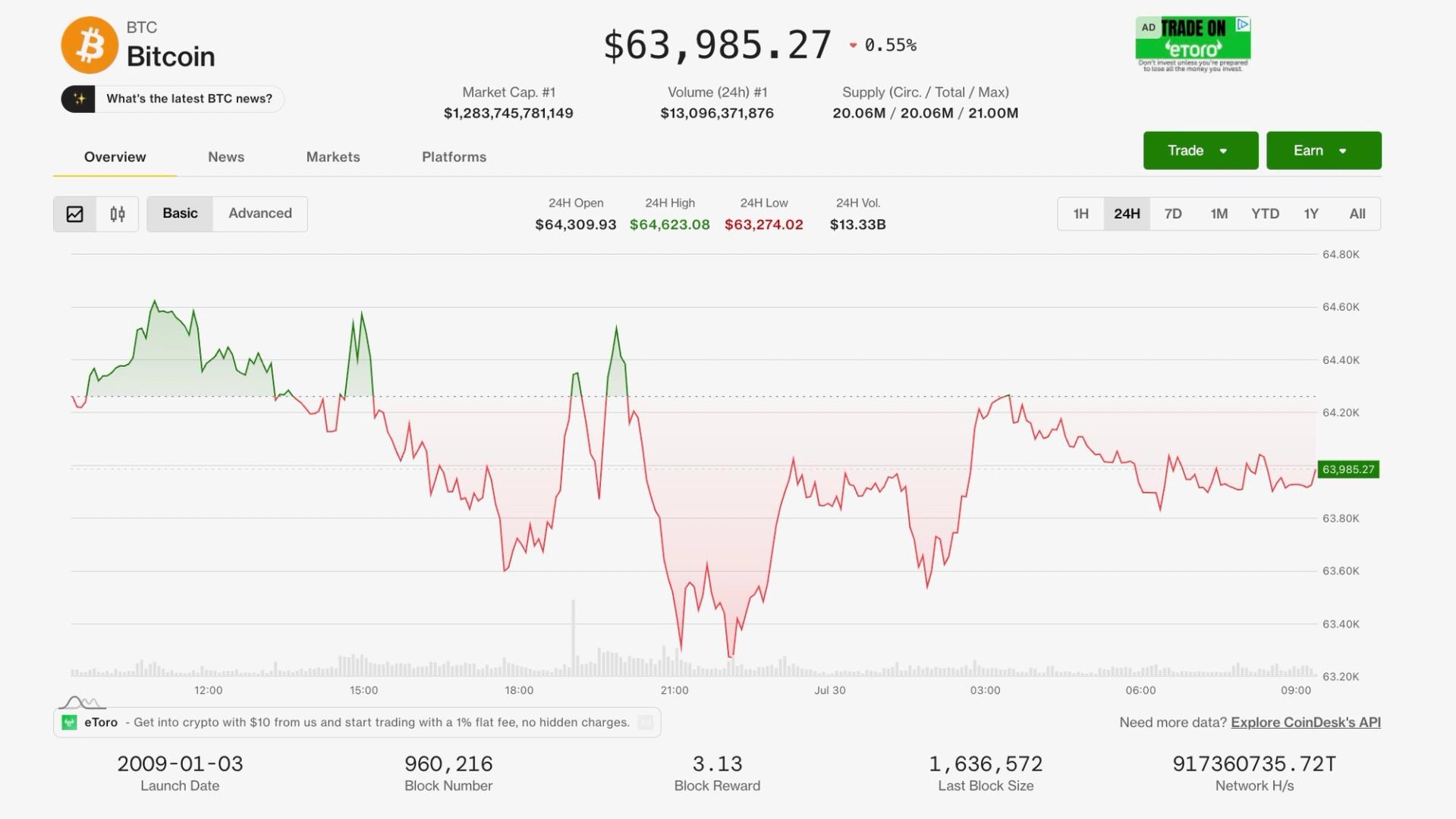
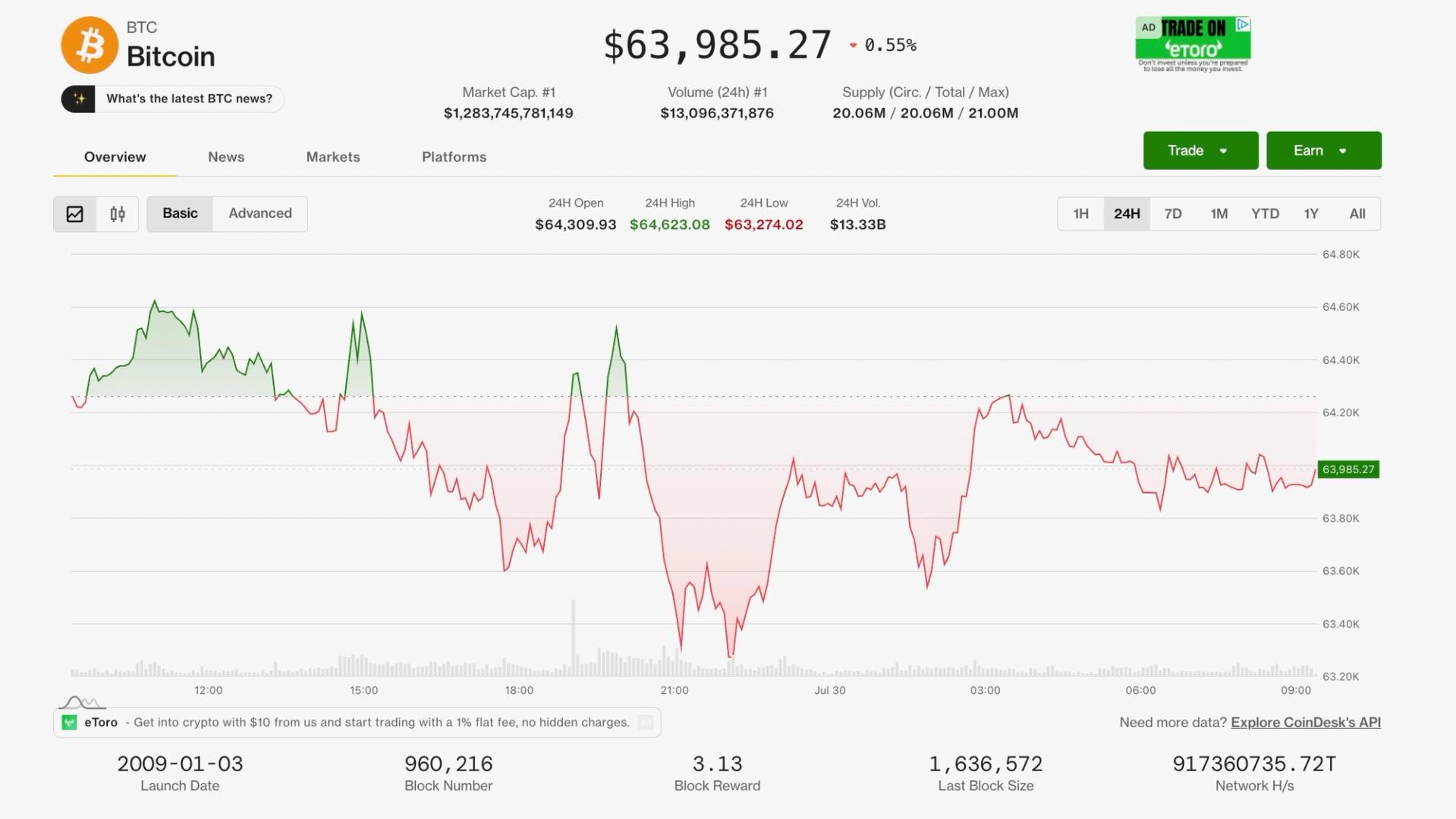
The crypto market is showing resilience on Thursday, with bitcoin trading little changed at $63,915 and ether dropping just 0.25% since midnight UTC after what might be seen as a difficult session for global risk assets on Wednesday.
The calm, however, masks erratic back-and-forth price swings around the Federal Reserve’s interest rate meeting that flushed out leveraged futures bets, triggering heavy liquidations.
While the rate remained unchanged, three committee members voted for an increase. Higher rates reduce the attractiveness of risky assets.
About $286 million in positions were liquidated in 24 hours, according to CoinGlass. Longs accounted for $186 million and shorts $100 million, a balance that signals a market that moved hard in both directions and settled back where it started.
Hours after the FOMC decision, Iran launched multiple ballistic missiles at U.S. troops, prompting President Donald Trump to vow to hit Iran “hard” in response.
Oil surged, erasing Monday’s declines, and U.S. equities fell. Still, S&P 500 and Nasdaq index futures are now slightly positive. Microsoft (MSFT) and Meta (META) earnings after the bell today could swing sentiment once again.
Derivatives positioning
- Crypto futures long/short ratio flips slightly bearish: The crypto futures long/short taker volume ratio has flipped slightly bearish, with shorts at 51%, according to Coinglass data. The market appears to be in stasis with both open interest (OI) and trading volume mostly unchanged from yesterday.
- Uniswap’s UNI among top performers: Uniswap’s UNI token is one of the best performers among the top 100 coins. Open interest in its futures, however, has pulled back to 65.80 million tokens, suggesting an unwind of positions. The 24-hour cumulative volume delta (CVD) isn’t encouraging either. The negative print points to leadership among those shorting futures at market orders rather than passive limit orders.
- Bitcoin open interest holds steady: Bitcoin’s OI remains around 750K BTC, as it has since early June. In other words, participation in the coin’s price bounce remains limited. Ether’s OI, too, has pulled back to under 14 million tokens from a six-week high of 14.53 million ETH. This again shows limited demand for leverage despite ether outperforming bitcoin this month.
- Bear dominance in the altcoin market: Most of the 25 largest coins, except BTC, ADA, TRX, CRO, ZEC, have negative 24-hour OI adjusted CVDs. It seems the altcoin market price action is still dominated by bears.
- Bitcoin’s BVIV drops below 38%: Bitcoin’s BVIV, the 30-day implied volatility index, has fallen back below 38%, nearing levels that have historically served as floors. This calls for caution, as volatility is mean-reverting and can snap back higher from the floor.
- BTC and ETH calls in demand: Options listed on Deribit show BTC calls at strikes $70,000 and $75,000 leading the 24-hour volume rankings. Calls offer an asymmetric upside exposure in the underlying asset (like a lottery ticket). The same is true for ether: The top five most traded bets are all call options.
Token talk
- Injective was the 24-hour standout on Thursday, rising 6.95% as DeFi tokens outperformed. Uniswap (UNI) added 4.46% and FET recovered 3.28% after a bruising week.
- Zcash (ZEC) extended its recent run, adding 1.54% since midnight UTC to $474, continuing to outpace privacy coin peers. Monero (XMR) gained 0.4%.
- Hyperliquid (HYPE) slipped 0.47% to $53.64, extending a retreat from last month’s highs that has now unwound roughly 30% from its peak.
- Lighter (LIT) gave back 4.22% over 24 hours, though it is up 0.50% since midnight, suggesting sellers may be running out of steam after a correction that has erased nearly 25% from its July peak.
- Jupiter (JUP) fell 1.48% since midnight after a brief recovery on Wednesday, with daily trading volume continuing to dwindle to $23 million despite regularly topping $50 million earlier this year.
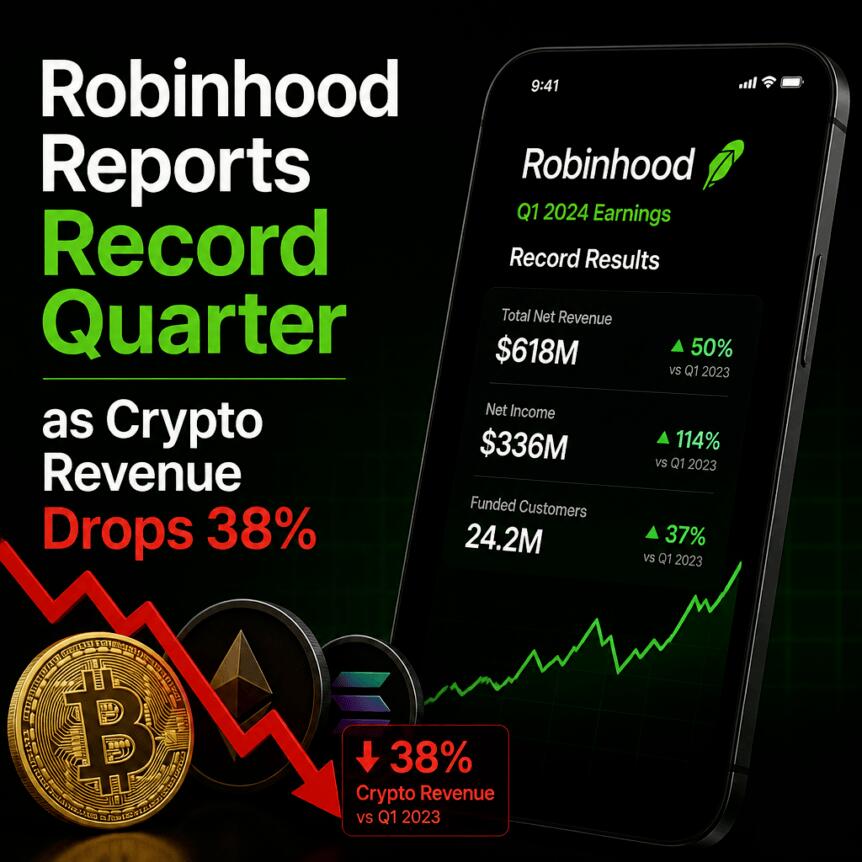
Robinhood reported record second-quarter results, highlighting strong growth in transaction-based revenue overall while acknowledging a meaningful pullback in cryptocurrency-specific earnings. In its latest earnings report, the online brokerage said crypto transaction revenue fell to $100 million, down from roughly $160 million a year earlier.
Despite the decline in crypto-related income, the company delivered an overall quarter marked by rising profitability and expanding platform activity. Total revenue climbed 32% year-over-year to $1.31 billion, and net income increased 48% to $573 million, according to the earnings release.
Key takeaways
- Crypto transaction revenue fell 38% to $100 million, even as Robinhood’s broader transaction-based revenue rose.
- Quarterly revenue and earnings reached records: revenue rose to $1.31 billion and net income grew to $573 million.
- Crypto notional trading volume totaled $40 billion: $18 billion on the Robinhood app and $22 billion via Bitstamp.
- Robinhood is scaling beyond trading: it launched parts of Robinhood Chain and introduced tokenized U.S. stocks and a decentralized lending product.
- Management reiterated a tighter cost outlook for 2026: it narrowed adjusted operating expenses and share-based compensation guidance.
Crypto revenue dips as overall transaction business grows
Robinhood’s results show a split between the performance of its crypto segment and the rest of its transaction engine. While cryptocurrency was the only major transaction category to decline during the quarter, the company pointed to strength in other areas that more than offset the weakness.
Crypto transaction revenue decreased to $100 million from about $160 million a year earlier, the company said. At the same time, transaction-based revenue rose 44% to $776 million, supported by higher contributions from categories outside digital assets.
The company also reported $40 billion in crypto notional trading volume for the quarter. Of this total, $18 billion came from the Robinhood app, down 35% year-over-year, while $22 billion came from Bitstamp. Robinhood acquired Bitstamp in June 2025, as referenced in earlier coverage here.
Market pricing reflected the mixed nature of the quarter ahead of the report: shares were down about 3.15% on Wednesday before the earnings release, based on Yahoo Finance data.
Robinhood’s crypto playbook shifts toward infrastructure and new products
Even with lower crypto transaction revenue, Robinhood used the quarter to push forward with its wider digital asset strategy. The company said it completed its acquisition of WonderFi, a Canadian crypto platform, continuing its efforts to broaden what it offers beyond pure trading.
After the quarter ended, Robinhood also rolled out additional ecosystem components. It unveiled the public mainnet of Robinhood Chain after previously reporting activity around bridged assets. The company further introduced tokenized U.S. stocks to eligible users in more than 120 countries and debuted its first decentralized lending product, Robinhood Earn.
On the Ethereum layer-2 side, DefiLlama data shows Robinhood’s new network posted $348 million in total value locked as of Thursday. The same dataset referenced stablecoins exceeding $500 million and more than $1 billion in bridged assets, illustrating that the platform’s activity is not limited to trading fees.
For investors, this matters because it reframes what “crypto performance” can mean for a brokerage. Transaction revenue can soften when market activity slows or user behavior shifts, but an expanding chain ecosystem—particularly one involving bridges and lending—can create alternative revenue pathways over time.
Non-crypto categories and platform metrics keep momentum
Robinhood’s earnings report emphasized that its broader product suite absorbed the crypto slowdown. The company said growth in event contracts, options, and equities more than offset the weakness in digital assets.
It reported that event contract revenue surged more than tenfold to $156 million, options revenue rose 29% to $342 million, and equities revenue jumped 95% to $129 million.
At the platform level, Robinhood posted record net deposits of $21.7 billion during the quarter. Total platform assets rose 32% year-over-year to $369 billion, and funded customers grew 7% to 28.4 million.
These metrics suggest that the company’s customer and balance-sheet expansion continued regardless of the crypto segment’s year-over-year revenue decline. For traders and users, that combination indicates a continued push to keep engagement broad—spreading attention across multiple asset classes and contract types rather than relying primarily on crypto transaction activity.
Guidance narrows as adjusted EBITDA grows
Robinhood also addressed expenses and profitability guidance. The company lowered and narrowed its 2026 outlook for adjusted operating expenses and share-based compensation to between $2.675 billion and $2.775 billion, down from a previously provided range of $2.7 billion to $2.825 billion.
On profitability, adjusted EBITDA rose 35% to $741 million. Total operating expenses increased 33% to $734 million, reflecting continued investment while still targeting more controlled growth at the operating level.
When viewed alongside the company’s digital asset expansion, the tighter expense guidance suggests management is trying to balance growth in new areas—like tokenization and decentralized lending—while keeping cost discipline in focus.
Going forward, investors will likely watch whether Robinhood Chain’s early traction translates into sustained engagement and monetization, and whether crypto transaction revenue stabilizes as broader platform growth continues to diversify away from purely crypto-dependent earnings.

Samsung SDS Targets Stablecoin Infrastructure With Dunamu
Murali Sreeshankar wins long jump silver, Indian boxers script history and more

Danny MacAskill and Kriss Kyle Take On Red Bull’s 200-Meter Floating Obstacle Course Without the Help of AI


-

 Fashion6 days ago
Weekend Open Thread: Brooks Brothers
-
 Sports4 days ago
Commonwealth Games boxing: Jadumani Singh seals dominant 5-0 win over Pakistan’s Sumama Rehman to enter quarter-finals | Commonwealth Games News
-

 Business15 hours ago
Why Trees Belong on the Risk Register
-

 Tech3 days ago
Intel is reversing course and bringing hyper-threading back to its server chips
-

 Crypto World5 days ago
Ripple bought a bank in pieces. The $4 billion audit
-

 Politics3 days ago
Luke Littler dismantles Gerwyn Price to retain title in Blackpool
-

 Politics2 days ago
The Part of the Electric Transition Nobody Wants to Discuss
-
 Entertainment6 days ago
A New Post-Apocalyptic Gundam Anime Series Blasts Into SDCC
-

 News Videos4 days ago
BITCOIN JUST ENTERED THIS CRITICAL ZONE…
-

 Fashion6 days ago
16 Dresses for the High Summer Event
-

 Sports6 days ago
2026 3M Open leaderboard: Scottie Scheffler finds putter in Round 1, sits three back
-

 News Videos7 days ago
The Peugeot Family: How 200 Years of an “Old Money” Dynasty Died in A Boardroom
-

 Business1 day ago
Major shareholder moves on Canyon
-

 Crypto World4 days ago
XRP Ledger adds $2.6B as RWA inflows rank second
-

 Politics4 days ago
Spain sweeps the board at 2026 World Cup with individual awards
-

 Crypto World7 days ago
Uniswap (UNI) pushes deeper into tokenized RWAs with permissioned trading pools
-
 Entertainment2 days ago
‘Stargate’ Creator’s New Sci-Fi Series Returns for Season 3 Tomorrow
-

 Tech5 days ago
Anthropic launches Claude Opus 5, a cheaper AI model for coding, agents and enterprise workflows
-

 Crypto World2 days ago
Kraken Enables Retail Access to Jersey Mike’s IPO via Tokenized Shares
-

 Entertainment4 days ago
Sara Gilson Killed By Husband After Viral “Pedophile” TikTok Video
You must be logged in to post a comment Login