Connect with us

NewsBeat

China is losing ground in Latin America

Published

on

China is losing ground in Latin America

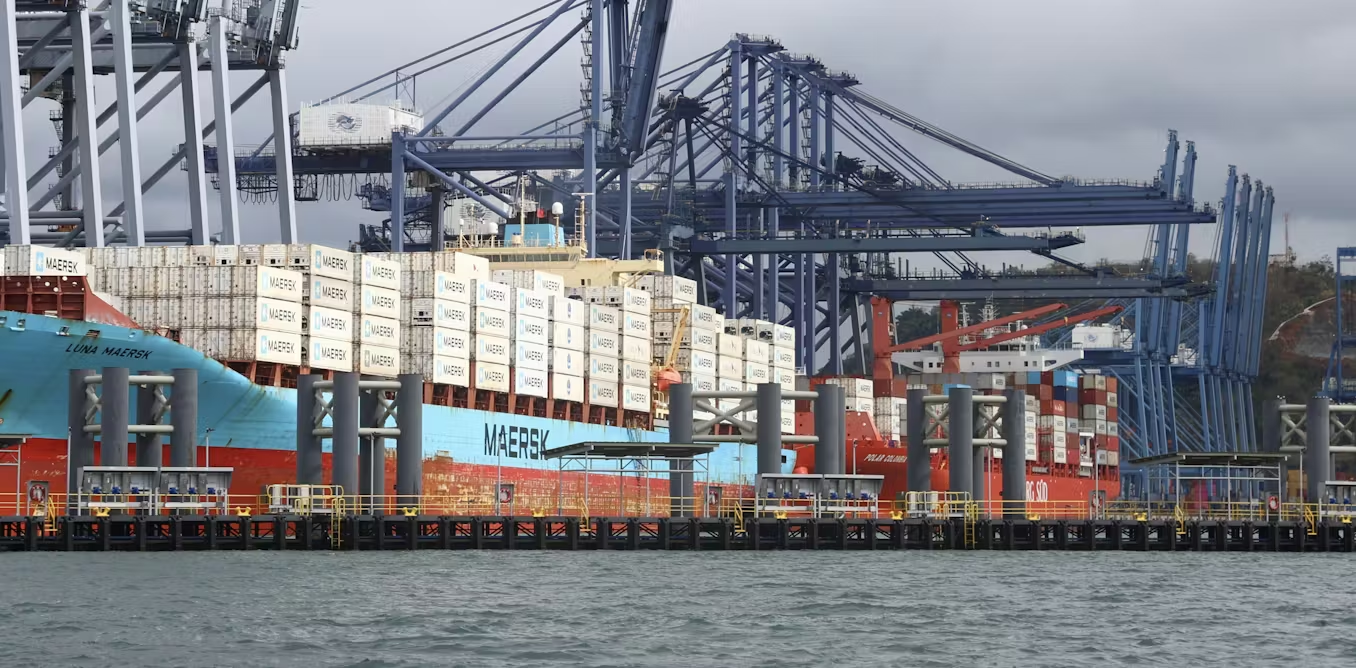
Panama’s supreme court invalidated a contract in late January that had allowed Panama Ports Company, a subsidiary of Hong Kong-based firm CK Hutchison, to operate two ports on the Panama canal since 1997.

The decision, which ruled that the laws allowing the firm to operate the ports were “unconstitutional”, comes one year after the US president, Donald Trump, threatened to take control of the canal to limit Chinese influence over the waterway.

Beijing reacted to the ruling angrily, calling the judgment “absurd, shameful and pathetic”. It also said the Panamanian government will pay “a heavy political and economic price” for evicting the company from the ports. The ruling is the latest sign that China’s ambitions in the region are losing momentum.

Chinese influence in Latin America is a relatively recent phenomenon. Since 1823, when President James Monroe declared the western hemisphere closed to further European colonisation, the US has largely maintained strict control over the region’s affairs.

Advertisement

But that changed after the end of the cold war in 1991, with successive US administrations reducing their focus on Latin America. This allowed emerging superpowers such as China to assert their influence in the region.

China is now the top trading partner for South America and is becoming the largest for Latin America as a whole. It is also a major source of foreign direct investment and infrastructure lending for the region.

Chinese influence in what the US considers its own backyard has irked the Trump administration. Shortly after the operation to capture Venezuelan leader Nicolás Maduro in January, the US secretary of state, Marco Rubio, declared: “This is the western hemisphere. This is where we live – and we’re not going to allow the western hemisphere to be a base of operations for adversaries, competitors and rivals of the United States.”

The eviction of Panama Ports Company from the Panama canal will have been celebrated as a victory in Washington, which is looking to promote its own national interests in the region. But it is also possible that the incident could prompt countries throughout Latin America to address their reliance on China.

Advertisement
Trump has made no secret of his desire to push China out of Latin America.
Bonnie Cash / EPA

Over the past two decades, China has swamped countries in Latin America and the Caribbean with loans. However, unlike loans from the World Bank or International Monetary Fund that are contingent on structural and institutional reforms, Chinese loans come with few conditions attached. China generally requires governments to guarantee repayment through the future export of commodities such as oil.

At the same time, Chinese investments generally bring low environmental and labour standards. In a 2023 analysis of 14 Chinese mining, hydroelectric, fossil fuel, infrastructure and agriculture projects in Latin America, the UN Committee on Economic, Social and Cultural Rights identified patterns of serious rights abuses. These included abuses against the rights of Indigenous people, as well as the rights to health, a healthy environment, water, food and housing.

Chinese investments also tend to focus on areas that give Beijing control over a country’s critical infrastructure. For example, China controls a majority stake in the strategically important Chancay port in western Peru and Chinese firms now control approximately two-thirds of Chile’s energy distribution. Under these circumstances, reducing reliance on China is probably in the interests of many Latin American countries.

In February 2025, Panama became the first country in the region to withdraw from China’s global infrastructure and investment project, the Belt and Road Initiative. The announcement followed a visit by Rubio, drawing criticism from Chinese officials over what they saw as US attempts to “deliberately sow discord” between China and Panama.

Advertisement

At a press conference, the Panamanian president, José Raúl Mulino, said: “I do not know what was the intention of those who signed this agreement with China. What has it brought to Panama all these years? What are the great things that this Belt and Road Initiative has brought to the country?”

Wind turbines in the Coquimbo region of Chile.
Jose Luis Stephens / Shutterstock

China’s choices

China itself already appears to be deprioritising Latin America as an investment destination, largely due to the region’s mediocre growth trajectory and frequent delays to loan repayments. It has scaled back on sovereign loans since 2020, while Chinese investment in large-scale Latin American infrastructure projects has reduced in recent years.

And it may be in China’s interests to accelerate this trend. The US capture of Maduro demonstrates the Trump administration’s willingness to induce dramatic changes in the Latin American political environment. These changes may undermine China’s ability to extract unpaid debts from governments in the region.

For example, analysts suggest there is a risk that the new Venezuelan government will attempt to challenge the legitimacy of the roughly US$10 billion (£7.3 billion) of debt it owes to China under a legal doctrine known as “odious debt”. This arises when a government argues that debt incurred by a previous regime did not benefit the nation and is therefore unenforceable.

The future ownership of the two ports previously operated by Panama Ports Company is unclear. The firm has announced it is launching international arbitration proceedings against Panama over the contract ruling, a process that is likely to last years. But it appears the high noon of Chinese economic domination in Latin America may well be over.

Advertisement

Source link

Continue Reading
Click to comment

Leave a Reply

Your email address will not be published. Required fields are marked *

NewsBeat

ICE chief questioned in Congress over Trump’s immigration policies

Published

on

ICE chief questioned in Congress over Trump's immigration policies

WASHINGTON (AP) — President Donald Trump’s top immigration officials appeared before Congress Tuesday for the first time since the shooting deaths of two American citizens in Minneapolis, seeking to defend their officers’ actions as their agencies face intensifying scrutiny over nationwide immigration enforcement operations.

Todd Lyons, who is the acting head of Immigration and Customs Enforcement, came in for some of the sharpest questioning during a more than 3-hour-long hearing in front of the House Homeland Security Committee. He appeared alongside Rodney Scott, who heads Customs and Border Protection, and Joseph Edlow, who leads U.S. Citizenship and Immigration Services.

Lawmakers asked them about issues that have dominated the public discourse since Trump launched his mass deportations agenda at the start of his second term. Here are some of their answers.

Defending officers after 2 Americans were killed in Minneapolis

Lyons and Scott faced scrutiny over the killings of Renee Good and Alex Pretti but they repeatedly declined to answer questions, citing active investigations.

Advertisement

Lyons was asked if he would apologize for the way some Trump administration officials characterized Good as an agitator, which he declined to do.

“I welcome the opportunity to speak to the family in private. But I’m not going to comment on any active investigation,” Lyons said.

Lyons said he had seen the video that captured Pretti’s shooting but said he could not comment because of the ongoing investigation.

Masks worn by immigration officers

Democrats painted masked officers as lawless and unaccountable. Republicans said masks are needed to protect officers from doxing.

Advertisement

Asked if he would commit to making his officers take off their masks and requiring them to wear “standard uniforms with identifiable badges,” Lyons answered with one word: “No.”

Lyons has said repeatedly that he supports officers who feel that they need to wear masks to protect their identities and their families.

Body cameras being deployed to officers

Lyons and Scott said thousands of federal immigration officers are already outfitted with body cameras, with more to come.

Lyons said the body camera footage caught in Minneapolis would be released to the public.

Advertisement

“That’s one thing that I’m committed to is full transparency. And I fully welcome body cameras all across the spectrum in all of our law enforcement activities,” Lyons said.

Lyons denies 5-year-old boy was used as bait

The case of Liam Conejo Ramos, who was wearing a bunny hat and Spider-Man backpack while he was surrounded by immigration officers, has sparked controversy over the administration’s crackdown in Minnesota.

The boy and his father, Adrian Conejo Arias, who originally is from Ecuador, were detained in a Minneapolis suburb on Jan. 20.

Asked about the case, Lyons denied that the boy was used as bait to get one of the parents out of the house, as neighbors and school officials have alleged.

Advertisement

“He was obviously upset. We comforted him. The officers actually placed him in one of our vehicles, played his favorite song, favorite music. Then they took him to McDonald’s,” Lyons said.

A DHS funding lapse will threaten the country’s security, officials said

The congressional hearing took place in the shadow of a looming government shutdown that would only affect the Department of Homeland Security.

Democrats are threatening to block funding for the department when it expires unless there are more restraints for ICE and other law enforcement agencies carrying out Trump’s federal immigration agenda.

Republican Rep. Michael Guest of Mississippi blamed Democrats for a possible shutdown and asked the agency heads whether such a shutdown would make the country less safe. They all answered that it would.

Advertisement

“It will have a great impact,” said Lyons. He said a shutdown would particularly harm the department’s task forces on transnational crimes and terrorism.

ICE at the World Cup

Lyons was asked if he would agree to pausing ICE operations during this year’s FIFA World Cup.

A Democratic lawmaker said visitors were concerned by ICE’s tactics. But Lyons declined to commit to a pause.

“ICE is dedicated to ensuring that everyone that visits the facilities will have a safe and secure event,” Lyons said.

Advertisement

Questions over guarding voting precincts

With Trump’s call for the federal government to “take over” elections, the ranking member of the committee, Democrat Bennie Thompson of Mississippi, asked the officials to answer if they are involved in any efforts to guard voting precincts, with the midterms set for later this year.

“You’ve not been asked to start deploying people for areas anywhere?” Thompson asked.

Lyon and Scott each replied, “No, sir.”

Advertisement

Source link

Continue Reading

NewsBeat

Sick mum amputated her 11-month-old baby’s arms because ‘God told her to’

Published

on

Daily Mirror

WARNING: DISTRESSING CONTENT Schlosser used a knife to cut off both of her 11-month-old daughter’s arms before attempting to kill herself, in an incident that shocked police and the wider public

When the police operator picked up Dena Schlosser’s call, they would never have expected from her relaxed demeanour and calm tone that something utterly tragic had happened.

Advertisement

When asked if there was an emergency, she showed no panic or hysteria, and was in fact so quiet that the sound of a hymn playing softly in the background could be heard during the 2004 call.

When asked by the 911 operator why she was calling and what had happened to her baby, Schlosser’s answered simply: “Yes.” I cut her arms off.”

Police rushed to an apartment in Plano, Texas, where they found a scene so disturbing it would stay with investigators for years. Schlosser sat quietly in the living room, covered head to toe in blood.

Nearby, her baby daughter lay in a crib, catastrophically injured. The child was rushed to hospital but sadly died shortly afterwards from her injuries.

Schlosser had used a knife to cut off both of her 11-month-old daughter’s arms before attempting to kill herself. Somehow, she had survived a self-inflicted gunshot wound to the head.

As officers secured the apartment, Christian music continued to play. Those at the scene would later say Schlosser appeared eerily peaceful, even humming hymns as she was taken into custody.

What made the case even harder to comprehend was how normal everything had seemed before it happened.

Advertisement

Neighbours described Schlosser as seeming attentive and even affectionate. She pushed her baby around the neighbourhood most afternoons, she took her children swimming, even stopping to engage in cheery conversations with those she bumped into.

“There were never any red flags,” one neighbour said. “She looked like a great mum.”

But behind closed doors, things had been unraveling.

Advertisement

Earlier that year, Schlosser had suffered a severe psychotic episode following childbirth and was diagnosed with postpartum mental illness.

Child protection services had investigated the family after she was hospitalised, but the case was later closed when she appeared stable and compliant with treatment.

On the day of the killing, something in Schlosser’s brain clearly went very, very wrong.

Psychologists later testified Schlosser believed she was receiving direct instructions from God, becoming convinced her baby was part of a divine plan connected to the apocalypse, and that she was being commanded to mutilate herself and her child.

Advertisement

Hours after her arrest, officers reported hearing her whisper prayers, repeatedly thanking Jesus.

She was initally charged with murder, before medical experts concluded Schlosser was suffering from a profound psychotic break and was incapable of understanding the reality or consequences of her actions.

She was found not guilty by reason of insanity and committed to a state psychiatric hospital. The remainder of her children were removed from the home and she was permanently barred from ever seeing them again.

Source link

Advertisement
Continue Reading

NewsBeat

New plans proposed to revitalise Whitby Fish Market

Published

on

New plans proposed to revitalise Whitby Fish Market

North Sea Conservation have proposed to extend and re-develop the watchtower at Whitby Fish Market – with the long-term plan to move it into public view along Pier Road.

The plans also include essential works and the creation of a new, two-storey glazed entrance, making the market attractive to residents and thousands of visitors of the town each year.


Recommended reading:


Still well used by the fishing industry, the 80-metre-long building added a lobster hatchery and marine discovery centre in 2023.

Advertisement

The juvenile lobsters are used by the site to educate the public and raise additional income.

Plans have been submitted to introduce a two-storey, glazed entrance to the Fish Market (Image: Supplied)

Above this area lies a two-storey watchtower which accommodates the Harbour Master Watchkeep in the watchtower.

The area above the Watchkeep, developers say, has been left underused.

Plans include a new and higher roof to transform the “tired looking” watchtower, which will be moved from its existing location to a more prominent street position for tourists and residents alike.  

Advertisement

Drawings of the proposal along Pier Road (Image: Supplied)

The developer argued: “The fishing industry has been within the thriving heart of Whitby for generations.

“However, it is clear that recent decades have seen a steady decline of the inshore fishing industry along the north-east coast, and within the town.

“Despite the cultural importance has been made in the industry locally to attract a new generation of fishermen.

“It is hoped that the investment in the existing Fish Market building by the proposed development, will help to inspire young people and demonstrate that a positive future and livelihood can be found working in the fishing industry in Whitby.”

Advertisement

Essential repairs include the replacement of the building’s existing roof coverings, windows and doors, with a paint refresh and steel foundation repairs.

Developers are inviting members of the community to visit the Marine Discovery Centre to learn about the proposals and pose questions to the project team.

This will be held from 3pm till 7pm on Thursday (February 12).

For more information, please visit https://whitbylobsterhatchery.co.uk/.

Advertisement

Source link

Continue Reading

NewsBeat

Why ‘activating’ your vagus nerve has become the latest wellness trend

Published

on

Why ‘activating’ your vagus nerve has become the latest wellness trend

The vagus nerve has become the internet’s favourite body part.

On social media, it is everywhere. People hum into their phones, gargle with theatrical enthusiasm, dunk their faces into bowls of ice water and poke at their ears in the hope of “activating” it. Influencers describe it as a hidden master switch for calm, digestion and emotional balance. Some claim that learning to control it can transform everything from anxiety to inflammation.

All of which makes it sound faintly mystical. In reality, the vagus nerve is not a wellness trend. It is a real, physical nerve. And a surprisingly important one.

In the fourth episode of the Strange Health podcast, we turn our attention to the body’s longest cranial nerve and ask a simple question: what does the vagus nerve actually do, and can we really hack it?

Advertisement

To find out, we spoke to Arshad Majid, a professor of cerebrovascular neurology at the University of Sheffield and an expert in vagus nerve stimulation. As he explains, the vagus nerve is one of 12 cranial nerves that emerge directly from the brain. Its name comes from the Latin for “wanderer”, which is fitting. It begins in the brainstem and travels down through the neck into the chest and abdomen, connecting to the heart, lungs, gut and even the liver.

It is less a single-purpose wire and more a busy two-way information highway. Most of its activity involves carrying signals from the body back to the brain, keeping it updated on what is happening internally. It is also part of the autonomic nervous system, which regulates the processes we do not consciously control, such as heart rate, breathing and digestion.

Within that system, the vagus nerve plays a key role in the parasympathetic response, sometimes known as “rest and digest”. When this system dominates, heart rate slows, blood pressure drops and the body shifts into a calmer, more restorative state. That much is well established. What is less clear is how easily we can influence it ourselves.

Advertisement

Despite the explosion of vagus nerve content online, Majid is cautious about claims that it can be switched on like a light. Slow breathing, singing, humming or splashing cold water on the face may indirectly influence vagus nerve activity, but it is not an on-off button and the effects vary widely between people. In some cases attempting to stimulate the vagus nerve can trigger headaches and even depression.

Vagus nerve stimulation is more firmly grounded in medicine. Implanted devices that stimulate the nerve directly have been used for years to treat conditions such as treatment-resistant epilepsy and depression. More recently, researchers have begun exploring non-invasive approaches. Some medical devices stimulate a small branch of the vagus nerve in the ear using gentle electrical pulses.

Advertisement

Majid and colleagues are currently running a major clinical trial investigating whether this kind of non-invasive stimulation can improve arm function in people recovering from stroke by encouraging the brain to rewire itself. If successful, it could transform rehabilitation for many patients.

Despite the online hype, then, scientists are only beginning to understand what this wandering nerve can do and how it might be used therapeutically.

Listen to Strange Health to find out why the vagus nerve has captured so much attention, what the science actually says, and why the next few years of research could reshape how we treat conditions from stroke to depression.

Just maybe hold off on aggressively poking your ear in the meantime.

Advertisement

Strange Health is hosted by Katie Edwards and Dan Baumgardt. The executive producer is Gemma Ware, with video and sound editing for this episode by Anouk Millet. Artwork by Alice Mason.

In this episode, Dan and Katie talk about social media clips via TikTok from drjoedamiani, ayuswellness and prettyspatricia.

Listen to Strange Health via any of the apps listed above, download it directly via our RSS feed or find out how else to listen here. A transcript is available via the Apple Podcasts or Spotify apps.

Advertisement

Source link

Continue Reading

NewsBeat

NHS issues ‘fatal’ message to anyone who always feels ‘thirsty’

Published

on

Daily Mirror

The NHS also said you may have to call 111 or 999 in more serious cases

The NHS has said that anyone who feels “thirsty” may need to “call 111”. Taking to social media, the health service said if ignored, it could be “fatal.”

In its post, it took to X, formerly Twitter, and said: “Do you know the signs of type 1 diabetes? They can happen at any age, and if left undiagnosed, it can be fatal.”

Advertisement

With this in mind, it urged people to learn the four T’s. “The most common symptoms are the 4 Ts: Toilet, Thirsty, Tired, Thinner”, it explained.

What is Type 1 diabetes?

Content cannot be displayed without consent

Type 1 diabetes is a condition in which your body cannot make the hormone insulin. This causes the level of glucose (sugar) in your blood to get too high.

The NHS adds: “If you have type 1 diabetes, you’ll need to take insulin every day to manage your blood glucose levels. There’s currently no cure for type 1 diabetes, but it can be managed by checking your blood glucose regularly, tracking what you eat and drink, and adjusting how much insulin you take.”

Four T’s

According to the NHS there are four Ts to remember. These are:

Advertisement
  • Toilet – “going for a wee more often, especially at night”
  • Thirsty – “being constantly thirsty and drinking more than usual”
  • Tired – “being very tired and having less energy.”
  • Thinner – “losing weight without trying to or looking thinner than usual”

Call 111

After sharing these common signs, the NHS warned: “Ask for an urgent GP appointment or call NHS 111 if you think you or your child has type 1 diabetes.”

According to the NHS website, other signs of type 1 diabetes include:

  1. blurred vision
  2. breath that smells sweet or fruity (like nail polish remover or pear drop sweets)
  3. cuts and wounds taking longer to heal
  4. getting frequent infections or infections that do not get better, such as thrush or nappy rash

The NHS warns: “The symptoms develop quickly, over a few days or weeks.”

Call 999

The NHS adds that if you should call 999 if you or your child has been peeing more, feeling very thirsty and tired, and:

  • your symptoms are getting worse quickly
  • you have stomach pain, diarrhoea, or you’re feeling or being sick
  • you’re feeling sleepy or confused
  • you’re breathing faster and more deeply than usual

“These could be signs of diabetic ketoacidosis, which can be life-threatening if not treated quickly”, it cautions.

Diabetes UK has a free helpline that’s open from 9am to 6pm, Monday to Friday. You can call 0345 123 2399 or email helpline@diabetes.org.uk for support and advice.

Advertisement

Source link

Continue Reading

NewsBeat

Shootings at school and home in northeastern British Columbia leave 10 dead, including shooter

Published

on

Shootings at school and home in northeastern British Columbia leave 10 dead, including shooter

VANCOUVER, Canada (AP) — A shooting at a school in British Columbia left eight dead including the suspect, with two more people found dead at a home believed to be connected to the incident, Canadian authorities said Tuesday.

The Royal Canadian Mounted Police said more than 25 people are injured, including two with life-threatening injuries, after the shooting at Tumbler Ridge Secondary School.

School shootings are rare in Canada.

The town of Tumbler Ridge, which has a population of about 2,400 people, is more than 1,000 kilometers (600 miles) north of Vancouver, near the border with Alberta. The provincial government website lists Tumbler Ridge Secondary School as having 175 students from Grades 7 to 12.

Advertisement

RCMP Superintendent Ken Floyd told reporters that investigators had identified the shooter but would not release a name, but that the suspect’s motive remained unclear.

“We are not in a place to understand why or what may have motivated this tragedy,” Floyd said.

He added that police are still investigating how the victims are connected to the shooter.

“As part of the initial response to the active shooting, police entered the school to locate the threat. During the search, officers located multiple victims. An individual believed to be the shooter was also found deceased with what appears to be a self‑inflicted injury,” RCMP said in a statement.

Advertisement

“Six additional individuals, not including the suspect, have been located deceased inside the school. Two victims have been airlifted to hospital with serious or life‑threatening injuries. A third victim died while being transported to hospital.”

The Peace River South School District said earlier Tuesday that there was a “lockdown and secure and hold” at both the secondary school and the Tumbler Ridge Elementary school.

Larry Neufeld, the member of the legislature for Peace River South, told reporters at the legislature that an “excess” of resources, including RCMP and ambulance support, have been sent to the community.

He said he didn’t want to release any more information over concerns that it might jeopardize the safety of the ongoing operation.

Advertisement

___

Gillies reported from Toronto.

Advertisement

Source link

Continue Reading

NewsBeat

9 cannabis factories and stolen gun uncovered in dramatic police raids in Cambridgeshire village

Published

on

Cambridgeshire Live

Two men have been arrested by police

Nine cannabis factories containing drugs worth around £600,000 were discovered by police in a Cambridgeshire village. Cambridgeshire Police worked with the Ministry of Defence to carry out a series of warrants at a site in Middle Drove and Ugg Mere Court Road, Ramsey Heights, on Monday (February 9).

Advertisement

As part of the operation, officers discovered nine cannabis factories at these addresses. As a result, a 54-year-old man from Ramsey was arrested on suspicion of burglary and possession of an offensive weapon. He has since been bailed until May 8.

A 26-year-old man from Ramsey was also arrested on suspicion of production of cannabis and possession with intent to supply drugs and a 73-year-old man from Ramsey was arrested on suspicion of handling stolen goods, concealing criminal property, possession with intent to supply drugs and possession of firearms. Both remain in custody while investigations continue.

While carrying out the warrants, officers also found suspected stolen property. These include: a suspected stolen Audi and BMW; a JCB believed to have been used in criminal activity; stolen firearm and ammunition; a large quantity of suspected stolen tools and plant machinery; car key cloning device, a stolen skip and cable cutting equipment.

Advertisement

Police also found copper cabling and stripped outer casing, multiple stolen number plates and two suspected stolen metal stags. This was a part of the force’s ongoing work to target organised criminal activity linked to cannabis production and recent metal thefts across Huntingdonshire.

Neighbourhood Inspector Colin Norden said: “This operation is another clear example of our commitment to disrupting drug networks, tackling organised criminal activity and safeguarding the wider community. We will continue to act on intelligence and strike at any moment to protect our communities.

“We want to make Huntingdonshire a safer place for everyone, and the public play a vital role in helping us do that. If you see anything suspicious, no matter how small it may seem, please report it to us.”

Do you want more of the latest Cambridgeshire news as it comes in from across the county? Sign up to our dedicated newsletter to make sure you never miss a big story from Cambridge or anywhere else in the county. You can also sign up to our dedicated Peterborough, Traffic and Crime newsletters for the latest updates on the topics you are most interested in .

Advertisement

Source link

Continue Reading

NewsBeat

Hundreds oppose ‘flawed’ plans to change Church in Wales school

Published

on

Wales Online

Governors and church representatives cite ‘fundamental flaws’ in proposals to discontinue the school’s Church in Wales status

Plans to discontinue a Church in Wales school in Pembrokeshire have been labelled as “fundamentally flawed,” partly due to issues surrounding land ownership, according to councillors. In a meeting held last May, Pembrokeshire council reviewed a report from the School Modernisation Working Group that detailed the findings of an education provision review in the Preseli area.

A subsequent meeting in July supported a general consultation to cease operations at Cilgerran Church in Wales Voluntary Controlled School and re-establish it as a 3-11 community school.

The council’s consultation highlighted the surplus of school places in the area, juxtaposed with a significant decline in pupil numbers. The consultation concluded on 30 January.

Advertisement

The proposed changes have met with substantial opposition, with hundreds signing a petition against them. The petition, hosted on the council’s own website, recently closed after amassing 391 signatures.

Any petition exceeding 100 signatures prompts a debate at a council scrutiny committee. In the case of Cilgerran, this debate took place at the schools and learning overview and scrutiny committee on 5 February.

The e-petition for Cilgerran, initiated by Louise Williams, stated: “Ysgol Cilgerran VC school has strong links with the Church community in Cilgerran and we believe this [change] will have a negative impact on the children who attend the school, the community of Cilgerran and the links between the two.

Advertisement

“We are proud of our school ethos and values which are strengthened by our links with the church. The school has close and strong relationships with our Church in Wales federation governors one of which is also our safeguarding governor.

“Our Church Federation governors work closely with the school and are regular visitors to the school and the children. They provide vital support and guidance to the school and have a positive impact on the children’s education. We believe these links will be weakened by this proposal to remove our VC status and we believe this is an un-necessary action.”

During the meeting, Gary Fieldhouse, vice-chair of the school governors, expressed that losing the Church in Wales status would be “a profound mistake,” emphasising that the school’s association with the church was “not symbolic but fundamental,” providing “a sense of belonging” that wouldn’t be replicated if the link was severed, and it would “change the essence of what we are”.

Advertisement

He highlighted issues of land ownership and pointed out that the “thriving” school, which is in a robust financial position with no deficit, was likely to see an increase in pupil numbers once a new housing estate in the village was constructed.

Reverend John Cecil criticised the proposals as “fundamentally flawed,” noting that the school’s land was legally held in trust as a Church of Wales school, and any change would essentially result in “essentially creating a new school with no premises to occupy”.

Cabinet member for education, Councillor Guy Woodham, reiterated pledges he had previously made regarding petitions for other schools across the county facing possible closure, stating that final reports concerning the school’s future would be “as balanced as possible”.

Advertisement

“I’m happy to give that assurance again; to present in a fair way so councillors can make an informed decision.”

Committee members were informed that legal discussions relating to the matter were continuing, with the petition being formally noted.

A report outlining the final proposals will be presented at a forthcoming council meeting.

Get daily breaking news updates on your phone by joining our WhatsApp community here. We occasionally treat members to special offers, promotions and ads from us and our partners. See our Privacy Notice.

Advertisement

Do you think you’re paying too much council tax this year?

Do you think you’re paying too much council tax this year?

Source link

Advertisement
Continue Reading

NewsBeat

New film follows George Best superfans on pilgrimage to his Belfast home

Published

on

Ipso logo

The film revisits his career and troubled personal life and tells the story of the fans that travel to Belfast

A new documentary film is set to meet George Best fans visitng his home in Belfast.

‘True North: Staying At Georgie Best’s’ takes a look at the ongoing global fandom surrounding football legend George Best, as told by the fans who make the pilgrimage to visit his childhood home.

It airs on BBC One Northern Ireland and iPlayer on Monday, February 16 at 10.40pm.

Advertisement

READ MORE: How to Get to Heaven from Belfast ‘shares Derry Girls DNA’ but is something very different, says Lisa McGeeREAD MORE: Blue Lights series four plot revealed as filming begins in Belfast

His family home at Burren Way on the Cregagh Estate in East Belfast has been restored to a style that captures the 1960s, when George was at the height of his fame.

Open for tours and overnight stays, it has become both a shrine and a sanctuary for football supporters from around the globe.

A description of the show reads: “True North: Staying at Georgie Best’s captures the stories of those who travel from all over the globe to visit the house and walk in the footsteps of their hero.

Advertisement

“For John from Manchester, who visits with his wife Christine, George Best was a boyhood hero. His visit to Belfast is a poignant one, which culminates in an emotional moment at George’s graveside.

“Andrew, a self-proclaimed George Best superfan organises an annual ceremony at the footballer’s grave on George’s birthday and retraces the star’s early steps by visiting Nettlefield Primary School where George’s story began.

“Manchester United fans Matt and Steve not only watched George Best play but had the rare opportunity to meet him in later years to reflect on the impact George had on the club.”

With archive photographs and video footage of George’s playing career and of his time in the house, the film revisits his career and troubled personal life and tells the story of the fans that travel to Belfast.

Advertisement

Whether they’re superfans, collectors, or casual admirers, what unites them is a shared affection for a player who transcended sport and inspired millions.

True North: Staying At Georgie Best’s is on Monday 16 February on BBC One NI and BBC iPlayer at 10.40pm. It was made by Ronin Films for BBC Northern Ireland.

For all the latest news, visit the Belfast Live homepage here and sign up to our daily newsletter here

Source link

Advertisement
Continue Reading

NewsBeat

Chilton woman, 45, found dead at home on Christmas Eve

Published

on

Chilton woman, 45, found dead at home on Christmas Eve

Emma Davies, 45, was discovered at her home on December 24.

She was said to have been alone at the time of her death.

An inquest into her death was opened at Crook Coroners’ Court on Tuesday (February 10), and heard she was identified by a friend and police officer.

Advertisement

Coroners’ officer Laura Menzies told the hearing: “I understand the circumstances to be that on December 24 Miss Davies was found dead at her home address.”

The inquest was adjourned to be held in full on April 22 at 10am in Spennymoor.

Source link

Advertisement
Continue Reading

Trending

Copyright © 2025