The Helios Horizon has completed what its developers call the first crewed, fixed-wing flight powered by solid-state batteries. New Atlas reports: On June 5, test pilot Miguel Iturmendi lifted off from Zephyrhills Municipal Airport in Florida at the controls of the Helios Horizon — the first crewed, fixed-wing aircraft ever to fly on solid-state batteries. The flight was neither spectacular in distance nor in duration — it was a series of short tests to validate the aircraft’s weight and balance after the new batteries had been installed — but it didn’t need to be to make history. […] The Helios Horizon’s previous lithium-ion pack delivered 260 Wh/kg (watt-hours per kilogram, a measure of how much energy a battery holds relative to its weight). The new solid-state cells hit 410 Wh/kg, a 60% jump. Chief test pilot and company founder Miguel Iturmendi expects that figure to grow another 40% within two years.
Though the battery pack can be topped up over any AC outlet, no special infrastructure needed, fast-charging is also supported for up to 80% capacity in under 15 minutes. The aircraft also recovers energy in flight through wing-mounted solar panels and a regenerative system that spins the propeller as a wind turbine during glides and descents. “Regenerative flight can significantly extend the aircraft’s range,” Iturmendi said after the test flights.
The Helios Horizon itself started life as a Pipistrel Taurus motorized glider. Iturmendi’s team added proprietary battery management, a custom propulsion stack, thermodynamic controls, and solar panel wing extensions. The aircraft already holds the world altitude record for electric planes in its weight class, having reached 24,000 ft (7,315 m). The next goal is 40,000 ft (12,192 m), commercial cruising altitude, in stratospheric flights planned for later this year.
OptiJuegos has delivered a working version of Minecraft to the original PlayStation 2, called OptiCraft. The port draws directly from Minecraft Pocket Edition version 0.6.1 and runs on real hardware released more than a decade before that mobile edition appeared. Players can generate worlds, break and place blocks, and engage with survival elements on a console many assumed could never handle the game.
Development focused on fitting the experience onto the PlayStation 2’s comparatively limited hardware, which only had 32 megabytes of main memory and a small amount of video memory to work with. OptiJuegos focused on specialized optimisations, making good use of the console’s VU1 vector unit for graphics and calculations. The end result is a frame rate of more than 30 per second, and the game runs smoothly even during normal play, unlike emulators, which stutter.
The gameplay loop basically follows the Pocket Edition’s original design. World generation creates a playable environment in which players may move around, harvest resources, and change the ground with blocks. Survival mode is all about keeping an eye on your basic needs and remaining vigilant for hazards. In addition, the Nether Reactor Core from version 0.6.1 reappears. The draw distance and active world size are lowered since there is just not enough memory to support all of the geometry, textures, lighting, and player activities. Even while the end result is a focused experience, you can still feel the excitement of seeing your construction come to life, as shown in the linked clip.
Acabo de PORTEAR MINECRAFT a PLAYSTATION 2
Basado en MCPE 0.6. Con muchas optimizaciones y arreglos para que pueda correr a mas de 30 FPS!
Advertisement
Lo mas complicado fue el tema de la RAM y VRAM. La consola solo cuenta con 32MB! Pero adaptandolo bien a la VU1 se pudo lograr! pic.twitter.com/GE8fl0Zru4
Controls translate directly to the DualShock 2. Camera movement and block interaction were sufficient for either cautious building or quick resource collection. People who tested the port on real consoles said that it performed well, with only the rare stutter during normal sessions. Certain players reported discovering console-specific peculiarities, such as lag on older platforms, although the essential gameplay remained consistent.
To get the port to work, you must consider a few things, which differ depending on the state of your console. If you have a modded PS2, you can use Open PS2 Loader to boot the executable by just placing it in the programs folder. If your PS2 is stock and one of the Slim variations, you can easily boot a burned disc image with FreeDVDBoot. World saves are now written to memory cards, however the developer has mentioned that they are working on adding USB storage capabilities, which would greatly simplify maintaining several worlds or huge projects.
Advertisement
This release is merely another example of the homebrew community’s ongoing story on the PlayStation 2. The console debuted in 2000 and has always been designed with fixed, pre-authored worlds in mind. However, efforts like this one show that with a little care and attention, the Emotion Engine and its processors can still provide new interactive experiences, even though official support ended years ago. It was a big challenge to remove or compress all of the pieces that would not fit while retaining the game’s core, which is what makes it so dynamic. [Source]
The approach of a new school year conjures images of teachers preparing their classrooms and principals greeting students as they walk through the doors on the first day of classes.
Parsing education data into snack-sized servings.
But federal data shows that the education jobs that will see the most growth over a decade are supporting roles like substitute teachers, therapists and technologists.
The findings are bracketed by changes in student enrollment and the ending of federal school emergency funds, which are reshaping school districts’ staffing outlooks. School districts across the country continue to grapple with millions in budget deficits, leading to hundreds of job cuts in some cases.
Recent reports show that schools are likely to struggle to fill the most in-demand roles.
Advertisement
Highest-Growth Areas
Looking at 10 education roles that will gain the most net jobs by 2034, short-term substitute teachers top the overall rankings with an increase of more than 10,000.
Malia Hite says that Utah is among the states that will see an increase in jobs for teacher assistants and paraeducators, who will specifically support student behavior and early literacy, thanks to an infusion of state and federal funds. Hite serves as the Utah State Board of Education’s executive coordinator of education licensing.
“However, I will say that those positions, because those positions are typically an entry-level position with a low wage or part-time, they’re hard positions to fill,” Hite says. “Even in the current job market, [where] it’s hard to find positions, we’re still seeing openings in our paraeducator job market statewide. Some of them are making $9 an hour, so why would I do that when I can go somewhere else and make $15 in an entry-level position?”
Hite is cautious when talking about education growth overall because it’s not equal among sectors. Increased demand is expected for non-teacher and non-administrator staff like speech language pathologists, social workers and occupational therapists, she says.
NEWSLETTERS
STAY AHEAD IN EDUCATION.
Sign up for EdSurge newsletters for timely news, insights and analysis.
Advertisement
“This is now our second year that we’ve seen a decrease of student enrollment, and so that means we need fewer teachers, there’s less funding, and so we’re seeing a lot of things like schools close,” she explains. “So in that way, there’s no way that education jobs are going to grow.”
A report from the Consortium for School Networking, a professional organization for K-12 tech leaders, found that schools struggle to retain IT staff across all specialities and levels. Among school leaders that it polled, 16 percent said they were in danger of losing IT staff due to the winding down of federal relief money that was allocated to schools during the pandemic.
Health Workers In Demand
The rest of the list, however, is filled by health therapy roles and technology roles. A recent analysis by staffing company ProTherapy predicts physical therapist assistants, speech-language pathologists and physical therapists will be the most in-demand education jobs of 2026 and continue to see double-digit percentage growth.
Advertisement
Schools employ physical therapists and assistants to ensure that students with disabilities can participate in school activities to the fullest extent, while speech language pathologists help students with communication disorders.
Dakota Long, who headed ProTherapy’s 2026 School Workforce Demand Index, says these jobs are growing in demand because schools are aiming to identify students with disabilities and set up interventions as early as possible, as early as age 3 in some schools.
But another factor in the demand for these specialists – physical therapist assistants, in particular – is the job market they are graduating into.
While teacher graduates are overwhelmingly likely to work in the classroom, newly minted health care workers can be wooed by jobs in hospitals, clinics and home health agencies in addition to schools.
Advertisement
“From my perspective in working with schools, they’re wanting to identify those things early on,” Long says, “that way they can provide the best services for these kiddos before it gets to age 7, 8, and then they realize, ‘Oh gosh, we could have been supplying these services earlier.’ So you have early intervention, more kiddos needing these services, but then employees that could be taking on these roles have a lot of different options, as well.”
Hite says that while non-teacher jobs are expected to increase in Utah, though realistically not by as much as ProTherapy’s projections, some nuance is required when looking at what the growth rates mean.
“If I look at the subsector of audiologist, we had two [full-time employees] six years ago, and now we have 11,” she says, an increase of more than five-fold. “We’re talking about 10 people.”
Nadia Tamez-Robledo (@nadiatamezr) is a reporter covering K-12 education for EdSurge with focuses on student and teacher mental health and changing demographics. You can reach her at nadia [at] edsurge [dot] com.
Fluoroscopy is probably the best-known method of X-ray imaging: an X-ray beam passes through the subject to be imaged, and the transmitted X-rays illuminate a phosphor screen. Dense objects, such as metal or bone, cast a shadow on the screen, which provides a real-time image of the subject’s interior. Already having access to X-ray sources, [MarcellF]’s next step was to investigate common phosphor materials, then synthesize his own.
Most common materials that fluoresce under ultraviolet light showed no activity under X-rays: fluorescein, quinine, UV fluorescent paint, and common fluorescent minerals emitted no noticeable glow under 80 kV X-ray stimulation. However, strontium aluminate phosphors did fluoresce well, with a strong afterglow, as did the phosphors in a fluorescent light bulb, some LEDs, and an electroluminescent panel. The electroluminescent panel, which used a zinc sulfide phosphor, was almost as bright as the gadolinium oxysulfide screen from a CT scanner’s detector and had no noticeable afterglow.
One well-known X-ray phosphor is scheelite (calcium tungstate), which [MarcellF] next synthesized. He had previously tested a sample of natural scheelite without success, probably due to impurities. The first step of the synthesis was to melt together potassium nitrate and sodium carbonate, in which [MarcellF] dissolved broken pieces of a tungsten TIG welding rod. This formed sodium and potassium tungstates, which were dissolved and reacted with a calcium chloride solution. This precipitated calcium tungstate, which [MarcellF] annealed to make fluorescent. This produced a blue glow under X-ray stimulation, and doping with lead atoms made it significantly brighter.
Two exclusive MacBook Air deals are in effect on M4 13-inch and 15-inch models, dropping prices to as low as $899 while supplies last.
The first exclusive deal is on Apple’s closeout M4 MacBook Air 13-inch. This upgraded model, which is discounted to $899* in Sky Blue, has a 10-core GPU for enhanced performance. It also has 16GB of unified memory and 512GB of storage.
Originally retailing for $1,199, the blowout $899 price at B&H can be activated by shopping through the special pricing links in this post or in our M4 MacBook Air 13-inch Price Guide.
Advertisement
If you prefer the larger screen size, B&H is also offering substantial savings on the 15-inch M4 MacBook Air. Pick up the M4/16GB/256GB model in the sleek Midnight finish for just $969*.
Both MacBook Air deals include free 2-day shipping within the contiguous U.S. for Father’s Day gift-giving (or to start using the laptop yourself right away).
To put the blowout savings into perspective, it would cost at least $180 more to pick up the cheapest 2026 M5 15-inch MacBook Air, albeit the starting model comes with 512GB of storage.
Advertisement
The exclusive offers are valid now through June 28, but supply is limited to stock on hand and inventory may sell out at any time.
MPs told that while concerns over handsets and social media grows, evidence they’re changing children’s brains is limited
MPs looking for proof that smartphones and social media are rotting children’s brains got a less satisfying answer from neuroscientists on Wednesday: nobody can really prove it.
Asked what evidence exists on the impact of digital devices on infants and young children, Professor Denis Mareschal, director of the Centre for Brain and Cognitive Development at Birkbeck, replied: “There is very little, if any, causal research in the early years. Almost everything is correlational.”
MPs kept coming back to the question – and the experts kept coming back to the same answer.
When questioned about social media’s impact on adolescents, Professor Sarah-Jayne Blakemore of the University of Cambridge was equally cautious. “What evidence do we have of the impact of digital devices or social media on the adolescent brain?” she asked. “Almost nothing. There are a few small studies, but they haven’t been replicated, and they’re purely correlational.”
However, that didn’t stop the witnesses from expressing concern. Blakemore noted that adolescence is a period when reward systems in the brain are highly active while regions involved in self-control are still developing. “Even as adults, it’s really hard to put our phones down if we’re seeing constantly interesting things, but as a child or an adolescent whose prefrontal cortex is developing, it’s even harder,” she said.
Advertisement
For Dr Dusana Dorjee, a senior lecturer in psychology in education at the University of York, the bigger concern was displacement. Children learn self-regulation through conversation, play, sport, and social interaction, she said, which can be crowded out by excessive screen use.
“What would children do if they were not on their devices?” she asked. “They would interact with others, they would play, they would have multi-sensory input that digital devices can’t provide.”
The researchers were also reluctant to throw every screen into the same bucket. Mareschal pointed to evidence that video calls can help families stay connected, while Dorjee drew a distinction between educational apps and endlessly scrolling whatever an algorithm decides comes next.
MPs also wanted to know whether neuroscience could settle one of the liveliest arguments in the debate: how old a child should be before they’re allowed onto social media.
Advertisement
“What neuroscience can’t do is pinpoint a precise age,” Blakemore said. “The individual differences in brain development are vast.”
AI companions also got their turn in the hot seat, and the answers were even fuzzier than they were for social media.
“We don’t really have any evidence, and that’s one area where I think we really urgently need new evidence,” Blakemore said. “We need to think about, and this is the research question, how children and young people are interpreting AI chatbots, and whether they’re interpreting them just like they would be interpreting a friend’s behavior and suggestions and mental states.”
If there was a takeaway from the hearing, it was that concern about digital childhood is running well ahead of the evidence needed to settle the argument. ®
Cast iron skillets from the kitchen rarely meet bullets outside fiction. The team at Yee Yee Life set out to change that on their private range in Texas. They lined up fresh pans in a row and fired round after round to find out exactly how many it takes to stop each type of ammunition. Slow motion cameras rolled while safety gear stayed on and results stayed unpredictable.
The tests began with the lightest choice, a Ruger Mark IV sending a.22 long rifle bullets were placed directly into the first skillet. The bullet struck the curved surface, showering a silver mist outwards, leaving just a faint mark. However, none of the pans shattered, and the round was nothing near breaking through. Handgun rounds followed, with a Glock 19 firing a 9mm round into the center of the first pan. Fragments flew out the opposite side and bounced off the second skillet. While the margins of the second pan were severely damaged, the round remained intact; just one pan cracked under pressure.
The 1911, loaded with.45 ACP ammo, came next. This cartridge created a much wider hole in the first skillet, and a piece of the bullet lodged in the second pan without going completely through. To be fair, the damage appeared significant, yet it still required two pans to stop it. Then came magnum strength, which, combined with a.44 Magnum round, sent the first two pans flying cleanly, but only barely cleared the third, leaving a tiny bulge with no crack or exit evident. The round ended with three pans, which was the magic number.
A Desert Eagle chambered in .50 AE replicated the two-pan penetration approach, with the bullet escaping the second skillet and bouncing off the third while spinning rapidly. In tests using stainless steel pans, we saw the same round pass clear through the first three layers, but the cast iron ones proved to be much tougher. The hosts noticed this right away, as these pans were far more durable than their steel counterparts.
Shotgun slugs had a minor impact on the game, as one 12 gauge slug burst through the first three pans, leaving a trail of flames around the entry point and a wider hole on the third pan. Shrapnel flew everywhere, and a handful of pans were damaged because this round had significantly more penetrating power than the.44 Magnum or The.50 AE, but it took four pans to bring it to a stop.
Rifle bullets slipped into the mix, with an AR platform firing 5.56 NATO green tip ammo, striking little holes in the first two pans and ejecting clouds of dust and smoke as it approached the third, leaving a terrible divot and fracture. However, the round came to a sudden end with only two pans removed. It was over after three pans. Next up was an AK-47 chambered in 7.62×39 ammo, which easily cleared three pans before shattering apart on the fourth, sending pan parts and bullets flying everywhere. A gold SCAR in.308 followed the same course, striking three pans before coming to a standstill on the fourth. Then comes a bolt-action rifle.30-06 appeared and opened up, emitting smoke, sparks, and fire as it traveled through three pans before coming to a halt on the fourth tier. All three rounds ended with three pans pierced.
Then, in the big leagues, he used a.50 BMG rifle, his most powerful hitter. Nine brand new cast iron pans were lined up in a row, waiting to see what would happen, and it soared perfectly through, entering the first pan without a hitch and leaving a wonderful large hole in the second. By the third pan, it was turning slightly sideways, and by the fifth, it was still clearly on a roll. The sixth pan eventually halted it dead in its tracks. We must emphasize that no other round in the entire test progressed past the third pan. Five pans fell down, and six pans finally brought everything to a halt.
The French government revealed that a recent breach of its Tchap encrypted messaging platform affects the accounts of over 73,000 employees in the French public sector.
DINUM, the French government’s digital affairs directorate, disclosed on Monday that a threat actor gained access to the Tchap platform using a compromised user account and notified France’s data protection authority (CNIL) due to the potential exposure of personal data shared by some users.
While it initially shared almost no details about what was exposed and how many people were affected by this breach, the DINUM disclosed in a subsequent update that the attackers may have accessed information shared by around 9% of all registered users on the platform.
DINUM explained that while private conversations are encrypted and their content protected, the attacker was able to steal all the data shared in public chat rooms, which are not encrypted. This allowed them to collect the users’ names and email addresses, as well as their avatar images and the public sector organization they work for.
“Of the more than 825,000 registered agents, 73,467 agents would be affected by this incident, or less than 9% of registered users. These forums, by design, are open to all users and their messages are not encrypted. Officers’ private conversations remain protected,” it said.
Advertisement
“At this point, the account behind the malicious requests has been identified. It was immediately blocked in order to remove the attacker’s persistent access and allow in-depth analysis of the data he was able to access. Potentially exposed data from user accounts concerns at least: last name, first name, email address, belonging entity and avatar.”
Although DINUM has yet to attribute this breach, a threat actor claimed responsibility for the attack over the weekend and shared a sample of stolen files, saying they gained access to the platform following a social engineering attack.
The threat actor claimed to have scraped nearly 650,000 messages and information from more than 73,000 accounts, including their email addresses, meeting links, organization information, as well as account and device metadata.
They’ve also allegedly stolen over 13.5GB of documents and media files shared by public servants using the Tchap service, as well as hardcoded LDAP credentials leaked via a PowerShell script.
Advertisement
Developed by DINUM in collaboration with ANSSI (the French Cybersecurity Agency) in 2018, Tchap is a decentralized collaboration tool and instant messaging platform for the French public sector, based on the Matrix protocol.
After becoming the default app for work communications for all civil servants in early August 2025, Tchap has reached over 300,000 monthly users and now has over 500,000 downloads on Google’s Play Store.
In May, French authorities also arrested a 15-year-old suspected of selling data stolen in an April cyberattack on ANTS (Agence nationale des titres sécurisés), the country’s agency for issuing and managing official identity and registration documents.
Security teams log 54% of successful attacks and alert on just 14%. The rest move through your environment unseen.
The Picus whitepaper shows how breach and attack simulation tests your SIEM and EDR rules so threats stop slipping by detection.
Last week, President Donald Trump claimed a secret US mission had moved 100 million barrels of oil through the Strait of Hormuz while it was blockaded. The claim landed in an industry already consumed by the question of how much oil is actually getting out—and nobody, it turns out, can answer that with confidence.
“No one’s experienced this kind of disruption,” said Matt Stanley, head of market engagement at Kpler, the commodity intelligence and ship-tracking firm. The reason the numbers are so hard to pin down is what the industry calls the dark trade—vessels running without their AIS transponders on, moving at night, closer to the Omani border, sometimes with naval escort.
There are ways to detect portions of outgoing oil anyway. Different grades of crude can only originate from specific fields. The UAE’s Murban crude can be exported via Fujairah, outside the strait. Another type of crude, Upper Zakum, cannot. One oil market analyst noted that their team has seen Upper Zakum crude oil appear in other markets. Those sightings are happening, yet the scale remains unknown.
Stanley says it’s possible that 100 million barrels made it through the Strait of Hormuz since the first of May. “When you put into context, pre-conflict, it was about 20 million barrels a day that was going through, so five days worth of oil, in a normal traffic environment, and it’s taken over a month. 100 million barrels, it’s a good number, but it’s a relative drop in the ocean, literally, compared to previous traffic.”
Advertisement
Why Prices Haven’t Exploded Yet
The world’s most important oil chokepoint has been effectively shut for more than 100 days. World Trade Organization data shows a 95 percent reduction in crude oil shipments from Arabian Gulf ports and a 99 percent reduction in liquified natural gas carriers. The International Energy Agency has called it “the largest supply disruption in the history of the global oil market.” Yet Brent crude sits at $87.55 per barrel—the lowest since before the conflict began.
This is because of buffers. China has approximately 1.3 billion barrels in storage, drawing it down at around a million barrels a day, Stanley says. “We see their demand, about 7 million barrels a day from May, June, and July. They were buying 12.5 million barrels a day in December.” The US, Brazil, and Canada have also stepped in to fill part of the void.
The three analysts interviewed agree that the oil market’s response has been robust. “The oil market responded to this outage significantly well in terms of cutting parts of demand,” says Iman Nasseri, managing director, Middle East of FGE NexantECA, an energy and chemical advisory company. “There is also a significant amount of stock that has come to market, but we doubt that they will continue to do that. We expect that by July [if the strait remains closed], things will change.”
The buffers will run out. One analyst said stocks are approaching what the industry calls operationally critical levels—where oil in storage and additional supply needs to be replenished. They added that the US, currently acting as a swing producer, faces its own deadline as the end of the year approaches, and the US will have to prioritize its own domestic production to accommodate people needing to heat their homes.
Advertisement
“People looking at October, you really think that it would be sorted out by the middle of August,” Stanley says. “That’s what I think the market is hoping for.”
Back Online
Global oil supply fell 10.1 million barrels per day in March, with OPEC+ production dropping by 9.4 million barrels per day month-on-month. The harder question is how much comes back, and when.
Analysis by S&P Global CERA estimates restart timelines of 10 weeks to seven months for fields shut down for two months. IEA executive director Fatih Birol has said more than 80 energy facilities have been damaged, and recovery “could take as long as two years.” The UAE’s national oil company estimates full Hormuz flows won’t resume until 2027.
I’m not surprised to discover that Suunto has given the Spark some protection against sweat and rain. The IP55 rating doesn’t extend to the charging case, which is reasonably compact and slim enough to slip into a pocket or running belt if you need to carry it with you.
Screenshot
Suunto provides two control methods, but neither are the type I like to see on earbuds built for exercise. There are touch panels placed on the outside of both buds, which I usually find to be fiddly to use when running or with sweaty hands. Even Suunto states that single-tap controls can be easily triggered by accident. Fortunately, the controls are well spread across the speaker units, and accidental triggers were rare. These touch controls can be tapped or held to skip back and forward a track. They can also adjust volume or play and pause audio. You can additionally use them to turn on metronome and workout tracking modes. That’s all great, but I would have liked them to also switch between EQ modes.
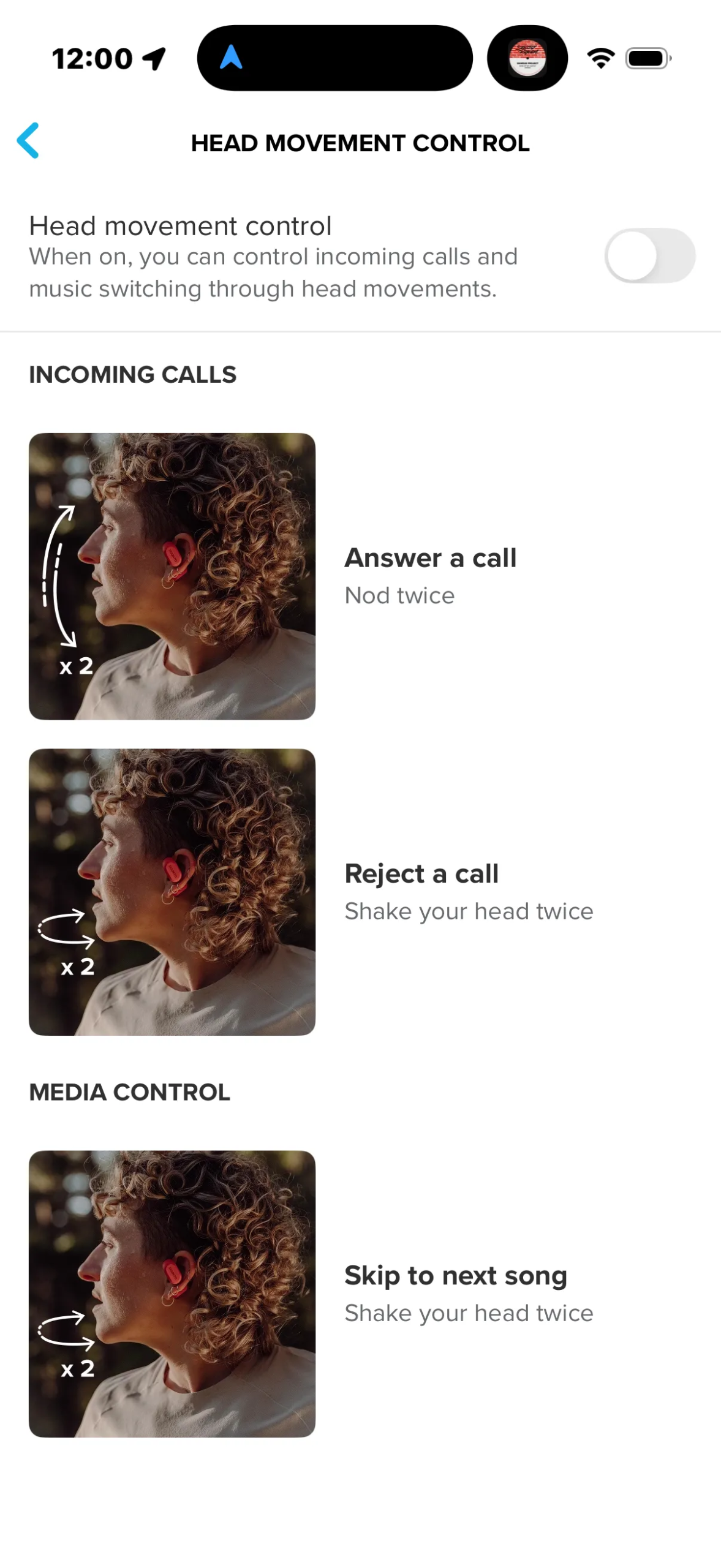
The head gesture controls aren’t as successful. This uses some pretty standard motion sensors found inside most smartwatches to register head nods or shakes to answer or reject a call or skip a track. I’ve used these on Suunto headphones previously, and my experience hasn’t been great. If you’re walking or sitting on a bike, they’re absolutely fine. When you run, your head naturally moves around a lot, and that does lead to accidentally setting off the controls. It quickly gets annoying.
Stellar Open-Ear Sound
Photograph: Michael Sawh
Bottom line, the Suunto Spark sound great. I’ve tested a lot of open-ear earbuds and headphones, and I’d put the Spark alongside the very best, including Shokz, Anker, and Bose.
Advertisement
Whether it’s the overall depth of the sound or versatility of the fit, I was impressed. They’re even great at not letting the wind cut through and drown out podcasts or calls. A big part of that strong performance lies with the available EQ modes, which (as mentioned) have to be enabled from the Suunto phone app. This is the same app used to set up Suunto’s watches. It’s not the prettiest, but the headphone section is pretty straightforward to get around.
There’s four EQ presets with an additional custom option, giving you greater control over the sound profile compared to other Suunto headphones. The switch to air conduction is what makes this possible. Air conduction works by placing speakers close to your ears and behaves a lot more like traditional earbuds. One of the chief benefits over bone conduction is the ability to offer much greater sound customization.
Many motorcyclists are passionate about their rides, and that’s especially true of Harley-Davidson owners. That appreciation goes beyond the brand’s iconic logo and company legacy, as the longevity of the bikes and their engines is often a huge selling point. When it comes to the Milwaukee-8 engine, it’s common to find owners praising its reliability online — albeit with some notable exceptions.
Harley owners mostly appreciate the engine, with the reliability seemingly a strong point. A Harley owner on the UKGSer claimed to have put over 16K miles on two different Milwaukee-8-powered bikes without issue, while a Harley-Davidson Forum poster asserts that they had put 224,000 trouble-free miles on their 2020 bike over five years. Reddit users also loved the M8, with many agreeing it’s a great engine that often outperforms other engines.
However, some owners have had problems with the 114 variation of the Milwaukee-8. Much of those problems are related to oil collecting at the bottom of the engine’s crankcase, a condition known as “sumping.” There are many tales of this occurring online, though evidence suggests that the issue is limited to older models.
Advertisement
The evolution of the Milwaukee-8 engine
Stefano Chiacchiarini ’74/Shutterstock
Harley-Davidson first acknowledged the Milwaukee-Eight’s sumping issue in a 2017 factory service bulletin. The bulletin noted that the issue primarily occured during extended periods of high-rpm operation or under heavy engine load. These situations would lead to an excessive amount of oil gathering in the engine’s crankcase, affecting the flywheel movement and causing the bike to lose power. High levels of engine braking were also possible, as was engine damage. Affected models included the Touring, CVO, Trike, Police, and Softail.
But while this was one of the reasons riders may have stayed away from even used Harleys, the company appears to have addressed the issue. The 2017 bulletin includes technical updates, indicating that the issue may have been fixed by implementing revised oil pump designs. These new pumps had updated part numbers and were installed to replace older pumps in affected motorcycles.
Advertisement
Despite any early problems, Harley-Davidson continues to use the M8 family of big-twin engines in the Touring and Softail models. The lineup’s variants currently include 107, 114, 117, and 121 cubic-inch models, with the 121-CI version powering certain CVO models like the Road Glide ST. These versions emphasize improved airflow, combustion efficiency, and better output compared to earlier large-displacement Harley engines like the Twin Cam engines.




































































You must be logged in to post a comment Login