Connect with us
DAPA Banner
DAPA Coin
DAPA
COIN PAYMENT ASSET
PRIVACY · BLOCKDAG · HOMOMORPHIC ENCRYPTION · RUST
ElGamal Encrypted MINE DAPA
🚫 GENESIS SOLD OUT
DAPAPAY COMING

Tech

Custom Watch Is On The Case

Published

on

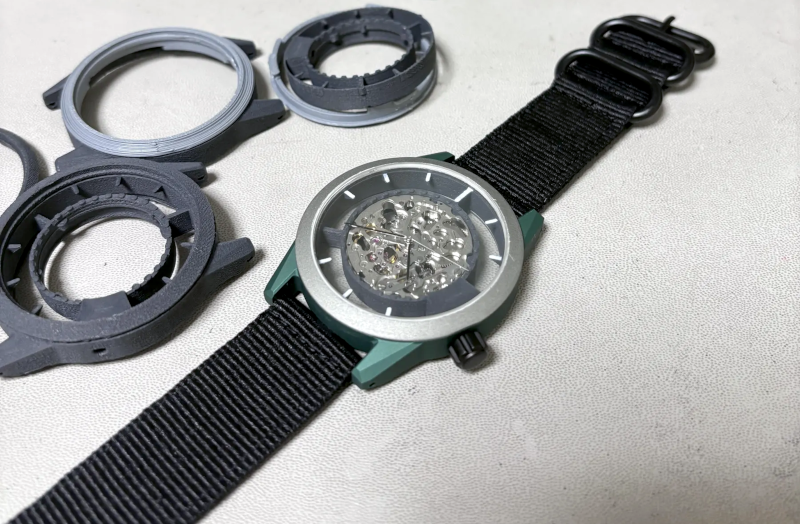
We were excited to see [Z0hn]’s project about 3D printing a custom watch from scratch — both because it was an exciting idea, and because the pictures looked great. While we still liked the project, we quickly realized it wasn’t really printing a watch so much as it was printing a case that holds an off-the-shelf movement. But it still looked great.

Many homebrew watches are cool and fine to wear to your next hackerspace board meeting. But this watch wouldn’t raise an eyebrow out among the normal public. Conventional watches use press-fit backs, tiny screws, or make the back screw into the housing. None of those are great for 3D printing, so this watch uses a bayonet connector, which is easy to create, robust, and reliable.

The watch looks easy to modify, so if you don’t like, for example, the unusual crown placement, you can change it. The movement is a Miyota 8N24 and, of course, the crystal is off-the-shelf, too.

Advertisement

While not exactly a printed watch, it was still pretty cool, and there are lessons to be learned here if you want to pull off the same feat. Or just go full on hacker. You could, too, try your hand with an open source movement.

Source link

Advertisement
Continue Reading
Click to comment

You must be logged in to post a comment Login

Leave a Reply

Tech

As a Tool of Productivity, AI Can Make the Effort to Learn More M

Published

on

This opinion article is an edited version of a post that originally appeared on the ASCD blog.

I want to share a story of struggle. Actually, two kinds of struggle.

My father completed his doctorate at the University of Utah in the early 1970s. For his dissertation, he ran a statistical analysis on genealogical records to determine the impact of certain economic conditions on family size.

He accomplished this on one of the most advanced computers of the time. His method? Literally punching out little rectangles in dozens of stiff paper cards, and feeding the stack into the computer.

Advertisement

My father was a lowly graduate student, and because the demand for computing time at the university was sky high, he had to run his analysis in the middle of the night. He spent many nights punching cards and running them through the machine. Even a single mispunch would cause the entire program to stop running and require painstaking troubleshooting, re-punching, and another night at the computer lab.

Unproductive vs. Productive Struggle

The soul-sapping sleep deprivation and endless paper punching that stood between my father and his goals represents the first kind of struggle in my story: unproductive struggle — the challenging, unavoidable tasks we must perform toward a learning goal, but which add no value to the intellectual outcome.

The real intellectual challenge in my father’s work was in deciding which variables belonged in the model, determining how to represent economic conditions over time, and interpreting the data. This is the second kind of struggle: productive struggle. That is, the effort a learner expends to make sense of concepts, to figure something out that is not immediately apparent. This struggle leads to growth and insight. It builds judgment, expertise and understanding.

What is frustrating about my father’s story in hindsight is that so much of his time and cognitive energy were consumed by the unproductive struggle of punching cards and managing the computer. Without those barriers, he would have had more capacity for the productive struggle that leads to meaningful learning.

Advertisement

Thinking About What Matters

When it comes to AI in schools, some educators fear that it will lead to learning becoming too easy. This is referred to as “cognitive laziness.” The assumption is that we will offload our thinking to AI and eventually lose our ability to think critically. This is a risk with any technology that makes our mental work more efficient, and AI is uniquely adept at taking on cognitively demanding tasks. But ceding our reasoning power to AI isn’t a foregone conclusion. And simply not using AI in learning settings doesn’t have to be our solution for preserving our mental capacities.

Just as better computing tools would have freed my father from punching cards without removing the intellectual rigor of his work, today’s tools, including AI, have the potential to offload unproductive struggle, while preserving, and even amplifying, the productive struggle that is central to learning.

Here’s an example: When reading comprehension is not the goal of a lesson but a necessary prerequisite — a student having to read an article to understand the causes of the French Revolution, for example — AI tools can adjust reading levels on the fly to assist learners who are below grade level or for whom English is not their first language. This allows them to focus on the history rather than on decoding the text.

Refining Rigor

So what does this mean for educators who are grappling with how to help students use AI effectively?

Advertisement

First, we need to remind ourselves and help our students understand that the goal of learning has never been to make learning easy. It is to make it meaningful. We must ensure that learners are spending their time wrestling with big ideas, not battling logistics or bogged down by rote tasks.

Second, educators need to face a hard truth about the assignments we give students. Many assignments contain a mix of productive and unproductive struggle, and we are not always very intentional about which is which. Under crushing time and resource pressure, we can become unreflective about the distinction between productive and unproductive work. We inherit assignments, reuse problem sets, and value rigor without always asking where the rigor actually lies.

If AI forces us to confront that, it may be one of the most useful disruptions education has experienced in decades.

For instance, requiring students to write citations according to a set format may feel rigorous, but the cognitive work of formatting has little to do with the intellectual work of evaluating sources and integrating evidence into an argument. This shift requires us to redesign tasks, rethink assessments and, if necessary, let go of practices that feel rigorous but don’t meaningfully deepen understanding.

Advertisement

Sharpening Learning

If we do this well, AI won’t hollow out learning; it will sharpen it. It will give students more space to wrestle with ideas instead of mechanics, more time to interpret instead of transcribe, and more opportunity to make active sense of the world. It will give us a chance to be far more intentional about the kind of struggle we ask students to engage in.

In the end, AI won’t decide whether our students experience cognitive laziness or cognitive growth. We will decide that by how we design assignments and assessments, and by the choices we make about which AI tools to adopt and how we choose to use them.

This is our chance to weed out the punch cards and open up more time for students to struggle over things that truly matter.

Joseph South is chief innovation officer at ISTE+ASCD.

Advertisement

Source link

Continue Reading

Tech

Amazon CEO’s Talks with U.S. Officials Triggered Crackdown on Anthropic Models

Published

on

The Wall Street Journal reports:

The Trump administration’s decision to halt all foreign use of Anthropic’s most capable AI models was prompted by conversations between Amazon Chief Executive Andy Jassy and U.S. officials including Treasury Secretary Scott Bessent, people familiar with the matter said.

Researchers at Amazon had used a series of prompts to get Anthropic’s Fable 5 model to provide them with information that could be used to aid cyberattacks and was supposed to be off limits, Jassy told the officials, according to people familiar with the matter. Tech industry executives have been in regular touch with the administration about the power of cutting-edge AI tools. Shortly afterward, White House officials held a meeting to discuss how to respond and security researchers began testing Amazon’s claims. The officials asked Anthropic to fix the vulnerabilities or take down the model, according to administration officials. The officials decided that the most direct way to address that risk was by preventing foreign governments, companies and individuals from accessing the tool, the people said. President Trump later signed off on the action despite reservations about it hindering innovation, a senior White House official said.

The administration had long felt that Anthropic, one of the leaders in America’s AI race, couldn’t be trusted to manage the security risks its new model presented. Friday’s call between some administration officials and Anthropic Chief Executive Dario Amodei reinforced that feeling, the people said…

Advertisement

Anthropic has said that the vulnerabilities like those flagged by Amazon are relatively basic. The company has said that other publicly available models are capable of discovering them and that they don’t represent a full so-called jailbreak, a point of view shared by some security researchers familiar with Amazon’s research.

The article points out that Amazon is “a big investor in Anthropic, supply Anthropic with chips for data centers.

Source link

Continue Reading

Tech

Amazon CEO reportedly raised Anthropic model concerns before government crackdown

Published

on

Amazon CEO Andy Jassy may have been the source of security concerns that led Anthropic to cut off worldwide access to two models on Friday.

The Wall Street Journal reports that Jassy told Treasury Secretary Scott Bessent and other government officials that Amazon researchers used Anthropic’s Claude Fable 5 to obtain information that could be used in cyberattacks. The government subsequently imposed an export control ban on the Fable 5 and Mythos 5 models.

An Amazon spokesperson said in a statement that while it’s “not uncommon for governments to seek our counsel on potential security risks,” the company does not “share the details of those discussions.”

The spokesperson also pointed to an update stating that AWS has been affected by the model cut off.

Advertisement

The Information and Reuters similarly reported that Amazon (a major Anthropic investor) had communicated concerns about the security of Anthropic’s models.

David Sacks, Trump’s former AI czar who now co-chairs the President’s Council of Advisors on Science and Technology, offered his own account of the discussions, claiming that “a highly credible trusted partner of both Anthropic and the USG […] came forward with a jailbreak.”

Sacks added, “The Admin asked [Anthropic CEO Dario Amodei] to fix the jailbreak or de-deploy the model. Dario refused.”

Anthropic said in a blog post that the capabilities apparently causing government concern are already available in other publicly accessible models.

Advertisement

This post has been updated with a statement from an Amazon spokesperson.

Source link

Continue Reading

Tech

A Report On The Benefits Of AI Was Reportedly Full Of AI Hallucinations

Published

on

It was published by KPMG, one of the world’s ‘Big Four’ accounting firms.

In October last year, KPMG published a report titled Total Experience: Redefining Excellence in the Age of Agentic AI, which was about how companies are using AI to cater to customers’ needs. KPMG is one of the “Big Four” professional services and accounting firms in the world, along with Deloitte, PricewaterhouseCoopers and Ernst & Young. Apparently, though, that report was full of AI hallucinations and included examples of agentic AIs that either did not exist or did not have the capabilities KPMG stated in the paper. Investigators for GPTZero, the maker of an AI content detection tool, found inaccuracies and fake footnotes all over the report, which were also verified by the Financial Times

In its report of the investigation, GPTZero said that only five citations out of 45 in the paper accurately pointed to real sources. A total of 28 citations paraphrased titles or added fake components to real sources, while 12 were phrased too vaguely to determine whether they actually existed. GPTZero called the creation of fake references by AI models “vibe citing.”

In addition to the fake or inaccurate citations, the investigators also found that approximately half of the claims in the paper were fake or misattributed. They were “likely the result of an AI research tool over-complying with a request to find examples of ‘agentic AI’ in the wild,” GPTZero wrote. In one example, KPMG claimed that Emirates launched a mobile chatbot called Sara that can talk to passengers and alter their flights for them. Sara was a mobile assistant launched in 2023 and not an AI-powered chatbot, and it also didn’t have the power to change bookings for passengers. 

Advertisement

KPMG also claimed that Swiss multinational investment bank UBS integrated agentic AI across its “investment advisory, risk management and compliance monitoring.” The bank told the Times that the information was “factually incorrect.” In another example, KMPG said that Swiss Federal Railways (SBB) has AI agents that can help passengers plan, book and optimize their trips based on preferences, real-time conditions and carbon impact. An SBB spokesperson said that was “not accurate.”

Papers by companies like KPMG are typically cited in other research papers and articles, since they’re considered as highly trusted sources. GPTZero chief executive Edward Tian explained that error-riddled papers published by the Big Four could “poison the well of information” and could lead to second-hand AI hallucinations. A KPMG spokesperson told the Times that the company “takes the accuracy and integrity of its published content seriously.” KPMG has since pulled the paper and is now “reviewing the circumstances surrounding its publication.”

Advertisement

Source link

Continue Reading

Tech

KPMG pulls report on AI usage due to apparent hallucinations

Published

on

Professional services firm KPMG has pulled a report titled, “Redefining excellence in the age of agentic AI,” after numerous organizations said the report’s claims about their AI usage were untrue.

Research group GPTZero identified a number of inaccuracies in the report, which was published in October 2025. GPTZero told the FT that the inaccuracies stemmed from AI hallucinations. In other words, the professional services firm appears to have used AI to help write a report about AI. 

UBS, the UK’s National Health Service, Swiss Federal Railways, and Transport for London all told the FT that the report’s claims about their AI usage were either untrue or misleading. A KPMG spokesperson said the firm removed the report from its websites while conducting its own investigation.

“We expect all our people to follow our guidelines on the responsible use of AI, including human oversight to validate content and verify independent sources,” the spokesperson said.

Advertisement

Last month, EY withdrew a report on loyalty rewards programs that appeared to include fake footnotes and AI hallucinations.

Source link

Continue Reading

Tech

The FBI secretly built an entire fake town just to practice cyberattacks

Published

on

While Hollywood has fake cities for filming movies, the FBI apparently has one for getting hacked. The agency has pulled back the curtain on its Kinetic Cyber Range, a 22,000-square-foot replica small town hidden inside its Huntsville, Alabama campus. But instead of training officers for shootouts or hostage rescues, the facility is designed to simulate realistic cyberattacks on homes, businesses, and critical infrastructure so investigators can practice responding to them in a controlled environment.

The FBI built an entire town just to simulate cybercrime

The indoor complex includes buildings such as homes, a hotel, a gas station, a courthouse, and even a fully functional data center packed with around 200 servers. Each location is wired with operating systems, connected devices, and live networks to mirror the kinds of digital environments agents encounter during real investigations.

According to the FBI, trainees can investigate simulated ransomware attacks, recover evidence from hacked vehicles, and trace digital footprints across multiple interconnected systems. Since opening last year, the facility has reportedly trained more than 1,400 FBI personnel and members of other government agencies. The goal is simple: replace classroom theory with realistic, hands-on scenarios where mistakes can be made safely before agents face similar incidents in the real world.

Cybercrime has become too real to train with PowerPoint slides

The idea might sound unusual, but it reflects how modern cyberattacks increasingly spill into the physical world. Ransomware can shut down hospitals, compromised industrial systems can disrupt utilities, and hacked vehicles or IoT devices often require investigators to understand both hardware and software simultaneously.

Advertisement

In many ways, the Kinetic Cyber Range is the cyber equivalent of the FBI’s famous Hogan’s Alley training town in Quantico, except the bullets have been replaced by malware and forensic tools. As digital attacks continue targeting everything from power grids to city infrastructure, having an entire fake town where agents can safely break and rebuild systems before responding to the real thing suddenly feels less like science fiction and more like a necessity.

Source link

Advertisement
Continue Reading

Tech

Waymo has bought Apple’s self-driving car test site for $220M

Published

on

Over two years after the Apple Car program was declared dead, Apple has offloaded its 5,500-acre Arizona proving ground to Waymo. It’s a sale that recoups $220M from the $10B Apple spent on the failed project.

The Apple Car project is a program believed to have been cancelled by Apple after about a decade of research and development. In what is the surest sign of it being dead, Apple has sold off a massive parcel of land used for self-driving vehicle testing.

In a filing reported by TechCrunch dated June 5, the property at Wittman, Arizona, has been acquired by Waymo. The sale, which was confirmed by Waymo, sees a payment of $220 million being handed over to Route 14 Investment Partners LLC.

Route 14 is a Delaware shell company believed to be connected to Apple. After renting the facility for a number of years, it Route 14 acquired it for $125 million in 2021.

Advertisement

The purchase gives Waymo yet another place to test out its vehicles. It already has locations in California and Ohio, but the Arizona lot will give it a massive amount of land for testing its fleet.

A Waymo spokesperson said the Arizona facility would be used to simulate driving scenarios in a controlled environment. This is to test its self-driving system, including rider-only testing, motion control, operational training workflows, and its future testing needs.

A self-driving playground

Apple’s renting and later purchase of the facility made sense at the time. It is a location that has a lot to offer companies in the automotive business.

The 5,458-acre site was previously used by Chrysler, again as a vehicle proving ground. It was then sold to a housing developer in 2005, but was later annexed by the City of Surprise and left alone.

Advertisement
Aerial view of a desert vehicle testing facility with large oval tracks, winding roads, and an elongated basin-like structure surrounded by barren rocky terrain

A view of the facility – Image credit: Google Earth

In 2016, the city signed a development agreement with the then-owner SFI Grand Vista LLC, under the intention that it would be used by Route 14.

Despite being over 5,000 acres in size, only a small part of the facility has been set up for testing purposes. There is a 115-acre city course, as well as a freeway course geared towards autonomous vehicle testing.

It also has a 35-acre vehicle dynamics area and a four-mile oval track.

Advertisement

The sheer size of the facility provides ample opportunity for occupiers to build out the area for extended testing. All while still maintaining a safe distance from the edge of the lot, which also helps keep the testing private.

Cash back from an expensive project

The sale of $220 million in now-unused land sounds like a lot, and so does the $95 million in value the site earned in just five years. That is, until you remember that this involves Apple.

At Apple’s scale, the proceeds of the property sale will help fund other projects, but it’s pocket change compared to its other investments.

Indeed, compared to the $10 billion Apple has been estimated to have shelled out over a decade for Project Titan, it’s barely 2% of the outlay.

Advertisement

It is, however, an attempt by Apple to shed the last vestiges of the extremely expensive failure.

It’s no longer testing its self-driving system on roads, after cancelling the Autonomous Vehicles Program Manufacturer’s Testing Permit in September 2024. Holding onto private grounds for testing doesn’t make sense if there aren’t any planned for the future.

The work wasn’t entirely a bust for Apple, as the teams and research that went into it will have been absorbed by other parts of the company. It’s not hard to imagine some of the computer vision elements being incorporated into Apple Intelligence, or elements being used to push forward its robotics efforts.

The sale, two years after a very public funeral for a very secretive project, is merely Apple getting rid of a massive site that it has no use for anymore.

Advertisement

It’s a reminder of the costly mistake that hurt its wallet and with little to prove for it.

Source link

Advertisement
Continue Reading

Tech

The modern leadership capabilities becoming critical as companies scale

Published

on

The Leadership Effectiveness Analysis best practices report explores the qualities that differentiate high-performing tech leadership professionals from their less effective counterparts.

Leadership skills in 2026 are a critical capability that enable professionals in all industries to navigate the highs and lows of the ever-changing global working environment. Whether a job announcement, acquisition, or restructuring, there is always a challenge to be overcome, and positive leadership is often the driving force towards success or a favourable outcome in a difficult situation.  

Touchstone Executive Assessment recently published the results of its Leadership Effectiveness Analysis best practices report. The company collected data from 142 senior professionals in advanced technology roles, across multiple European organisations, between March 2023 and March 2026. The aim was to determine the specific leadership attributes that differentiate highly effective and less effective leaders. 

The report said: “Many years of research and practice assert a direct connection between leadership effectiveness and organisational performance.

Advertisement

“Organisations, however, differ widely in terms of their culture, history, business strategy and people. Because organisations present unique cultural signatures, there is no one best model or profile of effective leadership behaviour.”

Leading in tech has undoubtedly become more complicated as professionals are working in a landscape that is being heavily impacted by political and social instability, threats to global supply chains and mass layoffs at major organisations. With that in mind, now more than ever, it is critical that tech leaders motivate and drive positive action in the workplace. To do that, a hefty arsenal of diverse skills is necessary. 

Steady skills

Among those identified by Touchstone Executive Assessment (TEA) as the most critical skills for a modern-day tech leader was significant cognitive ability. TEA’s research found that leaders depend on the ability to learn quickly, think strategically, see the bigger picture and embrace ambiguity. 

The report said: “Technical knowledge and domain expertise, while important in themselves, are not the factors that differentiate the best in class from the average. It is the ability of the individual to reason under uncertainty, in real time and in a very expansive manner.”

Advertisement

In blending domain expertise with the ability to view one’s industry through a strategic lens, TEA’s report found, professionals can take into account the long-term implications of decision-making, improve business aptitude and create that big picture perspective.

The data also suggested that operational and interpersonal skills are key areas to work on for professionals in demanding technology roles.

“This is where the worlds of technology and people really come together,” the research noted.

“While execution focus and a production mindset are important, leaders in advanced technology must also be able to manage stakeholder relationships, to communicate and influence effectively, and to drive accountability and engagement across their entire landscape. 

Advertisement

“This goes well beyond project management; there is a real sophistication in understanding the organisational environment, knowing the rules of the game and rallying people behind the mission as well as the person.” 

Strong leaders, it said, will have the ability to understand organisational dynamics, effectively lead organisational change and deliver results.

Long-term stability

Perhaps unsurprisingly, given the current state of global instability and disruption, TEA’s report also indicated that professionals who show the ability to thrive under pressure and scrutiny perform better in leadership roles. 

“This talks to the characteristics of the person, not just the person in their role. Our research indicates that personal and professional resilience are increasingly important factors, bringing an ability to sustain performance when the going gets tough and to bounce back quickly from setbacks.”

Advertisement

People in this position are, according to TEA, tenacious, determined and better able to sustain their performance in landscapes impacted by uncertainty and pressure. It found that they are unlikely to take issues personally or emotionally, as they demonstrate resilience, effective decision-making and a tolerance for ambiguity. 

Commenting on the results of the study, David Ringwood, the head of assessment and executive coaching at TEA, said: “There is no single right or wrong way to lead – context is king. Technology and AI today are very different than they were 10 years ago, and leadership accordingly needs to recalibrate in line with that shifting context and the changing expectations of employees. The best technology experts don’t always make the best leaders.

“Hiring, developing and building a book of talent that includes those who have the headroom to grow is critical, not least in technology and AI where there is always competition for top talent. This is a ‘how do we’ question – how do we objectively know what predicts the greatest future potential, how do we measure what is exactly relevant and how do we know we’re being as objective as possible?

“Putting the wrong person in the wrong role or career path is an expensive way for everyone to find out. This research may contribute to the definition of what high potential looks like in the tech sector and gives organisations a much clearer sense of where to build performance for today and leadership for tomorrow.”

Advertisement

Notably, in May of this year, technology and consulting company Expleo released the results of its AI sentiment tracker, AI Pulse, for Ireland, a report which found that business leaders in Ireland, ahead of their contributing European counterparts, are far more likely to value empathy as a fundamental skill for managers in the age of AI.

Among Irish business leaders, human-centric skills were identified as the most critical abilities a manager can wield, particularly in the context of increased AI adoption. 

Don’t miss out on the knowledge you need to succeed. Sign up for the Daily Brief, Silicon Republic’s digest of need-to-know sci-tech news.

Advertisement

Source link

Continue Reading

Tech

GM Updates 250,000 EVs with Vehicle-to-Grid Firmware, Announces Grid-Scale Sodium-Ion Batteries

Published

on

“Battery breakthroughs will lessen AI’s demand on the electricity grid,” argues The Washington Post’s editoral board, arguing that GM’s latest moves “offer a fresh reminder that resource constraints can be solved by innovation.”

Or As Fortune put it, “America’s electric grid is buckling under extreme weather, aging infrastructure, and an AI build-out that is quietly rewriting U.S. power demand — and General Motors wants to turn that crisis into a business.” They describe GM’s plan as offering itself “as a distributed utility in disguise… stitching together hundreds of thousands of battery-powered cars, new grid-scale storage, and a unified charging platform into what amounts to a virtual fleet of power plants.”

The bet puts GM on a collision course with Ford’s newly branded Ford Energy unit as both Detroit rivals race to repurpose underused EV capacity for a more urgent problem: keeping the lights on in the AI era. GM’s case rests on three planks. The first is its existing fleet. GM says more than 250,000 of its EVs on U.S. roads can already charge bidirectionally — pulling electricity from the grid and sending it back. “Every evening, a quiet transformation occurs across the American landscape,” GM Energy vice president Wade Sheffer writes in an open letter to utilities and regulators, describing the EVs sitting in driveways as “a massive opportunity to aggregate energy storage capacity.”

A firmware update is rolling out to customers with GM Energy’s vehicle-to-home hardware, converting those systems into full vehicle-to-grid assets with no new hardware and turning home backup systems into grid resources when utilities need them. GM is piloting the idea in Michigan with DTE Energy at 30 employee homes, and has sketched a 2030 vision with Pacific Gas & Electric in which more than 52,000 GM EVs help balance the grid out of a projected 130,000 vehicles in the area.
GM is also “seeking partnerships with utility companies nationwide to assist in offering such vehicle-to-grid services for customers,” reports CNBC, noting it’s one of two moves “meant to address concerns about rising energy costs amid an artificial intelligence boom.”

Advertisement

Forbes reports that GM’s second goal “is to leapfrog the dominant battery cell tech used for energy storage packs right now” — right past the LFP (lithium-iron phosphate) stage, “which is dominated by China.”

Sodium batteries are cheaper to use than LFP because they don’t need an additional cooling system. They also have a 20-year usable life and are made from materials that can be sourced from within the U.S., the company said at a briefing in San Francisco on Tuesday.
“Sodium-ion actually is the better chemistry for that application. And when I say sodium-ion is better, I mean GM’s version of sodium-ion,” Kurt Kelty, GM’s battery chief and a long-time Tesla battery executive, told Forbes. He said GM is seeing great results from its prototypes, even at scorching temperatures of 55 Celsius (131 Fahrenheit).

“Sodium-ion-powered energy storage systems have the potential to operate without active cooling and with much less system complexity,” Kurt Kelty, GM’s vice president of battery and sustainability, said Tuesday in a blog post. “In large energy storage systems, that matters.” Not having to cool the battery cells could lead to lower upfront costs as well as operating costs, the automaker said.

TechCrunch reports on GM’s big new partnership with energy-storage startup Peak Energy to develop GM’s sodium-ion battery chemistry for grid-scale deployments:
GM wouldn’t share with TechCrunch how much money it is investing in this energy-storage effort. But we do know the company has committed $900 million to commercialize new battery chemistries, an investment that includes a new battery-development center. .. The first GM cells are expected to enter trial production at the company’s Battery Cell Development Center in 2028.
“Our next-generation sodium-ion cell development will drive energy density higher,” promises GM’s blog post, arguing they’re extending the company’s battery expertise and technical infrastructure “into the electrical grid itself. If we get this right, we will not just build better batteries. We will help create a more resilient, more affordable and more flexible energy future… Every improvement we make strengthens the development stack that supports both EVs and energy storage.”

“The message: GM isn’t just selling cars into a stressed grid; it’s supplying the batteries to stabilize it,” argues Fortune.

Advertisement

And GM also announced they’re augmenting their apps with an “Energy Pass” offering “seamless access to Tesla Supercharger, IONNA, Electrify America, and soon, ChargePoint and EVgo networks.” Their goal is to simplify the charging experience with an app “that covers nearly 70% of all DC fast chargers in the United States, plus many Level 2 chargers, all through one app.”

Source link

Continue Reading

Tech

Parker Solar Probe Makes Another Flyby Of The Sun, Solar Energy Bags A Win, And More Science Stories

Published

on

NASA this week announced the four-person crew that will lead its Artemis III mission in 2027: NASA astronauts Andre Douglas, Frank Rubio and Randy Bresnik along with ESA’s Luca Parmitano as the flight’s pilot. Plus, the Parker Solar Probe took another trip around the sun, solar energy overtook coal in May, and more. Here’s this week’s science news.

Parker Solar Probe’s 28th flyby

NASA’s Parker Solar Probe made another close pass around the sun this week, getting 3.8 million miles from the surface and reaching a speed of 430,000 mph. This marked its 28th flyby, and matched the speed and distance records the probe first set back in December 2024. It’s hit those numbers five times since. The spacecraft began its latest approach on June 3, and transmitted a beacon tone on Thursday to signal to the team that all is well.

The Parker Solar Probe has been studying our star for eight years, incrementally getting closer and closer to the surface. It launched in 2018 and made its first close approach to the sun that fall, when it came within 15 million miles of the sun’s surface. For its first flyby, it reached a maximum speed of 213,200 mph. Despite the harsh conditions in the sun’s vicinity — the heat shield reaches an estimated 1,700 degrees F when the spacecraft is closest to the sun — the Parker team says the probe still appears to be doing well after all this time. Below the heat shield, the Parker probe is protected by thermal blankets which have kept the temperature of the spacecraft itself consistent during these flybys.

“That temperature consistency is a major indicator of spacecraft health,” said John Wirzburger, Parker Solar Probe mission systems engineer at the Johns Hopkins Applied Physics Laboratory. “It tells us the heat shield isn’t degrading. If it were cracking or weakening, we’d see temperatures drift upward as more heat leaked through.”

Advertisement

Parker is observing solar wind and activity, keeping track of the changes that occur across the sun’s 11-year cycle. The space probe arrived at the sun near the quieter period known as solar minimum, and has been there long enough to see it reach solar maximum, which was confirmed in 2024. This is when solar activity peaks, giving rise to an increase in sunspots and events like solar flares and coronal mass ejections. Solar activity will soon begin to gradually decline as it moves through the next phase. The Parker probe has had a front row seat for all of this, gathering unprecedented data that will help us better understand our star and its effects on space weather.

Solar overtakes coal in the US for the first time

According to a report from the energy think tank Ember, May 2026 marked the first month on record in which solar accounted for more electricity generation than coal in the United States. Despite the Trump administration’s push to revive the coal industry, “Solar supplied a record 12.8 percent of US electricity, while coal fell to 12.2 percent, its fourth-lowest monthly share ever,” according to Ember. The total output from solar last month was a record 45.5TWh, making it the third-largest source of electricity in the country, Ember reports.

Coal was only slightly behind it at 43.4TWh in May, but this marked an 11 percent drop compared to the same time last year. And in April, it dipped to its lowest-ever monthly total on record, at 39.3TWh. “The share of coal generation in the US mix has nearly halved in the last five years, falling from 19.7 percent in May 2021 to 12.2 percent in May 2026,” according to Ember. “In contrast, solar power’s share of the mix more than doubled from 5.4 percent to 12.8 percent over the same period.”

Solar still fell behind gas and nuclear, but analysts at Ember say clean power is still ticking upward even as policy shifts in the other direction. In March, according to Ember, “renewables collectively generated more electricity than gas for the first time in the US.”

Advertisement

Enjoy this timelapse of the southern lights seen from space

Earlier this week, an astronaut on the International Space Station shared a breathtaking timelapse video of aurora australis (the southern lights). Jessica Meir, who is the spacecraft commander for NASA’s SpaceX Crew-12 mission, captured the footage from a Dragon spacecraft docked to the ISS. “As opposed to the previous aurora I’ve seen, this one danced and snaked its way directly below us, putting on quite a show,” Meir wrote on social media. “I am in awe of this y [sic] evocative phenomenon.”

Astronauts may have some of the best views of auroras, but viewers down on the ground have been getting a pretty good show as of late, too. The NOAA’s National Space Weather Prediction Center last week issued G2 and G3 geomagnetic storm watches, giving enthusiasts a heads up that auroras may be visible in more regions than normal. In the Northern Hemisphere, auroras were predicted to be visible across Canada and the northern US, while viewers in Australia and New Zealand had a chance to catch the southern lights.

Before you go, be sure to check out these stories too:

Advertisement

Source link

Continue Reading

Trending

Copyright © 2025