TL;DR
Amazon’s Jassy reportedly told the government that researchers used Fable 5 for cyberattack info. That triggered the order to shut down Fable 5 and Mythos 5.





Amazon’s Jassy reportedly told the government that researchers used Fable 5 for cyberattack info. That triggered the order to shut down Fable 5 and Mythos 5.
Amazon CEO Andy Jassy was reportedly the source of security concerns that led the US government to force Anthropic to shut down Fable 5 and Mythos 5 for every customer on Friday. The Wall Street Journal reported that Jassy told Treasury Secretary Scott Bessent and other officials that Amazon researchers used Fable 5 to obtain information that could be used in cyberattacks. The government then imposed an export control ban on both models.
The revelation adds an uncomfortable dimension to the story. Amazon is one of Anthropic’s largest investors, having put in billions and receiving a $100 billion cloud spending commitment in return. The company that bankrolls Anthropic’s infrastructure is also the one that told the government its models are dangerous.
An Amazon spokesperson said it is “not uncommon for governments to seek our counsel on potential security risks” but declined to share details of the discussions. The spokesperson also pointed to an AWS status update confirming that Amazon’s own cloud platform was affected by the model shutdown.
David Sacks, Trump’s former AI czar who now co-chairs the President’s Council of Advisors on Science and Technology, offered a different account. He said “a highly credible trusted partner of both Anthropic and the USG came forward with a jailbreak.” Sacks added: “The Admin asked Dario to fix the jailbreak or de-deploy the model. Dario refused.”
Anthropic’s version is different. The company said it reviewed the jailbreak technique and found it surfaced “a small number of previously known, minor vulnerabilities.” It called the government’s response disproportionate and said the capabilities causing concern are already available in other publicly accessible models. The shutdown affected every customer globally because Anthropic cannot filter foreign nationals from US users in real time.
The sequence matters for the AI industry. Amazon invested billions in Anthropic. Anthropic built models on AWS. Amazon’s CEO told the government those models pose security risks. The government used export controls to force them offline. AWS was then affected by the shutdown. It is an ouroboros of corporate dependency and regulatory blowback.
For Anthropic, the immediate question is how quickly it can restore access. For the broader industry, the precedent is what matters. If a major cloud provider can trigger an export control action against its own portfolio company by raising concerns with the Treasury Secretary, the competitive dynamics of the AI market just gained a new weapon. Mythos is used by banks and government agencies for vulnerability discovery. Every one of those customers lost access because of a dispute between Anthropic’s biggest investor and the government its CEO has been lobbying for more regulatory power.
A roundup of recent reviews published by Engadget.
It’s as hot as the surface of the sun here in the southeast US, and we’ve got another batch of freshly baked reviews for you to catch up on. If you’ve missed any of our team’s in-depth testing over the last two weeks, read on for a full rundown of all of our latest impressions on foldable phones, an affordable GPU, headphones and more.
In case you’ve been living under a rock, Motorola turned its iconic Razr phone into a set of foldables. Now on the second iteration of the Razr Ultra, the company hasn’t done enough to justify a pricier follow-up. “With Samsung expected to announce a new Z Flip before the end of the summer, buying a Razr Ultra right now at full price feels like a bit of a trap,” writer Sam Rutherford said. “It’s a good phone, I just wish it cost less.”
It’s not a great time to buy a GPU, but AMD has a unique solution for the budget crunch. With the RX 9070 GRE, the company offers older tech for less money, but you’ll have to make some sacrifices along the way. “Given the times we’re in, I can’t easily recommend that you run out and buy the Radeon RX 9070 GRE,” writer Devindra Hardawar said. “But if you’re in desperate need of an upgrade, and you can’t wait until next year, it’s a solid choice for midrange 1440p gaming.”
Honor just launched the Magic V5 last August, but it announced the Magic V6 in March. Editor Daniel Cooper argues the company rushed out a successor to maintain its claim of the world’s thinnest foldable. “The tragedy of this device is that you can throw a rock and hit an issue with the UI design or software that you would expect to have been caught during the QA period,” he said. “Some of these would be forgivable in a cheaper handset, but not in an ultra-premium flagship of this caliber.”
Although over-ear ANC headphones are aplenty, noise-canceling on-ear headphones are much more rare. Marshall has a new take on the on-ear formula, balancing its product lines with a dash of distraction blocking on the Milton ANC. “The heritage of the popular Major line clearly has been put to good use here to make an on-ear headphone for the more discerning listener,” writer James Trew said. “The ANC capabilities are strong for the form-factor, even if they might be considered more mid-pack if they were over ears.”
Is a folding mouse the ultimate travel accessory? For a certain set of people, Logitech’s Mobi Fold may prove that answer to be a resounding “yes.”
“I’m faster and more productive when using a physical mouse and I’m more than willing to carry one with me, just as long as it doesn’t weigh things down too much,” Sam said. “And with the Mobi Fold, Logitech has created one of the most travel-friendly pointers on the market.”
While we await an opportunity for extended testing, you can read some initial impressions from behind the wheel of Rivian’s R2 SUV. “[The] R2 is very much a standard SUV, but one that proved both capable and comfortable in all conditions,” writer Tim Stevens said. “After a day of driving, I found myself liking it a lot more than the R1S. In other words, there’s no sophomore slump here, and now I’m even more excited about the R3X.”

After WIRED reported last week that Meta’s smart glasses app contained code that would enable the company to activate face-recognition features on the devices, the company removed the code this week without commenting on why or whether it plans to add such functionality back into the app later. Another WIRED investigation this week found that xAI’s Grok is still hosting sexualized deepfakes, including “nudified” images and videos, of celebrities and at least one prominent US politician.
After limiting the release of its new Mythos-class AI model over concerns about its potential impacts on cybersecurity, Anthropic announced a model upgrade for partners in its limited-access group this week and launched a “safe” version of the model to the public with guardrails meant to keep the system from being used to fuel cyberattacks. Meanwhile, the United States Cybersecurity and Infrastructure Security Agency issued a new directive to federal agencies this week in reaction to new AI threats that includes a requirement to fix the most urgent software vulnerabilities in as little as three days.
As Europe looks to separate and insulate itself from US Big Tech, WIRED created a timeline that tracks all the ways EU governments, companies, and other organizations are moving away from US tech. A new open-source project dubbed Encrypted Spaces could be used to make countless mainstream collaboration apps more private and surveillance-resistant with end-to-end encryption. And illegal pharmacy and scam websites hijacked Spotify’s search rankings using fake podcasts, according to a new joint US Congressional report.
The 2026 World Cup is in full swing, and WIRED looked at the surveillance technologies, from anti-drone tech to face recognition, that are being used in US, Canadian, and Mexican stadiums. We also mapped every Flock license plate reader near a US World Cup stadium. More broadly, Amnesty International said this week that it has concluded fans in all three host countries—both local residents and visitors—face potential human rights violations as a result of the FIFA tournament.
The American Civil Liberties Union is suing two Florida police departments over its use of FACES, one of the longest-running face recognition tools in the US, after its alleged misuse led to the wrongful arrest of a Fort Myers man. Donald Trump, meanwhile, jeopardized the future of a key surveillance authority after selecting Bill Pulte, who’s been described as “deeply unqualified,” as the acting director of national intelligence. (Trump has since selected an alternative nominee for the permanent role.)
And there’s more. Each week, we round up the security and privacy news we didn’t cover in depth ourselves. Click the headlines to read the full stories. And stay safe out there.
As difficult as digital anonymity has become in the modern world, obtaining a phone number without revealing almost any identifying information—whether by buying a temporary burner phone or registering an account with a privacy-preserving phone carrier—has remained entirely legal in the US. Now the Federal Communications Commission wants to change that.
Late last month, the FCC released a proposal for a new rule that would implement know-your-customer requirements for cellular networks, requiring that cellular providers “at a minimum, obtain and retain the name, physical address, government issued identification number, and an alternate telephone number of any new and renewing customer before granting access to its services.” The proposal is described as a measure akin to money-laundering laws designed to make it more difficult for scammers to exploit the phone networks. But privacy advocates argue it also threatens a last conduit of anonymity for those seeking to evade phone surveillance—whether that’s journalists, whistleblowers, activists, or simply people seeking to avoid mass data collection in yet another facet of their communications.

With delivery by Father’s Day and a 90-day low price, you’ll want to grab Amazon’s weekend Mac mini deal before inventory runs out.
With increased demand for a headless machine to run AI agents and a budget-friendly price tag, Apple’s M4 Mac mini has been sold out for much of Q2 2026. But Amazon has the 16GB/512GB configuration back in stock, and it’s on sale for $769.99 (a $30 discount off retail).
Now priced at a 90-day low, Amazon has repeatedly shown stock levels of 20 or fewer units left today, indicating stock is limited.
You can also find early Prime Day deals on dozens of Apple devices, including $299 iPads, $499 AirPods Max 2, and 2026 MacBook Airs from $949 in our early Prime Day Apple deals roundup.

Nintendo is introducing a new account-history requirement for Switch 2 purchases in Japan to keep consoles away from resellers. The move targets the multi-language Nintendo Switch 2 sold through the official Japanese Nintendo Store, which scalpers have been buying in bulk because it can be bought for less in Japan and resold abroad.
The price difference explains why scalpers are interested. In Japan, the multi-language Switch 2 is considerably cheaper compared to some other markets. That gap gives resellers room to import units and mark them up overseas, especially while official stock remains limited. The Japan-exclusive model, which only supports Japanese text and characters, is not affected by the new rule.
Nintendo said on X that it had found multiple orders linked to suspected resale activity and temporarily paused sales of the multi-language model. When sales resume, buyers will need to meet stricter conditions. Their Nintendo Account must show at least 50 hours of playtime on the original Nintendo Switch by 11:59 PM on May 31, 2026. Playtime from demo titles and free software will not qualify.
The company is also limiting purchases to one console per Nintendo Account. That gives Nintendo a way to reduce repeat buying while making fresh accounts less useful for resellers.
The Switch 2 has become one of the most practical handheld gaming console options, especially after Valve’s Steam Deck price hike made PC handhelds a bigger expense for many buyers. Still, Nintendo’s console will not stay immune to higher pricing for long, with its own price increase expected soon.

Scalpers have been a thorn in the side of gamers for years. Valve faced a similar issue with the recent Steam Controller launch, where units quickly sold out and appeared on resale sites at inflated prices. Valve responded with a reservation queue, purchase-history checks, and a one-controller-per-account limit.
Nintendo is now applying a similar idea to the Switch 2. Fresh accounts will have a much harder time passing the check, which could reduce bulk buying through the Japanese store.

A few weeks ago on a bike ride “inspiration struck” for Dave Eggers, reports SFGate…
Without a pen and paper handy, he was stuck texting the idea to himself. The problem? Eggers doesn’t own a smartphone. “It takes 20 minutes to write a sentence,” Eggers said… It’s a funny predicament for Eggers, given that he’s arguably the city’s biggest proponent of the written word… Now age 56, Eggers’ latest book is called “Contrapposto“…
On writing days, Eggers bikes to his sailboat docked near the Golden Gate Bridge. He writes using a hefty 1998 Mac that has never been connected to the internet. On the boat, he keeps “banker’s hours,” working 9 to 5 without any meetings or interruptions except for the occasional wildlife visit. “You’re there with the cormorants and the occasional porpoise and sea lions and seals, and when you want to take a break, you walk around and you’re in the thick of it, one of the most beautiful spots on Earth,” he said. “Especially coming from the Midwest, it never gets old.”
Given Eggers’ decidedly low-tech existence, it’s not surprising that the current state of San Francisco gives him pause, but there’s a streak of hope that underlies his concerns. He abhors the growing surveillance technology that’s gripping the city, refusing to get into Ubers that use recording devices, but he feels a well-written ballot measure about Flock cameras could potentially save our dwindling privacy. ChatGPT’s effects on the art of writing are demoralizing, but he welcomes that teachers are re-embracing pencil and paper, with cursive making a big comeback. The wave of artificial intelligence ads blanketing bus stops imploring companies to stop hiring humans are so over the top, they’d sound cliché if he were to include them in one of his dystopian tech industry novels like “The Circle” or “The Every,” but tech philanthropy has helped many of his projects flourish.
Case in point, Art + Water, a new art space scheduled to open next year on Pier 29 funded largely by art world donations… Co-founded with the artist JD Beltran, the space is slated to operate as an old-school apprenticeship system, hosting 10 artists in residence mentoring 20 students, all free of charge… The ultimate goal is to break down the financial barriers that keep students from pursuing art.
Thanks to Slashdot reader destinyland for sharing the article.

Slashdot reader BrianFagioli writes:
Shutterstock has unveiled what it calls a “human-led, AI-powered” creative platform that combines its massive library of [human] contributor-created content with AI image and video generation, AI editing, conversational search, prompt enhancement, and automated model selection tools. The company says the goal is to help creators move from idea to finished work faster [in a single application] while maintaining commercial licensing protections and contributor royalty payments… While Shutterstock repeatedly emphasizes human creativity, much of the platform’s future appears centered on AI-generated and AI-modified content.
An article at Nerds.xyz suggests Shutterstock’s AI tools let users “transform existing content into something new,” while noting Shutterstock’s repeated references to human creativity “almost feel defensive.”
But it points out other companies including Adobe and Canva “and countless startups are all racing to integrate AI into creative workflows.”
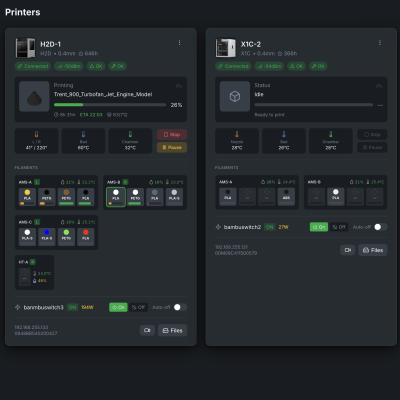
If you have a Bambu Labs printer and aren’t keen to send your files to Bambu’s servers with each print job, then check out Bambuddy, an open-source, self-hosted, cloud-free central command that offers a local alternative for managing Bambu Labs printers. It acts as a replacement for the official cloud services, allowing you to slice, print, and monitor with full local control and zero reliance on Bambu Labs’ servers.
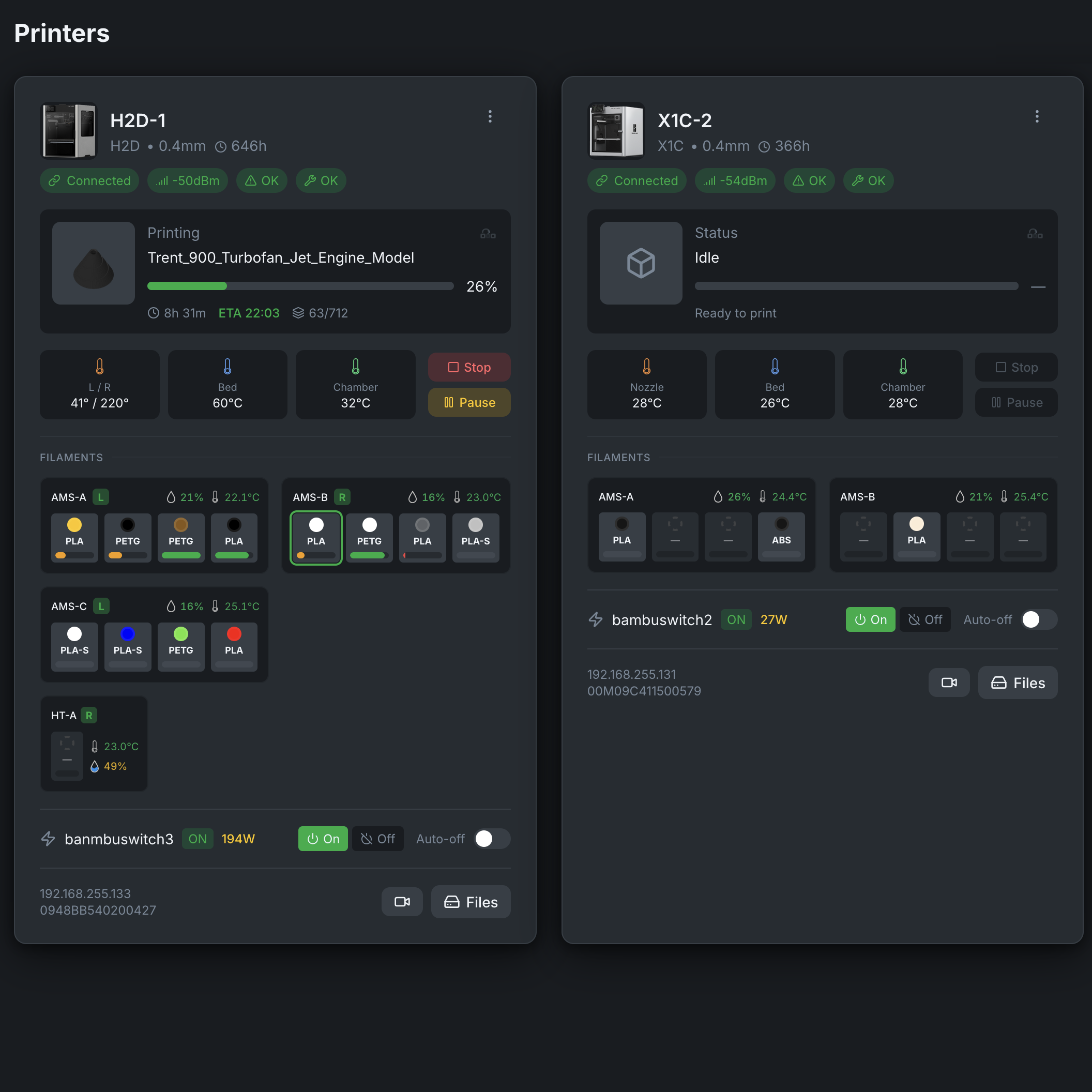
To use it, one installs Bambuddy, then puts their printer(s) into LAN-only mode. Doing this disables cloud functionality, including remote access. Then one enables Developer Mode, which allows external software to control printer functions via a machine API. Once that’s done, the printers can be added to Bambuddy.
Bambuddy then acts as a full-featured control panel and management center for anywhere from one to forty printers. It runs on Linux, macOS, or Windows, and a Raspberry Pi is a common install target.
Bambu Labs makes indisputably high-quality printers, and using their software and official app is certainly convenient. But the fact that every print job goes through Bambu’s servers, and a software architecture that frustrates home-grown solutions? Not so much. Add AGPLv3 violations and some heavy-handed legal behavior to the mix, and it’s easy to understand the motivation for an alternative to the factory software.
Bambuddy has a huge number of features — including an integrated slicer and proxy mode for remote access — and it may look a little intimidating at first. Fortunately, the project’s website offers a live sandbox demo with simulated printers, which should be right up the alley of those who prefer to learn by clicking around in a consequence-free environment.
Meta has begun dismantling its $2 billion acquisition of Manus, completing an operational separation from the Chinese-founded AI startup and halting data sharing between the two companies. This is the most concrete step yet toward complying with a divestiture order Beijing issued roughly two months ago on national security grounds.
Meta has cut Manus off from its internal systems, Bloomberg reported, preventing employees from using Manus tools for internal projects as the two companies move toward a full separation.
Meanwhile, according to May reports, the co-founders of Manus have held preliminary discussions about raising approximately $1 billion from outside investors to reclaim the startup from Meta, a move that could pave the way for a Chinese joint venture structure and an eventual listing in Hong Kong, a venue that has seen a surge in AI listings this year for Chinese AI startups like MiniMax and Zhipu.
What was supposed to be a landmark exit for Chinese AI is quickly unraveling. The move underscores Beijing’s determination to retain control over strategically sensitive technology, regardless of a company’s offshore incorporation.
In addition to the forced divestiture, Chinese authorities have since expanded travel restrictions to researchers and executives at private firms, requiring government approval before heading abroad. China is also tightening its grip on foreign capital, with reports indicating that top AI firms, including Moonshot AI, StepFun, and ByteDance, will need government sign-off before accepting U.S. investment, adding another layer to Beijing’s sweeping effort to control its AI sector.
Even as Meta moves to sever ties with Manus, the agentic AI startup has continued to ship new features, rolling out integrations with Similarweb and Shopify.
Manus drew widespread attention with a viral agent demo relocated its staff to Singapore in mid-2025 before announcing a $2 billion acquisition by Meta in December. Chinese regulators moved to scrutinize the transaction earlier this year, citing potential violations of technology export controls and foreign investment rules.
Manus investors, including California-based venture firm Benchmark, have already received their proceeds from the acquisition, while Asian backers, including Tencent, HSG, and ZhenFund, have indicated they will cooperate with the unwinding process, according to the WSJ.
Manus’ Chinese origins with parent company Butterfly Effect drew scrutiny on both sides of the Pacific, with Senator John Cornyn questioning whether American capital should flow to a Chinese-linked firm.
Meta and Manus did not immediately respond to a request for comment outside regular business hours.
When you purchase through links in our articles, we may earn a small commission. This doesn’t affect our editorial independence.


Washington state Gov. Bob Ferguson on Tuesday announced that banning cellphone use in kindergarten through 12th grade throughout the school day will be one of his top priorities when lawmakers convene in January.
“More than half of states across the country are moving in one direction, and one direction only. They’re passing laws to keep cell phones out of classrooms,” Ferguson said. “Washington state is not one of them, and that must change in the next legislative session.”
Despite mounting concern, Washington has moved cautiously on the issue. Legislators passed a law in March requiring the Office of the Superintendent of Public Instruction to study district phone policies, review research and gather student input for an analysis due at the end of 2027.
Ferguson is urging faster action, seeking all-day bans on the devices in public schools by the start of the 2027-28 academic year. Superintendent of Public Instruction Chris Reykdal also supports a ban and is proposing a similar policy.
A study published in January from the University of Washington School of Medicine and others found that U.S. adolescents ages 13-18 spend more than one hour per day on phones during school hours, with “addictive” social media apps accounting for the largest share of use. Newly released documents reveal strategies employed by social media companies that aim to increase student use of the apps.
At the same time, the impact of phone restrictions are less clear. Recent research found that test scores did not improve at schools where cellphones were put away all day, but teachers observed fewer distractions and students reported a greater sense of personal well-being, per the New York Times.
Support among teachers is strong. At the Washington Education Association’s annual meeting in April, nearly 1,000 educators passed a resolution almost unanimously to ban cellphones during school.
“We support a statewide ‘away for the day’ cellphone policy, so that students can focus on learning, growing, and reaching their full potential,” said Larry Delaney, president of the WEA. “We owe it to our students to make this happen.”
The push comes as local districts are already acting. Last month, Seattle Public Schools instituted a district-wide policy requiring K-8 students to put phones away for the entire school day. High schoolers must store them during instruction time but have access during lunch and passing periods. Exemptions exist for health and educational needs.
Tuesday’s announcement was made at Robert Eagle Staff Middle School, one of the first in the district to institute an all-day phone ban. The speakers included Zoe Taggart, a seventh grader at the school.
Taggart said that while she sometimes misses her phone, the benefits to students are clear. “We spend more time talking to each other, building friendships and relationships in the present day,” she said. “Instead of texting someone who’s right down the hall, we actually go down and find them and have a real conversation.”
The Phone-Free Schools State Report Card, which rates school cellphone policies nationwide, gives Washington and three other states a failing grade for lacking statewide regulations.
Four states have earned “A” grades for requiring phones to be fully inaccessible during the entire school day, or “bell-to-bell.” Twenty states plus Washington, D.C., have “B” grades for all-day restrictions, though in those cases devices are stored in lockers or backpacks, keeping them potentially within reach.


For all the things that Formula 1 has changed over the years, from the powertrains, drivers, and safety equipment, some aspects always stay the same. One of the most vital of these is communication. Bear in mind that, unlike in video games, drivers don’t have convenient heads-up displays telling them what position they’re in, where their opponents are in relation to them, and other vital pieces of information. That’s the job of the race team in the pits, which usually relay such information over the radio. But what if the radio fails, it’s difficult to understand, or any number of other scenarios occur? Then it’s time to go old school.
Enter the traditional pit board: A large, easy-to-read board filled with numbers and letters. There’s no specific set language, but everything is concise and carries specific meanings — it’s designed to be read as the driver passes the start-finish line at racing speeds, after all. It’s never going to be as involved as actual radio calls or presenting the information on a steering wheel display, of course. But it’s a system that will never break down due to electronic or mechanical failure, which is why it’s still just as valid today as it was yesteryear.
F1 teams use pit boards to eke out every last possible advantage in a championship race and to avoid losing time and position. When points are on the line, a team doesn’t want to be forced to retire because of something like a radio failure. Auto racing is a brutal and unpredictable sport; that’s why these redundancies exist. Much like an aircraft flying on one engine, it may not be the most efficient, but using pit boards to communicate can still get you across the finish line.

This is the biggest question for onlookers especially newbies just getting into F1, and the simplest answer is that it depends. Pit boards are designed to convey information, pure and simple — what that information precisely says varies depending on the team and what needs to be said. Generally, a pit board contains one or more of several points: Driver position, gap between cars, pit orders, sector cautions and other safety information, and general one or two-word commands can all be conveyed on a pit board.
There’s no real accepted “style,” per se. How many letters are used, what color the font is, what information is placed where on the board — it all varies. But you’ll often find that it’s usually based on common sense; you won’t place “BOX,” shorthand for “come in for a pit stop,” in the middle of two driver positions, for instance. Ultimately, it’s a form of coaching, and like the coaches themselves, there’s no set “right” or “wrong” way to convey the information as long as it’s clearly conveyed.
Let’s use an example. Imagine you’re leading on lap 10 and Verstappen is behind you by a little over 2 seconds. The pit board may say something like, “P1 – VER +2.1 – L10”, meaning you’re in Position 1, Verstappen is 2.1 seconds behind, and it’s Lap 10. Again, there’s no set language — different boards will have different formats. Sometimes they will spell out words like “LAP” or someone’s top message will be someone else’s bottom message. Because it has to be read at speed, presumably the order is committed to memory so it’s quickly legible at a glance. As a driver, it could potentially mess you up if your board’s format suddenly switches.
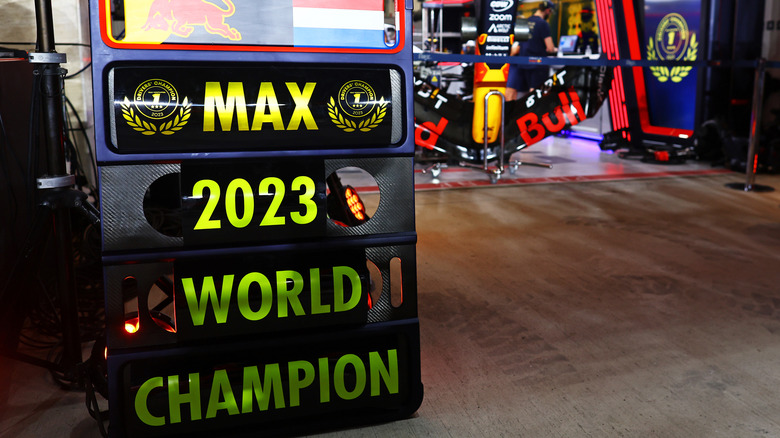
The biggest reason you’ll often see aside from track position and gap time is safety. Stewards use trackside boards to denote incidents, such as a large “SC” to indicate the presence of a safety car, or different colored boards to indicate flags; there’s a lot of racing flags, and their colors have their own standardized language.
As for the traditional pit board, it still has its uses outside of the radio or electronic equipment being broken. Sometimes it’s used because of personal preference or to keep from distracting the drivers. Bear in mind that top-level motorsport is incredibly demanding on drivers’ concentration, especially when racing in packs, which results in many compilations of drivers angrily shouting into their radios mid-race (much to our amusement). But let’s be honest — how many of us miss important pieces of information when we’re in high-stress environments? Something like a pit board might be more useful, even if just to repeat this sort of information.
In its purest sense, the pit board is a low-tech solution to the modern problem of information overload. With today’s F1 cars being faster than ever, coupled with the rising prevalence of automation and software on the racetrack, the sport has arguably become just as much a technical showcase as it is about the drivers’ skills. A pit board is a simple and effective method of getting information across to drivers without having to use words or other distractions, a point no less valid today, which is why it’s been crucial to motorsport since the dawn of the discipline.




Alexander Zverev wins the French Open to finally earn a 1st Grand Slam title


Anatomy of the June crypto crash: Fed, Iran, Saylor


Oppenheimer backs SpaceX as $70 billion retail frenzy builds


Markets Rally as SpaceX IPO Looms Amid Iran Tensions and Inflation Surge

Alexander Zverev conquers demons and outlasts Flavio Cobolli to win French Open for first major title


Microsoft unveils seven homegrown AI models in new bid for ‘long term self-sufficiency’


High Stakes for Wembanyama as New York Pushes for 3-0 Lead


Notion restores access to Anthropic after service disruption

Eli Lilly (LLY) Stock Surges 4% Following Breakthrough Sleep Apnea Trial Results

The investment to transform historic St Helen’s ground in Swansea


FIFA WC 2026 Group C: Morocco, Scotland challenge Brazil’s hunt for glory | FIFA World Cup 2022


Trump’s AI Ownership Plan Could Benefit Anthropic at OpenAI’s Expense

Bangladesh beat Australia after 20 years in ODIs, register only their second win over six-time world champions | Cricket News


NanoClaw integrates JFrog registries to secure AI agent downloads


Weekend Open Thread: Tuckernuck – Corporette.com


Bitget enters Argentina’s regulated crypto market through PSAV registration


This Week In Security: Microsoft On Microsoft, Register Your Domains, Linux On ARM, And FreeBSD Joins The File Cache Club


Politics Home | Healey Resignation Is “Colossal Failure Of Government”, Says Former Labour Defence Secretary


First Time Since 1971: Australia Register Historic Low In ODI Cricket

Donnie Wahlberg & More Heat Up Las Vegas at Circa’s Barry’s Downtown Prime



You must be logged in to post a comment Login