Connect with us
DAPA Banner
DAPA Coin
DAPA
COIN PAYMENT ASSET
PRIVACY · BLOCKDAG · HOMOMORPHIC ENCRYPTION · RUST
ElGamal Encrypted MINE DAPA
🚫 GENESIS SOLD OUT
DAPAPAY COMING

NewsBeat

US and Iran’s exchange of strikes shows how far diplomacy has changed

Published

on

US and Iran’s exchange of strikes shows how far diplomacy has changed

The US military launched strikes against Iran on June 9 in response to the downing of a US Army helicopter near the Strait of Hormuz a day earlier. These strikes, which the US military called “a proportional response to unjustified Iranian aggression”, came after Donald Trump claimed he was in the “final throes of what will be a very, very good deal” to end the war.

Iran swiftly carried out retaliatory attacks of its own. The powerful Islamic Revolutionary Guard Corps branch of Iran’s armed forces says it has struck US bases in Bahrain and Jordan. And it has warned of “even more severe attacks” if the US repeats its strikes.

This episode took place days after Israel and Iran had briefly returned to direct conflict. Triggered by Israeli operations against Hezbollah in Lebanon, where a ceasefire was supposedly in effect, both sides launched various rounds of tit-for-tat strikes before announcing they would halt hostilities.

At first glance, these incidents appear contradictory. Diplomacy is supposed to be the alternative to war and ceasefires are supposed to reduce violence. Yet with the US, Israel and Iran once again exchanging attacks, and as military operations continue in Lebanon despite ceasefire arrangements, diplomacy and conflict increasingly seem to be unfolding simultaneously.

Advertisement
Smoke rises following an Israeli strike in southern Lebanon on June 7.
Atef Safadi / EPA

For decades, policymakers assumed that war and diplomacy were distinct phases of international politics. States negotiated until talks broke down, and fighting followed. Eventually, battlefield realities or international pressure pushed adversaries back to the negotiating table. Diplomacy then functioned as an exit ramp from conflict.

The aftermath of the 1973 Arab-Israeli war exemplified this model. Sustained diplomatic efforts following the conflict culminated in the 1978 Camp David accords, which laid the groundwork for a definitive peace treaty between Egypt and Israel. This treaty was signed the following year and remains in effect to this day.

However, this model is becoming difficult to recognise, with the Middle East nowadays characterised by a different dynamic. Negotiations between warring parties continue during military confrontations, ceasefires coexist with airstrikes and mediators shuttle between capitals even as threats escalate.

The problem is not that diplomacy is failing. Instead, it is that diplomacy is no longer serving its traditional purpose. Rather than ending conflicts, diplomacy is helping to manage them – a distinction that matters because a conflict that is managed is not necessarily a conflict that is resolved.

Advertisement

Managing conflict

The latest escalations between Israel and Iran, and now Iran and the US, illustrate this dilemma. None of these parties appear to want a full-scale regional war, as the costs would be enormous and the consequences unpredictable. Yet each of them is unwilling to abandon what they see as vital security interests.

Israel views Hezbollah’s military capabilities as a major threat and therefore has a strong incentive to weaken the group. Iran, on the other hand, sees defending Hezbollah as critical to its security because the group serves as a key deterrent against Israel and extends Tehran’s regional influence. And the US struck Iran in an attempt to uphold deterrence and signal that attacks on US personnel and assets would carry consequences.

The result of this is a cycle of calibrated escalation. Military force is used not to secure decisive victory but to signal resolve to adversaries, reassure allies and domestic audiences, and persuade opposing leaders that the costs of further escalation outweigh the potential benefits. Diplomacy, meanwhile, works not to eliminate the underlying dispute but to prevent escalation from spiralling beyond control.

This creates a dangerous equilibrium. When diplomacy functions primarily as a mechanism for crisis management, leaders face less pressure to make the difficult compromises that lasting peace requires. Negotiations can continue indefinitely while violence persists, ceasefires become pauses rather than settlements and conflict becomes chronic.

Advertisement
Iranians walk past a billboard featuring late Iranian supreme leaders, Ayatollah Ruhollah Khomeini and Ayatollah Ali Khamenei, on a street in Tehran.
Abedin Taherkenareh / EPA

The old distinction between war and peace is becoming blurred in the Middle East. Rival powers do not move neatly from diplomacy to conflict and back again. Instead, they are operating permanently in the space between the two. This should concern policymakers.

Much of contemporary diplomacy remains based on assumptions that no longer fully apply. Negotiations are often treated as evidence of deescalation, while ceasefires are assumed to signal progress towards peace. Yet neither necessarily tells us much about whether a conflict is actually moving closer to resolution.

The latest exchanges between the US and Iran, as well as Iran and Israel, therefore raise a troubling possibility. The greatest danger may not be that the Middle East slides back into a wider war. It may be that it settles into a condition of permanent confrontation in which violence periodically erupts, diplomacy periodically intervenes and neither fundamentally changes the underlying reality.

For decades, the central challenge of international politics has been how to move from war to peace. The challenge emerging today is different, with negotiators grappling with the much more difficult task of ending a conflict when war and peace are happening at the same time.


Advertisement

Source link

Continue Reading
Click to comment

You must be logged in to post a comment Login

Leave a Reply

NewsBeat

Airdrie company boss wins top prize at Scotland Energy Efficiency Awards

Published

on

Daily Record

Bryan McGrory, of BMG Surveys, scooped the Energy Consultant/Consultancy of the Year accolade.

An Airdrie company boss took home a top prize at the Scotland Energy Efficiency Awards.

Advertisement

Bryan McGrory, of BMG Surveys, won the Energy Consultant/Consultancy of the Year accolade.

The firm, based at Alexander Street, is one of the largest providers of structural roof loading reports to the UK solar industry.

There were 13 categories up for grabs at the awards ceremony at Crown Plaza, Glasgow, attended by individuals and companies throughout Scotland that are involved in the energy efficiency industry.

Energy Efficiency Awards chairman Gary Braybrooke said: “The organisations and individuals recognised through these awards are operating in a period of real uncertainty in the sector.

Advertisement

“Despite that, they continue to deliver, to innovate and to hold standards high. That matters.

“Now in their 12th year, the Energy Efficiency Awards are about recognising leadership where it counts – in practical delivery, collaboration and professionalism.

“The winners are not just responding to policy ambition; they are creating real outcomes for homes, communities and businesses across the UK.

“These projects and people show that working together – across supply chains, local authorities and communities – remains the most powerful way to deliver meaningful, lasting change.”

Advertisement

Event organiser Kenneth Campbell added: “Our awards recipients have delivered commitment to improving energy efficiency and carbon savings, and their hard work in reinforcing the standards the sector will need as delivery scales up is recognised.

“We hope the awards continue to provide both recognition and reassurance – a reminder that, even in uncertain times, the sector has the talent and capability to move forward with confidence.”

*Don’t miss the latest headlines from around Lanarkshire. Sign up to our newsletters here.

And did you know Lanarkshire Live had its own app? Download yours for free here.

Advertisement

Source link

Continue Reading

NewsBeat

‘Take photo by end of June’ as expert says same thing as Martin Lewis in UK alert

Published

on

Wales Online

UK households have been given a two-week deadline as the Ofgem energy price cap is rising from July 1

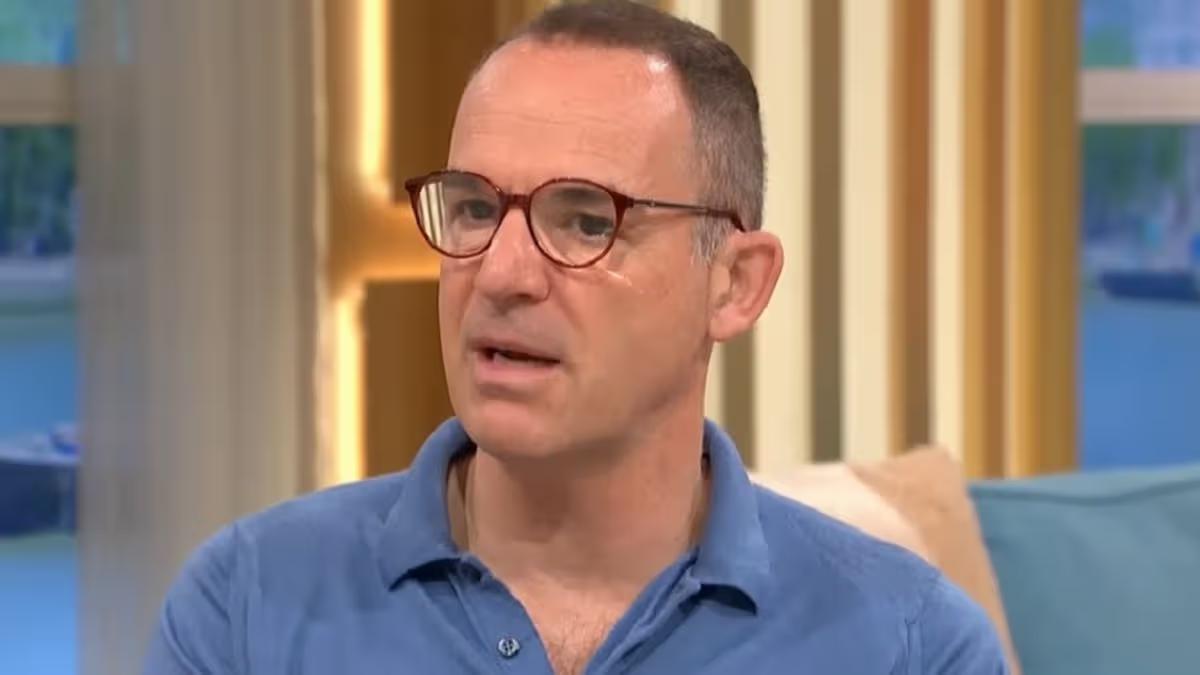
Households across the UK are being urged to take a single photograph before 1 July, in guidance previously echoed by Money Saving Expert (MSE) founder Martin Lewis. The Ofgem energy price cap is set to rise from the start of July, meaning numerous households on standard variable tariffs will pay more for each unit of gas and electricity they consume.

However, according to one energy specialist, the most significant error people can make is presuming their supplier will automatically know how much energy was used before and after the price change. Justin Nielsen, energy consultant at Wolf River Electric, says a straightforward meter reading could help avoid billing confusion and lower the risk of households being charged at the incorrect rate, reports the Express.

Advertisement

He said: “The one thing I would tell every household to do before July 1 is take a clear meter reading and keep a photo of it. It takes less than five minutes, but it gives you a record of exactly where your usage stood before the new rates came in. The price cap does not mean your bill is capped. It caps what suppliers can charge per unit of energy and standing charge, so your final bill still depends on how much you use. That is why accurate readings matter so much.”

Justin’s guidance mirrors that of Martin Lewis, who regularly urges households to capture a swift photograph of their meters, particularly as part of his recommendations for ‘Meter Reading Day’. He previously stated: “I would still get your phone out and take a picture of your meter today just in case of a future dispute, you don’t need to do anything with it, you might want to email it to yourself so you’ve got proof.”

On the MSE website, the team of specialists also advise: “The easiest way is to take a picture of your meters, so you have the readings to hand. Then you can log in to your online account and enter the readings.”

Why should you take a meter reading before July 1?

When the price cap adjusts, suppliers must split consumption between the previous and updated rates. For households with a functioning smart meter, this should typically occur automatically. However, those with conventional meters, defective smart meters, or accounts that rely on estimated readings may still need to submit a manual reading.

Advertisement

Justin cautioned that relying on an estimate can create difficulties, particularly if a household has consumed less energy than typical before July. He stated: “If your supplier does not have an up-to-date reading, they may estimate how much energy you used before the price change and how much came after it. That estimate might be reasonable, but it is still a guess.

“The risk is that some of your cheaper pre-July usage could be pushed into the more expensive period. Even if the difference is not huge for every household, nobody wants to pay more than they should because of an avoidable estimate.”

He continued: “A photo is useful because it gives you proof. Make sure the numbers are visible, and if your phone records the date automatically, even better. Keep it until your next bill has arrived and you are happy the reading has been used properly.”

Who needs to submit a meter reading before 1st July?

The advice is most critical for households without a smart meter, those with a smart meter that isn’t transmitting readings correctly, or those who have previously received estimated bills. It equally applies to those who have recently relocated, switched supplier, amended their direct debit, or experienced a period where bills appeared incorrect.

Justin said: “If your bills regularly say ‘estimated’, you should not wait until the next statement lands. Take control of the reading yourself. Estimated bills can catch people out because they often do not notice until weeks later. By then, it is harder to remember what your usage looked like at the time.”

He went on: “This is particularly important for households that have made an effort to cut usage in June. If you have been using less heating, drying clothes outside, cooking differently, or trying to keep costs low, you want that lower usage recorded accurately before the higher rates begin.”

How should you take a meter reading correctly?

Households need to record readings for both gas and electricity, unless their property only uses electricity. For a standard meter, note down the numbers from left to right, disregarding any red numbers or digits following a decimal point.

Advertisement

For digital meters, press the display button until the reading shows. For prepayment meters, the procedure can differ, so households should consult the supplier’s instructions.

Justin said: “Do not just scribble the number on a piece of paper and lose it. Take a photo, submit the reading through your supplier’s app or website, and keep a note of the confirmation if you get one. If you cannot access your meter safely, do not put yourself at risk. Ask your supplier for help, especially if the meter is too high, outside, locked away, or difficult to reach.”

He also advised taking the reading as near to July 1 as feasible, while not waiting until the final moment if the supplier’s app or telephone lines are engaged. He said: “The best time is usually the evening before or the morning of the change. But if you know you will forget, doing it a day or two earlier is still better than doing nothing. The key is to avoid going into July with an old reading on the account.”

Smart meter households should continue to verify their account

While smart meters are intended to transmit readings automatically, Justin stated households shouldn’t presume everything is functioning flawlessly. He said: “A smart meter can make this much easier, but I would still log into your account and check that recent readings are actually showing.

Advertisement

“Some smart meters lose communication, some accounts do not update properly, and some households have in-home displays that look fine even when the supplier is not receiving the data.”

He continued: “If your bill says estimated, your smart meter is not doing the job you think it is doing. That is when you need to contact the supplier and ask what is happening.”

Additional energy checks to complete before July

Justin also encouraged households to utilise the price cap adjustment as a prompt to review their tariff, direct debit and daily energy practices. He stated: “This is a good moment to review the whole account. Check whether you are on a fixed deal or a variable tariff, look at your standing charge and unit rates, and compare your direct debit against your real usage.

“Do not cancel a direct debit because you are frustrated with the amount, but do challenge it if it looks completely out of line with what you are using.” With the warmer months arriving, he suggested numerous households might also squander money on fans, portable air conditioners and appliances without being aware of it.

Advertisement

Justin stated: “People often think summer bills will automatically be low because the heating is off, but that is not always the case. Fridges and freezers work harder in warm kitchens, fans get left on in empty rooms, and portable air conditioners can be expensive if they are used badly.

“A fan should cool you, not an empty room. If nobody is in there, switch it off. With portable air conditioning, keep doors closed, seal the window properly and do not set the temperature unrealistically low.”

The straightforward rule to prevent bill shock

The energy adviser said homes should regard the July 1 adjustment as a financial dividing line. He stated: “Think of it like taking a photo of your mileage before selling a car. You are creating a record, and that record protects you if something does not add up later. The most expensive energy mistake is often the one you do not notice straight away. A bad estimate, a faulty smart reading or an unchecked tariff can quietly cost you over time.”

Justin continued: “My advice is simple: take the reading, submit it, photograph it and check your next bill. If the reading has not been used, query it straight away. People cannot control global energy prices, but they can control whether their own account is accurate. That small bit of admin before July 1 could make the difference between a bill you understand and one you have to fight later.”

Advertisement

Source link

Continue Reading

NewsBeat

‘They’re off!’: Leadership race to oust Keir Starmer started by London MP Wes Streeting

Published

on

'They're off!': Leadership race to oust Keir Starmer started by London MP Wes Streeting

Asked whether he had the support of enough colleagues to be the one that ousts Sir Keir, Mr Streeting replied: “As much as I can, I am going to resist being drawn into politics, process, personalities, because I want the contest to be a battle of ideas, not just a clash of personalities or an obsession with political drama.

Source link

Continue Reading

NewsBeat

World Cup 2026: Thomas Tuchel contract subject to performance clause, says FA chief

Published

on

Thomas Tuchel during England's training session in Kansas

Speaking at England’s World Cup media centre in Kansas City, Bullingham delivered a strong defence of the governing body’s decision to extend Tuchel’s contract before the tournament.

The FA has faced criticism for rewarding Tuchel with fresh terms without knowing the final outcome of his initial mission, given the 52-year-old’s target upon his appointment was to win England’s second World Cup.

But Bullingham said: “The reality is he’s a top-level manager who would be in demand and we knew we had someone who was doing a really good job and we can’t just expect someone to wait around and just leave it and see how you go.

“That’s not the reality of life in any profession. We have someone doing a really good job, we thought we could sign him up for two more years – it’s a home tournament (Euro 2028) where the pressure is even bigger and we have a manager who has been there and done it.”

Advertisement

Bullingham also made clear that the FA was keen to avoid the scenario of uncertainty over its manager’s future overshadowing the World Cup.

He said: “You never really want that hanging over you when you get into a tournament.”

Bullingham pointed out that anyone on a fixed-term contract would need to consider their future as such a deal neared its end.

“It was more about looking to 2028,” he added. “It’s a very important home tournament for us and we wanted the best chance to do the best we can and we felt we had a very good manager, so why not extend?

Advertisement

“They are two different projects. So the 2028 project, we want the best manager in place – we have signed him up. We are still looking at this World Cup to give ourselves the best possible chance and we said at the time we felt he gave us the best possible chance. We still feel that.

“If you look back at any tournament and you work back from it, you look at who is the best manager you want, when can he be available, when can you sign him up. I would argue it’s a bigger risk the other way.”

Source link

Advertisement
Continue Reading

NewsBeat

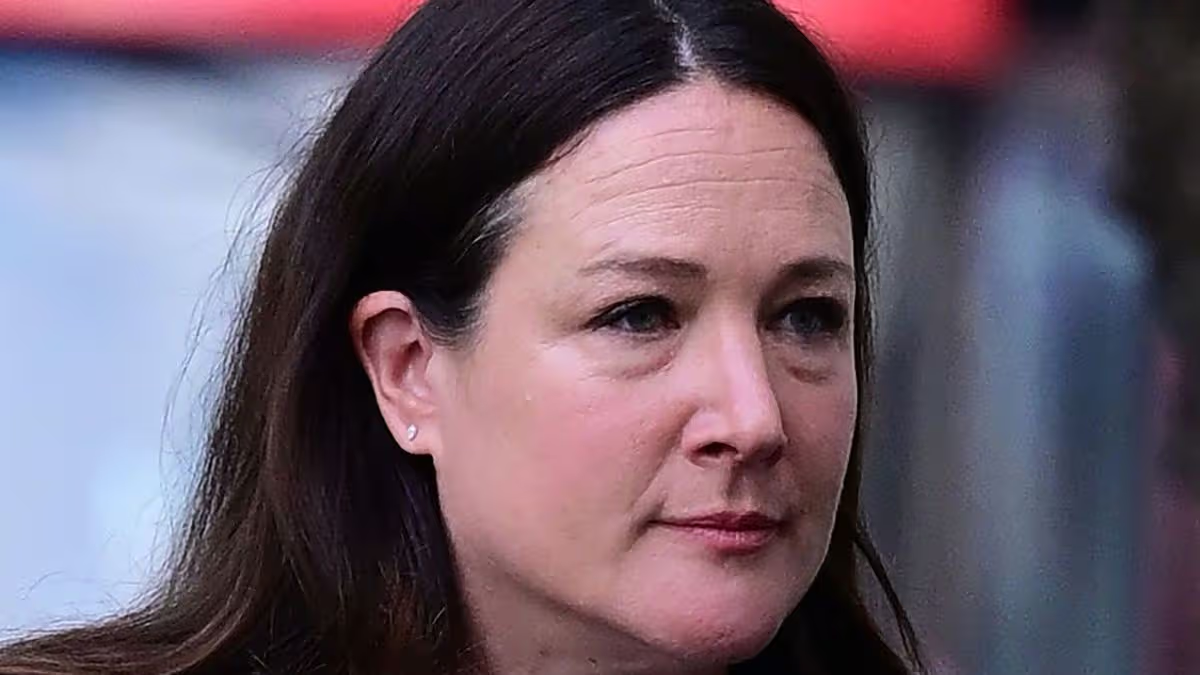
First picture of woman charged after Wimbledon school crash killed two girls

Published

on

Daily Record

Claire Freemantle, 49, is accused of two counts of causing death by dangerous driving and seven counts of causing serious injury by dangerous driving

The motorist whose 4×4 ploughed into a primary school, claiming the lives of two eight-year-old girls, has been photographed for the first time as she attended court.

Claire Freemantle, 49, faces two charges of causing death by dangerous driving and seven charges of causing serious injury by dangerous driving in connection with the tragic incident in July 2023.

Pupils Nuria Sajjad and Selena Lau died and seven others sustained injuries, including three adults, after Freemantle’s Land Rover Defender crashed through the barriers at The Study Prep school in Wimbledon, South West London, as youngsters enjoyed an end of term outdoor tea party.

Advertisement

Freemantle appeared today at Westminster magistrates’ court, where she only spoke to confirm her name, date of birth and address. She was not required to enter pleas.

Looking visibly distressed and dressed in a black trouser suit, Freemantle entered court. She was permitted to sit behind her barrister in the courtroom rather than viewing proceedings from the dock after her barrister Sallie Bennett-Jenkins KC expressed concerns that the strain of being in the dock could provoke an epileptic attack, reports the Mirror.

Ms Bennett-Jenkins KC informed the judge Freemantle had experienced a recent seizure in the past three weeks. Freemantle was granted unconditional bail.

Advertisement

Chief Magistrate Paul Goldspring informed Freemantle: “All nine charges must be sent to the Crown Court. You will have to appear at the Central Criminal Court on the 14th July this year. If you don’t, a warrant will be issued for your arrest.”

The Met has subsequently issued an apology for its initial handling of the incident and the “impact on those affected”, pledging that it will be “fundamentally resetting how [the force] investigates fatal and serious collisions”.

Ensure our latest stories always appear at the top of your Google Search by making us a Preferred Source. Click here to activate or add us as your Preferred Source in your Google search settings.

Source link

Advertisement
Continue Reading

NewsBeat

Vehicles and electronic devices seized in Dunmurry bomb investigation

Published

on

Belfast Live

Enquiries are ongoing, and police have reiterated their appeal for anyone with information to contact them on 101.

Two vehicles and a number of electronic devices have been seized during searches linked to a bomb attack on Dunmurry Police Station on 25th April.

Detectives from the PSNI’s Terrorism Investigation Unit, assisted by Local Policing and Operational Support officers, conducted searches in West Belfast earlier today, Tuesday 16 June, as part of the investigation.

Shortly before 10 past 10 on Saturday, 25th April, a call was made to a Chinese takeaway requesting delivery to Summerhill Park in Twinbrook.

Advertisement

Around 10:45 pm, the delivery driver arrived in the area, got out of his vehicle and was threatened by two men armed with a pistol.

One man then placed a gas canister-type bomb in the rear of his vehicle, and the driver was told he had 30 minutes to bring the vehicle to Dunmurry Police Station before a bomb would explode.

The delivery driver arrived at the station and raised the alarm before the device detonated at 11:15 pm as police officers were evacuating the area.

A PSNI spokesperson said: “Detectives from the Police Service of Northern Ireland’s Terrorism Investigation Unit, assisted by Local Policing and Operational Support officers, conducted searches in west Belfast earlier today, Tuesday 16 June, as part of an investigation into the attack at Dunmurry Police Station. The attack took place on the night of Saturday, 25 April.

Advertisement

“Today, two vehicles and a number of items, including electronic devices, were seized.

“Enquiries are ongoing, and police have reiterated their appeal for anyone with information to contact them on 101.

“Alternatively, Crimestoppers, who are a charity and independent of police, can be contacted with 100% anonymity on 0800 555 111 or online at www.crimestoppers-uk.org.”

For all the latest news, visit the Belfast Live homepage here and sign up to our daily newsletter here.

Advertisement

Source link

Continue Reading

NewsBeat

Tina Daheley quits BBC Radio 2 Breakfast show after 7 years

Published

on

Tina Daheley quits BBC Radio 2 Breakfast show after 7 years

Daheley has read the news on the Radio 2 Breakfast Show for more than seven years, working alongside former presenters, including Scott Mills and Zoe Ball.

She described working on the breakfast show “as one of the greatest privileges of my life” but was now “looking forward to a lie-in”.

Daheley, in a post on Instagram, said: “After more than 7 years of early alarm calls on Radio 2, I’m stepping away from Radio 2 Breakfast.

Advertisement

“It’s been one of the greatest privileges of my life to wake up with you every morning, and humbling to have been trusted to deliver the news on the biggest breakfast show in Europe.

“After 18 years and six back-to-back breakfast shows (probably a record in there somewhere), I’m looking forward to a lie-in.”

Ms Daheley began her broadcasting career on 1Xtra before moving to Radio 1, and then joining the Radio 2 Breakfast Show.

She said she will continue to present on Radio 2 between 12pm and 2pm when Jeremy is away, and will return to BBC One after the summer.

She ended her announcement with a hint that future projects may be on the horizon, telling listeners: “Beyond that, watch this space.”

Advertisement

When does Sara Cox start her BBC Radio 2 Breakfast Show?

Daheley’s announcement follows confirmation that Sara Cox will take over as BBC Radio 2’s new breakfast show host from July 6.

Cox will launch her show with Oscar-winning actor Tom Hanks as her first guest.

The 51-year-old shared her excitement during an appearance on Vernon Kay’s Radio 2 show on Monday (June 15).

Cox said: “There’s been quite a lot of mystery about when the brand new Sara Cox Breakfast Show begins on BBC Radio 2.

“I’ve been quite mysterious and going, ‘it’s in the summer’ and waggling my eyebrows mysteriously.

Advertisement

“But I can now announce, ladies and gentlemen, boys and girls, and everyone in between, please do join me for my very first Breakfast Show on Radio 2 on 6th of July.

“Three weeks today! Very very excited. It is 6.30am.

“I can’t wait – it’s so exciting.”


She said she would set 42 alarms to ensure she woke up in time for the early start.

Advertisement

Cox will bring a “fresh new format” to the programme, combined with familiar elements from her previous teatime show.

The Radio 2 presenter was confirmed as the new breakfast show host in April.

She replaces Scott Mills, who was sacked by the BBC earlier this year, shortly before it emerged the Metropolitan Police launched an investigation in 2016 into allegations of serious sexual offences involving a teenage boy under 16 between 1997 and 2000.

Are you going to miss Tina Daheley on the BBC Radio 2 Breakfast Show? Let us know in the poll above or comments below.

Advertisement

Source link

Continue Reading

NewsBeat

‘Pain and hurt’ of Jeffrey Donaldson’s alleged victims ‘still so visible’, court told

Published

on

Belfast Live

The “pain and hurt” of two women allegedly abused by Sir Jeffrey Donaldson is “still so visible”, a court has heard.

Closing speeches have begun in the sexual offences trial of the former DUP leader at Newry Crown Court.

Prosecution barrister Rosemary Walsh KC said the trial had been a “long and arduous” process for the two women who allege abuse.

Advertisement

Donaldson, 63, has pleaded not guilty to 18 alleged offences.

The charges include one count of rape and allegations of indecent assault and gross indecency, and span a period between 1985 and 2008 involving two alleged victims.

Complainants A and B have both given evidence at the trial. Both women allege they were abused as children.

Jeffrey Donaldson spent two days in the witness box giving evidence in the trial last week.

Advertisement

Lady Eleanor Donaldson, 60, from Dublinhill Road, Dromore, Co Down, denies several charges of aiding and abetting her husband’s alleged offending.

She is facing a trial of the facts on mental health grounds. The trial of the facts will test the evidence in the case, but cannot result in a criminal conviction.

Beginning her closing submssions to the jury of seven men and five women, Ms Walsh said the jury would have a “good understanding of what the evidence is in this case”.

She said it was human nature for people to sometimes “lock away” thoughts.

Advertisement

The barrister said Complainant A had spent years “shelving and avoiding dealing” with alleged abuse, while Complainant B “kept those memories locked away inside”.

But she said there had been “turning points” for both women which made them come forward and report the alleged abuse to police.

She said: “Issues which had been shelved and locked away surfaced, demanding to be seen and demanding to be dealt with.”

Turning to the issue of why A had not reported the alleged abuse before 2024, Ms Walsh said: “This is a woman who has really, properly considered whether she should put her head above the parapet.

Advertisement

“She knew this would not just be a normal case.

“It was a huge, huge decision to make and not one she made lightly.”

She said Complainant B had “blamed herself” for the alleged abuse.

Ms Walsh said both women had gone to police in 2024.

Advertisement

She said: “Yes, two voices are better than one… this process is difficut.”

She said it had been a “long and arduous process” which had culminated in several hours of questioning in court.

The barrister said: “Their pain and hurt is still so visible.”

She added: “This is not something they are doing for the fun of it.”

Advertisement

Ms Walsh said: “Today, you see two women at a time when they are ready for this… they have not always been that way.”

The barrister said neither woman has a “full or complete recollection” of the alleged abuse, stating some memories are “fragmentary”.

But she told the jury that is the way memory of childhood events can work.

She said both alleged victims remember “distinctive incidents”.

Advertisement

The barrister referred to a meeting Complainant B had with Donaldson while staying at a Christian centre in Armoy in Co Antrim in the 1990s.

Ms Walsh said it was clear “reconcilation at that stage was the purpose of the meeting”.

She said: “No-one asked this girl exactly what the abuse was she had referred to.

“The topic remained untouched, the hornet’s nest avoided.”

Advertisement

Referring to an incident in which Complainant A alleges Donaldson had used a light to look at her genitals, the barrister said Eleanor Donaldson had been told but that the incident was “brushed under the carpet”.

She said years later, Complainant A had told her husband about the alleged abuse to give him the “option of walking away” from the relationship if he chose to.

She said: “It underlines this is not something that has been fabricated on a whim.”

Ms Walsh told the jury they had watched police interviews with both of the alleged victims.

Advertisement

She said: “You are the people that have to assess if you are sure that they are telling the truth.”

Referring to an incident where Complainant B alleges she was raped by Donaldson, Ms Walsh said: “She recalls the breathing, laboured and panting and the hope he would stop and lose interest.”

Recounting an alleged incident where B claimed Donaldson lifted her top and played with her breasts, she said: “In the dark, he treats her like the object she is to him.”

Returning to the meeting at the Co Antrim Christian Centre between Complainant B and Donaldson in the 1990s, Ms Walsh said it was “clear there was very little discussion and very little conversation”.

Advertisement

She said: “This meeting had the potential to be explosive because everyone, including Mr Donaldson, knew it concerned a serious allegation.”

She added: “We say Jeffrey Donaldson shut that meeting down, he knew this was a problem that needed to be dealt with, he took control of that meeting.”

She said Donaldson “knew what the meeting was about and stopped questions”.

Ms Walsh said: “He was there to manage a problem and he did that very well indeed.”

Advertisement

The barrister said Donaldson had shown from his account of the meeting he was “willing to lie”.

Referring again to the light incident involving Complainant A, Ms Walsh said the alleged victim was “certain she knew he was looking at her private parts with a light”.

She said Donaldson had been “caught in the act”, adding “he knew he had no explanation”.

The barrister then turned to a letter written by Donaldson to Complainant A in 2020 where he referred to “being in a deep pit of sin” and of causing “deep wounds”.

Advertisement

Ms Walsh said it was a matter for the jury to decide whether the letter “refers to the hurt” of A.

She added that the prosecution say the reference to “deep wounds” in the letter is “highly significant”.

The case continues.

For all the latest news, visit the Belfast Live homepage here and sign up to our daily newsletter .

Advertisement

Source link

Continue Reading

NewsBeat

England defender Tino Livramento could miss World Cup 2026 after suffering fresh injury

Published

on

'Breaking' graphic

Newcastle United defender Tino Livramento is a doubt for England’s World Cup campaign after suffering a muscular injury.

The full-back is understood to have been injured during training on Sunday and is being assessed by medical staff.

England begin their World Cup bid against Croatia on Wednesday.

The 23-year-old’s involvement in the tournament had already been in doubt after he missed the final five weeks of the season with a thigh injury.

Advertisement

Chelsea defender Trevoh Chalobah, who is on England’s stand-by list, is a possible replacement for Livramento should the Newcastle defender be ruled out.

More to follow.

Source link

Advertisement
Continue Reading

NewsBeat

Holidaymakers travelling in July urged to do simple check

Published

on

Wales Online

Do it wrong and it could cost you a fair bit after the holiday!

Holidaymakers are being urged to carry out a simple check ahead of their holiday. And with June and July being peak times for flying due to the summer holidays and kids being off school, it’s not one to skip.

Advertisement

Experts at Compare the Market not only urge people to take out travel insurance, but also insurance against gadgets. But it’s not as simple as taking out any policy. The comparison specialists explain that many travellers assume that their travel insurance covers mobile phones and other gadgets as standard.But this isn’t always the case, and a simple check of this could save you hundreds, and maybe thousands, in the long run.

It notes: “Not all travel insurance policies include gadget cover. And travel insurance payouts for valuables are often low – as little as £200 for one item or £500 in total.”

Warning that standard travel insurance often won’t cover expensive gadgets like smartphones or laptops adequately if they’re lost, stolen, or damaged, it advises that seperate gadget travel insurance is ideal as it can provide higher cover limits, typically ranging from £1,000 to £3,000 depending on the policy.

What types of gadget travel insurance are available?

Options include:

  • Separate standalone travel insurance for gadgets
  • Adding gadget travel insurance to your standard policy for an extra charge
  • A dedicated gadget insurance policy – just make sure it covers you abroad
  • Home contents insurance with cover for personal possessions abroad.

Gadget travel insurance can cover your:

  • Smartphone
  • Tablet/iPad
  • Laptop
  • Camera
  • Games console
  • e-reader
  • Wearables, such as fitness trackers
  • GPS sat nav
  • Bluetooth headsets and earphones
  • Accessories, such as chargers
  • Drone

It notes that there may be a limit on the number of gadgets your policy covers. There may also be a limit on the total amount it will pay out.

What cover does gadget and mobile phone travel insurance provide?

Cover varies among insurance providers, but a good policy will usually include:

  • Accidental damage, loss or theft
  • Water damage
  • Unauthorised web data use
  • Unauthorised phone calls
  • A high single item limit (the most your policy will pay out for one item)

What restrictions are there with gadget travel insurance?

You typically won’t be covered if:

  • You don’t report a theft to the police within a specified period
  • The damage results from wear and tear or misuse
  • The damage doesn’t affect the functioning of your device
  • You left your gadget unattended
  • You’re claiming for more gadgets than your policy covers
  • You bought your gadget outside the UK
  • Your device is over (or under) a specified age limit
  • You’ve made the maximum number of claims under your policy
  • The fault lies with the manufacturer
  • You were under the influence of alcohol or drugs when your device was lost or stolen

Don’t take out insurance…yet

Before taking out gadget travel insurance, it’s worth checking whether you’re already covered through home contents insurance, mobile phone insurance, or a bank account package before buying extra cover.

It warns: “You should also check the excess. This is the amount you’ll have to pay towards any claim.

Advertisement

“Some policies don’t include ‘new for old’ cover. If your gadget isn’t brand new, your insurance provider might only offer a refurbished replacement of a similar age.

“Always read your policy before buying gadget travel insurance, so you know exactly what’s covered, along with any excesses, limits and exclusions.”

Compare the Market urges travellers to leave it at home

Concluding its advice, the comparison experts advise holidaymakers to think carefully about which gadgets they really need to take away, and whether they could manage without their most expensive devices for a week or two.

Travellers are also urged to back up their phones and laptops to the cloud before departure and to continue saving photos during their trip to avoid losing memories if devices are lost or stolen. Security experts also recommend keeping gadgets locked in hotel safes when not in use, staying vigilant when using smartphones in public, and never leaving devices unattended in places like cars or on the beach, as insurers are unlikely to pay out in cases of negligence.

Advertisement

I have an issue with my insurance provider, what can I do?

Experts at Money Saving Expert (MSE), which is founded by Martin Lewis, suggest using a free complaints tool. It writes: “The insurance industry doesn’t have the best customer-service reputation and while a provider may be good for some, it can be hell for others.

“Common problems include claims either not being paid out on time or at all, unfair charges, or exclusions being hidden in small print. It’s always worth trying to call your provider first, but, if not, then you can use free complaints tool Resolver.

“The tool helps you manage your complaint, and if the company doesn’t play ball, it also helps you escalate your complaint to the free Financial Ombudsman Service.”

Source link

Advertisement
Continue Reading

Trending

Copyright © 2025