

Crypto World
Aztec Connect Exploited For $2.1 Million

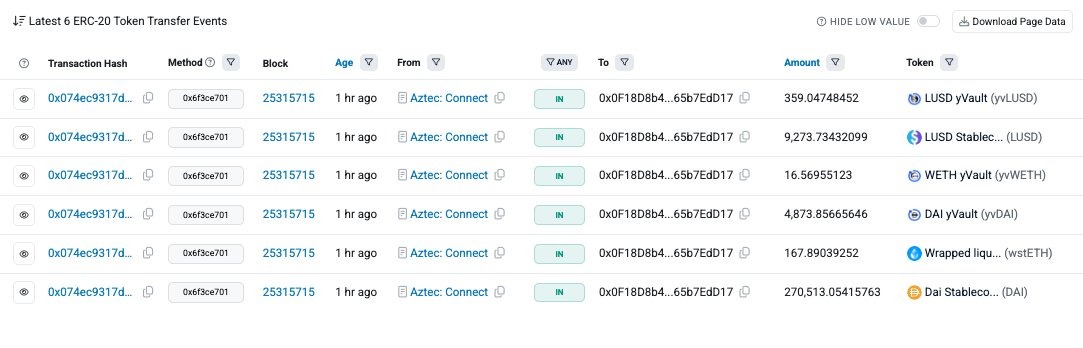
Aztec Connect, a deprecated decentralized finance platform, was drained of around $2.1 million in crypto on Sunday after an attacker exploited its verification function.
Aztec Labs posted to X on Sunday that it was “investigating a potential exploit affecting Aztec Connect,” adding that around $2.1 million was transferred from the platform’s smart contract, which did not affect users or assets on the current Aztec network.
The exploit is the latest in the $44 million worth of crypto that has been stolen so far this month from at least 12 other exploits, according to DeFiLlama.
A private key compromise on the Humanity Protocol has been the largest so far in June, with $30 million lost on June 8, followed by the Syscoin Bridge, which saw $8 million swiped in a fake proof exploit the previous day.
Crypto security firm BlockSec said that an attacker exploited a mismatch in how the platform verified transactions and settled them on Ethereum.
It said that verified transactions on Aztec Connect’s contract were “not effectively bound to the transaction set enforced by the ZK proof,” allowing its verification path and settlement logic on Ethereum “to interpret the transaction list differently.”
The attacker could then place transactions where the contract credited value without validating it on Ethereum, which created unbacked balances that could then be withdrawn. The attacker did this seven times across seven different assets.
The attacker made off with 909 Ether (ETH), 270,000 Dai (DAI), 167 of wrapped staked ETH and a handful of other cryptocurrencies.
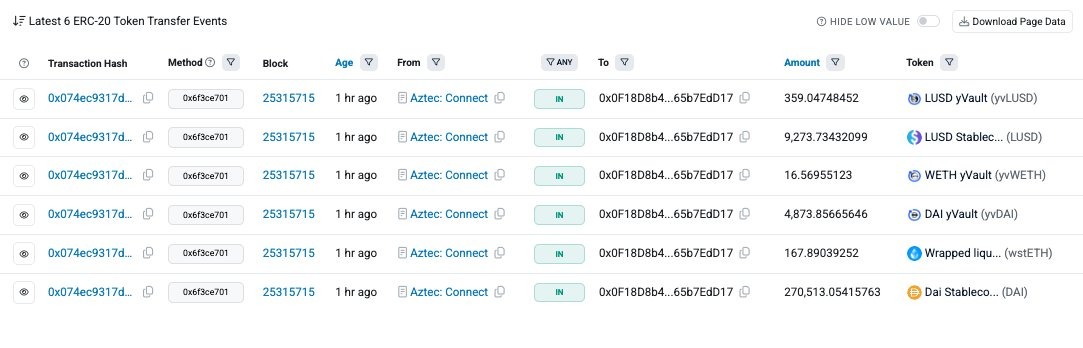
Some of the assets stolen in the exploit. Source: CertiK
Aztec Network is a privacy-focused layer-2 zero-knowledge (ZK) rollup on Ethereum. Aztec Connect was the previous version of the platform that launched in 2022 as a DeFi bridge.
Related: Crypto exploit losses in May fall 90% over month to $68M: CertiK
Aztec Connect was deprecated in March 2023, with deposits halted and the team shifting resources to the next-generation Aztec Network.
“Aztec Labs holds no admin keys or control over the system; it cannot be paused or upgraded by us,” the team said.
Crypto developer “Param” said Aztec Connect’s smart contracts became “fully immutable” and could no longer be upgraded or paused.
“The incident is another reminder that abandoned DeFi contracts can still become targets years later,” they said.
Magazine: OpenAI files for IPO, SEC scraps 611 rule and Hungary overhauls crypto: Hodlers Digest


A Spacex Flacon 9 rocket lifts off from Space Launch Complex 40 on June 12, 2026 in Cape Canaveral Space Force Station, Florida.
Joe Raedle | Getty Images
SpaceX made its debut at the Nasdaq on Friday, climbing more than 19% on its first day of trading and rising above a $2 trillion market valuation. But while the arrival of the company to public markets is squared away, some of its other long-term plans are years in the future.
Elon Musk’s company in its initial public offering prospectus with the Securities and Exchange Commission repeatedly focused on the “Moon, Mars and beyond.” The company’s goal for Mars is so large that Musk won’t get a bonus of restricted shares unless SpaceX establishes a colony on the planet with more than 1 million inhabitants.
But when that will happen is years from now, traders on prediction market platform Kalshi think.
Traders see just an 18% chance that SpaceX launches a human mission to Mars by 2030. Since the event contract first launched in March 2024, traders have never seen more than one-in-four odds of the mission happening this decade.
The event contract will resolve to yes if SpaceX verifies a manned mission to Mars by Dec. 31, 2029.
Traders’ uncertainty mirrors SpaceX’s own plans. In its prospectus, SpaceX made clear it doesn’t have a vision for when a Mars mission may happen.
“Many of our initiatives… involve significant technical complexity, unproven technologies or technologies that do not exist, and such initiatives may not achieve commercial viability,” SpaceX said. “As a result, the timeline for certain of our initiatives involving unproven or new innovations … may be difficult or impossible to determine.”
But while an exact timeline may be unknown, the company’s focus on Mars is clear. The planet was mentioned 63 times in the prospectus itself, and once in a photo caption featured in the document.
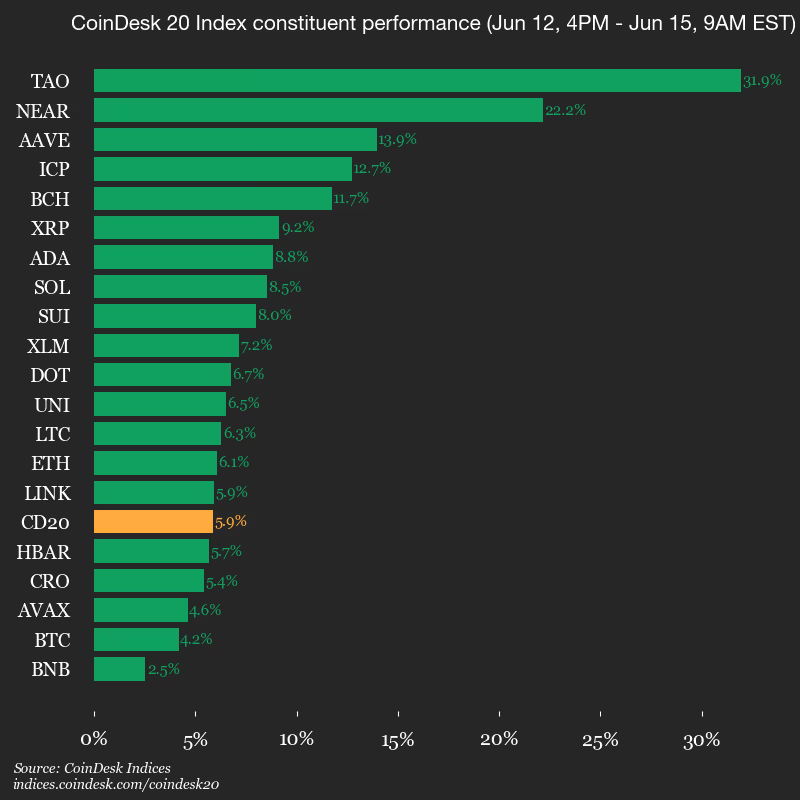
CoinDesk Indices presents its daily market update, highlighting the performance of leaders and laggards in the CoinDesk 20 Index.
The CoinDesk 20 is currently trading at 1812.32, up 5.9% (+100.88) since 4 p.m. ET on Friday.
All 20 assets are trading higher.

Leaders: TAO (+31.9%) and NEAR (+22.2%).
Laggards: BNB (+2.5%) and BTC (+4.2%).
The CoinDesk 20 is a broad-based index traded on multiple platforms in several regions globally.
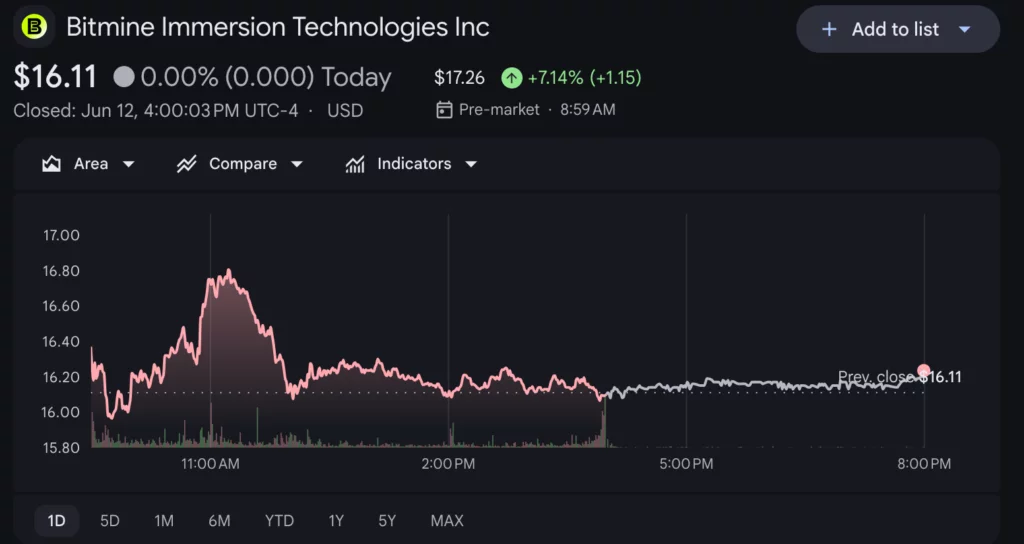
BitMine Immersion Technologies said its Ethereum holdings reached 5,620,754 ETH as of June 14, bringing the company closer to its goal of owning 5% of the total ETH supply.
Summary
- BitMine now holds 5.62 million ETH, equal to 4.66% of total Ethereum supply today overall.
- The company says staked ETH stands at 4.72 million, supporting projected annual staking revenue.
- BMNR traded near flat after the update, with shares at $16.11 in midday trading.
In a Monday announcement, the company said the position equals 4.66% of Ethereum’s 120.7 million token supply.
Meanwhile, the company also reported total crypto, cash, marketable securities and “moonshots” holdings of $10.4 billion. Its holdings include 204 BTC, $502 million in cash and marketable securities, a $180 million stake in Beast Industries and an $88 million stake in Eightco Holdings.
Staking operation backs preferred stock plan
BitMine said it has staked 4,718,677 ETH, worth about $8.1 billion at $1,718 per ETH. The company said this makes it the largest Ethereum treasury in the world and the second-largest crypto treasury behind Strategy.
“Over the past week, we acquired 76,881 ETH,” said chairman Thomas “Tom” Lee.
He said BitMine kept a higher buying pace because it believes the recent ETH pullback does not reflect stronger Ethereum fundamentals.
BitMine also closed the sale of 3,500,000 shares of 9.50% Series A Perpetual Preferred Stock on June 10. The company raised about $273.8 million in net proceeds after fees and expenses.
Lee said the preferred stock sale gives BitMine balance sheet diversification. He added that projected annual staking rewards of about $219 million provide recurring cash flow to support dividends on the preferred shares.
BMNR stock reaction stays muted
BitMine’s preferred shares are expected to start trading on the NYSE under the ticker BMNP on June 16. The company also declared a weekly cash dividend of $0.2639 per preferred share, expected to be paid on July 6 to holders of record on June 26.
BMNR stock showed little movement after the update. Google Finance data showed shares near $16.11, down about 0.03%, with a market capitalization of about $7.32 billion at the time checked.
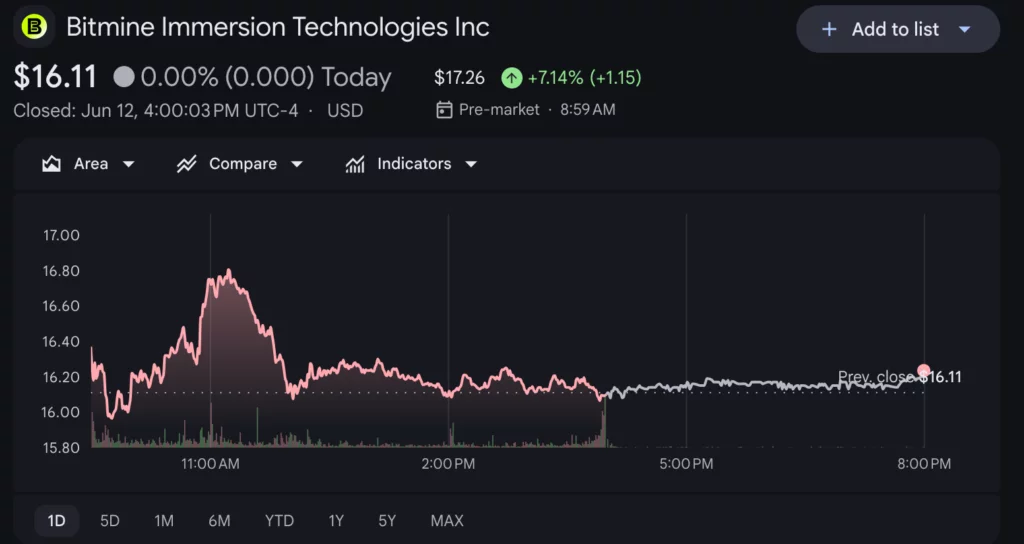
The muted reaction came after several weeks of heavy attention on BitMine’s Ethereum treasury model. The company said BMNR ranks among the most traded U.S. stocks, with average daily dollar volume of about $550 million over five days as of June 12.
Ethereum treasury race gains fresh attention
crypto.news recently reported that BitMine had raised its ETH holdings to 5.42 million tokens after buying 26,497 ETH. The report also noted that the firm had staked 4.72 million ETH and remained one of the largest public Ethereum treasury plays.
Moreover, as crypto.news reported, BitMine had moved closer to its 5% ETH target after further buying activity tied to large wallet transfers. That report also noted pressure on BMNR shares as ETH prices weakened and investors weighed the scale of the treasury bet.
The latest release shows BitMine has continued to add ETH while also building cash reserves and preferred stock financing. The next focus for investors will be whether the company can keep growing ETH per share while meeting weekly dividend obligations.

The Next Evolution of Decentralized Finance
Decentralized Finance (DeFi) was built on the promise of creating an open, permissionless financial system accessible to anyone with an internet connection. Yet despite billions of dollars flowing through decentralized exchanges, lending protocols, and on-chain financial products, one major obstacle remains: complexity.
For years, users have been expected to manage wallets, sign transactions, bridge assets, understand gas fees, navigate multiple blockchains, and interact with unfamiliar interfaces. While crypto-native users have adapted, mainstream adoption continues to face significant friction.
This challenge has sparked a new trend across the industry: abstraction. Increasingly, DeFi builders are racing to hide blockchain complexity behind seamless user experiences. The goal is simple yet transformative—allow users to benefit from decentralized finance without needing to understand the underlying infrastructure.
The future of DeFi may not be about adding more protocols. It may be about making those protocols invisible.
Why Abstraction Matters
The average internet user has little interest in learning blockchain mechanics.
Most people do not want to understand:
- Private key management
- Network switching
- Token approvals
- Transaction routing
- Liquidity fragmentation
- Layer-2 infrastructure
They simply want financial products that work.
Traditional fintech applications gained adoption because users never needed to understand payment rails, banking infrastructure, or settlement systems.
DeFi must reach a similar level of simplicity if it hopes to compete with mainstream financial services.
Abstraction is becoming the bridge between blockchain innovation and real-world usability.
Account Abstraction: The Foundation Layer
One of the most important developments driving this trend is account abstraction.
Traditional crypto wallets are often difficult for new users to manage. Losing a seed phrase can mean losing access to funds permanently.
Account abstraction introduces programmable wallet functionality that can dramatically improve user experience.
Features include:
- Social recovery
- Biometric authentication
- Multi-factor security
- Automated transaction execution
- Subscription payments
- Spending limits
Instead of behaving like rigid blockchain accounts, wallets become flexible financial operating systems.
This shift allows crypto applications to offer experiences that feel much closer to modern mobile banking.
The Rise of Intent-Based Finance
Another major innovation is the emergence of intent-based systems.
Historically, users have needed to specify exactly how transactions should be executed.
Intent-based finance flips this model.
Users simply express an objective.
For example:
- “Swap ETH for the highest amount of USDC.”
- “Earn the best stablecoin yield available.”
- “Transfer assets to another chain.”
Specialized networks, solvers, or agents then determine the optimal path to achieve the desired outcome.
This creates a user experience that resembles search engines or AI assistants rather than traditional financial software.
The complexity shifts from the user to the protocol layer.
Cross-Chain Abstraction Is Eliminating Blockchain Silos
One of the largest challenges in DeFi today is fragmentation.
Liquidity is distributed across numerous ecosystems, including:
- Ethereum
- Solana
- Base
- Arbitrum
- Optimism
- Avalanche
- BNB Chain
Historically, moving assets between these networks has required bridges, multiple wallets, and considerable technical knowledge.
Cross-chain abstraction aims to eliminate these obstacles.
Users increasingly interact with applications that automatically:
- Route transactions
- Bridge assets
- Manage liquidity
- Select execution venues
In the future, users may not even know which blockchain is processing their transaction.
The network becomes a backend service rather than a visible destination.
AI Agents Are Accelerating Abstraction
Artificial intelligence is emerging as a powerful force in the abstraction movement.
AI-powered agents can:
- Monitor markets
- Rebalance portfolios
- Execute trades
- Manage risk
- Optimize yield strategies
- Handle recurring financial tasks
Rather than manually interacting with multiple DeFi protocols, users can delegate objectives to autonomous systems.
Imagine saying:
“Allocate my capital across the safest opportunities earning more than 8% APY.”
An AI agent could evaluate markets, execute transactions, and continuously optimize positions.
As AI capabilities improve, financial management may become increasingly autonomous.
The Competitive Race Among DeFi Protocols
Protocols are recognizing that usability is becoming a competitive advantage.
Early DeFi focused primarily on:
- Liquidity
- Security
- Token incentives
The next phase is increasingly focused on:
- Simplicity
- Automation
- Accessibility
- User retention
Projects that successfully abstract complexity may gain significant market share by attracting non-technical users.
In many ways, DeFi is entering a new stage where user experience could become just as important as protocol design.
The winners may not be those with the most sophisticated technology, but those who make sophisticated technology disappear.
Risks of Increasing Abstraction
While abstraction improves usability, it also introduces new considerations.
Potential challenges include:
Reduced Transparency
Users may lose visibility into how transactions are executed.
Centralization Risks
Some abstraction layers may rely on intermediaries, solvers, or service providers.
Security Complexity
Additional automation can introduce new attack surfaces.
User Dependence
Overreliance on automated systems may reduce users’ understanding of financial risks.
The industry must balance convenience with transparency, security, and decentralization.
The Endgame: Invisible DeFi
The ultimate destination of abstraction is a world where blockchain technology becomes largely invisible.
Users may eventually interact through:
- Mobile applications
- AI assistants
- Embedded finance platforms
- Autonomous financial agents
Without needing to know:
- Which chain are they using
- Which bridge is involved
- Which protocol executes the trade
- How settlement occurs
They receive the benefits of an open, programmable financial infrastructure.
Just as internet users rarely think about TCP/IP, servers, or routing protocols, future DeFi users may never think about wallets, gas fees, or blockchain networks.
Conclusion
DeFi’s race toward abstraction represents one of the most important shifts in the industry’s evolution. While early decentralized finance proved that permissionless financial systems could exist, the next challenge is making them accessible to everyone.
Account abstraction, intent-based systems, cross-chain infrastructure, and AI-powered agents are collectively transforming how users interact with blockchain networks. The focus is moving from technical execution to user outcomes.
The future of DeFi may not be defined by more complexity, more chains, or more protocols. Instead, it may be defined by how effectively the industry can make those complexities disappear, creating a financial system that is both decentralized and effortless to use.
In that future, the most successful DeFi experience may be the one users never realize is DeFi at all.
REQUEST AN ARTICLE
Crypto World
Ethereum Price Prediction: ETH is Still Below Its 200 Week SMA, and Tom Lee Buying Spree Might End Soon
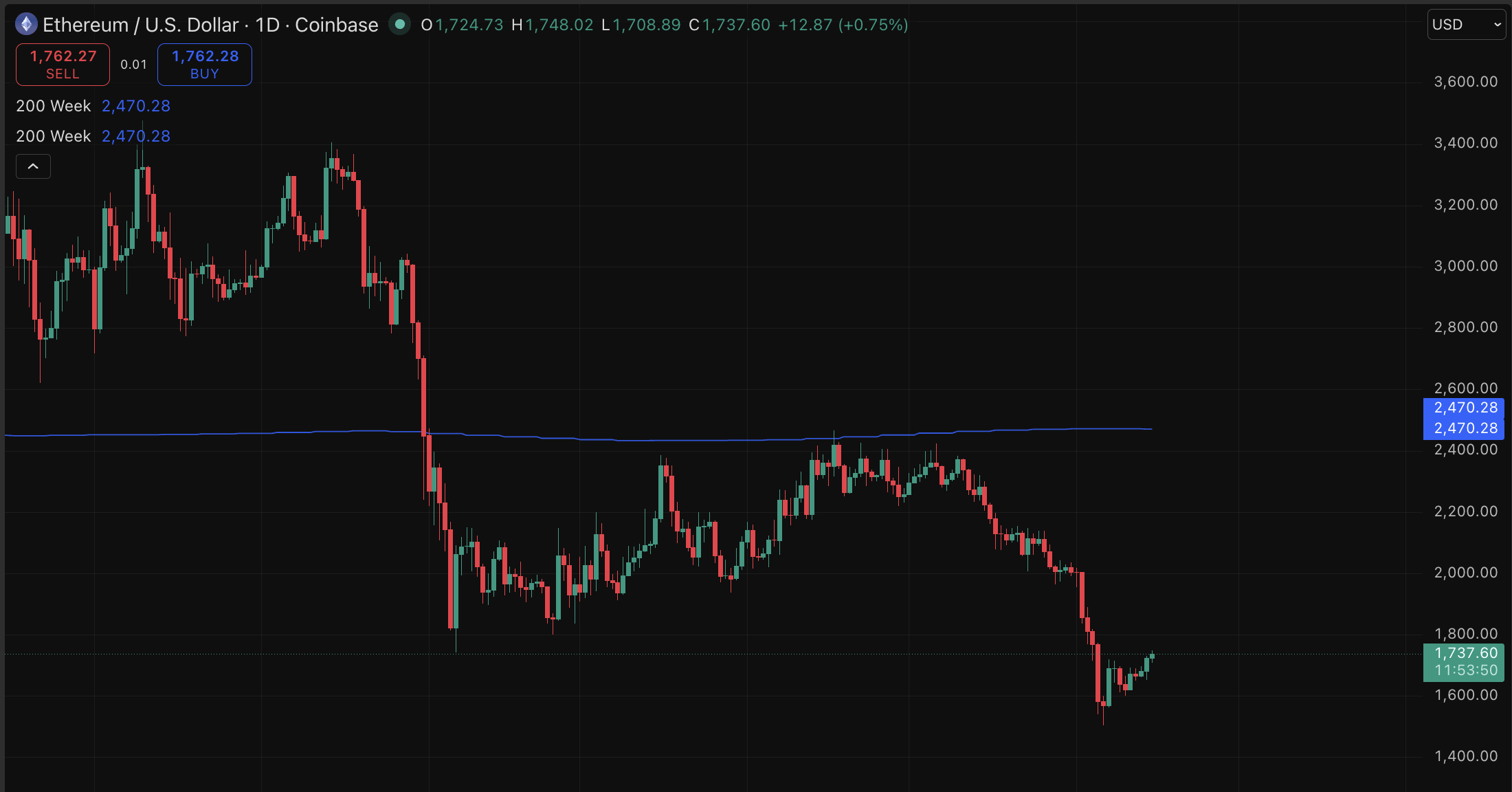
Ethereum price is trading above $1,700 after running for 5% today, and even our prediction model is calling for more leg higher. However, ETH remains pinned below its 200-week simple moving average, a level that historically separates accumulation floors from genuine bull market re-entries.
Tom Lee, after weeks of aggressive buying, is finally closing in on Bitmine 5% supply target. He is getting closer to his target, and Ethereum might lose its support defender.
Ethereum is doing well, but whether this bounce has legs or is simply just a dead-cat bounce is the question every ETH holder is asking.
Discover: The Best Crypto to Diversify Your Portfolio
Ethereum Price Prediction: Reclaim $1,800 Before Momentum Fades?
Spot ETH is closing to $1,800, price is recovering. Key levels are well-defined. Support clusters between $1,600 and $1,665, with the strongest floor sitting at $1,640.02. It’s anchoring its key support at $1,665.
Immediate resistance runs from $1,715 to $1,740. ETH has to close above $1,740 on meaningful volume to open a realistic path toward the $1,840 area that short-term forecasting models flag as a mid-June target.

The macro backdrop matters here, too. Institutional sentiment around the debasement trade has kept crypto broadly bid, but ETH specifically has been an underperformer relative to BTC this cycle. It’s a dynamic that doesn’t resolve on technicals alone.
Staking-related sell pressure has eased, which removes one headwind, but the 200-week SMA overhead remains a significant gravitational ceiling.
Discover: The Best Token Presales
LiquidChain Targets Early-Mover Positioning as Ethereum Tests Structural Resistance
ETH at $1,760 with a $200B market cap and a ceiling at its 200-week SMA is not the setup that generates 10x returns from here, not in the near term. Traders looking for asymmetric exposure during this consolidation window have been rotating toward earlier-stage infrastructure plays where price discovery hasn’t yet occurred.
LiquidChain ($LIQUID) is one project gaining traction in that context. It’s a Layer 3 infrastructure protocol built around a single execution environment that fuses Bitcoin, Ethereum, and Solana liquidity, a genuinely differentiated architecture at a time when cross-chain fragmentation remains one of DeFi’s most persistent friction points.
LiquidChain is always cooking something new.
This is what happens when a great idea meets innovation.pic.twitter.com/qYbth0impA
— LiquidChain (@getliquidchain) June 15, 2026

The project’s Unified Liquidity Layer and Deploy-Once Architecture mean developers write once and access all three ecosystems, which is the kind of structural utility that institutional-grade builders actually care about.
Presale figures as of writing: $0.0147 per $LIQUID, with $840K raised to date.
For traders who want exposure to the infrastructure layer while ETH consolidates overhead resistance, researching LiquidChain is worth the time.
The post Ethereum Price Prediction: ETH is Still Below Its 200 Week SMA, and Tom Lee Buying Spree Might End Soon appeared first on Cryptonews.


Strategy (MSTR) last week acquired 1,587 bitcoin for approximately $100 million, increasing its total holdings to 846,842 BTC, according to a Monday morning filing.
The latest purchase was made at an average price of $63,024 per bitcoin. The company disclosed it had also increased its USD Reserve by $100 million to $1.1 billion via the sale of common stock.
The purchase ran from June 8 to June 14, the same week Strategy raised $209 million by selling about 1.73 million MSTR shares through its at-the-market program.
The reserve is the money Strategy set aside in December 2025 to cover dividends on its preferred shares and interest on its debt. Building it up while continuing to buy bitcoin signals the company is funding both its accumulation and its obligations through equity issuance rather than touching its bitcoin or its cash cushion.
The buy lifts Strategy’s holdings to 846,842 BTC, worth about $56 billion at current prices and bought at an average of $75,656 per coin for a total of around $64 billion. The company remains the largest corporate holder of bitcoin, at roughly 4% of the supply that will ever exist.
Strategy disclosed on June 1 that it had sold 32 bitcoin to fund preferred dividends The company’s shares are up 5% pre market with bitcoin trading above $66,000.
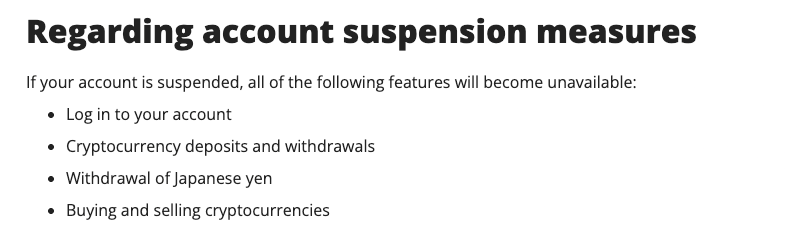
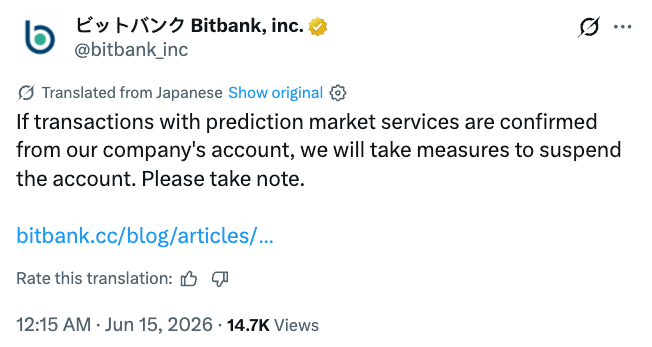
Bitbank, one of Japan’s largest cryptocurrency exchanges, warned users that transactions linked to prediction market platforms such as Polymarket could result in account suspensions due to potential conflicts with the country’s gambling laws.
In a notice published on Monday, Bitbank said it may restrict accounts making deposits or withdrawals connected to prediction market services.
The warning highlights the regulatory uncertainty surrounding prediction markets in Japan, where local gambling laws may complicate Polymarket’s previously stated interest in expanding into the country.
Bitbank warns of sweeping account restrictions
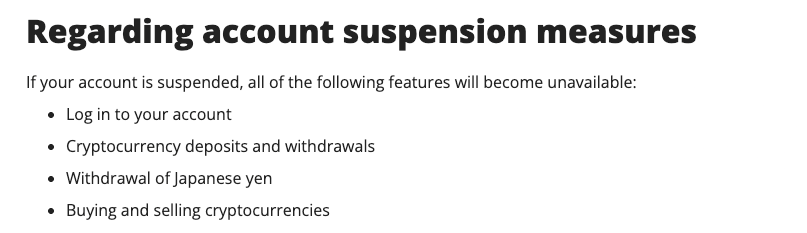
Bitbank said users whose accounts are suspended would lose access to a wide range of services, including account logins, deposits and withdrawals, as well as crypto trading.
“We will not be liable for any damages incurred by our customers as a result of the account suspension measures,” the exchange added.
Source: Bitbank (translated by Google)
The announcement urged customers to exercise caution when using external services and avoid becoming involved in criminal activity or legal disputes.
Bitbank did not cite any specific regulatory action or government directive behind the warning. It said prediction market platforms that allow users to bet on election results, sports outcomes and other future events could be considered gambling under Japanese law when used for financial gain.
Related: SBI eyes Bitbank deal as Japan’s crypto exchange market consolidates
Cointelegraph asked Bitbank what prompted the notice but had not received a response by publication.
Questions emerge as Polymarket eyes expansion
Bitbank’s notice comes as prediction markets face growing scrutiny globally, with regulators in multiple jurisdictions taking action against Polymarket and Kalshi over gambling concerns.
Polymarket currently lists Japan among 35 restricted jurisdictions in its access policy. The company signaled in May that it was exploring expansion in Japan, raising questions about how it may navigate potential conflicts with local gambling laws.
Source: Bitbank
Japan has not issued formal guidance specifically on prediction markets, but Bitbank’s warning indicates that at least some crypto companies are taking a more cautious approach to services that could be classified as gambling.
Magazine: Should users be allowed to bet on war and death in prediction markets?
The gold vs silver trade is no longer moving as one. As a cooling oil trade and a tentative Iran peace deal reshape the macro backdrop, capital is quietly rotating toward one metal and away from the other. The latest positioning data shows the split across precious metals widening.
What looks like a calm market on the surface hides a clear preference underneath. The precious metals trade has started to favor one side, and the reason sits in how each metal relates to oil.
Where the Money Is Actually Going
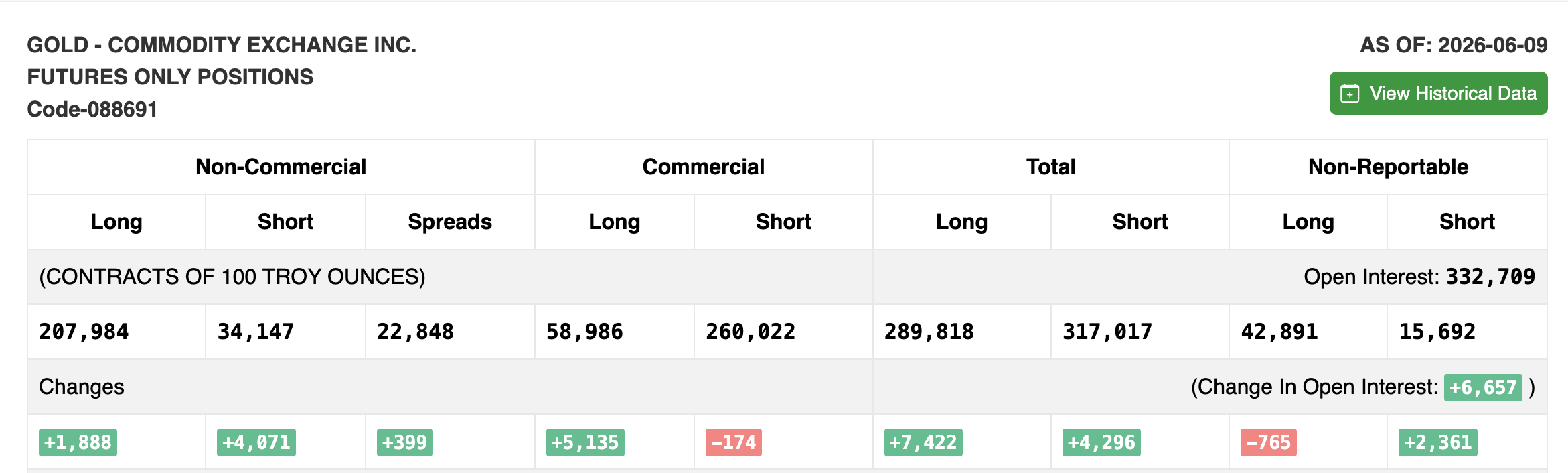
The clearest read comes from the Commitments of Traders report for June 9. This report breaks down how futures traders are positioned. Gold saw broad buying. Non-commercial longs rose 1,888 contracts, commercial longs jumped 5,135, and total open interest climbed 6,657, a build that spanned both speculators and hedgers. Open interest is the total number of contracts still active in the market, so a small rise means little fresh money committed.

Silver told a thinner story. Its non-commercial longs fell 1,446 contracts, and while total longs edged up 1,055, open interest rose just 631. The contrast is the signal. Gold drew conviction buying while silver positioning barely moved. Also gold’s open interest, by contrast, climbed 6,657, nearly ten times more, which shows new capital pouring in rather than traders simply swapping positions.

That divergence sets the tone for the whole precious metals complex. When traders crowd into gold over silver, they favor the metal that behaves like a safe haven over the one tied to industrial demand. The next layer explains why that choice makes sense right now.
Oil Is Quietly Steering the Trade
The reason traces to correlation, or how closely these assets move together. Over the past 30 days, gold and crude oil show a negative correlation of 0.34, meaning gold tends to rise as oil falls. With the Iran deal pulling the oil trade sharply lower, that inverse link is working directly in gold’s favor.
Silver sits in a more conflicted spot. It correlates 0.82 with gold, so the two largely move together, but silver also carries heavy industrial demand, which loosely ties it to the same growth signals that move oil. Also, the silver-oil correlation is way lower at -0.15.

That dual identity dilutes its safe-haven pull exactly when the macro story is about falling energy and easing inflation. A weaker oil trade is a clean tailwind for gold but a mixed message for silver.

The gold silver ratio captures the tilt in a single number. It sits near 61.7, up off its recent lows, and a rising ratio signals a risk-off lean where gold is preferred, while a falling one points to reflation with silver leading.

The direction now favors gold, and relative performance confirms it, with gold holding near the top of the group while oil sits well below.
The Signal That Confirms Gold’s Edge
The options market adds a check, and read carefully, it actually backs the gold side in the gold vs silver debate.
On the gold ETF, the put-call volume ratio rose from 0.73 to 0.78 since June 2. Also, the open-interest ratio edged up from 0.56 to 0.58, a tilt toward puts. That looks bearish at first, but it fits a crowded long. Traders who bought gold aggressively, as the futures data shows, tend to buy downside protection once the position has run, so rising put activity reads as hedging a winning trade rather than betting against it.

Silver’s ETF (SLV) leaned the other way, but only slightly. Its put-call volume ratio fell from 0.44 to 0.40, a small shift toward calls. The open-interest ratio held near 0.53.
Want more insights like this? Sign up for Editor Harsh Notariya’s Daily Newsletter here.
The contrast is telling. On gold, the rising put activity comes alongside the heavy futures buying from the COT data. Therefore, the same metal drawing conviction longs is also the one whose holders are paying for downside protection. That is what a serious, crowded position looks like: money commits, then insures itself. Silver shows neither side of that. Its mild shift toward calls sits on top of flat futures positioning, which points to light speculative interest, a few traders reaching for upside rather than large players building and defending a stake.

Put together, the options confirm the hierarchy rather than break it. Gold is the crowded, hedged trade that money takes seriously, and silver is the lighter side bet. Until that changes, the gold vs silver trade stays leaning toward gold as the defensive metal of choice, with silver lagging unless reflation takes hold and the oil trade turns back up.
The post The Gold vs Silver Debate Picks a Side as the US-Iran Deal Sinks Oil appeared first on BeInCrypto.
Bitcoin (BTC) starts the third week of June with a spring in its step as the US-Iran peace deal sends risk assets higher.
Key points:
- Bitcoin price action targets $66,000 as US stock futures soar and oil approaches its lowest levels since early March.
- Traders see $69,000 as a likely short-term BTC price target.
- The Federal Reserve interest-rate decision is under the microscope thanks to new Chair Kevin Warsh.
- Bitcoin whales have reversed their selling mentality, putting in a “rock-solid floor” near $60,000.
- Overall demand weakness raises questions over a bull-market comeback.
Oil price drops below $80 as Iran peace countdown begins
The US-Iran war is again the center of attention for traders this week as a peace deal appears closer than ever.
Developments over the weekend initially included a Sunday deadline for signing off on a ceasefire, but this subsequently became Friday.
Multiple sources then confirmed that the US and Iran would sign an agreement for a 60-day pause in hostilities, along with various other measures, in Switzerland on Friday.
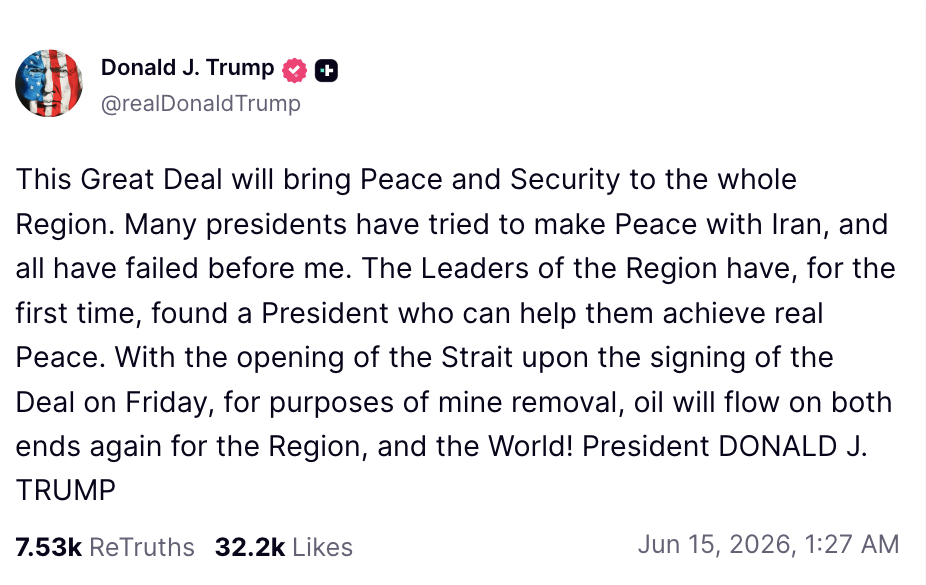
In a post on Truth Social, US President Donald Trump confirmed that the deal would include the reopening of the Strait of Hormuz — a key global oil route.
“With the opening of the Strait upon the signing of the Deal on Friday, for purposes of mine removal, oil will flow on both ends again for the Region, and the World!” he wrote.
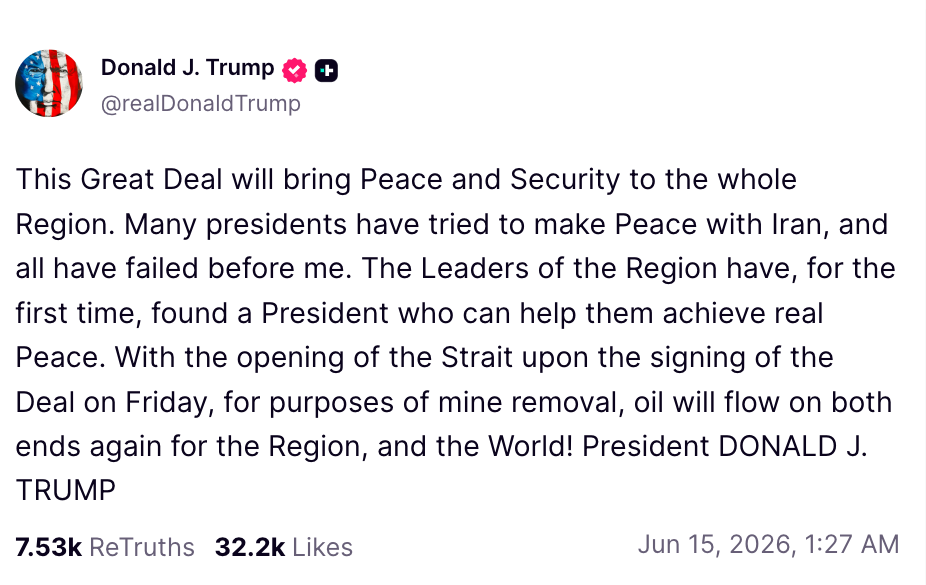
Source: Truth Social
US stock futures surged as a result, with risk assets moving higher across the board — including Bitcoin and crypto.
Oil, by contrast, fell immediately, with WTI crude trading below $80 per barrel for the first time since mid-April.
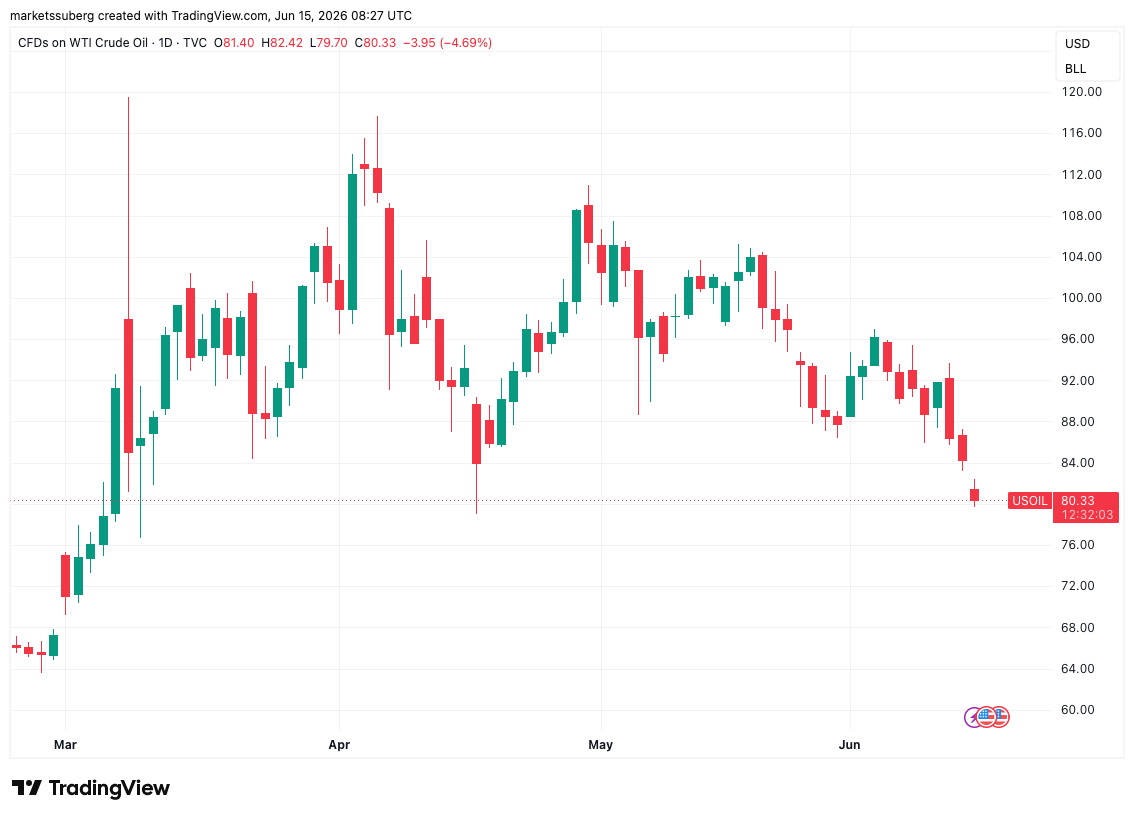
CFDs on US WTI crude oil one-day chart. Source: Cointelegraph/TradingView
Reacting, portfolio manager Danny Dayan described the deal as the “biggest and worst TACO of all time,” referring to the Trump administration’s approach to various geopolitical and macroeconomic conflicts.
“Overheat, higher core inflation, and higher neutral rate, will be the macro considerations ahead,” he told X followers, seeing a pivot away from oil as a market mover.
Throughout the conflict, oil price strength has been a headwind for Bitcoin, even as stocks see repeated new all-time highs.
BTC/USD is now back at the exact level it traded when it began on Feb. 28.
Bitcoin traders see $69,000 short squeeze
News of a US-Iran peace deal helped propel BTC price action toward two-week highs into Sunday’s weekly candle close.
Data from TradingView captured local highs of $65,988 as the new week began.
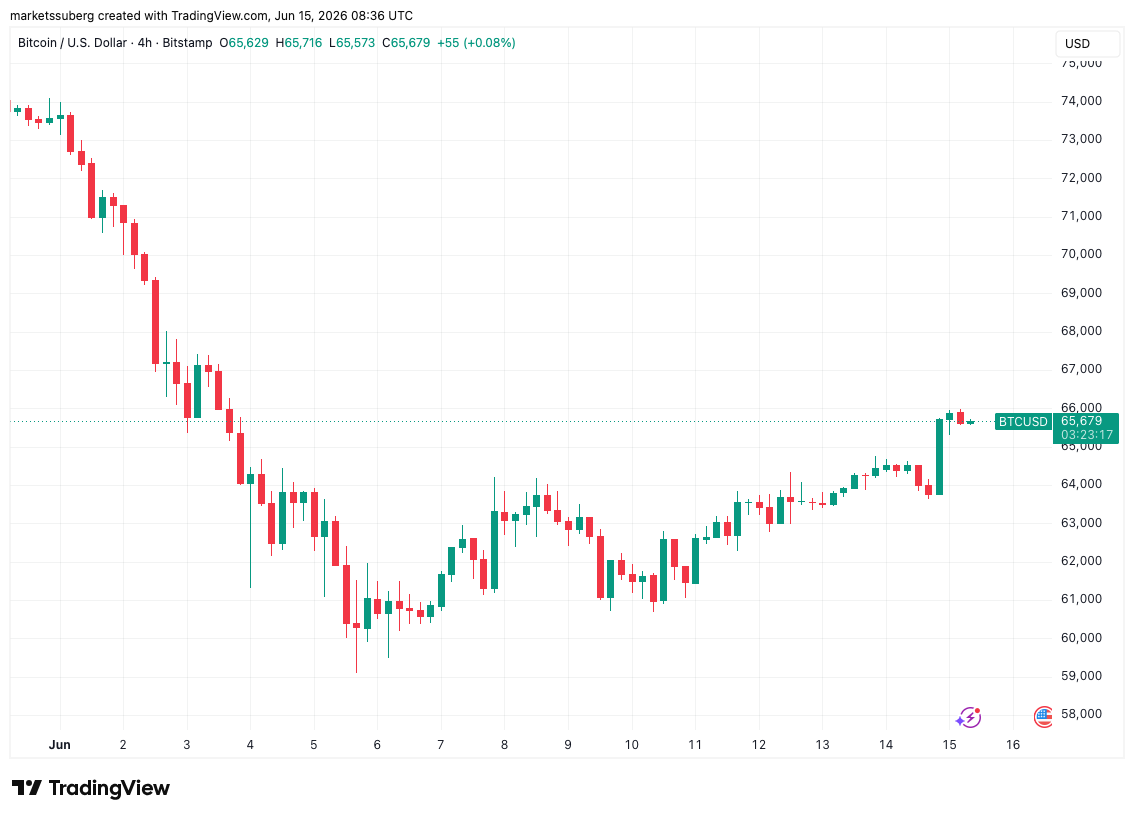
BTC/USD four-hour chart. Source: Cointelegraph/TradingView
With both $60,000 and Bitcoin’s 200-week simple moving average (SMA) at $62,000 holding as support, traders’ short-term outlook began to improve.
“Closed near the highs with almost no upper wick, favoring a push higher this week,” trader SuperBro wrote in his latest analysis on X.
SuperBro eyed the 200-week exponential moving average (EMA) as a potential target for a short squeeze.
“There are a lot of leveraged shorts up to the 200 EMA around $69K. Good chance that is where this is headed,” he added.
“Q2 closes in just 2 weeks. Let’s see if bulls can keep the heat on.”
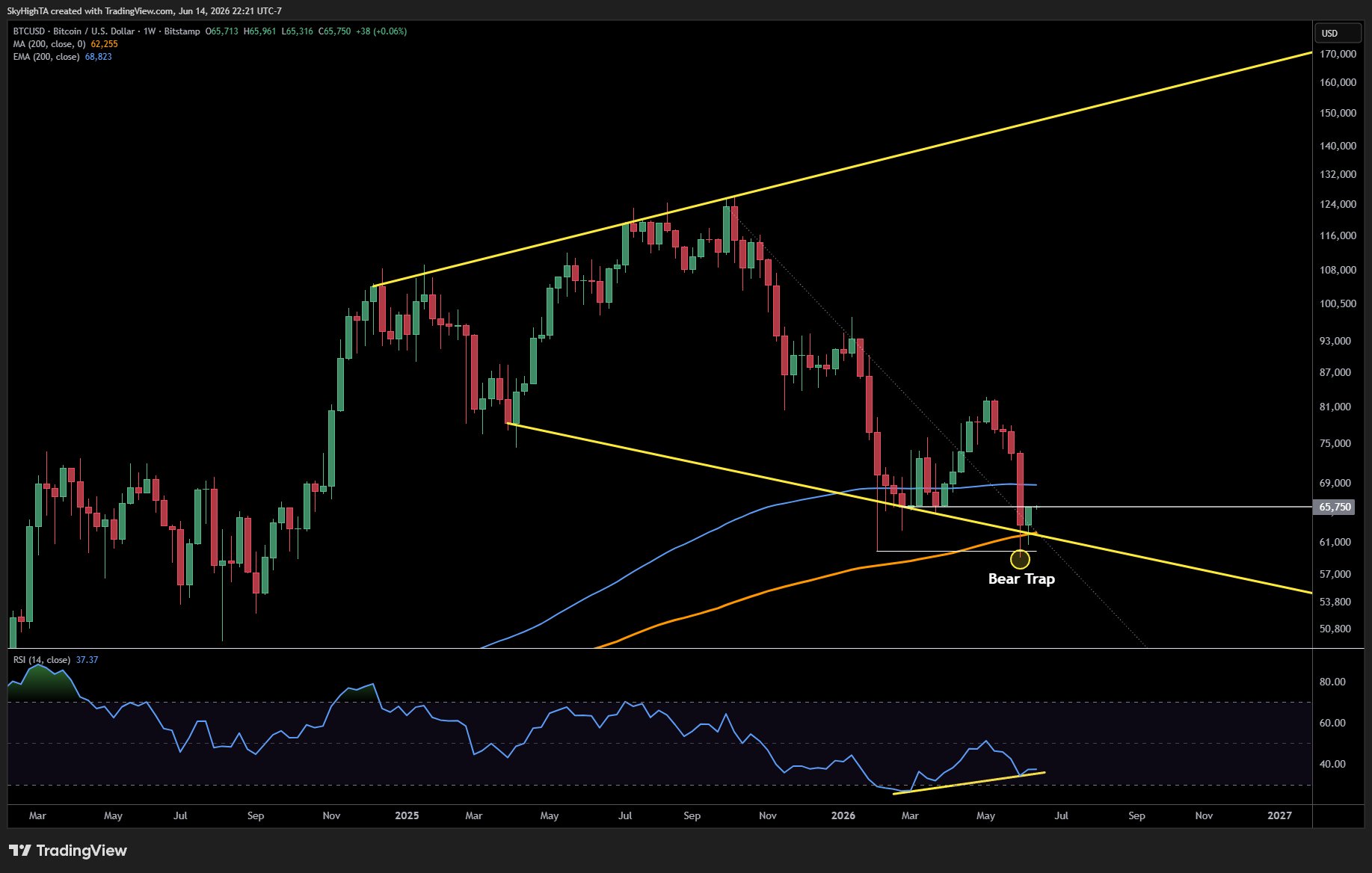
BTC/USD one-week chart. Source: SuperBro/X
Trader CrypNuevo also had the area just below the $70,000 boundary in sight for the week.
“Still seeing a recovery to the mid-range $69k,” he wrote in his X analysis.
CrypNuevo warned that BTC/USD could still return to local lows as part of range-bound trading.
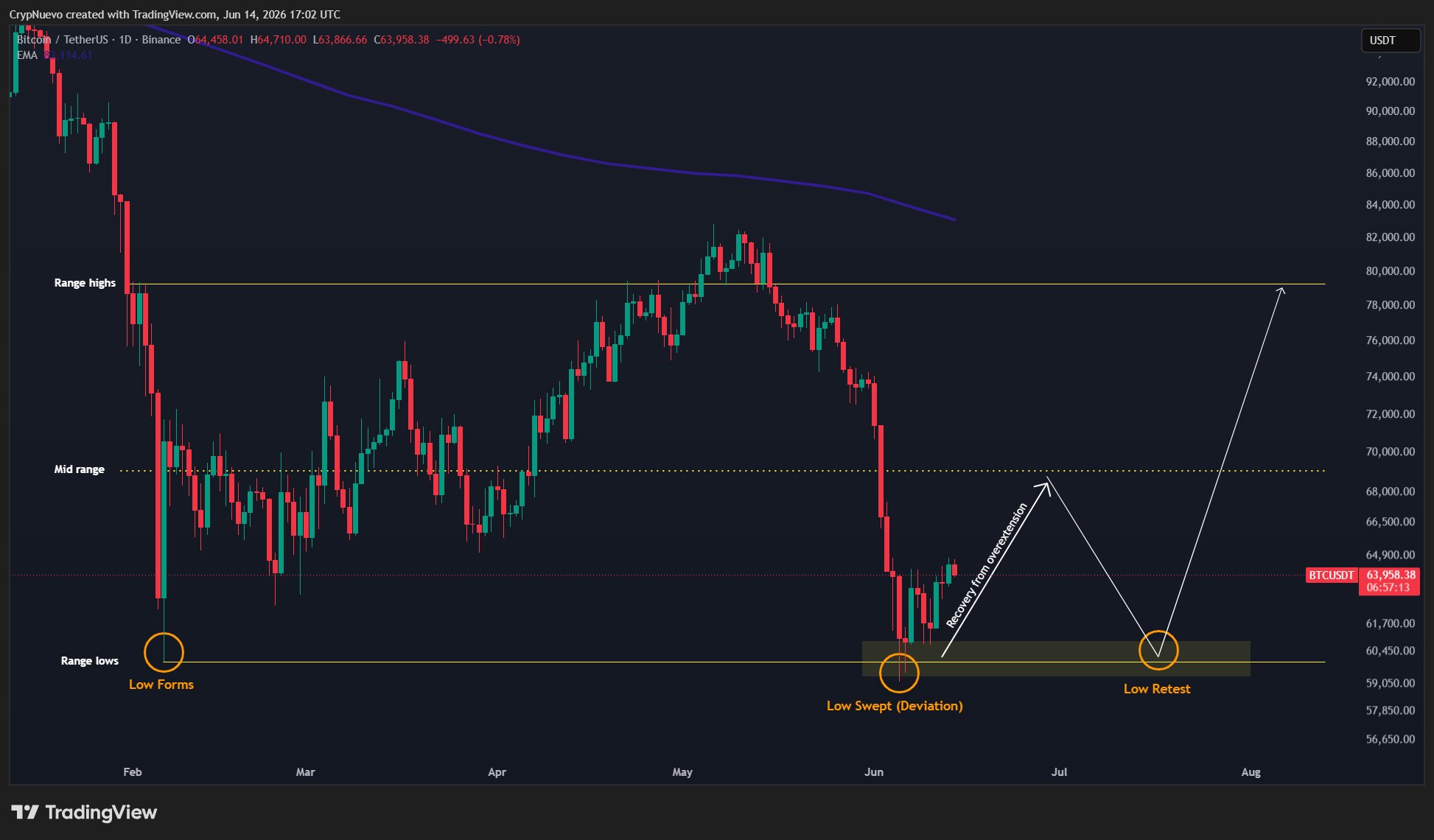
BTC/USDT one-day chart. Source: CrypNuevo/X
Trader and analyst Rekt Capital agreed, stressing that price rebounds tend to become weaker as bear markets progress, along with key support — in this case the $60,000 mark.
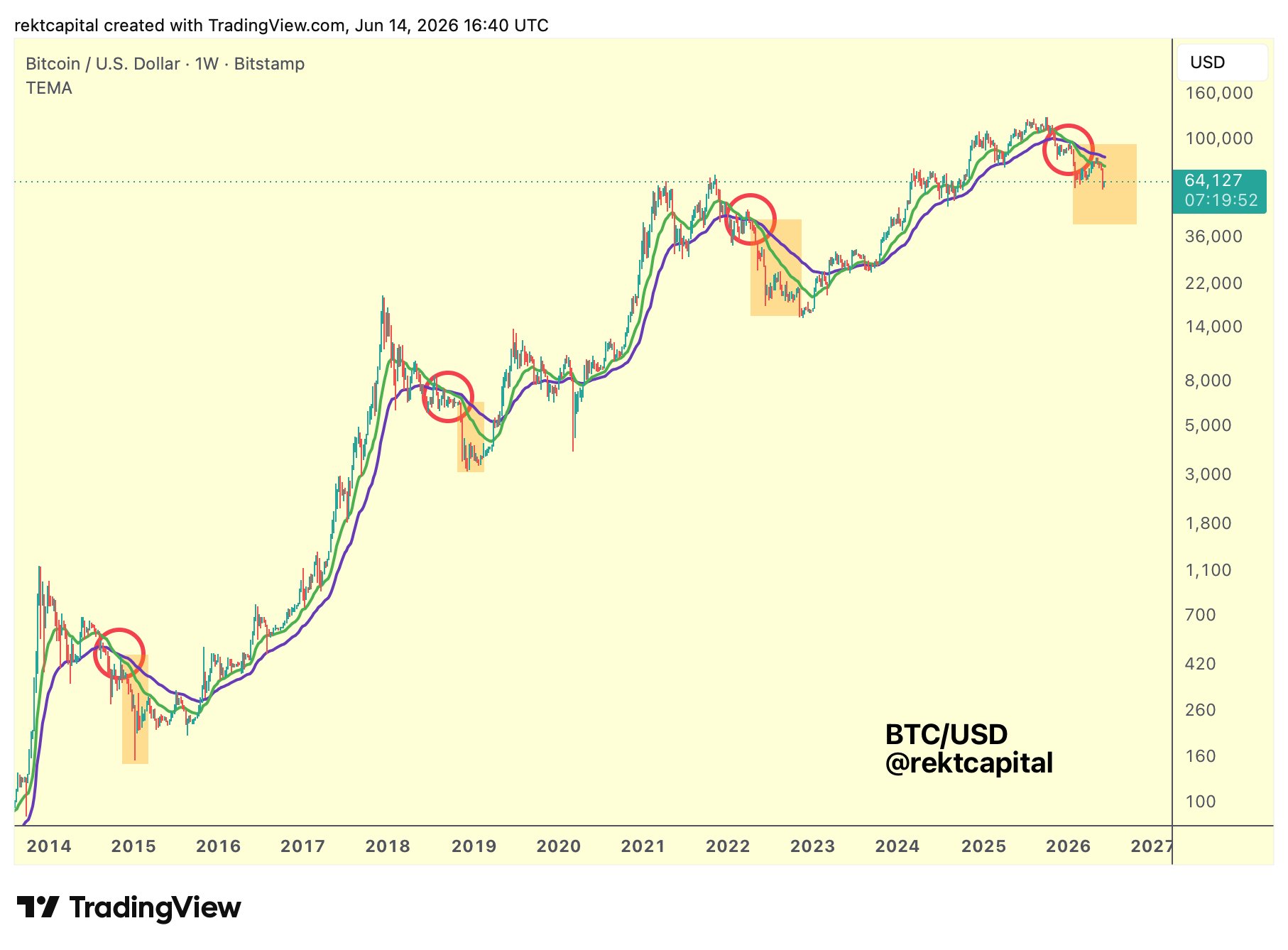
BTC/USD one-week chart. Source: Rekt Capital/X
New Fed chair under pressure on rate cut
Against the backdrop of serious geopolitical flux, “all eyes” nonetheless remain on the US Federal Reserve.
On Wednesday, the Fed’s new chair, Kevin Warsh, will lead his first meeting to decide on interest-rate changes.
Given the inflationary catalyst that the Iran war has become, markets see barely any chance of Warsh cutting rates — but Trump has repeatedly called for that very outcome.
In an interview in April, Trump told mainstream media that he “would” be disappointed if Warsh did not deliver a cut at the first opportunity.
“All eyes are on the Fed this week,” trading resource The Kobeissi Letter summarized in its latest X analysis.
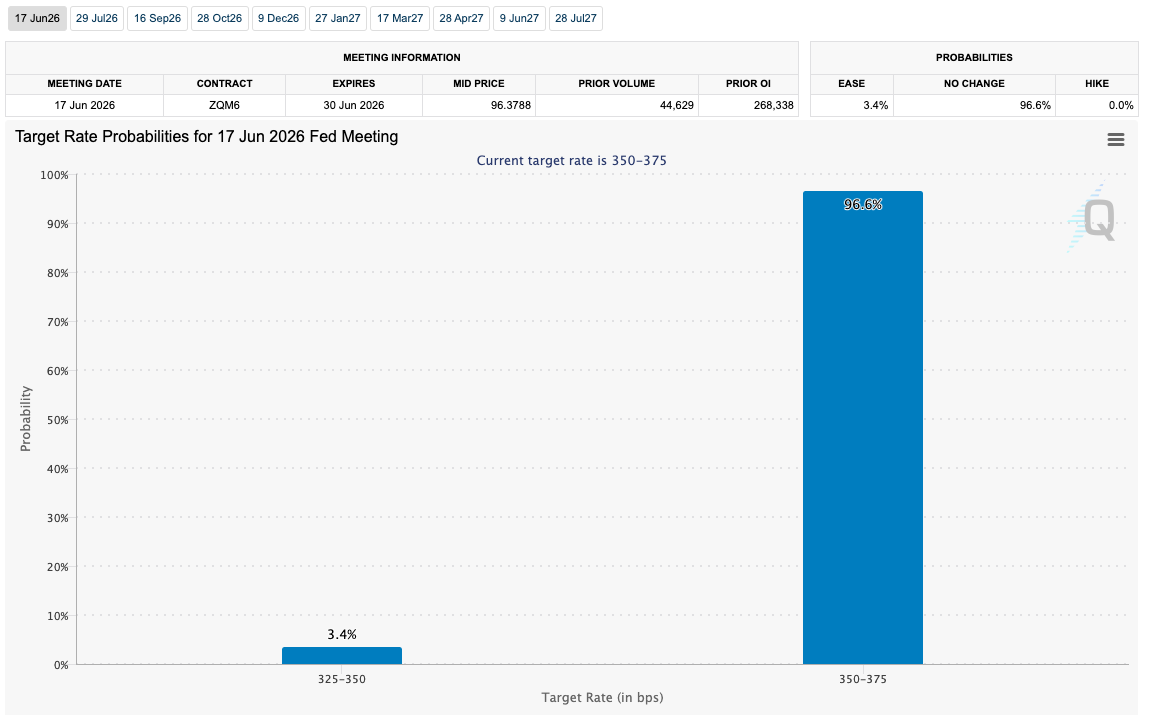
Fed target rate probabilities for Wednesday FOMC meeting (screenshot). Source: CME Group
The latest data from CME Group’s FedWatch Tool puts the odds of a minimal 0.25% cut at just 3.4%.
Reacting, commentators overwhelmingly see rates remaining at current levels.
In analysis on Sunday, Dayan described Warsh as “trapped no matter what he does.”
“If he is hawkish, he will be breaking promises made to Trump,” he wrote.
“On the other hand, if he uses the recent decline in oil prices as a reason for a wait and see stance, I think he is raising the odds we will see a panic hike in the second half of the year as the economy overheats.”
US markets will have a shorter four-day week, with Wall Street closed Friday for the Juneteenth holiday.
Whales deliver “rock-solid floor”
In a boost for Bitcoin bulls, new analysis reveals a potential sea change in large-volume investor mentality in recent days.
Bitcoin whales, according to onchain analytics platform CryptoQuant, have become buyers again.
Looking at exchange inflows from whale wallets, CryptoQuant data shows that coin days destroyed (CDD) — the number of days funds spent dormant after last moving — have significantly cooled.
“Inflow CDD plunged from 2.16M to near-zero (33K), showing long-term whale dumping has completely stopped,” contributor Woo Minkyu wrote in a Quicktake blog post on Monday.
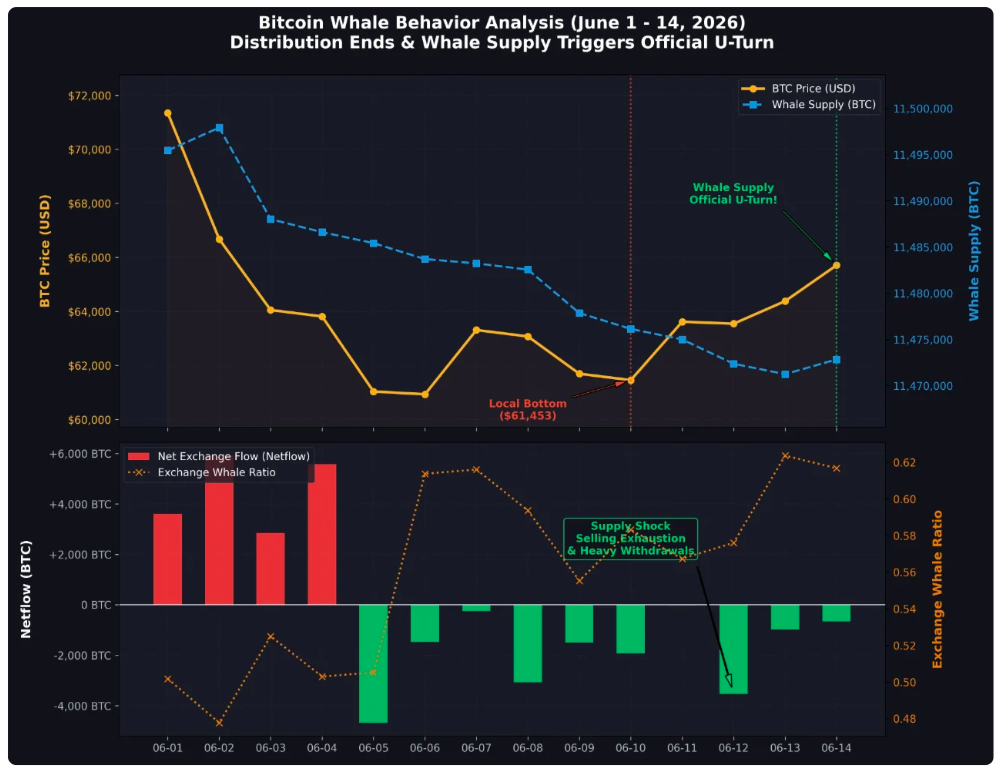
Bitcoin whale data (screenshot). Source: CryptoQuant
Woo described whales as putting in an “aggressive bottom buy” at around $61,000, absorbing “all” coins panic sold by other investor cohorts.
“The wealth transfer from weak hands to strong hands is complete,” he concluded.
“Whales have locked in the $60,000–$61,500 range as a rock-solid floor. With exchange reserves depleted, the path of least resistance for Bitcoin is now firmly upward.”
Earlier, Cointelegraph reported that three key conditions for a BTC price rebound were almost satisfied. Whales on Hyperliquid and Bitfinex, analysis said at the time, were already positioned for a bounce.
Bitcoin apparent demand stays negative
When it comes to a full bull-market rebound, CryptoQuant remains cautious in light of current onchain data.
Related: Bitcoin miner ‘capitulation’ comes as trader sees later 2026 bear-market bottom
Apparent demand, contributor XWIN Japan notes, is still negative — something that has always coincided with bear markets in the past.
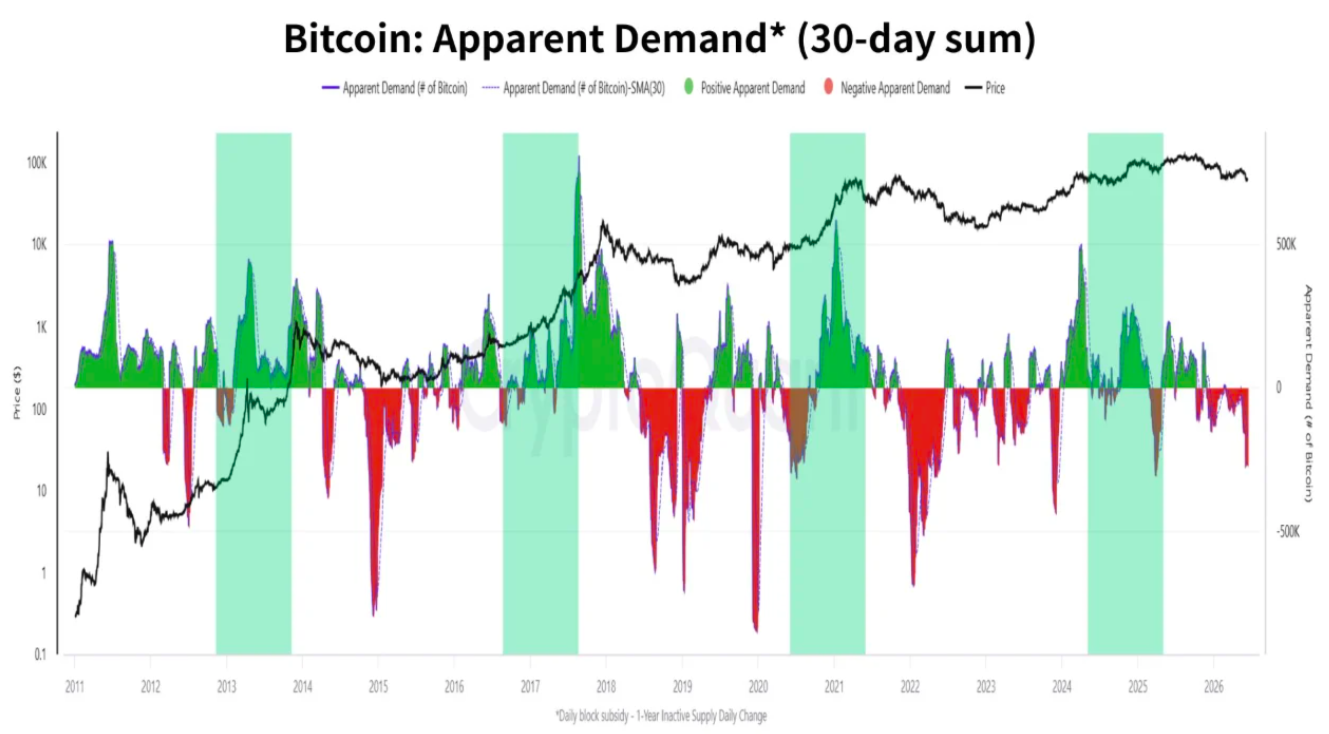
Bitcoin apparent demand (screenshot). Source: CryptoQuant
Apparent demand is the difference between Bitcoin’s issuance — or newly mined coins — and the supply inactive for over a year.
“If the decrease in inventory exceeds production, demand is increasing, and vice versa,” CryptoQuant head of research Julio Moreno explains.
Accordingly, current negative values signal a broad lack of interest in BTC exposure and may even override the four-year cycle theory to dictate future price action, XWIN says.
“This suggests that Bitcoin may not be declining simply because ‘the cycle says so.’ Instead, demand growth has slowed,” it wrote this weekend.
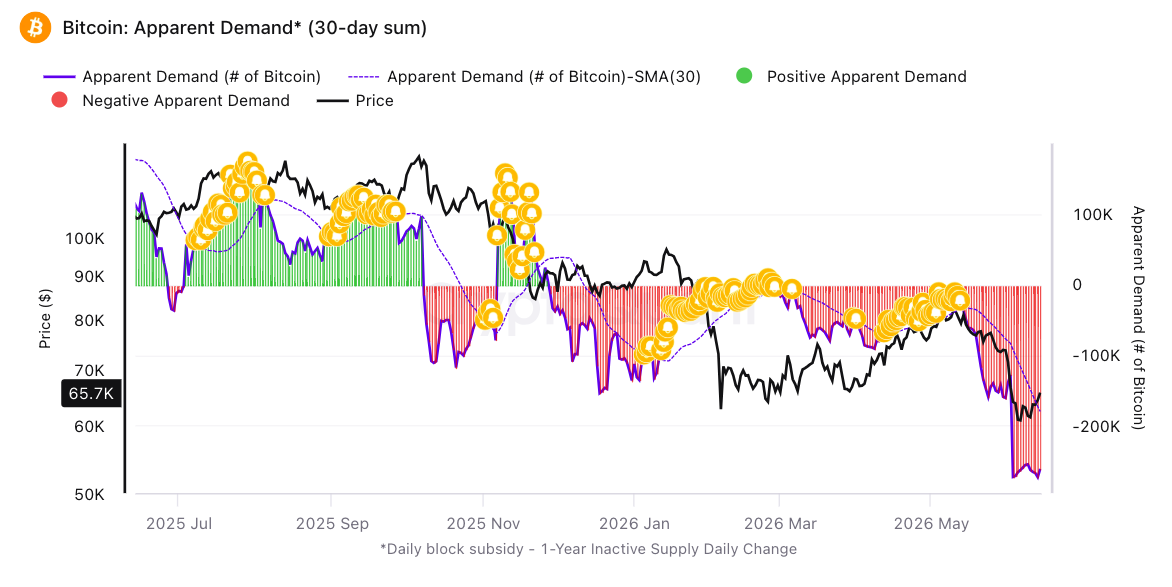
Bitcoin apparent demand (screenshot). Source: CryptoQuant
XWIN also pointed to declining open interest on Bitcoin futures markets while echoing the theory that a final “capitulation” event may yet occur.

Two weeks after announcing its first BTC sale in roughly four years, the Michael Saylor-founded business intelligence giant has reaffirmed its support for bitcoin, acquiring another 1,587 units for approximately $100 million.
The average purchase price was just over $63,000, and the company has also increased its USD stash by another $100 million to $1.1 billion. Its total crypto fortune has grown to 846,842 BTC, currently valued at almost $56 billion.
Strategy has acquired 1,587 BTC for $100 million to increase our $BTC Reserve to ₿846,842. We have also increased our USD Reserve by $100 million to $1.1 billion. $MSTR $STRC https://t.co/27PYXJN7GD
— Michael Saylor (@saylor) June 15, 2026
Recall that Strategy sold off 32 BTC a couple of weeks ago, which, despite what some critics claimed, wasn’t a capitulation event. Instead, it was necessary to support preferred stock distributions, including cash dividends across the firm’s stock series.
Aside from FUD that was among the reasons behind bitcoin’s price collapse to a 19-month low beneath $60,000, Strategy’s decision raised some eyebrows within the community and prompted Jim Cramer to say that the firm and its co-founder had “killed” the cryptocurrency.
Saylor was quick to respond, refuting the FUD and indicating that he never said the company would not sell any BTC when it becomes necessary. However, he remains a firm believer that individual investors should refrain from dumping their bitcoin.
Moreover, Strategy resumed its accumulation spree last week, buying 1,550 BTC for just over $100 million.
Prominent crypto figures, such as Samson Mow and Lyn Alden, defended BTC, arguing that if a single entity that likes it so much to buy it cannot kill it with one decision to sell a tiny portion of its holdings.
The post Strategy Buys Another 1,587 BTC as Bitcoin Sale FUD Fades Away appeared first on CryptoPotato.

HDFC and Nippon Life India AMC shares rally upto 6% after FM Sitharaman hints at more foreign capital measures

Kalshi traders say SpaceX won’t get to Mars this decade

Client journalists defend Musk becoming a trillionaire


-

 Business22 hours ago
No Jackpot Winner as $257 Million Prize Rolls Over to $269 Million Monday Draw
-

 Crypto World4 days ago
Oppenheimer backs SpaceX as $70 billion retail frenzy builds
-

 Crypto World4 days ago
Markets Rally as SpaceX IPO Looms Amid Iran Tensions and Inflation Surge
-

 Fashion3 days ago
Weekend Open Thread: Tuckernuck – Corporette.com
-

 Sports7 days ago
FIFA WC 2026 Group C: Morocco, Scotland challenge Brazil’s hunt for glory | FIFA World Cup 2022
-
 Crypto World14 hours ago
Zimbabwe Requires Crypto Businesses to Register Annually Under New FIU Regulations
-

 Entertainment6 days ago
The Ryan Gosling True Crime Thriller On Netflix That Gets Even Stranger, Stream It Now
-
 Sports6 days ago
Bangladesh beat Australia after 20 years in ODIs, register only their second win over six-time world champions | Cricket News
-

 Tech3 days ago
This Week In Security: Microsoft On Microsoft, Register Your Domains, Linux On ARM, And FreeBSD Joins The File Cache Club
-

 Tech2 days ago
NanoClaw integrates JFrog registries to secure AI agent downloads
-

 Crypto World2 days ago
Bitget enters Argentina’s regulated crypto market through PSAV registration
-

 Politics4 days ago
Politics Home | Healey Resignation Is “Colossal Failure Of Government”, Says Former Labour Defence Secretary
-
 Tech4 days ago
Dutton Ranch star claims they ‘didn’t see any disruption’ on set following Chad Feehan’s exit from Yellowstone spinoff fueled by Taylor Sheridan clash rumors
-

 Tech5 days ago
‘This is Seattle’s position on AI’: City Council votes unanimously to pause big new data centers
-

 NewsBeat4 days ago
El Nino has formed in the Pacific and could set records, forecasters say
-
 Entertainment4 days ago
Donnie Wahlberg & More Heat Up Las Vegas at Circa’s Barry’s Downtown Prime
-

 Sports4 days ago
First Time Since 1971: Australia Register Historic Low In ODI Cricket
-
 Tech4 days ago
Opendoor Ends India Operations, Fueling a Bigger Conversation About AI and Outsourcing
-

 Politics4 days ago
Belfast burns, while Met chief points finger at Iran and Russia
-

 NewsBeat3 days ago
FBI searches office of Ohio voter registration group
You must be logged in to post a comment Login