

Crypto World
Can BTC Rebound to $69K as Oil Prices Drop?

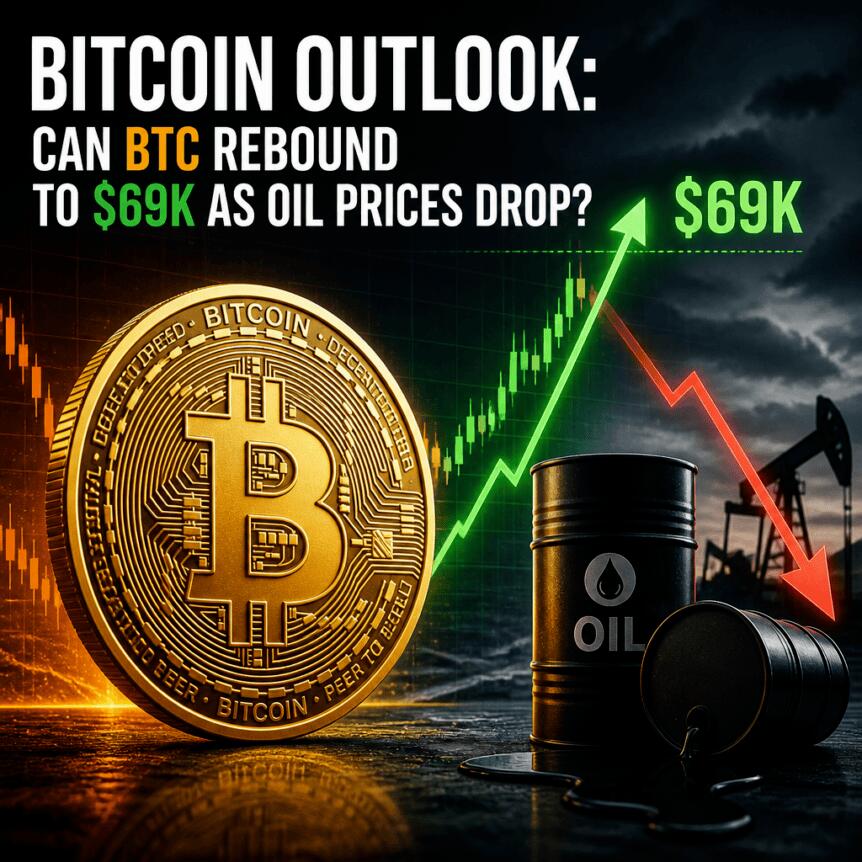
Bitcoin enters the third week of June supported by a rare alignment of macro and on-chain signals: US-Iran ceasefire expectations have lifted risk sentiment, while oil prices have fallen sharply. At the same time, traders are watching a potential short squeeze as price consolidates above long-standing support levels.
However, analysts at CryptoQuant also flag that the picture is not fully bullish. Whale activity may have shifted toward accumulation, but “apparent demand” for BTC remains negative—an indicator that has historically coincided with bear-market conditions.
Key takeaways
- US-Iran ceasefire momentum pushed broader markets higher, with WTI crude slipping below $80—an environment that traders say can ease an important headwind for BTC.
- BTC has held key technical support around $60,000 and its long-term moving averages near the low-$60,000s, improving near-term upside odds.
- Several traders cited $69,000 as a likely short-term target, pointing to concentrated leveraged shorts in the $60,000s to high-$60,000s area.
- CryptoQuant data suggests exchange inflow “coin days destroyed” has cooled dramatically, implying large holders have stopped dumping and moved into aggressive accumulation near ~$61,000.
- Despite that whale reversal, CryptoQuant reports BTC “apparent demand” is still negative, which historically has tracked with weaker market phases.
Ceasefire hopes lift risk assets, oil breaks down
The week’s earliest catalyst was the prospect of de-escalation between the United States and Iran. Reports circulated over the weekend about a ceasefire sign-off window, which later shifted to a June 19 timeline, before multiple sources confirmed a broader agreement framework.
According to those accounts, the US and Iran would sign an agreement for a 60-day pause in hostilities alongside additional measures in Switzerland on Friday. In a Truth Social post, US President Donald Trump said the deal would include reopening the Strait of Hormuz—a critical global oil route—after the agreement is signed.
Trump’s message also linked the Strait reopening to improved conditions for mine removal and the resumption of oil flow. Market participants reacted quickly: US stock futures strengthened as risk appetite improved, and crypto followed the move.
Oil moved in the opposite direction. WTI crude fell below $80 per barrel for the first time since mid-April, according to the reporting. The shift matters for BTC because sustained strength in crude has often correlated with tighter macro conditions and can dampen crypto risk-taking.
BTC traders target a squeeze toward $69,000
With the macro lift filtering into crypto, traders moved to technical levels that define whether the market can extend its bounce. TradingView data referenced in the report showed local highs around $65,988 as the new week began.
Support has been reinforced near $60,000, with both the $60,000 area and Bitcoin’s 200-week simple moving average (SMA) near $62,000 described as key floor levels. One trader, SuperBro, argued that BTC closed near its highs on the weekly candle with minimal upper wick—an expression of bullish pressure—while also highlighting the 200-week exponential moving average (EMA) as a potential magnet for price.
SuperBro specifically pointed to leveraged shorts clustered around the 200 EMA area near $69,000. In his view, that concentration could increase the odds of a short squeeze if price keeps grinding upward. He also noted that the market is approaching quarterly closing dynamics (“Q2 closes in just 2 weeks”), a period when positioning and liquidity can shift.
Other analysts echoed the $69,000 recovery zone. CrypNuevo said he still expected a return toward the mid-$69,000 range, while cautioning that BTC could still revisit local lows as part of range-bound trade behavior. Rekt Capital added a broader bearish-market nuance: rebounds in bear markets often weaken over time, and key support—again, the $60,000 level—remains pivotal to whether bulls can build momentum.
The Fed’s first Warsh meeting becomes the next pressure point
Even with geopolitical risk easing in the headlines, attention quickly turned back to monetary policy. The US Federal Reserve’s new chair, Kevin Warsh, is scheduled to lead his first meeting where interest-rate changes will be decided.
Market expectations, as reflected in CME Group’s FedWatch Tool, suggest minimal odds of a meaningful cut. The report cited FedWatch estimates placing the probability of at least a 0.25% cut at just 3.4%. That framing aligns with the broader view that inflationary pressures—potentially reintroduced or amplified by geopolitical developments—make rate cuts difficult.
Still, political pressure adds complexity. The reporting noted that Trump has repeatedly called for rate cuts and, in an April interview referenced by Cointelegraph, said he would be disappointed if Warsh did not deliver a cut at the first opportunity. That tension—between White House preferences and the Fed’s likely inflation constraints—has been part of trader anxiety going into the meeting.
One commentary cited in the piece described Warsh as “trapped no matter what he does.” The logic: if he appears hawkish to control inflation, he risks breaking promises implied by Trump; if he waits based on oil’s decline, he may be setting the stage for future tightening if the economy overheats later in the year.
The immediate calendar also matters. The US market will run a shorter four-day week with Wall Street closed Friday for Juneteenth, which can affect liquidity and the way traders react to Fed-linked headlines.
Whale behavior improves—but demand indicators remain weak
On-chain data provided the most bullish counterweight: CryptoQuant says large holders have shifted from selling to buying. The analysis referenced in the report focused on exchange inflows associated with whale wallets, and how long coins had been dormant before moving.
CryptoQuant contributor Woo Minkyu wrote that “coin days destroyed” (CDD) plunged from about 2.16 million to near-zero (around 33,000). In plain terms, this signals that long-idle BTC sitting in whale-controlled wallets is no longer being pushed to exchanges in a way consistent with continued distribution. Minkyu characterized it as the end of long-term whale dumping.
He also described an “aggressive bottom buy” around $61,000, framing it as an absorption of “all” panic-sold coins from other investor cohorts. The report further quoted the view that whales have effectively locked in a “rock-solid floor” in the $60,000–$61,500 range, especially as exchange reserves appear to have been depleted.
Yet, CryptoQuant’s overall stance remains cautious because whale buying alone may not be enough to restart a durable uptrend. The report highlighted a separate CryptoQuant indicator: BTC “apparent demand,” attributed to XWIN Japan’s analysis.
Apparent demand is defined in the source as the difference between BTC issuance (newly mined coins) and supply that has remained inactive for over a year. Julio Moreno of CryptoQuant, cited in the report, explained that when inactive inventory declines faster than production, demand is increasing; when it rises relative to production, demand is weakening.
In the latest readings referenced, apparent demand still appears negative—an outcome the analyst says has historically matched bear markets. That negative condition can matter because it suggests that even if whales are stabilizing prices by absorbing sell pressure, broader market interest and willingness to build exposure may still be lagging.
XWIN also pointed to declining open interest in BTC futures markets and reiterated the possibility that a final “capitulation” event may still occur, a theme Cointelegraph previously covered in relation to bear-market dynamics.
What to watch next
BTC’s immediate direction may be shaped by two competing forces: the potential for a squeeze toward trader-cited resistance near $69,000 versus the risk that weaker apparent demand keeps rallies fragile. The next major test will likely come from the Fed decision under Kevin Warsh—and whether macro relief translates into sustained crypto inflows rather than a temporary rebound.



Bitcoin has climbed more than 11% from its early June low as Santiment says the U.S.-Iran peace agreement may be laying the groundwork for a longer crypto bull market.
Summary
- Santiment says the U.S.-Iran peace deal has boosted risk appetite, helping Bitcoin recover more than 11% from its early June low.
- Glassnode data shows Bitcoin accumulation increased after the drop into the $60,000 range, with multiple wallet cohorts buying the dip.
- Despite the rally, more than $4.8 billion has left U.S. spot Bitcoin ETFs since May, highlighting continued investor caution.
According to on-chain analytics firm Santiment, investor sentiment has improved sharply after the United States and Iran reached a peace agreement that eased concerns about supply disruptions, inflation, and escalating geopolitical tensions.
In a June 15 X post, Santiment said traders had spent months reacting to fears surrounding energy markets and global instability. The firm argued that the agreement has instead encouraged investors to focus on reopening trade routes, lowering economic uncertainty, and the prospect of more stable market conditions.
President Donald Trump announced on Sunday that the deal with Iran had been finalized, authorizing the toll-free reopening of the Strait of Hormuz and ending the U.S. naval blockade. A formal signing ceremony is scheduled for June 19 in Switzerland.
On-chain data points to renewed buying
As risk appetite returned, capital moved back into digital assets while oil prices headed lower.
Santiment noted that Bitcoin, Ethereum, and other cryptocurrencies benefited as traders rotated funds into risk assets following the announcement.
Bitcoin traded above $66,600 on Monday, up roughly 3.5% over recent sessions and more than 11% above its early June low near $59,375. Ethereum climbed to around $1,846, while XRP and Solana gained 8.7% and 7.4%, respectively. The total cryptocurrency market capitalization remained above $2.36 trillion.
At the same time, oil prices moved in the opposite direction. WTI crude settled near $81 per barrel, down roughly 4.4% on the day.
Separate data from Glassnode suggests buying activity had already begun before the latest geopolitical catalyst emerged. The analytics firm reported that Bitcoin’s Accumulation Trend Score started moving toward accumulation after prices fell into the $60,000 range earlier this month.
Glassnode said the pattern indicates investors were absorbing supply during the correction rather than continuing to sell. A separate cohort analysis showed accumulation scores improving across multiple wallet groups, which the firm interpreted as evidence that buyers from different investor segments stepped in as Bitcoin declined.
ETF outflows continue despite improving sentiment
While Santiment sees the market response as potentially significant, the firm emphasized that expectations are playing an important role in the rally.
According to Santiment, financial markets often react before economic benefits become visible. The firm said many participants now view the agreement as an early sign of stability after a volatile period that included inflation concerns, conflict-related uncertainty, and pressure on risk assets.
“If inflation pressures ease and institutional investors finally begin feeling more comfortable themselves, the sharp gains following this announcement may end up looking less like a one-day relief rally and more like the opening chapter of a much larger bull cycle.”
Investor caution has not disappeared entirely. More than $4.8 billion has flowed out of U.S. spot Bitcoin exchange-traded funds since May, and some market participants remain wary after previous ceasefire agreements in the Middle East failed to hold.
Despite this, Santiment argued that improving market sentiment, falling oil prices, and renewed demand for digital assets have created conditions that could support further gains if macroeconomic pressures continue to ease.
Disclosure: This article does not represent investment advice. The content and materials featured on this page are for educational purposes only.
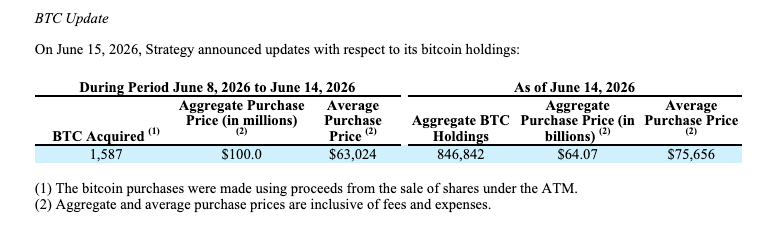
Michael Saylor’s Strategy, the world’s largest public Bitcoin holder, added to its cryptocurrency reserves last week as BTC continued to trade below the company’s average cost basis of about $75,700.
Strategy acquired 1,587 Bitcoin (BTC) for $100 million between June 8 and Sunday, according to Monday’s 8-K filing with the US Securities and Exchange Commission.
Source: SEC
The purchase was made at an average price of $63,024 per Bitcoin, bringing the company’s overall average cost basis slightly lower to $75,656.
With the latest buy, Strategy now holds 846,842 BTC, accumulated at a total cost of $64.07 billion. At the current price of about $66,216 per bitcoin, those holdings are worth roughly $56.1 billion, according to CoinGecko data.
MSTR sales behind the purchase
Similar to the previous 1,550 BTC acquisition announced last Monday, Strategy funded the latest acquisition through sales of its Class A common stock (MSTR).
In the filing, the company said it raised about $209 million by selling 1.73 million MSTR shares during the period. Preferred share programs, including STRC, STRF, STRK and STRD, showed no activity during the week.
Related: Bitcoin sales are necessary for Strategy’s digital credit business, Saylor says
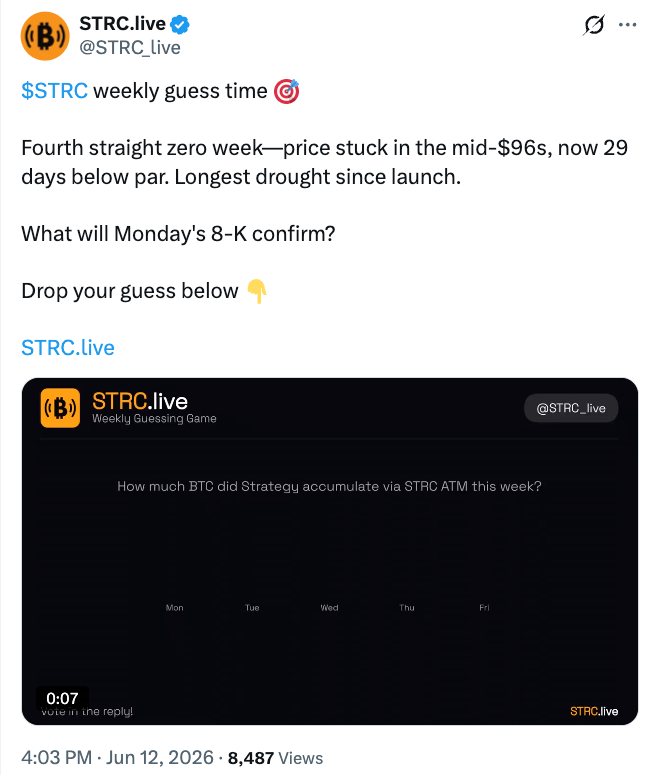
According to STRC.live, a tracker of Strategy’s preferred stock programs, STRC traded below its $100 par value for a fourth consecutive week as of June 12. The stock remained in the mid-$96 range, marking its longest stretch below par since launch.
STRC closed at $94.80 on Friday, down around 1%, according to TradingView data.
Source: STRC.live
Strategy executive chairman Saylor hinted at the latest purchase in a post on X on Sunday, writing, “Still adding dots,” a phrase investors have come to associate with the company’s upcoming Bitcoin acquisitions.

Source: Michael Saylor
The latest buy comes about two weeks after Strategy disclosed the sale of 32 BTC on June 1, its first reported Bitcoin sale in years. While the transaction represented only a tiny fraction of the company’s holdings, the sale ignited debate in the community, with some industry observers questioning whether the company was moving away from its long-standing buy-and-hold approach.
Saylor recently defended the sale, telling Cointelegraph that Bitcoin treasury companies must retain the ability to sell holdings to support dividend-paying securities.
Magazine: Bitcoin, the ‘canary in the coal mine,’ XRP transaction demand falls 91.5%: Market Moves
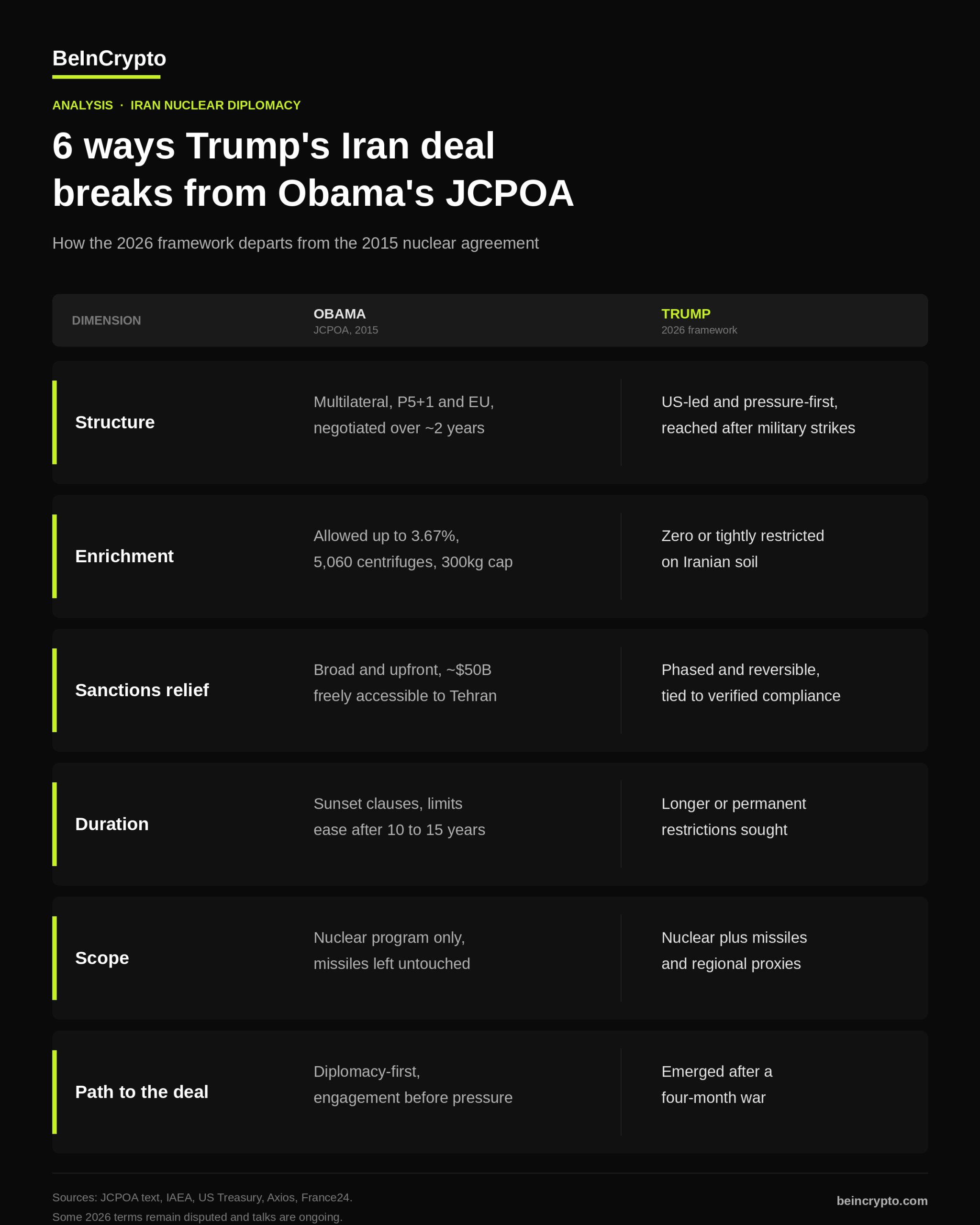
Donald Trump has signed an Iran deal that halts nearly four months of war and reopens the Strait of Hormuz. The framework looks nothing like the nuclear pact Barack Obama struck in 2015.
The agreement extends a ceasefire for 60 days and pushes the nuclear question into later talks. Its design departs sharply from the Joint Comprehensive Plan of Action (JCPOA), which Trump abandoned in 2018.
Two Deals Built on Opposite Logic
Obama’s JCPOA brought together the United States, Britain, France, Germany, Russia, China, and the European Union. Iran accepted verifiable limits on its nuclear program in return for sanctions relief.
The goal then was containment. Negotiators wanted verifiable limits that would hold for a decade or more.
Obama sold the JCPOA as a way to buy time. Trump casts his approach as a path to lasting change.
Trump took the opposite route. He withdrew in 2018, imposed maximum pressure, and reached this deal only after recent strikes on Iran.
That sequence matters. Obama led with diplomacy, while Trump led with leverage built on economic and military force.
Reports describe a 60-day ceasefire, with a framework covering navigation and future nuclear talks.
The two processes also differ in scale. Obama’s pact ran to roughly 159 pages and took about two years to finalize. Trump’s path moved faster, shaped by intermediaries such as Qatar and Pakistan.
Follow us on X to get the latest news as it happens
A formal signing is planned in Geneva, after the memorandum was agreed upon remotely. Trump, Vice President JD Vance, and Iranian parliament speaker Mohammad-Bagher Ghalibaf put their names to it.

Enrichment sits at the center
The JCPOA let Iran enrich uranium at home, capped at 3.67 percent for 15 years. It held Iran to 5,060 operating centrifuges and a 300-kilogram stockpile, under close monitoring by inspectors.
Those caps had a purpose. They stretched Iran’s breakout time from two to three months before the deal toward more than a year.
The limits also carried sunset clauses. Centrifuge caps eased after 10 years and enrichment terms after 15, a feature critics called the deal’s weakest point.
Trump wants the reverse. His team has pushed for zero or tightly restricted enrichment on Iranian soil and longer, firmer limits.
After the 2018 exit, those constraints collapsed. By May 2025, the IAEA reported more than 400 kilograms of uranium enriched to 60 percent, far past deal terms.
That figure left breakout near zero, enough for a bomb within days. Iran also became the only non-weapons state enriching to that level.
The 2015 deal had paired access with a snapback tool. That mechanism could restore United Nations sanctions fast if Iran broke its word.
Iran has treated domestic enrichment as a national right. That stance remains the hardest gap to close in any deal.
For now, the 2026 memorandum leaves the issue of enrichment unresolved. Talks over the coming weeks will decide the fate of Iran’s enriched stockpile.
How Trump’s Iran Deal Reshapes Sanctions Relief
Obama front-loaded the rewards. The deal unfroze Iranian assets and reopened oil exports. The US Treasury estimated that Tehran could freely access about $50 billion, not the $100 billion that critics often cite.
Trump has structured relief as phased and reversible. Iranian outlets reported about $24 billion in frozen funds tied to the 60-day window.
Vance disputed that figure, saying it appears nowhere in the text, and a US official said no money moves until compliance.
The current framework also suspends sanctions on Iranian oil and petrochemical exports. European governments signaled they would lift measures only after Tehran took verifiable action.
The 2015 accord kept penalties on terrorism and human rights untouched. Only nuclear-linked measures eased under its terms.
Critics of the older deal argued that the upfront cash strengthened Iran’s regional allies. Trump has framed his version as cash-light and outcome-driven.
“If I make a deal with Iran, it will be a good and proper one, not like the one made by Obama, which gave Iran massive amounts of CASH, and a clear and open path to a Nuclear Weapon.
Our deal is the exact opposite…” The Hill reported, citing Trump.
Scope, Leverage, and the Road Ahead
The JCPOA stayed narrow. It addressed the nuclear program alone and left missiles and regional proxies untouched.
The 2015 text said little about ballistic missiles or groups like Hezbollah. Trump has demanded that future terms confront that behavior.
Trump has tied his approach to broader aims. The memorandum links progress to reopening the Strait of Hormuz and wider security concerns.
The contrast is clear:
- Obama bet on multilateral compromise, while
- Trump bet on pressure and a stricter, longer-lasting settlement.
Iran and Washington have also floated different readings of the terms.
- Tehran has stressed its enrichment rights, while
- The US officials point to firmer limits ahead.
Supporters of the older pact warn that pressure can backfire. They note Iran’s program advanced fastest after the 2018 exit.
The next 60 days of talks will show if a leverage-first strategy delivers what diplomacy alone could not, especially after Trump’s Kharg Island threat raised the stakes.
The coming weeks will test one core question. Can pressure win deeper concessions than the bargain Obama once accepted?
The post How Trump’s Iran Deal Breaks Sharply From Obama’s 2015 JCPOA appeared first on BeInCrypto.
Crypto exchange Bybit will offer eligible customers access to tokenized bond funds managed by PIMCO and China Merchants Bank International, expanding its push into real-world assets through partnerships with Plume and DigiFT.
Bybit’s new RWA Earn platform launched with two tokenized bond funds: the PIMCO Dynamic Income Opportunities Fund (PDO), which invests across fixed-income assets including corporate debt, mortgage-backed securities and government bonds, and the CMBI Investment Grade Bond Fund, which focuses on investment-grade credit in Asian and global markets.
According to Monday’s announcement, the funds are tokenized through DigiFT, a digital asset exchange regulated in Singapore and Hong Kong, while Plume provides the onchain infrastructure used for subscriptions and fund allocation.
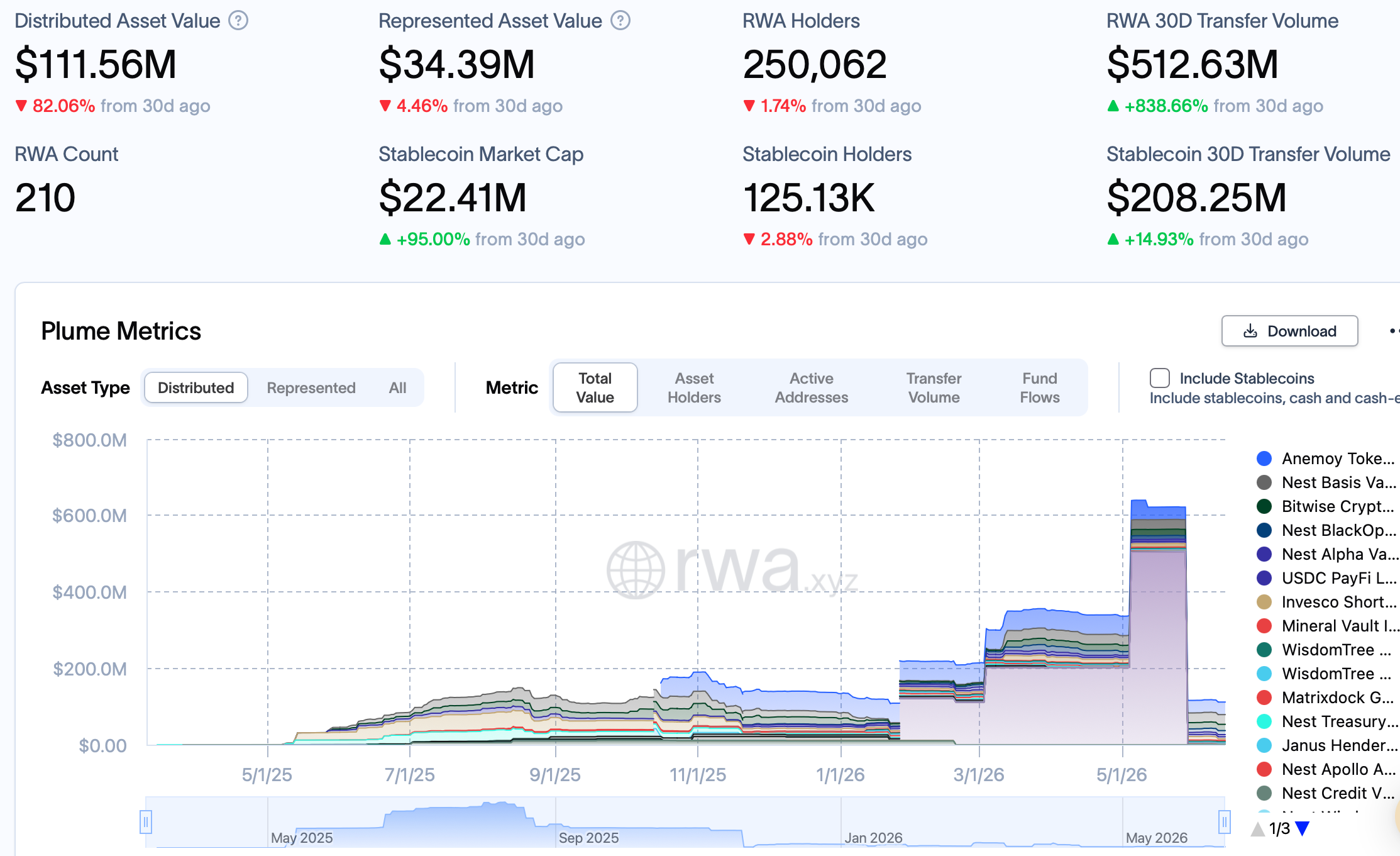
RWA.xyz data shows Plume has more than 250,000 RWA holders and supports over 210 tokenized assets. The network processed more than $512 million in RWA transfer volume during the past 30 days.
Plume Network at a glance. Source: RWA.xyz
Bybit said users can subscribe to the products using USDC (USDC) and will not pay subscription, redemption or onchain transaction fees, though the products are not principal protected and returns are not guaranteed.
Related: Bybit joins Western Union’s new USDPT network as stablecoin expands distribution
Tokenized asset sector grows beyond Treasuries
The launch comes as tokenized real-world assets continue to gain traction across both traditional and crypto finance. According to RWA.xyz data, the tokenized asset market was valued at $31.8 billion as of June 12, led by tokenized US Treasury products with around $14.9 billion in assets.
Commodities accounted for roughly $4.7 billion of tokenized assets, followed by asset-backed credit at $2.2 billion and tokenized stocks at approximately $1.5 billion.
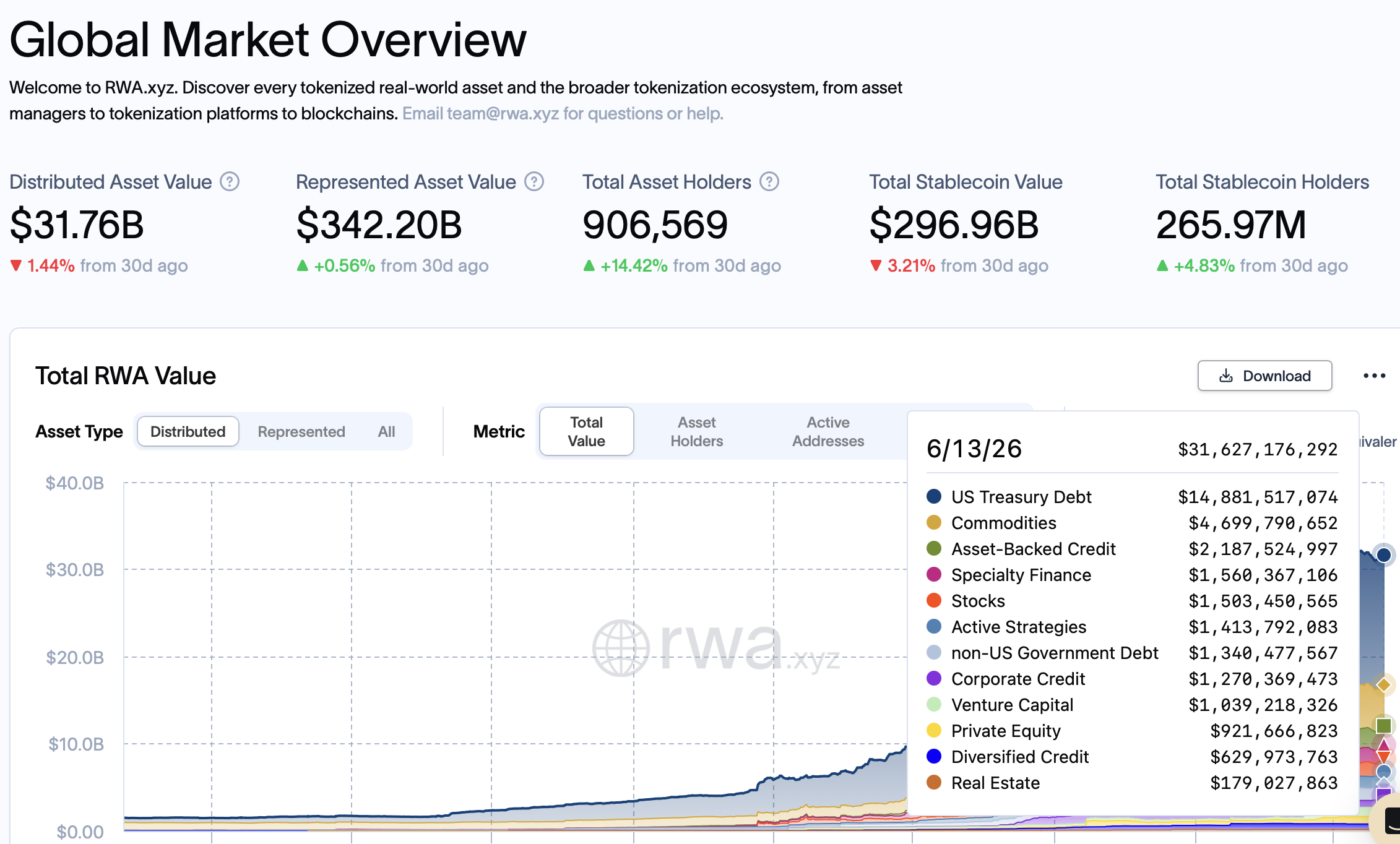
The tokenized asset market is valued at $31.8 billion. Source: RWA.xyz
Crypto companies have increasingly expanded the use of tokenized real-world assets beyond simple buy-and-hold investment products. In April, OKX integrated BlackRock’s BUIDL tokenized Treasury fund into its collateral framework, allowing eligible institutional clients to use the yield-bearing asset as trading margin.
Last week, Archax launched a system on Hedera that enables real-time interest payments for tokenized securities, allowing cash flows to follow assets as they change hands onchain.
The trend has also attracted major Wall Street firms. In May, JPMorgan filed to launch a tokenized money market fund on Ethereum (ETH).
Magazine: Bitcoin copying 2022 ‘almost perfectly,’ Ether to $4K in 2026: Market Moves
Non-fungible token (NFT) project Pudgy Penguins is winding down its mobile game Pudgy Party and halting further development.
In an X post, the team said on Saturday that it would shift its gaming resources toward Pudgy World, a browser-based experience which it described as the flagship gaming product for the Pudgy Penguins ecosystem.
“We’ve made the difficult decision to wind down Pudgy Party and halt further development,” the team wrote, adding that Pudgy World offered greater potential for scalability and introducing new users to the Pudgy Penguins brand.
The mobile game launched in August 2025 and surpassed 500,000 downloads on Google Play alone. Pudgy Party said total downloads have exceeded 1 million.
Pudgy Penguins is consolidating its gaming ambitions around a single flagship product as the project expands beyond NFTs through initiatives spanning toys, gaming, licensing and entertainment.
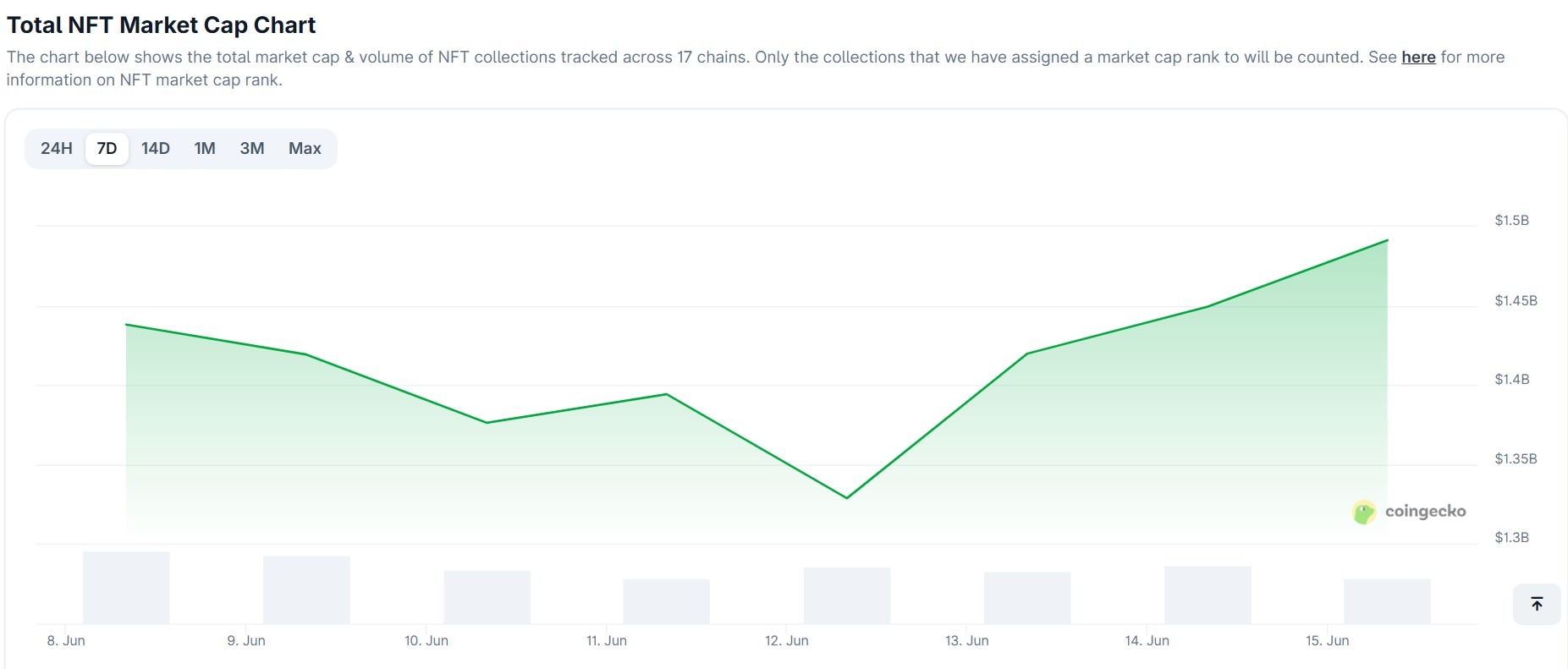
Total NFT market capitalization climbed to nearly $1.5 billion on Monday from more than $1.3 billion on Friday, according to CoinGecko, but remains far below its 2022 peak of over $17 billion.
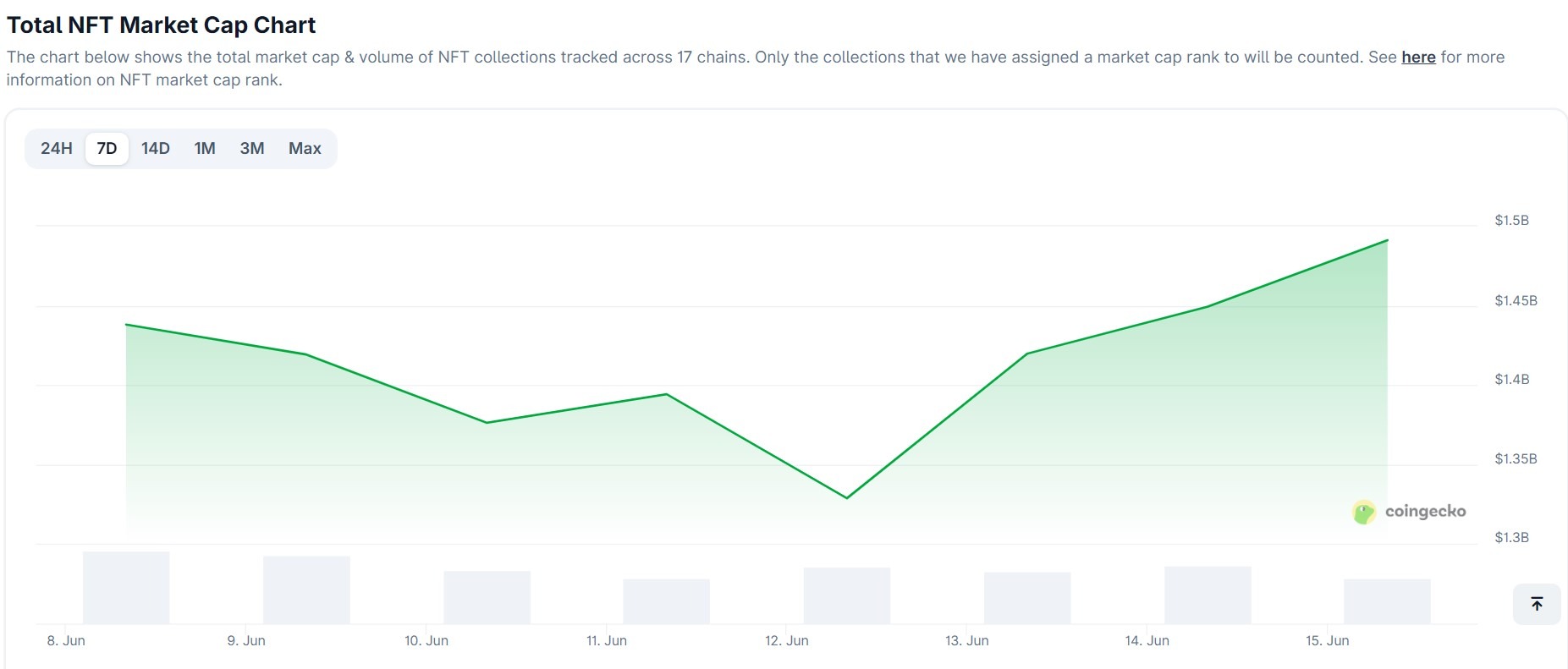
7-day NFT market capitalization data. Source: CoinGecko
Crypto games struggle to find sustainable business models
Pudgy Party’s wind-down comes as another Web3 gaming project, Fishing Frenzy, and its developer, Uncharted, announced they would cease operations after failing to establish a viable crypto-gaming model.
“Despite our best efforts, we were ultimately unable to prove our thesis on crypto gaming and could not find product-market-business fit,” Fishing Frenzy said in an X post on Monday.
The team said the company had spent the last year testing approaches and different audiences, but had not found a path that inspired the confidence to continue.
Related: Binance to end NFT support on exchange, shift service to wallet
Fishing Frenzy will shut down its servers on June 25 at 2:00 am UTC. The project has stopped selling USDC packages and made its FISH token spend-only and untradable.
The team said that the USDC remaining in the FISH/USDC liquidity pool would be redistributed to community members and stakers.
Magazine: Does ‘Paper Bitcoin’ mean there’s an unlimited supply of BTC?
Crypto World
Strategy Sold Shares and Bought $100 Million Bitcoin: This Is It? Bottom Was 2 Weeks Away?

Strategy just filed confirmation of a $100 million Bitcoin buy executed at an average of $63,024, which is unexpectedly before it jumped, this hour, to $66,000. Good buy timing this time.
Strategy sold 1,732,553 shares of MSTR between June 8 and 14, 2026, generating $209.0 million in net proceeds through its ATM program. Half of that went into 1,587 BTC at an average of $63,024, the other half padded a USD reserve that now sits at $1.1 billion, earmarked for preferred stock dividends and debt servicing.
With $25.7 billion still available under the MSTR ATM and another $25.2 billion across STRF, STRC, STRK, and STRD preferred offerings, Strategy’s buying capacity is nowhere near exhausted.
The macro backdrop is tilting supportive too, a U.S.–Iran interim peace deal sent the S&P surging and Nasdaq up over 2%, risk assets catching a bid as geopolitical premium unwinds from oil and flows toward equities and crypto.
To make this more interesting, Strive also bought 74 Bitcoin, which was retweeted by Michael Saylor, after they talked about Strategy 32BTC sell last week.
Discover: The Best Crypto to Diversify Your Portfolio
Can Bitcoin Finally Run Now?
The range is well-defined. Our classical pivot analysis puts immediate support at $63,700, with the strongest floor at $62,600. Resistance overhead sits at $68,000 and $72,000, the level that needs a clean break to run the short-term structure more bullish.
Momentum indicators have heated up from prior oversold readings, which is neutral at best. We likely see a continuing chop between $64,000 and $68,000 until on-chain catalyst forces a resolution. The bull case, a push toward $71.5k–$73k, requires $68,000 to break with conviction and sustained volume follow-through.

The bear case, which several Elliott Wave analysts are still running as their primary count, targets $56k–$52k if $60,000 gives way, with $45k cited as an extended downside scenario on higher timeframes.
Strategy’s $63,024 average cost on this tranche is almost exactly at the current pivot. If this level holds, they look sharp. If it doesn’t, macro threats including BOJ rate policy and global liquidity shifts could accelerate the flush.
Discover: The Best Token Presales
Bitcoin Hyper Targets Early Infrastructure Upside Before Companies Like Strategy Catch Bid
Traders watching Bitcoin grind through a range are starting to look at where asymmetric upside actually lives right now. At current levels, BTC needs a 10%+ move just to clear $73k resistance, it’s a meaningful ask in a risk-off macro environment.
Early-stage infrastructure plays on Bitcoin’s own ecosystem are attracting attention precisely because the upside math is different.
Bitcoin Hyper is positioning itself as the first Bitcoin Layer 2 with Solana Virtual Machine (SVM) integration. It is also faster execution than Solana itself, delivered on top of Bitcoin’s security model. It’s an ambitious project with sub-second finality, low-cost smart contract execution, and a decentralized canonical bridge for BTC transfers, all without abandoning the base layer’s trust guarantees.
The presale has raised $32 million at a current token price of just $0.0136, with staking already live. Those are real numbers with real participants.
Find Bitcoin Hyper here, and be ready for the next disruptive crypto product.
The post Strategy Sold Shares and Bought $100 Million Bitcoin: This Is It? Bottom Was 2 Weeks Away? appeared first on Cryptonews.
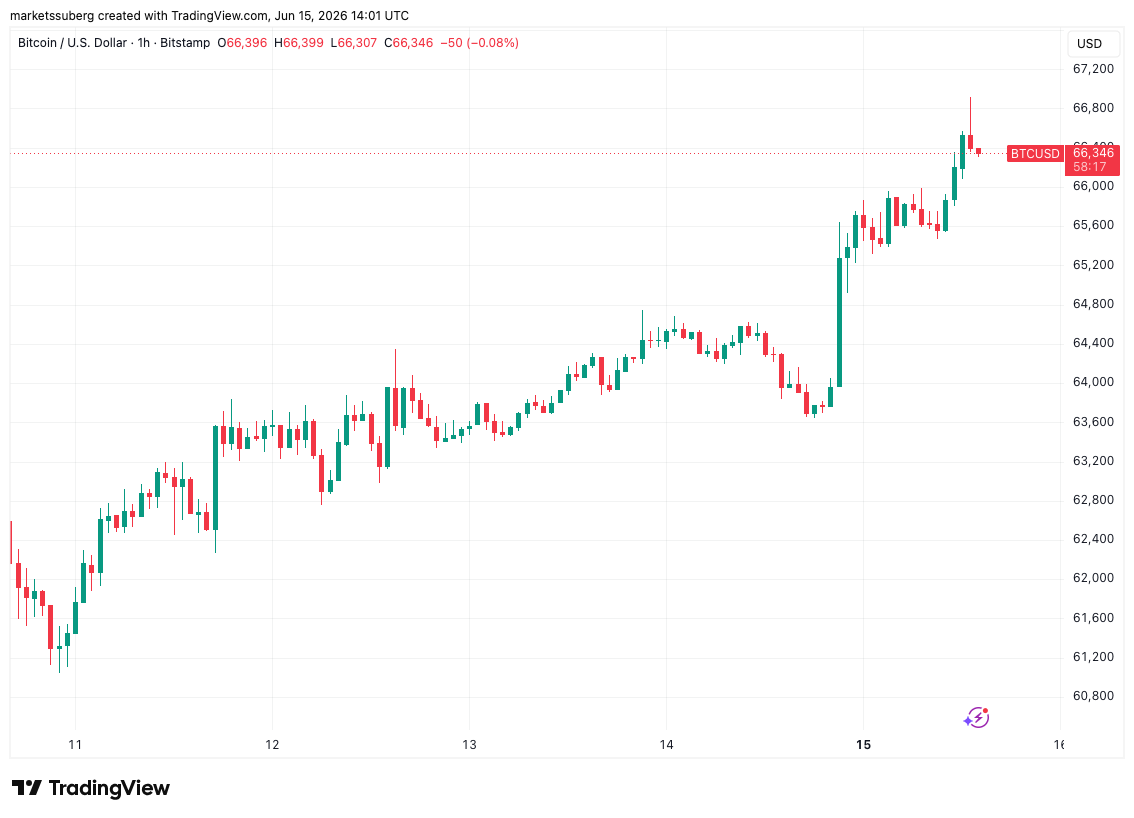
Bitcoin (BTC) neared $67,000 at Monday’s Wall Street open as the US-Iran peace deal kept risk assets surging.
Key points:
- Bitcoin adds to gains as US-Iran peace cues trigger broader risk-asset upside.
- Traders do not see downside pressure as over yet, with liquidity grabs the focus on low-time frame price action.
- Flagging demand shows signs of recovery after $60,000 holds.
BTC price eyes key liquidity “pocket” next
Data from TradingView tracked BTC price action as BTC/USD added another 1.5% since the weekly close.
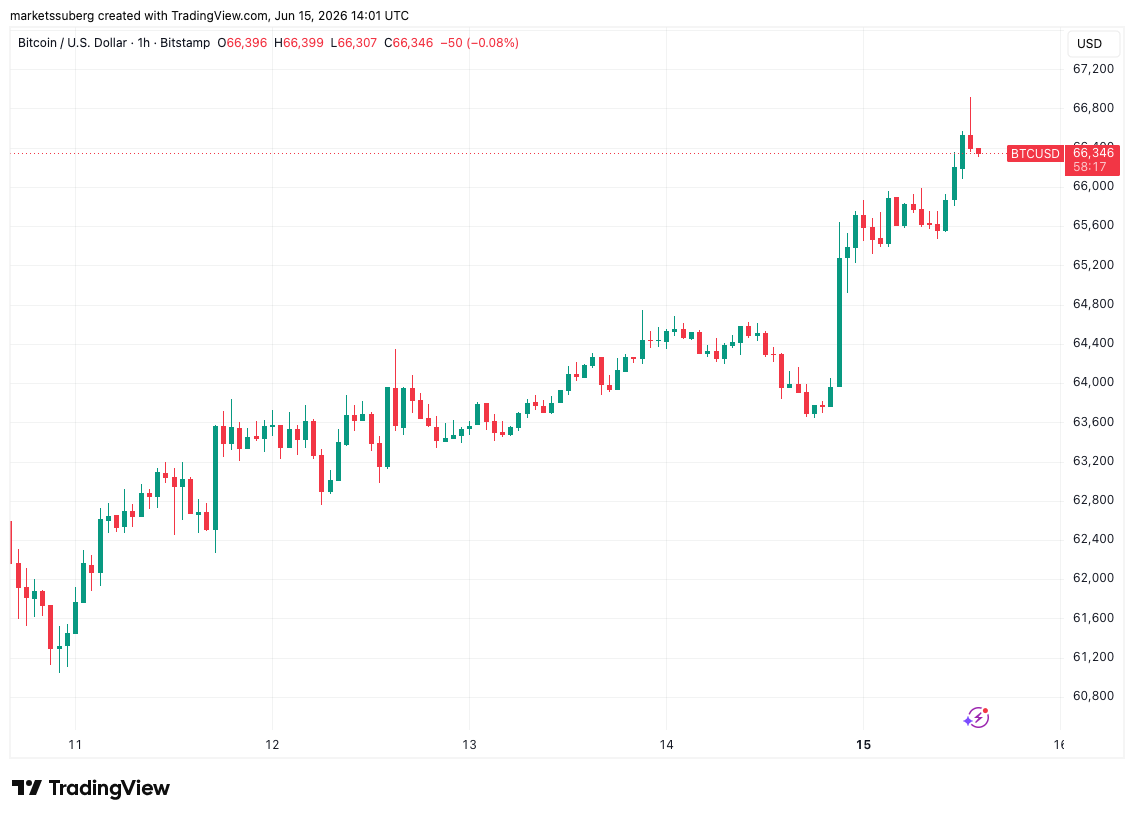
BTC/USD one-hour chart. Source: Cointelegraph/TradingView
Details of the Iran ceasefire agreement, set to be signed later in the week, delivered major upside to US stocks, with the S&P 500 and Nasdaq Composite Index adding up to 2.4%.
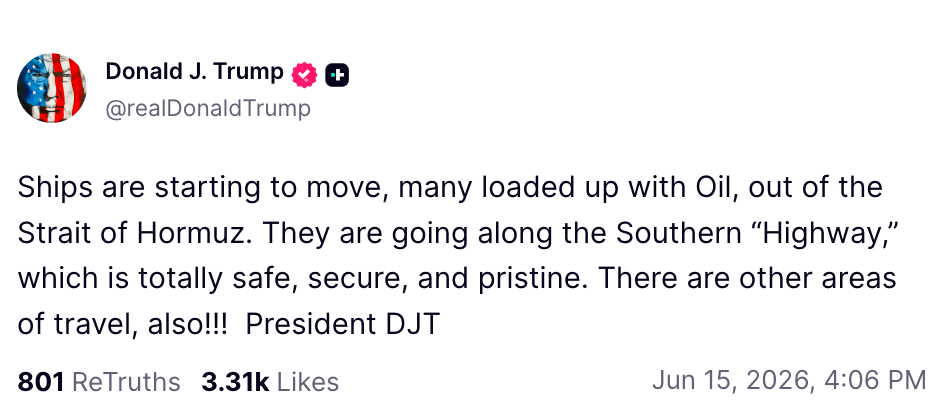
In one of his latest posts on Truth Social, US president Donald Trump reported that shipping traffic through the Strait of Hormuz oil route was already increasing.
“Ships are starting to move, many loaded up with Oil, out of the Strait of Hormuz,” he wrote.
Source: Truth Social
Among traders, opinions still differed over whether Bitcoin would continue higher or abort its latest relief bounce.
“This week is shaping up to be very interesting,” trader Killa told X followers, eyeing a rejection above $67,000.
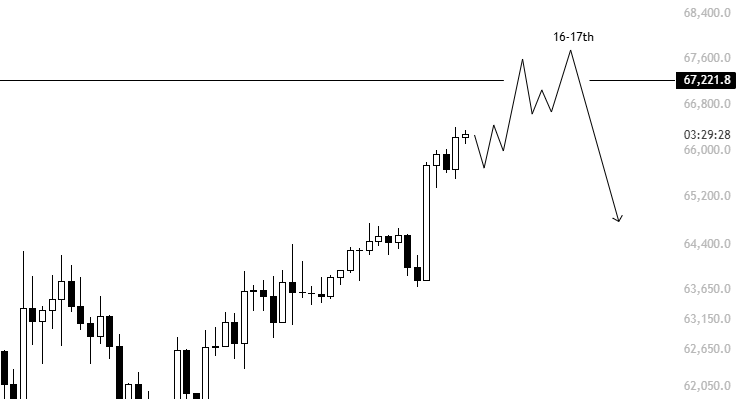
BTC/USD four-hour chart. Source: Killa/X
Trading account JDK analysis argued that it was “still too early to call” a reliable BTC price bottom.
“Now we’re also seeing a break of major resistance and acceptance back into previous value, opening the door for a larger move to the upside,” it wrote on the day.
“That said, strong bottoms take time. I still expect more chop, and there is still a major pocket of untapped liquidity below that shouldn’t be ignored.”
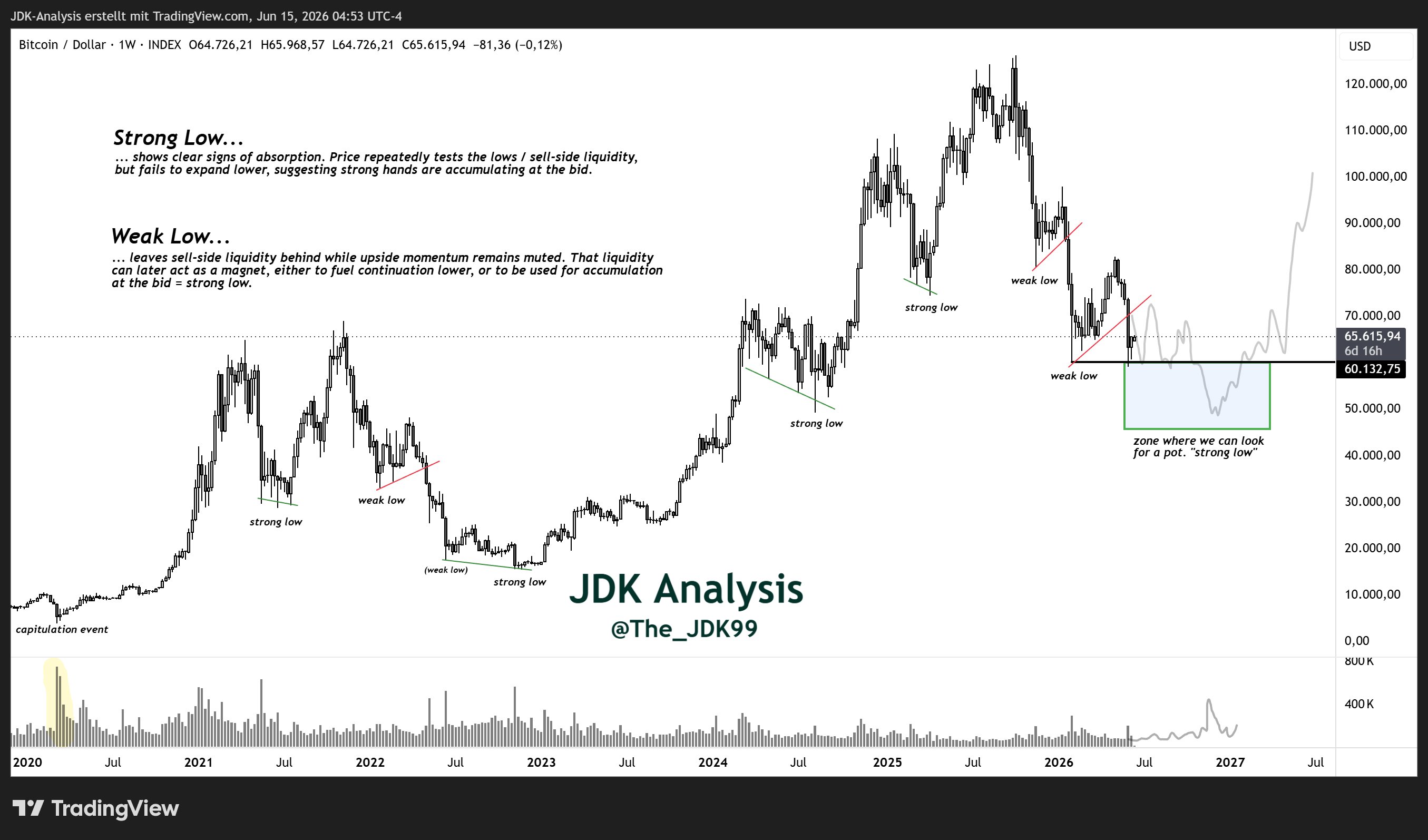
BTC/USDT one-week chart. Source: JDK Analysis/X
Bitcoin order-book liquidity remains thin
Commentator Exitpump continued that it was “easy” to push the price higher thanks to thin order-book liquidity both above and below.
Related: Can BTC rebound to $69K as oil price plunges? Five things to know in Bitcoin this week
The latest data from CoinGlass showed BTC/USD sweeping short liquidations around the US open.
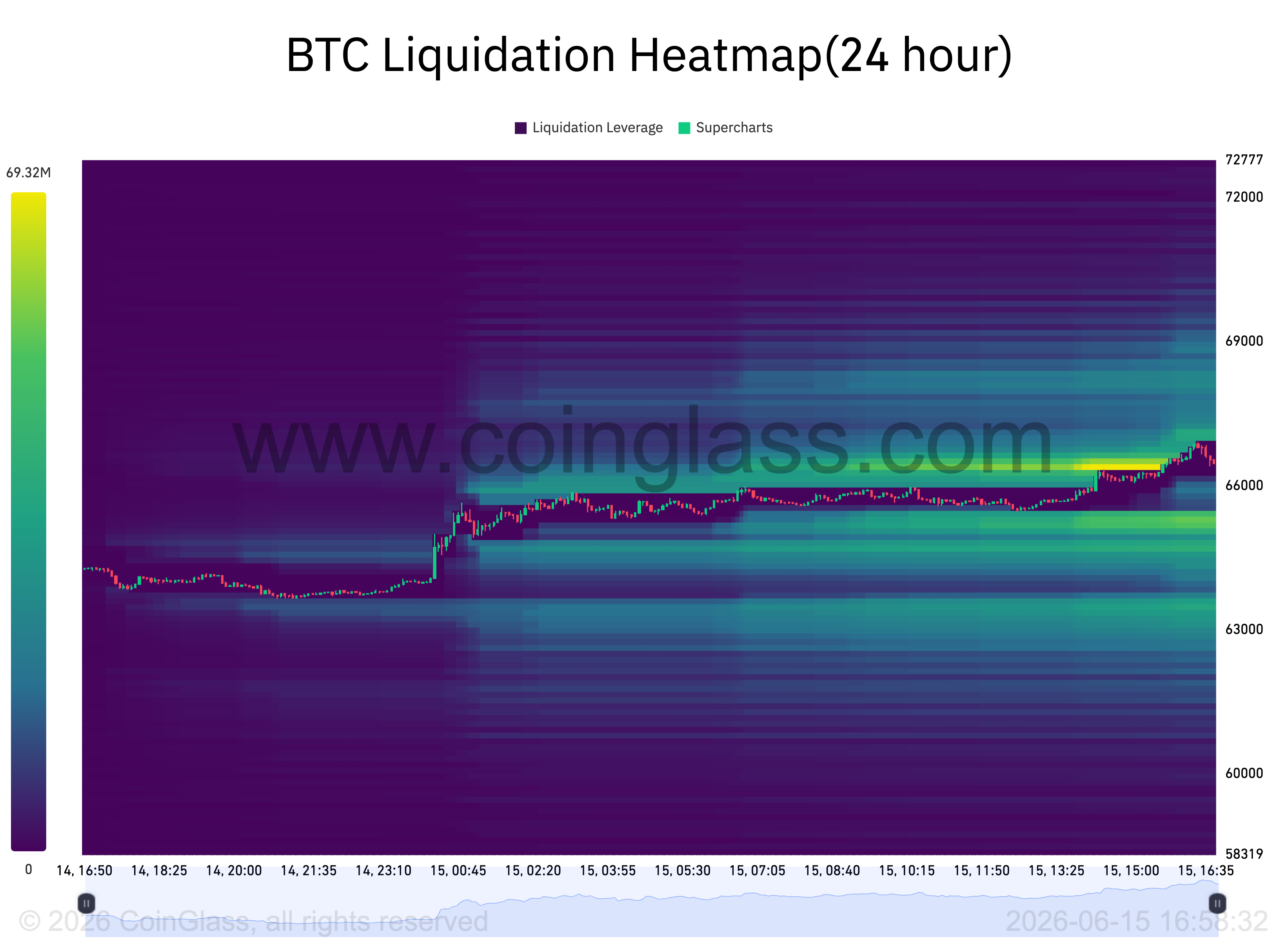
BTC liquidation heatmap. Source: CoinGlass
Commenting on liquidity, onchain analytics platform Glassnode flagged “supportive” conditions on options markets.
“$BTC has bounced and is now pushing back into a dense cluster of options positioning near $65K. As price moves into these zones, dealer hedging flows can become more supportive, helping stabilize the market after a period of elevated volatility,” it wrote on X.
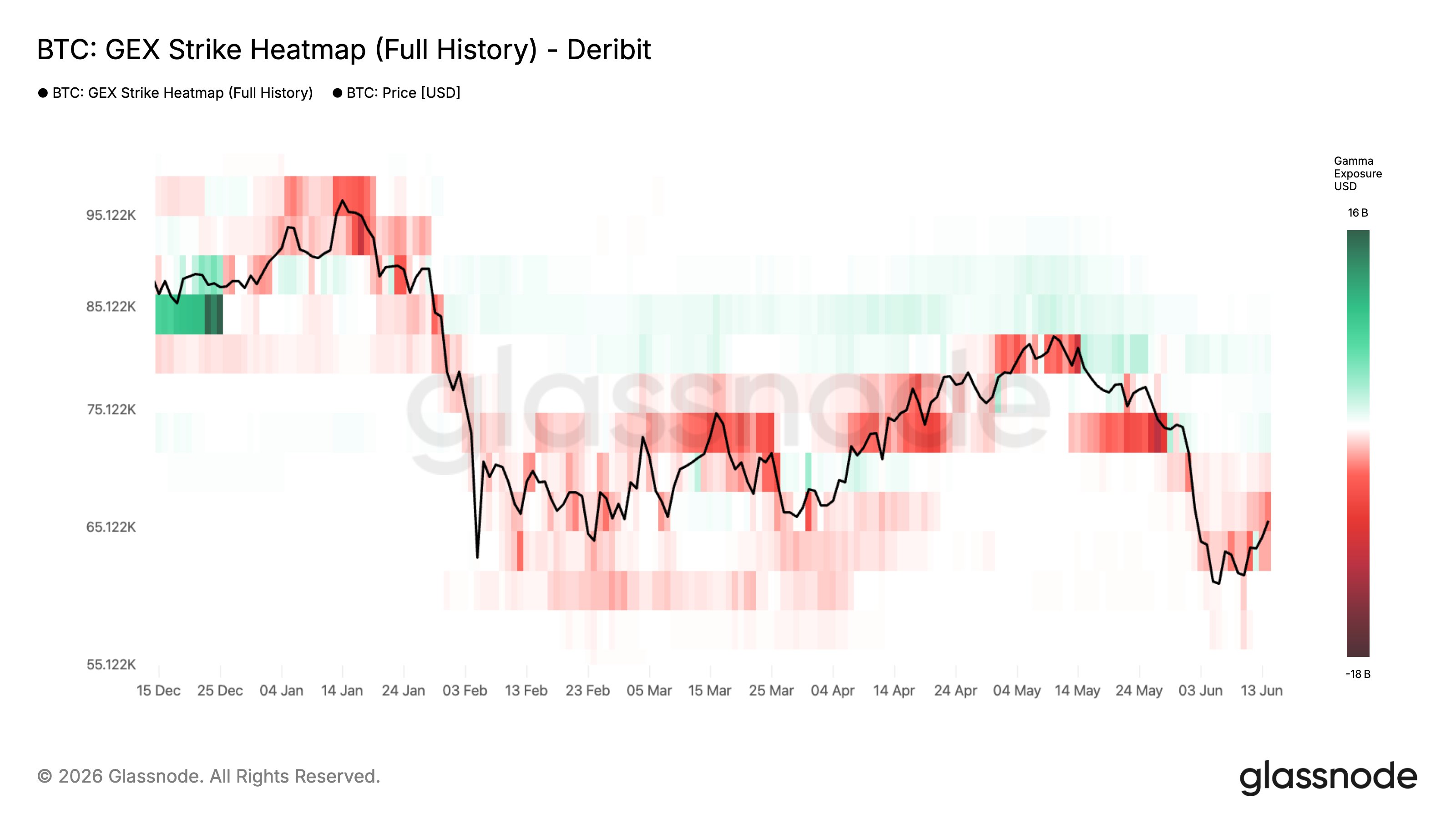
Bitcoin options strike heatmap. Source: Glassnode/X
A separate post noted that overall demand appeared to be returning after Bitcoin’s trip to $60,000.
“Accumulation Trend Scores have turned higher across multiple wallet cohorts, suggesting supply is being absorbed as investors step in following the move to down $60K,” Glassnode added.
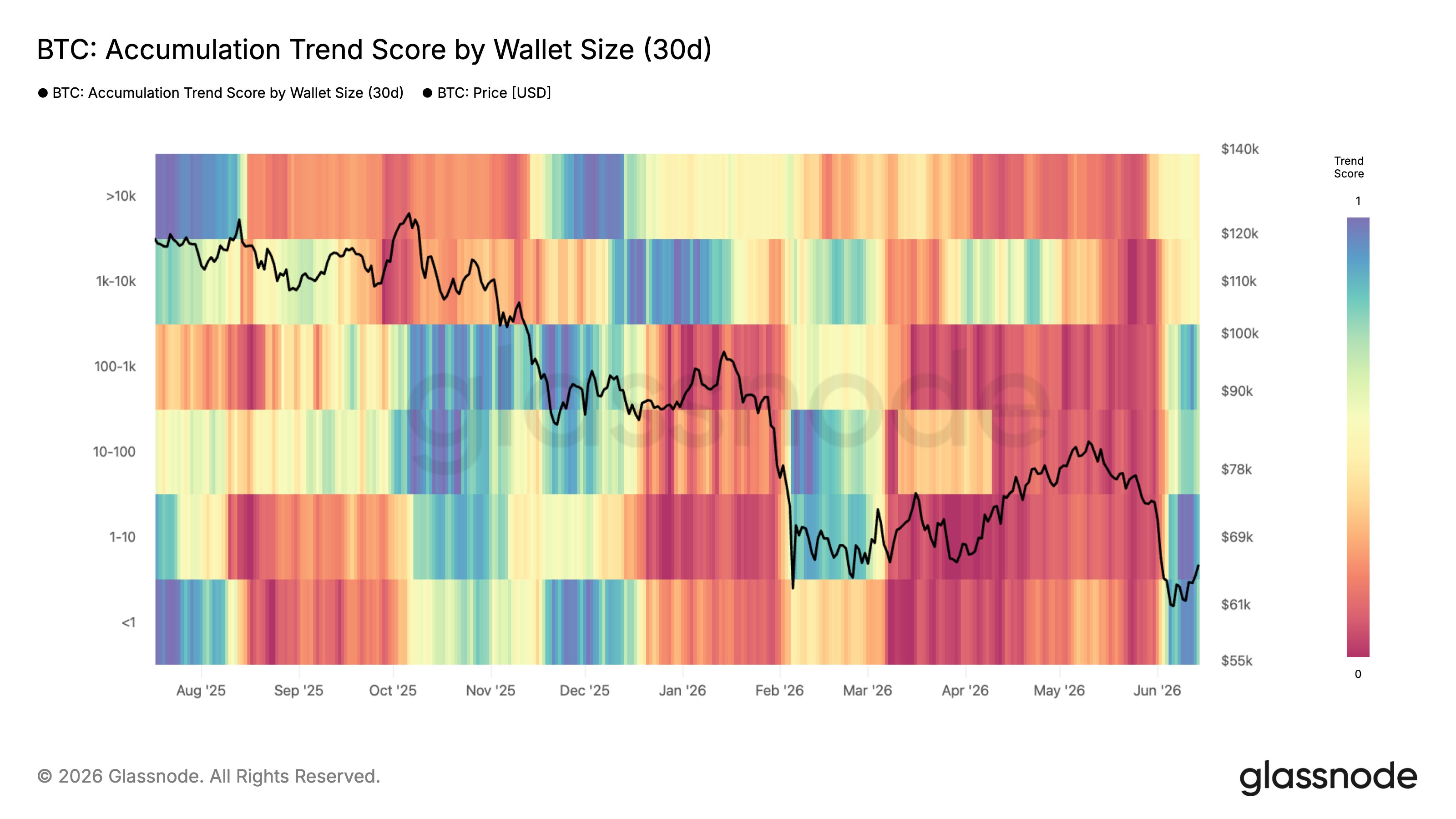
Bitcoin accumulation trend score data. Source: Glassnode/X

The Solana Institute has urged U.S. senators to preserve key provisions of the CLARITY Act as industry participants increasingly look toward an August timeline for advancing the legislation through Congress.
Summary
- Solana Institute urged senators to keep BRCA protections intact as the CLARITY Act moves closer to Senate consideration.
- Kristin Smith said non-custodial developers, validators, and node operators should not be classified as money transmitters.
- Growing procedural hurdles have pushed expectations for CLARITY Act passage from July 4 toward the August congressional recess.
According to Solana Institute President Kristin Smith, the Blockchain Regulatory Certainty Act provisions included in the CLARITY Act should remain unchanged as lawmakers prepare to consider the bill in the Senate.
In comments posted on X, Smith said the CLARITY Act could soon reach the Senate floor, while arguing that protections for non-custodial blockchain participants are essential to the legislation.
Smith said the BRCA would establish that blockchain developers, node operators, and validators who do not take custody of customer funds should not be treated as money transmitters under U.S. law.
She argued that the language creates a clear distinction between software and infrastructure providers and firms that directly control user assets.
Describing the measure as consistent with guidance issued by the Treasury Department’s Financial Crimes Enforcement Network last year, Smith said the provision provides legal certainty for open-source software developers and network operators.
She added that major founders, executives, and investors from across the crypto sector had jointly asked Senate leaders not to dilute those protections.
Lawmakers continue debating key provisions
While industry groups push to keep the language intact, several outstanding issues remain under discussion in Washington. Smith noted that BRCA provisions were recently reviewed during a White House meeting involving law enforcement officials, where participants discussed possible changes. Ongoing negotiations over ethics-related language have also remained unresolved.
Those debates come as lawmakers, regulators, investors, and industry representatives prepare to meet in Chicago for discussions focused on digital asset regulation and market structure legislation.
Among the participants expected to contribute to those conversations is Representative Dusty Johnson, who helped advance an earlier version of the legislation through the House Agriculture Committee in a bipartisan 47-6 vote last year.
Crypto journalist Eleanor Terrett said she is particularly interested in hearing how members of the House Agriculture Committee view the Senate’s version of the CLARITY Act.
As chairman of the House Agriculture Committee’s Subcommittee on Commodity Markets, Digital Assets and Rural Development, Johnson is expected to offer insight into how House lawmakers may respond to revisions currently being considered in the Senate.
August timeline gains support
Recent reporting has suggested that congressional timing may be becoming a larger obstacle than policy disagreements.
As crypto.news previously reported, lawmakers, industry organizations, and market observers have increasingly shifted their expectations away from a July 4 signing target and toward the August congressional recess.
According to reporting from Crypto In America cited by Terrett, the Senate must still combine separate versions approved by the Banking and Agriculture Committees, secure 60 votes to advance debate, navigate additional cloture votes on amendments, and pass the final legislation before any revised measure can return to the House.
Terrett wrote on Monday that even if remaining policy disputes were resolved immediately, the legislative calendar leaves little room for a July 4 signing.
The CLARITY Act would establish jurisdictional boundaries for digital assets, placing decentralized cryptocurrencies such as Bitcoin and Ethereum under the oversight of the Commodity Futures Trading Commission while leaving qualifying securities under securities regulators.
The bill also contains provisions covering stablecoins, anti-money laundering requirements, decentralized finance activities, and blockchain validators.
Pointing to competitiveness concerns, Smith said the U.S. share of open-source crypto developers has fallen from 38% in 2015 to about 19% today.
She argued that maintaining regulatory certainty could influence where future blockchain development takes place, warning that jurisdictions such as Singapore and Abu Dhabi are competing to attract the industry’s next generation of builders.
Crypto World
Arthur Hayes Buys 3,000 ETH Through OTC Deal as On-Chain Data Reveals $5.4M Accumulation

TLDR:
- Arthur Hayes received 3,000 ETH worth about $5.42 million through a Flowdesk OTC transaction.
- On-chain records linked the transfer to a wallet previously associated with the BitMEX co-founder.
- The OTC structure reduced order book impact and avoided visible exchange-based buying pressure.
- Ethereum’s recent price strength has increased attention on large wallet accumulation activity.
Arthur Hayes has added 3,000 ETH to a wallet linked to him, according to newly surfaced on-chain data. The transaction carried an estimated value of $5.42 million at the time of transfer.
Data shows the Ethereum was routed through Flowdesk’s over-the-counter trading desk rather than a public exchange. The move arrives as ETH records a strong daily gain and renewed activity across crypto trading markets.
Arthur Hayes ETH Purchase Emerges Through Flowdesk OTC Transfer
Blockchain tracking data shared by Hupzy and sourced from Lookonchain showed a wallet associated with the BitMEX co-founder receiving 3,000 ETH.
The transfer occurred roughly one hour before the transaction was highlighted on social media. On-chain records indicate the assets were delivered through Flowdesk’s OTC infrastructure.
Unlike exchange-based purchases, OTC transactions allow large buyers to acquire assets without placing sizable orders on public order books.
That approach can help reduce market impact during execution. It also limits visible buying pressure that often accompanies large spot purchases.
The wallet identified in the transaction has been linked to Hayes through previous blockchain activity. The transfer therefore attracted attention across crypto trading communities.
According to the data shared by Hupzy, the transaction was valued at approximately $5.42 million based on prevailing Ethereum prices.
The purchase follows a period of heightened volatility for ETH, which posted a double-digit gain over the previous 24 hours.
Hayes has previously made large directional Ethereum bets, making his wallet activity closely watched by market participants.
Ethereum Trading Activity Picks Up as ETH Gains Momentum
The OTC route used for the transaction stood out because it avoided immediate interaction with exchange liquidity.
Market participants often use OTC desks when executing large orders that could otherwise create price slippage.
Hupzy noted that the Flowdesk transaction structure reduced the likelihood of moving the market during execution.
Because the trade occurred away from public order books, no additional spot selling pressure emerged from the transaction itself.
Ethereum continued trading above recent consolidation levels following the transfer. Recent market action placed attention on the $2,450 to $2,500 range identified in the shared market commentary.
While the transaction represents a notable purchase, the data reflects activity from a single wallet rather than a broader market trend.
Lookonchain’s tracking data and Arkham-linked wallet records remain the primary sources confirming the transfer.
The development adds another closely watched Ethereum transaction to a market already seeing increased trading activity and renewed attention toward large on-chain movements.

Crypto World
Dogecoin Price Prediction Recovers as Iran Peace Deal Lifts Meme Coins and Pepeto Builds Fresh Momentum Toward Binance
The Dogecoin price prediction caught a shift on June 15 after President Trump declared the US-Iran peace deal “complete” on June 14, sending a risk-on signal across every asset class and lifting DOGE alongside the broader recovery, per BeInCrypto. Bitcoin surged past $65,000 and the meme sector bounced with it.
Social media speculation around Elon Musk and Pepeto has picked up as SpaceX surged 19% on its Nasdaq debut. The presale crossed $10.2 million at $0.0000001876, the exchange runs live, and the Binance listing approaches while the Dogecoin price prediction stays bearish per CoinCodex. When one meme token loses its engine, the energy finds a new home.
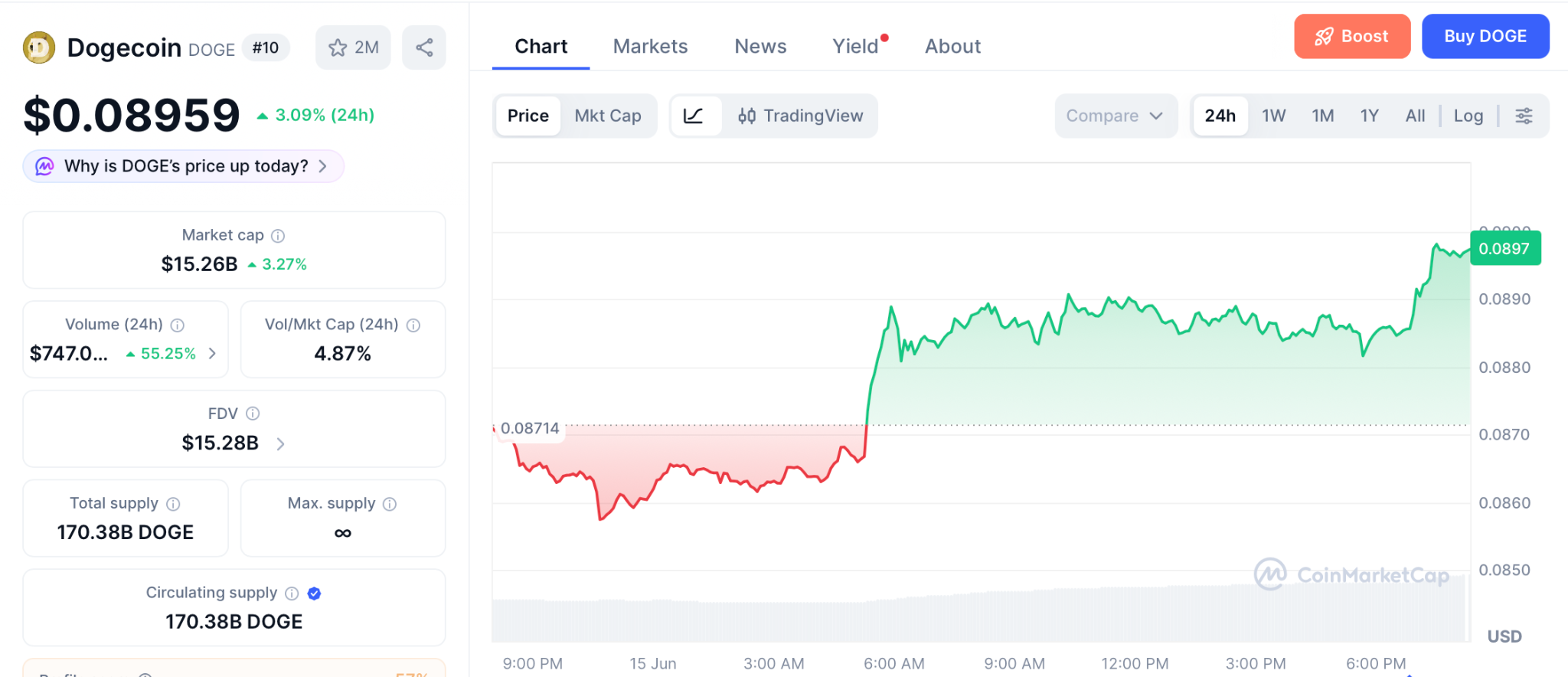
Dogecoin (DOGE) trades at $0.089 per CoinGecko on June 15, up 3.09% as the Iran peace deal lifted risk sentiment. DOGE remains 88% below its all-time high of $0.7376.
The Dogecoin price prediction from Changelly puts the 2026 range at $0.0899 to $0.115, and CoinCodex flags 18 of 30 indicators bearish. DOGE needs a new narrative.
Dogecoin Price Prediction Compared to the Presale Opportunity Pepeto
Why Pepeto Stands Where Dogecoin Stood Before 2021 While Musk Rumors Build
The meme sector spent years loaded with tokens that had nothing behind the ticker. No swap, no bridge, no contract checks. Just noise. The exchange built by the Pepe builder sits on a different level than any other meme coin trading right now, and social media speculation linking Elon Musk to the project keeps building across X and Telegram as SpaceX posts a 19% first-day gain on Nasdaq.
Wallet-draining attacks, trap contracts, and supply dumps that flood the sector all get blocked by Pepeto’s scanning tools. Every order routed through PepetoSwap clears with no deduction taken. Dangerous contracts and malicious wallets get flagged by the scanner before the trade goes through. Assets move between Ethereum, BNB Chain, and Solana through a bridge that charges zero fees.
The presale cleared $10.2 million while fear still gripped the market, priced at $0.0000001876 as the round presses toward its Binance debut. Every audit line passed under SolidProof. The listing path is guided by a veteran who ran token launches at Binance. Staking rewards compound at 170% APY while the exchange build-out keeps rolling.
Early Dogecoin buyers from 2020 turned small amounts into life-changing sums, and none of those holders believes they bought enough. Pepeto is assembling in that exact window right now, and the wallets positioned before the Binance debut become the stories quoted for years after, while latecomers end up paying the listing price to buy from holders who got in early.
Dogecoin (DOGE) Price at $0.089 as Peace Rally Lifts Meme Coins From Multi-Month Lows
Dogecoin (DOGE) trades at $0.089 on June 15 per CoinMarketCap, up 3.09% on the Iran peace signal, with support at $0.08 and resistance at $0.10. The all-time high of $0.7376 stands 719% above, but that needs a full parabolic cycle.
DOGE at $13 billion is a known name delivering slow returns. Pepeto at $10.2 million before a Binance listing carries multiples a $13 billion token cannot match.
Conclusion
Bitcoin sits at $65,695 and the Iran peace deal just flipped risk sentiment positive while the meme sector searches for its next catalyst, because the pattern repeats across every cycle and wealth always lands in the wallets that commit before the crowd catches on. Early DOGE buyers from 2020 turned small positions into life-changing gains because they moved while the market still looked weak.
Pepeto holders compound 170% APY every hour that passes while the Pepe builder steers the project and the Binance listing window tightens with every stage that sells out. Two kinds of wallets walk out of this window, the Pepeto holders who kept adding to their position every day and the empty wallets that remain empty once the listing pushes the entry permanently beyond reach.
The 2020 DOGE holder who put $100 into a meme coin was sitting on roughly $29,000 at the May 2021 peak, and Pepeto at $0.0000001876 before a Binance listing is that same entry returning one more time, only earlier in the cycle and with working tools already shipping. Every hour the presale stays open is one hour closer to a listing that closes this price forever, and the people who wait past this window will see the next Pepeto update on a chart at a price that makes today’s entry look like the opportunity of a lifetime that walked right past them.
Click To Visit Pepeto Website To Enter The Presale

FAQs
What is the Dogecoin price prediction after the Iran peace deal boosted crypto markets on June 15 2026?
The Dogecoin price prediction from Changelly places the 2026 range at $0.0899 to $0.115, with CoinCodex showing 18 of 30 indicators bearish despite the peace rally. DOGE trades at $0.089 on June 15, up 3.09%, with $0.7376 sitting 719% above.
How does Pepeto compare to Dogecoin as an entry in 2026?
Pepeto is the stronger entry because $10.2 million flowed into the presale at $0.0000001876 with a live zero-fee exchange and a Binance listing approaching, while Dogecoin at $13 billion market cap needs a full narrative reset to deliver comparable returns.
Disclaimer: This is a Press Release provided by a third party who is responsible for the content. Please conduct your own research before taking any action based on the content.

Dual personality makes Nissan’s Ariya Nismo a great car to live with

AMD: Agentic AI Makes EPYC The Winner Of The AI Infrastructure Cycle

Santiment says Iran deal sparks crypto’s next bull cycle


-

 Business1 day ago
No Jackpot Winner as $257 Million Prize Rolls Over to $269 Million Monday Draw
-

 Crypto World4 days ago
Oppenheimer backs SpaceX as $70 billion retail frenzy builds
-

 Crypto World4 days ago
Markets Rally as SpaceX IPO Looms Amid Iran Tensions and Inflation Surge
-

 Fashion3 days ago
Weekend Open Thread: Tuckernuck – Corporette.com
-
Crypto World23 hours ago
Zimbabwe Requires Crypto Businesses to Register Annually Under New FIU Regulations
-

 Entertainment6 days ago
The Ryan Gosling True Crime Thriller On Netflix That Gets Even Stranger, Stream It Now
-
 Sports6 days ago
Bangladesh beat Australia after 20 years in ODIs, register only their second win over six-time world champions | Cricket News
-

 Tech3 days ago
NanoClaw integrates JFrog registries to secure AI agent downloads
-

 Crypto World3 days ago
Bitget enters Argentina’s regulated crypto market through PSAV registration
-

 Tech3 days ago
This Week In Security: Microsoft On Microsoft, Register Your Domains, Linux On ARM, And FreeBSD Joins The File Cache Club
-
 Tech4 days ago
Dutton Ranch star claims they ‘didn’t see any disruption’ on set following Chad Feehan’s exit from Yellowstone spinoff fueled by Taylor Sheridan clash rumors
-

 Politics4 days ago
Politics Home | Healey Resignation Is “Colossal Failure Of Government”, Says Former Labour Defence Secretary
-

 NewsBeat4 days ago
El Nino has formed in the Pacific and could set records, forecasters say
-

 Tech6 days ago
‘This is Seattle’s position on AI’: City Council votes unanimously to pause big new data centers
-
 Entertainment4 days ago
Donnie Wahlberg & More Heat Up Las Vegas at Circa’s Barry’s Downtown Prime
-

 Sports4 days ago
First Time Since 1971: Australia Register Historic Low In ODI Cricket
-
 Tech4 days ago
Opendoor Ends India Operations, Fueling a Bigger Conversation About AI and Outsourcing
-

 Politics4 days ago
Belfast burns, while Met chief points finger at Iran and Russia
-

 Business6 days ago
Thailand Ranks Second Worldwide for AI Adoption Growth, Microsoft Reports
-

 NewsBeat3 days ago
FBI searches office of Ohio voter registration group
You must be logged in to post a comment Login