

Crypto World
Grayscale Cites Anthropic Shutdown as Proof for Decentralized AI


Anthropic’s move to suspend access to its latest frontier AI models—after a U.S. directive tied to national security—has reignited debate over how concentrated control over advanced AI can translate into sudden access restrictions for users worldwide. Grayscale says the episode underscores the “centralized control” risks of frontier AI and may bolster demand for decentralized alternatives such as Bittensor.
In a note published Monday, Grayscale head of research Zach Pandl linked the U.S. order to the decision to cut access to Anthropic’s Fable 5 and Mythos 5 models for foreign nationals, and later to disable access for all users to comply with the directive. Pandl argued that investors increasingly want ways to access AI capabilities without relying on a single institution’s permissions.
Key takeaways
- Grayscale says Anthropic’s access suspension highlights the risk that centralized frontier AI can be curtailed quickly by governments.
- After the shutdown, Grayscale pointed to a surge in demand for decentralized AI networks, citing Bittensor’s TAO token strength.
- The U.S. order required Anthropic to suspend access for foreign nationals over national security concerns, prompting broader compliance measures.
- Bittensor is positioned by Grayscale as an “open, global, decentralized” approach to AI access.
U.S. directive forces Anthropic to pull access
According to the reporting referenced by Cointelegraph, the U.S. government directed Anthropic on Friday to suspend access to its models for foreign nationals, citing national security concerns. Anthropic then disabled access to Fable 5 and Mythos 5 not only for the targeted group, but for all users, to comply with the order.
Grayscale’s Pandl framed this as a stark example of how quickly centralized systems can change who is allowed to use the latest AI capabilities. In his Monday note, he said the situation “drives home the need for decentralized alternatives,” arguing that frontier AI access can be shaped by decisions made outside the open technical ecosystem.
Grayscale ties the access shock to momentum in decentralized AI
Pandl also pointed to market behavior in the immediate aftermath of Anthropic’s cut-off. He noted that in the roughly 12 hours after access was reduced, Bittensor’s TAO token rose by 30%, reaching a three-week high of $283 on Monday.
The note positions that move as evidence that users and investors are actively looking for alternatives when access to prominent centralized models is disrupted. CoinGecko data referenced in the original piece indicates TAO’s outperformance relative to the broader crypto market over the prior week.
While token price changes do not prove causality, the timing described by Grayscale suggests that decentralized AI networks may be perceived as more resilient when frontier model availability is constrained.
Bittensor as an “AI for everyone” network, not a permissioned gate
Grayscale’s research director argued that Bittensor offers a different approach to AI infrastructure: an “alternative vision for AI based on decentralized principles,” intended to deliver access to AI resources through an open, global, decentralized network.
Pandl summarized the concept by comparing it to “Bitcoin for AI,” emphasizing the idea that access to capabilities should be governed by open protocols rather than by a single lab’s authorization policies. In his view, as AI improves, AI access increasingly functions like an economic resource—meaning the rules determining who can use it, and under what conditions, become a central issue for both governments and market participants.
Industry voices: centralized AI limits are becoming more visible
Beyond Grayscale, other commentators highlighted broader implications. Colton Malkerson, co-founder of EdgeRunner AI, described the incident as a “breaking point” for corporate data independence, telling Cointelegraph in a note that companies are “renting” intelligence from big labs—an arrangement he said can become worse when access is withdrawn abruptly.
In his analogy, he framed it like a tenant whose landlord can cancel a lease at any time while also viewing the tenant’s property. The point was not about a specific model’s quality, but about the structural dependency that arises when advanced AI is delivered through centralized systems.
Tech entrepreneur and author Brett Hurt also called the U.S. order a “precedent.” In comments provided to Cointelegraph, he argued that the ability of a government to silence a commercial AI model overnight—without a public hearing, technical disclosure, or an appeals process—creates an “invisible ceiling” over labs operating in the country.
Both perspectives reinforce Grayscale’s central claim: when frontier AI is treated as a permissioned resource, policy decisions can instantly determine its availability. For developers and users, that raises practical questions about continuity, portability of workflows, and the feasibility of building systems that can operate across changing access regimes.
Looking ahead, investors and builders will likely watch whether decentralized AI networks see sustained usage (not only short-term token volatility) and whether policymakers clarify how cross-border access to frontier models will be handled in the future. The larger uncertainty is how long access constraints remain and whether similar directives spread to other model providers.

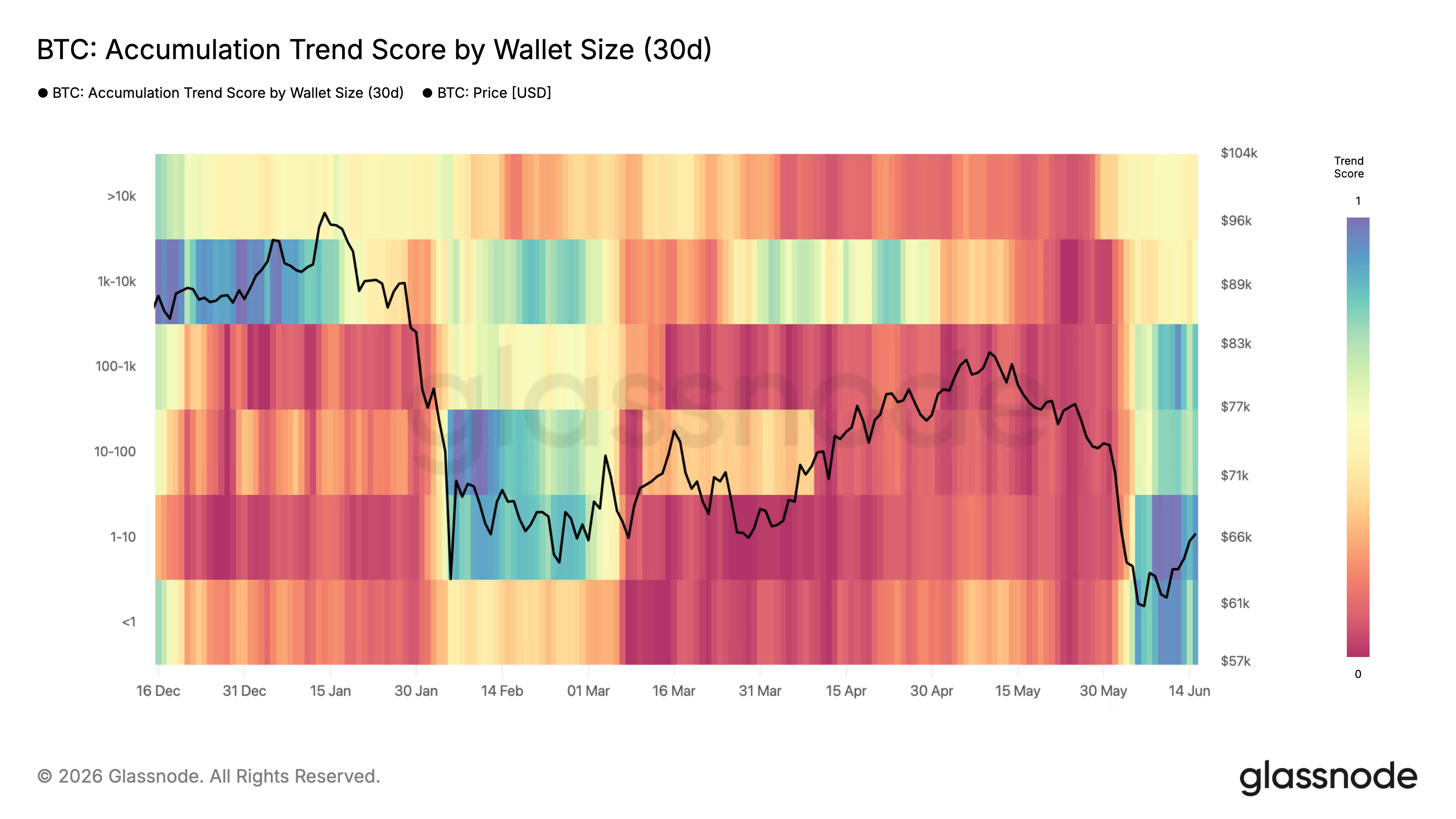
Bitcoin’s drop below $60,000 earlier this month spurred investors to pile into the largest cryptocurrency, with almost 260,000 BTC bought over 10 days and one measure of demand increasing to its highest possible level.
Investors have bought a net 259,298 BTC since June 5, paying between $59,000 and $67,000, according to Glassnode UTXO Realized Price Distribution data. Glassnode’s Accumulation Trend Score by Wallet Cohort, which measures the relative strength of purchasing fervor based on both the size of buyers and the amount acquired over the previous 15 days, stands at 1.0, the top reading.
Buying has been broad-based across wallet cohorts, ranging from holders with less than 1 BTC, typically retail investors, to those with as many as 1,000 BTC. Notably, from March through May, most groups were net distributors, or sellers, as bitcoin stagnated around $70,000.
The aggregate Accumulation Trend Score has now remained at a peak level for more than two weeks, indicating aggressive buying across cohorts and marking the strongest accumulation behavior observed during the current drawdown.

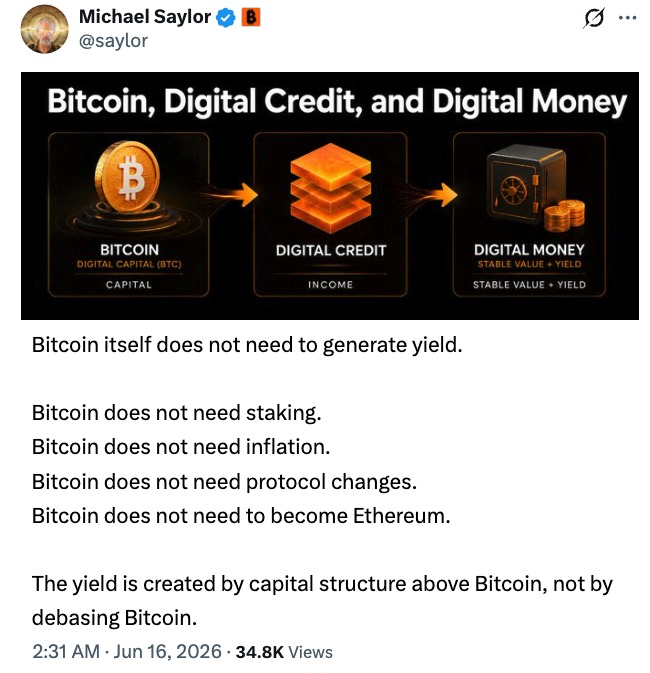
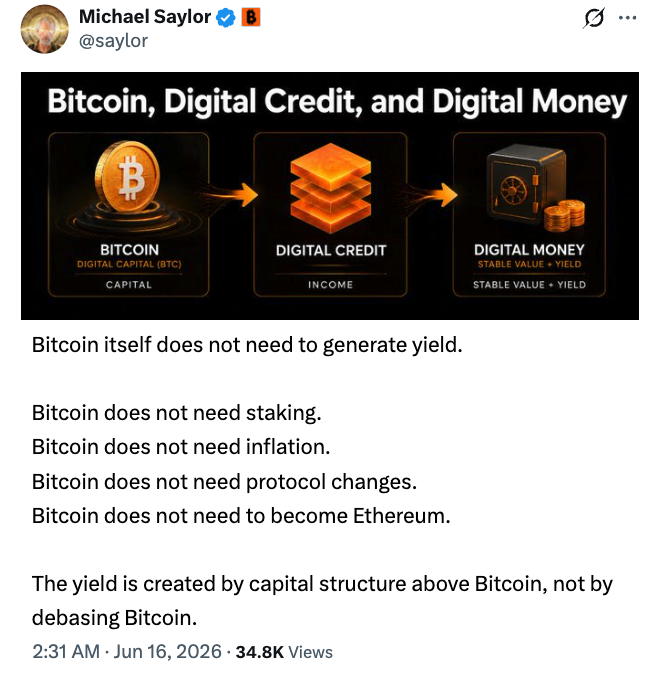
Strategy executive chairman Michael Saylor said Bitcoin does not need staking, inflation or protocol-based yield mechanisms, arguing returns should come from financial products built around BTC.
In an X post on Tuesday, Saylor outlined a five-layer “Digital Asset Stack” positioning Bitcoin (BTC) as the base for credit, money, yield and equity structures.
Saylor said Bitcoin should remain “pure digital capital” and that it “does not need to become Ethereum” to generate investor returns.
The framework reinforces Strategy’s approach to Bitcoin as a treasury reserve asset, where returns are generated through financial products built around the company’s Bitcoin holdings, the largest among publicly listed firms.
Digital credit and yield layer
Saylor’s framework is centered around “digital credit” as financial instruments built around Bitcoin holdings, designed to generate returns while reducing exposure to BTC price volatility.
Under this structure, Bitcoin serves as collateral, while equity absorbs most of the price risk and credit instruments receive more stable returns.
Source: Michael Saylor
Saylor repeatedly referenced Strategy-style securities such as STRC, the company’s perpetual preferred stock, positioning them as a key example of “digital credit.” In this framing, STRC-like instruments are not just company products but examples of a broader asset class built on top of Bitcoin through capital markets engineering.
Saylor argues credit instruments can smooth Bitcoin’s price swings
Saylor said Bitcoin’s volatility is “not a flaw,” framing it as a natural feature of “high-energy capital” that can move sharply because it is scarce, global and traded around the clock. In his model, instruments like STRC are designed to damp those price swings by sitting above Bitcoin in the capital structure.
While Saylor did not directly discuss STRC’s volatility in the X post, he said credit instruments can experience varying levels of risk depending on factors such as market stress, liquidity and investor demand.
Related: Saylor’s Strategy buys 1,587 BTC for $100M, holdings hit 846.8K
“The important point is not that digital credit always has one fixed volatility number. It does not,” Saylor said.
Strategy’s preferred stock STRC closed at $95.20 on Monday, down 1.45%, according to Nasdaq data. The stock has a $100 stated par value and is structured to trade near that level.
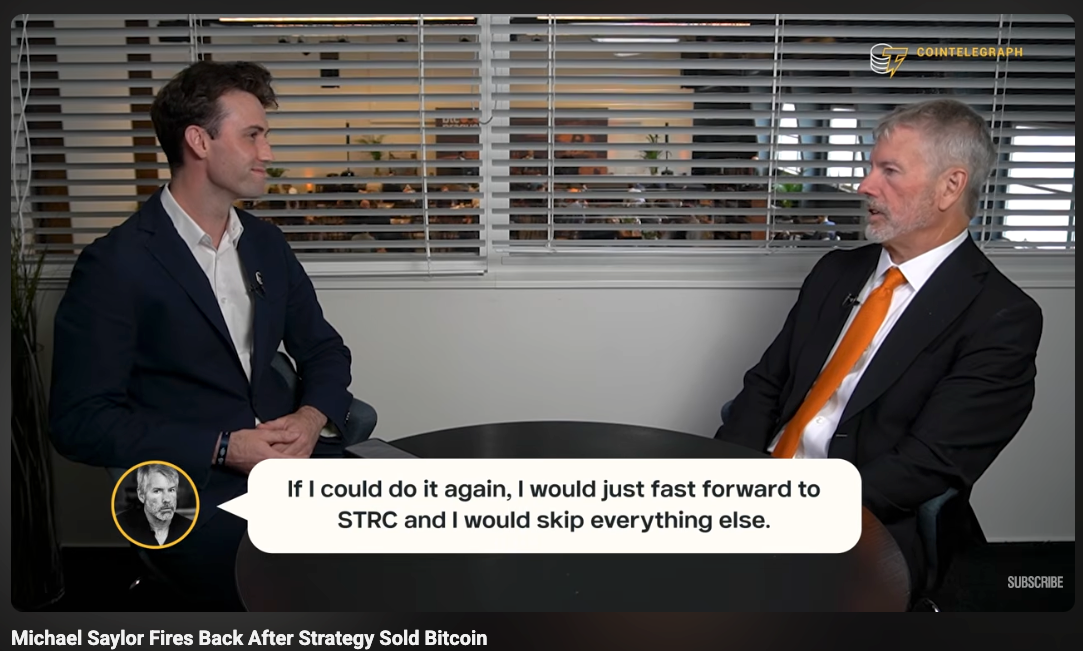
Cointelegraph’s Ciaran Lyons (left) and Strategy founder Michael Saylor (right) at BTC Prague. Source: Cointelegraph/YouTube
The remarks reinforce Saylor’s framing of Bitcoin as “digital capital” and Strategy’s role in issuing “digital credit” built around it, including the view that Bitcoin sales are sometimes required to support the structure.
“If the company’s policy is that we won’t sell the Bitcoin, then the credit won’t have value and the equity won’t have value,” Saylor told Cointelegraph at the BTC Prague conference last week.
Magazine: Bitcoin, the ‘canary in the coal mine,’ XRP transaction demand falls 91.5%: Market Moves


Circle reportedly minted another 1 billion USDC on Solana on June 16, according to on-chain tracker Lookonchain.
Summary
- Circle reportedly minted 1 billion USDC on Solana, bringing weekly issuance to 3.5 billion tokens.
- Large USDC mints can signal higher demand for Solana liquidity, payments, and trading settlement activity.
- Circle’s Movement post links USDC-backed settlement to low-cost payments, remittances, and broader dollar access globally.
The latest issuance lifted Circle’s total USDC minting on Solana to 3.5 billion over the past week. “Circle minted another 1B USDC on Solana today,” Lookonchain said.
The tracker added that Circle had minted 3.5 billion USDC on Solana over the past seven days. Circle had not issued a separate public statement on the specific mint at the time of writing.
Fresh USDC issuance increases the amount of dollar-linked liquidity available on Solana. It does not always mean immediate buying in crypto markets. Stablecoin mints can reflect exchange demand, treasury rebalancing, payment activity, or preparation for future settlement flows.
Solana remains a key stablecoin rail
Solana has become one of the main networks for stablecoin transfers due to its low fees and fast settlement. USDC is widely used across trading, DeFi, payments, and cross-border transfer products, which makes large mints closely watched by market participants.
Circle says USDC is a fully reserved stablecoin that is redeemable 1:1 for U.S. dollars. The company also says USDC is supported across dozens of networks, including Solana. This gives users and institutions several routes to move dollar liquidity across onchain markets.
The latest mint also follows months of rising attention on Solana-based USDC activity. Earlier market reports showed large USDC issuance on Solana during periods of higher trading and payment demand. The new weekly total adds to that trend.
Record HyperEVM transfer adds context
The Solana mint comes days after Circle moved a large amount of USDC through another onchain venue. As previously reported, Circle moved about 4.397 billion USDC to a Coinbase-linked address through HyperEVM.
“Circle just moved $4 billion to Coinbase on HyperEVM,” Arkham said. The analytics firm described the transfer as the largest USDC transaction ever. The move was linked to Coinbase’s role as Hyperliquid’s official USDC treasury deployer.
That transfer matters because Hyperliquid uses USDC as a core quote and settlement asset. Large treasury movements can support trading liquidity, collateral needs, and settlement flows across active onchain markets.
The Solana issuance and HyperEVM transfer show how USDC supply is moving across several networks at the same time. The activity points to growing demand for stablecoin liquidity across trading venues, payment rails, and blockchain applications.
Movement post points to payment demand
Circle also pointed to Movement as part of its wider stablecoin network push. The company said Movement’s Move-powered blockchain ecosystem is designed for low-cost payments, remittances, and financial access.
“With USDCx fully backed by USDC, Movement supports onchain settlement that can help modernize cross-border finance,” Circle said.
The statement connects stablecoin issuance to payment use cases beyond trading. USDCx is designed as a USDC-backed asset within Movement’s ecosystem. Its role is to support dollar-linked settlement across applications that need lower costs and faster transfers.

Key Takeaways
- Novo Nordisk will submit its oral Wegovy formulation to Chinese authorities “within a few months,” according to CEO
- The announcement marks CEO Mike Doustdar’s inaugural China trip following his appointment in August
- Rival Eli Lilly gained first-mover advantage by filing orforglipron with Chinese regulators in late 2025
- China patent protection for semaglutide lapsed in March, opening doors for generic manufacturers by mid-2026
- NVO stock shows modest 0.09% gain and holds a Hold rating with analysts targeting $46 per share
Novo Nordisk is making its move in China’s burgeoning oral obesity treatment sector, with Chief Executive Mike Doustdar revealing plans to seek regulatory clearance for the company’s Wegovy tablet formulation “very soon — a few months.”
Doustdar disclosed the timeline during his maiden visit to China after assuming leadership last August. Shares of NVO were marginally higher by 0.09% following the disclosure.
China represents the globe’s second-biggest pharmaceutical marketplace, with GLP-1 obesity medications emerging as one of its most dynamic therapeutic categories. First-quarter GLP-1 product sales through platforms including Alibaba and JD.com reached approximately 1.4 billion yuan ($207 million), data from Jefferies indicates.
Novo maintains existing market presence. Chinese regulators granted approval for its injectable Wegovy formulation in the middle of 2024. Introducing an oral alternative would provide the Danish pharmaceutical giant with an additional pathway, appealing to consumers who favor tablets over needles.
However, the company trails its primary competitor. Eli Lilly filed its once-daily oral candidate orforglipron with Chinese regulatory bodies in late 2025, securing a temporal advantage in the approval process. Lilly currently markets Mounjaro throughout China for both Type 2 diabetes management and weight reduction.
Generic Competitors Preparing to Enter
The challenge extends beyond Lilly. Semaglutide — the core compound in Wegovy and Ozempic — saw its Chinese patent expire in March. While Novo maintains regulatory data exclusivity through early next year, generic alternatives are anticipated to reach the market around Q2 2026.
Doustdar recognized the incoming challenge but emphasized production complexity as a defensive moat. “Not many of our competitors will be able to reach that level, have the capabilities,” he stated, highlighting the difficulties inherent in large-scale oral formulation manufacturing.
To maintain competitiveness against generic entrants and domestic imitation products, Novo has implemented price reductions for Wegovy across select Chinese regions.
Pfizer and domestic pharmaceutical company Innovent Biologics have likewise penetrated the space, although precise market distribution data for China remains opaque. Neither Innovent nor Lilly provides Chinese revenue breakdowns.
Novo introduced its Wegovy pill in American markets this year after securing expedited clearance there and in Britain. Lilly received U.S. regulatory approval for orforglipron in April.
Wall Street’s Perspective
Among equity analysts, NVO maintains a Hold consensus classification based on three uniform Hold recommendations on TipRanks. The mean price objective stands at $46, suggesting approximately 4.7% appreciation potential from present trading levels.
For the year-to-date period, NVO has declined 11.4%, mirroring investor apprehension regarding patent vulnerabilities, pricing headwinds, and intensifying competitive dynamics.
The China regulatory submission is anticipated within the coming months, per Doustdar’s indication.


Bitcoin (BTC) briefly crossed $67,000 yesterday after a recently brokered peace agreement between the United States and Iran boosted market sentiment.
Despite the rally, the crypto asset may be approaching another capitulation event, according to crypto analyst Doctor Profit, who compared the current market structure to the setup seen before the FTX collapse in 2022.
2022-Style Capitulation Pattern
In the latest tweet, the analyst explained that before that crash, Bitcoin was moving higher while forming a bullish divergence on the weekly chart, which led many traders to buy near the $20,000 level. However, panic selling followed after the market collapsed, leaving many investors with losses of around 20%.
A similar pattern appears to be developing once again, as Bitcoin shows a bullish divergence on the weekly time frame in addition to renewed buying pressure. Based on this setup, he believes the market could still face a sharp capitulation move before reaching its bottom.
The recent rise in Bitcoin came after US President Donald Trump revealed that the United States had completed a peace agreement with Iran following months of conflict. The deal reportedly includes reopening the Strait of Hormuz and lifting the US blockade affecting Iranian ports and shipping routes. Although much of the agreement remains unclear, Trump said the next step would involve fresh negotiations between both countries.
Meanwhile, on-chain data shared by Alphractal founder Joao Wedson revealed that many BTC holders are currently underwater as the crypto asset recorded the second-largest unrealized loss in its history. However, realized losses remain relatively low, which means that panic selling has not fully emerged yet. Wedson said the gap between unrealized and realized losses indicates that broad capitulation may still be ahead if investors begin selling aggressively at a loss.
Downside Target
Bitcoin’s previous major market bottom formed when the price reached the CVDD level before beginning a new bull run. According to the crypto analyst Ali Martinez, the metric is currently sitting near $48,000, a level that could become important if Bitcoin sees another deeper correction.
This also aligns with earlier market predictions from Doctor Profit, who had previously identified the $40,000-$48,000 range as a potential final bottom zone for Bitcoin in the current cycle.
The post Bitcoin (BTC) Is Flashing Same Pattern Seen Before FTX Crash: Analyst appeared first on CryptoPotato.
Crypto World
Crypto News, June 16: US-Iran Deal Oddity, FTX Claim Day, ETH USD Season Drawing Closer

We start today’s crypto news with a few oddities in the US-Iran deal as it closed faster than most expected, while the bombing talk was still fresh. At the same time, FTX claim proceedings showed real movement, and ETH USD started flashing clearer signs of life. They are creating a messy but interesting day where macro relief is mixed with steady accumulation.
Markets didn’t panic when the BOJ raised rates to 1%. BTC held $66k while corporate buyers kept throwing in cash. MARA flipped from seller to buyer, Strategy added more Bitcoin, and Bitmine continued loading ETH. ETF flows are also getting better.

Discover: The Best Crypto to Diversify Your Portfolio
US-Iran Deal Oddity, BOJ Hike, Crypto Butchers Lining Up
The US-Iran deal came with unusual speed, and it also left Israel out completely, which made the whole thing feel incomplete to a lot of observers. Longtime Trump supporter Mark Levin pointed out how strange it was that governments signed so quickly while officials were still talking about imminent strikes.
Netanyahu added to the immediate fear by saying he could still target Iran whenever he chose. As much as we love crypto going up, there are some skeptics. We know, crypto took the news with a lovely bounce and a full celebration. BTC reclaimed $66k, and oil dropped sharply as equities ran harder. The US-Iran rally removed a major barrier, yet it still looks odd.
The market clearly wanted more confirmation before getting too excited, yet the BOJ hike to 1% barely registered. Previous rate increases used to trigger instant BTC dumps, but this time, the market seems unbothered. It either showed how much the market has changed, with even a 31-year high in Japanese rates failing to spark a selloff, or the hike was already priced in long ago.
Discover: The Best Token Presales
FTX Payout Day Slides Bitcoin Dominance, as ETH USD Picks Up Steam
It’s FTX last claim eligibility day, and the US government has moved $349k in seized tokens from FTX and Alameda wallets on-chain. MKR, COMP, and other assets shifted in what looked like routine estate activity. Creditors who lost money in the 2022 collapse finally saw something concrete happening.
The next FTX claim registration window is expected to open soon, with distributions targeted for later this summer. The on-chain transfers have also reduced some uncertainty, though they also highlight how slow these processes remain. No major selling pressure followed the movement, which stood out on a day full of bigger headlines.
Also today, MARA bought 1,000 BTC for around $66.7 million, reversing its earlier selling. Last night, Strategy added another 1,587 BTC while Bitmine kept accumulating ETH. This comes as miner difficulty kept climbing, making spot purchases look more attractive than new mining at current levels, which also likely brings upside pressure.
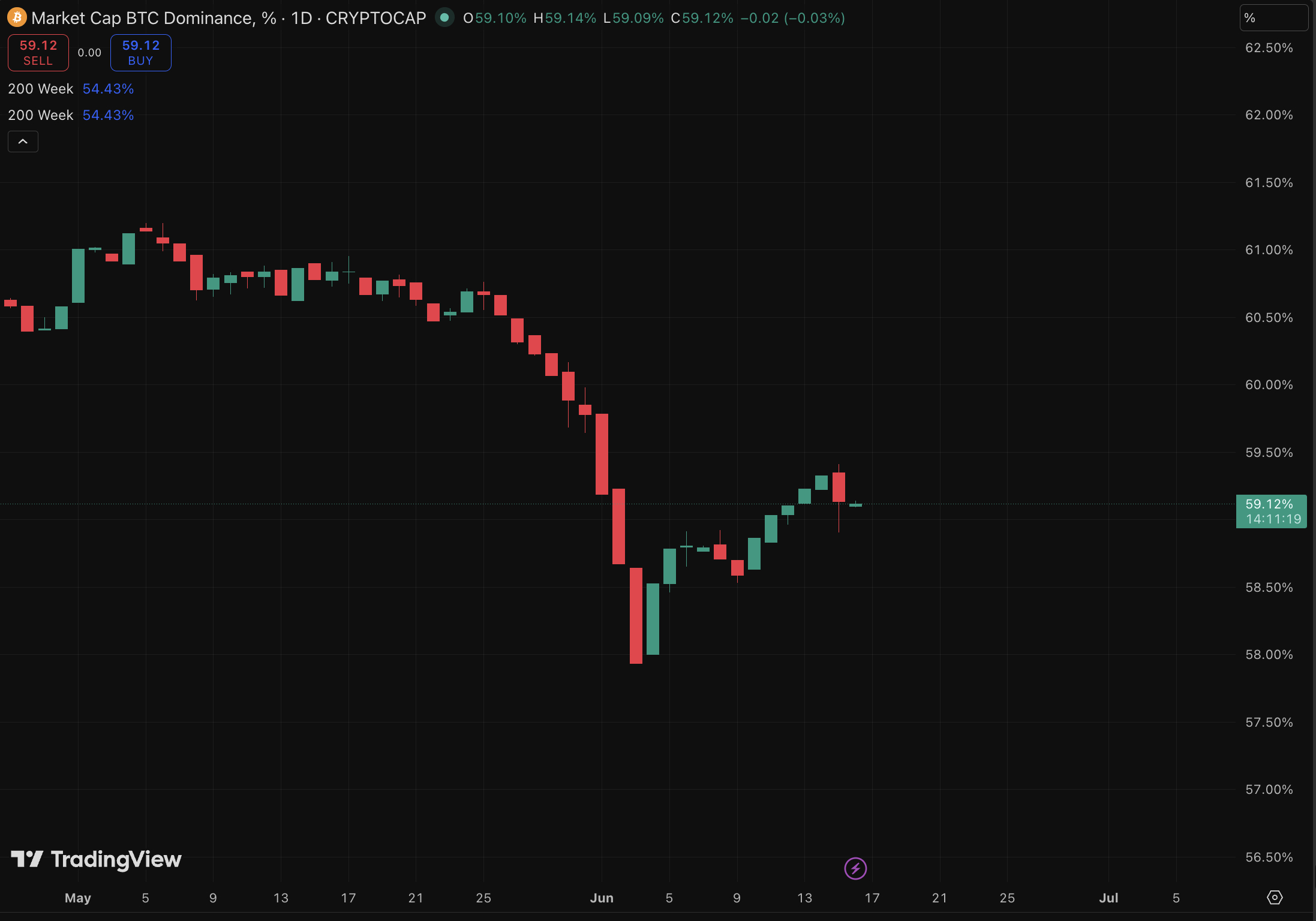
ETF flows show BTC products recorded net outflows near $64 million on June 15, but ETH, SOL, and XRP ETFs saw inflows. BlackRock’s IBIT is still buying tens of millions worth. BTC dominance continues drifting lower as capital enters Altcoins.
ETH USD has shown the strongest fundamental signs in weeks. Staking reached a new all-time high of 32.7%, locking up more supply and reflecting real network conviction. Standard Chartered pours gasoline on the fire by forecasting that UNI could run 40x to $100 by 2030 on the back of tokenized asset growth.
Discover: The Best Crypto to Diversify Your Portfolio
Crypto News Bullish Combo: Up or Down Next?
The combination of locked supply, bold price targets on UNI, and corporate buying is bullish. Dips are getting met with more interest. Although news on Arthur Hayes rebuying ETH seems like a fud than a shill. We saw tokens pumping on his buys and got jeeted days after, even with Hayes’ usual unrealistic targets.
The US-Iran relief, steady progress on FTX payouts, and fresh corporate accumulation all point to clearing barriers. Institutional infrastructure keeps expanding at the same time, with new yield products hitting the market.
Miners and treasury companies stepping up while difficulty rises, countering cost dynamics. MARA’s reversal after months of selling stands out as one of the most bullish signals. MARA is not a strategy; they don’t usually load up aggressively near obvious tops.
ETH USD season feels like it’s closing in, too, which is good for altcoins. Record staking, strong analyst calls, and steady buying from players form a solid base. The market has absorbed plenty of fear this cycle. It’s the time, maybe.
Discover: The Best Token Presales
The post Crypto News, June 16: US-Iran Deal Oddity, FTX Claim Day, ETH USD Season Drawing Closer appeared first on Cryptonews.
Senator Cynthia Lummis publicly tied Bitcoin to America’s $39.2 trillion national debt crisis on June 15, positioning the asset as a generational hedge against currency debasement as the Digital Asset Market CLARITY Act landed on the Senate legislative calendar.
The convergence of a macro fiscal argument with advancing crypto regulation legislation marks the most direct attempt yet to frame digital asset policy as a national balance-sheet imperative.
The CLARITY Act cleared the House in July 2025 with a 294–134 bipartisan vote and passed the Senate Banking Committee 15–9 on May 14, 2026, with Democrats Ruben Gallego and Angela Alsobrooks crossing the aisle.
Placement on the Senate legislative calendar on June 1 formally enables a floor vote. The bill draws hard regulatory lines by assigning SEC oversight to digital asset securities and new token offerings, while giving the CFTC jurisdiction over spot digital commodities, Bitcoin and Ethereum included.
It also builds out registration frameworks for exchanges, brokers, and custodians, requires capital segregation, and shields software developers from liability solely for publishing code, a provision that directly addresses post-Tornado Cash enforcement exposure.
“Our debt is real. Our fiscal trajectory is unsustainable. Bitcoin is one of the few tools that could help right that wrong for younger Americans.”
Lummis said this framing is intentional. She has argued in multiple forums that Bitcoin’s fixed supply makes it structurally distinct from sovereign debt instruments and that younger generations, those inheriting the fiscal consequences of decades of deficit spending, have the most to gain from institutional access to the asset.
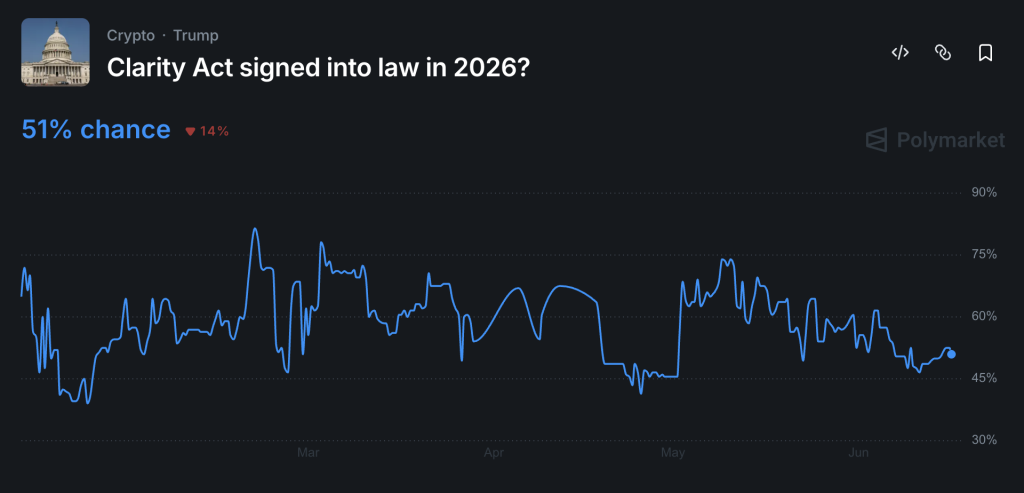
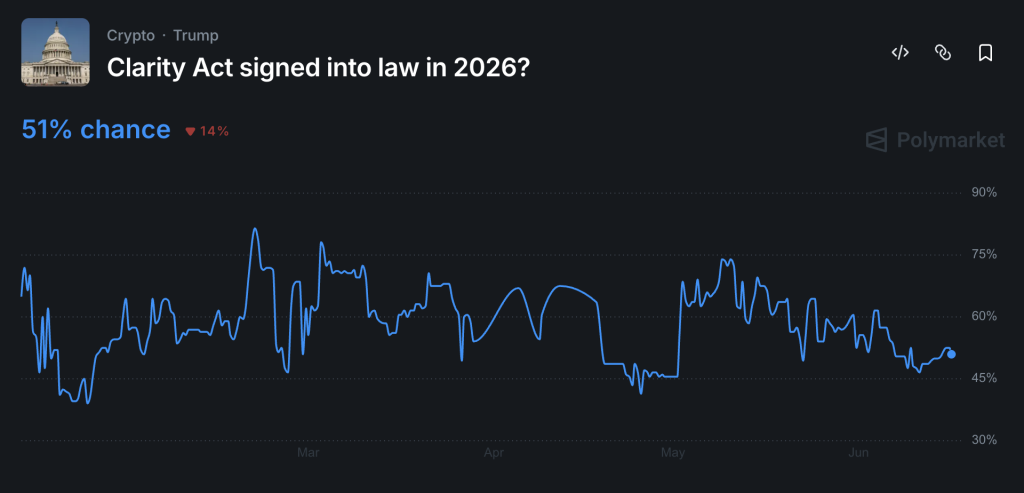
Galaxy Research currently puts the probability of the CLARITY Act becoming law in 2026 at 60–75%.
Discover: The Best Token Presales
What the CLARITY Act Actually Changes for Market Structure
The bill’s most consequential provision for active market participants is the SEC–CFTC jurisdictional split. Under the current framework, most tokens operate in regulatory ambiguity, subject to SEC enforcement posture without statutory clarity on whether they qualify as securities.
The CLARITY Act resolves that by creating an activity-based test: assets that are sufficiently decentralized fall under CFTC oversight as digital commodities, removing the perpetual Howey Test overhang that has depressed institutional participation in altcoin markets.
An analysis of the Howey Test implications under the CLARITY Act framework details how this shift recalibrates risk assessment across the altcoin landscape.
On stablecoins, the bill bans passive yield products outright, a provision that earlier drew Coinbase opposition, while protecting activity-based platform usage rewards.
The compromise held, but the passive yield ban remains a live point of tension for firms whose business models depend on it. Exchange customers also gain first claim on custodial assets in bankruptcy, a structural protection the industry has sought since the FTX collapse.
July 4 Deadline Is Slipping, What Actually Needs to Happen
The White House’s July 4 signing target is under significant pressure. Three distinct obstacles remain: unresolved ethics provisions, competing House and Senate committee versions requiring reconciliation, and the 60-vote cloture threshold in the Senate, a procedural bar that demands meaningful Democratic support before recess.
The specific legislative obstacles around the ethics provisions and the July 4 deadline illustrate just how tight the procedural window has become. Lummis herself acknowledged the timeline, stating that “nobody is popping the champagne quite yet.”
The Senate and House versions also diverge on the SEC–CFTC balance. The Senate Banking discussion draft leans more SEC-centric, giving the commission primary authority over “ancillary assets” and requiring joint SEC–CFTC rulemaking on margining and disclosures, a meaningful departure from the House bill’s CFTC-forward approach.
Reconciling those competing texts is the real legislative bottleneck, independent of the floor scheduling question. If the July 4 window closes without passage, most observers expect the effort to reset entirely into the next Congress, pushing comprehensive digital asset legislation toward the late 2020s.
Over 200 crypto firms have formally urged Senate leadership to schedule a floor vote promptly. Circle has backed the bill publicly, and institutional accumulation of Bitcoin as a treasury asset, Strategy’s continued Bitcoin purchases being the most visible example, aligns directly with the fiscal hedge narrative Lummis is running on Capitol Hill.
The next concrete signal to watch is whether Senate Majority Leader John Thune schedules floor time before the recess window closes, or whether the ethics and jurisdictional disputes force the bill into fall negotiations.
Discover: The Best Crypto to Diversify Your Portfolio
The post Lummis Links Bitcoin to $39.2T US Debt Crisis as CLARITY Act Nears Senate Floor appeared first on Cryptonews.
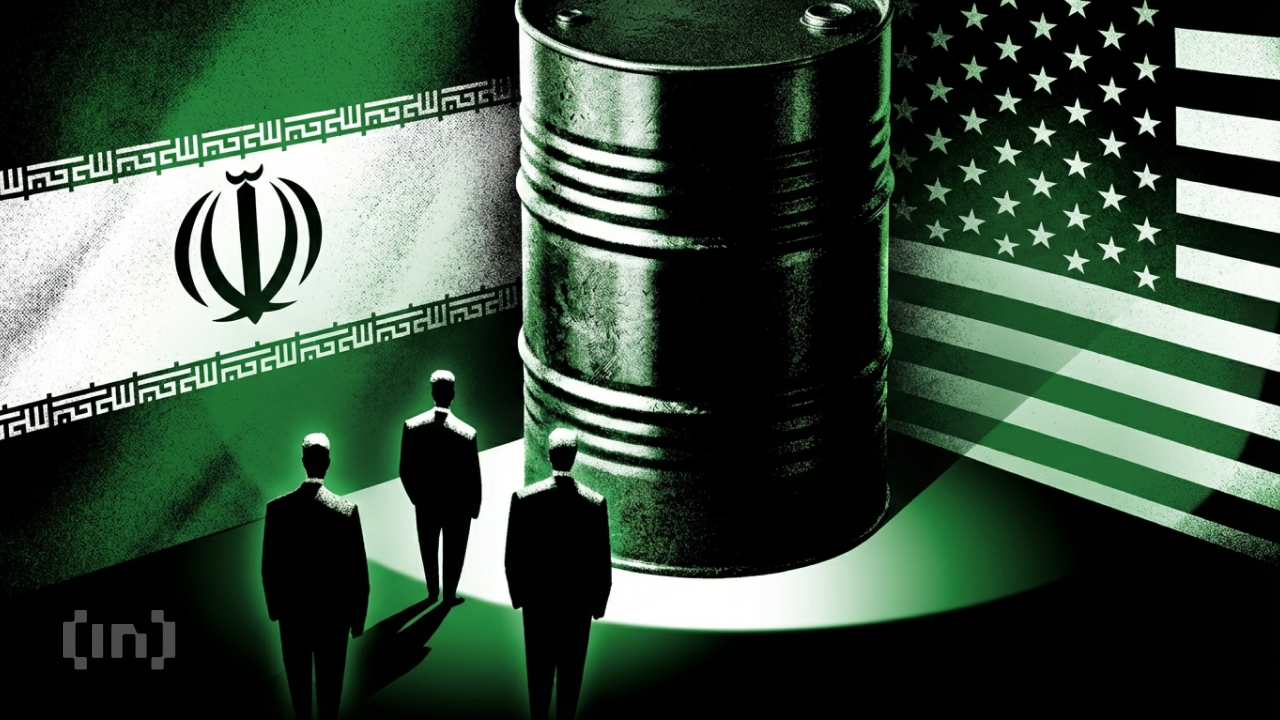
The CEO of the world’s largest tanker operator by vessel count said that shipowners will not resume sailing through the Strait of Hormuz for weeks, even after a US-Iran deal to reopen the waterway.
Mitsui OSK Lines CEO Jotaro Tamura said any agreement must prove “material” before shipping lines feel safe crossing. He estimated a return could take weeks or as long as a month.
Strait of Hormuz Return Hinges on a “Material” Deal, MOL CEO Says
The strait carried more than a fifth of global oil and liquefied natural gas before the conflict erupted in late February. Daily transits have since collapsed sharply.
Follow us on X to get the latest news as it happens
Tamura pointed to repeated false starts since the war began. Operators have learned caution from broken promises over the past few months.
“Given the experiences in the last couple of months, I think it’s reasonable to assume that it may take at least a couple of weeks or if not a month,” he told the Financial Times.
The CEO stressed that a signed agreement between governments would not be enough on its own. He argued the terms must hold up in practice and reflect actual conditions inside the Strait of Hormuz. Only then, he said, would shipping lines feel secure enough to send vessels through.
MOL operates more than 900 ships. The company moved four vessels out of the Gulf before the deal and paid no fees to Iran. At least seven of its ships still wait to transit.
Some cargoes are already moving, however. India’s flagged LNG tanker Disha became the first Indian vessel to clear the strait after the pact, carrying 62,370 tonnes of gas. Officials said 10 India-flagged and five foreign-flagged ships have now crossed.
The agreement is expected to be signed on Friday in Geneva. How quickly traffic normalizes will depend on whether owners trust the corridor enough to follow.
Subscribe to our YouTube channel to watch leaders and journalists provide expert insights
The post Tanker Giant Expects Weeks Before Ships Comfortably Cross Hormuz Again appeared first on BeInCrypto.
Today in crypto, Strategy’s latest Bitcoin purchase pushed its holdings to 846,842 Bitcoin, as the cryptocurrency’s continued recovery hinges on a successful deal between the US and Iran. Meanwhile, the CFTC poached an SEC crypto task force adviser with a strong blockchain forensics background.
Bitcoin recovery rests on US-Iran deal as momentum remains weak
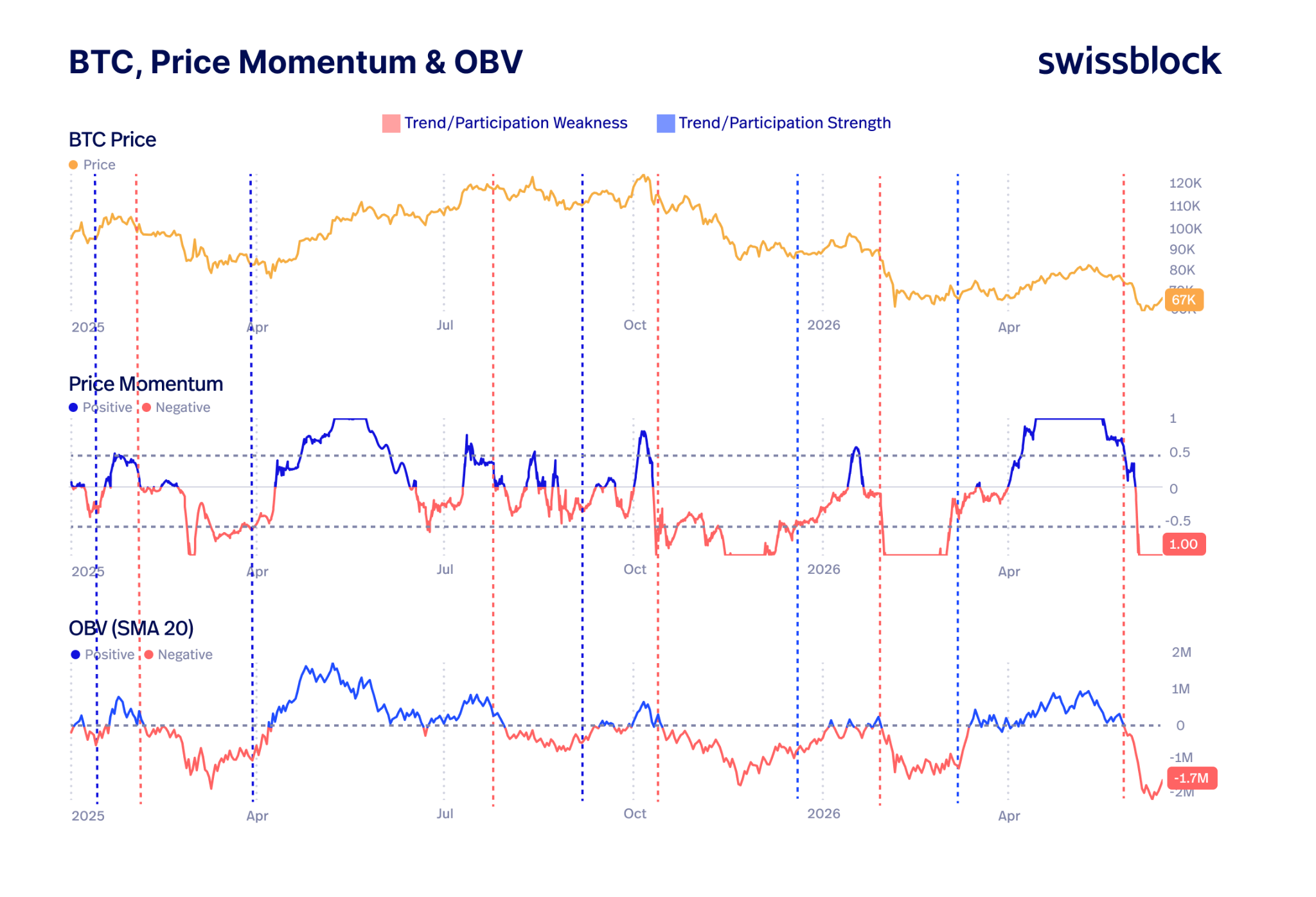
Bitcoin’s continued recovery is hinged on a successful peace deal between the US and Iran as Swissblock shows on-chain metrics signal the cryptocurrency remains weak despite its recent recovery.
LVRG Research director Nick Ruck told Cointelegraph that despite Bitcoin (BTC) reclaiming $67,000 on Monday, its “momentum remains weak, with declining volume and stagnant on-chain metrics indicating that the recovery lacks conviction and could quickly fade.”
Swissblock said on Monday that Bitcoin’s price momentum, measuring the strength of its price movements, and on-balance volume (OBV), which measures buying and selling pressure, remain in a “weak momentum and participation regime.”
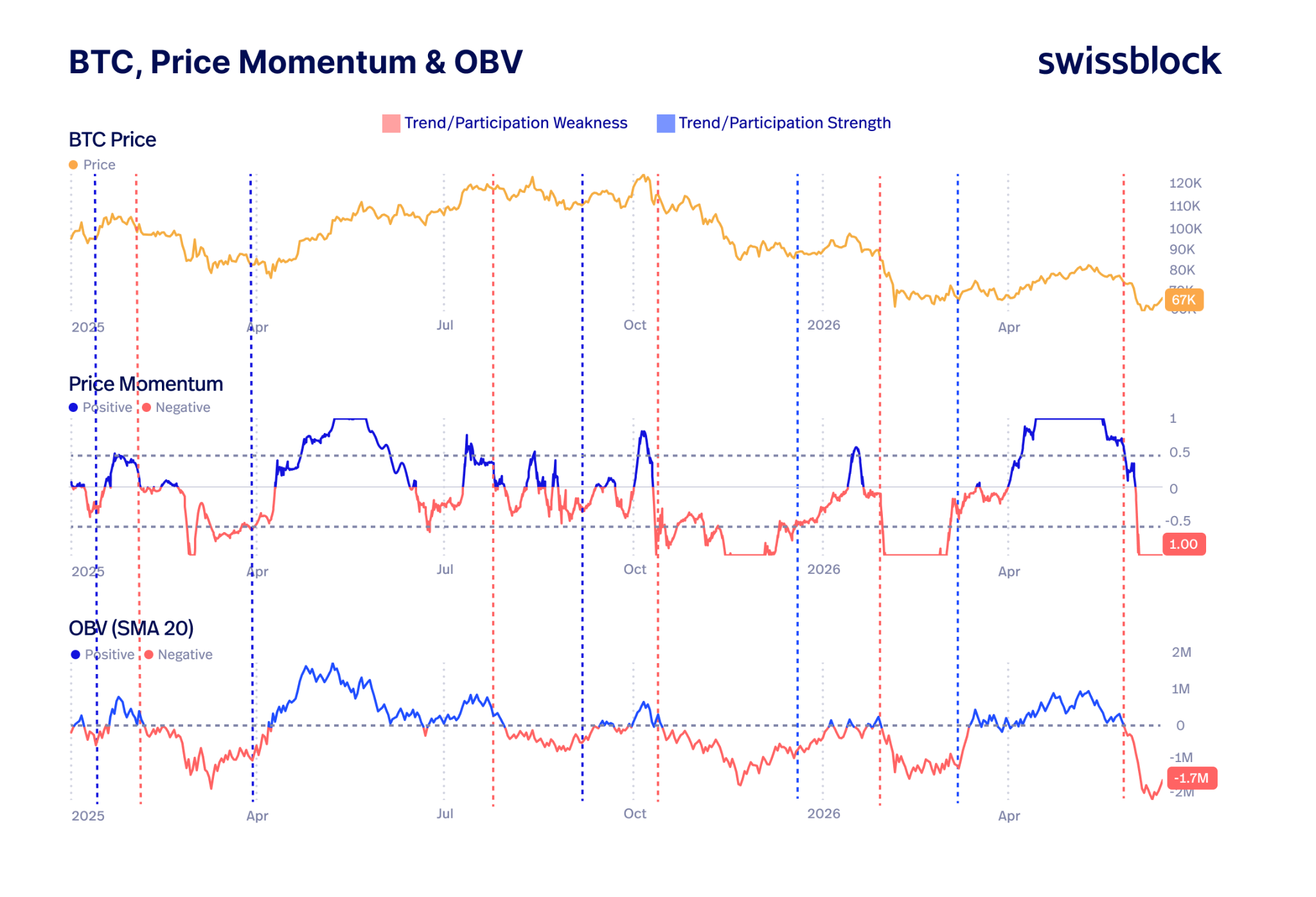
Price momentum and OBV remain at bear market lows. Source: Swissblock
Ruck said that if the peace deal between the US and Iran breaks down, the following geopolitical instability and potential oil shocks would see Bitcoin “face a volatile path” as geopolitical catalysts “continue to dominate crypto price action.”
US President Donald Trump said on Sunday that the US had completed a peace deal with Iran to end months of conflict, which is expected to be signed on Friday. Much of the deal remains unknown, but Trump said it would see the Strait of Hormuz reopen and the US lift its blockade.
CFTC hires SEC crypto task force adviser with blockchain forensics chops
The US Commodity Futures Trading Commission (CFTC) has hired a new chief data innovation officer with deep experience in blockchain forensics in what could be seen as the regulator’s move toward greater focus on the technology.
In a Monday notice, CFTC Chair Michael Selig said that Donald Battle, an adviser to the US Securities and Exchange Commission (SEC) crypto task force, would be the commission’s chief data innovation officer. Battle was appointed as an SEC crypto task force adviser in January 2025 with the incoming Trump administration, and previously worked as a blockchain data adviser for the CFTC and crypto enforcement specialist with the Treasury Department’s Financial Crimes Enforcement Network.
Selig cited Battle’s experience in “data science, blockchain forensics, programming interfaces, and cutting-edge AI solutions” among his reasons for his pick.
The appointment signaled the agency moving closer to addressing crypto regulation and enforcement at a time when Congress is seeking to overhaul the CFTC’s and SEC’s roles with a digital asset market structure bill, the CLARITY Act.
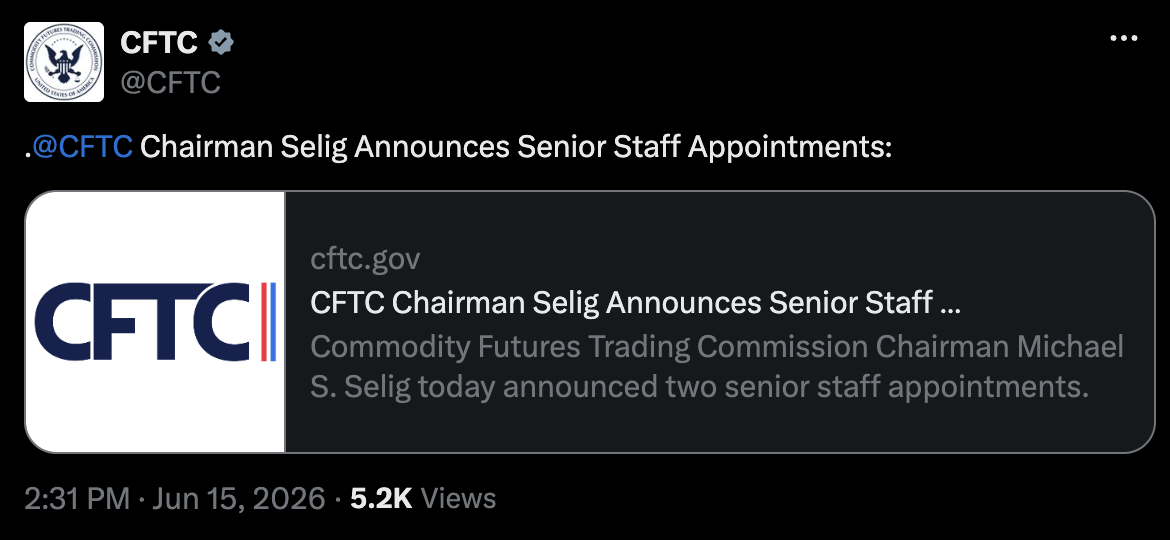
Source: CFTC on X.com
Saylor’s Strategy buys 1,587 BTC for $100M, holdings hit 846.8K
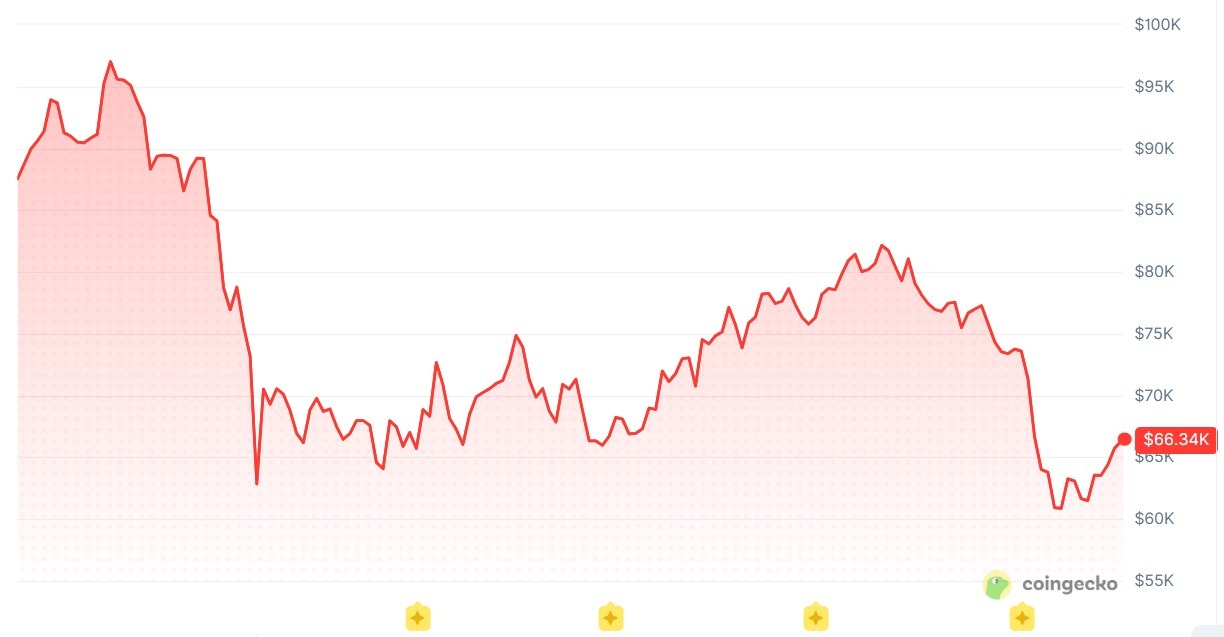
Michael Saylor’s Strategy, the world’s largest public Bitcoin holder, added to its cryptocurrency reserves last week as BTC continued to trade below the company’s average cost basis of about $75,700.
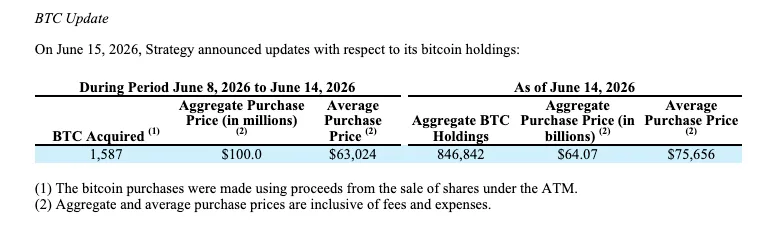
Strategy acquired 1,587 Bitcoin (BTC) for $100 million between June 8 and 14, according to Monday’s 8-K filing with the US Securities and Exchange Commission.
The purchase was made at an average price of $63,024 per Bitcoin, bringing the company’s overall average cost basis slightly lower to $75,656.
Source: SEC
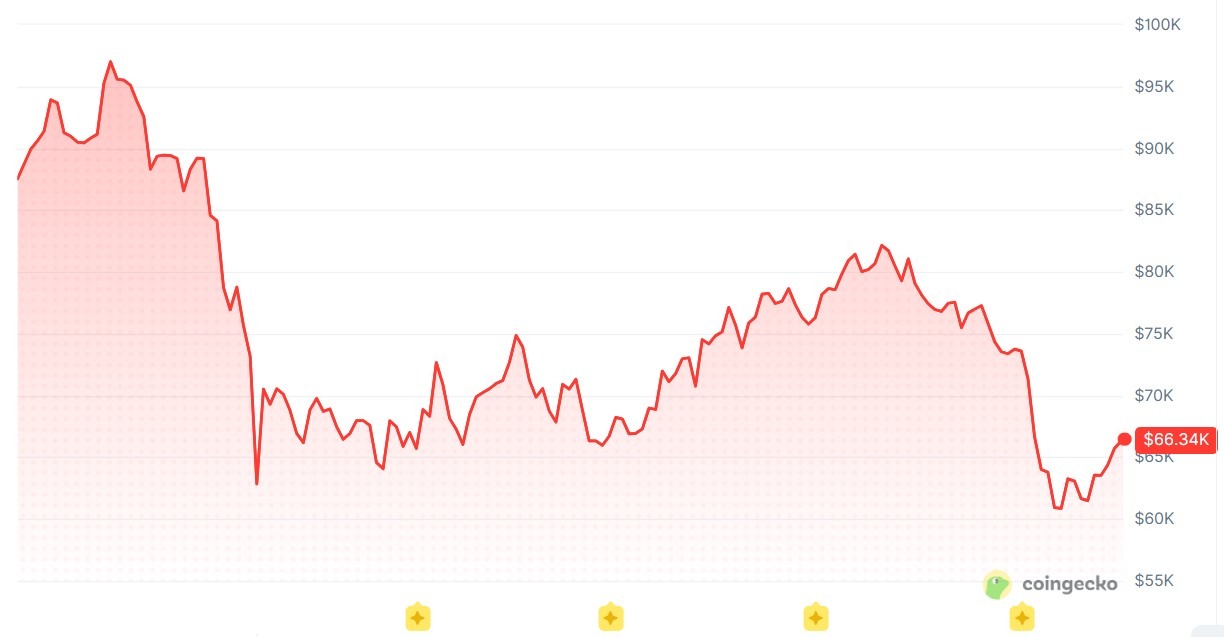
With the latest buy, Strategy now holds 846,842 BTC, accumulated at a total cost of $64.07 billion. At the current price of about $66,216 per bitcoin, those holdings are worth roughly $56.1 billion, according to CoinGecko data.
Similar to the previous 1,550 BTC acquisition announced last Monday, Strategy funded the latest acquisition through sales of its Class A common stock (MSTR).
Bitcoin miner IREN has completed its acquisition of the Spanish data center developer Nostrum Group, marking its entry into Europe as the company builds out its artificial intelligence cloud business.
IREN said in a press release on Monday that the acquisition adds about 490 megawatts of secured, grid-connected power in Spain, along with a development pipeline and over 50 employees across engineering, construction, development and operations.
The deal expands IREN’s global power portfolio to about 5 gigawatts, with the Spanish capacity representing about 10% of the total.
IREN co-founder and co-CEO Daniel Roberts said Spain offers a combination of renewable power and fiber connectivity, giving the company a base from which to serve growing European demand for AI infrastructure.
“Europe is one of the largest and fastest-growing markets for AI infrastructure, and Spain is among its most compelling entry points,” Roberts said.
The acquisition is part of IREN’s push into AI cloud services, which can provide more predictable, contract-based revenue as rising mining difficulty and volatile Bitcoin (BTC) prices pressure the economics of crypto mining.
Related: Trump-linked American Bitcoin reports $82M Q1 loss, revenue miss
The move also aligns IREN with a broader trend among Bitcoin miners building AI infrastructure in Europe. HIVE Digital has been converting part of its facility in Sweden for AI computing, while Bitdeer is developing AI data center capacity in Norway.
IREN accelerates AI cloud pivot
According to IREN’s results for the quarter that ended March 31, Bitcoin mining remained its largest revenue source. The company reported $111.2 million in mining revenue, compared with $33.6 million from its AI cloud services.
IREN said AI cloud revenue rose from $17.3 million in the previous quarter, while Bitcoin mining revenue fell from $167.4 million. The company attributed the decline in mining partly to lower average BTC prices and the decommissioning of mining hardware.
Bitcoin’s year-to-date chart. Source: CoinGecko
Analysts at Bernstein previously said IREN could eventually phase out much of its Bitcoin mining business as it retrofits existing sites for AI cloud infrastructure. IREN reported having about 150,000 GPUs installed or on order as of March 31, which they estimate could support a $3.7 billion annual revenue run rate.
Magazine: China’s 107 Bitcoin memory thief, Bithumb CEO booked: Asia Express

ITV respond to rumours that Jack Shepherd is taking break

G7 Summit: Ukraine, Iran In Focus
Glassnode data shows aggressive bitcoin buying between $59,000 and $67,000


-

 Business2 days ago
No Jackpot Winner as $257 Million Prize Rolls Over to $269 Million Monday Draw
-

 Crypto World5 days ago
Oppenheimer backs SpaceX as $70 billion retail frenzy builds
-

 Fashion4 days ago
Weekend Open Thread: Tuckernuck – Corporette.com
-

 Crypto World5 days ago
Markets Rally as SpaceX IPO Looms Amid Iran Tensions and Inflation Surge
-
 Crypto World1 day ago
Zimbabwe Requires Crypto Businesses to Register Annually Under New FIU Regulations
-

 Tech3 days ago
NanoClaw integrates JFrog registries to secure AI agent downloads
-
 Sports7 days ago
Bangladesh beat Australia after 20 years in ODIs, register only their second win over six-time world champions | Cricket News
-

 Crypto World3 days ago
Bitget enters Argentina’s regulated crypto market through PSAV registration
-

 Tech4 days ago
This Week In Security: Microsoft On Microsoft, Register Your Domains, Linux On ARM, And FreeBSD Joins The File Cache Club
-
 Tech5 days ago
Dutton Ranch star claims they ‘didn’t see any disruption’ on set following Chad Feehan’s exit from Yellowstone spinoff fueled by Taylor Sheridan clash rumors
-

 NewsBeat4 days ago
El Nino has formed in the Pacific and could set records, forecasters say
-

 Business6 days ago
Thailand Ranks Second Worldwide for AI Adoption Growth, Microsoft Reports
-

 Tech6 days ago
‘This is Seattle’s position on AI’: City Council votes unanimously to pause big new data centers
-

 Politics5 days ago
Politics Home | Healey Resignation Is “Colossal Failure Of Government”, Says Former Labour Defence Secretary
-
 Entertainment5 days ago
Donnie Wahlberg & More Heat Up Las Vegas at Circa’s Barry’s Downtown Prime
-
 Tech5 days ago
Opendoor Ends India Operations, Fueling a Bigger Conversation About AI and Outsourcing
-

 Sports5 days ago
First Time Since 1971: Australia Register Historic Low In ODI Cricket
-

 Politics5 days ago
Belfast burns, while Met chief points finger at Iran and Russia
-

 NewsBeat4 days ago
FBI searches office of Ohio voter registration group
-

 Business5 days ago
AT&T: Verizon's 27% Outperformance Sets Up A Solid Entry Point
You must be logged in to post a comment Login