

Crypto World
Ethereum Warning: Here’s Why ETH’s Price Can Drop by 15%


The recently announced peace deal between Iran and the US, expected to be officially signed on June 19, has triggered a substantial upswing in the cryptocurrency market, with Ethereum (ETH) among the biggest winners.
However, some analysts believe the green wave might be only temporary, predicting a major correction in the coming weeks.
Going South Again?
Several hours ago, ETH climbed to approximately $1,850, and it is currently worth around $1,790 (according to CoinGecko), representing a 7% increase since last Tuesday.
And while some holders might cheer the sharp rise, others think the upswing has occurred in an unhealthy manner and could be followed by a short-term pullback. One person sharing this theory is the popular analyst Ted. He noted that the asset’s Relative Strength Index (RSI) on a 4-hour scale reached its most overbought territory for the past three months.
“Last time this happened, Ethereum dropped 15% in 2 weeks,” he reminded.
The whales’ activity is also worth observing. X user Max Crypto revealed that one large investor opened a $30.9 million short on ETH with 20x leverage when the price was trading near $1,820. With this risky bet, a mere $90 rise would have liquidated the trader.
Whales are known as experienced market participants, and many believe that their decisions rarely depend on their sixth sense but on inside information that they might have about upcoming events that could influence the price. Their behavior is often monitored by smaller players who may get scared and exit the ecosystem, thus negatively impacting ETH’s valuation.
‘Phenomenal Spot’ to Buy?
Other well-known industry participants presented highly optimistic predictions. X user Michael van de Poppe touched on the ETH/BTC ratio, arguing that the current price level is a “phenomenal spot” to invest in the second-largest cryptocurrency over the next 6-12 months.
“Next step = breaking 0.03250 and to be getting clearly into an uptrend again. Other than that, price usually starts, narrative will come up and accelerate the momentum, and I won’t be surprised to see the momentum pick up significantly in the coming period on Ethereum,” he added.
Poseidon also chipped in, claiming that people have 90 days left to buy ETH under $2,000 “for the last time.” Meanwhile, the massive outflow from exchanges supports the bullish scenario.
As CryptoPotato recently reported, nearly 500,000 tokens have been withdrawn from centralized platforms over the past week, resulting in reduced selling pressure and considered an early sign of accumulation.
The post Ethereum Warning: Here’s Why ETH’s Price Can Drop by 15% appeared first on CryptoPotato.



Coinbase CEO Brian Armstrong called on the U.S. government to overhaul its accredited-investor framework on Monday, arguing that wealth-based restrictions on private investment lock ordinary Americans out of opportunities available only to the already wealthy. Armstrong's call came shortly after… Read the full story at The Defiant
Ripple, the blockchain firm closely associated with the XRP Ledger (XRP) network, invested in African payments company Flutterwave as part of its Series E funding round, a deal centered on expanding the use of stablecoins for cross-border payments.
Flutterwave said Tuesday that the funding round values the company at $3.2 billion. Financial terms of Ripple’s stake were not disclosed.
The deal will integrate Ripple’s U.S. dollar-backed stablecoin, RLUSD, into Flutterwave’s payments infrastructure, allowing businesses to settle some international transactions using digital dollars rather than relying solely on traditional banking networks.
Flutterwave will also connect to Ripple Payments, Ripple’s global payments network, and use the XRP Ledger blockchain to process transactions.
The companies said the goal is to make it easier and cheaper for businesses across Africa to send and receive money internationally.
The deal points to the growing role of stablecoins in international payments, one of the digital asset industry’s fastest-growing use cases. While cryptocurrencies are often associated with trading, stablecoins are increasingly being used by businesses and everyday people to move money across borders and manage U.S. dollar liquidity in regions where access to foreign currencies can be limited.
Crypto World
CoreWeave (CRWV) Stock Surges 7% as Nasdaq-100 Addition and Bullish Analyst Reports Drive Gains

Key Highlights
- CoreWeave will become a Nasdaq-100 component effective June 22 during the index’s quarterly adjustment.
- Cantor Fitzgerald maintained its Overweight stance with a $167 target, expecting a significant Q2 backlog surprise.
- Analyst estimates point to a potential $131 billion Q2 backlog by quarter-end, significantly surpassing the $104.4 billion Street forecast.
- Macquarie raised its rating to Outperform in the prior week, lifting its price objective from $90 to $125.
- Shares gained 7.38% to reach $104.59 during Tuesday’s session.
CoreWeave (CRWV) shares advanced more than 7% during Tuesday trading, hitting $104.59, as market participants responded positively to a pair of favorable developments.
CoreWeave, Inc. Class A Common Stock, CRWV
The primary driver is CoreWeave’s forthcoming entry into the Nasdaq-100 Index. The company will join the prestigious benchmark prior to market open on June 22, following the June 2026 quarterly reconstitution. Such index additions generally prompt purchasing activity from passive funds required to replicate the index composition.
CoreWeave will enter the index alongside Astera Labs, Nebius Group, Rocket Lab, and Teradyne during this rebalancing period.
The secondary positive development emerged from Cantor Fitzgerald. Analyst Brett Knoblauch maintained his Overweight recommendation and $167 price objective on Tuesday, highlighting information contained within a recent bond prospectus that he believes investors have largely dismissed.
Bond Filing Reveals Strong Backlog Trajectory
CoreWeave submitted a bond offering memorandum late last week. Within this document, Knoblauch uncovered operational data suggesting the firm is positioned to significantly exceed Q2 backlog expectations.
The prospectus disclosed run-rate EBITDA of $18.758 billion, representing an increase from the $16.098 billion figure reported in April’s offering document. Based on this progression, Knoblauch calculates that CoreWeave’s backlog may have already reached approximately $125 billion in early June.
He observes that the filing encompasses roughly 80% of the quarter’s duration. Assuming backlog accumulation continues at the current trajectory, his model projects the metric could achieve $131 billion by the June 30 quarter close.
This would comfortably surpass the previous quarter’s $99.4 billion backlog figure and substantially exceed the Street’s $104.4 billion consensus forecast.
Knoblauch offered a direct assessment: the market is significantly “undervaluing” both CoreWeave and the broader neocloud infrastructure segment.
Capital Structure Updates and Wall Street Upgrades
The disclosure also revealed anticipated gross debt of $68.5 billion, with net debt projected at $58.3 billion — amounts connected to the capital requirements necessary to fulfill existing backlog commitments.
Regarding financing activities, CoreWeave completed a private placement of $1.25 billion in 9.625% senior notes alongside 2 billion euros of 8.500% senior notes, both maturing in 2032. This transaction follows a previous plan to secure $3.5 billion through senior note issuance, with funds designated for general corporate use and existing debt refinancing.
In the previous week, Macquarie elevated CoreWeave to Outperform from Neutral, increasing its price target from $90 to $125. The research firm cited partnerships with Meta and OpenAI as confirmation that CoreWeave is establishing itself as a critical infrastructure provider in the AI ecosystem.
From a technical perspective, CRWV is positioned above all primary moving averages — trading 9.8% above its 20-day average, 5.7% above the 50-day, and 18% above the 100-day. The Relative Strength Index registers at a neutral 51.28. Critical resistance appears at the $125 level, with support identified near $103.
CRWV shares were trading up 7.38% at $104.59 at the time of publication on Tuesday.



A Russian sabotage network reportedly offered a 22-year-old Ukrainian man thousands of dollars worth of tether (USDT) to firebomb properties belonging to UK Prime Minister Sir Keir Starmer.
That’s according to numerous reports published by the BBC, Financial Times (FT), and The Guardian, which revealed the origins of the arson plot.
Roman Lavrynovych was convicted on Monday alongside Stanislav Carpiuc, 27, for conspiracy to commit arson after setting fire to the PM’s old car, previously owned Islington flat, and a property that he rents to his sister.
The attacks were carried out at the behest of a Russian-based Telegram user known as “El Money” who previously paid Lavrynovych to put up posters advertising Direct Action, a Russian-manufactured far-right group.
According to the FT and The Guardian, between 2024 and 2025, El Money offered to pay Lavrynovych £3,000 in USDT to carry out the arson attacks on the condition that they made it into the national news.
Read more: Crypto has become Kim Jong-Un’s lifeline — and Russia’s secret weapon
The BBC suspects that El Money is actually 23-year-old Russian diplomat and son of a senior Russian official Evgeny Lyukshin. Lyukshin was reportedly trained by spies and propagandists in “information warfare.”
The FT was also able to link El Money to Russian hacktivist group NoName057(16) which the US has labeled a “state-sanctioned project.”
Lavrynovych’s crypto address, which was sent to his Russian handler, also received funds from crypto wallets that were traced back to US-sanctioned crypto exchange Garantex.
Criminals often opt to use USDT when laundering ill-gotten gains into cash, working around sanctions, or dealing with payments for criminal activity.
Read more: Crypto sleuth links $500M in Iranian USDT to stolen Bybit funds
Garantex has long been suspected of aiding Russia’s government to avoid sanctions and has processed up to $20 billion worth of USDT transactions despite US and UK sanctions.
Lavrynovych claimed in court that he didn’t know the targets were connected to Starmer. Interestingly, the Russian aspect of this case wasn’t explored, and the arsonists’ handler is not mentioned in the Crown Prosecution Service’s press release.
The two men will be sentenced this Friday.
Got a tip? Send us an email securely via Protos Leaks. For more informed news and investigations, follow us on X, Bluesky, and Google News, or subscribe to our YouTube channel.

SpaceX’s long-awaited public debut on June 12 came with eye-watering headlines: the offering raised $75 billion at $135 per share, valuing the company at more than $2 trillion. For Elon Musk, it also delivered an extraordinary wealth milestone, making him the world’s first trillionaire.
But the event also exposed a fault line in “tokenized IPO access.” While derivatives traders appeared able to price the listing in real time, retail users who purchased tokenized SpaceX share exposure on platforms including Binance, Bybit, and Bitget reportedly received no allocation—prompting cancellations and refunds as the distribution pipeline failed at the last mile.
Key takeaways
- Pre-IPO perpetual futures provided a strong real-time signal of where traders expected SpaceX-linked shares to trade, according to Talos Research data shared with Cointelegraph.
- That price discovery did not translate into guaranteed share allocations for tokenized “IPO access” buyers, because the limiting factor was availability in the underlying IPO allocation process.
- Multiple crypto exchanges canceled tokenized SpaceX campaigns after xStocks “failed to deliver” the promised underlying allocation, leaving many retail subscribers with zero shares.
- Crypto venues can create synthetic or tokenized exposure, but they cannot control primary-market allocations that depend on underwriters and broker-dealer networks.
- Legal and regulatory constraints remain central: the SEC has reiterated that tokenized stocks are still securities subject to registration and disclosure rules.
Perpetuals nailed the signal—before the opening bell
One of the clearest windows into market expectations came from derivatives rather than spot-style tokenized offerings. According to Talos Research data shared with Cointelegraph on June 15, in the 30 minutes before the Nasdaq open, SPCX perpetuals traded at a volume-weighted average price (VWAP) of $159.89 across Hyperliquid, Binance, and OKX—about 6.6% above the opening print. For comparison, Cerebras (CBRS) perpetuals on Hyperliquid were within 1.3% of the Nasdaq open during the same window.
Talos Research also noted that SPCX perps peaked above $220 in mid-May, then gradually converged lower toward the IPO date as traders increasingly priced in more realistic valuation expectations. In other words, the derivatives market appeared to be doing what it does best: continuously absorbing information and reflecting it in pricing.
Samar Sen, head of international markets at Talos, told Cointelegraph that these signals can become difficult for “underwriters and retail-facing platforms” to ignore—particularly for high-profile listings with strong pre-IPO demand—and could supplement institutional orders, private-market marks, and comparable-company analysis.
Where tokenized access broke: the allocation bottleneck
The problem was not that derivatives markets failed. In Talos Research’s reporting, SPCX perpetual markets recorded roughly $4.6 billion in trading volume on the day of the IPO, with total open interest peaking near $500 million across eight venues, including Hyperliquid, Binance, OKX, and Kraken. Cerebras (CBRS) perpetuals on Hyperliquid saw $281 million in IPO-day volume. Traders were able to monetize volatility and the convergence around the listing.
However, tokenized “IPO access” products did not deliver comparable outcomes for subscribers. The SpaceX IPO was described in earlier coverage as four times oversubscribed, leaving many retail participants with too few shares—or none at all. In practice, tokenized SpaceX-linked share campaigns on major exchanges were canceled after xStocks, the mechanism routed through by platforms, did not secure the underlying IPO allocations.
Alvin Kan, chief operating officer of Bitget Wallet, told Cointelegraph that users subscribed through a tokenized IPO offering facilitated via Kraken’s xStocks. In that structure, the tokens were intended—“if issued”—to represent economic exposure to SpaceX shares. But the tokens were not issued, because the supply-side constraint was the underlying IPO share availability, not the onchain mechanics of issuance and trading.
Exchanges scrambled: cancellations, refunds, and shifting products
After the allocation pipeline broke, platforms sent users notices indicating they canceled campaigns due to “circumstances outside” their control. Binance, for example, published an announcement canceling its tokenized SpaceX campaign and returning subscribed funds. Binance founder and former CEO Changpeng Zhao posted the notice on X with the statement, “Protect users when things don’t go as planned,” which drew heavy retail backlash.
In response to customer frustration, a Binance Wallet representative told Cointelegraph that its role was limited to technical and support services. According to that account, Binance Wallet was not responsible for “pricing, issuance, backing or redemption,” and user-facing materials reportedly indicated allocation was not guaranteed.
Bitget followed a different path after canceling its pre-market subscriptions and refunding users. Rather than sticking with the third-party xStocks route, Bitget reportedly switched to Reality, a real-world asset platform backed by the exchange. Bitget’s chief executive, Gracy Chen, told Cointelegraph that Reality provides 1:1 tokenized SpaceX shares (rSPCX) on the spot market, held with a broker—framing the shift as moving from a short-term structure tied to a single IPO event toward tokens that are “properly backed” by real share equivalents.
The structural gap between onchain exposure and real allocations
At the center of the controversy is a basic structural mismatch. Crypto markets can mint and trade synthetic or tokenized exposure to an equity, and derivatives can generate credible, high-frequency price discovery. But neither tokenization nor perpetual trading can replace the primary-market allocation process, which depends on underwriters with established broker-dealer distribution channels.
Sen’s view, as presented to Cointelegraph, was that pre-IPO derivatives should be treated as “signals,” not substitutes for the actual machinery of IPO access. The SpaceX episode, he argued, underscores the need for more caution about how pre-IPO exposure is structured, marketed, and understood—especially when products are presented as pathways to underlying shares.
Kan similarly described the broader challenge facing tokenized RWA products: while crypto infrastructure for distribution and settlement may be ready, the mechanisms for crypto-native channels to reliably obtain primary allocations are still under development. He pointed to an asymmetry where retail demand can grow faster than the supply-side allocation infrastructure can scale, suggesting that closing the gap will require closer collaboration between crypto platforms, traditional intermediaries, and regulators.
Why regulators—and the law—make “onchain IPO access” harder
Regulatory constraints also help explain why a full “IPO onchain” replacement is difficult to execute. As noted by attorney Aaron Brogan of Brogan Law in earlier analysis cited by Cointelegraph, offering tokens sold to raise capital for SpaceX and marketed on the company’s future performance would likely fall squarely into securities law territory, in line with the SEC’s recent token guidance line. He argued that securities law, tax uncertainty, and the scrutiny involved in a mega-deal make a fully token-based substitute unrealistic for a company of SpaceX’s scale.
A spokesperson from the SEC did not comment on whether the regulator had concerns specifically about crypto platforms promoting IPO access or whether existing securities regulations adequately cover tokenized equity offerings. Still, an SEC staff statement released in January 2026 reiterated that tokenized stocks remain securities subject to registration and disclosure rules, explicitly distinguishing between different forms of tokenization—such as custodial, issuer-sponsored tokenization versus synthetic or third-party wrappers.
What comes next for tokenized equities
None of the major stakeholders cited in the reporting appeared to conclude that tokenized equity access is dead. Instead, the SpaceX episode is being treated as a stress test for the conditions required for these products to work reliably.
Dinari’s CEO Gabriel Otte, whose tokenized $SPCX product reportedly maintained continuous uptime while the allocation pipe ran dry, told Cointelegraph the opportunity lies in “extend[ing] the reach of public markets, not reinvent[ing] them.” He argued that tokenization should start from real underlying securities, regulated custody, and clear legal rights—then use the technology to improve access and settlement rather than bypass the rules.
Chen’s position at Bitget likewise emphasized learning from the failed third-party approach. She described a shift away from short-term, intermediary structures toward 1:1 broker-backed tokens the exchange can stand behind.
For investors, the underlying lesson is straightforward: the derivatives market can price a listing quickly, but share allocation is still governed by traditional market participants and primary-market processes. As activity around SpaceX demonstrated the depth of global demand, the next question is whether tokenized equity access can be redesigned so that “access” means something enforceable—not just tradable exposure.
Going forward, readers should watch for whether platforms tighten their allocation language, whether more products move toward broker-backed 1:1 models, and how regulators interpret the boundary between true securities exposure and tokenized wrappers that depend on fragile upstream allocation pipelines.


SpaceX perpetual futures have become Binance’s second-largest futures product by trading volume, generating more than $5.6 billion in rolling 24-hour activity as interest in the aerospace company continues to surge following its Nasdaq debut.
Summary
- SpaceX perpetuals have become Binance’s second-largest futures product after Bitcoin.
- SPCXUSDT has generated more than $9 billion in combined trading volume.
- Binance’s equity products surpassed $1 billion in turnover within nine days.
According to Binance, the SPCXUSDT perpetual contract now ranks behind only Bitcoin perpetual futures on the exchange. The company said the product has recorded more than $9 billion in combined trading volume across its pre-IPO and post-IPO phases.
The milestone comes as SpaceX shares continued attracting investor attention after the company’s public listing.
Binance noted that it currently leads both centralized and decentralized trading activity for the contract and also holds the largest open interest position among competing venues. Exchange data showed open interest reached $190.59 million per side as of June 15.
Soon after SpaceX filed its S-1 registration statement, Binance introduced SPCXUSDT to allow traders to speculate on the company before its stock began trading publicly. During that period, the product operated as a pre-IPO perpetual contract on Binance’s decentralized futures platform, with pricing determined through activity on the exchange’s global order book.
Once SpaceX completed its listing, Binance converted the product into a standard perpetual futures contract that tracks real-time Nasdaq pricing. The exchange also said it became the only trading venue to adjust the contract after SpaceX amended its filing to increase share issuance, rebasing positions according to the updated dilution data.
Retail traders continue chasing SpaceX exposure
Binance said the strong activity in SPCXUSDT highlights growing demand from retail investors seeking exposure to prominent public companies through crypto-based trading products.
According to the exchange, more than 80% of demand for direct stock offerings comes from users who do not have easy access to U.S. equity markets. Binance said early trading patterns suggest investors remain interested in products tied to well-known companies before and after public listings.
The exchange’s push into equity-linked products has continued even after its earlier SpaceX IPO campaign was canceled. Binance had planned to offer direct access to SpaceX shares through a partnership with xStocks, but the effort was abandoned after the required allocation of shares could not be secured.
At the time, former Binance CEO Changpeng Zhao said the company refunded participants in full and distributed a tokenized stock airdrop to affected users.
Binance subsequently expanded alternative routes for equity exposure through its stock-trading platform and tokenized securities products.
Equity products gain traction on Binance
Recent figures reported by crypto.news indicate that Binance’s U.S. equities platform averaged about $143 million in daily trading volume during its first nine days after launching on June 1. The report said turnover exceeded $1 billion over that period, while daily active traders peaked at approximately 30,700 and total value locked approached $400 million.
The service provides eligible users outside the U.S. with access to more than 7,000 stocks and exchange-traded funds through fractional trading and crypto-funded accounts.
Alongside traditional equity access, Binance has also expanded its bStocks offering. As previously reported by crypto.news, the first batch of tokenized equities included Nvidia, Tesla, Circle, Micron and Sandisk.
Binance said those assets are backed one-to-one by underlying securities and can be transferred to supported self-custody wallets or used in approved decentralized finance applications.
Looking ahead, Binance said investor sentiment and market conditions will remain important factors influencing demand for SpaceX-related products and tokenized equity exposure after the company’s public listing.
The meme coin sector, which was among crypto’s sensations during the last bull run, no longer shows the same strength or investor enthusiasm.
Shiba Inu (SHIB) – one of the most recognizable tokens of that type – has crashed by roughly 65% over the past year, but one important factor signals that a recovery could be incoming.
Finally, a Bullish Sign
The self-proclaimed Dogecoin killer currently trades at roughly $0.000005031, while its market capitalization remains below $3 billion. This means that SHIB is the 35th-largest cryptocurrency and third-biggest in the meme coin niche, trailing behind Dogecoin (DOGE) and MemeCore (M).
Its condition seems unsatisfactory (to say the least); Shiba Inu’s team has been rather inactive in expanding the ecosystem, yet the ongoing sell-off may be nearing exhaustion.
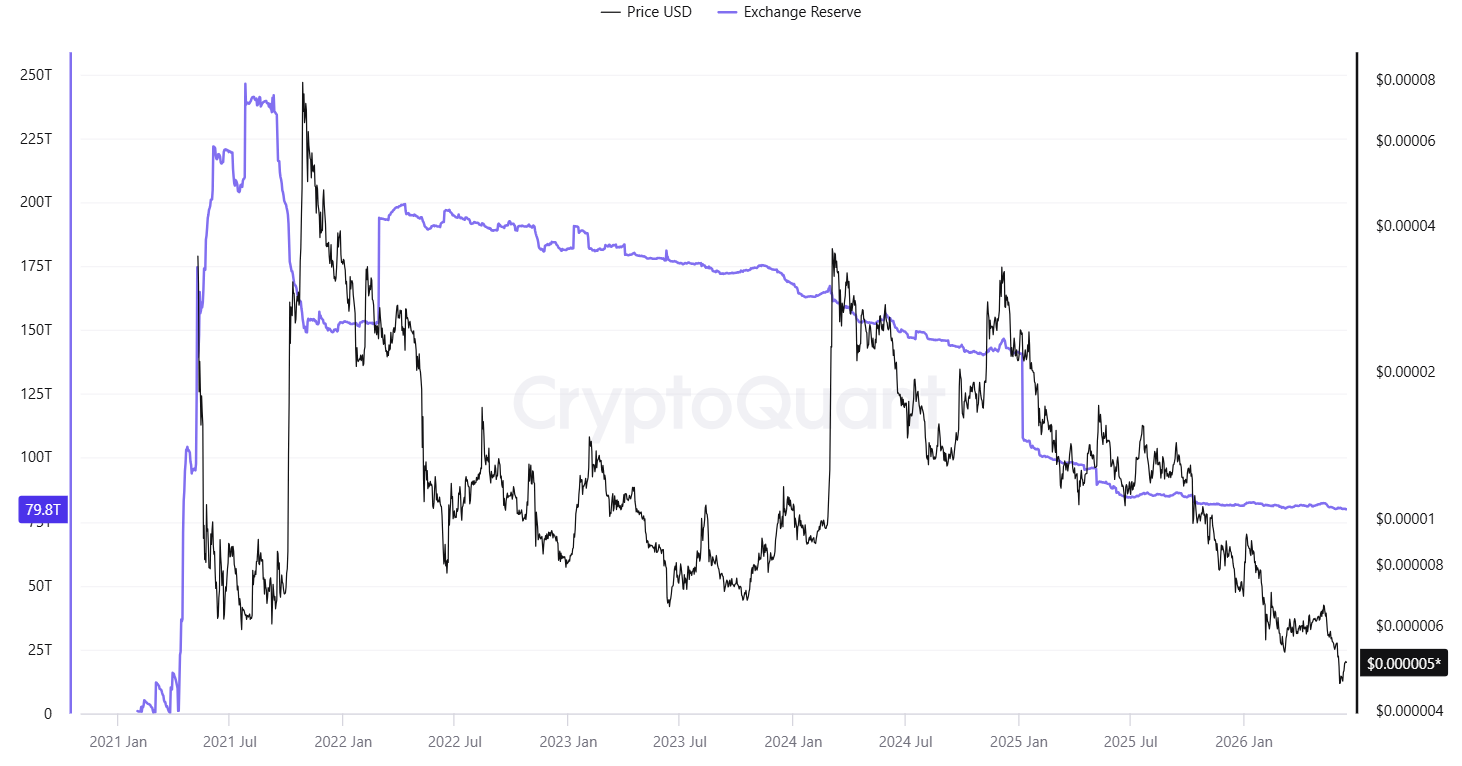
CryptoQuant’s data shows that the amount ot tokens stored on crypto exchanges has fallen to a five-year low of around 79.8 trillion. This trend points to investors moving away from centralized platforms in favor of self-custody methods, which, in turn, reduces immediate selling pressure.
Some analysts believe a price revival might indeed be in the cards. X user Nehal thinks that SHIB looks “dangerously ignored” at ongoing levels, adding that a 40-50% jump would not come as a surprise.
So Many Bearish Elements
The shrinking SHIB supply on exchanges is among the few positive signals for the meme coin, while many others suggest the price could collapse further in the near future.
The burn rate, for instance, has fallen by 62% over the past 24 hours, resulting in a negligible amount of tokens removed from circulation. The program’s ultimate goal is to increase SHIB’s value through scarcity, and over the past few years, the team and community have burned trillions of coins. Nonetheless, there are still around 590 trillion SHIB in circulation, which remains quite substantial.

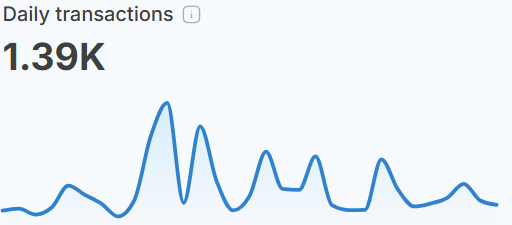
Another issue is Shibarium’s slowdown. The layer-2 scaling solution, launched in the summer of 2023 to boost speed, enhance scalability, and lower fees, initially handled millions of transactions. However, an exploit last year disrupted operations, and since then the figure has dropped significantly to mere hundreds and thousands.
The post Key Shiba Inu Metric Plunges to a 5-Year Low: SHIB Price Rally on the Way? appeared first on CryptoPotato.

Bitcoin miner IREN has finalized its acquisition of Spanish data center developer Nostrum Group, a step the company says accelerates its shift toward AI cloud services while expanding its presence in Europe.
In a press release issued Monday, IREN said the purchase brings roughly 490 megawatts of secured, grid-connected power in Spain, along with a development pipeline and a workforce of more than 50 employees spanning engineering, construction, development and operations. The deal also lifts IREN’s global secured power portfolio to about 5 gigawatts, with Spain accounting for around 10% of the total.
Key takeaways
- IREN’s acquisition of Nostrum Group adds about 490 MW of secured, grid-connected power in Spain and expands its European footprint for AI infrastructure.
- The company frames the move as part of a broader AI cloud pivot aimed at creating more contract-based revenue than crypto mining can deliver during volatile cycles.
- IREN’s quarterly financials show AI cloud revenue growing while Bitcoin mining revenue declined, reinforcing the strategy’s direction.
- The expansion places IREN alongside other Bitcoin miners investing in AI-related computing capacity in Europe, including HIVE Digital and Bitdeer.
A new foothold for AI infrastructure in Europe
IREN co-founder and co-CEO Daniel Roberts highlighted Spain’s mix of renewable generation and fiber connectivity, describing the country as a practical entry point to support growing European demand for AI computing and related infrastructure.
“Europe is one of the largest and fastest-growing markets for AI infrastructure, and Spain is among its most compelling entry points,” Roberts said in the company statement.
For investors, the key implication is that the Nostrum acquisition is not just about adding facilities—it is about adding grid-connected capacity that can be planned for AI workloads. In data-center economics, power availability and reliability often determine how quickly operators can scale compute demand, particularly when AI deployments require sustained electricity consumption.
Why IREN is moving beyond mining economics
IREN’s stated rationale ties the expansion to the company’s AI cloud strategy. As Bitcoin mining difficulty rises and Bitcoin price volatility continues to pressure mining margins, IREN argues that AI cloud offerings can provide more predictable, contract-based revenue.
The tension at the center of that argument is straightforward: mining remains IREN’s largest revenue contributor, but the company is clearly investing to reduce dependence over time.
That shift is visible in IREN’s reporting. According to the company’s results for the quarter ended March 31, Bitcoin mining remained its top source of revenue. However, AI cloud was already meaningful and growing faster than mining. IREN reported $111.2 million in mining revenue, versus $33.6 million from AI cloud services.
Quarterly results underscore the pivot
IREN said AI cloud revenue increased to $33.6 million in the quarter, up from $17.3 million in the prior quarter. Over the same comparison, Bitcoin mining revenue fell from $167.4 million. The company attributed the mining decline partly to lower average BTC prices and to the decommissioning of mining hardware.
Put differently, the gap between the two business lines is widening: AI cloud revenue is rising quarter over quarter, while mining is facing headwinds tied to market conditions and asset configuration changes.
IREN also disclosed that it had about 150,000 GPUs installed or on order as of March 31. In earlier reporting, Bernstein analysts suggested IREN could ultimately reduce much of its Bitcoin mining business as it retrofits existing sites for AI cloud infrastructure. Bernstein estimated that the company’s GPU footprint could support a $3.7 billion annual revenue run rate, based on their assumptions.
Part of a broader miner-to-AI infrastructure trend
IREN’s move aligns with a broader pattern among Bitcoin miners seeking to diversify into AI and high-performance computing. The acquisition comes as other players increase exposure to AI-related infrastructure in Europe.
HIVE Digital, for example, has been converting part of its facility in Sweden for AI computing, according to a Nasdaq press release. Bitdeer has also been developing AI data center capacity in Norway, based on its investor communications.
While these efforts differ in execution and scale, they reflect a common calculation: miners already control or procure power and compute-facing infrastructure, which can be repurposed for AI workloads. That said, the market still has to prove demand and pricing power. Even with secured electricity, AI cloud profitability depends on customer commitments, utilization rates, and the cost of deploying and operating large-scale GPU systems.
Next, readers should watch whether IREN’s AI cloud revenue continues its quarter-over-quarter growth as more capacity is integrated, and whether the company can convert its GPU pipeline into sustained contracted demand—especially as Bitcoin mining remains exposed to price swings and hardware lifecycle decisions.

Robinhood is reducing its workforce by 10% as part of a company-wide restructuring effort aimed at improving efficiency and execution, CEO Vlad Tenev said in an internal message shared by the company on X. The move is expected to impact roughly 290 employees out of approximately 2,900 full-time staff.
The announcement lands as Robinhood recently reported weaker-than-expected first-quarter results, with crypto trading described as a major drag due to sharply lower volumes year over year. Even so, the company framed the layoffs as a proactive step taken from a position of strength, citing record trading activity across multiple products.
Key takeaways
- Robinhood plans to cut 10% of its full-time workforce, expected to affect about 290 employees, while also closing a small number of remaining open roles.
- The company says the restructuring involves “flattening” its organizational structure and reducing management layers to improve performance and focus.
- Robinhood estimates $28 million in restructuring-related charges, including employee severance and benefits, plus share-based compensation costs, to be recognized in Q2 2026.
- Despite weak Q1 results, Robinhood points to record month-to-date average daily trading volumes across equities, options, and prediction markets.
- Crypto trading remains a key variable for transaction-based revenue, with Cointelegraph previously reported volumes down around 50% year-on-year.
A 10% cut tied to “flattening” the organization
Robinhood confirmed the layoffs on Tuesday via a statement on X attributed to the company, where CEO Vlad Tenev told staff that it would reduce its workforce by 10% of full-time employees. In his remarks, Tenev emphasized the need to avoid a “heavily-layered organization” as Robinhood attempts to scale its mission, and he urged teams to continuously raise their performance bar.
The rationale echoed restructuring explanations seen across the broader financial sector, and particularly among crypto-adjacent businesses that have faced cost pressure and shifting market conditions. Cointelegraph noted similar approaches from major crypto companies, including Coinbase’s workforce reduction and Block’s earlier job cuts tied to operational efficiency and organizational streamlining.
For investors and users, the key point is that this is not presented as a reaction solely to short-term earnings softness. Robinhood instead frames the change as an execution upgrade—one intended to make the organization faster and more accountable as trading activity moves through different market cycles.
How many jobs are affected, and what the company expects to cost
According to a Robinhood spokesperson speaking to Cointelegraph, the reduction is expected to affect about 290 employees. Robinhood currently has approximately 2,900 full-time employees, consistent with its reporting.
Robinhood previously reported about 2,900 full-time employees as of Dec. 31, 2025, according to its Form 10-K filing with the US Securities and Exchange Commission. In a separate Form 8-K filed on Tuesday, the company also stated that the reduction in force includes the closure of a small number of remaining open roles across the business.
Financially, Robinhood estimated total restructuring-related charges of about $28 million. The company said roughly $20 million would relate to employee severance and benefits, with about $8 million tied to share-based compensation costs. Robinhood expects to recognize these charges in the second quarter of 2026.
“Business has never been stronger,” despite soft results
In its announcement, Robinhood said it is taking the action from a position of business strength. The company cited June month-to-date average daily trading volumes reaching record levels across equities, options, and prediction markets.
Tenev described the company’s position as “never been stronger,” and suggested the workforce reduction is intended to improve execution and sharpen organizational focus. Robinhood also said it would continue hiring selectively, invest in top-tier talent, and “utilize frontier technologies” to improve performance.
While the company did not explicitly tie the restructuring to artificial intelligence initiatives, it did indicate an ongoing commitment to modernizing how work is done—language that will likely be watched closely by both job seekers and market participants as Robinhood’s cost structure evolves.
Crypto volumes remain a pressure point for transaction revenue
Even with Robinhood’s claims of strong trading activity in other areas, its first-quarter performance did not meet analyst expectations. Cointelegraph reported that crypto trading was a key contributor to that miss, pointing to volumes down roughly 50% year-on-year. That matters because crypto is closely linked to transaction-based revenue, which can swing noticeably when retail activity cools or volatility changes.
The broader implication for readers is that Robinhood’s financial outcomes may continue to depend on how quickly crypto markets stabilize relative to other parts of the platform. The company’s ability to offset crypto softness with momentum in equities, options, and emerging products such as prediction markets could determine whether this restructuring translates into more resilient earnings.
At the same time, the layoffs themselves may influence how Robinhood allocates resources across product lines. If transaction activity is uneven across categories, cost control becomes more than an internal efficiency exercise—it becomes a strategic hedge against future volatility in specific revenue streams.
What to watch next
Investors should monitor Robinhood’s next quarterly update for whether the $28 million restructuring charges and the “flattened” operating model improve operating leverage, and whether crypto volumes recover enough to narrow the gap between trading strength in other markets and continued weakness in digital assets.
Crypto World
BlackRock Launches BITA, a Covered-Call Bitcoin ETF Designed to Generate Monthly Income


BlackRock this week listed the iShares Bitcoin Premium Income ETF (BITA) on Nasdaq, extending its spot-bitcoin franchise into structured-income territory by overlaying a covered-call strategy on top of its flagship IBIT fund. The fund began trading on June 9, with bitcoin priced at $61,825.37 per… Read the full story at The Defiant

Coinbase CEO Armstrong Calls Accredited-Investor Rules a 'Regressive Tax'

Book Review: Outlasting the War on Terror in Iraq
Very Quietly, A Vikings O-Lineman Has Been Gaining Ground for Job Opening


-

 Business2 days ago
No Jackpot Winner as $257 Million Prize Rolls Over to $269 Million Monday Draw
-

 Crypto World5 days ago
Oppenheimer backs SpaceX as $70 billion retail frenzy builds
-

 Fashion4 days ago
Weekend Open Thread: Tuckernuck – Corporette.com
-

 Crypto World5 days ago
Markets Rally as SpaceX IPO Looms Amid Iran Tensions and Inflation Surge
-
 Crypto World2 days ago
Zimbabwe Requires Crypto Businesses to Register Annually Under New FIU Regulations
-

 Tech4 days ago
NanoClaw integrates JFrog registries to secure AI agent downloads
-

 Tech4 days ago
This Week In Security: Microsoft On Microsoft, Register Your Domains, Linux On ARM, And FreeBSD Joins The File Cache Club
-

 Crypto World3 days ago
Bitget enters Argentina’s regulated crypto market through PSAV registration
-

 Business7 days ago
Thailand Ranks Second Worldwide for AI Adoption Growth, Microsoft Reports
-
 Tech5 days ago
Dutton Ranch star claims they ‘didn’t see any disruption’ on set following Chad Feehan’s exit from Yellowstone spinoff fueled by Taylor Sheridan clash rumors
-

 NewsBeat5 days ago
El Nino has formed in the Pacific and could set records, forecasters say
-

 Politics5 days ago
Politics Home | Healey Resignation Is “Colossal Failure Of Government”, Says Former Labour Defence Secretary
-

 Tech6 days ago
‘This is Seattle’s position on AI’: City Council votes unanimously to pause big new data centers
-
 Entertainment5 days ago
Donnie Wahlberg & More Heat Up Las Vegas at Circa’s Barry’s Downtown Prime
-
 Tech5 days ago
Opendoor Ends India Operations, Fueling a Bigger Conversation About AI and Outsourcing
-

 Sports5 days ago
First Time Since 1971: Australia Register Historic Low In ODI Cricket
-

 Politics5 days ago
Belfast burns, while Met chief points finger at Iran and Russia
-

 Business5 days ago
AT&T: Verizon's 27% Outperformance Sets Up A Solid Entry Point
-

 NewsBeat4 days ago
FBI searches office of Ohio voter registration group
-
 Tech5 days ago
Anthropic is spending $150M to embed 1,000 AI fellows inside nonprofits. No degree required.
You must be logged in to post a comment Login