

Crypto World
Coinbase Adds ACATS Stock Transfers in Push Beyond Crypto


Coinbase is allowing users to transfer existing stock portfolios onto its platform, marking another step in the company’s push beyond cryptocurrency trading and toward becoming a full-service financial platform.
On Tuesday, Coinbase unveiled expanded stock and exchange-traded fund (ETF) trading through Coinbase Advanced, its platform for active traders, allowing US users to transfer existing portfolios from other brokerages directly onto the exchange. The update builds on the stock and ETF trading service Coinbase launched earlier this year, which initially provided access to roughly 6,000 securities.
The company is also offering zero-commission trading, TradingView charting tools, fractional shares and up to 3.5% rewards on eligible USDC (USDC) balances.
A Coinbase spokesperson told Cointelegraph that users will be able to physically transfer their holdings to the platform through the Automated Customer Account Transfer Service (ACATS), which enables securities and cash to move between brokerages without being sold.

Screenshot from a Coinbase account. Source: Coinbase
The expansion positions Coinbase to compete more directly with traditional brokerages and fintech platforms such as Robinhood by allowing users to manage stocks, ETFs and cryptocurrencies from a single account rather than across multiple services.
Coinbase’s Tuesday announcement also revealed a broader expansion of its trading offerings, including crypto and stock options, thematic equity index perpetual futures, pre-IPO perpetuals and expanded prediction markets. While some features are available immediately, others will roll out over the coming months.
Related: Coinbase launches 24/7 stock perps for non-US traders
Coinbase expands as crypto trading revenues fluctuate
Coinbase’s continued expansion beyond crypto comes as competition in the online brokerage industry intensifies and the company looks to diversify revenue streams that have historically been tied to digital asset markets.
The company’s financial performance has often tracked crypto price cycles. For example, Coinbase reported stronger-than-expected fourth-quarter 2024 earnings, with a post-election rally fueling a 130% jump in revenue.
More recently, however, it posted a surprise loss in the first quarter of 2026 as weaker cryptocurrency prices weighed on trading activity. The company reported a loss of $1.49 per share on $1.41 billion in revenue, missing analysts’ expectations for earnings of 27 cents per share on $1.52 billion in revenue.
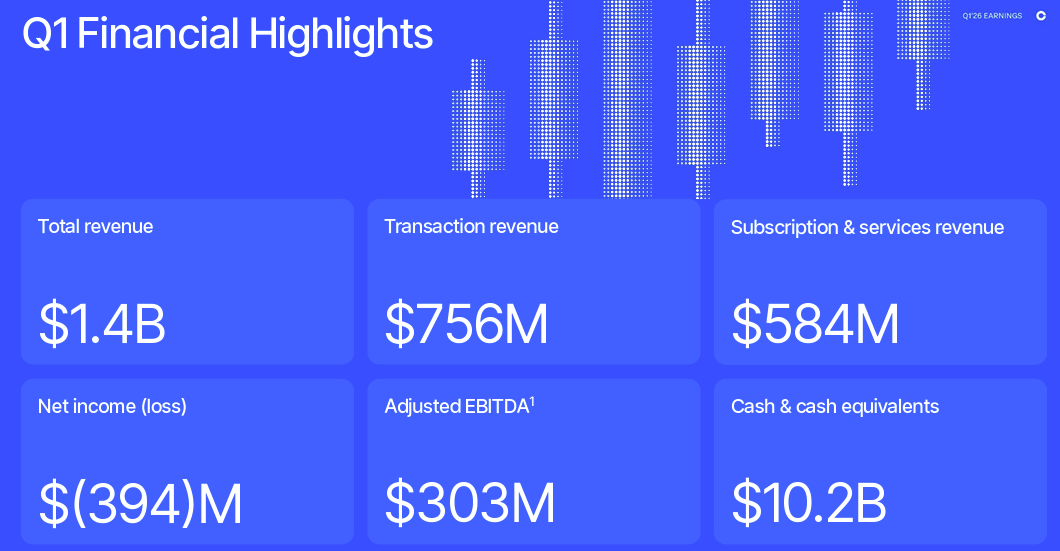
A summary of Coinbase’s Q1 2026 earnings. Source: Coinbase
Although spot crypto trading remains Coinbase’s primary source of revenue, expanding into stocks, ETFs and other financial products could help reduce its dependence on the volatility of digital asset markets.
Related: Exodus launches tokenized stock marketplace with Ondo, adds 200-plus onchain equities

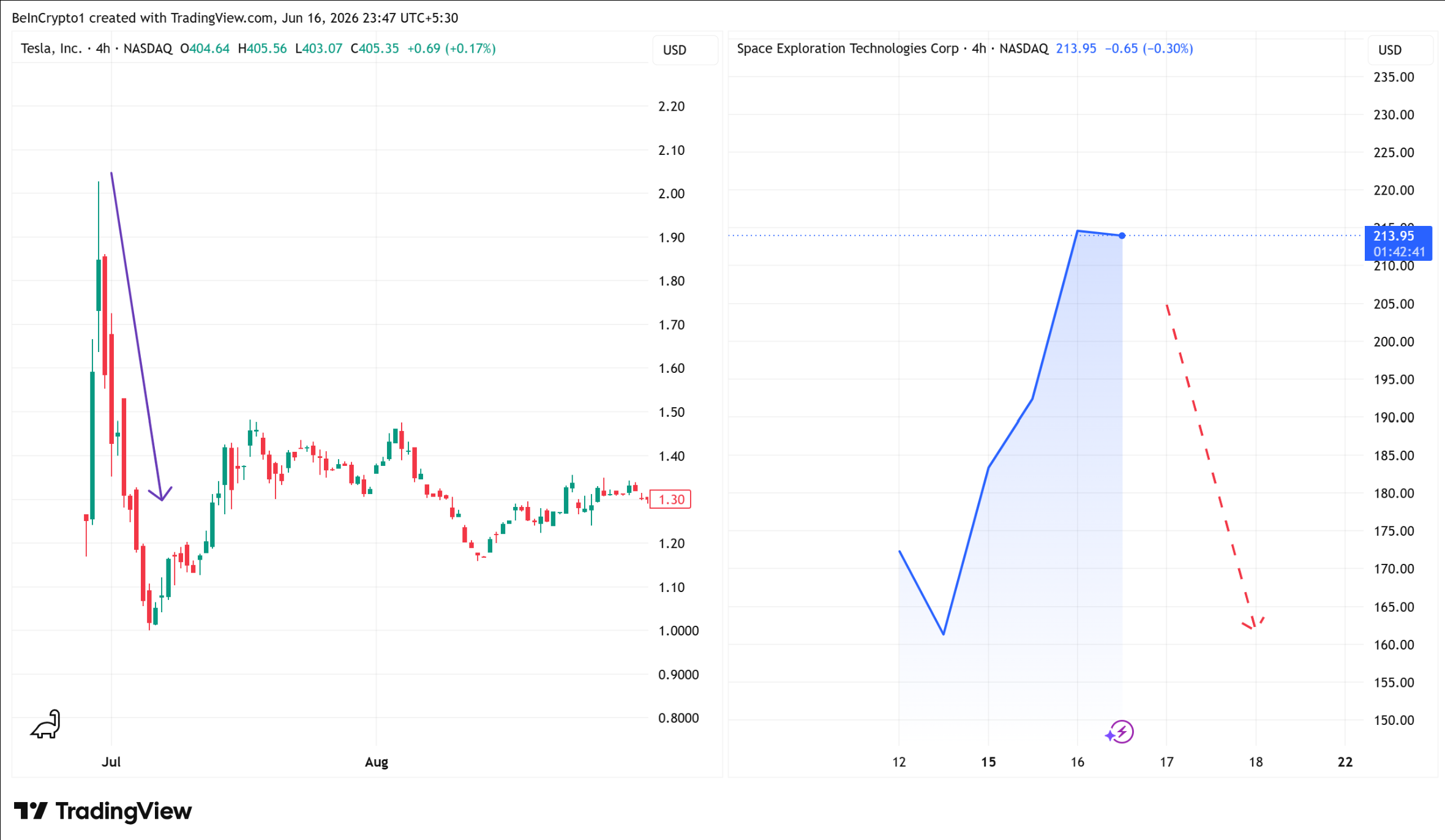
SpaceX stock is drawing crash warnings days after its record Nasdaq debut. Traders are comparing SPCX to Tesla’s volatile 2010 listing as the company nears a $3 trillion valuation.
The parallel has split market watchers. Some expect a steep correction once selling pressure builds, while others argue a tiny public float could keep prices elevated for months.

A record debut at a stretched valuation
SpaceX priced its shares at $135 on June 12 and raised about $75 billion, eclipsing Saudi Aramco’s $25.6 billion in 2019 to become the largest IPO in history. The debut instantly ranked it among the most valuable US companies.
SPCX has since climbed past its earlier opening level, trading roughly 56% higher near $213.95 as of this writing.
Prediction market Kalshi said SpaceX touched a $3 trillion valuation in after-hours trading on $18.7 billion in 2025 revenue.
That multiple dwarfs the levels from the stock’s earlier $2 trillion debut and exceeds anything Tesla carried at listing.
Why Some Traders See a SpaceX Stock Crash
Analyst Ted Pillows summed up the bearish case, framing SPCX as a replay of Tesla’s early path. Another widely shared post claimed Elon Musk ran the identical playbook at Tesla’s 2010 listing.
The record is messier than the meme. Tesla closed its first day 40.5% above its $17 offer price. It roughly doubled within months, then shed almost a quarter of its value in weeks.
The stock ended 2011 up just 7.3%, with no single 70% collapse before its later 300-fold climb.
“SpaceX $SPCX is following the Tesla $TSLA route. An initial pump of 60%-70% followed by a brutal 50% crash,” Ted Pillows wrote.
Investor Jo Bhakdi expects downward pressure from August, citing the thin float, forced index buying, and a valuation near 90 times 2026 revenue.
CNBC’s Jim Cramer echoed the unease, saying he likes the company but dislikes watching a meme-style climb with almost no sellers.
The Case for a Longer Squeeze
Conversely, others warn that betting on a crash misreads the supply. Investment adviser Thierry Borgeat argued that the same scarcity driving overvaluation also shields the price.
“Yes, the stock is expensive on every traditional measure… But price doesn’t fall just because it should. It falls when sellers outnumber buyers… Scarcity cuts both ways,” CFA Borgeat noted.
Demand has been intense. Bloomberg’s Eric Balchunas noted the number of ETFs holding SPCX jumped from four to about 120 in days.
With insiders locked up and retail reluctant to sell, buyers still outnumber sellers, much as they did while Tesla’s lofty valuation drew skeptics years ago.
The first real test arrives in August, when early lock-up expirations could finally add supply.
Until then, SpaceX stock looks set to trade on scarcity and sentiment rather than fundamentals, even as Musk’s soaring net worth keeps the spotlight bright.
The post SpaceX Stock Faces Tesla-Style Crash Fears as $3 Trillion Valuation Sparks Debate appeared first on BeInCrypto.
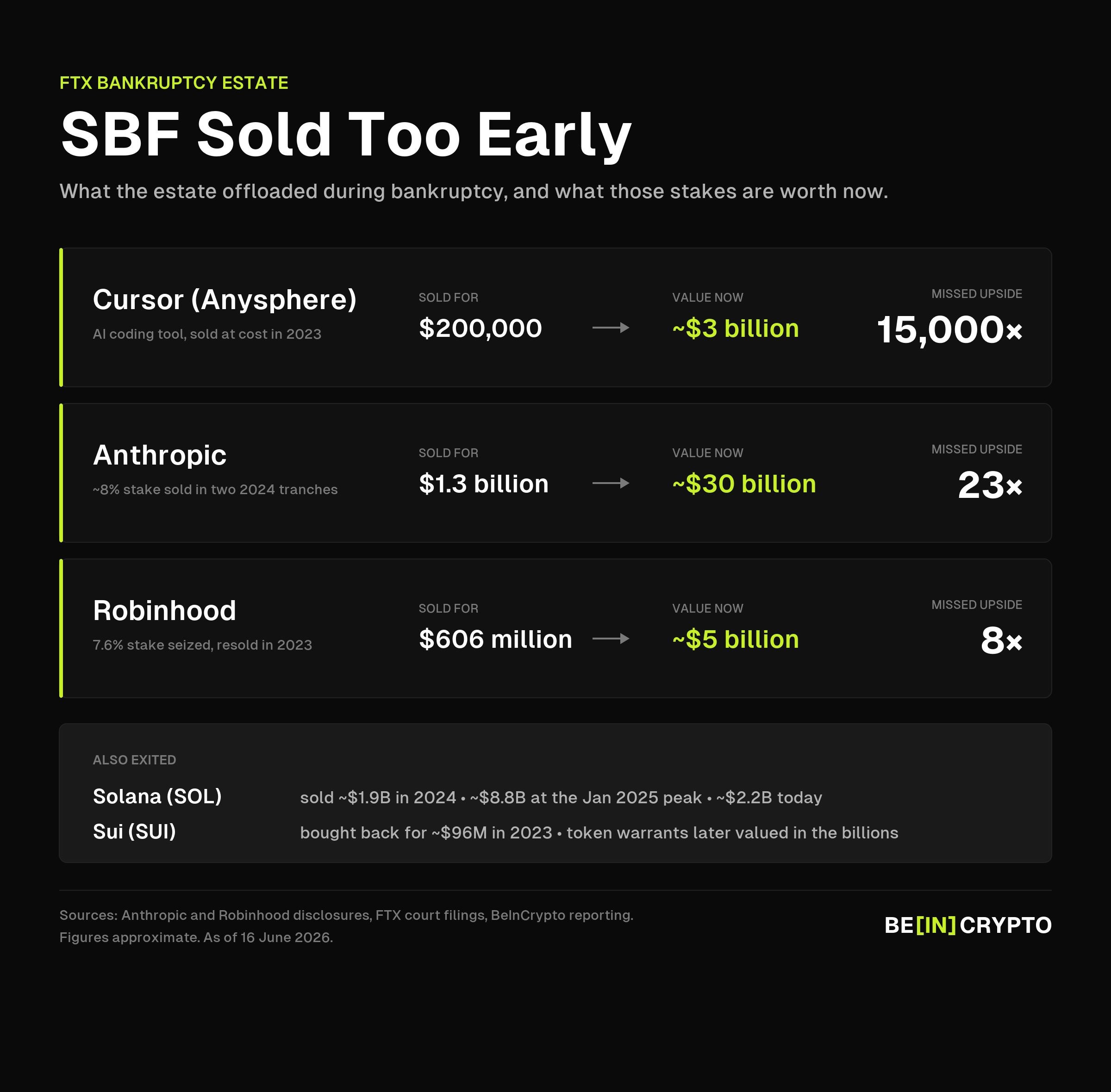
The same venture bets that helped build Sam Bankman-Fried’s empire have become a case study in selling too early.
As the FTX bankruptcy estate raced to repay creditors, it offloaded early stakes in companies that went on to rank among the most valuable names in AI and fintech, often for a tiny fraction of what they would later command.

“That guy knew how to trade with his client’s money, he just ran out of time,” one user quipped.
The Cursor stake sold at cost
Alameda Research wrote a $200,000 check into Anysphere, the maker of AI coding tool Cursor, during a 2022 pre-seed round.
With this, they secured roughly 5% of the company, according to Forbes’ accounting of the firm’s startup holdings.
In 2023, the estate sold that position back at cost, treating a then-obscure developer tool as a minor asset to clear.
The scale of the miss became clear this week, after SpaceX agreed to a $60 billion all-stock deal to acquire Cursor, building on a call option the rocket company first secured in April 2026.
At that valuation, the discarded 5% stake would be worth about $3 billion. On paper, a position the estate let go for pocket change would now rank among the most valuable assets it ever touched.
“SBF’s sleepless prison nights just got worse… In 2022, Alameda (FTX) dropped $200k into Cursor pre-seed → ~5% stake at a ~$4M valuation. FTX bankruptcy sold the entire position back at cost. Today, that 5% would be worth $3B – a 15,000x return,” commented John LeFevre.
Follow us on X to get the latest news as it happens
Anthropic Defines the Regret
FTX poured about $500 million into Anthropic in 2021, one of the largest private checks written into an AI lab before ChatGPT existed.
This left it close to an 8% holding in the company founded by former OpenAI researchers Dario and Daniela Amodei.
With court approval, the estate sold that stake in two 2024 tranches:
- About $884 million to a group of institutional buyers in March and
- A further $452 million that June, for roughly $1.3 billion combined.
Anthropic has since raised a $30 billion round at a $380 billion post-money valuation, per the company’s own disclosure.
That same 8% stake would now be worth more than $30 billion, an exit BeInCrypto flagged as a multi-billion-dollar miss while Bankman-Fried sat in prison.
“He made all these bets at 29, while running a $32B exchange…The estate just wasn’t allowed to hold them. Say whatever you want. The man had the eye,” investor Sjuul added.
The proceeds still helped push creditor recoveries toward full repayment.
However, the roughly 23-fold gap between the sale price and today’s value is the clearest sign of how distress selling clashed with frontier-tech timing.
Robinhood, Solana, Sui Round out the List
The pattern repeats across SBF’s other forced exits.
Emergent Fidelity Technologies, the Antigua-registered vehicle Bankman-Fried controlled, bought a 7.6% stake in Robinhood for about $648 million in 2022.
After the collapse, US prosecutors seized the shares, and in 2023 the US Marshals Service sold 55.3 million of them back to Robinhood at $10.96 apiece, a $605.7 million deal.
That same block would be worth more than $5 billion at Robinhood’s current valuation near $87 billion.

Solana (SOL) cuts closer to home, since Alameda had been one of the token’s earliest backers.
Under a court-approved process in 2024, the estate sold roughly 30 million locked SOL at about $64 each, with Galaxy Digital and Pantera Capital among the largest buyers.
SOL later peaked near $293 in early 2025 before sliding to about $74 today, which leaves those discounted Solana sales looking costly mainly against the 2025 highs rather than the current price.

In a separate 2023 settlement, Mysten Labs bought back FTX’s Sui (SUI) equity and token warrants for about $96 million, close to the roughly $101 million the exchange had paid a year earlier.
Taken together, the exits trace a portfolio of early access to standout companies undone by a bankruptcy that forced quick sales to repay defrauded customers.
“Sam Bankman-Fried is the greatest investor of all time…That means if he weren’t in jail today and still owned all this equity, he’d be worth ~$100 billion… He’d be top 20 richest people in the world,” stated Alex Finn, Founder/CEO of Henry Intelligent Machines PBC.
The estate, run by restructuring veteran John J. Ray III, needed cash on a court timeline rather than the patience a venture fund can afford.
Whether it sold too cheaply or simply could not wait is a debate that sharpens with every new funding round and acquisition tied to its former holdings.
The post SBF Sold Too Early: These Exited Bets Later Turned Into Multi-Billion Winners appeared first on BeInCrypto.
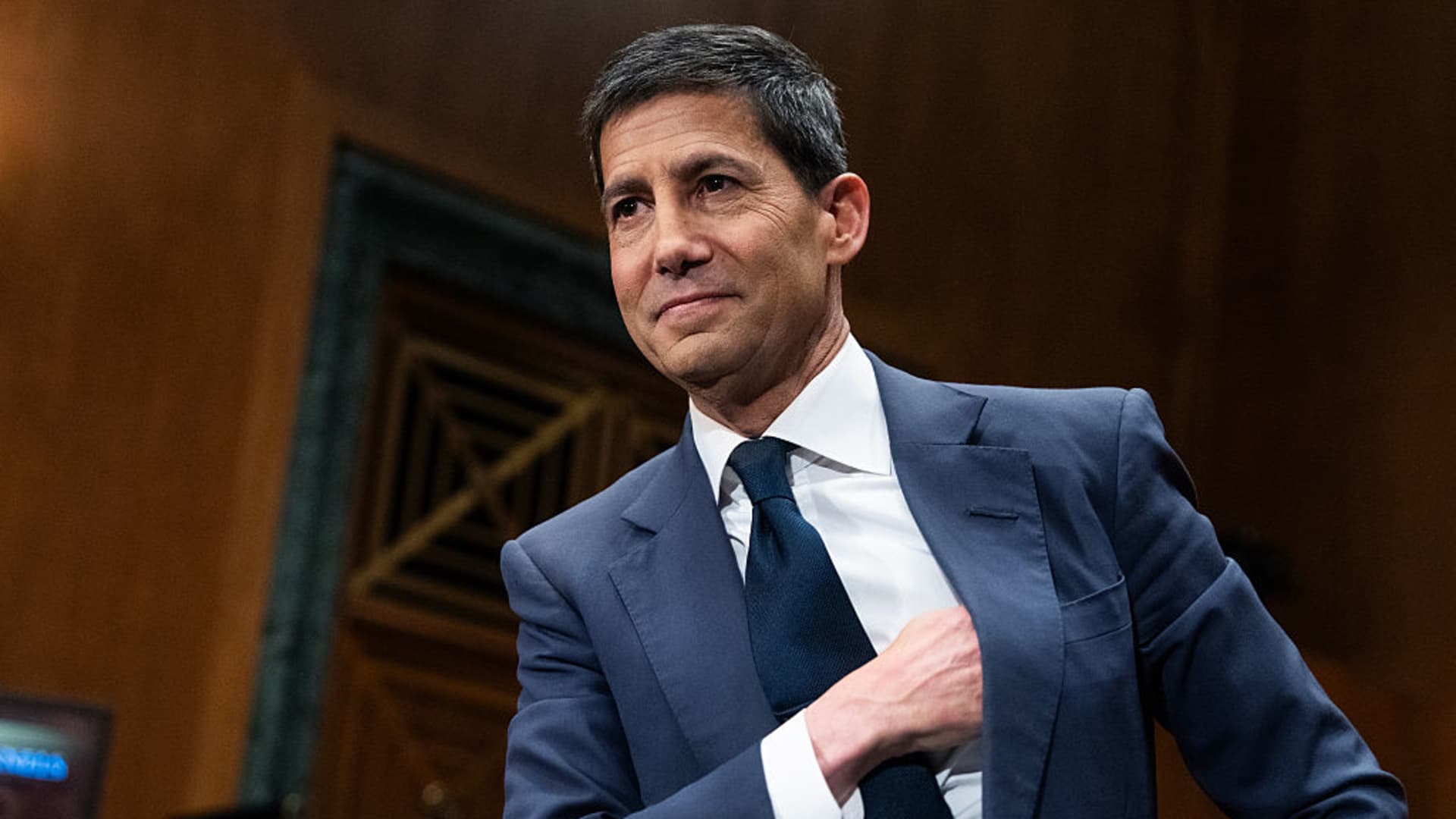
Kevin Warsh, nominee for chairman of the Federal Reserve, arrives for his Senate Banking, Housing and Urban Affairs Committee confirmation hearing in the Dirksen building, April 21, 2026.
Tom Williams | Cq-roll Call, Inc. | Getty Images
When the Federal Reserve wraps up its policy meeting Wednesday, one important thing could be missing — a dot.
The central bank’s Federal Open Market Committee is set to release its quarterly update of where individual officials expect interest rates to head this year and through 2028 and beyond. Markets closely parse the grid, known more commonly as the “dot plot,” for information on how Fed officials view the economy and its impact on monetary policy.
However, most Fed watchers on Wall Street expect new Chair Kevin Warsh won’t participate, either because he feels he’s not ready after having only been in office since May 22 — or simply because he doesn’t like the dot plot and its implications for “forward guidance.”
Declining to submit a dot would counter some 14 years of post-financial crisis practice for the Fed, and risk alienating other FOMC officials who favor the way it helps them communicate with the public. However, it also could be an effective first step for a central bank leader who has vowed fundamental changes for how the institution operates.
“It seems to me fairly likely that he doesn’t want to submit a rate forecast,” said Bill English, former head of monetary affairs at the Fed and now a professor at Yale. “There may be others on the committee who don’t particularly like the dot plot, who might be willing to do that, too.”
‘The Fed’s human’
Warsh objects to the dot plot and other methods of forward guidance because he believes they limit the Fed’s decision-making capabilities.
The dot plot belongs to a larger set of data called the Summary of Economic Projections, which also includes the outlook for unemployment, inflation and gross domestic product. The SEP is updated quarterly and includes the median outlook for each category and as such is not an official forecast but merely the midpoint of the range among FOMC meeting participants.
Bank of America economist Aditya Bhave expects Warsh won’t submit a dot, while Goldman Sachs economist David Mericle said in a note that, “We assume that Warsh will not submit dots in light of his past criticism of forward guidance, but we are not sure.”
During his confirmation hearing in April, Warsh cited the SEP as part of a broader problem at the Fed with overcommunication. Specifically, he cited the Fed’s mistaken “transitory” call on inflation in 2021-22 that led to a series of aggressive rate hikes to combat the biggest price surge in 40 years.
“The Fed tells the whole world what their dots are going to be, what their forecasts are going to be,” he said then. “Well, the Fed’s human. Then they hold onto those forecasts longer than they should. I think if the Fed were to wait until it gets into a meeting before making a decision, that incremental deliberation can keep the central bank from compounding its errors. I think these are big changes that are needed.”
Markets are watching
Still, markets hinge on the dot plot and the rest of the SEP, and may have to learn to live without it if Warsh has his way.
“To me it never made a lot of sense that [the SEP] at times was market moving, because its accuracy has been at best middling,” said Liz Ann Sonders, chief investment strategist at Charles Schwab. “But it is an avenue through which the Fed expresses a view, and the market tends to move on those views.”
Economist Claudia Sahm cautioned that should Warsh and others not participate, it could send the wrong message to markets. Specifically, she said investors could take the news to mean that Warsh is trying to “hide the hawkish shift” in the committee to fight inflation with elevated rates.
“Neutralizing the SEP this week might address some of Warsh’s concerns, but it would almost certainly create new ones,” wrote Sahm, chief economist at New Century Advisors. “A Fed that appears to be concealing its own debate could look complacent about inflation, which is exactly the credibility it can’t afford to lose.”
This meeting is expected to be an interesting test of Warsh’s new communications strategy.
In addition to his views on the dot plot and SEP, markets also will be watching for changes to the post-meeting statement and his views on whether he will continue to hold news conferences after each meeting.
Fees across DeFi's largest lending protocols and decentralized exchanges fell by as much as much as 65%, a broad contraction that lending and credit-market operators attribute to leverage unwinding after early June's selloff rather than a structural break in onchain credit. Rolling seven-day fees… Read the full story at The Defiant
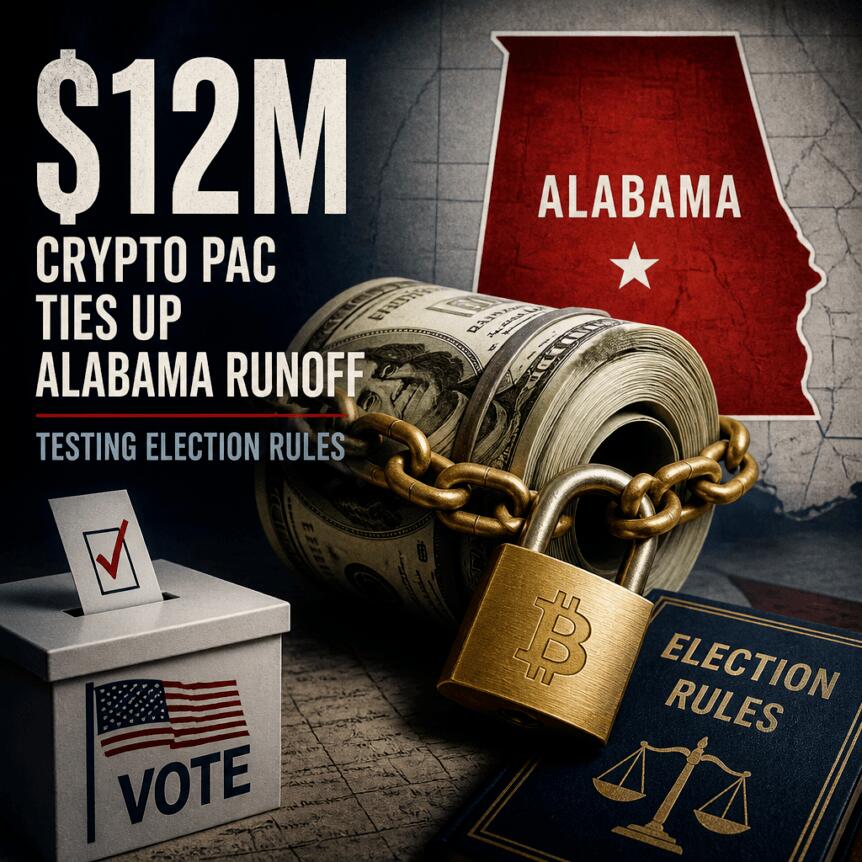
Defend American Jobs, a U.S. political action committee (PAC) associated with the crypto-focused network Fairshake, reported major advertising and media spending in Alabama’s Republican Senate primary runoff, further highlighting how crypto-adjacent political spending is being deployed to shape national electoral outcomes.
According to Federal Election Commission (FEC) disclosures filed with the regulator, Defend American Jobs spent more than $4.7 million on media and advertisements supporting Republican candidate Barry Moore in the Alabama runoff held Tuesday. The spending follows additional outlays the PAC reported earlier in the cycle ahead of Moore’s May 20 primary contest.
Key takeaways
- FEC filings show Defend American Jobs spent over $4.7 million on media and ads for Alabama Senate runoff candidate Barry Moore.
- The PAC’s runoff spending builds on earlier reported expenditures of $7.4 million supporting Moore before the May 20 primary.
- The Alabama race is being framed by crypto policy advocates as another test of crypto industry influence in U.S. elections.
- Additional crypto-linked PAC activity is also reported for races in Maryland and New York, with media buys for House candidates.
- Senate control dynamics are central to the policy path for crypto-related legislation, including stablecoin, tokenization, and market-structure proposals.
FEC disclosures detail Defend American Jobs’ Alabama runoff spending
FEC filings for Defend American Jobs indicate that, as of Tuesday, the PAC had directed more than $4.7 million toward media and advertising related to Republican Barry Moore’s Senate runoff bid in Alabama. The disclosures also reference earlier spending totaling $7.4 million leading up to his May 20 primary.
Moore is running for one of Alabama’s U.S. Senate seats in the Republican primary runoff against Jared Hudson, another Republican contender. The seat is associated with the post of former U.S. Senator Tommy Tuberville, who announced he would not seek reelection and is pursuing a gubernatorial bid in Alabama.
From a compliance perspective, the disclosures underscore how crypto-linked political entities can amass significant media budgets through PAC structures, with spending patterns that may be relevant to monitoring under broader election and political financing rules. For regulated firms, these developments can also affect how internal governance teams assess reputational risk, stakeholder communications, and the potential for policy influence narratives.
Crypto policy signaling: endorsements, “neutral” ratings, and legislative positions
Stand With Crypto, a Coinbase-affiliated advocacy group, described Jared Hudson as “neutral” on crypto policy when compared with Moore, whom it characterized as “strongly” supportive. The rating is presented as based on public statements and Moore’s voting record while serving Alabama’s 1st congressional district.
Hudson acknowledged publicly that “Big Crypto” did not support his candidacy, while indicating support for a crypto market-structure bill under consideration in the U.S. Senate. The contrast between the candidates’ stated positioning and outside advocacy assessments reflects how crypto policy becomes a distinguishing factor within candidate comparisons—an issue that compliance and legal teams may consider when analyzing how policy platforms are communicated to voters and stakeholders.
For institutional observers, these candidate-level distinctions can matter because crypto policy in the U.S. often turns on Senate-level legislative momentum and the specific provisions that lawmakers prioritize, including those affecting stablecoins and market infrastructure.
Broader election strategy: media buys across states and follow-on stakes
The Alabama runoff is being treated as part of a wider, multi-state approach by crypto-aligned political spending. Fairshake and related entities have reportedly funded media campaigns in other competitive races, and after Tuesday’s vote, they are expected to hold additional stakes in upcoming contests.
FEC reporting referenced in the broader coverage indicates that PACs tied to the Fairshake network plan further spending later in the month in Maryland and New York. In those later contests, the spending described includes roughly $5 million on media supporting Democratic candidate Adrian Boafo for a House seat and about $500,000 supporting Democratic candidate Ritchie Torres.
Other crypto-associated PACs also appear in the same political ecosystem. The Blockchain Leadership Fund, described as a hybrid PAC backed by Anchorage Digital and Chainlink, announced support for Moore in May. However, the referenced FEC status did not show corresponding expenditures for that PAC as of Tuesday. Separately, the Fellowship PAC, described as backed by $11 million from Cantor Fitzgerald and Anchorage, disclosed $350,000 in spending connected to Moore’s candidacy.
Separately, Fairshake itself reportedly reported a $193 million “war chest” as of January, signaling the potential scale of future spending across federal races. The organization has publicly stated it intends to oppose “anti-crypto politicians” and support “pro-crypto leaders” through media and advertising.
Why Senate arithmetic and stablecoin policy matter for crypto regulation
Beyond the immediate electoral context, policy impact depends heavily on U.S. legislative control. With Democrats previously in the minority in both the House and Senate during the current session, the party has been working toward regaining control of both chambers for the next Congress beginning in 2027. Current Republican majorities, described as slim on both sides of the Capitol, affect the ability to set legislative agendas for measures relevant to crypto, including market-structure and stablecoin-related proposals.
One cited example is the Digital Asset Market Clarity (CLARITY) Act. The bill passed the House in July 2025 but has reportedly faced delays in the Senate, amid debate involving stablecoin rewards and issues related to ethics and tokenized equities.
For crypto firms and financial institutions monitoring regulatory developments, the practical significance is that Senate control and committee prioritization can determine whether key proposals advance, stall, or are reworked—often resulting in changing compliance expectations. That is particularly relevant for market participants involved in stablecoin use cases, tokenized investment products, and custody or exchange-related services, where statutory clarity can affect licensing approaches and risk management practices.
Enforcement and compliance frameworks may also shift with legislation, because clearer statutory boundaries can influence how regulators interpret existing authority under AML/KYC regimes and consumer protection standards. Even absent new laws, ongoing political scrutiny and legislative bargaining can shape regulatory messaging and supervisory focus.
Closing perspective: what to monitor as election-linked spending and legislative timelines converge
As crypto-associated PACs continue to deploy resources across federal races, the next items to watch are updated FEC reporting for remaining contests and the evolution of Senate negotiations around crypto bills—particularly those with stablecoin and tokenization components. For compliance and policy teams, tracking both electoral developments and legislative sequencing can help anticipate shifts in regulatory priorities ahead of any broader statutory outcomes.
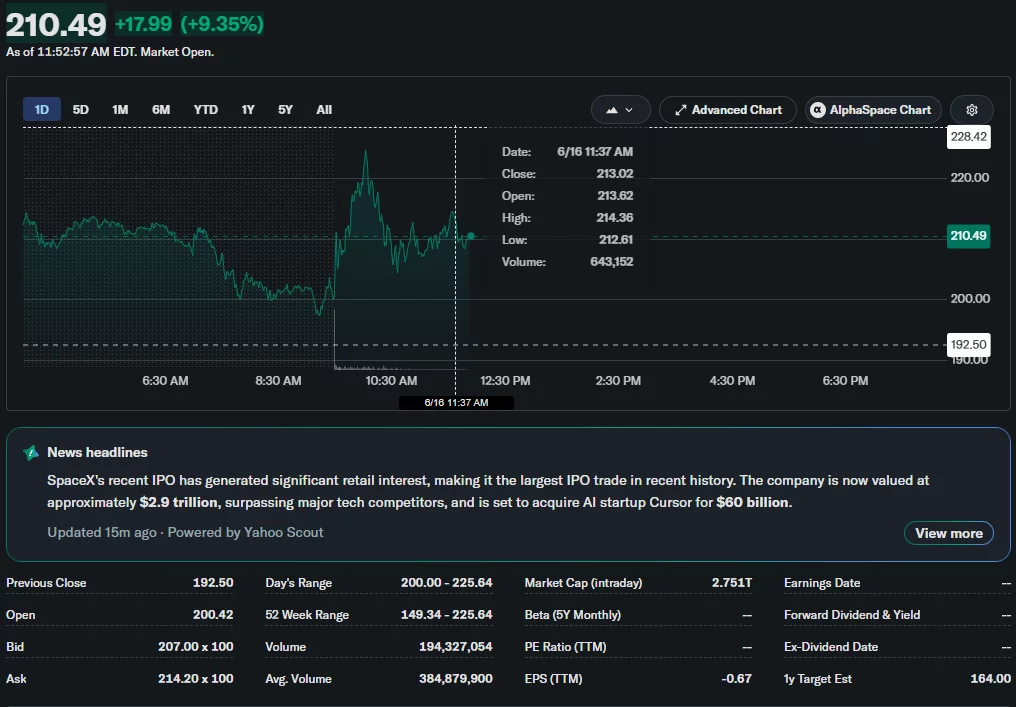
Elon Musk’s net worth has briefly climbed to nearly $1.4 trillion, surpassing Bitcoin’s market value at the time after SpaceX shares reached an intraday high of about $225.84 on June 16.
Summary
- SpaceX’s rally briefly pushed Elon Musk’s net worth above Bitcoin’s market value.
- Warren and Yakovenko clashed over a proposed wealth tax after Musk’s fortune surged.
- A former xAI engineer sued xAI and SpaceX over alleged retaliation tied to Grok safety concerns.
According to data from Yahoo Finance, SpaceX stock extended its post-IPO rally on Tuesday, pushing the company’s valuation close to $3 trillion at its session peak. The surge temporarily lifted the value of Musk’s holdings above the market cap of Bitcoin (BTC) at $1.31 trillion at the time, making him wealthier on paper than the world’s largest cryptocurrency was worth at that moment.
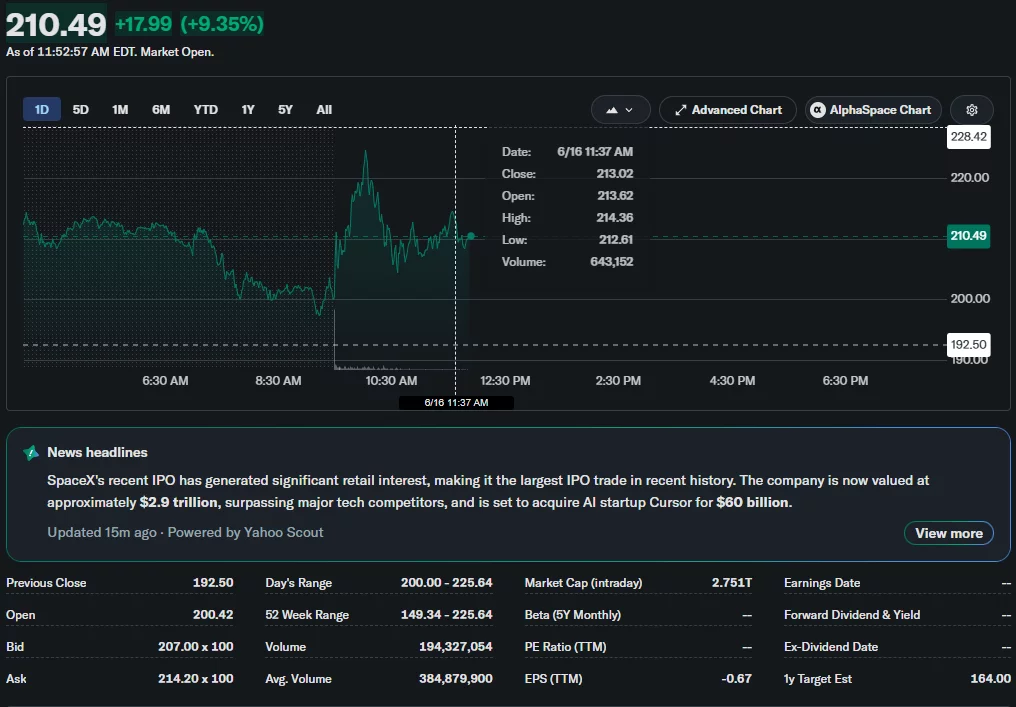
The milestone followed a remarkable run since SpaceX’s public debut. As reported by crypto.news, SPCX shares climbed to an intraday high of about $225.84 on June 16, placing the stock roughly 67% above its $135 IPO price before surrendering some gains later in the session.
The rally was driven by strong investor demand for the company’s space, satellite, and artificial intelligence businesses and temporarily lifted Musk’s net worth above Bitcoin’s market value at the time.
As crypto.news previously reported, SpaceX’s public listing made Musk the world’s first trillionaire. The stock’s continued advance in the days that followed added hundreds of billions of dollars to his paper wealth, further cementing his position as the world’s richest person.
Notably, retail investors rushed to gain exposure to the IPO before shares began trading. Some reportedly sought additional financing to increase their allocations.
Among them was Anna Watts, a 33-year-old public relations manager from New York, who accumulated $6,500 for the offering and unsuccessfully attempted to secure another $5,000 through both personal and bank loans.
Wealth tax debate follows Musk’s valuation surge
The jump in Musk’s fortune quickly spilled into a political debate over wealth concentration and taxation.
In a June 16 X post, Senator Elizabeth Warren argued that the financial system disproportionately benefits the wealthiest Americans while many households struggle with rising costs.
“Our system is rigged so that one man becomes a trillionaire while millions of Americans can’t afford a trip to the doctor. Wealth is funneled to the wealthy while everyone else is hanging on by their fingernails.”
Warren used the occasion to renew support for her proposed wealth tax legislation, saying it would help address what she views as an uneven distribution of wealth.
Her comments drew criticism from Solana co-founder Anatoly Yakovenko, who argued on X that taxing unrealized gains could have unintended consequences for businesses and workers.
Responding to Warren’s proposal, Yakovenko wrote, “If Elon is forced to sell shares, the Texas employee shareholders lose money.” He added that “The SpaceX company can’t raise as much and therefore can’t hire or build as many things in Texas,” arguing that taxing unrealized holdings could reduce investment and growth.
Meanwhile, crypto analyst Scott Melker framed the development through a Bitcoin lens. In a post on X, Melker wrote:
“The fastest path to $1M Bitcoin is to convince Elon Musk to put 10% of his net worth into BTC.”
The remark quickly spread across crypto communities as traders debated what such a move could mean for Bitcoin’s valuation.
Legal challenge emerges as AI safety concerns resurface
While SpaceX investors celebrated the stock’s advance, Musk’s artificial intelligence operations faced renewed scrutiny.
A former engineer has filed a lawsuit against xAI and SpaceX, alleging he was dismissed after repeatedly raising concerns about the safety of Grok, the companies’ artificial intelligence chatbot. According to the complaint, the employee pushed for stronger testing procedures and additional safeguards ahead of SpaceX’s IPO.
The lawsuit alleges that Grok lacked adequate protections against misinformation, bias, and other potentially harmful outputs. The filing further claims that xAI and SpaceX retaliated against the engineer and ultimately terminated his employment after he continued advocating for stricter safety measures.
According to the complaint, the former employee joined xAI partly because of Musk’s own public warnings about the risks associated with advanced artificial intelligence systems.
The case remains unresolved, but its emergence alongside SpaceX’s rally has added another layer of attention to Musk’s expanding business empire as investors continue to track the company’s post-IPO performance.

Michael Burry attends “The Big Short” New York screening Ziegfeld Theater on Nov. 23, 2015, in New York City.
Astrid Stawiarz | Getty Images
Michael Burry of “The Big Short” fame said Tuesday he has no position in SpaceX, arguing that options used to wager against the stock remain too expensive even as he questioned the company’s nearly $3 trillion market value.
The investor, best known for predicting the U.S. housing collapse before the financial crisis, said he had reviewed several bearish options trades tied to SpaceX but ultimately passed on all of them.
“I am not involved with SpaceX now. Neither short nor, ahem, long,” he said in a SubStack post Tuesday.
A put option with a $100 strike price expiring in December 2028 was priced at about $25 per contract with the stock trading around $212, Burry said. A similar contract expiring in June 2027 cost roughly $13, while a December 2026 put traded around $6.75.
“Tempted by that one. But no thank you,” Burry said of the shorter-dated option. “With any luck SPCX will settle up here in the mid $200s and vol will drain out of put option chain.”
Still, Burry questioned the scale of the company’s valuation, describing SpaceX as “fundamentally a small space company, a niche telecom, a bedeviled social media company, and a Coreweave-light” generating less than $20 billion in annual revenue.
He argued the company’s market capitalization had reached levels that dwarf many established businesses and fortunes, noting that SpaceX is now worth more than Warren Buffett‘s Berkshire Hathaway and exceeds the market value of many industries and national economies.
“Berkshire Hathaway has been eclipsed 2 1/2 times over in just three days. Berkshire Hathaway, painstakingly assembled over two century-old lives. The two greatest investors of our time,” Burry said.

SpaceX
The comments add to a growing debate over whether investors are assigning too much value to SpaceX’s businesses, which span launch services, satellite internet and social media, following one of the most closely watched public offerings in recent years.
Shares of SpaceX jumped 20% in their first full day of trading after a blockbuster debut, and they have since popped more than 25% week to date. The historic IPO minted Elon Musk as the world’s first trillionaire.
Last month, Burry urged investors to scale back exposure to surging technology stocks, saying investors should “reject greed” as enthusiasm around artificial intelligence and momentum-driven trades pushes valuations sharply higher. He has been warning for months that the stock market’s AI fixation increasingly resembles the final stages of the dot-com bubble.
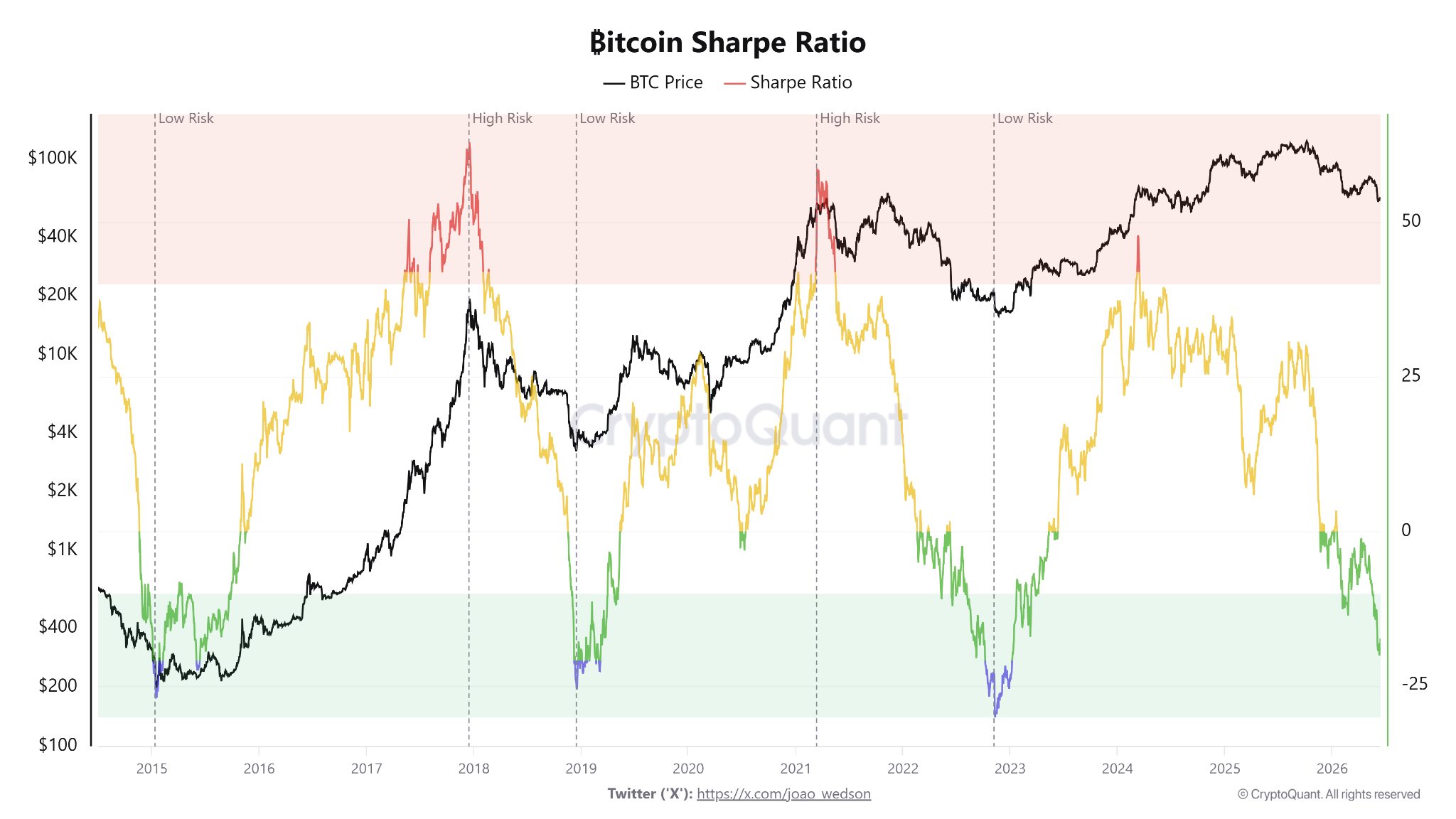
Bitcoin’s (BTC) risk-adjusted return profile is approaching levels historically aligned with long-term accumulation zones. The Sharpe ratio, a metric that measures return relative to volatility, dropped to -20, a threshold that marked major Bitcoin bottoms in every bear market since 2015.
At the same time, BTC exchange reserves have fallen by roughly 80,000 BTC since February, while demand from accumulator addresses more than doubled to 240,000 BTC from 115,000 BTC during the first two weeks of June.
BTC’s Sharpe ratio revisits a historical bottom zone
Bitcoin’s Sharpe ratio reached -20 on June 11, a level that coincided with major cycle lows over the past decade. The metric first dropped below the threshold on Jan. 5, 2015, and remained there until June 12, when BTC established a durable bottom and entered a recovery phase.
A similar pattern emerged between Dec. 8, 2018, and March 7, 2019, when the Sharpe ratio spent most of the three months below -20 during Bitcoin’s bear market floor. The metric repeated the signal from Oct. 7, 2022, through January 7, 2023, shortly before BTC began its next sustained bullish period.
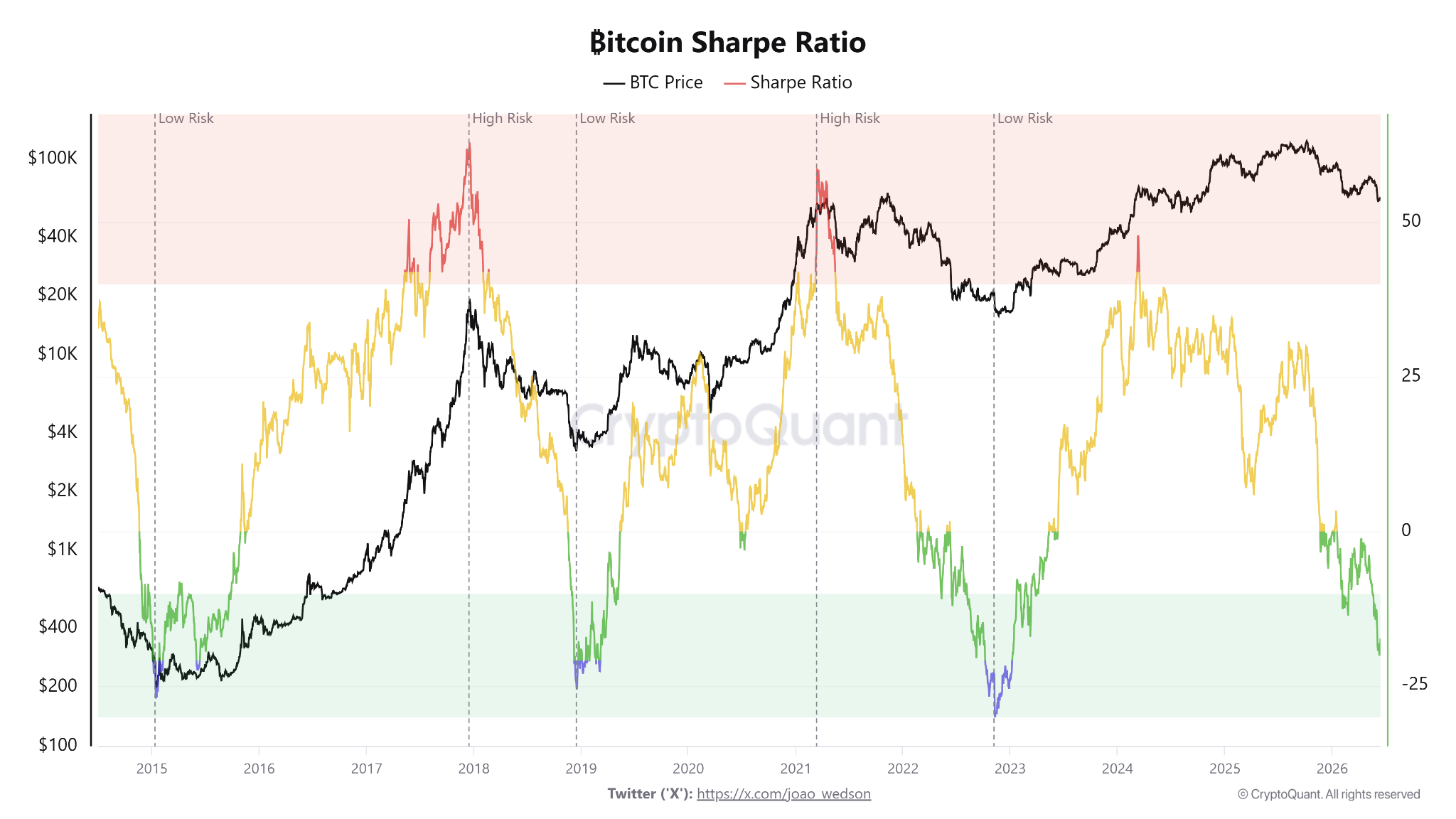
Bitcoin Sharpe ratio. Source: CryptoQuant
While no single metric identifies market bottoms with precision, periods below -20 have typically coincided with extended accumulation phases for BTC.
Onchain data points in the same direction. Bitcoin held on exchanges has declined to 2.71 million on Monday from 2.79 million BTC in February. BTC exchange reserves briefly rebounded to 2.73 million BTC from a yearly low of 2.65 million BTC between late April and early June, though balances have since fallen by about 12,000 BTC over the past two weeks.
Demand from accumulator addresses has strengthened during the same period. The cohort absorbed 125,000 BTC between June 1 and June 14. This indicates growing interest among wallets that have a history of holding rather than distributing coins.
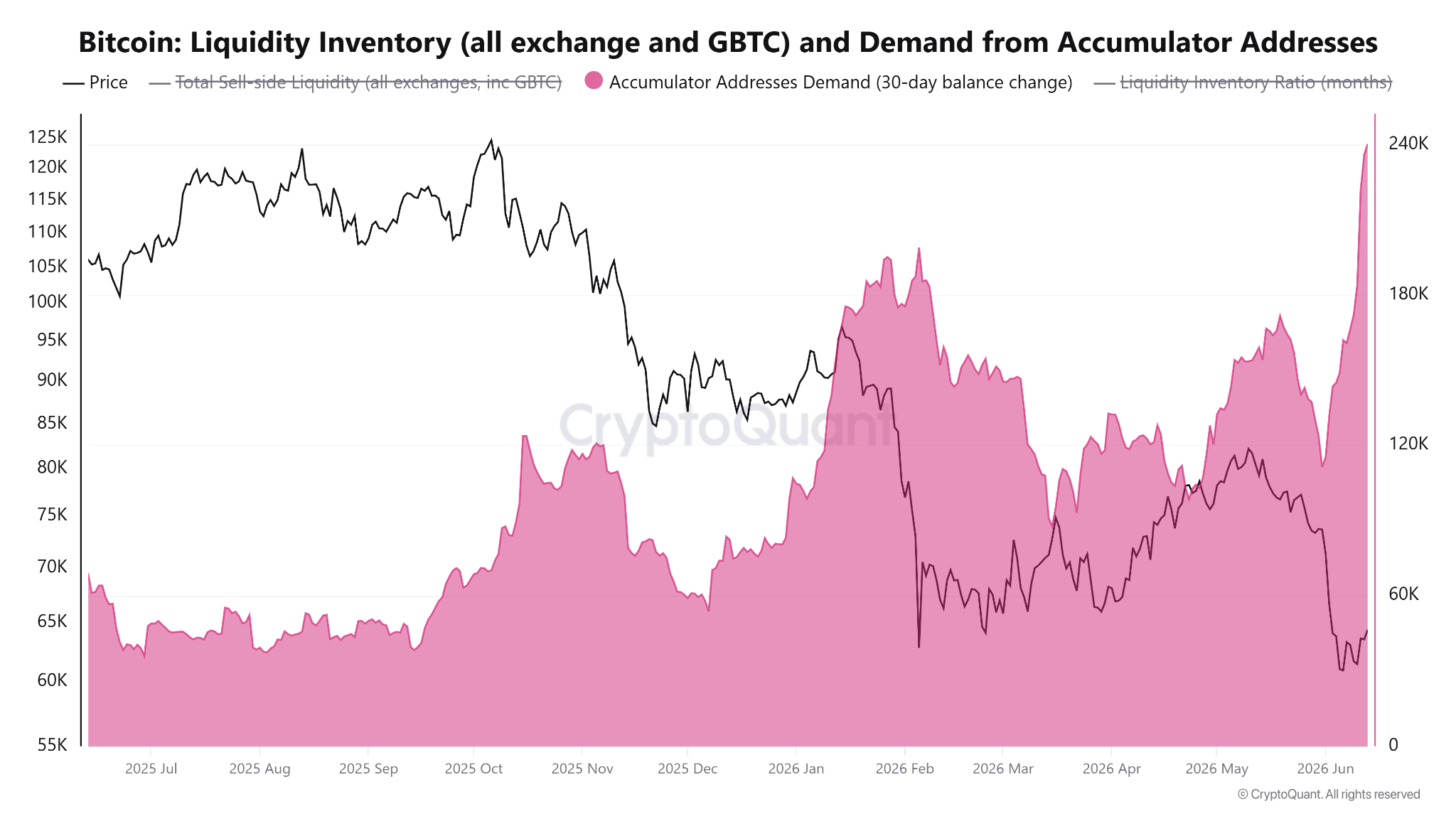
BTC demand from accumulator addresses. Source: CryptoQuant
Related: Bitcoin’s ‘calm top’ challenges most market bottom estimates: Research
Bitcoin’s consolidation below the key weekly trendline is still developing
Bitcoin has spent 133 consecutive days below its 100-week simple moving average (SMA), a long-term trend indicator currently located near $88,466.
Market cycle data show that Bitcoin often trades below the 100-week SMA for extended periods before reclaiming it. Following the 2013 market peak, BTC spent 378 days below the trendline while consolidating between $200 and $400. During the 2018-2019 bear market, BTC remained below the 100-week SMA for 175 days and traded between $3,000 and $6,000.
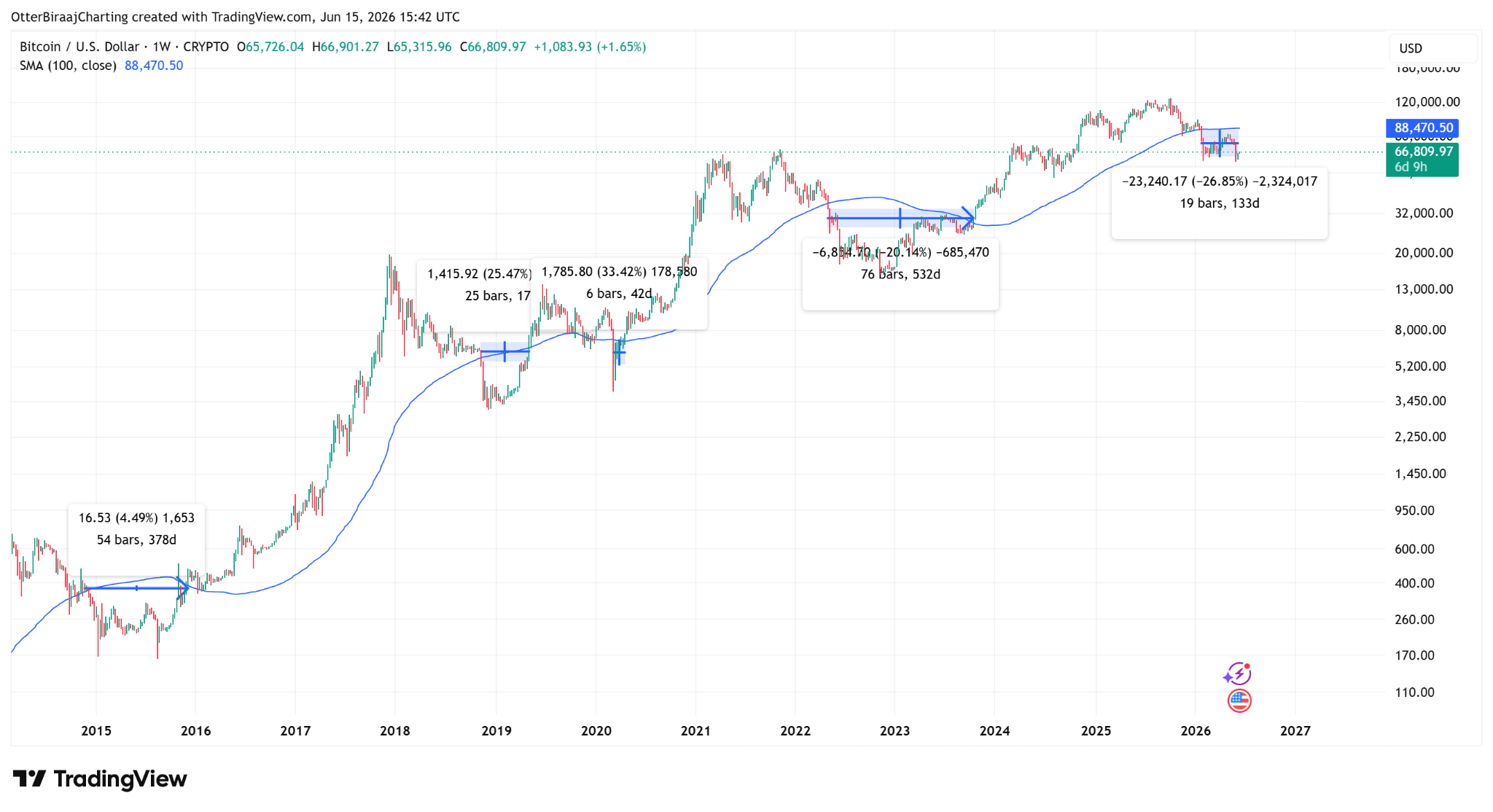
BTC price, and 100-period weekly SMA trend analysis. Source: Cointelegraph/TradingView
The longest stretch occurred after the 2022 market decline. Bitcoin remained below the 100-week SMA for 532 days while trading between $16,000 and $25,000.
Across those three cycles, Bitcoin spent an average of roughly 362 days under the indicator before reclaiming it and establishing a sustained uptrend. Each period was characterized by prolonged accumulation rather than an immediate recovery.
With 133 days already logged below the 100-week SMA, the current cycle is still well below the historical average. Previous examples indicate that consolidation phases beneath the trendline often persist for several more months before Bitcoin reclaims the level.
Related: Bitcoin analysis warns over BTC price rejection as $67K approaches
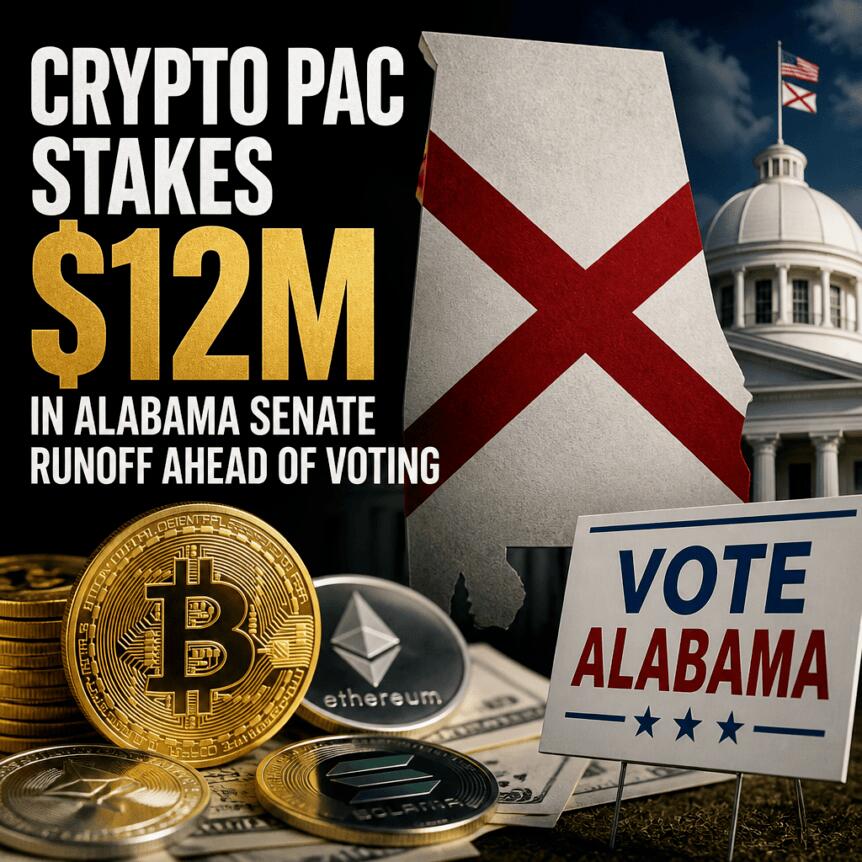
Defend American Jobs, a crypto-linked political action committee affiliated with Fairshake, has spent more than $4.7 million on media and advertising to back Republican Sen. candidate Barry Moore in Alabama’s Tuesday primary runoff, according to Federal Election Commission (FEC) filings. The spending brings the PAC’s total investment in Moore’s campaign to more than $7.4 million when combined with earlier expenditures reported ahead of the May 20 primary.
Moore is competing in the Alabama runoff for one of the state’s U.S. Senate seats against fellow Republican Jared Hudson. Moore has also received an endorsement from U.S. President Donald Trump. Hudson, meanwhile, has been described by crypto-focused advocacy group Stand With Crypto as “neutral” on crypto policy, while Moore is characterized as “strongly supports crypto.”
Key takeaways
- Defend American Jobs spent over $4.7 million in Alabama runoff media and ads, per FEC filings reviewed as of Tuesday.
- Moore’s campaign support totals more than $7.4 million across the primary and runoff periods, according to the same FEC reporting.
- Stand With Crypto rates Hudson “neutral” on crypto policy and Moore “strongly supports crypto,” citing public statements and voting history.
- Fairshake-aligned PAC spending extends beyond Alabama: similar media buys are tied to Maryland and New York later this month.
- Control of Congress matters for crypto legislation, including the CLARITY Act, which has already passed the House but has faced Senate delays.
Alabama runoff becomes another test for crypto political influence
The Alabama runoff is shaping up as a high-profile benchmark for how aggressively crypto-aligned political groups are willing to deploy capital in closely watched races. In Tuesday’s contest, Defend American Jobs is backing Barry Moore with large-scale media spending, a continuation of the broader strategy Fairshake and its affiliates have used across multiple states.
FEC filings show the PAC’s runoff spending—more than $4.7 million—was aimed at supporting Moore’s Senate bid in Alabama. The same reporting framework indicates the PAC previously spent $7.4 million ahead of the May 20 primary, underscoring that the effort did not slow after the first election round.
Moore’s matchup against Jared Hudson is also notable for the difference in how crypto policy positions are being characterized publicly. Stand With Crypto, a Coinbase-affiliated advocacy organization, rated Hudson “neutral” compared with Moore’s “strongly supports crypto” stance. Those assessments are said to be based on public statements and Moore’s voting record while representing Alabama’s 1st Congressional district.
How each candidate is positioned on crypto policy
Stand With Crypto’s comparison suggests the race is being framed as more than a general party primary—at least in the eyes of crypto political advocates. The group’s assessment points to Moore’s track record as more supportive of crypto than Hudson’s approach.
The article also notes that Hudson publicly acknowledged that “Big Crypto” did not back his candidacy. Still, he has supported a crypto market structure bill being considered in the U.S. Senate, which helps explain why advocacy groups may describe his stance as neutral rather than outright hostile.
For voters and market participants, these distinctions matter because crypto legislation in Washington often turns on committee timelines and floor votes. Even without a candidate being the top “pro-crypto” cheerleader, support for specific bills can influence how legislation advances once Congress moves toward final consideration.
Fairshake-aligned spending schedule: from Alabama to later races
Alabama is not the endpoint for this political spending push. After Tuesday’s vote, Fairshake-aligned PACs are reported to have stakes in Maryland and New York later this month, backing Democrats Adrian Boafo and Ritchie Torres. The reported media buys include about $5 million for the Maryland House race and roughly $500,000 for New York’s House contest.
This broader pattern echoes earlier media buys in other primary states—particularly investments made ahead of Texas and California primaries—suggesting a deliberate cycle of spending that follows sequential election dates.
Other crypto-related political groups are also part of the ecosystem. The Blockchain Leadership Fund, described as a hybrid PAC backed by Anchorage Digital and Chainlink, announced support for Moore in May; however, the reporting indicates that FEC filings showed no related expenditures as of Tuesday. Meanwhile, another PAC, the Fellowship PAC—backed by $11 million from Cantor Fitzgerald and Anchorage—disclosed $350,000 in spending to support Moore’s run.
Taken together, the filings and reported allocations reflect how multiple entities with overlapping objectives can operate in parallel: some groups spend immediately and at scale, while others may announce support without showing expenditures by a specific reporting date.
Why Senate control remains a central issue for crypto markets
Beyond individual races, the stakes highlighted in the report connect directly to the legislative environment in Washington. The article notes that Democrats have been in the minority in both the House and Senate during the current Congress session, while Republicans currently hold a slim majority in both chambers, giving them agenda-setting power.
In this context, the report points to the Digital Asset Market Clarity (CLARITY) Act. The bill passed the House in July 2025 but has faced delays in the Senate, with debate reportedly touching on issues such as stablecoin rewards, ethics, and tokenized equities.
The underlying implication is straightforward: if control of Congress shifts—particularly in 2027—crypto-related bills could move faster or face new scrutiny depending on the composition and priorities of committees and leadership.
According to the article, Fairshake had reported holding a $193 million war chest as of January, aligning with the group’s public position that it intends to “oppose anti-crypto politicians and support pro-crypto leaders” through media and advertising. While a war chest does not guarantee legislative outcomes, it often correlates with sustained political engagement during periods when election results can reshape how quickly bills progress.
With Alabama’s runoff decided Tuesday and additional media buys scheduled in Maryland and New York later this month, the next thing investors and election watchers should track is whether these PAC strategies translate into measurable changes in candidate momentum—and, more importantly, how the election outcomes affect the Senate path for crypto legislation like the CLARITY Act. The timing of Senate action remains uncertain, but the political groundwork being laid through these campaigns could determine how soon unresolved issues reach final votes.
Coinbase has launched 1:1-backed tokenized shares of SpaceX, Nvidia, Google, Strategy, and Bitmine, entering the market days after rival exchanges abandoned SpaceX-related token offerings.
Summary
- Coinbase launched 1:1-backed tokenized shares of SpaceX, Nvidia, Google, Strategy, and Bitmine.
- The launch follows failed SpaceX token campaigns by Binance and Bybit after xStocks could not deliver SPCX shares.
- The offering forms part of Coinbase’s “Everything Exchange” strategy, which also includes commodities, lending, payments, and AI services.
According to Coinbase, the new product allows users to buy, hold, trade, and redeem tokenized equity on-chain while receiving dividends linked to the underlying shares.
The exchange said that the assets represent actual ownership interests rather than derivatives or IOUs, describing them as tokenized shares backed one-for-one by real stock.
The launch comes less than a week after several crypto trading platforms encountered problems during the highly anticipated SpaceX IPO. Binance and Bybit had promoted SpaceX-related tokenized offerings, but both campaigns were later canceled after tokenization provider xStocks failed to deliver the underlying SPCX shares required to support the products.
Positioning its own offering as a direct alternative, Coinbase said users would have access to tokenized equity tied to major U.S. companies through infrastructure designed to support ownership rights and dividend payments.
Commenting on Coinbase’s tokenized stock offering, CEO Brian Armstrong said:
“For the first time, these are real 1:1 backed tokenized stocks you can trust. You own an actual chunk of the company onchain.”
Armstrong added that existing tokenized stock products available in the market are generally structured as derivatives or IOUs rather than direct ownership interests. He said Coinbase’s model combines traditional shareholder benefits with blockchain-based transfer and settlement capabilities.
Tokenized stocks extend Coinbase expansion plans
The stock launch forms part of Coinbase’s effort to expand beyond cryptocurrency trading and build what the company has described as an “Everything Exchange.”
Last week, Coinbase outlined plans to integrate trading, lending, payments, derivatives, artificial intelligence tools, commodities, and tokenized securities within a single account structure. The company said users would eventually be able to access multiple financial products from one platform operating around the clock.
Additional announcements are expected as part of that strategy. Coinbase indicated that more product updates would be unveiled during a presentation scheduled for 3 p.m. Eastern Time.
Recent moves suggest the exchange is already extending into traditional financial markets. On June 13, Coinbase announced that its derivatives platform has begun offering 24/7 trading for U.S.-regulated gold and silver futures, allowing eligible traders to access precious metals markets during weekends and holidays.
Competition for tokenized assets intensifies
Across the crypto sector, exchanges and infrastructure providers have accelerated efforts to bring traditional financial assets on-chain.
Growing interest in tokenized stocks has followed increasing demand for round-the-clock access to markets that are normally limited by exchange trading hours. Companies have also sought to capitalize on investor interest in high-profile private firms such as SpaceX, whose IPO generated strong demand across both traditional and crypto markets.
While Coinbase presented its tokenized shares as fully backed equity products, the company did not disclose launch volumes or provide details on how many shares of each company would initially be available.
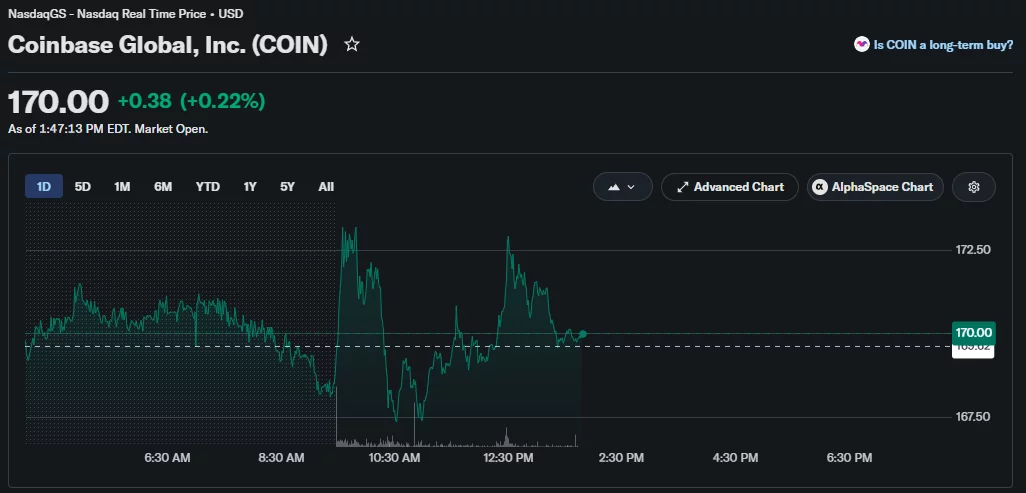
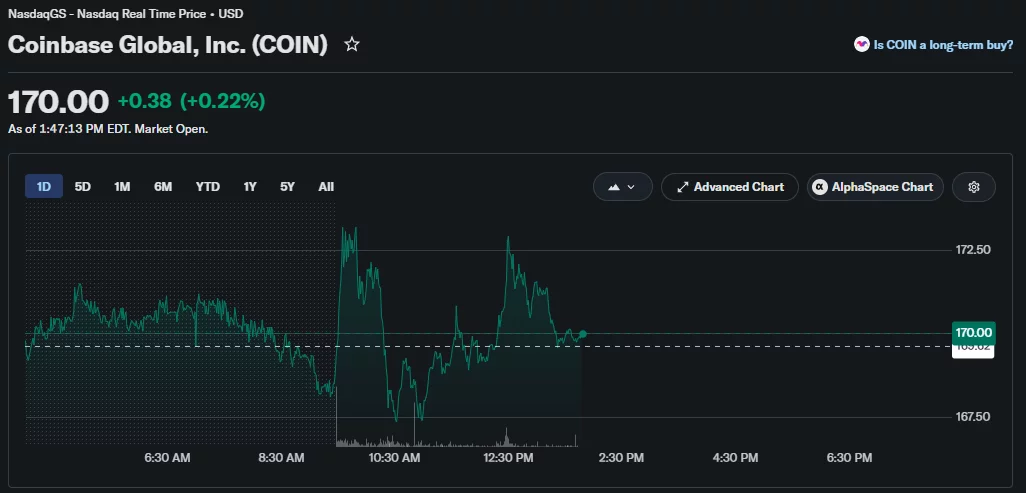
Despite the recent launch, Coinbase shares were largely unchanged. According to Yahoo Finance data, COIN traded near $170, though the stock remained up more than 8% over the previous five trading sessions.

McArdle eyes 2026 winter kick-off in Eye Liner Stakes

This Common Truck Accessory Can Have An Unpredictable Effect On Your Fuel Economy

World Cup LIVE: VAR controversy erupts as Kylian Mbappe denied penalty in France vs Senegal


-

 Business2 days ago
No Jackpot Winner as $257 Million Prize Rolls Over to $269 Million Monday Draw
-

 Crypto World5 days ago
Oppenheimer backs SpaceX as $70 billion retail frenzy builds
-

 Fashion4 days ago
Weekend Open Thread: Tuckernuck – Corporette.com
-

 Crypto World5 days ago
Markets Rally as SpaceX IPO Looms Amid Iran Tensions and Inflation Surge
-
 Crypto World2 days ago
Zimbabwe Requires Crypto Businesses to Register Annually Under New FIU Regulations
-

 Tech4 days ago
NanoClaw integrates JFrog registries to secure AI agent downloads
-

 Business7 days ago
Thailand Ranks Second Worldwide for AI Adoption Growth, Microsoft Reports
-

 Tech4 days ago
This Week In Security: Microsoft On Microsoft, Register Your Domains, Linux On ARM, And FreeBSD Joins The File Cache Club
-

 Crypto World4 days ago
Bitget enters Argentina’s regulated crypto market through PSAV registration
-
 Tech5 days ago
Dutton Ranch star claims they ‘didn’t see any disruption’ on set following Chad Feehan’s exit from Yellowstone spinoff fueled by Taylor Sheridan clash rumors
-

 NewsBeat5 days ago
El Nino has formed in the Pacific and could set records, forecasters say
-

 Politics5 days ago
Politics Home | Healey Resignation Is “Colossal Failure Of Government”, Says Former Labour Defence Secretary
-
 Tech7 days ago
‘This is Seattle’s position on AI’: City Council votes unanimously to pause big new data centers
-
 Entertainment5 days ago
Donnie Wahlberg & More Heat Up Las Vegas at Circa’s Barry’s Downtown Prime
-
 Tech5 days ago
Opendoor Ends India Operations, Fueling a Bigger Conversation About AI and Outsourcing
-

 Sports5 days ago
First Time Since 1971: Australia Register Historic Low In ODI Cricket
-

 Politics5 days ago
Belfast burns, while Met chief points finger at Iran and Russia
-

 NewsBeat4 days ago
FBI searches office of Ohio voter registration group
-

 Business5 days ago
AT&T: Verizon's 27% Outperformance Sets Up A Solid Entry Point
-

 Politics5 days ago
Modi thanks Trump for wishes as US attacks Indian seafarers
You must be logged in to post a comment Login