

Crypto World
Litecoin Spot ETF Sits at $9M as Altcoin-ETF Era Tests Its Demand Thesis



The first US spot Litecoin ETF has been trading for nearly eight months, and the price of the underlying asset has barely moved. Litecoin sits near $45, down roughly 89% from its $400-plus peak, even as Canary Capital's LTCC fund and a parallel SEC/CFTC commodity classification cleared the last… Read the full story at The Defiant

Crypto World
First Block, Onpharma Company, and Crito Capital Announce First Solana Sto for U.S. Medical Device Business

[PRESS RELEASE – London, United Kingdom, June 17th, 2026]
Landmark transaction brings real operating company equity to Solana-based tokenised capital formation
First Block deploys next-generation digital securities architecture for real- world operating business
Onpharma’s medical device technology for dentistry brings recurring revenue, high gross margins and a significant market opportunity to a tokenised capital raise
This offering is available for investment at sto.onpharma.com
First Block, Inc., a digital securities and tokenisation infrastructure company, together with Onpharma Company (Delaware) and UK-based Crito Capital LLP, today announce the launch of what is believed to be the first Solana-based Security Token Offering (“STO”) for an established U.S. operating business, a structural turning point in the modernisation of global private markets.
The Tokenisation Framework
The STO deploys Solana blockchain infrastructure combining atomic settlement technology, programmable ownership architecture, and digital distribution capabilities, structured within existing U.S. securities law. Where traditional private markets have struggled with fragmented, multi-intermediary processes, the tokenised framework enables issuance, settlement, and cross-border distribution to qualified investors quickly, transparently, and at low cost. Secondary transactions occur on-chain across compatible wallets subject to KYC controls, delivering near-instantaneous settlement, secondary trading liquidity, and international accessibility under Regulation S and other applicable frameworks.
The STO Structure
A Security Token Offering represents and transfers ownership rights in a company’s common stock via blockchain-based digital tokens rather than traditional share registers. The Onpharma STO is structured as a Regulation S offshore issuance to non-U.S. investors, combining the legal certainty of an exempt securities offering with the operational efficiency of Solana infrastructure, settling and distributing at speed and cost traditional private markets cannot match.
Onpharma: The Investment Case
Onpharma occupies a distinctive position in global dental technology. Its Onset EZ local anaesthetic buffering product is already used to buffer millions of dental injections annually, addressing the slow, uncomfortable, and unreliable performance of dental local anaesthetic that has remained largely unsolved for decades. The Onset EZ Pen requires no assembly or specialist training, integrating directly into existing workflows for an improved patient experience.
Onpharma sits at a post-validation, pre-scale inflection point: infrastructure, supply chain, regulatory compliance, and initial commercialisation are complete, while the growth phase is beginning. Septodont’s February 2025 market entry has validated anaesthetic buffering as an emerging standard of care, reducing category risk and increasing awareness. The disposable Onset EZ Pen provides operational leverage through scalable direct marketing, customer conversion, and repeat consumable revenue. The global dental anaesthesia buffering market is valued at $2bn and projected to reach $2.65bn by 2030. Capital raised will extend field sales and expand direct selling via the company’s recently deployed AI marketing tools.
The Infrastructure
First Block’s digital securities architecture underpins the transaction from issuance and compliance through to Solana-based settlement and distribution, compressing conventional private placement infrastructure, fragmented custodial arrangements, manual processing, multi-intermediary chains, into a single programmable, blockchain-enabled system built for the scale, speed, and wallet-level accessibility international investors increasingly require. Crito Capital LLP, an FCA-authorised investment banking and advisory platform focused on institutional capital formation, is providing structuring and advisory for the offering.
“This is larger than a traditional financing,” said Daniel P. Cannon, CEO of First Block. “We believe this transaction represents the beginning of the convergence between capital markets and Solana-based securities infrastructure. The STO itself is the story, but it starts with a real operating company, a real product, and exceptional revenue growth potential.”
“Onpharma has spent years building a real operating business around a simple clinical objective: making local anaesthetic better for dentists and patients,” said Matt Stepovich, Onpharma’s CEO. “This offering allows us to present a validated, revenue-generating medical device platform to a wider base of qualified international investors via a structure that reflects how capital markets are evolving. Combining Onpharma’s real-world commercial traction with First Block’s Solana-based securities infrastructure is an important step in making growth capital formation more efficient, accessible and transparent.”
Additional details regarding offering structure and participation frameworks are available on the landing page for the STO offering linked here – sto.onpharma.com
About First Block Inc.
First Block Inc. is a blockchain infrastructure and digital securities company focused on compliant tokenisation, STOs, real-world-asset digitisation and Solana-based settlement architecture for global markets.
About Onpharma Company
Onpharma Company develops dental technologies focused on improving local anaesthetic in dentistry. Its Onset EZ Pen buffering platform improves anaesthetic reliability, accelerates onset time, and makes the dental anaesthetic injection more comfortable.
About Crito Capital LLP
Crito Capital LLP is a UK-based investment banking and advisory firm authorised and regulated in the UK, focused on institutional capital markets, strategic advisory, and emerging fintech.
This press release contains forward-looking statements within the meaning of Section 27A of the Securities Act of 1933, as amended, and Section 21E of the Securities Exchange Act of 1934, as amended. Forward-looking statements include, without limitation, statements regarding Onpharma Company’s (the “Company”) business strategy, anticipated growth, market opportunity, product development, commercialization efforts, expected revenues, financing plans, digital asset initiatives, tokenization initiatives, regulatory matters, and future operations. These statements are based on current expectations, estimates, assumptions, and projections that involve significant risks and uncertainties, many of which are beyond the Company’s control. Actual results may differ materially from those expressed or implied by the forward-looking statements due to a variety of factors, including, without limitation, market conditions, regulatory developments, financing availability, competition, technological developments, product adoption, operational execution, and other risks and uncertainties. Forward-looking statements speak only as of the date of this press release, and the Company undertakes no obligation to update or revise any forward-looking statements except as required by applicable law.
This press release is provided for informational purposes only and does not constitute an offer to sell or a solicitation of an offer to buy any securities. Any offering of securities referenced herein will be made solely pursuant to definitive offering documents and in compliance with applicable securities laws and regulations. The offering referenced herein is intended solely for non-U.S. persons in offshore transactions pursuant to Regulation S under the Securities Act and is not directed to, or intended for, U.S. persons or investors located in the United States.
The post First Block, Onpharma Company, and Crito Capital Announce First Solana Sto for U.S. Medical Device Business appeared first on CryptoPotato.

TLDR:
- BTC open interest on Binance swung nearly $878M, from +$258M to -$620M within 24 hours.
- ETH Binance open interest dropped $821M, falling from +$131M to -$690M in under 48 hours.
- Bybit and Deribit also posted negative OI changes, confirming a broad cross-venue deleveraging.
- BlackRock’s IBIT and ETHA led spot ETF inflows even as derivatives exposure contracted sharply.
Bitcoin and Ethereum derivatives markets recorded a sharp synchronized open interest reset on Binance, the sharpest since April 2026.
BTC open interest change on Binance swung from +$258 million to -$620 million within 24 hours, a net reversal of nearly $878 million.
Ethereum followed almost simultaneously, with open interest change on Binance falling from +$131 million to -$690 million. Together, the two assets posted a combined Binance open interest swing of roughly $1.7 billion.
BTC and ETH Derivatives Exposure Contracts Across Major Venues
The Bitcoin open interest reset on Binance marked one of the sharpest single-day reversals recorded since April 2026.
The move from +$258 million to -$620 million represents a net swing of nearly $878 million over 24 hours. That scale of reversal reflects a meaningful shift in how traders were positioning across BTC derivatives.
Ethereum’s open interest change on Binance fell from +$131 million to -$690 million within a window of less than 48 hours.
The net decline came in at approximately $821 million, making it a near-mirror of what played out on the Bitcoin side.
Both moves occurred within the same narrow time frame, pointing to a coordinated reduction in derivatives exposure rather than isolated activity.
The reset was not confined to Binance alone. Other major derivatives platforms recorded negative open interest changes during the same period. Bybit posted approximately -$116 million on Ethereum, while Deribit recorded around -$78 million on Bitcoin.
Together, the cross-venue contraction adds further evidence that this was a broad derivatives deleveraging event. Position closures spanning multiple platforms and both major assets suggest traders were broadly reducing risk rather than rotating within specific markets.
Spot ETF Inflows Continue Amid Derivatives Pullback
On the spot market side, U.S. spot Bitcoin ETFs recorded total net inflows of $10.0643 million on June 16, according to SoSoValue data.
BlackRock’s IBIT led the Bitcoin ETF category, pulling in $16.3526 million in net inflows on that date. The inflow data shows continued institutional appetite for Bitcoin exposure through regulated products.
Spot Ethereum ETFs recorded total net inflows of $9.5876 million on the previous day. BlackRock’s ETHA led the ETH ETF category, recording $17.3358 million in net inflows.
The positive flows occurred even as derivatives positioning across ETH markets contracted sharply on Binance and other venues.
This type of synchronized open interest contraction typically reflects aggressive position closures, reduced leverage, or traders cutting risk after a heavily positioned market period.
It does not automatically confirm bearish price continuation. However, it does confirm that derivatives exposure across both BTC and ETH has been sharply reduced.
The divergence between declining open interest and continued spot ETF inflows presents a split picture across market structure.
Derivatives traders appear to be reducing risk, while ETF investors continue adding exposure through regulated channels. How these two dynamics interact in the near term will likely shape price behavior for both assets going forward.

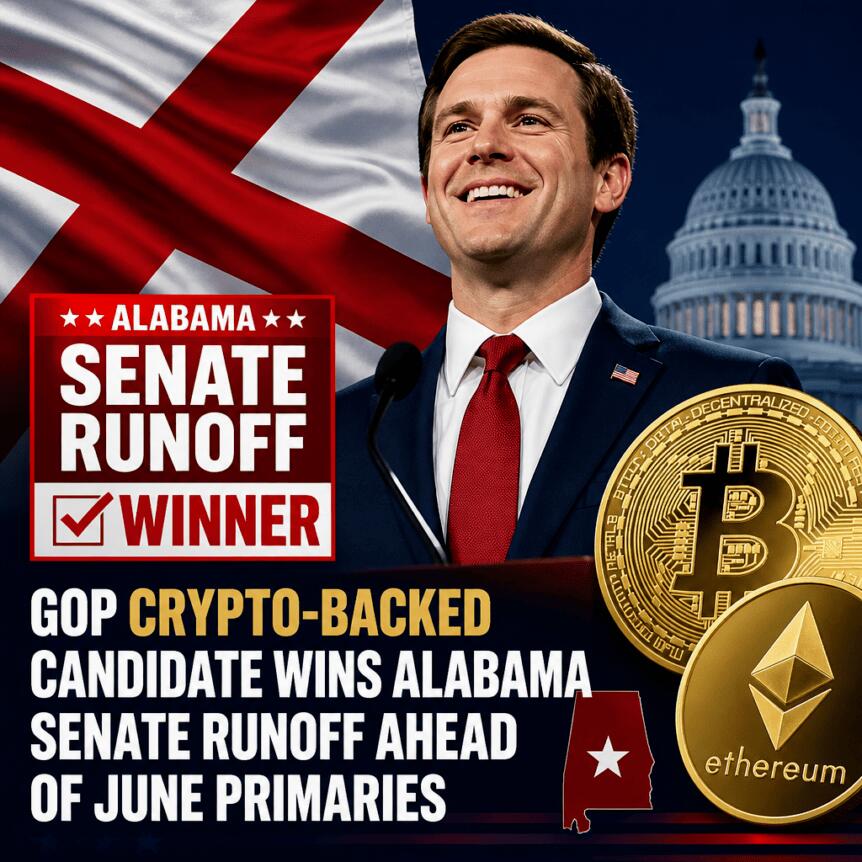
Crypto-linked political spending helped shape the outcome of Alabama’s U.S. Senate runoff, where Republican nominee Barry Moore defeated Democrat Everett Wess. The race hinged on advertising campaigns backed by industry-aligned political committees, according to Federal Election Commission (FEC) filings reviewed in reporting by NBC News.
Moore’s win came with him set to replace retiring Republican Sen. Tommy Tuberville. After no candidate secured a majority in the May 19 primary, the runoff took place Tuesday, with Moore winning 55.8% of the vote to Wess’s 44.2%, NBC News reported: https://www.nbcnews.com/politics/2026-primary-elections/alabama-senate-runoff-results.
Key takeaways
- FEC filings show Defend American Jobs PAC—affiliated with crypto advocacy group Fairshake—spent more than $12 million on media buys supporting Barry Moore in Alabama’s May primary and the Tuesday runoff.
- Stand With Crypto rated Moore as “strongly supports crypto,” citing his public statements and his voting record as Alabama’s 1st Congressional district representative.
- Fairshake spokesperson Geoff Vetter said the cycle’s spending helped secure another “pro-innovation” senator and referenced a large remaining cash position.
- Industry PAC spending is extending into additional primaries across multiple states ahead of the November general election.
FEC filings tie Fairshake-linked spending to Moore’s runoff
FEC records indicate Defend American Jobs PAC invested heavily in the Alabama contest. The committee, described as affiliated with cryptocurrency company-backed Fairshake, reported spending more than $12 million on advertising tied to Moore’s candidacy in both the May 19 primary and the Tuesday runoff.
Stand With Crypto, a Coinbase-affiliated advocacy organization, also weighed into the narrative around the candidate. It rated Moore as “strongly supports crypto,” attributing that assessment to his prior statements and voting record during his time representing Alabama’s 1st Congressional district.
In comments carried in the coverage, Fairshake spokesperson Geoff Vetter characterized the results as validation of the group’s strategy. “Our biggest spend of the cycle yielded yet another pro-innovation champion in the Senate,” Vetter said, adding that Fairshake believes it is positioned to keep pushing for crypto-friendly policy outcomes in Congress.
Fairshake signals a long runway after reporting a large cash position
Vetter’s remarks also put the Alabama results into a broader spending picture. Based on his statement, the Fairshake network and related affiliates may have deployed more than $40 million across several U.S. states to back candidates the group describes as “pro-crypto” ahead of the next legislative session.
That broader effort is supported by the committee’s reported financial position. The PAC reported holding a $193 million war chest as of January, according to the same coverage.
While Alabama’s runoff provides a high-profile win for the industry-aligned political wing, the more investor-relevant takeaway may be continuity: the existence of a substantial remaining cash buffer suggests this spending push is not a one-off event. Instead, it appears designed to support multiple races as election dates move forward.
Industry-aligned PAC spending expands to other primaries
Alabama is not the only state where crypto-aligned political committees have been active. Coverage notes that the runoff follows other primary contests in which industry PACs reportedly spent millions on media supporting candidates facing intra-party elections.
Fairshake affiliates have also been tied to House races in multiple states, with reporting citing Protect Progress—another Fairshake-linked entity—as having filed disclosure documents with the FEC. Those filings indicated media-buy spending totaling about $5.2 million and $587,000 for House seats, respectively, for Maryland Democrat Adrian Boafo and New York Democrat Ritchie Torres, according to FEC reporting referenced in the article. The primaries for those contests were scheduled for June 23.
That pattern underscores how crypto-linked political activity is increasingly concentrated around the primary phase—when candidates are selected within party structures—rather than waiting until November general-election matchups. For market participants, this matters because the primary election cycle can determine who ultimately holds negotiating leverage on crypto policy once Congress convenes.
What Moore’s win changes—and what remains uncertain
Moore’s victory gives the pro-crypto advocacy ecosystem a new potential legislative ally in the Senate as he prepares to take a seat expected to be vacated by outgoing Sen. Tuberville. His anticipated policy influence is likely to be watched closely by observers tracking the growing involvement of industry PACs in federal elections.
At the same time, several unknowns remain. A candidate’s stated stance and prior voting record—reflected in ratings like Stand With Crypto’s—does not guarantee how they will vote on complex legislation once in the Senate. The immediate impact will depend on committee assignments, coalition-building, and how political priorities evolve during the next session.
With additional primaries already set across the calendar, the next question for voters and industry watchers is whether similar spending and messaging translates into more wins for candidates viewed as aligned with crypto policy preferences—especially as the Fairshake network continues to indicate substantial available resources.
Readers should watch the next round of primary outcomes and subsequent FEC disclosures for how much ad spend is deployed, which races are targeted, and whether crypto-aligned PACs maintain the momentum signaled by Alabama’s runoff result.
Bitcoin has fallen back toward $64,000 after a hawkish Federal Reserve outlook erased a relief rally driven by easing Middle East tensions, with traders now debating whether support near $64,000 can prevent a deeper retracement toward June lows.
Summary
- Bitcoin fell from $66,315 to $64,103 after the Fed projected additional rate hikes for 2026.
- Liquidation heatmaps show major leverage clusters near $64K–$65K, increasing downside volatility risks.
- Analysts warn that weak spot demand and continued ETF outflows could expose the $60K support zone.
According to data from crypto.news, Bitcoin (BTC) climbed to an intraday high of $66,315 on June 17 before reversing sharply and dropping to as low as $64,103 during early June 18 trading.
The reversal followed the Federal Reserve’s decision to keep interest rates unchanged at 3.50%–3.75%, though policymakers surprised markets by projecting additional rate hikes in 2026. The announcement arrived just hours after reports of a preliminary U.S.-Iran agreement had fueled a risk-on move across crypto and equity markets.
Before the Fed decision, traders had welcomed news that Washington and Tehran were moving toward a framework that could reopen the Strait of Hormuz and ease pressure on global energy markets.
Oil prices had already retreated sharply from recent highs, helping risk assets recover. Bitcoin’s initial rally also triggered a wave of short liquidations, with more than $150 million in bearish positions forced out of the market as BTC price pushed above $66,000.
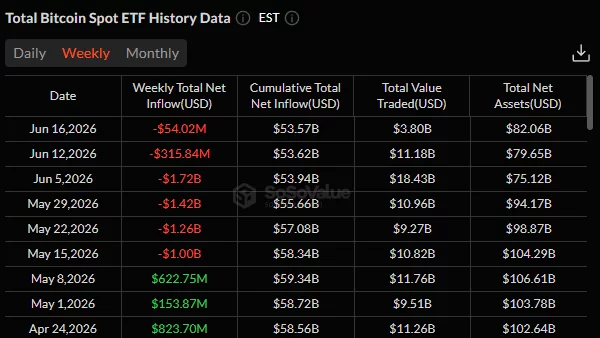
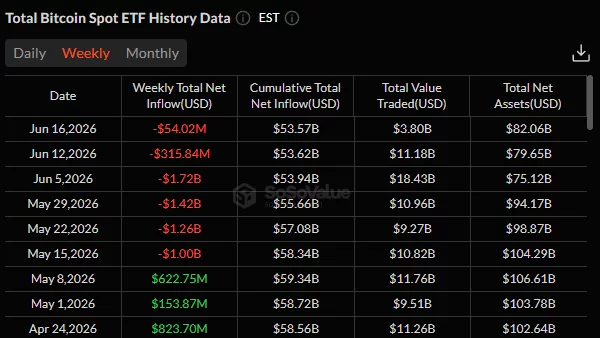
Away from macro headlines, institutional demand has remained under pressure. U.S. spot Bitcoin ETFs have continued to record net outflows over recent weeks, reducing a key source of structural demand that supported previous rallies.
Capital has also gravitated toward traditional risk assets, particularly artificial intelligence-related equities and newly listed high-growth companies such as SpaceX, which have attracted significant speculative flows from institutional investors.
Technical structure leaves Bitcoin trapped beneath major resistance
The daily chart shows Bitcoin’s rebound stalled almost precisely at the 78.6% Fibonacci retracement level near $64,230, calculated from the decline between the May peak around $82,939 and the June low near $59,136.
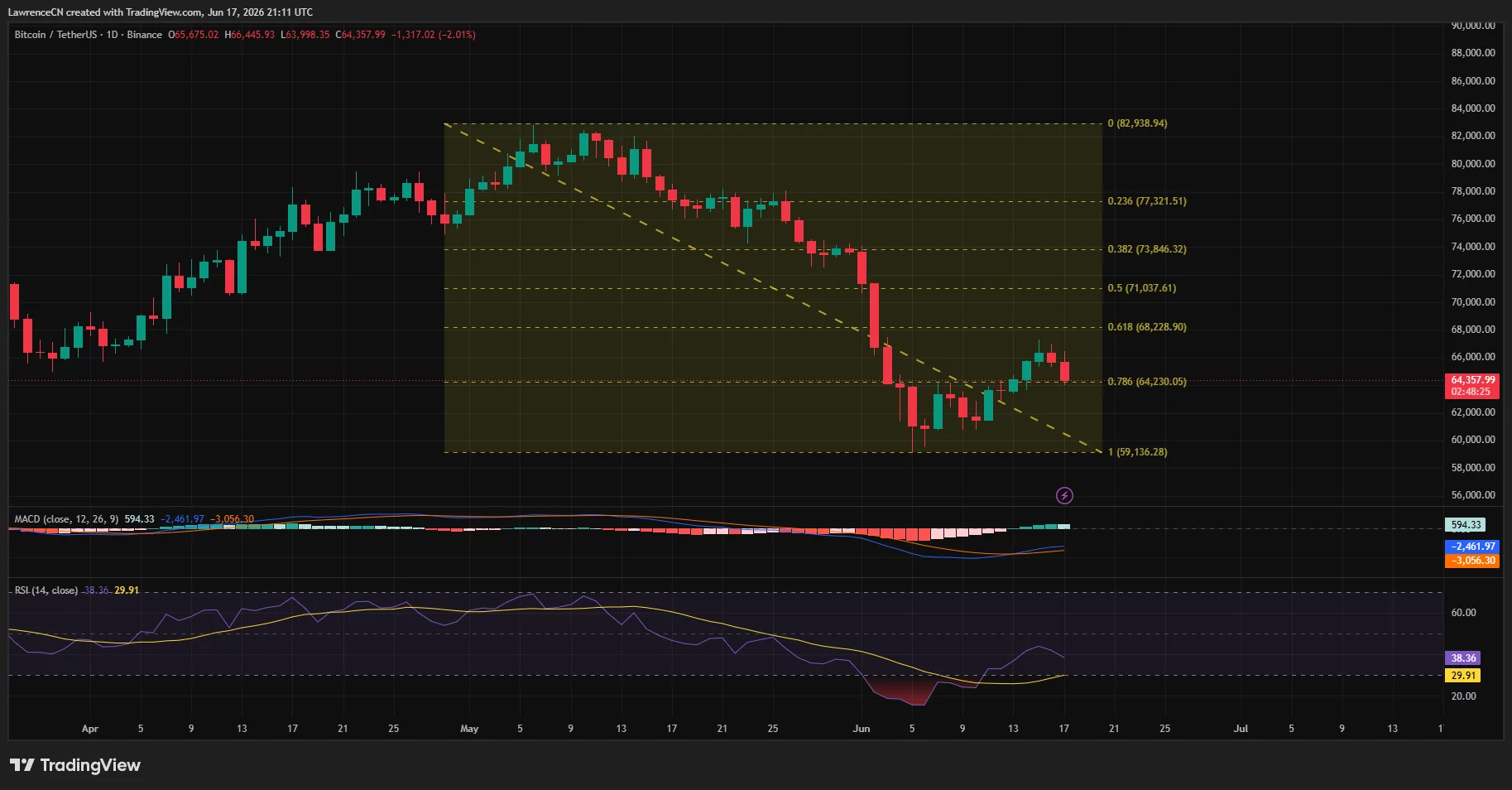
The larger 61.8% retracement level sits much higher near $68,229, reinforcing the importance of the $68,000–$69,000 zone as a major resistance area should buyers regain control.
Momentum indicators remain mixed. The daily MACD has begun recovering from deeply negative territory, but the histogram remains below levels typically associated with trend reversals. Meanwhile, the daily RSI sits below 40, showing that bearish momentum still dominates despite last week’s rebound from sub-$60,000 levels.
On the four-hour chart, Bitcoin has retreated back to test an ascending trendline that has supported price since the June 5 low. The asset also remains below the Supertrend resistance level near $67,113, a threshold that has repeatedly rejected recovery attempts throughout June. BTC price currently trades just above Supertrend support around $64,500, placing the market at a technically important inflection point.
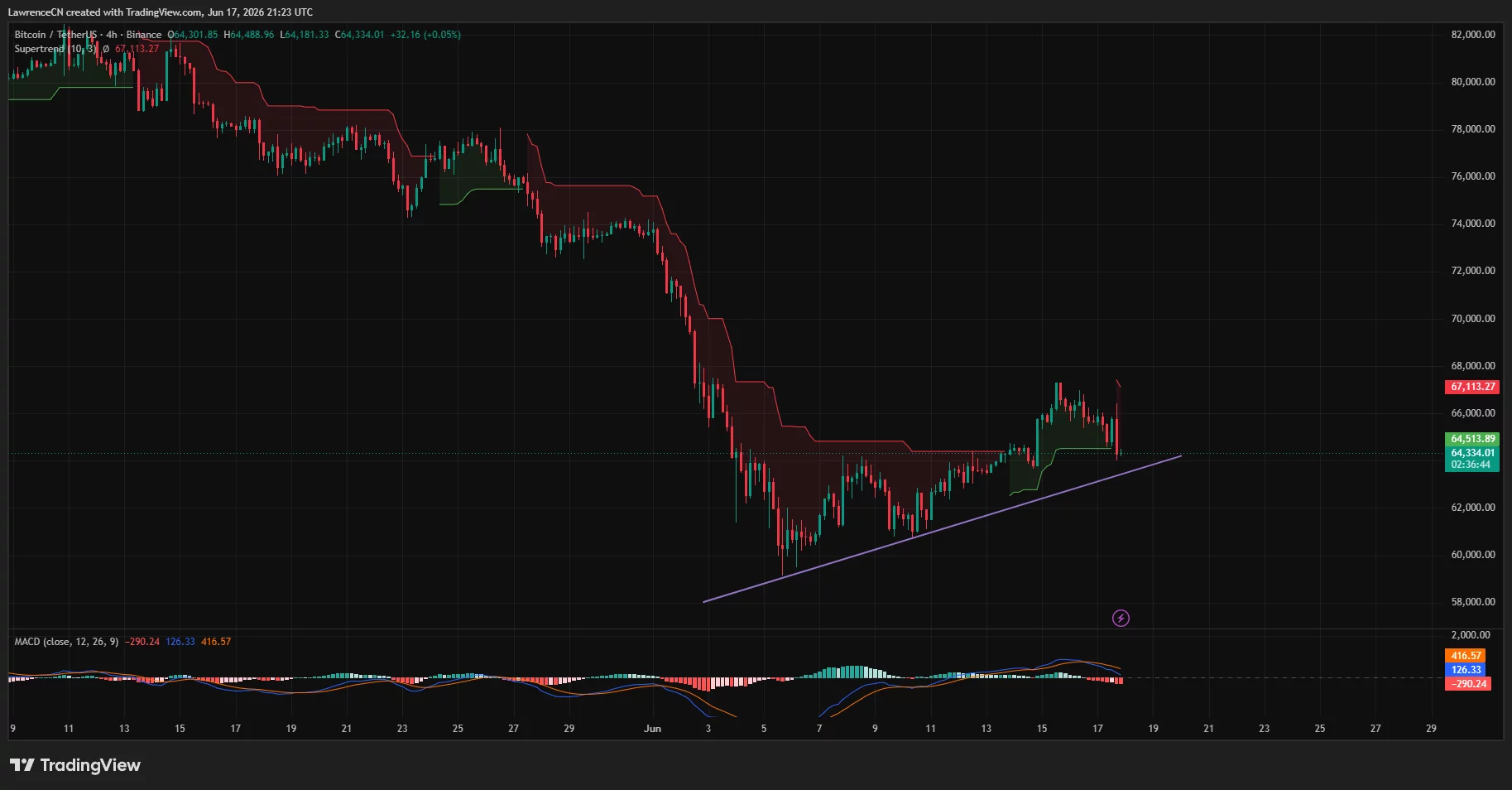
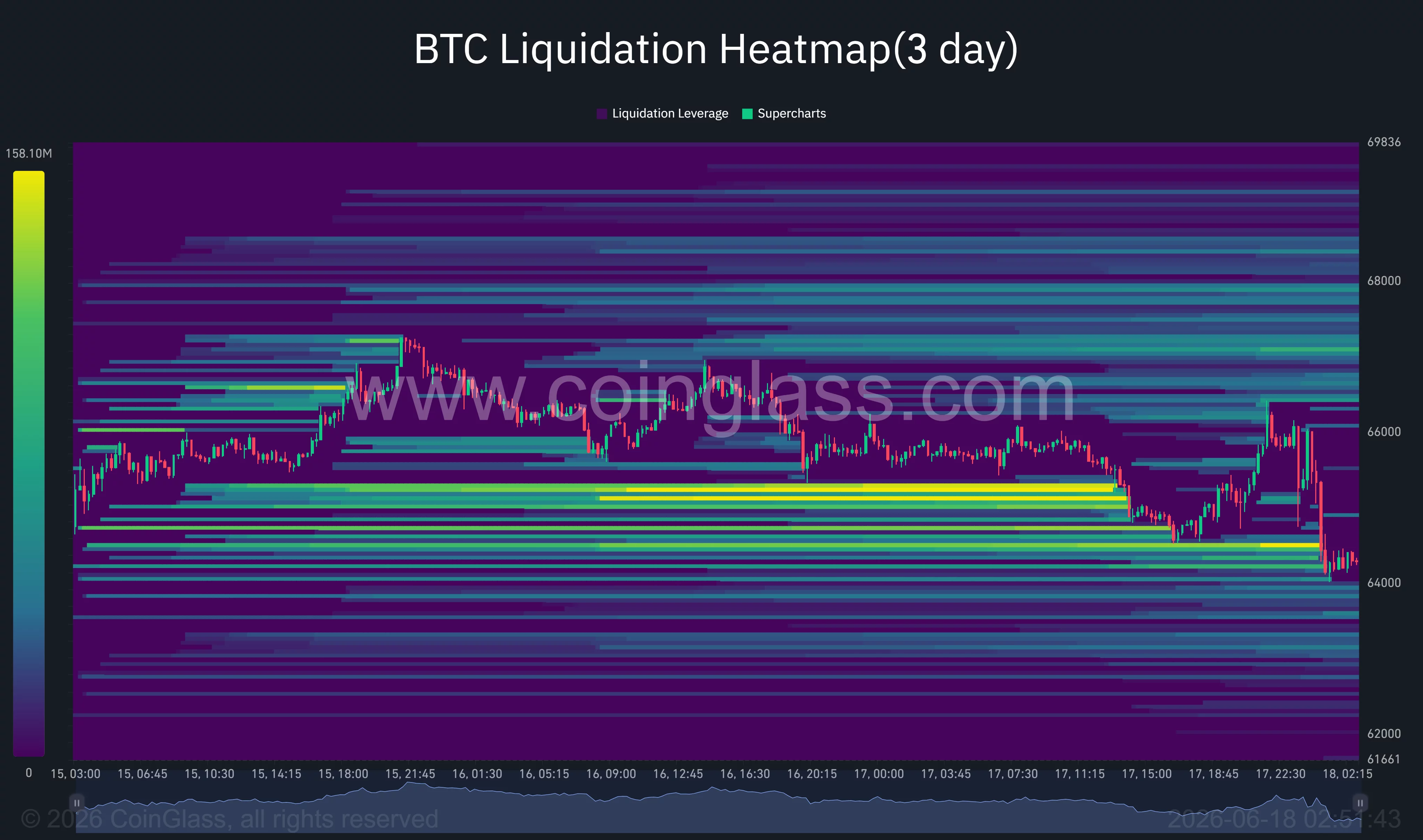
Derivatives positioning adds another layer of risk. CoinGlass liquidation heatmaps show one of the largest nearby liquidity clusters concentrated between $64,500 and $65,000, where heavily leveraged long positions accumulated during the latest rebound. Bitcoin’s drop through that area triggered a cascade of liquidations and exposed additional liquidity pockets near $64,000.
According to analyst Ardi, the current rally bears similarities to the move that preceded Bitcoin’s previous decline from $83,000.
“If we don’t see spot volume play catch up, there’s very little doubt in my mind we’ll eventually see a similar outcome.”
Ardi noted that perpetual futures activity has continued to rise while spot demand remains near cycle lows, suggesting leverage rather than fresh capital has driven much of the recent recovery.
Loss of $64K support could expose June lows
Several traders now view the $64,000 region as the market’s most important short-term support level. Commenting on the latest breakdown, analyst Wealthmanager argued that a sustained move below that zone could reopen the path toward $60,000.
Liquidation data supports that view. Below current prices, large leverage concentrations remain visible between $60,000 and $61,000, creating a potential magnet if selling pressure accelerates. At the same time, Bitcoin’s failure to reclaim the Supertrend resistance and its position beneath major moving-average resistance clusters leaves bulls with limited room for error.
A recovery above $66,000 would likely force another round of short liquidations and bring the $68,000–$69,000 resistance region back into focus. Until then, traders remain caught between deteriorating macro conditions, persistent ETF outflows, and a derivatives market still carrying elevated leverage.
Disclosure: This article does not represent investment advice. The content and materials featured on this page are for educational purposes only.
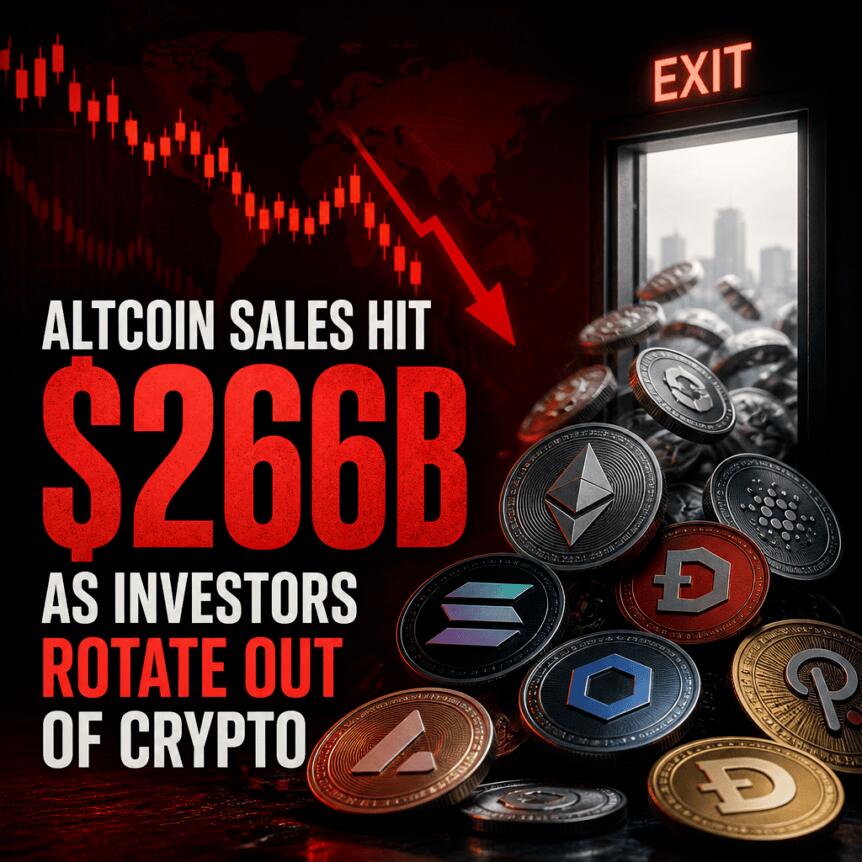
Altcoin spot demand has been under sustained pressure, but derivatives activity suggests traders are still heavily engaged with non-Bitcoin assets. On June 16, altcoins (excluding Ether) recorded $266 billion in net selling volume on centralized exchanges—the deepest reading since CryptoQuant began tracking spot demand in 2020—according to figures cited by analyst IT Tech on CryptoQuant.
At the same time, altcoins are taking a leading share of derivatives attention. CryptoQuant data referenced in the report shows altcoins accounted for 51% of daily futures trading volume on Binance on June 16, versus 28.85% for Bitcoin and 20.20% for Ether—an imbalance that points to capital rotating within crypto markets and into other exchange-linked products rather than consistently flowing into altcoin spot.
Key takeaways
- Altcoins excluding Ether saw one-year cumulative net outflows of $266 billion on centralized exchanges on June 16, the lowest since CryptoQuant’s 2020 tracking began.
- Despite those spot outflows, altcoins represented 51% of Binance futures trading volume on June 16, leading both Bitcoin and Ether.
- The divergence implies active trading and potential recycling of liquidity rather than fresh spot accumulation.
- Exchange stablecoin balances appear broadly steady since December 2024, suggesting liquidity remains available even as allocation becomes more selective.
- CryptoQuant data cited in the report points to rapid growth in exchange-linked “traditional asset” derivatives, including metals and pre-IPO perpetual products.
Spot selling hits a record low while futures stay crowded
The clearest tension in the data is between spot flows and market participation. IT Tech, quoting CryptoQuant analytics, said the one-year cumulative buy-sell difference for altcoins (excluding Bitcoin and Ether) fell to -$266 billion on June 16. The metric’s significance lies in what it represents: aggregate spot demand strength versus selling pressure over an extended period.
Such a persistent negative balance typically indicates that, at least on net, buyers have not been able to absorb the supply leaving exchanges. In this case, the report frames the shift as selling pressure outweighing buying demand “for an extended period,” pushing the cumulative figure to a new low.
But the story changes when looking at trading activity. CryptoQuant data cited alongside the spot metric shows that altcoins are dominating daily futures volume on Binance. On June 16, altcoins made up 51% of trading volume, while Bitcoin and Ether lagged with 28.85% and 20.20% respectively.
CryptoQuant’s referenced coverage also notes that altcoins have led exchange trading volumes for most of 2025, except for a short interval in February when Bitcoin temporarily overtook the sector. For investors, this is an important nuance: negative spot demand and heavy futures participation can coexist, often because derivatives positions do not require the same net spot purchases as long-only spot strategies.
What the divergence may mean for liquidity recycling
The report’s interpretation is that the combination of low or deeply negative spot demand and high futures turnover suggests capital rotation within altcoin markets—potentially involving repeated entering and exiting of positions—rather than a sustained inflow of spot capital.
In practical terms, when net selling pressure rises, traders may still keep deploying into altcoin exposure via futures, perps, or other leveraged instruments. That can sustain high derivatives volume even when exchange spot balances reflect ongoing selling. Meanwhile, fresh buying—if it exists—may be getting directed elsewhere or arriving in smaller, less consistent bursts.
This matters for market participants monitoring “demand” signals. For example, a decline in spot buy-sell balances might not immediately translate into reduced trading activity, especially if leverage and hedging strategies continue to concentrate volume in altcoins. Traders watching for a directional shift may therefore want to track whether futures dominance changes at the same time as spot outflows improve—or if futures remain strong while spot selling persists.
The report also flags a broader pattern: attention and liquidity may be spreading beyond altcoin spot entirely, moving toward other exchange products that can absorb stablecoin and trading capital.
Stablecoin balances look resilient, while deployment gets more selective
Another pillar of the report concerns exchange-held stablecoins. Analyst MorenoDV indicated that exchange stablecoin balances have changed little since December 2024. Using CryptoQuant’s “exchange supply ratio” for ERC-20 stablecoins, the report states that the figure has generally fluctuated between 0.40 and 0.46—meaning roughly 40% to 46% of circulating ERC-20 stablecoins have remained on exchanges for more than a year.
In other words, the liquidity needed to trade has not disappeared. Instead, the allocation of that liquidity appears to be shifting. The report contrasts this stability with price volatility: it says Bitcoin experienced swings exceeding 50% during the same period, trading between $60,000 and $120,000. Meanwhile, Binance’s share of total stablecoin supply has been described as sitting in the 25% to 30% range, accounting for more than half of exchange-held reserves.
For investors, the key takeaway is that “available liquidity” and “where it gets deployed” are becoming two separate questions. Stablecoin balances may remain broadly steady, but traders and capital providers may be deploying that liquidity into a wider set of instruments rather than keeping the money concentrated in spot.
Traditional-asset derivatives and pre-IPO contracts gain traction
The report points to a possible explanation for that shift: exchange users are increasingly spreading liquidity across assets that resemble traditional-market instruments. CryptoQuant data cited in the piece highlighted the expansion of metals futures and other non-crypto exposures.
According to CryptoQuant, metals futures volume peaked at nearly $500 billion in March 2026 as gold and silver reached record highs. The report also notes that the trading activity in “pre-IPO perpetual” products expanded rapidly—from about $2 million in March to $715 million in May and $2 billion in June.
On Binance specifically, the report says the exchange processed $10.3 billion in pre-IPO perpetual volume in June, roughly 20 times higher than the entire month of May, while maintaining around 83% control of that segment. It links this acceleration to growth across multiple asset categories—metals, oil, equities, and pre-IPO contracts—suggesting that exchange venues are pulling liquidity into derivatives that do not rely solely on crypto-native token spot demand.
The inclusion of these product categories helps contextualize why altcoin futures might stay active even as altcoin spot selling worsens. If stablecoin liquidity is being reallocated into broader derivative suites, altcoin spot buyers may face stronger competition for capital—while traders still retain access to altcoin exposure through leveraged instruments.
For market participants, the main uncertainty is whether the current pattern is temporary rotation or a longer structural rebalancing. Readers should watch next for signs of stabilization in altcoin spot buy-sell balances and whether altcoin dominance in futures changes as liquidity continues to migrate toward metals, oil, equities, and pre-IPO perpetual markets—areas where the report indicates Binance retains the largest concentration of deployable stablecoin capital.
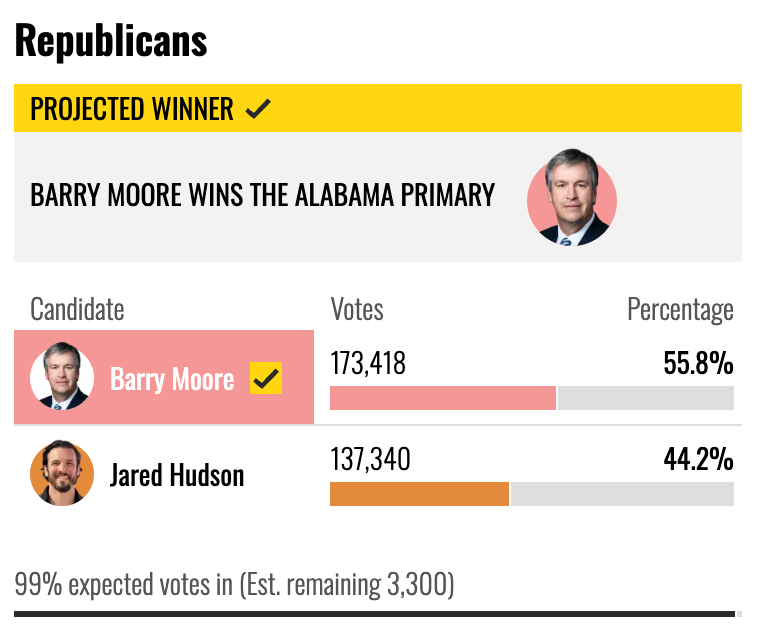
More than $12 million in crypto-aligned political action committee (PAC) media buys helped propel Barry Moore to victory in Tuesday’s Alabama Republican US Senate runoff over Barry Moore.
The runoff was necessary after neither candidate was able to secure a majority of the vote on May 19, Moore will be the Republican candidate for a US Senate seat in Alabama, facing off against Democrat Everett Wess. Moore won with 55.8% of the vote to Hudson’s 44.2%, giving him an opportunity to replace outgoing Republican Senator Tommy Tuberville.
Filings with the Federal Election Commission (FEC) showed that the Defend American Jobs PAC, a committee affiliated with the cryptocurrency company-backed Fairshake, spent more than $12 million on media and ads to back Moore’s candidacy in the May 19 primary and Tuesday’s runoff. The Coinbase-affiliated advocacy organization Stand With Crypto rated Moore as “strongly supports crypto,” based on public statements and his voting record while representing Alabama’s 1st Congressional district.
“Our biggest spend of the cycle yielded yet another pro-innovation champion in the Senate, and with nearly $150 million cash on hand we are ready to continue driving the construction of the largest pro-crypto caucus in history,” said Fairshake spokesperson Geoff Vetter.
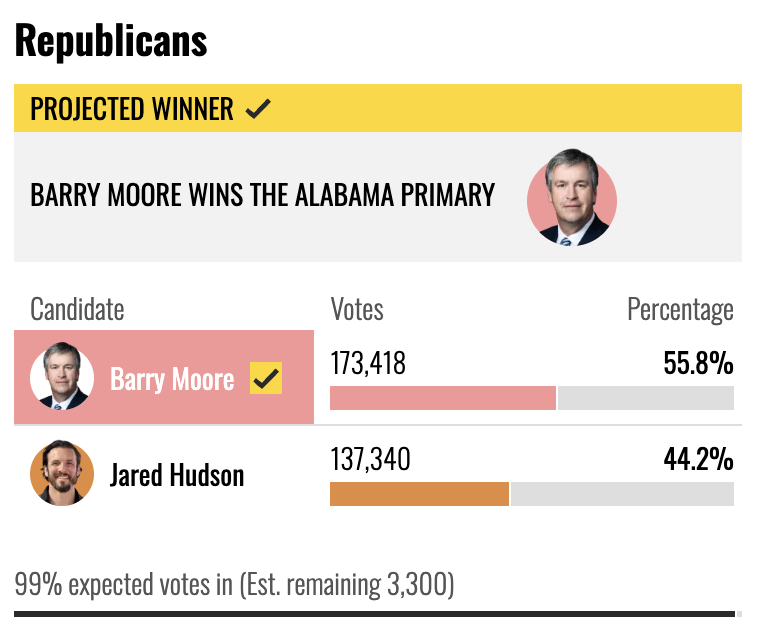
Source: NBC News
Related: US lawmakers warn against presidential pardon for Sam Bankman-Fried
Based on Vetter’s statement, Fairshake and its affiliates may have spent more than $40 million across several US states in an attempt to support what it considers “pro-crypto” candidates for the next session of Congress. The PAC reported holding a $193 million war chest as of January.
More primaries set for next week before November general election
The Alabama runoff was the latest vote that’s seen industry PACs spending millions of dollars on media for candidates facing primaries in several US states, including South Carolina, Texas, California, South Dakota and New Jersey. Fairshake affiliate Protect Progress also reported spending about $5.2 million and $587,000 in media buys for House seats, respectively, for Maryland Democrat Adrian Boafo and fellow party member Ritchie Torres in New York, scheduled to hold primaries on June 23.
Magazine: The end of anon? AI could unmask crypto’s hidden identities
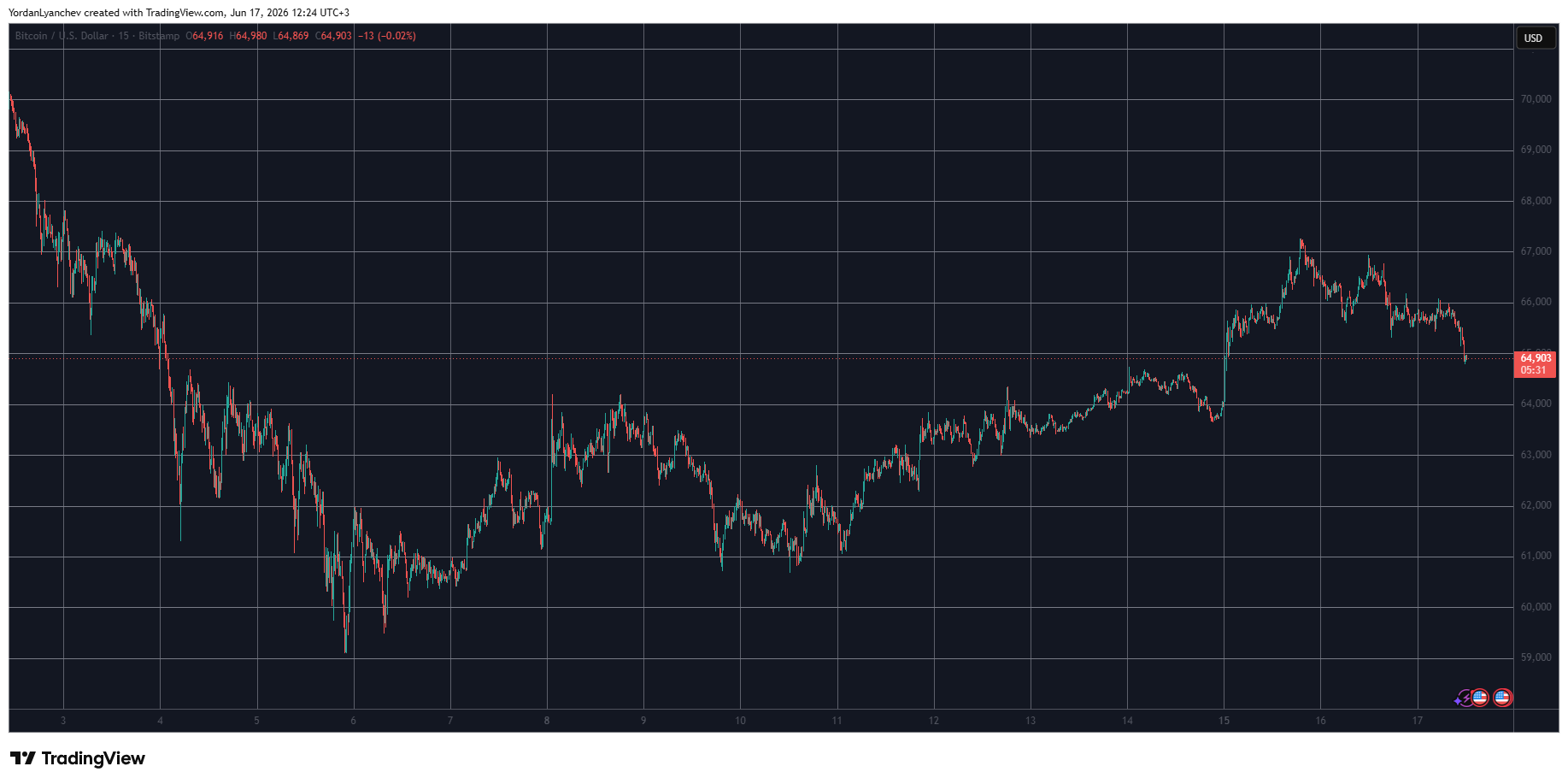
Bitcoin’s price recovery run was halted at $67,000 earlier this week, and the asset has shown an inability to sustain it, currently sitting below $65,000.
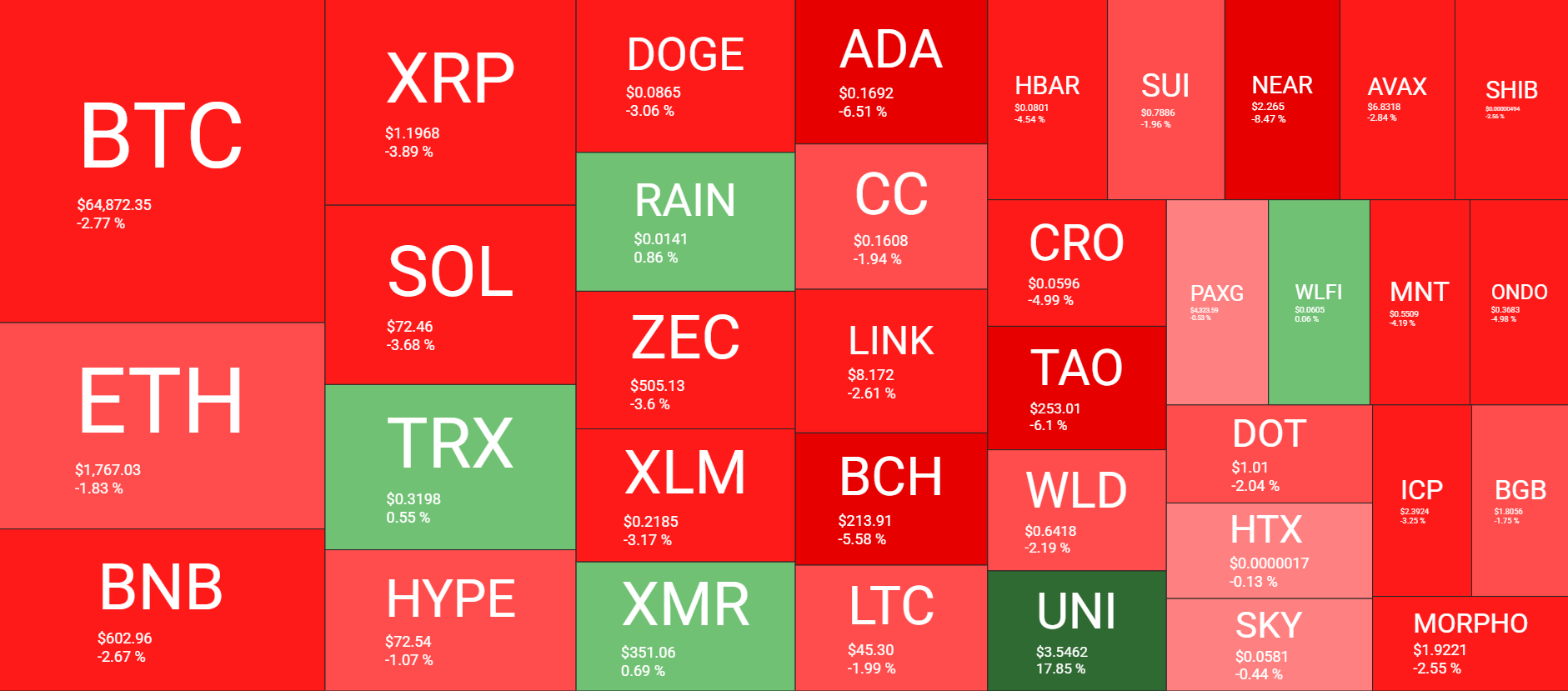
Most larger-cap alts have followed suit, with BNB dipping toward $600, XRP slipping to $1.20, and ADA plunging by over 6%.
BTC Slips Beneath $65K
Bitcoin reacted well to the early June crash that drove it below $60,000 for the first time since late November 2024. The bulls intercepted the move and didn’t allow another breakdown beneath $59,000. Just the opposite; the asset started to recover ground somewhat rapidly, going to $64,000 at the start of the following business week.
The cryptocurrency spent the next several days trading sideways between $61,000 and $64,000 before the landscape on the US-Iran war front started to improve over the weekend. The POTUS promised a deal to be announced on Sunday, which faced some doubt from critics that was exacerbated once Israel carried out new attacks against Lebanon.
After condemning Israel’s actions, Trump indeed announced on Sunday evening that the US and Iran had reached an agreement, which is to be signed by the end of the current week. BTC reacted with an immediate price pump that drove it to $66,000 on Monday morning and $67,000 later that day. However, its progress was rejected there, and the asset has dropped by over two grand, currently struggling below $65,000.
Its market cap is down to $1.3 trillion on CG, while its dominance over the alts has taken a beating and has slipped to 56.2%.
Alts Retreat, New SIREN?
Ethereum was stopped at $1,850 earlier this week, and now sits at $1,770 after another 1.8% daily decline. BNB is close to breaking below $600, and XRP has dropped to $1.20. SOL is below $73, DOGE has dropped by almost 3%, while ZEC is down by nearly 4%.
ADA has plunged by 6%, BCH is down by 5%, and so are TAO and CRO. NEAR has plummeted by over 8% to under $2.3.
BEAT, a recent high flyer, has tanked by over 40% daily, which has sparked some comparisons to the recent SIREN crash, which wiped out almost 100% of its value after a whale got out.
The total crypto market cap has shed around $40 billion daily and is below $2.320 trillion on CG now.
The post BEAT Plunges 43%, Drawing Comparisons to SIREN as BTC Falls Below $65K: Market Watch appeared first on CryptoPotato.

The former CEO of BitMEX faced significant backlash over the past few weeks for dumping tokens he had previously praised.
However, he has resumed accumulating Ethereum, according to data from Lookonchain.
Hayes Buys ETH
Data from the analytics resource reveals that a wallet linked to the Maelstrom Fund’s exec has acquired 1,400 ETH, worth around $2.5 million, earlier today.
The wallet linked to Arthur Hayes(@CryptoHayes) bought another 1,400 $ETH($2.51M) 4 hours ago.https://t.co/YIuiTiAoWm pic.twitter.com/eFgdSpTt0c
— Lookonchain (@lookonchain) June 17, 2026
Given his recent actions, though, this purchase drew some controversial comments in the comments section below the post. Many users lashed out against him, claiming he is “the biggest manipulator” who will sell the next day. Similar online backlash skyrocketed after some of his more recent sales.
For instance, he disposed of his entire ZEC position after developers found a vulnerability in Zcash’s protocol that had already been patched. In addition, he had made major price predictions for assets like NEAR, HYPE, and WLD, but sold off his holdings amid the recent market volatility.
After some of those sales, the prices of the underlying assets crashed. This is particularly true for ZEC, which dumped by over 50% in less than 24 hours (the day the sale was disclosed). Nevertheless, it has recovered most of its losses since then, jumping from under $300 to over $500 now.
Others Buy ETH
Lookonchain further updated that the Ethereum buying base had increased over the past few days. A whale going under the ticker geministar.eth accumulated another $20 million worth of the altcoin today. Thus, their total Ethereum purchase for the last two days rose to 32,278 ETH (valued at $57 million).
The Tom Lee-led Bitmine keeps buying as well. The company publishes updates every Monday about its Ethereum positions, including a massive $135 million purchase announced on June 15. Most recent data from Lookonchain noted that Bitmine has increased its position by another 20,000 ETH purchased from FalconX for almost $36 million. The company aims to own 5% of Ethereum’s total supply.
Tom Lee(@fundstrat)’s #Bitmine bought another 20,000 $ETH($35.85M) from #FalconX 5 hours ago.https://t.co/eeMZJkEUx4 pic.twitter.com/7APpHzUbDZ
— Lookonchain (@lookonchain) June 17, 2026
The post Arthur Hayes Adds More ETH After Facing Backlash Over HYPE, ZEC, and WLD appeared first on CryptoPotato.
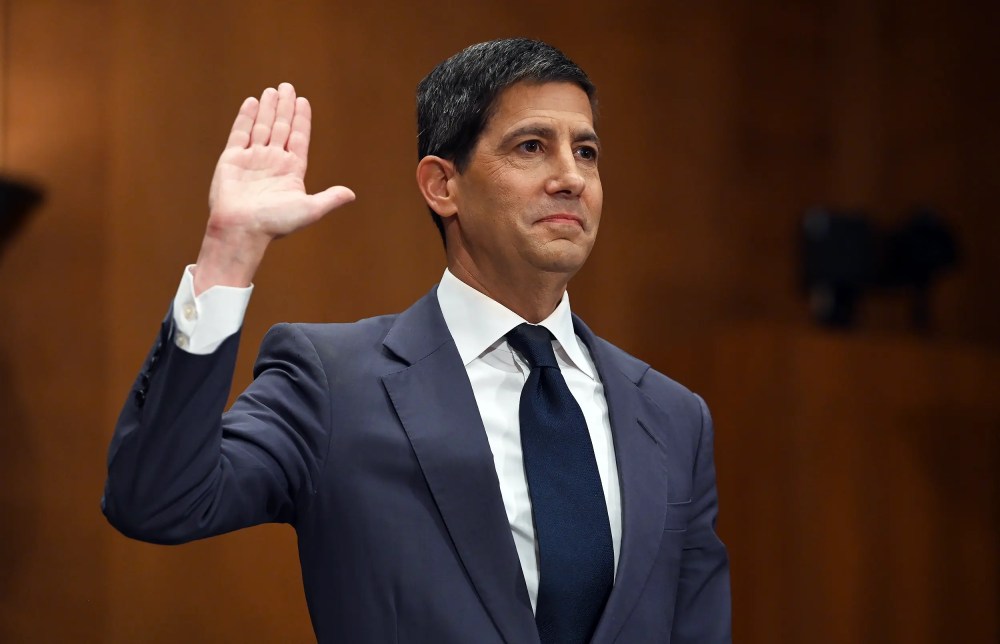
The Federal Open Market Committee (FOMC) meets on Wednesday, June 17, for what is new Chair Kevin Warsh’s first policy decision, and Bitget CEO Gracy Chen thinks it is one of the most important macro events for crypto.
The setup, as she puts it, is genuinely difficult, with inflation sticky and the White House looking for easier liquidity, all while the Fed appears more internally divided than it has in years.
What Warsh Does Next Matters
Going by online comments from market watchers, nobody is expecting a rate move today, and a hold is almost certainly priced in, with some of them, like analyst HaxKai, pointing out that watching the rate decision itself “is watching the wrong thing.”
What matters, it seems, is the dot plot, and more than anything, how Warsh conducts his first press conference as chair. According to Chen, crypto has become a truly cross-asset in the way that older frameworks don’t capture.
“The old idea that crypto only trades on crypto-native narratives is outdated,” she wrote on X. “Today, BTC, US equities, gold, FX and commodities are all reacting to the same macro question: Where is liquidity going next?”
So, if Warsh comes across as hawkish, she expects the dollar to hold strong and pressure to build on gold and risk assets. But, in her opinion, if he sounds dovish, then there could be a possible relief rally across equities and crypto. However, she did note that the market would immediately question whether easing is justified when inflation is still quite high.
That framing has some data behind it, with a June 16 analysis by Charlie Bilello showing that BTC and gold are the only two major asset classes in the red for 2026, the cryptocurrency being down 27% year-to-date, while the S&P 500 is up 9% and small-cap stocks have gained 19%.
Mixed Feelings Ahead of FOMC
A past analysis by XWIN Research on Warsh suggested that he would focus more on balance sheet reduction than on rate cuts. It also suggested that shrinking liquidity through quantitative tightening could put pressure on risk assets even if short-term rates stayed the same.
But investor Ran Neuner posted that he is “mega bullish” going into the meeting. His reasoning is that any signal that the Fed is not leaning toward a hike path could support risk assets, especially if inflation expectations ease alongside lower oil prices.
However, HaxKai was less convinced. They noted that Bitcoin has dropped after most FOMC meetings and pointed to the recent rally from $59,000, which was stopped short at $67,000 earlier this week, as leaving plenty of room to fall. In this regard, they urged traders to refrain from making moves at the early stage right after the announcement.
At the time of this writing, the Bitcoin price was hovering near the $65,000 mark, about 2% down from yesterday’s price while registering almost a 6% gain over the previous seven days.
The post Crypto Market Braces for Kevin Warsh’s First Fed Decision appeared first on CryptoPotato.

[PRESS RELEASE – New York, USA, June 17th, 2026]
Nexchain has opened a limited-time $0.05 bonus entry window ahead of a major project update scheduled for next week. The AI-powered Layer 1 blockchain is preparing to share upcoming milestones and launch progress, while the current bonus pricing remains available for a short period before the project moves into its next phase.
The Six-Day Hold Creates A Clear Entry Point
The current token presale stage gives Nexchain a defined price structure before its next phase. The $0.05 entry remains available for six days, freezing Stage 33 lists, which prices 1 NEX at $0.132. This creates a clear difference between the limited entry level and the current stage price.
The stage has also moved close to its USDT target, with $17,135,244 already raised. That figure places the round near its listed $17,475,000 goal. The $0.05 token presale level matters because staged presales usually change access terms as rounds progress.
Nexchain has linked its stages to protocol development and wider network availability. The next project update is expected next week, adding timing to the current pricing structure. This keeps the focus on stage progress, product work, and upcoming access changes.
A Quiet Build Now Moves Toward Public Update
Nexchain has spent recent months building its ecosystem before returning attention to its presale structure. The next update is expected to cover development progress, product preparation, and launch readiness. This gives the token presale a stronger angle than price access alone. It also places the $0.05 entry beside the project’s broader rebuild story.
The current stage therefore carries both timing and product context. The network presents itself as an AI-built Layer 1 blockchain with decentralized security and automation. Its design combines Proof-of-Stake with AI-driven algorithms through a hybrid consensus model.
Nexchain lists 400,000 transactions per second through AI optimization and parallel processing. It also lists transaction fees at $0.001 for transfers and smart contract activity. These details give the token presale a technical base before the next phase begins.
How NEX Powers The Nexchain Ecosystem
The NEX token carries planned utility across transaction fees, staking, governance, and AI service payments. The token presale therefore connects current entry access with listed network functions. NEX can support smart contract interactions, decentralized app payments, validator incentives, and AI model services. Additionally, Nexchain AI lists use cases across finance, healthcare, supply chains, IoT, content, AI services, and administration. These use cases show how NEX fits into the planned ecosystem.
The tokenomics structure lists 2.15 billion NEX as the total initial supply. Public allocation stands at 20%, treasury at 17%, and ecosystem support at 15%. Team allocation stands at 10%, liquidity at 8%, private allocation at 7%, and rewards at 7%. Burn allocation stands at 6%, while seed and marketing each hold 5%.
The token presale also sits beside an initial market cap of $157,057,500 and a fully diluted market cap of $430,000,000. The current token presale stage now centers on three facts: the $0.05 entry, the $0.132 Stage 33 price, and the six-day availability period. Nexchain also lists a planned listing price of $0.30 and an expected ROI of 227% under its stage data.
The coming update will add the next project detail before the phase changes. Market participants can review the token presale terms, compare the current price levels, and assess the next update before the $0.05 entry period ends.
About Nexchain
Nexchain is an AI-powered Layer 1 blockchain built to combine artificial intelligence with scalable blockchain infrastructure. The project focuses on high transaction throughput, AI-driven network optimization, EVM compatibility, and tools designed to support next-generation decentralized applications. With testnet development progressing and audited smart contracts already completed, the team is now entering a more public phase of its launch preparation.
For More Details, users can visit:
Website: https://nexchain.ai/
Telegram: t.me/nexchain_ai/3
White Paper: https://nexchain.ai/documents/Whitepaper-Nexchain.pdf
The post Nexchain Opens Limited-Time $0.05 Bonus Window Before Major Project Update appeared first on CryptoPotato.

United VET, uni system talks ongoing
First Block, Onpharma Company, and Crito Capital Announce First Solana Sto for U.S. Medical Device Business

‘Doctor Who’ Is Reinventing Itself in Ways Fans Haven’t Seen in 20 Years


-

 Business3 days ago
No Jackpot Winner as $257 Million Prize Rolls Over to $269 Million Monday Draw
-

 Fashion5 days ago
Weekend Open Thread: Tuckernuck – Corporette.com
-

 Crypto World6 days ago
Oppenheimer backs SpaceX as $70 billion retail frenzy builds
-

 Crypto World6 days ago
Markets Rally as SpaceX IPO Looms Amid Iran Tensions and Inflation Surge
-
Crypto World3 days ago
Zimbabwe Requires Crypto Businesses to Register Annually Under New FIU Regulations
-

 Tech5 days ago
NanoClaw integrates JFrog registries to secure AI agent downloads
-

 Crypto World5 days ago
Bitget enters Argentina’s regulated crypto market through PSAV registration
-

 Tech5 days ago
This Week In Security: Microsoft On Microsoft, Register Your Domains, Linux On ARM, And FreeBSD Joins The File Cache Club
-

 NewsBeat6 days ago
El Nino has formed in the Pacific and could set records, forecasters say
-
 Tech6 days ago
Dutton Ranch star claims they ‘didn’t see any disruption’ on set following Chad Feehan’s exit from Yellowstone spinoff fueled by Taylor Sheridan clash rumors
-

 Politics7 days ago
Politics Home | Healey Resignation Is “Colossal Failure Of Government”, Says Former Labour Defence Secretary
-
 Entertainment6 days ago
Donnie Wahlberg & More Heat Up Las Vegas at Circa’s Barry’s Downtown Prime
-
 Tech6 days ago
Opendoor Ends India Operations, Fueling a Bigger Conversation About AI and Outsourcing
-

 Politics6 days ago
Belfast burns, while Met chief points finger at Iran and Russia
-

 Sports7 days ago
First Time Since 1971: Australia Register Historic Low In ODI Cricket
-

 NewsBeat5 days ago
FBI searches office of Ohio voter registration group
-

 Business6 days ago
AT&T: Verizon's 27% Outperformance Sets Up A Solid Entry Point
-

 Politics6 days ago
Modi thanks Trump for wishes as US attacks Indian seafarers
-
 Tech6 days ago
Anthropic is spending $150M to embed 1,000 AI fellows inside nonprofits. No degree required.
-
 Entertainment6 days ago
‘The Pitt’s Fan-Favorite Doctor Confirms Noah Wyle Gave His Blessing to Return [Exclusive]
You must be logged in to post a comment Login